The Institution of Structural Engineers
11 Upper Belgrave Street, London SW1X 8BH, United Kingdom
T: 	 +44 (0) 20 7235 4535
F: 	 +44 (0) 20 7235 4294
E: 	 mail@istructe.org.uk
W: 	 www.istructe.org.uk
Standard Method of Detailing
Structural Concrete
A manual for best practice
Third edition
This document is intended to become a standard reference that can be
used in conjunction with the normal design codes and manuals for work in
structural design offices. The objective has been to provide 'good practice'
guidance within a working document on structural concrete that can be
used to interpret the designer’s instructions in the form of drawings and
schedules for communication to the site.
This edition considers the effects of Eurocode 2 on detailing principles and
materials and attempts to provide guidance consistent with the Eurocodes.
In addition, recent changes in practices and procurement of detailing
services have been considered, such as the development of increased
off-site fabrication and detailing being undertaken later in the construction
sequence through initiatives such as contractor detailing.
The information and advice is based on Eurocodes and UK practice, which
is associated with UK materials and labour costs. The principles and details
are relevant for use in most parts of the world with only minor adjustment.
As with the original Standard method, the Steering Group was formed
from members of both the Institution of Structural Engineers and the
Concrete Society. Views have been taken from a wide consultation
on the drafts prepared. All have been considered in finalising the
document. Consequently the document reflects the current concerns and
developments in the field of detailing.
The Steering Group is grateful for the funding provided by the Department
of Trade & Industry in support of this project.
IStructE/Concrete
Society
Third
edition
Standard Method of Detailing
Structural Concrete
A manual for best practice
Third edition
June 2006
Standard
Method
of
Detailing
Structural
Concrete
IStructE/Concrete Society Standard Method of Detailing Structural Concrete 
June 2006
Standard Method of
Detailing Structural Concrete
A manual for best practice
Third edition
IStructE/Concrete Society Standard Method of Detailing Structural Concrete

Acknowledgements
The preparation of this report was in part funded by the Department of Trade and Industry under their
‘Partners in Innovation’ programme. The Institution of Structural Engineers and the Concrete Society greatly
appreciate their support.
IStructE/Concrete Society Standard Method of Detailing Structural Concrete iii

CONTRIBUTORS
Constitution of Steering Group
J K Kenward BEng(Tech) CEng FIStructE MICE MIHT (Hyder Consulting Ltd) Chairman
R Bailey* CEng MIStructE (Milbank Floors)
R Bloomer** BSc CEng MICE (BRC)
B Bowsher (UK CARES)
P S Chana BSc(Eng) PhD CEng FIStructE MICE (British Cement Association)
S M Doran BSc(Eng) AKC PhD CEng MICE ACIS (Institution of Structural Engineers)
C H Goodchild BSc CEng MIStructE MCIOB (The Concrete Centre)
J Kelly (G.D.C. Partnership)
D Keogh (Laing O’Rourke)
S Mahmood BSc CEng MIStructE (Sir Robert McAlpine Ltd)
P Matthew*** (Matthew Consultants)
R P Wolstenholme**** BSc CEng MICE (Atkins)
Corresponding members
R Chu CEng FIStructE FICE FHKIE (Meinhardt (CS) Ltd Hong Kong)
R Gordon (Mace)
R Lancaster BSc(Eng) CEng FICE FCIArb FACI (Consultant)
G Nice (BRC Special Products)
D Pike BSc(Eng) PhD CEng MICE (Building Design Partnership)
C B Shaw CEng MIStructE FICE MCMI FIIExE (Consultant - Chairman BS 7973)
Consultants to the Steering Group
R Whittle MA(Cantab) CEng MICE (Arup Research and Development)
A E K Jones BEng(Hons) PhD MICE (Arup Research and Development)
Secretary to the Steering Group
J L Clarke MA PhD CEng MIStructE MICE (The Concrete Society)
Editor
B H G Cresswell Riol BEng (The Institution of Structural Engineers)
*	 representing the British Precast Concrete Federation
**	 representing the Steel Reinforcement Association
***	 representing CONSTRUCT
****	 representing the DTI
Published by The Institution of Structural Engineers
11 Upper Belgrave Street, London SW1X 8BH, United Kingdom
ISBN 
0 901297 41 0
978 0 901297 41 9
© 2006 The Institution of Structural Engineers
The Institution of Structural Engineers and the members who served on the Task Group that produced this report have endeavoured to
ensure the accuracy of its contents. However, the guidance and recommendations given should always be reviewed by those using the
report in the light of the facts of their particular case and any specialist advice. No liability for negligence or otherwise in relation to
this report and its contents is accepted by the Institution, the members of the Task Group, its servants or agents.
No part of this publication may be reproduced, stored in a retrieval system or transmitted in any form or by any means without prior
permission of the Institution of Structural Engineers, who may be contacted at 11 Upper Belgrave Street, London, SW1X 8BH.
IStructE/Concrete Society Standard Method of Detailing Structural Concrete
CONTENTS
1 	 Introduction and scope	 1
2 	 Communication of information	 3
2.1	 General	 3
2.2	 The reinforcement process	 3
2.3	 Designer detailing	 6
2.4	 Contractor detailing 	 6
2.5	 Electronic data interchange (EDI)	 6
2.6	 Examples of typical methods of providing the required information for detailing	 7
3 	Drawings	12
3.1	 General 	 12
3.2	 Types of drawings 	 12
3.2.1	 Structural drawings 	 12
3.2.2	 Reinforcement drawings 	 12
3.2.3	 Standard details 	 12
3.2.4	 Diagrams	 13
3.2.5	 Record drawings 	 13
3.3	 Photocopying and reduction 	 13
3.4	 Abbreviations 	 13
3.5	 Dimensions of drawing sheets 	 13
3.6	 Borders 	 14
3.7	 Title and information panels 	 14
3.8	 Key 	 14
3.9	 Orientation 	 14
3.9.1	 Site plans 	 14
3.9.2	 All other drawings 	 14
3.10	 Thickness of lines	 14
3.11	 Lettering 	 14
3.12	 Spelling	 14
3.13	 Dimensions	 14
3.14	 Levels 	 15
3.14.1	 Datum 	 15
3.14.2	 Levels on plan 	 15
3.14.3	 Levels on section and elevation 	 15
3.15	 Scales	 15
3.16	 Plans 	 15
3.17	 Elevations 	 15
3.18	 Sections 	 16
3.19	 Grid lines and a recommended reference system 	 16
3.20	 Layout of slabs	 16
3.20.1	 Methods of preparing general arrangement drawings for concrete structures 	16
3.20.2	 Information shown on general arrangement drawings for concrete structures	 17
3.20.3	 Fixing in concrete 	 21
3.20.4	 Example of general arrangement drawing for concrete structures 	 22
3.21	 Layout of foundations	 23
3.22	 Layout of stairs 	 23
IStructE/Concrete Society Standard Method of Detailing Structural Concrete
vi IStructE/Concrete Society Standard Method of Detailing Structural Concrete

4 	Detailing and scheduling	 24
4.1	 Detailing techniques	 24
4.1.1	 Tabular method of detailing 	 24
4.1.2	 Template drawings/Typical details 	 25
4.1.3	 Overlay drawings	 25
4.1.4	 Computer-aided detailing and scheduling	 25
4.2	 Detailing reinforcement 	 25
4.2.1	 General	 25
4.2.2	 Intersection and layering of reinforcement 	 26
4.2.3	 Preformed cages 	 29
4.2.4	 Straight bars	 30
4.2.5	 Welded fabric 	 30
4.2.6	 Chairs	 30
4.3	 Precast concrete 	 30
4.4	 Check list for detailer	 30
4.5	 Schedules and scheduling 	 31
4.5.1	 General	 31
4.5.2	 Allowances for tolerances/deviations 	 32
4.6	 Procedure for checking reinforcement drawings and schedules	 32
4.6.1	 Stage 1: Design check 	 33
4.6.2	 Stage 2: Detailing check 	 33
4.6.3	 Stage 3: Overall check 	 33
4.6.4	 Method of checking 	 33
5 	Technical information and requirements	 34
5.1	 Reinforcement	 34
5.1.1	 General	 34
5.1.2	 Strength/ductility properties	 34
5.1.3	 Bar identification	 34
5.1.4	 Notation 	 35
5.1.5	 Sizes of reinforcing bars	 35
5.1.6	 Length and overall dimensions of reinforcing bars	 35
5.1.7	 Rebending bars	 35
5.1.8	 Large diameter bends	 36
5.1.9 	 Structural tying reinforcement to ensure robustness 	 36
5.1.10	 Fabric reinforcement 	 36
5.2	 Cover to reinforcement	 37
5.2.1	 General 	 37
5.2.2	 Cover for durability 	 38
5.2.3	 Cover for fire resistance	 38
5.2.4	 Fixing reinforcement to obtain the correct cover	 38
5.2.5	 Minimum spacing of reinforcement 	 38
5.3	 Cutting and bending tolerances	 38
5.4	 Anchorage and lap lengths	 40
5.4.1	 General	 40
5.4.2 	 Anchorage lengths	 40
5.4.3	 Laps in reinforcement	 41
5.4.4	 Additional rules for large bars 	 42
5.4.5	 Bundled bars	 43
5.4.6	 Laps in welded fabric	 44
5.5	 Mechanical couplers for bars 	 45
5.6	 Welding of reinforcement	 47
5.6.1	 General	 47
5.6.2	 Semi-structural welding	 47
5.6.3 	 Tack welding	 47
IStructE/Concrete Society Standard Method of Detailing Structural Concrete vii

6 	 Common structural elements	 48
6.1	 General	 48
6.2	 Slabs	 48
6.2.1	 Scope 	 48
6.2.2	 Design and detailing notes	 48
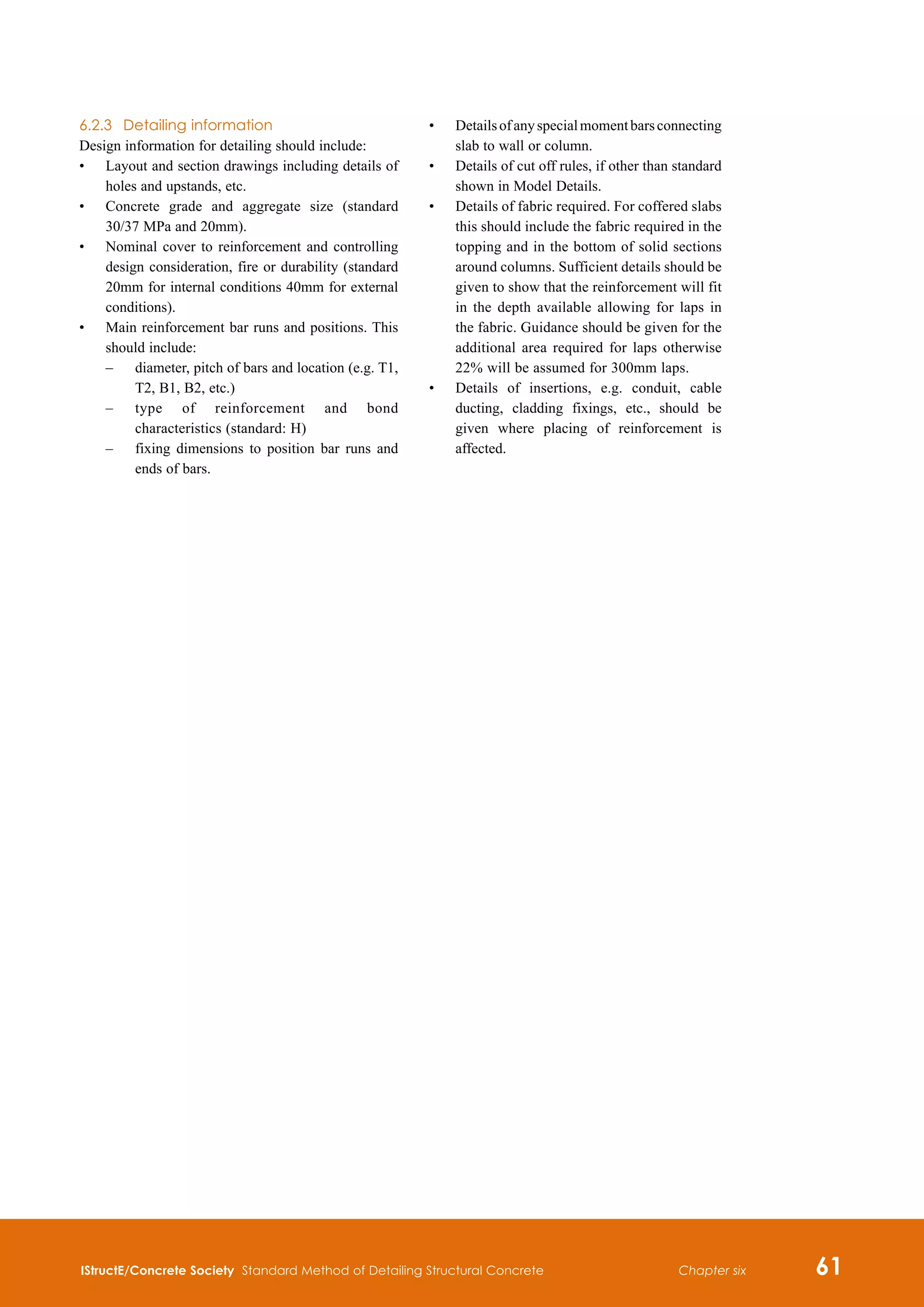
6.2.3	 Detailing information	 61
6.2.4	 Presentation of working drawings	 62
	 Model details	 66
6.3	 Beams	 74
6.3.1	 Scope 	 74
6.3.2	 Design and detailing notes	 74
6.3.3	 Detailing information	 78
6.3.4	 Presentation of working drawings	 79
	 Model details	 82
6.4	 Columns	 85
6.4.1	 Scope	 85
6.4.2	 Design and detailing notes	 85
6.4.3	 Detailing information	 88
6.4.4	 Presentation of working drawings	 89
	 Model details	 91
6.5	 Walls	 97
6.5.1	 Scope	 97
6.5.2	 Design and detailing notes	 97
6.5.3	 Detailing information	 99
6.5.4	 Presentation of working drawings	 100
	 Model details	 101
6.6	 Retaining Walls	 105
6.6.1	 Scope	 105
6.6.2	 Design and detailing notes	 105
6.6.3	 Detailing information	 106
6.6.4	 Presentation of working drawing	 107
	 Model details	 109
6.7	 Foundations	 112
6.7.1	 Scope	 112
6.7.2	 Design and detailing notes	 112
6.7.3	 Detailing information	 115
6.7.4	 Presentation of working drawings	 116
	 Model details	 118
6.8	 Staircases	 123
6.8.1	 Scope	 123
6.8.2	 Design and detailing notes	 123
6.8.3	 Detailing information	 124
6.8.4	 Presentation of working drawings	 125
	 Model details	 127
6.9	 Corbels, half joints and nibs	 129
6.9.1	 Scope	 129
6.9.2	 Design and detailing notes	 129
6.9.3	 Detailing information	 130
	 Model details	 131
viii IStructE/Concrete Society Standard Method of Detailing Structural Concrete

7	 PRESTRESSED CONCRETE	136
7.1	 General	 136
7.2	 Drawings	 136
7.3	 Components	 137
7.3.1	 Pre-tensioned units	 137
7.3.2	 Post-tensioned units	 137
7.4	 Reinforcement detailing	 144
7.4.1	 Minimum reinforcement	 144
7.4.2	 End blocks in post-tensioned elements	 144
7.4.3	 Secondary reinforcement	 148
7.4.4	 Additional reinforcement around holes	 148
7.4.5	 Reinforcement to resist the normal component of the prestress	 148
7.4.6	 Reinforcement against grouting pressure	 150
7.4.7	 Intermediate anchorages	 150
7.4.8	 Reinforcement in unstressed areas in slabs	 151
7.4.9	 Reinforcement infill strips	 151
7.4.10	 Reinforcement near stiff points	 152
7.4.11	 Movement joints	 152
7.4.12	 Pre-tensioned elements	 152
7.4.13	 Construction joints	 152
7.5	 Other effects of prestressing	 152
7.5.1	 Movements of the permanent structure	 152
7.5.2	 Variation in camber	 153
7.5.3	 Drilling and demolition	 153
7.6	 Typical details of post-tensioned floor slabs	 154
8 	Precast concrete 	160
8.1	 General	 160
8.2	 Particular durability problems	 161
9 	Water-retaining structures 	162
9.1	 General	 162
9.2	 Durability and crack control 	 162
9.2.1	 General 	 162
9.2.2	 Cover	 163
9.2.3	 Spacing of reinforcement	 163
9.3	 Other design and detailing information/requirements	 163
9.3.1	 Circular tanks	 163
9.3.2	 Opening corners	 163
9.4	 Typical details 	 163
IStructE/Concrete Society Standard Method of Detailing Structural Concrete ix

10 	References	164
Bibliography 	 165
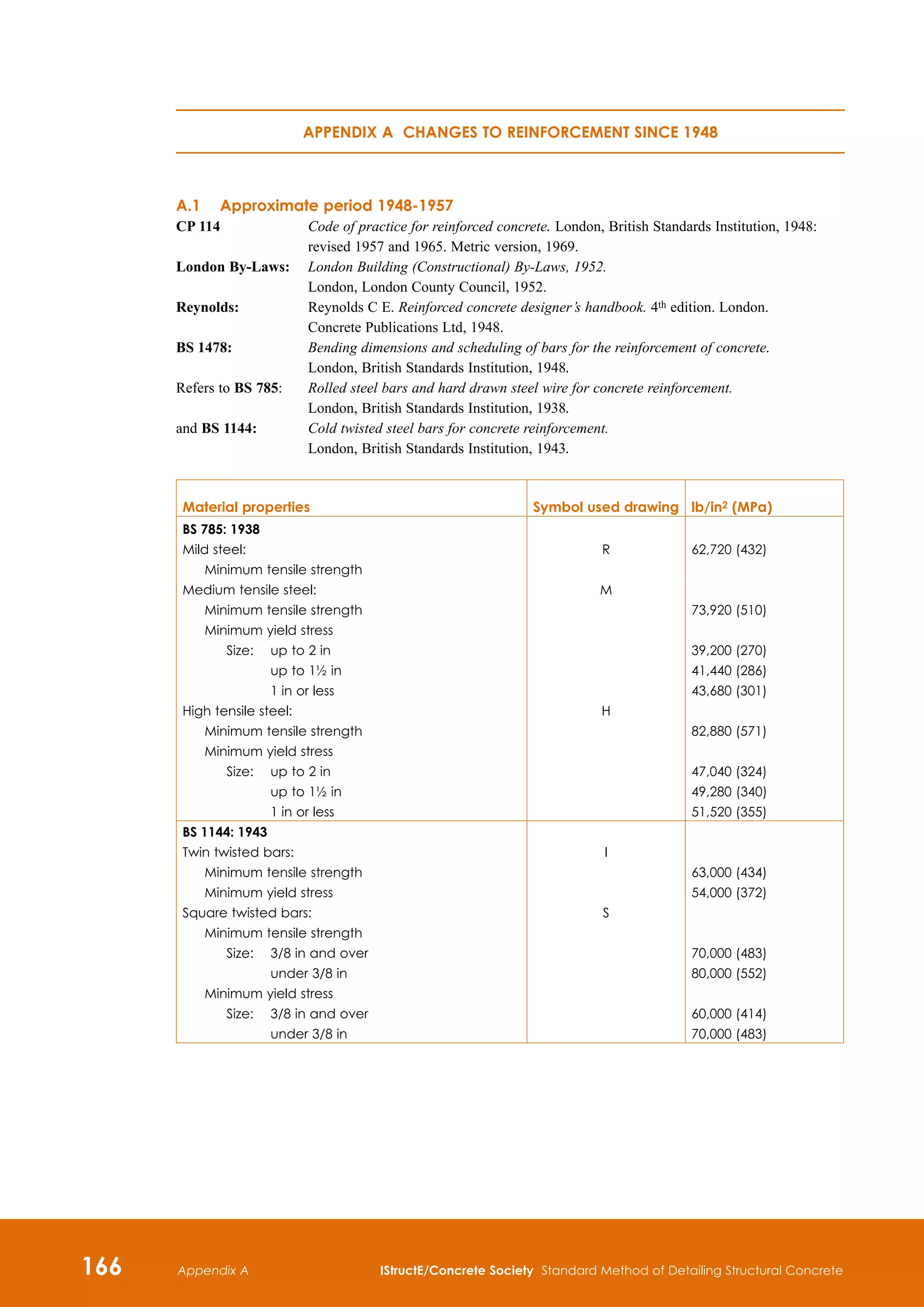
APPENDIX A CHANGES TO REINFORCEMENT SINCE 1948	166
A.1	 Approximate period 1948-1957	 166
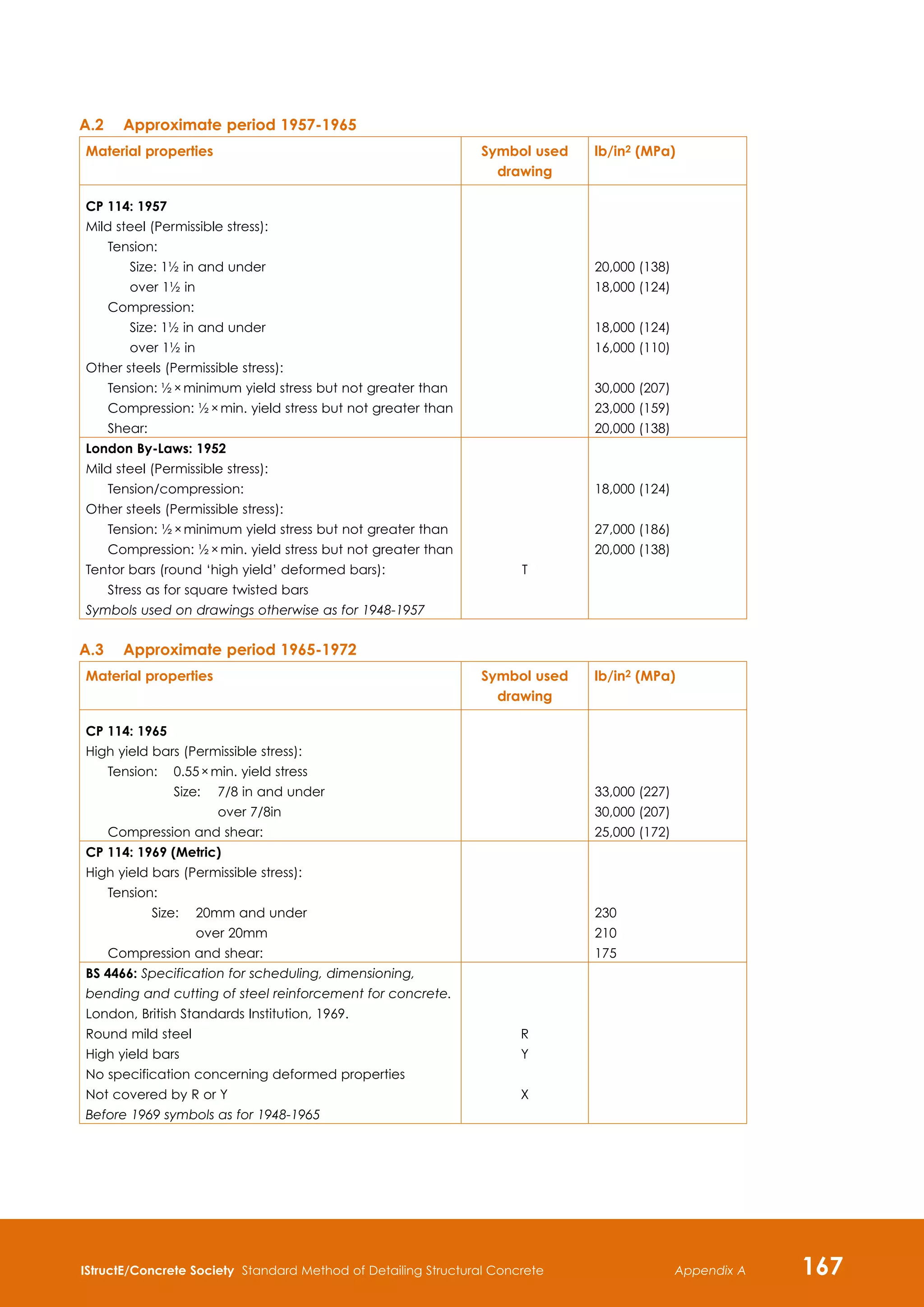
A.2	 Approximate period 1957-1965	 167
A.3	 Approximate period 1965-1972	 167
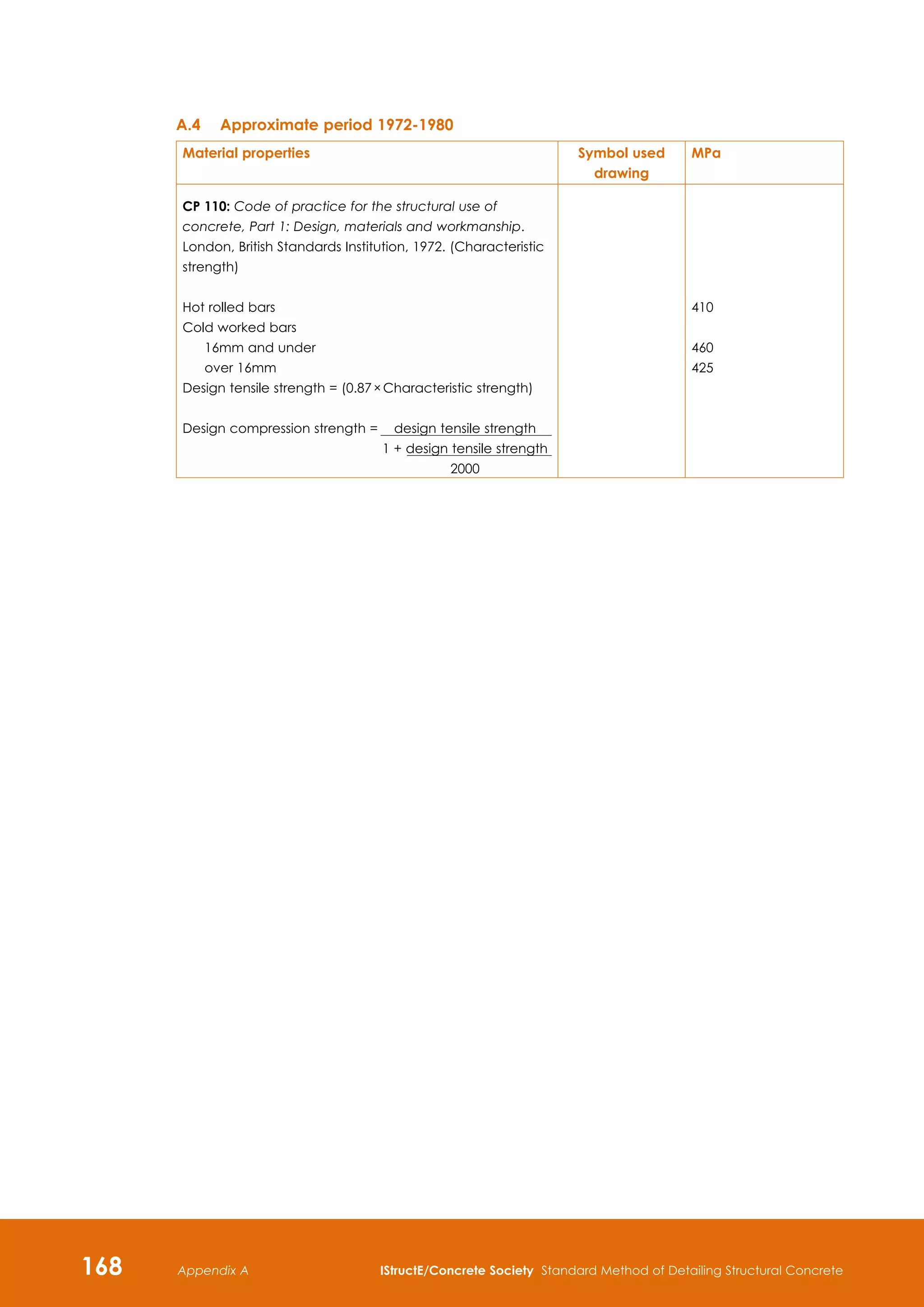
A.4	 Approximate period 1972-1980	 168
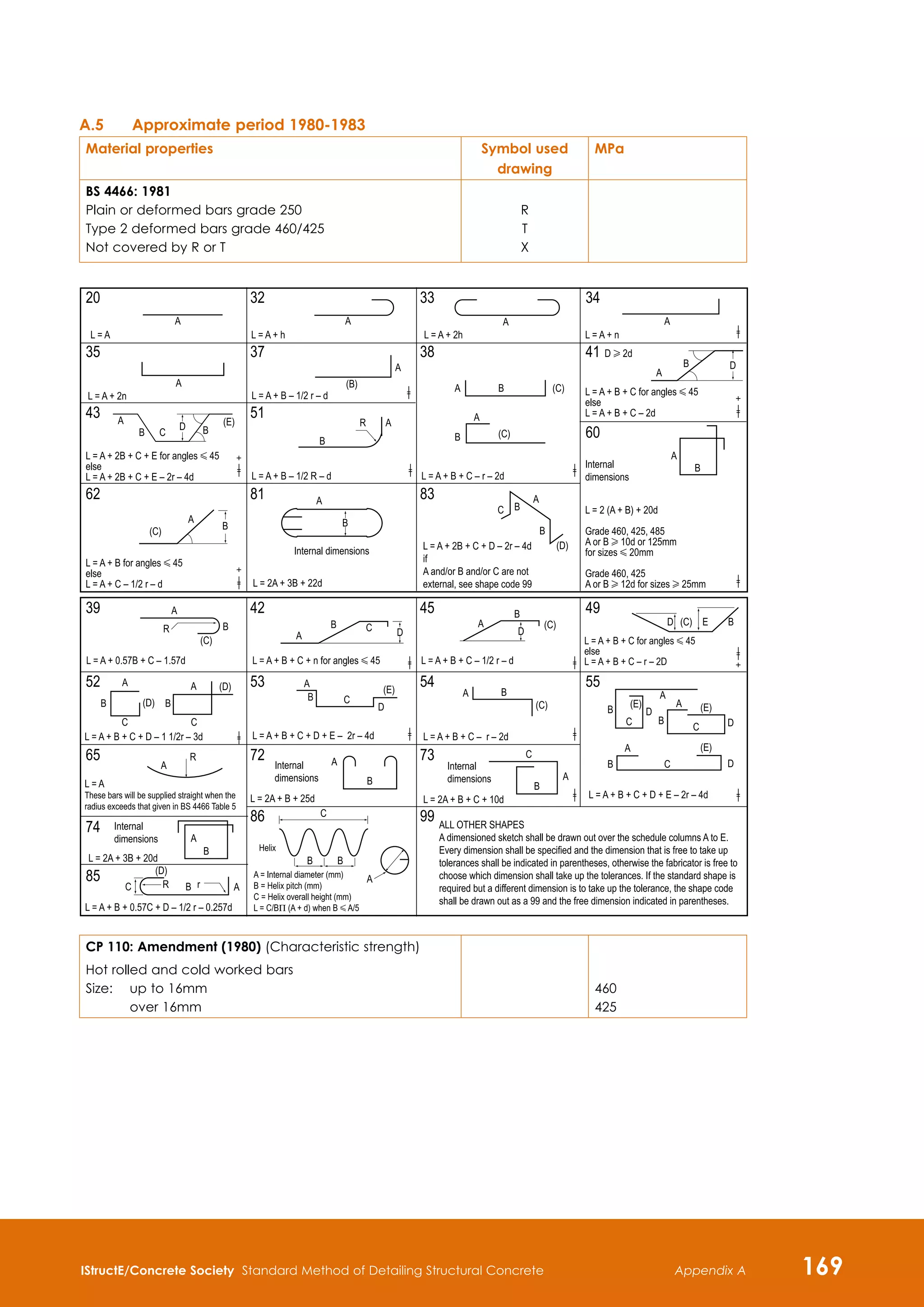
A.5	 Approximate period 1980-1983	 169
A.6	 Approximate period 1983-1985	 170
A.7	 Approximate period 1985-2004	 170
Appendix B TABLES	172
Bar shapes	 172
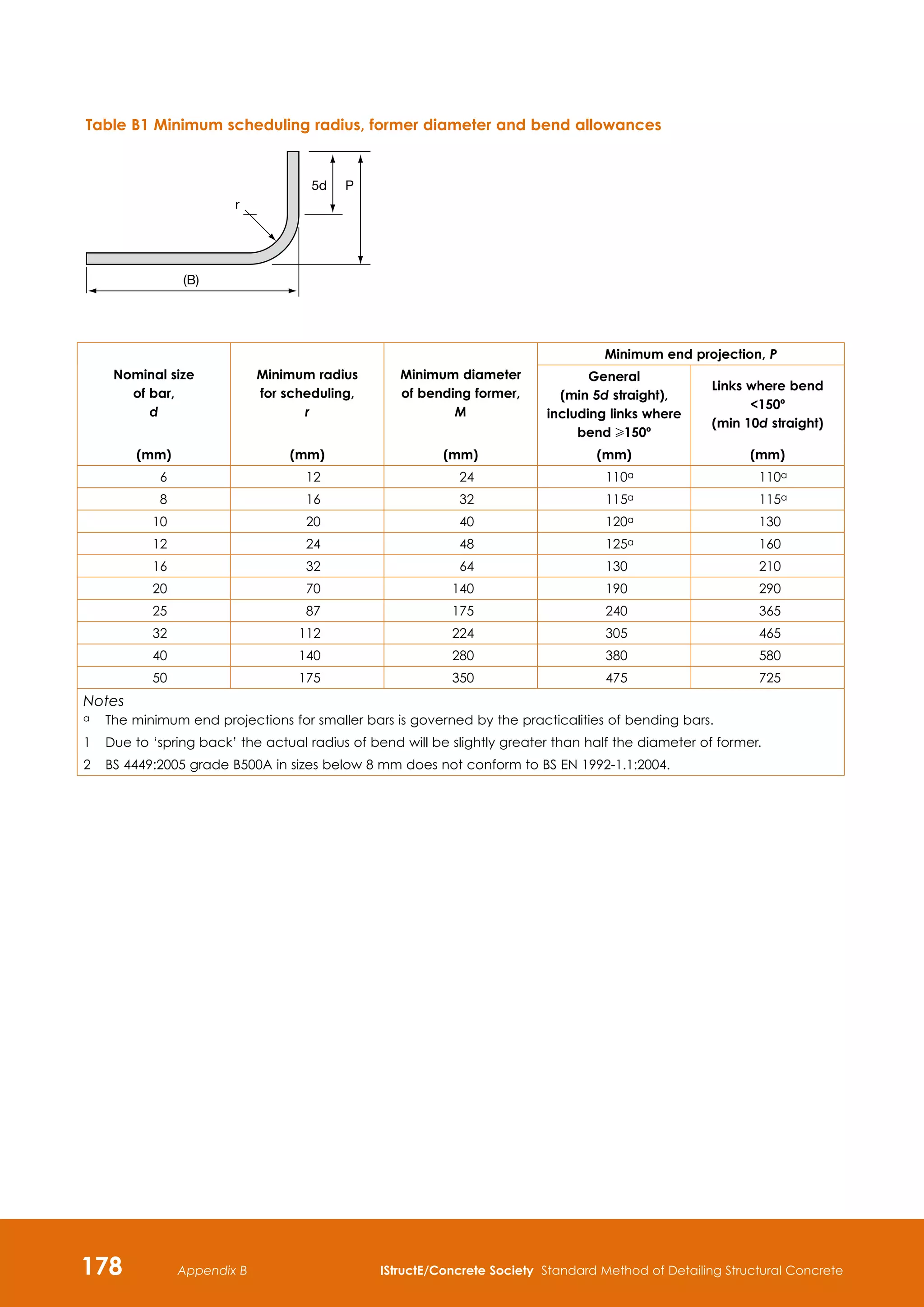
Table B1 Minimum scheduling radius, former diameter and bend allowances	 178
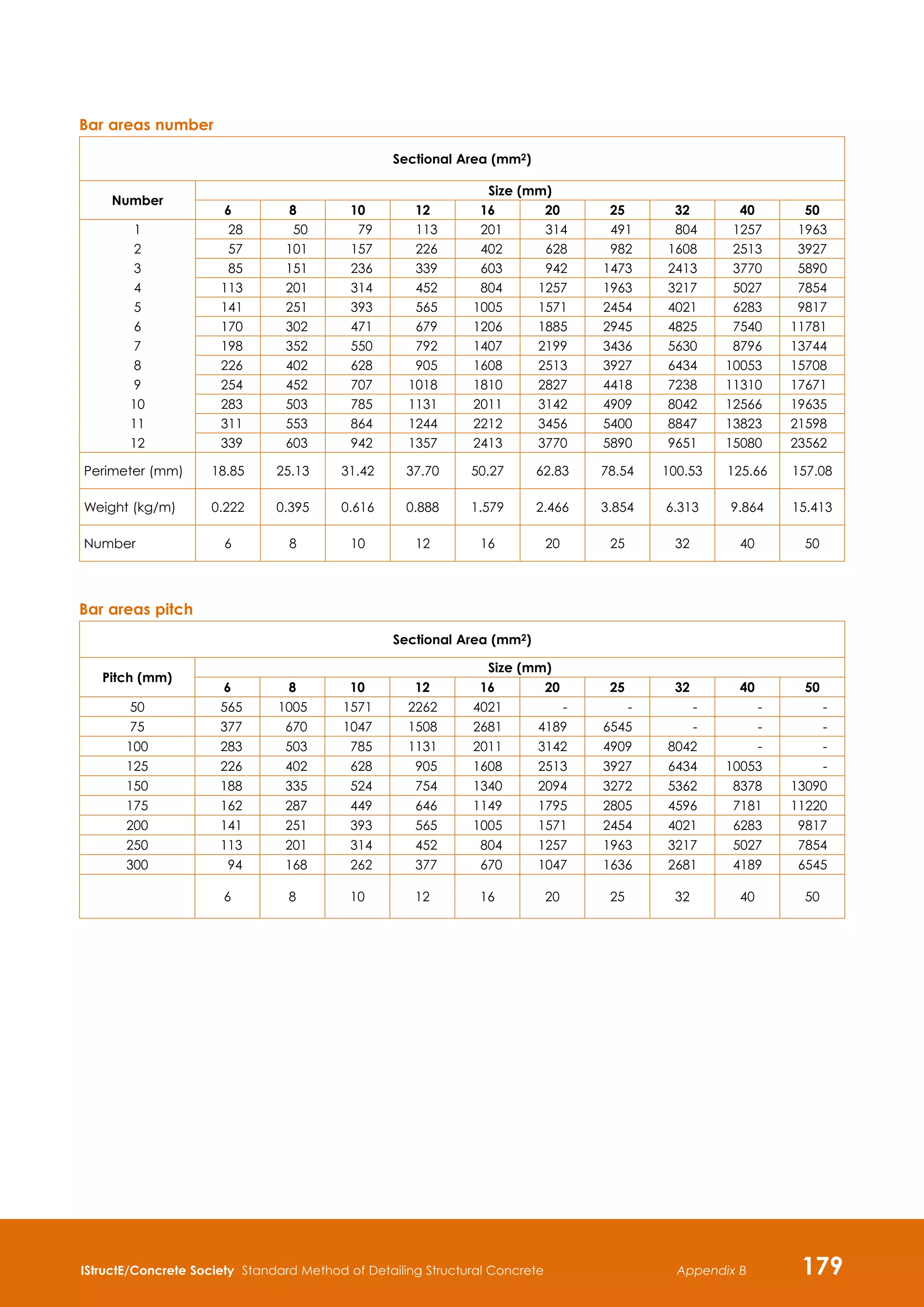
Bar areas number	 179
Bar areas pitch	 179
Bar weights pitch	 180
Fabric types	 180
Effective anchorage length	 181
L-bars			 181
U-bars			 181
Minimum overall depth of various U-bars	 182
Hook			 182
Trombone	 182
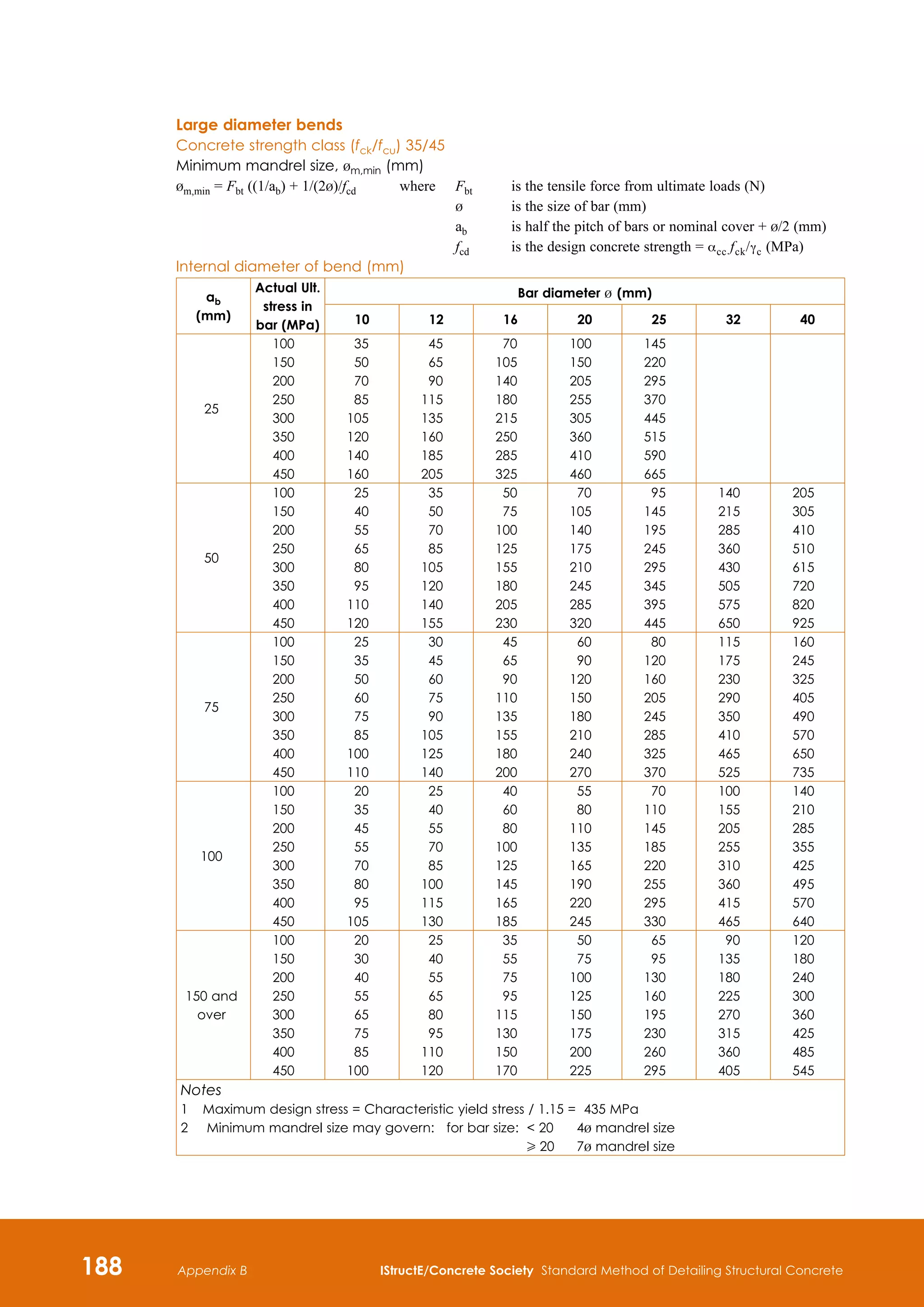
Large diameter bends	 183
Concrete strength class (fck/fcu) 20/25	 183
Internal diameter of bend (mm)	 183
Large diameter bends	 184
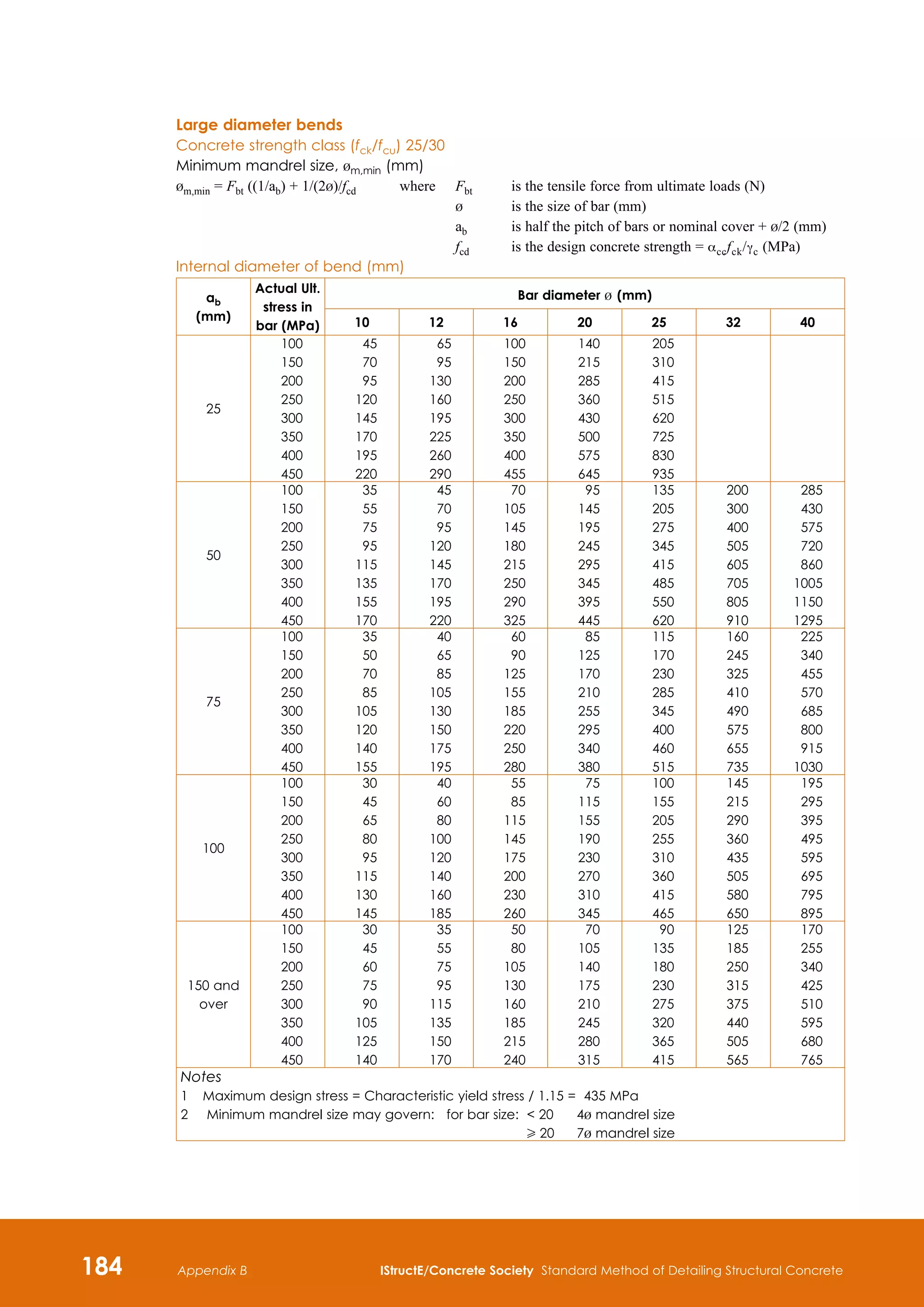
Concrete strength class (fck/fcu) 25/30	 184
Internal diameter of bend (mm)	 184
Large diameter bends	 185
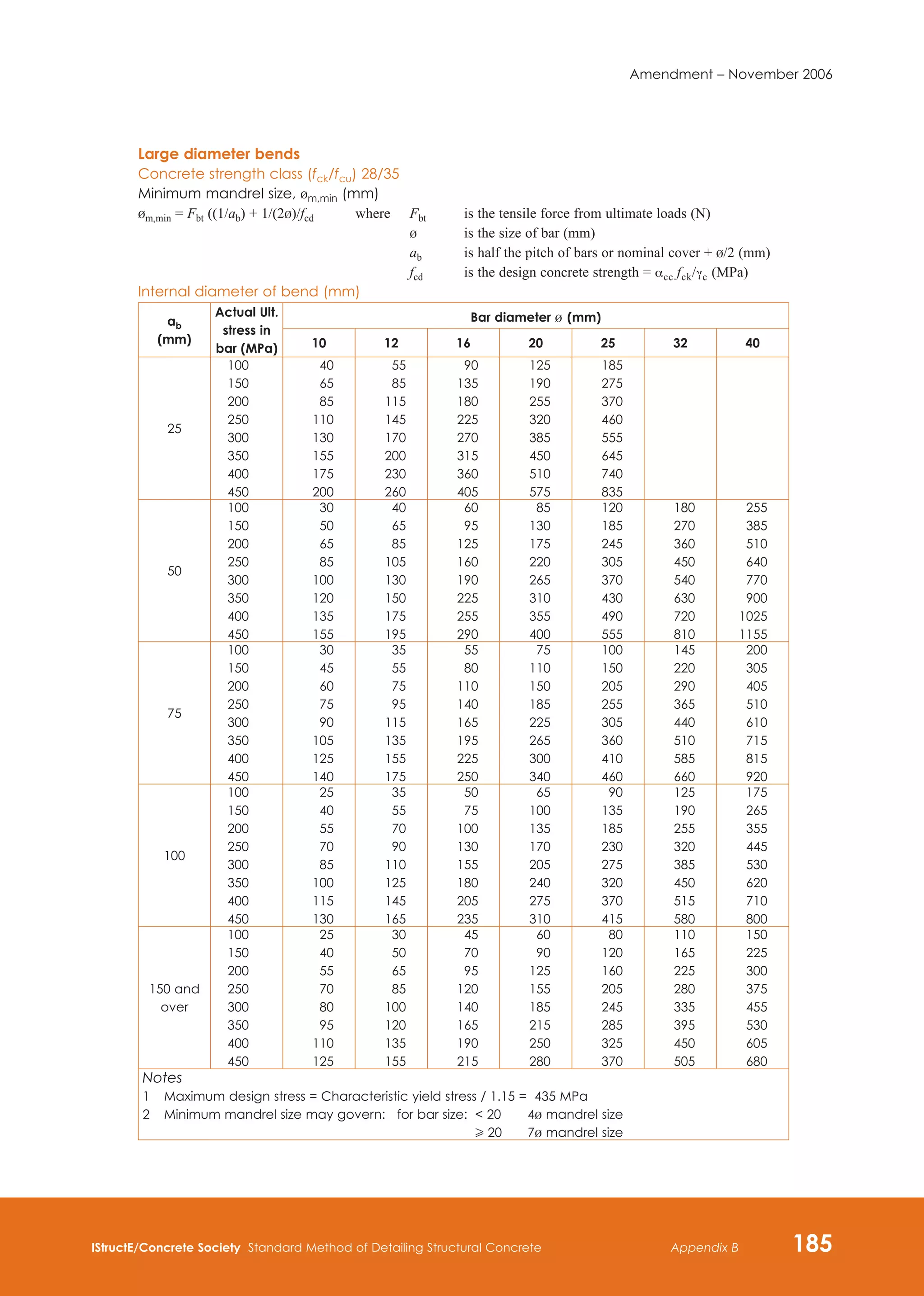
Concrete strength class (fck/fcu) 28/35	 185
Internal diameter of bend (mm)	 185
Large diameter bends	 186
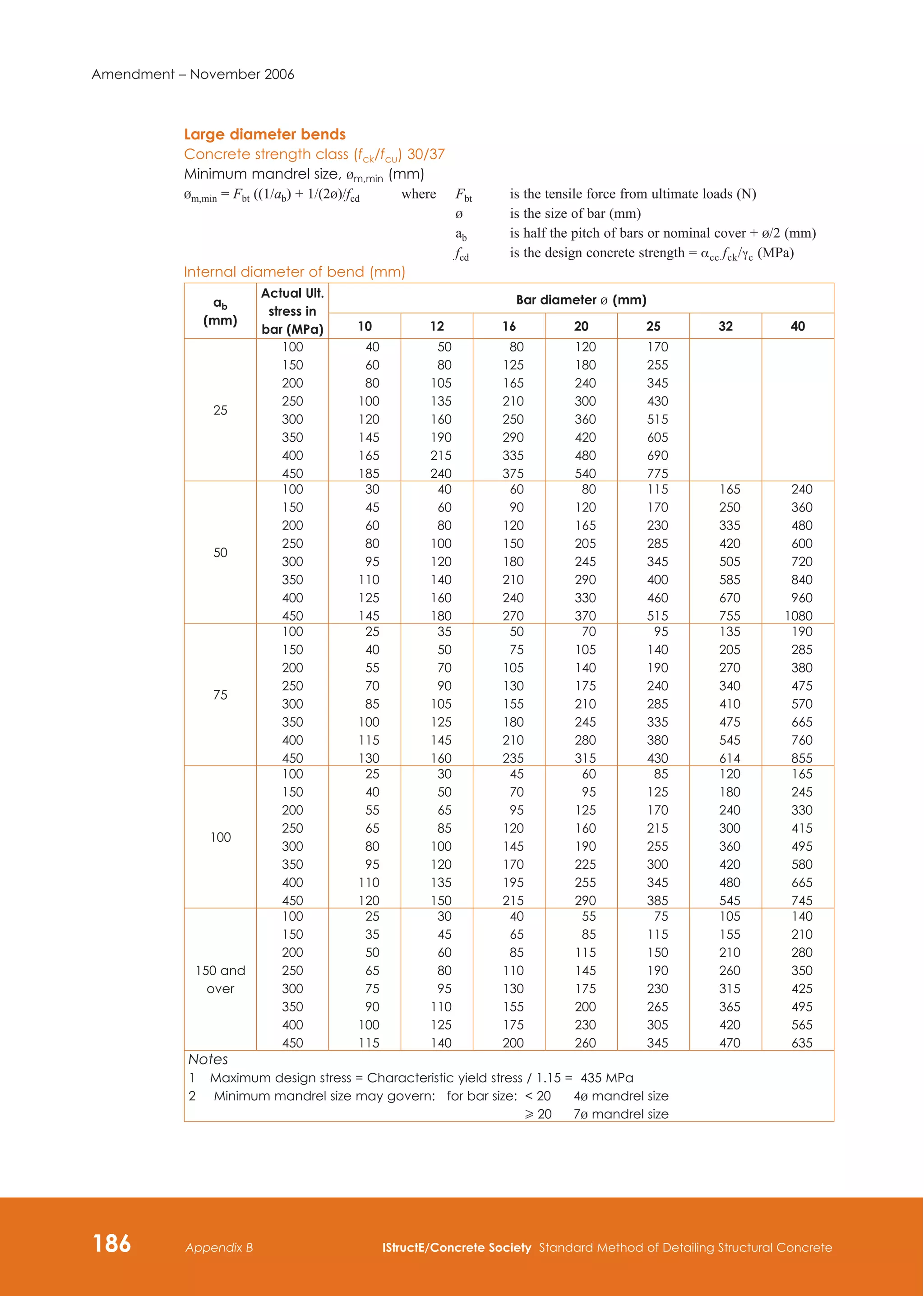
Concrete strength class (fck/fcu) 30/37	 186
Internal diameter of bend (mm)	 186
Large diameter bends	 187
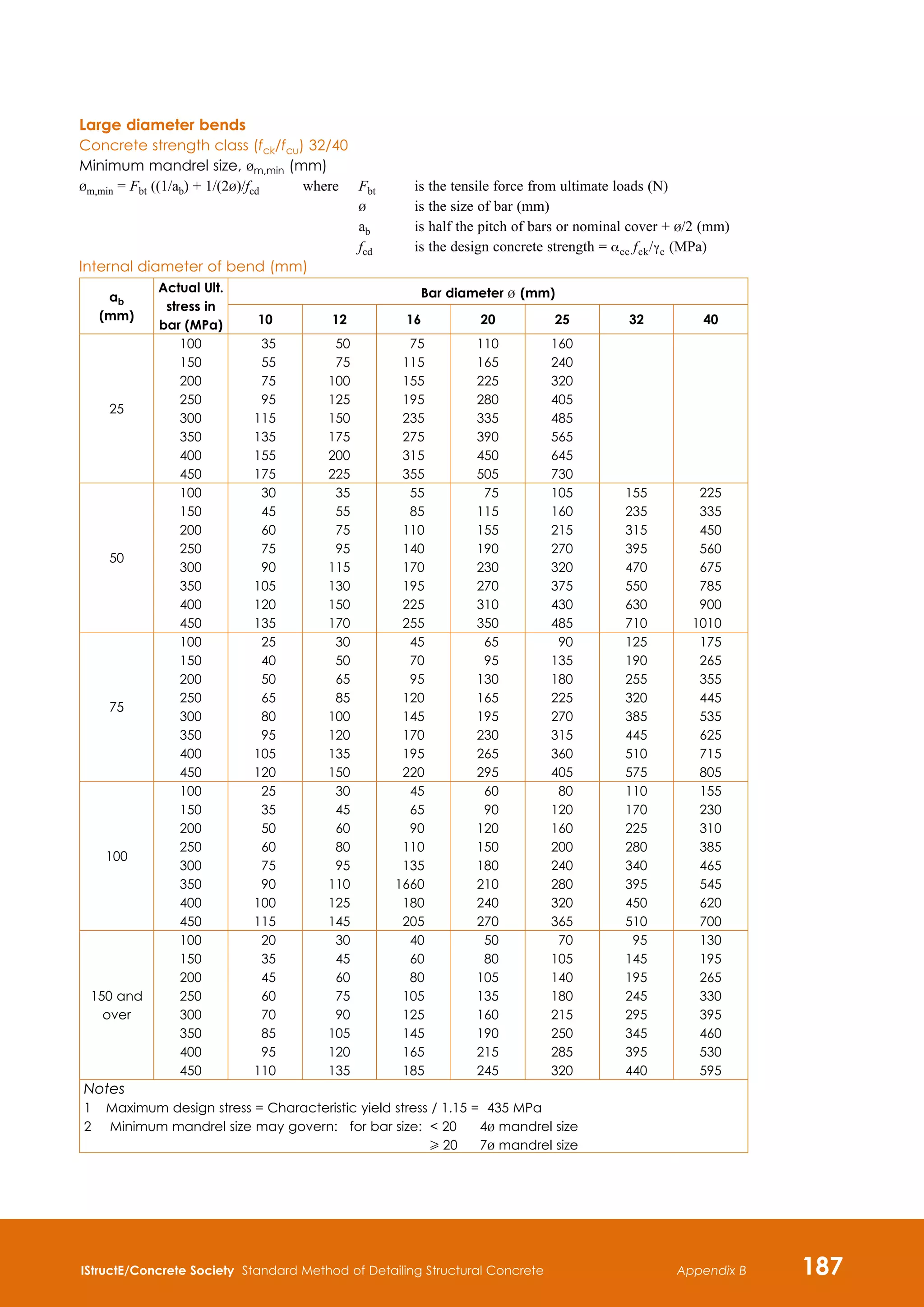
Concrete strength class (fck/fcu) 32/40	 187
Internal diameter of bend (mm)	 187
Large diameter bends	 188
Concrete strength class (fck/fcu) 35/45	 188
Internal diameter of bend (mm)	 188
IStructE/Concrete Society Standard Method of Detailing Structural Concrete
Foreword
The Standard method of detailing reinforced concrete was published in 1970 and followed in 1973 by the Concrete
Society’s publication on Standard reinforced concrete details. This was updated in 1989 to incorporate a section
on prestressed concrete and the title was amended to the Standard method of detailing structural concrete.
As with the original Standard method, the Steering Group was formed of members of both the Institution of
Structural Engineers and the Concrete Society. We have taken the views from a wide consultation on the drafts
prepared and are grateful for the variety of comments received, all of which have been considered in finalising
the document. We are confident the document provides a reflection of the current concerns and developments in
the field of detailing.
This document is intended to become a standard reference for work in structural design offices in conjunction with
the normal design codes and manuals.
The previous documents were based on the design guidance in BS 8110. The new document considers the likely
effects of Eurocode 2, as far as we can say at present, on detailing principles and materials and attempts to
provide guidance that is consistent with Eurocode 2. Recent changes in practices and procurement of detailing
services have also been considered such as the development of increased off-site fabrication and detailing being
undertaken later in the construction sequence through initiatives such as contractor detailing. These can all blur
the distinction between the work of the detailer and that of the designer. In practice, many decisions that are taken
by the detailer may technically be the province of the designer. We have attempted to provide guidance of good
practice in this document and to suggest the key items and information exchange that needs to be clarified to
enable the various members of the design team to be clearly briefed to allow them to efficiently carry out their
part of the works.
The Steering Group is grateful for the funding provided by the DTI to support this project. In developing and
updating this guidance my particular thanks must go to John Clarke and Robin Whittle; the former for managing
to succinctly record the many debates and finer points that had to be addressed and the latter for rising to the
daunting task of drafting the document and preparing responses to the comments in a way that satisfied the wide
variety of comments and viewpoints raised.
The original Standard method was widely distributed and accepted both in the UK and the rest of the world.
Good designs invariably use the principles set out in the documents and we are confident that the new edition
brings a timely update that properly reflects current developments and changes to this aspect of the construction
industry.
J K Kenward
Chairman
IStructE/Concrete Society Standard Method of Detailing Structural Concrete xi
IStructE/Concrete Society Standard Method of Detailing Structural Concrete
IStructE/Concrete Society Standard Method of Detailing Structural Concrete 
Chapter one
The objective of this manual is to provide a working
document on structural concrete that can be used to
interpret the designer’s instructions in the form of
drawings and schedules for communication to the site.
The information given in the manual is essential
for both the Designer and Detailer and both have a
responsibility for ensuring that the correct information
is provided. It should be noted that the Designer may
be one of many different parties depending on the
contractual arrangements.
The information and advice is based on Eurocodes
and UK practice, which is associated with UK
materials and labour costs. The principles and details
are relevant for use in most parts of the world with
only minor adjustment.
The purpose of this manual is to provide a
standard reference that can be used on training courses
and by detailers and design engineers alike. During
the early stages of the development of the original
document Arup made their detailing manual available
to the Joint Committee and this proved a useful base
document. As a consequence the concept of using
Model Details to indicate the preferred method of
detailing each type of structural element has been
adopted. These Details can be found at the end of the
appropriate section within Chapter 6.
A basic assumption in the preparation of this
manual has been that it is the responsibility of the
Designer to clearly specify design requirements to
the Detailer and it is the responsibility of the Detailer
to implement these requirements in a consistent
way that will be clear, complete and unambiguous
to the end user. In detailing structural concrete, the
impact on all parties involved in the construction
process should be borne in mind; details that lead
to problems or extra costs on site cannot be termed
good detailing.
It has not been the intention of the Joint
Committee to decrease in any way the responsibility
of the Designer, although it is recognised that certain
details have design implications; therefore Designers
should design with full knowledge of this manual.
The term ‘standard method’ also needs clarification.
It is not intended that any one detail should be copied
slavishly for all situations, but all the principles should
be followed, both in general and in detail. Details can
be prepared with different objectives in mind, e.g. to
reduce labour on site by detailing to allow off-site
prefabrication of the reinforcement into cages, or
to utilise the materials most readily available in a
particular location or on site. It is believed that such
different objectives can be satisfied by using the
principles covered in this manual. The details have
been prepared with the following priorities in mind:
•	
technical correctness and safety
•	
buildability and speed of construction
•	
labour and material costs.
This major revision of the manual introduces detailing
rules that conform to BS EN 1992-1-1, Eurocode 2:
Design of concrete structures. Part 1.1: General rules
and rules for buildings1 (EC2), BS EN 1992-1-2,
Structural fire design2 (EC2, Part 1.2), BS EN 1992-
1-2, Eurocode2:Concretebridges3 (EC2,Part2)andBS
EN 1992-3: Liquid retaining and containing structures4
(EC2, Part 3). Where information incorporates National
Determined Parameters from the UK National Annexes
the values are given in ‘bold’.
In general, the conventional use of materials
covered by Euronorms or British Standards is
assumed. Where other authoritative documents exist,
this manual refers to them rather than repeating them
in full. It refers to generic rather than any particular
proprietary system.
This revision also places more emphasis on the
communication of information and the responsibility
for detailing. The use of Contractor Detailing is
recognised and the difference this makes to the
process of detailing is considered.
Within the UK the use of mild steel
reinforcement is no longer common practice and
has now become more expensive than high yield
reinforcement. Class C high yield reinforcement is
considered to provide the required ductility for the
specific situations where mild steel was considered
necessary. Accordingly reference to mild steel has
been removed. In deriving details and standards it
is assumed that reinforcement will be supplied by
a company holding a valid certificate of approval
from a recognised third party product certification
body, e.g. UK CARES (Certification Authority for
Reinforcing Steels, www.ukcares.co.uk).
There is growing use of stainless steel for
reinforcement for situations where greater durability
is required. BS 6744: 20015 provides details on its use
and testing.
1 Introduction and scope
IStructE/Concrete Society Standard Method of Detailing Structural Concrete
Chapter one
The principles covered by BS 86666 have
been adopted. BS 8666 defines a standard method
of scheduling and a set of bar shapes that, in
suitable combination, are normally sufficient for
any detailing situation; it is considered to be an
essential companion document to the manual.
The division between civil and structural
engineering is somewhat arbitrary, and it follows
that good practice is common to both structural
engineering and civil engineering. There are,
however, a number of factors that occur in large-
scale works of which account be taken when
detailing reinforcement. These include:
•	
provision of access for concrete to be safely
placed in massive concrete sections such as raft
foundations
•	
adjustments of reinforcement to take account of
the effects in large pours of concrete. Attention
is drawn to CIRIA report 135, Concreting deep
lifts and large volume pours7
•	
suitable reinforcement arrangements to suit
long-strip methods of laying ground slabs
•	
recognition of the likely positioning of
construction joints and their effect on
reinforcement arrangements (also important for
building slabs)
•	
recognition of the effects of different concrete
mixes and aggregates.
It should be noted that this manual does not cover
•	
the detailing of structures designed for seismic
situations. For such situations reference should
be made to BS EN 1998: Design of structures
for earthquake resistance8 and other relevant
documents
•	
the detailing of joints and reinforcement for
ground slabs. For such information reference
shouldbemadetotheConcreteSocietyTechnical
Report 34, Concrete industrial ground floors –
A guide to their design and construction9
•	
water resistance of wall and slab elements in
contact with the ground. For such situations
reference should be made to CIRIA Report 9110
and CIRIA Report 13911
•	
the detailing of marine structures. For such
structures reference should be made to
BS 634912
•	
the use of lightweight aggregate concrete.
Reference for this should be made to EC2,
Section 11.
IStructE/Concrete Society Standard Method of Detailing Structural Concrete 
Chapter two
2.1	 General
Accurate detailing has an important role in the
procurement and durability of reinforced concrete
structures. The actual process of detailing normally
comes relatively late in the procurement process.
Concepts and working details can be decided during
the early design phases but the preparation of final
reinforcement drawings and schedules is generally
squeezed into a period between completion of final
design and the start of construction on site. Thus, very
often it becomes a critical process in the construction
programme. In the UK, pressure on construction
timescales and moves towards non-traditional forms
of construction has tended to make detailing an even
more critical and pressured activity.
2.2	The reinforcement process
Detailing can only really begin in earnest once the
final design is available. The design requirements
are normally given to the detailer in the form of
design calculations, marked up GA drawings, beam
schedules or completed pro forma or similar.
It is important that detailing is carried out with
responsibilities and adequate timescales clearly
defined. Issues such as site constraints, relevant
standards, laps, covers, concrete grades, holes,
detailing preferences, etc must all be covered. These
requirements should be formalised into a detailing
specification (see Construct’s Guide to contractor
detailing13) whether detailing is carried out in-house
or outsourced. Ideally the contractor’s preferred
methods and sequence of construction should be made
known and accommodated.
The requirements for the whole structure should
be handed over and explained to the detailer at a
single point in time. Packages of information that need
to be provided to match the construction sequence
or phasing must be defined. For instance sufficient
information for the detailing of foundations and (wall
and column) starter bars may be the first package
required to be delivered.
Drawings and schedules can then be prepared by
the detailer.
Once drawings and schedules have been
completed, they are usually checked by the detailers
themselves, checked by the designer for design
intent and compliance with standards, and where
appropriate, checked by contractors for buildability
and completeness, all in according with the relevant
contracts, specifications and Quality Assurance
procedures.
As far as possible, design changes once
detailing has started should be avoided.  
Any changes
significantly affect and interrupt work flows, increase
workloads and greatly increase the risk of errors.
However, there are often situations where final design
information is not available and design developments
and checks cause alterations or requirements to change.
While not ideal, changes are almost inevitable and
their control needs to be addressed. An agreed system
of design freezes is most beneficial.
Once the reinforcement drawings and schedules
gain the status of construction drawings they are
distributed to the relevant parties. In traditional
contracts, the reinforcement drawings and schedules
will be issued to the Contract Administrator and to the
main contractor, client’s Quantity Surveyor, etc. The
main contractor normally distributes the information
to site staff, quantity surveyors, buyers etc and to
specialist subcontractors. The schedules will be sent
to the reinforcement fabricator/supplier.
The reinforcement is usually ‘called off’ from
site. As the work proceeds and reinforcement is
required, the site will ask for reinforcement from
certain schedules to be delivered. Again depending
on circumstances, these may be bulk deliveries,
individual pages of schedules or schedules recast
by site into work packages. On site, deliveries of
reinforcement call for inspection, craneage, sorting,
storage, and document processing. Unless just-
in-time deliveries are feasible or suitable storage
areas are available adjacent to the work area, the
reinforcement may need to be sorted and moved again
just prior to fixing. Prefabrication, e.g. prefabricated
pile, column and beam cages, may be carried out on
or off site.
The reinforcement supplier or fabricator has
to predict ‘call offs’ so that sufficient stock and
manpower is available to answer their many customers’
requirements. The cutting and bending process is well
documented but of most concern are addressing
issues such as price changes, clarity of information,
off-cuts, non-standard shapes, full deliveries and most
especially delivery timescales. Deliveries that are
required within 48 hours of the receipt of a call off
usually attract a premium.
2 Communication of information
IStructE/Concrete Society Standard Method of Detailing Structural Concrete
Chapter two
The reinforcement is placed and fixed by steel
fixers then checked in-situ. Responsibility for checking
reinforcement should be covered in the specification.
Formal pre-concreting checks should include checks
of the reinforcement, covers, inserts and specialist
items etc. The reinforcement should be checked again
during concreting for position and afterwards dowels
and starter bars should be treated and/or protected.
The specification may also require a cover meter
survey of after concreting.
Through all these processes correct and current
reinforcement drawings and schedules play a vital
role in getting it right on site. The schedules also play
another vital role as they form the basis for payments
to suppliers and contractors.
The communication of reinforcement detailing
information from the design office to the site
must be as efficient as possible. Traditionally the
Designer has also been responsible for preparing the
reinforcement detail drawings and schedules, i.e.
‘Designer Detailing’. The emergence of specialist
concrete contractors has provided an alternative
means of producing the information through
‘Contractor Detailing’. Both systems handle the
same technical information but differ in the timing
and the emphasis of the way it is produced. Some
of the advantages and disadvantages are listed in
Table 2.1.
Irrespective of the method of detailing chosen,
it is essential that all the design information, that is
required for detailing, is provided. Furthermore a
standard way of providing the information reduces
the scope for mistakes and speeds up the process.
Currently for any particular type or size of project,
the calculations, and consequently the detailing
instructions, produced by different Designers vary
considerably both in format and content. These
variations affect the efficiency of the industry,
particularly in that:
•	
The variations make the checking of calculations
and instructions by Designers time-consuming
and laborious. In addition the communication
of design information to external checking
authorities can be unnecessarily confused and
protracted.
•	
It takes longer for the Detailer to absorb the
reinforcement information given and increases the
possible need for clarification. It can also lead to
a degree of abortive work and misunderstanding
between Designer and Detailer.
Table 2.1 Advantages/disadvantages of Designer and Contractor Detailing
Advantages of Designer Detailing/
Disadvantages of Contractor Detailing
Advantages of Contractor Detailing/
Disadvantages of Designer Detailing
Details from Designer Detailing are produced as
an integral part of the design and can be more
easily tailored to the demands of the Designer.
Contractor Detailing can more readily take
into account the Contractor’s preferred
method of working.
Production of reinforcement details by Designer
Detailing can take place while the design is
still being finalised, thus saving elapsed time.
A typical example where it might be more
efficient for the designer to produce details is
for foundations.
Reinforcement details by Contractor
Detailing can be prepared taking account
of the Contractor’s preferred methods of
construction and final material selection.
Preparing clear design information for
Contractor Detailing takes longer and is likely
to be later than for Designer Detailing with less
time for checking or changes.
Preparing reinforcement details by Contractor
Detailing benefits from following the actual
construction programme.
The approval process for Contractor Detailing
can take longer because of the rechecking
required.
Designer detailed work may require re-working
to take account of the Contractor’s method
of working.
IStructE/Concrete Society Standard Method of Detailing Structural Concrete 
Chapter two
Although it is clearly more efficient for the construction
process to invoke a time freeze on the provision of new
or altered information (e.g. mechanical and electrical
information) this may not always be in the interests of
the Client who is looking for the optimum solution.
The following includes the typical information
required for detailing (see 2.6 for examples):
•	
General Arrangement (GA) drawings: they must
be fully dimensioned, with sufficient sections
and details, and should show or reference all
necessary service holes, provisions for ducts and
cast fittings.
•	
Project specification: Unless noted otherwise,
the requirements of EC2 and this manual will
be deemed suitable and applicable. Special
requirements should be stated (e.g. seismic).
•	
Design requirements in one of the following
forms:
	 –	
the structural design calculations
	 –	
marked-up GAs: This is common practice
for small uncomplicated projects
	 –	
element schedules: Sketches of the required
reinforcement by element
	 –	
pre-printed drawings (completed proformas)
	 –	
sketches and tables incorporated with
Computer Aided Design (CAD).
The efficient communication of information from
Designer to Detailer is important. However, it is
not suggested that a rigorous format for calculations
be adopted throughout the industry. It is preferred
that the Designer should recognise and tailor the
guidelines given in this manual to suit the different
situations that arise. The following points should
be considered when the Designer is preparing
instructions to the Detailer:
•	
Instructions should be indexed. An edited
calculation index is normally sufficient.
•	
Basic design information relating to concrete and
reinforcement grades, fire resistance, durability
and associated concrete covers should be given by
a Detailing Notice Sheet preceding the detailing
instructions.
		 Where information is available concerning
theconstructionprocess(e.g.constructionmethod,
pour sequence etc.) this should be provided to the
Detailer.
		 Any special requirements should be noted on
individual calculation/instruction pages.
•	
Detailing instructions should comprise only
the calculation sheets describing the geometric
and reinforcement requirements of a particular
structural element. Information concerning
general analysis of the structure, e.g. stability
analysis, computer listings, is not required.
		 The instructions should include clear
diagrams of the reinforcement layering directions,
TI, T2 etc. and the layering at cross-over of
elements, consistent with the design calculations.
		 Reference should be made to the Model
Details in this manual where appropriate or
alternative sketches supplied.
•	
Detailing information should be normally given
in the right hand margin of the calculation sheet.
Where the calculations for an element or series
of elements are lengthy or complex the relevant
reinforcement information should be extracted
and presented in a summary sheet.
•	
The use of marked-up outline drawings as a
summary should be accompanied by calculations
for congested areas or where the section is small.
•	
Sketch details. All instructions should explicitly
address the curtailment of reinforcement including
the angle of strut assumed in shear design (see
6.3.2). Where conditions permit the use of standard
arrangements these should be adopted. The
instructions should also note where the standard
curtailments may still be used where the elements
fall outside the conditions for their use.
		 Where only bending moment and shear
force diagrams are provided these should be
accompanied with clear instructions concerning
curtailment. This method can be inefficient for
detailing unless the Designer has given thought to
the rationalisation of the layout (e.g. beam cages).
		 Where reinforcement is congested or there
are particularly complex connections e.g. corbels,
nibs, deep beams to thin cross-section walls or
columns, details should be sketched at a large
size, even full-size, to confirm buildability. The
sequence of installation must be considered to
ensure beams can be lifted and placed.
•	
Each particular structural element requires
specific design and geometric information. The
list of information required is given in ‘Detailing
Information’ sub-section of Chapter 6 for each
element.
•	
Always provide the Detailer with the latest
revision of relevant GAs and sections to avoid
abortive work and the possible issue of incorrect
details.
•	
The Designer should seek to maintain regular
direct contact with the Detailer during the
detailing process.
IStructE/Concrete Society Standard Method of Detailing Structural Concrete
Chapter two
	 It is recommended that in the absence of
an instruction from the Designer for a particular
detail, or for nominal reinforcement, the Detailer
should assume that the standards described by
this manual are to be applied.
	 Where the Model Details given in this manual
are not applicable to the geometric configuration,
the Detailer should provide suitable alternatives
based on similar principles.
2.3	Designer detailing
In order that the detailing is carried out in the most
efficient manner, wherever possible, the Designer
should seek to discover the Contractor’s preferred
methods and agree a sensible programme and sequence
of work eliminating any unrealistic demands. Where
the construction sequence is dependent on the design
the Designer should provide a description of the
design philosophy and constraints in addition to the
information listed in 2.1.
Provide a description of the design intent and the
form of construction assumed in design.
All sketches and rebar correspondence should
be given a unique identification sketch or instruction
number.
‘Nominal’ reinforcement should be assumed to be
in accordance with the relevant element in Section 6
unless clearly stated by the designer.
2.4	 Contractor detailing (see also A guide to
contractor detailing of reinforcement in concrete13 )
Where detailing is commissioned through the
Contractor under Works Contract for a project the
following managerial points should be noted:
•	
The sub-contract should clearly state and define
the responsibilities of each party.
•	
Legal advice should be sought, where necessary,
to remove any doubts over contractual liabilities.
•	
The Specialist Concrete Contractor should be
satisfied with the obligations and duties imposed
by the contract and any warranties.
•	
The Specialist Concrete Contractor should
have adequate insurance cover commensurate
with the exposure to the relevant risks and
liabilities.
2.5	 Electronic data interchange (EDI)
The key to successful data exchange is to ensure that
the specification of the data to be transferred from one
party to another is clearly and rigorously defined.
Electronic transfer of data allows contractors to
manage schedules and their revisions more quickly
and are less prone to error than the old fax or
postal methods which required re-keying of data. The
widespread adoption of electronic data interchange
(EDI) by the industry brings with it the need for
careful and consistent schedule formats complying
with BS 86666. This allows the data to be transferred
across the entire supply chain.
Minimum requirements
The following is a list of the minimum requirements
for setting up accurate electronic data which can be
universally accepted:
•	
Use of consistent nomenclature for drawing and
revision numbers or letters, i.e.:
–	
Revisions 1 and 2 should never be succeeded
by revisions C and D.
–	
The number 0 should never be interchanged
with the letter O.
–	
A revision at bar mark level should be
consistent with the Drawing level, e.g. if a
bar mark revision is marked 2 the drawing
and schedule revision should be marked 2,
although lower revisions can be displayed
against the appropriate bar mark, if they
were not changed in the new revision.
•	
Every bar mark must have a Member Name
against it.
•	
Member Names must remain consistent through
a schedule. The name itself is not important but a
member called, for example ‘garage-1’in one part
of a schedule and later abbreviated to ‘grge-1’ in
another part will be recognised by software as 2
different members.
•	
The same bar mark must never repeat within the
same member name.
•	
When a library of Shape Code 99s is created (e.g.
99-01, 99-02 etc.) the shapes should be defined
graphically and remain consistent for the duration
of the contract.
Recommended procedures
•	
When a revision is issued, each schedule page
should display this revision, regardless of whether
any bar marks have changed on that page.
•	
Revised bar marks should be individually labelled
with the revision number or letter. A bar mark
should retain the revision number or letter at
which it was last revised for accurate revision
history.
•	
When schedules are produced we recommend a
naming convention of drawing number_revision,
e.g. 213_02.
IStructE/Concrete Society Standard Method of Detailing Structural Concrete 
Chapter two
2.6	 Examples of typical methods of providing the required information for detailing
Example 1
Flat slab Example of a marked up general arrangement drawing for a flat slab. Notes on drawing should include
concrete grade and cover, or reference to these. The general arrangement drawings should also be provided.
Where contour plots from proprietary systems are provided the level of rationalisation to be applied should
be agreed between the Designer and Detailer. Alternatively where crack control is important a schematic layout
of Bars should be given.
The method of showing where holes and the associated reinforcement trimming details required for ME
purposes must be clearly stated (see also 6.2.2).
565mm2
2094
mm2
2094
mm2
2094
mm
2
565mm
2
565mm
2
565mm
2
565mm
2
565mm
2
565mm
2
565mm
2
565mm
2
565mm
2
565mm
2
565mm
2
565mm
2
565mm
2
1796mm
2
1796mm
2
1796mm
2
1796mm
2
1795mm2
1795mm2
565mm
2
565mm
2
1796mm
2
1795mm2
1795mm2
1795mm2
1795mm2
565mm2
2094
mm2
2094
mm2
1795mm2
565mm2
565mm2
646mm2
565mm2
565mm2
2805mm2
565mm2
565mm2
2094
mm2
2094
mm2
565mm
2
565mm2
565mm2
565mm2
565mm2
565mm
2
565mm
2
565mm2
1005mm2
1005mm
2
1005mm
2
1005
mm
2
565mm2
646mm2
646mm2
565mm2
565mm2
565mm2
C
B
A
1
2
3
4
5
A
D
IStructE/Concrete Society Standard Method of Detailing Structural Concrete
Chapter two
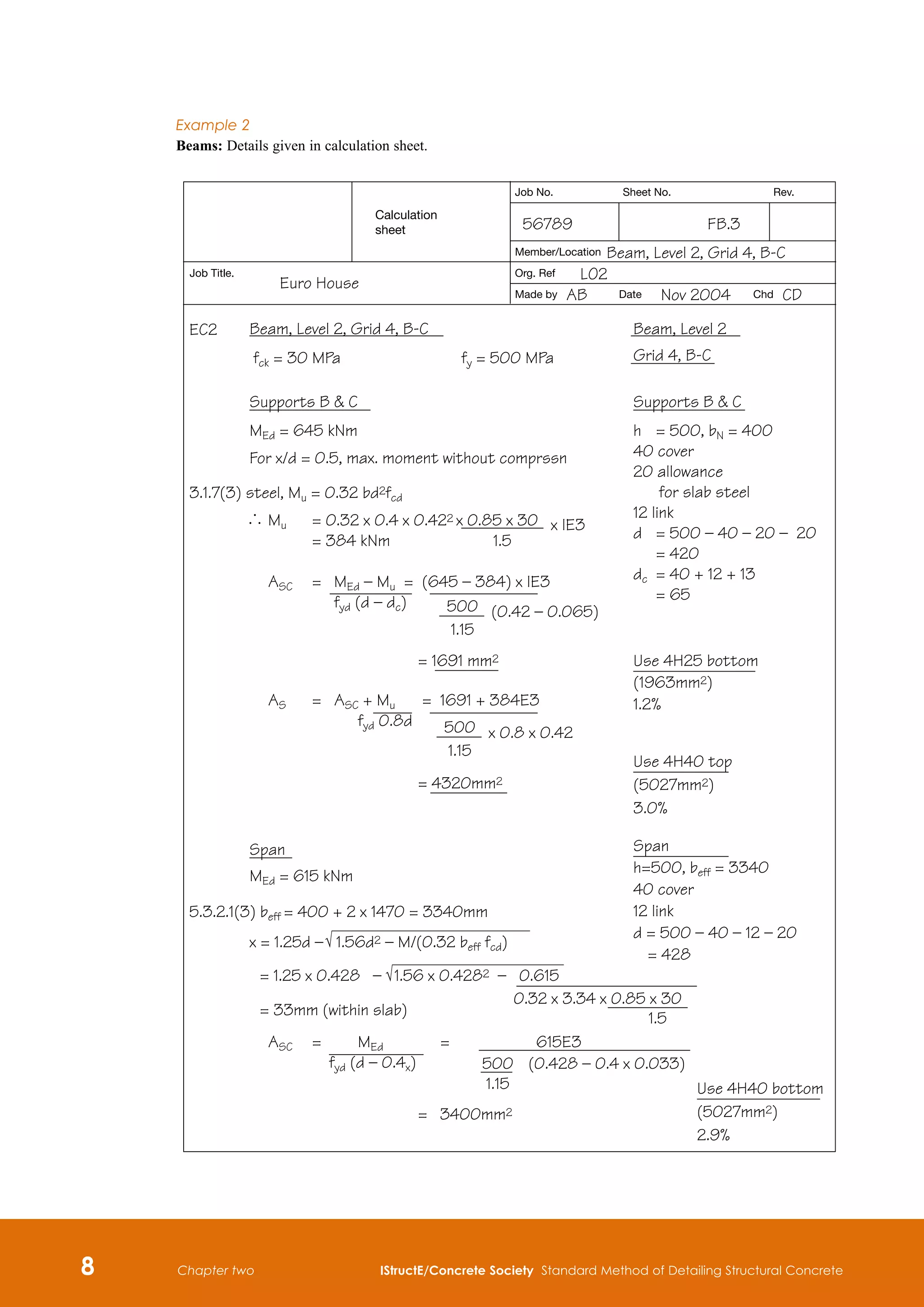
Example 2
Beams: Details given in calculation sheet.
IStructE/Concrete Society Standard Method of Detailing Structural Concrete 
Chapter two
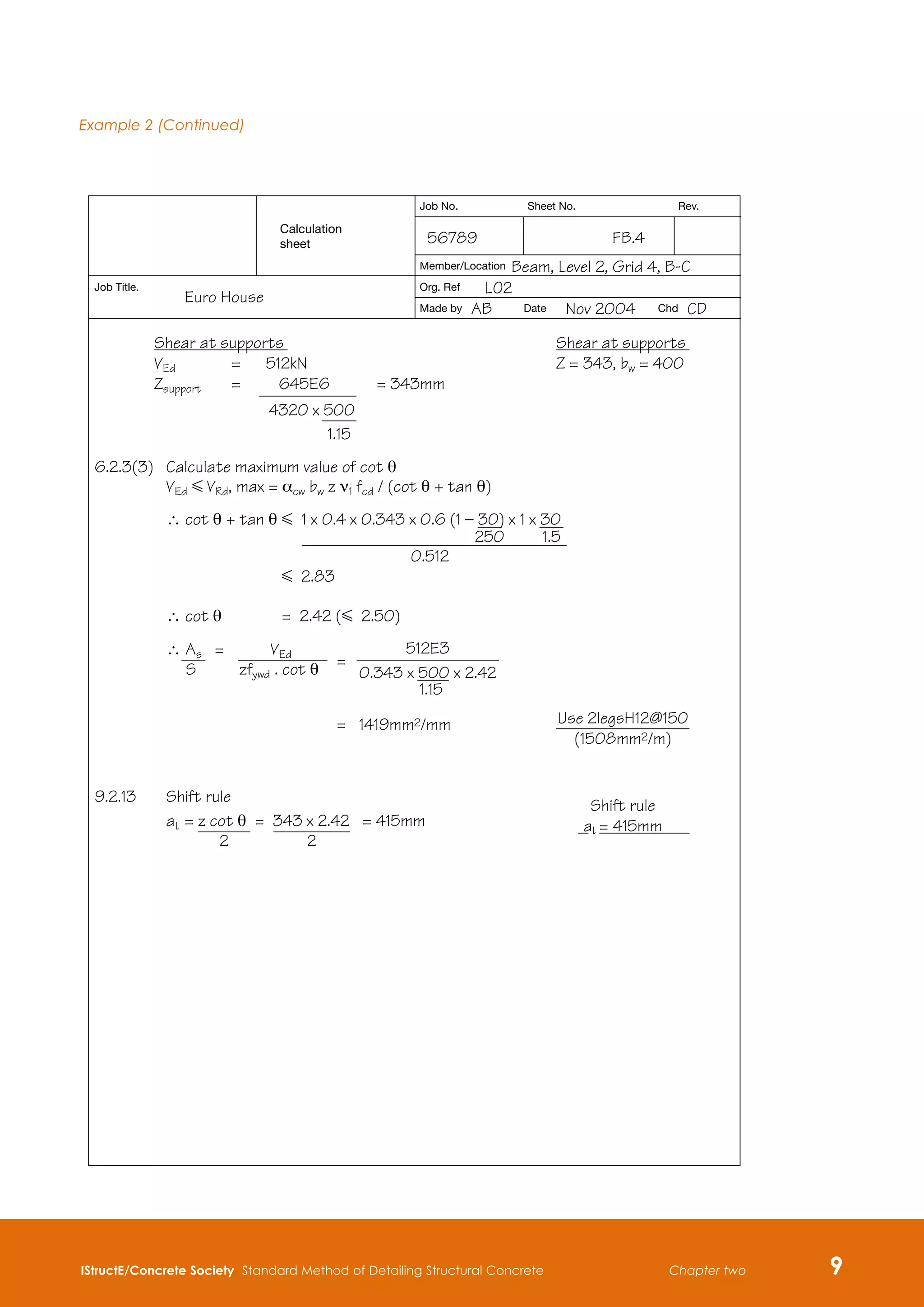
Example 2 (Continued)
10 IStructE/Concrete Society Standard Method of Detailing Structural Concrete
Chapter two
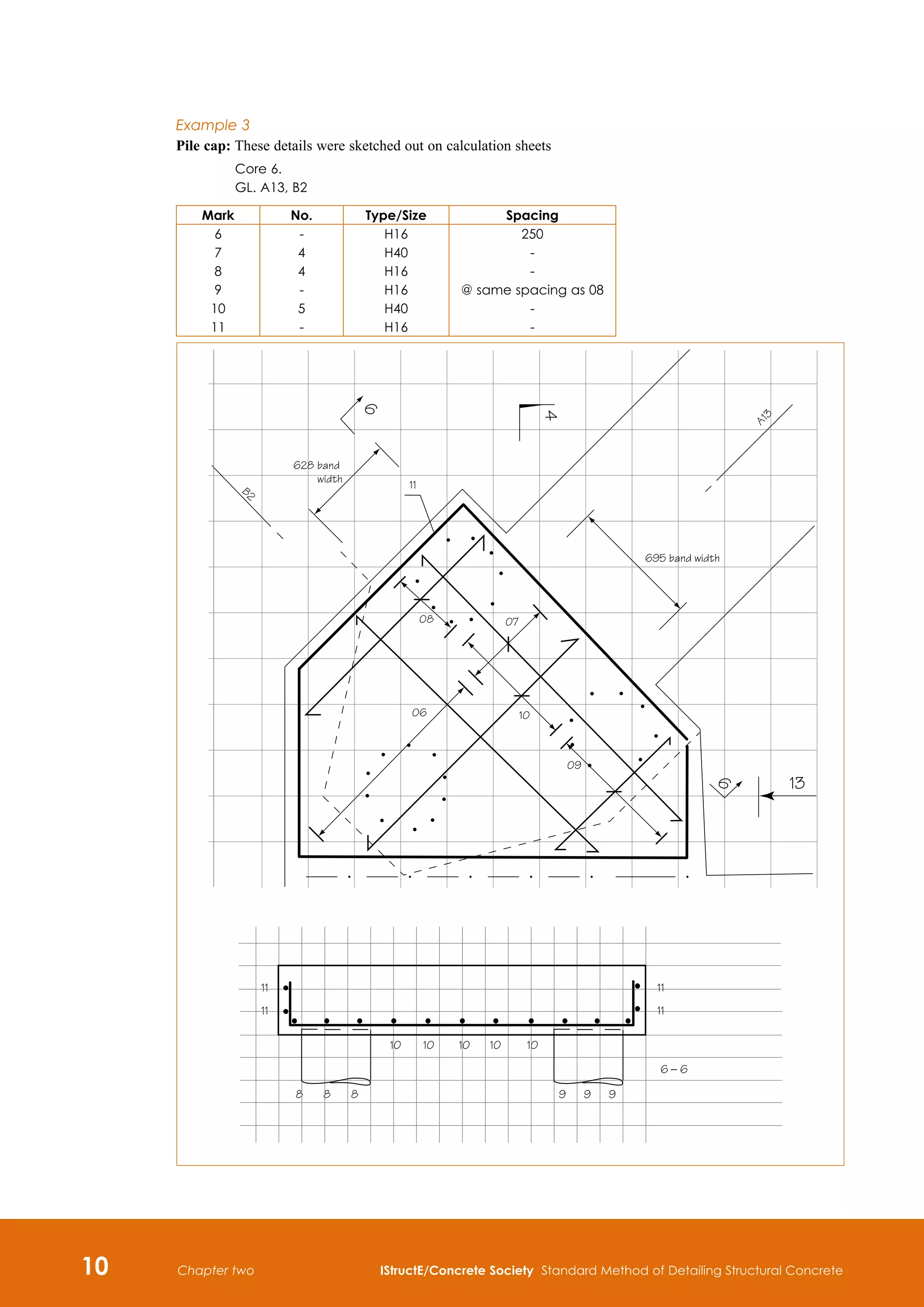
Example 3
Pile cap: 
These details were sketched out on calculation sheets
	
Core 6.
GL. A13, B2
Mark No. Type/Size Spacing
6
7
8
9
10
11
-
4
4
-
5
-
H16
H40
H16
H16
H40
H16
250
-
-
@ same spacing as 08
-
-
IStructE/Concrete Society Standard Method of Detailing Structural Concrete 11
Chapter two
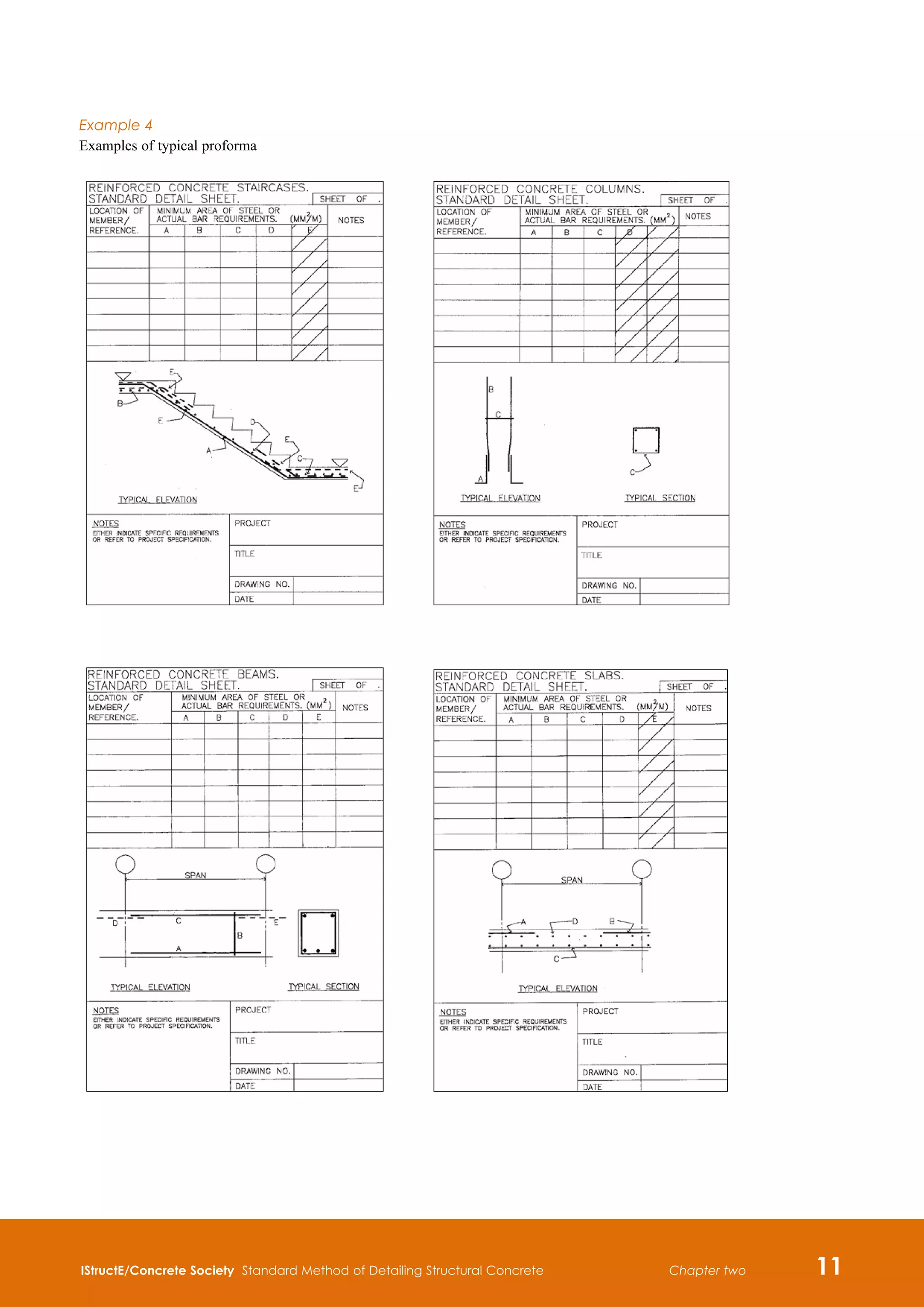
Example 4
Examples of typical proforma
12 IStructE/Concrete Society Standard Method of Detailing Structural Concrete
Chapter three
3.1	 General
Drawings are prepared so that the Designer can
communicate his requirements in a clear, concise
and unambiguous manner. It is important to ensure
that drawings are not unnecessarily congested or
complicated.
Drawings sent to the Detailer (or Contractor
Detailer) are likely to be electronic.
Drawings used on construction sites will get
dirty, wet and dog-eared. The clarity of the original
drawing that will be reproduced is, therefore, most
important.
It is recommended that A1 size drawings are
generally used for General Arrangements, larger sized
drawings being used only when unavoidable. A3 and
A4 are recommended for details. For each project,
the chosen drawing size should be used consistently.
The written descriptions on drawings should be as
brief as possible, consistent with completeness, and
the lettering should be clear. Any instructions on
drawings should be positive; they should be written
in the imperative.
Each drawing should give all the information
(together with reference to associated drawings)
necessary for the construction of the portion of the
work shown, omitting other irrelevant detail. Details
of materials to be used will normally be given in a
separate specification, and reference to the concrete
or other types of material on drawings will be in an
abbreviated form.
Reference to any special items concerned
with construction details should be made on the
general arrangement drawings and not in a separate
letter or document. Special requirements of the
designer, e.g. details of cambers, chamfers, sequence
of construction, position and type of joints, etc.,
should all be described on the general arrangement
drawings.
3.2	Types of drawings
The main purpose of preparing structural drawings
is to explain the shape and position of all the
parts of the structure. Such drawings are used to
progress the Architect’s concept and then to enable
construction of the structure on site. Structural
drawings are also necessary for the preparation of
the reinforcement drawings.
3.2.1	 Structural drawings
Drawingsforconcretestructuresconsistofdimensional
data necessary for the setting out and construction of
the concrete formwork, e.g.:
•	
setting out of the concrete structure on site
•	
plans, sections and elevations where appropriate
showing layout, dimensions and levels of all
concrete members within the structure
•	
location of all holes, chases, pockets, fixings and
items affecting the concrete work
•	
north point
•	
notes on specifications, finishes and cross-
references of the construction.
They also provide the detailer with the layout and
sectional information required to specify the length,
shape and number of each type of reinforcing bar.
All these matters should be considered at the
outset of every drawing programme.
Detailed examples of structural layout drawings
and guidance notes are illustrated in 3.20.
3.2.2	 Reinforcement drawings
Reinforcement drawings describe and locate the
reinforcement in relation to the outline of the concrete
work and to relevant holes and fixings.
Generally, circular holes up to 150mm diameter
and rectangular holes up to 150 × 150mm in slabs
or walls need not be indicated on the reinforcement
drawings. All other holes should be indicated on the
reinforcement drawing and should be trimmed, where
necessary, by suitable reinforcing bars.
Separate drawings or plans for top and bottom
layers of reinforcement should be used only
for fabric and in exceptional cases, e.g. voided
bridge decks and box girders with four layers of
reinforcement.
Reinforcement drawings are primarily for the
use of the steel fixers. It is preferable that general
arrangement and reinforcement drawings be kept
separate, but for simple structures a combined drawing
may be appropriate.
3.2.3	 Standard details
Standard details are those details that are used on
a repetitive basis. Details used in this way must
be carefully worked out, fully detailed and totally
3 Drawings
IStructE/Concrete Society Standard Method of Detailing Structural Concrete 13
Chapter three
applicable to each location where they are to be
specified. Standard details may apply to concrete
profiles or reinforcement arrangements, and they
should be drawn to a large scale.
3.2.4	 Diagrams
Diagrams may be used as a means of communicating
design ideas during both pre-contract work and the
post-contract period. Diagrams may be formally
presented or sketched freehand providing they convey
information clearly, neatly and in detail.
The information contained in diagrams should be
drawn to scale.
3.2.5	 Record drawings
When the reinforced concrete structure has been
constructed, the original drawings used for the
construction process should be amended to indicate
any changes in detail that were made during the
construction process. A suffix reference should be
added to the drawing number to indicate the drawing
is a ‘record’ drawing. The amendments should be
described in writing against the appropriate suffix
reference. A register of drawings should be kept
listing reference numbers, titles and recipients of
drawings. The record drawings should be included in
the Safety Plan compiled under CDM Regulations14
and submitted to the client for safekeeping at
handover of the project.
3.3	Photocopying and reduction
There are a number of considerations that must be
made if photographically reduced drawings are to
be fully intelligible in their reduced form (see 3.15).
These include:
•	
the chosen range of line thickness
•	
the size and nature of the script used
•	
the arrangement of the information on the
drawings, avoiding congestion
•	
the need to ensure that graphic and script
information is, as far as possible, kept separate
•	
the possibility that solid black areas will not print
properly.
Since many drawings will be reduced for archive
storage on completion of the construction, all these
matters should be considered at the outset of every
drawing programme.
It is recommended that checking of reinforcement
is undertaken on full size prints. Errors can easily
occur if reduced sizes prints are used, e.g. A1 to A3.
3.4	Abbreviations
Standard abbreviations are recommended but, if there
is any risk of confusion or ambiguity with their use in
any particular circumstances, then the words should
be written in full. No other abbreviations should be
used unless clearly defined on all the drawings on
which they appear.
Particular attention is drawn to the use of lower
case and capital letters. All abbreviations are the same
in the plural as in the singular. The following symbols
are commonly used:
reinforced concrete	 RC
blockwork	 blk
brickwork	 bwk
drawing	 drg
full size	 FS
not to scale	 NTS
diameter	 dia or b
centres	 crs
setting-out point	 SOP
setting-out line	 SOL
centre-line	
finished floor level	 FFL
structural slab level	 SSL
existing level	 EL
horizontal	 horiz
vertical	 vert
pocket	 pkt
3.5	Dimensions of drawing sheets
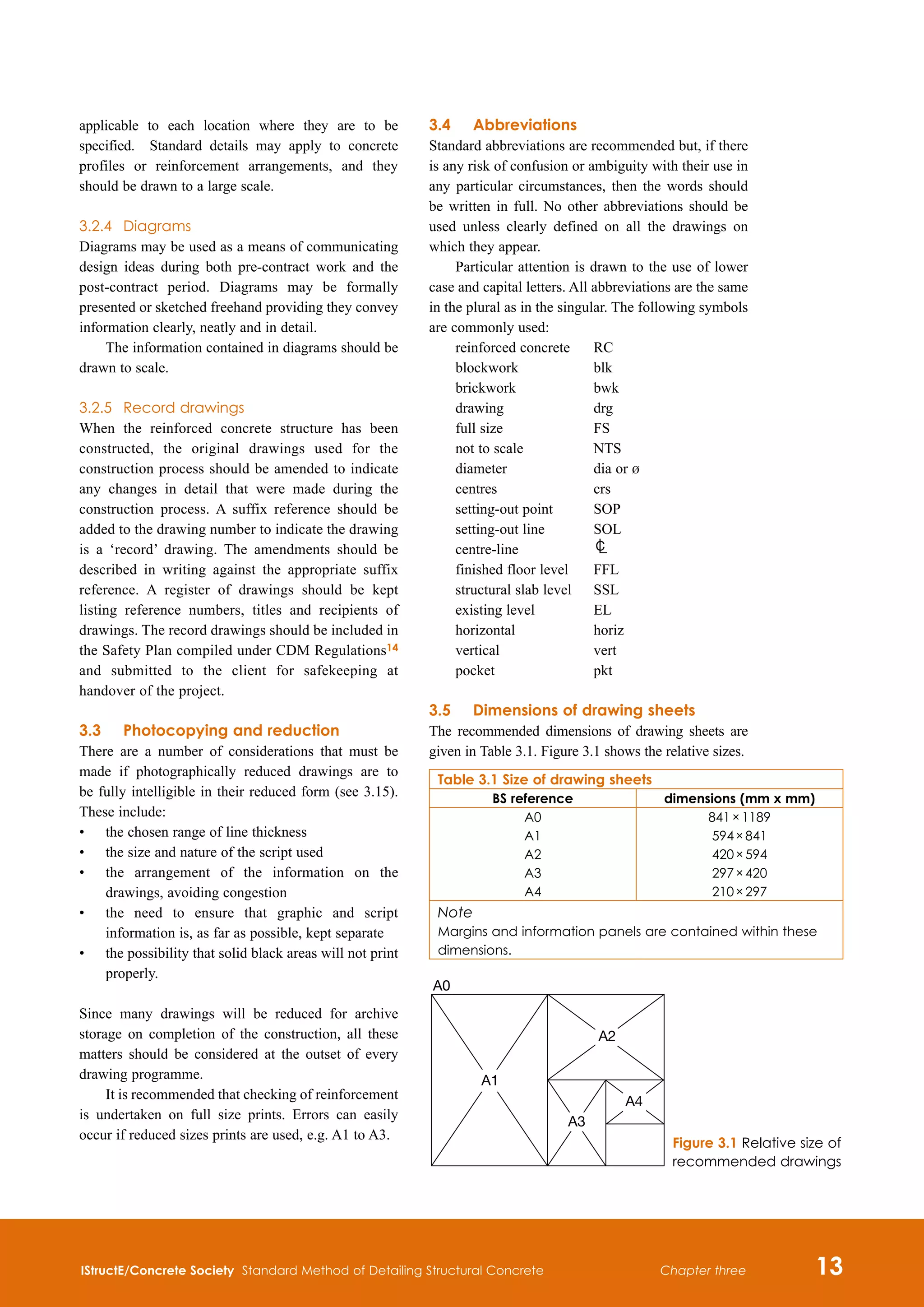
The recommended dimensions of drawing sheets are
given in Table 3.1. Figure 3.1 shows the relative sizes.
Table 3.1 Size of drawing sheets
BS reference dimensions (mm x mm)
A0
A1
A2
A3
A4
841 × 1189
594 × 841
420 × 594
297 × 420
210 × 297
Note
Margins and information panels are contained within these
dimensions.
A0
A4
A3
A2
A1
Figure 3.1 Relative size of
recommended drawings
14 IStructE/Concrete Society Standard Method of Detailing Structural Concrete
Chapter three
3.6	 Borders
All drawings should have a 20mm filing border on the
left-hand side. Elsewhere the border should be 20mm
(minimum) for A0 and Al and 10mm (minimum) for
A2, A3 and A4. The border margin line should be at
least 0.5mm thick.
3.7	Title and information panels
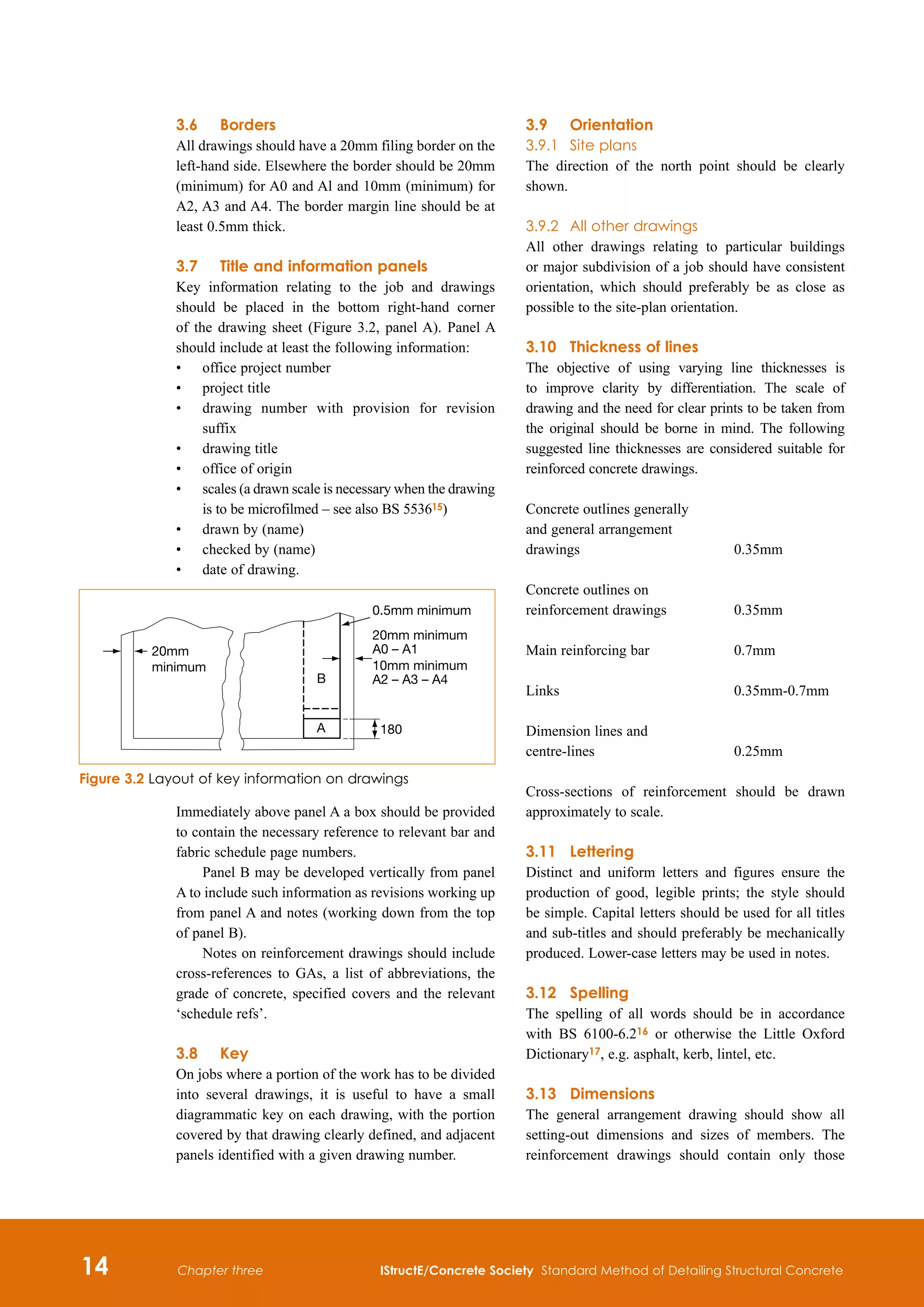
Key information relating to the job and drawings
should be placed in the bottom right-hand corner
of the drawing sheet (Figure 3.2, panel A). Panel A
should include at least the following information:
•	
office project number
•	
project title
•	
drawing number with provision for revision
suffix
•	
drawing title
•	
office of origin
•	
scales (a drawn scale is necessary when the drawing
is to be microfilmed – see also BS 553615)
•	
drawn by (name)
•	
checked by (name)
•	
date of drawing.
Immediately above panel A a box should be provided
to contain the necessary reference to relevant bar and
fabric schedule page numbers.
Panel B may be developed vertically from panel
A to include such information as revisions working up
from panel A and notes (working down from the top
of panel B).
Notes on reinforcement drawings should include
cross-references to GAs, a list of abbreviations, the
grade of concrete, specified covers and the relevant
‘schedule refs’.
3.8	 Key
On jobs where a portion of the work has to be divided
into several drawings, it is useful to have a small
diagrammatic key on each drawing, with the portion
covered by that drawing clearly defined, and adjacent
panels identified with a given drawing number.
3.9	Orientation
3.9.1	 Site plans
The direction of the north point should be clearly
shown.
3.9.2	 All other drawings
All other drawings relating to particular buildings
or major subdivision of a job should have consistent
orientation, which should preferably be as close as
possible to the site-plan orientation.
3.10	Thickness of lines
The objective of using varying line thicknesses is
to improve clarity by differentiation. The scale of
drawing and the need for clear prints to be taken from
the original should be borne in mind. The following
suggested line thicknesses are considered suitable for
reinforced concrete drawings.
Concrete outlines generally
and general arrangement
drawings 	 0.35mm
Concrete outlines on
reinforcement drawings 	 0.35mm
Main reinforcing bar 	 0.7mm
Links 	 0.35mm-0.7mm
Dimension lines and
centre-lines 	 0.25mm
Cross-sections of reinforcement should be drawn
approximately to scale.
3.11	 Lettering
Distinct and uniform letters and figures ensure the
production of good, legible prints; the style should
be simple. Capital letters should be used for all titles
and sub-titles and should preferably be mechanically
produced. Lower-case letters may be used in notes.
3.12	 Spelling
The spelling of all words should be in accordance
with BS 6100-6.216 or otherwise the Little Oxford
Dictionary17, e.g. asphalt, kerb, lintel, etc.
3.13	Dimensions
The general arrangement drawing should show all
setting-out dimensions and sizes of members. The
reinforcement drawings should contain only those
B
A 180
0.5mm minimum
20mm minimum
A0 – A1
10mm minimum
A2 – A3 – A4
20mm
minimum
Figure 3.2 Layout of key information on drawings
IStructE/Concrete Society Standard Method of Detailing Structural Concrete 15
Chapter three
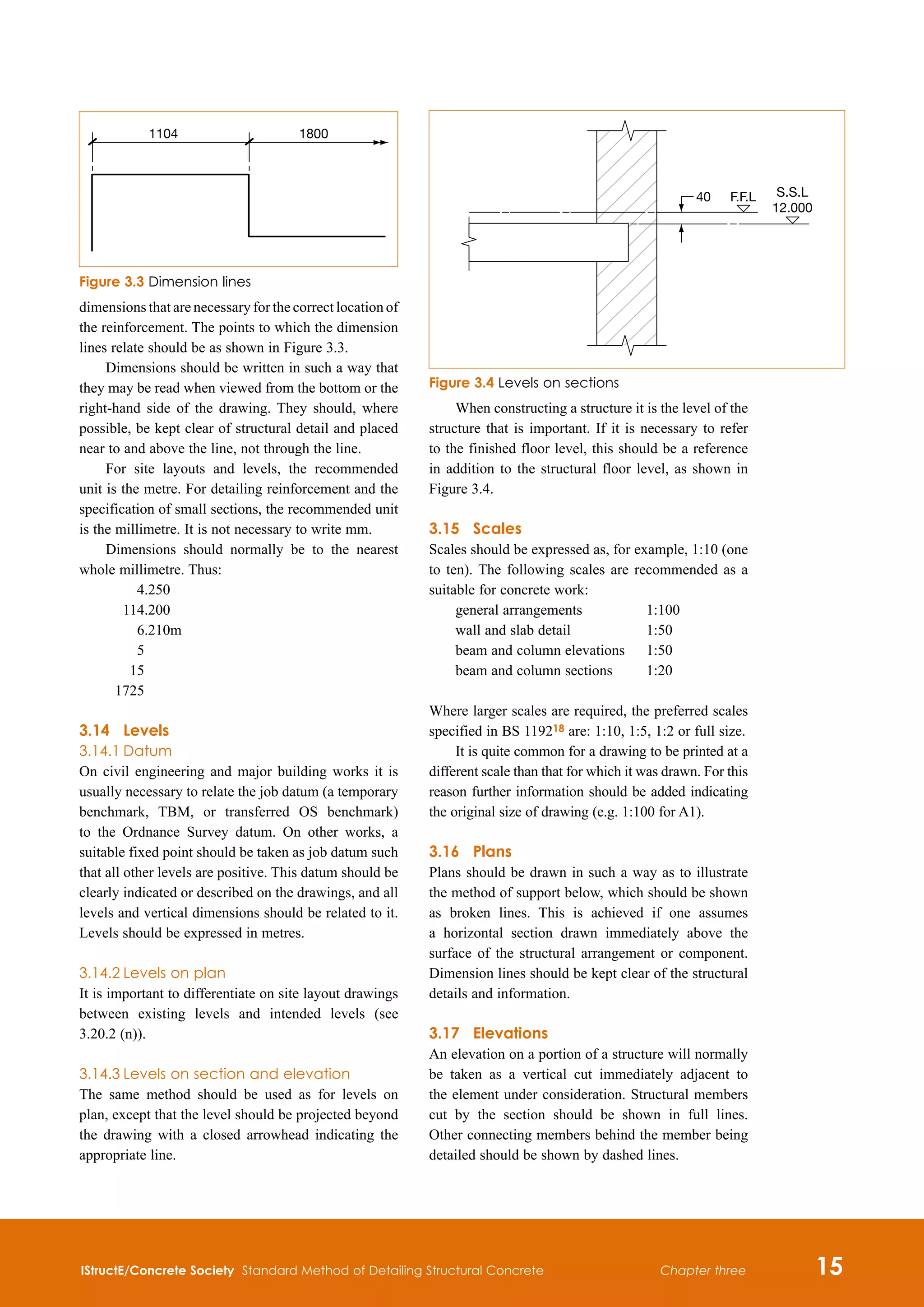
dimensions that are necessary for the correct location of
the reinforcement. The points to which the dimension
lines relate should be as shown in Figure 3.3.
Dimensions should be written in such a way that
they may be read when viewed from the bottom or the
right-hand side of the drawing. They should, where
possible, be kept clear of structural detail and placed
near to and above the line, not through the line.
For site layouts and levels, the recommended
unit is the metre. For detailing reinforcement and the
specification of small sections, the recommended unit
is the millimetre. It is not necessary to write mm.
Dimensions should normally be to the nearest
whole millimetre. Thus:
	 4.250
	 114.200
	 6.210m
	 5
	 15
	 1725
3.14	 Levels
3.14.1	Datum
On civil engineering and major building works it is
usually necessary to relate the job datum (a temporary
benchmark, TBM, or transferred OS benchmark)
to the Ordnance Survey datum. On other works, a
suitable fixed point should be taken as job datum such
that all other levels are positive. This datum should be
clearly indicated or described on the drawings, and all
levels and vertical dimensions should be related to it.
Levels should be expressed in metres.
3.14.2	Levels on plan
It is important to differentiate on site layout drawings
between existing levels and intended levels (see
3.20.2 (n)).
3.14.3	Levels on section and elevation
The same method should be used as for levels on
plan, except that the level should be projected beyond
the drawing with a closed arrowhead indicating the
appropriate line.
When constructing a structure it is the level of the
structure that is important. If it is necessary to refer
to the finished floor level, this should be a reference
in addition to the structural floor level, as shown in
Figure 3.4.
3.15	 Scales
Scales should be expressed as, for example, 1:10 (one
to ten). The following scales are recommended as a
suitable for concrete work:
general arrangements	 1:100
wall and slab detail	 1:50
beam and column elevations	 1:50
beam and column sections	 1:20
Where larger scales are required, the preferred scales
specified in BS 119218 are: 1:10, 1:5, 1:2 or full size.
It is quite common for a drawing to be printed at a
different scale than that for which it was drawn. For this
reason further information should be added indicating
the original size of drawing (e.g. 1:100 for A1).
3.16	Plans
Plans should be drawn in such a way as to illustrate
the method of support below, which should be shown
as broken lines. This is achieved if one assumes
a horizontal section drawn immediately above the
surface of the structural arrangement or component.
Dimension lines should be kept clear of the structural
details and information.
3.17	 Elevations
An elevation on a portion of a structure will normally
be taken as a vertical cut immediately adjacent to
the element under consideration. Structural members
cut by the section should be shown in full lines.
Other connecting members behind the member being
detailed should be shown by dashed lines.
1104 1800
Figure 3.3 Dimension lines
40 F.F.L S.S.L
12.000
Figure 3.4 Levels on sections
16 IStructE/Concrete Society Standard Method of Detailing Structural Concrete
Chapter three
3.18	 Sections
Where sections are taken through structural elements,
only the material in the cutting plane is shown on
a section; in general a cut showing features beyond
should not be used. For clarity, the cut member
may be shaded. The directions of sections should
be taken looking consistently in the same direction,
looking towards the left for beams and downwards
for columns. A section should be drawn as near as
possible to the detail to which it relates.
3.19	 Grid lines and a recommended
reference system
A grid system provides a convenient datum for
locating and referencing members, since columns are
usually placed at or near the intersection of grid lines
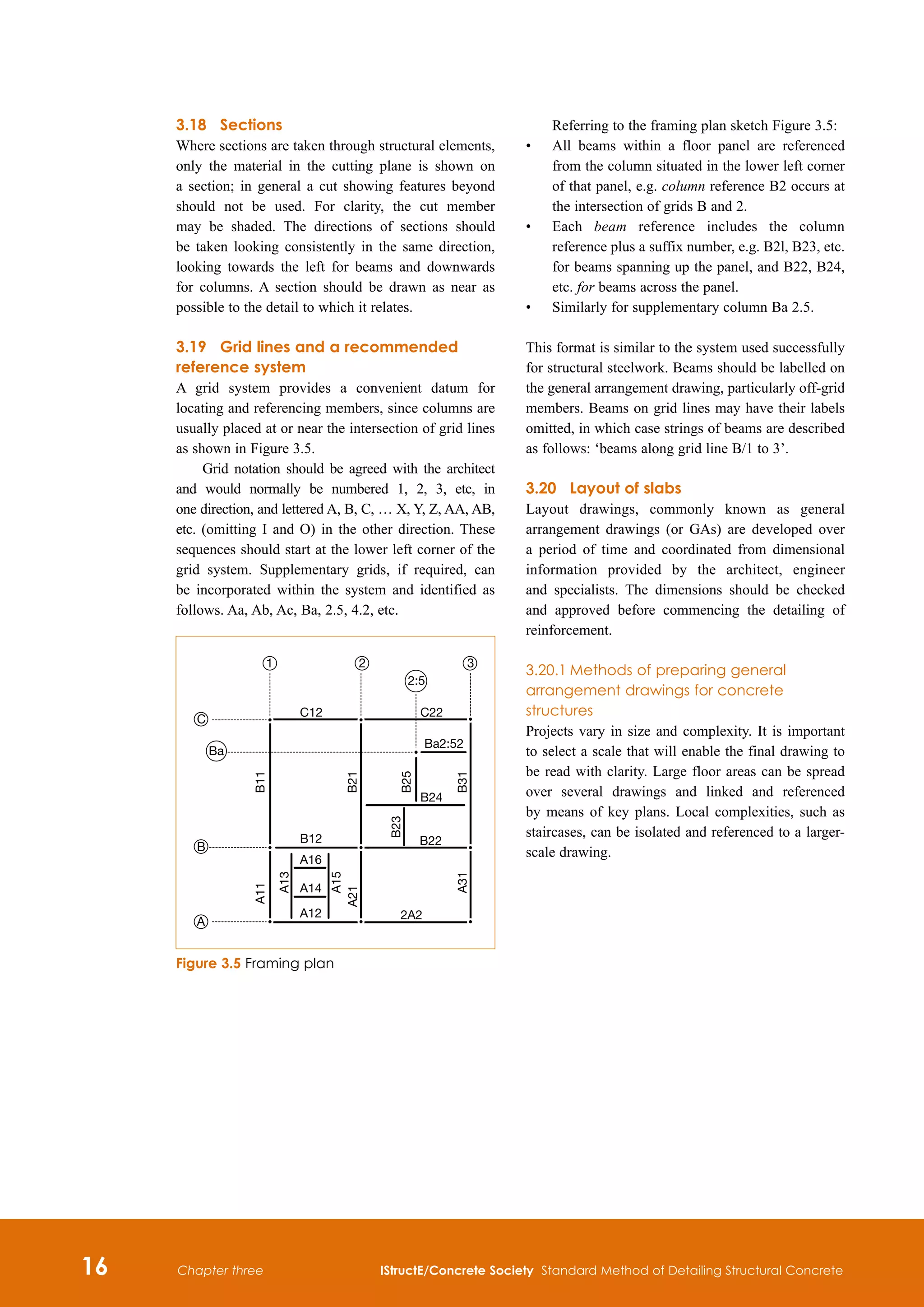
as shown in Figure 3.5.
Grid notation should be agreed with the architect
and would normally be numbered 1, 2, 3, etc, in
one direction, and lettered A, B, C, … X, Y, Z, AA, AB,
etc. (omitting I and O) in the other direction. These
sequences should start at the lower left corner of the
grid system. Supplementary grids, if required, can
be incorporated within the system and identified as
follows. Aa, Ab, Ac, Ba, 2.5, 4.2, etc.
Referring to the framing plan sketch Figure 3.5:
•	
All beams within a floor panel are referenced
from the column situated in the lower left corner
of that panel, e.g. column reference B2 occurs at
the intersection of grids B and 2.
•	
Each beam reference includes the column
reference plus a suffix number, e.g. B2l, B23, etc.
for beams spanning up the panel, and B22, B24,
etc. for beams across the panel.
•	
Similarly for supplementary column Ba 2.5.
This format is similar to the system used successfully
for structural steelwork. Beams should be labelled on
the general arrangement drawing, particularly off-grid
members. Beams on grid lines may have their labels
omitted, in which case strings of beams are described
as follows: ‘beams along grid line B/1 to 3’.
3.20	 Layout of slabs
Layout drawings, commonly known as general
arrangement drawings (or GAs) are developed over
a period of time and coordinated from dimensional
information provided by the architect, engineer
and specialists. The dimensions should be checked
and approved before commencing the detailing of
reinforcement.
3.20.1	Methods of preparing general
arrangement drawings for concrete
structures
Projects vary in size and complexity. It is important
to select a scale that will enable the final drawing to
be read with clarity. Large floor areas can be spread
over several drawings and linked and referenced
by means of key plans. Local complexities, such as
staircases, can be isolated and referenced to a larger-
scale drawing.
C
B
A
Ba
1 2 3
2:5
C12
B12
B11
A11
B21
B25
B23
B31
A31
A15
A21
A13
A16
A14
A12
C22
B22
2A2
B24
Ba2:52
Figure 3.5 Framing plan
IStructE/Concrete Society Standard Method of Detailing Structural Concrete 17
Chapter three
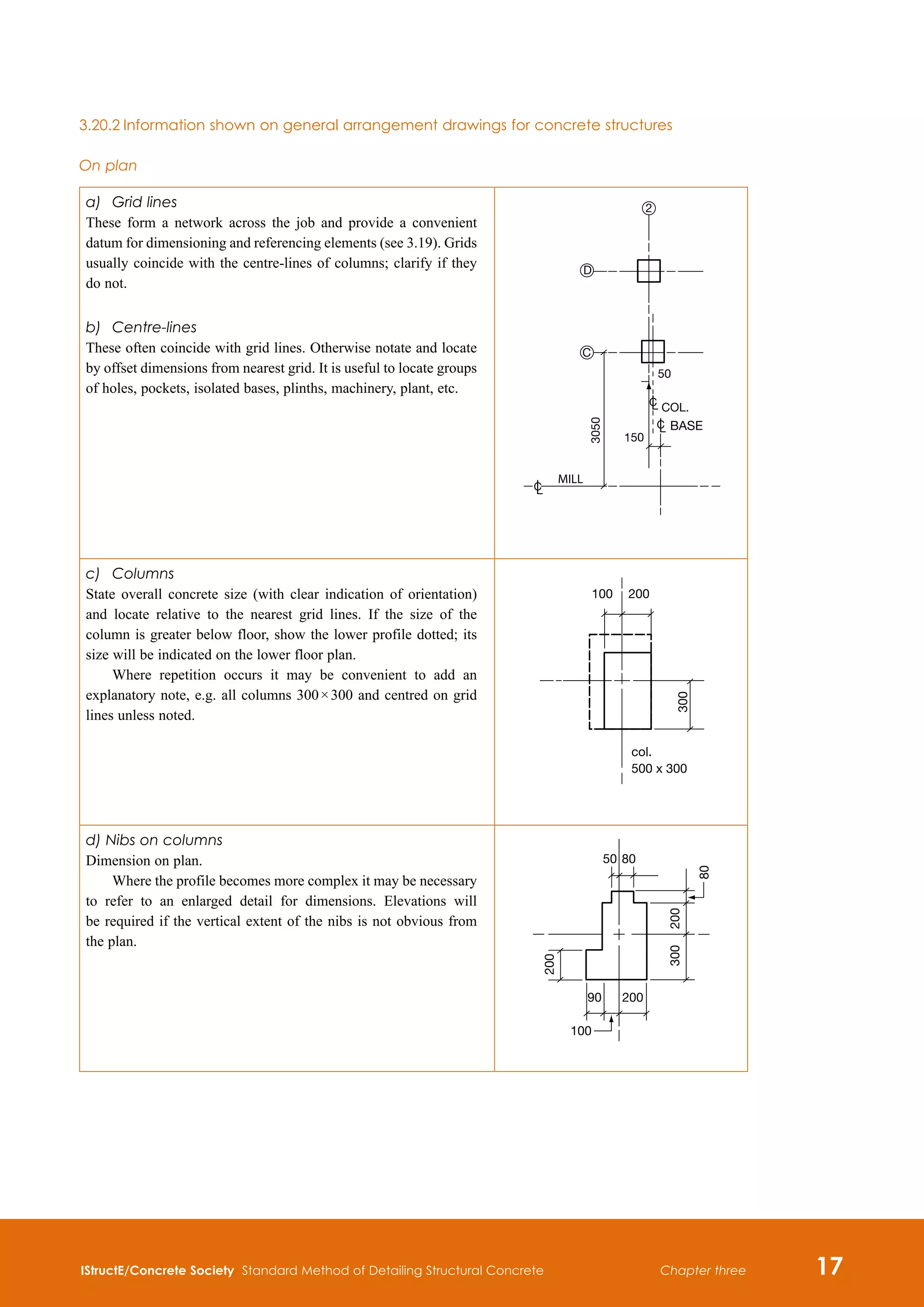
3.20.2	Information shown on general arrangement drawings for concrete structures
On plan
a)	 Grid lines
These form a network across the job and provide a convenient
datum for dimensioning and referencing elements (see 3.19). Grids
usually coincide with the centre-lines of columns; clarify if they
do not.
b)	 Centre-lines
These often coincide with grid lines. Otherwise notate and locate
by offset dimensions from nearest grid. It is useful to locate groups
of holes, pockets, isolated bases, plinths, machinery, plant, etc.
c)	 Columns
State overall concrete size (with clear indication of orientation)
and locate relative to the nearest grid lines. If the size of the
column is greater below floor, show the lower profile dotted; its
size will be indicated on the lower floor plan.
Where repetition occurs it may be convenient to add an
explanatory note, e.g. all columns 300 × 300 and centred on grid
lines unless noted.
d) Nibs on columns
Dimension on plan.
Where the profile becomes more complex it may be necessary
to refer to an enlarged detail for dimensions. Elevations will
be required if the vertical extent of the nibs is not obvious from
the plan.
2
D
50
150
3050
COL.
C
C
C
C
BASE
MILL
500 x 300
col.
100 200
300
50 80
80
90
100
200
200
200
300
18 IStructE/Concrete Society Standard Method of Detailing Structural Concrete
Chapter three
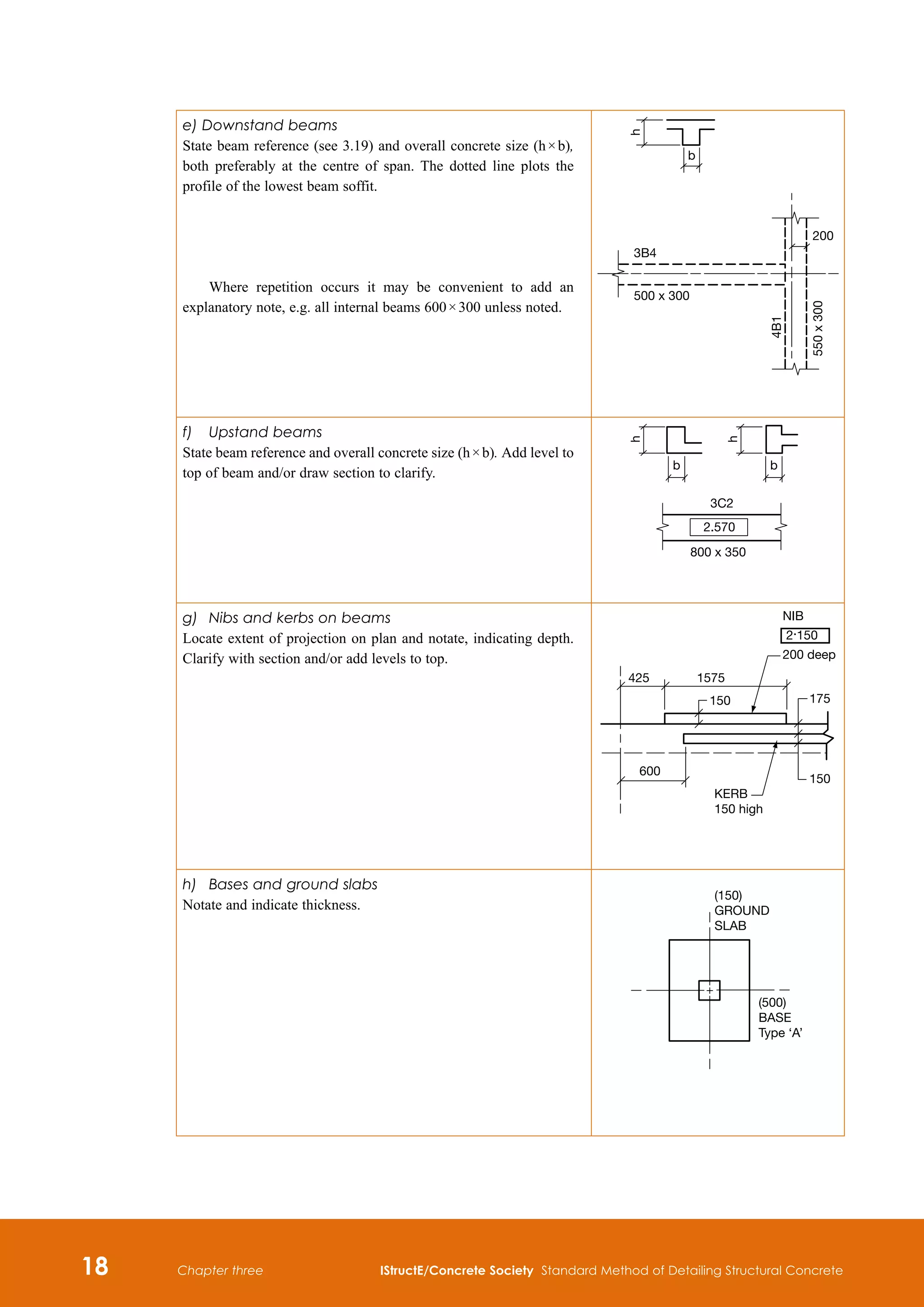
e) Downstand beams
State beam reference (see 3.19) and overall concrete size (h × b),
both preferably at the centre of span. The dotted line plots the
profile of the lowest beam soffit.
Where repetition occurs it may be convenient to add an
explanatory note, e.g. all internal beams 600 × 300 unless noted.
h
b
550
x
300
500 x 300
200
4B1
3B4
f)	 Upstand beams
State beam reference and overall concrete size (h × b). Add level to
top of beam and/or draw section to clarify.
h
3C2
2.570
800 x 350
b
h
b
g)	 Nibs and kerbs on beams
Locate extent of projection on plan and notate, indicating depth.
Clarify with section and/or add levels to top.
NIB
2.150
200 deep
150
150
600
KERB
150 high
175
425 1575
h)	 Bases and ground slabs
Notate and indicate thickness.
(150)
GROUND
SLAB
(500)
BASE
Type ‘A’
IStructE/Concrete Society Standard Method of Detailing Structural Concrete 19
Chapter three
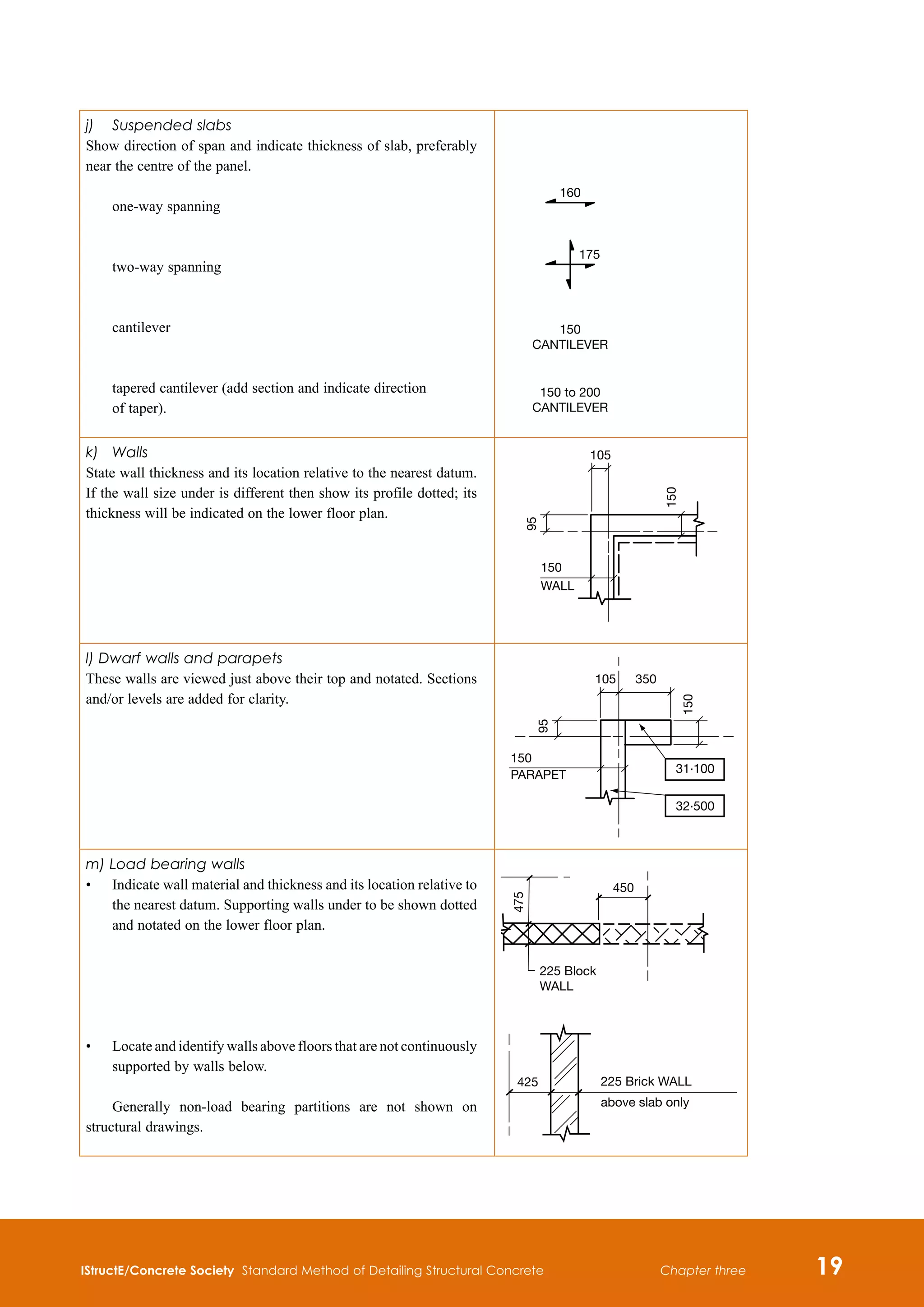
j)	 Suspended slabs
Show direction of span and indicate thickness of slab, preferably
near the centre of the panel.
one-way spanning
two-way spanning
cantilever

tapered cantilever (add section and indicate direction
of taper).
k)	 Walls
State wall thickness and its location relative to the nearest datum.
If the wall size under is different then show its profile dotted; its
thickness will be indicated on the lower floor plan.
105
150
95
150
WALL
l) Dwarf walls and parapets
These walls are viewed just above their top and notated. Sections
and/or levels are added for clarity.
m) Load bearing walls
•	
Indicate wall material and thickness and its location relative to
the nearest datum. Supporting walls under to be shown dotted
and notated on the lower floor plan.
•	
Locate and identify walls above floors that are not continuously
supported by walls below.
Generally non-load bearing partitions are not shown on
structural drawings.
150
CANTILEVER
150 to 200
CANTILEVER
160
175
150
PARAPET
150
95
105 350
31.100
32.500
450
475
225 Block
WALL
425 225 Brick WALL
above slab only
20 IStructE/Concrete Society Standard Method of Detailing Structural Concrete
Chapter three
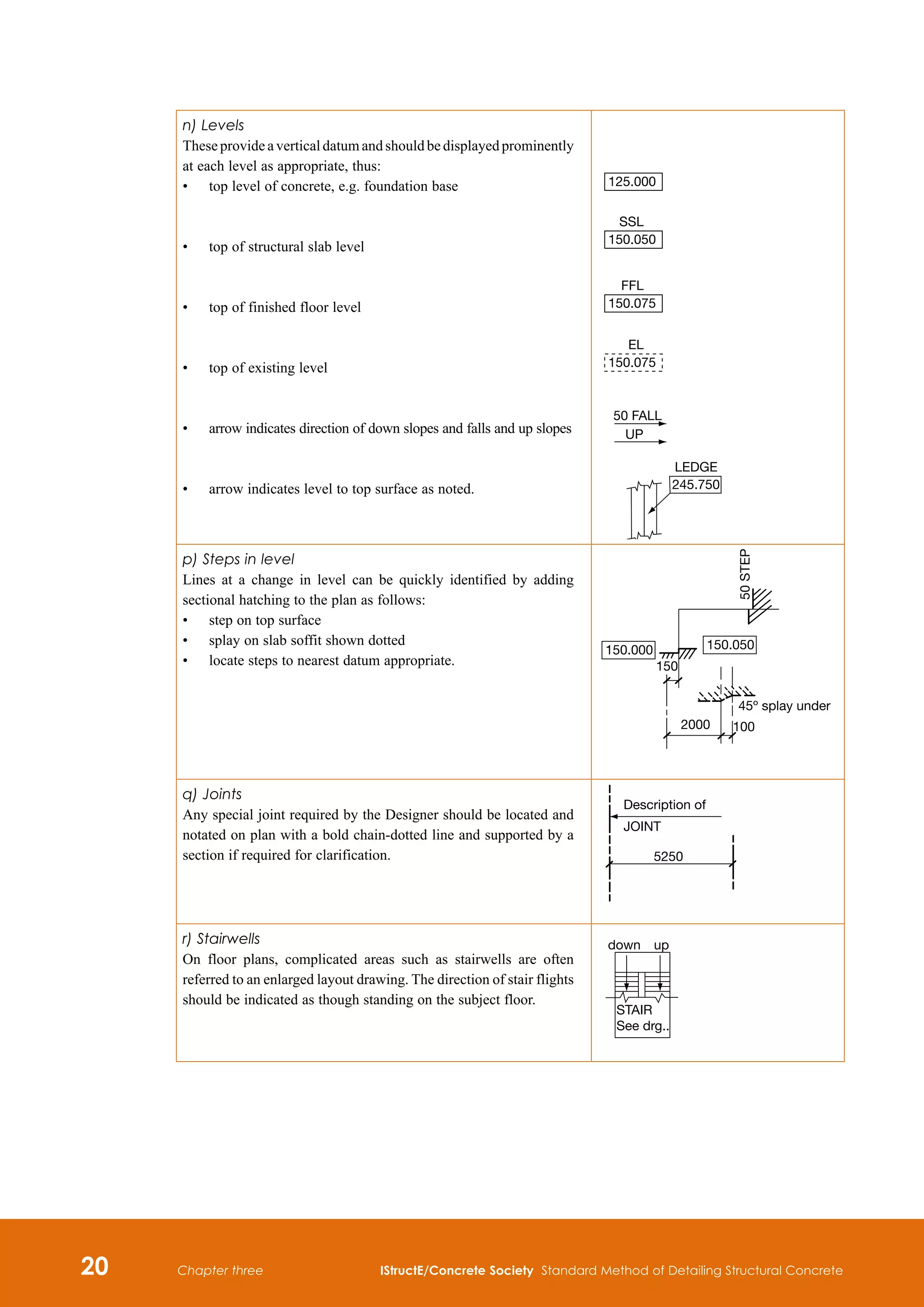
n) Levels
These provide a vertical datum and should be displayed prominently
at each level as appropriate, thus:
•	 top level of concrete, e.g. foundation base
•	 top of structural slab level
•	 top of finished floor level
•	 top of existing level	
•	
arrow indicates direction of down slopes and falls and up slopes
•	 arrow indicates level to top surface as noted.
p) Steps in level
Lines at a change in level can be quickly identified by adding
sectional hatching to the plan as follows:
•	 step on top surface
•	 splay on slab soffit shown dotted
•	 locate steps to nearest datum appropriate.
150.000 150.050
2000
150
45º splay under
100
50
STEP
q) Joints
Any special joint required by the Designer should be located and
notated on plan with a bold chain-dotted line and supported by a
section if required for clarification.
Description of
JOINT
5250
r) Stairwells
On floor plans, complicated areas such as stairwells are often
referred to an enlarged layout drawing. The direction of stair flights
should be indicated as though standing on the subject floor.
STAIR
See drg..
down up
125.000
150.050
SSL
FFL
EL
150.075
150.075
50 FALL
UP
245.750
LEDGE
125.000
150.050
SSL
FFL
EL
150.075
150.075
50 FALL
UP
245.750
LEDGE
125.000
150.050
SSL
FFL
EL
150.075
150.075
50 FALL
UP
245.750
LEDGE
125.000
150.050
SSL
FFL
EL
150.075
150.075
50 FALL
UP
245.750
LEDGE
125.000
150.050
SSL
FFL
EL
150.075
150.075
50 FALL
UP
245.750
LEDGE
125.000
150.050
SSL
FFL
EL
150.075
150.075
50 FALL
UP
245.750
LEDGE
IStructE/Concrete Society Standard Method of Detailing Structural Concrete 21
Chapter three
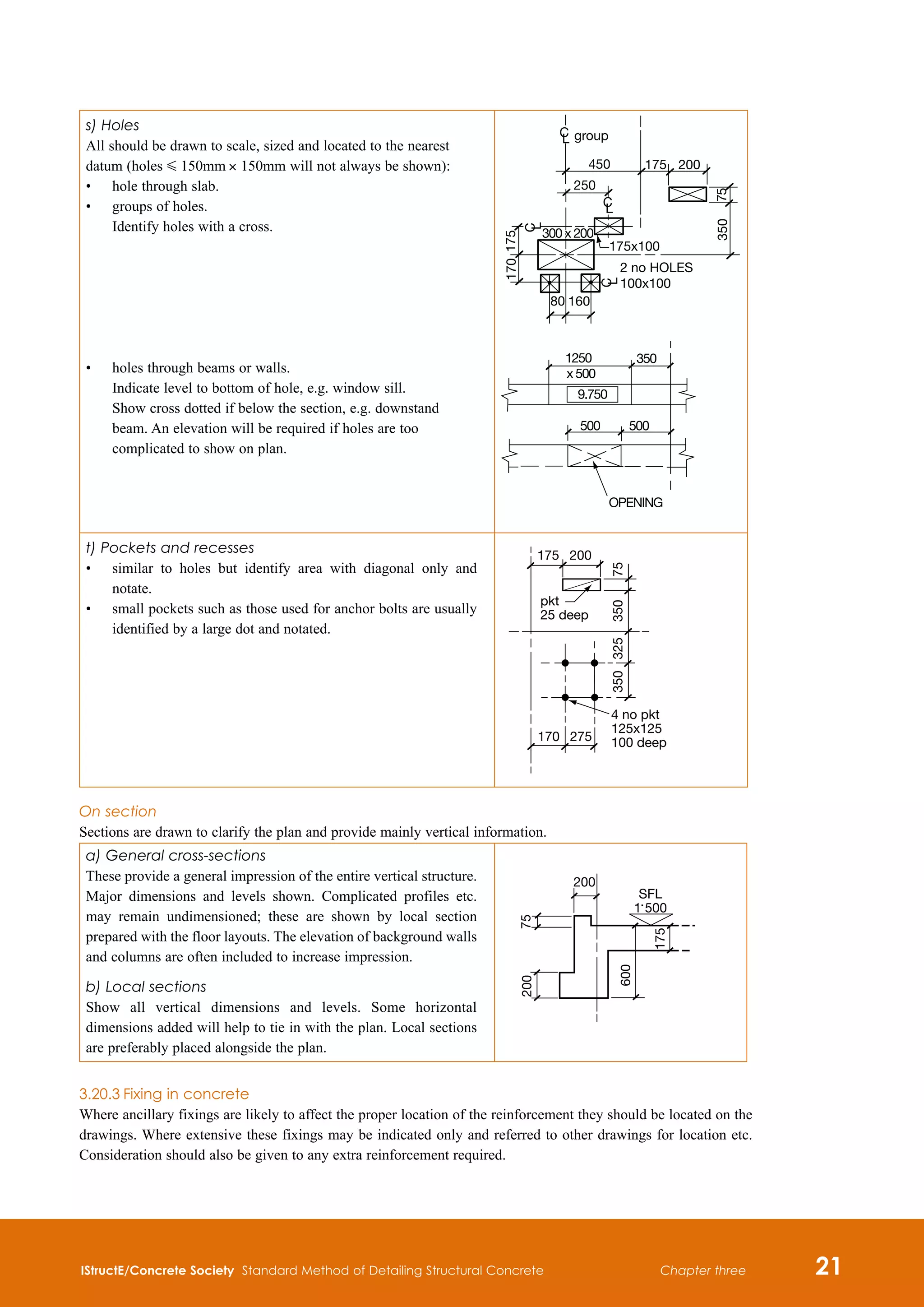
s) Holes
All should be drawn to scale, sized and located to the nearest
datum (holes G 150mm × 150mm will not always be shown):
•	 hole through slab.
•	
groups of holes.
Identify holes with a cross.
•	
holes through beams or walls.
Indicate level to bottom of hole, e.g. window sill.
Show cross dotted if below the section, e.g. downstand
beam. An elevation will be required if holes are too
complicated to show on plan.
450 175 200
C
L group
75
350
175x100
80 160
170
175
250
C
L
2 no HOLES
100x100
300 x 200
C
L
C
L
1250 350
x 500
9.750
500 500
OPENING
t) Pockets and recesses
•	
similar to holes but identify area with diagonal only and
notate.
•	
small pockets such as those used for anchor bolts are usually
identified by a large dot and notated.
175 200
170 275
pkt
25 deep
4 no pkt
125x125
100 deep
350
75
325
350
On section
Sections are drawn to clarify the plan and provide mainly vertical information.
a) General cross-sections
These provide a general impression of the entire vertical structure.
Major dimensions and levels shown. Complicated profiles etc.
may remain undimensioned; these are shown by local section
prepared with the floor layouts. The elevation of background walls
and columns are often included to increase impression.
b) Local sections
Show all vertical dimensions and levels. Some horizontal
dimensions added will help to tie in with the plan. Local sections
are preferably placed alongside the plan.
200
75
200
600
175
SFL
1 500
.
3.20.3	Fixing in concrete
Where ancillary fixings are likely to affect the proper location of the reinforcement they should be located on the
drawings. Where extensive these fixings may be indicated only and referred to other drawings for location etc.
Consideration should also be given to any extra reinforcement required.
22 IStructE/Concrete Society Standard Method of Detailing Structural Concrete
Chapter three
3.20.4	Example of general arrangement drawing for concrete structures
150 3750
KERB
150 high
150
H42
450 x 300
250
250
550
250
150 STEP
150
600
x
300
G51
7000
G41
450
x
300
SSL
112.000
150
WALL
PLINTH
1500 x 750 x 300 high
with 4 no pkt
75 x 75 x 75 deep
G42
500 x 300
150
F41
450
x
300
1800
450 x 300
F42
150
150 STEP
F51
600
x
300
1350 500 500
250
4250 150
H52
600 x 300
500
G54 400 x 300
150
125
STAIR
See
drg....
300
x
250
NIB
200 deep
175
600
x
300
G53
1650
3450
112.150
600 x 300
F52
150
F61
600
x
300
400 x 300 COL.
500 x 300
G52
Down
125
Up
1100
500
SSL
125
G61
150
450
300
150
150
300
600
125
SSL
112.150
200
600
7TH FLOOR LAYOUT
All columns 300 x 300 and centred on grids, unless noted.
4 5 6
G
F
4 5 6
N
C
L
3000
175
175
1
1
H
C
L
C
L
IStructE/Concrete Society Standard Method of Detailing Structural Concrete 23
Chapter three
3.21	 Layout of foundations
The position of each foundation should be given
relative to the grid lines. The width, length and depth
should be given and the level of the bottom of the
foundation should be given relative to a given datum.
This information is often given in tabular form.
Each foundation should be given a distinguishing
letter that will serve as a cross-reference for the
foundation details detailed elsewhere.
The maximum allowable safe ground bearing
pressure should be shown in note form on the drawing.
The blinding thickness and type should be noted.
When piling is employed it is usual to have a
separate general arrangement or piling plan. This
takes the form of a plan, showing the position of piles
relative to grid lines, that contains a schedule and
notes which includes the following relevant items
depending upon the project:
•	 pile reference number
•	 diameter
•	 safe working load of pile
•	 imposed moment
•	 imposed horizontal force
•	 cut-off level
•	 minimum toe level
•	 angle of rake
•	 pile positional tolerances.
It is normally stated in the piling specification what the
horizontal dimensional permissible deviation should
be, but it should also be repeated on the piling plan.
3.22	 Layout of stairs
The stair structural layout or general-arrangement
drawing should indicate all the dimensions required to
set out the concrete profile as shown in Figure 3.6.
The architect will normally locate the stair
between floors using the top of the finishes as the
vertical datum. The height of risers will be equal but
the thickness of finish may vary, particularly at floors
and landings. It follows that structural risers may vary
in height. Treads may require sloping risers to provide
a nosing, and fillets may be needed to maintain a
constant waist thickness (see Figure 3.7).
It is often arranged that the finishes to nosings
of adjacent flights will line through across the stair.
Sometimes the junctions of all soffits are made to line
through.
Architectural
finishes shown
Flight
9 Equal treads
Flight
Flight
Landing
FFL
Soffit
FFL
Tread or going
Pitch
Riser
Pitch
FFL
Pitch line
Storey
height
20
Equal
risers
20
19
18
17
16
14
13
12
11
10
9
8
7
6
5
4
3 2
1
Figure 3.6 Typical stair notation
Vertical risers Sloping risers with fillets
Structural
waist
Structural
waist
Fillet
Finishes
Nosing
Going
Riser
Finishes
SFL
Structural tread
or going
Figure 3.7 Typical stair shapes
Finished risers equal Structural risers vary to
suit thickness of finish
Finishes to treads of
each flight line through
Finishes to soffit junction
line through
24 IStructE/Concrete Society Standard Method of Detailing Structural Concrete
Chapter four
4.1	Detailing techniques
The majority of detailing examples contained in this
report are based on a manual detailing system, detailing
fully all aspects of each element. This method, the
‘traditional’ method of detailing in the UK, tends to
be simpler to plan and operate than the other methods
listed below, but in certain circumstances takes longer
to produce.
4.1.1	 Tabular method of detailing
The tabular method may be adopted where a number
of concrete elements have a similar profile and
reinforcement arrangement but have differing
dimensions and quantity of reinforcement (see Tables
4.1a and b). A typical element is drawn, usually not to
scale, but visually representative of its shape, with the
dimensions and reinforcement given as code letters. A
table is given to show the actual values of these code
letters for each individual element.
Advantages
•	
a large number of similar elements may be
detailed on a few drawings
•	
quicker to produce and thus saves detailing time.
Disadvantages
•	
elements are not drawn to scale
•	
checking of drawings and schedules tends to take
longer and is more prone to error
•	
once alterations or additions are made, special
details may be required to which the initial tables
have to refer, this complicates the system and
leads to errors
•	
visual checks of drawings may be misleading.
4 Detailing and scheduling
Table 4.1 Examples of the tabular method of detailing
Table 4.1a Column bases
Base No. off X Y Z
Reinforcement
Level – C
B1 B2
7A, 7B, 7C 3 1800 1800 400 12 H20-1-150 12 H20-1-150 19.000
8A, 8B, 8C 3 1800 1350 400 9 H16-2-150 12 H20-1-150 19.000
Level C
B2
Elevation
B1
Z
75
Blinding
conc.
Plan
X
Y
B2
B1
1 - 1
E E
E E
F
A
B B
A
E E
E
F
2 - 2
E E
E
Lap
length
E
F
75 Kicker
Level D
Level C
A - A
Table 4.1b Column starters
Col No. off
Level Reinforcement
Sect Elev
Column dims
C D E F A B
7A, 7B, 7C, 7D 3 19.000 19.400 4 H32-3 3 H10-4-150 1-1 A-A 350 550
8C 3 19.500 19.950 6 H25-5 6 H10-6-150 + 6 H10-7-150 2-2 A-A 575 575
IStructE/Concrete Society Standard Method of Detailing Structural Concrete 25
Chapter four
4.1.2	 Template drawings/Typical details
These are used where a library of typical elements
and details have been set up. The advantage of these
drawings is obvious but care must be taken to ensure
that the details given do, in fact, apply to the condition
required. A check should also be made to ensure
that they reflect the requirements of the Client and
Architect.
4.1.3	 Overlay drawings
These are layers of information which are brought
together and printed to form a single drawing.
4.1.4	 Computer-aided detailing and
scheduling
Detailing and scheduling of a reinforced concrete
structure takes a significant part of the total design
time. Automatic methods of detailing and scheduling
now have a significant effect on the efficiency of
design office procedures.
The relative advantages of different computer-
aided methods vary from office to office depending
on the hardware, software and staff that are
available. It is important to note that computer-based
detailing and scheduling systems should be used in a
responsible way by a suitably experienced person in
order to achieve buildability.
4.2	Detailing reinforcement
4.2.1	 General
Reinforcement detailing should be kept as simple as
possible consistent with showing its shape and exact
location (a list of standard shapes is given in the
Tables at the end of this manual). The information
given on a drawing should be in accordance with
BS 86666. The standard sequence of description is
as follows:
Number, type and grade, size, mark, bar centres,
location or comment.
For example, in a slab 20H16-63-150B1 describes
20 No. high yield deformed bars of 16mm nominal
size at a pitch of 150mm in the bottom outer layer. The
bar mark is -63-.
The bar centres, location or comment, are not
usually required for beams and columns (see 6.3 and
6.4). To avoid confusion when totalling quantities for
entry on the schedule, the number of bars in a group
should be stated only once on the drawing.
The position of reinforcement should be
established by dimensions to the faces of the concrete
or the formwork. The notation for specifying the
layering of reinforcement should be as follows:
far (face)	 Fl	 (outer layer)	 F2	 (second layer)
near (face)	 Nl	 (outer layer)	 N2	(second layer)
bottom (face)	 B1	 (outer layer)	 B2	 (second layer)
top (face)	 T1	 (outer layer)	 T2	 (second layer)
Since the contractor may not be familiar with this
notation it should be illustrated by a sketch on the
relevant drawings.
All reinforcement that needs to be fixed in a
certain part before it can be concreted should be
detailed with that part, e.g. starters from a tank
floor into the walls should be detailed with the
floor. Although the elements of a structure, such as
beam, slabs and columns, are detailed separately, the
Designer and the Detailer should always consider each
element as a part of the entire structure. Frequently the
arrangement for reinforcement in an element will
affect the arrangement in the adjacent elements, and
the following cases often arise:
•	
at beam-to-column intersections where the
beam reinforcement must avoid the column
reinforcement, which is likely to be cast into the
concrete before the beam reinforcement is fixed
•	
at beam-to-beam intersections where the levels of
the several layers of reinforcement in each beam
must be such that they will pass over each other
and give the correct cover to the upper and lower
layers
•	
at slab-to-beam intersections the cover over the
reinforcement in the beam must be sufficient for
the top steel in the slab to pass over the beam with
the correct cover.
Generally it is advisable early in the design to establish
a system for achieving the above, particularly in
projects on which several detailers may be working
simultaneously on adjacent elements of the structure.
Detailing should be carried out so that
reinforcement cages can be prefabricated. Figure 4.1
shows a typical layout to achieve this. The decision to
preassemble the reinforcement will normally be taken
by the Contractor. However the Designer and Detailer
should bear the possibility in mind.
26 IStructE/Concrete Society Standard Method of Detailing Structural Concrete
Chapter four
4.2.2	 Intersection and layering of
reinforcement
The physical size and shape of bars affects how the
intersection and layering of bars is arranged. Figures
4.2, 4.3 and 4.4 show the intersection of a complex
beam and column intersection. The notes on the
figures provide guidance to the Detailer.
The following notes relate to Figures 4.2, 4.3
and 4.4:
1	
Every column bar must be retained by a link
except where the distance between column bars
is 150mm or less, in which case every other bar
should be retained by a link.
2	
Where column reinforcement is bent out, e.g.
top lift of column, the position should be
clearly shown in order to maintain the correct
concrete cover and clearance for slab and beam
reinforcement.
3	
Where the secondary-beam reinforcement
has increased top cover check that the resulting
reduction in lever arm is satisfactory (see
also 5.15).
Link hanger bars stop
short of column face
Primary
beam
Bottom span bars stop
short of column face
Bottom
support bars
Bottom span bars
stop short of
column face
Secondary
beam
Column bars
straight through
junction
Top support
bars primary
beam bars
placed above
secondary
beam bars
Figure 4.1 Internal beam/column intersection showing flexible detailing of reinforcement
IStructE/Concrete Society Standard Method of Detailing Structural Concrete 27
Chapter four
Column reinforcement
from above
cranked inside
Crank 1:10
Check that when column
bars are cranked in they
do not foul any other
reinforcement
1
10
50
Compression
or
tension
lap
depending
on
design
Kicker
See note 3
See note 2
Spacer bars
See enlarged detail
Hole for vibrator, allow
75mm space for every 300mm
of beam width
Check sufficient space for slab
reinforcement at correct cover
Cross ties at 1000 crs to limit
free height of link to 400mm
Nominal longitudinal lacing bar
Check concrete cover is
maintained to link
Check if chamfers
and fillets are required.
(They may affect the
cover to the reinforcement)
Figure 4.2 Elevation of reinforcement at beam/column intersection
28 IStructE/Concrete Society Standard Method of Detailing Structural Concrete
Chapter four
Space bars at 1000
Check that standard radius for both links and secondary
beam reinforcement will pass between main reinforcement
see 5.2.5
Link
Link
Beam bar
Check that if main bar is
displaced it will not foul
any other bar
If corner bar has to
move to the right use
smaller diameter to fit
into radius of link.
Check with Designer
Figure 4.3 Detail of beam corner
Returned leg of link
See note 2
See note 1
Check if chamfers are required.
They may affect the cover to
the reinforcement
Denotes column bars from below
Check that there is sufficient space between links to
allow concrete and a vibrator to pass through. When
calculating the actual space between links remember to
add the thickness of the returned legs of the link
With large columns it is
advisable to keep central area
free of links to allow access
for cleaning out formwork
prior to concreting
Figure 4.4 Plan of reinforcement at beam/column intersection
IStructE/Concrete Society Standard Method of Detailing Structural Concrete 29
Chapter four
4.2.3	 Preformed cages
The use of preformed cages can improve the speed
and efficiency of work on site (assuming adequate
storage, craneage and correct handling). It allows
the Contractor to assemble a large proportion of the
reinforcement in one place and from there to lift the
cages into position using cranes. Prefabrication of
reinforcement cages in either a designated site or off
site, may have site safety benefits.
Flexible detailing
The term ‘Flexible detailing’is used to mean the method
of detailing end bars separate from the main longitudinal
bars of an element. This method ensures that the correct
end cover can be achieved by a limited amount of
telescoping at the splice. It also encourages the detailing
of preformed cages. A typical example of this is the
detail of separate bottom splice bars at the supports of
continuous beams which lap on to the main span bars.
Internal beam/column intersection
(see Figure 4.1)
The beam/column intersection demonstrates some
basic rules in the preferred method of detailing such
cages, namely:
•	
neither the bottom span bars nor the link hanger
bars extend into the column, and
•	
continuity through the column is provided by the
main support bars and by bottom support bars of
appropriate sizes.
This arrangement of steel has two major advantages.
First, the links, bottom span bars and link hanger
bars can be completely prefabricated. Second, since
the support bars do not have to be positioned
in the corners of the links, there is considerable
scope, without resorting to cranking, for them to
be positioned to avoid column or intersecting beam
reinforcement.
External beam/column intersection
(see Figure 4.5)
Themethodofconnectingabeamwithanedgecolumn
should take account of the construction sequence.
U-bars may be placed into the column reinforcement.
These bars can be fitted after the column below has
been cast and before the prefabricated beam cage
is fixed in position. It is important to note that the
U-bars must be positioned as close to the far face of
the column as possible.
Figure 4.5 External beam/column intersection showing flexible detailing of reinforcement
30 IStructE/Concrete Society Standard Method of Detailing Structural Concrete
Chapter four
Where the design requires L-bars with the vertical
leg to be fixed into the lower column (See Model Detail
MS2), the position of these need to be clearly shown
on the drawings. The beam bottom L-bars are cast
into the lower column before the prefabricated beam
cage is placed in position (see Figure 4.6). It should
be noted that this detail can delay construction, if the
reinforcement is not fixed in the correct position.
4.2.4		 Straight bars
Straight bars are easier to detail, supply and fix than
bars with bends. They should be used wherever
possible. Bars of size 12mm and over should normally
be scheduled with a maximum length of 12m. Bars of
size of 10mm and less should normally be scheduled
with a maximum length of 6m.
4.2.5	 Welded fabric
(see also 5.1.10 and 6.2.2)
Where the same fabric is used throughout it is normal
to identify the perimeter and note the type of fabric
(including orientation), layers, laps etc. Where the fabric
type varies, individual locations should be shown.
The number of sheets of fabric in a set should be
stated only once on the drawing.
Layering of fabric sheets can be avoided by the
use of ‘flying end’ fabrics, or by suitable detailing of
purpose made fabrics.
Where complicated detailing of fabric sheets
is required, such as for voided slab construction,
manufacturers will often be able to assist.
4.2.6		 Chairs
BS 797319 provides the specification for proprietary
chairs. In general this manual does not include the
detailing of top steel support chairs since this is
considered to be the contractor’s responsibility. An
exception to this concerns multi-column foundations
and rafts (see 6.7.2).
4.3	Precast concrete
Where congestion of reinforcement occurs in precast
concrete it may be necessary to fabricate a prototype
before finalising the details. It is essential to check:
•	
the cover shown on the drawing with that assumed
in the calculation
•	
the cover to reinforcement actually achieved on
site.
4.4	 Check list for detailer
•	
Study and be familiar with what is to be detailed.
Check that calculations, setting-out details,
concrete profiles, services, concrete covers, type
of reinforcement, concrete grade required are
known.
•	
Decide which scales are to be used.
•	
Plan drawings for content and therefore number
of drawings required.
•	
Determine which are secondary and which are
main beams from calculations and general-
arrangement drawings; check direction of slab
spans and layering of slab reinforcement.
•	
Determine setting out of column reinforcement.
Figure 4.6 External beam/column intersection showing main top beam bars bent down
into the column
IStructE/Concrete Society Standard Method of Detailing Structural Concrete 31
Chapter four
•	
Consider any difficult junctions and draw sketch
details to a scale of 1:10 or larger to clarify.
•	
Check that beam reinforcement will pass column
reinforcement.
•	
Check beam-to-beam connections and ensure
layers of reinforcement do not clash.
•	
Check location of laps remembering maximum
lengths of bar available.
•	
Detail all beams in one direction, then all beams
in the other direction.
•	
Draw sufficient sections or details to show
reinforcement arrangement not only in simple
areas but particularly in congested areas of
reinforcement.
•	
Check wording required for title boxes, notes, job
number and drawing number.
•	
Produce bar or fabric schedules, using a print of the
drawing and mark off bars as they are listed; update
drawing with errors found during scheduling.
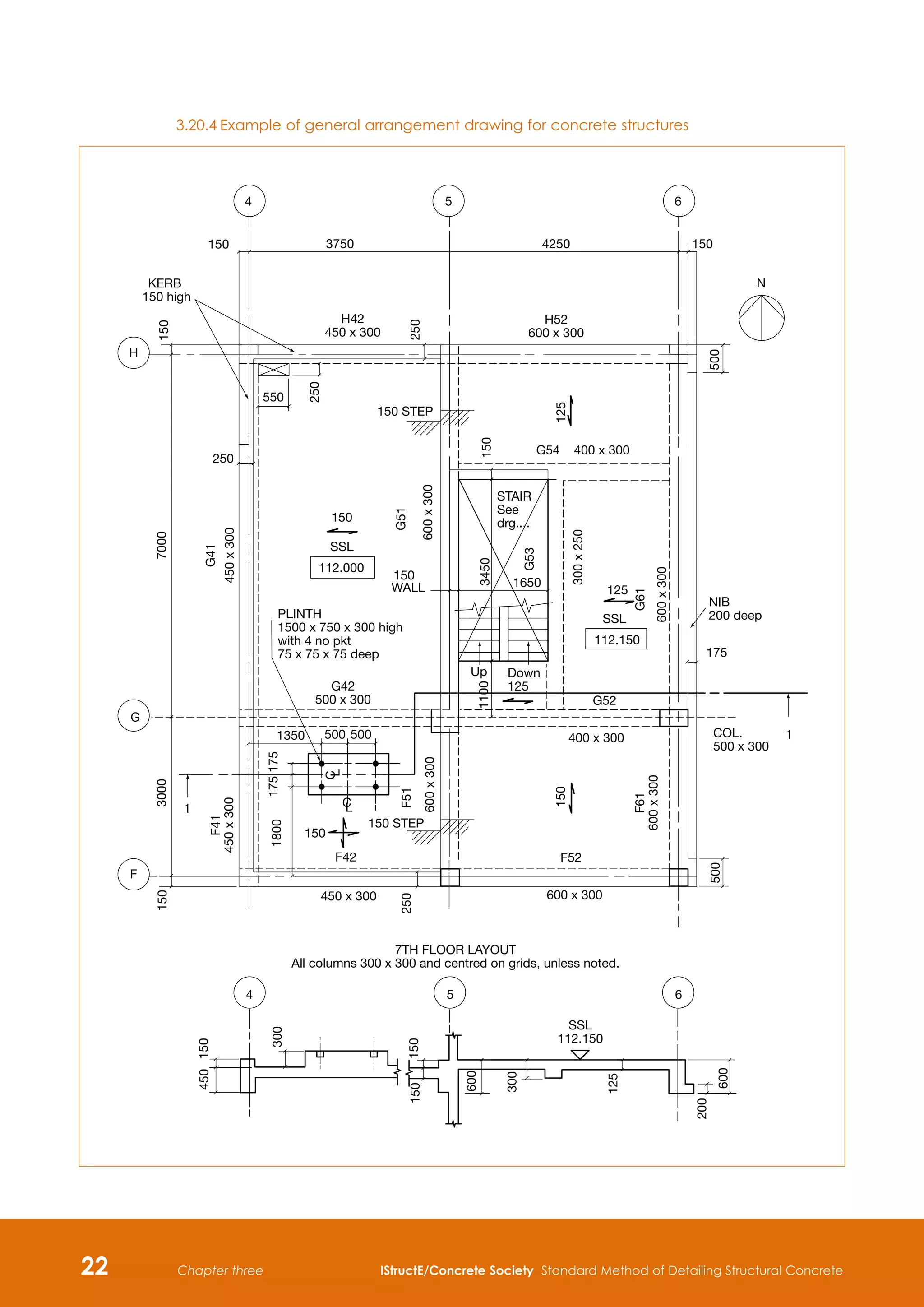
•	
Provide check prints of both drawing and
schedules for checking by another competent
person.
4.5	 Schedules and scheduling
4.5.1	 General
Scheduling is the operation of listing the location,
mark, type and size, number off, length and bending
details of each bar or sheet of fabric. When dealing
with bars the completed lists are called ‘bar schedules’
(see Table 4.2). The bars should be grouped together
for each structural unit, e.g. beam, column, etc. In a
building, the bars should be listed floor by floor.
Separate schedules should be prepared for fabric
reinforcement using the form of fabric schedule
shown (see Table 4.3). Fabrics should be grouped
together according to their BS reference number and
the size of sheet.
For cutting and bending purposes schedules should
be provided as separate A4 sheets and not as part of
the detailed reinforcement drawings. Each schedule
should be a document complete in itself, and reference
to earlier schedules by the use of such terms ‘as before’
or ‘repeat as 1st floor’ should not be allowed.
Schedules are used by the:
•	
detailer
•	
person checking the drawing
•	
contractor who orders the reinforcement
•	
organization responsible for fabricating the
reinforcement
•	
steel fixer
•	
clerk of works or other inspector
•	
the quantity surveyor.
Member Bar
mark
Type
and
size
Length
of each
bar †
mm
No.
of
mbrs
No.of
bars
in each
Total
no. EIR*
mm
D*
mm
C*
mm
B*
mm
A*
mm
This schedule conforms to BS 8666:2005
* Specified in multiples of 5 mm. † Specified in mutliples of 25 mm.
Shape
code Rev
letter
Status: P Preliminary T Tender C Construction
A B Consultants
New Library, Surbridge
Surbridge Council
7654
RTW
23 01 06
14 02 06
Beam 3 2 H25 1 4 4 5225 11 400 A
Table 4.2 Typical bar schedule
Purpose made fabric example
04
05
L
L
This schedule conforms to BS 8666: 2005
* Specified in multiples of 5 mm. † Specified in multiples of 25 mm
Status: P Preliminary T Tender C Construction
BS reference or sheet details Special details and/or bending dimensions
Fabric
mark
No.
of
wires
Type
and
size
mm
Pitch
†
mm
Sheet
length
L†
m
Sheet
width
B†
m
Length
†
mm
O
O
mm
1
3
O
O
mm
2
4
Overhangs
NO.
of
sheets
Shape
code
Bending
instruction
A*
mm
B*
mm
C*
mm
D*
mm
EIR*
mm
Rev
letter
Table 4.3 Typical fabric schedule
32 IStructE/Concrete Society Standard Method of Detailing Structural Concrete
Chapter four
The schedules should have simple consecutive
reference numbers not exceeding six characters, and
should be cross-referenced to the relevant drawing
number. Such terms as page number, sheet number,
etc., can be confusing and are not recommended.
A convenient way of achieving this is to use the
first three characters to refer to the drawing number
(implying that the project will be divided into units
with a maximum number of 999 drawings per
unit), to use the next two characters to describe the
schedule number (starting at 01 and not exceeding
99 schedules per drawing), and to reserve the last
character for revision letters. If an internal job
number or other internal reference number is used,
it is suggested that this should be incorporated
in the site reference, rather than extending the
reinforcement schedule reference.
The form of bar and fabric schedule and the
shapes of bar used should be in accordance with
BS 86666. The preferred shapes of that Standard
account for more than 95% of the reinforcement that
is used. It is preferable that bars should be listed in the
schedule in numerical order.
It is essential that the bar mark reference on the
label attached to a bundle of bars refers uniquely to
a particular group or set of bars of defined length,
size, shape and type used on the job. This unique
reference is achieved by a combination of the bar
schedule reference number and the bar mark number.
(To comply with BS 8666, both the schedule reference
number and the bar mark must appear on the label
attached to the bundle of bars).
Thus the bar schedule reference number 046 02A
in the example that follows, (note the importance of
the zeros) and the bar mark are associated, and the
bar-marking system that follows is based on the
assumption that the bar schedule reference numbering
system set out in BS 8666 is used precisely as
described with no variations. Each schedule must
have a different reference number and must refer
only to one drawing. Such terms as sheet number,
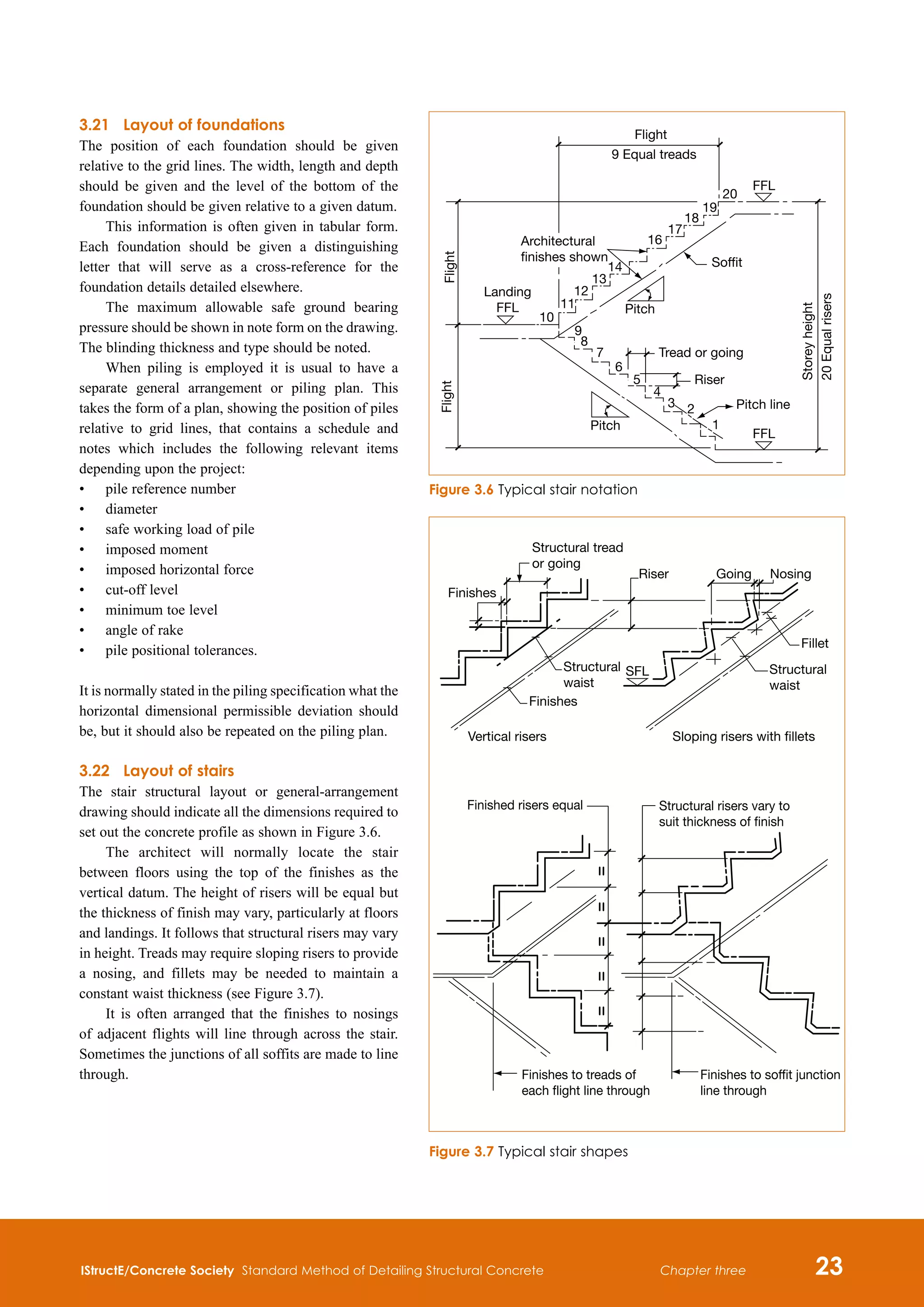
page number, 1 of 8, 2 of 8, etc. and such practices
as including the date, the year, the draughtsman’s
initials, the job number or other internal reference
as part of the reference number must not be used
with this combined systems of bar marking and
schedule numbering. Each of these practices may
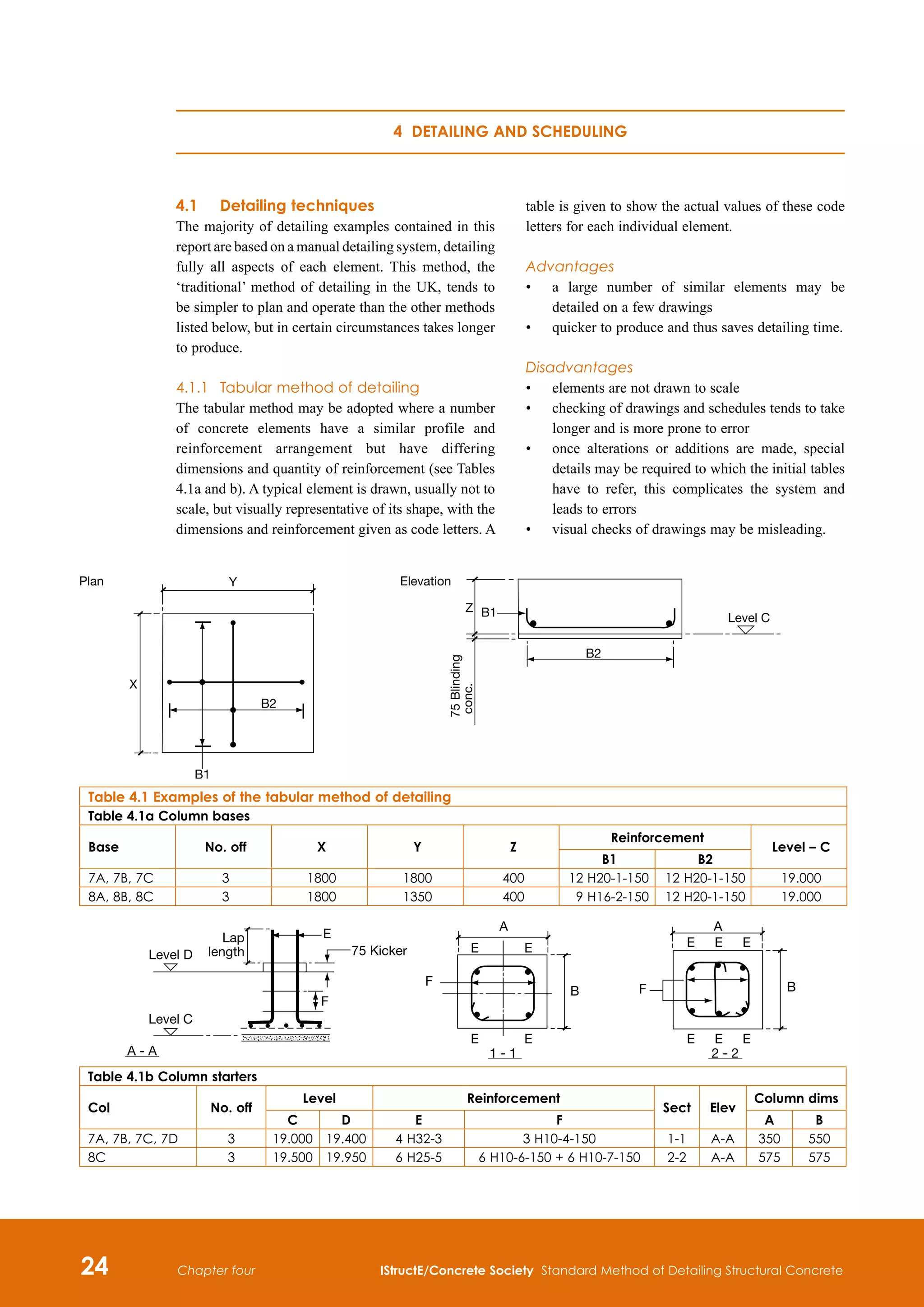
have intrinsic merits, but they should be abandoned
in favour of a system that is universally applicable
and universally understood.
Correct scheduling is not possible without a
thorough knowledge of BS 8666.
The bar size is not part of the bar mark, and
prefixes or suffixes of letters or other characters
to describe the location of the bars should not be
included in the bar mark. The exception to this rule is
when bars of varying shape or length are used and are
described on the drawing thus:
8H20-1(a to h)-150
The bar mark given on the schedule is therefore
la, 1b, 1c.
On a small job with only a few drawings it may be
convenient to start at bar mark 1 and carry on through
the whole job in a consecutive sequence. On larger
jobs it may be more convenient to start scheduling
each drawing with bar mark 1, relying on the site to
distinguish between mark 1 on drawing 1 and mark 1
on drawing 2.
When top and bottom reinforcement are detailed
on separate drawings it is advantageous to allocate
a group of bar marks for each drawing, e.g. bottom
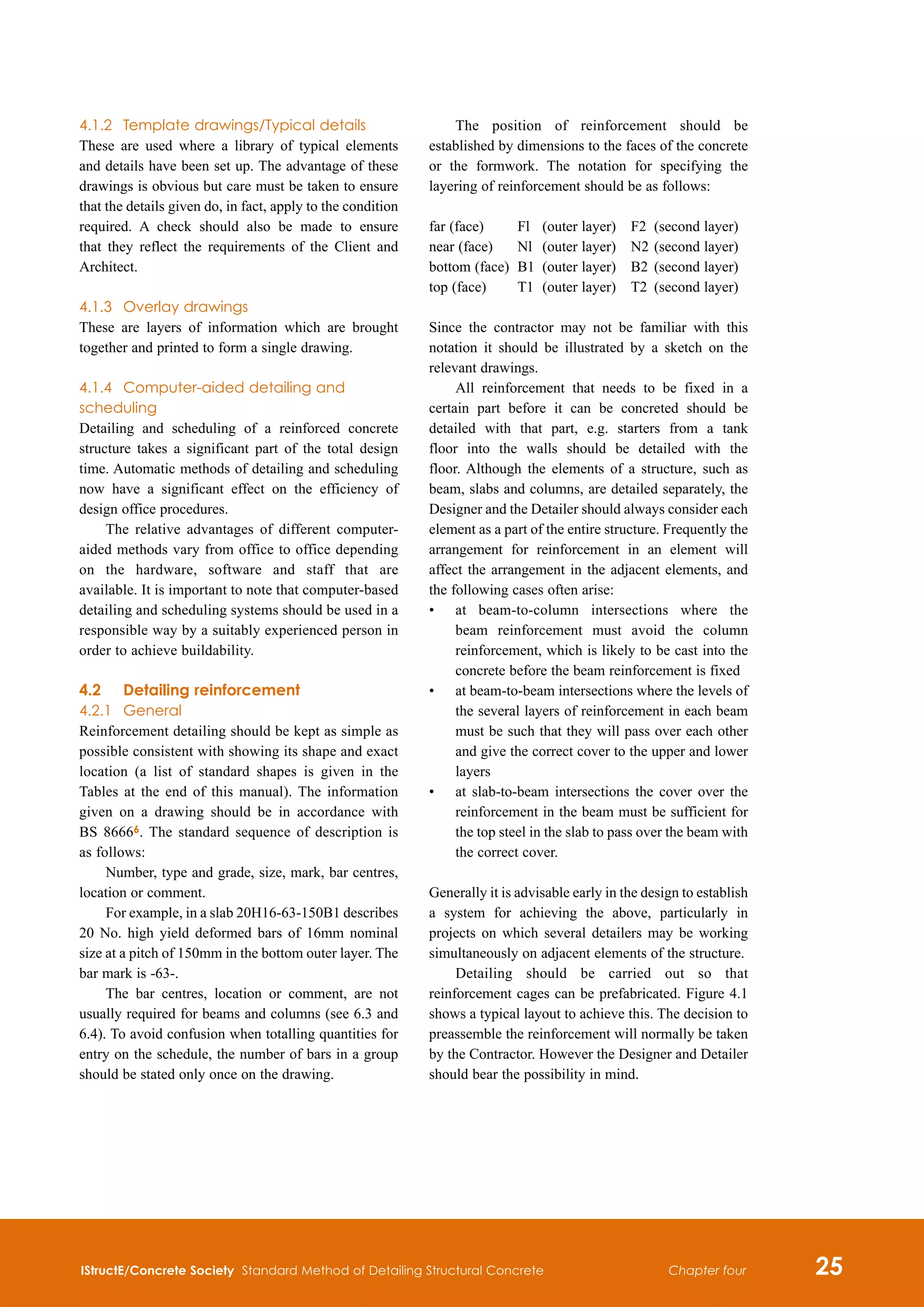
reinforcement bar marks 1-99, top reinforcement bar
marks 100-199.
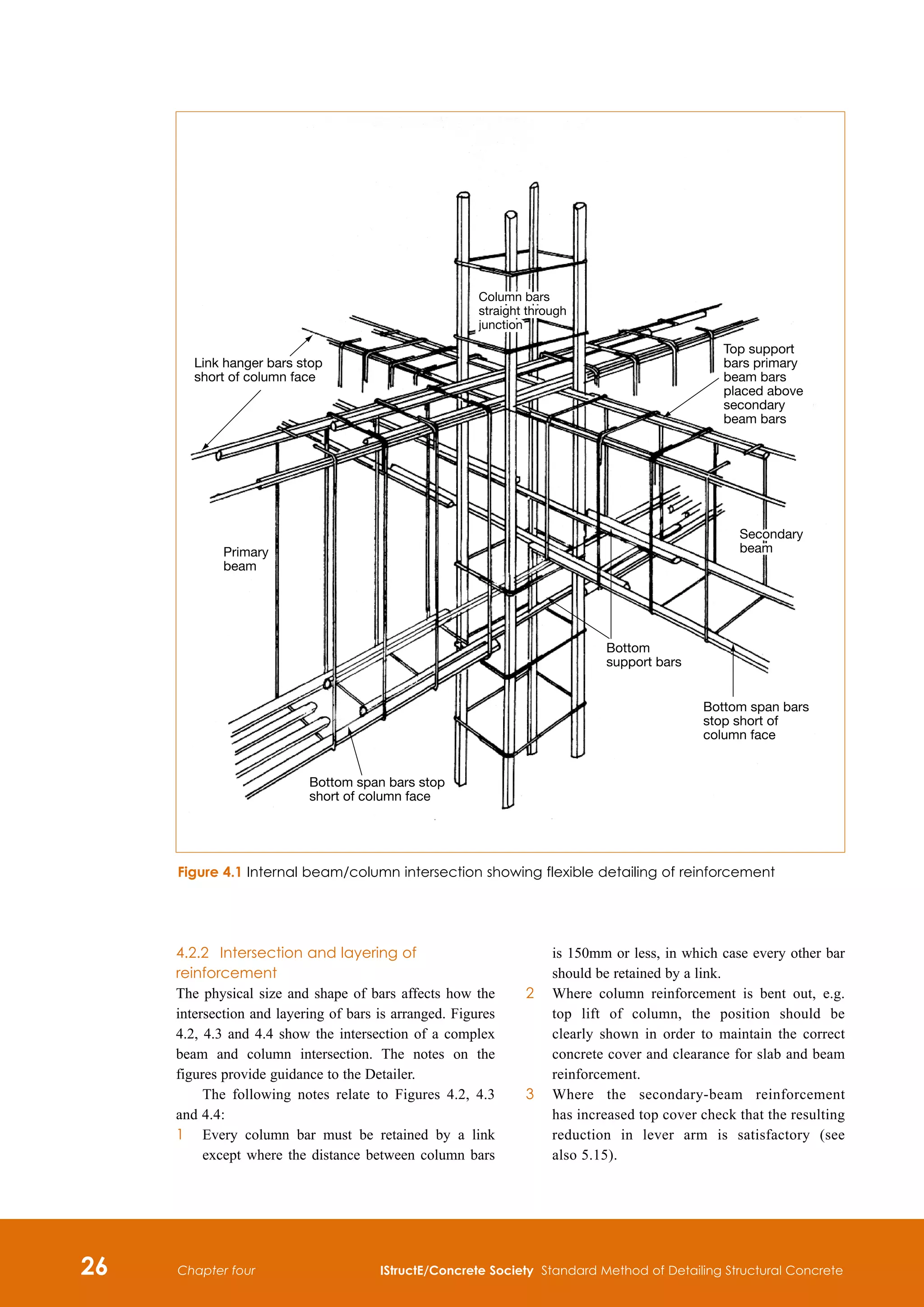
When it becomes necessary to revise a bar item
on the schedule or drawing both the drawing and
schedules should be re-issued.
4.5.2	 Allowances for tolerances/deviations
Cover to reinforcement is liable to variation on
account of the cumulative effect of inevitable small
errors in the dimensions of formwork and the cutting,
bending and fixing of the reinforcement.
All reinforcement should be fixed to the nominal
cover shown on the drawings; using spacers of the
same nominal size as the nominal cover (see 5.9.1)
and the correct size of chairs to achieve the nominal
cover.
Where a reinforcing bar is to fit between two
concrete faces (e.g. a single rectangular link in a
beam), the dimensions on the schedule should be
determined as the nominal dimension of the concrete
less the nominal cover on each face and less an
allowance for all other errors as in Table 5.5.
It should be noted that the actual size of the bar is
larger than the nominal size (see 5.1.5).
4.6	Procedure for checking
reinforcement drawings and schedules
All drawings and bar and fabric schedules must
be checked by a competent person other than
the Detailer. The checking of drawings falls into
3 stages.
IStructE/Concrete Society Standard Method of Detailing Structural Concrete 33
Chapter four
4.6.1	 Stage 1: Design check
Check that:
•	
The drawing correctly interprets the design
as described in and supported by the checked
calculations.
4.6.2	 Stage 2: Detailing check
Check that:
•	
The drawing has been prepared in accordance
with current standards and meets the requirements
of that particular job.
•	
The information agrees with the general
arrangement and other associated drawings and
bar and fabric schedules, with particular reference
to dimensions, termination of reinforcement,
construction details, notes, etc.
•	
The details shown can, in practice, be
constructed.
Where standard drawings are used they should be
checked to ensure they represent the actual structure
correctly, and when alterations are made to them, they
should be checked to ensure that the original design
intentions have not been lost.
4.6.3	 Stage 3: Overall check
Check that:
•	
The checks under stages 1 and 2 have been
carried out.
•	
The drawing is in all respects suitable for its
purpose and truly reflects the requirements of the
project.
•	
Each drawing has a ‘box’ containing the name of
the draughtsman and checker.
Standard checking lists may be a useful aid but
must not be considered a complete check, since no
checklist can be totally comprehensive. The items
set out below are some that could form the basis for
a checklist:
•	
Is general presentation and orientation correct?
•	
Are title, scales, drawing numbers correct?
•	
Are revision letters correct and their location
shown?
•	
Are sufficient sections and details given?
•	
Are general notes complete and can they be
understood?
•	
Is spelling correct?
•	
Have all standards and codes of practice been
complied with?
•	
Are setting out dimensions correct?
•	
Have check dimensions been included?
•	
Do running dimensions agree with overall
dimensions?
•	
Can materials specified be obtained?
•	
Do number, sizes and reinforcement agree with
the relevant calculations and other drawings?
•	
Has cross-referencing to other drawings and bar
and fabric schedules been provided?
•	
Where applicable is ‘No. off’ correct?
•	
Are chamfers, fillets and drips and similar features
shown?
•	
Are all projections reinforced?
•	
Is the cover specified and correct?
•	
Are splices and laps in correct position?
•	
Do splices suit construction joints?
•	
Is there congestion of reinforcement?
•	
Are large-scale details required?
•	
Are cranks required where bars cross?
•	
Is spacing of reinforcement correct both on plan
and section?
•	
Is reinforcement required for anti-crack or fire
resistance?
•	
Do hooks foul other reinforcement?
•	
Are schedules correct?
•	
Have drawings been signed by the detailer and
checker?
•	
Where required are the spacers and chairs shown/
specified?
4.6.4	 Method of checking
It is useful to adopt a standard checking system using
different coloured pencils. A suggested colour system
would be:
blue or yellow – correct
red – additions and corrections.
When the amendments have been completed it is
important to check the finished drawing against the
check print.
34 IStructE/Concrete Society Standard Method of Detailing Structural Concrete
Chapter five
5.1	Reinforcement
5.1.1	 General
BS 444920 specifies the requirements for weldable
reinforcing steel manufactured from bar, coil and
decoiled product in accordance with EC2, Annex C.
BS 4449 meets the requirements of EN 1008021.
BS 448322 specifies the requirements for factory-
made machine-welded steel fabric manufactured
from deformed wires conforming to BS 4449 and
Annex C of EC2. BS 4483 meets the requirements of
EN 10080.
BS 448223 contains provisions for plain, indented
and ribbed wire.The characteristic strength and ductility
requirements are aligned with grade B500Aof BS 4449.
This standard is complementary to the requirements of
EN 10080 and Annex C of EC2, except that no fatigue
performance is specified and EC2 only relates to ribbed
and not plain or indented steel.
In the UK, CARES is the certification body that
ensures that reinforcement is correctly produced,
processed and handled. It covers the steel production
and billet casting, reinforcement rolling, cutting and
bending of reinforcement and the fabrication and
welding of reinforcement.
5.1.2	 Strength/ductility properties
BS 4449 and Annex C of EC2 specify the strength
and ductility requirements for three grades of ductility,
Grade A, Grade B and Grade C. The tensile properties
are given in Table 5.1.
Grade 250 (mild steel) plain bars are no longer
commonly available. Where available they may be
found in sizes 8, 10, 12 and 16.
Other types of bars are as defined in the project
specification.
5.1.3	 Bar identification
Reinforcement can be identified by the arrangement
of ribs together with dots or spaces between them.
For Grade A steel the bars have two or more
series of parallel transverse ribs with the same angle of
inclination and the same direction for each series.
For Grade B steel the bars have two or more
series of parallel transverse ribs. For bars with two
or three rib series, one of the series is at a contrary
angle to the remainder; and for bars with four rib
series, two of the series are at a contrary angle to the
remainder.
For Grade C steel the bars have the same rib
series as for Grade B. However, in each rib series,
the ribs shall alternate between a higher and lower
angle with respect to the bar axis (differing by at
least 10º).
Figure 5.1 shows a typical rib layout for a Grade
B500A bar with the CARES ‘dot-dash-dot’ mark
together with the country and mill identity.
The identification of Country of origin is as follows:
5 Technical information and requirements
Table 5.1 Ductility properties of reinforcement
Grade Yield strength Re
(N/mm2)
Stress Ratio
Rm/Re
Total elongation at
maximum force (%)
500A
500B
500C
500
500
500
H 1.05
H 1.08
H 1.15  1.35
H 2.5
H 5.0
H 7.5
Note
Rm is the tensile strength and Re is the yield strength
one rib between dots
Country (5 No. ribs for UK) Mill Ref. (2)
Cares ' '
Figure 5.1 Example of manufacturer’s identification mark for Grade B500A (using dots)
UK, Ireland, Iceland 5 ribs

Austria, Germany, Czech Republic,
Poland, Slovakia
1 ribs
Belgium, Netherlands 2 ribs
Luxembourg, Switzerland 2 ribs
France, Hungary 3 ribs
Italy, Malta, Slovenia 4 ribs
Denmark, Estonia, Finland, Latvia,
Lithuania, Norway, Sweden
6 ribs
Spain, Portugal 7 ribs
Greece, Cyprus 8 ribs
Other countries 9 ribs
IStructE/Concrete Society Standard Method of Detailing Structural Concrete 35
Chapter five
5.1.4	 Notation
Type of reinforcement/
fabric according to
BS 444920
Notation Strength
(MPa)
Reinforcement Grade
500A, Grade 500B or
Grade 500C
H 500
Reinforcement Grade 500B
or B500C
B 500
Reinforcement Grade 500C C 500
Other types of reinforcement and fabric.
The notation remains as given in the present
BS 86666:
- S: a specified grade and type of stainless
steel of ribbed bars conforming to BS 67445
- X: reinforcement of a type not included in the
above list having material properties that are
defined in the design or contract specification.
5.1.5	 Sizes of reinforcing bars
Design and detailing of reinforcement is based on
nominal sizes of bars and wires. The nominal size
is the diameter of a circle with an area equal to the
effective cross-sectional area of the bar or wire.
The word ‘size’ rather than ‘diameter’ is used
to describe the nominal size of bar. For example, on
a size 20 bar no cross-dimension measures 20mm
because of the surface deformations. Most deformed
bars can be contained in a circumscribing circle
10% larger than the nominal size of bar. However,
because of variations in rib size individual sections
can measure 13 or 14% more than the nominal size at
the largest cross-dimension (see Table 5.2). Examples
where special care is required are given in 5.3.
Preferred sizes of high yield reinforcing bars
are 8, 10, 12, 16, 20, 25, 32 and 40mm. Size 6 is
not commonly available owing to low demand and
infrequent rollings. Size 50 is not generally stocked
by fabricators but can be available to order and is
dependent on rolling programmes. Since off-cuts
of 50mm are useless, the size tends to be ordered
cut to length from the mill and requires careful
planning. Consideration should be given to using the
commonly available size 40mm in bundles instead
of using 50mm.
It should be noted that the large bar sizes may be
difficult to handle and may require suitable cranage in
accordance with Health and Safety regulations. Table
5.3 gives the cross sectional area and mass of the
bars calculated on the basis that steels have a mass of
0.00785kg per square millimetre per metre run.
5.1.6	 Length and overall dimensions of
reinforcing bars
The standard length of bars available from stock for
sizes 12 and above is 12m. For sizes 8 and 10 the stock
sizes are 8, 9 or 10m. The maximum length of bar
available and transportable is 18m, but extra cost and
delays may be involved if 12m lengths are exceeded.
For a bent bar to be transportable the shape
should be contained by an imaginary rectangle where
the shortest side does not exceed 2.75m.
5.1.7	 Rebending bars
The minimum mandrel diameter for bending of bars
for sizes less than or equal to 16mm is 4b and for bar
sizes larger than 16mm is 7b. Generally rebending
bars on site should not be permitted. Where it can
be shown that the bars are sufficiently ductile (i.e.
Class B or Class C steel) bars not exceeding 12mm
size may be rebent provided that care is taken not
to reduce the mandrel size below four times the bar
size. Larger bar sizes may be rebent only where
they are within a proprietary system which holds a
Technical Approval issued by a suitably accredited
certification body (e.g. CARES UK) and it has been
shown by testing that no damage to the properties of
the bar occur.
It should be noted that where rebending of bars
is undertaken it can cause damage to the concrete
surface.
Table 5.2 Comparison between nominal size of bar and the
actual maximum size (mm)
Nominal size 6* 8 10 12 16 20 25 32 40 50*
Actual
maximum size
8 11 13 14 19 23 29 37 46 57
* Not a preferred size of bar
Table 5.3 Actual area and mass of bars (see BS 444920)
Bar size
(mm)
Cross- section
(mm2)
Mass per metre run
(kg/m)
6 28.3 0.222
8 50.3 0.395
10 78.5 0.616
12 113.1 0.888
16 201.1 1.579
20 314.2 2.466
25 490.9 3.854
32 804.2 6.313
40 1256.6 9.864
50 1963.5 15.413
36 IStructE/Concrete Society Standard Method of Detailing Structural Concrete
Chapter five
5.1.8	 Large diameter bends
The Designer will normally be responsible for the
calculation of large diameter bends, but the Detailer
should be aware of their existence and should be able
to recognise the difference between the occasion when
a large radius bend is required and when a standard
bend us required. Tables at the end of the manual give
values of mandrel size for various concrete grades for
a given steel design stress. Examples of where larger
diameter bends are required include:
•	
end of column and wall connections to beams or
slabs
•	
cantilever retaining walls
•	
corbels
•	
bottom bars for pile caps.
5.1.9 	 Structural tying reinforcement to
ensure robustness (EC2, Clause 9.10)
Tying reinforcement is not intended to be additional
reinforcement to that required by the design but is
required as a minimum to ensure the robustness of
the structure.
Peripheral ties
At each floor and roof level there should be an
effective continuous peripheral tie within 1.2m from
the edge of the structure. The peripheral tie should
be able to resist a design tensile force equal to
(20 + 4no) G 60kN where no is the number of storeys.
Internal ties
At each floor and roof level there should be internal ties
in two directions approximately at right angles. They
should be effectively continuous throughout their length
and should be anchored to the peripheral ties at each end,
unless continuing as horizontal ties to columns or walls.
They may, in whole or in part, be spread evenly in the
slabs or may be grouped at or in beams, walls or other
appropriate positions. In walls they should be within
0.5m from the top or bottom of floor slabs.
In each direction, internal ties should be capable
of resisting a design tensile force of:
Ftie,int = [(gk + qk) /7.5](l r   
/5)(F1) H Ft kN/m
where (gk + qk) is the sum of the average permanent
and variable floor loads (in kN/m2), lr is the greater
of the distances (in m) between the centres of the
columns, frames or walls supporting any two
adjacent floor spans in the direction of the tie under
consideration and Ft = (20 + 4no) G 60kN/m. The
maximum spacing of internal ties = 1.5 lr  .
Horizontal ties to columns and/or walls
Edge columns and walls should be tied horizontally
to the structure at each floor and roof level. Such ties
should be capable of resisting a design tensile force
which is the greater of 2 Ft G ls /2.5 Ft, where ls is
the floor to ceiling height in m, and 3% of the total
design ultimate vertical load carried by the column
or wall at that level. The force is in kN per metre
run of wall and in kN per column.
Tying of external walls is only required if the
peripheral tie is not located within the wall.
Corner columns should be tied in two directions.
Steel provided for the peripheral tie may be used as
the horizontal tie in this case.
All precast floor, roof and stair members should
be effectively anchored whether or not such members
are used to provide other ties. Such anchorages should
be capable of carrying the dead weight of the member
to that part of the structure that contains the ties.
Vertical ties
Each column and each wall carrying vertical load
should be tied continuously from the lowest to the
highest level. The tie should be capable of carrying
a tensile force equal to the design load likely to
be received by the column or wall from any one
storey under accidental design situation (i.e. loading
calculated using Expression 6.11b of BS EN 1990).
Continuity and anchorage of ties
Ties in two horizontal directions shall be effectively
continuous and anchored at the perimeter of the
structure. They may be provided wholly within the
in-situ concrete topping or at connections of precast
members. Where ties are not continuous in one plane,
the bending effects resulting from the eccentricities
should be considered.
Ties should not normally be lapped in narrow
joints between precast units. Mechanical anchorage
should be used in these cases.
5.1.10	Fabric reinforcement
(see also 4.2.5 and 6.2.2)
There are three classifications of fabric
reinforcement:
•	
Designated or Standard Fabric
•	
Scheduled or Non-Standard Fabric
•	
Detailed or Purpose Made Fabric
For detailing and scheduling of fabric see Section 4.
For British Standard fabrics see Tables at the end of
this manual.
IStructE/Concrete Society Standard Method of Detailing Structural Concrete 37
Chapter five
Designated (Standard fabric)
These are categorised by BS 448322, and have distinct
classifications according to the wire orientation and
the cross-sectional steel area. Standard sheet size is
4.8m long × 2.4m wide, with the edge overhangs being
0.5 × wire centres. There are three main types:
•	
‘A’ or square fabric has wires of equal size at
200mm centres in both directions. Wire sizes are
from 5mm to 10mm, but exclude 9mm.
•	
‘B’ or structural fabrics have the main
reinforcement in the long direction at 100mm
centres, with transverse reinforcement at 200mm
centres. Main wire sizes are from 5mm to 12mm,
excluding 9 and 11mm.
•	
‘C’or long fabrics have the main wires at 100mm,
with the transverse steel being nominal size at
400mm centres. Main wire sizes are from 6mm
to 10mm.
In addition there is a lightweight fabric (D49), which
is often used for crack control.
‘Flying end’ fabrics are also available as a
standard product from most manufacturers. These
have extended overhangs, which are designed to
eliminate the build-up of layers that occurs at lapping
points with standard fabric. Sheet sizes and overhangs
may vary between manufacturers.
Scheduled (non-standard fabric)
These use standard wire sizes, often with standard
configurations, but are a non-standard size sheet. It
is also possible to have a non-standard wire spacing,
preferably with increments of 50mm. There should be
consistency across a project to avoid incurring extra
production costs. Maximum wire size is typically
12mm. Non-standard overhangs can be specified to
avoid lap build-up.
Detailed (purpose-made) fabric
Purpose made sheets can be specified using standard
reinforcing bars. These bars can be set at varying
pitches and edge projections. Sheet sizes can vary
with due consideration given to handling and
transportation.
Bending of fabric
Generally, all fabrics can be cut to size, and bent to
most BS shapes. Manufacturers will normally be able
to offer guidance. Wire sizes in excess of 12mm may
not be possible by automatic machine manufacture.
Laps in fabric
Layering of fabric sheets can be avoided by using
‘flying end’fabrics, or by suitable detailing of purpose
made fabrics (see 5.3.4).
5.2	 Cover to reinforcement
5.2.1	 General
(EC2, Section 4 and Section 5, Part 1.2)
The required nominal cover should be specified by
the Designer.
Cover to reinforcement is required to ensure:
•	
the safe transmission of bond forces. The
minimum cover should not be less than the bar
size (or equivalent bar size for bundles of bars)
•	
the protection of the steel against corrosion
•	
adequate fire resistance (BS EN 1992-1-22 refers
to ‘axis distance’ for cover. This is the distance
from the centre of reinforcing bar to the surface
of concrete).
The importance of achieving cover cannot be
overstressed since the durability of the structure is
often determined by this.
Nominal cover (EC2, Clause 4.4.1.1)
Nominal cover is the cover specified by the Designer
and shown on the structural drawings. Nominal
cover is defined as the minimum cover, cmin, plus
an allowance in design for deviation to all steel
reinforcement, Δcdev. It should be specified to the
reinforcement nearest to the surface of the concrete
(e.g. links in a beam).
The nominal cover to a link should be such that
the resulting cover to the main bar is at least equal to
the size of the main bar (or to a bar of equivalent size
in the case of pairs or bundles of three or more bars)
plus Δcdev. Where no links are present the nominal
cover should be at least equal to this size of the bar)
plus Δcdev.
Where special surface treatments are used (e.g.
bush hammering), the expected depth of treatment
should be added to the nominal cover.
Nominal covers should not be less than the
maximum (nominal) aggregate size.
Deviation, Δcdev (EC2, Clause 4.4.1.3)
Where it is specified that only a contractor
with a recognised quality system shall do the
work (e.g. member of SpeCC, the Specialist
Concrete Contractors certification scheme)
Δcdev = 5mm, otherwise Δcdev = 10mm.
38 IStructE/Concrete Society Standard Method of Detailing Structural Concrete
Chapter five
5.2.2	 Cover for durability
(EC2, Clause 4.2)
The exposure conditions to which the structure may
be subjected determine the required cover to the
reinforcement.
5.2.3	 Cover for fire resistance
The required size of structural members and cover
(axis distance) required for fire resistance should be
specified by the Designer.
5.2.4	 Fixing reinforcement to obtain the
correct cover
Non-structural connections for the positioning of
reinforcement should be made with steel wire tying
devices (e.g. No. 16 gauge annealed soft iron wire)
or by welding (but see 5.6). It is not necessary to tie
every bar intersection provided that rigidity of the
cage or mat can be obtained while the concrete is
being placed and vibrated.
The most common way of maintaining cover
is by the use of spacers and chairs. A wide range
of plastic and cementitious spacers and steel wire
chairs is available. BS 797319 provides information
concerning spacers and their use. Layers of bars in
beams can be separated by means of short lengths of
bar. The spacing along the beam should be specified
on the drawings (usually 1m), and the bar spacers
should be detailed on the schedules.
Normally the method of achieving cover and
position is left entirely to the Contractor. However
where the detailing is complicated the Designer may
specify spacers and detail chairs, which should be in
accordance with the requirements of BS 7973.
It should be noted that the weight of reinforcement
can damage inserts (e.g. Styrofoam inserts) if it is not
properly supported.
5.2.5	 Minimum spacing of reinforcement
(EC2, Clause 9.3.1)
The minimum clear distance between bars (horizontal
or vertical) should not be less than the bar size,
b, (dg + 5mm), or 20mm, where dg is the maximum
size of aggregate.
Where bars are positioned in separate horizontal
layers, the bars in each layer should be located
vertically above each other. There should be sufficient
space between the resulting columns of bars to allow
access for vibrators and good compaction of the
concrete.
5.3	 Cutting and bending tolerances
(BS 86666)
Normally bending dimensions of reinforcement are
given without taking account of cutting and bending
tolerances. However, where close fit conditions exist,
these should be considered at an early stage otherwise
increases in member size may occur at a much later
and more expensive stage in the job. Large scale
sketches may help to show up any problems. Where
an overall or an internal dimension of a bent bar is
specified the tolerance, unless otherwise stated, is as
given in Table 5.4.
The cutting length is the sum of the bending
dimensions and allowances specified, rounded up to
the nearest 25mm.
‘Closed’ detailing tolerances
Where a closed system of detailing has been used
and the reinforcement is required to fit between two
concrete faces (e.g. beams, columns), a deduction for
cover to include member dimensional and bending
tolerances is given in Table 5.5. This assumes a
tolerance on the member size of 5mm for a size of
member up to 2m, 10mm otherwise. An allowance
should also be made for the deformities of the bar.
Table 5.4 Cutting and bending tolerances
Bar dimension Tolerance (mm)
Straight bars, all lengths including
bars to be bent
± 25
Bending dimensions less than 1m ± 5
Between 1 and 2m + 5 to -10
Greater than 2m + 5 to -25
Wires in fabric
greater of ± 25 or ±
0.5% of length
Table 5.5 ‘Closed’ detailing tolerances
Distance between
concrete faces (m)
Type of bar Total deduction
(mm)
0 – 1
Links and other
bent bars
10
1 – 2
Links and other
bent bars
15
Over 2
Links and other
bent bars
20
Any length Straight bars 40
IStructE/Concrete Society Standard Method of Detailing Structural Concrete 39
Chapter five
Examples
The following examples are given to highlight typical
situations which crop up regularly. The fitting of the
whole arrangement can affect the actual position of a
bar and can sometimes make compliance difficult.
Example 1: Beam corner detail
The actual size of H16 may be 18mm (+10%).
The curve in the H16 link causes further increase of
cover to main bar (H32).
Main bar in position A has increased cover to one of the
faces of 48mm.
Main bar in position B has increased cover to both
faces of 14mm.
The position of the bar will affect both the crack-width and
fire resistance. It may also cause problems at the column
intersection where clashes of reinforcement may occur.
H16
44
13
H40
B
A
40
Example 2: Beam/column junction
Since the tolerance deduction is 10mm for the bending
dimensions it is possible that the space inside the link (H12)
could be 275 – 80 – 2(12+1) – 10 = 159mm.
This is just under 5 × H32. Unfortunately it does not take into
account the actual bar size (+10%). The actual space
required by these bars is 176mm.
Hence, they won’t fit.
H32 H32
40
H32
H12
Column link
H32 H32
40
Beam bars
275
Example 3: Flanged beam
Without taking tolerances into account the gap between
bars A and B is 3mm. However with the link tolerance of
5mm and the effect of the actual size of bar the position
of bar A could be 12mm lower.
The weight of the cage is likely to cause the tolerance to
be taken out at the top and the cover to bar B could finish
up less than 10mm if the level of the slab formwork was
2 or 3mm out.
B A
20
20
H25
H25
H25
H16
H16
150
40 IStructE/Concrete Society Standard Method of Detailing Structural Concrete
Chapter five
5.4	Anchorage and lap lengths
5.4.1	 General (EC2, Clause 8.4)
The bond between the concrete and reinforcement
determines the anchorage and lap lengths. The
description of bond conditions for different positions
of the reinforcement in the concrete are indicated in
Figure 5.2.
5.4.2 	 Anchorage lengths
Anchorage lengths, lap lengths and dimensions of
shear reinforcement should be determined by the
Detailer unless noted otherwise.
The design anchorage length, lbd, is:
lbd = α1 α2 α3 α4 α5 lb, rqd H lb,min
The coefficients α1, α2, α3, α4 and α5 are given
in Table 5.6.
Table 5.6 Values of coefficients (α1, α2, α3, α4 and α5)
Influencing factor
Type of
anchorage
Reinforcement bar
In tension In compression
Shape of bars
Straight α1 = 1.0 α1 = 1.0
Other than
straight
α1 = 0.7 if cd 3b
otherwise α1 = 1.0
(see Figure 5.3 for values of cd)
α1 = 1.0
Concrete cover
Straight
α2 = 1 – 0.15 (cd – b)/b
H 0.7
G 1.0
α2 = 1.0
Other than
straight
α2 = 1 – 0.15 (cd – 3b)/b
H 0.7
G 1.0
(see Figure 5.3 for values of cd)
α2 = 1.0
Confinement by transverse reinforcement
not welded to main bars
All types
α3 = 1 – Kl
H 0.7
G 1.0
α3 = 1.0
Confinement by welded transverse
reinforcement
All types, position
and size
α4 = 0.7 α4 = 0.7
Confinement by transverse pressure All types
α5 = 1 – 0.04p
H 0.7 and G 1.0
Notes
l	 = (ΣAst – ΣAst,min)lAs
ΣAst 		
cross-sectional area of the transverse reinforcement along the design anchorage length lbd
ΣAst,min	 cross-sectional area of the minimum transverse reinforcement = 0.25 As for beams and 0 for slabs
As	 area of a single anchored bar with maximum bar diameter
K	 values shown in Figure 5.4
p	 transverse pressure [MPa] at ultimate limit state along lbd
a) 45º G α G 90º
A
A
a) and b) 'good' bond conditions
for all bars
c) and d) unhatched zone – 'good' bond conditions
hatched zone – 'poor' bond conditions
Direction of concreting
A
300
A
h
h
250
c) h  250mm
d) h  600mm
b) h G 250mm
A
α
Figure 5.2 Description of bond conditions
IStructE/Concrete Society Standard Method of Detailing Structural Concrete 41
Chapter five
α1	
is for the effect of the shape of the bars assuming
adequate cover
α2 	
is for the effect of concrete minimum cover (see
Figure 5.3)
α3	
is for the effect of confinement by transverse
reinforcement
α4	
is for the influence of one or more welded
transverse bars (bt  0.6b) along the design
anchorage length lbd
α5	
is for the effect of the pressure transverse to the
plane of splitting along the design anchorage
length
(α2 α3 α5) H 0.7
lb,rqd 	 is equal to (b/4) (σsd /fbd)
where	
σsd is the design stress of the bar at the
position from where the anchorage is
measured
fbd = 2.25 η1 η2 0.21 fck
(2/3)
(for fck G 50 MPa)
	
η1 = 1.0 for ‘good’ bond conditions
(see Figure 5.2)
	 η1 = 0.7 for ‘poor’ bond conditions
	 η2 = 1.0 for b G 32mm
	 η2 = (132 – b)/100 for b  32mm
lb,min 	
is the minimum anchorage length if no other
limitation is applied:
•	
for anchorages in tension:
lb,min  max{0.3lb,rqd; 10b; 100mm}	
•	
for anchorages in compression:
lb,min  max{0.6lb,rqd; 10b; 100mm}
For direct supports lbd may be taken less than lb,min
provided that there is at least one transverse wire
welded within the support. This should be at least
15mm from the face of the support.
5.4.3	 Laps in reinforcement
Laps between bars should normally be staggered and
not located in areas of high moments/forces (e.g.
plastic hinges). They should normally be arranged
symmetrically in any section.
The arrangement of lapped bars should comply
with Figure 5.5:
•	
The clear distance between lapped bars should
not be greater than 4b or 50mm, otherwise
the lap length should be increased by a length
equal to the clear space where it exceeds 4b or
50mm.
•	
The longitudinal distance between two adjacent
laps should not be less than 0.3 times the lap
length, l0.
•	
In case of adjacent laps, the clear distance
between adjacent bars should not be less than 2b
or 20mm.
When the provisions comply with the above, the
permissible percentage of lapped bars in tension may
be 100% where the bars are all in one layer. Where
the bars are in several layers the percentage should be
reduced to 50%.
C1
C
a
a) Straight bars
cd
= min (a/2, c1
, c)
b) Bent or
hooked bars
cd
= min (a/2, c1
)
c) Looped bars
cd
= c
C1
a
C
Figure 5.3 Values of cd for beams and slabs
A
A
A A
s t st s s
,
K = 0.1 K = 0.05 K = 0
Ø A
t st
,
Ø A
t st
,
Ø
Figure 5.4 Values of K for beams and slabs
F
s
F
s
F
s
F
s
F
s
F
s
b
a
H 0.3 l0 l0
G 50mm
G 4b
H 2b
H 20mm
Figure 5.5 Adjacent laps
42 IStructE/Concrete Society Standard Method of Detailing Structural Concrete
Chapter five
All bars in compression and secondary
(distribution) reinforcement may be lapped in one
section.
The design lap length, l0, is:
l0 = α1 α2 α3 α5 α6 lb, rqd H l0,min	
where:
l0,min  max{0.3 α6 lb,rqd ; 15b; 200mm}	
Values of α1, α2, α3 and α5 may be taken from Table
5.6; however, for the calculation of α3, ΣAst,min
should be taken as 1.0As(σsd/fyd), where As is the
area of one lapped bar and σsd is the design stress in
the bar.
α6 = (ρ1/25)0.5 but not exceeding 1.5 nor less
than 1.0, where ρ1 is the percentage of reinforcement
lapped within 0.65 l0 from the centre of the lap length
considered. Values of α6 are given in Table 5.7.
Table 5.7 Values of the coefficient α6
Percentage of
lapped bars
relative to the
total cross-
section area
 25% 33% 50% 50%
α6 1 1.15 1.4 1.5
Note
Intermediate values may be determined by
interpolation.
Transverse reinforcement for bars in tension
Transverse reinforcement is required in the lap zone to
resist transverse tension forces.
Where the diameter, b, of the lapped bars is
less than 20mm, or the percentage of lapped bars
in any section is less than 25%, then any transverse
reinforcement or links necessary for other reasons
may be assumed sufficient for the transverse tensile
forces without further justification.
Where the diameter, b, of the lapped bars is greater
than or equal to 20mm, the transverse reinforcement
should have a total area, Ast (sum of all legs parallel
to the layer of the spliced reinforcement) of not less
than the area As of one lapped bar (ΣAst H 1.0As). The
transverse bar should be placed perpendicular to the
direction of the lapped reinforcement and between
that and the surface of the concrete.
If more than 50% of the reinforcement is lapped
at one point and the distance, a, between adjacent
laps at a section is G 10b (see Figure 5.5) transverse
reinforcement should be formed by links or U-bars
anchored into the body of the section. The transverse
reinforcement provided for this should be positioned at
the outer sections of the lap as shown in Figure 5.6(a).
Transverse reinforcement for bars
permanently in compression
In addition to the rules for bars in tension one bar of
the transverse reinforcement should be placed outside
each end of the lap length and within 4b of the ends of
the lap length (Figure 5.6(b)).
5.4.4	 Additional rules for large bars
(EC2, Clause 8.8)
Additional rules should be applied to bar sizes greater
than40mm.Splittingforcesarehigheranddowelactionis
greater for such sizes. They should preferably be anchored
with mechanical devices. However where anchored as
straight bars, links should be provided as confining
reinforcement in the anchorage zone. These links should
be in addition to that provided for shear where transverse
compression is not present and the area of these should not
be less than the following (see Figure 5.7):
•	
in the direction parallel to the tension face:
Ash = 0.25 As n1	
•	
in the direction perpendicular to the tension face:
Asv = 0.25 As n2	
where:
As 
is the cross sectional area of an anchored bar
n1 
is the number of layers with bars anchored at
the same point in the member
n2 is the number of bars anchored in each layer
l0
l0 l3 l0 l3
G 150mm
a) bars in tension
b) bars in compression
ΣAst/2 ΣAst/2
F
s
l0 l3
l0
l0 l3 4b
4b
ΣAst/2 ΣAst/2
G 150mm
Figure 5.6 Transverse reinforcement for lapped
splices
IStructE/Concrete Society Standard Method of Detailing Structural Concrete 43
Chapter five
The additional transverse reinforcement should
be uniformly distributed in the anchorage zone and the
spacing of bars should not exceed 5 times the diameter
of the longitudinal reinforcement.
Large bars should not be lapped except for
sections with a minimum dimension of 1m or over or
where the stress is not greater than 80% of the design
ultimate strength.
Surface reinforcement may be required for crack
(see EC2, Clauses 7.3.4, 8.8 and 9.2.4).
5.4.5	 Bundled bars
General
It is sometimes an advantage to bundle bars to provide
better compaction of concrete in heavily reinforced
members. Generally the rules for individual bars
also apply for bundles of bars using the equivalent
diameter. In a bundle, all the bars should be of
the same characteristics (type and grade). Bars of
different sizes may be bundled provided that the ratio
of diameters does not exceed 1.7.
In design, the bundle is replaced by a notional bar
having the same sectional area and the same centre of
gravity as the bundle. The equivalent diameter, bn of
this notional bar is such that:
bn = b√nb G 55mm	
where

nb is the number of bars in the bundle, which is
limited to:

nb G 4	
for vertical bars in compression and for
bars in a lapped joint,
nb G 3	 for all other cases.
Thecleardistancebetweenbundlesshouldbemeasured
from the actual external contour of the bundle of bars.
The concrete cover should be measured from the
actual external contour of the bundles and should not
be less than bn.
Where two touching bars are positioned one
above the other, and where the bond conditions are
good, such bars need not be treated as a bundle.
Anchorage of bundles of bars
Bundles of bars in tension may be curtailed over end
and intermediate supports. Bundles with an equivalent
diameter  32mm may be curtailed near a support
without the need for staggering bars. Bundles with
an equivalent diameter H 32mm which are anchored
near a support should be staggered in the longitudinal
direction as shown in Figure 5.8.
Where individual bars are anchored with a
staggered distance greater than 1.3 lb,rqd (where
lb,rqd is based on the bar diameter), the diameter of
the bar may be used in assessing lbd (see Figure 5.8).
Otherwise the equivalent diameter of the bundle, bn,
should be used.
For compression anchorages bundled bars need
not be staggered. For bundles with an equivalent
diameter H 32mm, at least four links having a diameter
H 12mm should be provided at the ends of the bundle.
A further link should be provided just beyond the end
of the curtailed bar.
Lapping bundles of bars
The lap length should be calculated as for individual
bars using bn as the equivalent diameter of bar.
For bundles which consist of two bars with an
equivalent diameter  32mm the bars may be lapped
without staggering individual bars. In this case the
equivalent bar size should be used to calculate l0.
For bundles which consist of two bars with
an equivalent diameter H 32mm or of three bars,
individual bars should be staggered in the longitudinal
As1
As1
Example:
In the left hand case
n1 = 1, n2 = 2
and in the right hand case
n1 = 2, n2 = 2
Figure 5.7 Additional reinforcement in an
anchorage for large diameter bars where
there is no transverse compression
F
s
A
A A – A
H lb H 1.3 lb
Figure 5.8 Anchorage of widely staggered
bars in a bundle
44 IStructE/Concrete Society Standard Method of Detailing Structural Concrete
Chapter five
direction by at least 1.3l0 as shown in Figure 5.9,
where l0 is based on a single bar. For this case bar
No. 4 is used as the lapping bar. Care should be taken
to ensure that there are not more than four bars in any
lap cross section. Bundles of more than three bars
should not be lapped.
5.4.6	 Laps in welded fabric
Laps of the main reinforcement
Laps may be made either by intermeshing or by
layering of the fabrics (see Figure 5.10).
For intermeshed fabric, the lapping arrangements
for the main longitudinal bars should conform with
5.3.3 Any favourable effects of the transverse bars
should be ignored: thus taking α3 = 1.0.
For layered fabric, the laps of the main
reinforcement should generally be situated in zones
where the calculated stress in the reinforcement
at ultimate limit state is not more than 80% of the
design strength.
The percentage of the main reinforcement, which
may be lapped in any one section, should comply with
the following:
For intermeshed fabric, the values given in
Table 5.7 are applicable.
For layered fabric the permissible percentage of
the main reinforcement that may be spliced by lapping
in any section, depends on the specific cross-section
area of the welded fabric provided (As/s)prov, where s
is the spacing of the wires:
•	 100% if (As /s)prov G 1200mm2/m
•	 60% if (As /s)prov  1200mm2/m
The joints of the multiple layers should be staggered
by at least 1.3l0.
Laps of secondary or distribution
reinforcement
All secondary reinforcement may be lapped at the
same location. The minimum values of the lap length
l0 are given in Table 5.8; the lap length of two
secondary bars should cover two main bars.
Fs
1.3l0 1.3l0 1.3l0 1.3l0
1
3
4
1
2
3
4
Fs
Figure 5.9 Lap joint in tension including a fourth bar
Table 5.8 Required lap lengths for secondary wires of fabrics
Size of secondary wires (mm) Lap lengths
b G 6
H 150mm; at least 1 wire pitch
within the lap length
6  b G 8.5
H 250mm; at least 2 wire
pitches
8.5  b G 12
H 350mm; at least 2 wire
pitches
Fs
Fs
Fs
Fs
Fs
Fs
l0
l0
l0
a) intermeshed fabric (longitudinal section)
b) layered fabric (longitudinal section)
c) fabric with 'flying ends' (longitudinal section)
'flying end'
Figure 5.10 Lapping of welded fabric
IStructE/Concrete Society Standard Method of Detailing Structural Concrete 45
Chapter five
5.5	Mechanical couplers for bars
Where the reinforcement in a section is congested,
mechanical couplers may be used to good effect. There
are two distinct types of mechanical couplers (see
CIRIA 92 Reinforcement connector and anchorage
methods24):
•	 tension couplers
•	 compression couplers
Unless specified otherwise tension couplers should
be used.
It should be noted that the cover provided
for couplers should be that specified for the
reinforcement.
The notation used on the drawings and schedules
for any special end preparation requirements is given
as ‘E’ just before the mark.
Couplers are mainly tested in tension, but as
required, may be tested under compression, cyclic
and fatigue regimes. In the UK couplers should be
supplied by a company holding a valid third party
technical approval (e.g. CARES UK, BBA etc) and
should be processed by fabricators being a member
of the CARES UK third party certification scheme or
equivalent.
Several types of coupler are available for tensile
and compressive bars. Figure 5.11 shows typical
examples of commonly available couplers.
Internally
threaded
coupler
Internally
threaded
coupler
Threaded
bar area
less than
unthreaded
bar area
Steel
sleeve
hydraulically
swaged
onto
bars
Steel
sleeve half
swaged
onto bars
half threaded
onto stud
Threaded
stud Sleeve
Wedge
Coupler
containing
two serrated
locking strips
Lockshear
bolts tightened
until bolts
shear off
Enlarged
bar end
Threaded
bar area
the same as
unthreaded
bar area
Matching
tapered
bars
Internally
threaded
tapered
coupler
Internally
threaded
coupler
Bar with
helical
deformations
Lock
nut
Lock
nut
Type 3
Type 2
Type 1b
Type 1a
Type 7
Type 6
Type 5
Type 4
Figure 5.11 Tyically available mechanical couplers
46 IStructE/Concrete Society Standard Method of Detailing Structural Concrete
Chapter five
Type 1: Couplers with parallel threads
Threads can be cut, rolled or forged. There are
two variations to this type of coupler. Type 1a uses
reinforcing bars with the threaded portion having a
smaller diameter than the rest. Type 1b uses bars with
the threaded portion having a cross sectional area
equal or greater than the nominal size. The former
is rarely used since the load capacity is reduced; the
latter which maintains the parent bar load capacity is
widely used. An alternative to Type 1 also includes a
variant where one end of a parallel threaded coupler is
swaged on to a bar.
The parallel (Type 1) couplers also have
transitional and positional variants. The transitional
coupler allows two bars of different size to be joined.
The positional coupler usually comprises two halves
joined by a parallel thread and lock nut arrangement.
Type 2: Couplers with taper-cut threads
This system consists of an internally threaded metal
coupler with a tapered thread, and matching tapered
bars. Due to its ability to meet the majority of the
structural building applications it is popular.
The standard tapered coupler can only be used in
situations where the continuing bars can be rotated.
This is not always practical and more sophisticated
tapered couplers have been developed which allow the
joining of bars that can not be rotated, and the joining
of bars where the continuing bar can neither be rotated
nor moved (e.g. L-bars). Figure 5.12 shows examples
of positional and transitional couplers.
Type 3: Couplers with integral threads over
full length bar
High yield reinforcing bars are specially manufactured
with helical deformations along the full length of the
bar. The deformations form a continuous coarse
thread onto which an internally threaded coupler can
be screwed. Locknuts are used at either end of the
coupler to prevent slippage on the coarse threads. A
turnbuckle system for when the continuing bar cannot
be rotated is not available, but the coupler can be
completely threaded onto one bar and then run back
onto the continuing bar to form the joint.
Type 4: Metal sleeves swaged onto bars
A seamless malleable steel sleeve is slipped over the
abutting ends of two reinforcing bars (see Figure
5.13). The sleeve is then swaged (deformed) onto the
ends of the bars using a hydraulic press. This action
effectively splices the bars together. The process can
be carried out wholly in-situ. The hydraulic press
compresses the sleeve laterally onto the bars and
several ‘bites’ are usually necessary to cover the
whole joint.
Sufficient working space must be available
around the bars to enable the hydraulic press to
swage onto the bars. In addition, swaging equipment
for large diameter bars (H40 and greater) may
require mechanical support for safe operation. It is
therefore important to take this into account in likely
construction sequencing and detailing reinforcement
in confined areas.
Figure 5.12 Lap joint in tension including a fourth bar
a) Positional coupler
b) Transitional coupler
IStructE/Concrete Society Standard Method of Detailing Structural Concrete 47
Chapter five
Type 5: Threaded couplers swaged onto the
ends of reinforcing bars
Inthissystemtwomalleablesleeveswhicharethreaded
internally for half their length are joined together by
a high tensile threaded stud. The unthreaded parts of
the sleeves are hydraulically swaged on the two ends
of the bar to be joined. These ends can be screwed
together using the threaded stud (see Figure 5.13). The
swaging process can be performed by the fabricator
prior to arrival on site, in a stockyard at the site, or
in-situ. For the latter method it must be ensured that
there is sufficient working space around the bars.
Connection of the bars with the threaded stud is
performed in-situ.
Type 6: Wedge locking sleeves
This system can be used for connecting compression
bars only. The bars to be joined together are held in
concentric bearing by the lateral clamping action of a
sleeve and wedge. The sleeve is cylindrical in shape,
with a wedge-shaped opening. This opening has
collared-shaped flanges, onto which a wedge-shaped
piece of metal is driven. This action compresses the
sleeve laterally and so clamps the bars together. It is
very important that the bar faces are cut accurately and
aligned to within a 3° maximum angle tolerance.
Type 7: Couplers with shear bolts and
serrated saddles
This type of coupler system has been available in the
UK since 1986 and is now widely used. The system
does not require rebar threading and consists of a steel
coupler with a line of ‘lockshear’ bolts running along
its length. The two bars to be joined are placed inside
the coupler on two hardened serrated steel locking
strips, ‘saddles’, using ratchet wrench or electric or
air powered nut runner, which forces the bars against
the longitudinal saddles. As this happens, the serrated
saddles bite into the bar and wall of the coupler. When
the predetermined tightening torque for the bolts is
reached, the bolt heads shear off leaving the installed
bolt proud of the coupler. This provides a visual check
of correct installation.
This coupler has proved useful in refurbishment
work, joining pile cage steel to pile caps and where
couplers are required with minimum lead time. They
are, however, relatively bulky couplers requiring space
for sockets to tighten bolts. This should therefore be
taken into account in considering concrete placement.
Often reduced aggregated concrete is required in
congested areas.
5.6	Welding of reinforcement
5.6.1	 General
Welding of reinforcement should be avoided wherever
possible. Where it is essential it should be carried
out in accordance with the requirements of BS EN
287-125, BS EN 288-326 and BS EN 1011-227 and
Appendices 6 and 10 to the CARES Steel for the
Reinforcement of Concrete Scheme28.
Welding procedures and welder qualifications
should be subject to the agreement of the Contract
Administrator. BS 712329 does not adequately cover
the requirements for welding and welding procedures
in relation to reinforcement.
5.6.2	 Semi-structural welding
Semi-structural welding of reinforcement should only
be carried out by firms that have achieved certification
to CARES Appendix 10 – Quality and operations
assessment schedule for the manufacture of pre-
assembled welded fabrications using welded semi-
structural and/or structural joints28.
5.6.3 Tack welding
Tack welding on site should not be permitted, other
than in particular circumstances for which special
approval must be sought.
Only firms that have achieved certification to
CARES Appendix 6 – Quality schedule for the tack
welding of reinforcing steel28, should be permitted
to undertake contracts to supply pre-assembled tack
welded fabrications.
Where tack welding is proposed for reinforcement
withaCarbonEquivalentgreaterthan0.42,theappropriate
procedures in BS EN 101127 must be followed.
Figure 5.13 Example of swaged coupler
48 IStructE/Concrete Society Standard Method of Detailing Structural Concrete
Chapter six
6.1	 General
Where values are shown in bold (minimum
reinforcement etc.) they are based on the UK National
Annex of EC2.
Typical values of cover are given. The Designer
should confirm these are suitable for the specific
element being considered.
The information given in the Model Details
has been developed over many decades and the
current details are those used as standard practice
by Arup. The Detailer is expected to follow the
Model Details unless the Designer has given specific
instructions. The Designer should always check that,
where minimum reinforcements are provided, they
meet his/her requirements.
The recommendations given in this chapter
assume that the Contractor has a recognised quality
system in place (see 5.2.1) and as a consequence the
value of Δcdev assumed in the Model Details is 5mm.
6.2	 Slabs
6.2.1	 Scope
The information given relates to:
•	
single and two way orthogonal slabs
•	
cantilever slabs
•	
orthogonal flat slabs
•	
trough and coffered slabs.
Slabs of irregular shape may often be detailed using
the same principles. However, six or more layers of
reinforcement may be required and allowance should
be made for this in design.
For ribbed and coffered slabs the ribs should be
spaced at centres not exceeding 1.5m and their depth,
excluding any topping, should not exceed four times
their top width. Otherwise they should be designed
and detailed as beams.
Ground slabs are not covered by this manual and
reference should be made to the Concrete Society
Technical Report 34, Concrete industrial ground
floors9.
6.2.2	 Design and detailing notes
Concrete grade
For reinforced concrete the concrete grade is normally
30/37 MPa (cylinder strength/cube strength) with
a maximum aggregate of 20mm.
Nominal cover
(EC2, Clause 4.4)
Solid slabs
•	
Internal use (Concrete inside buildings with low
air humidity, XC1):
(15mm or bar diameter) + Δcdev, whichever is
greater
•	
External use (Corrosion induced by
carbonation, XC3): 35mm + Δcdev.
See 5.2.1 for values of Δcdev
Ribbed slabs
•	
For fire ratings greater than 2 hours the need to
provide supplementary reinforcement should be
considered. (See Model Detail MS8).
Note
Special care is required to ensure adequate cover is
specified where drainage channels with ‘falls’, run along
the surface of the slab. In addition where the surface
finish effects the cover this should be stated on the
drawings.
Minimum area of reinforcement
(EC2, Clauses 9.3.1.1, 9.3.1.2 and 9.2.1.1)
Solid slabs
•	
Tension reinforcement:
As,min = 0.26 bt d fctm /fyk H 0.0013 
btd where:
–	 bt is the mean width of the tension zone
–	 d is the effective depth
–	 fctm is determined from Table 3.2 of EC2
–	 fyk is the characteristic yield strength
•	
For concrete Grade 30/37 and fyk = 500 MPa
As,min = 0.0015 bt d
•	
This also applies for nominal reinforcement.
•	
Minimum bottom reinforcement in direction
of span:
40% of the maximum required reinforcement.
•	
Minimum top reinforcement at support (e.g.
where partial fixity exists):
	
25% of the maximum required reinforcement
in span, but not less than As,min. This may be
reduced to 15% for an end support.
•	
Secondary transverse reinforcement:
20% of main reinforcement except where there
is no transverse bending (e.g. near continuous
wall supports).
•	
Preferred minimum diameter: 10mm.
6 Common structural elements
IStructE/Concrete Society Standard Method of Detailing Structural Concrete 49
Chapter six
Cantilever slabs
•	
For exposed cantilevers where shrinkage
and temperature significantly affect the deflection,
the area of bottom reinforcement in the direction
of span should relate to the top reinforcement
(say 50%).
Ribbed slabs
•	
Minimum bar diameter in rib:
16mm.
•	
Minimum reinforcement in flange as for single
way slabs.
•	
If fabric is used, the spacing of wires should not
exceed half the pitch of ribs.
Bar spacing
(EC2, Clauses 8.2 and 9.3.1.1)
Recommended minimum pitch of
reinforcing bars
75mm (100mm for laps).

Maximum pitch of bars
•	
Main bars: 3h G 400mm (in areas of
concentrated loads 2h G 250mm)
•	
Secondary bars: 3.5h G 450mm (in areas of
concentrated loads 3h G 400mm)
Anchorage and lapping of bars
(EC2, Clauses 8.4 and 8.7)
For high yield and 500 Grade steel Table 6.1 gives
typical anchorage and lap lengths for ‘good’ and
‘poor’ bond conditions (see Figure 5.2).
For ends which are on ‘direct supports’ (see
Figure 6.1) the anchorage length beyond the face of the
support may be reduced to d but not less than the greater of
0.3 lb,rqd, 10b or 100mm). Where loading is abnormally
high or where point loads are close to the support
reference should be made to EC2, Sections 8 and 9.
Lap lengths provided (for nominal bars, etc.)
should not be less than 15 times the bar size or
200mm, whichever is greater.
The arrangement of lapped bars should comply
with Figure 6.2.
Table 6.1 Typical values of anchorage and lap lengths
Bond
conditions
Length in bar diameters
fck/fcu
= 25/30
fck/fcu
= 28/35
fck/fcu
= 30/37
fck/fcu
= 32/40
Full tension and compression
anchorage length, lbd
1
good 40 37 36 34
poor 58 53 51 49
Full tension and compression
lap length, l0
2
good 46 43 42 39
poor 66 61 59 56
Notes
1	
It is assumed that the bar size is not greater than 32mm and a1, a2, a3, a4 and a5 all equal 1.
2	
It is assumed that not more than 33% of the bars are lapped at one place, a6 = 1.15.
For other situations refer to EC2, Clause 8.4.4.
a) Direct support
Supported by wall/column
b) Indirect support
Supported by another beam
lbd
lbd
b
Figure 6.1 Anchorage of bottom reinforcement at end
supports
F
s
F
s
F
s
F
s
F
s
F
s
b
a
H 0.3 l0 l0
G 50mm
G 4b
H 2b
H 20mm
Figure 6.2 Adjacent laps
50 IStructE/Concrete Society Standard Method of Detailing Structural Concrete
Chapter six
Anchorage of bottom reinforcement
at end supports
(EC2, Clauses 8.4.4 and 9.2.1.4)
The area of bottom reinforcement provided at supports
with little or no end fixity assumed in design should be
at least 0.25 that provided in the span.
Simplified rules for the curtailment of
reinforcement
When only the minimum percentage of reinforcement
is provided, it should not be curtailed.
Simplified rules for curtailment of bars may be
used without bending moment diagrams, provided
adjacent spans are approximately equal (within 15%)
and provided that the loading is uniformly distributed.
The curtailment rules for such conditions are shown in
Model Details MS1 to MS5.
In other circumstances the curtailment of the main
longitudinal reinforcement should be related to the
bending/shear moment diagram (See 6.3.2). al may be
taken as d for slabs without shear reinforcement.
Where analysis is carried out for the single load
case of all spans loaded (see 5.1.3 (1)P of the UK
National Annex of EC2) and no shear reinforcement
is required, the following simplified method for
curtailment of bars may be used.
Top bars (see Figure 6.3)
Calculate the bar size and pitch for the maximum
moment and check that twice the pitch for the half
moment value does not exceed that permitted.
Calculate the bar length for alternate bars (a + b)
and (c + d). If the difference is less than 500mm make
the length of all bars equal to the greater value.
Stagger the bars alternately such that points (1)
and (2) in sketch below are the outer limits.
Bars over end supports should also be alternately
staggered and normally provided as two sets of
U-bars.
Whilst not essential it is considered good practice
to provide a continuous top mat over the central areas
of slabs and flat slabs for the following reasons:
•	
to control shrinkage cracking
•	
to reduce deflections
•	
to remove trip hazards before and during concrete
placement. This requires a mesh which is at least
heavy enough to walk on. An A252 mesh is
recommended as a minimum.
Bottom bars (see Figure 6.4)
Calculate the bar size and pitch for the maximum
moment and check that twice the pitch for the half
moment value does not exceed that permitted.
Bending moment diagram for support
Maximum moment
Tension
anchorage Tension
anchorage
Internal Support
Effective depth or
12 x bar diameter
a b
c d
1 2
Maximum moment
Tension
anchorage
Line of zero
moment
Effective depth or
12 x bar diameter
External Support
Figure 6.3 Simplified curtailment rules for top bars
Face of support
50
Tension
lap
Tension
anchorage
External Span
a
b
End support
Tension
anchorage
Tension
anchorage
b
a
Internal Span
Bending moment diagram for span
Line of
zero
moment
tension
lap
lap
1 2 tension
1 2
1 2 tension lap
Figure 6.4 Simplified curtailment rules for bottom bars
IStructE/Concrete Society Standard Method of Detailing Structural Concrete 51
Chapter six
For internal bays the bar length for all bars should
be the greater of ‘a’ and ‘b’. Alternate bars should be
staggered as shown.
For end bays the length of alternate bars should
be ‘a’ and ‘b’
Notation for the locating layers of
reinforcement
Reinforcement is fixed in layers starting from the
bottom of the slab upwards and bar marks should
preferably follow a similar sequence of numbering.
Notation is as follows:
•	 abbreviation for top outer layer	 T1
•	 abbreviation for top second layer	 T2
•	 abbreviation for bottom second layer	 B2
•	 abbreviation for bottom outer layer	 B1
The sketch and notation should be stated on each
drawing.
T2 T2
T1
B1 B2 B1
Typical bar and indicator lines
Generally each bar mark is represented on plan by
typical bar drawn to scale, using a thick line. The
bar is positioned approximately midway along its
indicator line, the junction highlighted by a large dot.
The first and last bars in a zone of several bars are
represented by short thick lines, their extent indicated
by arrowheads.
Bends or hooks, when they occur at either end
of the typical bar are represented by a medium dot or
similar.
•	 one bar only 	
	 1H10-63-T1
•	 two bars
	
2H10-63-150T1
•	 a zone of three of more bars
	
20H10-63-150T1
•	
multiple zones, showing similar marks in each
zone, with quantities indicated in brackets
	
20H10-63-150T1
(12) (8)
	
•	
multiple zones, showing dissimilar marks in
each zone
	
12H10-63-150T1
8H20-64-200T1
63 64

Generally the ‘calling up’ of bars is located at
the periphery of the detail or an extension of the
indicator line, as shown above.
•	
when space is restricted ‘calling up’ can be
written within the zone of the indicator line,
20H10-63 150T1
•	 or in extreme cases, written along the bar itself


20H10-63 150T1
•	 instructions to stagger bars of same mark


Stg.
•	 instructions to alternate bars of different mark
	
63 64
Alt.
Bars detailed ‘elsewhere’
These are shown as a thick dashed line
SEE DRG
Bars set out from a radius in a ‘fan’ zone
The indicator line can be located on a datum radius
for measuring the pitch of the bars. Locate end of bars
to datum.
s.o.p
1
2
5
0
7
5
0
20H10-63
150 T1
52 IStructE/Concrete Society Standard Method of Detailing Structural Concrete
Chapter six
Fixing dimensions
Dimensions (mm) are restricted to those required by
the steel-fixer to locate bars not already controlled by
end covers. Dimension lines are thin lines terminated
by short obliques.
1750
Bars in elevation
Bars in elevation are represented by thick line with
mark indicator. First and last bars in a zone are
indicated by a dot in section with appropriate mark.
64
63
Curtailed bars are identified by short 30° obliques
with appropriate mark. If the bars are congested the
ends should be clarified with pointers.
2
2 3
Bars of varying length in a zone
Each bar in the zone is given the same bar mark but a
different suffix, beginning with ‘a’. The bar schedule
will allocate different bar lengths to each suffix as
appropriate.
20H
Bars in long panels
To simplify the ‘calling up’ of strings of bars in very
long panels, e.g. distribution bars in one-way slabs,
identical bars of a convenient length can be lapped
from end to end of the panel. State minimum lap. The
use of random length bars is not recommended.
3x8H10-63- 150 B2
min. lap 300
Cranked and bent bars
These are sometimes, for convenience, drawn on
plan as though laid flat. However, confusion on
site can result if some of these bars are required to
be fixed flat and some upright. Sections and notes
should be provided to clarify this method if used.
63
64 Alt.
IStructE/Concrete Society Standard Method of Detailing Structural Concrete 53
Chapter six
Two way slabs
The recommended arrangement of reinforcement into
strips and areas is as shown in Figure 6.5.
Bars in the edge strips should be the same length
and diameter as those in the middle strips, but the pitch
may be increased to give the minimum reinforcement
permitted.
Flat slabs (EC2, Clause 9.4)
The detailing strips shown in Figure 6.6 are for
analysis by an equivalent frame method or by the use
of coefficients.
Internal panels
Each bay is divided into column and middle strips as
shown. The width of column strip in both directions
is normally half the shorter panel dimension. Where
column drops are used, the column strip is set equal
to their width. For aspect ratios greater than 2, the
centre of the panel behaves as if spanning one way.
Distribution reinforcement should be placed in this
strip, parallel to the short side.
Otherwise Table 6.2 indicates the proportion of
reinforcement which should be placed in each strip.
Table 6.2 Simplified apportionment of
bending moment for a flat slab
Negative
moments
Positive
moments
Column strip 75% 55%
Middle strip 25% 45%
Note
Total negative and positive moments to be resisted
by the column and middle strips together should
always add up to 100%.
Edge strips.
Nominal bars
spanning in
direction of
arrows
Ly
Ly/8
Lx/8
Ly/8
Lx/8
Edge strip
Edge strip
Edge strip
Middle strip Lx
Figure 6.5 Arrangement for reinforcement strips for two-way slabs
Lx
Ly
Ly/4
Ly/2
Ly/4 3Ly/4
Column
Strip
Middle
Strip
Nominal
Strip (one way)
Column
Strip
Middle
Strip
Figure 6.6 Division of reinforcement strips for flat slabs
54 IStructE/Concrete Society Standard Method of Detailing Structural Concrete
Chapter six
Ingeneraltwothirdsoftheamountofreinforcement
required to resist negative moment in the column strip
should be placed in a width equal to half that of the
column strip and central with the column
Note
These rules comply with EC2, Clause 9.4.1 (2).
At least two bottom bars should pass through the
column.
Slab at edge and corner columns
The reinforcement perpendicular to a free edge which
is required to transmit moments from the slab to an
edge or corner column should be placed within the
effective width as shown in Figure 6.7. Nominal
reinforcement should be placed along the remainder
of the edge.
Edge reinforcement
(EC2, Clauses 9.3.1.4 and 9.3.1.4)
Reinforcement should be placed along free
(unsupported) edges of slabs and at corners that are
supported on both sides. This allows the distribution
of local loads which helps to prevent unacceptable
cracking.
This reinforcement may be supplied in the form
of U-bars as shown in Figure 6.8.
Where the corners of slabs are held down the bars
should extend into the slab a minimum distance of at
least one fifth of the shorter span as shown in Figure
6.9. The area of this torsion reinforcement required in
each leg should be at least three quarters of the area
required for the maximum mid-span design moments
in the slab. Only half this area is required at a corner
with only one discontinuous edge.
Trimming holes in a slab
•	
Where holes, or groups of holes are considered
to be of structural significance (i.e. in flat slabs,
etc.), the design data should indicate any special
reinforcement.
•	
Where holes or groups of holes are considered to
be structurally insignificant, then the following
rules apply:
	 (i)	
minimum unsupported edge distance = width
of hole w1
	 (ii)	
maximum width of isolated opening
measured at right-angles to span = 1000mm
Slab edge
y
Slab edge
y
Slab edge
z
a) edge column b) corner column
Cz Cz
Cy
Cy
be = cx + 2y
be = z + y
Figure 6.7 Effective width, be, of a flat slab
h
H 2h
Figure 6.8 Edge reinforcement for a slab
IStructE/Concrete Society Standard Method of Detailing Structural Concrete 55
Chapter six
	 (iii)	
maximum length of isolated opening
measured parallel to span = 0.25 span lx
	 (iv)	
maximum total width (w1 + w2 + w3) of
multiple holes measured at right-angles to
the span lx = 0.25 span ly	
W1
W1
W2
W3
span lx
	 (v)	
small isolated holes with sides 150mm or
less can generally be ignored structurally.
Significant holes should be drawn to scale
and shown on the reinforcement drawing
	 (vi)	
larger isolated holes with sides 500mm or
less either: displace affected bars equally
either side of hole (see MS1 for spacing
details)
	
	 or:
	
cut or slide back affected bars to face of hole.
Compensating bars of equal area should be
provided to trim all sides. Trimmers should
extend a minimum 45b (nominal anchorage
length) beyond the hole
	
45ø 45ø
Edge
strip
Torsion mat at a
corner with one
discontinuous
edge and no
torsion mat
required in
adjacent bay
Torsion mat at a
corner with two
discontinuous
edges
Torsion mat at a
corner with one
discontinuous
edge
Figure 6.9 Torsion reinforcement at slab corners
56 IStructE/Concrete Society Standard Method of Detailing Structural Concrete
Chapter six
	 (vii)	
large isolated holes with sides 500 – 1000 mm.
Treat as (vi) above, but in addition trim top
of holes with similar bars. If depth of slab
exceeds 250mm, where practical, provide
diagonal reinforcement of similar area in
top and bottom, but consideration should be
given to the congestion of multiple layers
	
	
4
5
ø
m
i
n
	 (viii) 	
groups of holes within boundary of 500mm
or less. Trim as single hole using methods
described in (vi) above. Bars should pass
alongside holes where possible
45ø
min
45ø
min
trimmers
	 (ix)	
groups of holes within boundary of
500 – 1000 mm or less. Trim as single hole
using methods described in (vi) and (vii) above
Secondary reinforcement
(EC2, Clause 9.3.1 )
Distribution reinforcement is provided at right angles
to the main tensile reinforcement in all circumstances
where other main reinforcement is not already
included.
Fabric reinforcement (either as loose bars or a
welded mat) may be required to control cracking due
to shrinkage and temperature in:
•	
the whole of the top surface of the slab
•	
the bottom of solid areas around columns of
coffered slab construction
•	
the bottom of solid areas of troughed slabs
adjacent to beams.
If welded fabric is used for coffered and troughed
slabs it is essential to check that sufficient depth has
been given to fit all the layers of reinforcement at
the laps in the fabric. This must include, for coffered
slabs, two layers of main tension bars together with
at least two layers of fabric. Normally the top main
tension bars will be positioned to lie within the width
of the ribs, even in the solid area of the slab as shown
in Model Detail MS8. Although this allows the bars to
be fitted with sufficient cover it reduces the effective
lever arm.
Supplementary reinforcement may be required in
coffered and troughed slabs for fire protection. This
should be provided by links and lacer bars for coffered
slabs and welded fabric, D49, for troughed slabs as
indicated in Model Detail MS8.
Additional reinforcement may be required in
prestressed concrete to resist bursting tensile forces
in end zones, and to control cracking from restraint
to shrinkage due to formwork, before the prestress is
applied.
Fabric reinforcement
General
See 4.2.5 and 5.1.10.
Suspended solid floor construction
Wheretheleverarmisimportant,theorientationshould
indicate the level of the primary reinforcement.
For clarity on plan it is recommended that the top
sheets of fabric be drawn separately from the bottom
sheets, preferably on the same drawing. Fabric is
identified by a chain double-dashed line.
M
k
.
T1
B1
3
-
M
k
.
IStructE/Concrete Society Standard Method of Detailing Structural Concrete 57
Chapter six
•	 
Fabric detailing on plan. Each individual sheet
is given a mark number and related on plan to
the concrete outline. Indicate the direction of
the main reinforcement and its layer notation.
Wherever multiple sheets of identical marks
occur they can be combined as shown.
	
Areas of reinforcement can be increased by
double ‘layering’.
	
	
main
T1
T3

Also consider the possible advantages of ‘nesting’
the two sheets to maximize the lever arm.
main
B2

Similarly ‘nesting’ when main steel is required in
two directions, crossing at 90°.
main
T1
T2

Areas of steel can be increased either by layering,
or by using the ‘C’ fabrics as one directional
sheets, laid perpendicularly in two layers. The
main bars should always be in the same direction,
(e.g. facing down)
	
Structural fabric type ‘B’ is often specified for
suspended slabs, possibly with the addition of
loose bars. With reasonable production runs,
consideration should be given to specifying
‘purpose-made’ fabric. For each fabric mark
indicate its reinforcement in a table alongside
the plan.
•	 
Laps in fabric. The need for laps should be
kept to a minimum and, where required, should
be located away from regions of high tensile
force. Allow sufficient clearance to accommodate
any ‘multi-layering’ of sheets at laps, reducing
these occurrences where possible by ‘staggering’
sheets.

Show lap dimensions on plan and/or indicate
minimum lap requirements in a note on the
drawing. Minimum laps are required to prevent
cracks caused by secondary stresses.
3 sheets lap
2 sheets lap
lap
lap
lap
Voided-slab construction
A nominal designated fabric is normally placed within
the topping of trough and waffle-type floors The
extent of the fabric is shown by a diagonal on the
plan of the reinforcement drawing and the fabric type
scheduled as gross area in m2 by adding a suitable
percentage to the net area of the floor to allow for
laps. For ordering purposes, the contractor should
translate this gross area into the quantity of sheets
required to suit the method of working. Where more
comprehensive detailing of fabric sheets is required,
manufacturers will often be able to assist.
Ground-slab construction
The presence of fabric reinforcement can be indicated
by a sketch and a prominent note on the drawing
This can be the General Arrangement drawing (in
straightforward cases). The note should include type
of fabric, location within the depth of slab and
minimum lap requirements. A typical section to clarify
58 IStructE/Concrete Society Standard Method of Detailing Structural Concrete
Chapter six
this construction should be included. The fabric type
is scheduled as a gross area by adding a suitable
percentage to the net area of slab to allow for laps.
Roll mat reinforcement
Reinforcing bars in a ‘roll mat’ are connected by
steel tapes welded to the reinforcement to ensure
the correct spacing. The mats are conveyed to site
rolled up and are unrolled in the required layer of the
slab. The fixing of the spacers to support the mats is
more complicated than for fixing loose bars, but the
advantages of this system include:
•	
Time saving. Rolling out a mat takes minutes
compared with hours fixing loose bars.
•	
Less labour. Rolling out a mat requires only two
or three people.
It should be noted that where the roll mat uses bars cut
from rod reinforcement (20mm diameter), if variable
lengths are specified this could lead to large wastage
of steel from off-cuts. This is not the case where the
bars are cut from coils.
It is important to recognise the handling
requirements, as well as the possible need to strengthen
falsework and spacers to accommodate the initial
loading from the roll.
Shear reinforcement in flat slabs
(EC2, Clauses 6.4.5 and 9.4.3)
Where punching shear reinforcement is required it
should be placed between the loaded area/column
and 1.5d inside the control perimeter at which shear
reinforcement is no longer required, subject to a
minimum of 1.5d from the column. It should be
provided in at least two perimeters of link legs (see
Figure 6.10). The spacing of the link leg perimeters
should not exceed 0.75d.
The spacing of link legs around a perimeter should
not exceed 1.5d within the first control perimeter (2d
from loaded area), and should not exceed 2d for
perimeters outside the first control perimeter where
that part of the perimeter is assumed to contribute to
the shear capacity (see Figure 6.10a).
As the traditional method of fixing conventional
shear reinforcement is laborious and time consuming
prefabricated shear reinforcement systems should be
considered when construction time is limited. It is
recommended that the use of these systems is limited
to punching shear and not extended to general slab
reinforcement. The following examples of proprietary
systems are currently available.
Outer control perimeter
requiring shear reinforcement
, 2d
b) Spacing of bent-up bars
a) Spacing of links
 0.5d
Section A - A
Outer control
perimeter
G1.5d (2d if  2d
from column)
G0.75d
G0.75d
G0.5d
1.5d
0.5d
1.5d
Outer perimeter of
shear reinforcement
Outer control
perimeter
A A
G1.5d (2d if  2d
from column)
Figure 6.10 Punching shear reinforcement
IStructE/Concrete Society Standard Method of Detailing Structural Concrete 59
Chapter six
Stud rail system (see Figure 6.11)
This system consists of a series of studs with nail
heads welded onto a flat strip. These rails are often
placed radially so as to fan out from each column and
can be lifted easily into position. Although simple to
incorporate into a conventional design, care should be
taken in construction to ensure adequate cover to rails.
Orthogonal layouts use more studs but are less likely
to clash with the main reinforcing bars and more likely
to satisfy the spacing requirements.
Shear ladders (See Figure 6.12)
This is a system of prefabricated links welded to
longitudinal bars to form ‘ladders’ which can be fixed
easily with the normal reinforcement.
Structural steel shear head
This system forms a column head of steel cross
members, sometimes welded to a perimeter of
channels facing outwards. These can easily be placed
on reinforced concrete columns or pre-welded to steel
columns. This method has the advantage of allowing
holes to be placed close to the column.
Others
Other types of proprietary systems (e.g. ‘flying
saucers’, shear bands etc.).
a) Placed radially
Figure 6.11 Stud rail system
Orthogonal grid to fit main bar spacing
Bottom rail with cover spacers to rail preferred
b) Placed orthogonally
Spacer to stud rail
Perpendicular to
bottom layer ∴ mat
pushed up (should
not be critical)
Parallel to bottom
mat, covers
unaffected
Centres
of ladders
Centres
of
links
Col.
Plan
Shear ladder also serves as
support to top layer reinforcement
Detail
Figure 6.12 Typical arrangement of shear ladders
60 IStructE/Concrete Society Standard Method of Detailing Structural Concrete
Chapter six
Connection to walls
For simply supported conditions (e.g. a roof supported
by brickwork) the details given in Model Detail MS3
are relevant.
For conditions where the wall continues above
and below the slab the details given in Model Detail
MS2A are relevant. However, for situations where the
transfer of bending moment from slab to wall is large
it may be necessary to pass the top reinforcement from
the slab down into the wall (see Model Details MS2B
and C). It may be necessary to give such bars easy
bends (see 5.1.8).
In situations where the construction process
requires that edge bars are cast flush with the face of
the wall and then have to be rebent to project into the
slab proprietary systems are available.
Movement/construction joints
Mechanical shear sliding dowels may be considered
instead of half joints to avoid the use of nibs.
The following systems are currently available (see
Figure 6.13).
Double dowel system (see Figure 6.13a)
A connection which provides a robust mechanical
shear transfer with a sliding joint. This allows a
contraction and expansion between the two connected
pieces of structure.
Figure 6.13 Dowel systems
a) Double dowel system
b) Single dowel system
IStructE/Concrete Society Standard Method of Detailing Structural Concrete 61
Chapter six
6.2.3	 Detailing information
Design information for detailing should include:
•	
Layout and section drawings including details of
holes and upstands, etc.
•	
Concrete grade and aggregate size (standard
30/37 MPa and 20mm).
•	
Nominal cover to reinforcement and controlling
design consideration, fire or durability (standard
20mm for internal conditions 40mm for external
conditions).
•	
Main reinforcement bar runs and positions. This
should include:
–	
diameter, pitch of bars and location (e.g. T1,
T2, B1, B2, etc.)
–	
type of reinforcement and bond
characteristics (standard: H)
–	
fixing dimensions to position bar runs and
ends of bars.
•	
Detailsofanyspecialmomentbarsconnecting
slab to wall or column.
•	
Details of cut off rules, if other than standard
shown in Model Details.
•	
Details of fabric required. For coffered slabs
this should include the fabric required in the
topping and in the bottom of solid sections
around columns. Sufficient details should be
given to show that the reinforcement will fit
in the depth available allowing for laps in
the fabric. Guidance should be given for the
additional area required for laps otherwise
22% will be assumed for 300mm laps.
•	
Details of insertions, e.g. conduit, cable
ducting, cladding fixings, etc., should be
given where placing of reinforcement is
affected.
62 IStructE/Concrete Society Standard Method of Detailing Structural Concrete
Chapter six
6.2.4	 Presentation of working drawings
Single way slabs: [Cover should be shown]
26
H10
10
250
250
800
500
500
500
500
500
500
500
04
05
5
5
4
4
1
1
8
H10
08
300
T2
19
H10
10
250
21 H12 16 T1
10 H10 11 300
U-BARS
10 H10 06 300 B1
19 H12 15 150 T1 AS
10 H12 19 300 U-BARS
LONG LEG B1
19 H10 09 250
U-BARS
(2) (2)
(2) (2)
(2) (2)
07
07
07 07
08
08
08
08
08
22
22
22
22
08
08
08
01
01
01
01
18
17
16
08
08
08
08
08
08
19 H10 09 250
REINF’T REPEATS AS BAY 2–3
61 H12 15 150 T1 AS
61 H12 01 150 B1 AS
4 H10 22 T1
61 H12 15 150 T1 AS
61 H12 01 150 B1 AS
61 H16 13 150 T1 AS
19 H10 08 250 B2
19 H10 10 250
4 H10 21 T1
31 H12 03 150 AP
2 H16 14 T1
U-BARS LONG LEG B1
32 H12 02
3 3 2 2
8 H10 08 300 T2
U-BARS
U-BARS
21 H12 18 300 B2
4 H10 22 T1
30 H12 05 150 B1 AP
31 H12 04 B1
21 H12 17 150 T1 AP
19
H10
08
250
B2
9
H10
08
300
T2
1
H12
20
T2
6
H10
12
300
6T2,
6B2
6
H10
12
300
12
H10
07
300
U-BARS
U-BARS
19
H10
08
250B2
8
H10
08
300
T2
U-BARS
19
H10
08
250
B2
500
1000
1000
1000
250
450
450
500
500
(16)
(4)
(4)
(4)
(4)
(16)
03
02,03
09
09
09
08
18
19
10
08
08
08
04,05
04
04
11
07
05
06
06
05
10
SEE
WALL
DRG
R006
SEE
WALL
DRG
R007
2
–
2
3
–
3
4
–
4
5
–
5
1
–
1
1
1
2
2
3
4
5
5
5
10
16
17
16,17
13
13
13
13
13
15
15
04,05
15
15
15
15
11
19
15
15
15
15
01
01
01
01
01
02,03
02
03
01
01
01
02
(4)
(4)
(4)
(4)
(4)
16
17
(4)
26
H10
10
250
26
H10
08
250
B2
26
H10
08
250
B2
20
H10
08
300
T2
20
H10
08
300
T2
U-BARS
U-BARS
IStructE/Concrete Society Standard Method of Detailing Structural Concrete 63
Chapter six
Flat slabs: [Cover should be shown]
11 H16 04 250 T2 AS
(18)
600
600
1200
1500
(18 @ 175)
(18
@
175)
(13 @ 250) (13 @ 250)
(11 @ 250)
(11
@
250)
(16
@
200)
36
H20
03
175
T1
AS
24
H16
01
13
H16
05
7
H12
07
6
H12
08
250
T1
AP
13
H16
06
250
T1
AP
23
H16
02
B1
AP
26
H10
09
250
T1
37
H12
10
250
U-BARS
8
H16
04
350
T1
AS
50
50
09
03 03 03 03
03
02 01 SEE SLAB
DRG. R012
09 10
10
10 01,02
01,02
01,02
05 05,06
5
B
A
Y
A
6 7
A
B
C
05,06
06
2
2
6 7
BAY A
1 – 1
2 – 2 KEY PLAN
08
07
05
01
01
01
02
02
01
02
01
01
01
02
02
01
02
04
03
03
04
03
03
06
05
06
(18)
(18)
700
1500
1500
1200
1200
600
600
01
02
(18 @ 175)
1500
1500
1200
01
02
(13)
(13)
(13)
(13)
(13)
(13)
700
07
08
(18) 36 H20 03 175 T2 AS
24 H16 01
50
50
A
7
B
B
26 H10 09 250 T2
6 H12 07
7 H12 08 250 T2 AP
37 H12 11 250
U-BARS
13 H16 06 250 T2 AP
13 H16 05
23 H16 02 B2 AP
64 IStructE/Concrete Society Standard Method of Detailing Structural Concrete
Chapter six
Coffered slab: [Cover should be shown]
IStructE/Concrete Society Standard Method of Detailing Structural Concrete 65
Chapter six
Shear reinforcement for flat slabs: [Cover should be shown]
Chapter six IStructE/Concrete Society Standard Method of Detailing Structural Concrete
66
whichever is shorter
1
1
Pitch of distribution bars as given
in table, unless otherwise specified.
Not less than 2 No. bars
Top bars alternately staggered
as shown, unless otherwise
specified
Bottom bars of length 0.8 x span
+ 0.5 x tension lap alternately
reversed as shown, unless
otherwise specified
0.1 x short span or 600
0.3 x span 0.3 x span
0.5 x tension lap 0.5 x tension lap
0.5 x p
p
p
0.5 x p
Pitch of distribution bars (mm)
Bar
size
(mm)
Slab depth (mm)
10
12
16
100 150 225 275 400
350
175
275 150 125
450
300
325 250
450
200
375
125
425 425
200
350
450
300
450 400
450 450 450
250
225
350
200 200
275
450
325 350 375
175
250
150
250
425 400
optional mesh
SLABS MS1
One and two way slabs
Span and internal support
For edge support details see Model Detail MS2
Nominal cover specified by designer (At least 20 or bar size whichever is greater)
Generally curtailment of the main longitudinal reinforcement should relate to the bending moment diagram. See
design and detailing notes 6.2.2.
SLABS
MS1
IStructE/Concrete Society Standard Method of Detailing Structural Concrete Chapter six 67
0.3 x span
0.5 x p1
50
'X'
p
0.5 x p
DETAIL 'C'
DETAIL 'B'
DETAIL 'A'
p1
'U' bars alternately placed
Curtailment of top bars in slab as
specified. Minimum as for detail 'A'
Bars extending down into wall
from slab should be detailed with
the wall drawings wherever
possible. Otherwise they must be
clearly cross referenced
Bars extending down into wall
from slab should be detailed with
the wall drawings wherever
possible. Otherwise they must be
clearly cross referenced
This detail is used when 'X' is
more than an anchorage
length. Otherwise details 'B'
or 'C' are used
The area of 'U' bars equals
half the bottom steel at mid
span unless otherwise specified
A bar is placed inside each
corner
This detail is used when 'X' is
less than an anchorage
length, provided that the
bearing stress inside the
standard bend does not
exceed the limit. Otherwise
detail 'C' is used
Tension anchorage length
This detail is used when the
bearing stress inside the
bend requires a non-
standard radius of bend
Curtailment of top bars in slab as
specified. Minimum as for detail 'A'
0.1 x span or 600 whichever
is smaller
500 or tension lap whichever
is greater
SLABS MS2
One and two way slabs
External restrained supports
Distribution bars as for Model Detail MS1
Nominal cover specified by designer (At least 20 or bar size whichever is greater)
SLABS
MS2
Chapter six IStructE/Concrete Society Standard Method of Detailing Structural Concrete
68
0.1 x span or 45 x bar dia.
whichever is greater
500 or tension lap whichever is
greater
500 or tension lap whichever is
greater
This detail is used for slab
depth 150 or greater. Details
'B' or 'C' are used for slab
depth less than 150
End 'U' bars are same dia.
as bottom bars
This detail is used for support
width less than 200.
Otherwise detail 'C' is used
The greater of d, 0.3 lb, rqd,
Bobbed bars may be laid over
to ensure sufficient top cover
Support width
This details used for support
width 200 or more.
Otherwise detail 'B' is used.
This detail is also suitable for
fabric reinforcement
Support width
DETAIL 'A'
(Slab depth 150 or greater)
DETAIL 'B'
(Slab depth less than 150)
DETAIL 'C'
(Slab depth less than 150)
10 times bar dia. or 100
(see 6.2.2)
The greater of d, 0.3 lb, rqd,
10 times bar dia. or 100
(see 6.2.2)
SLABS MS3
One and two way slabs
External unrestrained supports
These details also apply to free edges
Distribution bars as for Model Detail MS1
Nominal cover specified by designer (At least 20 or bar size whichever is greater)
SLABS
MS3
IStructE/Concrete Society Standard Method of Detailing Structural Concrete Chapter six 69
The length of main cantilever top bars
should be specified. They should be a
minimum of 2 x cantilever length over
simple supports alternately staggered
as shown
Area of bottom reinforcement should
be at least 0.5 x area of top
reinforcement to control deflection
0.5 x tension lap
300 0.5 x cantilever
minimum
'U' bar ensures lever
arm retained
SLABS MS4
Cantilever slabs
Distribution bars as for Model Detail MS1
Nominal cover specified by designer (At least 20 or bar size whichever is greater)
SLABS
MS4
SLABS
MS5
Chapter six IStructE/Concrete Society Standard Method of Detailing Structural Concrete
70
When equivalent column dia. is
less than 0.15 x width of panel
be placed in the centre half
Distribution bars* of length
0.6 x span. Pitch as for
Model Detail MS1
Middle strip
Bars of the longer span are placed in the
outer layer unless otherwise specified
p : pitch of column strip top bars
1
1
p : pitch of column strip bottom bars
1
p : pitch of middle strip top bars
1
2
p : pitch of middle strip bottom bars
2
SECTION OF COLUMN STRIP
SECTION OF MIDDLE STRIP
1
1
of the bars for this strip should
2
3
p
1
1
1
p1
p 1
p1
p1
2 2
1
p
2 x p
2 x p
p1 p1 1
p
p2 p2
1
2 Two bottom bars should
pass through column
Column strip
optional mesh
Note
* Where the fire rating is R90 and above, the
area of the distribution bars should be at least
20% of the total design top reinforcement
required.
SLABS MS5
Flat slabs
Span and internal support
Edge details include a ‘U’ bar as shown in Model Detail MS2 A
Curtailment of main bars as for Model Detail MS1
Nominal cover specified by designer (At least 20 or bar size whichever is greater)
SLABS
MS6
IStructE/Concrete Society Standard Method of Detailing Structural Concrete Chapter six 71
The links may be fixed to the same
levels of reinforcement wherever they
occur on the perimeter, provided that
nominal hanger bars are included
wherever necessary
Links should be placed on rectangular plan
perimeters spaced as shown from column
face. The links are spaced evenly around each
perimeter with a maximum pitch of 1.5d within
2d from the column face and a maximum
12 dia. fixing bars are required to
locate the links in those positions
where main reinforcement is not
present. These bars should
extend a tension anchorage
beyond the last link
0.75d 0.75d 0.5d
d
10ø but H 70
pitch of 2d outside this
SLABS MS6
Flat slabs
Shear reinforcement
Curtailment of main bars as for Model Detail MS1
Nominal cover specified by designer (At least 20 or bar size whichever is greater)
Chapter six IStructE/Concrete Society Standard Method of Detailing Structural Concrete
72
The main bottom bars are carried through
the column drop. Nominal reinforcement is
provided in the bottom of the drop.
12 dia. bars at 300 pitch
75 minimum
SLABS MS7
Flat slabs
Column drops
This detail is not suitable when the bottom steel in the column drop is used in design
In such circumstances the reinforcement details should be specified by the designer
Nominal cover specified by designer (At least 20 or bar size which ever is greater)
SLABS
MS7
IStructE/Concrete Society Standard Method of Detailing Structural Concrete Chapter six 73
Special care should be given to
ensure sufficient cover where
fabric overlaps
300 unless otherwise
specified
Nominal fabric A252 is
provided, unless otherwise
specified. If greater than nominal
In order to ensure flow of concrete into bottom
of ribs the minimum width of rib for:-
i) one bar is 75
ii) two bars side by side is 125
Nominal fabric
A252 is provided,
unless otherwise
specified
12d minimum
Closed links
should be
provided if
required for shear
12 dia. lacing bars are provided
if overall depth exceeds 750
If cover exceeds 40
supplementary reinforcement
may be required for fire
resistance. This is provided by
6mm links as shown (Max.
pitch 200) plus nominal lacer
bar for coffered slabs
300 unless otherwise
specified
DETAIL 'A'
(Hollow pot)
DETAIL 'B'
(Coffered slab)
DETAIL 'C'
(Coffered slab with
supplementary reinforcement)
mesh used, check lap lengths to
EC2, Cl 8.7.5
SLABS MS8
Ribbed and coffered slabs
Nominal cover specified by designer (At least 20 or bar size whichever is greater)
SLABS
MS8
74 IStructE/Concrete Society Standard Method of Detailing Structural Concrete
Chapter six
6.3	 BEAMS
6.3.1	 Scope
The information given relates to specifically to straight
suspended beams with defined supports.
Ground beams are considered separately in 6.7 of
this manual.
The detailing of holes in beams should not normally
be carried out without specific design instructions. They
can dramatically affect the structural safety of a beam.
6.3.2	 Design and detailing notes
Concrete grade
For reinforced concrete the concrete grade is normally
30/37 MPa (cylinder strength/cube strength) with a
maximum aggregate of 20mm.
Nominal cover to all reinforcement
(EC2, Clause 4.4)
•	
Internal use: 30mm + Δcdev (Concrete inside
buildings with low air humidity, XC1)
•	
External use: 35mm + Δcdev (Corrosion induced
by carbonation, XC3)
See 5.2.1 for values of Δcdev
Note
The cover to grouped bars should be for the equivalent
bar size (see 5.8). Top cover may be determined by
slab or transverse beam reinforcement.
For the purposes of 4 hour fire resistance,
supplementary reinforcement may be required where
the nominal cover exceeds 40mm (See EC2: Part 1.2,
Clause 4.5.2; axis distance to the link reinforcement
exceeds 70mm).
Minimum area of reinforcement
(EC2, Clause 9.2.1.1)
Tension reinforcement
For concrete Grade 30/37 and fyk = 500MPa
As,min H 0.0015 bt d

where	 bt 	 is the mean width of the tension zone
		 d 	 is the effective depth

Compression reinforcement
Asc,min H 0.002 Ac
Transverse reinforcement in top flange
As,min H 0.0015 hf l
where	
hf 	 is depth of flange
l	 is the span of the beam
Minimum diameter
12mm
Bar spacing
Minimum horizontal pitch
75mm (sufficient space must be allowed for insertion
of poker vibrator)
100mm for pairs of bars
Minimum vertical pitch
25mm or bar diameter, whichever is greater
Maximum pitch
The following simplified values may normally be
used:
•	
Tension bars:	The values given in Table 6.3
may normally be used. Unless otherwise stated
it may be assumed that the service stress in the
reinforcement is 310 MPa.
•	
Compression bars: 300mm, provided that all
main bars in the compression zone are within
150mm of a restrained bar (see Figure 6.24).
Bars along side of beams
(see EC2, Clause 7.3.3)
For beams with a total depth of 1000mm or more
additional reinforcement is required to control cracking
in the side of faces of the beam. As a simplification
bars (16mm) should be placed along the sides inside
the links at a maximum pitch of 250mm.
Links
Asw/s bw H 0.085%
where	
Asw	
is the cross-sectional area of the 2 legs
of link
		 bw	
is the average breadth of concrete
below the upper flange
		 s	
spacing of link (G 15b of main
compression bars)
Preferred minimum diameter 8mm.
Table 6.3 Maximum bar spacing for
crack control
Steel stress
[MPa]
Maximum bar spacing [mm]
wk=0.4mm wk=0.3mm wk=0.2mm
160 300 300 200
200 300 250 150
240 250 200 100
280 200 150 50
310 165 115 -
320 150 100 -
360 100 50 -
Note
The values in the table are reproduced from
EC2, Table 7.3N
IStructE/Concrete Society Standard Method of Detailing Structural Concrete 75
Chapter six
Link spacing
Minimum pitch
100mm or [50 + 12.5 (No. of legs)]mm, whichever is
greater. This ensures that the space taken up by links
along the beam is not overlooked.
(See Model Details MB1 and MB2)
Maximum pitch
300mm or 0.75d or 12 × diameter of compression bar,
whichever is least.
Maximum lateral pitch of legs
600mm or 0.75d. The distance of a tension or
compression bar from a vertical leg should not be
greater than 150mm.
Anchorage and lapping of bars
(EC2, Clauses 8.4 and 8.7)
Minimum anchorage length
Greater of 10b or 100mm.
For high yield steel, 500 Grade and deformed
bars, Table 6.4 gives typical anchorage and lap lengths
for ‘good’ and ‘poor’ bond conditions (see 5.4).
Curtailment of longitudinal
reinforcement in beams
(EC2, Clauses 8.4.4 and 9.1.2.3)
Figure 6.14 shows a typical moment envelope.
The tension force, FE, to be anchored may be
determined by the shift rule:
FE = |VEd| al/z + NEd (See Figure 6.14 and EC2,
Expression (9.3))
The required anchorage length, lbd, is taken from
the line of contact between beam and support.
Transverse pressure may be taken into account for
‘direct’ supports (a5 in Table 8.2 of EC2, Clause 8.4.4).
The Designer should specify the curtailment
length lbd + al. Where nothing is specified the Detailer
should assume that al = 1.25d.
Simplified curtailment rules
The following simplified rules with ‘flexible
detailing’ (see Figure 6.15) may be applied to the
secondary longitudinal reinforcement and for the main
longitudinal reinforcement where:
•	
the characteristic imposed load, Qk does not
exceed the characteristic dead load, Gk
•	
the loads are substantially uniformly distributed
over three or more spans
•	
the variation in span length does not exceed 15%
of the longest span.
The effective span, L, need not be taken greater than:
(the clear span + d).
Hanger bars
At least 20% of maximum support area or sufficient
for compression area required, whichever is greater,
should be carried to 25mm from each support.
Diameter: 16mm (recommended size).
Table 6.4 Typical values of anchorage and lap lengths
Bond
conditions
Length in bar diameters
fck /fcu =
25/30
fck /fcu =
28/35
fck /fcu =
30/37
fck /fcu =
32/40
Full tension and compression anchorage
length, lb,rqd
1
good 36 34 32 31
poor 48 45 43 41
Full tension and compression lap length2
good 42 39 37 35
poor 56 52 49 47
Notes
1	
It is assumed that the bar size is not greater than 32mm and a1, a2, a4 and a5 all equal 1
and that a3 = 0.9 (l = 1.35 and K = 0.05).
2	
It is assumed a6 = 1.15 (not more than 33% of the bars are lapped at one place).
For other situations refer to EC2, Clause 8.4.4.
Envelope of (MEd /z + NEd )
Acting tensile force
Resisting tensile force
lbd
lbd
lbd
al
al
lbd
lbd
lbd
lbd
lbd
Ftd
Ftd
Ftd
Figure 6.14 Illustration of the curtailment of
longitudinal reinforcement
76 IStructE/Concrete Society Standard Method of Detailing Structural Concrete
Chapter six
Top bars at internal support
(Simplified rules)
At least 60% of the maximum support area should
continue to a point where the hanger bars are
sufficient, plus a tension lap, or to a point of
zero moment if the nominal hanger bars do not
satisfy the minimum spacing rules for tension
reinforcement. Where no information is given
concerning curtailment, this reinforcement
should extend 0.25L from the support face.
No reinforcement should extend less than 0.15L
from the support face, nor 45 times the bar diameter
from the support face, whichever is greater, where L
is the effective span of beam.
Bottom splice bars at internal support
The area should not be less than the minimum
percentage required. At least 30% of the maximum
span area should be supplied, if the simplified rules
are used. Otherwise it should conform to the bending
moment diagram as modified by Figure 6.14.
These bars should extend for a tension lap with
the main bottom bars or, if in compression, to a point
at which compression bars are no longer required, plus
a compression lap.
Bottom bars in span (Simplified rules)
Theareashouldnotbelessthantheminimumpercentage
required. At least 30% of maximum span area for
continuous beams and 50% of maximum span area for
simply supported beams, is continued to 25mm from
the support. The remainder extends to within 0.15L of
internal supports, 0.1L of exterior supports and 0.08L of
simply supported beam supports. The point of support
may be considered up to d/2 inside the face.
U-bars at end of beam
These should provide the tension area required for
support moment or 30% of maximum span area (50%
for simple supports), if the simplified rules are used,
whichever is greater.
The length of the top leg of the bar should be
calculated in the same way as for internal support bars.
The bottom leg of the bar extends to the same
distance into the span as for internal support splice bars.
Where the design has assumed a simply supported
end, sufficient top steel should be provided for crack
control. Where this is much less than the bottom
reinforcement required, the U-bars should be replaced
by L-bars, top and bottom.
The bars should extend for a tension lap from the
support, both at the top and bottom.
Lacer bars at sides of beam
As specified above.
Anchorage of bottom reinforcement
at end supports
(EC2, Clauses 8.4.4 and 9.2.1.4)
The area of bottom reinforcement provided at supports
with little or no end fixity assumed in design should be
at least 0.25 that provided in the span.
Partial fixity with monolithic construction
(EC2, Clause 9.2.1.2)
Even when simple supports have been assumed in
design the section at supports should be designed for
a bending moment arising from partial fixity of at least
0.15 of the maximum moment in the span.
Flanged beams at intermediate supports of
continuous beams
(EC2, Clause 9.2.1.2)
The total area of tension reinforcement, As, of a flanged
cross-section should be spread over the effective width
of flange. Part of it may be concentrated over the web
width (see Figure 6.16).
beff
bw
beff1
beff2
hf
As
Figure 6.16 Placing of tension reinforcement in
a flange cross-section
Top bars at
internal supports
U-bars at
end support
Hanger bars
Bars in
bottom span
Bottom splice
bars at internal
supports
Lacer bars
Figure 6.15 Layout of reinforcement for flexible
detailing of beams
IStructE/Concrete Society Standard Method of Detailing Structural Concrete 77
Chapter six
The effective flange width beff for a T beam or L
beam may be derived as:
	 beff = ∑ beff,i + bw G b
where	 beff,i = 0.2bi + 0.1l0 G 0.210
and		 beff,i G bi
(for the notations see Figures 6.17 and 6.18).
Curtailment of longitudinal reinforcement in
cantilevers
The curtailment of the main longitudinal reinforcement
in cantilevers should always be related to the bending
moment diagram.
Atleast50%ofthemaximumareaofreinforcement
at the support should be continued to the end of the
cantilever.
Arrangement of links (EC2, Clause 9.2.2)
Links are arranged such that if more than an enclosing
link is required other links are provided at the same
section with the preferred arrangements as shown in
Figure 6.19.
A pattern which overlaps links makes it difficult
to fix the reinforcement and should not be used (see
Figure 6.20).
Open links may be used for beam and slab
construction using L-hooks where the width of rib is
450mm or more. In such circumstance a top locking
link is also used (see Figure 6.21).
Where links are used for torsion they should be
shaped as shown in Figure 6.22.
Connection to edge supports
Wherever possible U-bars which can be placed within
the depth of beam should be used.
Where a moment connection requires bars to
be bent down into the column, refer to 6.4.2 of this
manual. Bending top bars up into the column is not
recommended.
For narrow edge supports each tension bar should
be anchored by one of the following:
•	
an effective anchorage length equivalent to 12
times the bar size beyond the centre line of the
support; no bend or hook should begin before the
centre of the support
•	
an effective anchorage length equivalent to 12
times the bar size plus d/2 from the face of
the support, where d is the effective depth of
member; no bend or hook should begin before d/2
from the face of the support.
l0 = 0.85 l1
l0 = 0.15
(l1+ l2)
l0 = 0.15 l2 + l3
l0 = 0.7 l2
The length of the cantilever, l3, should be less than half
the adjacent span and the ratio of adjacent spans should
lie between 2 and 1
2
l1 l2 l3
3
1
Note
Figure 6.17 Definition of l0, for calculation of effective flange width
beff
beff,1
bw
bw
beff,2
b
b1 b1 b2 b2
Figure 6.18 Effective flange width parameters
Figure 6.19 Preferred arrangement of links
Figure 6.20 Overlapping of links is not
recommended
Figure 6.21 Open links with top locking links
10ø
75mm min.
Figure 6.22 Required shape of torsion links
78 IStructE/Concrete Society Standard Method of Detailing Structural Concrete
Chapter six
These rules should be adhered to where there is
no vertical reinforcement through the support
(e.g. brickwork, see Detail MS3). Where vertical
reinforcement exists, sufficient anchorage can be
achieved by ensuring that some mechanical link
occurs between the beam and the vertical element.
A typical example is where a beam is supported by a
wall. Horizontal bars can be threaded through U-bars
as shown in Figure 6.23.
Where wide shallow beams are required with
narrow columns, it may be necessary to consider the
provision of design transverse top steel at the column
position, to cater for corbel action, in addition to any
links required for shear. This is most likely to occur
where precast slabs are used with no transverse beams
(note: tying action also to be considered). As a general
rule of thumb, this will apply where the beam is wider
than the column width plus twice the effective depth.
Deep beams (EC2, Clause 9.7)
Where the span of the beam is less than 3 times the
overall section depth it should be considered to be a
deep beam. For such elements reference should also
be made to CIRIA Guide 2, The design of deep beams
in reinforced concrete30.
Wall
Beam
Figure 6.23 Beam to wall connection
Minimum area of reinforcement
Deep beams should normally be provided with an
orthogonal mesh near each face with a minimum area
of 0.001Ac or 150mm2/m, whichever is greater, in
each face and in each direction.
Maximum spacing of bars
The spacing of the bars in the orthogonal mesh
should not exceed 2 times the beam width or 300mm
whichever is less.
Main tension reinforcement
The reinforcement corresponding to the ties in the
design model, should be fully anchored at the support
node, by bending the bars, by using U-bars or by
using end anchorage devices, unless there is sufficient
length of beam beyond the support for a full anchorage
length of bar.
6.3.3	 Detailing information
Design information for detailing should include:
•	
Layout and section drawings including details of
nibs and upstands, etc.
•	
Concrete grade and aggregate size (standard
30/37MPa and 20mm).
•	
Nominal cover to reinforcement (standard
35 or 40mm), and the criteria governing this (fire
resistance or durability). Where nominal cover is
more than 40mm further information is required
for fire resistance.
•	
Details of the main reinforcement and links
including:
	 –	 bar size and number or pitch
	 –	
type of reinforcement and bond
characteristics (standard H)
	 –	
curtailment of bars if other than standard lap
length or other than normal tension lap.
•	
Details of any special moment bar connecting
beam to edge columns with sketches at large
scale.
•	
Details of insertion and openings, e.g. conduit, cable
ducting, etc., should be given where the placing of
reinforcement is affected.
IStructE/Concrete Society Standard Method of Detailing Structural Concrete 79
Chapter six
6.3.4	 Presentation of working drawings
Traditional method
Individual beams are drawn related to specific grid lines.
This method is normally used where the job has little repetition and it is simpler to show the details of all
beams individually.
2
H20
02
UB
4
H20
01
2
H16
05
2
H12
09
4
H25
04
4
H25
10
2
H25
03
SEE
BEAMS
DRG
No
R010
SPACERS
1
EF
1
A
1
1 1
2
B
160
225 250
1000 2000
2
19/300
37 H12 07 LINKS P.A.S + 29 H12 08 300 LINK CLOSERS
BEAM ON GRID 1/A – B
5/200 13/150
13 H12 06 150
LINKS
05 05
SEE SLAB
DRG
02
07 07
10 08
06
COLUMN
BARS
CLOSER
05 04 04 04 04 05
03 03
09 09
08
01 01 01 01
01 01 01 01
09 09
2 – 2
1 – 1
80 IStructE/Concrete Society Standard Method of Detailing Structural Concrete
Chapter six
Representational method
The details relate to a general beam elevation and specific cross sections.
Bar location letters are used to cross-reference the reinforcement on the elevations and the table.
Fixing dimension of bars are labelled and cross-referenced from the elevations to the table.
The position of each beam is shown on a key plan which also shows the relevant grid lines.
IStructE/Concrete Society Standard Method of Detailing Structural Concrete 81
Chapter six
Broad beams
Chapter six IStructE/Concrete Society Standard Method of Detailing Structural Concrete
82
Bars specified by designer. For
beam depth of 1000 or more use
minimum of H12's at 150
For sections with more than one
layer of main bars spacers are
provided. Diameter 25 or main
bar diameter whichever is greater
Cover should be greater than
equivalent bar size
Tension lap unless otherwise specified
'Closer' bars used with open links for
beam width of 300 or more
Hanger bars to be 20% of maximum support
area unless otherwise specified. For beams
500 deep or more use minimum 2 H16s
One space should be left (75mm) sufficient
to insert poker vibrator
Main top bars placed inside hanger bars
Bottom support splice bars placed inside
main bars. Area at least 30% of maximum
span area
Special care should be given to avoid
congestion of reinforcement especially at laps
Nominal spacing of links to be 0.75d or 12 x
diameter of compression bar, whichever is less
Curtailment bars given by simplified
rules in 6.3.2 unless otherwise specified
Curtailment of bottom bars given by simplified
rules in 6.3.2 unless otherwise specified
50
25
50
25
A B
A-A
B-B
A B
Tension lap unless otherwise specified.
Area of 'U' bars equal to that for
support moment or 30% of maximum
span area (50% for simple supports),
whichever is greater. For moment
connection between beam and edge
columns see 6.4.2
BEAMS MB1
Span and support details
Nominal cover to all reinforcement specified by designer (Normally: Internal 35, External 40)
BEAMS
MB1
IStructE/Concrete Society Standard Method of Detailing Structural Concrete Chapter six 83
Maximum lateral spacing of link
legs is effective beam depth.
The distance of a tension bar
from a vertical leg should not
be greater than 150
'Closer' bar for overall link
Internal links should not overlap
Greater of 10ø or 70 75 minimum
Greater of 5ø or 50
(This may not be required
where the slab reinforcement
is coincident with links.)
BEAMS MB2
Broad shallow sections
For general details see Model Detail MB1
The longitudinal space taken by each set of links shown is 3 x bar size. This should be checked to
ensure congestion does not occur
At external supports the anchorage of longitudinal bars should be treated as for slabs
See Model detail MS2
BEAMS
MB2
Chapter six IStructE/Concrete Society Standard Method of Detailing Structural Concrete
84
At least 50% of cantilever bars
should be anchored a distance of
1.5 x cantilever. No reinforcement
should be stopped less than
0.75 x cantilever unless specified
by designer
At least 50% of maximum area
continues to end of cantilever
unless specified otherwise by
designer
Tension lap
for 'U' bar
Bottom bars specified by
designer. Minimum 2 H16's
50
25
BEAMS MB3
Cantilever beams
For general details see Model Detail MB1
Curtailment of main cantilever bars as specified by designer
BEAMS
MB3
IStructE/Concrete Society Standard Method of Detailing Structural Concrete 85
Chapter six
6.4	 COLUMNS
6.4.1	 Scope
The information given relates specifically to in-situ
rectangular and circular columns but in general it also
applies to all irregular shaped columns.
The details given are not applicable for earthquake
conditions (see BS EN 19988).
Walls, as defined by EC2, with a breadth/thickness
ratio greater than 4 are considered in 6.5 of this
manual.
6.4.2	 Design and detailing notes
Concrete grade
Concrete grades less than 28/35 MPa (cylinder strength/
cube strength) are not normally used. Care should be
taken to ensure that the design strength of concrete
required in a column does not exceed 1.4 times that
in the slab or beam intersecting with it unless special
measures are taken to resist the bursting forces.
Nominal cover to all reinforcement
(EC2, Clause 4.4)
•	
Internal use 30mm + Δcdev (Concrete inside
buildings with low air humidity, XC1)
•	
External use	35mm + Δcdev (Corrosion induced by
carbonation, XC3)
See 5.2.1 for values of Δcdev
The cover to bundled bars should be the equivalent
bar size (see 5.8).
Where nominal cover (i.e. cover to outermost
steel) exceeds 40mm (where the axis distance to the
main reinforcement is greater than 70mm), there
is a danger of concrete spalling in fire, (see EC2,
Part 1.2, Clause 4.5.2) and surface reinforcement
should be provided. The surface reinforcement mesh
should have a spacing not greater than 100mm, and a
diameter not less than 4mm.
Minimum area of reinforcement
(EC2, Clause 9.5.2)
0.002Ac or 0.10 NEd/fyd, whichever is greater
where	 Ac 	 is the area of concrete
		 NEd	is the design axial compression force
		 fyd	
is the design yield strength of
reinforcement
If the percentage of reinforcement is less than
0.002Ac it should be considered as a plain column
(see EC2, Section 12).
Recommended minimum bar diameter is 16mm
(for very small section columns, less than 200mm, the
minimum of 8mm given in EC2, Clause 9.5.2 may
apply).
Minimum number of bars for rectangular columns
is 4.
Minimum number of bars for circular columns is
6 (for very small diameter columns, less than 200mm,
the minimum of 4 given in EC2 may apply).
Maximum area of main reinforcement
(EC2, Clause 9.5.2)
Maximum area of reinforcement should not exceed
0.04 Ac	 unless it can be shown that any resulting
congestion of reinforcement does not hinder the ease
of construction.
At laps the maximum area of reinforcement
should not exceed 0.08 Ac.
Mechanical splices should be considered where
congestion becomes a problem (see 5.5).
Bar spacing (EC2, Clause 9.5.2)
Preferred minimum spacing
•	
Main bars	
75mm (bars 40mm size and greater: 100mm)
•	
Pairs of bars
100mm
When considering the minimum spacing of bars of
32mm size or greater, allowance must be made for
lapping of bars.
Preferred maximum spacing
•	
Compression bars
300mm, provided that all main bars in the
compression zone are within 150mm of a
restrained bar (see Figure 6.24)
•	
Tension bars
175mm
Anchorage and lapping of bars
(EC2, Clauses 8.4 and 8.7)
Minimum anchorage length
Greater of 10b or 100mm.
For 500 Grade steel Table 6.5 gives typical
anchorage and lap lengths for columns. This assumes
‘good’ bond conditions (see Figure 5.2 for definition
of ‘good’ and ‘poor’ bond conditions).
86 IStructE/Concrete Society Standard Method of Detailing Structural Concrete
Chapter six
Lapping of bundled bars
When lapping bundled bars, care should be taken to
avoid congestion. This may be achieved by staggering
the laps of the bars in each bundle (see 5.4.5).
Links
The size of link should be the greater of a quarter
the maximum size of longitudinal bar and 8mm (for
very small diameter columns, less than 200mm, the
minimum of 6mm given in EC2 may apply).
Bundled main bars may be represented by a
single bar for the purpose of calculating link size and
spacing. This single bar has an equivalent size to give
it the same cross section area as the bundle.
An overall enclosing link is required together with
additional restraining links for alternate main bars or
bundle of bars. Provided that all other main bars in the
compression zone are within 150mm of a restrained
bar no other links are required (see Figure 6.24).
Otherwise additional links should be added to satisfy
this requirement. Additional links are not required for
circular columns.
Maximum spacing of links
The least of:
•	 20 times the size of the longitudinal bars, or
•	 the lesser dimension of the column, or
•	 400mm.
The maximum spacing should be reduced by a factor
0.6 in sections within a distance equal to the larger
dimension of the column cross-section above and
below a beam or slab.
Where the direction of the longitudinal bars
changes (e.g. at laps), the spacing of links should be
calculated. The spacing of links should ensure that
there is a link close to the cranking positions of the
main bars. These effects may be ignored if the change
in direction is 1 in 12 or less.
Links to resist bursting at laps
Where the diameter of the longitudinal bars b H 20mm,
the links required to resist the bursting forces in the
lapping zone should have a total area, SAst, of not less
than the area As of one lapped bar (SAst H 1.0As). These
links required for bursting should be positioned at the
outer sections of the lap as shown in Figure 6.25.
Table 6.5 Typical values of anchorage and lap lengths
Length in bar diameters
fck/fcu =
25/30
fck/fcu =
28/35
fck/fcu =
30/37
fck/fcu =
32/40
Full tension and compression
anchorage length, lb,rqd
1
36 34 32 31
Full tension and compression lap length2
54 51 48 46
Notes
1	
It is assumed that the bar size is not greater than 32mm and a1, a2, a4 and a5 all
equal 1 and that a3 = 0.9 (l = 1.35 and K = 0.05).
2	
It is assumed a6 = 1.5 (more than 50% of the bars are lapped at one place).
For other situations refer to EC2, Clause 8.4.4.
 150mm  150mm
Fs
Fs
4ø 4ø
G150mm
l0 l3
l0
l0 l3
• Ast /2 • Ast /2
Figure 6.24 Requirement of links in columns Figure 6.25 Links required for bursting at
column laps
IStructE/Concrete Society Standard Method of Detailing Structural Concrete 87
Chapter six
Moment connections between beam 
and edge column
Wherever possible U-bars which can be placed within
the depth of beam should be used. These are fixed in
position and concreted with the beam, and thus do
not require precise fixing when the column is being
concreted. L-bars which penetrate down into the
column should be used when the distance ‘A’ (see
Figure 6.26) is less than the anchorage length for that
bar diameter. These bars must be fixed accurately
at the top of the column lift which is a difficult and
unattractive site task. A standard radius to the bend
may normally be used provided a bar of the same size
or greater is placed inside the corner normal to it.
A non-standard bend may be required if a corner
bar is not present. If so, a thorough check should be
carried out to ensure that the reinforcement fits and
will perform as intended. The critical effective depth
may not be obvious, and various locations may need
to be assessed.
Special care should be taken by the Designer and
Detailer to make sure that this reinforcement does not
conflict with any beam reinforcement passing through
the column in the other direction.
Shear capacity of column (EC2, Clause 6.2)
The maximum tensile reinforcement in the beam or
that part required for the moment connection to the
column is also controlled by the shear capacity of
the column. (See The Structural Engineer, February
199431).
Where there is no edge beam intersecting at
approximately the same level as the joint, transverse
column reinforcement should be provided within the
depth of the beam (See Figure 6.27). This may be
in the form of links or horizontal U-bar extending
into the beam. Unless specified by the Designer the
spacing should be as for the links in the column.
Bursting action
Where a change of column section occurs, particularly
at edge and corner locations, links may be required to
provide adequate restraint to bursting action (i.e. end
block action). These links may occur within the depth
of beam or slab, but may extend further down also.
Starter bars
It is important to recognise at the design stage the
implications of the construction sequence and the
level of foundation on the length of starter bars, e.g.
if the foundation reinforcement is placed at a depth
lower than specified the consequent lap of the first
lift of column bars is likely to be too short. For this
reason the length of starter bars from pad footings and
pile caps is specified longer than required. (See Model
Details MF1 and MF2).
A
U-bar Standard bend Non-standard bend
Critical
effective
depth
Horizontal
U-bars
Figure 6.26 Moment connection between beam and edge column
Figure 6.27 Shear enhancement of column
88 IStructE/Concrete Society Standard Method of Detailing Structural Concrete
Chapter six
6.4.3	 Detailing information
Design information for detailing should include:
•	
The section dimensions and its position and
orientation relative to particular grid lines.
•	
Outline drawings which show clearly what
happens to the column above the lift being
considered.
•	
Kicker height if other than 75mm.
•	
Concrete grade and aggregate size (standard
30/37MPa and 20mm).
•	
Nominal cover to all reinforcement (standard
35mm internal, 40mm external). Supplementary
mesh reinforcement if required.
•	
A simple sketch of cross-section of column
showing the longitudinal reinforcement in each
face of the column, i.e.
	 –	
number and position of bars
	 –	
type of reinforcement and bond
characteristics (standard H)
	 –	
diameter of bars
	 –	
lap length if other than normal compression
lap the linking reinforcement.
	 –	 type of reinforcement (standard H)
	 –	 diameter of links
	 –	 spacing
	 –	 pattern of links (if special).
•	
Instructions for lapping of bunched bars if
required.
•	
Special instructions for links within depth of slab
or beam.
•	
If a mechanical or special method of splicing
bars is required this must be shown in a sketch,
otherwise the method given in the Model Details
will be assumed.
•	
Special instructions and sketches should be
given where services are provided within the
column.
•	
Details of insertions, e.g. conduit, cable ducting,
cladding fixings, etc., should be given where the
placing of reinforcement is affected.
IStructE/Concrete Society Standard Method of Detailing Structural Concrete 89
Chapter six
Sections are shown with the column outline
drawn to scale.
This method is normally used where the job has
little repetition and it is simpler to show the details of
all columns individually.
6.4.4	 Presentation of working drawings
Traditional method
Individual columns are drawn related to specific grid
lines.
Reinforcement is shown in schematic form on the
elevations.
90 IStructE/Concrete Society Standard Method of Detailing Structural Concrete
Chapter six
Representational method
The detail relates general column elevations and
sections to X and Y directions, together with a table
giving details of reinforcement for each type of column.
Bar location letters are used to cross-reference the
reinforcement on the drawing and in the table.
Column outlines to the elevations are not drawn.
The section shapes of each column type are only
representative, and may not be drawn to scale.
The following points should be noted:
•	
The X and Y directions must be related to the
general arrangement drawing.
•	
Each column is related to a reinforcement type,
either by a location plan or by tabulating the
column grid references (shown below).
•	
The levels and any relevant fixing dimensions
must be specified either on the drawing or in the
table.
IStructE/Concrete Society Standard Method of Detailing Structural Concrete Chapter six 91
Compression lap plus 150
for foundation level tolerance
Kicker: 75
(150 below ground)
This detail allows bars to be
extended easily to give
foundation level tolerance
Spacing of links at lap not
greater than:
- 12ø of longitudinal bar
- 0.6 x lesser dimension of column
- 240
Top of foundation
A A
450
min.
A-A
At least 3 No. links
COLUMNS MC1
Bottom detail
Nominal cover to all reinforcement specified by designer (Normally: Internal 35, External 40)
COLUMNS
MC1
Chapter six IStructE/Concrete Society Standard Method of Detailing Structural Concrete
92
Additional links may be required
See 6.4.2 for spacing of links
See 6.4.3
Link at knuckle of crank
Crank at bottom of lift
Length of crank is 10 x offset
50 to start to link run
Kicker: 75
-Denotes direction of crank
Link not required for face bar if
it is within 150 of restrained bar
A A
50
12b minimum
A-A
Projection above slab level:
Compression lap + kicker
height - unless specified
otherwise
Nominal floor level
Slab or beam soffit
No special link at crank
Main bars rest on kicker
Nominal floor level
Spacing of links at lap not
greater than:
- 12ø of longitudinal bar
- 0.6 x lesser dimension of column
- 240
At least 3 No. links
Pitch of links not greater than:
- 12ø of longitudinal bar
- 0.6 x lesser dim. of column
- 240
At least 3 No. links
Larger dimension of column
COLUMNS MC2
Intermediate detail
This detail is used where the column is concentric and of the same dimensions as the storey below
Nominal cover to all reinforcement specified by designer (Normally: Internal 35, External 40)
COLUMNS
MC2
IStructE/Concrete Society Standard Method of Detailing Structural Concrete Chapter six 93
Additional links may be required
See 6.4.2
Fixing dimension to be
compression lap +75 unless
specified
X X
Y Y
75 min.
Where columns are offset or
large moments exist these bars
should be anchored into floor
slab as shown
Nominal floor level
Slab or beam soffit
Splice bars are located by
dimensions from face of lower
column
Locating links. Minimum 3 set
X-X
Y-Y
At least 3 No. links
- 0.6 x lesser dim. of column
- 12ø of longitudinal bar
Spacing of links at lap not
- 240
greater than:
COLUMNS MC3
Intermediate detail
This detail applies for stepped or offset columns
For general notes see Model Detail MC2
COLUMNS
MC3
Chapter six IStructE/Concrete Society Standard Method of Detailing Structural Concrete
94
Tension lap
For edge and corner columns
tension laps should equal
1.4 x anchorage length for
25mm diameter bars and
over, unless otherwise specified
Nominal roof level
Slab or beam soffit
Tension lap
Column bars are positioned in
level from nominal roof level.
Bars must be positioned to
avoid clashes
PLAN
DETAIL 'A'
PLAN
DETAIL 'B'
- 0.6 x lesser dim. of column
- 12ø of longitudinal bar
Spacing of links at lap not
greater than:
- 240
At least 3 No. links
- 0.6 x lesser dim. of column
- 12ø of longitudinal bar
Spacing of links at lap not
greater than:
- 240
At least 3 No. links
COLUMNS MC4
Top detail
Detail ‘A’ applies when slab depth is not less than:
– 200 using 20 size of column bars
– 250 using 25 size of column bars
– 300 using 32 size of column bars
otherwise Detail ‘B’ applies
For single storey buildings orwhere splice bars have been used at the floor below see MC5
For general details see Model Detail MC2
COLUMNS
MC4
IStructE/Concrete Society Standard Method of Detailing Structural Concrete Chapter six 95
These bars should be turned as
shown in Model Detail MC4 B in
accordance with the table given
in MC4
Kicker: 75
For detail of splice see MC3
Level of top bar depends on
accuracy of vertical leg length
and height of kicker
Nominal roof level
Slab or beam soffit
- 0.6 x lesser dim. of column
- 12ø of longitudinal bar
Spacing of links at lap not
greater than:
- 240
At least 3 No. links
COLUMNS	MC5
Top detail
This detail is used for single storey buildings and where splice bars have been used at the floor below
For general details see Model Detail MC2
COLUMNS
MC5
Chapter six IStructE/Concrete Society Standard Method of Detailing Structural Concrete
96
Main bars scheduled straight.
Cage is rotated to lap with cage
below
p=pitch of helix
0.5p
Kicker: 75
Helical binders scheduled in 12m
lengths. Tension lap length is
required between helical binders
p
COLUMNS MC6
Circular columns
For general details see Model Detail MC2
Helical binders are used unless circular links are specified by designer
COLUMNS
MC6
IStructE/Concrete Society Standard Method of Detailing Structural Concrete 97
Chapter six
6.5	Walls
6.5.1	 Scope
The information given relates specifically to walls
which are vertical loadbearing members. It includes
for plain concrete walls as defined in EC2.
Columns, as defined by EC2, with a breadth/
thickness ratio of not greater than four are considered
separately in 6.4 of this manual.
Walls thinner than 150mm are not recommended.
Basementretainingwallsareconsideredseparately
in 6.6 of this manual.
Deep beams are covered in 6.3 of this manual.
6.5.2	 Design and detailing notes
Concrete grade
Concrete grades lower than 28/35 MPa (cylinder
strength/cube strength) are not normally used.
Nominal cover to all reinforcement
(EC2, Clause 4.4)
Horizontal bars are placed outside the vertical bars
and cover is measured to these.
•	
Internal use (15mm or bar diameter) + Δcdev
(Concrete inside buildings with low air humidity,
XC1) whichever is greater
•	
External use 35mm + Δcdev
(Corrosion induced by carbonation, XC3)
See 5.2.1 for values of Δcdev
Minimum area of reinforcement
(EC2, Clause 9.6.2)
Vertical reinforcement
0.002 Ac (half placed in each face)
Minimum bar diameter to ensure robust cage: 12mm
Horizontal reinforcement (in each face)
25% of the vertical reinforcement or 0.001 Ac
whichever is greater
Preferred minimum bar diameter: ¼  ×  diameter
of vertical bars.
Links
Diameter to be not less than a quarter of the size of the
largest compression bar.
Plain concrete walls
Where reinforcement is required for the purpose of
controlling shrinkage or temperature (also applies to
reinforced concrete walls), it should comply with the
following.
Minimum steel area for both vertical and
horizontal reinforcement 0.0025Ac.
This reinforcement should consist of small diameter
bars closely spaced and placed (with adequate cover)
near the exposed surface. This reinforcement should
be distributed half near each face.
Maximum area of vertical reinforcement
(EC2, Clause 9.6.2)
Maximum percentage of gross cross section: 0.04 Ac
Bar spacing (EC2, Clause 9.6.3)
Minimum spacing
75mm (bars 40mm size and greater: 100mm).
Pairs of bars
100mm. When considering the minimum spacing of
bars of 32mm size or greater, allowance must be made
for lapping of bars.
Maximum spacing
Vertical and horizontal bars. The lesser of
•	 3 times the wall thickness
•	 400mm.
Links
Where the total area of the vertical reinforcement in
the two faces exceeds 0.02 Ac links should be provided
(see 6.4.2. The larger dimension referred to need not
be taken larger than 4 times  thickness of wall).
Vertical spacing
The lesser of
•	 16 times the size of the vertical bar size or
•	 twice the wall thickness.
Any vertical compression bar not enclosed by a link
should be within 200mm of a restrained bar.
Horizontal spacing
Maximum spacing should not exceed twice the wall
thickness.
98 IStructE/Concrete Society Standard Method of Detailing Structural Concrete
Chapter six
Anchorage and lapping of bars
(EC2, Clauses 8.4 and 8.7)
For high yield steel, 500 Grade Table 6.6 gives typical
anchorage and lap lengths for ‘good’ bond conditions.
Lap lengths provided (for nominal bars, etc.)
should not be less than 15 times the bar size or
200mm, whichever is greater.
Notation for layers of reinforcement
Reinforcement is fixed in two layers at right-angles to
form a mat, normally one mat at each wall face:
•	 abbreviation for near face	 N
•	 abbreviation for far face	 F
F – far face N – near face
Typical bar and indicator line
The convention for illustrating and ‘calling up’bars on
walls follows closely to that for slabs (see 6.2.2)
A zone of similar bars in one face
20H10-63-150N1

A zone of similar bars in two faces
40H10-63-150
(20N1-20F2)

A zone of dissimilar bars in two faces
20H10-63-150N1
20H10-64-150F2
63 64
Identical bars appearing on different faces are
itemised separately.
To avoid congestion in thin walls less than
150mm thick, a single mat of reinforcement may be
provided, if design requirements permit.
Corner details
For most conditions of applied moment, Model Detail
MW2 is suitable. For situations where the opening
applied moment requires more than 1.5% tensile
reinforcement, consideration should be given to
introducing a splay and diagonal reinforcement (see
also EC2, Annex J: UK National Annex).
Openings in walls
Isolated openings which are smaller than the pitch
of the reinforcement need not be trimmed. Where
an opening does affect the structural integrity,
consideration should be given to the use of diagonal
bars at the corners of the hole, to provide better crack
control. Where an opening occurs in a wall which
does not affect the structural integrity, it should be
trimmed with bars of diameter one size larger than
that used in the surrounding wall. For such situations
the minimum wall thickness should be increased to
175mm. U-bars of the same size as the horizontal bars
should be placed around the opening enclosing the
trimmer bars. See Model Detail MW4.
Table 6.6 Typical values of anchorage and lap lengths
Length in bar diameters
fck/fcu =
25/30
fck/fcu =
28/35
fck/fcu =
30/37
fck/fcu =
32/40
Full tension and compression
anchorage length, lbd
1
40 37 36 34
Full tension and compression lap length l0
2 61 56 54 51
Notes
1	
It is assumed that the bar size is not greater than 32mm and a1, a2, a4 and a5 all equal 1.
2	
It is assumed that no more than 50% of the bars are lapped at one place a6 = 1.5.
For other situations refer to EC2, Clause 8.4.4.
IStructE/Concrete Society Standard Method of Detailing Structural Concrete 99
Chapter six
Edge wall connections to slabs
This method for detailing slab to edge walls is
described in section 6.2.2. This is similar to that for
beam to edge columns which is described in 6.3.2.
Model detail MS2 shows the reinforcement detail
for such a joint. Where slab starter bars are required
and can not be inserted through holes left in the wall
Model detail MW3 is used.
Half landings
Where starter bars are required for half landings these
may be inserted in the walls. Mechanical shear dowels
and couplers may be considered as alternatives to half
joints so avoiding the use of nibs.
6.5.3	 Detailing information
Design information for detailing should include:
•	
Layout and section drawings including details
of slab intersections and holes, and details of the
construction system if known.
•	
Concrete grade and aggregate size (standard
30/37MPa and 20mm).
•	
Nominal cover to reinforcement and controlling
design consideration, fire or durability (standard
20mm for internal conditions, 40mm for external
conditions).
•	
Details of any design reinforcement required
including:
	 –	
type of reinforcement (standard H)
	 –	 bar diameter
	 –	 pitch or number
	 –	 where it is required
	 –	
lap length if other than normal
compression lap.
	
Otherwise bar size and pitch given in Model
Detail MW1 is assumed.
•	
Details of proprietary reinforcement, insertions
and openings, e.g. conduit, cable ducting,
etc., should be given where the placing of
reinforcement is affected. Provide this
information at an early stage.
100 IStructE/Concrete Society Standard Method of Detailing Structural Concrete
Chapter six
6.5.4	 Presentation of working drawings
IStructE/Concrete Society Standard Method of Detailing Structural Concrete Chapter six 101
For edge walls the starter bars
for slabs shown on Model Detail
MS2 B and C should be detailed
with the wall drawings wherever
possible. Otherwise they must be
clearly cross referenced
Vertical bars rest on kicker
'U' bars provided at top
Compression lap unless
specified otherwise
Projection above floor level:-
Compression lap + kicker height
unless specified otherwise
Structural floor level
Compression lap + 150 for
foundation level tolerance
Kicker: 75
(150 below ground)
'L' bars provided at bottom
450
Kicker: 75
150-175
175-200
200-250
250-300
300-400
400-500
500-600
600-700
700-800
12
12
12
16
16
16
20
20
20
300
250
200
300
250
200
250
200
200
10
10
10
10
12
12
16
16
16
200
200
200
200
200
150
200
200
200
Vertical
bars
Horizontal
bars
Wall
thickness
Dia. Pitch Dia. Pitch
WALLS MW1
General details
Horizontal bars are laid outside vertical bars
Nominal cover specified by designer (At least 20 or bar size whichever is greater)
Where there is no specific design requirement the bar size and pitch given below may be used
WALLS
MW1
Chapter six IStructE/Concrete Society Standard Method of Detailing Structural Concrete
102
Tension lap
Two bars should be placed
within loop for wall thickness
300 and less. For wall
thickness over 300 four bars
should be included as shown
Two bars should be placed
within loop for wall thickness
300 and less. For wall
thickness over 300 four bars
should be included as shown
Tension lap
DETAIL 'A'
DETAIL 'B' (for large opening moments)
WALLS MW2
Corner details
For cover, size and pitch of main bars see Model Detail MW1 unless specified otherwise
U-bars to be same size and pitch as horizontal bars
WALLS
MW2
IStructE/Concrete Society Standard Method of Detailing Structural Concrete Chapter six 103
Horizontal wall reinforcement
not shown for clarity
Bars are pre-bent to fit flush
with the shutter
Tension lap
35
Two fixing bars are
placed inside 'U' bars
WALLS MW3
Half landing detail
For cover, size and pitch of wall bars see Model Detail MW1
For details of slab bars see Model Detail MS2, but ‘U’ bars to be Class B or C steel and of size not greater than 12
For details of staircases see Model Details MST1 and MST2
WALLS
MW3
Chapter six IStructE/Concrete Society Standard Method of Detailing Structural Concrete
104
Compression lap unless specified
otherwise
Diameter of trimmer bars is one
size larger than vertical bars.
For walls less than 250 thick only
one trimmer bar of equivalent
area is used
Trimmer bars above and below
Diameter of trimmer bars is one
size larger than vertical bars.
For wall thickness of 200 or less
only one trimmer bar on each side
of the hole is used
Tension anchorage length
beyond trimmer bars
Trimmer bars at side of
opening
Tension anchorage length
beyond trimmer bars
Tension lap
Hole
Hole
DETAIL 'A'
Section through top of opening
Section through bottom similar
DETAIL 'B'
Section through left of opening
Section through right similar
WALLS MW4
Hole details
For cover, size and pitch of main bars see Model Detail MW1
WALLS
MW4
IStructE/Concrete Society Standard Method of Detailing Structural Concrete 105
Chapter six
6.6	Retaining Walls
6.6.1	 Scope
The information given relates specifically to
retaining walls with two layers of reinforcement. The
requirements for water retaining structures given in
Chapter 9 may also be relevant (e.g. basement walls).
The specification of joints and water-bars for
water resistant structures is not covered by this manual.
ReferenceshouldalsobemadetoEN1992-34,BS 800732
and CIRIA Report 139, Water-resisting basements11.
Reinforced and plain concrete walls are considered
separately in 6.5 of this manual.
Foundations are considered separately in 6.7 of
this manual. Diaphragm walls are not considered in
this manual.
6.6.2	 Design and detailing notes
Concrete grade
Concrete grades lower than 28/35 MPa (cylinder
strength/cube strength) are not normally used.
Note
There may be particular requirements for concrete
grade/mix in contaminated ground.
Nominal cover to all reinforcement
(EC2, Clause 4.4)
Cover is measured to the outer layer of reinforcement.
•	
Internal face
(20mm or bar size) + Δcdev, whichever is greater.
(Concrete inside buildings with low air humidity,
XC1).This may be modified by particular
internal environment.
•	
External face
35mm + Δcdev (Corrosion induced by
carbonation, XC3)
•	
Earth face
45mm + Δcdev	 (see Model Detail MRW1)
See 5.2.1 for values of Δcdev
Minimum area of reinforcement
(EC2, Clause 9.6.2, pr EN 1992-3)
Simple earth retaining walls
Retaining walls which provide means for the water to
drain, e.g. weep holes, and for which minor seeping
problems do not create problems.
•	
Vertical reinforcement
0.002 Ac (half in each face). Minimum bar size
12mm
•	
Horizontal reinforcement
the greater of 25% of vertical reinforcement
or 0.001Ac (in each face)
Water resisting retaining walls or retaining
walls which are required to prevent water
seepage, e.g. basements
Restraints can cause cracking to occur in any direction
and hence the minimum steel provided should equal
Ac fct /fy in both directions and the crack widths
checked accordingly.
See also EC2, Part 3 and CIRIA Report 139,
Water-resisting basements11.
Maximum area of vertical reinforcement
(EC2, Clause 9.6.2)
•	
Maximum percentage of gross cross section: 4%.
Bar spacing (EC2, Clause 9.6.3 and EC2,
Part 3 Clause 7.3.3)
•	
Minimum spacing
	
75mm (bars 40mm size and greater:100mm)
•	
Pairs of bars
	 100mm
	
When considering the minimum spacing of bars
of 32mm size or greater, allowance must be
made for lapping of bars.
•	
Maximum spacing
	 200mm
Anchorage and lapping of bars
(EC2, Clauses 5.2.2, 5.2.3 and 5.2.4)
For high yield steel, 500 Grade Table 6.7 gives
typical anchorage and lap lengths for ‘good’ bond
conditions.
Lap lengths provided (for nominal bars, etc.)
should not be less than 15 times the bar size or
200mm, whichever is greater.
Table 6.7 Typical values of anchorage and lap lengths
Length in bar diameters
fck/fcu =
25/30
fck/fcu =
28/35
fck/fcu =
30/37
fck/fcu =
32/40
Full tension and
compression
anchorage length, lbd
1
40 37 36 34
Full tension and
compression lap
length, L0
2
61 56 54 51
Notes
1	
It is assumed that the bar size is not greater than 32mm
and a1, a2, a4 and a5 all equal 1.
2	
It is assumed that not more than 50% of the bars are
lapped at one place. a6 = 1.5.
For other situations refer to EC2, Clause 8.4.4
106 IStructE/Concrete Society Standard Method of Detailing Structural Concrete
Chapter six
Edge wall connection to slabs
The method for detailing slab to edge walls is
described in 6.2. This is similar to that for beam to
edge columns which is described in 6.4. Model Detail
MS2 shows the reinforcement details for such a joint.
Mechanical shear dowels and couplers may be
considered as alternatives and are described in 6.2.2.
Corner details
For most conditions of applied moment Model Detail
MW2 is suitable. However for thin sections with a
high applied opening moment a special detail may be
required (see EC2, Annex J, UK National Annex).
Construction joints
Kicker height for walls below ground level should
be a minimum of 150mm and cast integral with the
foundations.
Full contraction joints should only be used
when it is predicted that shortening along the
full length of the wall will be cumulative. Where
necessary they should be detailed at 30m centres.
See Model Detail MRW3B.
Liquidretainingstructuresshouldonlybeprovided
with movement joints if effective and economic means
cannot otherwise be taken to minimise cracking.
There are two main options available (see
Table 6.8).
A	
Design for full restraint. In this case, no movement
joints are provided and the crack widths and
spacings are controlled by the provision of
appropriate reinforcement according to the
provisions of EC2, Clause 7.3.
B	
Design for free movement (see Model Detail
MRW3C). Cracking is controlled by the proximity
of joints. A moderate amount of reinforcement is
provided sufficient to transmit any movements to
the adjacent joint. Significant cracking between
the joints should not occur. Where restraint
is provided by concrete below the member
considered, a sliding joint may be used to remove
or reduce the restraint.
Wall starters
Wall starter bars should always be specified with the
base slab reinforcement and care taken to define them
relative to the wall section, or at least refer to their
location on drawing and schedule.
Links in walls
Where the total area of the vertical reinforcement in the
two faces exceeds 0.02 Ac links should be provided.
6.6.3	 Detailing information
Design information for detailing should include:
•	
Layout and section drawings, which include plan
dimensions, depths and levels.
•	
Dimensions and positions of kickers (standard
kicker height below ground 150mm, above
ground 75mm).
•	
Concrete grade and aggregate size (standard
30/37MPa and 20mm).
•	
Cover to reinforcement:
	 –	
standard:
50mm to earth face of walls
40mm to external exposed faces of walls
75mm to bottom and side cover to base
25mm to internal faces.
•	
Detail of design reinforcement required
including:
	 –	 type of reinforcement (standard H)
	 –	 bar diameter
	 –	 pitch or number
	 –	 position.
•	
Details of construction joints.
•	
Details of any services fittings where placing
of reinforcement may be affected, e.g. large
openings, puddle flanges.
Table 6.8 Design of joints for the control of cracking
Option Method of control Movement joint spacing Reinforcement
A Continuous –
full restraint
Generally no joints, though
some widely spaced joints
may be desirable where
a substantial temperature
range is expected
Reinforcement in
accordance with EC2,
Clauses 6 and 7.3
B Close movement joints –
maximum freedom from
restraint
Complete joints at greater of
5m or 1.5 times wall height
Reinforcement in
accordance with EC2,
Clauses 6 but not less than
minimum given in Clauses
9.6.2 to 9.6.4.
IStructE/Concrete Society Standard Method of Detailing Structural Concrete 107
Chapter six
6.6.4	 Presentation of working drawing
	 Free standing retaining wall
8
H12
05
250
B
PANEL B
150
1.800
52
07
06
3 3 2
10
SEE PANEL B
09
13
09 09
12
ELEVATION PANEL C
(1 No OFF)
10
11
09
1
12
B B B C
A
KEY PLAN
WALL A
PANEL A
08
11
11
08
08
10
08
2 – 2
3 – 3
2
2
2
52
2
52
500
75
54 H12 08 150 NF
54 H12 06 150 NF
54 H16 09 150 FF
54 H16 07 150 FF
PLAN PANEL C
PANEL B
4.300
07
1 – 1
06 02
03
1.800
03
01
10
10
03
03
A
1
SEE PANEL D
50
4.300
10
08 09
10
14
8
H16
04
250
T
47
H12
02
150
B
08
06
11
H12
12
250
FF
22
H12
11
250
NF
54
H10
14
150
UB
(UB)
11
H10
13
(a-k)
250
22
H12
10
250
11NF
11FF
11
A
D
11NF
11FF
22
H12
10
250
16
H12
03
250
47
H16
01
150
T
8H
8B
1
1
14
09
07
09
08
1
108 IStructE/Concrete Society Standard Method of Detailing Structural Concrete
Chapter six
Basement retaining wall
8
H16
02
29
H12
04
300
T
34
H12
13
150
34
H12
13
150
34
H12
14
150
65
H12
11
150
UB
17NF
18FF
17NF
18FF
17NF
18FF
29
H12
05
300
B
29
H12
06
300
B
8
H16
02
8
H16
01
03 03
A B
1
1
50
04
05
50
13 13
10.300
50 CVR
75 CVR
40 CVR
10
03
03
500
08 07
06
09
01
01
01
05
(2)
(61)
(61)
(61)
(2)
(2)
3
3
150
550
50 50
08
07
14 14
14
10 10 10
10
09 09 09
09
A
WALL A
KEY PLAN
WALL
B
WALL
B
B
1
SEE WALL B DRG
SEE SLAB DRG
13 13
13 13 13 13
12 12
2
1
2
ELEVATION WALL A
PLAN WALL A
DETAILED
WITH WALL B
2 – 2 3 – 3
(2)
(2)
(2)
17 H12 12 150 UB
17 H12 12 150
UB
10.300
6.800
65 H12 09 150 NF
65 H16 10 150 FF
65 H12 07 150 NF
65 H16 08 150 FF
01
05
05
04
13 13
09
07
1
10
08
06
4B
4T
4B
4T
4B
4T
2
H12
03
SIDE
2
H12
03
09
10
SIDE
1
1
IStructE/Concrete Society Standard Method of Detailing Structural Concrete Chapter six 109
Bar size and pitch for earth face
as specified by designer
50 for buried faces
Granular fill
Bar size and pitch as specified by
designer
Nominal reinforcement, see Model
Detail MS1, unless stated otherwise
Large radius of bend specified by
designer if necessary
Tension lap
40 for externally exposed faces
Bar size and pitch for exposed
face (based on minimum wall
thickness) given in table of
Model Detail MW1 unless
stated otherwise
Tension laps
Tension lap
Key added if and where
required
Tension lap
50
Kicker:150
75
75
RETAINING WALLS MRW1
External cantilever wall
Vertical bars placed on outside for earth faces
Horizontal bars placed on outside for exposed faces
RETAINING
WALLS
MRW1
Chapter six IStructE/Concrete Society Standard Method of Detailing Structural Concrete
110
Tension lap
50 for buried faces
Tension lap
Wall placed centrally on
ground beam
300 minimum
overlap
Cavity drain slot
Details of waterbars as specified
Vertical reinforcement fixed
first for ease of construction
25 for internal faces
40 for external exposed faces
Reinforcement not specified by
designer is given by nominal steel
table for Model Detail MW1
Large radius of bend specified by
designer if necessary
Large radius of bend specified by
designer if necessary
75
50 Kicker: 150
Tension lap
75
75
75
Tension lap
Tension lap
75
75
75
Floor to falls
Kicker: 150
50
75
300 minimum
overlap
Tension lap
Tension lap
RETAINING WALLS MRW2
Basement retaining wall
RETAINING
WALLS
MRW2
IStructE/Concrete Society Standard Method of Detailing Structural Concrete Chapter six 111
DETAIL 'A'
Simple construction joint
If dowel bar specified see
Model Detail MF5 B
Spacing of joints should be
30m maximum
H10 'U' bars
For details of waterbars and
expansion joints see CIRIA Report 139
'Water-resisting basements’
50 for buried faces
Tension lap
50
50
Tension lap
25 for internal faces
40 for external exposed faces
DETAIL 'B'
Full contraction joint
500
75 75
500
75 75
500
DETAIL 'C'
Movement joint
Splice bars of the same
size and pitch as main bars
If internal water bar is
required 'U' bars are
displaced to avoid clash
500
RETAINING WALLS MRW3
Vertical construction joints
RETAINING
WALLS
MRW3
112 IStructE/Concrete Society Standard Method of Detailing Structural Concrete
Chapter six
6.7	Foundations
6.7.1	 Scope
The information given relates to:
•	 rectangular pad footings and multi-column bases
•	 piled foundations
•	 rafts
•	 ground beams and slabs.
The specification of joints and waterbars for water
resistant structures is not covered by this manual.
Reference should be made to CIRIA Report 139,
Water-resisting basements11.
Retaining walls are considered separately in 6.6
of this manual.
Details for holding down bolts are not included.
6.7.2	 Design and detailing notes
Concrete grade
Concrete grades lower than 28/35 MPa (cylinder
strength/cube strength) are not normally used, unless
there is a specific durability requirements (e.g. for
concrete grade/mix in contaminated ground).
Nominal cover to all reinforcement
(EC2, Clause 4.4.1.3)
•	
Large foundations, pile caps, pad and wall
footings:	75mm
•	
Bottom cover for piled foundations: 100mm
	
The extra cover recognises that piles project
into the cap and the reinforcement mat is laid
on them.
•	
Earth face: 45mm + Δcdev	
•	
External exposed face: 35mm + Δcdev (other than
earth faces)
•	
Internal face:	(25mm or bar size) + Δcdev,
whichever is the larger. This refers to the top of
ground slabs, inside trenches, etc.
See 5.2.1 for values of Δcdev
Note
There may be particular requirements for concrete
grade/mix in contaminated ground.
Minimum area of reinforcement
(EC2, Clause 9.2.1.1)
•	
Tension reinforcement:
As,min = 0.26 bt d fctm /fyk H 0.0013 bt d
	 where	
bt is the mean width of the tension zone
d is the effective depth
fctm is determined from Table 3.2 of EC2
fyk is the characteristic yield strength
•	
For concrete Grade 28/35 and fyk = 500 MPa
As,min = 0.0014 bt d
	 This also applies for nominal reinforcement.
•	
Bar diameters less than 16mm should not be
used except for lacers.
Bar spacing (EC2, Clause 9.8)
•	
Minimum spacing
75mm (bars 40mm sizes and greater: 100mm)
•	
Pairs of bars:	
100mm
	
When considering the minimum spacing of bars
of 32mm size or greater, allowance must be
made for lapping of bars.
•	
Maximum spacing:	 200mm
•	
Minimum spacing:	 100mm
•	
Maximum spacing
	 When Ast is 0.5% or less – 300mm
	 Between 0.5% and 1.0% – 225mm
	 1.0% Ast or greater – 175mm
Anchorage and lapping of bars
(EC2, Clauses 5.2.2, 5.2.3 and 5.2.4)
For 500 Grade steel Table 6.9 gives typical
anchorage and lap lengths for ‘good’ and ‘poor’ bond
conditions.
Table 6.9 Typical values of anchorage and lap lengths
Bond
conditions
Length in bar diameters
fck /fcu =
25/30
fck /fcu =
28/35
fck /fcu =
30/37
fck /fcu =
32/40
Full tension and compression
anchorage length, lbd
1
good 40 37 36 34
poor 48 45 43 41
Full tension and compression lap
length l0
2
good 46 43 42 39
poor 66 61 59 56
Notes
1	
It is assumed that the bar size is not greater than 32mm and a1, a2, a4 and a5 all equal 1.
2	
It is assumed that not more than 33% of the bars are lapped at one place, a6 = 1.15.
For other situations refer to EC2, Clause 8.4.4.
IStructE/Concrete Society Standard Method of Detailing Structural Concrete 113
Chapter six
Lap lengths provided (for nominal bars, etc.)
should not be less than 15 times the bar size or
200mm, whichever is greater.
Starter bars for columns should have a minimum
horizontal leg of 450mm to ensure that the compression
forces can be transmitted to the foundation, unless it
can be shown that the column is lightly loaded and
that the design compressive stress in the bars is less
than 50% of its maximum capacity.
Pad footings and column strips
Straight bars are normally used without curtailment,
and should be detailed if nothing else is specified (see
Figure 6.28). However, an anchorage length should
be provided from the face of the wall or column to the
end of the bars. This may require bobs to be bent at
the ends of bars.
If lx  1.5 (cx + 3d), at least two-thirds of the
reinforcement parallel to ly should be concentrated in
a band width (cx + 3d) centred at the column, where
d is the effective depth, lx and cx are the footing and
column dimensions in the x-direction and ly and cy are
the footing and column dimensions in the y-direction.
The same applies in the transverse direction with
suffixes x and y transposed.
Pile caps
A full tension anchorage length should be provided from
the centre line of the edge pile to the end of the bar.
Standard pile caps
The configuration of reinforcement that is normally
adopted for standard pile caps is shown in Table 6.10.
Table 6.10 Layout of reinforcement for standard pile caps
No. of
Piles
Bar
Ref.
Shape
Code
Size and Type
2 1
2
3
21*
12
21
Design H20, H25, H32 or H40 (Easy bends)
Nominal H16, H20 or H25
Nominal H16
1 3
2
3 1
2
3
4
5
6
21*
21*
21
21
27
25
Nominal H16
Design H20, H25, H32 or H40 (Easy bends)
Nominal H16 @ 200
Design H20, H25, H32 or H40
Nominal H16
Nominal H16


4, 6
5, 8
or 9
1
2
3
21*
21
12
Design H20, H25, H32 or H40
Nominal H16


7 1
2
3
4
21
21
21
15
Design H20, H25, H32
Nominal H16
4
4
4 4
4
4
2 2
3
1
Note
* Where the design requires a large mandrel size the Shape Code will be 99
If this is less than
tension anchorage
length, bob bars
Figure 6.28 Detailing of pad footings and
column strips
114 IStructE/Concrete Society Standard Method of Detailing Structural Concrete
Chapter six
Ground slabs
(See the Concrete Society Technical Report No. 34,
Concrete industrial ground floors9)
This clause refers only to lightly loaded ground
slabs, typically in buildings. Where such slabs are cast
directly onto the ground they should be reinforced to
control cracking. Square mesh fabric (A193) is suitable
for this purpose. Laps of 300mm minimum should be
used (see Figure 6.29). Details for fully reinforced slabs
are given separately in 6.2 of this manual.
Ground beams
Detailing of ground beams is dealt with in 6.3 of this
manual, except that the cover to reinforcement should
be increased to 75mm where formwork is not used.
Where ground beams span on to pad footings or
pile caps which otherwise would not require top steel,
the main beam reinforcement should be continued
right across the foundation.
When the ground beam is used as a tie between
foundations, the main beam reinforcement should pass
around the column or wall starter bars and be fully
anchored (see Figure 6.30).
Rafts
Detailing reinforcement in rafts is dependent on the
construction method and sequence. The designer
should give clear instructions which relate to a possible
solution. These instructions should be confirmed with
the contractor before detail drawings are produced and
should include:
•	
position of construction joints for lapping of
reinforcement
•	
position, width and depth of movement joints
•	
position of water bar joints.
In order to avoid congestion of reinforcement,
consideration should be given to adding splice bars at
lapping points and placing them in a separate layer.
Ducts and trenches
Where ducts and trenches occur in ground slabs
(see Ground slabs), if there is no requirement for
design reinforcement, nominal reinforcement should
be placed around them (see Figure 6.31).
Where they occur in rafts or multi-column
foundations, special attention should be given to
detailing continuity top reinforcement, where moment
transfer is required (see Figure 6.32).
Normally walls for small trenches and manhole
chambers should be detailed with a single layer of
reinforcement in each direction.
TL TL
TL Tension Lap 25 cover (slabs
exposed to
weather 40)
Figure 6.31 Nominal reinforcement for ducts
and trenches
Horizontal U-bars
Figure 6.30 The beam between two
foundations
25 cover (slabs exposed to
weather 40)
Blinding
Sub base
Figure 6.29 Detailing of ground slab cast
directly onto ground
TL TL
TA TA
TA TA
TA Tension Anchorage TL Tension Lap
Figure 6.32 Continuity reinforcement across
trenches in foundations
IStructE/Concrete Society Standard Method of Detailing Structural Concrete 115
Chapter six
Column and wall starters
Wherever possible column and wall starter bars
should be specified with the footing reinforcement
and care taken to define their position relative to the
column section or wall.
Chairs (BS 797319)
Where top reinforcement is required in multi-column
foundations and rafts, consideration should be given to the
method of supporting this with chairs and edge U-bars.
This should take into account the construction sequence,
the weight of top reinforcement and depth of foundation,
which affect the size and number of chairs required. The
concrete may be poured in more than one layer, and it may
thus be possible to sit the chairs on an intermediate level.
6.7.3	 Detailing information
Design information for detailing should include:
•	
Layout drawings including column and wall
outlines.
•	
Plan dimensions including depth and level.
•	
Dimensions and positions of kickers (standard
kicker height below ground 150mm, above
ground 75mm).
•	
Concrete grade and aggregate size (standard
30/37MPa and 20mm).
•	
Cover to reinforcement (standard 75mm; bottom
cover for piled foundations 100mm). Position in
plan of starter bars.
•	
Reinforcement parallel to x axis and parallel to
y axis, clearly relating to layout drawings. This
should include:
	 –	 Number and pitch of bars
	 –	
Typeofreinforcementandbondcharacteristics
(standard H)
	 –	 Diameter of bars and direction of bottom bars
	
If standard pile cap number of piles (see standard
arrangements in 6.7.2).
•	
Reinforcement for starter bars and links. This
should include:
	 –	 Number and position of bars
	 –	
Type of reinforcement and bond
characteristics.
•	
Band width details of reinforcement when
required.
•	
Details of L-bends. These are only required if
anchorage length necessary exceeds the length
between the face of the column or wall and the
edge of foundation.
–	
Details of construction joints
–	
Details of gullies etc. which affect slab
detail.
116 IStructE/Concrete Society Standard Method of Detailing Structural Concrete
Chapter six
6.7.4	 Presentation of working drawings
Traditional method
Individual pad footings or pile caps are drawn related
to specific grid lines.
This method is normally used where the job has
little repetition and it is simpler to show the details of
all footings individually.
Details of column starter bars are shown with the
footing drawings wherever possible. The position of
these must take into account the position of the main
column bars which are spliced to them.
IStructE/Concrete Society Standard Method of Detailing Structural Concrete 117
Chapter six
Representational method
The detail relates a general pad footing or pile cap to
X and Y directions, together with a table giving details
of reinforcement for each type of footing, and, where
possible, column starters.
The plan shape of each footing type is only
representative and not drawn to scale. Rectangular
footings are divided into those with and without
banded reinforcement.
The following points should be noted:
•	
The X and Y directions must be related to the
general arrangement drawing.
•	
Each footing is related to a reinforcement type,
either by a location plan or by tabulating the
column grid references (shown below).
•	
Column starters are shown, wherever possible,
in the same table. Where column starters are not
shown on the same drawing, comprehensive cross
referencing of drawings is an essential requirement.
Chapter six IStructE/Concrete Society Standard Method of Detailing Structural Concrete
118
Footing level
Sufficient cover
to ensure no
problems of fit
Main bars normally straight.
Bars may be bobbed if
required by design
Compression lap plus 150 for
foundation level tolerance
Kicker: 75
(150 below ground)
Unless specified
by design, use
H10-300 (3 No. min.)
Cover to starter bars is given
from column faces
75
75
450
min.
PAD FOOTINGS MF1
For details of column splice see Model Detail MC1
PAD
FOOTINGS
MF1
IStructE/Concrete Society Standard Method of Detailing Structural Concrete Chapter six 119
Cover to starter bars is
specified from column
faces
Pile cap level
Sufficient cover to ensure
no problems of fit
The main bars are bent
at both ends
Bars normally rest on top
of piles - bottom cover
allows for this
Compression lap plus 150
for foundation level
tolerance
Kicker: 75
(150 below ground)
Length of bob specified
by design
2 layers of lacers, H12
If large radius of bend
specified corner bar
shifted accordingly
Unless specified by design
use H10-300 (3 No. min.)
100 (allows for pile head)
450
min.
75
PILE CAPS	MF2
For details of column splice see Model Detail MC1
PILE
CAPS	MF2
Chapter six IStructE/Concrete Society Standard Method of Detailing Structural Concrete
120
Foundation level
40 for exposed concrete
50 for buried concrete
300 min. overlap
Distribution bars H16s at 300
centres
Two layers of lacers, H12s
75
300 min. overlap
A
A
A-A
75
FOUNDATIONS MF3
Multi-column Base
For details of column starter bars see Model Detail MF
For details of column splice see Model Detail MC1
FOUNDATIONS
MF3
IStructE/Concrete Society Standard Method of Detailing Structural Concrete Chapter six 121
40 for exposed concrete
50 for buried concrete
Mesh fabric – A193 unless
specified otherwise
Extension to link not required if
width of link is 300 or more
Tension lap
75
75
FOUNDATIONS MF4
Ground slab and beam
For retaining wall details see Model Details MRW1 or MRW2
FOUNDATIONS
MF4
Chapter six IStructE/Concrete Society Standard Method of Detailing Structural Concrete
122
Tension lap
Tension lap
25 for internal faces
40 for external exposed faces
50
Tension lap (=1.4
x Anchorage length)
Splay bars used when design
moment specified
Tension lap
50
x Anchorage length)
Tension lap (=1.4
DETAIL 'B'
Wall thickness more than 150
DETAIL 'A'
Wall thickness 150 or less
FOUNDATIONS MF5
Trenches
For retaining wall details see Model Details MRW1 or MRW2
FOUNDATIONS
MF5
IStructE/Concrete Society Standard Method of Detailing Structural Concrete 123
Chapter six
6.8	 Staircases
6.8.1	 Scope
The information given relates specifically to suspended
in-situ reinforced concrete stair flights and related half
landings.
Precast concrete stair flights with half joints are
not covered in this manual.
6.8.2	 Design and detailing notes
Concrete grade
For reinforced concrete the concrete grade is normally
30/37 MPa (cylinder strength/cube strength) with a
maximum aggregate of 20mm
Nominal cover (EC2, Clause 4.4)
Solid slabs
•	
Internal use:	(15mm or bar size) + Δcdev,
(Concrete inside buildings with low air humidity,
XC1)	 whichever is greater
•	
External use:	35mm + Δcdev
(Corrosion induced by carbonation, XC3)
See 5.2.1 for values of Δcdev
The top cover also applies at the throat of the stairway.
Where there will be no applied finish, allow an extra
10mm on the top wearing surface.
Minimum area of reinforcement
(EC2, Clauses 9.3.1.1, 9.3.1.2 and 9.2.1.1)
•	
Tension reinforcement:
As,min = 0.26 bt d fctm /fyk H 0.0013 bt d
	 where
	 
bt 		 is the mean width of the tension zone
d 		 is the effective depth
fctm 	 is determined from Table 3.2 of EC2
fyk 		 is the characteristic yield strength
For concrete Grade 30/37 and fyk = 500 MPa
As,min = 0.0015 bt d
Bar spacing (EC2, Clauses 8.2 and 9.3.1.1)
•	
Recommended minimum pitch of reinforcing
bars:	 75mm (100mm for laps)
•	
Maximum pitch of bars:	
•	
Main bars:	 3h G 400mm (in areas of
concentrated loads 2h G 250mm)
•	
Secondary bars:	 3.5h G 450mm (in areas of
concentrated loads 3h G 400mm)
Anchorage and lapping of bars
(EC2, Clauses 8.4 and 8.7):
For 500 Grade steel Table 6.11 gives typical
anchorage and lap lengths for ‘good’ and ‘poor’ bond
conditions.
End supported stair flights
Model Detail MST1 shows the arrangement
of reinforcement and curtailment details for end
supported Stair flights.
An alternative is for the landings to support
the stair flight and to have a simple concrete recess
at the end as shown in Figure 6.33. This method
avoids congestion of starter bars at the corners of
the landings.
Where there is an in-situ wall at the edge of the
stairs, the recess should be continued up the flight as
shown in Figure 6.33 to avoid cracking.
Cantilever stair flights
Stair flights which are cantilevered from the side
of a wall should be detailed as shown in Model
Detail MST2.
Connection to walls
This method for detailing connections of half landings
to walls is described in 6.5.2 of this manual.
Table 6.11 Typical values of anchorage and lap lengths
Bond
conditions
Length in bar diameters
fck /fcu =
25/30
fck /fcu =
28/35
fck /fcu =
30/37
fck /fcu =
32/40
Full tension and compression
anchorage length, lbd
1
good 40 37 36 34
poor 58 53 51 49
Full tension and compression lap
length l0
2
good 46 43 42 39
poor 66 61 59 56
Notes
1	
It is assumed that the bar size is not greater than 32mm and a1, a2, a4 and a5 all equal 1.
2	
It is assumed that not more than 33% of the bars are lapped at one place, a6 = 1.15.
For other situations refer to EC2, Clause 8.4.4.
124 IStructE/Concrete Society Standard Method of Detailing Structural Concrete
Chapter six
Bottom connection of stair flights to ground
floor or foundations
The following methods are recommended for the
bottom of stair flights:
•	
Starter bars projecting from a prepared concrete
surface. This is suitable when the position and
height of the starter bars is closely controlled.
•	
Pocket left in the ground floor or foundations of
sufficient size to ensure fitting the end of the stair
flight reinforcement cage.
Handrail supports
The Designer should make sure that adequate
consideration is given to the reinforcement detail for
handrail supports.
If pockets are left in the concrete into which the
handrail posts are later concreted, reinforcement must
pass around the pockets and be anchored into the main
body of the concrete.
If inserts are set into the concrete these should
have reinforcement bars passing around them or have
sufficient anchorage ties built in.
6.8.3	 Detailing information
Design information for detailing should include:
•	
Layout and section drawings of staircase and
landings. The setting out of the soffit should be
clearly shown.
•	
Concrete grade and aggregate size (standard
30/37MPa and 20mm).
•	
Nominal cover to reinforcement and controlling
design consideration, fire or durability (standard
20mm for internal conditions/40mm for external
conditions).
•	
Details of design reinforcement required
including:
–	 type of reinforcement
–	 bar diameter
–	 pitch or number
	
–	 where it is required.
Otherwise bar size and pitch given in Model
Detail MST1 is assumed.
•	
Details of cast in inserts or pocket details, and
associated reinforcement details.
Landing span
Landing at
mid floor level
20 deep
formed recess
Distribution
reinforcement
a
a
Confine
landing
starters
to
shaded
area
Stair
span
Figure 6.33 Detail for stair flight landing
IStructE/Concrete Society Standard Method of Detailing Structural Concrete 125
Chapter six
6.8.4	 Presentation of working drawings
End supported stair flights
5 H10 10 200
(UB)
2
1 H10 12 UB
12 H10 01 200
12 H10 09 200
6T. 6B
1
50
5 H10 10 200
(UB)
25
6 sets of bars at 200 each set
(H10 02 B. H10 03 B. H10 04 B.
H10 05 B. H10 06 B. H10 07 T. H10 C8 T)
12.102 (First floor)
15.642 (2nd Floor)
15 H10 11 200 B
6 H10 11 200 T
1
FLIGHT B WITH LANDING
2 No THUS
01
09
09
07 01
02
09
03 02
07
09
03
1
1
1
1
1
1
0
3
0
7
0
4
0
2
04
1 - 1
SLAB REINF'T
08
05 08
06
05
0
5
0
4
1
1
1
1
1
1
15.642
12.102
WALL REINF'T
See drg. R021
2
0
8
Flight B
Flight C
Flight B
2nd Floor
1st Floor
Gnd Floor
STAIR S1
KEY PLAN
Flight A
2
126 IStructE/Concrete Society Standard Method of Detailing Structural Concrete
Chapter six
Cantilever stair flights
6
See landing drg R012
1
11 H8 03 UB
1 per tread
7
6 H8 04 200 links per tread
10 No treads
FLIGHT B
2 No THUS
1
20 H10 01. 2 per tread
11 H10 02 B
SPINE WALL
See drg R010
09 10
05
10
0
2
10
0
9
06
05
04
(typ.)
2
2
06
Position of
03's in tread
01
01
11
07
11
08
07
02
08
06
01
01
03
02
02
2 - 2
02
06
04
04
06
03
1 - 1
Flight B
STAIR S2
KEY PLAN
Flight C
Flight A
6 7
B
C
01
6 sets of bars at 200 each set
(H10 05 B. H10 06 B. H10 07 B. H10 08 B.
H10 09 T. H10 10 T. H10 11 T)
IStructE/Concrete Society Standard Method of Detailing Structural Concrete Chapter six 127
Tension anchorage
'A'
Tension lap
'A'
Tension lap
Tension anchorage
Construction joint
Tension lap
25
Similar bars to main bottom
reinforcement
Tension lap
25
Construction
joint
Similar bars to main bottom
reinforcement
STAIRCASES MST1
End supported with landings
Distribution bars as for Model Detail MS1
‘U’ bars for both landings to be 50% of the area of the main bottom reinforcement
‘A’ to be the greatest of 0.1 x design span, tension anchorage length or 500
For detail where landing reinforcement spans in other direction see design notes 6.5.2
See also Model Detail MW3
Nominal cover specified by designer (Minimum 20 or bar size whichever is greater)
See also design notes 6.8.2
STAIRCASES
MST1
Chapter six IStructE/Concrete Society Standard Method of Detailing Structural Concrete
128
Linking to be H8s at 300
unless otherwise specified.
N.B. Bends to be adjusted
to suit on site
Specified by designer
Position of H8 'U' bar
Distribution bars to be H10s at
300 unless otherwise specified
A
A
Nominal H8 'U' bar
Design reinforcement
Corner bar detailed
with wall
Tension
anchorage
A-A
STAIRCASES MST2
Cantilever from wall or edge beam
Main cantilever bars must be mild steel if they areto be rebent. See Model Detail MW3
Nominal cover specified by designer (Minimum 20 or barsize whichever is greater)
See also design notes 6.8.2
STAIRCASES
MST2
IStructE/Concrete Society Standard Method of Detailing Structural Concrete 129
Chapter six
6.9	 Corbels, half joints and nibs
6.9.1	 Scope
This section covers the detailing of in-situ corbels,
beam half joints and continuous nibs. The detailing for
these elements is very closely related to the joint, and
the designer must, in all circumstances, ensure that the
detail design is clearly specified.
Details given in this section are not intended to
cover all aspects of precast concrete corbels, half
joints and nibs.
Detailed information concerning the design of
bearing pads is not included, for more information see
specific proprietary literature.
6.9.2	 Design and detailing notes
Concrete grades lower than 28/35 MPa (cylinder
strength/cube strength) are not normally used.
Nominal cover to all reinforcement
(EC2, Clause 4.4)
Corbels
•	
Internal use:	25mm + Δcdev (Concrete inside
buildings with low air humidity, XC1)
•	
External use:	35mm + Δcdev (Corrosion induced by
carbonation, XC3) See 5.2.1 for values of Δcdev
Note
The cover to grouped bars should be for the equivalent
bar size (see 5.8). For the purposes of 4 hour
fire resistance, supplementary reinforcement may be
required where the nominal cover exceeds 40mm
(See EC2: Part 1.2, Clause 4.5.2; axis distance to main
reinforcement exceeds 70mm).
Continuous nibs and slab half joints
•	
Internal use:	20mm or bar size whichever is
greater (Concrete inside buildings with low air
humidity, XC1)
•	
External use:	40mm (Corrosion induced by
carbonation, XC3)
Minimum area of reinforcement
(EC2, Clauses 9.2.1.1, 9.3.1.1 and 9.3.1.2)
Corbels
For concrete grades 28/35 and fyk = 500 MPa
•	
Tension reinforcement:
As,min H 0.0014 bt d
	 where	 bt 	
is the mean width of the tension
zone
			 d 	 is the effective depth
•	
Compression reinforcement:	
Asc,min H 0.002 Ac
Half joints and continuous nibs
•	 Tension reinforcement:	
	 As,min = 0.26 bt d fctm /fyk H 0.0013 btd
	 where	 bt 	
is the mean width of the tension
zone
			 d 	 is the effective depth
			 fctm 	
is determined from Table 3.2 of EC2
			 fyk 	is the characteristic yield strength
	 For concrete Grade 28/35 and fyk = 500 MPa
	 As,min = 0.0014 btd
•	 Preferred minimum bar diameter:	 10mm
Bar spacing (EC2, Clauses 8.2 and 9.3.1.1)
•	
Minimum pitch of bars: 75mm	(Sufficient space
must be allowed for insertion of poker vibrator)
•	
Minimum vertical space between individual
bars: 25mm or bar size, whichever is greater
Continuous nibs
•	
Maximum pitch of bars
	 –	
Main bars:
3h G 400mm (in areas of concentrated loads
2h G 250mm)
	 –	
Secondary bars:
3.5h G 450mm (in areas of concentrated
loads 3h G 400mm)
Anchorage and lapping of bars
(EC2, Clauses 8.4 and 8.7)
Minimum anchorage length
Greater of 10b or 100mm.
For high yield steel, 500 Grade and deformed bars,
Table 6.12 gives typical anchorage and lap lengths for
‘good’ and ‘poor’ bond conditions (see 5.4).
Arrangement of reinforcement
The arrangement of reinforcement is very closely
related to the design of corbels, half joints and nibs,
and the Designer must ensure that the detail design is
clearly specified.
In general small bar diameters, i.e. not larger than
16mm, should be used when detailing such elements.
If larger diameter bars are used, it is likely that welding
will be required. This should normally be carried out
off-site under factory conditions (see 5.6).
Corbels (EC2, Clauses 6.2, 6.5 and Annex J)
The use of small bar diameters, horizontal U-bars or
links with easy bends is preferred, as shown in Model
Detail MCB1. However, where the loading is high and
the geometry restrictive, large bar diameters may be
necessary, in which case welding them to a cross bar
130 IStructE/Concrete Society Standard Method of Detailing Structural Concrete
Chapter six
or plate may be the only solution. The size of this may
be governed by the strength of weld (see also 5.6).
This is shown in Model Detail MCB2.
It is essential that the main tensile reinforcement
is extended as close to the outer face of the corbel as
possible, and that it extends beyond the load bearing
area by a minimum of the distance shown on the
Model Details.
Where large horizontal forces are required to be
transmitted into the corbel, a welded joint may be
the only suitable solution (see Reinforced concrete
structures33).
Half joints in beams
(EC2, Clauses 6.2, 6.5 and Annex J)
The use of inclined bars in half joints provides
better control of cracking than other arrangements
of reinforcement (see Serviceability behaviour of
reinforced concrete half joints34). However such
bars are often difficult to fix correctly and can cause
congestion of reinforcement. Great care is needed to
ensure the use of practical details with inclined links
or bent bars, especially when large bar diameters are
required and a welded solution is adopted.
Continuous nibs
(EC2, Clauses 6.2 and 6.5)
The arrangement of reinforcement for continuous
nibs may control the depth of nib. Vertical U-bars or
links should be used wherever possible, as shown in
Model Detail MN1. However, where a shallow nib
is required, e.g. for supporting brickwork, horizontal
U-bars should be used, as shown in Model Detail
MN2. The vertical leg of the links in the supporting
beam must be designed to carry the loads from the
nibs (see Figure 6.34). The Designer should note that
it is necessary to reduce the value of d as the concrete
in the nib below the vertical beam link does not
contribute to the resistance.
In situations where horizontal movement may
occur between the nib and the supported member,
the outer edge of the nib should be given a 20mm
chamfer.
6.9.3	 Detailing information
Design information for detailing should include:
•	
Detail and section drawings at half full scale,
giving all relevant dimensions.
•	
Concrete grade and aggregate size (standard
30/37MPa and 20mm).
•	
Nominal cover to reinforcement and controlling
design consideration, fire or durability
	
(standard 35mm for internal conditions, 40mm
for external conditions).
•	
Details of reinforcement required including:
	 –	 type of reinforcement
	 –	 bar diameter
	 –	
number and position of bars (the exact
position of the main bars should be given).
Table 6.12 Typical values of anchorage and lap lengths
Bond
conditions
Length in bar diameters
fck /fcu =
25/30
fck /fcu =
28/35
fck /fcu
=30/37
fck /fcu
=32/40
Full tension and compression
anchorage length, lbd
1
good 36 34 32 31
poor 48 45 43 41
Full tension and compression lap
length l0
2
good 55 51 37 48
poor 73 68 64 62
Notes
1	
It is assumed that the bar size is not greater than 32mm and a1, a2, a4 and a5 of Table 8.2 of EC2 all equal
1 and that a3 = 0.9 (l = 1.35 and K = 0.05).
2	
It is assumed that a6 = 1.5 (more than 50% of the bars are lapped at one place).
For other situations refer to EC2, Clause 8.4.4.
Compression strut
Tie
The position at which
this force is applied may
be critical to the design
Figure 6.34 Design and detailing of shallow nibs
IStructE/Concrete Society Standard Method of Detailing Structural Concrete Chapter six 131
Distance between edge of bearing and inside of
bar to be a minimum of the bar diameter
or 0.75 x cover, whichever is greater
Main tensile
reinforcement.
Large radius of
bend is required
Secondary horizontal reinforcement.
Total area of this should not be less
than 0.50 of area of main tensile
reinforcement
Main tension bars
Compression bars. Total area of
this should not be less than
1000mm2
/metre width of corbel
Outer compression bars angled to
pass inside links
Two column links should be
placed close to corbel top
Tension lap
Compression anchorage
A-A
A A
corbels MCB1
Without welds
This detail is suitable when using 16mm bar size or smaller for the main tensile reinforcement
Nominal cover specified by designer
corbels
MCB1
Chapter six IStructE/Concrete Society Standard Method of Detailing Structural Concrete
132
Distance between edge of bearing
and outside of plate or bar should
not be less than the vertical
cover to the plate or bar
Two column links should be
placed close to corbel top
Large radius of
bend required
Tension lap
Compression anchorage
A A
Main tensile bars
welded to a cross
bar, or plate,
and to the vertical
compression bars
Horizontal links. Total
area should not be less
than 0.50 of area of
the main tensile
reinforcement
Compression bars. Total area of
which should not be less than
1000mm2
/metre width of corbel
A-A
corbels MCB2
With welds
This detail is suitable when using 20mm bar size or smaller for the main tensile reinforcement
Nominal cover specified by designer
corbels
MCB2
IStructE/Concrete Society Standard Method of Detailing Structural Concrete Chapter six 133
Full length links sufficient to
resist total reaction equally spaced
Distance between edge of bearing
and inside of bar to be a minimum
of the bar diameter or 0.75 x
cover, whichever is greater
Horizontal 'U' bar to be the same
diameter as main bottom bars
Cranked bars if necessary for
crack control
Horizontal 'U' bar with standard
radius of bend
Tension anchorage hh
hh
A
Nominal hanger links at 450
Tension lap for cranked bar
Tension lap
A-A
Nominal links at 150
A
HALF JOINTS MHJ
Special design information must be given concerning the bearing pads
Nominal cover specified by designer. (Normally to ensure 40mm to the main steel)
HALF
JOINTS
MHJ
Chapter six IStructE/Concrete Society Standard Method of Detailing Structural Concrete
134
Links to be specified by
designer to take load on nib
Closed links or 'U' bars may be
used
Not less than bar diameter or 0.75
x nominal cover, whichever is
greater
Diameter of links to be not more
than 12
Tension anchorage length if 'U'
bars are used
NIBS MN1
This detail is also suitable for half joints in slabs
Minimum nominal overlap of reinforcement in nib and reinforcement in supported member to be 60
Nominal cover specified by designer
NIBS
MN1
IStructE/Concrete Society Standard Method of Detailing Structural Concrete Chapter six 135
Wired to at least two main
longitudinal bars
Links to be specified by
designer to take load on nib
Horizontal 'U' bars. Diameter
to be not more than 16
A
Depth of nib to be
not less than 140.
Tension anchorage length
Lacer bar to be same diameter as 'U' bars
Pitch of 'U' bars to
be not more than
250
A-A
A
See also 6.9.2 for
strut and tie model
NIBS	MN2
Shallow nibs (suitable for light loads)
Nominal cover specified by designer. (Normally to ensure 40mm to the main steel)
NIBS
MN2
136 IStructE/Concrete Society Standard Method of Detailing Structural Concrete
Chapter seven
7.1	 General
Design and detailing of prestressed concrete are
to a large extent inseparable and this section is
therefore addressed to the Designer/Detailer. Only
those structural elements that are commonly used in
buildings (flat slabs, banded beams, and trough/waffle
slabs, transfer structures etc.) are reviewed, although
the principles are applicable to other prestressed
concrete structures such as bridges.
There are two methods of prestressing: pre-
tensioning and post-tensioning. Pre-tensioning
consists of stressing the reinforcement between large
steel buttresses, and then casting the concrete around
the reinforcement. This process is generally carried
out in a factory environment and is commonly used
for precast prestressed units that are delivered to the
construction site. Post-tensioning involves stressing
of steel in a duct installed in concrete when the
concrete reaches the specified strength. This latter
process is used for in-situ concrete frames and is
considered in more detail in this section of the manual.
Due to their nature the two are invariably similar in
principle and therefore the term ‘prestressed’ is used
in the chapter in introducing the principles of both
pre-tensioning and post-tensioning.
7.2	Drawings
In addition to the drawings showing the general
arrangement and reinforcement details of a prestressed
concrete structure, a separate set of drawings should be
prepared detailing the prestress. This set of drawings
should include the following information for each
prestressed concrete element:
•	
layout and arrangement of tendons, including
spacing of tendons
•	
minimum cover to tendons
•	
setting out data for each tendon, profile and
tolerances both in vertical and horizontal direction
•	
tendon and duct types and sizes
•	
anchorage recess dimensions if any
•	
the prestressing system that is detailed if any
•	
forces to be applied to each tendon and tensioning
sequence
•	
location of grouting points and vents
•	
grouting pressure in the ducts and grout
specifications
•	
infill strips (size and location)
•	
connection detail consideration with shear walls
and other strong bracing points in the structure
•	
any tendons to be debonded marked on sections
and elevations and the method and length of
debonding specified as illustrated in Figure 7.1
•	
deflection of tendons to be clearly indicated and
dimensioned both horizontally and vertically
as shown in Figure 7.2 (radius of curvature
to comply with the recommendations of the
manufacturer)
7 PRESTRESSED CONCRETE
A B
B
A
Xm Xm
Elevation
60
Section A-A
50
50
60 Section B-B
Straight strands
Deflected strands
Strand positions not used
Figure 7.2 Pre-tensioned element with
deflected etendons
Strands fully bonded
Strands debonded for 1700 from each end of beam
Strands debonded for 4500 from each end of beam
Debonded
length
Figure 7.1 Debonding tendons for pre-
tensioned elements
IStructE/Concrete Society Standard Method of Detailing Structural Concrete 137
Chapter seven
•	
concrete grade and minimum strength required at
transfer of prestress
•	
relevant parameters assumed in design
	 –	 relaxation of prestressing steel
	 –	 duct friction and wobble factors
	 –	 anchorage draw-in
	 –	
modulus of elasticity of steel and expected
tendon extensions
	 –	
movement of permanent structure at
stressing
	 –	 variations in camber
•	
method of marking the tendons on the soffit of
the slab
•	
demolition sequence where required (as per CDM
guidelines).
It should be clearly stated that the choice of pre-
stressing is left to the specialist contractor where
no system is shown on the drawings or where an
alternative system to that detailed is permitted.
It should also be stated on the drawings that
the original Detailer/Designer should check any
alternative proposed by the contractor, particularly any
reinforcement modifications that may be required.
It should also be stated where clashes occur with
reinforcement bars (links or main steel), or inserts, or
pipes, the tendons should take priority.
It should be stated that the use of harmful
additives such as calcium chloride have corrosive
effects on the tendons and must not be used.
7.3	 Components
7.3.1	 Pre-tensioned units
Pre-tensioned units should be suitable for precasting.
Apart from the common forms of floor slabs (e.g.
hollowcore and double tee units), pre-tensioned beams
are used for transfer structures in buildings. Bearing
plates or similar should be designed to allow elastic
shortening of the element to take place.
Tendons should be in vertical rows with spacing
and edge dimensions compatible with the maximum
size of aggregates to allow placing and compaction
of the concrete. For symmetrical concrete sections,
the centroid of the tendons should lie on the vertical
centroidal axis (see Figure 7.3).
The minimum permissible clear spacing of
pre-tensioned bonded tendons is shown in Figure 7.4.
7.3.2	 Post-tensioned units
Tendons and anchorages
•	
Tendons generally consist of wires, strands
or bars, produced in accordance with
BS EN 1013835. Several diameters and types
of wire and strand are in common use, but it
is recommended that only one particular type
should be employed on a specific project to
avoid errors during installation. Prestressing
strands are available in several diameters. Some
commonly used sizes are given in Table 7.1. For
the full available range refer to BS EN 10138,
Table 4.
ø
H dg
H 2ø
H dg + 5
H 2ø
H 20
Note
Where ø is the diameter of
pre-tensioned tendon and dg is
the maximum size of aggregate
Figure 7.4 Minimum clear spacing between
pre-tensioned tendons
Pretensioned section
Tendon
locations
c
L
Dimensions
to suit
aggregate
size and
concrete
compaction
Figure 7.3 Symmetrical arrangement of
tendons for pre-tensioned units
138 IStructE/Concrete Society Standard Method of Detailing Structural Concrete
Chapter seven
	
The designation of the type of strand may include
the steel grade, number and size of strand, e.g.
EN 10138-3-1..373-12.9, or the full description,
e.g. EN 10138-3-Y1860S7-12.9 (where ‘Y’
means prestressing steel and ‘S’ means strand).
•	
Post-tensioning anchorages should be
of proprietary manufacture and meet the
requirements of BS 444736 and ETAG 01337.
They may be either live (stressing), dead-end
or passive anchorages or anchorage couplings.
Each manufacturer produces a range of suitable
anchorages.
•	
Couplers for tendons should be located away
from intermediate supports. The placing of the
couplers on 50% or more of the tendons at one
cross-section should be avoided.
Tendon ducts
A tendon duct should be identified by its internal
diameter, which should be that recommended by the
prestressing equipment supplier for each size and type
of tendon.
•	
Ducts may be formed in several ways, most
commonly by using semi-rigid corrugated
steel or plastic sheathing (see Concrete Society
Technical Report No 4338), which may be bent
to suit the tendon profile. Rigid steel sheathing is
occasionally used on special projects, sometimes
pre-bent to radius.
•	
Externaldiameterofsheathingmayvary,depending
on the type and depth of corrugations, for which
due allowance should be made when considering
spacing, clearances and reinforcement details.
•	
The detailing should enable the sheathing or duct
formers to be adequately fixed or supported to
prevent displacement.
•	
Designed tendon deviations up to an angle of
0.01 radians may be permitted without using a
deviator. The forces developed by the change
of angle using a deviator in accordance with the
relevant European technical Approval should be
taken into account in the design calculations.
•	
The radius of curvature of the tendon in a deviation
zone shall be in accordance with EN 1013835 and
appropriate European Technical Approvals.
Duct spacing and cover,
EC2, Clause 8.10.1
The minimum spacing and cover to ducts are specified
in Codes of Practice and Standards, taking account
of the grouping of tendons, the exposure conditions
of the structure and the maximum size of aggregate.
Tolerances relating to the position of ducts should
be stated in accordance with the relevant Codes of
Practice. The minimum permissible clear spacing of
post-tensioned bonded tendons is shown in Figure 7.5.
Table 7.1 Prestressing strands commonly used in buildings
Strand
type
Steel
Number
Nominal
tensile
strength
(MPa)
Nominal
diameter
(mm)
Cross-
sectional
area
(mm2)
Nominal
mass
(kg/m)
Characteristic
value of
maximum
force (kN)
Maximum
value of
maximum
force
(kN)
Characteristic
value of 0.1%
proof force
(kN)
12.9 Super 1.1373 1860 12.9 100 0.781 186 213 160
12.7 Super 1.1372 1860 12.7 112 0.875 209 238 180
15.7 Super 1.1375 1770 15.7 150 1.17 265 302 228
15.7 Euro 1.1373 1860 15.7 150 1.17 279 319 240
15.2 Drawn 1.1371 1820 15.2 165 1.290 300 342 258
H ø
H 40mm
H dg + 5
H ø
H 50mm
H dg
H ø
H 40mm
Note
Where ø is the diameter of post-tension duct
and dg is the maximum size of aggregate
Figure 7.5 Minimum clear spacing between
ducts
IStructE/Concrete Society Standard Method of Detailing Structural Concrete 139
Chapter seven
Nominal cover requirements
The nominal cover, cnom, is the minimum cover cmin
plus an allowance for deviation, Δcdev.
The minimum cover with regard to bond, cmin,b,
for post-tensioned circular and rectangular ducts for
bonded tendons is:
•	
for circular ducts: diameter
•	
for rectangular ducts: greater of the smaller
dimension or half the greater dimension.
There is no requirement for more than 80mm for
either circular or rectangular ducts.
The minimum cover with regard to bond, cmin,b,
for pre-tensioned tendons is:
•	
1.5 × diameter of strand or plain wire
•	
2.5 × diameter of indented wire.
For prestressing tendons, the minimum cover of the
anchorage should be provided in accordance with the
appropriate European Technical Approval.
The value of Δcdev should be taken as 10mm. This
may be reduced to 5mm if special control measures
are in place.
The nominal cover with regard to durability,
cmin,dur + Δcdev for prestressing tendons is as for
reinforced concrete (see 6.2 for slabs and 6.3 for beams).
For unbonded tendons the cover should be provided
in accordance with the European Technical Approval.
Deviation in duct position
Allowable deviation in the position of ducts should
be specified. The recommended values for maximum
deviation are given in Table 7.2.
Multiple layer tendons
Multiple layer tendons should be arranged in vertical
rowswithsufficientspacebetweentherowstofacilitate
proper placing and compaction of the concrete without
damage to sheathing (See Figure 7.6).
Curved tendons
Where tendon profiles are curved, vertically and/or
horizontally, sufficient concrete must be provided
to give full support to the duct to prevent the radial
force from pulling the tendon through the wall of the
duct. The spacing of ducts may need to be adjusted to
Table 7.2 Permissible deviation in position of post-tensioned ducts
Slab thickness, h
Permissible deviation
Vertical Horizontal
h  200mm + or – h/40 + or – 20mm
h  200mm + 5mm or -5mm +20mm or -20mm
4ø100mm CTS
4ø100mm CTS
150
150
4ø100mm CTS
4ø100mm CTS
4ø100mm CTS
1110
935
760
370
180
2nd Stage Stressing
(Min three days after third
phase construction)
1st Stage Stressing
(After first phase construction)
Figure 7.6 Symmetrical layout of multiple layer of tendons
140 IStructE/Concrete Society Standard Method of Detailing Structural Concrete
Chapter seven
comply with Codes of Practice. The radial stresses on
the insides of curves of small radius are considerable.
Increased duct spacing and tensile reinforcement are
normally required.
Recommendations on the minimum radius of
curvature of tendons may be obtained from the
prestressing equipment supplier who will take into
account the bending, without damage, of the sheathing
and the installation of the tendon. Very small radii
may require the use of specially made preformed rigid
sheathing. In some circumstances, larger diameter
sheathing may be required locally.
Minimum straight length of tendon
In order to ensure that the elements forming the
tendon bear an equal proportion of the prestressing
force at the anchorage, it is necessary for the duct to
be straight where it connects to the anchorage. The
recommended length of straight tendon may usually
be obtained from the anchorage manufacturer (see
Figure 7.7).
Grouting points and vents
Grouting points (see Figure 7.8) are associated with
anchorages and should have facilities for connection
to high‑pressure grouting equipment. Vents are
required at all high points to prevent air‑locks. For
long tendons, intermediate vents may be advisable at
low points, and in an emergency these can be used as
intermediate grouting points.
Grout vents may be combined with sheathing
couplers in which a short steel tube is riveted
to the coupler. Alternatively, a plastic saddle
vent is placed in the desired position against a
Anchorage
Straight length from
anchorage manufacturer
Tangent
Duct
Figure 7.7 Minimum straight length of bonded tendon in a post-tensioned system
a
a
b
b
c
A
A Vent pipes
Grout pipes
c
d
d
100 min
100 min
Figure 7.8 Grouting points and vents
IStructE/Concrete Society Standard Method of Detailing Structural Concrete 141
Chapter seven
Note
All dimensions to duct centre lines
Elevation of duct profiles
Plan of duct profiles
x
1
2
1
2
Soffit
y
x
z
Tendon
Tendon
Figure 7.9 Duct setting-out profiles
Section
Part plan * Key dimensions required
End elevation
Angle
Min
Min
compressible gasket to prevent leakage and wired
to the sheathing.
A hole is punched in the sheathing through the
vent pipe, using a soft steel punch so as not to damage
the tendon. A plastic pipe is connected to the vent pipe
and placed vertically to protrude above the surface
of the concrete; an internal diameter of not less than
20mm is recommended.
Plastic vent pipes should be adequately supported,
possibly by the insertion of a loose-fitting reinforcing
bar or length of prestressing strand.
Duct profile
The duct profile should preferably be given in tabular
form, the horizontal and vertical dimensions being
based on a datum that is easy to identify on site.
The profiles for each vertical row of ducts should be
tabulated separately, with x-,y- and z-coordinates (see
Figure 7.9)
Dimensions should be to the top or bottom of
the duct or ducts and should be sufficiently frequent
to define adequately the profile, taking account of its
radius of curvature.
Anchorages
If the structure is detailed for a particular prestressing
system, an outline of the anchorage should be shown
(see Figure 7.10); it should be axially in line with the
last straight length of tendon.
Figure 7.10 Anchorage recess in end block
Distance along member
(intervals at 1/10 or 1/20 of span).
0 0.05 0.10 0.15 0.20
Ordinate above soffit, y (mm)
Tendon ➀ 1340 1203 1061 938 833
Tendon ➁ 888 771 679 602 536
Distance along member
0 0.05 0.10 0.15 0.20
Distance from outside face, z (mm)
Tendon ➀ 560 300 150 105 105
Tendon ➁ 1020 770 600 570 570
142 IStructE/Concrete Society Standard Method of Detailing Structural Concrete
Chapter seven
Key dimensions and photographs of typical live
end and dead end anchorages are shown in Figures
7.11a and 7.11b respectively. Reference should be
made to suppliers’ information.
The spacing and edge distance should not be less
than those recommended by the manufacturer. If the
structure is not detailed for a particular system then a
general outline should be drawn that would generally
encompass approved systems.
Figure 7.11b) Typical live end and dead end
anchorages
Figure 7.11a) Key dimensions of typical live
end and dead end anchorages
Anchorage recesses should be dimensioned to
provide adequate working clearance to the stressing
equipment and sufficient depth to ensure that they
can be subsequently filled with mortar or concrete
to provide corrosion protection. Reinforcement may
be required to retain the concrete or mortar filling;
a convenient method is to screw small diameter bars
into sockets provided in the faces of the recess.
IStructE/Concrete Society Standard Method of Detailing Structural Concrete 143
Chapter seven
Working clearances
Space should be provided in front of the anchorages
to enable the stressing jack to be lowered into
position with its oil pipes, to be extended inline
with the tendon and to be removed after stressing
(see Figure 7.12).
Figure 7.12 Jack clearance dimensions
There must be sufficient space for the operators to
stand alongside the jack.
Where the permanent works cause a temporary
obstruction to the stressing operations, they should be
detailed to allow for the completion of construction
after stressing, e.g. wing and fencing walls.
a) Flat ducts commonly used in buildings
A
B
B
C
A
A Total clearance recommended to
allow removal of equipment after
completion of stressing
B Overall length of stressing
equipment including extension
C Overall length of equipment before
stressing
b) Jack clearances for circular ducts (refer to suppliers for the dimensions)
144 IStructE/Concrete Society Standard Method of Detailing Structural Concrete
Chapter seven
7.4	Reinforcement detailing
7.4.1	 Minimum reinforcement
Where fire ratings of greater than 2 hours are required,
it is recommended that anti-spalling reinforcement be
placed in the soffit when no other reinforcement is
provided.
One-way spanning floors
Bonded tendons
There are no minimum un-tensioned reinforcement
requirements for one-way spanning floors with bonded
tendons. It is considered that these floors have sufficient
tendon-to-concrete bond to distribute flexural cracking.
Care should be taken to ensure sufficient reinforcement
is provided to guard against cracking before stressing,
if early phased stressing is not employed.
Unbonded tendons
One-way spanning floors with unbonded tendons
should have minimum reinforcement in accordance
with EC2, Section 9. This reinforcement should
be spread evenly across the full width of slab in
accordance with the spacing rules given in EC2,
Sections 8 and 9.
Flat slabs (two-way spanning on discrete
column supports)
All flat slabs should have minimum un-tensioned
reinforcementatcolumnpositionstodistributecracking.
The cross-sectional area of such reinforcement should
be at least 0.075% of the gross concrete cross-section
0.00075 Ac, and should be concentrated between lines
that are 1.5 times the slab depth either side of the
width of the column. The reinforcement should be
placed as near as practical to the top of the floor, with
due regard for cover and tendon location, and should
extend at least an anchorage length beyond 0.2 × L into
the span or as far as necessary by calculation (see 5.8.1
and 5.8.2). The maximum pitch of the reinforcement
should be 300mm.
In the span zone, there are no minimum
requirements. However, when unbonded tendons are
used it would normally be necessary to provide
designed un-tensioned reinforcement in the bottom
of the slab (see 5.8.1). This reinforcement should
extend at least to within a distance of 0.2 × L (plus an
anchorage length), measured from the centre of the
support. It should be placed at a spacing of 3 × slab
thickness or 500mm, whichever is the lesser.
Minimum reinforcement (or bonded tendons) of
0.1% should be provided in the hogging regions of a
slab. The spacing of this should not exceed 500mm.
7.4.2	 End blocks in post-tensioned elements
An ‘end block’ is that zone of a prestressed concrete
element in which the prestressing force is dispersed
from the tendon anchorages to an approximately
linear distribution across the section. Reinforcement
in end blocks should be detailed to ensure satisfactory
behaviour of the end block under the following
effects.
Overall internal equilibrium of the end block
Both vertical and horizontal equilibrium should be
considered and reinforcement provided to resist the
tensile forces induced .
Tensile bursting forces behind the
anchorages
These forces act normally to the line of the prestressing
force in all lateral planes. The distribution is influenced
by the geometry of the element. The reinforcement to
resist these forces is normally provided as closed
hoops or spirals (see Figure 7.13). Because the tensile
forces act in all lateral planes the reinforcement will
be stressed throughout its length, and it is essential
that any hoops or links are detailed with full tensile
laps and with large radius bends to avoid crushing the
concrete.
Simple equilibrium calculations including strut
and tie models can be used to estimate the bursting
forces. Table 7.3 may be used to estimate the bursting
forces behind the anchorages where ypo is the half
side of the loaded area, yo is the half side of the end
block, Po is the tendon jacking force, and Fbst is the
bursting force.
This force is distributed in a region from 0.2yo to
2yo from the loaded face and should be resisted by
reinforcement in the form of spirals or closed links,
uniformly distributed throughout this region, and
acting at a stress of 200N/mm2.
To restrain the bursting forces effectively the
reinforcement should be positioned as near as
possible to the outer edge of the largest prism whose
cross‑section is similar to and concentric with that
of the anchor plate having regard to the direction in
which the load is spreading, and at least 50mm outside
the edge of the anchor plate.
Table 7.3 Design bursting tensile forces in end
blocks
ypo/yo 0.2 0.3 0.4 0.5 0.6 0.7
Fbst/Po 0.20 0.18 0.15 0.13 0.10 0.08
IStructE/Concrete Society Standard Method of Detailing Structural Concrete 145
Chapter seven
Reinforcement links for adjacent anchorages
should be overlapped and longitudinal bars positioned
in the corners, Where spirals are provided with some
proprietary anchorages as part of the anchorage
system, additional reinforcement may be required to
resist the bursting forces.
Tensile stresses occurring on the faces of
end block, adjacent to the anchorages
To resist these stresses and prevent concrete spalling,
reinforcement should be placed in two directions
at right angles as close to the end face as cover
considerations permit.
End blocks distribute high forces requiring large
quantities of reinforcement in relatively small spaces.
This has two consequences:
•	
The forces in the reinforcement build up quickly
over relatively short lengths, and great care should
be taken to ensure that the bars are anchored
effectively. At all corners, the bars should have
large radius bends to avoid crushing the concrete
or should pass round a longitudinal bar or tendon
of at least the same diameter.
•	
As well as the tensile forces described above there
are significant compressive forces in end blocks,
particularly immediately behind the anchorages,
which must be resisted by the concrete. The
reinforcement should be detailed to allow the
concrete to be properly placed and compacted and
to allow ease of fixing.
b Theoretical prism
associated with
horizontal bursting
Horizontal bursting
reinforcement
(extends to depth b)
Prism associated with
vertical bursting
Vertical bursting reinforcement
(extends to depth t)
Anchorage
End elevation
b/k
b/2
b
Zone for positioning horizontal
bursting reinforcement
Zone for positioning vertical
bursting reinforcement
Side elevation
t = Least dimension of member
t
kt
ka
t
50 min
a
+ a
+
Figure 7.13 Location of bursting reinforcement
146 IStructE/Concrete Society Standard Method of Detailing Structural Concrete
Chapter seven
Stressing pockets are used in some cases in buildings
where there is no scope for access to the anchorages.
Figure 7.14 demonstrates the compatibility forces
behind the anchorage. A pragmatic approach to
analyse such situations should be to provide a certain
minimum amount of well distributed reinforcement
to control cracking.
Anchorage blisters are used in some cases either
to stop the tendons at intermediate points to avoid
congestion at the ends of the elements or where the
access is restricted.
P/2
P/2
Note
Trimmer bars require proper anchorage
Note
Check pocket dimensions to
ensure that there is sufficient
clearance for the stressing jack
Curved stressing
chairs may be used
to reduce required
stressing pocket
dimensions
P/8
P/8
P/2
P/2
Pc
B
l
d
Total area of longitudinal
bars to equal area of
prestressing steel
being anchored at pocket
Nominal trimmer bars
Recessed stressing pocket
or full blockout
Figure 7.14 Local reinforcement design near stressing pockets
IStructE/Concrete Society Standard Method of Detailing Structural Concrete 147
Chapter seven
Blisters, as far as is reasonably practical, should
be located at stiffer points in the structure. Local
strut and tie models should be used to determine the
amount of reinforcement. A typical model is shown in
Figure 7.15.
In cases where tendons are spaced closely, as in
a slab, splitting along the plane of the tendon may
be likely. To avoid cracking, reinforcement may be
required as shown in the Figure 7.16.
Formwork simplifications
can cause pinching of
the blister
3
4
P
C
A
A
T = C -
Strain compatibility
results in tension
behind the blister
P
16
P
P
4
T
Strain compatibility causes a
deviation in the primary stress field
resulting in a local force couple
Figure 7.15 Typical blisters in slabs or diaphragms (stress trajectories shown)
Deduct width of
ducts when
determining net
area of concrete
in tension
A variety of
reinforcement
schemes are
available to prevent
splitting failure
Section B-B
B
B
Partial elevation of cantilever slab with
numerous closely spaced tendons
Check to see if reinforcement is required to
prevent splitting failure
Figure 7.16 Example of slab splitting
148 IStructE/Concrete Society Standard Method of Detailing Structural Concrete
Chapter seven
7.4.3	 Secondary reinforcement
While prestress is normally introduced into an element
to enable it to resist bending moments and axial loads,
it may also contribute to the shear and torsion capacity.
However, secondary reinforcement may be required to
enhance shear and torsion resistance, for crack control
and for fire resistance.
Shear reinforcement in post‑tensioned beams
may consist of open links or pairs of lapping U‑bars
so that the tendons can be easily positioned (see
Figure 7.17).
The designer/detailer should be aware that Codes
of Practice may require that:
•	
minimum areas of reinforcement be provided to
control cracking in end blocks or to satisfy shear
requirements for the end support
•	
reinforcement be provided longitudinally to resist
tensile forces caused by restraints to early thermal
movement (e.g. by the falsework) before the
element is stressed.
7.4.4	 Additional reinforcement around holes
When holes occur in prestressed concrete elements,
the compressive stresses in the direction parallel to
the line of action of the prestress may be significantly
increased (see Figure 7.18). Tensile stresses of the
same order as the longitudinal stresses are also
induced normal to the line of action of the prestress.
Reinforcement may be required to resist the tensile
forces and the enhanced compressive stresses. The
reinforcement should be fully anchored into the
surrounding concrete.
Local reductions in cross‑sectional area also
occur at coupler positions and at ducts for transverse,
vertical or diagonal tendons. These reductions may
lead to substantially increased stresses that require
additional reinforcement.
7.4.5	 Reinforcement to resist the normal
component of the prestress
Angular deviation of the tendon line causes forces
normal to the tendon. Although these lateral forces
are in equilibrium when the element is considered as
a whole, local shear forces and moments are induced,
and these may need to be resisted by reinforcement.
As an example consider an anchorage blister on
the flange of a box girder (see Figure 7.19). The radial
component of the prestress force (PR) is applied to the
concrete along the curved length of the tendon and is
balanced by the forces at the end of the tendon (Pv1,
PH1 and PH2). Reinforcement should be provided to
resist the forces and moments induced.
Position of
ducts vary
Figure 7.17 Shear reinforcement
Compression
anchorage
length
Compression
Tension
Tension
anchorage
length
p
p
p
3p
Longitudinal
stress
p
Figure 7.18 Stress distribution and additional
reinforcement around circular holes
Possible crack
Additional reinforcement
A – A
A
e
Additional reinforcement
for local bending
PH2
PH1
PR
PV1
A
Figure 7.19 Forces acting on anchorage
blisters
IStructE/Concrete Society Standard Method of Detailing Structural Concrete 149
Chapter seven
Where the radial prestress component PR is
applied near the face of the concrete it may cause
spalling Reinforcement links should be provided
to transfer this force into the concrete flange. They
should be distributed along the curved part of the
tendon. Additional links should be provided beyond
the tangent points to allow for any misalignment of
the tendon.
When tendons are located in the webs of
beams that are curved in plan (see Figure 7.20),
A
A
Plan
A-A
Forces acting on cross section
Moments around box
Plan
Radial
forces
Tensile bursting forces
Elevation
Figure 7.20 Forces in box girder in plan Figure 7.21 Forces at looped anchorages
the lateral force from the tendon is balanced by
the combined lateral forces from the compressions
in the web and flanges. The distribution of forces
induces bending in the web that should be resisted
by reinforcement.
The radial component of the prestress forces
increases with decreasing radius of curvature. In
looped anchorages the radial force is large, and local
reinforcement similar to that in end blocks is required
(see Figure 7.21).
150 IStructE/Concrete Society Standard Method of Detailing Structural Concrete
Chapter seven
7.4.6	 Reinforcement against grouting pressure
It is usually specified that tendon ducts should be
grouted to a pressure of 0.1 MPa for slabs and for
beams according to the Concrete Society Technical
Report No. 4739. In all circumstances, the grout
pressure must be sufficient to penetrate around the
strands and must also expel the air and any water
in the duct. In some circumstances, higher pressure
may be used in order to force grout through the duct.
Sheathings, anchorages and couplers are not designed
to resist grouting pressure, which is consequently
transmitted to the concrete where it can induce tensile
stresses.
Figure 7.22 shows areas where tensile stresses
are induced when the ducts are grouted. It may be
necessary to provide reinforcement links around
the ducts.
7.4.7	 Intermediate anchorages
Figure 7.23 shows an anchorage within the body of
a concrete element. Under the localized action of the
prestress force, an imaginary line AA will tend to
deform to Al
Al
creating tensile forces parallel to the
tendon. These tensile forces may occur even when
there is an overall compression in the element from,
for example, other prestressing tendons.
Reinforcementfullyanchoredintothesurrounding
concrete should be provided each side of the anchorage
parallel to the prestressing tendon.
Ducts in thin members
Local reduction in concrete section at couplers
Local bending at rectangular ducts
Figure 7.22 Tensile forces from grouting
pressure
A A'
A A'
X X
Large radius
bend
Alternatively :-
A A'
A A'
Y Y
X - X
Y - Y
Large
radius
bend
Figure 7.23 Tensile forces and additional reinforcement at intermediate anchorages
IStructE/Concrete Society Standard Method of Detailing Structural Concrete 151
Chapter seven
Local tensile forces can also occur at anchorage
couplings (see Figure 7.24). When the coupled
tendon is stressed the force between the previously
stressed concrete and the anchorage decreases, and
the local deformation of this concrete is reduced.
Increased compressive forces are induced adjacent to
the anchorage and balancing tensile forces between
adjacent anchorages. Cracking in the tensile zones
should be controlled by distributing tendons around
the cross‑section, by providing fully anchored
reinforcement to resist the tensile forces or by
providing some uncoupled tendons across the joint.
7.4.8	 Reinforcement in unstressed areas in
slabs
Reinforcement may be required in the unstressed
areas of the slabs. Figure 7.25 shows part of a typical
floor slab with equally spaced tendons and the hatched
areas show the unstressed zones of slab.
The area of reinforcement placed perpendicular
to the slab edge should be the greater of 0.13% bh, or
a quarter of the reinforcement provided parallel to the
edge. It should be placed evenly between anchorages,
and extend the greater of la or 0.7la plus a full
anchorage length into the slab.
7.4.9	 Reinforcement infill strips
Infill strips required in prestressed elements should
be designed as reinforced concrete elements and be
suitably reinforced. The drawings should clearly
specify the minimum time to elapse before the infill
strip is concreted.
45º 45º
la
la
Figure 7.24 Tensile forces at anchorage
coupling
Figure 7.25 Unstressed zones near the edges of post tensioned floor slabs
Stage 1
Stage 2
152 IStructE/Concrete Society Standard Method of Detailing Structural Concrete
Chapter seven
7.4.10	Reinforcement near stiff points
Additional reinforcement may be required near stiff
points such as core walls in the floors to account for
shrinkage cracking. This should be shown on the
reinforcement drawings.
7.4.11	Movement joints
The movements in a post-tensioned concrete slab or
frame system are generally larger than that anticipated
in similar reinforced concrete. The drawings should
specify the long term movements at the movement
joints taking into account the long term creep and
shrinkage.
7.4.12	Pre-tensioned elements
In pre-tensioned elements the axial prestress force
is transferred from the tendons to the concrete over
a finite length. When the tendons are released from
the casting bed the stress within the transmission
length is reduced leading to an increase in the
diameter of the tendon because of the Poisson
effect. Transmission zones occur where tendons are
debonded as well as at end of elements. This transmits
a radial compressive force into the concrete that is
balanced by circumferential tensile forces. Adequately
anchored reinforcement should be provided over the
whole transmission length to resist these forces. If the
tendons are distributed both vertically and laterally
in conformity with the linear prestress distribution
remote from the transmission zone effects, then the
transmission zone will be in internal equilibrium
without the need for any additional reinforcement.
If the tendons are concentrated in groups the overall
internal equilibrium of the transmission zone should be
considered and reinforcement provided as necessary
(see Figure 7.26).
It is recommended that the end zone of a beam is
designed and detailed as a reinforced concrete element
with longitudinal and shear reinforcement as necessary.
It is normal practice to provide sets of standard stirrups
at a closer spacing (e.g. 75mm) in transmission. This
reinforcement is usually sufficient to resist the Poisson
effect and equilibrium forces, as well as providing
adequate shear capacity (see Figure 7.26).
7.4.13	Construction joints
Detailing reinforcement should allow for possible
locations of vertical and horizontal construction joints,
which should avoid cast‑in components such as
anchorages and couplers. Where construction joints
intersect the planes of tendon ducts, they should be
positioned to avoid areas with restricted access for
vibration equipment and scabbling tools.
7.5	Other effects of prestressing
Information relating to the points addressed in this
section should be provided on the drawings.
7.5.1	 Movements of the permanent
structure
During application of the prestressing forces to the
permanent structure, horizontal movements arising
from elastic shortening of the concrete elements
and vertical movements due to the induced prestress
will take place. The movements will be transmitted
to supporting falsework, which in turn will tend to
move in sympathy. Clear indications of the expected
movements and the method of articulation should
be given to avoid overstressing either permanent
or temporary structures. In particular, temporary
restraints to movements should be identified, e.g.
anchored sliding bearings.
Length of debonding
(see schedule)
Debonded tendon
Bonded tendon
Transmission zone
of bonded tendon
Transmission zone
of debonded tendon
Figure 7.26 Transmission zones in pre-tensioned elements
IStructE/Concrete Society Standard Method of Detailing Structural Concrete 153
Chapter seven
Where prestressed concrete structures are
formed on long‑span falsework that has greater
flexibility than that of the permanent structure,
consideration should be given to the effect of
any residual deflection of the falsework imposing
additional upward forces on the permanent structure
on completion of the stressing operations (see
Figures 7.27 and 7.28).
To ensure that these temporary upward forces
do not overload the permanent structure it may
be necessary to release falsework in phase with
the application of the prestress. Any tendency
during stressing for the permanent works to impose
additional vertical downward forces on falsework
should be clearly stated on the drawings.
7.5.2	 Variation in camber
In defining the dimensional tolerances of prestressed
concrete elements, variations in the modulus of
elasticity and elastic shortening of the concrete
should be considered.
The effects of variations in camber are of great
significance at the detailing stage. As an example,
variations in camber will occur between the adjacent
units of a floor, which in turn will influence the
average thickness of subsequent floor screeds.
7.5.3	 Drilling and demolition
In order to avoid drilling into tendons during the
‘life’ of the building, the detailer must specify the
specialist techniques required for drilling into post-
tensioned structures. The drawing should specify the
drilling techniques and measures to prevent drilling
into tendons. Release of high energy, particularly with
unbonded tendons due to drilling or demolition poses
a direct risk of personal injury as well as posing a
structural safety hazard and hence should be addressed
by the designer/detailer.
Structures with bonded tendons can be
demolished using similar techniques and methods
to reinforced concrete. However structures with
unbonded tendons may require a method of
de‑stressing prior to demolition due to sudden
release of high energy and could pose a safety
hazard. Therefore the Designer/Detailer should
specify a safe method and sequence of demolition
in accordance with the current CDM (Construction
Design and Management) regulations.
It is helpful for later reference to specify that
the soffit of slabs be marked to show the positions
of the tendons.
Stage 1
1
Initial falsework deflection = 1
Concrete
structure
Long span
falsework
Tendons stressed
Stage 2
2
Deflection reduces to 2 1

Stage 3
2
Residual reactions on structure from
falsework left in position
Figure 7.27 Effect of leaving falsework in
position – Case A
Initial falsework deflection =
Previously
stressed
Concrete
structure Joint
Long span
falsework
1
Stage 1
Stage 2
2
Deflection reduces to  1
1
2
Tendons
stressed
Stage 3
Residual concentrated reactions on structure
from falsework left in position
Corresponding concentration of forces on falsework
Figure 7.28 Effect of leaving falsework in
position – Case B
154 IStructE/Concrete Society Standard Method of Detailing Structural Concrete
Chapter seven
7.6	Typical details of post-tensioned
floor slabs
Figures 7.29 to 7.40 show typical methods of detailing
post-tensioned elements in which the tendon layout,
the tendon support bars and additional bonded
reinforcement are shown separately.
Typical examples of the legend for bonded
and unbonded systems showing groups of tendons
and anchorage types are given in Figures 7.29
and 7.30.
Tendon quantity, colour code
One tendon
Two tendons
Three tendons
Four tendons
Five tendons
Live End
Weave
17
Yellow
Will be marked with a number symbol
Edge of slab
Note
When more than one symbol appears on a tendon group, the number of tendons will equal the sum of the symbols
1
2
3
4
6
7
10
11
15
400
450
400
600
600
1
3
3
2
7
Tendon stressing reference numbers
Dimension between tendon group centres
Placing sequence
Intermediate anchor
Intermediate stressing anchor
Add tendons
Dead end
Figure 7.29 Typical legends
0.40
0.80
1.20
1.60
2.00
2.40
2.80
1
1
3
5
7
7
9
Stressed
ends
Edge of slab
One strand
Two strands
Three strands
Four strands
Five strands
Fixed end
Additional
strands
Note
When more than one symbol appears on a tendon group, the number of strands equals the sum of the symbol designations
24
x
31.850
Green
�
=
84
Tendon quantity, length, colour code and elongation
Placing sequence (where required)
Dimensions from reference line to of tendon group
C
L
Symbol defining numbers of tendons in group
a) Unbonded tendons
b) Bonded tendons
IStructE/Concrete Society Standard Method of Detailing Structural Concrete 155
Chapter seven
A
Red 15ººº
14 no
White 43ººº
20 no
Blue 9ººº
2 no
Black 26ººº
122 no
White 43ººº
18 no
A
Tendon layout
Placing
sequence
not shown
2000
3500
3000
0500
1500
2500
3500
4500
5500
6500
7500
8500
9500
10500
11500
12500
13500
14500
15500
16500
0
Section A.A
Figure 7.30 Typical unbonded tendon layout and placing sequence
8H12 – 2 – 200T1
6H12 – 10 – 300
(U-bars)
4H10 – 12
(2 – B2 + 2 = T2
6H12 – 1 – 200T2
4H10–11
(2 – B2 + 2 – T2)
6H12 – 5 – 200T2
8H12 – 6 – 200T1
Fabric
A–A
Floor plan
10
13
4
3
8H12 – 14 (2 – B1 +
2 – B2 + 2 – T1 + 2 – T2)
'Y'
1200
Typical bars at
columns 'Y' (12 No)
8H12 – 7 – 200T2
8H12 – 8 – 200T2
8H12 – 3 – 200T2
8H12 – 4 – 200T1
1200
Typical bars at
columns 'X' (12 No)
'X'
A
8 x 4H10 – 13
(2 – B2 – 2 – T2)
Min lap = 300
192H12 – 10 – 300
(U-bars)
2600
28H12
–
10
–
300
(U-bars)
A
1600
1300
101 (A193)
Figure 7.31 Example of untensioned reinforcement layout for an unbonded system
It is always necessary to prepare the reinforcement
drawings separately from the post-tensioning profile
drawings. An example of untensioned reinforcement
layout for an unbonded tendon system is shown in
Figure 7.31. Reinforcement is always required in
the top of the slab at columns and at prestressing
anchorages. It is also sometimes required in the
bottom of the slab at mid-span.
156 IStructE/Concrete Society Standard Method of Detailing Structural Concrete
Chapter seven
Figures 7.32 and 7.33 show layouts for a post-tensioned band beam and slab with bonded tendons.
Figure 7.32 a) Typical tendon profile in a post-tensioned band beam and slab (plan)
31 32 33 34
300 985 5 SPACES AT 1300
1 2 3 4 5 6 7 8 9 10
4 4 4 4 4 4 4 4 4 4
40
40
40
40
80
120
440
475
155
440
120
80
40
525
525
40
40
40
80
120
440
475
440
120
80
80
80
80
80
80
120
440
475
440
120
80
40
40
40
40
115
250
525
400C
L
4
11
6 SPACES AT 1300
12
4
13
4
14
4
15
4
16
4
6 SPACES AT 1300
17
4
18
4
CONSTANT PROFILE 60 U/S
270
19 20
1150 300
21
22
23
24
25
26
27
28
29
30
31
32
33
34
35
40
40
40
40
80
425
390
120
80
40
40
40
40
80
425
390
120
80
80
80
80
80
80
120
390
425
390
120
60
40
40
40
40
115
400C
L
36
37
38
39
525
SLABS 240 THICK U.N.O.
BEAMS 475 DEEP U.N.O.
300C
L
100C
L
150
65
35
70
2000
180
360
455
335
205
125
100
125
205
335
405
2000
335
205
125
100
125
205
335
405
390
300
550
2100
370C
2100
2100
550
550
L
370C
L
60
70
425
390
425
335
205
125
100
60
70
2100
2100
550
550
4
4
4
4
4
4
4
4
4
4
4
4
4
4
4
4
4
4
4
700
2100
2100
550
550
425
405
390
425
335
205
125
100
125
205
125
205
1250
335
2500
2500
2500
1250
335
1250
60
70
425
370C
L
370C
L
70
60
390
425
335
205
125
100
125
205
1250
1250
2500
2500
425
405
425
335
205
125
100
125
205
335
475
475
1250
1250
180
70
35
65
150
70
60
70
60
100C
L
100C
L
300C
L
300C
L
300C
L
100C
L
70
60
150
65
35
2500
2500
2500
2500
1250
1250
180
2500
2500
1250
1250
180
150
65
35
70
70
60
475
155
360
475
335
205
125
100
125
205
335
425
425
2500
1250
425
205
125
100
125
205
335
425
335
475
475
335
100C
L
100C
L
100C
L
100C
L
4 4
155
405
405
360
360
405
405
250 250
500
500
IStructE/Concrete Society Standard Method of Detailing Structural Concrete 157
Chapter seven
Figure 7.33 Slab and beam tendons in post tensioned slab (courtesy of Sir Robert McAlpine Ltd)
Figure 7.32 b) Typical tendon profile in a post-tensioned band beam and slab (typical sections)
Extra bars
(40mm cover
to suit closers)
H12
H12
Typical section through band beam
Tendon Tendon
H12
H12
25
Cov
30
Cov
30
Cov
50
Cov
50
Cov
Typical section through band beam at grids
showing tendon high points
425
Chair
405
Chair
425
Chair
–
–
Extra bars
(40mm cover
to suit closers)
158 IStructE/Concrete Society Standard Method of Detailing Structural Concrete
Chapter seven
Figures 7.34 and 7.35 show typical infill strip details
1000 1000 Pour strip
Section 7
Refer plan
Refer plan
Cross rods
Cross rods
1000
Cross rods
Cross rods
Figure 7.34 Infill strip detail
Figure 7.35 Typical pour strip (infill strip)(courtesy of Sir Robert McAlpine Ltd)
250 0/A
250
0/A
Refer to plan
for ties
as applicable
Beam shape if applicable
R10 helix
6 turns, 50 pitch
Figure 7.36 Section through a band strip over a column
IStructE/Concrete Society Standard Method of Detailing Structural Concrete 159
Chapter seven
Infill strip
Say 1000mm
Prop
Figure 7.37 Typical infill detail near core wall
Figure 7.38 Bursting reinforcement for a typical
live end in a post-tensioned slab
(courtesy of Sir Robert McAlpine Ltd)
Figure 7.40 Typical ducts in transfer beams (courtesy of Sir Robert McAlpine Ltd)
Figure 7.39 Typical dead end anchorage
showing the grout tube and bursting helix
(courtesy of Sir Robert McAlpine Ltd)
160 IStructE/Concrete Society Standard Method of Detailing Structural Concrete
Chapter eight
8.1	 General
Detailing of precast concrete work requires special
disciplines that do not occur with in-situ concrete. The
reasons for these are:
•	
The precast unit is, by definition, transported after
it is made before it can be incorporated in the
works.
•	
The unit is often incorporated into a ready built or
part built structure. In these cases, consideration
of tolerances is important.
•	
The unit is often made by a third party who may
not have visited the site and will not have all the
drawings. Clarity of instruction to the precaster
and preliminary discussions are therefore vital.
•	
Precast concrete structures usually require special
consideration of joints. Sound detailing of these
areas leads to attractive, serviceable and safe
structures.
Precast units are often cast in a different orientation from
that of their final use. The decision of how to cast is often
best left with the precaster or should at least be discussed
and agreed with him. At the detailing stage the designer
should make his intention clear on surface finish and
on tolerance. Areas where tolerances different from the
specification are required for particular reasons should
be clearly noted. Remember that unnecessarily rigid
specifications may not be economic in the long run.
It is particularly difficult to form re-entrant or
protruding corners without having breakage or an
unsightly finish. Acute re-entrant corners are to be
avoided as it is difficult to remove the formwork
without damage. Acute protruding corners are often
broken in handling and are often discoloured because
the large aggregate cannot get into the corner.
The need to transport a precast concrete clement
requires that consideration should be given not only
to its physical size and weight so that transportation
is possible but also to the specification of permissible
lifting positions and angles of lifting.
These basic rules are not exhaustive but give a
guide for the detailer in proportioning elements.
Length	
 
27.4m no restriction (police notification
required if over 18.3m)
		  
27.4m special dispensation required from
Department for Transport
Height	  
4.88m (standard height of motorways is
5.03m)
		  
4.88m two days notice to traffic authorities,
concerning route, required
Width	  
2.9m no restriction
2.9 up to 3.5m possible with notification
to police
3.5 up to 5m special dispensation required
from the Department for Transport
Weight	  
26 tonne no restriction on normal
32/36/42 tonne trucks
where weight of vehicle and load exceeds
44 tonnes Special Types vehicle is
required:
STGO 1 Up to 80 tonnes gross (2 day
police notification required)
STGO Over 80 tonnes gross (5 day police
notification required)
The most frequently used loads are with a 20 tonne
payload on a 32 tonne gross truck. In these cases,
with multiple numbers of units on a load, significant
savings can be made if the weight of the whole
number of units approaches but does not exceed
30 tonne, i.e. 2 number 9.8 tonne per load as against
1 number 10.2 tonne unit.
Permissible support points and packing materials
should also be noted.
Lifting strengths for the concrete should be stated
on the drawing, remembering that the maximum mould
use on a repetitive job will bring all its economies only
if the very minimum lifting strength is specified.
The weight of the unit for craneage and for the
estimation of transportation should be clearly stated
on the drawing.
Reinforcement is considered generally not
suitable for use as lifting hooks. Some precast
manufacturers do use reinforcement for lifting
purposes, but it is presumed that they do so with
proper care and attention to details and lifting
practices and on the basis of practical tests and an
assessment of the risks involved.
A range of proprietary inserts are marketed, both
for fixing and lifting. It is important that these are used
to the manufacturer’s instructions with adequate factors
of safety. It is also important that secondary load effects
or structural movements do not put forces on inserts for
which they have not been tested or designed. In these
cases, ways should be sought to isolate the fixings so
that only the correct forces may be applied.
8 Precast concrete
IStructE/Concrete Society Standard Method of Detailing Structural Concrete 161
Chapter eight
Where a drawing shows a part of a unit that is cast
on to another precast unit, the drawings of each should
clearly state where the weights are noted and that the
weights are only for part units.
Units of complex shapes should be discussed
with a precaster before their details are finalized.
Units with a requirement for a high quality of finish
may be required to be cast in one piece moulds. In
these cases, a drawing for de-moulding is necessary,
and the unit and its surrounding structure should be
detailed accordingly.
The design of joints and the requirements for
the detailing of reinforcement and concrete (binding
links, chamfers, etc.) are covered in the Institution of
Structural Engineers report Structural joints in precast
concrete, 197840.
Where in-situ concrete is placed adjacent to
precast units, e.g. an infill slab, the precast units
should have a key joint cast in the mutual face for
mechanical anchorage or shear purposes. Where a
precast concrete face is to receive in-situ concrete
placed against it, that face of the precast unit should
be properly prepared (e.g. scabbled when the concrete
is ‘green’).
For precasting, the detailer needs to be fully
aware of the method of moulding and the assembly
and handling of the reinforcement cage, but such
expert knowledge is normally available only in the
office of the specialist precaster.
8.2	Particular durability problems
In bridge and car park construction where there is a
risk of chloride exposure, the joints between precast
units require special attention in order to protect the
reinforcement from corrosion. Figure 8.1 illustrates an
example where severe exposure, XD3, conditions exist.
Reference should be made to the following
reports:
Enhancing the whole life structural performance
of multi-storey car parks41
Design recommendations for multi-storey and
underground car parks42
Recommendations for the inspection, maintenance
and management of car park structures43.
Figure 8.1 Example of severe exposure, XD3, positions for precast car parks and bridges
Areas of moderate exposure
Severe exposure possible
in splash zone
Transverse
beams
Floor slab
Zone with possibility of very
severe exposure if sealant fails
Soffit and ends of beams
can be subject to severe
exposure if sealant fails
1.0 - 1.5m
162 IStructE/Concrete Society Standard Method of Detailing Structural Concrete
Chapter nine
9.1	 General
Water-retaining structures will in general be detailed
in accordance with the recommendations for normal
reinforced concrete structures except that the provision
of reinforcement, spacing of reinforcement, cover and
durability requirements are generally more onerous.
BS EN 1992-3 (EC2, Part 3)4 deals with the design
of reinforced concrete liquid retaining and containing
structures. In normal structures the most critical aspect
of design is generally the ultimate limit state (strength),
whereas for structures designed to retain liquids not only
is strength to be considered but it is essential to restrict
the width of cracks in the concrete. The provision and
spacing of reinforcement to satisfy the serviceability
limit state of cracking may therefore control the design
and in many cases exceed that required for strength.
Water-retaining structures designed to EC2, Part 3
require reinforcement to resist tensile forces caused by
•	
structural actions due to applied loads and
•	
restraint to thermal contraction and drying shrinkage.
The reinforcement to be provided in all slabs and
walls in a particular direction is the larger of the
amounts required separately for each cause.
Unlike normal structures where the construction
joints are not normally shown on the detailed drawings
but are described in the specification, the positions of
all construction joints and movement joints must be
shown on the drawings. Typical joints are given in 9.4.
Partial joints are not covered in EC2, Part 3.
It is the responsibility of the Designer to position
all joints as the amount of reinforcement to resist the
tensile forces arising from thermal contraction and
drying shrinkage is dependent on the frequency and
spacing of all types of joints.
9.2	Durability and crack control
9.2.1	 General (EC2, Part 3, Clause 7)
The Designer should specify the cover and the size
and spacing of the reinforcement necessary for crack
control and durability.
Where the aesthetic appearance is critical the
crack width should be limited to 0.1mm.
Crack control also affects tightness (e.g. water-
tightness). Table 9.1 gives the classification of
tightness. It should be noted that all concrete will
permit the passage of small quantities of liquids and
gasses by diffusion.
Table 9.1 Classification of tightness
Tightness
Class
Requirements for leakage
0 Some degree of leakage acceptable,
or leakage of liquids irrelevant.
1 Leakage to be limited to a small
amount. Some surface staining or
damp patches acceptable.
2 Leakage to be minimal. Appearance
not to be impaired by staining.
3 No leakage permitted.
Tightness Class 0
The same provisions as for retaining walls are
appropriate (EC2, Clause 7.3.1). The minimum
thickness of wall is 120mm.
Tightness Class 1
Any cracks which can be expected to pass through the
full thickness of the section should be limited to wk1
The minimum thickness of wall is 150mm.
wk1 is defined as a function of the ratio of the
hydrostatic pressure, hD to the wall thickness of the
containing structure, hw. For hD /hw G 5, wk1 = 0.2mm
while for hD /hw H 25, wk1 = 0.05mm. For intermediate
values of hD   /hw, linear interpolation between 0.2 and
0.05 may be used. Limitation of the crack widths to
these values should result in the effective healing of
the cracks within a relatively short time (see also EC2,
Part 3, Clause 7.3.1 (112) and (113).
Tightness Class 2
Cracks which may be expected to pass through the full
thickness of the section should generally be avoided
unless appropriate measures such as liners or water
bars have been incorporated. The minimum thickness
of wall is 150mm.
Tightness Class 3
Generally, special measures such as liners or prestress
will be required to ensure water-tightness.
Prestressed walls
A minimum amount of passive reinforcement of
300mm2/m or 0.001Ac should be provided in each
direction and in each face.
9 Water-retaining structures
IStructE/Concrete Society Standard Method of Detailing Structural Concrete 163
Chapter nine
9.2.2	 Cover
The nominal cover given should not be less than
40mm. A greater cover may be necessary at a face in
contact with aggressive soils or subject to erosion or
abrasion.
9.2.3	 Spacing of reinforcement
For tensile reinforcement where the stress in the bar
does not exceed 150 MPa the bar spacing should
not exceed 250mm. The spacing of distribution
bars should not exceed 150mm (preferably closer).
For higher stresses the pitch reduces rapidly (see
EC2, Part 3, Clause 7.3.3).
9.3	Other design and detailing
information/requirements
9.3.1	 Circular tanks
In circular tanks the centroid of horizontal prestressing
tendons should generally lie in the outer third of the
wall. Where cover makes this impossible this may be
relaxed providing the tendon duct remains in the outer
half of the wall. The diameter of ducts should not
exceed 20% of the wall thickness.
9.3.2	 Opening corners
At an opening corner the detailing of the reinforcement
should ensure that the diagonal tension faces are
adequately catered for. A strut and tie system as
covered in EC2, Clause 5.6.4 provides an appropriate
design approach.
9.4	Typical details
Construction joints
Movement joint
Crack inducer
(filled with sealing
compound)
Wet side
Hydrophilic strip
Construction
joint
Rebar
continuous
through joint
Joint sealing
compound
Wet side
Compressible filler
Expansion type waterstop
Rebar
stopped of
at joint
Crack inducer
(filled with sealing
compound)
Wet side
Waterstop
Construction
joint
Rebar
continuous
through joint
Crack inducer
(filled with sealing
compound)
Wet side
Hydrophilic strip
Construction
joint
Rebar
continuous
through joint
Waterstop with
crack inducer
Construction joints
Movement joint
Crack inducer
(filled with sealing
compound)
Wet side
Hydrophilic strip
Construction
joint
Rebar
continuous
through joint
Joint sealing
compound
Wet side
Compressible filler
Expansion type waterstop
Rebar
stopped of
at joint
Crack inducer
(filled with sealing
compound)
Wet side
Waterstop
Construction
joint
Rebar
continuous
through joint
Crack inducer
(filled with sealing
compound)
Wet side
Hydrophilic strip
Construction
joint
Rebar
continuous
through joint
Waterstop with
crack inducer
164 IStructE/Concrete Society Standard Method of Detailing Structural Concrete
Chapter ten
1	
British Standards Institution. BS EN 1992-1-1:
Eurocode 2: Design of concrete structures. General
rules and rules for buildings. London, BSI, 2004.
2	
British Standards Institution. BS EN 1992-1-2:
Eurocode 2: Design of concrete structures. General
rules. Structural fire design. London, BSI, 2004.
3	
British Standards Institution. BS EN 1992-2:
Eurocode 2. Design of concrete structures. Bridges.
London, BSI, 2004.
4	
British Standards Institution. BS EN 1992-3:
Eurocode 2: Design of concrete structures, Part
3: Liquid retaining and containing structures.
London, BSI, 2004.
5	
British Standards Institution. BS 6744: Stainless
steel bars for the reinforcement of and use in
concrete. Requirements and test methods. London,
BSI, 2001.
6	
BritishStandardsInstitution.BS8666:Specification
for scheduling, dimensioning, bending and cutting
of steel reinforcement for concrete. London, BSI,
2000.
7	 
Bamforth P B and Price W F. Concreting deep lifts
and large volume pours. Construction Industry
Research and Information Association Report 135.
London, CIRIA, 1995.
8	
British Standards Institution. BS EN 1998: Design
of structures for earthquake resistance. London,
BSI, 2005.
9	
Concrete Society. Concrete industrial ground
floors - A guide to their design and construction.
Technical Report 34: 3rd edition. Camberley,
Concrete Society, 2003.
10	
Harrison T A. Early-age thermal crack control
in concrete. Construction Industry Research and
Information Association Report 91. London,
CIRIA, 1981.
11	
Johnson R A. Water resisting basements - a guide.
Safeguarding new and existing basements against
water and dampness. Construction Industry
Research and Information Association Report 139.
London, CIRIA, 1995.
12	
British Standards Institution. BS 6349: Maritime
structures. London, BSI, 2000.
13	
Construct Concrete Structures Group. A guide to
contractor detailing of reinforcement in concrete.
Camberley, British Cement Association, 1997.
14	
The Construction (Design and Management)
Regulations 1994. Statutory Instrument 1994 No.
3140. The Stationery Office, UK, 1994.
15	
British Standards Institution. BS 5536:
Recommendations for preparation of technical
drawings for microfilming. London, BSI, 1988.
16	
BritishStandardsInstitution.BS6100-6.2:Glossary
of building and civil engineering terms. Concrete
and plaster. Concrete. London, BSI, 1986.
17	
Waite M. The Little Oxford Dictionary. 7th ed.
Oxford University Press, Oxford, 1998.
18	
British Standards Institution. BS 1192: Parts 1 to
4, Construction drawing practice. London, BSI,
1984 - 1987. Superseded
19	
British Standards Institution. BS 7973: Spacers
and chairs for steel reinforcement and their
specification. London, BSI, 2001.
20	
BritishStandardsInstitution.BS4449:Specification
for carbon steel bars for the reinforcement of
concrete. London, BSI, 1997.
21	 
British Standards Institution. BS EN 10080: Steel
for the reinforcement of concrete - Weldable
reinforcing steel - General. London, BSI, 2005.
22	
British Standards Institution. BS 4483: Steel fabric
for the reinforcement of concrete. London, BSI,
1998.
23	
BritishStandardsInstitution.BS4482:Specification
for cold reduced steel wire for the reinforcement of
concrete. London, BSI, 1985.
24	
Construction Industry Research and Information
Association, Reinforcement connector and
anchorage methods, Report 92, CIRIA, London,
1981.
25	
British Standards Institution. BS EN 287-1:
Qualification test of welders. Fusion welding..
Part 1: Steels. London, BSI, 2004.
26	
British Standards Institution. BS EN 288-3,
Specification and approval of welding procedures for
metallic materials. Part 3: Welding procedure tests
for the arc welding of steels. London, BSI, 1992.
27	
British Standards Institution. BS EN 1011-2,
Welding. Recommendations for welding of metallic
materials. Part 2: Arc welding of ferritic steels.
London, BSI, 2001.
28	
UK Certification Authority for Reinforcing Steels
(UK CARES). Certification Schemes: Steel for the
Reinforcement of Concrete. www.ukcares.co.uk.
2005.
10 References
IStructE/Concrete Society Standard Method of Detailing Structural Concrete 165
Chapter ten
29	
British Standards Institution. BS 7123:
Specification for metal arc welding of steel for
concrete reinforcement. London, BSI, 1989.
30	
Construction Industry Research and Information
Association.Thedesignofdeepbeamsinreinforced
concrete, CIRIA Guide 2, London, CIRIA 1977.
31	
Scott R H, Feltham R I, Whittle R T. Reinforced
beam-column connections and BS8110. Structural
Engineer. 72 (4), 1994, p55 - 60.
32	
British Standards Institution. BS 8007, Code of
practice for design of concrete structures for
retaining aqueous liquids. London, BSI, 1987.
33	
Park R and Pauley T. Reinforced concrete
structures. London, John Wiley and Sons, 1975.
34	
Clark L A and Thorogood P. Serviceability
behaviour of reinforced concrete half joints.
Structural Engineer. 66 (18), 1988, p295 - 302.
35	
British Standards Institution. pr EN 10138-1,
Prestressing steel: Part 1: General requirements.
London,BSI,1991.(SeealsoBS5896,Bibliography
reference 9.)
36	
BritishStandardsInstitution.BS4447,Specification
for the performance of prestressing anchorages for
post-tensioned construction. London, BSI, 1973.
Superseded
37	
European Organisation for Technical Approval.
Post-tensioning kits for prestressing of structures.
ETAG 013. Brussels, EOTA, 2002.
38	
Concrete Society, Post-tensioned concrete floors -
Design handbook,Technical Report 43. Camberley,
Concrete Society, 2005.
39	
Concrete Society, Durable post-tensioned concrete
bridges. Technical Report 47, Second Edition,
Camberley, Concrete Society, 2002.
40	
Institution of Structural Engineers, Structural joints
in precast concrete. London, IStructE, 1978.
41	
Henderson N A, Johnson R A and Wood J G M.
Enhancing the whole life structural performance
of multi-storey car parks. London, Office of the
Deputy Prime Minister, 2002.
42	
Institution of Structural Engineers. Design
recommendationsformulti-storeyandunderground
car parks. 3rd edition. London, IStructE. 2002.
43	
Institution of Civil Engineers. Recommendations
for the inspection, maintenance and management
of car park structures. London, Thomas Telford,
2002.
Bibliography
1	
British Standards Institution. BS 5536:
Recommendations for preparation of technical
drawings for microfilming. London, BSI, 1988.
2	
British Standards Institution. BS 8102: Code of
practice for protection of structures against water
from the ground. London, BSI, 1990.
3	
British Standards Institution. BS EN 206-1,
Concrete. Part 1: Specification, performance,
production and conformity. London, BSI, 2000.
4	
British Standards Institution. BS EN ISO 3766:
Construction drawings. Simplified representation
of concrete reinforcement London, BSI, 2003.
5	
Construction Industry Research and Information
Association, A guide to the design of anchor
blocks for post-tensioned prestressed concrete
members. CIRIA Guide 1. London, CIRIA,
1976.
6	
Institution of Structural Engineers and Concrete
Society. Standard method of detailing structural
concrete. London, Institution of Structural
Engineers, 1989.
7	
The Building Regulations 2000. Statutory
Instrument 2000 No. 2531. Approved Document:
Basement for dwellings. The Stationery Office,
UK, 2000.
8	
British Cement Association. Basement
Waterproofing – Design guide. London, BCA,
1994.
9	
British Standards Institution. BS 5896:
Specification for high tensile steel wire and
strand for the prestressing of concrete. London,
BSI, 1980. (This standard is currently undergoing
review and an amendment is due in 2006.)
166 IStructE/Concrete Society Standard Method of Detailing Structural Concrete
Appendix A
A.1	Approximate period 1948-1957
CP 114			 	
Code of practice for reinforced concrete. London, British Standards Institution, 1948:
revised 1957 and 1965. Metric version, 1969.
London By-Laws:	
London Building (Constructional) By-Laws, 1952.
London, 
London County Council, 1952.
Reynolds:			
Reynolds C E. Reinforced concrete designer’s handbook. 4th edition. London.
Concrete Publications Ltd, 1948.
BS 1478:			
Bending dimensions and scheduling of bars for the reinforcement of concrete.
London, British Standards Institution, 1948.
Refers to BS 785: 	
Rolled steel bars and hard drawn steel wire for concrete reinforcement.
London, British Standards Institution, 1938.
and BS 1144:		 
Cold twisted steel bars for concrete reinforcement.
London, British Standards Institution, 1943.
Material properties Symbol used drawing lb/in2 (MPa)
BS 785: 1938
Mild steel:	
	 Minimum tensile strength
R 62,720	(432)
Medium tensile steel:	
	
Minimum tensile strength	
Minimum yield stress
		
Size: 	 up to 2 in	
		
up to 1½ in
1 in or less
M
73,920	(510)
39,200	(270)
41,440	(286)
43,680	(301)
High tensile steel:	
	
Minimum tensile strength
Minimum yield stress
	
Size:	 up to 2 in
		 up to 1½ in	
		 1 in or less
H
82,880	(571)
47,040	(324)
49,280 (340)
51,520	(355)
BS 1144: 1943
Twin twisted bars:	
	
Minimum tensile strength
Minimum yield stress
I
63,000	(434)
54,000	(372)
Square twisted bars:	
	 Minimum tensile strength
		
Size:	 3/8 in and over	
		 under 3/8 in
	 Minimum yield stress
		 Size: 	 3/8 in and over
				 under 3/8 in
S
70,000	(483)
80,000	(552)
60,000	(414)
70,000	(483)
APPENDIX A CHANGES TO REINFORCEMENT SINCE 1948
IStructE/Concrete Society Standard Method of Detailing Structural Concrete 167
Appendix A
A.2	Approximate period 1957-1965
Material properties Symbol used
drawing
lb/in2 (MPa)
CP 114: 1957
Mild steel (Permissible stress):
	 Tension:
		
Size: 1½ in and under
over 1½ in
	 Compression:
		
Size: 1½ in and under
		 over 1½ in	
20,000	(138)
18,000	(124)
18,000	(124)
16,000	(110)
Other steels (Permissible stress):
	
Tension: ½ × minimum yield stress but not greater than
	 Compression: ½ × min. yield stress but not greater than
	 Shear:	
30,000	(207)
23,000	(159)
20,000	(138)
London By-Laws: 1952
Mild steel (Permissible stress):
	 Tension/compression:	
Other steels (Permissible stress):
	 Tension: ½ × minimum yield stress but not greater than
	 Compression: ½ × min. yield stress but not greater than
Tentor bars (round ‘high yield’ deformed bars):	
	 Stress as for square twisted bars
Symbols used on drawings otherwise as for 1948-1957
T
18,000	(124)
27,000	(186)
20,000	(138)
A.3	Approximate period 1965-1972
Material properties Symbol used
drawing
lb/in2 (MPa)
CP 114: 1965
High yield bars (Permissible stress):
	 Tension:	 0.55 × min. yield stress
				 Size: 	
7/8 in and under
over 7/8in
	 Compression and shear:	
33,000	(227)
30,000	(207)
25,000	(172)
CP 114: 1969 (Metric)
High yield bars (Permissible stress):
	 Tension:
			 Size: 	 20mm and under
					 over 20mm
	 Compression and shear:
230
210
175
BS 4466: Specification for scheduling, dimensioning,
bending and cutting of steel reinforcement for concrete.
London, British Standards Institution, 1969.
Round mild steel
High yield bars
No specification concerning deformed properties
Not covered by R or Y
Before 1969 symbols as for 1948-1965
R
Y
X
168 IStructE/Concrete Society Standard Method of Detailing Structural Concrete
Appendix A
A.4	Approximate period 1972-1980
Material properties Symbol used
drawing
MPa
CP 110: Code of practice for the structural use of
concrete, Part 1: Design, materials and workmanship.
London, British Standards Institution, 1972. (Characteristic
strength)
Hot rolled bars
Cold worked bars
	 16mm and under	
	 over 16mm	
Design tensile strength = (0.87 × Characteristic strength)
Design compression strength = 	
design tensile strength
	 1 + design tensile strength
	 2000
410
460
425
IStructE/Concrete Society Standard Method of Detailing Structural Concrete 169
Appendix A
A.5		Approximate period 1980-1983
Material properties Symbol used
drawing
MPa
BS 4466: 1981
Plain or deformed bars grade 250
Type 2 deformed bars grade 460/425	
Not covered by R or T
R
T
X
CP 110: Amendment (1980) (Characteristic strength)
Hot rolled and cold worked bars
Size:	
up to 16mm	
over 16mm	
460
425
170 IStructE/Concrete Society Standard Method of Detailing Structural Concrete
Appendix A
A.6	Approximate period 1983-1985
Material properties Symbol used
drawing
MPa
CP 110: Amendment (1983) (Characteristic strength)
All sizes 460
A.7	Approximate period 1985 – 2004
Material properties Symbol used
drawing
MPa
BS 8110: Structural use of concrete, Part 1: Code of
practice for design and construction. London, British
Standards Institution, 1985.
Design compressive strength made equal to Design
tensile strength which is (0.87 × Characteristic strength)
BS 4466: 1989
Plain or deformed
Type 2 deformed bars or fabric
Stainless reinforcement	
Plain reinforcement to BS 4482
Type 1 deformed reinforcement to BS 4482
Not covered by others
R
T
S
W
D
X
250
460
460
460
20 32 33 34
35 37 38
62 82 61
41
43 51
L = A
A
A
A
A
A
A
B B
B
(E)
C
(B)
L = A + h
A
A
A
R
D
B
B
B
D
A
A
A
A
B B
B
(C)
(C)
(C)
A
L = A + 2h L = A + n
L = A + 2n L = A + B – 1/2 r – d
L = A + B – 1/2 R – d
L = A + B for angles G 45
else
L = A + C – 1/2 r – d
L = 2A + 3B + 18d
External dimensions
If B  350mm see BS 4466 clause 10.2
L = A + B + C – r – 2d
L = A + 2B + C + E for angles G 45
else
L = A + 2B + C + E – 2r – 4d
L = A + B + C for angles G 45
else
L = A + B + C – 2d
L = 2 (A + B) + 12d
External dimensions
Grade 460
A or B H 12d or 150mm for sizes G 20
A or B H 14d for sizes H 25
Grade 250, with 100mm minimum
A or B H 10d for sizes G 20
A or B H 12d for sizes H 25
IStructE/Concrete Society Standard Method of Detailing Structural Concrete 171
Appendix A
Material properties Symbol used
drawing
MPa
BS 8110: 1997
	
Design strength increased to:	
Characteristic strength/1.05
BS 8666: Specification for scheduling, dimensioning,
bending and cutting of steel reinforcement for concrete.
London, British Standards Institution, 2000
(replaced BS 4466).
Conformed with new ISO and European standards
Conforming to BS 4449
Deformed Type 1 conforming to BS 4482
(and for fabric conforming to BS 4483)
Deformed Type 2 conforming to BS 4482 or Ductility A of
BS4449 (and for fabric conforming to BS 4483)
Plain round conforming to BS 4482
(and for fabric conforming to BS 4483)
Ductility A or B deformed Type 2 conforming to BS 4449
Ductility B deformed Type 2 conforming to BS 4449
(for bar or fabric conforming to BS 4483)
A specified grade and type of stainless steel conforming
to BS 6744
Reinforcement of a type not included in the above list
having material properties that are defined in the design
or contract specification
R
F
D
W
T
B
S
X
250
460
460
460
460
460
172 IStructE/Concrete Society Standard Method of Detailing Structural Concrete
Appendix B
Bar shapes
Shape
code
Shape Total length of bar (L) measured along centre line
00 A A
01 A
A
Stock lengths
See Note 4
11
A
(B)
A + (B) – 0.5r – d
Neither A nor B shall be less than P in Table B.1
12
R
A
(B)
A + (B) – 0.43R – 1.2d
Neither A nor B shall be less than P in Table B.1 nor less than (R + 6d)
13 Semi circular
A
(C)
B
A + 0.57B + (C) – 1.6d
B shall not be less than 2(r + d). Neither A nor C shall be less than P in Table
B.1 nor less than (½B + 5d). See note 3
14
A
B
(C)
A + (C) – 4d
Neither A nor (C) shall be less than P in Table B.1. See note 1
15
(C)
B
A
A + (C)
Neither A nor (C) shall be less than P in Table B.1. See note 1
21 (C)
B
A A + B + (C) – r – 2d
Neither A nor (C) shall be less than P in Table B.1
Appendix B TABLES
IStructE/Concrete Society Standard Method of Detailing Structural Concrete 173
Appendix B
Shape
code
Shape Total length of bar (L) measured along centre line
22
Semi circular
C=2r + 2d
B
C
A
(D)
A + B + C + (D) - 1.5r - 3d
C shall not be less than 2(r + d). Neither A nor (D) shall be less than P in
Table B.1. (D) shall not be less than C/2 + 5d
23
A
B
(C)
A + B + (C) – r – 2d
Neither A nor (C) shall be less than P in Table B.1
24
(C)
A
B
D
A + B + (C)
A and (C) are at 90º to one another
25
A
C
(E)
B
D
A + B + (E)
Neither A nor B shall be less than P in Table B.1. If E is the critical dimension,
schedule a 99 and specify A or B as the free dimension. See note 1
26
(C)
D
A
B
A + B + (C)
Neither A nor (C) shall be less than P in Table B.1. See note 1
27
A
D
B (C)
A + B + (C) – 0.5r-d
Neither A nor (C) shall be less than P in Table B.1. See note 1
174 IStructE/Concrete Society Standard Method of Detailing Structural Concrete
Appendix B
Shape
code
Shape Total length of bar (L) measured along centre line
28 A
B
(C)
D
A + B + (C) – 0.5r-d
Neither A nor (C) shall be less than P in Table B.1. See note 1
29
A
(C)
B
D
A + B + (C) – r – 2d
Neither A nor (C) shall be less than P in Table B.1. See note 1
31
A
B
C
(D) A + B + C + (D) – 1.5r – 3d
Neither A nor (D) shall be less than P in Table B.1
32
B
A
C
(D)
A + B + C + (D) – 1.5r – 3d
Neither A nor (D) shall be less than P in Table B.1
33
(C)
B
A
Semi circular 2A + 1.7B + 2(C) – 4d
A shall not be less than 12d + 30mm. B shall not be less than 2(r + d). (C)
shall not be less than P in Table B.1, nor less than B/2 + 5d. See note 3
34
A
B
C (E)
D
A + B + C + (E) – 0.5r - d
Neither A nor (E) shall be less than P in Table B.1. See note 1
35
B
A
C
(E)
D
A + B + C + (E) – 0.5r - d
Neither A nor (E) shall be less than P in Table B.1. See note 1
IStructE/Concrete Society Standard Method of Detailing Structural Concrete 175
Appendix B
Shape
code
Shape Total length of bar (L) measured along centre line
36
E
B
A
(D)
C
A + B + C + (D) – r - 2d
Neither A nor (D) shall be less than P in Table B.1. See note 1
41 B
C
A
D
(E)
A + B + C + D + (E) - 2r - 4d
Neither A nor (E) shall be less than P in Table B.1
	 May also be used for flag link viz:
C
(E)
B
D
A
44
A
B
C
(E)
D
A + B + C + D + (E) - 2r - 4d
Neither A nor (E) shall be less than P in Table B.1
46 D D
A
B B
C
(E)
A + 2B + C + (E)
Neither A nor (E) shall be less than P in Table B.1. See note 1
47
(D)
B
(C)
A
2A + B + 2(C) +1.5r - 3d
(C) and (D) shall be equal and not more than A nor less than P in Table B.1.
Where (C) and (D) are to be minimized the following formula may be used:
L = 2A + B + max (21d, 240)
51 B
(C)
(D)
A
2 (A + B + (C)) – 2.5r – 5d
(C) and (D) shall be equal and not more than A or B nor less than P for links
in Table B.1. Where (C) and (D) are to be minimized the following formula
may be used:
L = 2 A + 2B + max (16d, 160)
56
A
B
C
(D)
E
(F)
A + B + C + (D)+ 2(E) – 2.5r – 5d
(E) and (F) shall be equal and not more than B or C nor less than P in
Table B.1. See notes 1 and 2
176 IStructE/Concrete Society Standard Method of Detailing Structural Concrete
Appendix B
Shape
code
Shape Total length of bar (L) measured along centre line
63
A
(D)
(C)
B
2A + 3B + 2(C) - 3r - 6d
(C) and (D) shall be equal and not more than A or B nor less than P for links
in Table B.1. Where (C) and (D) are to be minimized the following formula
may be used:
L = 2A + 3B + max(14d, 150)
64
A
B
D
C
(F)
E
A + B + C + 2D + E + (F) - 3r - 6d
Neither A and (F) shall be less than P in Table B.1. See note 2
67
A
R
C
B
A
See BS8666 Clause 10
75
A
(B)
π (A-d) + B
Where B is the lap
77
C = number of turns
A
B
C π (A –d)
Where B is greater than A/5 this equation no longer applied, in which case
the following formula may be used:
L = C ((π(A-d))2 + B2)1/2
98
A
B
C
(D)
B A + 2B + C + (D) – 2r – 4d
Isometric sketch. Neither C nor (D) shall be less than P in Table B.1
IStructE/Concrete Society Standard Method of Detailing Structural Concrete 177
Appendix B
Shape
code
Shape Total length of bar (L) measured along centre line
99 All other shapes where standard shapes
cannot be used.
No other shape code number, form of
designation or abbreviation shall be used in
scheduling.
A dimensioned sketch shall be drawn
over the dimension columns A to E. Every
dimension shall be specified and the
dimension that is to allow for permissible
deviations shall be indicated in parenthesis,
otherwise the fabricator is free to choose
which dimension shall allow for tolerance.
To be calculated
See note 2
General Notes
The values for minimum radius and end dimensions, r and A respectively, as specified in Table B.1, shall apply to all
shape codes.
The dimensions in parentheses are the free dimensions. If a shape given in this table is required but a different
dimension is to allow for the possible deviations, the shape shall be drawn out and given the shape code 99 and the
free dimension shall be indicated in parentheses.
The length of straight between two bends shall be at least 4d, (see Figure 6 BS 86666).
BS 86666, Figures 4, 5 and 6 should be used in the interpretation of bending dimensions.
Notes
1	 
The length equations for shapes 14, 15, 25, 26, 27, 28, 29, 34, 35, 36 and 46 are approximate and where the bend
angle is greater than 45º, the length should be calculated more accurately allowing for the difference between
the specified overall dimensions and the true length measured along the central axis of the bar. When the
bending angles approach 90º, it is preferable to specify shape code 99 with a fully dimensioned sketch.
2	 5 bends or more may be impractical within permitted tolerances.
3	 
For shapes with straight and curved lengths (e.g. shape codes 12, 13, 22, 33 and 47) the largest practical mandrel
size for the production of a continuous curve is 400 mm. See also BS 86666 Clause 10.
4	
Stock lengths are available in a limited number of lengths (e.g. 6m, 12m). Dimension A for shape code 01 should
be regarded as indicative and used for the purpose of calculating total length. Actual delivery lengths should
be by agreement with the supplier. Tolerances for shape code 01, stock lengths, shall be subject to the relevant
product standard, e.g. BS 449:2005.
178 IStructE/Concrete Society Standard Method of Detailing Structural Concrete
Appendix B
Table B1 Minimum scheduling radius, former diameter and bend allowances
(B)
r
5d P
Nominal size
of bar,
d
Minimum radius
for scheduling,
r
Minimum diameter
of bending former,
M
Minimum end projection, P
General
(min 5d straight),
including links where
bend H150º
Links where bend
150º
(min 10d straight)
(mm) (mm) (mm) (mm) (mm)
6 12 24 110a 110a
8 16 32 115a 115a
10 20 40 120a 130
12 24 48 125a 160
16 32 64 130 210
20 70 140 190 290
25 87 175 240 365
32 112 224 305 465
40 140 280 380 580
50 175 350 475 725
Notes
a 	 The minimum end projections for smaller bars is governed by the practicalities of bending bars.
1 	 Due to ‘spring back’ the actual radius of bend will be slightly greater than half the diameter of former.
2	 BS 4449:2005 grade B500A in sizes below 8 mm does not conform to BS EN 1992-1.1:2004.
IStructE/Concrete Society Standard Method of Detailing Structural Concrete 179
Appendix B
Bar areas number
Sectional Area (mm2)
Number
Size (mm)
6 8 10 12 16 20 25 32 40 50
1 28 50 79 113 201 314 491 804 1257 1963
2 57 101 157 226 402 628 982 1608 2513 3927
3 85 151 236 339 603 942 1473 2413 3770 5890
4 113 201 314 452 804 1257 1963 3217 5027 7854
5 141 251 393 565 1005 1571 2454 4021 6283 9817
6 170 302 471 679 1206 1885 2945 4825 7540 11781
7 198 352 550 792 1407 2199 3436 5630 8796 13744
8 226 402 628 905 1608 2513 3927 6434 10053 15708
9 254 452 707 1018 1810 2827 4418 7238 11310 17671
10 283 503 785 1131 2011 3142 4909 8042 12566 19635
11 311 553 864 1244 2212 3456 5400 8847 13823 21598
12 339 603 942 1357 2413 3770 5890 9651 15080 23562
Perimeter (mm) 18.85 25.13 31.42 37.70 50.27 62.83 78.54 100.53 125.66 157.08
Weight (kg/m) 0.222 0.395 0.616 0.888 1.579 2.466 3.854 6.313 9.864 15.413
Number 6 8 10 12 16 20 25 32 40 50
Bar areas pitch
Sectional Area (mm2)
Pitch (mm)
Size (mm)
6 8 10 12 16 20 25 32 40 50
50 565 1005 1571 2262 4021 - - - - -
75 377 670 1047 1508 2681 4189 6545 - - -
100 283 503 785 1131 2011 3142 4909 8042 - -
125 226 402 628 905 1608 2513 3927 6434 10053 -
150 188 335 524 754 1340 2094 3272 5362 8378 13090
175 162 287 449 646 1149 1795 2805 4596 7181 11220
200 141 251 393 565 1005 1571 2454 4021 6283 9817
250 113 201 314 452 804 1257 1963 3217 5027 7854
300 94 168 262 377 670 1047 1636 2681 4189 6545
6 8 10 12 16 20 25 32 40 50
180 IStructE/Concrete Society Standard Method of Detailing Structural Concrete
Appendix B
Bar weights pitch
Weight (kg/m2)
Pitch (mm)
Size (mm)
6 8 10 12 16 20 25 32 40 50
50 4.44 7.89 12.33 17.76 31.57 49.32 - - - -
75 2.96 5.26 8.22 11.84 21.04 32.88 51.38 84.18 - -
100 2.22 3.95 6.17 8.88 15.78 24.66 38.53 63.13 - -
125 1.78 3.16 4.93 7.10 12.63 19.73 30.83 50.51 78.92 -
150 1.48 2.63 4.11 5.92 10.52 16.44 25.69 42.09 65.76 102.76
175 1.27 2.25 3.52 5.07 9.02 14.09 22.02 36.08 56.37 88.08
200 1.11 1.97 3.08 4.44 7.89 12.33 19.27 31.57 49.32 77.07
250 0.89 1.58 2.47 3.55 6.31 9.86 15.41 25.25 39.46 61.65
300 0.74 1.32 2.06 2.96 5.26 8.22 12.84 21.04 32.88 51.38
6 8 10 12 16 20 25 32 40 50
Fabric types
Preferred types of steel fabric are defined in BS 4483 : 1985
British Standard Fabric
Reference
Longitudinal Wires Cross Wires
Nominal
Mass
Nominal
wire size
Pitch Area
Nominal
wire size
Pitch Area
(mm) (mm) (mm2) (mm) (mm) (mm2) (kg/m2)
Square Mesh
A 393
A 252
A 193
A 142
A 98
10
8
7
6
5
200
200
200
200
200
393
252
193
142
98
10
8
7
6
5
200
200
200
200
200
393
252
193
142
98
6.16
3.95
3.02
2.22
1.54
Structural
Mesh
B 1131
B 785
B 503
B 385
B 283
B 196
12
10
8
7
6
5
100
100
100
100
100
100
1131
785
503
385
283
196
8
8
8
7
7
7
200
200
200
200
200
200
252
252
252
193
193
193
10.9
8.14
5.93
4.53
3.73
3.05
Long Mesh
C 785
C 636
C 503
C 385
C 283
10
9
8
7
6
100
100
100
100
100
785
636
503
385
283
6
6
5
5
5
400
400
400
400
400
70.8
70.8
49
49
49
6.72
5.55
4.34
3.41
2.61
Wrapping
Mesh
D 98
D 49
5
2.5
200
100
98
49
5
2.5
200
100
98
49
1.54
0.77
Stock Sheet Size Length 4.8m	 Width 2.4m	 Sheet Area 11.52m2
Notes
Wire of Grade 500 complying with BS 4449 or BS 4482 shall be used except that wire of grade 250 shall be permitted
for wrapping fabric.
5mm size is available in hard drawn wire only
The 6, 7, 8, 10 and 12 mm sizes are available in either hard drawn wire or bar form.
The 7 mm size is not a preferred size of cold worked bar.
IStructE/Concrete Society Standard Method of Detailing Structural Concrete 181
Appendix B
Effective anchorage length
L-bars
5ø
Mandrel dia.
Effective anchorage length = (p (mandrel dia. + b)/4 + 5b)/0.7
Mandrel
size/Bar dia
Effective anchorage length from start of bend (mm)
Bar Sizes
8 10 12 16 20 25 32 40
4
5
6
7
8
9
10
11
12
13
14
102
78
84
90
97
103
109
115
122
128
134
128
139
150
161
172
184
195
206
217
229
240
153
166
180
193
207
220
234
247
261
274
288
204
222
240
258
276
294
312
330
348
366
384
255
277
300
322
345
367
390
412
435
457
479
319
347
375
403
431
459
487
515
543
571
599
408
444
480
516
552
588
624
659
695
731
767
510
555
600
645
690
735
779
824
869
914
959
U-bars
5ø
Mandrel dia.
Effective anchorage length = (p (mandrel dia. + b)/2 + 5b)/0.7
Mandrel
size/Bar dia
Effective anchorage length from start of bend (mm)
Bar Sizes
8 10 12 16 20 25 32 40
4
5
6
7
8
9
10
11
12
13
14
147
165
183
201
219
237
255
273
291
308
326
184
206
229
251
273
296
318
341
363
386
408
220
247
274
301
328
355
382
409
436
463
490
294
330
366
402
437
473
509
545
581
617
653
367
412
457
502
547
592
637
681
726
771
816
459
515
571
627
683
740
796
852
908
964
1020
588
659
731
803
875
947
1018
1090
1162
1234
1306
735
824
914
1004
1094
1183
1273
1363
1453
1542
1632
182 IStructE/Concrete Society Standard Method of Detailing Structural Concrete
Appendix B
Minimum overall depth of various U-bars
Hook
5ø
Mandrel dia.
B
fy = 500 MPa
Minimum mandrel diameter:
for b G16mm	 Mandrel dia. = 4b
for b G16mm	 Mandrel dia. = 7b
Bar Size 6 8 10 12 16 20 25 32 40
B 40 50 60 75 100 180 225 290 360
Trombone
5ø
4ø
B Mandrel dia.
fy = 500 MPa
Minimum mandrel diameter:
for b G16mm	 Mandrel dia. = 4b
for b G16mm	 Mandrel dia. = 7b
Bar Size 6 8 10 12 16 20 25 32 40
B 60 80 100 120 160 260 325 420 520
IStructE/Concrete Society Standard Method of Detailing Structural Concrete 183
Appendix B
Large diameter bends
Concrete strength class (fck/fcu) 20/25
Minimum mandrel size, bm,min (mm)
bm,min = Fbt ((1/ab) + 1/(2b)/fcd 	 where	
Fbt 	 is the tensile force from ultimate loads (N)
b 	 is the size of bar (mm)
ab	 is half the pitch of bars or nominal cover + b/2 (mm)
fcd	 is the design concrete strength = accfck/gc (MPa)
Internal diameter of bend (mm)
ab
(mm)
Actual Ult.
stress in
bar (MPa)
Bar diameter b (mm)
10 12 16 20 25 32 40
25
100
150
200
250
300
350
400
450
60
90
120
155
185
215
245
280
80
120
160
200
240
285
325
365
125
185
250
315
375
440
505
565
180
270
360
450
540
630
720
810
255
385
515
645
775
905
1035
1165
50
100
150
200
250
300
350
400
450
45
70
95
120
145
165
190
215
60
90
120
150
180
215
245
275
90
135
180
225
270
315
360
405
120
185
245
310
370
435
495
560
170
255
345
430
515
605
690
775
250
375
505
630
755
880
1010
1135
360
540
720
900
1080
1260
1440
1620
75
100
150
200
250
300
350
400
450
40
65
85
105
130
150
175
195
50
80
105
135
160
190
215
245
75
115
155
195
235
275
315
355
105
155
210
265
315
370
425
475
140
215
285
360
430
505
575
645
205
305
410
510
615
715
820
920
285
425
570
715
855
1000
1145
1285
100
100
150
200
250
300
350
400
450
40
60
80
100
120
145
165
185
50
75
100
125
150
180
205
230
70
105
145
180
215
255
290
325
95
145
190
240
290
335
385
435
125
190
255
320
385
450
515
580
180
270
360
450
545
635
725
815
245
370
495
620
745
870
995
1120
150 and
over
100
150
200
250
300
350
400
450
35
55
75
95
115
135
155
175
45
70
95
120
140
165
190
215
65
100
130
165
200
235
265
300
85
130
175
215
260
305
350
395
115
170
230
285
345
400
460
515
155
235
315
395
470
550
630
710
210
315
425
530
635
740
850
955
Notes
1	 Maximum design stress = Characteristic yield stress / 1.15 = 435 MPa
2	 Minimum mandrel size may govern: for bar size: 
 20		 4b mandrel size
H 20		 7b mandrel size
184 IStructE/Concrete Society Standard Method of Detailing Structural Concrete
Appendix B
Large diameter bends
Concrete strength class (fck/fcu) 25/30
Minimum mandrel size, bm,min (mm)
bm,min = Fbt ((1/ab) + 1/(2b)/fcd 	 where	
Fbt 	 is the tensile force from ultimate loads (N)
b 	 is the size of bar (mm)
ab	 is half the pitch of bars or nominal cover + b/2 (mm)
fcd	 is the design concrete strength = accfck/gc (MPa)
Internal diameter of bend (mm)
ab
(mm)
Actual Ult.
stress in
bar (MPa)
Bar diameter b (mm)
10 12 16 20 25 32 40
25
100
150
200
250
300
350
400
450
45
70
95
120
145
170
195
220
65
95
130
160
195
225
260
290
100
150
200
250
300
350
400
455
140
215
285
360
430
500
575
645
205
310
415
515
620
725
830
935
50
100
150
200
250
300
350
400
450
35
55
75
95
115
135
155
170
45
70
95
120
145
170
195
220
70
105
145
180
215
250
290
325
95
145
195
245
295
345
395
445
135
205
275
345
415
485
550
620
200
300
400
505
605
705
805
910
285
430
575
720
860
1005
1150
1295
75
100
150
200
250
300
350
400
450
35
50
70
85
105
120
140
155
40
65
85
105
130
150
175
195
60
90
125
155
185
220
250
280
85
125
170
210
255
295
340
380
115
170
230
285
345
400
460
515
160
245
325
410
490
575
655
735
225
340
455
570
685
800
915
1030
100
100
150
200
250
300
350
400
450
30
45
65
80
95
115
130
145
40
60
80
100
120
140
160
185
55
85
115
145
175
200
230
260
75
115
155
190
230
270
310
345
100
155
205
255
310
360
415
465
145
215
290
360
435
505
580
650
195
295
395
495
595
695
795
895
150 and
over
100
150
200
250
300
350
400
450
30
45
60
75
90
105
125
140
35
55
75
95
115
135
150
170
50
80
105
130
160
185
215
240
70
105
140
175
210
245
280
315
90
135
180
230
275
320
365
415
125
185
250
315
375
440
505
565
170
255
340
425
510
595
680
765
Notes
1	 Maximum design stress = Characteristic yield stress / 1.15 = 435 MPa
2	 Minimum mandrel size may govern: for bar size: 
 20		 4b mandrel size
H 20		 7b mandrel size
IStructE/Concrete Society Standard Method of Detailing Structural Concrete 185
Appendix B
Amendment – November 2006
Large diameter bends
Concrete strength class (fck/fcu) 28/35
Minimum mandrel size, bm,min (mm)
bm,min = Fbt ((1/ab) + 1/(2b)/fcd 	 where	
Fbt 	 is the tensile force from ultimate loads (N)
b 	 is the size of bar (mm)
ab	 is half the pitch of bars or nominal cover + b/2 (mm)
fcd	 is the design concrete strength = acc fck/gc (MPa)
Internal diameter of bend (mm)
ab
(mm)
Actual Ult.
stress in
bar (MPa)
Bar diameter b (mm)
10 12 16 20 25 32 40
25
100
150
200
250
300
350
400
450
40
65
85
110
130
155
175
200
55
85
115
145
170
200
230
260
90
135
180
225
270
315
360
405
125
190
255
320
385
450
510
575
185
275
370
460
555
645
740
835
50
100
150
200
250
300
350
400
450
30
50
65
85
100
120
135
155
40
65
85
105
130
150
175
195
60
95
125
160
190
225
255
290
85
130
175
220
265
310
355
400
120
185
245
305
370
430
490
555
180
270
360
450
540
630
720
810
255
385
510
640
770
900
1025
1155
75
100
150
200
250
300
350
400
450
30
45
60
75
90
105
125
140
35
55
75
95
115
135
155
175
55
80
110
140
165
195
225
250
75
110
150
185
225
265
300
340
100
150
205
255
305
360
410
460
145
220
290
365
440
510
585
660
200
305
405
510
610
715
815
920
100
100
150
200
250
300
350
400
450
25
40
55
70
85
100
115
130
35
55
70
90
110
125
145
165
50
75
100
130
155
180
205
235
65
100
135
170
205
240
275
310
90
135
185
230
275
320
370
415
125
190
255
320
385
450
515
580
175
265
355
445
530
620
710
800
150 and
over
100
150
200
250
300
350
400
450
25
40
55
70
80
95
110
125
30
50
65
85
100
120
135
155
45
70
95
120
140
165
190
215
60
90
125
155
185
215
250
280
80
120
160
205
245
285
325
370
110
165
225
280
335
395
450
505
150
225
300
375
455
530
605
680
Notes
1	 Maximum design stress = Characteristic yield stress / 1.15 = 435 MPa
2	 Minimum mandrel size may govern: for bar size: 
 20		 4b mandrel size
H 20		 7b mandrel size
186 IStructE/Concrete Society Standard Method of Detailing Structural Concrete
Appendix B
Amendment – November 2006
Large diameter bends
Concrete strength class (fck/fcu) 30/37
Minimum mandrel size, bm,min (mm)
bm,min = Fbt ((1/ab) + 1/(2b)/fcd 	 where	
Fbt 	 is the tensile force from ultimate loads (N)
b 	 is the size of bar (mm)
ab	 is half the pitch of bars or nominal cover + b/2 (mm)
fcd	 is the design concrete strength = acc fck/gc (MPa)
Internal diameter of bend (mm)
ab
(mm)
Actual Ult.
stress in
bar (MPa)
Bar diameter b (mm)
10 12 16 20 25 32 40
25
100
150
200
250
300
350
400
450
40
60
80
100
120
145
165
185
50
80
105
135
160
190
215
240
80
125
165
210
250
290
335
375
120
180
240
300
360
420
480
540
170
255
345
430
515
605
690
775
50
100
150
200
250
300
350
400
450
30
45
60
80
95
110
125
145
40
60
80
100
120
140
160
180
60
90
120
150
180
210
240
270
80
120
165
205
245
290
330
370
115
170
230
285
345
400
460
515
165
250
335
420
505
585
670
755
240
360
480
600
720
840
960
1080
75
100
150
200
250
300
350
400
450
25
40
55
70
85
100
115
130
35
50
70
90
105
125
145
160
50
75
105
130
155
180
210
235
70
105
140
175
210
245
280
315
95
140
190
240
285
335
380
430
135
205
270
340
410
475
545
614
190
285
380
475
570
665
760
855
100
100
150
200
250
300
350
400
450
25
40
55
65
80
95
110
120
30
50
65
85
100
120
135
150
45
70
95
120
145
170
195
215
60
95
125
160
190
225
255
290
85
125
170
215
255
300
345
385
120
180
240
300
360
420
480
545
165
245
330
415
495
580
665
745
150 and
over
100
150
200
250
300
350
400
450
25
35
50
65
75
90
100
115
30
45
60
80
95
110
125
140
40
65
85
110
130
155
175
200
55
85
115
145
175
200
230
260
75
115
150
190
230
265
305
345
105
155
210
260
315
365
420
470
140
210
280
350
425
495
565
635
Notes
1	 Maximum design stress = Characteristic yield stress / 1.15 = 435 MPa
2	 Minimum mandrel size may govern: for bar size: 
 20		 4b mandrel size
H 20		 7b mandrel size
IStructE/Concrete Society Standard Method of Detailing Structural Concrete 187
Appendix B
Large diameter bends
Concrete strength class (fck/fcu) 32/40
Minimum mandrel size, bm,min (mm)
bm,min = Fbt ((1/ab) + 1/(2b)/fcd 	 where	
Fbt 	 is the tensile force from ultimate loads (N)
b 	 is the size of bar (mm)
ab	 is half the pitch of bars or nominal cover + b/2 (mm)
fcd	 is the design concrete strength = acc fck/gc (MPa)
Internal diameter of bend (mm)
ab
(mm)
Actual Ult.
stress in
bar (MPa)
Bar diameter b (mm)
10 12 16 20 25 32 40
25
100
150
200
250
300
350
400
450
35
55
75
95
115
135
155
175
50
75
100
125
150
175
200
225
75
115
155
195
235
275
315
355
110
165
225
280
335
390
450
505
160
240
320
405
485
565
645
730
50
100
150
200
250
300
350
400
450
30
45
60
75
90
105
120
135
35
55
75
95
115
130
150
170
55
85
110
140
170
195
225
255
75
115
155
190
230
270
310
350
105
160
215
270
320
375
430
485
155
235
315
395
470
550
630
710
225
335
450
560
675
785
900
1010
75
100
150
200
250
300
350
400
450
25
40
50
65
80
95
105
120
30
50
65
85
100
120
135
150
45
70
95
120
145
170
195
220
65
95
130
165
195
230
265
295
90
135
180
225
270
315
360
405
125
190
255
320
385
445
510
575
175
265
355
445
535
625
715
805
100
100
150
200
250
300
350
400
450
25
35
50
60
75
90
100
115
30
45
60
80
95
110
125
145
45
65
90
110
135
1660
180
205
60
90
120
150
180
210
240
270
80
120
160
200
240
280
320
365
110
170
225
280
340
395
450
510
155
230
310
385
465
545
620
700
150 and
over
100
150
200
250
300
350
400
450
20
35
45
60
70
85
95
110
30
45
60
75
90
105
120
135
40
60
80
105
125
145
165
185
50
80
105
135
160
190
215
245
70
105
140
180
215
250
285
320
95
145
195
245
295
345
395
440
130
195
265
330
395
460
530
595
Notes
1	 Maximum design stress = Characteristic yield stress / 1.15 = 435 MPa
2	 Minimum mandrel size may govern: for bar size: 
 20		 4b mandrel size
H 20		 7b mandrel size
188 IStructE/Concrete Society Standard Method of Detailing Structural Concrete
Appendix B
Large diameter bends
Concrete strength class (fck/fcu) 35/45
Minimum mandrel size, bm,min (mm)
bm,min = Fbt ((1/ab) + 1/(2b)/fcd 	 where	
Fbt 	 is the tensile force from ultimate loads (N)
b 	 is the size of bar (mm)
ab	 is half the pitch of bars or nominal cover + b/2 (mm)
fcd	 is the design concrete strength = acc fck/gc (MPa)
Internal diameter of bend (mm)
ab
(mm)
Actual Ult.
stress in
bar (MPa)
Bar diameter b (mm)
10 12 16 20 25 32 40
25
100
150
200
250
300
350
400
450
35
50
70
85
105
120
140
160
45
65
90
115
135
160
185
205
70
105
140
180
215
250
285
325
100
150
205
255
305
360
410
460
145
220
295
370
445
515
590
665
50
100
150
200
250
300
350
400
450
25
40
55
65
80
95
110
120
35
50
70
85
105
120
140
155
50
75
100
125
155
180
205
230
70
105
140
175
210
245
285
320
95
145
195
245
295
345
395
445
140
215
285
360
430
505
575
650
205
305
410
510
615
720
820
925
75
100
150
200
250
300
350
400
450
25
35
50
60
75
85
100
110
30
45
60
75
90
105
125
140
45
65
90
110
135
155
180
200
60
90
120
150
180
210
240
270
80
120
160
205
245
285
325
370
115
175
230
290
350
410
465
525
160
245
325
405
490
570
650
735
100
100
150
200
250
300
350
400
450
20
35
45
55
70
80
95
105
25
40
55
70
85
100
115
130
40
60
80
100
125
145
165
185
55
80
110
135
165
190
220
245
70
110
145
185
220
255
295
330
100
155
205
255
310
360
415
465
140
210
285
355
425
495
570
640
150 and
over
100
150
200
250
300
350
400
450
20
30
40
55
65
75
85
100
25
40
55
65
80
95
110
120
35
55
75
95
115
130
150
170
50
75
100
125
150
175
200
225
65
95
130
160
195
230
260
295
90
135
180
225
270
315
360
405
120
180
240
300
360
425
485
545
Notes
1	 Maximum design stress = Characteristic yield stress / 1.15 = 435 MPa
2	 Minimum mandrel size may govern: for bar size: 
 20		 4b mandrel size
H 20		 7b mandrel size
Front cover images courtesy of Valbruna UK Ltd., Arminox®, ROM and Hy-Ten Reinforcements.
The Concrete Society
Riverside House
4 Meadows Business Park
Station Approach
Blackwater
Camberley
Surrey
GU17 9AB
www.concrete.org.uk
Department of Trade and Industry
1 Victoria Street
London
SW1H 0ET
www.dti.gov.uk

Detailing standard method 3rd ed 2006 istruct e

  • 1.
    The Institution ofStructural Engineers 11 Upper Belgrave Street, London SW1X 8BH, United Kingdom T: +44 (0) 20 7235 4535 F: +44 (0) 20 7235 4294 E: mail@istructe.org.uk W: www.istructe.org.uk Standard Method of Detailing Structural Concrete A manual for best practice Third edition This document is intended to become a standard reference that can be used in conjunction with the normal design codes and manuals for work in structural design offices. The objective has been to provide 'good practice' guidance within a working document on structural concrete that can be used to interpret the designer’s instructions in the form of drawings and schedules for communication to the site. This edition considers the effects of Eurocode 2 on detailing principles and materials and attempts to provide guidance consistent with the Eurocodes. In addition, recent changes in practices and procurement of detailing services have been considered, such as the development of increased off-site fabrication and detailing being undertaken later in the construction sequence through initiatives such as contractor detailing. The information and advice is based on Eurocodes and UK practice, which is associated with UK materials and labour costs. The principles and details are relevant for use in most parts of the world with only minor adjustment. As with the original Standard method, the Steering Group was formed from members of both the Institution of Structural Engineers and the Concrete Society. Views have been taken from a wide consultation on the drafts prepared. All have been considered in finalising the document. Consequently the document reflects the current concerns and developments in the field of detailing. The Steering Group is grateful for the funding provided by the Department of Trade & Industry in support of this project. IStructE/Concrete Society Third edition Standard Method of Detailing Structural Concrete A manual for best practice Third edition June 2006 Standard Method of Detailing Structural Concrete
  • 2.
    IStructE/Concrete Society StandardMethod of Detailing Structural Concrete June 2006 Standard Method of Detailing Structural Concrete A manual for best practice Third edition
  • 3.
    IStructE/Concrete Society StandardMethod of Detailing Structural Concrete Acknowledgements The preparation of this report was in part funded by the Department of Trade and Industry under their ‘Partners in Innovation’ programme. The Institution of Structural Engineers and the Concrete Society greatly appreciate their support.
  • 4.
    IStructE/Concrete Society StandardMethod of Detailing Structural Concrete iii CONTRIBUTORS Constitution of Steering Group J K Kenward BEng(Tech) CEng FIStructE MICE MIHT (Hyder Consulting Ltd) Chairman R Bailey* CEng MIStructE (Milbank Floors) R Bloomer** BSc CEng MICE (BRC) B Bowsher (UK CARES) P S Chana BSc(Eng) PhD CEng FIStructE MICE (British Cement Association) S M Doran BSc(Eng) AKC PhD CEng MICE ACIS (Institution of Structural Engineers) C H Goodchild BSc CEng MIStructE MCIOB (The Concrete Centre) J Kelly (G.D.C. Partnership) D Keogh (Laing O’Rourke) S Mahmood BSc CEng MIStructE (Sir Robert McAlpine Ltd) P Matthew*** (Matthew Consultants) R P Wolstenholme**** BSc CEng MICE (Atkins) Corresponding members R Chu CEng FIStructE FICE FHKIE (Meinhardt (CS) Ltd Hong Kong) R Gordon (Mace) R Lancaster BSc(Eng) CEng FICE FCIArb FACI (Consultant) G Nice (BRC Special Products) D Pike BSc(Eng) PhD CEng MICE (Building Design Partnership) C B Shaw CEng MIStructE FICE MCMI FIIExE (Consultant - Chairman BS 7973) Consultants to the Steering Group R Whittle MA(Cantab) CEng MICE (Arup Research and Development) A E K Jones BEng(Hons) PhD MICE (Arup Research and Development) Secretary to the Steering Group J L Clarke MA PhD CEng MIStructE MICE (The Concrete Society) Editor B H G Cresswell Riol BEng (The Institution of Structural Engineers) * representing the British Precast Concrete Federation ** representing the Steel Reinforcement Association *** representing CONSTRUCT **** representing the DTI Published by The Institution of Structural Engineers 11 Upper Belgrave Street, London SW1X 8BH, United Kingdom ISBN 0 901297 41 0 978 0 901297 41 9 © 2006 The Institution of Structural Engineers The Institution of Structural Engineers and the members who served on the Task Group that produced this report have endeavoured to ensure the accuracy of its contents. However, the guidance and recommendations given should always be reviewed by those using the report in the light of the facts of their particular case and any specialist advice. No liability for negligence or otherwise in relation to this report and its contents is accepted by the Institution, the members of the Task Group, its servants or agents. No part of this publication may be reproduced, stored in a retrieval system or transmitted in any form or by any means without prior permission of the Institution of Structural Engineers, who may be contacted at 11 Upper Belgrave Street, London, SW1X 8BH.
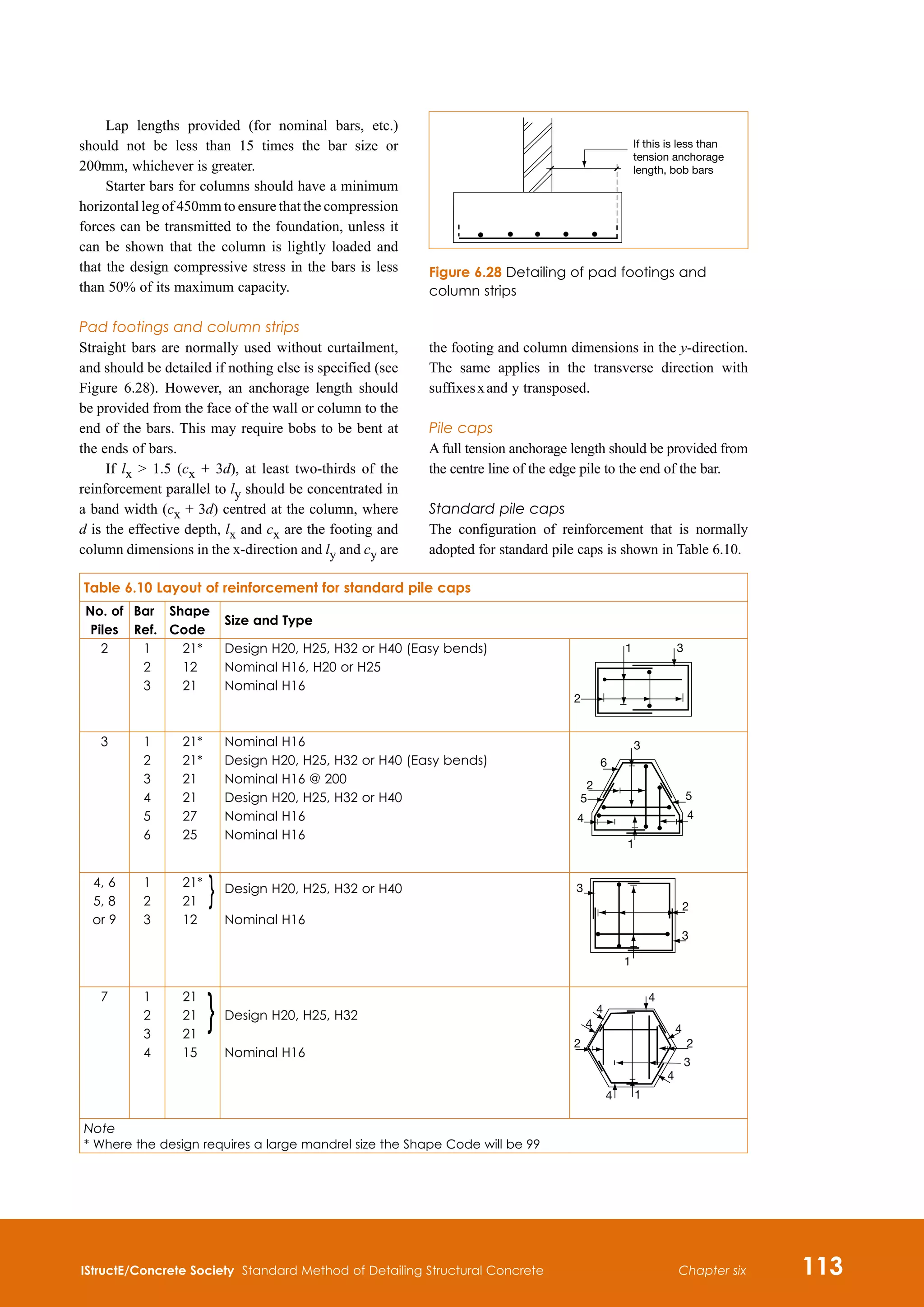
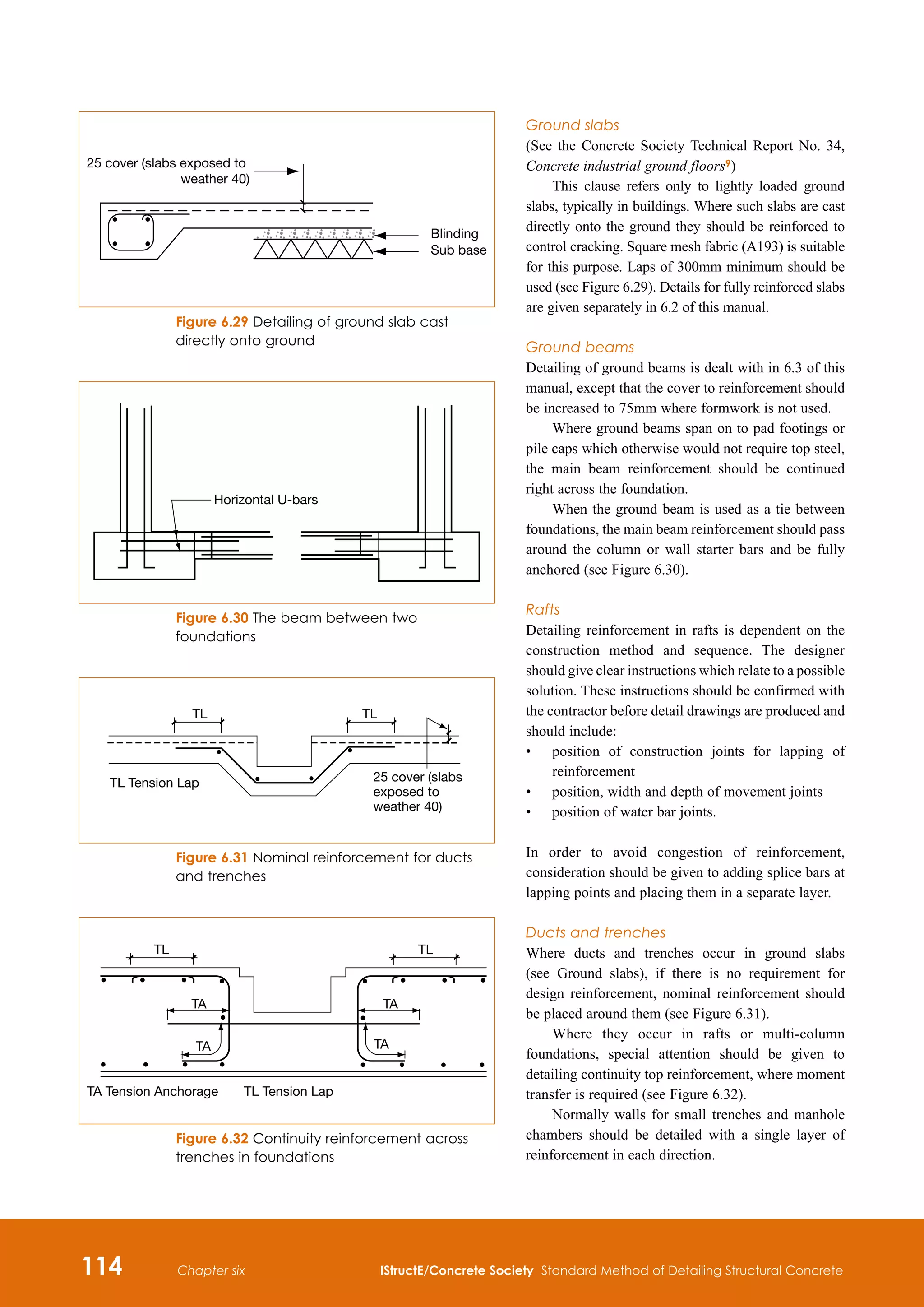
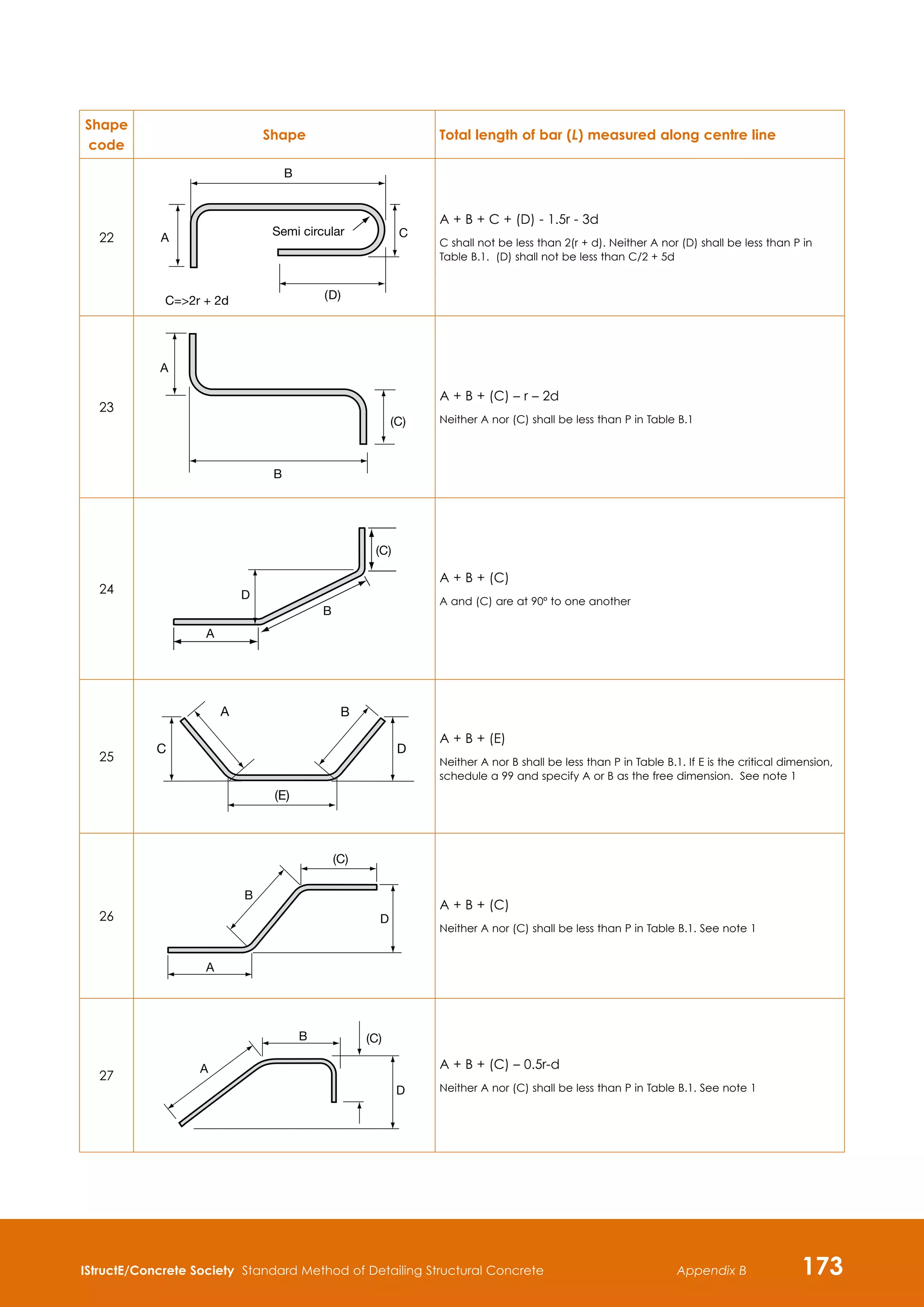
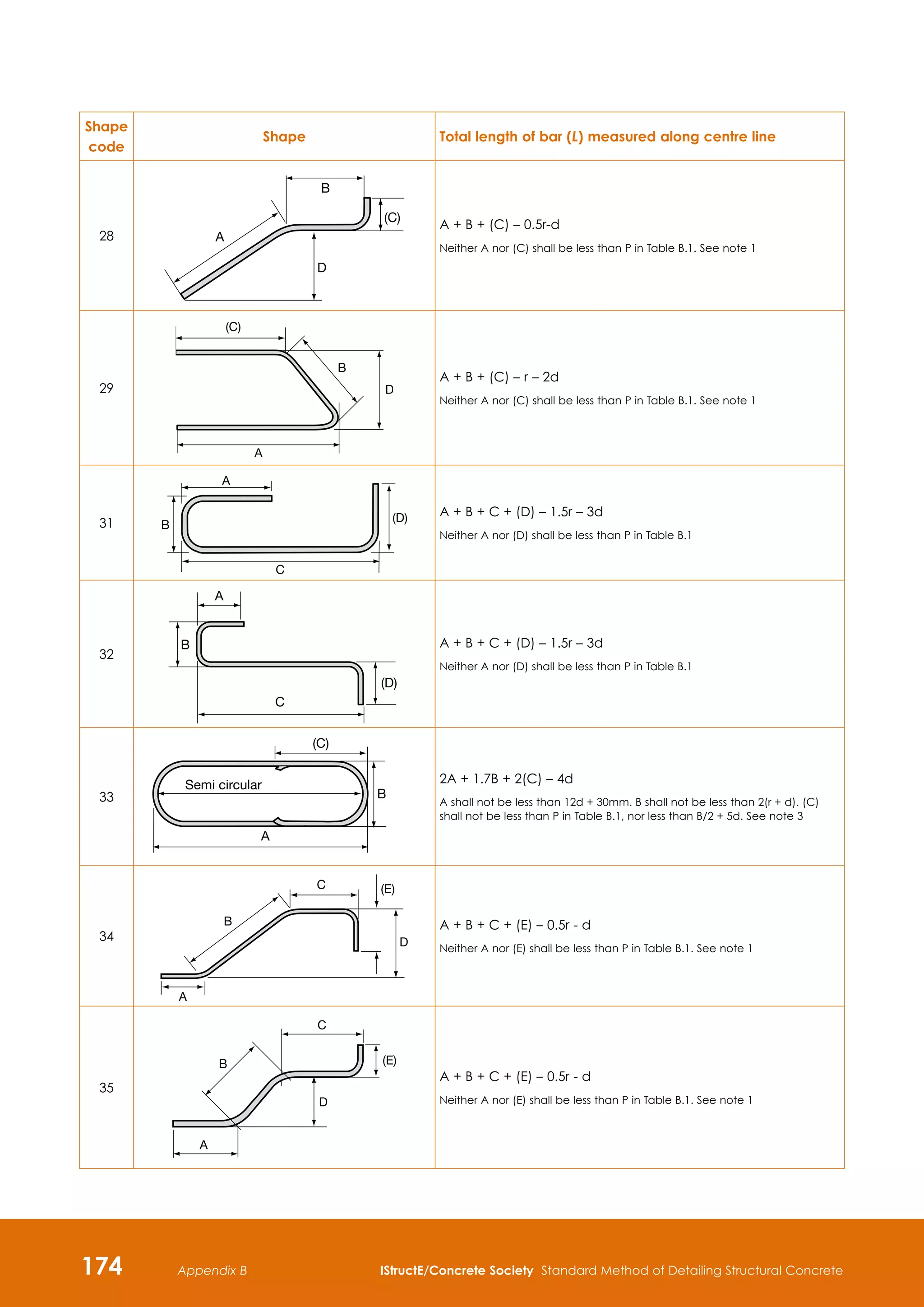
  • 5.
    IStructE/Concrete Society StandardMethod of Detailing Structural Concrete
  • 6.
    CONTENTS 1 Introductionand scope 1 2 Communication of information 3 2.1 General 3 2.2 The reinforcement process 3 2.3 Designer detailing 6 2.4 Contractor detailing 6 2.5 Electronic data interchange (EDI) 6 2.6 Examples of typical methods of providing the required information for detailing 7 3 Drawings 12 3.1 General 12 3.2 Types of drawings 12 3.2.1 Structural drawings 12 3.2.2 Reinforcement drawings 12 3.2.3 Standard details 12 3.2.4 Diagrams 13 3.2.5 Record drawings 13 3.3 Photocopying and reduction 13 3.4 Abbreviations 13 3.5 Dimensions of drawing sheets 13 3.6 Borders 14 3.7 Title and information panels 14 3.8 Key 14 3.9 Orientation 14 3.9.1 Site plans 14 3.9.2 All other drawings 14 3.10 Thickness of lines 14 3.11 Lettering 14 3.12 Spelling 14 3.13 Dimensions 14 3.14 Levels 15 3.14.1 Datum 15 3.14.2 Levels on plan 15 3.14.3 Levels on section and elevation 15 3.15 Scales 15 3.16 Plans 15 3.17 Elevations 15 3.18 Sections 16 3.19 Grid lines and a recommended reference system 16 3.20 Layout of slabs 16 3.20.1 Methods of preparing general arrangement drawings for concrete structures 16 3.20.2 Information shown on general arrangement drawings for concrete structures 17 3.20.3 Fixing in concrete 21 3.20.4 Example of general arrangement drawing for concrete structures 22 3.21 Layout of foundations 23 3.22 Layout of stairs 23 IStructE/Concrete Society Standard Method of Detailing Structural Concrete
  • 7.
    vi IStructE/Concrete SocietyStandard Method of Detailing Structural Concrete 4 Detailing and scheduling 24 4.1 Detailing techniques 24 4.1.1 Tabular method of detailing 24 4.1.2 Template drawings/Typical details 25 4.1.3 Overlay drawings 25 4.1.4 Computer-aided detailing and scheduling 25 4.2 Detailing reinforcement 25 4.2.1 General 25 4.2.2 Intersection and layering of reinforcement 26 4.2.3 Preformed cages 29 4.2.4 Straight bars 30 4.2.5 Welded fabric 30 4.2.6 Chairs 30 4.3 Precast concrete 30 4.4 Check list for detailer 30 4.5 Schedules and scheduling 31 4.5.1 General 31 4.5.2 Allowances for tolerances/deviations 32 4.6 Procedure for checking reinforcement drawings and schedules 32 4.6.1 Stage 1: Design check 33 4.6.2 Stage 2: Detailing check 33 4.6.3 Stage 3: Overall check 33 4.6.4 Method of checking 33 5 Technical information and requirements 34 5.1 Reinforcement 34 5.1.1 General 34 5.1.2 Strength/ductility properties 34 5.1.3 Bar identification 34 5.1.4 Notation 35 5.1.5 Sizes of reinforcing bars 35 5.1.6 Length and overall dimensions of reinforcing bars 35 5.1.7 Rebending bars 35 5.1.8 Large diameter bends 36 5.1.9 Structural tying reinforcement to ensure robustness 36 5.1.10 Fabric reinforcement 36 5.2 Cover to reinforcement 37 5.2.1 General 37 5.2.2 Cover for durability 38 5.2.3 Cover for fire resistance 38 5.2.4 Fixing reinforcement to obtain the correct cover 38 5.2.5 Minimum spacing of reinforcement 38 5.3 Cutting and bending tolerances 38 5.4 Anchorage and lap lengths 40 5.4.1 General 40 5.4.2 Anchorage lengths 40 5.4.3 Laps in reinforcement 41 5.4.4 Additional rules for large bars 42 5.4.5 Bundled bars 43 5.4.6 Laps in welded fabric 44 5.5 Mechanical couplers for bars 45 5.6 Welding of reinforcement 47 5.6.1 General 47 5.6.2 Semi-structural welding 47 5.6.3 Tack welding 47
  • 8.
    IStructE/Concrete Society StandardMethod of Detailing Structural Concrete vii 6 Common structural elements 48 6.1 General 48 6.2 Slabs 48 6.2.1 Scope 48 6.2.2 Design and detailing notes 48 6.2.3 Detailing information 61 6.2.4 Presentation of working drawings 62 Model details 66 6.3 Beams 74 6.3.1 Scope 74 6.3.2 Design and detailing notes 74 6.3.3 Detailing information 78 6.3.4 Presentation of working drawings 79 Model details 82 6.4 Columns 85 6.4.1 Scope 85 6.4.2 Design and detailing notes 85 6.4.3 Detailing information 88 6.4.4 Presentation of working drawings 89 Model details 91 6.5 Walls 97 6.5.1 Scope 97 6.5.2 Design and detailing notes 97 6.5.3 Detailing information 99 6.5.4 Presentation of working drawings 100 Model details 101 6.6 Retaining Walls 105 6.6.1 Scope 105 6.6.2 Design and detailing notes 105 6.6.3 Detailing information 106 6.6.4 Presentation of working drawing 107 Model details 109 6.7 Foundations 112 6.7.1 Scope 112 6.7.2 Design and detailing notes 112 6.7.3 Detailing information 115 6.7.4 Presentation of working drawings 116 Model details 118 6.8 Staircases 123 6.8.1 Scope 123 6.8.2 Design and detailing notes 123 6.8.3 Detailing information 124 6.8.4 Presentation of working drawings 125 Model details 127 6.9 Corbels, half joints and nibs 129 6.9.1 Scope 129 6.9.2 Design and detailing notes 129 6.9.3 Detailing information 130 Model details 131
  • 9.
    viii IStructE/Concrete SocietyStandard Method of Detailing Structural Concrete 7 PRESTRESSED CONCRETE 136 7.1 General 136 7.2 Drawings 136 7.3 Components 137 7.3.1 Pre-tensioned units 137 7.3.2 Post-tensioned units 137 7.4 Reinforcement detailing 144 7.4.1 Minimum reinforcement 144 7.4.2 End blocks in post-tensioned elements 144 7.4.3 Secondary reinforcement 148 7.4.4 Additional reinforcement around holes 148 7.4.5 Reinforcement to resist the normal component of the prestress 148 7.4.6 Reinforcement against grouting pressure 150 7.4.7 Intermediate anchorages 150 7.4.8 Reinforcement in unstressed areas in slabs 151 7.4.9 Reinforcement infill strips 151 7.4.10 Reinforcement near stiff points 152 7.4.11 Movement joints 152 7.4.12 Pre-tensioned elements 152 7.4.13 Construction joints 152 7.5 Other effects of prestressing 152 7.5.1 Movements of the permanent structure 152 7.5.2 Variation in camber 153 7.5.3 Drilling and demolition 153 7.6 Typical details of post-tensioned floor slabs 154 8 Precast concrete 160 8.1 General 160 8.2 Particular durability problems 161 9 Water-retaining structures 162 9.1 General 162 9.2 Durability and crack control 162 9.2.1 General 162 9.2.2 Cover 163 9.2.3 Spacing of reinforcement 163 9.3 Other design and detailing information/requirements 163 9.3.1 Circular tanks 163 9.3.2 Opening corners 163 9.4 Typical details 163
  • 10.
    IStructE/Concrete Society StandardMethod of Detailing Structural Concrete ix 10 References 164 Bibliography 165 APPENDIX A CHANGES TO REINFORCEMENT SINCE 1948 166 A.1 Approximate period 1948-1957 166 A.2 Approximate period 1957-1965 167 A.3 Approximate period 1965-1972 167 A.4 Approximate period 1972-1980 168 A.5 Approximate period 1980-1983 169 A.6 Approximate period 1983-1985 170 A.7 Approximate period 1985-2004 170 Appendix B TABLES 172 Bar shapes 172 Table B1 Minimum scheduling radius, former diameter and bend allowances 178 Bar areas number 179 Bar areas pitch 179 Bar weights pitch 180 Fabric types 180 Effective anchorage length 181 L-bars 181 U-bars 181 Minimum overall depth of various U-bars 182 Hook 182 Trombone 182 Large diameter bends 183 Concrete strength class (fck/fcu) 20/25 183 Internal diameter of bend (mm) 183 Large diameter bends 184 Concrete strength class (fck/fcu) 25/30 184 Internal diameter of bend (mm) 184 Large diameter bends 185 Concrete strength class (fck/fcu) 28/35 185 Internal diameter of bend (mm) 185 Large diameter bends 186 Concrete strength class (fck/fcu) 30/37 186 Internal diameter of bend (mm) 186 Large diameter bends 187 Concrete strength class (fck/fcu) 32/40 187 Internal diameter of bend (mm) 187 Large diameter bends 188 Concrete strength class (fck/fcu) 35/45 188 Internal diameter of bend (mm) 188
  • 11.
    IStructE/Concrete Society StandardMethod of Detailing Structural Concrete
  • 12.
    Foreword The Standard methodof detailing reinforced concrete was published in 1970 and followed in 1973 by the Concrete Society’s publication on Standard reinforced concrete details. This was updated in 1989 to incorporate a section on prestressed concrete and the title was amended to the Standard method of detailing structural concrete. As with the original Standard method, the Steering Group was formed of members of both the Institution of Structural Engineers and the Concrete Society. We have taken the views from a wide consultation on the drafts prepared and are grateful for the variety of comments received, all of which have been considered in finalising the document. We are confident the document provides a reflection of the current concerns and developments in the field of detailing. This document is intended to become a standard reference for work in structural design offices in conjunction with the normal design codes and manuals. The previous documents were based on the design guidance in BS 8110. The new document considers the likely effects of Eurocode 2, as far as we can say at present, on detailing principles and materials and attempts to provide guidance that is consistent with Eurocode 2. Recent changes in practices and procurement of detailing services have also been considered such as the development of increased off-site fabrication and detailing being undertaken later in the construction sequence through initiatives such as contractor detailing. These can all blur the distinction between the work of the detailer and that of the designer. In practice, many decisions that are taken by the detailer may technically be the province of the designer. We have attempted to provide guidance of good practice in this document and to suggest the key items and information exchange that needs to be clarified to enable the various members of the design team to be clearly briefed to allow them to efficiently carry out their part of the works. The Steering Group is grateful for the funding provided by the DTI to support this project. In developing and updating this guidance my particular thanks must go to John Clarke and Robin Whittle; the former for managing to succinctly record the many debates and finer points that had to be addressed and the latter for rising to the daunting task of drafting the document and preparing responses to the comments in a way that satisfied the wide variety of comments and viewpoints raised. The original Standard method was widely distributed and accepted both in the UK and the rest of the world. Good designs invariably use the principles set out in the documents and we are confident that the new edition brings a timely update that properly reflects current developments and changes to this aspect of the construction industry. J K Kenward Chairman IStructE/Concrete Society Standard Method of Detailing Structural Concrete xi
  • 13.
    IStructE/Concrete Society StandardMethod of Detailing Structural Concrete
  • 14.
    IStructE/Concrete Society StandardMethod of Detailing Structural Concrete Chapter one The objective of this manual is to provide a working document on structural concrete that can be used to interpret the designer’s instructions in the form of drawings and schedules for communication to the site. The information given in the manual is essential for both the Designer and Detailer and both have a responsibility for ensuring that the correct information is provided. It should be noted that the Designer may be one of many different parties depending on the contractual arrangements. The information and advice is based on Eurocodes and UK practice, which is associated with UK materials and labour costs. The principles and details are relevant for use in most parts of the world with only minor adjustment. The purpose of this manual is to provide a standard reference that can be used on training courses and by detailers and design engineers alike. During the early stages of the development of the original document Arup made their detailing manual available to the Joint Committee and this proved a useful base document. As a consequence the concept of using Model Details to indicate the preferred method of detailing each type of structural element has been adopted. These Details can be found at the end of the appropriate section within Chapter 6. A basic assumption in the preparation of this manual has been that it is the responsibility of the Designer to clearly specify design requirements to the Detailer and it is the responsibility of the Detailer to implement these requirements in a consistent way that will be clear, complete and unambiguous to the end user. In detailing structural concrete, the impact on all parties involved in the construction process should be borne in mind; details that lead to problems or extra costs on site cannot be termed good detailing. It has not been the intention of the Joint Committee to decrease in any way the responsibility of the Designer, although it is recognised that certain details have design implications; therefore Designers should design with full knowledge of this manual. The term ‘standard method’ also needs clarification. It is not intended that any one detail should be copied slavishly for all situations, but all the principles should be followed, both in general and in detail. Details can be prepared with different objectives in mind, e.g. to reduce labour on site by detailing to allow off-site prefabrication of the reinforcement into cages, or to utilise the materials most readily available in a particular location or on site. It is believed that such different objectives can be satisfied by using the principles covered in this manual. The details have been prepared with the following priorities in mind: • technical correctness and safety • buildability and speed of construction • labour and material costs. This major revision of the manual introduces detailing rules that conform to BS EN 1992-1-1, Eurocode 2: Design of concrete structures. Part 1.1: General rules and rules for buildings1 (EC2), BS EN 1992-1-2, Structural fire design2 (EC2, Part 1.2), BS EN 1992- 1-2, Eurocode2:Concretebridges3 (EC2,Part2)andBS EN 1992-3: Liquid retaining and containing structures4 (EC2, Part 3). Where information incorporates National Determined Parameters from the UK National Annexes the values are given in ‘bold’. In general, the conventional use of materials covered by Euronorms or British Standards is assumed. Where other authoritative documents exist, this manual refers to them rather than repeating them in full. It refers to generic rather than any particular proprietary system. This revision also places more emphasis on the communication of information and the responsibility for detailing. The use of Contractor Detailing is recognised and the difference this makes to the process of detailing is considered. Within the UK the use of mild steel reinforcement is no longer common practice and has now become more expensive than high yield reinforcement. Class C high yield reinforcement is considered to provide the required ductility for the specific situations where mild steel was considered necessary. Accordingly reference to mild steel has been removed. In deriving details and standards it is assumed that reinforcement will be supplied by a company holding a valid certificate of approval from a recognised third party product certification body, e.g. UK CARES (Certification Authority for Reinforcing Steels, www.ukcares.co.uk). There is growing use of stainless steel for reinforcement for situations where greater durability is required. BS 6744: 20015 provides details on its use and testing. 1 Introduction and scope
  • 15.
    IStructE/Concrete Society StandardMethod of Detailing Structural Concrete Chapter one The principles covered by BS 86666 have been adopted. BS 8666 defines a standard method of scheduling and a set of bar shapes that, in suitable combination, are normally sufficient for any detailing situation; it is considered to be an essential companion document to the manual. The division between civil and structural engineering is somewhat arbitrary, and it follows that good practice is common to both structural engineering and civil engineering. There are, however, a number of factors that occur in large- scale works of which account be taken when detailing reinforcement. These include: • provision of access for concrete to be safely placed in massive concrete sections such as raft foundations • adjustments of reinforcement to take account of the effects in large pours of concrete. Attention is drawn to CIRIA report 135, Concreting deep lifts and large volume pours7 • suitable reinforcement arrangements to suit long-strip methods of laying ground slabs • recognition of the likely positioning of construction joints and their effect on reinforcement arrangements (also important for building slabs) • recognition of the effects of different concrete mixes and aggregates. It should be noted that this manual does not cover • the detailing of structures designed for seismic situations. For such situations reference should be made to BS EN 1998: Design of structures for earthquake resistance8 and other relevant documents • the detailing of joints and reinforcement for ground slabs. For such information reference shouldbemadetotheConcreteSocietyTechnical Report 34, Concrete industrial ground floors – A guide to their design and construction9 • water resistance of wall and slab elements in contact with the ground. For such situations reference should be made to CIRIA Report 9110 and CIRIA Report 13911 • the detailing of marine structures. For such structures reference should be made to BS 634912 • the use of lightweight aggregate concrete. Reference for this should be made to EC2, Section 11.
  • 16.
    IStructE/Concrete Society StandardMethod of Detailing Structural Concrete Chapter two 2.1 General Accurate detailing has an important role in the procurement and durability of reinforced concrete structures. The actual process of detailing normally comes relatively late in the procurement process. Concepts and working details can be decided during the early design phases but the preparation of final reinforcement drawings and schedules is generally squeezed into a period between completion of final design and the start of construction on site. Thus, very often it becomes a critical process in the construction programme. In the UK, pressure on construction timescales and moves towards non-traditional forms of construction has tended to make detailing an even more critical and pressured activity. 2.2 The reinforcement process Detailing can only really begin in earnest once the final design is available. The design requirements are normally given to the detailer in the form of design calculations, marked up GA drawings, beam schedules or completed pro forma or similar. It is important that detailing is carried out with responsibilities and adequate timescales clearly defined. Issues such as site constraints, relevant standards, laps, covers, concrete grades, holes, detailing preferences, etc must all be covered. These requirements should be formalised into a detailing specification (see Construct’s Guide to contractor detailing13) whether detailing is carried out in-house or outsourced. Ideally the contractor’s preferred methods and sequence of construction should be made known and accommodated. The requirements for the whole structure should be handed over and explained to the detailer at a single point in time. Packages of information that need to be provided to match the construction sequence or phasing must be defined. For instance sufficient information for the detailing of foundations and (wall and column) starter bars may be the first package required to be delivered. Drawings and schedules can then be prepared by the detailer. Once drawings and schedules have been completed, they are usually checked by the detailers themselves, checked by the designer for design intent and compliance with standards, and where appropriate, checked by contractors for buildability and completeness, all in according with the relevant contracts, specifications and Quality Assurance procedures. As far as possible, design changes once detailing has started should be avoided.   Any changes significantly affect and interrupt work flows, increase workloads and greatly increase the risk of errors. However, there are often situations where final design information is not available and design developments and checks cause alterations or requirements to change. While not ideal, changes are almost inevitable and their control needs to be addressed. An agreed system of design freezes is most beneficial. Once the reinforcement drawings and schedules gain the status of construction drawings they are distributed to the relevant parties. In traditional contracts, the reinforcement drawings and schedules will be issued to the Contract Administrator and to the main contractor, client’s Quantity Surveyor, etc. The main contractor normally distributes the information to site staff, quantity surveyors, buyers etc and to specialist subcontractors. The schedules will be sent to the reinforcement fabricator/supplier. The reinforcement is usually ‘called off’ from site. As the work proceeds and reinforcement is required, the site will ask for reinforcement from certain schedules to be delivered. Again depending on circumstances, these may be bulk deliveries, individual pages of schedules or schedules recast by site into work packages. On site, deliveries of reinforcement call for inspection, craneage, sorting, storage, and document processing. Unless just- in-time deliveries are feasible or suitable storage areas are available adjacent to the work area, the reinforcement may need to be sorted and moved again just prior to fixing. Prefabrication, e.g. prefabricated pile, column and beam cages, may be carried out on or off site. The reinforcement supplier or fabricator has to predict ‘call offs’ so that sufficient stock and manpower is available to answer their many customers’ requirements. The cutting and bending process is well documented but of most concern are addressing issues such as price changes, clarity of information, off-cuts, non-standard shapes, full deliveries and most especially delivery timescales. Deliveries that are required within 48 hours of the receipt of a call off usually attract a premium. 2 Communication of information
  • 17.
    IStructE/Concrete Society StandardMethod of Detailing Structural Concrete Chapter two The reinforcement is placed and fixed by steel fixers then checked in-situ. Responsibility for checking reinforcement should be covered in the specification. Formal pre-concreting checks should include checks of the reinforcement, covers, inserts and specialist items etc. The reinforcement should be checked again during concreting for position and afterwards dowels and starter bars should be treated and/or protected. The specification may also require a cover meter survey of after concreting. Through all these processes correct and current reinforcement drawings and schedules play a vital role in getting it right on site. The schedules also play another vital role as they form the basis for payments to suppliers and contractors. The communication of reinforcement detailing information from the design office to the site must be as efficient as possible. Traditionally the Designer has also been responsible for preparing the reinforcement detail drawings and schedules, i.e. ‘Designer Detailing’. The emergence of specialist concrete contractors has provided an alternative means of producing the information through ‘Contractor Detailing’. Both systems handle the same technical information but differ in the timing and the emphasis of the way it is produced. Some of the advantages and disadvantages are listed in Table 2.1. Irrespective of the method of detailing chosen, it is essential that all the design information, that is required for detailing, is provided. Furthermore a standard way of providing the information reduces the scope for mistakes and speeds up the process. Currently for any particular type or size of project, the calculations, and consequently the detailing instructions, produced by different Designers vary considerably both in format and content. These variations affect the efficiency of the industry, particularly in that: • The variations make the checking of calculations and instructions by Designers time-consuming and laborious. In addition the communication of design information to external checking authorities can be unnecessarily confused and protracted. • It takes longer for the Detailer to absorb the reinforcement information given and increases the possible need for clarification. It can also lead to a degree of abortive work and misunderstanding between Designer and Detailer. Table 2.1 Advantages/disadvantages of Designer and Contractor Detailing Advantages of Designer Detailing/ Disadvantages of Contractor Detailing Advantages of Contractor Detailing/ Disadvantages of Designer Detailing Details from Designer Detailing are produced as an integral part of the design and can be more easily tailored to the demands of the Designer. Contractor Detailing can more readily take into account the Contractor’s preferred method of working. Production of reinforcement details by Designer Detailing can take place while the design is still being finalised, thus saving elapsed time. A typical example where it might be more efficient for the designer to produce details is for foundations. Reinforcement details by Contractor Detailing can be prepared taking account of the Contractor’s preferred methods of construction and final material selection. Preparing clear design information for Contractor Detailing takes longer and is likely to be later than for Designer Detailing with less time for checking or changes. Preparing reinforcement details by Contractor Detailing benefits from following the actual construction programme. The approval process for Contractor Detailing can take longer because of the rechecking required. Designer detailed work may require re-working to take account of the Contractor’s method of working.
  • 18.
    IStructE/Concrete Society StandardMethod of Detailing Structural Concrete Chapter two Although it is clearly more efficient for the construction process to invoke a time freeze on the provision of new or altered information (e.g. mechanical and electrical information) this may not always be in the interests of the Client who is looking for the optimum solution. The following includes the typical information required for detailing (see 2.6 for examples): • General Arrangement (GA) drawings: they must be fully dimensioned, with sufficient sections and details, and should show or reference all necessary service holes, provisions for ducts and cast fittings. • Project specification: Unless noted otherwise, the requirements of EC2 and this manual will be deemed suitable and applicable. Special requirements should be stated (e.g. seismic). • Design requirements in one of the following forms: – the structural design calculations – marked-up GAs: This is common practice for small uncomplicated projects – element schedules: Sketches of the required reinforcement by element – pre-printed drawings (completed proformas) – sketches and tables incorporated with Computer Aided Design (CAD). The efficient communication of information from Designer to Detailer is important. However, it is not suggested that a rigorous format for calculations be adopted throughout the industry. It is preferred that the Designer should recognise and tailor the guidelines given in this manual to suit the different situations that arise. The following points should be considered when the Designer is preparing instructions to the Detailer: • Instructions should be indexed. An edited calculation index is normally sufficient. • Basic design information relating to concrete and reinforcement grades, fire resistance, durability and associated concrete covers should be given by a Detailing Notice Sheet preceding the detailing instructions. Where information is available concerning theconstructionprocess(e.g.constructionmethod, pour sequence etc.) this should be provided to the Detailer. Any special requirements should be noted on individual calculation/instruction pages. • Detailing instructions should comprise only the calculation sheets describing the geometric and reinforcement requirements of a particular structural element. Information concerning general analysis of the structure, e.g. stability analysis, computer listings, is not required. The instructions should include clear diagrams of the reinforcement layering directions, TI, T2 etc. and the layering at cross-over of elements, consistent with the design calculations. Reference should be made to the Model Details in this manual where appropriate or alternative sketches supplied. • Detailing information should be normally given in the right hand margin of the calculation sheet. Where the calculations for an element or series of elements are lengthy or complex the relevant reinforcement information should be extracted and presented in a summary sheet. • The use of marked-up outline drawings as a summary should be accompanied by calculations for congested areas or where the section is small. • Sketch details. All instructions should explicitly address the curtailment of reinforcement including the angle of strut assumed in shear design (see 6.3.2). Where conditions permit the use of standard arrangements these should be adopted. The instructions should also note where the standard curtailments may still be used where the elements fall outside the conditions for their use. Where only bending moment and shear force diagrams are provided these should be accompanied with clear instructions concerning curtailment. This method can be inefficient for detailing unless the Designer has given thought to the rationalisation of the layout (e.g. beam cages). Where reinforcement is congested or there are particularly complex connections e.g. corbels, nibs, deep beams to thin cross-section walls or columns, details should be sketched at a large size, even full-size, to confirm buildability. The sequence of installation must be considered to ensure beams can be lifted and placed. • Each particular structural element requires specific design and geometric information. The list of information required is given in ‘Detailing Information’ sub-section of Chapter 6 for each element. • Always provide the Detailer with the latest revision of relevant GAs and sections to avoid abortive work and the possible issue of incorrect details. • The Designer should seek to maintain regular direct contact with the Detailer during the detailing process.
  • 19.
    IStructE/Concrete Society StandardMethod of Detailing Structural Concrete Chapter two It is recommended that in the absence of an instruction from the Designer for a particular detail, or for nominal reinforcement, the Detailer should assume that the standards described by this manual are to be applied. Where the Model Details given in this manual are not applicable to the geometric configuration, the Detailer should provide suitable alternatives based on similar principles. 2.3 Designer detailing In order that the detailing is carried out in the most efficient manner, wherever possible, the Designer should seek to discover the Contractor’s preferred methods and agree a sensible programme and sequence of work eliminating any unrealistic demands. Where the construction sequence is dependent on the design the Designer should provide a description of the design philosophy and constraints in addition to the information listed in 2.1. Provide a description of the design intent and the form of construction assumed in design. All sketches and rebar correspondence should be given a unique identification sketch or instruction number. ‘Nominal’ reinforcement should be assumed to be in accordance with the relevant element in Section 6 unless clearly stated by the designer. 2.4 Contractor detailing (see also A guide to contractor detailing of reinforcement in concrete13 ) Where detailing is commissioned through the Contractor under Works Contract for a project the following managerial points should be noted: • The sub-contract should clearly state and define the responsibilities of each party. • Legal advice should be sought, where necessary, to remove any doubts over contractual liabilities. • The Specialist Concrete Contractor should be satisfied with the obligations and duties imposed by the contract and any warranties. • The Specialist Concrete Contractor should have adequate insurance cover commensurate with the exposure to the relevant risks and liabilities. 2.5 Electronic data interchange (EDI) The key to successful data exchange is to ensure that the specification of the data to be transferred from one party to another is clearly and rigorously defined. Electronic transfer of data allows contractors to manage schedules and their revisions more quickly and are less prone to error than the old fax or postal methods which required re-keying of data. The widespread adoption of electronic data interchange (EDI) by the industry brings with it the need for careful and consistent schedule formats complying with BS 86666. This allows the data to be transferred across the entire supply chain. Minimum requirements The following is a list of the minimum requirements for setting up accurate electronic data which can be universally accepted: • Use of consistent nomenclature for drawing and revision numbers or letters, i.e.: – Revisions 1 and 2 should never be succeeded by revisions C and D. – The number 0 should never be interchanged with the letter O. – A revision at bar mark level should be consistent with the Drawing level, e.g. if a bar mark revision is marked 2 the drawing and schedule revision should be marked 2, although lower revisions can be displayed against the appropriate bar mark, if they were not changed in the new revision. • Every bar mark must have a Member Name against it. • Member Names must remain consistent through a schedule. The name itself is not important but a member called, for example ‘garage-1’in one part of a schedule and later abbreviated to ‘grge-1’ in another part will be recognised by software as 2 different members. • The same bar mark must never repeat within the same member name. • When a library of Shape Code 99s is created (e.g. 99-01, 99-02 etc.) the shapes should be defined graphically and remain consistent for the duration of the contract. Recommended procedures • When a revision is issued, each schedule page should display this revision, regardless of whether any bar marks have changed on that page. • Revised bar marks should be individually labelled with the revision number or letter. A bar mark should retain the revision number or letter at which it was last revised for accurate revision history. • When schedules are produced we recommend a naming convention of drawing number_revision, e.g. 213_02.
  • 20.
    IStructE/Concrete Society StandardMethod of Detailing Structural Concrete Chapter two 2.6 Examples of typical methods of providing the required information for detailing Example 1 Flat slab Example of a marked up general arrangement drawing for a flat slab. Notes on drawing should include concrete grade and cover, or reference to these. The general arrangement drawings should also be provided. Where contour plots from proprietary systems are provided the level of rationalisation to be applied should be agreed between the Designer and Detailer. Alternatively where crack control is important a schematic layout of Bars should be given. The method of showing where holes and the associated reinforcement trimming details required for ME purposes must be clearly stated (see also 6.2.2). 565mm2 2094 mm2 2094 mm2 2094 mm 2 565mm 2 565mm 2 565mm 2 565mm 2 565mm 2 565mm 2 565mm 2 565mm 2 565mm 2 565mm 2 565mm 2 565mm 2 565mm 2 1796mm 2 1796mm 2 1796mm 2 1796mm 2 1795mm2 1795mm2 565mm 2 565mm 2 1796mm 2 1795mm2 1795mm2 1795mm2 1795mm2 565mm2 2094 mm2 2094 mm2 1795mm2 565mm2 565mm2 646mm2 565mm2 565mm2 2805mm2 565mm2 565mm2 2094 mm2 2094 mm2 565mm 2 565mm2 565mm2 565mm2 565mm2 565mm 2 565mm 2 565mm2 1005mm2 1005mm 2 1005mm 2 1005 mm 2 565mm2 646mm2 646mm2 565mm2 565mm2 565mm2 C B A 1 2 3 4 5 A D
  • 21.
    IStructE/Concrete Society StandardMethod of Detailing Structural Concrete Chapter two Example 2 Beams: Details given in calculation sheet.
  • 22.
    IStructE/Concrete Society StandardMethod of Detailing Structural Concrete Chapter two Example 2 (Continued)
  • 23.
    10 IStructE/Concrete SocietyStandard Method of Detailing Structural Concrete Chapter two Example 3 Pile cap: These details were sketched out on calculation sheets Core 6. GL. A13, B2 Mark No. Type/Size Spacing 6 7 8 9 10 11 - 4 4 - 5 - H16 H40 H16 H16 H40 H16 250 - - @ same spacing as 08 - -
  • 24.
    IStructE/Concrete Society StandardMethod of Detailing Structural Concrete 11 Chapter two Example 4 Examples of typical proforma
  • 25.
    12 IStructE/Concrete SocietyStandard Method of Detailing Structural Concrete Chapter three 3.1 General Drawings are prepared so that the Designer can communicate his requirements in a clear, concise and unambiguous manner. It is important to ensure that drawings are not unnecessarily congested or complicated. Drawings sent to the Detailer (or Contractor Detailer) are likely to be electronic. Drawings used on construction sites will get dirty, wet and dog-eared. The clarity of the original drawing that will be reproduced is, therefore, most important. It is recommended that A1 size drawings are generally used for General Arrangements, larger sized drawings being used only when unavoidable. A3 and A4 are recommended for details. For each project, the chosen drawing size should be used consistently. The written descriptions on drawings should be as brief as possible, consistent with completeness, and the lettering should be clear. Any instructions on drawings should be positive; they should be written in the imperative. Each drawing should give all the information (together with reference to associated drawings) necessary for the construction of the portion of the work shown, omitting other irrelevant detail. Details of materials to be used will normally be given in a separate specification, and reference to the concrete or other types of material on drawings will be in an abbreviated form. Reference to any special items concerned with construction details should be made on the general arrangement drawings and not in a separate letter or document. Special requirements of the designer, e.g. details of cambers, chamfers, sequence of construction, position and type of joints, etc., should all be described on the general arrangement drawings. 3.2 Types of drawings The main purpose of preparing structural drawings is to explain the shape and position of all the parts of the structure. Such drawings are used to progress the Architect’s concept and then to enable construction of the structure on site. Structural drawings are also necessary for the preparation of the reinforcement drawings. 3.2.1 Structural drawings Drawingsforconcretestructuresconsistofdimensional data necessary for the setting out and construction of the concrete formwork, e.g.: • setting out of the concrete structure on site • plans, sections and elevations where appropriate showing layout, dimensions and levels of all concrete members within the structure • location of all holes, chases, pockets, fixings and items affecting the concrete work • north point • notes on specifications, finishes and cross- references of the construction. They also provide the detailer with the layout and sectional information required to specify the length, shape and number of each type of reinforcing bar. All these matters should be considered at the outset of every drawing programme. Detailed examples of structural layout drawings and guidance notes are illustrated in 3.20. 3.2.2 Reinforcement drawings Reinforcement drawings describe and locate the reinforcement in relation to the outline of the concrete work and to relevant holes and fixings. Generally, circular holes up to 150mm diameter and rectangular holes up to 150 × 150mm in slabs or walls need not be indicated on the reinforcement drawings. All other holes should be indicated on the reinforcement drawing and should be trimmed, where necessary, by suitable reinforcing bars. Separate drawings or plans for top and bottom layers of reinforcement should be used only for fabric and in exceptional cases, e.g. voided bridge decks and box girders with four layers of reinforcement. Reinforcement drawings are primarily for the use of the steel fixers. It is preferable that general arrangement and reinforcement drawings be kept separate, but for simple structures a combined drawing may be appropriate. 3.2.3 Standard details Standard details are those details that are used on a repetitive basis. Details used in this way must be carefully worked out, fully detailed and totally 3 Drawings
  • 26.
    IStructE/Concrete Society StandardMethod of Detailing Structural Concrete 13 Chapter three applicable to each location where they are to be specified. Standard details may apply to concrete profiles or reinforcement arrangements, and they should be drawn to a large scale. 3.2.4 Diagrams Diagrams may be used as a means of communicating design ideas during both pre-contract work and the post-contract period. Diagrams may be formally presented or sketched freehand providing they convey information clearly, neatly and in detail. The information contained in diagrams should be drawn to scale. 3.2.5 Record drawings When the reinforced concrete structure has been constructed, the original drawings used for the construction process should be amended to indicate any changes in detail that were made during the construction process. A suffix reference should be added to the drawing number to indicate the drawing is a ‘record’ drawing. The amendments should be described in writing against the appropriate suffix reference. A register of drawings should be kept listing reference numbers, titles and recipients of drawings. The record drawings should be included in the Safety Plan compiled under CDM Regulations14 and submitted to the client for safekeeping at handover of the project. 3.3 Photocopying and reduction There are a number of considerations that must be made if photographically reduced drawings are to be fully intelligible in their reduced form (see 3.15). These include: • the chosen range of line thickness • the size and nature of the script used • the arrangement of the information on the drawings, avoiding congestion • the need to ensure that graphic and script information is, as far as possible, kept separate • the possibility that solid black areas will not print properly. Since many drawings will be reduced for archive storage on completion of the construction, all these matters should be considered at the outset of every drawing programme. It is recommended that checking of reinforcement is undertaken on full size prints. Errors can easily occur if reduced sizes prints are used, e.g. A1 to A3. 3.4 Abbreviations Standard abbreviations are recommended but, if there is any risk of confusion or ambiguity with their use in any particular circumstances, then the words should be written in full. No other abbreviations should be used unless clearly defined on all the drawings on which they appear. Particular attention is drawn to the use of lower case and capital letters. All abbreviations are the same in the plural as in the singular. The following symbols are commonly used: reinforced concrete RC blockwork blk brickwork bwk drawing drg full size FS not to scale NTS diameter dia or b centres crs setting-out point SOP setting-out line SOL centre-line finished floor level FFL structural slab level SSL existing level EL horizontal horiz vertical vert pocket pkt 3.5 Dimensions of drawing sheets The recommended dimensions of drawing sheets are given in Table 3.1. Figure 3.1 shows the relative sizes. Table 3.1 Size of drawing sheets BS reference dimensions (mm x mm) A0 A1 A2 A3 A4 841 × 1189 594 × 841 420 × 594 297 × 420 210 × 297 Note Margins and information panels are contained within these dimensions. A0 A4 A3 A2 A1 Figure 3.1 Relative size of recommended drawings
  • 27.
    14 IStructE/Concrete SocietyStandard Method of Detailing Structural Concrete Chapter three 3.6 Borders All drawings should have a 20mm filing border on the left-hand side. Elsewhere the border should be 20mm (minimum) for A0 and Al and 10mm (minimum) for A2, A3 and A4. The border margin line should be at least 0.5mm thick. 3.7 Title and information panels Key information relating to the job and drawings should be placed in the bottom right-hand corner of the drawing sheet (Figure 3.2, panel A). Panel A should include at least the following information: • office project number • project title • drawing number with provision for revision suffix • drawing title • office of origin • scales (a drawn scale is necessary when the drawing is to be microfilmed – see also BS 553615) • drawn by (name) • checked by (name) • date of drawing. Immediately above panel A a box should be provided to contain the necessary reference to relevant bar and fabric schedule page numbers. Panel B may be developed vertically from panel A to include such information as revisions working up from panel A and notes (working down from the top of panel B). Notes on reinforcement drawings should include cross-references to GAs, a list of abbreviations, the grade of concrete, specified covers and the relevant ‘schedule refs’. 3.8 Key On jobs where a portion of the work has to be divided into several drawings, it is useful to have a small diagrammatic key on each drawing, with the portion covered by that drawing clearly defined, and adjacent panels identified with a given drawing number. 3.9 Orientation 3.9.1 Site plans The direction of the north point should be clearly shown. 3.9.2 All other drawings All other drawings relating to particular buildings or major subdivision of a job should have consistent orientation, which should preferably be as close as possible to the site-plan orientation. 3.10 Thickness of lines The objective of using varying line thicknesses is to improve clarity by differentiation. The scale of drawing and the need for clear prints to be taken from the original should be borne in mind. The following suggested line thicknesses are considered suitable for reinforced concrete drawings. Concrete outlines generally and general arrangement drawings 0.35mm Concrete outlines on reinforcement drawings 0.35mm Main reinforcing bar 0.7mm Links 0.35mm-0.7mm Dimension lines and centre-lines 0.25mm Cross-sections of reinforcement should be drawn approximately to scale. 3.11 Lettering Distinct and uniform letters and figures ensure the production of good, legible prints; the style should be simple. Capital letters should be used for all titles and sub-titles and should preferably be mechanically produced. Lower-case letters may be used in notes. 3.12 Spelling The spelling of all words should be in accordance with BS 6100-6.216 or otherwise the Little Oxford Dictionary17, e.g. asphalt, kerb, lintel, etc. 3.13 Dimensions The general arrangement drawing should show all setting-out dimensions and sizes of members. The reinforcement drawings should contain only those B A 180 0.5mm minimum 20mm minimum A0 – A1 10mm minimum A2 – A3 – A4 20mm minimum Figure 3.2 Layout of key information on drawings
  • 28.
    IStructE/Concrete Society StandardMethod of Detailing Structural Concrete 15 Chapter three dimensions that are necessary for the correct location of the reinforcement. The points to which the dimension lines relate should be as shown in Figure 3.3. Dimensions should be written in such a way that they may be read when viewed from the bottom or the right-hand side of the drawing. They should, where possible, be kept clear of structural detail and placed near to and above the line, not through the line. For site layouts and levels, the recommended unit is the metre. For detailing reinforcement and the specification of small sections, the recommended unit is the millimetre. It is not necessary to write mm. Dimensions should normally be to the nearest whole millimetre. Thus: 4.250 114.200 6.210m 5 15 1725 3.14 Levels 3.14.1 Datum On civil engineering and major building works it is usually necessary to relate the job datum (a temporary benchmark, TBM, or transferred OS benchmark) to the Ordnance Survey datum. On other works, a suitable fixed point should be taken as job datum such that all other levels are positive. This datum should be clearly indicated or described on the drawings, and all levels and vertical dimensions should be related to it. Levels should be expressed in metres. 3.14.2 Levels on plan It is important to differentiate on site layout drawings between existing levels and intended levels (see 3.20.2 (n)). 3.14.3 Levels on section and elevation The same method should be used as for levels on plan, except that the level should be projected beyond the drawing with a closed arrowhead indicating the appropriate line. When constructing a structure it is the level of the structure that is important. If it is necessary to refer to the finished floor level, this should be a reference in addition to the structural floor level, as shown in Figure 3.4. 3.15 Scales Scales should be expressed as, for example, 1:10 (one to ten). The following scales are recommended as a suitable for concrete work: general arrangements 1:100 wall and slab detail 1:50 beam and column elevations 1:50 beam and column sections 1:20 Where larger scales are required, the preferred scales specified in BS 119218 are: 1:10, 1:5, 1:2 or full size. It is quite common for a drawing to be printed at a different scale than that for which it was drawn. For this reason further information should be added indicating the original size of drawing (e.g. 1:100 for A1). 3.16 Plans Plans should be drawn in such a way as to illustrate the method of support below, which should be shown as broken lines. This is achieved if one assumes a horizontal section drawn immediately above the surface of the structural arrangement or component. Dimension lines should be kept clear of the structural details and information. 3.17 Elevations An elevation on a portion of a structure will normally be taken as a vertical cut immediately adjacent to the element under consideration. Structural members cut by the section should be shown in full lines. Other connecting members behind the member being detailed should be shown by dashed lines. 1104 1800 Figure 3.3 Dimension lines 40 F.F.L S.S.L 12.000 Figure 3.4 Levels on sections
  • 29.
    16 IStructE/Concrete SocietyStandard Method of Detailing Structural Concrete Chapter three 3.18 Sections Where sections are taken through structural elements, only the material in the cutting plane is shown on a section; in general a cut showing features beyond should not be used. For clarity, the cut member may be shaded. The directions of sections should be taken looking consistently in the same direction, looking towards the left for beams and downwards for columns. A section should be drawn as near as possible to the detail to which it relates. 3.19 Grid lines and a recommended reference system A grid system provides a convenient datum for locating and referencing members, since columns are usually placed at or near the intersection of grid lines as shown in Figure 3.5. Grid notation should be agreed with the architect and would normally be numbered 1, 2, 3, etc, in one direction, and lettered A, B, C, … X, Y, Z, AA, AB, etc. (omitting I and O) in the other direction. These sequences should start at the lower left corner of the grid system. Supplementary grids, if required, can be incorporated within the system and identified as follows. Aa, Ab, Ac, Ba, 2.5, 4.2, etc. Referring to the framing plan sketch Figure 3.5: • All beams within a floor panel are referenced from the column situated in the lower left corner of that panel, e.g. column reference B2 occurs at the intersection of grids B and 2. • Each beam reference includes the column reference plus a suffix number, e.g. B2l, B23, etc. for beams spanning up the panel, and B22, B24, etc. for beams across the panel. • Similarly for supplementary column Ba 2.5. This format is similar to the system used successfully for structural steelwork. Beams should be labelled on the general arrangement drawing, particularly off-grid members. Beams on grid lines may have their labels omitted, in which case strings of beams are described as follows: ‘beams along grid line B/1 to 3’. 3.20 Layout of slabs Layout drawings, commonly known as general arrangement drawings (or GAs) are developed over a period of time and coordinated from dimensional information provided by the architect, engineer and specialists. The dimensions should be checked and approved before commencing the detailing of reinforcement. 3.20.1 Methods of preparing general arrangement drawings for concrete structures Projects vary in size and complexity. It is important to select a scale that will enable the final drawing to be read with clarity. Large floor areas can be spread over several drawings and linked and referenced by means of key plans. Local complexities, such as staircases, can be isolated and referenced to a larger- scale drawing. C B A Ba 1 2 3 2:5 C12 B12 B11 A11 B21 B25 B23 B31 A31 A15 A21 A13 A16 A14 A12 C22 B22 2A2 B24 Ba2:52 Figure 3.5 Framing plan
  • 30.
    IStructE/Concrete Society StandardMethod of Detailing Structural Concrete 17 Chapter three 3.20.2 Information shown on general arrangement drawings for concrete structures On plan a) Grid lines These form a network across the job and provide a convenient datum for dimensioning and referencing elements (see 3.19). Grids usually coincide with the centre-lines of columns; clarify if they do not. b) Centre-lines These often coincide with grid lines. Otherwise notate and locate by offset dimensions from nearest grid. It is useful to locate groups of holes, pockets, isolated bases, plinths, machinery, plant, etc. c) Columns State overall concrete size (with clear indication of orientation) and locate relative to the nearest grid lines. If the size of the column is greater below floor, show the lower profile dotted; its size will be indicated on the lower floor plan. Where repetition occurs it may be convenient to add an explanatory note, e.g. all columns 300 × 300 and centred on grid lines unless noted. d) Nibs on columns Dimension on plan. Where the profile becomes more complex it may be necessary to refer to an enlarged detail for dimensions. Elevations will be required if the vertical extent of the nibs is not obvious from the plan. 2 D 50 150 3050 COL. C C C C BASE MILL 500 x 300 col. 100 200 300 50 80 80 90 100 200 200 200 300
  • 31.
    18 IStructE/Concrete SocietyStandard Method of Detailing Structural Concrete Chapter three e) Downstand beams State beam reference (see 3.19) and overall concrete size (h × b), both preferably at the centre of span. The dotted line plots the profile of the lowest beam soffit. Where repetition occurs it may be convenient to add an explanatory note, e.g. all internal beams 600 × 300 unless noted. h b 550 x 300 500 x 300 200 4B1 3B4 f) Upstand beams State beam reference and overall concrete size (h × b). Add level to top of beam and/or draw section to clarify. h 3C2 2.570 800 x 350 b h b g) Nibs and kerbs on beams Locate extent of projection on plan and notate, indicating depth. Clarify with section and/or add levels to top. NIB 2.150 200 deep 150 150 600 KERB 150 high 175 425 1575 h) Bases and ground slabs Notate and indicate thickness. (150) GROUND SLAB (500) BASE Type ‘A’
  • 32.
    IStructE/Concrete Society StandardMethod of Detailing Structural Concrete 19 Chapter three j) Suspended slabs Show direction of span and indicate thickness of slab, preferably near the centre of the panel. one-way spanning two-way spanning cantilever tapered cantilever (add section and indicate direction of taper). k) Walls State wall thickness and its location relative to the nearest datum. If the wall size under is different then show its profile dotted; its thickness will be indicated on the lower floor plan. 105 150 95 150 WALL l) Dwarf walls and parapets These walls are viewed just above their top and notated. Sections and/or levels are added for clarity. m) Load bearing walls • Indicate wall material and thickness and its location relative to the nearest datum. Supporting walls under to be shown dotted and notated on the lower floor plan. • Locate and identify walls above floors that are not continuously supported by walls below. Generally non-load bearing partitions are not shown on structural drawings. 150 CANTILEVER 150 to 200 CANTILEVER 160 175 150 PARAPET 150 95 105 350 31.100 32.500 450 475 225 Block WALL 425 225 Brick WALL above slab only
  • 33.
    20 IStructE/Concrete SocietyStandard Method of Detailing Structural Concrete Chapter three n) Levels These provide a vertical datum and should be displayed prominently at each level as appropriate, thus: • top level of concrete, e.g. foundation base • top of structural slab level • top of finished floor level • top of existing level • arrow indicates direction of down slopes and falls and up slopes • arrow indicates level to top surface as noted. p) Steps in level Lines at a change in level can be quickly identified by adding sectional hatching to the plan as follows: • step on top surface • splay on slab soffit shown dotted • locate steps to nearest datum appropriate. 150.000 150.050 2000 150 45º splay under 100 50 STEP q) Joints Any special joint required by the Designer should be located and notated on plan with a bold chain-dotted line and supported by a section if required for clarification. Description of JOINT 5250 r) Stairwells On floor plans, complicated areas such as stairwells are often referred to an enlarged layout drawing. The direction of stair flights should be indicated as though standing on the subject floor. STAIR See drg.. down up 125.000 150.050 SSL FFL EL 150.075 150.075 50 FALL UP 245.750 LEDGE 125.000 150.050 SSL FFL EL 150.075 150.075 50 FALL UP 245.750 LEDGE 125.000 150.050 SSL FFL EL 150.075 150.075 50 FALL UP 245.750 LEDGE 125.000 150.050 SSL FFL EL 150.075 150.075 50 FALL UP 245.750 LEDGE 125.000 150.050 SSL FFL EL 150.075 150.075 50 FALL UP 245.750 LEDGE 125.000 150.050 SSL FFL EL 150.075 150.075 50 FALL UP 245.750 LEDGE
  • 34.
    IStructE/Concrete Society StandardMethod of Detailing Structural Concrete 21 Chapter three s) Holes All should be drawn to scale, sized and located to the nearest datum (holes G 150mm × 150mm will not always be shown): • hole through slab. • groups of holes. Identify holes with a cross. • holes through beams or walls. Indicate level to bottom of hole, e.g. window sill. Show cross dotted if below the section, e.g. downstand beam. An elevation will be required if holes are too complicated to show on plan. 450 175 200 C L group 75 350 175x100 80 160 170 175 250 C L 2 no HOLES 100x100 300 x 200 C L C L 1250 350 x 500 9.750 500 500 OPENING t) Pockets and recesses • similar to holes but identify area with diagonal only and notate. • small pockets such as those used for anchor bolts are usually identified by a large dot and notated. 175 200 170 275 pkt 25 deep 4 no pkt 125x125 100 deep 350 75 325 350 On section Sections are drawn to clarify the plan and provide mainly vertical information. a) General cross-sections These provide a general impression of the entire vertical structure. Major dimensions and levels shown. Complicated profiles etc. may remain undimensioned; these are shown by local section prepared with the floor layouts. The elevation of background walls and columns are often included to increase impression. b) Local sections Show all vertical dimensions and levels. Some horizontal dimensions added will help to tie in with the plan. Local sections are preferably placed alongside the plan. 200 75 200 600 175 SFL 1 500 . 3.20.3 Fixing in concrete Where ancillary fixings are likely to affect the proper location of the reinforcement they should be located on the drawings. Where extensive these fixings may be indicated only and referred to other drawings for location etc. Consideration should also be given to any extra reinforcement required.
  • 35.
    22 IStructE/Concrete SocietyStandard Method of Detailing Structural Concrete Chapter three 3.20.4 Example of general arrangement drawing for concrete structures 150 3750 KERB 150 high 150 H42 450 x 300 250 250 550 250 150 STEP 150 600 x 300 G51 7000 G41 450 x 300 SSL 112.000 150 WALL PLINTH 1500 x 750 x 300 high with 4 no pkt 75 x 75 x 75 deep G42 500 x 300 150 F41 450 x 300 1800 450 x 300 F42 150 150 STEP F51 600 x 300 1350 500 500 250 4250 150 H52 600 x 300 500 G54 400 x 300 150 125 STAIR See drg.... 300 x 250 NIB 200 deep 175 600 x 300 G53 1650 3450 112.150 600 x 300 F52 150 F61 600 x 300 400 x 300 COL. 500 x 300 G52 Down 125 Up 1100 500 SSL 125 G61 150 450 300 150 150 300 600 125 SSL 112.150 200 600 7TH FLOOR LAYOUT All columns 300 x 300 and centred on grids, unless noted. 4 5 6 G F 4 5 6 N C L 3000 175 175 1 1 H C L C L
  • 36.
    IStructE/Concrete Society StandardMethod of Detailing Structural Concrete 23 Chapter three 3.21 Layout of foundations The position of each foundation should be given relative to the grid lines. The width, length and depth should be given and the level of the bottom of the foundation should be given relative to a given datum. This information is often given in tabular form. Each foundation should be given a distinguishing letter that will serve as a cross-reference for the foundation details detailed elsewhere. The maximum allowable safe ground bearing pressure should be shown in note form on the drawing. The blinding thickness and type should be noted. When piling is employed it is usual to have a separate general arrangement or piling plan. This takes the form of a plan, showing the position of piles relative to grid lines, that contains a schedule and notes which includes the following relevant items depending upon the project: • pile reference number • diameter • safe working load of pile • imposed moment • imposed horizontal force • cut-off level • minimum toe level • angle of rake • pile positional tolerances. It is normally stated in the piling specification what the horizontal dimensional permissible deviation should be, but it should also be repeated on the piling plan. 3.22 Layout of stairs The stair structural layout or general-arrangement drawing should indicate all the dimensions required to set out the concrete profile as shown in Figure 3.6. The architect will normally locate the stair between floors using the top of the finishes as the vertical datum. The height of risers will be equal but the thickness of finish may vary, particularly at floors and landings. It follows that structural risers may vary in height. Treads may require sloping risers to provide a nosing, and fillets may be needed to maintain a constant waist thickness (see Figure 3.7). It is often arranged that the finishes to nosings of adjacent flights will line through across the stair. Sometimes the junctions of all soffits are made to line through. Architectural finishes shown Flight 9 Equal treads Flight Flight Landing FFL Soffit FFL Tread or going Pitch Riser Pitch FFL Pitch line Storey height 20 Equal risers 20 19 18 17 16 14 13 12 11 10 9 8 7 6 5 4 3 2 1 Figure 3.6 Typical stair notation Vertical risers Sloping risers with fillets Structural waist Structural waist Fillet Finishes Nosing Going Riser Finishes SFL Structural tread or going Figure 3.7 Typical stair shapes Finished risers equal Structural risers vary to suit thickness of finish Finishes to treads of each flight line through Finishes to soffit junction line through
  • 37.
    24 IStructE/Concrete SocietyStandard Method of Detailing Structural Concrete Chapter four 4.1 Detailing techniques The majority of detailing examples contained in this report are based on a manual detailing system, detailing fully all aspects of each element. This method, the ‘traditional’ method of detailing in the UK, tends to be simpler to plan and operate than the other methods listed below, but in certain circumstances takes longer to produce. 4.1.1 Tabular method of detailing The tabular method may be adopted where a number of concrete elements have a similar profile and reinforcement arrangement but have differing dimensions and quantity of reinforcement (see Tables 4.1a and b). A typical element is drawn, usually not to scale, but visually representative of its shape, with the dimensions and reinforcement given as code letters. A table is given to show the actual values of these code letters for each individual element. Advantages • a large number of similar elements may be detailed on a few drawings • quicker to produce and thus saves detailing time. Disadvantages • elements are not drawn to scale • checking of drawings and schedules tends to take longer and is more prone to error • once alterations or additions are made, special details may be required to which the initial tables have to refer, this complicates the system and leads to errors • visual checks of drawings may be misleading. 4 Detailing and scheduling Table 4.1 Examples of the tabular method of detailing Table 4.1a Column bases Base No. off X Y Z Reinforcement Level – C B1 B2 7A, 7B, 7C 3 1800 1800 400 12 H20-1-150 12 H20-1-150 19.000 8A, 8B, 8C 3 1800 1350 400 9 H16-2-150 12 H20-1-150 19.000 Level C B2 Elevation B1 Z 75 Blinding conc. Plan X Y B2 B1 1 - 1 E E E E F A B B A E E E F 2 - 2 E E E Lap length E F 75 Kicker Level D Level C A - A Table 4.1b Column starters Col No. off Level Reinforcement Sect Elev Column dims C D E F A B 7A, 7B, 7C, 7D 3 19.000 19.400 4 H32-3 3 H10-4-150 1-1 A-A 350 550 8C 3 19.500 19.950 6 H25-5 6 H10-6-150 + 6 H10-7-150 2-2 A-A 575 575
  • 38.
    IStructE/Concrete Society StandardMethod of Detailing Structural Concrete 25 Chapter four 4.1.2 Template drawings/Typical details These are used where a library of typical elements and details have been set up. The advantage of these drawings is obvious but care must be taken to ensure that the details given do, in fact, apply to the condition required. A check should also be made to ensure that they reflect the requirements of the Client and Architect. 4.1.3 Overlay drawings These are layers of information which are brought together and printed to form a single drawing. 4.1.4 Computer-aided detailing and scheduling Detailing and scheduling of a reinforced concrete structure takes a significant part of the total design time. Automatic methods of detailing and scheduling now have a significant effect on the efficiency of design office procedures. The relative advantages of different computer- aided methods vary from office to office depending on the hardware, software and staff that are available. It is important to note that computer-based detailing and scheduling systems should be used in a responsible way by a suitably experienced person in order to achieve buildability. 4.2 Detailing reinforcement 4.2.1 General Reinforcement detailing should be kept as simple as possible consistent with showing its shape and exact location (a list of standard shapes is given in the Tables at the end of this manual). The information given on a drawing should be in accordance with BS 86666. The standard sequence of description is as follows: Number, type and grade, size, mark, bar centres, location or comment. For example, in a slab 20H16-63-150B1 describes 20 No. high yield deformed bars of 16mm nominal size at a pitch of 150mm in the bottom outer layer. The bar mark is -63-. The bar centres, location or comment, are not usually required for beams and columns (see 6.3 and 6.4). To avoid confusion when totalling quantities for entry on the schedule, the number of bars in a group should be stated only once on the drawing. The position of reinforcement should be established by dimensions to the faces of the concrete or the formwork. The notation for specifying the layering of reinforcement should be as follows: far (face) Fl (outer layer) F2 (second layer) near (face) Nl (outer layer) N2 (second layer) bottom (face) B1 (outer layer) B2 (second layer) top (face) T1 (outer layer) T2 (second layer) Since the contractor may not be familiar with this notation it should be illustrated by a sketch on the relevant drawings. All reinforcement that needs to be fixed in a certain part before it can be concreted should be detailed with that part, e.g. starters from a tank floor into the walls should be detailed with the floor. Although the elements of a structure, such as beam, slabs and columns, are detailed separately, the Designer and the Detailer should always consider each element as a part of the entire structure. Frequently the arrangement for reinforcement in an element will affect the arrangement in the adjacent elements, and the following cases often arise: • at beam-to-column intersections where the beam reinforcement must avoid the column reinforcement, which is likely to be cast into the concrete before the beam reinforcement is fixed • at beam-to-beam intersections where the levels of the several layers of reinforcement in each beam must be such that they will pass over each other and give the correct cover to the upper and lower layers • at slab-to-beam intersections the cover over the reinforcement in the beam must be sufficient for the top steel in the slab to pass over the beam with the correct cover. Generally it is advisable early in the design to establish a system for achieving the above, particularly in projects on which several detailers may be working simultaneously on adjacent elements of the structure. Detailing should be carried out so that reinforcement cages can be prefabricated. Figure 4.1 shows a typical layout to achieve this. The decision to preassemble the reinforcement will normally be taken by the Contractor. However the Designer and Detailer should bear the possibility in mind.
  • 39.
    26 IStructE/Concrete SocietyStandard Method of Detailing Structural Concrete Chapter four 4.2.2 Intersection and layering of reinforcement The physical size and shape of bars affects how the intersection and layering of bars is arranged. Figures 4.2, 4.3 and 4.4 show the intersection of a complex beam and column intersection. The notes on the figures provide guidance to the Detailer. The following notes relate to Figures 4.2, 4.3 and 4.4: 1 Every column bar must be retained by a link except where the distance between column bars is 150mm or less, in which case every other bar should be retained by a link. 2 Where column reinforcement is bent out, e.g. top lift of column, the position should be clearly shown in order to maintain the correct concrete cover and clearance for slab and beam reinforcement. 3 Where the secondary-beam reinforcement has increased top cover check that the resulting reduction in lever arm is satisfactory (see also 5.15). Link hanger bars stop short of column face Primary beam Bottom span bars stop short of column face Bottom support bars Bottom span bars stop short of column face Secondary beam Column bars straight through junction Top support bars primary beam bars placed above secondary beam bars Figure 4.1 Internal beam/column intersection showing flexible detailing of reinforcement
  • 40.
    IStructE/Concrete Society StandardMethod of Detailing Structural Concrete 27 Chapter four Column reinforcement from above cranked inside Crank 1:10 Check that when column bars are cranked in they do not foul any other reinforcement 1 10 50 Compression or tension lap depending on design Kicker See note 3 See note 2 Spacer bars See enlarged detail Hole for vibrator, allow 75mm space for every 300mm of beam width Check sufficient space for slab reinforcement at correct cover Cross ties at 1000 crs to limit free height of link to 400mm Nominal longitudinal lacing bar Check concrete cover is maintained to link Check if chamfers and fillets are required. (They may affect the cover to the reinforcement) Figure 4.2 Elevation of reinforcement at beam/column intersection
  • 41.
    28 IStructE/Concrete SocietyStandard Method of Detailing Structural Concrete Chapter four Space bars at 1000 Check that standard radius for both links and secondary beam reinforcement will pass between main reinforcement see 5.2.5 Link Link Beam bar Check that if main bar is displaced it will not foul any other bar If corner bar has to move to the right use smaller diameter to fit into radius of link. Check with Designer Figure 4.3 Detail of beam corner Returned leg of link See note 2 See note 1 Check if chamfers are required. They may affect the cover to the reinforcement Denotes column bars from below Check that there is sufficient space between links to allow concrete and a vibrator to pass through. When calculating the actual space between links remember to add the thickness of the returned legs of the link With large columns it is advisable to keep central area free of links to allow access for cleaning out formwork prior to concreting Figure 4.4 Plan of reinforcement at beam/column intersection
  • 42.
    IStructE/Concrete Society StandardMethod of Detailing Structural Concrete 29 Chapter four 4.2.3 Preformed cages The use of preformed cages can improve the speed and efficiency of work on site (assuming adequate storage, craneage and correct handling). It allows the Contractor to assemble a large proportion of the reinforcement in one place and from there to lift the cages into position using cranes. Prefabrication of reinforcement cages in either a designated site or off site, may have site safety benefits. Flexible detailing The term ‘Flexible detailing’is used to mean the method of detailing end bars separate from the main longitudinal bars of an element. This method ensures that the correct end cover can be achieved by a limited amount of telescoping at the splice. It also encourages the detailing of preformed cages. A typical example of this is the detail of separate bottom splice bars at the supports of continuous beams which lap on to the main span bars. Internal beam/column intersection (see Figure 4.1) The beam/column intersection demonstrates some basic rules in the preferred method of detailing such cages, namely: • neither the bottom span bars nor the link hanger bars extend into the column, and • continuity through the column is provided by the main support bars and by bottom support bars of appropriate sizes. This arrangement of steel has two major advantages. First, the links, bottom span bars and link hanger bars can be completely prefabricated. Second, since the support bars do not have to be positioned in the corners of the links, there is considerable scope, without resorting to cranking, for them to be positioned to avoid column or intersecting beam reinforcement. External beam/column intersection (see Figure 4.5) Themethodofconnectingabeamwithanedgecolumn should take account of the construction sequence. U-bars may be placed into the column reinforcement. These bars can be fitted after the column below has been cast and before the prefabricated beam cage is fixed in position. It is important to note that the U-bars must be positioned as close to the far face of the column as possible. Figure 4.5 External beam/column intersection showing flexible detailing of reinforcement
  • 43.
    30 IStructE/Concrete SocietyStandard Method of Detailing Structural Concrete Chapter four Where the design requires L-bars with the vertical leg to be fixed into the lower column (See Model Detail MS2), the position of these need to be clearly shown on the drawings. The beam bottom L-bars are cast into the lower column before the prefabricated beam cage is placed in position (see Figure 4.6). It should be noted that this detail can delay construction, if the reinforcement is not fixed in the correct position. 4.2.4 Straight bars Straight bars are easier to detail, supply and fix than bars with bends. They should be used wherever possible. Bars of size 12mm and over should normally be scheduled with a maximum length of 12m. Bars of size of 10mm and less should normally be scheduled with a maximum length of 6m. 4.2.5 Welded fabric (see also 5.1.10 and 6.2.2) Where the same fabric is used throughout it is normal to identify the perimeter and note the type of fabric (including orientation), layers, laps etc. Where the fabric type varies, individual locations should be shown. The number of sheets of fabric in a set should be stated only once on the drawing. Layering of fabric sheets can be avoided by the use of ‘flying end’ fabrics, or by suitable detailing of purpose made fabrics. Where complicated detailing of fabric sheets is required, such as for voided slab construction, manufacturers will often be able to assist. 4.2.6 Chairs BS 797319 provides the specification for proprietary chairs. In general this manual does not include the detailing of top steel support chairs since this is considered to be the contractor’s responsibility. An exception to this concerns multi-column foundations and rafts (see 6.7.2). 4.3 Precast concrete Where congestion of reinforcement occurs in precast concrete it may be necessary to fabricate a prototype before finalising the details. It is essential to check: • the cover shown on the drawing with that assumed in the calculation • the cover to reinforcement actually achieved on site. 4.4 Check list for detailer • Study and be familiar with what is to be detailed. Check that calculations, setting-out details, concrete profiles, services, concrete covers, type of reinforcement, concrete grade required are known. • Decide which scales are to be used. • Plan drawings for content and therefore number of drawings required. • Determine which are secondary and which are main beams from calculations and general- arrangement drawings; check direction of slab spans and layering of slab reinforcement. • Determine setting out of column reinforcement. Figure 4.6 External beam/column intersection showing main top beam bars bent down into the column
  • 44.
    IStructE/Concrete Society StandardMethod of Detailing Structural Concrete 31 Chapter four • Consider any difficult junctions and draw sketch details to a scale of 1:10 or larger to clarify. • Check that beam reinforcement will pass column reinforcement. • Check beam-to-beam connections and ensure layers of reinforcement do not clash. • Check location of laps remembering maximum lengths of bar available. • Detail all beams in one direction, then all beams in the other direction. • Draw sufficient sections or details to show reinforcement arrangement not only in simple areas but particularly in congested areas of reinforcement. • Check wording required for title boxes, notes, job number and drawing number. • Produce bar or fabric schedules, using a print of the drawing and mark off bars as they are listed; update drawing with errors found during scheduling. • Provide check prints of both drawing and schedules for checking by another competent person. 4.5 Schedules and scheduling 4.5.1 General Scheduling is the operation of listing the location, mark, type and size, number off, length and bending details of each bar or sheet of fabric. When dealing with bars the completed lists are called ‘bar schedules’ (see Table 4.2). The bars should be grouped together for each structural unit, e.g. beam, column, etc. In a building, the bars should be listed floor by floor. Separate schedules should be prepared for fabric reinforcement using the form of fabric schedule shown (see Table 4.3). Fabrics should be grouped together according to their BS reference number and the size of sheet. For cutting and bending purposes schedules should be provided as separate A4 sheets and not as part of the detailed reinforcement drawings. Each schedule should be a document complete in itself, and reference to earlier schedules by the use of such terms ‘as before’ or ‘repeat as 1st floor’ should not be allowed. Schedules are used by the: • detailer • person checking the drawing • contractor who orders the reinforcement • organization responsible for fabricating the reinforcement • steel fixer • clerk of works or other inspector • the quantity surveyor. Member Bar mark Type and size Length of each bar † mm No. of mbrs No.of bars in each Total no. EIR* mm D* mm C* mm B* mm A* mm This schedule conforms to BS 8666:2005 * Specified in multiples of 5 mm. † Specified in mutliples of 25 mm. Shape code Rev letter Status: P Preliminary T Tender C Construction A B Consultants New Library, Surbridge Surbridge Council 7654 RTW 23 01 06 14 02 06 Beam 3 2 H25 1 4 4 5225 11 400 A Table 4.2 Typical bar schedule Purpose made fabric example 04 05 L L This schedule conforms to BS 8666: 2005 * Specified in multiples of 5 mm. † Specified in multiples of 25 mm Status: P Preliminary T Tender C Construction BS reference or sheet details Special details and/or bending dimensions Fabric mark No. of wires Type and size mm Pitch † mm Sheet length L† m Sheet width B† m Length † mm O O mm 1 3 O O mm 2 4 Overhangs NO. of sheets Shape code Bending instruction A* mm B* mm C* mm D* mm EIR* mm Rev letter Table 4.3 Typical fabric schedule
  • 45.
    32 IStructE/Concrete SocietyStandard Method of Detailing Structural Concrete Chapter four The schedules should have simple consecutive reference numbers not exceeding six characters, and should be cross-referenced to the relevant drawing number. Such terms as page number, sheet number, etc., can be confusing and are not recommended. A convenient way of achieving this is to use the first three characters to refer to the drawing number (implying that the project will be divided into units with a maximum number of 999 drawings per unit), to use the next two characters to describe the schedule number (starting at 01 and not exceeding 99 schedules per drawing), and to reserve the last character for revision letters. If an internal job number or other internal reference number is used, it is suggested that this should be incorporated in the site reference, rather than extending the reinforcement schedule reference. The form of bar and fabric schedule and the shapes of bar used should be in accordance with BS 86666. The preferred shapes of that Standard account for more than 95% of the reinforcement that is used. It is preferable that bars should be listed in the schedule in numerical order. It is essential that the bar mark reference on the label attached to a bundle of bars refers uniquely to a particular group or set of bars of defined length, size, shape and type used on the job. This unique reference is achieved by a combination of the bar schedule reference number and the bar mark number. (To comply with BS 8666, both the schedule reference number and the bar mark must appear on the label attached to the bundle of bars). Thus the bar schedule reference number 046 02A in the example that follows, (note the importance of the zeros) and the bar mark are associated, and the bar-marking system that follows is based on the assumption that the bar schedule reference numbering system set out in BS 8666 is used precisely as described with no variations. Each schedule must have a different reference number and must refer only to one drawing. Such terms as sheet number, page number, 1 of 8, 2 of 8, etc. and such practices as including the date, the year, the draughtsman’s initials, the job number or other internal reference as part of the reference number must not be used with this combined systems of bar marking and schedule numbering. Each of these practices may have intrinsic merits, but they should be abandoned in favour of a system that is universally applicable and universally understood. Correct scheduling is not possible without a thorough knowledge of BS 8666. The bar size is not part of the bar mark, and prefixes or suffixes of letters or other characters to describe the location of the bars should not be included in the bar mark. The exception to this rule is when bars of varying shape or length are used and are described on the drawing thus: 8H20-1(a to h)-150 The bar mark given on the schedule is therefore la, 1b, 1c. On a small job with only a few drawings it may be convenient to start at bar mark 1 and carry on through the whole job in a consecutive sequence. On larger jobs it may be more convenient to start scheduling each drawing with bar mark 1, relying on the site to distinguish between mark 1 on drawing 1 and mark 1 on drawing 2. When top and bottom reinforcement are detailed on separate drawings it is advantageous to allocate a group of bar marks for each drawing, e.g. bottom reinforcement bar marks 1-99, top reinforcement bar marks 100-199. When it becomes necessary to revise a bar item on the schedule or drawing both the drawing and schedules should be re-issued. 4.5.2 Allowances for tolerances/deviations Cover to reinforcement is liable to variation on account of the cumulative effect of inevitable small errors in the dimensions of formwork and the cutting, bending and fixing of the reinforcement. All reinforcement should be fixed to the nominal cover shown on the drawings; using spacers of the same nominal size as the nominal cover (see 5.9.1) and the correct size of chairs to achieve the nominal cover. Where a reinforcing bar is to fit between two concrete faces (e.g. a single rectangular link in a beam), the dimensions on the schedule should be determined as the nominal dimension of the concrete less the nominal cover on each face and less an allowance for all other errors as in Table 5.5. It should be noted that the actual size of the bar is larger than the nominal size (see 5.1.5). 4.6 Procedure for checking reinforcement drawings and schedules All drawings and bar and fabric schedules must be checked by a competent person other than the Detailer. The checking of drawings falls into 3 stages.
  • 46.
    IStructE/Concrete Society StandardMethod of Detailing Structural Concrete 33 Chapter four 4.6.1 Stage 1: Design check Check that: • The drawing correctly interprets the design as described in and supported by the checked calculations. 4.6.2 Stage 2: Detailing check Check that: • The drawing has been prepared in accordance with current standards and meets the requirements of that particular job. • The information agrees with the general arrangement and other associated drawings and bar and fabric schedules, with particular reference to dimensions, termination of reinforcement, construction details, notes, etc. • The details shown can, in practice, be constructed. Where standard drawings are used they should be checked to ensure they represent the actual structure correctly, and when alterations are made to them, they should be checked to ensure that the original design intentions have not been lost. 4.6.3 Stage 3: Overall check Check that: • The checks under stages 1 and 2 have been carried out. • The drawing is in all respects suitable for its purpose and truly reflects the requirements of the project. • Each drawing has a ‘box’ containing the name of the draughtsman and checker. Standard checking lists may be a useful aid but must not be considered a complete check, since no checklist can be totally comprehensive. The items set out below are some that could form the basis for a checklist: • Is general presentation and orientation correct? • Are title, scales, drawing numbers correct? • Are revision letters correct and their location shown? • Are sufficient sections and details given? • Are general notes complete and can they be understood? • Is spelling correct? • Have all standards and codes of practice been complied with? • Are setting out dimensions correct? • Have check dimensions been included? • Do running dimensions agree with overall dimensions? • Can materials specified be obtained? • Do number, sizes and reinforcement agree with the relevant calculations and other drawings? • Has cross-referencing to other drawings and bar and fabric schedules been provided? • Where applicable is ‘No. off’ correct? • Are chamfers, fillets and drips and similar features shown? • Are all projections reinforced? • Is the cover specified and correct? • Are splices and laps in correct position? • Do splices suit construction joints? • Is there congestion of reinforcement? • Are large-scale details required? • Are cranks required where bars cross? • Is spacing of reinforcement correct both on plan and section? • Is reinforcement required for anti-crack or fire resistance? • Do hooks foul other reinforcement? • Are schedules correct? • Have drawings been signed by the detailer and checker? • Where required are the spacers and chairs shown/ specified? 4.6.4 Method of checking It is useful to adopt a standard checking system using different coloured pencils. A suggested colour system would be: blue or yellow – correct red – additions and corrections. When the amendments have been completed it is important to check the finished drawing against the check print.
  • 47.
    34 IStructE/Concrete SocietyStandard Method of Detailing Structural Concrete Chapter five 5.1 Reinforcement 5.1.1 General BS 444920 specifies the requirements for weldable reinforcing steel manufactured from bar, coil and decoiled product in accordance with EC2, Annex C. BS 4449 meets the requirements of EN 1008021. BS 448322 specifies the requirements for factory- made machine-welded steel fabric manufactured from deformed wires conforming to BS 4449 and Annex C of EC2. BS 4483 meets the requirements of EN 10080. BS 448223 contains provisions for plain, indented and ribbed wire.The characteristic strength and ductility requirements are aligned with grade B500Aof BS 4449. This standard is complementary to the requirements of EN 10080 and Annex C of EC2, except that no fatigue performance is specified and EC2 only relates to ribbed and not plain or indented steel. In the UK, CARES is the certification body that ensures that reinforcement is correctly produced, processed and handled. It covers the steel production and billet casting, reinforcement rolling, cutting and bending of reinforcement and the fabrication and welding of reinforcement. 5.1.2 Strength/ductility properties BS 4449 and Annex C of EC2 specify the strength and ductility requirements for three grades of ductility, Grade A, Grade B and Grade C. The tensile properties are given in Table 5.1. Grade 250 (mild steel) plain bars are no longer commonly available. Where available they may be found in sizes 8, 10, 12 and 16. Other types of bars are as defined in the project specification. 5.1.3 Bar identification Reinforcement can be identified by the arrangement of ribs together with dots or spaces between them. For Grade A steel the bars have two or more series of parallel transverse ribs with the same angle of inclination and the same direction for each series. For Grade B steel the bars have two or more series of parallel transverse ribs. For bars with two or three rib series, one of the series is at a contrary angle to the remainder; and for bars with four rib series, two of the series are at a contrary angle to the remainder. For Grade C steel the bars have the same rib series as for Grade B. However, in each rib series, the ribs shall alternate between a higher and lower angle with respect to the bar axis (differing by at least 10º). Figure 5.1 shows a typical rib layout for a Grade B500A bar with the CARES ‘dot-dash-dot’ mark together with the country and mill identity. The identification of Country of origin is as follows: 5 Technical information and requirements Table 5.1 Ductility properties of reinforcement Grade Yield strength Re (N/mm2) Stress Ratio Rm/Re Total elongation at maximum force (%) 500A 500B 500C 500 500 500 H 1.05 H 1.08 H 1.15 1.35 H 2.5 H 5.0 H 7.5 Note Rm is the tensile strength and Re is the yield strength one rib between dots Country (5 No. ribs for UK) Mill Ref. (2) Cares ' ' Figure 5.1 Example of manufacturer’s identification mark for Grade B500A (using dots) UK, Ireland, Iceland 5 ribs Austria, Germany, Czech Republic, Poland, Slovakia 1 ribs Belgium, Netherlands 2 ribs Luxembourg, Switzerland 2 ribs France, Hungary 3 ribs Italy, Malta, Slovenia 4 ribs Denmark, Estonia, Finland, Latvia, Lithuania, Norway, Sweden 6 ribs Spain, Portugal 7 ribs Greece, Cyprus 8 ribs Other countries 9 ribs
  • 48.
    IStructE/Concrete Society StandardMethod of Detailing Structural Concrete 35 Chapter five 5.1.4 Notation Type of reinforcement/ fabric according to BS 444920 Notation Strength (MPa) Reinforcement Grade 500A, Grade 500B or Grade 500C H 500 Reinforcement Grade 500B or B500C B 500 Reinforcement Grade 500C C 500 Other types of reinforcement and fabric. The notation remains as given in the present BS 86666: - S: a specified grade and type of stainless steel of ribbed bars conforming to BS 67445 - X: reinforcement of a type not included in the above list having material properties that are defined in the design or contract specification. 5.1.5 Sizes of reinforcing bars Design and detailing of reinforcement is based on nominal sizes of bars and wires. The nominal size is the diameter of a circle with an area equal to the effective cross-sectional area of the bar or wire. The word ‘size’ rather than ‘diameter’ is used to describe the nominal size of bar. For example, on a size 20 bar no cross-dimension measures 20mm because of the surface deformations. Most deformed bars can be contained in a circumscribing circle 10% larger than the nominal size of bar. However, because of variations in rib size individual sections can measure 13 or 14% more than the nominal size at the largest cross-dimension (see Table 5.2). Examples where special care is required are given in 5.3. Preferred sizes of high yield reinforcing bars are 8, 10, 12, 16, 20, 25, 32 and 40mm. Size 6 is not commonly available owing to low demand and infrequent rollings. Size 50 is not generally stocked by fabricators but can be available to order and is dependent on rolling programmes. Since off-cuts of 50mm are useless, the size tends to be ordered cut to length from the mill and requires careful planning. Consideration should be given to using the commonly available size 40mm in bundles instead of using 50mm. It should be noted that the large bar sizes may be difficult to handle and may require suitable cranage in accordance with Health and Safety regulations. Table 5.3 gives the cross sectional area and mass of the bars calculated on the basis that steels have a mass of 0.00785kg per square millimetre per metre run. 5.1.6 Length and overall dimensions of reinforcing bars The standard length of bars available from stock for sizes 12 and above is 12m. For sizes 8 and 10 the stock sizes are 8, 9 or 10m. The maximum length of bar available and transportable is 18m, but extra cost and delays may be involved if 12m lengths are exceeded. For a bent bar to be transportable the shape should be contained by an imaginary rectangle where the shortest side does not exceed 2.75m. 5.1.7 Rebending bars The minimum mandrel diameter for bending of bars for sizes less than or equal to 16mm is 4b and for bar sizes larger than 16mm is 7b. Generally rebending bars on site should not be permitted. Where it can be shown that the bars are sufficiently ductile (i.e. Class B or Class C steel) bars not exceeding 12mm size may be rebent provided that care is taken not to reduce the mandrel size below four times the bar size. Larger bar sizes may be rebent only where they are within a proprietary system which holds a Technical Approval issued by a suitably accredited certification body (e.g. CARES UK) and it has been shown by testing that no damage to the properties of the bar occur. It should be noted that where rebending of bars is undertaken it can cause damage to the concrete surface. Table 5.2 Comparison between nominal size of bar and the actual maximum size (mm) Nominal size 6* 8 10 12 16 20 25 32 40 50* Actual maximum size 8 11 13 14 19 23 29 37 46 57 * Not a preferred size of bar Table 5.3 Actual area and mass of bars (see BS 444920) Bar size (mm) Cross- section (mm2) Mass per metre run (kg/m) 6 28.3 0.222 8 50.3 0.395 10 78.5 0.616 12 113.1 0.888 16 201.1 1.579 20 314.2 2.466 25 490.9 3.854 32 804.2 6.313 40 1256.6 9.864 50 1963.5 15.413
  • 49.
    36 IStructE/Concrete SocietyStandard Method of Detailing Structural Concrete Chapter five 5.1.8 Large diameter bends The Designer will normally be responsible for the calculation of large diameter bends, but the Detailer should be aware of their existence and should be able to recognise the difference between the occasion when a large radius bend is required and when a standard bend us required. Tables at the end of the manual give values of mandrel size for various concrete grades for a given steel design stress. Examples of where larger diameter bends are required include: • end of column and wall connections to beams or slabs • cantilever retaining walls • corbels • bottom bars for pile caps. 5.1.9 Structural tying reinforcement to ensure robustness (EC2, Clause 9.10) Tying reinforcement is not intended to be additional reinforcement to that required by the design but is required as a minimum to ensure the robustness of the structure. Peripheral ties At each floor and roof level there should be an effective continuous peripheral tie within 1.2m from the edge of the structure. The peripheral tie should be able to resist a design tensile force equal to (20 + 4no) G 60kN where no is the number of storeys. Internal ties At each floor and roof level there should be internal ties in two directions approximately at right angles. They should be effectively continuous throughout their length and should be anchored to the peripheral ties at each end, unless continuing as horizontal ties to columns or walls. They may, in whole or in part, be spread evenly in the slabs or may be grouped at or in beams, walls or other appropriate positions. In walls they should be within 0.5m from the top or bottom of floor slabs. In each direction, internal ties should be capable of resisting a design tensile force of: Ftie,int = [(gk + qk) /7.5](l r    /5)(F1) H Ft kN/m where (gk + qk) is the sum of the average permanent and variable floor loads (in kN/m2), lr is the greater of the distances (in m) between the centres of the columns, frames or walls supporting any two adjacent floor spans in the direction of the tie under consideration and Ft = (20 + 4no) G 60kN/m. The maximum spacing of internal ties = 1.5 lr  . Horizontal ties to columns and/or walls Edge columns and walls should be tied horizontally to the structure at each floor and roof level. Such ties should be capable of resisting a design tensile force which is the greater of 2 Ft G ls /2.5 Ft, where ls is the floor to ceiling height in m, and 3% of the total design ultimate vertical load carried by the column or wall at that level. The force is in kN per metre run of wall and in kN per column. Tying of external walls is only required if the peripheral tie is not located within the wall. Corner columns should be tied in two directions. Steel provided for the peripheral tie may be used as the horizontal tie in this case. All precast floor, roof and stair members should be effectively anchored whether or not such members are used to provide other ties. Such anchorages should be capable of carrying the dead weight of the member to that part of the structure that contains the ties. Vertical ties Each column and each wall carrying vertical load should be tied continuously from the lowest to the highest level. The tie should be capable of carrying a tensile force equal to the design load likely to be received by the column or wall from any one storey under accidental design situation (i.e. loading calculated using Expression 6.11b of BS EN 1990). Continuity and anchorage of ties Ties in two horizontal directions shall be effectively continuous and anchored at the perimeter of the structure. They may be provided wholly within the in-situ concrete topping or at connections of precast members. Where ties are not continuous in one plane, the bending effects resulting from the eccentricities should be considered. Ties should not normally be lapped in narrow joints between precast units. Mechanical anchorage should be used in these cases. 5.1.10 Fabric reinforcement (see also 4.2.5 and 6.2.2) There are three classifications of fabric reinforcement: • Designated or Standard Fabric • Scheduled or Non-Standard Fabric • Detailed or Purpose Made Fabric For detailing and scheduling of fabric see Section 4. For British Standard fabrics see Tables at the end of this manual.
  • 50.
    IStructE/Concrete Society StandardMethod of Detailing Structural Concrete 37 Chapter five Designated (Standard fabric) These are categorised by BS 448322, and have distinct classifications according to the wire orientation and the cross-sectional steel area. Standard sheet size is 4.8m long × 2.4m wide, with the edge overhangs being 0.5 × wire centres. There are three main types: • ‘A’ or square fabric has wires of equal size at 200mm centres in both directions. Wire sizes are from 5mm to 10mm, but exclude 9mm. • ‘B’ or structural fabrics have the main reinforcement in the long direction at 100mm centres, with transverse reinforcement at 200mm centres. Main wire sizes are from 5mm to 12mm, excluding 9 and 11mm. • ‘C’or long fabrics have the main wires at 100mm, with the transverse steel being nominal size at 400mm centres. Main wire sizes are from 6mm to 10mm. In addition there is a lightweight fabric (D49), which is often used for crack control. ‘Flying end’ fabrics are also available as a standard product from most manufacturers. These have extended overhangs, which are designed to eliminate the build-up of layers that occurs at lapping points with standard fabric. Sheet sizes and overhangs may vary between manufacturers. Scheduled (non-standard fabric) These use standard wire sizes, often with standard configurations, but are a non-standard size sheet. It is also possible to have a non-standard wire spacing, preferably with increments of 50mm. There should be consistency across a project to avoid incurring extra production costs. Maximum wire size is typically 12mm. Non-standard overhangs can be specified to avoid lap build-up. Detailed (purpose-made) fabric Purpose made sheets can be specified using standard reinforcing bars. These bars can be set at varying pitches and edge projections. Sheet sizes can vary with due consideration given to handling and transportation. Bending of fabric Generally, all fabrics can be cut to size, and bent to most BS shapes. Manufacturers will normally be able to offer guidance. Wire sizes in excess of 12mm may not be possible by automatic machine manufacture. Laps in fabric Layering of fabric sheets can be avoided by using ‘flying end’fabrics, or by suitable detailing of purpose made fabrics (see 5.3.4). 5.2 Cover to reinforcement 5.2.1 General (EC2, Section 4 and Section 5, Part 1.2) The required nominal cover should be specified by the Designer. Cover to reinforcement is required to ensure: • the safe transmission of bond forces. The minimum cover should not be less than the bar size (or equivalent bar size for bundles of bars) • the protection of the steel against corrosion • adequate fire resistance (BS EN 1992-1-22 refers to ‘axis distance’ for cover. This is the distance from the centre of reinforcing bar to the surface of concrete). The importance of achieving cover cannot be overstressed since the durability of the structure is often determined by this. Nominal cover (EC2, Clause 4.4.1.1) Nominal cover is the cover specified by the Designer and shown on the structural drawings. Nominal cover is defined as the minimum cover, cmin, plus an allowance in design for deviation to all steel reinforcement, Δcdev. It should be specified to the reinforcement nearest to the surface of the concrete (e.g. links in a beam). The nominal cover to a link should be such that the resulting cover to the main bar is at least equal to the size of the main bar (or to a bar of equivalent size in the case of pairs or bundles of three or more bars) plus Δcdev. Where no links are present the nominal cover should be at least equal to this size of the bar) plus Δcdev. Where special surface treatments are used (e.g. bush hammering), the expected depth of treatment should be added to the nominal cover. Nominal covers should not be less than the maximum (nominal) aggregate size. Deviation, Δcdev (EC2, Clause 4.4.1.3) Where it is specified that only a contractor with a recognised quality system shall do the work (e.g. member of SpeCC, the Specialist Concrete Contractors certification scheme) Δcdev = 5mm, otherwise Δcdev = 10mm.
  • 51.
    38 IStructE/Concrete SocietyStandard Method of Detailing Structural Concrete Chapter five 5.2.2 Cover for durability (EC2, Clause 4.2) The exposure conditions to which the structure may be subjected determine the required cover to the reinforcement. 5.2.3 Cover for fire resistance The required size of structural members and cover (axis distance) required for fire resistance should be specified by the Designer. 5.2.4 Fixing reinforcement to obtain the correct cover Non-structural connections for the positioning of reinforcement should be made with steel wire tying devices (e.g. No. 16 gauge annealed soft iron wire) or by welding (but see 5.6). It is not necessary to tie every bar intersection provided that rigidity of the cage or mat can be obtained while the concrete is being placed and vibrated. The most common way of maintaining cover is by the use of spacers and chairs. A wide range of plastic and cementitious spacers and steel wire chairs is available. BS 797319 provides information concerning spacers and their use. Layers of bars in beams can be separated by means of short lengths of bar. The spacing along the beam should be specified on the drawings (usually 1m), and the bar spacers should be detailed on the schedules. Normally the method of achieving cover and position is left entirely to the Contractor. However where the detailing is complicated the Designer may specify spacers and detail chairs, which should be in accordance with the requirements of BS 7973. It should be noted that the weight of reinforcement can damage inserts (e.g. Styrofoam inserts) if it is not properly supported. 5.2.5 Minimum spacing of reinforcement (EC2, Clause 9.3.1) The minimum clear distance between bars (horizontal or vertical) should not be less than the bar size, b, (dg + 5mm), or 20mm, where dg is the maximum size of aggregate. Where bars are positioned in separate horizontal layers, the bars in each layer should be located vertically above each other. There should be sufficient space between the resulting columns of bars to allow access for vibrators and good compaction of the concrete. 5.3 Cutting and bending tolerances (BS 86666) Normally bending dimensions of reinforcement are given without taking account of cutting and bending tolerances. However, where close fit conditions exist, these should be considered at an early stage otherwise increases in member size may occur at a much later and more expensive stage in the job. Large scale sketches may help to show up any problems. Where an overall or an internal dimension of a bent bar is specified the tolerance, unless otherwise stated, is as given in Table 5.4. The cutting length is the sum of the bending dimensions and allowances specified, rounded up to the nearest 25mm. ‘Closed’ detailing tolerances Where a closed system of detailing has been used and the reinforcement is required to fit between two concrete faces (e.g. beams, columns), a deduction for cover to include member dimensional and bending tolerances is given in Table 5.5. This assumes a tolerance on the member size of 5mm for a size of member up to 2m, 10mm otherwise. An allowance should also be made for the deformities of the bar. Table 5.4 Cutting and bending tolerances Bar dimension Tolerance (mm) Straight bars, all lengths including bars to be bent ± 25 Bending dimensions less than 1m ± 5 Between 1 and 2m + 5 to -10 Greater than 2m + 5 to -25 Wires in fabric greater of ± 25 or ± 0.5% of length Table 5.5 ‘Closed’ detailing tolerances Distance between concrete faces (m) Type of bar Total deduction (mm) 0 – 1 Links and other bent bars 10 1 – 2 Links and other bent bars 15 Over 2 Links and other bent bars 20 Any length Straight bars 40
  • 52.
    IStructE/Concrete Society StandardMethod of Detailing Structural Concrete 39 Chapter five Examples The following examples are given to highlight typical situations which crop up regularly. The fitting of the whole arrangement can affect the actual position of a bar and can sometimes make compliance difficult. Example 1: Beam corner detail The actual size of H16 may be 18mm (+10%). The curve in the H16 link causes further increase of cover to main bar (H32). Main bar in position A has increased cover to one of the faces of 48mm. Main bar in position B has increased cover to both faces of 14mm. The position of the bar will affect both the crack-width and fire resistance. It may also cause problems at the column intersection where clashes of reinforcement may occur. H16 44 13 H40 B A 40 Example 2: Beam/column junction Since the tolerance deduction is 10mm for the bending dimensions it is possible that the space inside the link (H12) could be 275 – 80 – 2(12+1) – 10 = 159mm. This is just under 5 × H32. Unfortunately it does not take into account the actual bar size (+10%). The actual space required by these bars is 176mm. Hence, they won’t fit. H32 H32 40 H32 H12 Column link H32 H32 40 Beam bars 275 Example 3: Flanged beam Without taking tolerances into account the gap between bars A and B is 3mm. However with the link tolerance of 5mm and the effect of the actual size of bar the position of bar A could be 12mm lower. The weight of the cage is likely to cause the tolerance to be taken out at the top and the cover to bar B could finish up less than 10mm if the level of the slab formwork was 2 or 3mm out. B A 20 20 H25 H25 H25 H16 H16 150
  • 53.
    40 IStructE/Concrete SocietyStandard Method of Detailing Structural Concrete Chapter five 5.4 Anchorage and lap lengths 5.4.1 General (EC2, Clause 8.4) The bond between the concrete and reinforcement determines the anchorage and lap lengths. The description of bond conditions for different positions of the reinforcement in the concrete are indicated in Figure 5.2. 5.4.2 Anchorage lengths Anchorage lengths, lap lengths and dimensions of shear reinforcement should be determined by the Detailer unless noted otherwise. The design anchorage length, lbd, is: lbd = α1 α2 α3 α4 α5 lb, rqd H lb,min The coefficients α1, α2, α3, α4 and α5 are given in Table 5.6. Table 5.6 Values of coefficients (α1, α2, α3, α4 and α5) Influencing factor Type of anchorage Reinforcement bar In tension In compression Shape of bars Straight α1 = 1.0 α1 = 1.0 Other than straight α1 = 0.7 if cd 3b otherwise α1 = 1.0 (see Figure 5.3 for values of cd) α1 = 1.0 Concrete cover Straight α2 = 1 – 0.15 (cd – b)/b H 0.7 G 1.0 α2 = 1.0 Other than straight α2 = 1 – 0.15 (cd – 3b)/b H 0.7 G 1.0 (see Figure 5.3 for values of cd) α2 = 1.0 Confinement by transverse reinforcement not welded to main bars All types α3 = 1 – Kl H 0.7 G 1.0 α3 = 1.0 Confinement by welded transverse reinforcement All types, position and size α4 = 0.7 α4 = 0.7 Confinement by transverse pressure All types α5 = 1 – 0.04p H 0.7 and G 1.0 Notes l = (ΣAst – ΣAst,min)lAs ΣAst cross-sectional area of the transverse reinforcement along the design anchorage length lbd ΣAst,min cross-sectional area of the minimum transverse reinforcement = 0.25 As for beams and 0 for slabs As area of a single anchored bar with maximum bar diameter K values shown in Figure 5.4 p transverse pressure [MPa] at ultimate limit state along lbd a) 45º G α G 90º A A a) and b) 'good' bond conditions for all bars c) and d) unhatched zone – 'good' bond conditions hatched zone – 'poor' bond conditions Direction of concreting A 300 A h h 250 c) h 250mm d) h 600mm b) h G 250mm A α Figure 5.2 Description of bond conditions
  • 54.
    IStructE/Concrete Society StandardMethod of Detailing Structural Concrete 41 Chapter five α1 is for the effect of the shape of the bars assuming adequate cover α2 is for the effect of concrete minimum cover (see Figure 5.3) α3 is for the effect of confinement by transverse reinforcement α4 is for the influence of one or more welded transverse bars (bt 0.6b) along the design anchorage length lbd α5 is for the effect of the pressure transverse to the plane of splitting along the design anchorage length (α2 α3 α5) H 0.7 lb,rqd is equal to (b/4) (σsd /fbd) where σsd is the design stress of the bar at the position from where the anchorage is measured fbd = 2.25 η1 η2 0.21 fck (2/3) (for fck G 50 MPa) η1 = 1.0 for ‘good’ bond conditions (see Figure 5.2) η1 = 0.7 for ‘poor’ bond conditions η2 = 1.0 for b G 32mm η2 = (132 – b)/100 for b 32mm lb,min is the minimum anchorage length if no other limitation is applied: • for anchorages in tension: lb,min max{0.3lb,rqd; 10b; 100mm} • for anchorages in compression: lb,min max{0.6lb,rqd; 10b; 100mm} For direct supports lbd may be taken less than lb,min provided that there is at least one transverse wire welded within the support. This should be at least 15mm from the face of the support. 5.4.3 Laps in reinforcement Laps between bars should normally be staggered and not located in areas of high moments/forces (e.g. plastic hinges). They should normally be arranged symmetrically in any section. The arrangement of lapped bars should comply with Figure 5.5: • The clear distance between lapped bars should not be greater than 4b or 50mm, otherwise the lap length should be increased by a length equal to the clear space where it exceeds 4b or 50mm. • The longitudinal distance between two adjacent laps should not be less than 0.3 times the lap length, l0. • In case of adjacent laps, the clear distance between adjacent bars should not be less than 2b or 20mm. When the provisions comply with the above, the permissible percentage of lapped bars in tension may be 100% where the bars are all in one layer. Where the bars are in several layers the percentage should be reduced to 50%. C1 C a a) Straight bars cd = min (a/2, c1 , c) b) Bent or hooked bars cd = min (a/2, c1 ) c) Looped bars cd = c C1 a C Figure 5.3 Values of cd for beams and slabs A A A A s t st s s , K = 0.1 K = 0.05 K = 0 Ø A t st , Ø A t st , Ø Figure 5.4 Values of K for beams and slabs F s F s F s F s F s F s b a H 0.3 l0 l0 G 50mm G 4b H 2b H 20mm Figure 5.5 Adjacent laps
  • 55.
    42 IStructE/Concrete SocietyStandard Method of Detailing Structural Concrete Chapter five All bars in compression and secondary (distribution) reinforcement may be lapped in one section. The design lap length, l0, is: l0 = α1 α2 α3 α5 α6 lb, rqd H l0,min where: l0,min max{0.3 α6 lb,rqd ; 15b; 200mm} Values of α1, α2, α3 and α5 may be taken from Table 5.6; however, for the calculation of α3, ΣAst,min should be taken as 1.0As(σsd/fyd), where As is the area of one lapped bar and σsd is the design stress in the bar. α6 = (ρ1/25)0.5 but not exceeding 1.5 nor less than 1.0, where ρ1 is the percentage of reinforcement lapped within 0.65 l0 from the centre of the lap length considered. Values of α6 are given in Table 5.7. Table 5.7 Values of the coefficient α6 Percentage of lapped bars relative to the total cross- section area 25% 33% 50% 50% α6 1 1.15 1.4 1.5 Note Intermediate values may be determined by interpolation. Transverse reinforcement for bars in tension Transverse reinforcement is required in the lap zone to resist transverse tension forces. Where the diameter, b, of the lapped bars is less than 20mm, or the percentage of lapped bars in any section is less than 25%, then any transverse reinforcement or links necessary for other reasons may be assumed sufficient for the transverse tensile forces without further justification. Where the diameter, b, of the lapped bars is greater than or equal to 20mm, the transverse reinforcement should have a total area, Ast (sum of all legs parallel to the layer of the spliced reinforcement) of not less than the area As of one lapped bar (ΣAst H 1.0As). The transverse bar should be placed perpendicular to the direction of the lapped reinforcement and between that and the surface of the concrete. If more than 50% of the reinforcement is lapped at one point and the distance, a, between adjacent laps at a section is G 10b (see Figure 5.5) transverse reinforcement should be formed by links or U-bars anchored into the body of the section. The transverse reinforcement provided for this should be positioned at the outer sections of the lap as shown in Figure 5.6(a). Transverse reinforcement for bars permanently in compression In addition to the rules for bars in tension one bar of the transverse reinforcement should be placed outside each end of the lap length and within 4b of the ends of the lap length (Figure 5.6(b)). 5.4.4 Additional rules for large bars (EC2, Clause 8.8) Additional rules should be applied to bar sizes greater than40mm.Splittingforcesarehigheranddowelactionis greater for such sizes. They should preferably be anchored with mechanical devices. However where anchored as straight bars, links should be provided as confining reinforcement in the anchorage zone. These links should be in addition to that provided for shear where transverse compression is not present and the area of these should not be less than the following (see Figure 5.7): • in the direction parallel to the tension face: Ash = 0.25 As n1 • in the direction perpendicular to the tension face: Asv = 0.25 As n2 where: As is the cross sectional area of an anchored bar n1 is the number of layers with bars anchored at the same point in the member n2 is the number of bars anchored in each layer l0 l0 l3 l0 l3 G 150mm a) bars in tension b) bars in compression ΣAst/2 ΣAst/2 F s l0 l3 l0 l0 l3 4b 4b ΣAst/2 ΣAst/2 G 150mm Figure 5.6 Transverse reinforcement for lapped splices
  • 56.
    IStructE/Concrete Society StandardMethod of Detailing Structural Concrete 43 Chapter five The additional transverse reinforcement should be uniformly distributed in the anchorage zone and the spacing of bars should not exceed 5 times the diameter of the longitudinal reinforcement. Large bars should not be lapped except for sections with a minimum dimension of 1m or over or where the stress is not greater than 80% of the design ultimate strength. Surface reinforcement may be required for crack (see EC2, Clauses 7.3.4, 8.8 and 9.2.4). 5.4.5 Bundled bars General It is sometimes an advantage to bundle bars to provide better compaction of concrete in heavily reinforced members. Generally the rules for individual bars also apply for bundles of bars using the equivalent diameter. In a bundle, all the bars should be of the same characteristics (type and grade). Bars of different sizes may be bundled provided that the ratio of diameters does not exceed 1.7. In design, the bundle is replaced by a notional bar having the same sectional area and the same centre of gravity as the bundle. The equivalent diameter, bn of this notional bar is such that: bn = b√nb G 55mm where nb is the number of bars in the bundle, which is limited to: nb G 4 for vertical bars in compression and for bars in a lapped joint, nb G 3 for all other cases. Thecleardistancebetweenbundlesshouldbemeasured from the actual external contour of the bundle of bars. The concrete cover should be measured from the actual external contour of the bundles and should not be less than bn. Where two touching bars are positioned one above the other, and where the bond conditions are good, such bars need not be treated as a bundle. Anchorage of bundles of bars Bundles of bars in tension may be curtailed over end and intermediate supports. Bundles with an equivalent diameter 32mm may be curtailed near a support without the need for staggering bars. Bundles with an equivalent diameter H 32mm which are anchored near a support should be staggered in the longitudinal direction as shown in Figure 5.8. Where individual bars are anchored with a staggered distance greater than 1.3 lb,rqd (where lb,rqd is based on the bar diameter), the diameter of the bar may be used in assessing lbd (see Figure 5.8). Otherwise the equivalent diameter of the bundle, bn, should be used. For compression anchorages bundled bars need not be staggered. For bundles with an equivalent diameter H 32mm, at least four links having a diameter H 12mm should be provided at the ends of the bundle. A further link should be provided just beyond the end of the curtailed bar. Lapping bundles of bars The lap length should be calculated as for individual bars using bn as the equivalent diameter of bar. For bundles which consist of two bars with an equivalent diameter  32mm the bars may be lapped without staggering individual bars. In this case the equivalent bar size should be used to calculate l0. For bundles which consist of two bars with an equivalent diameter H 32mm or of three bars, individual bars should be staggered in the longitudinal As1 As1 Example: In the left hand case n1 = 1, n2 = 2 and in the right hand case n1 = 2, n2 = 2 Figure 5.7 Additional reinforcement in an anchorage for large diameter bars where there is no transverse compression F s A A A – A H lb H 1.3 lb Figure 5.8 Anchorage of widely staggered bars in a bundle
  • 57.
    44 IStructE/Concrete SocietyStandard Method of Detailing Structural Concrete Chapter five direction by at least 1.3l0 as shown in Figure 5.9, where l0 is based on a single bar. For this case bar No. 4 is used as the lapping bar. Care should be taken to ensure that there are not more than four bars in any lap cross section. Bundles of more than three bars should not be lapped. 5.4.6 Laps in welded fabric Laps of the main reinforcement Laps may be made either by intermeshing or by layering of the fabrics (see Figure 5.10). For intermeshed fabric, the lapping arrangements for the main longitudinal bars should conform with 5.3.3 Any favourable effects of the transverse bars should be ignored: thus taking α3 = 1.0. For layered fabric, the laps of the main reinforcement should generally be situated in zones where the calculated stress in the reinforcement at ultimate limit state is not more than 80% of the design strength. The percentage of the main reinforcement, which may be lapped in any one section, should comply with the following: For intermeshed fabric, the values given in Table 5.7 are applicable. For layered fabric the permissible percentage of the main reinforcement that may be spliced by lapping in any section, depends on the specific cross-section area of the welded fabric provided (As/s)prov, where s is the spacing of the wires: • 100% if (As /s)prov G 1200mm2/m • 60% if (As /s)prov 1200mm2/m The joints of the multiple layers should be staggered by at least 1.3l0. Laps of secondary or distribution reinforcement All secondary reinforcement may be lapped at the same location. The minimum values of the lap length l0 are given in Table 5.8; the lap length of two secondary bars should cover two main bars. Fs 1.3l0 1.3l0 1.3l0 1.3l0 1 3 4 1 2 3 4 Fs Figure 5.9 Lap joint in tension including a fourth bar Table 5.8 Required lap lengths for secondary wires of fabrics Size of secondary wires (mm) Lap lengths b G 6 H 150mm; at least 1 wire pitch within the lap length 6 b G 8.5 H 250mm; at least 2 wire pitches 8.5 b G 12 H 350mm; at least 2 wire pitches Fs Fs Fs Fs Fs Fs l0 l0 l0 a) intermeshed fabric (longitudinal section) b) layered fabric (longitudinal section) c) fabric with 'flying ends' (longitudinal section) 'flying end' Figure 5.10 Lapping of welded fabric
  • 58.
    IStructE/Concrete Society StandardMethod of Detailing Structural Concrete 45 Chapter five 5.5 Mechanical couplers for bars Where the reinforcement in a section is congested, mechanical couplers may be used to good effect. There are two distinct types of mechanical couplers (see CIRIA 92 Reinforcement connector and anchorage methods24): • tension couplers • compression couplers Unless specified otherwise tension couplers should be used. It should be noted that the cover provided for couplers should be that specified for the reinforcement. The notation used on the drawings and schedules for any special end preparation requirements is given as ‘E’ just before the mark. Couplers are mainly tested in tension, but as required, may be tested under compression, cyclic and fatigue regimes. In the UK couplers should be supplied by a company holding a valid third party technical approval (e.g. CARES UK, BBA etc) and should be processed by fabricators being a member of the CARES UK third party certification scheme or equivalent. Several types of coupler are available for tensile and compressive bars. Figure 5.11 shows typical examples of commonly available couplers. Internally threaded coupler Internally threaded coupler Threaded bar area less than unthreaded bar area Steel sleeve hydraulically swaged onto bars Steel sleeve half swaged onto bars half threaded onto stud Threaded stud Sleeve Wedge Coupler containing two serrated locking strips Lockshear bolts tightened until bolts shear off Enlarged bar end Threaded bar area the same as unthreaded bar area Matching tapered bars Internally threaded tapered coupler Internally threaded coupler Bar with helical deformations Lock nut Lock nut Type 3 Type 2 Type 1b Type 1a Type 7 Type 6 Type 5 Type 4 Figure 5.11 Tyically available mechanical couplers
  • 59.
    46 IStructE/Concrete SocietyStandard Method of Detailing Structural Concrete Chapter five Type 1: Couplers with parallel threads Threads can be cut, rolled or forged. There are two variations to this type of coupler. Type 1a uses reinforcing bars with the threaded portion having a smaller diameter than the rest. Type 1b uses bars with the threaded portion having a cross sectional area equal or greater than the nominal size. The former is rarely used since the load capacity is reduced; the latter which maintains the parent bar load capacity is widely used. An alternative to Type 1 also includes a variant where one end of a parallel threaded coupler is swaged on to a bar. The parallel (Type 1) couplers also have transitional and positional variants. The transitional coupler allows two bars of different size to be joined. The positional coupler usually comprises two halves joined by a parallel thread and lock nut arrangement. Type 2: Couplers with taper-cut threads This system consists of an internally threaded metal coupler with a tapered thread, and matching tapered bars. Due to its ability to meet the majority of the structural building applications it is popular. The standard tapered coupler can only be used in situations where the continuing bars can be rotated. This is not always practical and more sophisticated tapered couplers have been developed which allow the joining of bars that can not be rotated, and the joining of bars where the continuing bar can neither be rotated nor moved (e.g. L-bars). Figure 5.12 shows examples of positional and transitional couplers. Type 3: Couplers with integral threads over full length bar High yield reinforcing bars are specially manufactured with helical deformations along the full length of the bar. The deformations form a continuous coarse thread onto which an internally threaded coupler can be screwed. Locknuts are used at either end of the coupler to prevent slippage on the coarse threads. A turnbuckle system for when the continuing bar cannot be rotated is not available, but the coupler can be completely threaded onto one bar and then run back onto the continuing bar to form the joint. Type 4: Metal sleeves swaged onto bars A seamless malleable steel sleeve is slipped over the abutting ends of two reinforcing bars (see Figure 5.13). The sleeve is then swaged (deformed) onto the ends of the bars using a hydraulic press. This action effectively splices the bars together. The process can be carried out wholly in-situ. The hydraulic press compresses the sleeve laterally onto the bars and several ‘bites’ are usually necessary to cover the whole joint. Sufficient working space must be available around the bars to enable the hydraulic press to swage onto the bars. In addition, swaging equipment for large diameter bars (H40 and greater) may require mechanical support for safe operation. It is therefore important to take this into account in likely construction sequencing and detailing reinforcement in confined areas. Figure 5.12 Lap joint in tension including a fourth bar a) Positional coupler b) Transitional coupler
  • 60.
    IStructE/Concrete Society StandardMethod of Detailing Structural Concrete 47 Chapter five Type 5: Threaded couplers swaged onto the ends of reinforcing bars Inthissystemtwomalleablesleeveswhicharethreaded internally for half their length are joined together by a high tensile threaded stud. The unthreaded parts of the sleeves are hydraulically swaged on the two ends of the bar to be joined. These ends can be screwed together using the threaded stud (see Figure 5.13). The swaging process can be performed by the fabricator prior to arrival on site, in a stockyard at the site, or in-situ. For the latter method it must be ensured that there is sufficient working space around the bars. Connection of the bars with the threaded stud is performed in-situ. Type 6: Wedge locking sleeves This system can be used for connecting compression bars only. The bars to be joined together are held in concentric bearing by the lateral clamping action of a sleeve and wedge. The sleeve is cylindrical in shape, with a wedge-shaped opening. This opening has collared-shaped flanges, onto which a wedge-shaped piece of metal is driven. This action compresses the sleeve laterally and so clamps the bars together. It is very important that the bar faces are cut accurately and aligned to within a 3° maximum angle tolerance. Type 7: Couplers with shear bolts and serrated saddles This type of coupler system has been available in the UK since 1986 and is now widely used. The system does not require rebar threading and consists of a steel coupler with a line of ‘lockshear’ bolts running along its length. The two bars to be joined are placed inside the coupler on two hardened serrated steel locking strips, ‘saddles’, using ratchet wrench or electric or air powered nut runner, which forces the bars against the longitudinal saddles. As this happens, the serrated saddles bite into the bar and wall of the coupler. When the predetermined tightening torque for the bolts is reached, the bolt heads shear off leaving the installed bolt proud of the coupler. This provides a visual check of correct installation. This coupler has proved useful in refurbishment work, joining pile cage steel to pile caps and where couplers are required with minimum lead time. They are, however, relatively bulky couplers requiring space for sockets to tighten bolts. This should therefore be taken into account in considering concrete placement. Often reduced aggregated concrete is required in congested areas. 5.6 Welding of reinforcement 5.6.1 General Welding of reinforcement should be avoided wherever possible. Where it is essential it should be carried out in accordance with the requirements of BS EN 287-125, BS EN 288-326 and BS EN 1011-227 and Appendices 6 and 10 to the CARES Steel for the Reinforcement of Concrete Scheme28. Welding procedures and welder qualifications should be subject to the agreement of the Contract Administrator. BS 712329 does not adequately cover the requirements for welding and welding procedures in relation to reinforcement. 5.6.2 Semi-structural welding Semi-structural welding of reinforcement should only be carried out by firms that have achieved certification to CARES Appendix 10 – Quality and operations assessment schedule for the manufacture of pre- assembled welded fabrications using welded semi- structural and/or structural joints28. 5.6.3 Tack welding Tack welding on site should not be permitted, other than in particular circumstances for which special approval must be sought. Only firms that have achieved certification to CARES Appendix 6 – Quality schedule for the tack welding of reinforcing steel28, should be permitted to undertake contracts to supply pre-assembled tack welded fabrications. Where tack welding is proposed for reinforcement withaCarbonEquivalentgreaterthan0.42,theappropriate procedures in BS EN 101127 must be followed. Figure 5.13 Example of swaged coupler
  • 61.
    48 IStructE/Concrete SocietyStandard Method of Detailing Structural Concrete Chapter six 6.1 General Where values are shown in bold (minimum reinforcement etc.) they are based on the UK National Annex of EC2. Typical values of cover are given. The Designer should confirm these are suitable for the specific element being considered. The information given in the Model Details has been developed over many decades and the current details are those used as standard practice by Arup. The Detailer is expected to follow the Model Details unless the Designer has given specific instructions. The Designer should always check that, where minimum reinforcements are provided, they meet his/her requirements. The recommendations given in this chapter assume that the Contractor has a recognised quality system in place (see 5.2.1) and as a consequence the value of Δcdev assumed in the Model Details is 5mm. 6.2 Slabs 6.2.1 Scope The information given relates to: • single and two way orthogonal slabs • cantilever slabs • orthogonal flat slabs • trough and coffered slabs. Slabs of irregular shape may often be detailed using the same principles. However, six or more layers of reinforcement may be required and allowance should be made for this in design. For ribbed and coffered slabs the ribs should be spaced at centres not exceeding 1.5m and their depth, excluding any topping, should not exceed four times their top width. Otherwise they should be designed and detailed as beams. Ground slabs are not covered by this manual and reference should be made to the Concrete Society Technical Report 34, Concrete industrial ground floors9. 6.2.2 Design and detailing notes Concrete grade For reinforced concrete the concrete grade is normally 30/37 MPa (cylinder strength/cube strength) with a maximum aggregate of 20mm. Nominal cover (EC2, Clause 4.4) Solid slabs • Internal use (Concrete inside buildings with low air humidity, XC1): (15mm or bar diameter) + Δcdev, whichever is greater • External use (Corrosion induced by carbonation, XC3): 35mm + Δcdev. See 5.2.1 for values of Δcdev Ribbed slabs • For fire ratings greater than 2 hours the need to provide supplementary reinforcement should be considered. (See Model Detail MS8). Note Special care is required to ensure adequate cover is specified where drainage channels with ‘falls’, run along the surface of the slab. In addition where the surface finish effects the cover this should be stated on the drawings. Minimum area of reinforcement (EC2, Clauses 9.3.1.1, 9.3.1.2 and 9.2.1.1) Solid slabs • Tension reinforcement: As,min = 0.26 bt d fctm /fyk H 0.0013  btd where: – bt is the mean width of the tension zone – d is the effective depth – fctm is determined from Table 3.2 of EC2 – fyk is the characteristic yield strength • For concrete Grade 30/37 and fyk = 500 MPa As,min = 0.0015 bt d • This also applies for nominal reinforcement. • Minimum bottom reinforcement in direction of span: 40% of the maximum required reinforcement. • Minimum top reinforcement at support (e.g. where partial fixity exists): 25% of the maximum required reinforcement in span, but not less than As,min. This may be reduced to 15% for an end support. • Secondary transverse reinforcement: 20% of main reinforcement except where there is no transverse bending (e.g. near continuous wall supports). • Preferred minimum diameter: 10mm. 6 Common structural elements
  • 62.
    IStructE/Concrete Society StandardMethod of Detailing Structural Concrete 49 Chapter six Cantilever slabs • For exposed cantilevers where shrinkage and temperature significantly affect the deflection, the area of bottom reinforcement in the direction of span should relate to the top reinforcement (say 50%). Ribbed slabs • Minimum bar diameter in rib: 16mm. • Minimum reinforcement in flange as for single way slabs. • If fabric is used, the spacing of wires should not exceed half the pitch of ribs. Bar spacing (EC2, Clauses 8.2 and 9.3.1.1) Recommended minimum pitch of reinforcing bars 75mm (100mm for laps). Maximum pitch of bars • Main bars: 3h G 400mm (in areas of concentrated loads 2h G 250mm) • Secondary bars: 3.5h G 450mm (in areas of concentrated loads 3h G 400mm) Anchorage and lapping of bars (EC2, Clauses 8.4 and 8.7) For high yield and 500 Grade steel Table 6.1 gives typical anchorage and lap lengths for ‘good’ and ‘poor’ bond conditions (see Figure 5.2). For ends which are on ‘direct supports’ (see Figure 6.1) the anchorage length beyond the face of the support may be reduced to d but not less than the greater of 0.3 lb,rqd, 10b or 100mm). Where loading is abnormally high or where point loads are close to the support reference should be made to EC2, Sections 8 and 9. Lap lengths provided (for nominal bars, etc.) should not be less than 15 times the bar size or 200mm, whichever is greater. The arrangement of lapped bars should comply with Figure 6.2. Table 6.1 Typical values of anchorage and lap lengths Bond conditions Length in bar diameters fck/fcu = 25/30 fck/fcu = 28/35 fck/fcu = 30/37 fck/fcu = 32/40 Full tension and compression anchorage length, lbd 1 good 40 37 36 34 poor 58 53 51 49 Full tension and compression lap length, l0 2 good 46 43 42 39 poor 66 61 59 56 Notes 1 It is assumed that the bar size is not greater than 32mm and a1, a2, a3, a4 and a5 all equal 1. 2 It is assumed that not more than 33% of the bars are lapped at one place, a6 = 1.15. For other situations refer to EC2, Clause 8.4.4. a) Direct support Supported by wall/column b) Indirect support Supported by another beam lbd lbd b Figure 6.1 Anchorage of bottom reinforcement at end supports F s F s F s F s F s F s b a H 0.3 l0 l0 G 50mm G 4b H 2b H 20mm Figure 6.2 Adjacent laps
  • 63.
    50 IStructE/Concrete SocietyStandard Method of Detailing Structural Concrete Chapter six Anchorage of bottom reinforcement at end supports (EC2, Clauses 8.4.4 and 9.2.1.4) The area of bottom reinforcement provided at supports with little or no end fixity assumed in design should be at least 0.25 that provided in the span. Simplified rules for the curtailment of reinforcement When only the minimum percentage of reinforcement is provided, it should not be curtailed. Simplified rules for curtailment of bars may be used without bending moment diagrams, provided adjacent spans are approximately equal (within 15%) and provided that the loading is uniformly distributed. The curtailment rules for such conditions are shown in Model Details MS1 to MS5. In other circumstances the curtailment of the main longitudinal reinforcement should be related to the bending/shear moment diagram (See 6.3.2). al may be taken as d for slabs without shear reinforcement. Where analysis is carried out for the single load case of all spans loaded (see 5.1.3 (1)P of the UK National Annex of EC2) and no shear reinforcement is required, the following simplified method for curtailment of bars may be used. Top bars (see Figure 6.3) Calculate the bar size and pitch for the maximum moment and check that twice the pitch for the half moment value does not exceed that permitted. Calculate the bar length for alternate bars (a + b) and (c + d). If the difference is less than 500mm make the length of all bars equal to the greater value. Stagger the bars alternately such that points (1) and (2) in sketch below are the outer limits. Bars over end supports should also be alternately staggered and normally provided as two sets of U-bars. Whilst not essential it is considered good practice to provide a continuous top mat over the central areas of slabs and flat slabs for the following reasons: • to control shrinkage cracking • to reduce deflections • to remove trip hazards before and during concrete placement. This requires a mesh which is at least heavy enough to walk on. An A252 mesh is recommended as a minimum. Bottom bars (see Figure 6.4) Calculate the bar size and pitch for the maximum moment and check that twice the pitch for the half moment value does not exceed that permitted. Bending moment diagram for support Maximum moment Tension anchorage Tension anchorage Internal Support Effective depth or 12 x bar diameter a b c d 1 2 Maximum moment Tension anchorage Line of zero moment Effective depth or 12 x bar diameter External Support Figure 6.3 Simplified curtailment rules for top bars Face of support 50 Tension lap Tension anchorage External Span a b End support Tension anchorage Tension anchorage b a Internal Span Bending moment diagram for span Line of zero moment tension lap lap 1 2 tension 1 2 1 2 tension lap Figure 6.4 Simplified curtailment rules for bottom bars
  • 64.
    IStructE/Concrete Society StandardMethod of Detailing Structural Concrete 51 Chapter six For internal bays the bar length for all bars should be the greater of ‘a’ and ‘b’. Alternate bars should be staggered as shown. For end bays the length of alternate bars should be ‘a’ and ‘b’ Notation for the locating layers of reinforcement Reinforcement is fixed in layers starting from the bottom of the slab upwards and bar marks should preferably follow a similar sequence of numbering. Notation is as follows: • abbreviation for top outer layer T1 • abbreviation for top second layer T2 • abbreviation for bottom second layer B2 • abbreviation for bottom outer layer B1 The sketch and notation should be stated on each drawing. T2 T2 T1 B1 B2 B1 Typical bar and indicator lines Generally each bar mark is represented on plan by typical bar drawn to scale, using a thick line. The bar is positioned approximately midway along its indicator line, the junction highlighted by a large dot. The first and last bars in a zone of several bars are represented by short thick lines, their extent indicated by arrowheads. Bends or hooks, when they occur at either end of the typical bar are represented by a medium dot or similar. • one bar only 1H10-63-T1 • two bars 2H10-63-150T1 • a zone of three of more bars 20H10-63-150T1 • multiple zones, showing similar marks in each zone, with quantities indicated in brackets 20H10-63-150T1 (12) (8) • multiple zones, showing dissimilar marks in each zone 12H10-63-150T1 8H20-64-200T1 63 64 Generally the ‘calling up’ of bars is located at the periphery of the detail or an extension of the indicator line, as shown above. • when space is restricted ‘calling up’ can be written within the zone of the indicator line, 20H10-63 150T1 • or in extreme cases, written along the bar itself 20H10-63 150T1 • instructions to stagger bars of same mark Stg. • instructions to alternate bars of different mark 63 64 Alt. Bars detailed ‘elsewhere’ These are shown as a thick dashed line SEE DRG Bars set out from a radius in a ‘fan’ zone The indicator line can be located on a datum radius for measuring the pitch of the bars. Locate end of bars to datum. s.o.p 1 2 5 0 7 5 0 20H10-63 150 T1
  • 65.
    52 IStructE/Concrete SocietyStandard Method of Detailing Structural Concrete Chapter six Fixing dimensions Dimensions (mm) are restricted to those required by the steel-fixer to locate bars not already controlled by end covers. Dimension lines are thin lines terminated by short obliques. 1750 Bars in elevation Bars in elevation are represented by thick line with mark indicator. First and last bars in a zone are indicated by a dot in section with appropriate mark. 64 63 Curtailed bars are identified by short 30° obliques with appropriate mark. If the bars are congested the ends should be clarified with pointers. 2 2 3 Bars of varying length in a zone Each bar in the zone is given the same bar mark but a different suffix, beginning with ‘a’. The bar schedule will allocate different bar lengths to each suffix as appropriate. 20H Bars in long panels To simplify the ‘calling up’ of strings of bars in very long panels, e.g. distribution bars in one-way slabs, identical bars of a convenient length can be lapped from end to end of the panel. State minimum lap. The use of random length bars is not recommended. 3x8H10-63- 150 B2 min. lap 300 Cranked and bent bars These are sometimes, for convenience, drawn on plan as though laid flat. However, confusion on site can result if some of these bars are required to be fixed flat and some upright. Sections and notes should be provided to clarify this method if used. 63 64 Alt.
  • 66.
    IStructE/Concrete Society StandardMethod of Detailing Structural Concrete 53 Chapter six Two way slabs The recommended arrangement of reinforcement into strips and areas is as shown in Figure 6.5. Bars in the edge strips should be the same length and diameter as those in the middle strips, but the pitch may be increased to give the minimum reinforcement permitted. Flat slabs (EC2, Clause 9.4) The detailing strips shown in Figure 6.6 are for analysis by an equivalent frame method or by the use of coefficients. Internal panels Each bay is divided into column and middle strips as shown. The width of column strip in both directions is normally half the shorter panel dimension. Where column drops are used, the column strip is set equal to their width. For aspect ratios greater than 2, the centre of the panel behaves as if spanning one way. Distribution reinforcement should be placed in this strip, parallel to the short side. Otherwise Table 6.2 indicates the proportion of reinforcement which should be placed in each strip. Table 6.2 Simplified apportionment of bending moment for a flat slab Negative moments Positive moments Column strip 75% 55% Middle strip 25% 45% Note Total negative and positive moments to be resisted by the column and middle strips together should always add up to 100%. Edge strips. Nominal bars spanning in direction of arrows Ly Ly/8 Lx/8 Ly/8 Lx/8 Edge strip Edge strip Edge strip Middle strip Lx Figure 6.5 Arrangement for reinforcement strips for two-way slabs Lx Ly Ly/4 Ly/2 Ly/4 3Ly/4 Column Strip Middle Strip Nominal Strip (one way) Column Strip Middle Strip Figure 6.6 Division of reinforcement strips for flat slabs
  • 67.
    54 IStructE/Concrete SocietyStandard Method of Detailing Structural Concrete Chapter six Ingeneraltwothirdsoftheamountofreinforcement required to resist negative moment in the column strip should be placed in a width equal to half that of the column strip and central with the column Note These rules comply with EC2, Clause 9.4.1 (2). At least two bottom bars should pass through the column. Slab at edge and corner columns The reinforcement perpendicular to a free edge which is required to transmit moments from the slab to an edge or corner column should be placed within the effective width as shown in Figure 6.7. Nominal reinforcement should be placed along the remainder of the edge. Edge reinforcement (EC2, Clauses 9.3.1.4 and 9.3.1.4) Reinforcement should be placed along free (unsupported) edges of slabs and at corners that are supported on both sides. This allows the distribution of local loads which helps to prevent unacceptable cracking. This reinforcement may be supplied in the form of U-bars as shown in Figure 6.8. Where the corners of slabs are held down the bars should extend into the slab a minimum distance of at least one fifth of the shorter span as shown in Figure 6.9. The area of this torsion reinforcement required in each leg should be at least three quarters of the area required for the maximum mid-span design moments in the slab. Only half this area is required at a corner with only one discontinuous edge. Trimming holes in a slab • Where holes, or groups of holes are considered to be of structural significance (i.e. in flat slabs, etc.), the design data should indicate any special reinforcement. • Where holes or groups of holes are considered to be structurally insignificant, then the following rules apply: (i) minimum unsupported edge distance = width of hole w1 (ii) maximum width of isolated opening measured at right-angles to span = 1000mm Slab edge y Slab edge y Slab edge z a) edge column b) corner column Cz Cz Cy Cy be = cx + 2y be = z + y Figure 6.7 Effective width, be, of a flat slab h H 2h Figure 6.8 Edge reinforcement for a slab
  • 68.
    IStructE/Concrete Society StandardMethod of Detailing Structural Concrete 55 Chapter six (iii) maximum length of isolated opening measured parallel to span = 0.25 span lx (iv) maximum total width (w1 + w2 + w3) of multiple holes measured at right-angles to the span lx = 0.25 span ly W1 W1 W2 W3 span lx (v) small isolated holes with sides 150mm or less can generally be ignored structurally. Significant holes should be drawn to scale and shown on the reinforcement drawing (vi) larger isolated holes with sides 500mm or less either: displace affected bars equally either side of hole (see MS1 for spacing details) or: cut or slide back affected bars to face of hole. Compensating bars of equal area should be provided to trim all sides. Trimmers should extend a minimum 45b (nominal anchorage length) beyond the hole 45ø 45ø Edge strip Torsion mat at a corner with one discontinuous edge and no torsion mat required in adjacent bay Torsion mat at a corner with two discontinuous edges Torsion mat at a corner with one discontinuous edge Figure 6.9 Torsion reinforcement at slab corners
  • 69.
    56 IStructE/Concrete SocietyStandard Method of Detailing Structural Concrete Chapter six (vii) large isolated holes with sides 500 – 1000 mm. Treat as (vi) above, but in addition trim top of holes with similar bars. If depth of slab exceeds 250mm, where practical, provide diagonal reinforcement of similar area in top and bottom, but consideration should be given to the congestion of multiple layers 4 5 ø m i n (viii) groups of holes within boundary of 500mm or less. Trim as single hole using methods described in (vi) above. Bars should pass alongside holes where possible 45ø min 45ø min trimmers (ix) groups of holes within boundary of 500 – 1000 mm or less. Trim as single hole using methods described in (vi) and (vii) above Secondary reinforcement (EC2, Clause 9.3.1 ) Distribution reinforcement is provided at right angles to the main tensile reinforcement in all circumstances where other main reinforcement is not already included. Fabric reinforcement (either as loose bars or a welded mat) may be required to control cracking due to shrinkage and temperature in: • the whole of the top surface of the slab • the bottom of solid areas around columns of coffered slab construction • the bottom of solid areas of troughed slabs adjacent to beams. If welded fabric is used for coffered and troughed slabs it is essential to check that sufficient depth has been given to fit all the layers of reinforcement at the laps in the fabric. This must include, for coffered slabs, two layers of main tension bars together with at least two layers of fabric. Normally the top main tension bars will be positioned to lie within the width of the ribs, even in the solid area of the slab as shown in Model Detail MS8. Although this allows the bars to be fitted with sufficient cover it reduces the effective lever arm. Supplementary reinforcement may be required in coffered and troughed slabs for fire protection. This should be provided by links and lacer bars for coffered slabs and welded fabric, D49, for troughed slabs as indicated in Model Detail MS8. Additional reinforcement may be required in prestressed concrete to resist bursting tensile forces in end zones, and to control cracking from restraint to shrinkage due to formwork, before the prestress is applied. Fabric reinforcement General See 4.2.5 and 5.1.10. Suspended solid floor construction Wheretheleverarmisimportant,theorientationshould indicate the level of the primary reinforcement. For clarity on plan it is recommended that the top sheets of fabric be drawn separately from the bottom sheets, preferably on the same drawing. Fabric is identified by a chain double-dashed line. M k . T1 B1 3 - M k .
  • 70.
    IStructE/Concrete Society StandardMethod of Detailing Structural Concrete 57 Chapter six • Fabric detailing on plan. Each individual sheet is given a mark number and related on plan to the concrete outline. Indicate the direction of the main reinforcement and its layer notation. Wherever multiple sheets of identical marks occur they can be combined as shown. Areas of reinforcement can be increased by double ‘layering’. main T1 T3 Also consider the possible advantages of ‘nesting’ the two sheets to maximize the lever arm. main B2 Similarly ‘nesting’ when main steel is required in two directions, crossing at 90°. main T1 T2 Areas of steel can be increased either by layering, or by using the ‘C’ fabrics as one directional sheets, laid perpendicularly in two layers. The main bars should always be in the same direction, (e.g. facing down) Structural fabric type ‘B’ is often specified for suspended slabs, possibly with the addition of loose bars. With reasonable production runs, consideration should be given to specifying ‘purpose-made’ fabric. For each fabric mark indicate its reinforcement in a table alongside the plan. • Laps in fabric. The need for laps should be kept to a minimum and, where required, should be located away from regions of high tensile force. Allow sufficient clearance to accommodate any ‘multi-layering’ of sheets at laps, reducing these occurrences where possible by ‘staggering’ sheets. Show lap dimensions on plan and/or indicate minimum lap requirements in a note on the drawing. Minimum laps are required to prevent cracks caused by secondary stresses. 3 sheets lap 2 sheets lap lap lap lap Voided-slab construction A nominal designated fabric is normally placed within the topping of trough and waffle-type floors The extent of the fabric is shown by a diagonal on the plan of the reinforcement drawing and the fabric type scheduled as gross area in m2 by adding a suitable percentage to the net area of the floor to allow for laps. For ordering purposes, the contractor should translate this gross area into the quantity of sheets required to suit the method of working. Where more comprehensive detailing of fabric sheets is required, manufacturers will often be able to assist. Ground-slab construction The presence of fabric reinforcement can be indicated by a sketch and a prominent note on the drawing This can be the General Arrangement drawing (in straightforward cases). The note should include type of fabric, location within the depth of slab and minimum lap requirements. A typical section to clarify
  • 71.
    58 IStructE/Concrete SocietyStandard Method of Detailing Structural Concrete Chapter six this construction should be included. The fabric type is scheduled as a gross area by adding a suitable percentage to the net area of slab to allow for laps. Roll mat reinforcement Reinforcing bars in a ‘roll mat’ are connected by steel tapes welded to the reinforcement to ensure the correct spacing. The mats are conveyed to site rolled up and are unrolled in the required layer of the slab. The fixing of the spacers to support the mats is more complicated than for fixing loose bars, but the advantages of this system include: • Time saving. Rolling out a mat takes minutes compared with hours fixing loose bars. • Less labour. Rolling out a mat requires only two or three people. It should be noted that where the roll mat uses bars cut from rod reinforcement (20mm diameter), if variable lengths are specified this could lead to large wastage of steel from off-cuts. This is not the case where the bars are cut from coils. It is important to recognise the handling requirements, as well as the possible need to strengthen falsework and spacers to accommodate the initial loading from the roll. Shear reinforcement in flat slabs (EC2, Clauses 6.4.5 and 9.4.3) Where punching shear reinforcement is required it should be placed between the loaded area/column and 1.5d inside the control perimeter at which shear reinforcement is no longer required, subject to a minimum of 1.5d from the column. It should be provided in at least two perimeters of link legs (see Figure 6.10). The spacing of the link leg perimeters should not exceed 0.75d. The spacing of link legs around a perimeter should not exceed 1.5d within the first control perimeter (2d from loaded area), and should not exceed 2d for perimeters outside the first control perimeter where that part of the perimeter is assumed to contribute to the shear capacity (see Figure 6.10a). As the traditional method of fixing conventional shear reinforcement is laborious and time consuming prefabricated shear reinforcement systems should be considered when construction time is limited. It is recommended that the use of these systems is limited to punching shear and not extended to general slab reinforcement. The following examples of proprietary systems are currently available. Outer control perimeter requiring shear reinforcement , 2d b) Spacing of bent-up bars a) Spacing of links 0.5d Section A - A Outer control perimeter G1.5d (2d if 2d from column) G0.75d G0.75d G0.5d 1.5d 0.5d 1.5d Outer perimeter of shear reinforcement Outer control perimeter A A G1.5d (2d if 2d from column) Figure 6.10 Punching shear reinforcement
  • 72.
    IStructE/Concrete Society StandardMethod of Detailing Structural Concrete 59 Chapter six Stud rail system (see Figure 6.11) This system consists of a series of studs with nail heads welded onto a flat strip. These rails are often placed radially so as to fan out from each column and can be lifted easily into position. Although simple to incorporate into a conventional design, care should be taken in construction to ensure adequate cover to rails. Orthogonal layouts use more studs but are less likely to clash with the main reinforcing bars and more likely to satisfy the spacing requirements. Shear ladders (See Figure 6.12) This is a system of prefabricated links welded to longitudinal bars to form ‘ladders’ which can be fixed easily with the normal reinforcement. Structural steel shear head This system forms a column head of steel cross members, sometimes welded to a perimeter of channels facing outwards. These can easily be placed on reinforced concrete columns or pre-welded to steel columns. This method has the advantage of allowing holes to be placed close to the column. Others Other types of proprietary systems (e.g. ‘flying saucers’, shear bands etc.). a) Placed radially Figure 6.11 Stud rail system Orthogonal grid to fit main bar spacing Bottom rail with cover spacers to rail preferred b) Placed orthogonally Spacer to stud rail Perpendicular to bottom layer ∴ mat pushed up (should not be critical) Parallel to bottom mat, covers unaffected Centres of ladders Centres of links Col. Plan Shear ladder also serves as support to top layer reinforcement Detail Figure 6.12 Typical arrangement of shear ladders
  • 73.
    60 IStructE/Concrete SocietyStandard Method of Detailing Structural Concrete Chapter six Connection to walls For simply supported conditions (e.g. a roof supported by brickwork) the details given in Model Detail MS3 are relevant. For conditions where the wall continues above and below the slab the details given in Model Detail MS2A are relevant. However, for situations where the transfer of bending moment from slab to wall is large it may be necessary to pass the top reinforcement from the slab down into the wall (see Model Details MS2B and C). It may be necessary to give such bars easy bends (see 5.1.8). In situations where the construction process requires that edge bars are cast flush with the face of the wall and then have to be rebent to project into the slab proprietary systems are available. Movement/construction joints Mechanical shear sliding dowels may be considered instead of half joints to avoid the use of nibs. The following systems are currently available (see Figure 6.13). Double dowel system (see Figure 6.13a) A connection which provides a robust mechanical shear transfer with a sliding joint. This allows a contraction and expansion between the two connected pieces of structure. Figure 6.13 Dowel systems a) Double dowel system b) Single dowel system
  • 74.
    IStructE/Concrete Society StandardMethod of Detailing Structural Concrete 61 Chapter six 6.2.3 Detailing information Design information for detailing should include: • Layout and section drawings including details of holes and upstands, etc. • Concrete grade and aggregate size (standard 30/37 MPa and 20mm). • Nominal cover to reinforcement and controlling design consideration, fire or durability (standard 20mm for internal conditions 40mm for external conditions). • Main reinforcement bar runs and positions. This should include: – diameter, pitch of bars and location (e.g. T1, T2, B1, B2, etc.) – type of reinforcement and bond characteristics (standard: H) – fixing dimensions to position bar runs and ends of bars. • Detailsofanyspecialmomentbarsconnecting slab to wall or column. • Details of cut off rules, if other than standard shown in Model Details. • Details of fabric required. For coffered slabs this should include the fabric required in the topping and in the bottom of solid sections around columns. Sufficient details should be given to show that the reinforcement will fit in the depth available allowing for laps in the fabric. Guidance should be given for the additional area required for laps otherwise 22% will be assumed for 300mm laps. • Details of insertions, e.g. conduit, cable ducting, cladding fixings, etc., should be given where placing of reinforcement is affected.
  • 75.
    62 IStructE/Concrete SocietyStandard Method of Detailing Structural Concrete Chapter six 6.2.4 Presentation of working drawings Single way slabs: [Cover should be shown] 26 H10 10 250 250 800 500 500 500 500 500 500 500 04 05 5 5 4 4 1 1 8 H10 08 300 T2 19 H10 10 250 21 H12 16 T1 10 H10 11 300 U-BARS 10 H10 06 300 B1 19 H12 15 150 T1 AS 10 H12 19 300 U-BARS LONG LEG B1 19 H10 09 250 U-BARS (2) (2) (2) (2) (2) (2) 07 07 07 07 08 08 08 08 08 22 22 22 22 08 08 08 01 01 01 01 18 17 16 08 08 08 08 08 08 19 H10 09 250 REINF’T REPEATS AS BAY 2–3 61 H12 15 150 T1 AS 61 H12 01 150 B1 AS 4 H10 22 T1 61 H12 15 150 T1 AS 61 H12 01 150 B1 AS 61 H16 13 150 T1 AS 19 H10 08 250 B2 19 H10 10 250 4 H10 21 T1 31 H12 03 150 AP 2 H16 14 T1 U-BARS LONG LEG B1 32 H12 02 3 3 2 2 8 H10 08 300 T2 U-BARS U-BARS 21 H12 18 300 B2 4 H10 22 T1 30 H12 05 150 B1 AP 31 H12 04 B1 21 H12 17 150 T1 AP 19 H10 08 250 B2 9 H10 08 300 T2 1 H12 20 T2 6 H10 12 300 6T2, 6B2 6 H10 12 300 12 H10 07 300 U-BARS U-BARS 19 H10 08 250B2 8 H10 08 300 T2 U-BARS 19 H10 08 250 B2 500 1000 1000 1000 250 450 450 500 500 (16) (4) (4) (4) (4) (16) 03 02,03 09 09 09 08 18 19 10 08 08 08 04,05 04 04 11 07 05 06 06 05 10 SEE WALL DRG R006 SEE WALL DRG R007 2 – 2 3 – 3 4 – 4 5 – 5 1 – 1 1 1 2 2 3 4 5 5 5 10 16 17 16,17 13 13 13 13 13 15 15 04,05 15 15 15 15 11 19 15 15 15 15 01 01 01 01 01 02,03 02 03 01 01 01 02 (4) (4) (4) (4) (4) 16 17 (4) 26 H10 10 250 26 H10 08 250 B2 26 H10 08 250 B2 20 H10 08 300 T2 20 H10 08 300 T2 U-BARS U-BARS
  • 76.
    IStructE/Concrete Society StandardMethod of Detailing Structural Concrete 63 Chapter six Flat slabs: [Cover should be shown] 11 H16 04 250 T2 AS (18) 600 600 1200 1500 (18 @ 175) (18 @ 175) (13 @ 250) (13 @ 250) (11 @ 250) (11 @ 250) (16 @ 200) 36 H20 03 175 T1 AS 24 H16 01 13 H16 05 7 H12 07 6 H12 08 250 T1 AP 13 H16 06 250 T1 AP 23 H16 02 B1 AP 26 H10 09 250 T1 37 H12 10 250 U-BARS 8 H16 04 350 T1 AS 50 50 09 03 03 03 03 03 02 01 SEE SLAB DRG. R012 09 10 10 10 01,02 01,02 01,02 05 05,06 5 B A Y A 6 7 A B C 05,06 06 2 2 6 7 BAY A 1 – 1 2 – 2 KEY PLAN 08 07 05 01 01 01 02 02 01 02 01 01 01 02 02 01 02 04 03 03 04 03 03 06 05 06 (18) (18) 700 1500 1500 1200 1200 600 600 01 02 (18 @ 175) 1500 1500 1200 01 02 (13) (13) (13) (13) (13) (13) 700 07 08 (18) 36 H20 03 175 T2 AS 24 H16 01 50 50 A 7 B B 26 H10 09 250 T2 6 H12 07 7 H12 08 250 T2 AP 37 H12 11 250 U-BARS 13 H16 06 250 T2 AP 13 H16 05 23 H16 02 B2 AP
  • 77.
    64 IStructE/Concrete SocietyStandard Method of Detailing Structural Concrete Chapter six Coffered slab: [Cover should be shown]
  • 78.
    IStructE/Concrete Society StandardMethod of Detailing Structural Concrete 65 Chapter six Shear reinforcement for flat slabs: [Cover should be shown]
  • 79.
    Chapter six IStructE/ConcreteSociety Standard Method of Detailing Structural Concrete 66 whichever is shorter 1 1 Pitch of distribution bars as given in table, unless otherwise specified. Not less than 2 No. bars Top bars alternately staggered as shown, unless otherwise specified Bottom bars of length 0.8 x span + 0.5 x tension lap alternately reversed as shown, unless otherwise specified 0.1 x short span or 600 0.3 x span 0.3 x span 0.5 x tension lap 0.5 x tension lap 0.5 x p p p 0.5 x p Pitch of distribution bars (mm) Bar size (mm) Slab depth (mm) 10 12 16 100 150 225 275 400 350 175 275 150 125 450 300 325 250 450 200 375 125 425 425 200 350 450 300 450 400 450 450 450 250 225 350 200 200 275 450 325 350 375 175 250 150 250 425 400 optional mesh SLABS MS1 One and two way slabs Span and internal support For edge support details see Model Detail MS2 Nominal cover specified by designer (At least 20 or bar size whichever is greater) Generally curtailment of the main longitudinal reinforcement should relate to the bending moment diagram. See design and detailing notes 6.2.2. SLABS MS1
  • 80.
    IStructE/Concrete Society StandardMethod of Detailing Structural Concrete Chapter six 67 0.3 x span 0.5 x p1 50 'X' p 0.5 x p DETAIL 'C' DETAIL 'B' DETAIL 'A' p1 'U' bars alternately placed Curtailment of top bars in slab as specified. Minimum as for detail 'A' Bars extending down into wall from slab should be detailed with the wall drawings wherever possible. Otherwise they must be clearly cross referenced Bars extending down into wall from slab should be detailed with the wall drawings wherever possible. Otherwise they must be clearly cross referenced This detail is used when 'X' is more than an anchorage length. Otherwise details 'B' or 'C' are used The area of 'U' bars equals half the bottom steel at mid span unless otherwise specified A bar is placed inside each corner This detail is used when 'X' is less than an anchorage length, provided that the bearing stress inside the standard bend does not exceed the limit. Otherwise detail 'C' is used Tension anchorage length Tension anchorage length This detail is used when the bearing stress inside the bend requires a non- standard radius of bend Curtailment of top bars in slab as specified. Minimum as for detail 'A' 0.1 x span or 600 whichever is smaller 500 or tension lap whichever is greater SLABS MS2 One and two way slabs External restrained supports Distribution bars as for Model Detail MS1 Nominal cover specified by designer (At least 20 or bar size whichever is greater) SLABS MS2
  • 81.
    Chapter six IStructE/ConcreteSociety Standard Method of Detailing Structural Concrete 68 0.1 x span or 45 x bar dia. whichever is greater 500 or tension lap whichever is greater 500 or tension lap whichever is greater This detail is used for slab depth 150 or greater. Details 'B' or 'C' are used for slab depth less than 150 End 'U' bars are same dia. as bottom bars This detail is used for support width less than 200. Otherwise detail 'C' is used The greater of d, 0.3 lb, rqd, Bobbed bars may be laid over to ensure sufficient top cover Support width This details used for support width 200 or more. Otherwise detail 'B' is used. This detail is also suitable for fabric reinforcement Support width DETAIL 'A' (Slab depth 150 or greater) DETAIL 'B' (Slab depth less than 150) DETAIL 'C' (Slab depth less than 150) 10 times bar dia. or 100 (see 6.2.2) The greater of d, 0.3 lb, rqd, 10 times bar dia. or 100 (see 6.2.2) SLABS MS3 One and two way slabs External unrestrained supports These details also apply to free edges Distribution bars as for Model Detail MS1 Nominal cover specified by designer (At least 20 or bar size whichever is greater) SLABS MS3
  • 82.
    IStructE/Concrete Society StandardMethod of Detailing Structural Concrete Chapter six 69 The length of main cantilever top bars should be specified. They should be a minimum of 2 x cantilever length over simple supports alternately staggered as shown Area of bottom reinforcement should be at least 0.5 x area of top reinforcement to control deflection 0.5 x tension lap 300 0.5 x cantilever minimum 'U' bar ensures lever arm retained SLABS MS4 Cantilever slabs Distribution bars as for Model Detail MS1 Nominal cover specified by designer (At least 20 or bar size whichever is greater) SLABS MS4
  • 83.
    SLABS MS5 Chapter six IStructE/ConcreteSociety Standard Method of Detailing Structural Concrete 70 When equivalent column dia. is less than 0.15 x width of panel be placed in the centre half Distribution bars* of length 0.6 x span. Pitch as for Model Detail MS1 Middle strip Bars of the longer span are placed in the outer layer unless otherwise specified p : pitch of column strip top bars 1 1 p : pitch of column strip bottom bars 1 p : pitch of middle strip top bars 1 2 p : pitch of middle strip bottom bars 2 SECTION OF COLUMN STRIP SECTION OF MIDDLE STRIP 1 1 of the bars for this strip should 2 3 p 1 1 1 p1 p 1 p1 p1 2 2 1 p 2 x p 2 x p p1 p1 1 p p2 p2 1 2 Two bottom bars should pass through column Column strip optional mesh Note * Where the fire rating is R90 and above, the area of the distribution bars should be at least 20% of the total design top reinforcement required. SLABS MS5 Flat slabs Span and internal support Edge details include a ‘U’ bar as shown in Model Detail MS2 A Curtailment of main bars as for Model Detail MS1 Nominal cover specified by designer (At least 20 or bar size whichever is greater)
  • 84.
    SLABS MS6 IStructE/Concrete Society StandardMethod of Detailing Structural Concrete Chapter six 71 The links may be fixed to the same levels of reinforcement wherever they occur on the perimeter, provided that nominal hanger bars are included wherever necessary Links should be placed on rectangular plan perimeters spaced as shown from column face. The links are spaced evenly around each perimeter with a maximum pitch of 1.5d within 2d from the column face and a maximum 12 dia. fixing bars are required to locate the links in those positions where main reinforcement is not present. These bars should extend a tension anchorage beyond the last link 0.75d 0.75d 0.5d d 10ø but H 70 pitch of 2d outside this SLABS MS6 Flat slabs Shear reinforcement Curtailment of main bars as for Model Detail MS1 Nominal cover specified by designer (At least 20 or bar size whichever is greater)
  • 85.
    Chapter six IStructE/ConcreteSociety Standard Method of Detailing Structural Concrete 72 The main bottom bars are carried through the column drop. Nominal reinforcement is provided in the bottom of the drop. 12 dia. bars at 300 pitch 75 minimum SLABS MS7 Flat slabs Column drops This detail is not suitable when the bottom steel in the column drop is used in design In such circumstances the reinforcement details should be specified by the designer Nominal cover specified by designer (At least 20 or bar size which ever is greater) SLABS MS7
  • 86.
    IStructE/Concrete Society StandardMethod of Detailing Structural Concrete Chapter six 73 Special care should be given to ensure sufficient cover where fabric overlaps 300 unless otherwise specified Nominal fabric A252 is provided, unless otherwise specified. If greater than nominal In order to ensure flow of concrete into bottom of ribs the minimum width of rib for:- i) one bar is 75 ii) two bars side by side is 125 Nominal fabric A252 is provided, unless otherwise specified 12d minimum Closed links should be provided if required for shear 12 dia. lacing bars are provided if overall depth exceeds 750 If cover exceeds 40 supplementary reinforcement may be required for fire resistance. This is provided by 6mm links as shown (Max. pitch 200) plus nominal lacer bar for coffered slabs 300 unless otherwise specified DETAIL 'A' (Hollow pot) DETAIL 'B' (Coffered slab) DETAIL 'C' (Coffered slab with supplementary reinforcement) mesh used, check lap lengths to EC2, Cl 8.7.5 SLABS MS8 Ribbed and coffered slabs Nominal cover specified by designer (At least 20 or bar size whichever is greater) SLABS MS8
  • 87.
    74 IStructE/Concrete SocietyStandard Method of Detailing Structural Concrete Chapter six 6.3 BEAMS 6.3.1 Scope The information given relates to specifically to straight suspended beams with defined supports. Ground beams are considered separately in 6.7 of this manual. The detailing of holes in beams should not normally be carried out without specific design instructions. They can dramatically affect the structural safety of a beam. 6.3.2 Design and detailing notes Concrete grade For reinforced concrete the concrete grade is normally 30/37 MPa (cylinder strength/cube strength) with a maximum aggregate of 20mm. Nominal cover to all reinforcement (EC2, Clause 4.4) • Internal use: 30mm + Δcdev (Concrete inside buildings with low air humidity, XC1) • External use: 35mm + Δcdev (Corrosion induced by carbonation, XC3) See 5.2.1 for values of Δcdev Note The cover to grouped bars should be for the equivalent bar size (see 5.8). Top cover may be determined by slab or transverse beam reinforcement. For the purposes of 4 hour fire resistance, supplementary reinforcement may be required where the nominal cover exceeds 40mm (See EC2: Part 1.2, Clause 4.5.2; axis distance to the link reinforcement exceeds 70mm). Minimum area of reinforcement (EC2, Clause 9.2.1.1) Tension reinforcement For concrete Grade 30/37 and fyk = 500MPa As,min H 0.0015 bt d where bt is the mean width of the tension zone d is the effective depth Compression reinforcement Asc,min H 0.002 Ac Transverse reinforcement in top flange As,min H 0.0015 hf l where hf is depth of flange l is the span of the beam Minimum diameter 12mm Bar spacing Minimum horizontal pitch 75mm (sufficient space must be allowed for insertion of poker vibrator) 100mm for pairs of bars Minimum vertical pitch 25mm or bar diameter, whichever is greater Maximum pitch The following simplified values may normally be used: • Tension bars: The values given in Table 6.3 may normally be used. Unless otherwise stated it may be assumed that the service stress in the reinforcement is 310 MPa. • Compression bars: 300mm, provided that all main bars in the compression zone are within 150mm of a restrained bar (see Figure 6.24). Bars along side of beams (see EC2, Clause 7.3.3) For beams with a total depth of 1000mm or more additional reinforcement is required to control cracking in the side of faces of the beam. As a simplification bars (16mm) should be placed along the sides inside the links at a maximum pitch of 250mm. Links Asw/s bw H 0.085% where Asw is the cross-sectional area of the 2 legs of link bw is the average breadth of concrete below the upper flange s spacing of link (G 15b of main compression bars) Preferred minimum diameter 8mm. Table 6.3 Maximum bar spacing for crack control Steel stress [MPa] Maximum bar spacing [mm] wk=0.4mm wk=0.3mm wk=0.2mm 160 300 300 200 200 300 250 150 240 250 200 100 280 200 150 50 310 165 115 - 320 150 100 - 360 100 50 - Note The values in the table are reproduced from EC2, Table 7.3N
  • 88.
    IStructE/Concrete Society StandardMethod of Detailing Structural Concrete 75 Chapter six Link spacing Minimum pitch 100mm or [50 + 12.5 (No. of legs)]mm, whichever is greater. This ensures that the space taken up by links along the beam is not overlooked. (See Model Details MB1 and MB2) Maximum pitch 300mm or 0.75d or 12 × diameter of compression bar, whichever is least. Maximum lateral pitch of legs 600mm or 0.75d. The distance of a tension or compression bar from a vertical leg should not be greater than 150mm. Anchorage and lapping of bars (EC2, Clauses 8.4 and 8.7) Minimum anchorage length Greater of 10b or 100mm. For high yield steel, 500 Grade and deformed bars, Table 6.4 gives typical anchorage and lap lengths for ‘good’ and ‘poor’ bond conditions (see 5.4). Curtailment of longitudinal reinforcement in beams (EC2, Clauses 8.4.4 and 9.1.2.3) Figure 6.14 shows a typical moment envelope. The tension force, FE, to be anchored may be determined by the shift rule: FE = |VEd| al/z + NEd (See Figure 6.14 and EC2, Expression (9.3)) The required anchorage length, lbd, is taken from the line of contact between beam and support. Transverse pressure may be taken into account for ‘direct’ supports (a5 in Table 8.2 of EC2, Clause 8.4.4). The Designer should specify the curtailment length lbd + al. Where nothing is specified the Detailer should assume that al = 1.25d. Simplified curtailment rules The following simplified rules with ‘flexible detailing’ (see Figure 6.15) may be applied to the secondary longitudinal reinforcement and for the main longitudinal reinforcement where: • the characteristic imposed load, Qk does not exceed the characteristic dead load, Gk • the loads are substantially uniformly distributed over three or more spans • the variation in span length does not exceed 15% of the longest span. The effective span, L, need not be taken greater than: (the clear span + d). Hanger bars At least 20% of maximum support area or sufficient for compression area required, whichever is greater, should be carried to 25mm from each support. Diameter: 16mm (recommended size). Table 6.4 Typical values of anchorage and lap lengths Bond conditions Length in bar diameters fck /fcu = 25/30 fck /fcu = 28/35 fck /fcu = 30/37 fck /fcu = 32/40 Full tension and compression anchorage length, lb,rqd 1 good 36 34 32 31 poor 48 45 43 41 Full tension and compression lap length2 good 42 39 37 35 poor 56 52 49 47 Notes 1 It is assumed that the bar size is not greater than 32mm and a1, a2, a4 and a5 all equal 1 and that a3 = 0.9 (l = 1.35 and K = 0.05). 2 It is assumed a6 = 1.15 (not more than 33% of the bars are lapped at one place). For other situations refer to EC2, Clause 8.4.4. Envelope of (MEd /z + NEd ) Acting tensile force Resisting tensile force lbd lbd lbd al al lbd lbd lbd lbd lbd Ftd Ftd Ftd Figure 6.14 Illustration of the curtailment of longitudinal reinforcement
  • 89.
    76 IStructE/Concrete SocietyStandard Method of Detailing Structural Concrete Chapter six Top bars at internal support (Simplified rules) At least 60% of the maximum support area should continue to a point where the hanger bars are sufficient, plus a tension lap, or to a point of zero moment if the nominal hanger bars do not satisfy the minimum spacing rules for tension reinforcement. Where no information is given concerning curtailment, this reinforcement should extend 0.25L from the support face. No reinforcement should extend less than 0.15L from the support face, nor 45 times the bar diameter from the support face, whichever is greater, where L is the effective span of beam. Bottom splice bars at internal support The area should not be less than the minimum percentage required. At least 30% of the maximum span area should be supplied, if the simplified rules are used. Otherwise it should conform to the bending moment diagram as modified by Figure 6.14. These bars should extend for a tension lap with the main bottom bars or, if in compression, to a point at which compression bars are no longer required, plus a compression lap. Bottom bars in span (Simplified rules) Theareashouldnotbelessthantheminimumpercentage required. At least 30% of maximum span area for continuous beams and 50% of maximum span area for simply supported beams, is continued to 25mm from the support. The remainder extends to within 0.15L of internal supports, 0.1L of exterior supports and 0.08L of simply supported beam supports. The point of support may be considered up to d/2 inside the face. U-bars at end of beam These should provide the tension area required for support moment or 30% of maximum span area (50% for simple supports), if the simplified rules are used, whichever is greater. The length of the top leg of the bar should be calculated in the same way as for internal support bars. The bottom leg of the bar extends to the same distance into the span as for internal support splice bars. Where the design has assumed a simply supported end, sufficient top steel should be provided for crack control. Where this is much less than the bottom reinforcement required, the U-bars should be replaced by L-bars, top and bottom. The bars should extend for a tension lap from the support, both at the top and bottom. Lacer bars at sides of beam As specified above. Anchorage of bottom reinforcement at end supports (EC2, Clauses 8.4.4 and 9.2.1.4) The area of bottom reinforcement provided at supports with little or no end fixity assumed in design should be at least 0.25 that provided in the span. Partial fixity with monolithic construction (EC2, Clause 9.2.1.2) Even when simple supports have been assumed in design the section at supports should be designed for a bending moment arising from partial fixity of at least 0.15 of the maximum moment in the span. Flanged beams at intermediate supports of continuous beams (EC2, Clause 9.2.1.2) The total area of tension reinforcement, As, of a flanged cross-section should be spread over the effective width of flange. Part of it may be concentrated over the web width (see Figure 6.16). beff bw beff1 beff2 hf As Figure 6.16 Placing of tension reinforcement in a flange cross-section Top bars at internal supports U-bars at end support Hanger bars Bars in bottom span Bottom splice bars at internal supports Lacer bars Figure 6.15 Layout of reinforcement for flexible detailing of beams
  • 90.
    IStructE/Concrete Society StandardMethod of Detailing Structural Concrete 77 Chapter six The effective flange width beff for a T beam or L beam may be derived as: beff = ∑ beff,i + bw G b where beff,i = 0.2bi + 0.1l0 G 0.210 and beff,i G bi (for the notations see Figures 6.17 and 6.18). Curtailment of longitudinal reinforcement in cantilevers The curtailment of the main longitudinal reinforcement in cantilevers should always be related to the bending moment diagram. Atleast50%ofthemaximumareaofreinforcement at the support should be continued to the end of the cantilever. Arrangement of links (EC2, Clause 9.2.2) Links are arranged such that if more than an enclosing link is required other links are provided at the same section with the preferred arrangements as shown in Figure 6.19. A pattern which overlaps links makes it difficult to fix the reinforcement and should not be used (see Figure 6.20). Open links may be used for beam and slab construction using L-hooks where the width of rib is 450mm or more. In such circumstance a top locking link is also used (see Figure 6.21). Where links are used for torsion they should be shaped as shown in Figure 6.22. Connection to edge supports Wherever possible U-bars which can be placed within the depth of beam should be used. Where a moment connection requires bars to be bent down into the column, refer to 6.4.2 of this manual. Bending top bars up into the column is not recommended. For narrow edge supports each tension bar should be anchored by one of the following: • an effective anchorage length equivalent to 12 times the bar size beyond the centre line of the support; no bend or hook should begin before the centre of the support • an effective anchorage length equivalent to 12 times the bar size plus d/2 from the face of the support, where d is the effective depth of member; no bend or hook should begin before d/2 from the face of the support. l0 = 0.85 l1 l0 = 0.15 (l1+ l2) l0 = 0.15 l2 + l3 l0 = 0.7 l2 The length of the cantilever, l3, should be less than half the adjacent span and the ratio of adjacent spans should lie between 2 and 1 2 l1 l2 l3 3 1 Note Figure 6.17 Definition of l0, for calculation of effective flange width beff beff,1 bw bw beff,2 b b1 b1 b2 b2 Figure 6.18 Effective flange width parameters Figure 6.19 Preferred arrangement of links Figure 6.20 Overlapping of links is not recommended Figure 6.21 Open links with top locking links 10ø 75mm min. Figure 6.22 Required shape of torsion links
  • 91.
    78 IStructE/Concrete SocietyStandard Method of Detailing Structural Concrete Chapter six These rules should be adhered to where there is no vertical reinforcement through the support (e.g. brickwork, see Detail MS3). Where vertical reinforcement exists, sufficient anchorage can be achieved by ensuring that some mechanical link occurs between the beam and the vertical element. A typical example is where a beam is supported by a wall. Horizontal bars can be threaded through U-bars as shown in Figure 6.23. Where wide shallow beams are required with narrow columns, it may be necessary to consider the provision of design transverse top steel at the column position, to cater for corbel action, in addition to any links required for shear. This is most likely to occur where precast slabs are used with no transverse beams (note: tying action also to be considered). As a general rule of thumb, this will apply where the beam is wider than the column width plus twice the effective depth. Deep beams (EC2, Clause 9.7) Where the span of the beam is less than 3 times the overall section depth it should be considered to be a deep beam. For such elements reference should also be made to CIRIA Guide 2, The design of deep beams in reinforced concrete30. Wall Beam Figure 6.23 Beam to wall connection Minimum area of reinforcement Deep beams should normally be provided with an orthogonal mesh near each face with a minimum area of 0.001Ac or 150mm2/m, whichever is greater, in each face and in each direction. Maximum spacing of bars The spacing of the bars in the orthogonal mesh should not exceed 2 times the beam width or 300mm whichever is less. Main tension reinforcement The reinforcement corresponding to the ties in the design model, should be fully anchored at the support node, by bending the bars, by using U-bars or by using end anchorage devices, unless there is sufficient length of beam beyond the support for a full anchorage length of bar. 6.3.3 Detailing information Design information for detailing should include: • Layout and section drawings including details of nibs and upstands, etc. • Concrete grade and aggregate size (standard 30/37MPa and 20mm). • Nominal cover to reinforcement (standard 35 or 40mm), and the criteria governing this (fire resistance or durability). Where nominal cover is more than 40mm further information is required for fire resistance. • Details of the main reinforcement and links including: – bar size and number or pitch – type of reinforcement and bond characteristics (standard H) – curtailment of bars if other than standard lap length or other than normal tension lap. • Details of any special moment bar connecting beam to edge columns with sketches at large scale. • Details of insertion and openings, e.g. conduit, cable ducting, etc., should be given where the placing of reinforcement is affected.
  • 92.
    IStructE/Concrete Society StandardMethod of Detailing Structural Concrete 79 Chapter six 6.3.4 Presentation of working drawings Traditional method Individual beams are drawn related to specific grid lines. This method is normally used where the job has little repetition and it is simpler to show the details of all beams individually. 2 H20 02 UB 4 H20 01 2 H16 05 2 H12 09 4 H25 04 4 H25 10 2 H25 03 SEE BEAMS DRG No R010 SPACERS 1 EF 1 A 1 1 1 2 B 160 225 250 1000 2000 2 19/300 37 H12 07 LINKS P.A.S + 29 H12 08 300 LINK CLOSERS BEAM ON GRID 1/A – B 5/200 13/150 13 H12 06 150 LINKS 05 05 SEE SLAB DRG 02 07 07 10 08 06 COLUMN BARS CLOSER 05 04 04 04 04 05 03 03 09 09 08 01 01 01 01 01 01 01 01 09 09 2 – 2 1 – 1
  • 93.
    80 IStructE/Concrete SocietyStandard Method of Detailing Structural Concrete Chapter six Representational method The details relate to a general beam elevation and specific cross sections. Bar location letters are used to cross-reference the reinforcement on the elevations and the table. Fixing dimension of bars are labelled and cross-referenced from the elevations to the table. The position of each beam is shown on a key plan which also shows the relevant grid lines.
  • 94.
    IStructE/Concrete Society StandardMethod of Detailing Structural Concrete 81 Chapter six Broad beams
  • 95.
    Chapter six IStructE/ConcreteSociety Standard Method of Detailing Structural Concrete 82 Bars specified by designer. For beam depth of 1000 or more use minimum of H12's at 150 For sections with more than one layer of main bars spacers are provided. Diameter 25 or main bar diameter whichever is greater Cover should be greater than equivalent bar size Tension lap unless otherwise specified 'Closer' bars used with open links for beam width of 300 or more Hanger bars to be 20% of maximum support area unless otherwise specified. For beams 500 deep or more use minimum 2 H16s One space should be left (75mm) sufficient to insert poker vibrator Main top bars placed inside hanger bars Bottom support splice bars placed inside main bars. Area at least 30% of maximum span area Special care should be given to avoid congestion of reinforcement especially at laps Nominal spacing of links to be 0.75d or 12 x diameter of compression bar, whichever is less Curtailment bars given by simplified rules in 6.3.2 unless otherwise specified Curtailment of bottom bars given by simplified rules in 6.3.2 unless otherwise specified 50 25 50 25 A B A-A B-B A B Tension lap unless otherwise specified. Area of 'U' bars equal to that for support moment or 30% of maximum span area (50% for simple supports), whichever is greater. For moment connection between beam and edge columns see 6.4.2 BEAMS MB1 Span and support details Nominal cover to all reinforcement specified by designer (Normally: Internal 35, External 40) BEAMS MB1
  • 96.
    IStructE/Concrete Society StandardMethod of Detailing Structural Concrete Chapter six 83 Maximum lateral spacing of link legs is effective beam depth. The distance of a tension bar from a vertical leg should not be greater than 150 'Closer' bar for overall link Internal links should not overlap Greater of 10ø or 70 75 minimum Greater of 5ø or 50 (This may not be required where the slab reinforcement is coincident with links.) BEAMS MB2 Broad shallow sections For general details see Model Detail MB1 The longitudinal space taken by each set of links shown is 3 x bar size. This should be checked to ensure congestion does not occur At external supports the anchorage of longitudinal bars should be treated as for slabs See Model detail MS2 BEAMS MB2
  • 97.
    Chapter six IStructE/ConcreteSociety Standard Method of Detailing Structural Concrete 84 At least 50% of cantilever bars should be anchored a distance of 1.5 x cantilever. No reinforcement should be stopped less than 0.75 x cantilever unless specified by designer At least 50% of maximum area continues to end of cantilever unless specified otherwise by designer Tension lap for 'U' bar Bottom bars specified by designer. Minimum 2 H16's 50 25 BEAMS MB3 Cantilever beams For general details see Model Detail MB1 Curtailment of main cantilever bars as specified by designer BEAMS MB3
  • 98.
    IStructE/Concrete Society StandardMethod of Detailing Structural Concrete 85 Chapter six 6.4 COLUMNS 6.4.1 Scope The information given relates specifically to in-situ rectangular and circular columns but in general it also applies to all irregular shaped columns. The details given are not applicable for earthquake conditions (see BS EN 19988). Walls, as defined by EC2, with a breadth/thickness ratio greater than 4 are considered in 6.5 of this manual. 6.4.2 Design and detailing notes Concrete grade Concrete grades less than 28/35 MPa (cylinder strength/ cube strength) are not normally used. Care should be taken to ensure that the design strength of concrete required in a column does not exceed 1.4 times that in the slab or beam intersecting with it unless special measures are taken to resist the bursting forces. Nominal cover to all reinforcement (EC2, Clause 4.4) • Internal use 30mm + Δcdev (Concrete inside buildings with low air humidity, XC1) • External use 35mm + Δcdev (Corrosion induced by carbonation, XC3) See 5.2.1 for values of Δcdev The cover to bundled bars should be the equivalent bar size (see 5.8). Where nominal cover (i.e. cover to outermost steel) exceeds 40mm (where the axis distance to the main reinforcement is greater than 70mm), there is a danger of concrete spalling in fire, (see EC2, Part 1.2, Clause 4.5.2) and surface reinforcement should be provided. The surface reinforcement mesh should have a spacing not greater than 100mm, and a diameter not less than 4mm. Minimum area of reinforcement (EC2, Clause 9.5.2) 0.002Ac or 0.10 NEd/fyd, whichever is greater where Ac is the area of concrete NEd is the design axial compression force fyd is the design yield strength of reinforcement If the percentage of reinforcement is less than 0.002Ac it should be considered as a plain column (see EC2, Section 12). Recommended minimum bar diameter is 16mm (for very small section columns, less than 200mm, the minimum of 8mm given in EC2, Clause 9.5.2 may apply). Minimum number of bars for rectangular columns is 4. Minimum number of bars for circular columns is 6 (for very small diameter columns, less than 200mm, the minimum of 4 given in EC2 may apply). Maximum area of main reinforcement (EC2, Clause 9.5.2) Maximum area of reinforcement should not exceed 0.04 Ac unless it can be shown that any resulting congestion of reinforcement does not hinder the ease of construction. At laps the maximum area of reinforcement should not exceed 0.08 Ac. Mechanical splices should be considered where congestion becomes a problem (see 5.5). Bar spacing (EC2, Clause 9.5.2) Preferred minimum spacing • Main bars 75mm (bars 40mm size and greater: 100mm) • Pairs of bars 100mm When considering the minimum spacing of bars of 32mm size or greater, allowance must be made for lapping of bars. Preferred maximum spacing • Compression bars 300mm, provided that all main bars in the compression zone are within 150mm of a restrained bar (see Figure 6.24) • Tension bars 175mm Anchorage and lapping of bars (EC2, Clauses 8.4 and 8.7) Minimum anchorage length Greater of 10b or 100mm. For 500 Grade steel Table 6.5 gives typical anchorage and lap lengths for columns. This assumes ‘good’ bond conditions (see Figure 5.2 for definition of ‘good’ and ‘poor’ bond conditions).
  • 99.
    86 IStructE/Concrete SocietyStandard Method of Detailing Structural Concrete Chapter six Lapping of bundled bars When lapping bundled bars, care should be taken to avoid congestion. This may be achieved by staggering the laps of the bars in each bundle (see 5.4.5). Links The size of link should be the greater of a quarter the maximum size of longitudinal bar and 8mm (for very small diameter columns, less than 200mm, the minimum of 6mm given in EC2 may apply). Bundled main bars may be represented by a single bar for the purpose of calculating link size and spacing. This single bar has an equivalent size to give it the same cross section area as the bundle. An overall enclosing link is required together with additional restraining links for alternate main bars or bundle of bars. Provided that all other main bars in the compression zone are within 150mm of a restrained bar no other links are required (see Figure 6.24). Otherwise additional links should be added to satisfy this requirement. Additional links are not required for circular columns. Maximum spacing of links The least of: • 20 times the size of the longitudinal bars, or • the lesser dimension of the column, or • 400mm. The maximum spacing should be reduced by a factor 0.6 in sections within a distance equal to the larger dimension of the column cross-section above and below a beam or slab. Where the direction of the longitudinal bars changes (e.g. at laps), the spacing of links should be calculated. The spacing of links should ensure that there is a link close to the cranking positions of the main bars. These effects may be ignored if the change in direction is 1 in 12 or less. Links to resist bursting at laps Where the diameter of the longitudinal bars b H 20mm, the links required to resist the bursting forces in the lapping zone should have a total area, SAst, of not less than the area As of one lapped bar (SAst H 1.0As). These links required for bursting should be positioned at the outer sections of the lap as shown in Figure 6.25. Table 6.5 Typical values of anchorage and lap lengths Length in bar diameters fck/fcu = 25/30 fck/fcu = 28/35 fck/fcu = 30/37 fck/fcu = 32/40 Full tension and compression anchorage length, lb,rqd 1 36 34 32 31 Full tension and compression lap length2 54 51 48 46 Notes 1 It is assumed that the bar size is not greater than 32mm and a1, a2, a4 and a5 all equal 1 and that a3 = 0.9 (l = 1.35 and K = 0.05). 2 It is assumed a6 = 1.5 (more than 50% of the bars are lapped at one place). For other situations refer to EC2, Clause 8.4.4. 150mm 150mm Fs Fs 4ø 4ø G150mm l0 l3 l0 l0 l3 • Ast /2 • Ast /2 Figure 6.24 Requirement of links in columns Figure 6.25 Links required for bursting at column laps
  • 100.
    IStructE/Concrete Society StandardMethod of Detailing Structural Concrete 87 Chapter six Moment connections between beam  and edge column Wherever possible U-bars which can be placed within the depth of beam should be used. These are fixed in position and concreted with the beam, and thus do not require precise fixing when the column is being concreted. L-bars which penetrate down into the column should be used when the distance ‘A’ (see Figure 6.26) is less than the anchorage length for that bar diameter. These bars must be fixed accurately at the top of the column lift which is a difficult and unattractive site task. A standard radius to the bend may normally be used provided a bar of the same size or greater is placed inside the corner normal to it. A non-standard bend may be required if a corner bar is not present. If so, a thorough check should be carried out to ensure that the reinforcement fits and will perform as intended. The critical effective depth may not be obvious, and various locations may need to be assessed. Special care should be taken by the Designer and Detailer to make sure that this reinforcement does not conflict with any beam reinforcement passing through the column in the other direction. Shear capacity of column (EC2, Clause 6.2) The maximum tensile reinforcement in the beam or that part required for the moment connection to the column is also controlled by the shear capacity of the column. (See The Structural Engineer, February 199431). Where there is no edge beam intersecting at approximately the same level as the joint, transverse column reinforcement should be provided within the depth of the beam (See Figure 6.27). This may be in the form of links or horizontal U-bar extending into the beam. Unless specified by the Designer the spacing should be as for the links in the column. Bursting action Where a change of column section occurs, particularly at edge and corner locations, links may be required to provide adequate restraint to bursting action (i.e. end block action). These links may occur within the depth of beam or slab, but may extend further down also. Starter bars It is important to recognise at the design stage the implications of the construction sequence and the level of foundation on the length of starter bars, e.g. if the foundation reinforcement is placed at a depth lower than specified the consequent lap of the first lift of column bars is likely to be too short. For this reason the length of starter bars from pad footings and pile caps is specified longer than required. (See Model Details MF1 and MF2). A U-bar Standard bend Non-standard bend Critical effective depth Horizontal U-bars Figure 6.26 Moment connection between beam and edge column Figure 6.27 Shear enhancement of column
  • 101.
    88 IStructE/Concrete SocietyStandard Method of Detailing Structural Concrete Chapter six 6.4.3 Detailing information Design information for detailing should include: • The section dimensions and its position and orientation relative to particular grid lines. • Outline drawings which show clearly what happens to the column above the lift being considered. • Kicker height if other than 75mm. • Concrete grade and aggregate size (standard 30/37MPa and 20mm). • Nominal cover to all reinforcement (standard 35mm internal, 40mm external). Supplementary mesh reinforcement if required. • A simple sketch of cross-section of column showing the longitudinal reinforcement in each face of the column, i.e. – number and position of bars – type of reinforcement and bond characteristics (standard H) – diameter of bars – lap length if other than normal compression lap the linking reinforcement. – type of reinforcement (standard H) – diameter of links – spacing – pattern of links (if special). • Instructions for lapping of bunched bars if required. • Special instructions for links within depth of slab or beam. • If a mechanical or special method of splicing bars is required this must be shown in a sketch, otherwise the method given in the Model Details will be assumed. • Special instructions and sketches should be given where services are provided within the column. • Details of insertions, e.g. conduit, cable ducting, cladding fixings, etc., should be given where the placing of reinforcement is affected.
  • 102.
    IStructE/Concrete Society StandardMethod of Detailing Structural Concrete 89 Chapter six Sections are shown with the column outline drawn to scale. This method is normally used where the job has little repetition and it is simpler to show the details of all columns individually. 6.4.4 Presentation of working drawings Traditional method Individual columns are drawn related to specific grid lines. Reinforcement is shown in schematic form on the elevations.
  • 103.
    90 IStructE/Concrete SocietyStandard Method of Detailing Structural Concrete Chapter six Representational method The detail relates general column elevations and sections to X and Y directions, together with a table giving details of reinforcement for each type of column. Bar location letters are used to cross-reference the reinforcement on the drawing and in the table. Column outlines to the elevations are not drawn. The section shapes of each column type are only representative, and may not be drawn to scale. The following points should be noted: • The X and Y directions must be related to the general arrangement drawing. • Each column is related to a reinforcement type, either by a location plan or by tabulating the column grid references (shown below). • The levels and any relevant fixing dimensions must be specified either on the drawing or in the table.
  • 104.
    IStructE/Concrete Society StandardMethod of Detailing Structural Concrete Chapter six 91 Compression lap plus 150 for foundation level tolerance Kicker: 75 (150 below ground) This detail allows bars to be extended easily to give foundation level tolerance Spacing of links at lap not greater than: - 12ø of longitudinal bar - 0.6 x lesser dimension of column - 240 Top of foundation A A 450 min. A-A At least 3 No. links COLUMNS MC1 Bottom detail Nominal cover to all reinforcement specified by designer (Normally: Internal 35, External 40) COLUMNS MC1
  • 105.
    Chapter six IStructE/ConcreteSociety Standard Method of Detailing Structural Concrete 92 Additional links may be required See 6.4.2 for spacing of links See 6.4.3 Link at knuckle of crank Crank at bottom of lift Length of crank is 10 x offset 50 to start to link run Kicker: 75 -Denotes direction of crank Link not required for face bar if it is within 150 of restrained bar A A 50 12b minimum A-A Projection above slab level: Compression lap + kicker height - unless specified otherwise Nominal floor level Slab or beam soffit No special link at crank Main bars rest on kicker Nominal floor level Spacing of links at lap not greater than: - 12ø of longitudinal bar - 0.6 x lesser dimension of column - 240 At least 3 No. links Pitch of links not greater than: - 12ø of longitudinal bar - 0.6 x lesser dim. of column - 240 At least 3 No. links Larger dimension of column COLUMNS MC2 Intermediate detail This detail is used where the column is concentric and of the same dimensions as the storey below Nominal cover to all reinforcement specified by designer (Normally: Internal 35, External 40) COLUMNS MC2
  • 106.
    IStructE/Concrete Society StandardMethod of Detailing Structural Concrete Chapter six 93 Additional links may be required See 6.4.2 Fixing dimension to be compression lap +75 unless specified X X Y Y 75 min. Where columns are offset or large moments exist these bars should be anchored into floor slab as shown Nominal floor level Slab or beam soffit Splice bars are located by dimensions from face of lower column Locating links. Minimum 3 set X-X Y-Y At least 3 No. links - 0.6 x lesser dim. of column - 12ø of longitudinal bar Spacing of links at lap not - 240 greater than: COLUMNS MC3 Intermediate detail This detail applies for stepped or offset columns For general notes see Model Detail MC2 COLUMNS MC3
  • 107.
    Chapter six IStructE/ConcreteSociety Standard Method of Detailing Structural Concrete 94 Tension lap For edge and corner columns tension laps should equal 1.4 x anchorage length for 25mm diameter bars and over, unless otherwise specified Nominal roof level Slab or beam soffit Tension lap Column bars are positioned in level from nominal roof level. Bars must be positioned to avoid clashes PLAN DETAIL 'A' PLAN DETAIL 'B' - 0.6 x lesser dim. of column - 12ø of longitudinal bar Spacing of links at lap not greater than: - 240 At least 3 No. links - 0.6 x lesser dim. of column - 12ø of longitudinal bar Spacing of links at lap not greater than: - 240 At least 3 No. links COLUMNS MC4 Top detail Detail ‘A’ applies when slab depth is not less than: – 200 using 20 size of column bars – 250 using 25 size of column bars – 300 using 32 size of column bars otherwise Detail ‘B’ applies For single storey buildings orwhere splice bars have been used at the floor below see MC5 For general details see Model Detail MC2 COLUMNS MC4
  • 108.
    IStructE/Concrete Society StandardMethod of Detailing Structural Concrete Chapter six 95 These bars should be turned as shown in Model Detail MC4 B in accordance with the table given in MC4 Kicker: 75 For detail of splice see MC3 Level of top bar depends on accuracy of vertical leg length and height of kicker Nominal roof level Slab or beam soffit - 0.6 x lesser dim. of column - 12ø of longitudinal bar Spacing of links at lap not greater than: - 240 At least 3 No. links COLUMNS MC5 Top detail This detail is used for single storey buildings and where splice bars have been used at the floor below For general details see Model Detail MC2 COLUMNS MC5
  • 109.
    Chapter six IStructE/ConcreteSociety Standard Method of Detailing Structural Concrete 96 Main bars scheduled straight. Cage is rotated to lap with cage below p=pitch of helix 0.5p Kicker: 75 Helical binders scheduled in 12m lengths. Tension lap length is required between helical binders p COLUMNS MC6 Circular columns For general details see Model Detail MC2 Helical binders are used unless circular links are specified by designer COLUMNS MC6
  • 110.
    IStructE/Concrete Society StandardMethod of Detailing Structural Concrete 97 Chapter six 6.5 Walls 6.5.1 Scope The information given relates specifically to walls which are vertical loadbearing members. It includes for plain concrete walls as defined in EC2. Columns, as defined by EC2, with a breadth/ thickness ratio of not greater than four are considered separately in 6.4 of this manual. Walls thinner than 150mm are not recommended. Basementretainingwallsareconsideredseparately in 6.6 of this manual. Deep beams are covered in 6.3 of this manual. 6.5.2 Design and detailing notes Concrete grade Concrete grades lower than 28/35 MPa (cylinder strength/cube strength) are not normally used. Nominal cover to all reinforcement (EC2, Clause 4.4) Horizontal bars are placed outside the vertical bars and cover is measured to these. • Internal use (15mm or bar diameter) + Δcdev (Concrete inside buildings with low air humidity, XC1) whichever is greater • External use 35mm + Δcdev (Corrosion induced by carbonation, XC3) See 5.2.1 for values of Δcdev Minimum area of reinforcement (EC2, Clause 9.6.2) Vertical reinforcement 0.002 Ac (half placed in each face) Minimum bar diameter to ensure robust cage: 12mm Horizontal reinforcement (in each face) 25% of the vertical reinforcement or 0.001 Ac whichever is greater Preferred minimum bar diameter: ¼  ×  diameter of vertical bars. Links Diameter to be not less than a quarter of the size of the largest compression bar. Plain concrete walls Where reinforcement is required for the purpose of controlling shrinkage or temperature (also applies to reinforced concrete walls), it should comply with the following. Minimum steel area for both vertical and horizontal reinforcement 0.0025Ac. This reinforcement should consist of small diameter bars closely spaced and placed (with adequate cover) near the exposed surface. This reinforcement should be distributed half near each face. Maximum area of vertical reinforcement (EC2, Clause 9.6.2) Maximum percentage of gross cross section: 0.04 Ac Bar spacing (EC2, Clause 9.6.3) Minimum spacing 75mm (bars 40mm size and greater: 100mm). Pairs of bars 100mm. When considering the minimum spacing of bars of 32mm size or greater, allowance must be made for lapping of bars. Maximum spacing Vertical and horizontal bars. The lesser of • 3 times the wall thickness • 400mm. Links Where the total area of the vertical reinforcement in the two faces exceeds 0.02 Ac links should be provided (see 6.4.2. The larger dimension referred to need not be taken larger than 4 times  thickness of wall). Vertical spacing The lesser of • 16 times the size of the vertical bar size or • twice the wall thickness. Any vertical compression bar not enclosed by a link should be within 200mm of a restrained bar. Horizontal spacing Maximum spacing should not exceed twice the wall thickness.
  • 111.
    98 IStructE/Concrete SocietyStandard Method of Detailing Structural Concrete Chapter six Anchorage and lapping of bars (EC2, Clauses 8.4 and 8.7) For high yield steel, 500 Grade Table 6.6 gives typical anchorage and lap lengths for ‘good’ bond conditions. Lap lengths provided (for nominal bars, etc.) should not be less than 15 times the bar size or 200mm, whichever is greater. Notation for layers of reinforcement Reinforcement is fixed in two layers at right-angles to form a mat, normally one mat at each wall face: • abbreviation for near face N • abbreviation for far face F F – far face N – near face Typical bar and indicator line The convention for illustrating and ‘calling up’bars on walls follows closely to that for slabs (see 6.2.2) A zone of similar bars in one face 20H10-63-150N1 A zone of similar bars in two faces 40H10-63-150 (20N1-20F2) A zone of dissimilar bars in two faces 20H10-63-150N1 20H10-64-150F2 63 64 Identical bars appearing on different faces are itemised separately. To avoid congestion in thin walls less than 150mm thick, a single mat of reinforcement may be provided, if design requirements permit. Corner details For most conditions of applied moment, Model Detail MW2 is suitable. For situations where the opening applied moment requires more than 1.5% tensile reinforcement, consideration should be given to introducing a splay and diagonal reinforcement (see also EC2, Annex J: UK National Annex). Openings in walls Isolated openings which are smaller than the pitch of the reinforcement need not be trimmed. Where an opening does affect the structural integrity, consideration should be given to the use of diagonal bars at the corners of the hole, to provide better crack control. Where an opening occurs in a wall which does not affect the structural integrity, it should be trimmed with bars of diameter one size larger than that used in the surrounding wall. For such situations the minimum wall thickness should be increased to 175mm. U-bars of the same size as the horizontal bars should be placed around the opening enclosing the trimmer bars. See Model Detail MW4. Table 6.6 Typical values of anchorage and lap lengths Length in bar diameters fck/fcu = 25/30 fck/fcu = 28/35 fck/fcu = 30/37 fck/fcu = 32/40 Full tension and compression anchorage length, lbd 1 40 37 36 34 Full tension and compression lap length l0 2 61 56 54 51 Notes 1 It is assumed that the bar size is not greater than 32mm and a1, a2, a4 and a5 all equal 1. 2 It is assumed that no more than 50% of the bars are lapped at one place a6 = 1.5. For other situations refer to EC2, Clause 8.4.4.
  • 112.
    IStructE/Concrete Society StandardMethod of Detailing Structural Concrete 99 Chapter six Edge wall connections to slabs This method for detailing slab to edge walls is described in section 6.2.2. This is similar to that for beam to edge columns which is described in 6.3.2. Model detail MS2 shows the reinforcement detail for such a joint. Where slab starter bars are required and can not be inserted through holes left in the wall Model detail MW3 is used. Half landings Where starter bars are required for half landings these may be inserted in the walls. Mechanical shear dowels and couplers may be considered as alternatives to half joints so avoiding the use of nibs. 6.5.3 Detailing information Design information for detailing should include: • Layout and section drawings including details of slab intersections and holes, and details of the construction system if known. • Concrete grade and aggregate size (standard 30/37MPa and 20mm). • Nominal cover to reinforcement and controlling design consideration, fire or durability (standard 20mm for internal conditions, 40mm for external conditions). • Details of any design reinforcement required including: – type of reinforcement (standard H) – bar diameter – pitch or number – where it is required – lap length if other than normal compression lap. Otherwise bar size and pitch given in Model Detail MW1 is assumed. • Details of proprietary reinforcement, insertions and openings, e.g. conduit, cable ducting, etc., should be given where the placing of reinforcement is affected. Provide this information at an early stage.
  • 113.
    100 IStructE/Concrete SocietyStandard Method of Detailing Structural Concrete Chapter six 6.5.4 Presentation of working drawings
  • 114.
    IStructE/Concrete Society StandardMethod of Detailing Structural Concrete Chapter six 101 For edge walls the starter bars for slabs shown on Model Detail MS2 B and C should be detailed with the wall drawings wherever possible. Otherwise they must be clearly cross referenced Vertical bars rest on kicker 'U' bars provided at top Compression lap unless specified otherwise Projection above floor level:- Compression lap + kicker height unless specified otherwise Structural floor level Compression lap + 150 for foundation level tolerance Kicker: 75 (150 below ground) 'L' bars provided at bottom 450 Kicker: 75 150-175 175-200 200-250 250-300 300-400 400-500 500-600 600-700 700-800 12 12 12 16 16 16 20 20 20 300 250 200 300 250 200 250 200 200 10 10 10 10 12 12 16 16 16 200 200 200 200 200 150 200 200 200 Vertical bars Horizontal bars Wall thickness Dia. Pitch Dia. Pitch WALLS MW1 General details Horizontal bars are laid outside vertical bars Nominal cover specified by designer (At least 20 or bar size whichever is greater) Where there is no specific design requirement the bar size and pitch given below may be used WALLS MW1
  • 115.
    Chapter six IStructE/ConcreteSociety Standard Method of Detailing Structural Concrete 102 Tension lap Two bars should be placed within loop for wall thickness 300 and less. For wall thickness over 300 four bars should be included as shown Two bars should be placed within loop for wall thickness 300 and less. For wall thickness over 300 four bars should be included as shown Tension lap DETAIL 'A' DETAIL 'B' (for large opening moments) WALLS MW2 Corner details For cover, size and pitch of main bars see Model Detail MW1 unless specified otherwise U-bars to be same size and pitch as horizontal bars WALLS MW2
  • 116.
    IStructE/Concrete Society StandardMethod of Detailing Structural Concrete Chapter six 103 Horizontal wall reinforcement not shown for clarity Bars are pre-bent to fit flush with the shutter Tension lap 35 Two fixing bars are placed inside 'U' bars WALLS MW3 Half landing detail For cover, size and pitch of wall bars see Model Detail MW1 For details of slab bars see Model Detail MS2, but ‘U’ bars to be Class B or C steel and of size not greater than 12 For details of staircases see Model Details MST1 and MST2 WALLS MW3
  • 117.
    Chapter six IStructE/ConcreteSociety Standard Method of Detailing Structural Concrete 104 Compression lap unless specified otherwise Diameter of trimmer bars is one size larger than vertical bars. For walls less than 250 thick only one trimmer bar of equivalent area is used Trimmer bars above and below Diameter of trimmer bars is one size larger than vertical bars. For wall thickness of 200 or less only one trimmer bar on each side of the hole is used Tension anchorage length beyond trimmer bars Trimmer bars at side of opening Tension anchorage length beyond trimmer bars Tension lap Hole Hole DETAIL 'A' Section through top of opening Section through bottom similar DETAIL 'B' Section through left of opening Section through right similar WALLS MW4 Hole details For cover, size and pitch of main bars see Model Detail MW1 WALLS MW4
  • 118.
    IStructE/Concrete Society StandardMethod of Detailing Structural Concrete 105 Chapter six 6.6 Retaining Walls 6.6.1 Scope The information given relates specifically to retaining walls with two layers of reinforcement. The requirements for water retaining structures given in Chapter 9 may also be relevant (e.g. basement walls). The specification of joints and water-bars for water resistant structures is not covered by this manual. ReferenceshouldalsobemadetoEN1992-34,BS 800732 and CIRIA Report 139, Water-resisting basements11. Reinforced and plain concrete walls are considered separately in 6.5 of this manual. Foundations are considered separately in 6.7 of this manual. Diaphragm walls are not considered in this manual. 6.6.2 Design and detailing notes Concrete grade Concrete grades lower than 28/35 MPa (cylinder strength/cube strength) are not normally used. Note There may be particular requirements for concrete grade/mix in contaminated ground. Nominal cover to all reinforcement (EC2, Clause 4.4) Cover is measured to the outer layer of reinforcement. • Internal face (20mm or bar size) + Δcdev, whichever is greater. (Concrete inside buildings with low air humidity, XC1).This may be modified by particular internal environment. • External face 35mm + Δcdev (Corrosion induced by carbonation, XC3) • Earth face 45mm + Δcdev (see Model Detail MRW1) See 5.2.1 for values of Δcdev Minimum area of reinforcement (EC2, Clause 9.6.2, pr EN 1992-3) Simple earth retaining walls Retaining walls which provide means for the water to drain, e.g. weep holes, and for which minor seeping problems do not create problems. • Vertical reinforcement 0.002 Ac (half in each face). Minimum bar size 12mm • Horizontal reinforcement the greater of 25% of vertical reinforcement or 0.001Ac (in each face) Water resisting retaining walls or retaining walls which are required to prevent water seepage, e.g. basements Restraints can cause cracking to occur in any direction and hence the minimum steel provided should equal Ac fct /fy in both directions and the crack widths checked accordingly. See also EC2, Part 3 and CIRIA Report 139, Water-resisting basements11. Maximum area of vertical reinforcement (EC2, Clause 9.6.2) • Maximum percentage of gross cross section: 4%. Bar spacing (EC2, Clause 9.6.3 and EC2, Part 3 Clause 7.3.3) • Minimum spacing 75mm (bars 40mm size and greater:100mm) • Pairs of bars 100mm When considering the minimum spacing of bars of 32mm size or greater, allowance must be made for lapping of bars. • Maximum spacing 200mm Anchorage and lapping of bars (EC2, Clauses 5.2.2, 5.2.3 and 5.2.4) For high yield steel, 500 Grade Table 6.7 gives typical anchorage and lap lengths for ‘good’ bond conditions. Lap lengths provided (for nominal bars, etc.) should not be less than 15 times the bar size or 200mm, whichever is greater. Table 6.7 Typical values of anchorage and lap lengths Length in bar diameters fck/fcu = 25/30 fck/fcu = 28/35 fck/fcu = 30/37 fck/fcu = 32/40 Full tension and compression anchorage length, lbd 1 40 37 36 34 Full tension and compression lap length, L0 2 61 56 54 51 Notes 1 It is assumed that the bar size is not greater than 32mm and a1, a2, a4 and a5 all equal 1. 2 It is assumed that not more than 50% of the bars are lapped at one place. a6 = 1.5. For other situations refer to EC2, Clause 8.4.4
  • 119.
    106 IStructE/Concrete SocietyStandard Method of Detailing Structural Concrete Chapter six Edge wall connection to slabs The method for detailing slab to edge walls is described in 6.2. This is similar to that for beam to edge columns which is described in 6.4. Model Detail MS2 shows the reinforcement details for such a joint. Mechanical shear dowels and couplers may be considered as alternatives and are described in 6.2.2. Corner details For most conditions of applied moment Model Detail MW2 is suitable. However for thin sections with a high applied opening moment a special detail may be required (see EC2, Annex J, UK National Annex). Construction joints Kicker height for walls below ground level should be a minimum of 150mm and cast integral with the foundations. Full contraction joints should only be used when it is predicted that shortening along the full length of the wall will be cumulative. Where necessary they should be detailed at 30m centres. See Model Detail MRW3B. Liquidretainingstructuresshouldonlybeprovided with movement joints if effective and economic means cannot otherwise be taken to minimise cracking. There are two main options available (see Table 6.8). A Design for full restraint. In this case, no movement joints are provided and the crack widths and spacings are controlled by the provision of appropriate reinforcement according to the provisions of EC2, Clause 7.3. B Design for free movement (see Model Detail MRW3C). Cracking is controlled by the proximity of joints. A moderate amount of reinforcement is provided sufficient to transmit any movements to the adjacent joint. Significant cracking between the joints should not occur. Where restraint is provided by concrete below the member considered, a sliding joint may be used to remove or reduce the restraint. Wall starters Wall starter bars should always be specified with the base slab reinforcement and care taken to define them relative to the wall section, or at least refer to their location on drawing and schedule. Links in walls Where the total area of the vertical reinforcement in the two faces exceeds 0.02 Ac links should be provided. 6.6.3 Detailing information Design information for detailing should include: • Layout and section drawings, which include plan dimensions, depths and levels. • Dimensions and positions of kickers (standard kicker height below ground 150mm, above ground 75mm). • Concrete grade and aggregate size (standard 30/37MPa and 20mm). • Cover to reinforcement: – standard: 50mm to earth face of walls 40mm to external exposed faces of walls 75mm to bottom and side cover to base 25mm to internal faces. • Detail of design reinforcement required including: – type of reinforcement (standard H) – bar diameter – pitch or number – position. • Details of construction joints. • Details of any services fittings where placing of reinforcement may be affected, e.g. large openings, puddle flanges. Table 6.8 Design of joints for the control of cracking Option Method of control Movement joint spacing Reinforcement A Continuous – full restraint Generally no joints, though some widely spaced joints may be desirable where a substantial temperature range is expected Reinforcement in accordance with EC2, Clauses 6 and 7.3 B Close movement joints – maximum freedom from restraint Complete joints at greater of 5m or 1.5 times wall height Reinforcement in accordance with EC2, Clauses 6 but not less than minimum given in Clauses 9.6.2 to 9.6.4.
  • 120.
    IStructE/Concrete Society StandardMethod of Detailing Structural Concrete 107 Chapter six 6.6.4 Presentation of working drawing Free standing retaining wall 8 H12 05 250 B PANEL B 150 1.800 52 07 06 3 3 2 10 SEE PANEL B 09 13 09 09 12 ELEVATION PANEL C (1 No OFF) 10 11 09 1 12 B B B C A KEY PLAN WALL A PANEL A 08 11 11 08 08 10 08 2 – 2 3 – 3 2 2 2 52 2 52 500 75 54 H12 08 150 NF 54 H12 06 150 NF 54 H16 09 150 FF 54 H16 07 150 FF PLAN PANEL C PANEL B 4.300 07 1 – 1 06 02 03 1.800 03 01 10 10 03 03 A 1 SEE PANEL D 50 4.300 10 08 09 10 14 8 H16 04 250 T 47 H12 02 150 B 08 06 11 H12 12 250 FF 22 H12 11 250 NF 54 H10 14 150 UB (UB) 11 H10 13 (a-k) 250 22 H12 10 250 11NF 11FF 11 A D 11NF 11FF 22 H12 10 250 16 H12 03 250 47 H16 01 150 T 8H 8B 1 1 14 09 07 09 08 1
  • 121.
    108 IStructE/Concrete SocietyStandard Method of Detailing Structural Concrete Chapter six Basement retaining wall 8 H16 02 29 H12 04 300 T 34 H12 13 150 34 H12 13 150 34 H12 14 150 65 H12 11 150 UB 17NF 18FF 17NF 18FF 17NF 18FF 29 H12 05 300 B 29 H12 06 300 B 8 H16 02 8 H16 01 03 03 A B 1 1 50 04 05 50 13 13 10.300 50 CVR 75 CVR 40 CVR 10 03 03 500 08 07 06 09 01 01 01 05 (2) (61) (61) (61) (2) (2) 3 3 150 550 50 50 08 07 14 14 14 10 10 10 10 09 09 09 09 A WALL A KEY PLAN WALL B WALL B B 1 SEE WALL B DRG SEE SLAB DRG 13 13 13 13 13 13 12 12 2 1 2 ELEVATION WALL A PLAN WALL A DETAILED WITH WALL B 2 – 2 3 – 3 (2) (2) (2) 17 H12 12 150 UB 17 H12 12 150 UB 10.300 6.800 65 H12 09 150 NF 65 H16 10 150 FF 65 H12 07 150 NF 65 H16 08 150 FF 01 05 05 04 13 13 09 07 1 10 08 06 4B 4T 4B 4T 4B 4T 2 H12 03 SIDE 2 H12 03 09 10 SIDE 1 1
  • 122.
    IStructE/Concrete Society StandardMethod of Detailing Structural Concrete Chapter six 109 Bar size and pitch for earth face as specified by designer 50 for buried faces Granular fill Bar size and pitch as specified by designer Nominal reinforcement, see Model Detail MS1, unless stated otherwise Large radius of bend specified by designer if necessary Tension lap 40 for externally exposed faces Bar size and pitch for exposed face (based on minimum wall thickness) given in table of Model Detail MW1 unless stated otherwise Tension laps Tension lap Key added if and where required Tension lap 50 Kicker:150 75 75 RETAINING WALLS MRW1 External cantilever wall Vertical bars placed on outside for earth faces Horizontal bars placed on outside for exposed faces RETAINING WALLS MRW1
  • 123.
    Chapter six IStructE/ConcreteSociety Standard Method of Detailing Structural Concrete 110 Tension lap 50 for buried faces Tension lap Wall placed centrally on ground beam 300 minimum overlap Cavity drain slot Details of waterbars as specified Vertical reinforcement fixed first for ease of construction 25 for internal faces 40 for external exposed faces Reinforcement not specified by designer is given by nominal steel table for Model Detail MW1 Large radius of bend specified by designer if necessary Large radius of bend specified by designer if necessary 75 50 Kicker: 150 Tension lap 75 75 75 Tension lap Tension lap 75 75 75 Floor to falls Kicker: 150 50 75 300 minimum overlap Tension lap Tension lap RETAINING WALLS MRW2 Basement retaining wall RETAINING WALLS MRW2
  • 124.
    IStructE/Concrete Society StandardMethod of Detailing Structural Concrete Chapter six 111 DETAIL 'A' Simple construction joint If dowel bar specified see Model Detail MF5 B Spacing of joints should be 30m maximum H10 'U' bars For details of waterbars and expansion joints see CIRIA Report 139 'Water-resisting basements’ 50 for buried faces Tension lap 50 50 Tension lap 25 for internal faces 40 for external exposed faces DETAIL 'B' Full contraction joint 500 75 75 500 75 75 500 DETAIL 'C' Movement joint Splice bars of the same size and pitch as main bars If internal water bar is required 'U' bars are displaced to avoid clash 500 RETAINING WALLS MRW3 Vertical construction joints RETAINING WALLS MRW3
  • 125.
    112 IStructE/Concrete SocietyStandard Method of Detailing Structural Concrete Chapter six 6.7 Foundations 6.7.1 Scope The information given relates to: • rectangular pad footings and multi-column bases • piled foundations • rafts • ground beams and slabs. The specification of joints and waterbars for water resistant structures is not covered by this manual. Reference should be made to CIRIA Report 139, Water-resisting basements11. Retaining walls are considered separately in 6.6 of this manual. Details for holding down bolts are not included. 6.7.2 Design and detailing notes Concrete grade Concrete grades lower than 28/35 MPa (cylinder strength/cube strength) are not normally used, unless there is a specific durability requirements (e.g. for concrete grade/mix in contaminated ground). Nominal cover to all reinforcement (EC2, Clause 4.4.1.3) • Large foundations, pile caps, pad and wall footings: 75mm • Bottom cover for piled foundations: 100mm The extra cover recognises that piles project into the cap and the reinforcement mat is laid on them. • Earth face: 45mm + Δcdev • External exposed face: 35mm + Δcdev (other than earth faces) • Internal face: (25mm or bar size) + Δcdev, whichever is the larger. This refers to the top of ground slabs, inside trenches, etc. See 5.2.1 for values of Δcdev Note There may be particular requirements for concrete grade/mix in contaminated ground. Minimum area of reinforcement (EC2, Clause 9.2.1.1) • Tension reinforcement: As,min = 0.26 bt d fctm /fyk H 0.0013 bt d where bt is the mean width of the tension zone d is the effective depth fctm is determined from Table 3.2 of EC2 fyk is the characteristic yield strength • For concrete Grade 28/35 and fyk = 500 MPa As,min = 0.0014 bt d This also applies for nominal reinforcement. • Bar diameters less than 16mm should not be used except for lacers. Bar spacing (EC2, Clause 9.8) • Minimum spacing 75mm (bars 40mm sizes and greater: 100mm) • Pairs of bars: 100mm When considering the minimum spacing of bars of 32mm size or greater, allowance must be made for lapping of bars. • Maximum spacing: 200mm • Minimum spacing: 100mm • Maximum spacing When Ast is 0.5% or less – 300mm Between 0.5% and 1.0% – 225mm 1.0% Ast or greater – 175mm Anchorage and lapping of bars (EC2, Clauses 5.2.2, 5.2.3 and 5.2.4) For 500 Grade steel Table 6.9 gives typical anchorage and lap lengths for ‘good’ and ‘poor’ bond conditions. Table 6.9 Typical values of anchorage and lap lengths Bond conditions Length in bar diameters fck /fcu = 25/30 fck /fcu = 28/35 fck /fcu = 30/37 fck /fcu = 32/40 Full tension and compression anchorage length, lbd 1 good 40 37 36 34 poor 48 45 43 41 Full tension and compression lap length l0 2 good 46 43 42 39 poor 66 61 59 56 Notes 1 It is assumed that the bar size is not greater than 32mm and a1, a2, a4 and a5 all equal 1. 2 It is assumed that not more than 33% of the bars are lapped at one place, a6 = 1.15. For other situations refer to EC2, Clause 8.4.4.
  • 126.
    IStructE/Concrete Society StandardMethod of Detailing Structural Concrete 113 Chapter six Lap lengths provided (for nominal bars, etc.) should not be less than 15 times the bar size or 200mm, whichever is greater. Starter bars for columns should have a minimum horizontal leg of 450mm to ensure that the compression forces can be transmitted to the foundation, unless it can be shown that the column is lightly loaded and that the design compressive stress in the bars is less than 50% of its maximum capacity. Pad footings and column strips Straight bars are normally used without curtailment, and should be detailed if nothing else is specified (see Figure 6.28). However, an anchorage length should be provided from the face of the wall or column to the end of the bars. This may require bobs to be bent at the ends of bars. If lx 1.5 (cx + 3d), at least two-thirds of the reinforcement parallel to ly should be concentrated in a band width (cx + 3d) centred at the column, where d is the effective depth, lx and cx are the footing and column dimensions in the x-direction and ly and cy are the footing and column dimensions in the y-direction. The same applies in the transverse direction with suffixes x and y transposed. Pile caps A full tension anchorage length should be provided from the centre line of the edge pile to the end of the bar. Standard pile caps The configuration of reinforcement that is normally adopted for standard pile caps is shown in Table 6.10. Table 6.10 Layout of reinforcement for standard pile caps No. of Piles Bar Ref. Shape Code Size and Type 2 1 2 3 21* 12 21 Design H20, H25, H32 or H40 (Easy bends) Nominal H16, H20 or H25 Nominal H16 1 3 2 3 1 2 3 4 5 6 21* 21* 21 21 27 25 Nominal H16 Design H20, H25, H32 or H40 (Easy bends) Nominal H16 @ 200 Design H20, H25, H32 or H40 Nominal H16 Nominal H16 4, 6 5, 8 or 9 1 2 3 21* 21 12 Design H20, H25, H32 or H40 Nominal H16 7 1 2 3 4 21 21 21 15 Design H20, H25, H32 Nominal H16 4 4 4 4 4 4 2 2 3 1 Note * Where the design requires a large mandrel size the Shape Code will be 99 If this is less than tension anchorage length, bob bars Figure 6.28 Detailing of pad footings and column strips
  • 127.
    114 IStructE/Concrete SocietyStandard Method of Detailing Structural Concrete Chapter six Ground slabs (See the Concrete Society Technical Report No. 34, Concrete industrial ground floors9) This clause refers only to lightly loaded ground slabs, typically in buildings. Where such slabs are cast directly onto the ground they should be reinforced to control cracking. Square mesh fabric (A193) is suitable for this purpose. Laps of 300mm minimum should be used (see Figure 6.29). Details for fully reinforced slabs are given separately in 6.2 of this manual. Ground beams Detailing of ground beams is dealt with in 6.3 of this manual, except that the cover to reinforcement should be increased to 75mm where formwork is not used. Where ground beams span on to pad footings or pile caps which otherwise would not require top steel, the main beam reinforcement should be continued right across the foundation. When the ground beam is used as a tie between foundations, the main beam reinforcement should pass around the column or wall starter bars and be fully anchored (see Figure 6.30). Rafts Detailing reinforcement in rafts is dependent on the construction method and sequence. The designer should give clear instructions which relate to a possible solution. These instructions should be confirmed with the contractor before detail drawings are produced and should include: • position of construction joints for lapping of reinforcement • position, width and depth of movement joints • position of water bar joints. In order to avoid congestion of reinforcement, consideration should be given to adding splice bars at lapping points and placing them in a separate layer. Ducts and trenches Where ducts and trenches occur in ground slabs (see Ground slabs), if there is no requirement for design reinforcement, nominal reinforcement should be placed around them (see Figure 6.31). Where they occur in rafts or multi-column foundations, special attention should be given to detailing continuity top reinforcement, where moment transfer is required (see Figure 6.32). Normally walls for small trenches and manhole chambers should be detailed with a single layer of reinforcement in each direction. TL TL TL Tension Lap 25 cover (slabs exposed to weather 40) Figure 6.31 Nominal reinforcement for ducts and trenches Horizontal U-bars Figure 6.30 The beam between two foundations 25 cover (slabs exposed to weather 40) Blinding Sub base Figure 6.29 Detailing of ground slab cast directly onto ground TL TL TA TA TA TA TA Tension Anchorage TL Tension Lap Figure 6.32 Continuity reinforcement across trenches in foundations
  • 128.
    IStructE/Concrete Society StandardMethod of Detailing Structural Concrete 115 Chapter six Column and wall starters Wherever possible column and wall starter bars should be specified with the footing reinforcement and care taken to define their position relative to the column section or wall. Chairs (BS 797319) Where top reinforcement is required in multi-column foundations and rafts, consideration should be given to the method of supporting this with chairs and edge U-bars. This should take into account the construction sequence, the weight of top reinforcement and depth of foundation, which affect the size and number of chairs required. The concrete may be poured in more than one layer, and it may thus be possible to sit the chairs on an intermediate level. 6.7.3 Detailing information Design information for detailing should include: • Layout drawings including column and wall outlines. • Plan dimensions including depth and level. • Dimensions and positions of kickers (standard kicker height below ground 150mm, above ground 75mm). • Concrete grade and aggregate size (standard 30/37MPa and 20mm). • Cover to reinforcement (standard 75mm; bottom cover for piled foundations 100mm). Position in plan of starter bars. • Reinforcement parallel to x axis and parallel to y axis, clearly relating to layout drawings. This should include: – Number and pitch of bars – Typeofreinforcementandbondcharacteristics (standard H) – Diameter of bars and direction of bottom bars If standard pile cap number of piles (see standard arrangements in 6.7.2). • Reinforcement for starter bars and links. This should include: – Number and position of bars – Type of reinforcement and bond characteristics. • Band width details of reinforcement when required. • Details of L-bends. These are only required if anchorage length necessary exceeds the length between the face of the column or wall and the edge of foundation. – Details of construction joints – Details of gullies etc. which affect slab detail.
  • 129.
    116 IStructE/Concrete SocietyStandard Method of Detailing Structural Concrete Chapter six 6.7.4 Presentation of working drawings Traditional method Individual pad footings or pile caps are drawn related to specific grid lines. This method is normally used where the job has little repetition and it is simpler to show the details of all footings individually. Details of column starter bars are shown with the footing drawings wherever possible. The position of these must take into account the position of the main column bars which are spliced to them.
  • 130.
    IStructE/Concrete Society StandardMethod of Detailing Structural Concrete 117 Chapter six Representational method The detail relates a general pad footing or pile cap to X and Y directions, together with a table giving details of reinforcement for each type of footing, and, where possible, column starters. The plan shape of each footing type is only representative and not drawn to scale. Rectangular footings are divided into those with and without banded reinforcement. The following points should be noted: • The X and Y directions must be related to the general arrangement drawing. • Each footing is related to a reinforcement type, either by a location plan or by tabulating the column grid references (shown below). • Column starters are shown, wherever possible, in the same table. Where column starters are not shown on the same drawing, comprehensive cross referencing of drawings is an essential requirement.
  • 131.
    Chapter six IStructE/ConcreteSociety Standard Method of Detailing Structural Concrete 118 Footing level Sufficient cover to ensure no problems of fit Main bars normally straight. Bars may be bobbed if required by design Compression lap plus 150 for foundation level tolerance Kicker: 75 (150 below ground) Unless specified by design, use H10-300 (3 No. min.) Cover to starter bars is given from column faces 75 75 450 min. PAD FOOTINGS MF1 For details of column splice see Model Detail MC1 PAD FOOTINGS MF1
  • 132.
    IStructE/Concrete Society StandardMethod of Detailing Structural Concrete Chapter six 119 Cover to starter bars is specified from column faces Pile cap level Sufficient cover to ensure no problems of fit The main bars are bent at both ends Bars normally rest on top of piles - bottom cover allows for this Compression lap plus 150 for foundation level tolerance Kicker: 75 (150 below ground) Length of bob specified by design 2 layers of lacers, H12 If large radius of bend specified corner bar shifted accordingly Unless specified by design use H10-300 (3 No. min.) 100 (allows for pile head) 450 min. 75 PILE CAPS MF2 For details of column splice see Model Detail MC1 PILE CAPS MF2
  • 133.
    Chapter six IStructE/ConcreteSociety Standard Method of Detailing Structural Concrete 120 Foundation level 40 for exposed concrete 50 for buried concrete 300 min. overlap Distribution bars H16s at 300 centres Two layers of lacers, H12s 75 300 min. overlap A A A-A 75 FOUNDATIONS MF3 Multi-column Base For details of column starter bars see Model Detail MF For details of column splice see Model Detail MC1 FOUNDATIONS MF3
  • 134.
    IStructE/Concrete Society StandardMethod of Detailing Structural Concrete Chapter six 121 40 for exposed concrete 50 for buried concrete Mesh fabric – A193 unless specified otherwise Extension to link not required if width of link is 300 or more Tension lap 75 75 FOUNDATIONS MF4 Ground slab and beam For retaining wall details see Model Details MRW1 or MRW2 FOUNDATIONS MF4
  • 135.
    Chapter six IStructE/ConcreteSociety Standard Method of Detailing Structural Concrete 122 Tension lap Tension lap 25 for internal faces 40 for external exposed faces 50 Tension lap (=1.4 x Anchorage length) Splay bars used when design moment specified Tension lap 50 x Anchorage length) Tension lap (=1.4 DETAIL 'B' Wall thickness more than 150 DETAIL 'A' Wall thickness 150 or less FOUNDATIONS MF5 Trenches For retaining wall details see Model Details MRW1 or MRW2 FOUNDATIONS MF5
  • 136.
    IStructE/Concrete Society StandardMethod of Detailing Structural Concrete 123 Chapter six 6.8 Staircases 6.8.1 Scope The information given relates specifically to suspended in-situ reinforced concrete stair flights and related half landings. Precast concrete stair flights with half joints are not covered in this manual. 6.8.2 Design and detailing notes Concrete grade For reinforced concrete the concrete grade is normally 30/37 MPa (cylinder strength/cube strength) with a maximum aggregate of 20mm Nominal cover (EC2, Clause 4.4) Solid slabs • Internal use: (15mm or bar size) + Δcdev, (Concrete inside buildings with low air humidity, XC1) whichever is greater • External use: 35mm + Δcdev (Corrosion induced by carbonation, XC3) See 5.2.1 for values of Δcdev The top cover also applies at the throat of the stairway. Where there will be no applied finish, allow an extra 10mm on the top wearing surface. Minimum area of reinforcement (EC2, Clauses 9.3.1.1, 9.3.1.2 and 9.2.1.1) • Tension reinforcement: As,min = 0.26 bt d fctm /fyk H 0.0013 bt d where bt is the mean width of the tension zone d is the effective depth fctm is determined from Table 3.2 of EC2 fyk is the characteristic yield strength For concrete Grade 30/37 and fyk = 500 MPa As,min = 0.0015 bt d Bar spacing (EC2, Clauses 8.2 and 9.3.1.1) • Recommended minimum pitch of reinforcing bars: 75mm (100mm for laps) • Maximum pitch of bars: • Main bars: 3h G 400mm (in areas of concentrated loads 2h G 250mm) • Secondary bars: 3.5h G 450mm (in areas of concentrated loads 3h G 400mm) Anchorage and lapping of bars (EC2, Clauses 8.4 and 8.7): For 500 Grade steel Table 6.11 gives typical anchorage and lap lengths for ‘good’ and ‘poor’ bond conditions. End supported stair flights Model Detail MST1 shows the arrangement of reinforcement and curtailment details for end supported Stair flights. An alternative is for the landings to support the stair flight and to have a simple concrete recess at the end as shown in Figure 6.33. This method avoids congestion of starter bars at the corners of the landings. Where there is an in-situ wall at the edge of the stairs, the recess should be continued up the flight as shown in Figure 6.33 to avoid cracking. Cantilever stair flights Stair flights which are cantilevered from the side of a wall should be detailed as shown in Model Detail MST2. Connection to walls This method for detailing connections of half landings to walls is described in 6.5.2 of this manual. Table 6.11 Typical values of anchorage and lap lengths Bond conditions Length in bar diameters fck /fcu = 25/30 fck /fcu = 28/35 fck /fcu = 30/37 fck /fcu = 32/40 Full tension and compression anchorage length, lbd 1 good 40 37 36 34 poor 58 53 51 49 Full tension and compression lap length l0 2 good 46 43 42 39 poor 66 61 59 56 Notes 1 It is assumed that the bar size is not greater than 32mm and a1, a2, a4 and a5 all equal 1. 2 It is assumed that not more than 33% of the bars are lapped at one place, a6 = 1.15. For other situations refer to EC2, Clause 8.4.4.
  • 137.
    124 IStructE/Concrete SocietyStandard Method of Detailing Structural Concrete Chapter six Bottom connection of stair flights to ground floor or foundations The following methods are recommended for the bottom of stair flights: • Starter bars projecting from a prepared concrete surface. This is suitable when the position and height of the starter bars is closely controlled. • Pocket left in the ground floor or foundations of sufficient size to ensure fitting the end of the stair flight reinforcement cage. Handrail supports The Designer should make sure that adequate consideration is given to the reinforcement detail for handrail supports. If pockets are left in the concrete into which the handrail posts are later concreted, reinforcement must pass around the pockets and be anchored into the main body of the concrete. If inserts are set into the concrete these should have reinforcement bars passing around them or have sufficient anchorage ties built in. 6.8.3 Detailing information Design information for detailing should include: • Layout and section drawings of staircase and landings. The setting out of the soffit should be clearly shown. • Concrete grade and aggregate size (standard 30/37MPa and 20mm). • Nominal cover to reinforcement and controlling design consideration, fire or durability (standard 20mm for internal conditions/40mm for external conditions). • Details of design reinforcement required including: – type of reinforcement – bar diameter – pitch or number – where it is required. Otherwise bar size and pitch given in Model Detail MST1 is assumed. • Details of cast in inserts or pocket details, and associated reinforcement details. Landing span Landing at mid floor level 20 deep formed recess Distribution reinforcement a a Confine landing starters to shaded area Stair span Figure 6.33 Detail for stair flight landing
  • 138.
    IStructE/Concrete Society StandardMethod of Detailing Structural Concrete 125 Chapter six 6.8.4 Presentation of working drawings End supported stair flights 5 H10 10 200 (UB) 2 1 H10 12 UB 12 H10 01 200 12 H10 09 200 6T. 6B 1 50 5 H10 10 200 (UB) 25 6 sets of bars at 200 each set (H10 02 B. H10 03 B. H10 04 B. H10 05 B. H10 06 B. H10 07 T. H10 C8 T) 12.102 (First floor) 15.642 (2nd Floor) 15 H10 11 200 B 6 H10 11 200 T 1 FLIGHT B WITH LANDING 2 No THUS 01 09 09 07 01 02 09 03 02 07 09 03 1 1 1 1 1 1 0 3 0 7 0 4 0 2 04 1 - 1 SLAB REINF'T 08 05 08 06 05 0 5 0 4 1 1 1 1 1 1 15.642 12.102 WALL REINF'T See drg. R021 2 0 8 Flight B Flight C Flight B 2nd Floor 1st Floor Gnd Floor STAIR S1 KEY PLAN Flight A 2
  • 139.
    126 IStructE/Concrete SocietyStandard Method of Detailing Structural Concrete Chapter six Cantilever stair flights 6 See landing drg R012 1 11 H8 03 UB 1 per tread 7 6 H8 04 200 links per tread 10 No treads FLIGHT B 2 No THUS 1 20 H10 01. 2 per tread 11 H10 02 B SPINE WALL See drg R010 09 10 05 10 0 2 10 0 9 06 05 04 (typ.) 2 2 06 Position of 03's in tread 01 01 11 07 11 08 07 02 08 06 01 01 03 02 02 2 - 2 02 06 04 04 06 03 1 - 1 Flight B STAIR S2 KEY PLAN Flight C Flight A 6 7 B C 01 6 sets of bars at 200 each set (H10 05 B. H10 06 B. H10 07 B. H10 08 B. H10 09 T. H10 10 T. H10 11 T)
  • 140.
    IStructE/Concrete Society StandardMethod of Detailing Structural Concrete Chapter six 127 Tension anchorage 'A' Tension lap 'A' Tension lap Tension anchorage Construction joint Tension lap 25 Similar bars to main bottom reinforcement Tension lap 25 Construction joint Similar bars to main bottom reinforcement STAIRCASES MST1 End supported with landings Distribution bars as for Model Detail MS1 ‘U’ bars for both landings to be 50% of the area of the main bottom reinforcement ‘A’ to be the greatest of 0.1 x design span, tension anchorage length or 500 For detail where landing reinforcement spans in other direction see design notes 6.5.2 See also Model Detail MW3 Nominal cover specified by designer (Minimum 20 or bar size whichever is greater) See also design notes 6.8.2 STAIRCASES MST1
  • 141.
    Chapter six IStructE/ConcreteSociety Standard Method of Detailing Structural Concrete 128 Linking to be H8s at 300 unless otherwise specified. N.B. Bends to be adjusted to suit on site Specified by designer Position of H8 'U' bar Distribution bars to be H10s at 300 unless otherwise specified A A Nominal H8 'U' bar Design reinforcement Corner bar detailed with wall Tension anchorage A-A STAIRCASES MST2 Cantilever from wall or edge beam Main cantilever bars must be mild steel if they areto be rebent. See Model Detail MW3 Nominal cover specified by designer (Minimum 20 or barsize whichever is greater) See also design notes 6.8.2 STAIRCASES MST2
  • 142.
    IStructE/Concrete Society StandardMethod of Detailing Structural Concrete 129 Chapter six 6.9 Corbels, half joints and nibs 6.9.1 Scope This section covers the detailing of in-situ corbels, beam half joints and continuous nibs. The detailing for these elements is very closely related to the joint, and the designer must, in all circumstances, ensure that the detail design is clearly specified. Details given in this section are not intended to cover all aspects of precast concrete corbels, half joints and nibs. Detailed information concerning the design of bearing pads is not included, for more information see specific proprietary literature. 6.9.2 Design and detailing notes Concrete grades lower than 28/35 MPa (cylinder strength/cube strength) are not normally used. Nominal cover to all reinforcement (EC2, Clause 4.4) Corbels • Internal use: 25mm + Δcdev (Concrete inside buildings with low air humidity, XC1) • External use: 35mm + Δcdev (Corrosion induced by carbonation, XC3) See 5.2.1 for values of Δcdev Note The cover to grouped bars should be for the equivalent bar size (see 5.8). For the purposes of 4 hour fire resistance, supplementary reinforcement may be required where the nominal cover exceeds 40mm (See EC2: Part 1.2, Clause 4.5.2; axis distance to main reinforcement exceeds 70mm). Continuous nibs and slab half joints • Internal use: 20mm or bar size whichever is greater (Concrete inside buildings with low air humidity, XC1) • External use: 40mm (Corrosion induced by carbonation, XC3) Minimum area of reinforcement (EC2, Clauses 9.2.1.1, 9.3.1.1 and 9.3.1.2) Corbels For concrete grades 28/35 and fyk = 500 MPa • Tension reinforcement: As,min H 0.0014 bt d where bt is the mean width of the tension zone d is the effective depth • Compression reinforcement: Asc,min H 0.002 Ac Half joints and continuous nibs • Tension reinforcement: As,min = 0.26 bt d fctm /fyk H 0.0013 btd where bt is the mean width of the tension zone d is the effective depth fctm is determined from Table 3.2 of EC2 fyk is the characteristic yield strength For concrete Grade 28/35 and fyk = 500 MPa As,min = 0.0014 btd • Preferred minimum bar diameter: 10mm Bar spacing (EC2, Clauses 8.2 and 9.3.1.1) • Minimum pitch of bars: 75mm (Sufficient space must be allowed for insertion of poker vibrator) • Minimum vertical space between individual bars: 25mm or bar size, whichever is greater Continuous nibs • Maximum pitch of bars – Main bars: 3h G 400mm (in areas of concentrated loads 2h G 250mm) – Secondary bars: 3.5h G 450mm (in areas of concentrated loads 3h G 400mm) Anchorage and lapping of bars (EC2, Clauses 8.4 and 8.7) Minimum anchorage length Greater of 10b or 100mm. For high yield steel, 500 Grade and deformed bars, Table 6.12 gives typical anchorage and lap lengths for ‘good’ and ‘poor’ bond conditions (see 5.4). Arrangement of reinforcement The arrangement of reinforcement is very closely related to the design of corbels, half joints and nibs, and the Designer must ensure that the detail design is clearly specified. In general small bar diameters, i.e. not larger than 16mm, should be used when detailing such elements. If larger diameter bars are used, it is likely that welding will be required. This should normally be carried out off-site under factory conditions (see 5.6). Corbels (EC2, Clauses 6.2, 6.5 and Annex J) The use of small bar diameters, horizontal U-bars or links with easy bends is preferred, as shown in Model Detail MCB1. However, where the loading is high and the geometry restrictive, large bar diameters may be necessary, in which case welding them to a cross bar
  • 143.
    130 IStructE/Concrete SocietyStandard Method of Detailing Structural Concrete Chapter six or plate may be the only solution. The size of this may be governed by the strength of weld (see also 5.6). This is shown in Model Detail MCB2. It is essential that the main tensile reinforcement is extended as close to the outer face of the corbel as possible, and that it extends beyond the load bearing area by a minimum of the distance shown on the Model Details. Where large horizontal forces are required to be transmitted into the corbel, a welded joint may be the only suitable solution (see Reinforced concrete structures33). Half joints in beams (EC2, Clauses 6.2, 6.5 and Annex J) The use of inclined bars in half joints provides better control of cracking than other arrangements of reinforcement (see Serviceability behaviour of reinforced concrete half joints34). However such bars are often difficult to fix correctly and can cause congestion of reinforcement. Great care is needed to ensure the use of practical details with inclined links or bent bars, especially when large bar diameters are required and a welded solution is adopted. Continuous nibs (EC2, Clauses 6.2 and 6.5) The arrangement of reinforcement for continuous nibs may control the depth of nib. Vertical U-bars or links should be used wherever possible, as shown in Model Detail MN1. However, where a shallow nib is required, e.g. for supporting brickwork, horizontal U-bars should be used, as shown in Model Detail MN2. The vertical leg of the links in the supporting beam must be designed to carry the loads from the nibs (see Figure 6.34). The Designer should note that it is necessary to reduce the value of d as the concrete in the nib below the vertical beam link does not contribute to the resistance. In situations where horizontal movement may occur between the nib and the supported member, the outer edge of the nib should be given a 20mm chamfer. 6.9.3 Detailing information Design information for detailing should include: • Detail and section drawings at half full scale, giving all relevant dimensions. • Concrete grade and aggregate size (standard 30/37MPa and 20mm). • Nominal cover to reinforcement and controlling design consideration, fire or durability (standard 35mm for internal conditions, 40mm for external conditions). • Details of reinforcement required including: – type of reinforcement – bar diameter – number and position of bars (the exact position of the main bars should be given). Table 6.12 Typical values of anchorage and lap lengths Bond conditions Length in bar diameters fck /fcu = 25/30 fck /fcu = 28/35 fck /fcu =30/37 fck /fcu =32/40 Full tension and compression anchorage length, lbd 1 good 36 34 32 31 poor 48 45 43 41 Full tension and compression lap length l0 2 good 55 51 37 48 poor 73 68 64 62 Notes 1 It is assumed that the bar size is not greater than 32mm and a1, a2, a4 and a5 of Table 8.2 of EC2 all equal 1 and that a3 = 0.9 (l = 1.35 and K = 0.05). 2 It is assumed that a6 = 1.5 (more than 50% of the bars are lapped at one place). For other situations refer to EC2, Clause 8.4.4. Compression strut Tie The position at which this force is applied may be critical to the design Figure 6.34 Design and detailing of shallow nibs
  • 144.
    IStructE/Concrete Society StandardMethod of Detailing Structural Concrete Chapter six 131 Distance between edge of bearing and inside of bar to be a minimum of the bar diameter or 0.75 x cover, whichever is greater Main tensile reinforcement. Large radius of bend is required Secondary horizontal reinforcement. Total area of this should not be less than 0.50 of area of main tensile reinforcement Main tension bars Compression bars. Total area of this should not be less than 1000mm2 /metre width of corbel Outer compression bars angled to pass inside links Two column links should be placed close to corbel top Tension lap Compression anchorage A-A A A corbels MCB1 Without welds This detail is suitable when using 16mm bar size or smaller for the main tensile reinforcement Nominal cover specified by designer corbels MCB1
  • 145.
    Chapter six IStructE/ConcreteSociety Standard Method of Detailing Structural Concrete 132 Distance between edge of bearing and outside of plate or bar should not be less than the vertical cover to the plate or bar Two column links should be placed close to corbel top Large radius of bend required Tension lap Compression anchorage A A Main tensile bars welded to a cross bar, or plate, and to the vertical compression bars Horizontal links. Total area should not be less than 0.50 of area of the main tensile reinforcement Compression bars. Total area of which should not be less than 1000mm2 /metre width of corbel A-A corbels MCB2 With welds This detail is suitable when using 20mm bar size or smaller for the main tensile reinforcement Nominal cover specified by designer corbels MCB2
  • 146.
    IStructE/Concrete Society StandardMethod of Detailing Structural Concrete Chapter six 133 Full length links sufficient to resist total reaction equally spaced Distance between edge of bearing and inside of bar to be a minimum of the bar diameter or 0.75 x cover, whichever is greater Horizontal 'U' bar to be the same diameter as main bottom bars Cranked bars if necessary for crack control Horizontal 'U' bar with standard radius of bend Tension anchorage hh hh A Nominal hanger links at 450 Tension lap for cranked bar Tension lap A-A Nominal links at 150 A HALF JOINTS MHJ Special design information must be given concerning the bearing pads Nominal cover specified by designer. (Normally to ensure 40mm to the main steel) HALF JOINTS MHJ
  • 147.
    Chapter six IStructE/ConcreteSociety Standard Method of Detailing Structural Concrete 134 Links to be specified by designer to take load on nib Closed links or 'U' bars may be used Not less than bar diameter or 0.75 x nominal cover, whichever is greater Diameter of links to be not more than 12 Tension anchorage length if 'U' bars are used NIBS MN1 This detail is also suitable for half joints in slabs Minimum nominal overlap of reinforcement in nib and reinforcement in supported member to be 60 Nominal cover specified by designer NIBS MN1
  • 148.
    IStructE/Concrete Society StandardMethod of Detailing Structural Concrete Chapter six 135 Wired to at least two main longitudinal bars Links to be specified by designer to take load on nib Horizontal 'U' bars. Diameter to be not more than 16 A Depth of nib to be not less than 140. Tension anchorage length Lacer bar to be same diameter as 'U' bars Pitch of 'U' bars to be not more than 250 A-A A See also 6.9.2 for strut and tie model NIBS MN2 Shallow nibs (suitable for light loads) Nominal cover specified by designer. (Normally to ensure 40mm to the main steel) NIBS MN2
  • 149.
    136 IStructE/Concrete SocietyStandard Method of Detailing Structural Concrete Chapter seven 7.1 General Design and detailing of prestressed concrete are to a large extent inseparable and this section is therefore addressed to the Designer/Detailer. Only those structural elements that are commonly used in buildings (flat slabs, banded beams, and trough/waffle slabs, transfer structures etc.) are reviewed, although the principles are applicable to other prestressed concrete structures such as bridges. There are two methods of prestressing: pre- tensioning and post-tensioning. Pre-tensioning consists of stressing the reinforcement between large steel buttresses, and then casting the concrete around the reinforcement. This process is generally carried out in a factory environment and is commonly used for precast prestressed units that are delivered to the construction site. Post-tensioning involves stressing of steel in a duct installed in concrete when the concrete reaches the specified strength. This latter process is used for in-situ concrete frames and is considered in more detail in this section of the manual. Due to their nature the two are invariably similar in principle and therefore the term ‘prestressed’ is used in the chapter in introducing the principles of both pre-tensioning and post-tensioning. 7.2 Drawings In addition to the drawings showing the general arrangement and reinforcement details of a prestressed concrete structure, a separate set of drawings should be prepared detailing the prestress. This set of drawings should include the following information for each prestressed concrete element: • layout and arrangement of tendons, including spacing of tendons • minimum cover to tendons • setting out data for each tendon, profile and tolerances both in vertical and horizontal direction • tendon and duct types and sizes • anchorage recess dimensions if any • the prestressing system that is detailed if any • forces to be applied to each tendon and tensioning sequence • location of grouting points and vents • grouting pressure in the ducts and grout specifications • infill strips (size and location) • connection detail consideration with shear walls and other strong bracing points in the structure • any tendons to be debonded marked on sections and elevations and the method and length of debonding specified as illustrated in Figure 7.1 • deflection of tendons to be clearly indicated and dimensioned both horizontally and vertically as shown in Figure 7.2 (radius of curvature to comply with the recommendations of the manufacturer) 7 PRESTRESSED CONCRETE A B B A Xm Xm Elevation 60 Section A-A 50 50 60 Section B-B Straight strands Deflected strands Strand positions not used Figure 7.2 Pre-tensioned element with deflected etendons Strands fully bonded Strands debonded for 1700 from each end of beam Strands debonded for 4500 from each end of beam Debonded length Figure 7.1 Debonding tendons for pre- tensioned elements
  • 150.
    IStructE/Concrete Society StandardMethod of Detailing Structural Concrete 137 Chapter seven • concrete grade and minimum strength required at transfer of prestress • relevant parameters assumed in design – relaxation of prestressing steel – duct friction and wobble factors – anchorage draw-in – modulus of elasticity of steel and expected tendon extensions – movement of permanent structure at stressing – variations in camber • method of marking the tendons on the soffit of the slab • demolition sequence where required (as per CDM guidelines). It should be clearly stated that the choice of pre- stressing is left to the specialist contractor where no system is shown on the drawings or where an alternative system to that detailed is permitted. It should also be stated on the drawings that the original Detailer/Designer should check any alternative proposed by the contractor, particularly any reinforcement modifications that may be required. It should also be stated where clashes occur with reinforcement bars (links or main steel), or inserts, or pipes, the tendons should take priority. It should be stated that the use of harmful additives such as calcium chloride have corrosive effects on the tendons and must not be used. 7.3 Components 7.3.1 Pre-tensioned units Pre-tensioned units should be suitable for precasting. Apart from the common forms of floor slabs (e.g. hollowcore and double tee units), pre-tensioned beams are used for transfer structures in buildings. Bearing plates or similar should be designed to allow elastic shortening of the element to take place. Tendons should be in vertical rows with spacing and edge dimensions compatible with the maximum size of aggregates to allow placing and compaction of the concrete. For symmetrical concrete sections, the centroid of the tendons should lie on the vertical centroidal axis (see Figure 7.3). The minimum permissible clear spacing of pre-tensioned bonded tendons is shown in Figure 7.4. 7.3.2 Post-tensioned units Tendons and anchorages • Tendons generally consist of wires, strands or bars, produced in accordance with BS EN 1013835. Several diameters and types of wire and strand are in common use, but it is recommended that only one particular type should be employed on a specific project to avoid errors during installation. Prestressing strands are available in several diameters. Some commonly used sizes are given in Table 7.1. For the full available range refer to BS EN 10138, Table 4. ø H dg H 2ø H dg + 5 H 2ø H 20 Note Where ø is the diameter of pre-tensioned tendon and dg is the maximum size of aggregate Figure 7.4 Minimum clear spacing between pre-tensioned tendons Pretensioned section Tendon locations c L Dimensions to suit aggregate size and concrete compaction Figure 7.3 Symmetrical arrangement of tendons for pre-tensioned units
  • 151.
    138 IStructE/Concrete SocietyStandard Method of Detailing Structural Concrete Chapter seven The designation of the type of strand may include the steel grade, number and size of strand, e.g. EN 10138-3-1..373-12.9, or the full description, e.g. EN 10138-3-Y1860S7-12.9 (where ‘Y’ means prestressing steel and ‘S’ means strand). • Post-tensioning anchorages should be of proprietary manufacture and meet the requirements of BS 444736 and ETAG 01337. They may be either live (stressing), dead-end or passive anchorages or anchorage couplings. Each manufacturer produces a range of suitable anchorages. • Couplers for tendons should be located away from intermediate supports. The placing of the couplers on 50% or more of the tendons at one cross-section should be avoided. Tendon ducts A tendon duct should be identified by its internal diameter, which should be that recommended by the prestressing equipment supplier for each size and type of tendon. • Ducts may be formed in several ways, most commonly by using semi-rigid corrugated steel or plastic sheathing (see Concrete Society Technical Report No 4338), which may be bent to suit the tendon profile. Rigid steel sheathing is occasionally used on special projects, sometimes pre-bent to radius. • Externaldiameterofsheathingmayvary,depending on the type and depth of corrugations, for which due allowance should be made when considering spacing, clearances and reinforcement details. • The detailing should enable the sheathing or duct formers to be adequately fixed or supported to prevent displacement. • Designed tendon deviations up to an angle of 0.01 radians may be permitted without using a deviator. The forces developed by the change of angle using a deviator in accordance with the relevant European technical Approval should be taken into account in the design calculations. • The radius of curvature of the tendon in a deviation zone shall be in accordance with EN 1013835 and appropriate European Technical Approvals. Duct spacing and cover, EC2, Clause 8.10.1 The minimum spacing and cover to ducts are specified in Codes of Practice and Standards, taking account of the grouping of tendons, the exposure conditions of the structure and the maximum size of aggregate. Tolerances relating to the position of ducts should be stated in accordance with the relevant Codes of Practice. The minimum permissible clear spacing of post-tensioned bonded tendons is shown in Figure 7.5. Table 7.1 Prestressing strands commonly used in buildings Strand type Steel Number Nominal tensile strength (MPa) Nominal diameter (mm) Cross- sectional area (mm2) Nominal mass (kg/m) Characteristic value of maximum force (kN) Maximum value of maximum force (kN) Characteristic value of 0.1% proof force (kN) 12.9 Super 1.1373 1860 12.9 100 0.781 186 213 160 12.7 Super 1.1372 1860 12.7 112 0.875 209 238 180 15.7 Super 1.1375 1770 15.7 150 1.17 265 302 228 15.7 Euro 1.1373 1860 15.7 150 1.17 279 319 240 15.2 Drawn 1.1371 1820 15.2 165 1.290 300 342 258 H ø H 40mm H dg + 5 H ø H 50mm H dg H ø H 40mm Note Where ø is the diameter of post-tension duct and dg is the maximum size of aggregate Figure 7.5 Minimum clear spacing between ducts
  • 152.
    IStructE/Concrete Society StandardMethod of Detailing Structural Concrete 139 Chapter seven Nominal cover requirements The nominal cover, cnom, is the minimum cover cmin plus an allowance for deviation, Δcdev. The minimum cover with regard to bond, cmin,b, for post-tensioned circular and rectangular ducts for bonded tendons is: • for circular ducts: diameter • for rectangular ducts: greater of the smaller dimension or half the greater dimension. There is no requirement for more than 80mm for either circular or rectangular ducts. The minimum cover with regard to bond, cmin,b, for pre-tensioned tendons is: • 1.5 × diameter of strand or plain wire • 2.5 × diameter of indented wire. For prestressing tendons, the minimum cover of the anchorage should be provided in accordance with the appropriate European Technical Approval. The value of Δcdev should be taken as 10mm. This may be reduced to 5mm if special control measures are in place. The nominal cover with regard to durability, cmin,dur + Δcdev for prestressing tendons is as for reinforced concrete (see 6.2 for slabs and 6.3 for beams). For unbonded tendons the cover should be provided in accordance with the European Technical Approval. Deviation in duct position Allowable deviation in the position of ducts should be specified. The recommended values for maximum deviation are given in Table 7.2. Multiple layer tendons Multiple layer tendons should be arranged in vertical rowswithsufficientspacebetweentherowstofacilitate proper placing and compaction of the concrete without damage to sheathing (See Figure 7.6). Curved tendons Where tendon profiles are curved, vertically and/or horizontally, sufficient concrete must be provided to give full support to the duct to prevent the radial force from pulling the tendon through the wall of the duct. The spacing of ducts may need to be adjusted to Table 7.2 Permissible deviation in position of post-tensioned ducts Slab thickness, h Permissible deviation Vertical Horizontal h 200mm + or – h/40 + or – 20mm h 200mm + 5mm or -5mm +20mm or -20mm 4ø100mm CTS 4ø100mm CTS 150 150 4ø100mm CTS 4ø100mm CTS 4ø100mm CTS 1110 935 760 370 180 2nd Stage Stressing (Min three days after third phase construction) 1st Stage Stressing (After first phase construction) Figure 7.6 Symmetrical layout of multiple layer of tendons
  • 153.
    140 IStructE/Concrete SocietyStandard Method of Detailing Structural Concrete Chapter seven comply with Codes of Practice. The radial stresses on the insides of curves of small radius are considerable. Increased duct spacing and tensile reinforcement are normally required. Recommendations on the minimum radius of curvature of tendons may be obtained from the prestressing equipment supplier who will take into account the bending, without damage, of the sheathing and the installation of the tendon. Very small radii may require the use of specially made preformed rigid sheathing. In some circumstances, larger diameter sheathing may be required locally. Minimum straight length of tendon In order to ensure that the elements forming the tendon bear an equal proportion of the prestressing force at the anchorage, it is necessary for the duct to be straight where it connects to the anchorage. The recommended length of straight tendon may usually be obtained from the anchorage manufacturer (see Figure 7.7). Grouting points and vents Grouting points (see Figure 7.8) are associated with anchorages and should have facilities for connection to high‑pressure grouting equipment. Vents are required at all high points to prevent air‑locks. For long tendons, intermediate vents may be advisable at low points, and in an emergency these can be used as intermediate grouting points. Grout vents may be combined with sheathing couplers in which a short steel tube is riveted to the coupler. Alternatively, a plastic saddle vent is placed in the desired position against a Anchorage Straight length from anchorage manufacturer Tangent Duct Figure 7.7 Minimum straight length of bonded tendon in a post-tensioned system a a b b c A A Vent pipes Grout pipes c d d 100 min 100 min Figure 7.8 Grouting points and vents
  • 154.
    IStructE/Concrete Society StandardMethod of Detailing Structural Concrete 141 Chapter seven Note All dimensions to duct centre lines Elevation of duct profiles Plan of duct profiles x 1 2 1 2 Soffit y x z Tendon Tendon Figure 7.9 Duct setting-out profiles Section Part plan * Key dimensions required End elevation Angle Min Min compressible gasket to prevent leakage and wired to the sheathing. A hole is punched in the sheathing through the vent pipe, using a soft steel punch so as not to damage the tendon. A plastic pipe is connected to the vent pipe and placed vertically to protrude above the surface of the concrete; an internal diameter of not less than 20mm is recommended. Plastic vent pipes should be adequately supported, possibly by the insertion of a loose-fitting reinforcing bar or length of prestressing strand. Duct profile The duct profile should preferably be given in tabular form, the horizontal and vertical dimensions being based on a datum that is easy to identify on site. The profiles for each vertical row of ducts should be tabulated separately, with x-,y- and z-coordinates (see Figure 7.9) Dimensions should be to the top or bottom of the duct or ducts and should be sufficiently frequent to define adequately the profile, taking account of its radius of curvature. Anchorages If the structure is detailed for a particular prestressing system, an outline of the anchorage should be shown (see Figure 7.10); it should be axially in line with the last straight length of tendon. Figure 7.10 Anchorage recess in end block Distance along member (intervals at 1/10 or 1/20 of span). 0 0.05 0.10 0.15 0.20 Ordinate above soffit, y (mm) Tendon ➀ 1340 1203 1061 938 833 Tendon ➁ 888 771 679 602 536 Distance along member 0 0.05 0.10 0.15 0.20 Distance from outside face, z (mm) Tendon ➀ 560 300 150 105 105 Tendon ➁ 1020 770 600 570 570
  • 155.
    142 IStructE/Concrete SocietyStandard Method of Detailing Structural Concrete Chapter seven Key dimensions and photographs of typical live end and dead end anchorages are shown in Figures 7.11a and 7.11b respectively. Reference should be made to suppliers’ information. The spacing and edge distance should not be less than those recommended by the manufacturer. If the structure is not detailed for a particular system then a general outline should be drawn that would generally encompass approved systems. Figure 7.11b) Typical live end and dead end anchorages Figure 7.11a) Key dimensions of typical live end and dead end anchorages Anchorage recesses should be dimensioned to provide adequate working clearance to the stressing equipment and sufficient depth to ensure that they can be subsequently filled with mortar or concrete to provide corrosion protection. Reinforcement may be required to retain the concrete or mortar filling; a convenient method is to screw small diameter bars into sockets provided in the faces of the recess.
  • 156.
    IStructE/Concrete Society StandardMethod of Detailing Structural Concrete 143 Chapter seven Working clearances Space should be provided in front of the anchorages to enable the stressing jack to be lowered into position with its oil pipes, to be extended inline with the tendon and to be removed after stressing (see Figure 7.12). Figure 7.12 Jack clearance dimensions There must be sufficient space for the operators to stand alongside the jack. Where the permanent works cause a temporary obstruction to the stressing operations, they should be detailed to allow for the completion of construction after stressing, e.g. wing and fencing walls. a) Flat ducts commonly used in buildings A B B C A A Total clearance recommended to allow removal of equipment after completion of stressing B Overall length of stressing equipment including extension C Overall length of equipment before stressing b) Jack clearances for circular ducts (refer to suppliers for the dimensions)
  • 157.
    144 IStructE/Concrete SocietyStandard Method of Detailing Structural Concrete Chapter seven 7.4 Reinforcement detailing 7.4.1 Minimum reinforcement Where fire ratings of greater than 2 hours are required, it is recommended that anti-spalling reinforcement be placed in the soffit when no other reinforcement is provided. One-way spanning floors Bonded tendons There are no minimum un-tensioned reinforcement requirements for one-way spanning floors with bonded tendons. It is considered that these floors have sufficient tendon-to-concrete bond to distribute flexural cracking. Care should be taken to ensure sufficient reinforcement is provided to guard against cracking before stressing, if early phased stressing is not employed. Unbonded tendons One-way spanning floors with unbonded tendons should have minimum reinforcement in accordance with EC2, Section 9. This reinforcement should be spread evenly across the full width of slab in accordance with the spacing rules given in EC2, Sections 8 and 9. Flat slabs (two-way spanning on discrete column supports) All flat slabs should have minimum un-tensioned reinforcementatcolumnpositionstodistributecracking. The cross-sectional area of such reinforcement should be at least 0.075% of the gross concrete cross-section 0.00075 Ac, and should be concentrated between lines that are 1.5 times the slab depth either side of the width of the column. The reinforcement should be placed as near as practical to the top of the floor, with due regard for cover and tendon location, and should extend at least an anchorage length beyond 0.2 × L into the span or as far as necessary by calculation (see 5.8.1 and 5.8.2). The maximum pitch of the reinforcement should be 300mm. In the span zone, there are no minimum requirements. However, when unbonded tendons are used it would normally be necessary to provide designed un-tensioned reinforcement in the bottom of the slab (see 5.8.1). This reinforcement should extend at least to within a distance of 0.2 × L (plus an anchorage length), measured from the centre of the support. It should be placed at a spacing of 3 × slab thickness or 500mm, whichever is the lesser. Minimum reinforcement (or bonded tendons) of 0.1% should be provided in the hogging regions of a slab. The spacing of this should not exceed 500mm. 7.4.2 End blocks in post-tensioned elements An ‘end block’ is that zone of a prestressed concrete element in which the prestressing force is dispersed from the tendon anchorages to an approximately linear distribution across the section. Reinforcement in end blocks should be detailed to ensure satisfactory behaviour of the end block under the following effects. Overall internal equilibrium of the end block Both vertical and horizontal equilibrium should be considered and reinforcement provided to resist the tensile forces induced . Tensile bursting forces behind the anchorages These forces act normally to the line of the prestressing force in all lateral planes. The distribution is influenced by the geometry of the element. The reinforcement to resist these forces is normally provided as closed hoops or spirals (see Figure 7.13). Because the tensile forces act in all lateral planes the reinforcement will be stressed throughout its length, and it is essential that any hoops or links are detailed with full tensile laps and with large radius bends to avoid crushing the concrete. Simple equilibrium calculations including strut and tie models can be used to estimate the bursting forces. Table 7.3 may be used to estimate the bursting forces behind the anchorages where ypo is the half side of the loaded area, yo is the half side of the end block, Po is the tendon jacking force, and Fbst is the bursting force. This force is distributed in a region from 0.2yo to 2yo from the loaded face and should be resisted by reinforcement in the form of spirals or closed links, uniformly distributed throughout this region, and acting at a stress of 200N/mm2. To restrain the bursting forces effectively the reinforcement should be positioned as near as possible to the outer edge of the largest prism whose cross‑section is similar to and concentric with that of the anchor plate having regard to the direction in which the load is spreading, and at least 50mm outside the edge of the anchor plate. Table 7.3 Design bursting tensile forces in end blocks ypo/yo 0.2 0.3 0.4 0.5 0.6 0.7 Fbst/Po 0.20 0.18 0.15 0.13 0.10 0.08
  • 158.
    IStructE/Concrete Society StandardMethod of Detailing Structural Concrete 145 Chapter seven Reinforcement links for adjacent anchorages should be overlapped and longitudinal bars positioned in the corners, Where spirals are provided with some proprietary anchorages as part of the anchorage system, additional reinforcement may be required to resist the bursting forces. Tensile stresses occurring on the faces of end block, adjacent to the anchorages To resist these stresses and prevent concrete spalling, reinforcement should be placed in two directions at right angles as close to the end face as cover considerations permit. End blocks distribute high forces requiring large quantities of reinforcement in relatively small spaces. This has two consequences: • The forces in the reinforcement build up quickly over relatively short lengths, and great care should be taken to ensure that the bars are anchored effectively. At all corners, the bars should have large radius bends to avoid crushing the concrete or should pass round a longitudinal bar or tendon of at least the same diameter. • As well as the tensile forces described above there are significant compressive forces in end blocks, particularly immediately behind the anchorages, which must be resisted by the concrete. The reinforcement should be detailed to allow the concrete to be properly placed and compacted and to allow ease of fixing. b Theoretical prism associated with horizontal bursting Horizontal bursting reinforcement (extends to depth b) Prism associated with vertical bursting Vertical bursting reinforcement (extends to depth t) Anchorage End elevation b/k b/2 b Zone for positioning horizontal bursting reinforcement Zone for positioning vertical bursting reinforcement Side elevation t = Least dimension of member t kt ka t 50 min a + a + Figure 7.13 Location of bursting reinforcement
  • 159.
    146 IStructE/Concrete SocietyStandard Method of Detailing Structural Concrete Chapter seven Stressing pockets are used in some cases in buildings where there is no scope for access to the anchorages. Figure 7.14 demonstrates the compatibility forces behind the anchorage. A pragmatic approach to analyse such situations should be to provide a certain minimum amount of well distributed reinforcement to control cracking. Anchorage blisters are used in some cases either to stop the tendons at intermediate points to avoid congestion at the ends of the elements or where the access is restricted. P/2 P/2 Note Trimmer bars require proper anchorage Note Check pocket dimensions to ensure that there is sufficient clearance for the stressing jack Curved stressing chairs may be used to reduce required stressing pocket dimensions P/8 P/8 P/2 P/2 Pc B l d Total area of longitudinal bars to equal area of prestressing steel being anchored at pocket Nominal trimmer bars Recessed stressing pocket or full blockout Figure 7.14 Local reinforcement design near stressing pockets
  • 160.
    IStructE/Concrete Society StandardMethod of Detailing Structural Concrete 147 Chapter seven Blisters, as far as is reasonably practical, should be located at stiffer points in the structure. Local strut and tie models should be used to determine the amount of reinforcement. A typical model is shown in Figure 7.15. In cases where tendons are spaced closely, as in a slab, splitting along the plane of the tendon may be likely. To avoid cracking, reinforcement may be required as shown in the Figure 7.16. Formwork simplifications can cause pinching of the blister 3 4 P C A A T = C - Strain compatibility results in tension behind the blister P 16 P P 4 T Strain compatibility causes a deviation in the primary stress field resulting in a local force couple Figure 7.15 Typical blisters in slabs or diaphragms (stress trajectories shown) Deduct width of ducts when determining net area of concrete in tension A variety of reinforcement schemes are available to prevent splitting failure Section B-B B B Partial elevation of cantilever slab with numerous closely spaced tendons Check to see if reinforcement is required to prevent splitting failure Figure 7.16 Example of slab splitting
  • 161.
    148 IStructE/Concrete SocietyStandard Method of Detailing Structural Concrete Chapter seven 7.4.3 Secondary reinforcement While prestress is normally introduced into an element to enable it to resist bending moments and axial loads, it may also contribute to the shear and torsion capacity. However, secondary reinforcement may be required to enhance shear and torsion resistance, for crack control and for fire resistance. Shear reinforcement in post‑tensioned beams may consist of open links or pairs of lapping U‑bars so that the tendons can be easily positioned (see Figure 7.17). The designer/detailer should be aware that Codes of Practice may require that: • minimum areas of reinforcement be provided to control cracking in end blocks or to satisfy shear requirements for the end support • reinforcement be provided longitudinally to resist tensile forces caused by restraints to early thermal movement (e.g. by the falsework) before the element is stressed. 7.4.4 Additional reinforcement around holes When holes occur in prestressed concrete elements, the compressive stresses in the direction parallel to the line of action of the prestress may be significantly increased (see Figure 7.18). Tensile stresses of the same order as the longitudinal stresses are also induced normal to the line of action of the prestress. Reinforcement may be required to resist the tensile forces and the enhanced compressive stresses. The reinforcement should be fully anchored into the surrounding concrete. Local reductions in cross‑sectional area also occur at coupler positions and at ducts for transverse, vertical or diagonal tendons. These reductions may lead to substantially increased stresses that require additional reinforcement. 7.4.5 Reinforcement to resist the normal component of the prestress Angular deviation of the tendon line causes forces normal to the tendon. Although these lateral forces are in equilibrium when the element is considered as a whole, local shear forces and moments are induced, and these may need to be resisted by reinforcement. As an example consider an anchorage blister on the flange of a box girder (see Figure 7.19). The radial component of the prestress force (PR) is applied to the concrete along the curved length of the tendon and is balanced by the forces at the end of the tendon (Pv1, PH1 and PH2). Reinforcement should be provided to resist the forces and moments induced. Position of ducts vary Figure 7.17 Shear reinforcement Compression anchorage length Compression Tension Tension anchorage length p p p 3p Longitudinal stress p Figure 7.18 Stress distribution and additional reinforcement around circular holes Possible crack Additional reinforcement A – A A e Additional reinforcement for local bending PH2 PH1 PR PV1 A Figure 7.19 Forces acting on anchorage blisters
  • 162.
    IStructE/Concrete Society StandardMethod of Detailing Structural Concrete 149 Chapter seven Where the radial prestress component PR is applied near the face of the concrete it may cause spalling Reinforcement links should be provided to transfer this force into the concrete flange. They should be distributed along the curved part of the tendon. Additional links should be provided beyond the tangent points to allow for any misalignment of the tendon. When tendons are located in the webs of beams that are curved in plan (see Figure 7.20), A A Plan A-A Forces acting on cross section Moments around box Plan Radial forces Tensile bursting forces Elevation Figure 7.20 Forces in box girder in plan Figure 7.21 Forces at looped anchorages the lateral force from the tendon is balanced by the combined lateral forces from the compressions in the web and flanges. The distribution of forces induces bending in the web that should be resisted by reinforcement. The radial component of the prestress forces increases with decreasing radius of curvature. In looped anchorages the radial force is large, and local reinforcement similar to that in end blocks is required (see Figure 7.21).
  • 163.
    150 IStructE/Concrete SocietyStandard Method of Detailing Structural Concrete Chapter seven 7.4.6 Reinforcement against grouting pressure It is usually specified that tendon ducts should be grouted to a pressure of 0.1 MPa for slabs and for beams according to the Concrete Society Technical Report No. 4739. In all circumstances, the grout pressure must be sufficient to penetrate around the strands and must also expel the air and any water in the duct. In some circumstances, higher pressure may be used in order to force grout through the duct. Sheathings, anchorages and couplers are not designed to resist grouting pressure, which is consequently transmitted to the concrete where it can induce tensile stresses. Figure 7.22 shows areas where tensile stresses are induced when the ducts are grouted. It may be necessary to provide reinforcement links around the ducts. 7.4.7 Intermediate anchorages Figure 7.23 shows an anchorage within the body of a concrete element. Under the localized action of the prestress force, an imaginary line AA will tend to deform to Al Al creating tensile forces parallel to the tendon. These tensile forces may occur even when there is an overall compression in the element from, for example, other prestressing tendons. Reinforcementfullyanchoredintothesurrounding concrete should be provided each side of the anchorage parallel to the prestressing tendon. Ducts in thin members Local reduction in concrete section at couplers Local bending at rectangular ducts Figure 7.22 Tensile forces from grouting pressure A A' A A' X X Large radius bend Alternatively :- A A' A A' Y Y X - X Y - Y Large radius bend Figure 7.23 Tensile forces and additional reinforcement at intermediate anchorages
  • 164.
    IStructE/Concrete Society StandardMethod of Detailing Structural Concrete 151 Chapter seven Local tensile forces can also occur at anchorage couplings (see Figure 7.24). When the coupled tendon is stressed the force between the previously stressed concrete and the anchorage decreases, and the local deformation of this concrete is reduced. Increased compressive forces are induced adjacent to the anchorage and balancing tensile forces between adjacent anchorages. Cracking in the tensile zones should be controlled by distributing tendons around the cross‑section, by providing fully anchored reinforcement to resist the tensile forces or by providing some uncoupled tendons across the joint. 7.4.8 Reinforcement in unstressed areas in slabs Reinforcement may be required in the unstressed areas of the slabs. Figure 7.25 shows part of a typical floor slab with equally spaced tendons and the hatched areas show the unstressed zones of slab. The area of reinforcement placed perpendicular to the slab edge should be the greater of 0.13% bh, or a quarter of the reinforcement provided parallel to the edge. It should be placed evenly between anchorages, and extend the greater of la or 0.7la plus a full anchorage length into the slab. 7.4.9 Reinforcement infill strips Infill strips required in prestressed elements should be designed as reinforced concrete elements and be suitably reinforced. The drawings should clearly specify the minimum time to elapse before the infill strip is concreted. 45º 45º la la Figure 7.24 Tensile forces at anchorage coupling Figure 7.25 Unstressed zones near the edges of post tensioned floor slabs Stage 1 Stage 2
  • 165.
    152 IStructE/Concrete SocietyStandard Method of Detailing Structural Concrete Chapter seven 7.4.10 Reinforcement near stiff points Additional reinforcement may be required near stiff points such as core walls in the floors to account for shrinkage cracking. This should be shown on the reinforcement drawings. 7.4.11 Movement joints The movements in a post-tensioned concrete slab or frame system are generally larger than that anticipated in similar reinforced concrete. The drawings should specify the long term movements at the movement joints taking into account the long term creep and shrinkage. 7.4.12 Pre-tensioned elements In pre-tensioned elements the axial prestress force is transferred from the tendons to the concrete over a finite length. When the tendons are released from the casting bed the stress within the transmission length is reduced leading to an increase in the diameter of the tendon because of the Poisson effect. Transmission zones occur where tendons are debonded as well as at end of elements. This transmits a radial compressive force into the concrete that is balanced by circumferential tensile forces. Adequately anchored reinforcement should be provided over the whole transmission length to resist these forces. If the tendons are distributed both vertically and laterally in conformity with the linear prestress distribution remote from the transmission zone effects, then the transmission zone will be in internal equilibrium without the need for any additional reinforcement. If the tendons are concentrated in groups the overall internal equilibrium of the transmission zone should be considered and reinforcement provided as necessary (see Figure 7.26). It is recommended that the end zone of a beam is designed and detailed as a reinforced concrete element with longitudinal and shear reinforcement as necessary. It is normal practice to provide sets of standard stirrups at a closer spacing (e.g. 75mm) in transmission. This reinforcement is usually sufficient to resist the Poisson effect and equilibrium forces, as well as providing adequate shear capacity (see Figure 7.26). 7.4.13 Construction joints Detailing reinforcement should allow for possible locations of vertical and horizontal construction joints, which should avoid cast‑in components such as anchorages and couplers. Where construction joints intersect the planes of tendon ducts, they should be positioned to avoid areas with restricted access for vibration equipment and scabbling tools. 7.5 Other effects of prestressing Information relating to the points addressed in this section should be provided on the drawings. 7.5.1 Movements of the permanent structure During application of the prestressing forces to the permanent structure, horizontal movements arising from elastic shortening of the concrete elements and vertical movements due to the induced prestress will take place. The movements will be transmitted to supporting falsework, which in turn will tend to move in sympathy. Clear indications of the expected movements and the method of articulation should be given to avoid overstressing either permanent or temporary structures. In particular, temporary restraints to movements should be identified, e.g. anchored sliding bearings. Length of debonding (see schedule) Debonded tendon Bonded tendon Transmission zone of bonded tendon Transmission zone of debonded tendon Figure 7.26 Transmission zones in pre-tensioned elements
  • 166.
    IStructE/Concrete Society StandardMethod of Detailing Structural Concrete 153 Chapter seven Where prestressed concrete structures are formed on long‑span falsework that has greater flexibility than that of the permanent structure, consideration should be given to the effect of any residual deflection of the falsework imposing additional upward forces on the permanent structure on completion of the stressing operations (see Figures 7.27 and 7.28). To ensure that these temporary upward forces do not overload the permanent structure it may be necessary to release falsework in phase with the application of the prestress. Any tendency during stressing for the permanent works to impose additional vertical downward forces on falsework should be clearly stated on the drawings. 7.5.2 Variation in camber In defining the dimensional tolerances of prestressed concrete elements, variations in the modulus of elasticity and elastic shortening of the concrete should be considered. The effects of variations in camber are of great significance at the detailing stage. As an example, variations in camber will occur between the adjacent units of a floor, which in turn will influence the average thickness of subsequent floor screeds. 7.5.3 Drilling and demolition In order to avoid drilling into tendons during the ‘life’ of the building, the detailer must specify the specialist techniques required for drilling into post- tensioned structures. The drawing should specify the drilling techniques and measures to prevent drilling into tendons. Release of high energy, particularly with unbonded tendons due to drilling or demolition poses a direct risk of personal injury as well as posing a structural safety hazard and hence should be addressed by the designer/detailer. Structures with bonded tendons can be demolished using similar techniques and methods to reinforced concrete. However structures with unbonded tendons may require a method of de‑stressing prior to demolition due to sudden release of high energy and could pose a safety hazard. Therefore the Designer/Detailer should specify a safe method and sequence of demolition in accordance with the current CDM (Construction Design and Management) regulations. It is helpful for later reference to specify that the soffit of slabs be marked to show the positions of the tendons. Stage 1 1 Initial falsework deflection = 1 Concrete structure Long span falsework Tendons stressed Stage 2 2 Deflection reduces to 2 1 Stage 3 2 Residual reactions on structure from falsework left in position Figure 7.27 Effect of leaving falsework in position – Case A Initial falsework deflection = Previously stressed Concrete structure Joint Long span falsework 1 Stage 1 Stage 2 2 Deflection reduces to 1 1 2 Tendons stressed Stage 3 Residual concentrated reactions on structure from falsework left in position Corresponding concentration of forces on falsework Figure 7.28 Effect of leaving falsework in position – Case B
  • 167.
    154 IStructE/Concrete SocietyStandard Method of Detailing Structural Concrete Chapter seven 7.6 Typical details of post-tensioned floor slabs Figures 7.29 to 7.40 show typical methods of detailing post-tensioned elements in which the tendon layout, the tendon support bars and additional bonded reinforcement are shown separately. Typical examples of the legend for bonded and unbonded systems showing groups of tendons and anchorage types are given in Figures 7.29 and 7.30. Tendon quantity, colour code One tendon Two tendons Three tendons Four tendons Five tendons Live End Weave 17 Yellow Will be marked with a number symbol Edge of slab Note When more than one symbol appears on a tendon group, the number of tendons will equal the sum of the symbols 1 2 3 4 6 7 10 11 15 400 450 400 600 600 1 3 3 2 7 Tendon stressing reference numbers Dimension between tendon group centres Placing sequence Intermediate anchor Intermediate stressing anchor Add tendons Dead end Figure 7.29 Typical legends 0.40 0.80 1.20 1.60 2.00 2.40 2.80 1 1 3 5 7 7 9 Stressed ends Edge of slab One strand Two strands Three strands Four strands Five strands Fixed end Additional strands Note When more than one symbol appears on a tendon group, the number of strands equals the sum of the symbol designations 24 x 31.850 Green � = 84 Tendon quantity, length, colour code and elongation Placing sequence (where required) Dimensions from reference line to of tendon group C L Symbol defining numbers of tendons in group a) Unbonded tendons b) Bonded tendons
  • 168.
    IStructE/Concrete Society StandardMethod of Detailing Structural Concrete 155 Chapter seven A Red 15ººº 14 no White 43ººº 20 no Blue 9ººº 2 no Black 26ººº 122 no White 43ººº 18 no A Tendon layout Placing sequence not shown 2000 3500 3000 0500 1500 2500 3500 4500 5500 6500 7500 8500 9500 10500 11500 12500 13500 14500 15500 16500 0 Section A.A Figure 7.30 Typical unbonded tendon layout and placing sequence 8H12 – 2 – 200T1 6H12 – 10 – 300 (U-bars) 4H10 – 12 (2 – B2 + 2 = T2 6H12 – 1 – 200T2 4H10–11 (2 – B2 + 2 – T2) 6H12 – 5 – 200T2 8H12 – 6 – 200T1 Fabric A–A Floor plan 10 13 4 3 8H12 – 14 (2 – B1 + 2 – B2 + 2 – T1 + 2 – T2) 'Y' 1200 Typical bars at columns 'Y' (12 No) 8H12 – 7 – 200T2 8H12 – 8 – 200T2 8H12 – 3 – 200T2 8H12 – 4 – 200T1 1200 Typical bars at columns 'X' (12 No) 'X' A 8 x 4H10 – 13 (2 – B2 – 2 – T2) Min lap = 300 192H12 – 10 – 300 (U-bars) 2600 28H12 – 10 – 300 (U-bars) A 1600 1300 101 (A193) Figure 7.31 Example of untensioned reinforcement layout for an unbonded system It is always necessary to prepare the reinforcement drawings separately from the post-tensioning profile drawings. An example of untensioned reinforcement layout for an unbonded tendon system is shown in Figure 7.31. Reinforcement is always required in the top of the slab at columns and at prestressing anchorages. It is also sometimes required in the bottom of the slab at mid-span.
  • 169.
    156 IStructE/Concrete SocietyStandard Method of Detailing Structural Concrete Chapter seven Figures 7.32 and 7.33 show layouts for a post-tensioned band beam and slab with bonded tendons. Figure 7.32 a) Typical tendon profile in a post-tensioned band beam and slab (plan) 31 32 33 34 300 985 5 SPACES AT 1300 1 2 3 4 5 6 7 8 9 10 4 4 4 4 4 4 4 4 4 4 40 40 40 40 80 120 440 475 155 440 120 80 40 525 525 40 40 40 80 120 440 475 440 120 80 80 80 80 80 80 120 440 475 440 120 80 40 40 40 40 115 250 525 400C L 4 11 6 SPACES AT 1300 12 4 13 4 14 4 15 4 16 4 6 SPACES AT 1300 17 4 18 4 CONSTANT PROFILE 60 U/S CONSTANT PROFILE 60 U/S CONSTANT PROFILE 60 U/S CONSTANT PROFILE 60 U/S 270 19 20 1150 300 21 22 23 24 25 26 27 28 29 30 31 32 33 34 35 40 40 40 40 80 425 390 120 80 40 40 40 40 80 425 390 120 80 80 80 80 80 80 120 390 425 390 120 60 40 40 40 40 115 400C L 36 37 38 39 525 SLABS 240 THICK U.N.O. BEAMS 475 DEEP U.N.O. 300C L 100C L 150 65 35 70 2000 180 360 455 335 205 125 100 125 205 335 405 2000 335 205 125 100 125 205 335 405 390 300 550 2100 370C 2100 2100 550 550 L 370C L 60 70 425 390 425 335 205 125 100 60 70 2100 2100 550 550 4 4 4 4 4 4 4 4 4 4 4 4 4 4 4 4 4 4 4 700 2100 2100 550 550 425 405 390 425 335 205 125 100 125 205 125 205 1250 335 2500 2500 2500 1250 335 1250 60 70 425 370C L 370C L 70 60 390 425 335 205 125 100 125 205 1250 1250 2500 2500 425 405 425 335 205 125 100 125 205 335 475 475 1250 1250 180 70 35 65 150 70 60 70 60 100C L 100C L 300C L 300C L 300C L 100C L 70 60 150 65 35 2500 2500 2500 2500 1250 1250 180 2500 2500 1250 1250 180 150 65 35 70 70 60 475 155 360 475 335 205 125 100 125 205 335 425 425 2500 1250 425 205 125 100 125 205 335 425 335 475 475 335 100C L 100C L 100C L 100C L 4 4 155 405 405 360 360 405 405 250 250 500 500
  • 170.
    IStructE/Concrete Society StandardMethod of Detailing Structural Concrete 157 Chapter seven Figure 7.33 Slab and beam tendons in post tensioned slab (courtesy of Sir Robert McAlpine Ltd) Figure 7.32 b) Typical tendon profile in a post-tensioned band beam and slab (typical sections) Extra bars (40mm cover to suit closers) H12 H12 Typical section through band beam Tendon Tendon H12 H12 25 Cov 30 Cov 30 Cov 50 Cov 50 Cov Typical section through band beam at grids showing tendon high points 425 Chair 405 Chair 425 Chair – – Extra bars (40mm cover to suit closers)
  • 171.
    158 IStructE/Concrete SocietyStandard Method of Detailing Structural Concrete Chapter seven Figures 7.34 and 7.35 show typical infill strip details 1000 1000 Pour strip Section 7 Refer plan Refer plan Cross rods Cross rods 1000 Cross rods Cross rods Figure 7.34 Infill strip detail Figure 7.35 Typical pour strip (infill strip)(courtesy of Sir Robert McAlpine Ltd) 250 0/A 250 0/A Refer to plan for ties as applicable Beam shape if applicable R10 helix 6 turns, 50 pitch Figure 7.36 Section through a band strip over a column
  • 172.
    IStructE/Concrete Society StandardMethod of Detailing Structural Concrete 159 Chapter seven Infill strip Say 1000mm Prop Figure 7.37 Typical infill detail near core wall Figure 7.38 Bursting reinforcement for a typical live end in a post-tensioned slab (courtesy of Sir Robert McAlpine Ltd) Figure 7.40 Typical ducts in transfer beams (courtesy of Sir Robert McAlpine Ltd) Figure 7.39 Typical dead end anchorage showing the grout tube and bursting helix (courtesy of Sir Robert McAlpine Ltd)
  • 173.
    160 IStructE/Concrete SocietyStandard Method of Detailing Structural Concrete Chapter eight 8.1 General Detailing of precast concrete work requires special disciplines that do not occur with in-situ concrete. The reasons for these are: • The precast unit is, by definition, transported after it is made before it can be incorporated in the works. • The unit is often incorporated into a ready built or part built structure. In these cases, consideration of tolerances is important. • The unit is often made by a third party who may not have visited the site and will not have all the drawings. Clarity of instruction to the precaster and preliminary discussions are therefore vital. • Precast concrete structures usually require special consideration of joints. Sound detailing of these areas leads to attractive, serviceable and safe structures. Precast units are often cast in a different orientation from that of their final use. The decision of how to cast is often best left with the precaster or should at least be discussed and agreed with him. At the detailing stage the designer should make his intention clear on surface finish and on tolerance. Areas where tolerances different from the specification are required for particular reasons should be clearly noted. Remember that unnecessarily rigid specifications may not be economic in the long run. It is particularly difficult to form re-entrant or protruding corners without having breakage or an unsightly finish. Acute re-entrant corners are to be avoided as it is difficult to remove the formwork without damage. Acute protruding corners are often broken in handling and are often discoloured because the large aggregate cannot get into the corner. The need to transport a precast concrete clement requires that consideration should be given not only to its physical size and weight so that transportation is possible but also to the specification of permissible lifting positions and angles of lifting. These basic rules are not exhaustive but give a guide for the detailer in proportioning elements. Length 27.4m no restriction (police notification required if over 18.3m) 27.4m special dispensation required from Department for Transport Height 4.88m (standard height of motorways is 5.03m) 4.88m two days notice to traffic authorities, concerning route, required Width 2.9m no restriction 2.9 up to 3.5m possible with notification to police 3.5 up to 5m special dispensation required from the Department for Transport Weight 26 tonne no restriction on normal 32/36/42 tonne trucks where weight of vehicle and load exceeds 44 tonnes Special Types vehicle is required: STGO 1 Up to 80 tonnes gross (2 day police notification required) STGO Over 80 tonnes gross (5 day police notification required) The most frequently used loads are with a 20 tonne payload on a 32 tonne gross truck. In these cases, with multiple numbers of units on a load, significant savings can be made if the weight of the whole number of units approaches but does not exceed 30 tonne, i.e. 2 number 9.8 tonne per load as against 1 number 10.2 tonne unit. Permissible support points and packing materials should also be noted. Lifting strengths for the concrete should be stated on the drawing, remembering that the maximum mould use on a repetitive job will bring all its economies only if the very minimum lifting strength is specified. The weight of the unit for craneage and for the estimation of transportation should be clearly stated on the drawing. Reinforcement is considered generally not suitable for use as lifting hooks. Some precast manufacturers do use reinforcement for lifting purposes, but it is presumed that they do so with proper care and attention to details and lifting practices and on the basis of practical tests and an assessment of the risks involved. A range of proprietary inserts are marketed, both for fixing and lifting. It is important that these are used to the manufacturer’s instructions with adequate factors of safety. It is also important that secondary load effects or structural movements do not put forces on inserts for which they have not been tested or designed. In these cases, ways should be sought to isolate the fixings so that only the correct forces may be applied. 8 Precast concrete
  • 174.
    IStructE/Concrete Society StandardMethod of Detailing Structural Concrete 161 Chapter eight Where a drawing shows a part of a unit that is cast on to another precast unit, the drawings of each should clearly state where the weights are noted and that the weights are only for part units. Units of complex shapes should be discussed with a precaster before their details are finalized. Units with a requirement for a high quality of finish may be required to be cast in one piece moulds. In these cases, a drawing for de-moulding is necessary, and the unit and its surrounding structure should be detailed accordingly. The design of joints and the requirements for the detailing of reinforcement and concrete (binding links, chamfers, etc.) are covered in the Institution of Structural Engineers report Structural joints in precast concrete, 197840. Where in-situ concrete is placed adjacent to precast units, e.g. an infill slab, the precast units should have a key joint cast in the mutual face for mechanical anchorage or shear purposes. Where a precast concrete face is to receive in-situ concrete placed against it, that face of the precast unit should be properly prepared (e.g. scabbled when the concrete is ‘green’). For precasting, the detailer needs to be fully aware of the method of moulding and the assembly and handling of the reinforcement cage, but such expert knowledge is normally available only in the office of the specialist precaster. 8.2 Particular durability problems In bridge and car park construction where there is a risk of chloride exposure, the joints between precast units require special attention in order to protect the reinforcement from corrosion. Figure 8.1 illustrates an example where severe exposure, XD3, conditions exist. Reference should be made to the following reports: Enhancing the whole life structural performance of multi-storey car parks41 Design recommendations for multi-storey and underground car parks42 Recommendations for the inspection, maintenance and management of car park structures43. Figure 8.1 Example of severe exposure, XD3, positions for precast car parks and bridges Areas of moderate exposure Severe exposure possible in splash zone Transverse beams Floor slab Zone with possibility of very severe exposure if sealant fails Soffit and ends of beams can be subject to severe exposure if sealant fails 1.0 - 1.5m
  • 175.
    162 IStructE/Concrete SocietyStandard Method of Detailing Structural Concrete Chapter nine 9.1 General Water-retaining structures will in general be detailed in accordance with the recommendations for normal reinforced concrete structures except that the provision of reinforcement, spacing of reinforcement, cover and durability requirements are generally more onerous. BS EN 1992-3 (EC2, Part 3)4 deals with the design of reinforced concrete liquid retaining and containing structures. In normal structures the most critical aspect of design is generally the ultimate limit state (strength), whereas for structures designed to retain liquids not only is strength to be considered but it is essential to restrict the width of cracks in the concrete. The provision and spacing of reinforcement to satisfy the serviceability limit state of cracking may therefore control the design and in many cases exceed that required for strength. Water-retaining structures designed to EC2, Part 3 require reinforcement to resist tensile forces caused by • structural actions due to applied loads and • restraint to thermal contraction and drying shrinkage. The reinforcement to be provided in all slabs and walls in a particular direction is the larger of the amounts required separately for each cause. Unlike normal structures where the construction joints are not normally shown on the detailed drawings but are described in the specification, the positions of all construction joints and movement joints must be shown on the drawings. Typical joints are given in 9.4. Partial joints are not covered in EC2, Part 3. It is the responsibility of the Designer to position all joints as the amount of reinforcement to resist the tensile forces arising from thermal contraction and drying shrinkage is dependent on the frequency and spacing of all types of joints. 9.2 Durability and crack control 9.2.1 General (EC2, Part 3, Clause 7) The Designer should specify the cover and the size and spacing of the reinforcement necessary for crack control and durability. Where the aesthetic appearance is critical the crack width should be limited to 0.1mm. Crack control also affects tightness (e.g. water- tightness). Table 9.1 gives the classification of tightness. It should be noted that all concrete will permit the passage of small quantities of liquids and gasses by diffusion. Table 9.1 Classification of tightness Tightness Class Requirements for leakage 0 Some degree of leakage acceptable, or leakage of liquids irrelevant. 1 Leakage to be limited to a small amount. Some surface staining or damp patches acceptable. 2 Leakage to be minimal. Appearance not to be impaired by staining. 3 No leakage permitted. Tightness Class 0 The same provisions as for retaining walls are appropriate (EC2, Clause 7.3.1). The minimum thickness of wall is 120mm. Tightness Class 1 Any cracks which can be expected to pass through the full thickness of the section should be limited to wk1 The minimum thickness of wall is 150mm. wk1 is defined as a function of the ratio of the hydrostatic pressure, hD to the wall thickness of the containing structure, hw. For hD /hw G 5, wk1 = 0.2mm while for hD /hw H 25, wk1 = 0.05mm. For intermediate values of hD   /hw, linear interpolation between 0.2 and 0.05 may be used. Limitation of the crack widths to these values should result in the effective healing of the cracks within a relatively short time (see also EC2, Part 3, Clause 7.3.1 (112) and (113). Tightness Class 2 Cracks which may be expected to pass through the full thickness of the section should generally be avoided unless appropriate measures such as liners or water bars have been incorporated. The minimum thickness of wall is 150mm. Tightness Class 3 Generally, special measures such as liners or prestress will be required to ensure water-tightness. Prestressed walls A minimum amount of passive reinforcement of 300mm2/m or 0.001Ac should be provided in each direction and in each face. 9 Water-retaining structures
  • 176.
    IStructE/Concrete Society StandardMethod of Detailing Structural Concrete 163 Chapter nine 9.2.2 Cover The nominal cover given should not be less than 40mm. A greater cover may be necessary at a face in contact with aggressive soils or subject to erosion or abrasion. 9.2.3 Spacing of reinforcement For tensile reinforcement where the stress in the bar does not exceed 150 MPa the bar spacing should not exceed 250mm. The spacing of distribution bars should not exceed 150mm (preferably closer). For higher stresses the pitch reduces rapidly (see EC2, Part 3, Clause 7.3.3). 9.3 Other design and detailing information/requirements 9.3.1 Circular tanks In circular tanks the centroid of horizontal prestressing tendons should generally lie in the outer third of the wall. Where cover makes this impossible this may be relaxed providing the tendon duct remains in the outer half of the wall. The diameter of ducts should not exceed 20% of the wall thickness. 9.3.2 Opening corners At an opening corner the detailing of the reinforcement should ensure that the diagonal tension faces are adequately catered for. A strut and tie system as covered in EC2, Clause 5.6.4 provides an appropriate design approach. 9.4 Typical details Construction joints Movement joint Crack inducer (filled with sealing compound) Wet side Hydrophilic strip Construction joint Rebar continuous through joint Joint sealing compound Wet side Compressible filler Expansion type waterstop Rebar stopped of at joint Crack inducer (filled with sealing compound) Wet side Waterstop Construction joint Rebar continuous through joint Crack inducer (filled with sealing compound) Wet side Hydrophilic strip Construction joint Rebar continuous through joint Waterstop with crack inducer Construction joints Movement joint Crack inducer (filled with sealing compound) Wet side Hydrophilic strip Construction joint Rebar continuous through joint Joint sealing compound Wet side Compressible filler Expansion type waterstop Rebar stopped of at joint Crack inducer (filled with sealing compound) Wet side Waterstop Construction joint Rebar continuous through joint Crack inducer (filled with sealing compound) Wet side Hydrophilic strip Construction joint Rebar continuous through joint Waterstop with crack inducer
  • 177.
    164 IStructE/Concrete SocietyStandard Method of Detailing Structural Concrete Chapter ten 1 British Standards Institution. BS EN 1992-1-1: Eurocode 2: Design of concrete structures. General rules and rules for buildings. London, BSI, 2004. 2 British Standards Institution. BS EN 1992-1-2: Eurocode 2: Design of concrete structures. General rules. Structural fire design. London, BSI, 2004. 3 British Standards Institution. BS EN 1992-2: Eurocode 2. Design of concrete structures. Bridges. London, BSI, 2004. 4 British Standards Institution. BS EN 1992-3: Eurocode 2: Design of concrete structures, Part 3: Liquid retaining and containing structures. London, BSI, 2004. 5 British Standards Institution. BS 6744: Stainless steel bars for the reinforcement of and use in concrete. Requirements and test methods. London, BSI, 2001. 6 BritishStandardsInstitution.BS8666:Specification for scheduling, dimensioning, bending and cutting of steel reinforcement for concrete. London, BSI, 2000. 7 Bamforth P B and Price W F. Concreting deep lifts and large volume pours. Construction Industry Research and Information Association Report 135. London, CIRIA, 1995. 8 British Standards Institution. BS EN 1998: Design of structures for earthquake resistance. London, BSI, 2005. 9 Concrete Society. Concrete industrial ground floors - A guide to their design and construction. Technical Report 34: 3rd edition. Camberley, Concrete Society, 2003. 10 Harrison T A. Early-age thermal crack control in concrete. Construction Industry Research and Information Association Report 91. London, CIRIA, 1981. 11 Johnson R A. Water resisting basements - a guide. Safeguarding new and existing basements against water and dampness. Construction Industry Research and Information Association Report 139. London, CIRIA, 1995. 12 British Standards Institution. BS 6349: Maritime structures. London, BSI, 2000. 13 Construct Concrete Structures Group. A guide to contractor detailing of reinforcement in concrete. Camberley, British Cement Association, 1997. 14 The Construction (Design and Management) Regulations 1994. Statutory Instrument 1994 No. 3140. The Stationery Office, UK, 1994. 15 British Standards Institution. BS 5536: Recommendations for preparation of technical drawings for microfilming. London, BSI, 1988. 16 BritishStandardsInstitution.BS6100-6.2:Glossary of building and civil engineering terms. Concrete and plaster. Concrete. London, BSI, 1986. 17 Waite M. The Little Oxford Dictionary. 7th ed. Oxford University Press, Oxford, 1998. 18 British Standards Institution. BS 1192: Parts 1 to 4, Construction drawing practice. London, BSI, 1984 - 1987. Superseded 19 British Standards Institution. BS 7973: Spacers and chairs for steel reinforcement and their specification. London, BSI, 2001. 20 BritishStandardsInstitution.BS4449:Specification for carbon steel bars for the reinforcement of concrete. London, BSI, 1997. 21 British Standards Institution. BS EN 10080: Steel for the reinforcement of concrete - Weldable reinforcing steel - General. London, BSI, 2005. 22 British Standards Institution. BS 4483: Steel fabric for the reinforcement of concrete. London, BSI, 1998. 23 BritishStandardsInstitution.BS4482:Specification for cold reduced steel wire for the reinforcement of concrete. London, BSI, 1985. 24 Construction Industry Research and Information Association, Reinforcement connector and anchorage methods, Report 92, CIRIA, London, 1981. 25 British Standards Institution. BS EN 287-1: Qualification test of welders. Fusion welding.. Part 1: Steels. London, BSI, 2004. 26 British Standards Institution. BS EN 288-3, Specification and approval of welding procedures for metallic materials. Part 3: Welding procedure tests for the arc welding of steels. London, BSI, 1992. 27 British Standards Institution. BS EN 1011-2, Welding. Recommendations for welding of metallic materials. Part 2: Arc welding of ferritic steels. London, BSI, 2001. 28 UK Certification Authority for Reinforcing Steels (UK CARES). Certification Schemes: Steel for the Reinforcement of Concrete. www.ukcares.co.uk. 2005. 10 References
  • 178.
    IStructE/Concrete Society StandardMethod of Detailing Structural Concrete 165 Chapter ten 29 British Standards Institution. BS 7123: Specification for metal arc welding of steel for concrete reinforcement. London, BSI, 1989. 30 Construction Industry Research and Information Association.Thedesignofdeepbeamsinreinforced concrete, CIRIA Guide 2, London, CIRIA 1977. 31 Scott R H, Feltham R I, Whittle R T. Reinforced beam-column connections and BS8110. Structural Engineer. 72 (4), 1994, p55 - 60. 32 British Standards Institution. BS 8007, Code of practice for design of concrete structures for retaining aqueous liquids. London, BSI, 1987. 33 Park R and Pauley T. Reinforced concrete structures. London, John Wiley and Sons, 1975. 34 Clark L A and Thorogood P. Serviceability behaviour of reinforced concrete half joints. Structural Engineer. 66 (18), 1988, p295 - 302. 35 British Standards Institution. pr EN 10138-1, Prestressing steel: Part 1: General requirements. London,BSI,1991.(SeealsoBS5896,Bibliography reference 9.) 36 BritishStandardsInstitution.BS4447,Specification for the performance of prestressing anchorages for post-tensioned construction. London, BSI, 1973. Superseded 37 European Organisation for Technical Approval. Post-tensioning kits for prestressing of structures. ETAG 013. Brussels, EOTA, 2002. 38 Concrete Society, Post-tensioned concrete floors - Design handbook,Technical Report 43. Camberley, Concrete Society, 2005. 39 Concrete Society, Durable post-tensioned concrete bridges. Technical Report 47, Second Edition, Camberley, Concrete Society, 2002. 40 Institution of Structural Engineers, Structural joints in precast concrete. London, IStructE, 1978. 41 Henderson N A, Johnson R A and Wood J G M. Enhancing the whole life structural performance of multi-storey car parks. London, Office of the Deputy Prime Minister, 2002. 42 Institution of Structural Engineers. Design recommendationsformulti-storeyandunderground car parks. 3rd edition. London, IStructE. 2002. 43 Institution of Civil Engineers. Recommendations for the inspection, maintenance and management of car park structures. London, Thomas Telford, 2002. Bibliography 1 British Standards Institution. BS 5536: Recommendations for preparation of technical drawings for microfilming. London, BSI, 1988. 2 British Standards Institution. BS 8102: Code of practice for protection of structures against water from the ground. London, BSI, 1990. 3 British Standards Institution. BS EN 206-1, Concrete. Part 1: Specification, performance, production and conformity. London, BSI, 2000. 4 British Standards Institution. BS EN ISO 3766: Construction drawings. Simplified representation of concrete reinforcement London, BSI, 2003. 5 Construction Industry Research and Information Association, A guide to the design of anchor blocks for post-tensioned prestressed concrete members. CIRIA Guide 1. London, CIRIA, 1976. 6 Institution of Structural Engineers and Concrete Society. Standard method of detailing structural concrete. London, Institution of Structural Engineers, 1989. 7 The Building Regulations 2000. Statutory Instrument 2000 No. 2531. Approved Document: Basement for dwellings. The Stationery Office, UK, 2000. 8 British Cement Association. Basement Waterproofing – Design guide. London, BCA, 1994. 9 British Standards Institution. BS 5896: Specification for high tensile steel wire and strand for the prestressing of concrete. London, BSI, 1980. (This standard is currently undergoing review and an amendment is due in 2006.)
  • 179.
    166 IStructE/Concrete SocietyStandard Method of Detailing Structural Concrete Appendix A A.1 Approximate period 1948-1957 CP 114 Code of practice for reinforced concrete. London, British Standards Institution, 1948: revised 1957 and 1965. Metric version, 1969. London By-Laws: London Building (Constructional) By-Laws, 1952. London, London County Council, 1952. Reynolds: Reynolds C E. Reinforced concrete designer’s handbook. 4th edition. London. Concrete Publications Ltd, 1948. BS 1478: Bending dimensions and scheduling of bars for the reinforcement of concrete. London, British Standards Institution, 1948. Refers to BS 785: Rolled steel bars and hard drawn steel wire for concrete reinforcement. London, British Standards Institution, 1938. and BS 1144: Cold twisted steel bars for concrete reinforcement. London, British Standards Institution, 1943. Material properties Symbol used drawing lb/in2 (MPa) BS 785: 1938 Mild steel: Minimum tensile strength R 62,720 (432) Medium tensile steel: Minimum tensile strength Minimum yield stress Size: up to 2 in up to 1½ in 1 in or less M 73,920 (510) 39,200 (270) 41,440 (286) 43,680 (301) High tensile steel: Minimum tensile strength Minimum yield stress Size: up to 2 in up to 1½ in 1 in or less H 82,880 (571) 47,040 (324) 49,280 (340) 51,520 (355) BS 1144: 1943 Twin twisted bars: Minimum tensile strength Minimum yield stress I 63,000 (434) 54,000 (372) Square twisted bars: Minimum tensile strength Size: 3/8 in and over under 3/8 in Minimum yield stress Size: 3/8 in and over under 3/8 in S 70,000 (483) 80,000 (552) 60,000 (414) 70,000 (483) APPENDIX A CHANGES TO REINFORCEMENT SINCE 1948
  • 180.
    IStructE/Concrete Society StandardMethod of Detailing Structural Concrete 167 Appendix A A.2 Approximate period 1957-1965 Material properties Symbol used drawing lb/in2 (MPa) CP 114: 1957 Mild steel (Permissible stress): Tension: Size: 1½ in and under over 1½ in Compression: Size: 1½ in and under over 1½ in 20,000 (138) 18,000 (124) 18,000 (124) 16,000 (110) Other steels (Permissible stress): Tension: ½ × minimum yield stress but not greater than Compression: ½ × min. yield stress but not greater than Shear: 30,000 (207) 23,000 (159) 20,000 (138) London By-Laws: 1952 Mild steel (Permissible stress): Tension/compression: Other steels (Permissible stress): Tension: ½ × minimum yield stress but not greater than Compression: ½ × min. yield stress but not greater than Tentor bars (round ‘high yield’ deformed bars): Stress as for square twisted bars Symbols used on drawings otherwise as for 1948-1957 T 18,000 (124) 27,000 (186) 20,000 (138) A.3 Approximate period 1965-1972 Material properties Symbol used drawing lb/in2 (MPa) CP 114: 1965 High yield bars (Permissible stress): Tension: 0.55 × min. yield stress Size: 7/8 in and under over 7/8in Compression and shear: 33,000 (227) 30,000 (207) 25,000 (172) CP 114: 1969 (Metric) High yield bars (Permissible stress): Tension: Size: 20mm and under over 20mm Compression and shear: 230 210 175 BS 4466: Specification for scheduling, dimensioning, bending and cutting of steel reinforcement for concrete. London, British Standards Institution, 1969. Round mild steel High yield bars No specification concerning deformed properties Not covered by R or Y Before 1969 symbols as for 1948-1965 R Y X
  • 181.
    168 IStructE/Concrete SocietyStandard Method of Detailing Structural Concrete Appendix A A.4 Approximate period 1972-1980 Material properties Symbol used drawing MPa CP 110: Code of practice for the structural use of concrete, Part 1: Design, materials and workmanship. London, British Standards Institution, 1972. (Characteristic strength) Hot rolled bars Cold worked bars 16mm and under over 16mm Design tensile strength = (0.87 × Characteristic strength) Design compression strength = design tensile strength 1 + design tensile strength 2000 410 460 425
  • 182.
    IStructE/Concrete Society StandardMethod of Detailing Structural Concrete 169 Appendix A A.5 Approximate period 1980-1983 Material properties Symbol used drawing MPa BS 4466: 1981 Plain or deformed bars grade 250 Type 2 deformed bars grade 460/425 Not covered by R or T R T X CP 110: Amendment (1980) (Characteristic strength) Hot rolled and cold worked bars Size: up to 16mm over 16mm 460 425
  • 183.
    170 IStructE/Concrete SocietyStandard Method of Detailing Structural Concrete Appendix A A.6 Approximate period 1983-1985 Material properties Symbol used drawing MPa CP 110: Amendment (1983) (Characteristic strength) All sizes 460 A.7 Approximate period 1985 – 2004 Material properties Symbol used drawing MPa BS 8110: Structural use of concrete, Part 1: Code of practice for design and construction. London, British Standards Institution, 1985. Design compressive strength made equal to Design tensile strength which is (0.87 × Characteristic strength) BS 4466: 1989 Plain or deformed Type 2 deformed bars or fabric Stainless reinforcement Plain reinforcement to BS 4482 Type 1 deformed reinforcement to BS 4482 Not covered by others R T S W D X 250 460 460 460 20 32 33 34 35 37 38 62 82 61 41 43 51 L = A A A A A A A B B B (E) C (B) L = A + h A A A R D B B B D A A A A B B B (C) (C) (C) A L = A + 2h L = A + n L = A + 2n L = A + B – 1/2 r – d L = A + B – 1/2 R – d L = A + B for angles G 45 else L = A + C – 1/2 r – d L = 2A + 3B + 18d External dimensions If B 350mm see BS 4466 clause 10.2 L = A + B + C – r – 2d L = A + 2B + C + E for angles G 45 else L = A + 2B + C + E – 2r – 4d L = A + B + C for angles G 45 else L = A + B + C – 2d L = 2 (A + B) + 12d External dimensions Grade 460 A or B H 12d or 150mm for sizes G 20 A or B H 14d for sizes H 25 Grade 250, with 100mm minimum A or B H 10d for sizes G 20 A or B H 12d for sizes H 25
  • 184.
    IStructE/Concrete Society StandardMethod of Detailing Structural Concrete 171 Appendix A Material properties Symbol used drawing MPa BS 8110: 1997 Design strength increased to: Characteristic strength/1.05 BS 8666: Specification for scheduling, dimensioning, bending and cutting of steel reinforcement for concrete. London, British Standards Institution, 2000 (replaced BS 4466). Conformed with new ISO and European standards Conforming to BS 4449 Deformed Type 1 conforming to BS 4482 (and for fabric conforming to BS 4483) Deformed Type 2 conforming to BS 4482 or Ductility A of BS4449 (and for fabric conforming to BS 4483) Plain round conforming to BS 4482 (and for fabric conforming to BS 4483) Ductility A or B deformed Type 2 conforming to BS 4449 Ductility B deformed Type 2 conforming to BS 4449 (for bar or fabric conforming to BS 4483) A specified grade and type of stainless steel conforming to BS 6744 Reinforcement of a type not included in the above list having material properties that are defined in the design or contract specification R F D W T B S X 250 460 460 460 460 460
  • 185.
    172 IStructE/Concrete SocietyStandard Method of Detailing Structural Concrete Appendix B Bar shapes Shape code Shape Total length of bar (L) measured along centre line 00 A A 01 A A Stock lengths See Note 4 11 A (B) A + (B) – 0.5r – d Neither A nor B shall be less than P in Table B.1 12 R A (B) A + (B) – 0.43R – 1.2d Neither A nor B shall be less than P in Table B.1 nor less than (R + 6d) 13 Semi circular A (C) B A + 0.57B + (C) – 1.6d B shall not be less than 2(r + d). Neither A nor C shall be less than P in Table B.1 nor less than (½B + 5d). See note 3 14 A B (C) A + (C) – 4d Neither A nor (C) shall be less than P in Table B.1. See note 1 15 (C) B A A + (C) Neither A nor (C) shall be less than P in Table B.1. See note 1 21 (C) B A A + B + (C) – r – 2d Neither A nor (C) shall be less than P in Table B.1 Appendix B TABLES
  • 186.
    IStructE/Concrete Society StandardMethod of Detailing Structural Concrete 173 Appendix B Shape code Shape Total length of bar (L) measured along centre line 22 Semi circular C=2r + 2d B C A (D) A + B + C + (D) - 1.5r - 3d C shall not be less than 2(r + d). Neither A nor (D) shall be less than P in Table B.1. (D) shall not be less than C/2 + 5d 23 A B (C) A + B + (C) – r – 2d Neither A nor (C) shall be less than P in Table B.1 24 (C) A B D A + B + (C) A and (C) are at 90º to one another 25 A C (E) B D A + B + (E) Neither A nor B shall be less than P in Table B.1. If E is the critical dimension, schedule a 99 and specify A or B as the free dimension. See note 1 26 (C) D A B A + B + (C) Neither A nor (C) shall be less than P in Table B.1. See note 1 27 A D B (C) A + B + (C) – 0.5r-d Neither A nor (C) shall be less than P in Table B.1. See note 1
  • 187.
    174 IStructE/Concrete SocietyStandard Method of Detailing Structural Concrete Appendix B Shape code Shape Total length of bar (L) measured along centre line 28 A B (C) D A + B + (C) – 0.5r-d Neither A nor (C) shall be less than P in Table B.1. See note 1 29 A (C) B D A + B + (C) – r – 2d Neither A nor (C) shall be less than P in Table B.1. See note 1 31 A B C (D) A + B + C + (D) – 1.5r – 3d Neither A nor (D) shall be less than P in Table B.1 32 B A C (D) A + B + C + (D) – 1.5r – 3d Neither A nor (D) shall be less than P in Table B.1 33 (C) B A Semi circular 2A + 1.7B + 2(C) – 4d A shall not be less than 12d + 30mm. B shall not be less than 2(r + d). (C) shall not be less than P in Table B.1, nor less than B/2 + 5d. See note 3 34 A B C (E) D A + B + C + (E) – 0.5r - d Neither A nor (E) shall be less than P in Table B.1. See note 1 35 B A C (E) D A + B + C + (E) – 0.5r - d Neither A nor (E) shall be less than P in Table B.1. See note 1
  • 188.
    IStructE/Concrete Society StandardMethod of Detailing Structural Concrete 175 Appendix B Shape code Shape Total length of bar (L) measured along centre line 36 E B A (D) C A + B + C + (D) – r - 2d Neither A nor (D) shall be less than P in Table B.1. See note 1 41 B C A D (E) A + B + C + D + (E) - 2r - 4d Neither A nor (E) shall be less than P in Table B.1 May also be used for flag link viz: C (E) B D A 44 A B C (E) D A + B + C + D + (E) - 2r - 4d Neither A nor (E) shall be less than P in Table B.1 46 D D A B B C (E) A + 2B + C + (E) Neither A nor (E) shall be less than P in Table B.1. See note 1 47 (D) B (C) A 2A + B + 2(C) +1.5r - 3d (C) and (D) shall be equal and not more than A nor less than P in Table B.1. Where (C) and (D) are to be minimized the following formula may be used: L = 2A + B + max (21d, 240) 51 B (C) (D) A 2 (A + B + (C)) – 2.5r – 5d (C) and (D) shall be equal and not more than A or B nor less than P for links in Table B.1. Where (C) and (D) are to be minimized the following formula may be used: L = 2 A + 2B + max (16d, 160) 56 A B C (D) E (F) A + B + C + (D)+ 2(E) – 2.5r – 5d (E) and (F) shall be equal and not more than B or C nor less than P in Table B.1. See notes 1 and 2
  • 189.
    176 IStructE/Concrete SocietyStandard Method of Detailing Structural Concrete Appendix B Shape code Shape Total length of bar (L) measured along centre line 63 A (D) (C) B 2A + 3B + 2(C) - 3r - 6d (C) and (D) shall be equal and not more than A or B nor less than P for links in Table B.1. Where (C) and (D) are to be minimized the following formula may be used: L = 2A + 3B + max(14d, 150) 64 A B D C (F) E A + B + C + 2D + E + (F) - 3r - 6d Neither A and (F) shall be less than P in Table B.1. See note 2 67 A R C B A See BS8666 Clause 10 75 A (B) π (A-d) + B Where B is the lap 77 C = number of turns A B C π (A –d) Where B is greater than A/5 this equation no longer applied, in which case the following formula may be used: L = C ((π(A-d))2 + B2)1/2 98 A B C (D) B A + 2B + C + (D) – 2r – 4d Isometric sketch. Neither C nor (D) shall be less than P in Table B.1
  • 190.
    IStructE/Concrete Society StandardMethod of Detailing Structural Concrete 177 Appendix B Shape code Shape Total length of bar (L) measured along centre line 99 All other shapes where standard shapes cannot be used. No other shape code number, form of designation or abbreviation shall be used in scheduling. A dimensioned sketch shall be drawn over the dimension columns A to E. Every dimension shall be specified and the dimension that is to allow for permissible deviations shall be indicated in parenthesis, otherwise the fabricator is free to choose which dimension shall allow for tolerance. To be calculated See note 2 General Notes The values for minimum radius and end dimensions, r and A respectively, as specified in Table B.1, shall apply to all shape codes. The dimensions in parentheses are the free dimensions. If a shape given in this table is required but a different dimension is to allow for the possible deviations, the shape shall be drawn out and given the shape code 99 and the free dimension shall be indicated in parentheses. The length of straight between two bends shall be at least 4d, (see Figure 6 BS 86666). BS 86666, Figures 4, 5 and 6 should be used in the interpretation of bending dimensions. Notes 1 The length equations for shapes 14, 15, 25, 26, 27, 28, 29, 34, 35, 36 and 46 are approximate and where the bend angle is greater than 45º, the length should be calculated more accurately allowing for the difference between the specified overall dimensions and the true length measured along the central axis of the bar. When the bending angles approach 90º, it is preferable to specify shape code 99 with a fully dimensioned sketch. 2 5 bends or more may be impractical within permitted tolerances. 3 For shapes with straight and curved lengths (e.g. shape codes 12, 13, 22, 33 and 47) the largest practical mandrel size for the production of a continuous curve is 400 mm. See also BS 86666 Clause 10. 4 Stock lengths are available in a limited number of lengths (e.g. 6m, 12m). Dimension A for shape code 01 should be regarded as indicative and used for the purpose of calculating total length. Actual delivery lengths should be by agreement with the supplier. Tolerances for shape code 01, stock lengths, shall be subject to the relevant product standard, e.g. BS 449:2005.
  • 191.
    178 IStructE/Concrete SocietyStandard Method of Detailing Structural Concrete Appendix B Table B1 Minimum scheduling radius, former diameter and bend allowances (B) r 5d P Nominal size of bar, d Minimum radius for scheduling, r Minimum diameter of bending former, M Minimum end projection, P General (min 5d straight), including links where bend H150º Links where bend 150º (min 10d straight) (mm) (mm) (mm) (mm) (mm) 6 12 24 110a 110a 8 16 32 115a 115a 10 20 40 120a 130 12 24 48 125a 160 16 32 64 130 210 20 70 140 190 290 25 87 175 240 365 32 112 224 305 465 40 140 280 380 580 50 175 350 475 725 Notes a The minimum end projections for smaller bars is governed by the practicalities of bending bars. 1 Due to ‘spring back’ the actual radius of bend will be slightly greater than half the diameter of former. 2 BS 4449:2005 grade B500A in sizes below 8 mm does not conform to BS EN 1992-1.1:2004.
  • 192.
    IStructE/Concrete Society StandardMethod of Detailing Structural Concrete 179 Appendix B Bar areas number Sectional Area (mm2) Number Size (mm) 6 8 10 12 16 20 25 32 40 50 1 28 50 79 113 201 314 491 804 1257 1963 2 57 101 157 226 402 628 982 1608 2513 3927 3 85 151 236 339 603 942 1473 2413 3770 5890 4 113 201 314 452 804 1257 1963 3217 5027 7854 5 141 251 393 565 1005 1571 2454 4021 6283 9817 6 170 302 471 679 1206 1885 2945 4825 7540 11781 7 198 352 550 792 1407 2199 3436 5630 8796 13744 8 226 402 628 905 1608 2513 3927 6434 10053 15708 9 254 452 707 1018 1810 2827 4418 7238 11310 17671 10 283 503 785 1131 2011 3142 4909 8042 12566 19635 11 311 553 864 1244 2212 3456 5400 8847 13823 21598 12 339 603 942 1357 2413 3770 5890 9651 15080 23562 Perimeter (mm) 18.85 25.13 31.42 37.70 50.27 62.83 78.54 100.53 125.66 157.08 Weight (kg/m) 0.222 0.395 0.616 0.888 1.579 2.466 3.854 6.313 9.864 15.413 Number 6 8 10 12 16 20 25 32 40 50 Bar areas pitch Sectional Area (mm2) Pitch (mm) Size (mm) 6 8 10 12 16 20 25 32 40 50 50 565 1005 1571 2262 4021 - - - - - 75 377 670 1047 1508 2681 4189 6545 - - - 100 283 503 785 1131 2011 3142 4909 8042 - - 125 226 402 628 905 1608 2513 3927 6434 10053 - 150 188 335 524 754 1340 2094 3272 5362 8378 13090 175 162 287 449 646 1149 1795 2805 4596 7181 11220 200 141 251 393 565 1005 1571 2454 4021 6283 9817 250 113 201 314 452 804 1257 1963 3217 5027 7854 300 94 168 262 377 670 1047 1636 2681 4189 6545 6 8 10 12 16 20 25 32 40 50
  • 193.
    180 IStructE/Concrete SocietyStandard Method of Detailing Structural Concrete Appendix B Bar weights pitch Weight (kg/m2) Pitch (mm) Size (mm) 6 8 10 12 16 20 25 32 40 50 50 4.44 7.89 12.33 17.76 31.57 49.32 - - - - 75 2.96 5.26 8.22 11.84 21.04 32.88 51.38 84.18 - - 100 2.22 3.95 6.17 8.88 15.78 24.66 38.53 63.13 - - 125 1.78 3.16 4.93 7.10 12.63 19.73 30.83 50.51 78.92 - 150 1.48 2.63 4.11 5.92 10.52 16.44 25.69 42.09 65.76 102.76 175 1.27 2.25 3.52 5.07 9.02 14.09 22.02 36.08 56.37 88.08 200 1.11 1.97 3.08 4.44 7.89 12.33 19.27 31.57 49.32 77.07 250 0.89 1.58 2.47 3.55 6.31 9.86 15.41 25.25 39.46 61.65 300 0.74 1.32 2.06 2.96 5.26 8.22 12.84 21.04 32.88 51.38 6 8 10 12 16 20 25 32 40 50 Fabric types Preferred types of steel fabric are defined in BS 4483 : 1985 British Standard Fabric Reference Longitudinal Wires Cross Wires Nominal Mass Nominal wire size Pitch Area Nominal wire size Pitch Area (mm) (mm) (mm2) (mm) (mm) (mm2) (kg/m2) Square Mesh A 393 A 252 A 193 A 142 A 98 10 8 7 6 5 200 200 200 200 200 393 252 193 142 98 10 8 7 6 5 200 200 200 200 200 393 252 193 142 98 6.16 3.95 3.02 2.22 1.54 Structural Mesh B 1131 B 785 B 503 B 385 B 283 B 196 12 10 8 7 6 5 100 100 100 100 100 100 1131 785 503 385 283 196 8 8 8 7 7 7 200 200 200 200 200 200 252 252 252 193 193 193 10.9 8.14 5.93 4.53 3.73 3.05 Long Mesh C 785 C 636 C 503 C 385 C 283 10 9 8 7 6 100 100 100 100 100 785 636 503 385 283 6 6 5 5 5 400 400 400 400 400 70.8 70.8 49 49 49 6.72 5.55 4.34 3.41 2.61 Wrapping Mesh D 98 D 49 5 2.5 200 100 98 49 5 2.5 200 100 98 49 1.54 0.77 Stock Sheet Size Length 4.8m Width 2.4m Sheet Area 11.52m2 Notes Wire of Grade 500 complying with BS 4449 or BS 4482 shall be used except that wire of grade 250 shall be permitted for wrapping fabric. 5mm size is available in hard drawn wire only The 6, 7, 8, 10 and 12 mm sizes are available in either hard drawn wire or bar form. The 7 mm size is not a preferred size of cold worked bar.
  • 194.
    IStructE/Concrete Society StandardMethod of Detailing Structural Concrete 181 Appendix B Effective anchorage length L-bars 5ø Mandrel dia. Effective anchorage length = (p (mandrel dia. + b)/4 + 5b)/0.7 Mandrel size/Bar dia Effective anchorage length from start of bend (mm) Bar Sizes 8 10 12 16 20 25 32 40 4 5 6 7 8 9 10 11 12 13 14 102 78 84 90 97 103 109 115 122 128 134 128 139 150 161 172 184 195 206 217 229 240 153 166 180 193 207 220 234 247 261 274 288 204 222 240 258 276 294 312 330 348 366 384 255 277 300 322 345 367 390 412 435 457 479 319 347 375 403 431 459 487 515 543 571 599 408 444 480 516 552 588 624 659 695 731 767 510 555 600 645 690 735 779 824 869 914 959 U-bars 5ø Mandrel dia. Effective anchorage length = (p (mandrel dia. + b)/2 + 5b)/0.7 Mandrel size/Bar dia Effective anchorage length from start of bend (mm) Bar Sizes 8 10 12 16 20 25 32 40 4 5 6 7 8 9 10 11 12 13 14 147 165 183 201 219 237 255 273 291 308 326 184 206 229 251 273 296 318 341 363 386 408 220 247 274 301 328 355 382 409 436 463 490 294 330 366 402 437 473 509 545 581 617 653 367 412 457 502 547 592 637 681 726 771 816 459 515 571 627 683 740 796 852 908 964 1020 588 659 731 803 875 947 1018 1090 1162 1234 1306 735 824 914 1004 1094 1183 1273 1363 1453 1542 1632
  • 195.
    182 IStructE/Concrete SocietyStandard Method of Detailing Structural Concrete Appendix B Minimum overall depth of various U-bars Hook 5ø Mandrel dia. B fy = 500 MPa Minimum mandrel diameter: for b G16mm Mandrel dia. = 4b for b G16mm Mandrel dia. = 7b Bar Size 6 8 10 12 16 20 25 32 40 B 40 50 60 75 100 180 225 290 360 Trombone 5ø 4ø B Mandrel dia. fy = 500 MPa Minimum mandrel diameter: for b G16mm Mandrel dia. = 4b for b G16mm Mandrel dia. = 7b Bar Size 6 8 10 12 16 20 25 32 40 B 60 80 100 120 160 260 325 420 520
  • 196.
    IStructE/Concrete Society StandardMethod of Detailing Structural Concrete 183 Appendix B Large diameter bends Concrete strength class (fck/fcu) 20/25 Minimum mandrel size, bm,min (mm) bm,min = Fbt ((1/ab) + 1/(2b)/fcd where Fbt is the tensile force from ultimate loads (N) b is the size of bar (mm) ab is half the pitch of bars or nominal cover + b/2 (mm) fcd is the design concrete strength = accfck/gc (MPa) Internal diameter of bend (mm) ab (mm) Actual Ult. stress in bar (MPa) Bar diameter b (mm) 10 12 16 20 25 32 40 25 100 150 200 250 300 350 400 450 60 90 120 155 185 215 245 280 80 120 160 200 240 285 325 365 125 185 250 315 375 440 505 565 180 270 360 450 540 630 720 810 255 385 515 645 775 905 1035 1165 50 100 150 200 250 300 350 400 450 45 70 95 120 145 165 190 215 60 90 120 150 180 215 245 275 90 135 180 225 270 315 360 405 120 185 245 310 370 435 495 560 170 255 345 430 515 605 690 775 250 375 505 630 755 880 1010 1135 360 540 720 900 1080 1260 1440 1620 75 100 150 200 250 300 350 400 450 40 65 85 105 130 150 175 195 50 80 105 135 160 190 215 245 75 115 155 195 235 275 315 355 105 155 210 265 315 370 425 475 140 215 285 360 430 505 575 645 205 305 410 510 615 715 820 920 285 425 570 715 855 1000 1145 1285 100 100 150 200 250 300 350 400 450 40 60 80 100 120 145 165 185 50 75 100 125 150 180 205 230 70 105 145 180 215 255 290 325 95 145 190 240 290 335 385 435 125 190 255 320 385 450 515 580 180 270 360 450 545 635 725 815 245 370 495 620 745 870 995 1120 150 and over 100 150 200 250 300 350 400 450 35 55 75 95 115 135 155 175 45 70 95 120 140 165 190 215 65 100 130 165 200 235 265 300 85 130 175 215 260 305 350 395 115 170 230 285 345 400 460 515 155 235 315 395 470 550 630 710 210 315 425 530 635 740 850 955 Notes 1 Maximum design stress = Characteristic yield stress / 1.15 = 435 MPa 2 Minimum mandrel size may govern: for bar size: 20 4b mandrel size H 20 7b mandrel size
  • 197.
    184 IStructE/Concrete SocietyStandard Method of Detailing Structural Concrete Appendix B Large diameter bends Concrete strength class (fck/fcu) 25/30 Minimum mandrel size, bm,min (mm) bm,min = Fbt ((1/ab) + 1/(2b)/fcd where Fbt is the tensile force from ultimate loads (N) b is the size of bar (mm) ab is half the pitch of bars or nominal cover + b/2 (mm) fcd is the design concrete strength = accfck/gc (MPa) Internal diameter of bend (mm) ab (mm) Actual Ult. stress in bar (MPa) Bar diameter b (mm) 10 12 16 20 25 32 40 25 100 150 200 250 300 350 400 450 45 70 95 120 145 170 195 220 65 95 130 160 195 225 260 290 100 150 200 250 300 350 400 455 140 215 285 360 430 500 575 645 205 310 415 515 620 725 830 935 50 100 150 200 250 300 350 400 450 35 55 75 95 115 135 155 170 45 70 95 120 145 170 195 220 70 105 145 180 215 250 290 325 95 145 195 245 295 345 395 445 135 205 275 345 415 485 550 620 200 300 400 505 605 705 805 910 285 430 575 720 860 1005 1150 1295 75 100 150 200 250 300 350 400 450 35 50 70 85 105 120 140 155 40 65 85 105 130 150 175 195 60 90 125 155 185 220 250 280 85 125 170 210 255 295 340 380 115 170 230 285 345 400 460 515 160 245 325 410 490 575 655 735 225 340 455 570 685 800 915 1030 100 100 150 200 250 300 350 400 450 30 45 65 80 95 115 130 145 40 60 80 100 120 140 160 185 55 85 115 145 175 200 230 260 75 115 155 190 230 270 310 345 100 155 205 255 310 360 415 465 145 215 290 360 435 505 580 650 195 295 395 495 595 695 795 895 150 and over 100 150 200 250 300 350 400 450 30 45 60 75 90 105 125 140 35 55 75 95 115 135 150 170 50 80 105 130 160 185 215 240 70 105 140 175 210 245 280 315 90 135 180 230 275 320 365 415 125 185 250 315 375 440 505 565 170 255 340 425 510 595 680 765 Notes 1 Maximum design stress = Characteristic yield stress / 1.15 = 435 MPa 2 Minimum mandrel size may govern: for bar size: 20 4b mandrel size H 20 7b mandrel size
  • 198.
    IStructE/Concrete Society StandardMethod of Detailing Structural Concrete 185 Appendix B Amendment – November 2006 Large diameter bends Concrete strength class (fck/fcu) 28/35 Minimum mandrel size, bm,min (mm) bm,min = Fbt ((1/ab) + 1/(2b)/fcd where Fbt is the tensile force from ultimate loads (N) b is the size of bar (mm) ab is half the pitch of bars or nominal cover + b/2 (mm) fcd is the design concrete strength = acc fck/gc (MPa) Internal diameter of bend (mm) ab (mm) Actual Ult. stress in bar (MPa) Bar diameter b (mm) 10 12 16 20 25 32 40 25 100 150 200 250 300 350 400 450 40 65 85 110 130 155 175 200 55 85 115 145 170 200 230 260 90 135 180 225 270 315 360 405 125 190 255 320 385 450 510 575 185 275 370 460 555 645 740 835 50 100 150 200 250 300 350 400 450 30 50 65 85 100 120 135 155 40 65 85 105 130 150 175 195 60 95 125 160 190 225 255 290 85 130 175 220 265 310 355 400 120 185 245 305 370 430 490 555 180 270 360 450 540 630 720 810 255 385 510 640 770 900 1025 1155 75 100 150 200 250 300 350 400 450 30 45 60 75 90 105 125 140 35 55 75 95 115 135 155 175 55 80 110 140 165 195 225 250 75 110 150 185 225 265 300 340 100 150 205 255 305 360 410 460 145 220 290 365 440 510 585 660 200 305 405 510 610 715 815 920 100 100 150 200 250 300 350 400 450 25 40 55 70 85 100 115 130 35 55 70 90 110 125 145 165 50 75 100 130 155 180 205 235 65 100 135 170 205 240 275 310 90 135 185 230 275 320 370 415 125 190 255 320 385 450 515 580 175 265 355 445 530 620 710 800 150 and over 100 150 200 250 300 350 400 450 25 40 55 70 80 95 110 125 30 50 65 85 100 120 135 155 45 70 95 120 140 165 190 215 60 90 125 155 185 215 250 280 80 120 160 205 245 285 325 370 110 165 225 280 335 395 450 505 150 225 300 375 455 530 605 680 Notes 1 Maximum design stress = Characteristic yield stress / 1.15 = 435 MPa 2 Minimum mandrel size may govern: for bar size: 20 4b mandrel size H 20 7b mandrel size
  • 199.
    186 IStructE/Concrete SocietyStandard Method of Detailing Structural Concrete Appendix B Amendment – November 2006 Large diameter bends Concrete strength class (fck/fcu) 30/37 Minimum mandrel size, bm,min (mm) bm,min = Fbt ((1/ab) + 1/(2b)/fcd where Fbt is the tensile force from ultimate loads (N) b is the size of bar (mm) ab is half the pitch of bars or nominal cover + b/2 (mm) fcd is the design concrete strength = acc fck/gc (MPa) Internal diameter of bend (mm) ab (mm) Actual Ult. stress in bar (MPa) Bar diameter b (mm) 10 12 16 20 25 32 40 25 100 150 200 250 300 350 400 450 40 60 80 100 120 145 165 185 50 80 105 135 160 190 215 240 80 125 165 210 250 290 335 375 120 180 240 300 360 420 480 540 170 255 345 430 515 605 690 775 50 100 150 200 250 300 350 400 450 30 45 60 80 95 110 125 145 40 60 80 100 120 140 160 180 60 90 120 150 180 210 240 270 80 120 165 205 245 290 330 370 115 170 230 285 345 400 460 515 165 250 335 420 505 585 670 755 240 360 480 600 720 840 960 1080 75 100 150 200 250 300 350 400 450 25 40 55 70 85 100 115 130 35 50 70 90 105 125 145 160 50 75 105 130 155 180 210 235 70 105 140 175 210 245 280 315 95 140 190 240 285 335 380 430 135 205 270 340 410 475 545 614 190 285 380 475 570 665 760 855 100 100 150 200 250 300 350 400 450 25 40 55 65 80 95 110 120 30 50 65 85 100 120 135 150 45 70 95 120 145 170 195 215 60 95 125 160 190 225 255 290 85 125 170 215 255 300 345 385 120 180 240 300 360 420 480 545 165 245 330 415 495 580 665 745 150 and over 100 150 200 250 300 350 400 450 25 35 50 65 75 90 100 115 30 45 60 80 95 110 125 140 40 65 85 110 130 155 175 200 55 85 115 145 175 200 230 260 75 115 150 190 230 265 305 345 105 155 210 260 315 365 420 470 140 210 280 350 425 495 565 635 Notes 1 Maximum design stress = Characteristic yield stress / 1.15 = 435 MPa 2 Minimum mandrel size may govern: for bar size: 20 4b mandrel size H 20 7b mandrel size
  • 200.
    IStructE/Concrete Society StandardMethod of Detailing Structural Concrete 187 Appendix B Large diameter bends Concrete strength class (fck/fcu) 32/40 Minimum mandrel size, bm,min (mm) bm,min = Fbt ((1/ab) + 1/(2b)/fcd where Fbt is the tensile force from ultimate loads (N) b is the size of bar (mm) ab is half the pitch of bars or nominal cover + b/2 (mm) fcd is the design concrete strength = acc fck/gc (MPa) Internal diameter of bend (mm) ab (mm) Actual Ult. stress in bar (MPa) Bar diameter b (mm) 10 12 16 20 25 32 40 25 100 150 200 250 300 350 400 450 35 55 75 95 115 135 155 175 50 75 100 125 150 175 200 225 75 115 155 195 235 275 315 355 110 165 225 280 335 390 450 505 160 240 320 405 485 565 645 730 50 100 150 200 250 300 350 400 450 30 45 60 75 90 105 120 135 35 55 75 95 115 130 150 170 55 85 110 140 170 195 225 255 75 115 155 190 230 270 310 350 105 160 215 270 320 375 430 485 155 235 315 395 470 550 630 710 225 335 450 560 675 785 900 1010 75 100 150 200 250 300 350 400 450 25 40 50 65 80 95 105 120 30 50 65 85 100 120 135 150 45 70 95 120 145 170 195 220 65 95 130 165 195 230 265 295 90 135 180 225 270 315 360 405 125 190 255 320 385 445 510 575 175 265 355 445 535 625 715 805 100 100 150 200 250 300 350 400 450 25 35 50 60 75 90 100 115 30 45 60 80 95 110 125 145 45 65 90 110 135 1660 180 205 60 90 120 150 180 210 240 270 80 120 160 200 240 280 320 365 110 170 225 280 340 395 450 510 155 230 310 385 465 545 620 700 150 and over 100 150 200 250 300 350 400 450 20 35 45 60 70 85 95 110 30 45 60 75 90 105 120 135 40 60 80 105 125 145 165 185 50 80 105 135 160 190 215 245 70 105 140 180 215 250 285 320 95 145 195 245 295 345 395 440 130 195 265 330 395 460 530 595 Notes 1 Maximum design stress = Characteristic yield stress / 1.15 = 435 MPa 2 Minimum mandrel size may govern: for bar size: 20 4b mandrel size H 20 7b mandrel size
  • 201.
    188 IStructE/Concrete SocietyStandard Method of Detailing Structural Concrete Appendix B Large diameter bends Concrete strength class (fck/fcu) 35/45 Minimum mandrel size, bm,min (mm) bm,min = Fbt ((1/ab) + 1/(2b)/fcd where Fbt is the tensile force from ultimate loads (N) b is the size of bar (mm) ab is half the pitch of bars or nominal cover + b/2 (mm) fcd is the design concrete strength = acc fck/gc (MPa) Internal diameter of bend (mm) ab (mm) Actual Ult. stress in bar (MPa) Bar diameter b (mm) 10 12 16 20 25 32 40 25 100 150 200 250 300 350 400 450 35 50 70 85 105 120 140 160 45 65 90 115 135 160 185 205 70 105 140 180 215 250 285 325 100 150 205 255 305 360 410 460 145 220 295 370 445 515 590 665 50 100 150 200 250 300 350 400 450 25 40 55 65 80 95 110 120 35 50 70 85 105 120 140 155 50 75 100 125 155 180 205 230 70 105 140 175 210 245 285 320 95 145 195 245 295 345 395 445 140 215 285 360 430 505 575 650 205 305 410 510 615 720 820 925 75 100 150 200 250 300 350 400 450 25 35 50 60 75 85 100 110 30 45 60 75 90 105 125 140 45 65 90 110 135 155 180 200 60 90 120 150 180 210 240 270 80 120 160 205 245 285 325 370 115 175 230 290 350 410 465 525 160 245 325 405 490 570 650 735 100 100 150 200 250 300 350 400 450 20 35 45 55 70 80 95 105 25 40 55 70 85 100 115 130 40 60 80 100 125 145 165 185 55 80 110 135 165 190 220 245 70 110 145 185 220 255 295 330 100 155 205 255 310 360 415 465 140 210 285 355 425 495 570 640 150 and over 100 150 200 250 300 350 400 450 20 30 40 55 65 75 85 100 25 40 55 65 80 95 110 120 35 55 75 95 115 130 150 170 50 75 100 125 150 175 200 225 65 95 130 160 195 230 260 295 90 135 180 225 270 315 360 405 120 180 240 300 360 425 485 545 Notes 1 Maximum design stress = Characteristic yield stress / 1.15 = 435 MPa 2 Minimum mandrel size may govern: for bar size: 20 4b mandrel size H 20 7b mandrel size
  • 202.
    Front cover imagescourtesy of Valbruna UK Ltd., Arminox®, ROM and Hy-Ten Reinforcements. The Concrete Society Riverside House 4 Meadows Business Park Station Approach Blackwater Camberley Surrey GU17 9AB www.concrete.org.uk Department of Trade and Industry 1 Victoria Street London SW1H 0ET www.dti.gov.uk