Problem Solving
Meaning and Definition
Meaning – It is a process of identifying problems,
analyzing causes, and finding solutions.
Definition : “Problem solving is the process of
overcoming difficulties that prevent the organization
from achieving its objectives.”
It combines rational analysis with creative thinking.
Nature / Characteristics
• • Goal-oriented and systematic.
• • Continuous and information-based.
• • Requires judgment and creativity.
• • Involves decision-making.
• • Applicable at all levels of management.
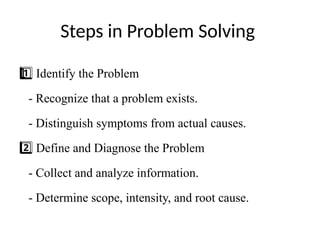
Steps in Problem Solving
Identify the Problem
1 ️
1️⃣
- Recognize that a problem exists.
- Distinguish symptoms from actual causes.
Define and Diagnose the Problem
2️⃣
- Collect and analyze information.
- Determine scope, intensity, and root cause.
Steps in Problem Solving
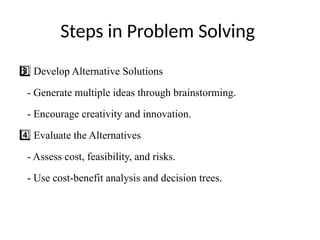
Develop Alternative Solutions
3 ️
3️⃣
- Generate multiple ideas through brainstorming.
- Encourage creativity and innovation.
Evaluate the Alternatives
4️⃣
- Assess cost, feasibility, and risks.
- Use cost-benefit analysis and decision trees.
Steps in Problem Solving
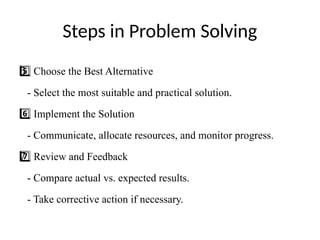
Choose the Best Alternative
5 ️
5️⃣
- Select the most suitable and practical solution.
Implement the Solution
6️⃣
- Communicate, allocate resources, and monitor progress.
Review and Feedback
7 ️
7️⃣
- Compare actual vs. expected results.
- Take corrective action if necessary.
Techniques Used in Problem
Solving
• Brainstorming – Generates creative ideas in groups.
• Delphi Technique – Expert opinions gathered in rounds.
• SWOT Analysis – Strengths, Weaknesses, Opportunities,
Threats.
• Cause-and-Effect Diagram – Identifies root causes.
• Cost-Benefit Analysis – Compares costs with benefits.
• Simulation – Tests solutions virtually before implementation.
Example
Problem: High employee turnover in a software company.
• Diagnosis – Poor work-life balance.
• Alternatives – Flexible timings, recognition, better pay.
• Best Solution – Introduce flexible work hours.
• Implementation – Pilot program for 6 months.
• Result – 25% reduction in turnover and higher satisfaction.

Detailed_explanation_Problem_Solving_Concept.pptx

  • 1.
  • 2.
    Meaning and Definition Meaning– It is a process of identifying problems, analyzing causes, and finding solutions. Definition : “Problem solving is the process of overcoming difficulties that prevent the organization from achieving its objectives.” It combines rational analysis with creative thinking.
  • 3.
    Nature / Characteristics •• Goal-oriented and systematic. • • Continuous and information-based. • • Requires judgment and creativity. • • Involves decision-making. • • Applicable at all levels of management.
  • 4.
    Steps in ProblemSolving Identify the Problem 1 ️ 1️⃣ - Recognize that a problem exists. - Distinguish symptoms from actual causes. Define and Diagnose the Problem 2️⃣ - Collect and analyze information. - Determine scope, intensity, and root cause.
  • 5.
    Steps in ProblemSolving Develop Alternative Solutions 3 ️ 3️⃣ - Generate multiple ideas through brainstorming. - Encourage creativity and innovation. Evaluate the Alternatives 4️⃣ - Assess cost, feasibility, and risks. - Use cost-benefit analysis and decision trees.
  • 6.
    Steps in ProblemSolving Choose the Best Alternative 5 ️ 5️⃣ - Select the most suitable and practical solution. Implement the Solution 6️⃣ - Communicate, allocate resources, and monitor progress. Review and Feedback 7 ️ 7️⃣ - Compare actual vs. expected results. - Take corrective action if necessary.
  • 7.
    Techniques Used inProblem Solving • Brainstorming – Generates creative ideas in groups. • Delphi Technique – Expert opinions gathered in rounds. • SWOT Analysis – Strengths, Weaknesses, Opportunities, Threats. • Cause-and-Effect Diagram – Identifies root causes. • Cost-Benefit Analysis – Compares costs with benefits. • Simulation – Tests solutions virtually before implementation.
  • 8.
    Example Problem: High employeeturnover in a software company. • Diagnosis – Poor work-life balance. • Alternatives – Flexible timings, recognition, better pay. • Best Solution – Introduce flexible work hours. • Implementation – Pilot program for 6 months. • Result – 25% reduction in turnover and higher satisfaction.