AUT University
AUT DESIS Lab
New Zealand
Linda Jones.
Creative
Common
Occupation.
Supporting creative
practice.
Promoter.
Auckland University of
Technology (AUT University)
- AUT Fashion Department
- AUT School of Art and Design
Funders.
K Rd Business Association
Wall Fabrics
D&M Hair Design
Showroom 22
Aknowledgements.
Linda Jones, Glenn Yungnickel, April Haszard, Sara Andrews, Keva Rands, Frances Haszard,
Hudson Ghansell, Jebbe Unthank, Tom Press, Steven Park, Lisa Li, Jyoti Kalyanji,
Elizabeth Kwan, Rogue Society.
Context.
New Zealand fashion
graduates find that the
industry is largely unable to
offer jobs that are in any way
aligned to their design
training. While ‘throw-away’
mass-fashion remains
dominant in the market place,
it is incumbent on the design
community to develop
alternative strategies. These
strategies seek to offer both
[self] employment
opportunities in the creative
sector, and a better, more
sustainable product for the
end consumer.
The project.
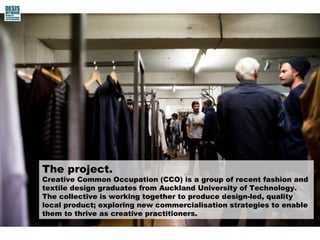
Creative Common Occupation (CCO) is a group of recent fashion and
textile design graduates from Auckland University of Technology.
The collective is working together to produce design-led, quality
local product; exploring new commercialisation strategies to enable
them to thrive as creative practitioners.
The design process.
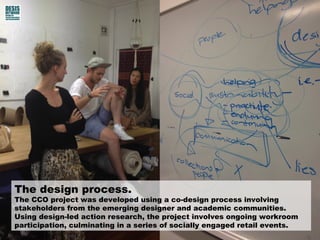
The CCO project was developed using a co-design process involving
stakeholders from the emerging designer and academic communities.
Using design-led action research, the project involves ongoing workroom
participation, culminating in a series of socially engaged retail events.
Re-envisaged city zoning
Local commerce
Governance and Policy Making
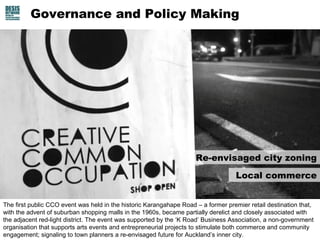
The first public CCO event was held in the historic Karangahape Road – a former premier retail destination that,
with the advent of suburban shopping malls in the 1960s, became partially derelict and closely associated with
the adjacent red-light district. The event was supported by the ‘K Road’ Business Association, a non-government
organisation that supports arts events and entrepreneurial projects to stimulate both commerce and community
engagement; signaling to town planners a re-envisaged future for Auckland’s inner city.
Activism and Civic Participation
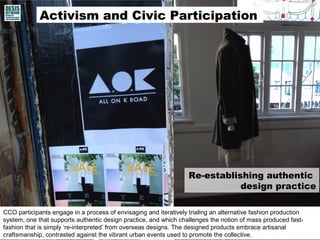
CCO participants engage in a process of envisaging and iteratively trialing an alternative fashion production
system, one that supports authentic design practice, and which challenges the notion of mass produced fast-
fashion that is simply ‘re-interpreted’ from overseas designs. The designed products embrace artisanal
craftsmanship, contrasted against the vibrant urban events used to promote the collective.
Re-establishing authentic
design practice
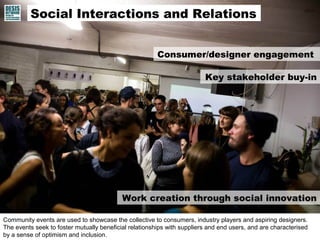
Community events are used to showcase the collective to consumers, industry players and aspiring designers.
The events seek to foster mutually beneficial relationships with suppliers and end users, and are characterised
by a sense of optimism and inclusion.
Work creation through social innovation
Consumer/designer engagement
Social Interactions and Relations
Key stakeholder buy-in
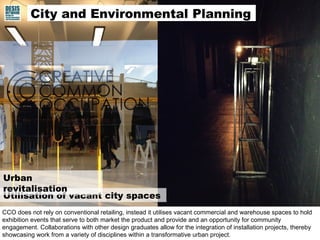
CCO does not rely on conventional retailing, instead it utilises vacant commercial and warehouse spaces to hold
exhibition events that serve to both market the product and provide and an opportunity for community
engagement. Collaborations with other design graduates allow for the integration of installation projects, thereby
showcasing work from a variety of disciplines within a transformative urban project.
Utilisation of vacant city spaces
City and Environmental Planning
Urban
revitalisation
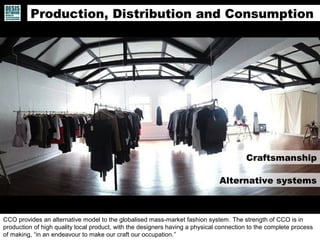
CCO provides an alternative model to the globalised mass-market fashion system. The strength of CCO is in
production of high quality local product, with the designers having a physical connection to the complete process
of making, “in an endeavour to make our craft our occupation.”
Alternative systems
Craftsmanship
Production, Distribution and Consumption
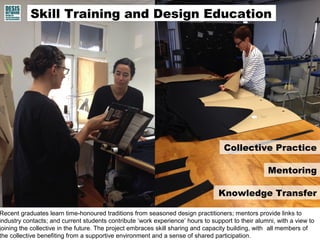
Recent graduates learn time-honoured traditions from seasoned design practitioners; mentors provide links to
industry contacts; and current students contribute ‘work experience’ hours to support to their alumni, with a view to
joining the collective in the future. The project embraces skill sharing and capacity building, with all members of
the collective benefiting from a supportive environment and a sense of shared participation.
Collective Practice
Mentoring
Knowledge Transfer
Skill Training and Design Education
Collective self-employment
Commercialisation
Job Creation
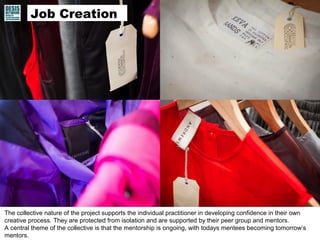
The collective nature of the project supports the individual practitioner in developing confidence in their own
creative process. They are protected from isolation and are supported by their peer group and mentors.
A central theme of the collective is that the mentorship is ongoing, with todays mentees becoming tomorrow’s
mentors.
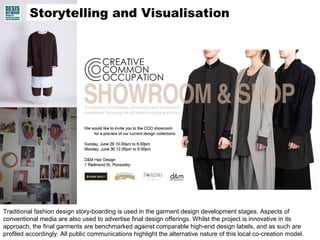
Traditional fashion design story-boarding is used in the garment design development stages. Aspects of
conventional media are also used to advertise final design offerings. Whilst the project is innovative in its
approach, the final garments are benchmarked against comparable high-end design labels, and as such are
profiled accordingly. All public communications highlight the alternative nature of this local co-creation model.
Storytelling and Visualisation
https://www.facebook.com/
creativecommonoccupation
?fref=ts
http://www.studiohomeonlin
e.com/creative-common-
occupation/
lindajones@aut.ac.nz
AUT University
AUT DESIS Lab
New Zealand

Creative Common Occupation: Supporting Creative Practice

  • 1.
    AUT University AUT DESISLab New Zealand Linda Jones. Creative Common Occupation. Supporting creative practice.
  • 2.
    Promoter. Auckland University of Technology(AUT University) - AUT Fashion Department - AUT School of Art and Design Funders. K Rd Business Association Wall Fabrics D&M Hair Design Showroom 22 Aknowledgements. Linda Jones, Glenn Yungnickel, April Haszard, Sara Andrews, Keva Rands, Frances Haszard, Hudson Ghansell, Jebbe Unthank, Tom Press, Steven Park, Lisa Li, Jyoti Kalyanji, Elizabeth Kwan, Rogue Society.
  • 3.
    Context. New Zealand fashion graduatesfind that the industry is largely unable to offer jobs that are in any way aligned to their design training. While ‘throw-away’ mass-fashion remains dominant in the market place, it is incumbent on the design community to develop alternative strategies. These strategies seek to offer both [self] employment opportunities in the creative sector, and a better, more sustainable product for the end consumer.
  • 4.
    The project. Creative CommonOccupation (CCO) is a group of recent fashion and textile design graduates from Auckland University of Technology. The collective is working together to produce design-led, quality local product; exploring new commercialisation strategies to enable them to thrive as creative practitioners.
  • 5.
    The design process. TheCCO project was developed using a co-design process involving stakeholders from the emerging designer and academic communities. Using design-led action research, the project involves ongoing workroom participation, culminating in a series of socially engaged retail events.
  • 6.
    Re-envisaged city zoning Localcommerce Governance and Policy Making The first public CCO event was held in the historic Karangahape Road – a former premier retail destination that, with the advent of suburban shopping malls in the 1960s, became partially derelict and closely associated with the adjacent red-light district. The event was supported by the ‘K Road’ Business Association, a non-government organisation that supports arts events and entrepreneurial projects to stimulate both commerce and community engagement; signaling to town planners a re-envisaged future for Auckland’s inner city.
  • 7.
    Activism and CivicParticipation CCO participants engage in a process of envisaging and iteratively trialing an alternative fashion production system, one that supports authentic design practice, and which challenges the notion of mass produced fast- fashion that is simply ‘re-interpreted’ from overseas designs. The designed products embrace artisanal craftsmanship, contrasted against the vibrant urban events used to promote the collective. Re-establishing authentic design practice
  • 8.
    Community events areused to showcase the collective to consumers, industry players and aspiring designers. The events seek to foster mutually beneficial relationships with suppliers and end users, and are characterised by a sense of optimism and inclusion. Work creation through social innovation Consumer/designer engagement Social Interactions and Relations Key stakeholder buy-in
  • 9.
    CCO does notrely on conventional retailing, instead it utilises vacant commercial and warehouse spaces to hold exhibition events that serve to both market the product and provide and an opportunity for community engagement. Collaborations with other design graduates allow for the integration of installation projects, thereby showcasing work from a variety of disciplines within a transformative urban project. Utilisation of vacant city spaces City and Environmental Planning Urban revitalisation
  • 10.
    CCO provides analternative model to the globalised mass-market fashion system. The strength of CCO is in production of high quality local product, with the designers having a physical connection to the complete process of making, “in an endeavour to make our craft our occupation.” Alternative systems Craftsmanship Production, Distribution and Consumption
  • 11.
    Recent graduates learntime-honoured traditions from seasoned design practitioners; mentors provide links to industry contacts; and current students contribute ‘work experience’ hours to support to their alumni, with a view to joining the collective in the future. The project embraces skill sharing and capacity building, with all members of the collective benefiting from a supportive environment and a sense of shared participation. Collective Practice Mentoring Knowledge Transfer Skill Training and Design Education
  • 12.
    Collective self-employment Commercialisation Job Creation Thecollective nature of the project supports the individual practitioner in developing confidence in their own creative process. They are protected from isolation and are supported by their peer group and mentors. A central theme of the collective is that the mentorship is ongoing, with todays mentees becoming tomorrow’s mentors.
  • 13.
    Traditional fashion designstory-boarding is used in the garment design development stages. Aspects of conventional media are also used to advertise final design offerings. Whilst the project is innovative in its approach, the final garments are benchmarked against comparable high-end design labels, and as such are profiled accordingly. All public communications highlight the alternative nature of this local co-creation model. Storytelling and Visualisation
  • 14.