Celebrating 7th Annual issue
10th January 2012

                                 Message
I wish to congratulate the initiators on the special issue of the
Design For All India publication brought out with EDAD-Germany.
EIDD's declared mission is “to play a vital role in the necessary
transformation of our societies into more cohesive, innovative and
sustainable ones”. This links up well with the focus of the Year of
Germany in India titled Germany and India 2011-2012: Infinite
Opportunities, which is dedicated to 60 years of Indo-German
diplomatic relations and was launched in September 2011.


“StadtRäume – CitySpaces”, the focal theme of the Year, will broach
the implications of rapid urbanisation and challenges posed by the
fast   changes    in   cities   of   both   countries   today.     Issues    like
sustainable     city   development,     architecture,        mobility,   energy,
education, cultural spaces and urban art will be featured touching
genres   such    as    performing     and   visual   arts,    design,    science,
education, technology and business.


The centrepiece of this ambitious project is a masterpiece of

         January 2012 Vol-7 No-1 Design For All Institute of India
modern design, the “Mobile Space” - a set of modern multi- purpose
pavilions, created especially for the Year of Germany in India by
renowned German artist Markus Heinsdorff. The pavilions combine
state of the art steel and textile technologies from both countries.
The “Mobile Space” will tour a number of Indian metropolises
during the year and will host interactive presentations by various
German corporations and organisations on topics and solutions
related to "StadtRäume – CitySpaces”. Conceived in Germany,
produced in India, the “Mobile Space” symbolises some of the
“infinite   opportunities”   in   our   long-standing   Indo-German
partnership.


With all the best wishes to the Design For All Institute of India and
its activities,


Cord Meier-Klodt
Acting German Ambassador


        January 2012 Vol-7 No-1 Design For All Institute of India
Chairman’s Desk:


Every Country has a history; greatness of the latter is confirmed to
the citizens of that state .A great state can only boast on the basis of
creativity, innovation and values it had carried forward for the
progress of humanity. Many primitive communities highlight their
greatness by magnifying their gods who had supreme powers,
omnipotent, and omnipresent.        When some god is pleased; he
showers blessings and when anything annoyed he may create havoc.
They believe they are living with His mercy. What He wishes us to do
we are allowed to do. What He does not wish we cannot dare go
against His orders. Every community is privileged with great divine
music that no other community can match, and a holy book that is
held world’s ultimate knowledge and it is divine treasure for
mankind. In simple words, it is god’s words directly spoken to
messengers of God. There is no exception in this process. Reason is
every community lives under such influences and it would remain in
future too.


        January 2012 Vol-7 No-1 Design For All Institute of India
Exception is how a community is instills values that would end to
innovation and creativity without disturbing the social fabric. In my
opinion, a progress without values is nothing but a nuisance.         It
supports greed and sooner or later it would bounce back and
humanity shall have to pay heavy price. Innovation and creativity
always grow at the prevailing basic values of the society and these
are the prerequisite requirements to create further advancement &
progress. Where there are no basic values prevailing, innovations
and creativities are not of great consequences.       No civilization is
considered to be advanced, if it does not inspire its citizens for
caring others & helps them to lead meaningful lives. Civilization
marches further when people start looking beyond the stay-in-the-
box perspective. Role of designer is very important for progress of
the society and to maintain the environmental balance since he
should have excellent knowledge of present as well as future
technology. Designer with substantial materials knowledge will
allow him to experiment with his design with more freedom. To
establish as a niche designer, he should work for incorporating
social values in his design. History of Design tells us that products
should    have   initially   been   designed   to   meet   the   desired
requirements. Later on to optimizing functional values they had
begun incorporate ideas by introducing the concept of ‘user friendly’
since then awareness of ‘corporate social responsibility’ has come
into existence, Design face has changed recently and it is more
toward ‘environment friendly’ .Our modern education is lacking in
teaching the social values to our students and emphasizing on
human beings as machines and treats their existence to utilize for
optimum profits for corporate houses. Our education has narrowed

         January 2012 Vol-7 No-1 Design For All Institute of India
down people’s vision to such a low level that they have now ignored
every aspect of human being except benefiting the commercial
world. ‘How long will we ignore the social needs and keep working
for satisfying greed of corporate houses?’ Design education is to
reimagine beyond the limited thinking of today.


Civilization never progress on exhibiting skyscrapers, sophisticated
cars and other technological advancements but these move on
strong foundations of values of individual.      Human quality index
matters a lot and it is directly related with the overall well-meaning.
Some states are exception and keep progressing inspite of all odds
and have faced ups & downs in their history. There is of course
remarkable quality amongst individuals who can prove to be reason
of progress and he/she deserve our admiration. Challenges are
inevitable but designs of the solution are in our own hands and that
needs right education, skill and openness of faculty of minds.
Modern teachers are not educating for opening of the minds of their
students rather students admire a teacher if he spoon feeds instead
of guiding them in searching own solutions. ‘Spoon feeding is reason
that we are not able to design masterpieces and present scenario is
that everyone is looking at the past for redesigning and busy in self-
praise by calling highly innovative.’ I call this ‘era of remake, remix’
it can connect present generation with past but never help in
exploring in own path that should lead to great future. ‘Crying over
spilt milk is not answer rather how to use innovations to make spilt
milk for further use is real creativity.’


        January 2012 Vol-7 No-1 Design For All Institute of India
How to design for the better human material is a real art. In present
paradigms,   sometime    we   look   into   innate   capabilities   of   an
individual for designing the solutions or say certain design demands
collective efforts and nothing else works or sometime outside. There
are moments when we cannot design for solution without their help.
That help reminds us that no one is complete or perfect in this world.
We need others help because no one is born complete. ‘Newly born
child needs help of others for survival. An abandoned newly born
child cannot survive.’ It is mother who takes care of her child out of
emotion or affection. She even gambles her life in delivering the
child & later on helps in feeding and looks after it. Man role is
supportive throughout child development and real part is confined
only to mother. It is the combination of mother and father who
raises the child.   Man needs woman and vice versa she needs for
completeness, so state is incomplete because it is born out of group
of incomplete peoples and ultimately various incomplete states
make our mankind incomplete. Mankind keeps on working for
developing with its own pace and it accelerates when well-
intentioned peoples work for betterment of humanity. It retards
when some selfish peoples are at the helm of affairs. States and
individuals are left with one option for attaining perfection that is
through friendship. Friendship demands good gesture for winning
the hearts and trust of others for mutual developments. Woman has
left with one option of trust because of biological demands and man
lives with many other options than trust. This outside help is
compulsion and forces an individual to be good with others. He does
not know at what point he may require the help of others. This
uncertainty compels him to be good with some and control his

        January 2012 Vol-7 No-1 Design For All Institute of India
animal instincts.      I call, it is an arrangement of one kind of barter
system but we associate this crude intention of exchange with
selfishness under the cover of social emotions of obligation & divine
wish. When woman surrenders to man out of trust and gets
pregnant, she might be thinking to get rid of this trouble but we
assure her by saying ‘It is God’s wish. Don’t think of terminating.
You are blessed to be mother. Look at those who wish to be mother
but cannot bear children, will become Grandfather & grandmother.
Others will also promote to new hierarchy of social order with this
child birth. She comes under the social and divine influence and
delivers the child’.


Everyone is bound with the divine depths, ethical resolution, the
character of perception of the world, clarity of knowledge; all have
their great roles in great individuals. Great Individual makes a great
state, so great world and great civilization. Individual has liberty to
work independently and enjoy enormous freedom. Yet he is under
the influence of those parameters which are affecting but beyond his
controls. What are under his control he never relishes and what are
beyond his control never allow him to live in peace. This struggle to
achieve beyond control power with his inner capabilities along with
covering his weaknesses makes him to progress and makes us inch
toward establishing as supreme power.             Ambition to be most
powerful person some time becomes so strong that to achieve he
even sacrifice his life. A better system helps in evolving better
human material in general and great personalities in exception. If
we are left out someone who has potential to bring great changes
and help in progress of the society, it would change the system.

        January 2012 Vol-7 No-1 Design For All Institute of India
These are the factors which bring infinite possibilities. Infinite
possibilities are nothing but infinite opportunities what create the
historical knowledge that fulfills the individuals. If we work only for
satisfying our own ambitions and our existence in this world would
be limited in purpose and of little consequences. We shall then bring
decay of the civilization. When I look at the pyramids I admire their
design. When I look at the king and his officials are lying as
mummies .I feel sorry that body is finished but their ambitions to
remain as king is still with the dead in hope that one day another he
may come into life and would come into life and rule as king. This
ambition of remaining immortal had tempted the kings & queens of
Egypt to raise such monuments in human history.


Individuals make the state and states make the world and it makes
the history of mankind. Great civilizations have produced sensitive
minds who cared for others and sacrificed their own interests for
upholding the high values. Civilization decays, when individuals lose
their basic characters and rulers turn ambitious for actualizing their
own selfish agendas. Germany had been blessed by a great artistic
heritage. They were famous poets, philosophers, who thoughts
history have found the German collective consciousness was no less
a manner than our ‘man of state’, as they so respectfully call them.
Once world renowned philosopher and educationist said” A living
society must have the power of continuity and power of change. In
savage community there is hardly any progress from one generation
to another. Change is looked upon with suspicion and all human
energies are concentrated on maintaining the status quo. In a
civilized community progress and change are the life blood of its

        January 2012 Vol-7 No-1 Design For All Institute of India
activity”.   German Characters are different from rest of the world.
They are focused, dedicated, highly sensitive and sometime it surges
to peak and forced the world to be involved with their revolutionized
thought process. I have noticed an advertisement in India about
washing machine, dishwasher etc. of German make by “Germans are
mad about Machine”. I say it is not madness but it is the passion
that is driving in designing such a durable, reliable machine and
world is compelled to admire their products and rest strive hard to
achieve their feats . Passion is real dynamo of their society and it is
driving them to be at the top inspite of all odds. An individual is
better human material than collective and they have proved in
history. Germany has always been a leading country when it comes
to innovative design, with a long history in the fields of bookmaking
and printing, Germany had emerged as a graphic design industry
leader. In the late nineteenth century, industrialization, commercial
print and mass communication catapulted German design from small
workshop crafts into a worldwide industry. Over the last few
decades, the culture and creative industries have become a major
economic force of Germany. The creative industries in Germany are a
complex of sectors that is more economically powerful than the
agricultural or the energy sector in terms of gross value added
.Economic and cultural diversity are their great strengths of German
people. Economic studies have shown that all cultural sectors are
increasingly characterized by an above-average number of small and
very small or one-person enterprises. This tendency seems to have
been facilitated by the use of new cost-efficient technological
equipment and means of production in the cultural sectors. This
trend went hand in hand with a growing public perception of all

        January 2012 Vol-7 No-1 Design For All Institute of India
industries, which have meanwhile also led to the enhancement of
the status of independent cultural professions (artists / cultural
production).


A   vibrant   state   demands      change   and   pushes      individuals    for
accepting changes. Changes are constructive if those who are at the
helm of affairs in the state are genuine leaders, They have vision and
understanding of continuity of civilization also A great leader
believes what he is thinking is absolute correct and he is willing to
meet all challenges. His priorities are different from what the
common    person      feel.   Common    man    feels   that   the   future   of
innovation is lying somewhere else and leader is striking aimlessly.
This gap creates frustration among the genuine innovators and it
proves reason of civilization decay. This gap must be reduced this
can be achieved only by great leaders. Patty Politicians are always
eyeing on power and they work on those areas that can make them
closer to chair. On other side common person thinks only in terms of
survival and struggle.        History is not always led by great leaders.
Even     simply   politicians     &   people   may     worked    together     in
collaborative manner and can meet their goals without harming one
another interest, that stage of state is ideal and gradually state
comes back on track of progress and it does not need extra efforts.
Those who are at helm of affairs should focus on progress of human
index and in this process they should not compromise with such
activities that disturb the flow of the creativity or ignore that
parameter for wider perspectives that can harm the growth. If we
don’t have mastery in art of ignoring and promoting but keep on
hammering on unnecessary issues ,waste energies on senseless

        January 2012 Vol-7 No-1 Design For All Institute of India
matters that will affect our judgment and chances are things may go
wrong that will prove sooner or later doomsday for society & even
for   civilization   .   It   needs   befitting   treatment    of   parameters
otherwise society will suffer a lot .I consider a genuine creative,
innovative person is bound to work with values and that value is the
driving force for his works. A fake innovator imitates and gives
nothing new but tries to present an old wine into new bottle. He
manipulates the situation with his shrewdness and enjoys all the
privilege of what society has earmarked for innovators. A genuine
person works under the influence of his passion and carries the
values on his shoulder without craving for recognitions from society.


A common thinker contemplates about ‘how to make this world
better’ and it is real problem for him.           Everyone is working in this
direction but in totality real affects is missing. ‘Why world appears
to be good at one time and bad otherwise?’ We are generally guided
by two philosophies and have thus two options for evaluating the
world. One is social and another is biological.               Common person
judges the standard of the world with his social relationships. If his
relations are good his world is good and does not need any
improvement and when his relations are sour, he thinks this world is
in bad shape and requires improvement. ‘As a man is not happy with
his surroundings, he is bound to live much of his time with
unimaginable sadness ’. His first reaction to counter his frustration
is by criticizing the existing establishment. If he is affected by
political class then he votes against the existing rulers or agitates to
dethrone them. We call it anti-incumbency and all ruling class is
aware about this factor. When he is affected by financial factor,

         January 2012 Vol-7 No-1 Design For All Institute of India
generally he blames the existing rulers and works in destructive way
to seek their attention. When he is purely sufferings with social
factors, he works hard to design for improvement and it benefits
others who are closely associated or he surrenders to his faith. Our
designers do not think what common person thinks. They are little
intellectually above than common person because they have formal
training to think better. Our wrong education tilts their minds for
work where they are commercially benefited.           Another way of
judging the world is biological parameters. If a man or woman is
talking in such a way that his/her mind is not trained to accept that
situations he/she immediately comes under suspicion and declares
the world by in such a way as he/she is prophet and his/her words
are final and unchallengeable, “Why this man and woman is talking
in such a manner. World is day by day deteriorating and what
nonsense they are doing”


An unselfish mind keeps on probing and that guides him for
improvement of system. If he is under the influence of selfish
motives, he will disturb the social fabrics for satisfying his concerns.
Our modern designers only think when matter of biology strikes,
they talk in terms of gender and ergonomics in their design. Our
modern designer’s faculty of mind is not open enough to see beyond
these parameters. They believe ‘To be good social designers you
should strive to gain the divine blessings. To achieve commercial
status, he should not only design in terms of social that is directly
related with profit and loss or gender wise but in manipulative
manner and please every stack holders.’ To be a sensible driver of
an automobile one should be with good driving skill is not enough

        January 2012 Vol-7 No-1 Design For All Institute of India
but he should be blessed that other should not misbehave and lead
to road rage. If you are not good driver but knows the art of
manipulation you may be awarded with good driver. I have heard
that getting a driving license in Germany is the most difficult where
there are no speed limits on the motorway and therefore it is taken
seriously. A person who is born in rural area and his lifetime wish is
to settle in urban and own his car. Growing up in a small village
having a driving license and subsequently a car was a vital part of
social life and also works options. Therefore, no one could wait for
longer for license and those forces everyone to learn driving.
Everyone wishes to enjoy the privilege of car and liberty to move
anywhere he wishes. The reality of getting a driving license though
is difficult because spending quite a lot of evenings in a boring
classroom before anyone is allowed for getting behind the wheel.
They learn about the code of the street, the different signs and what
to do in all kind of situations in a car. They make everyone to
understand the some functioning of car’s engine and different parts
of the car. The reason is that it scales better—it makes the driver
confident and saves the lives of all who are using road. The role of
driving school is to channelize his energy, control his impatience and
develop the skills to anticipate others actions on roads. I call driving
school make you to learn the interface with machine and make you
to learn the art of manipulation to tackle different situations in favor
of your own.


Interface is similar to friendship. Friendship has some objectives. It
may be for resources, emotional, biological or something rare for
safeguarding the future. These are the basic requirements for

        January 2012 Vol-7 No-1 Design For All Institute of India
interface design of machine and man. If any designer uses the
resources of one another in most compatible and optimum manner,
he is supposed to be best designer. If he incorporates the emotions
of an individual according to biological or say for gender way, it will
establish him as an expert designer. Once some one understands the
culture and social behavior of specific local areas and use in such a
way   that     it   becomes   universal   then    it   establishes   him   as
phenomenon. Friendship always stays longer where involved parties
are of equal status and wherever class difference is high its end is
tragic and would never last long. In interface design, if machine or
man is not of equal status or doesn’t have proper understanding or
proper compatibility, it will be difficult to design and complete
exercise will prove a disastrous design.          We should research on
limitations of human capabilities as well as machine for designing
interface. Those limitations may be his physical, biological or social
& cultural. Design has a long tradition in Germany and has
developed the philosophy of merging art with mass production on
large scale and people enjoy better reputation among the minds of
Indian people. We admire their manufacturing skills; have faith in
whatever Germans do. I always inform my students ‘work with
dedication, honesty and conviction like Germans’. We are divided by
seas but united by disappearing spaces. We are probably two
nations who take pride of an Aryan origin. It may be a myth but it is
at work. German design journey begins with “Spirit of the times”
that was entirely different from emotional expressionism to the
matter of the fact. This could not last longer and it was replaced
fanciful    experimentation    with   rational,    functional,   sometimes
standardized products/services. They also responded to the promise

           January 2012 Vol-7 No-1 Design For All Institute of India
of a “New minimalism”. The decisive factor here is not objective
reduction, however, but the sounding out of the qualities of the
materials and their inherent creative, functional and technical
possibilities. The intelligent use of new materials and technologies
leads to innovative results, for example, gel furniture by Werner
Aisslinger. Precisely for this reason, the creative range in Germany is
wide. The world is under the grip of avarice and shortsightedness
and it is the reason world is under the grip of frustration. What we
are today partly we can blame our political system because those
who are head of the state are generally non serious, happy in
projecting their image as debonair, and late night party animals. We
should not expect much from this class. I have serious doubt in role
of   teacher,   professional   &   intelligential   class   too.   My   doubt
evaporates on quality of education but surges significantly at the
question of their values. Reason is educated without values may
harm more compare to man with values having no education. To
meet their narrow interest they can go so low that it will go beyond
imagination of common people. We should not misguide the people
by enchasing their emotion in the name of mass rally, revolution for
settling power equation        and shun those have bad long-term
consequences on mankind. I have high hope from this friendship
that world will be safe in this hand.


I must congratulate on the behalf of team of Design For All Institute
of India to our contributors, readers and well-wishers who have
expressed their faith in our publication and it is now time for
celebration of 7th year of successful publication without missing
single issue. Our journey from confidence building to faith is

        January 2012 Vol-7 No-1 Design For All Institute of India
pleasurable and we have enjoyed this process. What we are today in
national as well as international scenario is the collective love for
social responsibility for making this world a better place, everyone
should enjoy equal freedom, mobility, help in progress of our culture
and   thought    process   in    individual   capacity.        We    are   merely
supporting the social cause with selflessness, our consciousness and
intentions are clear that may be reason we are blessed with so many
people of the world and divine power that constantly guide us. My
special thanks to those who wishe         us to work what we are doing
without interruption and always keep vigil eyes on those who wish
to derail our efforts, protected us by standing as strong wall,
behaved as our philosopher & guide and always bestowed us with
proper advice at the time of crisis. We can count year 2011 a
successful, praiseworthy and succeeded in publishing every issue a
special issue by inviting eminent international, national institutes for
collaboration. This is our friendship with rest of the world that is
becoming strong as time passes. We take praise and criticism at par
for progress of social movement. We are silent, selfless and not very
demanding friends .We need blessings in the form of contribution of
articles and that helps us publishing this publication for achieving
the effort to realize the UN Convention on the Rights of Persons with
Disabilities.


My special thanks for expressing solidarity by President Dr. Peter
Neumann of EIDD- Germany by accepting our invitation to celebrate
our 7th year annual issue by special issue with Germany and to mark
another great occasion ‘Germany and India 2011-2012: Infinite
Opportunities’   by   inviting    different   authors     of   his   choice   for

        January 2012 Vol-7 No-1 Design For All Institute of India
publication of this special issue. Salute to Dr. Peter and his team for
making our dream come true.


“A friend should be master at guessing and keep still”-Nietzsche


Wishing Happy New Year 2012

Enjoy Republic day 26th January 2012

With regards

Dr. Sunil Bhatia

Design For All Institute of India

www.designforall.in

dr_subha@yahoo.com

91-11-27853470®


        January 2012 Vol-7 No-1 Design For All Institute of India
Forthcoming issues:


    February 2012 Vol-7, No-2
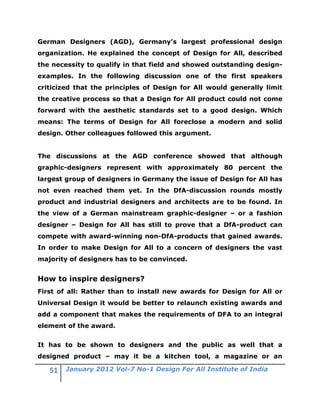
Dr Hua Dong will be the Guest Editor and it is
special    issue   focusing   role   of   China’s
Designers.


          March 2012 Vol-7, No-3


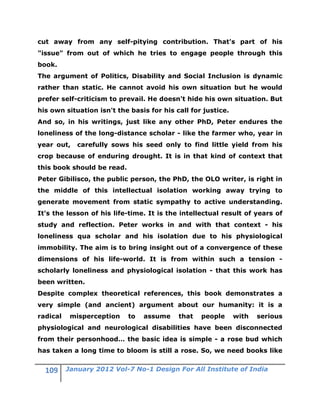
  Adjunct Prof Ravi Hazra of IDC, Indian
  Institute of Technology – Mumbai, India will
  be the Guest Editor and he will invite the
  author of his choice for contribution of
  articles for this special issue.


          January 2012 Vol-7 No-1 Design For All Institute of India
April 2012 Vol-7 No-4


Dr. Sherril York is the Executive Director of the
National Center on Accessibility (NCA), a center
within     the         Recreation,   Park   and        Tourism
Studies      department           located    at        Indiana
University in Bloomington, IN. Dr. York brings
over     thirty    years     of   experience      in    higher
education         in    personnel    preparation,        direct
service programming, and research with people
with     disabilities        from    toddlers     in     early
intervention            programs,    children/adults         in   physical   activity
development, to elite athletes in adapted sport programs. She will be
the Guest Editor for our special issue of April 2012


          May 2012 Vol-7, No-5
A special issue on archive articles of EIDD

and Guest Editor will be Mr. Pete Kercher

Ambassador/External relations: Pete Kercher,
E-mail: pkercher(at)libero.it


          January 2012 Vol-7 No-1 Design For All Institute of India
June 2012 Vol-7, No-6
Prof Marcus Ormerod is co-director for the
SURFACE Inclusive Design Research Centre
with Rita Newton and they will be guest
editors    for   a   special   edition   of   getting
outdoors.


     July 2012 Vol-7, No-7
Dr. Eujin Pei is a Senior Lecturer in Product
and Furniture Design at De Montfort
University in the United Kingdom. His
research interests include inclusive design,
multi-disciplinary    design   and    additive
manufacture. He has worked at leading
institutions   including   Brunel  University,
Loughborough       University, University   of
Southampton       and    Vaal  University   of
Technology. Eujin is a Fellow of the Royal
Society for the Arts, Manufactures and
Commerce, and a member of the Editorial Advisory Board for the
Journal of Assembly Automation. Email: epei@dmu.ac.uk

          January 2012 Vol-7 No-1 Design For All Institute of India
Editor:


Shri L.K. Das
Former Head Industrial Design Center, Indian Institute of
Technology (Delhi), India


       January 2012 Vol-7 No-1 Design For All Institute of India
Design for All for All Times
Evolving an agenda for a caring and sustainable
society

Lalit Kumar Das

lalitdas@gmail.com


India & Germany have embarked on an year of celebration under the
banner of “Germany and India 2011-2012: Infinite Opportunities”.
There will be many exchanges in the fields of politics, business,
culture, education, science and research. Germany and India share a
number    of   values   and   experiences,   including   democracy   and
federalism. This provides an excellent foundation for the countries to
work as partners in addressing the issues of the future.


Celebration and reflection should go together.


2011 saw the combined effect of tusnami, earthquake and nuclear
disaster in one of the technological countries of the world.


The 2011 earthquake off the Pacific coast of Tōhoku which was of
magnitude 9 brought immense suffering. The Japanese National
Police Agency confirmed 15,845 deaths, 5,893 injured, and 3,380
people missing across eighteen prefectures, as well as over 125,000
buildings damaged or destroyed. The earthquake and tsunami
caused extensive and severe structural damage in Japan, including
heavy damage to roads and railways as well as fires in many areas,
and a dam collapse. Japanese Prime Minister Naoto Kan said, "In the

         January 2012 Vol-7 No-1 Design For All Institute of India
65 years after the end of World War II, this is the toughest and the
most difficult crisis for Japan." Around 4.4 million households in
north-eastern Japan were left without electricity and 1.5 million
without water.


Early estimates placed insured losses from the earthquake alone at
US$14.5 to $34.6 billion. The Bank of Japan offered ¥15 trillion
(US$183 billion) to the banking system on 14 March in an effort to
normalize market conditions. The World Bank's estimated economic
cost was US$235 billion, making it the most expensive natural
disaster in world history.


        January 2012 Vol-7 No-1 Design For All Institute of India
Worse then the above disaster was Japan's ability to cope with the
post disaster situation. Electricity, communication, food, medicine
was difficult to quickly arrange for the survivors. The old suffered
the most. Their health deteriorated alarmingly fast. Japanese
capacity for self-effacement and forbearance lent dignity to the
suffering. The lack of prior design initiative for disaster management
was conspicuous by its absence. Time to think of 'Design for all
times' movement.


During the cold war era, Europe and America were better prepared
with nuclear shelters, safe rooms in houses stocked with food
supplies. This was a designed effort. Our capacity to cope with
natural disasters is not been thought out well in our insatiable
appetite for pleasure propelled consumerism which continues to
capture most of our design attention and the revenue returns makes
our governments myopic in their planning.


Consumerisms is a disaster in itself. It has created a movement were
products are being consciously by designers and engineers in
companies with limited life. Rather then product repair, replacement
has become a norm. This normative lifestyle has created piles of
waste in every city.


        January 2012 Vol-7 No-1 Design For All Institute of India
Such piles of waste are there in every city. Cumulatively they are a
much bigger disaster then the most unfortunate natural disaster that
struck Japan last year.


Is our life style becoming a disaster itself.


Is Design for All and Design for all times hampered by our life styles.


Germany is renowned for quality products that last longer. Perhaps
designing for shorter life to fuel consumerism is not a norm in the
professional philosophy German designers and          engineers. And
Germany is a robust economy. It perhaps is not at all necessary to
design products with shorter life to keep our factories running.

        January 2012 Vol-7 No-1 Design For All Institute of India
Any economy that dumps, on a regular basis, its production in
garbage bins first in the form of packaging and later as discarded
products, and this repeated several times for any single product item
during the life of its consumer, is bound to falter sooner or later.


Germany is in the fore front of saving faltering economies in
economies    in   European   Union.   A   reorientation   by   saving   on
packaging material and increasing product life and designing for all
will go a longer distance in bolstering these faltering economy. The
first will have immediate effect, the second, long term lasting and
sustainable impact.


There is a need to redefine our design and engineering premises for
new product development. Following is submitted for consideration
of designers in India, Germany and our colleagues around the world.


1. Design, to save on packaging, reuse packaging, design multi use
and utilitarian packaging.


2. Design Products for longer service life. Ease of repair. Products
that will last the life time of the user. Provision to retrofit products
for different user limits and potentialities


3. Make it mandatory for products to carry information on designed
service life and mean time between failure.


        January 2012 Vol-7 No-1 Design For All Institute of India
4. Design products and services that can be quickly deployed to
provide basic amenities like shelter, food, medicine, communication
in event of a natural disaster. Helicopters, trucks and deployable
devices can be used for the purpose.


There is a need to understand nature of consumption.


1. Productive Consumption:
     Consumption that to growth of the user, thereby making him
     healthier, creative, productive and generates resources for
     others.


2. Wasteful Consumption
     Consumption that leads to immediate waste and costs money
     and environmental damage and health risks.


3. Dead End or Blocked Consumption
     Consumption that blocks resources in the form of unutilised
     resources or blocked resources.


Design for All movement needs to enlarge its mandate to incorporate
design for all to consider design for all times. Design for All and
Universal Design is all about creativity & caring. Let us include
concern for mother earth in our mandate.


Now is most opportune moment when India & Germany are
exploring infinite opportunities. Let us convert it into a multilogue
embracing all professionals around the world.

       January 2012 Vol-7 No-1 Design For All Institute of India
The author gratefully the owners of the photographs used in this
paper whose sources I do not immediately know. Hope there work
will go long way in lessening the sufferings in future disasters.


Lalit Das


References


http://en.wikipedia.org/wiki/2011_T%C5%8Dhoku_earthquake_and_tsunami


Pyramids of Waste
http://youtu.be/Wv9MyB0hbI4


         January 2012 Vol-7 No-1 Design For All Institute of India
2011 Vol-6 No-1To12 Newsletters
     (January 2011         to December 2011)


January 2011      February2011          March 2011


 April 2011          May 2011             June 2011


     January 2012 Vol-7 No-1 Design For All Institute of India
July 2011          August 2011          September 2011


October 2011       November 2011          December 2011


     January 2012 Vol-7 No-1 Design For All Institute of India
January 2012 Vol-7 No-1 Design For All Institute of India
Content of January 2012 Vol-7 No-1
1. Chairman’s Desk:…………………………………………………………4

2. Editor’s Note:………………………………………………………………22

3. Guest Editor (Dr. Peter Neumann) Design for All –
  Experiences from Germany:………………………………………….36

4. Economic prerequisites of the concept of Design for All:…..42

5. Design for All in Germany –

  a claim has to be put to reality:…………………………………….48

6. The (older) user in mind: "Design for All" from a German
  perspective:……………………………………………………………….58

7. Intelligent Furniture: German SMEs improving their Design
  for All competencies :………………………………………………….70

8. Health Tourism for All – experiences from Germany:………80

9. Design for All – Berlin for All:……………………………………….93

       Other Regular features


  January 2012 Vol-7 No-1 Design For All Institute of India
Guest Editor:


Dr. Peter Neumann has been working in the field of
accessibility and Design for All for nearly 20 years.
On a voluntary basis he acts as President of Design for All
Germany (EDAD), the national member organisation of EIDD –
Design for All Europe.
Furthermore he is director of NeumannConsult, a German
consultancy focussing on urban and regional development,
tourism planning and Design for All. He is also project manager
at the Department for Geography at the University of Münster.
EDAD - Design for All Germany
Alter Steinweg 22-24
48143 Münster,Germany
Tel.: +49 (0)251 / 48286-33 ,Fax: +49 (0)251 / 48286-34
neumann@design-fuer-alle.de              www.design-fuer-alle.de


        January 2012 Vol-7 No-1 Design For All Institute of India
Design for All – Experiences from Germany
Dr. Peter Neumann

In these days we celebrate the 60 years of Indo-German diplomatic
relations. This anniversary starts with a year of Germany in India
titled “Germany and India 2011-2012: Infinite Opportunities” which
will be held in India from September 2011 to November 2012 with
the main theme “StadtRäume – CitySpaces”. The following year
India will present itself with a cultural year in Germany.


These two events in India and Germany testify the long-standing
and strong friendship between our countries.


Another proof for our close friendship is the present Newsletter of
the Design for All Institute of India focusing on Design for All in
Germany. The invitation by Dr. Sunil Bhatia to be the guest editor of
this issue is for me both a pleasure and an honour.


As president of EDAD-Design for All Germany I represent the
German-wide network related to Design for All. On a voluntary basis
we advise, inform, carry out research and build up networks. Our
main objective is to improve the usability of products, services and
the built environment, make them easy, comfortable and attractive
to use for everybody and according to the individual needs.


In Germany Design for All is becoming more and more important.
Three reasons and trends are responsible for that: the effort to


        January 2012 Vol-7 No-1 Design For All Institute of India
realise the UN Convention on the Rights of Persons with Disabilities,
the economic development and the demographic change.


The result of the demographic change is a population that declines,
gets older and more diverse. This development influences the use of
tools of everyday life but also the use of products and services.


Not only the demographic change but also the economic crisis
influences the market demand on national as well as international
level. The adjustment of product and service supply to the variety of
customers needs is one of the biggest challenges for German
enterprises during the forthcoming years in order to maintain their
competitiveness. The market offers a lot of opportunities to earn
money with innovative products and services.


Also on European level, some organisations or networks such as
EIDD-Design for All Europe, Design for All Foundation, EuCAN-
European Concept for Accessibility Network as well as the European
Commission or the Council of Europe hold the opinion that the
orientation towards Design for All results in competitive advantages
because the attractiveness of products and services increases, the
number of potential user groups increases and generates more
growth and employment.


That was proved with regard to the German tourism industry by a
study commissioned by the Federal Ministry of Economics and
Technology in 2003. The study showed that by the elimination of
barriers the turnover of tourism enterprises could increase and up to

        January 2012 Vol-7 No-1 Design For All Institute of India
100.000 new jobs could be created. These results show that
economic sectors that focus on Design for All already record
economic growth and increasing employment.


Several good-practice examples all over Germany, not all of them in
the tourism sector, confirm that a visionary, successful Design for All
creates an entrepreneurial and economic promising dimension that
generates innovations and added-value – in economic and societal
respect.


In 2009 a study commissioned by the Federal Ministry of Economics
and Technology show the same results. This study - along with a
German wide series of Design-for All seminars targeted to small and
medium-sized enterprises – demonstrated that across all sectors
Design     for   All   is    a   concept   that    creates   important   growth
opportunities.


But if you take a look at the daily corporate and administrative
practices in Germany you'll see that Design for All didn’t reach the
day-to-day routine yet. For most of the stakeholders involved this
issue is too abstract or too complex. Another reason is the
communication of the matter which often is not professionally
prepared and thus not sufficiently attractive.


In this context it is pleasing to see that in 2011 the German Federal
Government       in    the   frame    of   the    implementation   of    the   UN
Convention on the Rights of Persons with Disabilities announced
measures to raise awareness for Design for All.


         January 2012 Vol-7 No-1 Design For All Institute of India
In this regard hopefully new policy programmes and instruments
will be developed that complement and put into practice the existing
German-wide activities and organisations. Especially in the field of
training and education (designers, architects, planners, craftspeople
and developers etc.) and in the individual development processes of
companies a lot could be achieved with new, practical instruments
and media.


Qualified and motivated managers and employees that understand
the meaning of Design for All are able to achieve a lot more and can
initiate activities much better than what can be achieved with e.g.
conferences and publications.


But we must not forget that a lot of instruments and measures will
only work in the medium or long run. Therefore they should be
initiated as soon as possible.


The following articles of ten authors from Germany describe how the
concept of Design for All can successfully be realised in Germany:


In his article Rüdiger      Leidner pursues the thesis that the
importance of Design for All in the future is strongly supported by
economic reasons.


Boris Buchholz draws quite critical conclusions from the efforts
and implementation as well as the realisation of the concept of
Design for All within the German group of designers.


        January 2012 Vol-7 No-1 Design For All Institute of India
Mathias Knigge describes how companies can profit from the
already growing market of Design for All products.


Sonia Carpinelli, Manfred Heilemann and Constanze Unger
show how Design for All can increase the competences and
competitiveness in the interior design and furniture sector.


Andreas Lorenz, Peter Neumann und Kai Pagenkopf come to
the conclusion that health tourism combined with the holistic
approach of Design for All can be a unique selling point for tourism
destinations.


Ingeborg Stude describes the various approaches of the German
capital Berlin considering Design for All within the frame of its urban
development.


Along with all authors I'd like to wish all readers interesting new
insights and I am looking forward to receiving comments and
feedback.


Dr. Peter Neumann
EDAD – European Institute Design for All Germany
Alter Steinweg 22-24 , 48143 Münster ,Germany
Tel.: +49 (0)251 / 48286-33Fax: +49 (0)251 / 48286-34
neumann@design-fuer-alle.de www.design-fuer-alle.de

        January 2012 Vol-7 No-1 Design For All Institute of India
Ruediger Leidner, born 1950, studied Economics. Since 1980 he
has been working in the German Federal Ministry of Economics and
Technology, interrupted by a four years secondment to the European
Commission in Brussels as National Expert for tourism policy.


Besides his professional activities he works in honorary capacities as
head of the Coordination Unit on Tourism of the German Federation
for the Blind and Partially Sighted and president of the National
Coordination Board Tourism For All.

leidner@natko.de


        January 2012 Vol-7 No-1 Design For All Institute of India
Economic prerequisites of the concept of Design for
All

Dr. Rüdiger Leidner

Introductory remarks

The idea of Design for All is, as was described in the inaugural issue
of the newsletter of the Design For All Institute of India, about fifty
years old.

Pete Kercher, the author of the article in the inaugural issue
explained    the   emergence   of   Design   for   All   by   socio-political
movements in Scandinavian countries in the 1960s.

On the other hand, the reasons given for the importance of Design
for All are mainly economic. As example I only mention the change
in consumer demand in the context of demographic change that
makes it attractive for companies to follow this concept when
designing their products.

If, however, the importance of Design for All in future is strongly
supported by economic reasons, I asked myself, is its origin really to
be explained by political reasons only or do economic reasons play a
role as well.

In this article I present some considerations to answer this question.

Characteristic developments in economic history

Two processes of economic development are of major importance for
the understanding of my considerations: the so-called “Three-sector-

        January 2012 Vol-7 No-1 Design For All Institute of India
hypothesis” on the one hand and the growing division of labor on
the other.

The   Three-sector-hypothesis      describes   the    development     of
economies by a change in the relative importance of three main
sectors, the agricultural, the industrial and the services sector.

Early economies are, according to this theory, characterized by a
high proportion of agricultural production and almost no production
of manufactured goods and services. In the course of economic
progress first the industrial production and later the services sector
gain importance, whereas first the agricultural and later also the
industrial production shrinks as proportion of total production.

This process comes along with a growing division of labor and
increasing trade relations.

Ancient economies can be regarded as self-supporting economies.
The Production serves the needs of the producers themselves and
takes place within small groups, the family respectively the tribe.

This is not only true with regard to agricultural production, but also
when the production of tools or housing facilities are considered.

In this phase of economic development, where consumers and
producers are nearly identical or at least in close contact, Design
“for All” means “Design for the own needs”.

I suppose that all readers of this newsletter agree that this is not
the situation that the parents of the concept of Design for All had in
mind when they formulated as criteria to be met that the users
should be involved in the production process and that a Design-For-

        January 2012 Vol-7 No-1 Design For All Institute of India
All-Product should meet the needs of the most large number of
potential users.

Turning    to    the   next   important   phase   of   economic   history,
industrialization and formation of capitalism, we observe a much
higher degree of division of labor and increasing trade across
national borders.

But also in this phase there would be not a single opportunity to
bear, much less to realize, a concept like Design for All.

Of course the reasons for this impossibility can also be seen in the
demographic situation which is very different from the situation
today at least in the so-called industrialized countries and the lower
proportion of people with disabilities in the population under
consideration.

But in the early stages of industrialization which is characterized by
simple and inflexible machines it would have been very expensive to
produce a variety of products that are more or less identical in
function but different in design to take into account the needs of
diverse users.

In this stage of economic development the user had to adapt his
needs to the product. The only exception was the yet very small
services sector, for example handicraft. For craftsmen are used to
bring the design of their product into line with the individual wishes
of the customer.

We find the same situation even today and independent of the
development stage of an economy, e.g. phases where demand


          January 2012 Vol-7 No-1 Design For All Institute of India
exceeds supply to a large extent after destructions because of wars
or earthquakes.

The third development stage in economic history is characterized not
only by a significantly higher degree of production in the services
sector than in the industrial and agricultural sector, but also by a
production that is sufficient in quantity so that the entrepreneurs
have to compete to sell their products.

Usually     this   situation   is   characterized    by   modern   production
capacities that facilitate flexible and diversified production to meet
the wishes of the market.

Only in this situation concepts like Design For All can be borne and
argue that companies that consider the criteria of Design For All in
their planning and production processes would have economic
advantages.

In the former periods described above, be it the phase of early
industrialization      or      a    situation   of   production    scarcities,
entrepreneurs do not feel any economic pressure respectively would
not recognize any advantage in designing their products considering
diverse needs of their customers.

Conclusions

Which conclusions can be drawn of these very short and quite
general considerations on economic history? Does it mean, that
economies in the first or second of the described three development
stages should just wait until the time has come to think of Design
For All?


           January 2012 Vol-7 No-1 Design For All Institute of India
Of course, this is not my intention!

I rather wanted to point out that all economies are going through
these stages and because of this reason their citizens should not
wait with implementing the concept of Design For All as soon as
possible. In the so-called “mature economies in Europe and North
America   the   countries   where   already   covered   with   buildings
constructed in ferroconcrete and the manufacturing plants designed
to produce “standard products” for the average customer when the
concept of Design for All was born.

Considering the Concept of Design for All as soon as possible in the
process of economic development gives the opportunity to avoid the
mistakes made by the so-called “more developed countries” and
thus reduces costs.

Finally I would like to say that I appreciate very much the activities
of the Design for All Institute of India that set up this newsletter in
2006 only two years after Peter Neumann and me established with
some friends EDAD, the European Institute Design For All Germany.


Ruediger Leidner,


        January 2012 Vol-7 No-1 Design For All Institute of India
Boris Buchholz is a freelance graphic-designer and journalist
based in Berlin. His clients are mostly local government offices,
universities, health organizations and institutions of the Evangelical
Church in Germany. Since 2000 he is active member of the Alliance
of German Designers AGD. He worked first as regional spokesperson,
than he became the AGD press officer and a staff writer.
Grafik- und Medienbüro
Leydenallee 85
12167 Berlin
Germany
Tel.: +49 (0) 30 844 19 18 0
Fax: +49 (0) 30 844 19 18 3


        January 2012 Vol-7 No-1 Design For All Institute of India
Design for All in Germany – a claim has to be put to
reality.
A Designers view


Boris Buchholz


German Designers are not the pioneers in implementing Design for
All. That sounds strange. In fact, not only a few people see the
concept as a restriction to their creativity. One reason is that up to
now mainly product and industrial designers were part of the
discussion. German politics and the design associations should
declare Design for All as a top priority. Offers to educate and qualify
designers are to be made and existing awards should incorporate
the Design for All principles.


In 2010 when the German Federal Ministry of Economics and
Technology and the Federal Government Commissioner for Culture
and the Media invited hundreds of representatives of the creative
industries to their annual conference it should have been a starting
point. „Demographic change as challenge and chance“ was the
subtitle of the event. Advertised as a “power-play event” the
conference input stirred no controversial discussion in political and
professional dimensions. The federal government did what it does
best: It described a problem: In 2030 more than one third of the
German population will be older than 60, thus the German creative
class should be thinking about goods and services which the future
older generation will need and like. But instead of discussing ways

        January 2012 Vol-7 No-1 Design For All Institute of India
how strategies like Design for All could be implemented on a broader
base the architects, musicians, authors, actors, artists, journalists
and designers in the audience had to listen to another row of best-
practice examples. The federal government describes prettily; but it
is time to act and implement.


In 2002 the German parliament voted on the Act on Equal
Opportunities        for        Persons         with        Disabilities
(Behindertengleichstellungsgesetz) which includes accessibility to
official documents and services. In 2011 the latest by-law, the
Barrierefreie Informationstechnik-Verordnung 2.0 that regulates
how official internet sites have to be designed and programmed so
that they are usable by every citizen, was updated.


Unfortunately, most professionals who advise federal, regional and
local authorities (and businesses) and who design their web
interfaces have no idea of these regulations. Very few benefit from
the advantage to co-operate with programmers who have higher
qualifications in this field. Most German designers have no explicit
skills in the field of accessibility or Design for All. They do not know
that their clients are obliged to follow laws that determine the
design course at least with regard to accessibility. With that
background I have the impression that most German designers have
no interest in learning the necessary skills.


Design for All: Only a limitation?
In 2009 Markus Rebstock, board member of Design for All Germany
(EDAD) held a lecture at the annual meeting of the Alliance of

        January 2012 Vol-7 No-1 Design For All Institute of India
German Designers (AGD), Germany’s largest professional design
organization. He explained the concept of Design for All, described
the necessity to qualify in that field and showed outstanding design-
examples. In the following discussion one of the first speakers
criticized that the principles of Design for All would generally limit
the creative process so that a Design for All product could not come
forward with the aesthetic standards set to a good design. Which
means: The terms of Design for All foreclose a modern and solid
design. Other colleagues followed this argument.


The discussions at the AGD conference showed that although
graphic-designers represent with approximately 80 percent the
largest group of designers in Germany the issue of Design for All has
not even reached them yet. In the DfA-discussion rounds mostly
product and industrial designers and architects are to be found. In
the view of a German mainstream graphic-designer – or a fashion
designer – Design for All has still to prove that a DfA-product can
compete with award-winning non-DfA-products that gained awards.
In order to make Design for All to a concern of designers the vast
majority of designers has to be convinced.


How to inspire designers?
First of all: Rather than to install new awards for Design for All or
Universal Design it would be better to relaunch existing awards and
add a component that makes the requirements of DFA to an integral
element of the award.


It has to be shown to designers and the public as well that a
designed product – may it be a kitchen tool, a magazine or an

        January 2012 Vol-7 No-1 Design For All Institute of India
innovative CD cover – that meets the criteria of DfA is the smarter
and more aesthetic product and the best useful choice for many
users.


To put up new awards exclusively for DfA products easily reinforce
the wrong understanding that Design for All is restricted to a niche
that is of no concern to the “normal majority”.


Annerose Hintzke, a representative of the national coordination
board for Tourism for All, asked at a conference of the Federal
Ministry of Economics and Technology, why the Design Award of the
Federal Republic of Germany does not regard inclusive design at all.
Let‘s get away from the niche, let‘s occupy the front row!


Secondly, in order to get more DfA-products one has to explain to
designers how to produce them properly. What requirements are to
be reached? What needs do the different target groups have? What
is the minimum size and optimal form of characters? Which tools are
available to evaluate the quality of accessibility? What are the
accessibility requirements of documents including PDF documents?


PDF documents are a good example: Just a few designers do have
the knowledge to create accessible PDF documents. That shows in
most websites from private enterprises and state authorities. Even
when ministries and other government offices acknowledge their
legal responsibilities in their daily routine they do not necessarily
cope with the accepted standards. To publish a DfA-brochure in easy
language is much more complex and sometimes more costly than a
„normal“ publication: Perhaps more pages are needed, perhaps the

         January 2012 Vol-7 No-1 Design For All Institute of India
necessary knowledge is not found inhouse so that an expert has to
be paid. Convenience and habit are sometimes misleading the acting
persons.


More and better education is indispensable. Students of all design
branches should be instructed the principles of Design for All as well
as about sustainable design. Other programs have to be established
in order to give existing design companies and freelancers the
possibility to qualify themselves.


The pricing of these programs may become a crucial point. In
Germany approximately 94 percent of the design enterprises are
small sized or even micro enterprises, one-person offices that
achieve just enough income to be able to cover the current costs.
Since skills in the field of Design for All are not absolutely necessary
yet in order to survive as a professional the expenditures for
additional   qualification   must    not   exceed   a   reasonable   level.
Subsidized by the state government, offline and online materials
should be provided as soon as possible.


The economic argument
Of course, the notion that skills in Design for All will be of advantage
in the economic competition of designers is true. Some German
design associations as the Association of German Communications
Designers (BDG) and the AGD spread that notion to their members.
Henning Krause, former president of the BDG wrote in a publication
dealing with the „Future Market 50plus“: „ Design for the generation
50plus is – seen in the cold light of day – the supreme discipline ...


        January 2012 Vol-7 No-1 Design For All Institute of India
The collaboration with design professionals in this market segment
leads to quick repayment.“


Today, there are a few design companies which are specialized in
the field. The increasing number of older people in the course of
demographic change pushes demand. This perspective requests to
spread the knowledge on Design for All amongst the 130.000
professional designers in Germany       in order   to   improve their
vocational opportunities.


In 2007 the former chairman of the AGD, Dr. Aladdin Jokhosha,
stated that „designers and consultants in Germany have to do a lot
to catch up as far as ,Design for All‘ is concerned“. The corporate
possibilities of the concept have to be emphasized, he said. In the
same year AGD and EDAD signed a co-operation agreement. Both
organizations agreed: The ignorance concerning Design for All
should be abolished, Design for All should be promoted in the design
world.


Four years later the website of the BDG contains one document
concerning Design for All. The Alliance of German Designers is doing
better – but just a little. Articles about some conferences can be
found, two issues of the AGD design magazine dealt with the concept
of Design for All. Good practice examples, FAQs, own events and
such are missing. That there is an active cooperation between AGD
and EDAD cannot be observed – neither in written words nor in
deeds.


Thanks to the work of institutions like the International Design
Center Berlin and universal design e.V., Design for All is still
         January 2012 Vol-7 No-1 Design For All Institute of India
somehow present in the design community. But since their own
member organizations yet do not give enough attention to Design
for All, why should any freelance designer spare costly time to learn
more about a concept that – according to the information published
by his organization – he does not seem to need?


The clients generate some pressure
There are two reasons why a design professional should get engaged
in the field of Design for All: The first is that he could improve his
economic outcome.


But how many of his clients are interested in Design for All? It aren‘t
that many. As long as this situation continues only a few designers
will occupy themselves with and follow the road of Design for All.
The above mentioned proclaimed economic advantages are more or
less of importance for academic discussions only – at least at the
moment.


The Federal Ministry of Economics and Technology actively tries to
convince companies to adopt the new design perspective. But it
walks a slow pace. A dozen conferences and a best-practice-study
alone will not warm up the debate sufficiently. Just a few companies
will be convinced by these meager efforts to develop their own
Design for All strategy.


The federal government and the German state authorities should do
something more: They should implement the existing laws in their
own administrations. The legislative bodies should demand that any
enterprise, social organization or cultural activity that is financially
supported by public means should comply with the principles of
       January 2012 Vol-7 No-1 Design For All Institute of India
Design for All. That would mean for example that the bill of the
water supply company which is mostly run by the local authorities
would be readable even by visually impaired people – and that the
wording would be understandable for everyone.


To take the existing law serious would trigger the demand for
Design for All enormously. Then the economic argument would be
applicable.


The second reason why a design professional should get engaged in
the field of Design for All: caring


The other lever that could push the interest in Design for All is the
answer to the question „Why is Design for All important and
necessary?“ That designers work in order to let a social and political
dream come true is no new idea. The Bauhaus school and the work
of its followers are the most famous examples. So if I – as a
designer – can decide whether I would like many people to share
and use the fruit of my work or if only a chosen elite shall benefit
from my design skills why don‘t I turn for the social road? To care
for social realities and to try to influence how we deal with them
does not mean that it is not possible to develop a cool, functional
and innovative design.


Designers are designing a big chunk of the world. And they have fun
doing their job. The other side of the coin is that they are
responsible for that part of the world that they design. In that
regard there is no excuse for designers not to deal with Design for
All concepts.

        January 2012 Vol-7 No-1 Design For All Institute of India
Conclusions and outlook
In Germany, designers are not the main force in order to implement
Design for All. Some efforts from the political institutions and the
professional associations have to be made in order to bring the
designers back into the game. Hopefully, the other players in the
Design for All arena will not forget to include designers on their way.
The movement will grow and the necessity as well.


Part of the German political class has understood that somewhat has
to change – due to the ongoing demographic change of German (and
European) society. It is more than lamentable that the main reason
for the political interest in Design for All is the demographic change.
In this way Design for All seems to be limited to design for older
people. However, even this knowledge of the political class is put
only restrictively in action. The design associations and the design
community on the other hand have not apprehended that there is a
wave of need in sight that will wash them away and turn their
professional understanding upside down if they do not move.


Or, to use another image: If Germany‘s official design for All politics
would be a vehicle, at the moment it would be a stage coach. The
Federal Government should replace the stage coach with at least a
minivan pretty soon. And the design community and especially the
design associations should invest some money on a train ticket – it
is time that they get moving again.


Boris Buchholz
        January 2012 Vol-7 No-1 Design For All Institute of India
For more than ten years,   Mathias Knigge has been dealing with the
needs and wishes of ageing users and supports companies during
the development of solutions in the sense of "design for all /
universal    design".      The     forty-year-old     studied       mechanical
engineering at the TU Berlin and product design at the University of
the Arts. After his studies, the graduate engineer and designer spent
five years as a researcher in the research project "sentha" (Everday
Technology for Senior Households«. This multi-disciplinary research
project was funded by the German Research Society (DFG). The
focus was user integration and a design without limiting form and
function to this user group.

In 2004 Knigge established the agency “grauwert” to consult
companies in the field of demographic shift, product development,
user   integration   and    product    tests.    Mathias   Knigge    (Certified
Designer    /   Certified        Engineer)      grauwert    –   agency     for
demographically inclusive products and services Ruhrstrasse 13
22761 Hamburg

mail@grauwert.info www.grauwert.info

        January 2012 Vol-7 No-1 Design For All Institute of India
The (older) user in mind: "Design for All" from a
German perspective

Mathias Knigge

Content
The demographically-induced changes are taking place slowly in the
German markets. Therefore it is important for companies to explore the
needs and preferences of older clients today, even if customers do not
realized the change that urgent. Products and services as well as internal
development processes and communication have to be thought over for
the ageing customer. Only companies that react now and position
themselves   in   time,   can   profit   from   this   already   growing   market.


The consumer behaviour of older people differs significantly from
younger ones. This can be represented well by the sector of
information and communication technology. So far, mainly young
people belong to industries target groups. Unlike them, older people
set no great store by digital entertainment, however, they show
more interest in products for health, safety and support in everyday
life. Technology providers need to ask themselves how they can
better adapt their offerings to meet the special needs and the
potential physical limitations of this consumer group. The big
challenge for product developers and marketing strategists is
currently to create age-appropriate offerings, which are neither
interfering with their autonomy nor stigmatizing by emphasizing of
their potential infirmities. This target group is refusing to centre
problems by the act of consumption.


        January 2012 Vol-7 No-1 Design For All Institute of India
Solution: Integration without an obvious focus on deficits
A constructive way is the approach of "Design for All". Similar to the
concept of "universal design" both concepts have the goal of
enabling barrier-free access for many users without developing
specific solutions that are separating by their stigmatizing design.
In this way a benefit is created for various groups: left-handed,
visually impaired, wheelchair users, but also users of shopping carts
or a baby stroller. For example an optimized audio output offers a
benefit    for   hearing-impaired   users   in   a   noisy   environment.
A major advantage of these solutions is that older consumers feel
neither obstructed nor stigmatized, because physical limitations are
not emphasized. Therefore the concept of special "Senior Products"
contrary to the approach to the wishes of older consumers and
discourage other potential buyers: A strong argument for the non-
deficit-oriented product design.


                    Users benefit in several dimensions


          January 2012 Vol-7 No-1 Design For All Institute of India
Potential benefits can be explained on the basis of the principles of
universal design. Examples are presented to illustrate the non-
stigmatizing design:

1) Equitable Use: wherever possible, everybody should be able to
use a product or service. For instance at the Kunsthalle Emden there
is no special wheelchair entrance. A ground-level access with
automatic sliding doors complies with people using a walker,
stroller, wheelchair or the deliveryman entering       the building.


2) Flexibility of Use: When different modes of operation are
possible, many people can use and operate a product in their own
way. Through a unique and highly restrictive access users can be
excluded. For example, a general-shaped handle of a gardening tool
complies with the requirements of right- and left-handed users.


       January 2012 Vol-7 No-1 Design For All Institute of India
3) Intuitive Use: By avoiding unnecessary complexity and the
clear identification of controls, a product can be used simply and
intuitively.   Catchy   icons,   clear   operating   procedures   that   are
understandable to first time users, are for example integrated in
Apples ipad.


4) Maximum Visibility: Many users should perceive information
or warnings. Hence several senses should be addressed and sound
or image be adjustable individually. Dial buttons on phones can
provide large lettering, raised surfaces and different keypad tones.


        January 2012 Vol-7 No-1 Design For All Institute of India
5) Error Tolerance: Products or services must be usable without
risk or be provided with appropriate warnings. Misuse should have
as little impact as possible. For example, when pouring out hot
water from the saucepan the lid is fixed with a bayonet to the pot.


6) Reduced Physical Effort:        a natural posture and the avoidance of

major operating forces can minimize stress. The placement area in front of
the refrigerator helps when unloading heavy shopping bags.


        January 2012 Vol-7 No-1 Design For All Institute of India
7) Improving access: Regardless of size, posture and mobility
buildings   should   be   accessible   and   products/services   usable.
Therefore, for example, cash machines need to be readable and
usable for people with different body sizes use and reachable for
people in wheelchairs


       January 2012 Vol-7 No-1 Design For All Institute of India
The seismic effect of age as a key to “Design for All”
Older people are particularly well suited as a seismograph for the
user friendliness of products. Therefore, older users are involved in
product development processes - preferably in early conceptual
phases to define demand-profiles. From those tests with older users
everyone will benefit later, including younger users. The agency
“grauwert” includes volunteers usually over 65 years. The reason:
from then on individual limitations and usability issues are clearly
noticeable to the proband.

At the same time, older people have a wealth of experience.
Depending on the category they may have experienced four or five
product generations. This experience, knowledge and observation of
current usage patterns are important sources of information to
simplify things. Thus, weak points are identified and demands for
innovative product concepts formulated. This approach centres the
users with their desires and abilities again at the centre of the
design.


Seven steps to a generation-friendly product

–   Align the compass: The demographic shift raises social and
economic changes in Germany and Europe. Since they take place
very slowly, they are often perceived as not urgent and perish in
daily business. Make a strategy and pursue them consistently with
the   support   of   management,    so   your   business   can   benefit.


–   Meet the users: The involvement of older users allows you to
discover vulnerabilities and to develop innovative solutions that can
          January 2012 Vol-7 No-1 Design For All Institute of India
be used easily by relevant target groups and be attractive to them.
Include your target customers actively as possible in product
development and design.

–   Optimize products and services: customer orientation is a
good way to distinguish from competitors and to expand the range
of users. Avoid to develop products that appear like aids for daily
living. Design, quality and aesthetics are required. A good way is
also the integration of different benefits that give multiple reasons
for interest.

–   Try and develop: Since older users do not appreciate specific,
deficit-oriented     solutions,   it   is   advisable to    coordinate range,
distribution and communication to the needs of this target group. In
this way it is possible to avoid the stereotypical connotation of
"senior product" and to learn from the feedback to first solutions.


–   Customize retail space:In the future it is already decided at the
distribution channel, whether older consumers embrace an offer.
This applies to barrier-free shops as well for easy to understand web
pages.    Check      your   distribution      channels     for   usability   and
accessibility. For an overview a check-up by a consulting office is a
good start.

– Improve communication: Without a coordinated marketing
“Design for All” solutions can not reach the potential customer.
Campaigns with a positive but realistic image of different consumers
are a good way. It is important to put forward advantages instead of
assumed         deficits.   Exaggerated         positive     (and     negative)

         January 2012 Vol-7 No-1 Design For All Institute of India
representations       are   perceived    as      irritating    or     annoying.


–    Implement structures:         The Topic “Design for All” for many

companies is an unknown ground. Appropriate solutions, like
demographically inclusive products or the integration of (older)
users has often never been practised before. It is recommended to
involve    external   expertise,   consultants    having      dealt   with   the
different approaches for quite some time and being informed about
sector-specific solutions. In this way you discover the required level
of     change      and      the     potential      of      new        solutions.
Practical examples

– Gardening tools for demanding users: STIHL a manufacturer of
motorized garden tools like hedge trimmers and chain saws will face
the demographic shift as well. With support in the fields of
evaluation by user tests and the integration of older professionals in
workshops it was possible to create new concepts. They are
integrated in the easy to use range of STIHL products. www.stihl.de


          January 2012 Vol-7 No-1 Design For All Institute of India
– Museums for All: The art museums in Emden and Bremen were
consulted to raise accessibility and to include wishes of ageing
visitors – especially children and older people. After an analysis of
the existing buildings a concept was developed and fixed in a
handbook to attend future changes. The aim was to keep attraction
and to optimize accessibility which results in benefit not only for
elderly.
www.kunsthalle-emden.de,                    www.kunsthalle-bremen.de


–   Movement         to   maintain    people’s     health:   equipment
developed for physical training outdoors in fresh air and atmosphere
of a park. Instead of emphasizing on high performance it focuses on
gentle exercises: designed to strengthen mental and physical
fitness. With little effort, simple sequences of movement will
improve fitness, increase mobility and self-confidence in every day
life. The cycle trainer is a communicative alternative, that is not
focussed on deficits. It offers the opportunity for a little "bike ride",
but in a comfortable sitting position and without having to forgo a
relaxed conversation. The moderate resistance training requires
little force to gently leg and back muscles. Other elements include a
balance beam, a Nordic coach and a bench seat with matching


           January 2012 Vol-7 No-1 Design For All Institute of India
geometry and refined details such as a storage for walking sticks.
www.giro-vitale.de


Find    out      on   more   examples     at    www.grauwert.info


Mathias Knigge


       January 2012 Vol-7 No-1 Design For All Institute of India
Sonia Carpinelli is an architect and joined the German
company NeumannConsult as consultant in 2009. She studied
architecture at the university “La Sapienza" in Rome (Italy). She
is specialized in the fields of accessibility, planning and design
as well as Design for All. She is a member of the Architects
Chamber of North Rhine Westphalia since 2011 and member of
the European Concept for Accessibility (ECA) Network since
2002.

NeumannConsult

Alter Steinweg 22-24

48143 Muenster ,Germany

Tel.: +49 (0)251 /48286-33 , Fax: +49 (0)251 / 48286-34

carpinelli@neumann-consult.com      www.neumann-consult.com,


        January 2012 Vol-7 No-1 Design For All Institute of India
Manfred Heilemann studied social and cultural studies in Münster
and has a university diploma in pedagogics. Since mid -1990s he has
been working in culture and art projects, sometimes as curator,
more often as a photographer. He had lectureships for film theory at
the University of Münster and the Academy of Fine Arts Münster.
Since 1996 he is research and development associate, project
manager and lecturer for photography in the Academy of Design and
Crafts Münster.

Akademie Gestaltung im Handwerk Münster

Echelmeyerstr. 1-2

48163 Münster

Germany

Tel.: +49 (0)251-7051469,

Fax: +49 (0)251-7051442

manfred.heilemann@hwk-muenster.de

www.akademie-gestaltung.de

       January 2012 Vol-7 No-1 Design For All Institute of India
Constanze Unger studied visual arts and design in Pforzheim and
Kassel, and fine arts at the Academy of Fine Arts Düsseldorf,
department Münster. She works as an artist in the field of
performances, installation and public space. Since 1990 she has
been the the director of the Academy of Design and Crafts in
Münster. She is lecturer for experimental design and design history.

Director

Akademie Gestaltung im Handwerk Münster

Echelmeyerstr. 1-2

48163 Münster    Germany

Tel.: +49 (0)251-7051469,

Fax: +49 (0)251-7051442

constanze.unger@hwk-muenster.de

www.akademie-gestaltung.de

       January 2012 Vol-7 No-1 Design For All Institute of India
Intelligent Furniture: German SMEs improving their
Design for All competencies
Sonia Carpinelli, Manfred Heilemann & Constanze Unger


Intelligent Furniture: the idea

”Intelligent Furniture” (IF) is a European-wide project (2009-2012).
It’s aim is to develop and improve professional education methods
and contents for design students, designers, entrepreneurs and staff
of small and medium sized enterprises (SME) in the interior design
and furniture sector (see http://intelligentfurniture.wordpress.com)


New technologies, marketing strategies, innovative materials and
customer   oriented   design   represent   the   topics   on   which   the
attention of the furniture sector should concentrate itself to face the
challenges of the economic crisis gaining new market opportunities.


The IF project aims to fill this gap with the development of training
modules considering three different topics:


  (1)      Design for All
  (2)      Service Design
  (3)      Image, Branding and furniture heritage


The project products have been tested at local level by each one of
the seven partners from Italy, Finland, Germany and Spain.

The main task of the Academy of Design and Crafts at the Chamber
of Crafts and Skilled Trades in Muenster/Germany is to develop and
practically test the Design for All training module.

        January 2012 Vol-7 No-1 Design For All Institute of India
Design for All means to design and plan in an inclusive and
multisensory way ensuring comfort and enjoyment to all final users.

The current demographic changes, social trends and new life styles
have been considered as fundamental basis to include in the design
process. The concepts of comfort and safety have been integrated
with accessibility and usability topics bearing in mind that to reach a
better design quality the final users with all their different needs
must be the centre of the project.


In this regard the designers and SME should recognize widened
methodological competences and a new potential sector for the
enlargement of their market.


For this reason it is very important that designers and the key actors
of furniture crafts and industry receive proper education and
training in this field in order to be able to understand the demands
and to generate substantial additional profits.


Intelligent Furniture: the results

The IF project has successfully created innovative training tools,
taking into consideration new customer oriented ideas, concepts and
marketing strategies through training and networking.


The new education modules and practices are expected to increase
competences    and   competitiveness   in   the   interior   design   and
furniture sector, improving the skills of designers, craftsmen and
SME entrepreneurs and personal.


        January 2012 Vol-7 No-1 Design For All Institute of India
We focus on the testing phase of the Design for All module that took
place at the Academy of Design and Crafts in Muenster/Germany.

Training methods and effective strategies for customer and future-
oriented design and production processes were used with an amount
of about 80 lessons.


The first part of the training was based on seminars, observation
and analysis, discussions, theoretical lessons, sensitizing lessons
with   simulations,    researches,   workshops      with   potential   users,
usability   tests,    context   simulation,     mentored    seminars     and
researches. These were the tools used during the lessons to involve
and    stimulate      the   participating     designers,   craftsmen     and
entrepreneurs, in order to strengthen their awareness for Design for
All.


The second part of the training module was based on the analysis of
different user needs and usage situation/ context of products, as a
tool to find out the basic requirements necessary in the subsequent
design development phase.


Through the Design for All design process, the participants have
developed and produced different items (as prototype), starting
from the research phase to definition of the needs of the end users
and the requirements of the products, the realization of prototypes
and the testing phase of them with the help of groups of different
customers (“Personas”) and the definition of the final solution.


The final products developed by the participants differ from each
other but are very much satisfying from a didactical and practical

        January 2012 Vol-7 No-1 Design For All Institute of India
point of view, clearly focused on the Design for All approach,
intended to respond to a widest range of as many real needs as
possible, at the same time guaranteeing comfort and enjoyment to
the users.


Examples of the final products


Shower stool      (by Sandra Kerkhoff)
The shower stool provides a comfortable feeling in the bathroom and
under the shower for every user. It is safe and healthy, solid and
ecological and it has a high visual quality. The materials used are
bamboo and steel.


Furniture for kindergarten (by Maren Schmitz, Jonas Scholz, Patrick Tenbrinck)

         January 2012 Vol-7 No-1 Design For All Institute of India
Three designers developed four interior solutions for integrative play
schools. They visited different play schools and they did find a lot of
problems there. One final product was a chair, which can be used by
children of different heights and which can be used as a seesaw and
as a toy.


        January 2012 Vol-7 No-1 Design For All Institute of India
Handrail (by Jim Honermann)

The handrail offers a good possibility for gripping and orientation; it
supports the mobility of the user and involves the concept of two
senses.


Clothespin (by Björn Kwapp)
The clothespin is useful for nearly everybody. The indentations on
the clothespins are reduced which makes these clothespins usable
also for people with arthritis or other disabilities regarding hands
and/or fingers.

These items were so interesting that they will be shown at the
famous     Passagen,   the   off-program   besides   the   International
Furniture Fair IMM in Cologne/Germany from January 16th to
January                  22nd                 2012                    (see
www.voggenreiter.com/passagen2012/en/index.html                       and
www.imm-cologne.com).

„Intelligent Furniture“ give service, reflect cultural heritage and
don’t exclude anybody. Very intelligent”
          January 2012 Vol-7 No-1 Design For All Institute of India
(from a press release of the Academy of Design and Crafts Muenster
for the projects presentation of Intelligent Furniture at the
Passagen/IMM 2012)


Sonia Carpinelli


Manfred Heilemann


Constanze Unger


        January 2012 Vol-7 No-1 Design For All Institute of India
Andreas Lorenz is director of PROJECT M, one of the leading
companies on the market in Germany in the fields of tourism and
destination management as well as leisure and hotel facilities.
Andreas Lorenz owns a degree (Dipl.-Volksw.) in economics at the
Free University of Berlin. During his long-time activity as consultant
Andreas Lorenz has been responsible for the management of more
then 800 consulting projects in national and international tourism.
He is an acknowledged expert for destination management as well
as evaluation of tourism projects. He is specialised in strategies and
concepts, nature tourism, sport tourism, health and spa tourism,
culture tourism, meetings industry and accessible tourism.

Andreas Lorenz

PROJECT M GmbH ,Tempelhofer Ufer 23/24

10963 Berlin, Germany

Tel. +49 (0)3021 45 87 0 ,Fax. +49 (0)3021 45 87 11

andreas.lorenz@projectm.de , http://www.projectm.de
        January 2012 Vol-7 No-1 Design For All Institute of India
Dr. Peter Neumann is director of the German consultancy
NeumannConsult. His main activities are project management and
teaching with a special focus on accessibility and Design for All. He
is project manager at the Department of Geography at the University
of Münster and President of the European Institute Design for All in
Germany (EDAD). Moreover he is member of the German DIN
CERTCO Expert-Group in the specific field of “barrier-free planning,
buildings and products”, member of the “ECA Expert- Group”
(European Concept for Accessibility Network), and member of ENAT
- European Network for Accessible Tourism. In 2003 he was member
of   the     "European    Commission     Expert   Working   Group      on
Accessibility".

NeumannConsult

Alter Steinweg 22-24 48143 Muenster , Germany

Tel.: +49 (0)251 /48286-33, Fax: +49 (0)251 / 48286-34

neumann@neumann-consult.com            www.neumann-consult.com


           January 2012 Vol-7 No-1 Design For All Institute of India
Dr. Kai Pagenkopf studied Geography and works as a senior
consultant and project manager for NeumannConsult. He joined the
team   in   2007.   He   is   specialized   in   regional-and   tourism
development, accessibility and Design for All/ Universal Design. He
has multicultural experiences in coordinating international projects
(e.g. Former Soviet Union, Eastern Europe). Beside this he is lecturer
at the University of Münster and the Rhine-Waal University of
Applied Sciences.

Dr. Kai Pagenkopf

NeumannConsult

Alter Steinweg 22-24

48143 Muenster , Germany

Tel.: +49 (0)251 /48286-33 , Fax: +49 (0)251 / 48286-34

pagenkopf@neumann-consult.com        ,www.neumann-consult.com


        January 2012 Vol-7 No-1 Design For All Institute of India
Health Tourism for All – experiences from Germany

Andreas Lorenz, Peter Neumann & Kai Pagenkopf


Tourism for All

Tourism in Germany is constantly changing. Quality, service and
comfort are important aspects that on one hand reflect the guest’s
requirements and on the other hand express new challenges for
tourist service providers.


Due to the demographic change, Germany's resident population
decreases while the average age rises. The guest’s requirements
change and rethinking and reorientation are necessary. Against a
background of the “Design for All” concept “Tourism for All”
experiences a significant change of comprehension: A few years ago
“Tourism for All” mostly meant accessible tourism focussing on
guests with disabilities. Two studies commissioned by the German
Federal    Ministry   of   Economics   and   Technology   focussing   on
Accessible Tourism for All (BMWi 2004, Neumann et al. 2008) and
the high acceptance that the concept of Design for All has
experienced in Germany in the recent past have helped that Tourism
for All will be perceived beyond this insufficient understanding.


Accessibility and usability of tourist infrastructure as well as tourist
services have become basic requirements. Groups of older guests
that like to travel and have the financial means currently generate
about 40 % of the tourism turnover.


          January 2012 Vol-7 No-1 Design For All Institute of India
But not only older people and people with mobility and activity
limitations    benefit    from    a   comfortable,   accessible       tourist
environment for all. Families with children- the most important
target group during the high season - know how to appreciate
comfortable offers as well.


The challenge of Tourism for All is to avoid special solutions for
certain guest-and target groups but to develop solutions that
(according to the concept of Design for All) focus on as many users
as possible.


Special solutions are mostly expensive and often not accepted by the
guests and therefore Tourism for All is an economic necessity.

Health tourism - A growth market


In most parts of Europe the health tourism has already become a
market with a high demand and a strong growth potential. In 2009
approx. 4 million holiday trips were made in this segment in
Germany (FUR 2010). Until the year 2020 an increase up to 7 million
trips is expected.

In 2010, 19 % of Germany’s population were interested in a
“wellness”     holiday   within the   next   three years. 15      %    were
interested in a health holiday, 13 % in treatments at health resorts
and 9 % in a “fitness” holiday. These numbers speak for themselves.
What’s interesting       is the   fundamental meaning    of the travel
intention “Well-being during the holiday”: For 36 % of all Germans
“doing something for your well-being” during the holiday is “very
important” (FUR 2010).

        January 2012 Vol-7 No-1 Design For All Institute of India
Health Tourism – a market changes
But Health tourism doesn't sell itself. It is important to know the
respective impacts that characterise the demand. Four important
driving forces have to be considered:

  1. Change of framework conditions: a changing health system
     that is e.g. characterised by a decline of social security/
     insurance (i.e. benefits that were paid either by legal or private
     health   insurance   e.g.    treatments   at   health    resorts   and
     preventive measures must now be paid by themselves) results
     into an increasing demand for health offers by self-paying
     patients.

  2. Changes on the provider’s side: e.g. new health offers can be
     generated by medical-technological progress. It'll open up new
     potential to design tourism related products.

  3. Psychographic change: the change of lifestyle influences the
     theoretical quantity structure of potential customers. They
     influence the necessary kind of health tourism services.

  4. Demographic change: the number of older people increases –
     both in relative as in absolute terms.

Demographic Change – Chance and challenges for tourism

The demographic change has an extremely significant time factor: In
the next few years, the number of people older than 65 years old will
increase. These older travellers of tomorrow (and also partly of
today)   won't   change   their    travel   behaviour   and    will   travel
frequently. The future senior people are getting older than those of


         January 2012 Vol-7 No-1 Design For All Institute of India
today and besides increasing mobility limitations they will not give
up travelling.

Until    the   year   2030   experts   (e.   G.   Beske   2010)   foresee   a
significantly rising number of age related illnesses in Germany e. g:

  -     diabetes and secondary illnesses: +30 %

  -     heart attacks: +51 %

  -     dementia (e.g. Alzheimer`s disease): +51 %

  -     Cancer: +26 %

There will be an increasing significance for “safe” tourism offers.
Accessibility will be an obligation, accompanying health services,
medical/therapeutic surveillance during the holiday have to be
included in the portfolio of holiday destination in the future.

Challenges in health tourism

Even in the „real“ health tourism that is based on indicators and
which focuses the curative treatment of a disease already existing -
destinations and service providers need to concentrate on guests
who demand more than an abatement of their pain. The holiday
experience where health tourism is different from a normal stay at a
clinic needs to be the main focus of the development of customised
offers. Combinations of health related services as well as holiday
relevant matters could be:

  -     health and culinary art

  -     health and sports

  -     health and nature experiences


          January 2012 Vol-7 No-1 Design For All Institute of India
Health and culinary art

Healthy nutrition is going to be a fundamental module in tourism
offers and services. This is the consequence of the above mentioned
age related diseases. Nutrition is a very important aspect of their
treatment. The increasing importance is also a result of diseases
that are not age related such as allergies and food intolerances that
have been diagnosed more often within the last couple of years.
Next to specific dietary guidelines healthy nutrition is relevant
considering certain indicators as well as during recovery and the
general well-being of diseases that are not related to nutrition. This
is additionally intensified by the trend towards „health “and
„wellness“ but also „authenticity” that results in an increasing
demand of regional and organic food during the holiday.

Health and sports

Cycling or hiking are very popular physical activities that like to be
exercised by travellers especially by older guests. The health aspect
here is as important as the enjoyment of nature or the joint holiday
experience with family and friends.

Health and nature experience

Pristine nature and a clean intact environment are important for the
satisfaction of 84 % of German travellers. For most of the guests
nature is just a setting for other activities such as cycling or hiking.
Tourist offers considering well-being with healthy activities should
be developed for an environment with a pristine looking nature.


        January 2012 Vol-7 No-1 Design For All Institute of India
Case Study: Health tourism iPhone-Applications for the

health resort Bad Zwischenahn

The German health resort Bad Zwischenahn offers an innovative
combination of nature experience and well-being and is also testing
the      usage    of    current     mobile     technology       (http://www.bad-
zwischenahn-touristik.de/urlaubsthemen/iphoneapp.html).                         Guests
can download an application on their iPhone that guides them to the
most beautiful and accessible places within the health resort.
Selected most attractive locations additionally offer fitness-tips by
video. The application automatically calculates the users energy
consumption.


Figure    1:   Health   tourism   iPhone-Applications   for   the   health   resort   Bad
Zwischenahn

Conclusion

The demand for health tourism in Germany is constantly growing
especially in combination with other tourist offers.


           January 2012 Vol-7 No-1 Design For All Institute of India
Health Tourism:

  •   offers various chances due to demographic and psychographic
      change and changes in general conditions such as new age
      related requirements, new life styles and derived from that
      new needs and situations,

  •   will belong to any offer of any holiday destination: healthy
      nutrition, comfort and accessibility gain more importance
      especially by older target groups,

  •   will become more differentiated due to different requirements
      and problem situations.         For tourism service providers this
      topic   can   be   a   chance   to   specialise   on   sub-topics   and
      accordingly different indicators and the development of unique
      selling points,

  •   will be more sustainable: Offers concerning change of lifestyle
      and change of nutrition will still affect people's lives after the
      holiday,

  •   can offer possibilities to create a long term customer loyalty
      due to necessary preparatory and follow up care. To generate a
      long term customer loyalty indication related offers need to be
      developed.

In order to fully realise this potential, innovative and holistic offers
need to be developed:

  •   The increase of age and man-made related diseases and
      limitations require individual concepts.


        January 2012 Vol-7 No-1 Design For All Institute of India
•   An increase of competence regarding health as well as medical
    care, „Design for All“, know-how and networking is asked for.

•   Furthermore, the segment-specific requirements towards the
    overall product increase. A consistent realisation along the
    entire tourism service chain is called for.

•   Opportunites are in the networking of topics but also in the
    combination of gastronomy, accommodation, health providers,
    retail industry and providers of leisure. This combination will
    lead to functioning, accessible service chains.

•   Health tourism combined with the holistic subject of “Design
    for All” can be a unique selling point for tourism destinations.


      January 2012 Vol-7 No-1 Design For All Institute of India
References

Beske, F. (2010). Häufigkeit ausgewählter überwiegend chronischer
Krankheiten als Beispiel für Probleme der Gesundheitsversorgung
von morgen. Public Health Forum, 18, Heft 66, 21e1 – 21e2

BMWi (Ed.) (²2004): Economic Impulses of Accessible Tourism for
All. Study commissioned by the Federal Ministry of Economics and
Technology. Summary of results. Berlin. Online:

http://www.bmwi.de/English/Redaktion/Pdf/economic-impulses-
of-accessible-tourism-for-all-
526,property=pdf,bereich=bmwi,sprache=en,rwb=true.pdf

Forschungsgemeinschaft Urlaub und Reisen (F.U.R.) (Hrsg.) (2003):
Reiseanalyse 2003. Hamburg, Kiel

Forschungsgemeinschaft Urlaub und Reisen (F.U.R.) (Hrsg.) (2010):
Reiseanalyse 2010. Hamburg, Kiel

Lorenz,      A.    (2011):       Gesundheitstourismus      mit     großen
Wachstumspotenzialen. In: RKW Kompetenzzentrum/ EDAD (Hrsg.):
Gesund und sicher unterwegs. Konzepte und Marktchancen für
kleine und mittlere Unternehmen im Tourismus. Eschborn, S. 19-21


Neumann, P. & K. Pagenkopf (2011): Tourismus für Alle – Neue
Marktchancen      für   kleine   und   mittlere   Unternehmen.   In:   RKW
Kompetenzzentrum/ EDAD (Hrsg.): Gesund und sicher unterwegs.
Konzepte und Marktchancen für kleine und mittlere Unternehmen im
Tourismus. Eschborn, S. 6-7


          January 2012 Vol-7 No-1 Design For All Institute of India
Neumann, P., Pagenkopf, K., Schiefer, J. & A. Lorenz (2008):
Barrierefreier Tourismus für Alle in Deutschland - Erfolgsfaktoren
und Maßnahmen zur Qualitätssteigerung. Berlin. Online unter:

http://www.bmwi.de/BMWi/Navigation/Service/publikationen,did
=269772.html

Studienkreises für Tourismus und Entwicklung e.V. (SfTE) (2005):
Urlaubsreisen und Umwelt: Untersuchung über die Ansprechbarkeit
der   Bundesbürger   auf   Umweltaspekte    in   Zusammenhang       mit
Urlaubsreisen. Ammerland


Andreas Lorenz


Dr. Peter Neumann


Dr. Kai Pagenkopf


        January 2012 Vol-7 No-1 Design For All Institute of India
Ingeborg Stude was born in 1955 in Thuringia, Germany. Between
1974 and1979 she studied at the Bauhaus University Weimar in the
Department of Planning and Urban Design and graduated in 1979
with a diploma. In the following years she worked as a sector leader
and reigning urban designer in the district of Mühlhausen, Thuringia.
In 1981 she moved to Berlin and worked as a lead engineer at the
magistrate of Berlin.
Since 1990 she has coordinated ministerial and individual affairs of
the barrier-free building in the Senate Department for Urban
Development Berlin. Mrs. Stude holds national and international
lectures on "Design for All". She was an active founding member of
the   European   Working    Group   "Barrier-free   Cities   for   All".
Ingeborg Stude

Senate Department for Urban Development and the Environment
Berlin, Issues on Construction Coordination Office Barrier-free
Construction , Württembergische Straße 6, 10707 Berlin, Germany

Tel.: +49 (0)30 901394226, Fax: +49 (0)30 901394221
ingeborg.stude@senstadt.berlin.de

        January 2012 Vol-7 No-1 Design For All Institute of India
Design for All – Berlin for All

Ingeborg Stude


The main challenges that Berlin's government is currently facing
during the planning and design process of the city are represented
by health assistance and demographic change. In the future, the
German as well as the European cities will be more diverse and
older. Berlin would like to be prepared and wants to present itself as
hospitable capital of Germany.


In Europe the global ranking of cities in order to achieve location
and quality advantages and therefore opportunities for development
is in full swing.


Convenience     and   usability   in   the   cities   are   significant   facts.
Developing a city by using the Design for All concept means:


  •   General adaptation of the principle of human-scale
  •   Observance of human diversity (gendering)
  •   Consideration of target groups (like older people or people with
      disabilities) and
  •   Globalism (international visitors, immigrants).


Building according to Design for All is an extremely complex task.
Almost all design areas are affected.


        January 2012 Vol-7 No-1 Design For All Institute of India
In recent years, the legal principles have been developed at various
levels. Berlin has decided to perform an equal rights law in 1999 as
the first federal state in Germany. In 2002 a federal Equality Act
followed.


Berlin has merged the first fundamental guiding principles with the
"Guidelines for the development of Berlin as a disabled friendly city"
in 1992. Accessibility of public space is a communal task. In order to
ensure that, a principle was settled with an amendment to the
Building    Regulations   for   Berlin   in   2006   followed   by   further
settlements in various fields by means of regulations.


Considering the ratification of the UN Convention on the Rights of
Persons with Disabilities in 2009 it is once again necessary to
rethink strategies. Impairments or disabilities of people are not the
focus anymore but the barriers within the public sphere itself.


The developments are aimed at far-reaching self-sufficiency and
independence for all. For this purpose, conditions must be created,
and therefore a great social change in thinking needs to be set in
motion.


  •   How do we like to live in future? And will this be possible?
  •   How should our environment be designed?
  •   The concept of Design for All can answer many questions and
      should become a greater part of the mainstream of social
      action.          That              concerns          us           all!
      All roads we walk, all stairs we climb, all the doors we open

          January 2012 Vol-7 No-1 Design For All Institute of India
and all buildings and rooms that we enter and use are
     ultimately built for people. They’re built for people in all their
     diversity. They’re built for people with all their abilities and
     possibilities, when they walk, sit, touch, hear and see as well
     as understand and feel.


Mechanization, the pace of large cities and constant change with
increasing complexity as well as sensory overload make our lives
easier but also place even greater demands on us. During the design
process of the environment the focus should be the creation of
relationship   to   the    human     scale   and   its   requirements.


Therefore, barriers need to be eliminated. Berlin has been doing this
for years. Gradually, Design for All will become a sustainable
strategy, which is not only ecological and economical but also offers
room for socio-cultural requirements.


This requires an attentive and educated society and well-trained
builders and planners. I'd like to emphasize the great responsibility
of the builders and planners. Scientific institutions are encouraged
to devote themselves to the topic and prepare their students for the
future and not just in the building faculties.


Architecture and urban planning have a permanent influence on us.
We can not evade this influence and thus perceive the usability or
amenity values automatically.


        January 2012 Vol-7 No-1 Design For All Institute of India
Design for All in urban design, architecture, transportation, open
space and housing shall produce added value for all, including
people with disabilities. Regulations for such a vision can not only be
developed by using standards.


With two interesting Design for All manuals (“Barrier-Free Planning
and Construction in Berlin” in 2007 and “Design for all - Public
Outdoor Space in Berlin” in 2011) the city of Berlin wants builders
and planners to think about Design for All in order to create and
realise in this way.


 Picture: Title of publication “Barrier-   Picture: Title of publication “Design for all -
 Free Planning and Construction in         Public outdoor space in Berlin” (2011)
 Berlin” (2007)
                                           (Source:
 (Source:                                  http://www.stadtentwicklung.berlin.de/baue
 http://www.stadtentwicklung.berli         n/barrierefreies_bauen/download/publicout
 n.de/bauen/barrierefreies_bauen/d         door/pods_manual_engl2011.pdf)
 ownload/handbuch/00_Barrierefrei
 esBauen_gesamt_engl.pdf)


          January 2012 Vol-7 No-1 Design For All Institute of India
The objective was to establish standardized planning guidelines to
supplement laws, regulations and technical requirements. They were
published to catch the interest of builders and planners – not only in
Berlin but also in other European cities – in order to deal with the
requirements of “Design for all” in buildings and architecture. They
also offer advice and design ideas to support correct decision-
making during all planning phases.


With this project, Berlin has made a significant step towards the
realisation of the UN Convention on the Rights of Persons with
Disabilities.   The   Manuals   are   mandatory   for   the   design   and
construction of public buildings in Berlin.


Design for All means inclusion. Since 2001 the Senate Department of
Urban    Development      monthly     organizes   the   working    group
"Construction and Transport - without barriers", which brings
together representatives of user groups with experts, planners and
other stakeholders. Here, everyday problems are presented and
plans and processes can be influenced. The direct inclusion in the
processes of change in society will find a significant platform.


In 2011 the city of Berlin set a professional development basis. But
how can planners and builders be activated and motivated? The
focus lies on further work.


There are laws, ordinances and planning principles to be adapted
according to Design for All - each project from the draft to the detail.
Public Relations and application of very specific tools, such as to be

        January 2012 Vol-7 No-1 Design For All Institute of India
called   up   "Concept    of   accessibility"     for      all   construction   and
permanent further education will be an important part of future
work.


The coordination office "accessible building", set up in the Senate
Department for Urban Development in the year 2000 will intensively
continue to take effect.


In 2012 there will be a very interesting exhibition, with focus on the
needs of visually impaired or blind people. The central part is a
tactile model in a scale 1:2000 of downtown Berlin. There is a close
cooperation    with    Technical      University        Berlin,    which   is   the
manufacturer of the model.


                      Pictures: tactile models of Berlin


         January 2012 Vol-7 No-1 Design For All Institute of India
The   planning   principles   are   further   developed,   e.g.   by   using
worksheets to convey what the most important parameters are and
they are also used on the construction site.


Seminars and workshops should provide knowledge and promote
professional exchanges in order to prepare and raise awareness of
anybody involved to the challenges ahead. The crucial fact for the
coming years will also be the educational sector.


Berlin's experiences are passed on in a European context. In 2010
the city of Berlin founded a European working group "Barrier-free
City for All" within EUROCITIES - the network of major European
cities. Current members are Barcelona, Den Haag, Dresden, Helsinki,
Frankfurt am Main, Copenhagen, Cologne, Lille, Oslo, Paris, Prague,
Southampton, Toulouse, Vienna, Warsaw und Berlin. They learn from
each other and influences European targets for cities.


The working group compares urban strategies for accessibility at
European level and in cooperation with the European Commission's
develops priorities and common design principles for accessible
cities.


Within the framework of town-twinning the city of Berlin is already
cooperating with the city of Moscow in an intensive form since 2008
on the topic of Design for All.


Implementing Design for All in such a big city like Berlin means an
intensive interaction beginning with the task and the first design

          January 2012 Vol-7 No-1 Design For All Institute of India
idea and then should be continued using many details in the
execution, in the equipment and service. Only if accessibility is no
longer visible, Design for All is achieved and ethical and aesthetic
requirements are brought into compliance.


Design for All will shape future location advantages of a city. The
goal is to design a livable and lovable city for all so that everybody
can use it in an easy and comfortable way.


In this regard I want to express my hope that the 60th anniversary
of Indo-German diplomatic relations will raise awareness for Design
for All of public spaces since the main theme of the year of Germany
in India is “CitySpaces“. I would be happy to support the efforts in
the direction of “CitySpaces for All”.


               I


Ingeborg Stude
ingeborg.stude@senstadt.berlin.de


        January 2012 Vol-7 No-1 Design For All Institute of India
APPEAL:


    January 2012 Vol-7 No-1 Design For All Institute of India
January 2012 Vol-7 No-1 Design For All Institute of India
2.
I am happy to inform you that International Journal of Public
Information Systems (IJPIS), Mid Sweden University, ISSN 1653-
4360 has published a Special Issue on Human Work Interaction
Design for E-Government and Public Information Systems.
This issue includes 6 position papers selected from the INTERACT
HWID workshop at Portugal, which was organized by us.
Link to current issue of IJPIS: http://www.ijpis.net/
This issue includes my research articles as under-
1) URL for Expert Usability Evaluation of 28 State Government Web
Portals of India -
http://www.ijpis.net/issues/no3_2011/IJPIS_no3_2011_p2.pdf
The Editorial for this issue of IJPIS is authored by myself and Prof.
Torkil   Clemmensen,    Department     of   Informatics,   Copenhagen
Business School, Denmark.
2) URL for Human Work Interaction Design for e-Government and
Public Information Systems - Editorial
http://www.ijpis.net/issues/no3_2011/IJPIS_no3_2011_p0.pdf
Normally, usability or HCI is discussed and debated among the same
community.
Whenever possible, in my limited capacity, I have tried to take these
topics in other relevant domains.
The special issue of IJPIS is one such effort.
With best regards,
Vice Chair, IFIP HWID TC 13.6
Dinesh Katre, Ph.D.
Associate Director and HOD
Human-Centred Design & Computing Group

         January 2012 Vol-7 No-1 Design For All Institute of India
Centre for Development of Advanced Computing (C-DAC)
7th Flr., NSG, IT Park, Sarja Hotel Lane, Aundh, Pune - 411007,
INDIA
Video presentation at Allience for Permanent Access 2011, London
Home: http://www.hceye.org/abouteye.html
3.
Every Year Design Incubator provides Design Apprenticeship to
young energetic professionals who wish to grow and learn User
Experience Design.
Over the years, several professionals who joined into the Design
Apprenticeships at Design incubator were looking for a “guru” / a
mentor and an environment to learn design in. Their reasons for this
quest were as varied as the backgrounds that they came from. Some
were fresher’s who wanted to learn and work in the field of User
Experience Design. Some were self-taught seasoned designers
Who wanted to be in an environment where serious design
consulting is delivered and followed as a systematic way of work?
Some were engineers and artists who wanted to go for further
education in Design in institutes like NID or IDC and so wanted
experience and exposure to serious design work. But all of them
have one thing in common – they are extremely determined people,
with a very deep interest in Use Experience Design and are not
scared to take a bold plunge in life in order to grow.
Design Incubator offers such driven professionals the right training,
mentoring,   professional   work   experience,   permission   to   make
mistakes (and learn from them!) and the right nudge on the career
path forward. We are happy that they become part of our team and
happier when they get what they set out to do!

        January 2012 Vol-7 No-1 Design For All Institute of India
If you are such a person, please feel free to write to us at:
training(at)designincubator(dot)com and apply. Do send in your CV
and information about yourself. Location of work is at Pune, India.


       January 2012 Vol-7 No-1 Design For All Institute of India
BOOK RECEIVED:
Public policy requires active understanding of the
situation of the disabled


      January 2012 Vol-7 No-1 Design For All Institute of India
Public policy requires active understanding of the situation of the
disabled
It is a radical misperception to assume that people with serious
physiological and neurological disabilities have been disconnected
from their personhood.
Peter Gibilisco Politics, Disability and Social Inclusion: People with
Different Abilities in the 21st Century VDM Verlag Dr. Mü¬ller,
Saarbrücken     20111    ISBN    978-3-639-29355-5.      Available   at
http://petergibilisco.com.au/
These are perilous days for doctored scholars like Peter Gibilisco, a
regular contributor to On-Line Opinion. This review is to encourage
more people to read his work, and in particular, the readers of
Peter's OLO offerings to read this magnum opus. Just like any other
PhD, Peter suffers the normal anxiety about his work being read
when it is finally "out there" in the market place of ideas.
But this review, just like Peter's book, is not about generating
sympathy for Peter or for PhDs, and in fact it isn't about tweaking
reader sentiment for those facing the hurdles of disability. The
author has actually re-written his PhD thesis to counter an ethos of
conventional sympathy for the disabled with public policy that
embodies active understanding. Peter is concerned that the culture
of passive sympathy is counter-productive. His work tells us that
this has been all too evident from where he sits in his wheelchair
typing at 1 or 2 or 3 words a minute. In fact his work documents a
significant deepening of insight (a matured wisdom) about how our
society has been bogged down with sympathy for the "disabled" at
the expense of understanding what is merely human. And his OLO
offerings demonstrate that he has been active in making a path to

        January 2012 Vol-7 No-1 Design For All Institute of India
cut away from any self-pitying contribution. That's part of his
"issue" from out of which he tries to engage people through this
book.
The argument of Politics, Disability and Social Inclusion is dynamic
rather than static. He cannot avoid his own situation but he would
prefer self-criticism to prevail. He doesn't hide his own situation. But
his own situation isn't the basis for his call for justice.
And so, in his writings, just like any other PhD, Peter endures the
loneliness of the long-distance scholar - like the farmer who, year in
year out,    carefully sows his seed only to find little yield from his
crop because of enduring drought. It is in that kind of context that
this book should be read.
Peter Gibilisco, the public person, the PhD, the OLO writer, is right in
the middle of this intellectual isolation working away trying to
generate movement from static sympathy to active understanding.
It's the lesson of his life-time. It is the intellectual result of years of
study and reflection. Peter works in and with that context - his
loneliness qua scholar and his isolation due to his physiological
immobility. The aim is to bring insight out of a convergence of these
dimensions of his life-world. It is from within such a tension -
scholarly loneliness and physiological isolation - that this work has
been written.
Despite complex theoretical references, this book demonstrates a
very simple (and ancient) argument about our humanity: it is a
radical    misperception    to   assume    that   people      with   serious
physiological and neurological disabilities have been disconnected
from their personhood… the basic idea is simple - a rose bud which
has taken a long time to bloom is still a rose. So, we need books like

          January 2012 Vol-7 No-1 Design For All Institute of India
Politics, Disability and Social Inclusion to see important aspects of
our life which will escape us until people with Peter's developed
insight confront us with their perspective. His work is like the Braille
board placed on a public pathway near to where I live, overlooking
the Rip - the entrance to Port Phillip Bay. We might never have
grasped what a magnificent soundscape this place is if this board
hadn't been erected to assist people with impaired vision to marvel.
But not just sight-impaired people. The soundscape is there for all to
hear if only we will close our eyes and experienced it. In its own way
Politics, Disability and Social Inclusion is just like the Braille board
telling us about things we wouldn't have perceived if Peter hadn't
taken the trouble to tell us.
Peter's work aims to deepen our sensitivity about issues of
inclusion. I have known Peter for over 20 years, when he took his
first tentative steps along the scholarly path. These terms - "first
tentative steps" - are rich with meaning - at that stage Peter was
wobbling along on calipers - a determined young man who didn't
want his progressive physiological condition to stand in his way. Our
first encounter - "Can I enrol in your summer semester course in
sociology, doctor?" - was after he had already negotiated the back
stairs of the Frankston Monash campus building to knock on my
office door.
This began our friendship. Thus began Peter's odyssey. After a few
courses in sociology, having decided to take out a BA as well as a B
Bus, Peter decided there was one theoretical problem he just had to
tackle - economic theory had to be brought together with sociology.
No small project this. This was the "big idea" of his own intellectual
future. It's the philosophical problem that got Peter going. And does

        January 2012 Vol-7 No-1 Design For All Institute of India
Politics, Disability and Social Inclusion achieve such an intellectual
tour de force? No. Not at all. Not yet. But he has provided something
very important for those seeking such a synthesis. The book
illustrates how any sociological explanation will have to include
economic concepts and analysis, while also emphasizing that any
economic explanation worthy of the name cannot avoid sociological
theorising. For Dr Gibilisco, the OLO author, this is a basic insight
that fires his discussion in Politics, Disability and Social Inclusion.
Bruce Wearne
bcwearne@ozemail.com.au
Point Lonsdale
Tuesday, December 27, 2011


Bruce Wearne was formerly a lecturer in sociology at Chisholm
Institute of Technology and Monash University. His own scholarly
contribution has focused upon the impact of the theory of Talcott
Parsons. Having left academia in 1998, in the aftermath of the
Chisholm-Monash merger, he continues working as an independent
writer and academic consultant. In recent years, among other
things, has been working on conceptualizing the basic issues of
political theory that have to be part of any Christian political option.
http://members.ozemail.com.au/~bcwearne/nj.htm


        January 2012 Vol-7 No-1 Design For All Institute of India
NEWS:
1. NCKU Whiz Kid Constant Winner of Design Awards
TAINAN, Taiwan, Dec 26, 2011 (BUSINESS WIRE) -- Sheng-Hung
Lee, a design student of the Tainan based National Cheng Kung
University    (NCKU),   has   won   a   string   of   awards   locally   and
internationally, showing a great potential in a profession of his
choice.
Internationally, Lee won the iF Lebenstraume 2010 universal design
award (along with You-lin Chen for their design of curvy scissors)
and the 2011 Red Dot award: Design Concept.
Locally, he has been the winner of Technology Creativity Scholarship
of China Technical Consultants Foundation for two consecutive years
and the winner of Research Creativity Award for college students of
National Science Council, also for the second year in a row.
These awards, along with others, earned him not only high regards
but also a total of US$20,000, with which he could travel abroad for
international competitions.
Lee is an example of interdisciplinary learner who double majors in
industrial design and electrical engineering to familiarize himself
with product parts and the theory of control engineering. However,
"since the human touch makes products humane, I have been taking
courses in social sciences and humanities to enrich my vision," said
Lee.
The resourceful and free learning environment of NCKU cultivates
creativity in students, Lee said. He also acknowledged the support of
his parents and the guidance of Dr. Ding-Bang Luh of the Industrial
Design Dept. and Dr. Jeng-Horng Chen of Systems and Naval
Mechatronic Engineering Dept. of NCKU in southern Taiwan

          January 2012 Vol-7 No-1 Design For All Institute of India
Lee wishes to do interface study in the MIT Media Laboratory in the
near future -- another step towards realizing his dream.
(SOURCE: National Cheng Kung University)

2.
Institute makes national anthem accessible to hearing
impaired
Commemorating the 100th anniversary of the national anthem, first
sung on December 27, 1911, the Ali Yavar Jung National Institute for
the Hearing Handicapped, Mumbai, has brought out a universal
design version of the anthem making it disabled friendly. This
version of the anthem has features like audio description for the
visually challenged and Indian sign language and captions for the
hearing impaired. Captions are available in English and 14 Indian
languages, a release said. The certification from the Central Board of
Film Certification has been obtained for universal and educational
viewing of this version of the anthem which is available in the DVD
format at the Indian Sign Language Cell of the Institute.
3.


        January 2012 Vol-7 No-1 Design For All Institute of India
4.


     January 2012 Vol-7 No-1 Design For All Institute of India
PROGRAM & EVENTS:
1.


     January 2012 Vol-7 No-1 Design For All Institute of India
2.


     January 2012 Vol-7 No-1 Design For All Institute of India
3.


     January 2012 Vol-7 No-1 Design For All Institute of India
4.


     January 2012 Vol-7 No-1 Design For All Institute of India
January 2012 Vol-7 No-1 Design For All Institute of India
5.


     January 2012 Vol-7 No-1 Design For All Institute of India
6.


2012 International Design Excellence Awards
open for entries.
The Industrial Designers Society of America has announced its
International Design Excellence Awards® (IDEA) 2012 program is
now open for entry.


Gold IDEA 2011 winner - Science Storms by Evidence Design for the Museum of
Science and Industry, Chicago

The awards are changing slightly this year, with the introduction of
no less than 5 new categories, including social impact design.

“In 2010, the jury decided the concept of the designer’s
responsibility towards the world, its people and their cultures must
be a more important part of the criteria for excellence in the awards.
Now for 2012, there will be a new category added to reflect the
profession’s deepening interest and commitment to help solve some
of the world’s larger systemic issues,” explains Clive Roux, CEO of
the IDSA.

“These issues have not been given as much attention as the
incremental solutions for more mainstream mass-market products.
This shift mirrors design’s shift from the position of styling in the

        January 2012 Vol-7 No-1 Design For All Institute of India
middle of the last century, to a core problem solving and value
added methodology for businesses today,” explains Roux.

Each year IDEA are awarded for design excellence in products,
sustainability, interaction design, packaging, strategy, research and
concepts

7.
First Call for Papers:
HWID 2012 working conference on “Work Analysis and HCI”
HWID Conference Website: <to come>
Hosted by Copenhagen Business School
Venue: Copenhagen Business School (CBS), Solbjerg Plads 3,
DK-2000 Frederiksberg, Denmark
Wednesday and Thursday, 5 – 6 December 2012, in Copenhagen,
Denmark
Deadline for submissions: August 1st, 2012.
Theme, Scope and Focus:
The HUMAN WORK INTERACTION DESIGN 2012 (HWID 2012)
working conference analyzes the combination of empirical Work
Analysis and Human computer interaction (HCI).
Human work analysis involves user goals, user requirements, tasks
and procedures, human factors, cognitive and physical processes,
contexts (organizational, social, cultural). In particular in the HCI
and human factors tradition, work is analyzed as end-user tasks
performed within a work domain. The focus is on the user’s
experience of tasks (procedures) and the artefact environment
(constraints in the work domain). Hierarchical Task Analysis (Annett
& Duncan, 1967) and Work Domain Analysis (Salmon, Jenkins,
Stanton, & Walker, 2010) are among the methods that can be used
to analyse the goal-directed tasks, and map the work environmental
        January 2012 Vol-7 No-1 Design For All Institute of India
constraints and opportunities for behavior. In addition, there is a
strong tradition in HCI for studying work with ethnographic methods
(Button & Sharrock, 2009) and from socio-technical perspectives
(e.g., Nocera, Dunckley, & Sharp, 2007). These approaches focus on
work as end-user actions performed together with other people in a
field setting, that is, the user’s experience of using systems are
social and organizational experiences. User experience, usability and
interaction   design   are     influenced     by    these   approaches   and
techniques for analyzing and interpreting the human work, which
eventually    manifests   in   the   design    of   technological   products,
systems and applications.
The working conference will present current research of human
work interaction design and industrial experiences in a wide
spectrum of domains such as medical, safety critical systems, e-
government, enterprise IT solutions, learning systems, information
systems for rural populations, etc. The relevant domains not
mentioned here could also be considered.
The purpose of the working conference is to enable practitioners and
researchers to analyze the relation between empirical work analysis
and HCI/user experience. After the conference, a limited number of
selected papers will be published in an IFIP Springer book. We
expect the participants will be people from industry and academia
with an interest on empirical work analysis, HCI, interaction design
and usability and user experience in work situations and at the
workplace. The working conference will be conducted in a good
social atmosphere that invites to openness and provides time to
reflection and discussion about each of the accepted papers and
cases.

         January 2012 Vol-7 No-1 Design For All Institute of India
We are interested in submissions that discuss the before mentioned
aspects of work analysis and how the results of these manifests in
the design of technological products, systems and applications. Also,
today generic designs are applied to use-situations with very
different purposes, as using the same social software or game for
work and leisure situations. Thus, design shifts from design of a
technology to design of various use-situations encompassing the
same technological design, and we find that there is a need to
discuss the relations between work analysis and design in both
situations.
The topics include, but are not limited to:
Techniques and methods for mapping the relations between work
analysis and interaction design
Translating (Cognitive) Work Analysis to Interaction Design
How work analysis can feed HCI testing and evaluation
Work analysis and HCI in medical and safety critical ICT
Work analysis and HCI in business contexts
Work analysis and HCI in enterprise-level systems
Work analysis and HCI in e-government services
Work analysis and HCI in Mobile Devices
User experience in work situations and at the workplace
Design   cases   bridging   the   gap   between   work   analysis    and
interaction design
Socio-technical theory and HCI combined
Work analysis and HCI in cultural contexts
The concept of Work Analysis (Enid Mumford, Tavistock, “work
style“, HCI work analysis, cognitive work analysis, more)
Theory for relating interaction design and work analysis

         January 2012 Vol-7 No-1 Design For All Institute of India
Synergies   between    work      analysis   and   model-driven    interface
development
Evolution of interface models in accordance to evolving human
activity systems
Impact of emerging interaction technologies in human work practice
Submission guidelines:
We invite two types of papers:
Full research papers (10 pages)
Industry – case studies & work in progress (4 pages)
For submissions to the working conference, the authors must use
the    LNCS     templates        and   style      files   available   from
http://www.springer.com/computer/lncs?SGWID=0-164-7-72376-
0#anchor10.
Download paper template with format specifications: typeinst.doc.
All papers should be in the working conference publication format
and sent as both pdf and MS Word files to tc.itm@cbs.dk and
dinesh@cdac.in by August 1st 2012. An IFIP Springer copyright form
must be filled in for each paper. They can be downloaded from
http://www.springer.com/series/6102.
Acceptance notification for conference papers:
Notification of acceptance will be provided by 1st October 2012. All
accepted papers will be published in the working conference
proceedings in the form of an electronic copy with ISBN and made
available to the participants.
Selection of Papers for IFIP Springer Book:
During the review process, the reviewers are asked to evaluate (also
among papers from industry and students) whether the paper is
suitable for an IFIP Springer book. We aim at most accepted full

        January 2012 Vol-7 No-1 Design For All Institute of India
research papers to be included here, but also the possibility to have
a very interesting perspective from industry or similar represented.
This IFIP Springer book will be available after the conference. In
addition, four to five papers will be selected for further development
for a special issue in the International Journal of Socio-technology
and Knowledge Development.
Organizers:
Torkil   Clemmensen,    Associate   Professor,   Department    of    IT
Management, CBS, Denmark, Denmark
Dinesh Katre, Associate Director & HOD, Human-Centred Design &
Computing, Centre for Development of Advanced Computing (C-
DAC), Pune, India
Rikke Orngreen, Associate Professor, The research programme of
Media and ICT in a Learning Perspective, Danish School of Education,
Aarhus University, Denmark
Pedro Campos, Assistant Professor, University of Madeira, Campus
Universitario da Penteada, Funchal, Portugal
José Abdelnour Nocera, Postgraduate Computing Field Leader, Head
of Centre for Internationalisation and Usability, University of West
London, United Kingdom
Arminda Lopes, Instituto Politécnico de Castelo Branco, Portugal
Program committee:
Annelise Mark Pejtersen, Professor, Center of Cognitive Systems
Engineering and the University of Washington, Denmark and USA.
Sergio España Cubillo, Investigador, Universidad Politécnica de
Valencia, Spain
William Wong, Professor of Human-Computer Interaction and Head,
Interaction Design Centre, Middlesex University, London

         January 2012 Vol-7 No-1 Design For All Institute of India
Anirudha   Joshi,   Associate   Professor,   Industrial   Design   Centre,
Indian Institute of Technology, Mumbai, India
Anant Bhaskar Garg, Professor, Centre for behavioural and cognitive
sciences(CBCS), University of Allahabad, India
Thomas Visby Snitker, CEO, SnitkerGroup, UXalliance, Denmark
Pradeep Yammiyavar, Professor, Department of Design, Indian
Institute of Technology, Guwahati, India
Shailey Minocha, Associate Professor, The Open University, Milton
Keynes, United Kingdom
About the conference:
The Human Work interaction Design (HWID) working conference is
organized by IFIP TC 13.6 working group, see http://hwid.cbs.dk/.
The 1st HWID conference was organized at Madeira, Portugal in
2006 (Clemmensen, Campos, Orngreen, Pejtersen, & Wong, 2006).
The 2nd HWID conference took place at Pune, India in 2009 (Katre,
Orngreen, Yammiyavar, & Clemmensen, 2010). In continuation with
this series of the IFIP WG 13.6 on Human Work Interaction Design,
the 3rd HWID conference will be held at Copenhagen, Denmark on 5-
6 December 2012.
References:
Annett, J., & Duncan, K. D. (1967). Task analysis and training
design. Occupational Psychology, 41(1967), 211-227.
Button, G., & Sharrock, W. (2009). Studies of Work and the
Workplace in HCI: Concepts and Techniques. Synthesis Lectures on
Human-Centered Informatics, 2(1), 1-96.
Clemmensen, T., Campos, P., Orngreen, R., Pejtersen, A. M., & Wong,
W. (Eds.). (2006). Human work interaction design: designing for


       January 2012 Vol-7 No-1 Design For All Institute of India
human work: the first IFIP TC 13.6 WG conference: designing for
human work (Vol. 1): Springer.
Katre, D. S., Orngreen, R., Yammiyavar, P. G., & Clemmensen, T.
(Eds.). (2010). Human Work Interaction Design: Usability in Social,
Cultural and Organizational Contexts. (Vol. 316). Hamburg: Springer.
Nocera, J. A., Dunckley, L., & Sharp, H. (2007). An Approach to the
Evaluation of Usefulness as a Social Construct Using Technological
Frames.    International     Journal   of    Human-Computer       Interaction,
22(1-2), 153-172.
Salmon,    P.,   Jenkins,   D.,   Stanton,    N.,   &   Walker,   G.   (2010).
Hierarchical task analysis vs. cognitive work analysis: comparison of
theory, methodology and contribution to system design. Theoretical
Issues in Ergonomics Science, 11(6), 504-531.
8.


9.
CALL FOR ENTRY-- SPARK:CONCEPT AUTUMN/WINTER
We   are    happy    to     announce    the    next     competition    in   the
Spark:Concept series. From August to January, we will be gathering
the finest examples of concept design, from around the world. After
       January 2012 Vol-7 No-1 Design For All Institute of India
a resounding success with the first Spark:Concept, we are on track
to break records. The next few months will be exciting-- if you are
an architect with a great proposal, a car designer with a bright idea
or a brilliant student with a grand thesis-- make sure you see the
Spark! The entry system is open now, and it's a great time to Spark.
PLEASE NOTE--The Standard Deadline is January 9.
DEFINITIONS
The Spark Concept Awards are for work that is in the idea or
proposal stage. For example, this would include architectural
proposals, concept automobiles and design student work.
This competition does not include design work which has been built,
produced, realized or is in pre-production, which can be found in a
dedicated competition called The Spark Design & Architecture
Awards (Spark:Pro).
Both competitions continue Spark's mission, criteria and categories.
All Design, and all designers are welcome at Spark.
Thanks for your interest in Spark. Please tell your friends–there's a
new home for Good Design!
OVERVIEW
The New Spark Awards divide the former competition into two new
awards series for design entries, determined by their degree of
“realization.” This division will allow for greater focus and dedicated
resources for each type of design.
a.   Spark Concept Design, for work that is essentially an idea
b.   The Spark Design & Architecture Awards, for work that has been
built (produced, realized or in pre-production)
TIMEFRAME


        January 2012 Vol-7 No-1 Design For All Institute of India
Because     concept      design   entries   are   often   student     work,
Spark:Concept events are held twice a year, timed to facilitate
entries    from   each    major    school   semester—the     Spring    and
Fall/Winter terms. Both events are international in scope and accept
entries from all designers, everywhere.
PROCESS
The Competitions are judged along the same lines as earlier Spark
events—Criteria, Categories, website and branding. They are multi-
disciplinary and multi-level. They are two-phase competitions.
There are two pricing tiers—one for companies and professional
designers, and a second for non-professionals, non-profits, students
and recent graduates (i.e., in the past 24 months, with status
provable via student ID or copy of degree to win a Spark).
Spark:Concept is entirely “virtual.” That is, it is entered and
conducted online, over the Spark website. No materials, boards or
designs are delivered to Spark:Concept. All entries are via the
website and first phase judging takes place online as well.
Both juries are international and come from across the spectrum of
design disciplines, media, educators and experts.
Entrants uploads three low-resolution, 72 DPI images of their work.
Finalists also upload one high-resolution (300 DPI) image sized to fit
an A0 board. Entrants will also supply a short description (synopsis)
of up to 125 words, and a longer description of up to 1,000 words.
All entries and their descriptions must be in English.
The Phase One jury will begin to review entries at the Standard
deadline. Phase two Finalists will pay a "hanging fee" to proceed in
the competition. Phase Two judging will review all confirmed
Finalists after the Late Deadline.

          January 2012 Vol-7 No-1 Design For All Institute of India
10.


Welcome to APCHI 2012
The 10th Asia Pacific Conference on Computer Human Interaction
(APCHI 2012) will be held in Matsue, Japan, August 28-31, 2012.
The conference brings researchers together from academia and
industry and provides an excellent opportunity to exchange ideas
and information on human-computer interaction and related areas in
computer and communication technologies and human and social
sciences.
All submitted papers will be subject to a double-blind review
process.    Accepted   papers   will   be   published   in   conference
proceedings. Selected papers presented at the conference are
planned to be published at a special issue of international journal
after further improvement and revision.
APCHI 2012 will be hosted by Human Centered Design Organization
(HCD-Net) and ACM (approval pending).
Important Dates
Papers submission due: February 1st, 2012
Author notification of papers: April 30th, 2012
Camera-ready papers due: June 15th, 2012
Posters submission due: May 1st, 2012
Author notification of posters: June 30th, 2012


        January 2012 Vol-7 No-1 Design For All Institute of India
11.


      January 2012 Vol-7 No-1 Design For All Institute of India
January 2012 Vol-7 No-1 Design For All Institute of India
12.


      January 2012 Vol-7 No-1 Design For All Institute of India
13.


The event is planned over three days:
Day 1: Workshops on Typography ( 1St March 2012)
Day 2-3 : Conference focusing on ‘Typography in Publication Design’
( 2nd & 3rd March 2012)
Themes
The Conference will focus on, but will not be limited to the following
issues:
1. Experiments and Explorations in Publication Design.
2. Publication Design with multilingual scripts.
3. Typography and Publication Design in native (indigenous)
Scripts.
4. Typography and Publication Design within local contexts.
5. Research activities in Typography and Publication Design.
Typography Day 2012 - Industrial Design Centre, IIT Bombay (IIT
Bombay), India


           January 2012 Vol-7 No-1 Design For All Institute of India
14.

Welcome to IDEA 2012!
The International Design Excellence Awards (IDEA®) program is the
premier international competition honoring design excellence in
products,   ecodesign,    interaction   design,   packaging,      strategy,
research and concepts. Entries are invited from designers, students
and companies worldwide.
Winning entries receive coverage in hundreds of print and broadcast
media around the world. IDSA has been honoring design excellence
through the IDEA program since 1980. IDEA was formerly known as
the Industrial Design Excellence Awards. The name changed in 2007
to    emphasize   the   international   reach   and   influence    of   the
competition.


15.


         January 2012 Vol-7 No-1 Design For All Institute of India
16.


International          Design         for     All    Foundation
Awards 2012


The Design for All Foundation is delighted to announce the opening
of the International Design for All Foundation Awards 2012. The
awards recognise the efforts of private companies, not-for-profit
organisations and public bodies all over the world to ensure that
environments, products and services respect and take into account
all aspects of human diversity, so promoting the participation of all
people in the construction of our society under equal conditions.

This year, this annual event to recognise and highlight international
examples of best practice in the field of Design for All will include a
series of new features. These are intended to inspire new candidates
to submit entries and to promote collaboration with businesses, not-
for-profit organisations and public bodies wishing to offer
sponsorship and support.

The current edition includes a new award category, named “User-
centred design initiatives in Living Labs: Project proposal”, in
addition to the three categories of previous years for projects by

        January 2012 Vol-7 No-1 Design For All Institute of India
not-for-profit organisations, businesses and public bodies. This new
category aims to help meet the pressing need for research into user-
centred innovation, and in so doing ensure that everyone benefits
from improved products and services. It has been created due to the
Design for All Foundation’s belief in the crucial importance of
developing knowledge within the business community about users
and their requirements.

The award winners will be selected by an international jury formed
of     individuals       renowned        in       their       field.


The call for entries opens on 16 January and ends on 29
February 2012, and the awards ceremony will take place
on 19 April at the Design for All Foundation headquarters
in Barcelona.


       January 2012 Vol-7 No-1 Design For All Institute of India
JOB OPENINGS:
1. We are planning to hire Product Designers for Samsung Design Lab, Noida as
per below details:
DIVISION:
SDD(Samsung Design Delhi)
REPORT TO: (TITLE)
Manager/Senior Designer
PURPOSE OF POSITION: Briefly summarize the key responsibilities of the position
and why this position exists.
-Conceptualize and develop new products ranging from the current line-up to
advanced product concepts.
-To develop several design projects concurrently as assigned.
-To bring fresh and innovative ideas at each phase of design development.
-The position should be able to communicate with other disciplines within the
design studio and other business functions for appropriate execution of the
projects.
-To support design managers to manage the design process for Indian product
design development within agreed time, cost and other allocated parameters.
ESSENTIAL DUTIES & RESPONSIBILITIES: State the major activities and job
results for which the position responsible.
Duties and Responsibilities Performance Standards (Job results)
-Plan and execute design projects based on given briefs and schedules.
-Implement design identity characteristics for SWA (South West Asia)
market
-Demonstrate high aptitude of information gathering and analysis
-Communicate with internal and external functions in related to the projects.
-Support all the additional work for operating design office based on given order
by design managers
-Deliver the project on time and budget.
-Ensure the results satisfy the given briefs in aspects of form, aesthetics, physical
and   psychological   interfaces   between    users   and   products,   and   system
compatibility where required.


            January 2012 Vol-7 No-1 Design For All Institute of India
-Determine    appropriate    materials,   mechanism,   construction,   color,   surface
finishes, manufacturing process and package in cooperation with related business
functions involved in the projects.
-Create the documentation necessary to convey the design solutions through
renderings, models, mechanical drawings.
-Ensure the `look and feel' of the design solutions satisfy the identity guidelines.
-Provide meaningful clues to enhance overall quality of the projects
-Build a Trust through appropriate and persuasive design presentation at each
phase of the design process.
-Resolve the project related issues with professional and logical manner.
REQUIRED KNOWLEDGE, EDUCATION AND/OR EXPERIENCE: List the special
skills, technical Knowledge, certification, experience or education a person would
need to assume this position.
-Graduate and Post Graduate in Industrial design or Product design
- Fresher's and 2 ~ 6 years hands-on product design experience from scratch to
final production.
-Knowledge of key Industrial design processes starting from consumer research,
all the way through conceptualization, visualization, detailing, mockup building,
validation and conversion.
-Excellent design sense and passion for design with a very good understanding of
trends.
- Require Good Knowledge of Styling in 2D/3D software. Proficiency in
Adobe Photoshop and Illustrator is a plus.
- Must demonstrate creative innovative approach to design.
- Excellent sketching skills and ability to communicate new ideas using sketches
and illustrations.
- Excellent oral and written communication and Presentation skills.
If above mentioned details interest you and you have the required
experience, please revert with your resume and work samples(online link or
portfolio(pdf)) to amarjeet.kr@samsung.com
<mailto:amarjeet.kr@samsung.com> .
2.
MudPie, a Gurgaon based advertising, design & strategy firm is looking for
a full time Art Director to join immediately.

          January 2012 Vol-7 No-1 Design For All Institute of India
- 3-5 years relevant experience in advertising/ brand communication
- impressive folio
- strong conceptual thinking; ability to handle projects independently
- expertise in Photoshop, Illustrator
Kindly apply with your resume and work folio to:
start@mudpieindia.com
3.
YourNextLeap is looking for a passionate Visual Designer who has a sharp
eye for designing clean internet products. In this role, you will be the
guiding light to continue our focus on designing quality internet products.
If you enjoy building clean usable interfaces, then this role is for you.
We are looking for people who:
— are intelligent and ambitious
— have an excellent visual design portfolio
— are passionate about web design and look forward to challenging leadership
roles
— have good knack of understanding product requirements and translating them to
an effective and delightful visual language
— understand how usability is important and helps solve interface problems
— live or want to live in Pune
If you would like to work on quality internet products with a team that puts user
experience and design as first priority, do send your portfolio link and resume to
mohit@yournextleap.com.
*About the Company:*
YourNextLeap is one of the few quality Internet product companies in India. Our
focus on clean products has been a major growth factor of our user base. With the
core    team   from   top   institutes   like   Stanford,   USC,   NID   and   BITS   Pilani,
YourNextLeap has managed to build a recommendation engine which acts as a
virtual career counselor to help students make smarter career decisions. Our
investors include the Patni Family anchored Venture Capital firm - Nirvana Venture
Advisors. More details at www.yournextleap.com
4.
Nokia-NID Digital Experience Lab is looking for a Research Associate.
Job Location : NID, Bangalore campus

          January 2012 Vol-7 No-1 Design For All Institute of India
Roles and Responsibilities
1.     He/she should preferably be a designer with background and passion for
User Experience Design.
2.   He/she should have the ability to lead a team of two Diploma interns as per
the directions of the faculty members of NID, Researchers of Nokia heading the
research activity.
3.    He/she would be responsible to take up the full cycle of User Experience
Design beginning with User Research, Analysis, Conceptualizing, testing and
refinements.
4.   He/she should have good knowhow of various research methods so as to set
up efficient research goals and outcomes, good knowhow of various forms of
Digital media/technologies related to mobile based applications.
5.     Preparing weekly progress reports, research study documentations would
also be a part of the responsibilities of the Research Associate.
6.    Earlier work experience in the above mentioned areas would be an added
advantage.
7.   Self-motivated person with lot of experience in conducting workshops.
Those interested are requested to please send their resume and portfolio to:
Ms Mamata Rao : mamatarao@nid.edu with CC to Mr Amaresh Tripathi : ext-
amaresh.tripathi@nokia.com
5.
Apalya Technologies is looking for a UI Designer (1-3 years of experience).
Position: UI Designer
Location: Hyderabad
Job Profile:
* Support development teams with design requests
* Come up with ground-breaking designs for entertainment (television, video,
music etc.) on mobile phones
* Creating new concepts and strategies for upcoming products
* Bring fresh and innovative ideas to the table
* Improve on existing products and their related designs
* Followup on the designs to development to ensure that the implementation is as
per the specifications


          January 2012 Vol-7 No-1 Design For All Institute of India
Qualifications/Skillsets:
* Being able to work on multiple projects at the same time
* Well versed with mobile domain and its design constraints/opportunities
* Being able to work in a diverse team and communicate with other business units
* Good grounding on design concepts
* Strong visual design and aesthetic sense
* Being able to work with provided branding guidelines to create innovative
concepts/ideas
* Good hands-on experience in various design tools including Photoshop
and Illustrator
* Being able to come up with design options under tight deadlines
* Being able to document the ideas well for implementation
* Open to listening and learning
* 1 – 2 years of relevant experience preferable
* Preferably from NID/IDC and similar institutes
*    Apalya   Technologies   is   India's   leading   white-label   content   aggregation,
provisioning and distribution platform in the Mobile Video Delivery space. Apalya's
Mobile Video Delivery Platform seamlessly streams video content to Consumers,
integrating Mobile Operators, Content owners and Mobile advertisers, creating
new revenue streams across the New Media value chain.
* Apalya Technologies was formed to take advantage of the growing demand for
media and entertainment related Download in the mobile space.
* Apalya aggregates premium entertainment content from many different content
providers, and then optimizes the content to be suitable for small screen or mobile
viewing. Apalya's unique technology works on delivering the best possible mobile
entertainment experience based on the type of the device and the type of network
being used.
Interested candidates can send in their updated resume and portfolio to
devesh.j@apalya.com or pradnya.g@apalya.com.
6.
We‘ve openings in Microsoft GD for User Experience designers, if anyone
interested do share your portfolio with latest resume. Experience: 6 to 10 years.
Please send me your resume and portfolio to: msatya@microsoft.com


          January 2012 Vol-7 No-1 Design For All Institute of India
7.
ThoughtWorks       India    Pvt.   Ltd.   (http://www.thoughtworks.com/about-us)          is
looking to hire the following profiles at its India offices:
Sr/Lead User Experience Designers ,Sr./Lead User Researchers & Sr.Visual
Designer
Please send in your profiles to rakheek@thoughtworks.com
1. Sr./Lead User Experience Designers
You should love:
Interacting with the clients and in house stakeholders to understand Business
Requirements (verbal and/or written) and effectively translate and apply them to
create compelling User Experience Design concepts for the applications/ products
Investigating   user   needs       and    requirements,   and   identifying    areas   where
constructive changes can have maximum impact.
User interaction design for complex UI intensive applications: analysis of
workflow, creation of Lo/Hi-Fi mockups and prototypes, design consultations
Ensure that there is no error while translating the wireframes & visual design to
code.
Help define roadmaps for User Experience Design within ThoughtWorks by
collaborating with other designers and key stakeholders
Conduct UXD workshops and presentations to transfer UX know-how to those
interested   within        ThoughtWorks      and   the    external    design     community
enthusiastically
This is what your profile reads:
Min. 3-8 yrs experience in UX Design with a awesome portfolio
A degree/ post graduation in design from a reputed institute
Multi-platform, rich transactional websites experience would be good, with
examples that increased conversion rates and delivered business value to the
client along with a wow experience for the customers
Skilled in and well read on user experience design practices like contextual
inquiries, focus group feedback, lightweight usability testing, rapid prototyping,
etc.
Excellent skills with quick design reviews and recommendations. You are able to
quickly make concept sketches during stakeholder meetings and drive home your
views on UXD

           January 2012 Vol-7 No-1 Design For All Institute of India
Needless to say, a good communicator with excellent negotiating and presentation
skills
Proven skills to create Information Architecture, Navigation maps, wireframes and
Lo/Hi-Fi prototypes along with design specifications are a must
Ability to drive projects from start to finish with minimal supervision and to juggle
multiple projects and priorities in a fast-paced, multi-disciplinary environment
A good sense of composition, typography and balance
Effective    with     popular   design   tools   like:   Dreamweaver,      Photoshop,
CorelDraw/Fireworks , Visio, etc.
HTML and CSS skills, with cross-browser, cross-platform compatibility; familiarity
with basic scripting, particularly Java script and/or PHP for functional prototyping;
translate visual design from mockups to html/css templates will be awesome to
have, though not a must
Experience of working in a charged up Agile environment is a plus
A flair for presentation and have presented at conferences/UX meets and are
active on the Indian UX design groups as well
2. Sr./Lead User Researchers
ThoughtWorks is looking for User Researchers with 3+ years of experience.
What we are looking for:
The User Researcher will work closely with National/International Urban/Rural
user profiles for eliciting real user feedback
You will be well versed in research methodologies such as contextual inquiries,
competitive    benchmarking,     ethnographic    deduction,   usability   testing   and
emerging trends in the domain under research
You will have a demonstrated experience of turning qualitative, quantitative and
secondary research into actionable strategies
Design research plans according to the scope of project and the timelines, run the
research activities and document the analysis diligently
Partner with all project stakeholders, including the Client to communicate
research analysis, challenge assumptions and stir the line of thinking in the most
effective direction
Team up with Interaction Designers at times to ensure the designs reflect the user
insights


            January 2012 Vol-7 No-1 Design For All Institute of India
Proficient in online, remote and desktop based user observation and analytical
tools
Define through user research insights new products, services and experiences that
have the potential to make a mark in the emerging markets
Derive, through experience and trials of the user research methods, the best
process fit for the TW environment
Plan, facilitate workshops on user research, communicate research analysis,
challenge     assumptions    and   be   able   to   influence   design   thinking   within
ThoughtWorks, in the design community and with the clients with equal ease
Blog, write papers and articles and present ideas on various user research
experiences and methodologies
Mobile, Tablets, Surfaces, Other touch screen based platform testing experience
desirable
Experience with eye tracking and click-through tools welcome
Work in a fast paced, multi-disciplinary teams preferred
3. Sr.Visual Designer
ThoughtWorks is looking for a Sr. Visual Designer with 3+ years of experience.
A degree in Visual Communication/Graphics from a reputed institute preferable
We are looking for folks with good multi-platform visual design experience
Please send us along with your resume, a link/ Portfolio copy of your work done.
To know more about us, please visit us at http/www.thoughtworks.com.
Please send in your profiles to rakheek@thoughtworks.com
8.
MindTickle Interactive Media Pvt. Ltd. is looking for a rockstar Visual Designer
who has a Knack for creating highly aesthetic and user friendly Web 2.0 UI and
Mobile UIs.
Impressive Visual Design Portfolio Can work in a start-up environment
And who is ambitious, self-motivated and creative
If   interested   please    send   your   CV   and    portfolio   (preferably    web)   to
careers@mindtickle.com
About MindTickle.
MindTickle is a dynamic startup company based out of Pune, that creates online
social gaming products for collaborative learning and engagement.               MindTickle
was founded by top minds from IIT, Stanford and ISB with the mission of leading

            January 2012 Vol-7 No-1 Design For All Institute of India
innovation in online social gaming industry. MindTickle founders collectively bring
over 30 years of deep technology and business experience spread across many
successful startups in Silicon Valley and Pune, India. MindTickle’s client list
includes leadiing Fortune 500 companies and top educational institutions in India.
MindTickle is privately held and is in process of closing a seed round of funding
from highly reputed angels and top tier investor firms, making it a perfect time for
top talent to join the MindTickle team and enjoy the early stage benefits.
9.
UX / UI designers ( 1 - 5 years of experience )
Responsibilities:
* Conceptualize, design and deliver UI solutions for various digital delivery
platforms, including web, mobile, and tablet platforms.
* Interface with clients throughout the project life cycle, starting from the
requirement gathering phase.
* Own and lead the charge on end-to-end project life cycles.
Requirements:
* Formal design education background.
* An impressive portfolio is a must.
* Hands-on experience designing for digital media, websites, etc.
* Needs to have a firm grasp over IA concepts and be comfortable with IA
artifacts like wire-framing, navigation flow diagrams, etc.
* Needs to have excellent analytical as well as creative skills, and needs to be in
tune with the latest trends in the domain of Interaction Design.
* Should have the ability to work in a multi-disciplinary team and interface with
clients to gather requirements, etc.
* Expertise with design tools like Visio, Omnigraffle, Photoshop, CorelDraw, Flash,
In Design, Illustrator, etc.
* Good communication and interpersonal skills.
* An understanding/grasp of relevant technology (HTML/CSS/JS etc) that goes
with building digital experiences will be an added plus.
A small brief about the company.
Having an array of options available at a click, customers seek increased
emotional connect and superior experience with products and businesses.
"Experience" thus becomes a key lever for differentiation in the face of

          January 2012 Vol-7 No-1 Design For All Institute of India
commoditization. The diffusion of digital technology into every day life generates
great opportunities to offer differentiated experience but poses unique challenges
in engineering them.
Moonraft Innovation Labs was founded by experienced design and information
technology professionals recognizing this need. At Moonraft, we bring together the
disciplines of Design and IT to conceive and engineer optimal experiences for
consumers, business, employees and other stakeholders. We address a variety of
business needs viz. user experience for ecommerce, solutions for mobile and
connected   devices,   interactive   spaces    and   social   hubs,   connected   retail
experiences and so on. Our integrated Experience Engineering services prevent
any potential loss of design integrity in the hand-off between design and
engineering teams. We bring on board an array of skills in user experience design,
product design, visual design, information architecture, information visualization,
interactive technologies and technology architecture.
7 REASONS YOU SHOULD NOT JOIN US
1.You will not be given a career path
Because you'll define your own career path
2.You will not have work-life balance
Because you won't know the difference between work and fun
3.You will have to ask stupid questions
Because we encourage questioning and believe that ideas can come from
anywhere
4. Your colleagues will not hear you
Because they're far out in orbit dreaming up their next great idea, or coding their
hearts out, or doing something else that totally consumes them.
   5. You will not be given a desk to sit at
Because you will choose where you want to work each day – next to the CEO, or
the hot new intern, at home, or the café next door
6.You will have to stand on your head
Or stay on your toes, because what we know today is already out-dated by
tomorrow, if we want to be part of creating the future
7.You won't find a 3-year business plan


         January 2012 Vol-7 No-1 Design For All Institute of India
Instead, you will find an inspiring vision, fuelled by burning passion, propelled by
a flexible approach that allows you to explore new possibilities, which you can find
only in an organisation in the making – like ours
If any of these interests you do shoot us a mail at careers@moonraft.com
Please apply with an updated resume and portfolio.
10.
We are looking for web designers and code geeks (freshers & mid-level) for a
digital agency "Frog Walks Out". We handle social media marketing and website
design for clients like
- Spire World,
- Carnation,
- PVR,
- TOI
- Spell & Bound Bookshop, etc.
Entries accepted from around the world as long as you are comfortable living in
Delhi .You can get in touch with me at kanika.tree@gmail.com and share your
work. We guarantee a good time and great team of people to work with.
11.


The Department of Design and Industry in the College of Arts and Humanities at
San Francisco State University seeks candidates for a tenure-track Assistant
Professor position in Industrial Design to begin in Fall 2012.


          January 2012 Vol-7 No-1 Design For All Institute of India
For more information and to apply, please visit:

design.sfsu.edu/idsearch

12.

We are looking for a talented visual designer to join McAfee's user experience
design team in Bangalore. 2+ years experience required; position will be highly
focused on visual design of products. This is a great opportunity to be a part of the
groundbreaking things happening in the digital security and protection industry.
Please contact Kumar_Devaraj@McAfee.com with CV and work samples/portfolio
if interested.

13.

Brief Description – UX Designer

Times Business Solutions is seeking a talented user experience professional with
strong hands on and analytical experience in Delhi NCR, India. As UX professional,
you will be responsible for developing IA, navigational flows, visual design,
heuristic evaluation, UT and expert analysis for the purpose of improving the user
experience of TimesJobs’ Internet based products.

Qualifications

— - Formal education in Human Computer Interaction, Human Factors, Visual
Communication, Product Design, Interaction Design, or equivalent

— - Possess minimum of 4 yrs of professional user-centered design experience as
an individual contributor in internet industry

— - Possess a proven knowledge and experience in user-centered design principles
and applications.

Requirements

— - Play a key role in the design of our user interfaces and take part in all new site
and its features.

— - Work primarily with the product and engineering teams.

— - Turn product requirements into compelling user interface designs under tight
release deadlines. Promote consistency across TmesJobs product, working from
and building upon our style guidelines. Consult and collaborate with Product
Management and Developers throughout design to ensure design work
consistently

— - Conduct individual user interviews as input for projects, participate in or
conduct focus groups, conduct expert evaluation of existing services.
         January 2012 Vol-7 No-1 Design For All Institute of India
— - Define the overall service structure, including flow charts and interaction
model.

— - Firm grasp over IA concepts and be comfortable with IA artifacts like wire-
framing, navigation flow diagrams, etc.

— - Excellent analytical and creative skills, and needs to be in tune with the latest
trends in the domain of Interaction Design.

— - Ability to work in a multi-disciplinary team and interface with clients to gather
requirements, etc.

— - Expertise with design tools like Visio, Omnigraffle, Photoshop, CorelDraw,
Flash, In Design, Illustrator, etc.

— - An understanding/grasp of relevant technology (HTML/CSS/JS etc) that goes
with building digital experiences will be an added plus.

—   - Knowledge of the latest design patterns and usability principles

— - Good communication and interpersonal skills.

Recommended Design Skills

— -Possess great user interface design skills

— -Possess great analytical skills

— -Possess great visualization skills

— -Ability to plan, coordinate, and facilitate usability evaluations and report
findings to product development team

— -Ability to engage with end-users, understand their tasks and expectations, and
deliver a user driven user experience

— -Ability to follow established practices and guidelines for designing user
interfaces and usability evaluation test plans

—-Ability to construct surveys, checklists, and other related tools

— -Ability to conduct expert design reviews independently

— -Possess experimental design knowledge sufficient to plan usability experiments

— -Possess knowledge of data analysis tools and techniques

Please send your resume and work samples to -

           January 2012 Vol-7 No-1 Design For All Institute of India
Rachna Mittal - Head User Experience at TBSL rachna.mittal@timesgroup.com

14.

We have an opening for a Retail Designer at Grey Group, Mumbai. The ideal
candidate should have a strong retail design background in terms of design
education (retail design, communication design, spatial design) and atleast 4-5
years of work experience.

Job Description:

- Understanding the brief and planning the retail strategy and design approach

- The candidate will be responsible for providing retail design solutions
(Conceptualization, visualization, detailing and execution)

- Working with and managing teams/resources effectively to meet project
timelines and deliverables

- The candidate should have adequate production knowledge and technical
expertise to guide the production team

- Should have excellent interpersonal, management, presentation and
communication skills

- Software proficiency: Autocad, Photoshop, Illustrator, Microsoft Office.

Adequate knowledge of 3D MAX to be able to guide the 3D Visualization team If
interested, please send your resume and portfolio to juhiegupta@gmail.com

15.

Apalya Technologies is looking for a UI Designer (1-3 years of experience).

Position: UI Designer

Location: Hyderabad

Job Profile:

* Support development teams with design requests

* Come up with ground-breaking designs for entertainment (television, video,
music etc.) on mobile phones

* Creating new concepts and strategies for upcoming products

* Bring fresh and innovative ideas to the table

          January 2012 Vol-7 No-1 Design For All Institute of India
* Improve on existing products and their related designs

* Followup on the designs to development to ensure that the implementation is as
per the specifications

Qualifications/Skillsets:

* Being able to work on multiple projects at the same time

* Well versed with mobile domain and its design constraints/opportunities

* Being able to work in a diverse team and communicate with other business units

* Good grounding on design concepts

* Strong visual design and aesthetic sense

* Being able to work with provided branding guidelines to create innovative
concepts/ideas

* Good hands-on experience in various design tools including Photoshop and
Illustrator

* Being able to come up with design options under tight deadlines

* Being able to document the ideas well for implementation

* Open to listening and learning

* 1 – 2 years of relevant experience preferable

* Preferably from NID/IDC and similar institutes

About Apalya:

* Apalya Technologies is India's leading white-label content aggregation,
provisioning and distribution platform in the Mobile Video Delivery space. Apalya's
Mobile Video Delivery Platform seamlessly streams video content to Consumers,
integrating Mobile Operators, Content owners and Mobile advertisers, creating
new revenue streams across the New Media value chain.

* Apalya Technologies was formed to take advantage of the growing demand for
media and entertainment related Download in the mobile space.

* Apalya aggregates premium entertainment content from many different content
providers, and then optimizes the content to be suitable for small screen or mobile
viewing. Apalya's unique technology works on delivering the best possible mobile


         January 2012 Vol-7 No-1 Design For All Institute of India
entertainment experience based on the type of the device and the type of network
being used.

Interested candidates can send in their updated resume and portfolio to
devesh.j@apalya.com or pradnya.g@apalya.com.

16.

We at TCS are looking for experienced candidates to join UX team as UI and Visual
design experts. The position is for our office in Mumbai.

About TCS-iON:

Tata Consultancy Services has launched the first of its kind IT Solutions on Cloud
platform through iON. The service provides best-in-class, on-demand business IT
solutions using the very latest in scalable cloud computing technology. It has been
developed to deliver IT in the third generation service model to SMBs (Small and
Medium Businesses). Using a pay-per-use business model, iON helps SMBs
leverage world-class technology solutions as a key business differentiator. It
removes the need for SMBs to invest in IT assets or retain scarce IT talent.

The UX team:

The team comprises of highly talented and experienced designers and developers
who provide a very good opportunity for new joinees to contribute and learn at a
very fast pace. The UX team at iON is responsible to create unique experiences for
its customers. As a team member of the User Experience team, you will actively
partner in the development and delivery of dynamic solutions supporting a best-
in-class consumer experience for iON customers.

We design solutions ranging from websites, web applications to Touch screen
interfaces for Stationery and Handheld devices for multiple technologies.

Sr. UI Designer (2 Positions)

Job Description –

This position is responsible for working closely with the Senior management and
Solution Architects to create highly usable and sophisticated User Interface design
for web based applications.

Key Responsibilities

Ensure all UI designs meet usability objectives and user requirements

Coordinate with solution teams to gather requirements and to ensure standards
are understood and followed


         January 2012 Vol-7 No-1 Design For All Institute of India
Generalize design techniques to apply and contribute to corporate UI standards
and consistency with other products

Work on UI designs in the form of sketches, story boards, wire frames, and
interactive prototypes

Independently produce detailed user interface designs and specifications

Conduct Usability tests during formative and summative stages of development

Role Definition

A senior level professional role. Evaluation, originality or ingenuity required.
Knows and applies the fundamental concepts, practices, and procedures of UI
Design. Performs work under general supervision that is varied, and may be
difficult, yet typically involves limited responsibility.

Education

Graduate or Masters degree in Human Computer Interaction, Information Design,
Industrial Design , Human Factors, Cognitive Psychology, or related HCI discipline

Work Experience

Possesses a portfolio demonstrating 2 to 5 yrs of exp in UI design demonstrating
expertise in web based applications.

Skills

Expertise in UI design and prototyping skills.

Ability to document root cause of UI design issues instead of symptoms and
propose clear solutions

Comprehensive knowledge of advanced HCI principles

Comprehensive understanding of UCD analytical methods

Proficiency in the ability to perform usability tests, cognitive walkthroughs,
heuristics evaluations, surveys, interviews, competitive analysis, card sorts, task
and needs analysis, user profiling, and other usability methodologies.

Possess excellent written and oral communication skills.

Please respond with your updated CV and portfolio to anant.tambade@tcs.com


         January 2012 Vol-7 No-1 Design For All Institute of India
17.

Logitech India, Digital HomeGroup ( DHG), Chennai is looking for Interaction
designers across all Levels.Logitech DHG User Experience team is responsible for
designing next generation home entertainment devices across multiple platforms(
Hand held devices, Smart phones, tablets, cloud) which focuses on enriching the
overall entertainment experience for the users.We are looking for Interaction
designers ( 3-15 years experience) who have experience of designing for mobile
applications, consumer electronics products or complex web applications. Prior
experience with consumer electronics or mobile is a plus but not mandatory.

We are only looking for candidates who are interested in working full time out of
our Chennai Product Development Center. For details please go through the Job
Descriptions below. Interested candidates can forward their resume along with
the portfolio directly to me at skarmakar@... or pkumar1@.... When you
apply,please do mention the position that you are interested in

NOTE : We are also looking for Senior and Lead Visual Designers. For the visual
design opening please check the other post

Overview

As an interaction design at Logitech, you must be smart and passionate about
designing products for the people who uses them. This means your key focus
should be on creating compelling interactive experiences and also good at:

Understanding the complex systems, processes, and relationships of people and
products.

Creatively solving problems at all levels of detail: from the big picture to the nuts
and bolts

Presenting your work, and communicating your design concepts at various levels
starting from software developers to Business Stake holders

Learning new things.

Being decisive. You value feedback but don't require it to make a judgment call.

Working collaboratively with a globally distributed team

Principal Interaction Designer (12+ years of experience)

As a Principal Interaction Designers you are responsible for defining interaction
design strategy and experience across multiple product lines, or across multiple
platforms including web, Mobiles and Tablets. He/she actively collaborates with
Product owners and global business owners to define the product for the target
user segment. His key responsibility is to define interaction experience for a single


           January 2012 Vol-7 No-1 Design For All Institute of India
product or product range across multiple platforms. He/she is also responsible for
providing the thought leadership to the interaction design team.

Responsibilities:

Define interaction design strategy across multiple products for Mobile/Web

Plan, prioritize, coordinate, and conduct user requirements analysis, task analysis,
conceptual modelling, information architecture design, interaction design, and
usability testing.

Articulate and communicate Interaction design goals, objectives and strategy to
different teams and business owners

Lead multiple interaction design projects

Evangelize Interaction design best practices, and User Canter Design process
across the organization

Mentor junior and senior Interactions designers,

Design and specify user interfaces and information architecture using
participatory and iterative design techniques, including observational studies,
customer interviews, usability testing, and other forms of requirements discovery.

Produce user requirements specifications, personas, storyboards, scenarios,
flowcharts, design prototypes, and design specifications.

Effectively communicate conceptual ideas, detailed design, and design rationale
both verbally and visually.

Manage the design process, drive decisions, track issues, and assist in estimating
resource needs and schedules.

Work closely with development teams to ensure that design specifications are
implemented.

Participate as a contributor to an interdisciplinary team that includes other
designers, project management, business and brand strategists, and hardware
and software developers.

 Requirements:

12+ years of user interface design experience.

Experience of defining Interaction design framework and strategy for
Web/Mobile/ other devices


         January 2012 Vol-7 No-1 Design For All Institute of India
Experience of working in a globally distributed cross functional team

Lead and mentor other designers

Strong knowledge of user interface design processes and methodology,
particularly as applied to Web-based applications and consumer electronics
products

Strong project and people management skills. Must be able to function as a project
leader as well as an individual contributor.

Proficiency with design and prototyping using various tools

Knowledge of capabilities and limitations of Web and mobile technologies

Excellent communication and organization skills.

A passion for creating products that resonate emotionally with people.

Senior Interaction Designer (5-9 years): Web/Mobile

Senior Interaction Designers leads Interaction design strategy, information
architecture development, and interaction design to create products that brings
joy to the users regardless of whether it's a software application, or consumer
electronics device. Senior Interaction Designers are able to discover, understand,
and communicate the business requirements of the product, the emotional desires
of their customers, and the context in which these two come together.

Responsibilities:

Plan, prioritize, coordinate, and conduct user requirements analysis, task analysis,
conceptual modelling, information architecture design, interaction design, and
usability testing.

Design and specify user interfaces and information architecture using
participatory and iterative design techniques, including observational studies,
customer interviews, usability testing, and other forms of requirements discovery.

Produce user requirements specifications, personas, storyboards, scenarios,
flowcharts, design prototypes, and design specifications.

Effectively communicate conceptual ideas, detailed design, and design rationale
both verbally and visually.

Manage the design process, drive decisions, track issues, and assist in estimating
resource needs and schedules.


         January 2012 Vol-7 No-1 Design For All Institute of India
Work closely with development teams to ensure that design specifications are
implemented.

Participate as a contributor to an interdisciplinary team that includes other
designers, project management, business and brand strategists, and hardware
and software developers.

Requirements:

5-10 years of user interface design experience.

Strong knowledge of user interface design processes and methodology,
particularly as applied to Web-based applications and consumer electronics.

Strong project and people management skills. Must be able to function as a project
leader as well as an individual contributor.

Proficiency with design and prototyping tools such using various tools

Knowledge of capabilities and limitations of Web and mobile technologies

Excellent communication and organization skills.

A passion for creating products that resonate emotionally with people.

Interaction Designer ( 3- 6 years) Web/Mobile

Interaction Designer participate in product research, strategy, information
architecture development, and interaction design to create products that
emotionally connects users with the product regardless of whether it's a software
application, or consumer electronics devices.

Responsibilities:

Conduct user requirements analysis, task analysis, conceptual modelling,
information architecture design, and interaction design.

Participates actively in user research and usability testing activities in
collaboration with the user research team.

Design and specify user interfaces and information architecture using
participatory and iterative design techniques, including observational studies,
customer interviews, usability testing, and other forms of requirements discovery.

Produce user requirements specifications, personas, storyboards, scenarios,
flowcharts, design prototypes, and design specifications.


          January 2012 Vol-7 No-1 Design For All Institute of India
Effectively communicate research findings, conceptual ideas, detailed design, and
design rationale both verbally and visually.

Work closely with development teams to ensure that design specifications are
implemented.

Participate as a contributor to an interdisciplinary team that includes other
designers, project management, business and brand strategists, and hardware
and software developers.

Job Requirement

1-3 years of user interface design experience.

Diploma/Bachelors degree in Human-Computer Interaction or a related design or
behavioural science discipline.

In depth knowledge of user interface design processes and methodology,
particularly as applied to Web-based applications and consumer electronics.

Proficiency with design and prototyping tools such as PhotoShop, Illustrator,
Visio, and Dreamweaver, Axure.

Knowledge of capabilities and limitations of Web technologies such as HTML,
JavaScript, Flash, and CSS.

Knowledge and capabilities

• Excellent communication and organization skills. Must be able to work both on a
team and independently.

• A passion for creating products that resonate emotionally with people

18.

Brief Description - Front End Engineer

Times Business Solutions is seeking a talented Front End Engineer with strong
hands on experience in Delhi NCR, India.

Responsibilities:

— Elegantly implement interactive page designs in standards-compliant dynamic
XHTML, JSON and CSS

— Ability to develop table-less layouts/pages


         January 2012 Vol-7 No-1 Design For All Institute of India
— Implement functionality in JavaScript, Java/JSP and using Ajax Frameworks like
GWT

—Knowledge of cross browser optimization

— Collaborate with the design team to ensure pixel to pixel design, Interaction
design and behavior with focus on consistency and usability

—Work closely with back-end developers to find ways to push the Limits of existing
Web technology in service of creating the best Possible user experience

—You should be able to make a reusable library of prototype components which can
be used in various projects

Qualifications & Skills:

— Bachelor's degree and at least 3-4 years Web development Experience or
equivalent

— Strong Web application design skills, including working knowledge of information
Architecture, interface design and visual design

— Strong Web development skills, including Java, JavaScript, DHTML (HTML, CSS,
JSON and JavaScript) and XML

— Working knowledge of industry standard visual design tools (Visio, Photoshop,
Illustrator)

— Ability to understand and interpret existing site design and style guides to
perform your work

—Excellent communication skills: able to facilitate your own meetings as necessary,
comfortable working with all levels of the organization

—Knowledge of W3C standards

—A good knowledge of Usability testing, Interaction design and user research is a
Plus

Please send your resume and work samples to -

Rachna Mittal - Head User Experience at TBSL rachna.mittal@timesgroup.com


          January 2012 Vol-7 No-1 Design For All Institute of India
Advertising:
          To advertise in digital Newsletter
          advertisement@designforall.in
          Acceptance of advertisement does not mean
          our endorsement of the products or services
          by the Design for All Institute of India
          News and Views:
          Regarding new products or events or
          seminars/conferences /workshops.
          News@designforall.in
          Feedback:
          Readers are requested to express their views
          about our newsletter to the Editor
          Feedback@designforall.in


January 2012 Vol-7 No-1 Design For All Institute of India
Forthcoming Events and Programs:
          Editor@designforall.in
          The views expressed in the signed articles do
          not necessarily reflect the official views of the
          Design for All Institute of India.
          Chief-Editor:


          Dr .Sunil Kumar Bhatia Faculty Member,
          13, Lodhi Institutional Area, Lodhi Road, New
          Delhi-110003(INDIA)
          Editor:


          Shri L.K. Das
          Former Head Industrial Design Center, Indian
          Institute of Technology (Delhi), India

          Associate Editor:
          Shri. Amitav Bhowmick Industrial Designer
          Small Industries Service Institute. Ministry of
          Small scale, Government Of India, Delhi

          Editorial Board:
          Mr. M.L .Dhawan
          Mr. Pankaj Sharma
          Mr. Pramod Chauhan

          Special Correspondent:
          Ms Nemisha Sharma ,Mumbai, India
          Nemisha.17@hotmail.com


January 2012 Vol-7 No-1 Design For All Institute of India
Contributors:


          Dr. Peter Neumann


          Andreas Lorenz


           Dr. Kai Pagenkopf


          Sonia Carpinelli


          Manfred Heilemann


January 2012 Vol-7 No-1 Design For All Institute of India
Constanze Unger


          Mathias Knigge


           Boris Buchholz


           Ruediger Leidner


           Ingeborg Stude


January 2012 Vol-7 No-1 Design For All Institute of India
Address for Correspondence:
          13, Lodhi Institutional Area,
          Lodhi Road, New Delhi-110 003India.

          Material appearing in this Newsletter may be
          freely reproduced. A copy of the same and
          acknowledgement would be appreciated.

          This Newsletter is published monthly, by
          Design for All Institute of India,
          13 Lodhi Institutional Area,
          Lodhi Road, New Delhi-110 003 (INDIA)
          Tel: +91-11-27853470
          E-Mail: newsletter@designforall.in
          Website: www.designforall.in

          (Cover Design: Design For All Institute of India)


January 2012 Vol-7 No-1 Design For All Institute of India

DesignfoAllIndia_Jan 2012

  • 1.
  • 2.
    10th January 2012 Message I wish to congratulate the initiators on the special issue of the Design For All India publication brought out with EDAD-Germany. EIDD's declared mission is “to play a vital role in the necessary transformation of our societies into more cohesive, innovative and sustainable ones”. This links up well with the focus of the Year of Germany in India titled Germany and India 2011-2012: Infinite Opportunities, which is dedicated to 60 years of Indo-German diplomatic relations and was launched in September 2011. “StadtRäume – CitySpaces”, the focal theme of the Year, will broach the implications of rapid urbanisation and challenges posed by the fast changes in cities of both countries today. Issues like sustainable city development, architecture, mobility, energy, education, cultural spaces and urban art will be featured touching genres such as performing and visual arts, design, science, education, technology and business. The centrepiece of this ambitious project is a masterpiece of January 2012 Vol-7 No-1 Design For All Institute of India
  • 3.
    modern design, the“Mobile Space” - a set of modern multi- purpose pavilions, created especially for the Year of Germany in India by renowned German artist Markus Heinsdorff. The pavilions combine state of the art steel and textile technologies from both countries. The “Mobile Space” will tour a number of Indian metropolises during the year and will host interactive presentations by various German corporations and organisations on topics and solutions related to "StadtRäume – CitySpaces”. Conceived in Germany, produced in India, the “Mobile Space” symbolises some of the “infinite opportunities” in our long-standing Indo-German partnership. With all the best wishes to the Design For All Institute of India and its activities, Cord Meier-Klodt Acting German Ambassador January 2012 Vol-7 No-1 Design For All Institute of India
  • 4.
    Chairman’s Desk: Every Countryhas a history; greatness of the latter is confirmed to the citizens of that state .A great state can only boast on the basis of creativity, innovation and values it had carried forward for the progress of humanity. Many primitive communities highlight their greatness by magnifying their gods who had supreme powers, omnipotent, and omnipresent. When some god is pleased; he showers blessings and when anything annoyed he may create havoc. They believe they are living with His mercy. What He wishes us to do we are allowed to do. What He does not wish we cannot dare go against His orders. Every community is privileged with great divine music that no other community can match, and a holy book that is held world’s ultimate knowledge and it is divine treasure for mankind. In simple words, it is god’s words directly spoken to messengers of God. There is no exception in this process. Reason is every community lives under such influences and it would remain in future too. January 2012 Vol-7 No-1 Design For All Institute of India
  • 5.
    Exception is howa community is instills values that would end to innovation and creativity without disturbing the social fabric. In my opinion, a progress without values is nothing but a nuisance. It supports greed and sooner or later it would bounce back and humanity shall have to pay heavy price. Innovation and creativity always grow at the prevailing basic values of the society and these are the prerequisite requirements to create further advancement & progress. Where there are no basic values prevailing, innovations and creativities are not of great consequences. No civilization is considered to be advanced, if it does not inspire its citizens for caring others & helps them to lead meaningful lives. Civilization marches further when people start looking beyond the stay-in-the- box perspective. Role of designer is very important for progress of the society and to maintain the environmental balance since he should have excellent knowledge of present as well as future technology. Designer with substantial materials knowledge will allow him to experiment with his design with more freedom. To establish as a niche designer, he should work for incorporating social values in his design. History of Design tells us that products should have initially been designed to meet the desired requirements. Later on to optimizing functional values they had begun incorporate ideas by introducing the concept of ‘user friendly’ since then awareness of ‘corporate social responsibility’ has come into existence, Design face has changed recently and it is more toward ‘environment friendly’ .Our modern education is lacking in teaching the social values to our students and emphasizing on human beings as machines and treats their existence to utilize for optimum profits for corporate houses. Our education has narrowed January 2012 Vol-7 No-1 Design For All Institute of India
  • 6.
    down people’s visionto such a low level that they have now ignored every aspect of human being except benefiting the commercial world. ‘How long will we ignore the social needs and keep working for satisfying greed of corporate houses?’ Design education is to reimagine beyond the limited thinking of today. Civilization never progress on exhibiting skyscrapers, sophisticated cars and other technological advancements but these move on strong foundations of values of individual. Human quality index matters a lot and it is directly related with the overall well-meaning. Some states are exception and keep progressing inspite of all odds and have faced ups & downs in their history. There is of course remarkable quality amongst individuals who can prove to be reason of progress and he/she deserve our admiration. Challenges are inevitable but designs of the solution are in our own hands and that needs right education, skill and openness of faculty of minds. Modern teachers are not educating for opening of the minds of their students rather students admire a teacher if he spoon feeds instead of guiding them in searching own solutions. ‘Spoon feeding is reason that we are not able to design masterpieces and present scenario is that everyone is looking at the past for redesigning and busy in self- praise by calling highly innovative.’ I call this ‘era of remake, remix’ it can connect present generation with past but never help in exploring in own path that should lead to great future. ‘Crying over spilt milk is not answer rather how to use innovations to make spilt milk for further use is real creativity.’ January 2012 Vol-7 No-1 Design For All Institute of India
  • 7.
    How to designfor the better human material is a real art. In present paradigms, sometime we look into innate capabilities of an individual for designing the solutions or say certain design demands collective efforts and nothing else works or sometime outside. There are moments when we cannot design for solution without their help. That help reminds us that no one is complete or perfect in this world. We need others help because no one is born complete. ‘Newly born child needs help of others for survival. An abandoned newly born child cannot survive.’ It is mother who takes care of her child out of emotion or affection. She even gambles her life in delivering the child & later on helps in feeding and looks after it. Man role is supportive throughout child development and real part is confined only to mother. It is the combination of mother and father who raises the child. Man needs woman and vice versa she needs for completeness, so state is incomplete because it is born out of group of incomplete peoples and ultimately various incomplete states make our mankind incomplete. Mankind keeps on working for developing with its own pace and it accelerates when well- intentioned peoples work for betterment of humanity. It retards when some selfish peoples are at the helm of affairs. States and individuals are left with one option for attaining perfection that is through friendship. Friendship demands good gesture for winning the hearts and trust of others for mutual developments. Woman has left with one option of trust because of biological demands and man lives with many other options than trust. This outside help is compulsion and forces an individual to be good with others. He does not know at what point he may require the help of others. This uncertainty compels him to be good with some and control his January 2012 Vol-7 No-1 Design For All Institute of India
  • 8.
    animal instincts. I call, it is an arrangement of one kind of barter system but we associate this crude intention of exchange with selfishness under the cover of social emotions of obligation & divine wish. When woman surrenders to man out of trust and gets pregnant, she might be thinking to get rid of this trouble but we assure her by saying ‘It is God’s wish. Don’t think of terminating. You are blessed to be mother. Look at those who wish to be mother but cannot bear children, will become Grandfather & grandmother. Others will also promote to new hierarchy of social order with this child birth. She comes under the social and divine influence and delivers the child’. Everyone is bound with the divine depths, ethical resolution, the character of perception of the world, clarity of knowledge; all have their great roles in great individuals. Great Individual makes a great state, so great world and great civilization. Individual has liberty to work independently and enjoy enormous freedom. Yet he is under the influence of those parameters which are affecting but beyond his controls. What are under his control he never relishes and what are beyond his control never allow him to live in peace. This struggle to achieve beyond control power with his inner capabilities along with covering his weaknesses makes him to progress and makes us inch toward establishing as supreme power. Ambition to be most powerful person some time becomes so strong that to achieve he even sacrifice his life. A better system helps in evolving better human material in general and great personalities in exception. If we are left out someone who has potential to bring great changes and help in progress of the society, it would change the system. January 2012 Vol-7 No-1 Design For All Institute of India
  • 9.
    These are thefactors which bring infinite possibilities. Infinite possibilities are nothing but infinite opportunities what create the historical knowledge that fulfills the individuals. If we work only for satisfying our own ambitions and our existence in this world would be limited in purpose and of little consequences. We shall then bring decay of the civilization. When I look at the pyramids I admire their design. When I look at the king and his officials are lying as mummies .I feel sorry that body is finished but their ambitions to remain as king is still with the dead in hope that one day another he may come into life and would come into life and rule as king. This ambition of remaining immortal had tempted the kings & queens of Egypt to raise such monuments in human history. Individuals make the state and states make the world and it makes the history of mankind. Great civilizations have produced sensitive minds who cared for others and sacrificed their own interests for upholding the high values. Civilization decays, when individuals lose their basic characters and rulers turn ambitious for actualizing their own selfish agendas. Germany had been blessed by a great artistic heritage. They were famous poets, philosophers, who thoughts history have found the German collective consciousness was no less a manner than our ‘man of state’, as they so respectfully call them. Once world renowned philosopher and educationist said” A living society must have the power of continuity and power of change. In savage community there is hardly any progress from one generation to another. Change is looked upon with suspicion and all human energies are concentrated on maintaining the status quo. In a civilized community progress and change are the life blood of its January 2012 Vol-7 No-1 Design For All Institute of India
  • 10.
    activity”. German Characters are different from rest of the world. They are focused, dedicated, highly sensitive and sometime it surges to peak and forced the world to be involved with their revolutionized thought process. I have noticed an advertisement in India about washing machine, dishwasher etc. of German make by “Germans are mad about Machine”. I say it is not madness but it is the passion that is driving in designing such a durable, reliable machine and world is compelled to admire their products and rest strive hard to achieve their feats . Passion is real dynamo of their society and it is driving them to be at the top inspite of all odds. An individual is better human material than collective and they have proved in history. Germany has always been a leading country when it comes to innovative design, with a long history in the fields of bookmaking and printing, Germany had emerged as a graphic design industry leader. In the late nineteenth century, industrialization, commercial print and mass communication catapulted German design from small workshop crafts into a worldwide industry. Over the last few decades, the culture and creative industries have become a major economic force of Germany. The creative industries in Germany are a complex of sectors that is more economically powerful than the agricultural or the energy sector in terms of gross value added .Economic and cultural diversity are their great strengths of German people. Economic studies have shown that all cultural sectors are increasingly characterized by an above-average number of small and very small or one-person enterprises. This tendency seems to have been facilitated by the use of new cost-efficient technological equipment and means of production in the cultural sectors. This trend went hand in hand with a growing public perception of all January 2012 Vol-7 No-1 Design For All Institute of India
  • 11.
    industries, which havemeanwhile also led to the enhancement of the status of independent cultural professions (artists / cultural production). A vibrant state demands change and pushes individuals for accepting changes. Changes are constructive if those who are at the helm of affairs in the state are genuine leaders, They have vision and understanding of continuity of civilization also A great leader believes what he is thinking is absolute correct and he is willing to meet all challenges. His priorities are different from what the common person feel. Common man feels that the future of innovation is lying somewhere else and leader is striking aimlessly. This gap creates frustration among the genuine innovators and it proves reason of civilization decay. This gap must be reduced this can be achieved only by great leaders. Patty Politicians are always eyeing on power and they work on those areas that can make them closer to chair. On other side common person thinks only in terms of survival and struggle. History is not always led by great leaders. Even simply politicians & people may worked together in collaborative manner and can meet their goals without harming one another interest, that stage of state is ideal and gradually state comes back on track of progress and it does not need extra efforts. Those who are at helm of affairs should focus on progress of human index and in this process they should not compromise with such activities that disturb the flow of the creativity or ignore that parameter for wider perspectives that can harm the growth. If we don’t have mastery in art of ignoring and promoting but keep on hammering on unnecessary issues ,waste energies on senseless January 2012 Vol-7 No-1 Design For All Institute of India
  • 12.
    matters that willaffect our judgment and chances are things may go wrong that will prove sooner or later doomsday for society & even for civilization . It needs befitting treatment of parameters otherwise society will suffer a lot .I consider a genuine creative, innovative person is bound to work with values and that value is the driving force for his works. A fake innovator imitates and gives nothing new but tries to present an old wine into new bottle. He manipulates the situation with his shrewdness and enjoys all the privilege of what society has earmarked for innovators. A genuine person works under the influence of his passion and carries the values on his shoulder without craving for recognitions from society. A common thinker contemplates about ‘how to make this world better’ and it is real problem for him. Everyone is working in this direction but in totality real affects is missing. ‘Why world appears to be good at one time and bad otherwise?’ We are generally guided by two philosophies and have thus two options for evaluating the world. One is social and another is biological. Common person judges the standard of the world with his social relationships. If his relations are good his world is good and does not need any improvement and when his relations are sour, he thinks this world is in bad shape and requires improvement. ‘As a man is not happy with his surroundings, he is bound to live much of his time with unimaginable sadness ’. His first reaction to counter his frustration is by criticizing the existing establishment. If he is affected by political class then he votes against the existing rulers or agitates to dethrone them. We call it anti-incumbency and all ruling class is aware about this factor. When he is affected by financial factor, January 2012 Vol-7 No-1 Design For All Institute of India
  • 13.
    generally he blamesthe existing rulers and works in destructive way to seek their attention. When he is purely sufferings with social factors, he works hard to design for improvement and it benefits others who are closely associated or he surrenders to his faith. Our designers do not think what common person thinks. They are little intellectually above than common person because they have formal training to think better. Our wrong education tilts their minds for work where they are commercially benefited. Another way of judging the world is biological parameters. If a man or woman is talking in such a way that his/her mind is not trained to accept that situations he/she immediately comes under suspicion and declares the world by in such a way as he/she is prophet and his/her words are final and unchallengeable, “Why this man and woman is talking in such a manner. World is day by day deteriorating and what nonsense they are doing” An unselfish mind keeps on probing and that guides him for improvement of system. If he is under the influence of selfish motives, he will disturb the social fabrics for satisfying his concerns. Our modern designers only think when matter of biology strikes, they talk in terms of gender and ergonomics in their design. Our modern designer’s faculty of mind is not open enough to see beyond these parameters. They believe ‘To be good social designers you should strive to gain the divine blessings. To achieve commercial status, he should not only design in terms of social that is directly related with profit and loss or gender wise but in manipulative manner and please every stack holders.’ To be a sensible driver of an automobile one should be with good driving skill is not enough January 2012 Vol-7 No-1 Design For All Institute of India
  • 14.
    but he shouldbe blessed that other should not misbehave and lead to road rage. If you are not good driver but knows the art of manipulation you may be awarded with good driver. I have heard that getting a driving license in Germany is the most difficult where there are no speed limits on the motorway and therefore it is taken seriously. A person who is born in rural area and his lifetime wish is to settle in urban and own his car. Growing up in a small village having a driving license and subsequently a car was a vital part of social life and also works options. Therefore, no one could wait for longer for license and those forces everyone to learn driving. Everyone wishes to enjoy the privilege of car and liberty to move anywhere he wishes. The reality of getting a driving license though is difficult because spending quite a lot of evenings in a boring classroom before anyone is allowed for getting behind the wheel. They learn about the code of the street, the different signs and what to do in all kind of situations in a car. They make everyone to understand the some functioning of car’s engine and different parts of the car. The reason is that it scales better—it makes the driver confident and saves the lives of all who are using road. The role of driving school is to channelize his energy, control his impatience and develop the skills to anticipate others actions on roads. I call driving school make you to learn the interface with machine and make you to learn the art of manipulation to tackle different situations in favor of your own. Interface is similar to friendship. Friendship has some objectives. It may be for resources, emotional, biological or something rare for safeguarding the future. These are the basic requirements for January 2012 Vol-7 No-1 Design For All Institute of India
  • 15.
    interface design ofmachine and man. If any designer uses the resources of one another in most compatible and optimum manner, he is supposed to be best designer. If he incorporates the emotions of an individual according to biological or say for gender way, it will establish him as an expert designer. Once some one understands the culture and social behavior of specific local areas and use in such a way that it becomes universal then it establishes him as phenomenon. Friendship always stays longer where involved parties are of equal status and wherever class difference is high its end is tragic and would never last long. In interface design, if machine or man is not of equal status or doesn’t have proper understanding or proper compatibility, it will be difficult to design and complete exercise will prove a disastrous design. We should research on limitations of human capabilities as well as machine for designing interface. Those limitations may be his physical, biological or social & cultural. Design has a long tradition in Germany and has developed the philosophy of merging art with mass production on large scale and people enjoy better reputation among the minds of Indian people. We admire their manufacturing skills; have faith in whatever Germans do. I always inform my students ‘work with dedication, honesty and conviction like Germans’. We are divided by seas but united by disappearing spaces. We are probably two nations who take pride of an Aryan origin. It may be a myth but it is at work. German design journey begins with “Spirit of the times” that was entirely different from emotional expressionism to the matter of the fact. This could not last longer and it was replaced fanciful experimentation with rational, functional, sometimes standardized products/services. They also responded to the promise January 2012 Vol-7 No-1 Design For All Institute of India
  • 16.
    of a “Newminimalism”. The decisive factor here is not objective reduction, however, but the sounding out of the qualities of the materials and their inherent creative, functional and technical possibilities. The intelligent use of new materials and technologies leads to innovative results, for example, gel furniture by Werner Aisslinger. Precisely for this reason, the creative range in Germany is wide. The world is under the grip of avarice and shortsightedness and it is the reason world is under the grip of frustration. What we are today partly we can blame our political system because those who are head of the state are generally non serious, happy in projecting their image as debonair, and late night party animals. We should not expect much from this class. I have serious doubt in role of teacher, professional & intelligential class too. My doubt evaporates on quality of education but surges significantly at the question of their values. Reason is educated without values may harm more compare to man with values having no education. To meet their narrow interest they can go so low that it will go beyond imagination of common people. We should not misguide the people by enchasing their emotion in the name of mass rally, revolution for settling power equation and shun those have bad long-term consequences on mankind. I have high hope from this friendship that world will be safe in this hand. I must congratulate on the behalf of team of Design For All Institute of India to our contributors, readers and well-wishers who have expressed their faith in our publication and it is now time for celebration of 7th year of successful publication without missing single issue. Our journey from confidence building to faith is January 2012 Vol-7 No-1 Design For All Institute of India
  • 17.
    pleasurable and wehave enjoyed this process. What we are today in national as well as international scenario is the collective love for social responsibility for making this world a better place, everyone should enjoy equal freedom, mobility, help in progress of our culture and thought process in individual capacity. We are merely supporting the social cause with selflessness, our consciousness and intentions are clear that may be reason we are blessed with so many people of the world and divine power that constantly guide us. My special thanks to those who wishe us to work what we are doing without interruption and always keep vigil eyes on those who wish to derail our efforts, protected us by standing as strong wall, behaved as our philosopher & guide and always bestowed us with proper advice at the time of crisis. We can count year 2011 a successful, praiseworthy and succeeded in publishing every issue a special issue by inviting eminent international, national institutes for collaboration. This is our friendship with rest of the world that is becoming strong as time passes. We take praise and criticism at par for progress of social movement. We are silent, selfless and not very demanding friends .We need blessings in the form of contribution of articles and that helps us publishing this publication for achieving the effort to realize the UN Convention on the Rights of Persons with Disabilities. My special thanks for expressing solidarity by President Dr. Peter Neumann of EIDD- Germany by accepting our invitation to celebrate our 7th year annual issue by special issue with Germany and to mark another great occasion ‘Germany and India 2011-2012: Infinite Opportunities’ by inviting different authors of his choice for January 2012 Vol-7 No-1 Design For All Institute of India
  • 18.
    publication of thisspecial issue. Salute to Dr. Peter and his team for making our dream come true. “A friend should be master at guessing and keep still”-Nietzsche Wishing Happy New Year 2012 Enjoy Republic day 26th January 2012 With regards Dr. Sunil Bhatia Design For All Institute of India www.designforall.in dr_subha@yahoo.com 91-11-27853470® January 2012 Vol-7 No-1 Design For All Institute of India
  • 19.
    Forthcoming issues: February 2012 Vol-7, No-2 Dr Hua Dong will be the Guest Editor and it is special issue focusing role of China’s Designers. March 2012 Vol-7, No-3 Adjunct Prof Ravi Hazra of IDC, Indian Institute of Technology – Mumbai, India will be the Guest Editor and he will invite the author of his choice for contribution of articles for this special issue. January 2012 Vol-7 No-1 Design For All Institute of India
  • 20.
    April 2012 Vol-7No-4 Dr. Sherril York is the Executive Director of the National Center on Accessibility (NCA), a center within the Recreation, Park and Tourism Studies department located at Indiana University in Bloomington, IN. Dr. York brings over thirty years of experience in higher education in personnel preparation, direct service programming, and research with people with disabilities from toddlers in early intervention programs, children/adults in physical activity development, to elite athletes in adapted sport programs. She will be the Guest Editor for our special issue of April 2012 May 2012 Vol-7, No-5 A special issue on archive articles of EIDD and Guest Editor will be Mr. Pete Kercher Ambassador/External relations: Pete Kercher, E-mail: pkercher(at)libero.it January 2012 Vol-7 No-1 Design For All Institute of India
  • 21.
    June 2012 Vol-7,No-6 Prof Marcus Ormerod is co-director for the SURFACE Inclusive Design Research Centre with Rita Newton and they will be guest editors for a special edition of getting outdoors. July 2012 Vol-7, No-7 Dr. Eujin Pei is a Senior Lecturer in Product and Furniture Design at De Montfort University in the United Kingdom. His research interests include inclusive design, multi-disciplinary design and additive manufacture. He has worked at leading institutions including Brunel University, Loughborough University, University of Southampton and Vaal University of Technology. Eujin is a Fellow of the Royal Society for the Arts, Manufactures and Commerce, and a member of the Editorial Advisory Board for the Journal of Assembly Automation. Email: epei@dmu.ac.uk January 2012 Vol-7 No-1 Design For All Institute of India
  • 22.
    Editor: Shri L.K. Das FormerHead Industrial Design Center, Indian Institute of Technology (Delhi), India January 2012 Vol-7 No-1 Design For All Institute of India
  • 23.
    Design for Allfor All Times Evolving an agenda for a caring and sustainable society Lalit Kumar Das lalitdas@gmail.com India & Germany have embarked on an year of celebration under the banner of “Germany and India 2011-2012: Infinite Opportunities”. There will be many exchanges in the fields of politics, business, culture, education, science and research. Germany and India share a number of values and experiences, including democracy and federalism. This provides an excellent foundation for the countries to work as partners in addressing the issues of the future. Celebration and reflection should go together. 2011 saw the combined effect of tusnami, earthquake and nuclear disaster in one of the technological countries of the world. The 2011 earthquake off the Pacific coast of Tōhoku which was of magnitude 9 brought immense suffering. The Japanese National Police Agency confirmed 15,845 deaths, 5,893 injured, and 3,380 people missing across eighteen prefectures, as well as over 125,000 buildings damaged or destroyed. The earthquake and tsunami caused extensive and severe structural damage in Japan, including heavy damage to roads and railways as well as fires in many areas, and a dam collapse. Japanese Prime Minister Naoto Kan said, "In the January 2012 Vol-7 No-1 Design For All Institute of India
  • 24.
    65 years afterthe end of World War II, this is the toughest and the most difficult crisis for Japan." Around 4.4 million households in north-eastern Japan were left without electricity and 1.5 million without water. Early estimates placed insured losses from the earthquake alone at US$14.5 to $34.6 billion. The Bank of Japan offered ¥15 trillion (US$183 billion) to the banking system on 14 March in an effort to normalize market conditions. The World Bank's estimated economic cost was US$235 billion, making it the most expensive natural disaster in world history. January 2012 Vol-7 No-1 Design For All Institute of India
  • 25.
    Worse then theabove disaster was Japan's ability to cope with the post disaster situation. Electricity, communication, food, medicine was difficult to quickly arrange for the survivors. The old suffered the most. Their health deteriorated alarmingly fast. Japanese capacity for self-effacement and forbearance lent dignity to the suffering. The lack of prior design initiative for disaster management was conspicuous by its absence. Time to think of 'Design for all times' movement. During the cold war era, Europe and America were better prepared with nuclear shelters, safe rooms in houses stocked with food supplies. This was a designed effort. Our capacity to cope with natural disasters is not been thought out well in our insatiable appetite for pleasure propelled consumerism which continues to capture most of our design attention and the revenue returns makes our governments myopic in their planning. Consumerisms is a disaster in itself. It has created a movement were products are being consciously by designers and engineers in companies with limited life. Rather then product repair, replacement has become a norm. This normative lifestyle has created piles of waste in every city. January 2012 Vol-7 No-1 Design For All Institute of India
  • 26.
    Such piles ofwaste are there in every city. Cumulatively they are a much bigger disaster then the most unfortunate natural disaster that struck Japan last year. Is our life style becoming a disaster itself. Is Design for All and Design for all times hampered by our life styles. Germany is renowned for quality products that last longer. Perhaps designing for shorter life to fuel consumerism is not a norm in the professional philosophy German designers and engineers. And Germany is a robust economy. It perhaps is not at all necessary to design products with shorter life to keep our factories running. January 2012 Vol-7 No-1 Design For All Institute of India
  • 27.
    Any economy thatdumps, on a regular basis, its production in garbage bins first in the form of packaging and later as discarded products, and this repeated several times for any single product item during the life of its consumer, is bound to falter sooner or later. Germany is in the fore front of saving faltering economies in economies in European Union. A reorientation by saving on packaging material and increasing product life and designing for all will go a longer distance in bolstering these faltering economy. The first will have immediate effect, the second, long term lasting and sustainable impact. There is a need to redefine our design and engineering premises for new product development. Following is submitted for consideration of designers in India, Germany and our colleagues around the world. 1. Design, to save on packaging, reuse packaging, design multi use and utilitarian packaging. 2. Design Products for longer service life. Ease of repair. Products that will last the life time of the user. Provision to retrofit products for different user limits and potentialities 3. Make it mandatory for products to carry information on designed service life and mean time between failure. January 2012 Vol-7 No-1 Design For All Institute of India
  • 28.
    4. Design productsand services that can be quickly deployed to provide basic amenities like shelter, food, medicine, communication in event of a natural disaster. Helicopters, trucks and deployable devices can be used for the purpose. There is a need to understand nature of consumption. 1. Productive Consumption: Consumption that to growth of the user, thereby making him healthier, creative, productive and generates resources for others. 2. Wasteful Consumption Consumption that leads to immediate waste and costs money and environmental damage and health risks. 3. Dead End or Blocked Consumption Consumption that blocks resources in the form of unutilised resources or blocked resources. Design for All movement needs to enlarge its mandate to incorporate design for all to consider design for all times. Design for All and Universal Design is all about creativity & caring. Let us include concern for mother earth in our mandate. Now is most opportune moment when India & Germany are exploring infinite opportunities. Let us convert it into a multilogue embracing all professionals around the world. January 2012 Vol-7 No-1 Design For All Institute of India
  • 29.
    The author gratefullythe owners of the photographs used in this paper whose sources I do not immediately know. Hope there work will go long way in lessening the sufferings in future disasters. Lalit Das References http://en.wikipedia.org/wiki/2011_T%C5%8Dhoku_earthquake_and_tsunami Pyramids of Waste http://youtu.be/Wv9MyB0hbI4 January 2012 Vol-7 No-1 Design For All Institute of India
  • 30.
    2011 Vol-6 No-1To12Newsletters (January 2011 to December 2011) January 2011 February2011 March 2011 April 2011 May 2011 June 2011 January 2012 Vol-7 No-1 Design For All Institute of India
  • 31.
    July 2011 August 2011 September 2011 October 2011 November 2011 December 2011 January 2012 Vol-7 No-1 Design For All Institute of India
  • 32.
    January 2012 Vol-7No-1 Design For All Institute of India
  • 33.
    January 2012 Vol-7No-1 Design For All Institute of India
  • 34.
    January 2012 Vol-7No-1 Design For All Institute of India
  • 35.
    Content of January2012 Vol-7 No-1 1. Chairman’s Desk:…………………………………………………………4 2. Editor’s Note:………………………………………………………………22 3. Guest Editor (Dr. Peter Neumann) Design for All – Experiences from Germany:………………………………………….36 4. Economic prerequisites of the concept of Design for All:…..42 5. Design for All in Germany – a claim has to be put to reality:…………………………………….48 6. The (older) user in mind: "Design for All" from a German perspective:……………………………………………………………….58 7. Intelligent Furniture: German SMEs improving their Design for All competencies :………………………………………………….70 8. Health Tourism for All – experiences from Germany:………80 9. Design for All – Berlin for All:……………………………………….93 Other Regular features January 2012 Vol-7 No-1 Design For All Institute of India
  • 36.
    Guest Editor: Dr. PeterNeumann has been working in the field of accessibility and Design for All for nearly 20 years. On a voluntary basis he acts as President of Design for All Germany (EDAD), the national member organisation of EIDD – Design for All Europe. Furthermore he is director of NeumannConsult, a German consultancy focussing on urban and regional development, tourism planning and Design for All. He is also project manager at the Department for Geography at the University of Münster. EDAD - Design for All Germany Alter Steinweg 22-24 48143 Münster,Germany Tel.: +49 (0)251 / 48286-33 ,Fax: +49 (0)251 / 48286-34 neumann@design-fuer-alle.de www.design-fuer-alle.de January 2012 Vol-7 No-1 Design For All Institute of India
  • 37.
    Design for All– Experiences from Germany Dr. Peter Neumann In these days we celebrate the 60 years of Indo-German diplomatic relations. This anniversary starts with a year of Germany in India titled “Germany and India 2011-2012: Infinite Opportunities” which will be held in India from September 2011 to November 2012 with the main theme “StadtRäume – CitySpaces”. The following year India will present itself with a cultural year in Germany. These two events in India and Germany testify the long-standing and strong friendship between our countries. Another proof for our close friendship is the present Newsletter of the Design for All Institute of India focusing on Design for All in Germany. The invitation by Dr. Sunil Bhatia to be the guest editor of this issue is for me both a pleasure and an honour. As president of EDAD-Design for All Germany I represent the German-wide network related to Design for All. On a voluntary basis we advise, inform, carry out research and build up networks. Our main objective is to improve the usability of products, services and the built environment, make them easy, comfortable and attractive to use for everybody and according to the individual needs. In Germany Design for All is becoming more and more important. Three reasons and trends are responsible for that: the effort to January 2012 Vol-7 No-1 Design For All Institute of India
  • 38.
    realise the UNConvention on the Rights of Persons with Disabilities, the economic development and the demographic change. The result of the demographic change is a population that declines, gets older and more diverse. This development influences the use of tools of everyday life but also the use of products and services. Not only the demographic change but also the economic crisis influences the market demand on national as well as international level. The adjustment of product and service supply to the variety of customers needs is one of the biggest challenges for German enterprises during the forthcoming years in order to maintain their competitiveness. The market offers a lot of opportunities to earn money with innovative products and services. Also on European level, some organisations or networks such as EIDD-Design for All Europe, Design for All Foundation, EuCAN- European Concept for Accessibility Network as well as the European Commission or the Council of Europe hold the opinion that the orientation towards Design for All results in competitive advantages because the attractiveness of products and services increases, the number of potential user groups increases and generates more growth and employment. That was proved with regard to the German tourism industry by a study commissioned by the Federal Ministry of Economics and Technology in 2003. The study showed that by the elimination of barriers the turnover of tourism enterprises could increase and up to January 2012 Vol-7 No-1 Design For All Institute of India
  • 39.
    100.000 new jobscould be created. These results show that economic sectors that focus on Design for All already record economic growth and increasing employment. Several good-practice examples all over Germany, not all of them in the tourism sector, confirm that a visionary, successful Design for All creates an entrepreneurial and economic promising dimension that generates innovations and added-value – in economic and societal respect. In 2009 a study commissioned by the Federal Ministry of Economics and Technology show the same results. This study - along with a German wide series of Design-for All seminars targeted to small and medium-sized enterprises – demonstrated that across all sectors Design for All is a concept that creates important growth opportunities. But if you take a look at the daily corporate and administrative practices in Germany you'll see that Design for All didn’t reach the day-to-day routine yet. For most of the stakeholders involved this issue is too abstract or too complex. Another reason is the communication of the matter which often is not professionally prepared and thus not sufficiently attractive. In this context it is pleasing to see that in 2011 the German Federal Government in the frame of the implementation of the UN Convention on the Rights of Persons with Disabilities announced measures to raise awareness for Design for All. January 2012 Vol-7 No-1 Design For All Institute of India
  • 40.
    In this regardhopefully new policy programmes and instruments will be developed that complement and put into practice the existing German-wide activities and organisations. Especially in the field of training and education (designers, architects, planners, craftspeople and developers etc.) and in the individual development processes of companies a lot could be achieved with new, practical instruments and media. Qualified and motivated managers and employees that understand the meaning of Design for All are able to achieve a lot more and can initiate activities much better than what can be achieved with e.g. conferences and publications. But we must not forget that a lot of instruments and measures will only work in the medium or long run. Therefore they should be initiated as soon as possible. The following articles of ten authors from Germany describe how the concept of Design for All can successfully be realised in Germany: In his article Rüdiger Leidner pursues the thesis that the importance of Design for All in the future is strongly supported by economic reasons. Boris Buchholz draws quite critical conclusions from the efforts and implementation as well as the realisation of the concept of Design for All within the German group of designers. January 2012 Vol-7 No-1 Design For All Institute of India
  • 41.
    Mathias Knigge describeshow companies can profit from the already growing market of Design for All products. Sonia Carpinelli, Manfred Heilemann and Constanze Unger show how Design for All can increase the competences and competitiveness in the interior design and furniture sector. Andreas Lorenz, Peter Neumann und Kai Pagenkopf come to the conclusion that health tourism combined with the holistic approach of Design for All can be a unique selling point for tourism destinations. Ingeborg Stude describes the various approaches of the German capital Berlin considering Design for All within the frame of its urban development. Along with all authors I'd like to wish all readers interesting new insights and I am looking forward to receiving comments and feedback. Dr. Peter Neumann EDAD – European Institute Design for All Germany Alter Steinweg 22-24 , 48143 Münster ,Germany Tel.: +49 (0)251 / 48286-33Fax: +49 (0)251 / 48286-34 neumann@design-fuer-alle.de www.design-fuer-alle.de January 2012 Vol-7 No-1 Design For All Institute of India
  • 42.
    Ruediger Leidner, born1950, studied Economics. Since 1980 he has been working in the German Federal Ministry of Economics and Technology, interrupted by a four years secondment to the European Commission in Brussels as National Expert for tourism policy. Besides his professional activities he works in honorary capacities as head of the Coordination Unit on Tourism of the German Federation for the Blind and Partially Sighted and president of the National Coordination Board Tourism For All. leidner@natko.de January 2012 Vol-7 No-1 Design For All Institute of India
  • 43.
    Economic prerequisites ofthe concept of Design for All Dr. Rüdiger Leidner Introductory remarks The idea of Design for All is, as was described in the inaugural issue of the newsletter of the Design For All Institute of India, about fifty years old. Pete Kercher, the author of the article in the inaugural issue explained the emergence of Design for All by socio-political movements in Scandinavian countries in the 1960s. On the other hand, the reasons given for the importance of Design for All are mainly economic. As example I only mention the change in consumer demand in the context of demographic change that makes it attractive for companies to follow this concept when designing their products. If, however, the importance of Design for All in future is strongly supported by economic reasons, I asked myself, is its origin really to be explained by political reasons only or do economic reasons play a role as well. In this article I present some considerations to answer this question. Characteristic developments in economic history Two processes of economic development are of major importance for the understanding of my considerations: the so-called “Three-sector- January 2012 Vol-7 No-1 Design For All Institute of India
  • 44.
    hypothesis” on theone hand and the growing division of labor on the other. The Three-sector-hypothesis describes the development of economies by a change in the relative importance of three main sectors, the agricultural, the industrial and the services sector. Early economies are, according to this theory, characterized by a high proportion of agricultural production and almost no production of manufactured goods and services. In the course of economic progress first the industrial production and later the services sector gain importance, whereas first the agricultural and later also the industrial production shrinks as proportion of total production. This process comes along with a growing division of labor and increasing trade relations. Ancient economies can be regarded as self-supporting economies. The Production serves the needs of the producers themselves and takes place within small groups, the family respectively the tribe. This is not only true with regard to agricultural production, but also when the production of tools or housing facilities are considered. In this phase of economic development, where consumers and producers are nearly identical or at least in close contact, Design “for All” means “Design for the own needs”. I suppose that all readers of this newsletter agree that this is not the situation that the parents of the concept of Design for All had in mind when they formulated as criteria to be met that the users should be involved in the production process and that a Design-For- January 2012 Vol-7 No-1 Design For All Institute of India
  • 45.
    All-Product should meetthe needs of the most large number of potential users. Turning to the next important phase of economic history, industrialization and formation of capitalism, we observe a much higher degree of division of labor and increasing trade across national borders. But also in this phase there would be not a single opportunity to bear, much less to realize, a concept like Design for All. Of course the reasons for this impossibility can also be seen in the demographic situation which is very different from the situation today at least in the so-called industrialized countries and the lower proportion of people with disabilities in the population under consideration. But in the early stages of industrialization which is characterized by simple and inflexible machines it would have been very expensive to produce a variety of products that are more or less identical in function but different in design to take into account the needs of diverse users. In this stage of economic development the user had to adapt his needs to the product. The only exception was the yet very small services sector, for example handicraft. For craftsmen are used to bring the design of their product into line with the individual wishes of the customer. We find the same situation even today and independent of the development stage of an economy, e.g. phases where demand January 2012 Vol-7 No-1 Design For All Institute of India
  • 46.
    exceeds supply toa large extent after destructions because of wars or earthquakes. The third development stage in economic history is characterized not only by a significantly higher degree of production in the services sector than in the industrial and agricultural sector, but also by a production that is sufficient in quantity so that the entrepreneurs have to compete to sell their products. Usually this situation is characterized by modern production capacities that facilitate flexible and diversified production to meet the wishes of the market. Only in this situation concepts like Design For All can be borne and argue that companies that consider the criteria of Design For All in their planning and production processes would have economic advantages. In the former periods described above, be it the phase of early industrialization or a situation of production scarcities, entrepreneurs do not feel any economic pressure respectively would not recognize any advantage in designing their products considering diverse needs of their customers. Conclusions Which conclusions can be drawn of these very short and quite general considerations on economic history? Does it mean, that economies in the first or second of the described three development stages should just wait until the time has come to think of Design For All? January 2012 Vol-7 No-1 Design For All Institute of India
  • 47.
    Of course, thisis not my intention! I rather wanted to point out that all economies are going through these stages and because of this reason their citizens should not wait with implementing the concept of Design For All as soon as possible. In the so-called “mature economies in Europe and North America the countries where already covered with buildings constructed in ferroconcrete and the manufacturing plants designed to produce “standard products” for the average customer when the concept of Design for All was born. Considering the Concept of Design for All as soon as possible in the process of economic development gives the opportunity to avoid the mistakes made by the so-called “more developed countries” and thus reduces costs. Finally I would like to say that I appreciate very much the activities of the Design for All Institute of India that set up this newsletter in 2006 only two years after Peter Neumann and me established with some friends EDAD, the European Institute Design For All Germany. Ruediger Leidner, January 2012 Vol-7 No-1 Design For All Institute of India
  • 48.
    Boris Buchholz isa freelance graphic-designer and journalist based in Berlin. His clients are mostly local government offices, universities, health organizations and institutions of the Evangelical Church in Germany. Since 2000 he is active member of the Alliance of German Designers AGD. He worked first as regional spokesperson, than he became the AGD press officer and a staff writer. Grafik- und Medienbüro Leydenallee 85 12167 Berlin Germany Tel.: +49 (0) 30 844 19 18 0 Fax: +49 (0) 30 844 19 18 3 January 2012 Vol-7 No-1 Design For All Institute of India
  • 49.
    Design for Allin Germany – a claim has to be put to reality. A Designers view Boris Buchholz German Designers are not the pioneers in implementing Design for All. That sounds strange. In fact, not only a few people see the concept as a restriction to their creativity. One reason is that up to now mainly product and industrial designers were part of the discussion. German politics and the design associations should declare Design for All as a top priority. Offers to educate and qualify designers are to be made and existing awards should incorporate the Design for All principles. In 2010 when the German Federal Ministry of Economics and Technology and the Federal Government Commissioner for Culture and the Media invited hundreds of representatives of the creative industries to their annual conference it should have been a starting point. „Demographic change as challenge and chance“ was the subtitle of the event. Advertised as a “power-play event” the conference input stirred no controversial discussion in political and professional dimensions. The federal government did what it does best: It described a problem: In 2030 more than one third of the German population will be older than 60, thus the German creative class should be thinking about goods and services which the future older generation will need and like. But instead of discussing ways January 2012 Vol-7 No-1 Design For All Institute of India
  • 50.
    how strategies likeDesign for All could be implemented on a broader base the architects, musicians, authors, actors, artists, journalists and designers in the audience had to listen to another row of best- practice examples. The federal government describes prettily; but it is time to act and implement. In 2002 the German parliament voted on the Act on Equal Opportunities for Persons with Disabilities (Behindertengleichstellungsgesetz) which includes accessibility to official documents and services. In 2011 the latest by-law, the Barrierefreie Informationstechnik-Verordnung 2.0 that regulates how official internet sites have to be designed and programmed so that they are usable by every citizen, was updated. Unfortunately, most professionals who advise federal, regional and local authorities (and businesses) and who design their web interfaces have no idea of these regulations. Very few benefit from the advantage to co-operate with programmers who have higher qualifications in this field. Most German designers have no explicit skills in the field of accessibility or Design for All. They do not know that their clients are obliged to follow laws that determine the design course at least with regard to accessibility. With that background I have the impression that most German designers have no interest in learning the necessary skills. Design for All: Only a limitation? In 2009 Markus Rebstock, board member of Design for All Germany (EDAD) held a lecture at the annual meeting of the Alliance of January 2012 Vol-7 No-1 Design For All Institute of India
  • 51.
    German Designers (AGD),Germany’s largest professional design organization. He explained the concept of Design for All, described the necessity to qualify in that field and showed outstanding design- examples. In the following discussion one of the first speakers criticized that the principles of Design for All would generally limit the creative process so that a Design for All product could not come forward with the aesthetic standards set to a good design. Which means: The terms of Design for All foreclose a modern and solid design. Other colleagues followed this argument. The discussions at the AGD conference showed that although graphic-designers represent with approximately 80 percent the largest group of designers in Germany the issue of Design for All has not even reached them yet. In the DfA-discussion rounds mostly product and industrial designers and architects are to be found. In the view of a German mainstream graphic-designer – or a fashion designer – Design for All has still to prove that a DfA-product can compete with award-winning non-DfA-products that gained awards. In order to make Design for All to a concern of designers the vast majority of designers has to be convinced. How to inspire designers? First of all: Rather than to install new awards for Design for All or Universal Design it would be better to relaunch existing awards and add a component that makes the requirements of DFA to an integral element of the award. It has to be shown to designers and the public as well that a designed product – may it be a kitchen tool, a magazine or an January 2012 Vol-7 No-1 Design For All Institute of India
  • 52.
    innovative CD cover– that meets the criteria of DfA is the smarter and more aesthetic product and the best useful choice for many users. To put up new awards exclusively for DfA products easily reinforce the wrong understanding that Design for All is restricted to a niche that is of no concern to the “normal majority”. Annerose Hintzke, a representative of the national coordination board for Tourism for All, asked at a conference of the Federal Ministry of Economics and Technology, why the Design Award of the Federal Republic of Germany does not regard inclusive design at all. Let‘s get away from the niche, let‘s occupy the front row! Secondly, in order to get more DfA-products one has to explain to designers how to produce them properly. What requirements are to be reached? What needs do the different target groups have? What is the minimum size and optimal form of characters? Which tools are available to evaluate the quality of accessibility? What are the accessibility requirements of documents including PDF documents? PDF documents are a good example: Just a few designers do have the knowledge to create accessible PDF documents. That shows in most websites from private enterprises and state authorities. Even when ministries and other government offices acknowledge their legal responsibilities in their daily routine they do not necessarily cope with the accepted standards. To publish a DfA-brochure in easy language is much more complex and sometimes more costly than a „normal“ publication: Perhaps more pages are needed, perhaps the January 2012 Vol-7 No-1 Design For All Institute of India
  • 53.
    necessary knowledge isnot found inhouse so that an expert has to be paid. Convenience and habit are sometimes misleading the acting persons. More and better education is indispensable. Students of all design branches should be instructed the principles of Design for All as well as about sustainable design. Other programs have to be established in order to give existing design companies and freelancers the possibility to qualify themselves. The pricing of these programs may become a crucial point. In Germany approximately 94 percent of the design enterprises are small sized or even micro enterprises, one-person offices that achieve just enough income to be able to cover the current costs. Since skills in the field of Design for All are not absolutely necessary yet in order to survive as a professional the expenditures for additional qualification must not exceed a reasonable level. Subsidized by the state government, offline and online materials should be provided as soon as possible. The economic argument Of course, the notion that skills in Design for All will be of advantage in the economic competition of designers is true. Some German design associations as the Association of German Communications Designers (BDG) and the AGD spread that notion to their members. Henning Krause, former president of the BDG wrote in a publication dealing with the „Future Market 50plus“: „ Design for the generation 50plus is – seen in the cold light of day – the supreme discipline ... January 2012 Vol-7 No-1 Design For All Institute of India
  • 54.
    The collaboration withdesign professionals in this market segment leads to quick repayment.“ Today, there are a few design companies which are specialized in the field. The increasing number of older people in the course of demographic change pushes demand. This perspective requests to spread the knowledge on Design for All amongst the 130.000 professional designers in Germany in order to improve their vocational opportunities. In 2007 the former chairman of the AGD, Dr. Aladdin Jokhosha, stated that „designers and consultants in Germany have to do a lot to catch up as far as ,Design for All‘ is concerned“. The corporate possibilities of the concept have to be emphasized, he said. In the same year AGD and EDAD signed a co-operation agreement. Both organizations agreed: The ignorance concerning Design for All should be abolished, Design for All should be promoted in the design world. Four years later the website of the BDG contains one document concerning Design for All. The Alliance of German Designers is doing better – but just a little. Articles about some conferences can be found, two issues of the AGD design magazine dealt with the concept of Design for All. Good practice examples, FAQs, own events and such are missing. That there is an active cooperation between AGD and EDAD cannot be observed – neither in written words nor in deeds. Thanks to the work of institutions like the International Design Center Berlin and universal design e.V., Design for All is still January 2012 Vol-7 No-1 Design For All Institute of India
  • 55.
    somehow present inthe design community. But since their own member organizations yet do not give enough attention to Design for All, why should any freelance designer spare costly time to learn more about a concept that – according to the information published by his organization – he does not seem to need? The clients generate some pressure There are two reasons why a design professional should get engaged in the field of Design for All: The first is that he could improve his economic outcome. But how many of his clients are interested in Design for All? It aren‘t that many. As long as this situation continues only a few designers will occupy themselves with and follow the road of Design for All. The above mentioned proclaimed economic advantages are more or less of importance for academic discussions only – at least at the moment. The Federal Ministry of Economics and Technology actively tries to convince companies to adopt the new design perspective. But it walks a slow pace. A dozen conferences and a best-practice-study alone will not warm up the debate sufficiently. Just a few companies will be convinced by these meager efforts to develop their own Design for All strategy. The federal government and the German state authorities should do something more: They should implement the existing laws in their own administrations. The legislative bodies should demand that any enterprise, social organization or cultural activity that is financially supported by public means should comply with the principles of January 2012 Vol-7 No-1 Design For All Institute of India
  • 56.
    Design for All.That would mean for example that the bill of the water supply company which is mostly run by the local authorities would be readable even by visually impaired people – and that the wording would be understandable for everyone. To take the existing law serious would trigger the demand for Design for All enormously. Then the economic argument would be applicable. The second reason why a design professional should get engaged in the field of Design for All: caring The other lever that could push the interest in Design for All is the answer to the question „Why is Design for All important and necessary?“ That designers work in order to let a social and political dream come true is no new idea. The Bauhaus school and the work of its followers are the most famous examples. So if I – as a designer – can decide whether I would like many people to share and use the fruit of my work or if only a chosen elite shall benefit from my design skills why don‘t I turn for the social road? To care for social realities and to try to influence how we deal with them does not mean that it is not possible to develop a cool, functional and innovative design. Designers are designing a big chunk of the world. And they have fun doing their job. The other side of the coin is that they are responsible for that part of the world that they design. In that regard there is no excuse for designers not to deal with Design for All concepts. January 2012 Vol-7 No-1 Design For All Institute of India
  • 57.
    Conclusions and outlook InGermany, designers are not the main force in order to implement Design for All. Some efforts from the political institutions and the professional associations have to be made in order to bring the designers back into the game. Hopefully, the other players in the Design for All arena will not forget to include designers on their way. The movement will grow and the necessity as well. Part of the German political class has understood that somewhat has to change – due to the ongoing demographic change of German (and European) society. It is more than lamentable that the main reason for the political interest in Design for All is the demographic change. In this way Design for All seems to be limited to design for older people. However, even this knowledge of the political class is put only restrictively in action. The design associations and the design community on the other hand have not apprehended that there is a wave of need in sight that will wash them away and turn their professional understanding upside down if they do not move. Or, to use another image: If Germany‘s official design for All politics would be a vehicle, at the moment it would be a stage coach. The Federal Government should replace the stage coach with at least a minivan pretty soon. And the design community and especially the design associations should invest some money on a train ticket – it is time that they get moving again. Boris Buchholz January 2012 Vol-7 No-1 Design For All Institute of India
  • 58.
    For more thanten years, Mathias Knigge has been dealing with the needs and wishes of ageing users and supports companies during the development of solutions in the sense of "design for all / universal design". The forty-year-old studied mechanical engineering at the TU Berlin and product design at the University of the Arts. After his studies, the graduate engineer and designer spent five years as a researcher in the research project "sentha" (Everday Technology for Senior Households«. This multi-disciplinary research project was funded by the German Research Society (DFG). The focus was user integration and a design without limiting form and function to this user group. In 2004 Knigge established the agency “grauwert” to consult companies in the field of demographic shift, product development, user integration and product tests. Mathias Knigge (Certified Designer / Certified Engineer) grauwert – agency for demographically inclusive products and services Ruhrstrasse 13 22761 Hamburg mail@grauwert.info www.grauwert.info January 2012 Vol-7 No-1 Design For All Institute of India
  • 59.
    The (older) userin mind: "Design for All" from a German perspective Mathias Knigge Content The demographically-induced changes are taking place slowly in the German markets. Therefore it is important for companies to explore the needs and preferences of older clients today, even if customers do not realized the change that urgent. Products and services as well as internal development processes and communication have to be thought over for the ageing customer. Only companies that react now and position themselves in time, can profit from this already growing market. The consumer behaviour of older people differs significantly from younger ones. This can be represented well by the sector of information and communication technology. So far, mainly young people belong to industries target groups. Unlike them, older people set no great store by digital entertainment, however, they show more interest in products for health, safety and support in everyday life. Technology providers need to ask themselves how they can better adapt their offerings to meet the special needs and the potential physical limitations of this consumer group. The big challenge for product developers and marketing strategists is currently to create age-appropriate offerings, which are neither interfering with their autonomy nor stigmatizing by emphasizing of their potential infirmities. This target group is refusing to centre problems by the act of consumption. January 2012 Vol-7 No-1 Design For All Institute of India
  • 60.
    Solution: Integration withoutan obvious focus on deficits A constructive way is the approach of "Design for All". Similar to the concept of "universal design" both concepts have the goal of enabling barrier-free access for many users without developing specific solutions that are separating by their stigmatizing design. In this way a benefit is created for various groups: left-handed, visually impaired, wheelchair users, but also users of shopping carts or a baby stroller. For example an optimized audio output offers a benefit for hearing-impaired users in a noisy environment. A major advantage of these solutions is that older consumers feel neither obstructed nor stigmatized, because physical limitations are not emphasized. Therefore the concept of special "Senior Products" contrary to the approach to the wishes of older consumers and discourage other potential buyers: A strong argument for the non- deficit-oriented product design. Users benefit in several dimensions January 2012 Vol-7 No-1 Design For All Institute of India
  • 61.
    Potential benefits canbe explained on the basis of the principles of universal design. Examples are presented to illustrate the non- stigmatizing design: 1) Equitable Use: wherever possible, everybody should be able to use a product or service. For instance at the Kunsthalle Emden there is no special wheelchair entrance. A ground-level access with automatic sliding doors complies with people using a walker, stroller, wheelchair or the deliveryman entering the building. 2) Flexibility of Use: When different modes of operation are possible, many people can use and operate a product in their own way. Through a unique and highly restrictive access users can be excluded. For example, a general-shaped handle of a gardening tool complies with the requirements of right- and left-handed users. January 2012 Vol-7 No-1 Design For All Institute of India
  • 62.
    3) Intuitive Use:By avoiding unnecessary complexity and the clear identification of controls, a product can be used simply and intuitively. Catchy icons, clear operating procedures that are understandable to first time users, are for example integrated in Apples ipad. 4) Maximum Visibility: Many users should perceive information or warnings. Hence several senses should be addressed and sound or image be adjustable individually. Dial buttons on phones can provide large lettering, raised surfaces and different keypad tones. January 2012 Vol-7 No-1 Design For All Institute of India
  • 63.
    5) Error Tolerance:Products or services must be usable without risk or be provided with appropriate warnings. Misuse should have as little impact as possible. For example, when pouring out hot water from the saucepan the lid is fixed with a bayonet to the pot. 6) Reduced Physical Effort: a natural posture and the avoidance of major operating forces can minimize stress. The placement area in front of the refrigerator helps when unloading heavy shopping bags. January 2012 Vol-7 No-1 Design For All Institute of India
  • 64.
    7) Improving access:Regardless of size, posture and mobility buildings should be accessible and products/services usable. Therefore, for example, cash machines need to be readable and usable for people with different body sizes use and reachable for people in wheelchairs January 2012 Vol-7 No-1 Design For All Institute of India
  • 65.
    The seismic effectof age as a key to “Design for All” Older people are particularly well suited as a seismograph for the user friendliness of products. Therefore, older users are involved in product development processes - preferably in early conceptual phases to define demand-profiles. From those tests with older users everyone will benefit later, including younger users. The agency “grauwert” includes volunteers usually over 65 years. The reason: from then on individual limitations and usability issues are clearly noticeable to the proband. At the same time, older people have a wealth of experience. Depending on the category they may have experienced four or five product generations. This experience, knowledge and observation of current usage patterns are important sources of information to simplify things. Thus, weak points are identified and demands for innovative product concepts formulated. This approach centres the users with their desires and abilities again at the centre of the design. Seven steps to a generation-friendly product – Align the compass: The demographic shift raises social and economic changes in Germany and Europe. Since they take place very slowly, they are often perceived as not urgent and perish in daily business. Make a strategy and pursue them consistently with the support of management, so your business can benefit. – Meet the users: The involvement of older users allows you to discover vulnerabilities and to develop innovative solutions that can January 2012 Vol-7 No-1 Design For All Institute of India
  • 66.
    be used easilyby relevant target groups and be attractive to them. Include your target customers actively as possible in product development and design. – Optimize products and services: customer orientation is a good way to distinguish from competitors and to expand the range of users. Avoid to develop products that appear like aids for daily living. Design, quality and aesthetics are required. A good way is also the integration of different benefits that give multiple reasons for interest. – Try and develop: Since older users do not appreciate specific, deficit-oriented solutions, it is advisable to coordinate range, distribution and communication to the needs of this target group. In this way it is possible to avoid the stereotypical connotation of "senior product" and to learn from the feedback to first solutions. – Customize retail space:In the future it is already decided at the distribution channel, whether older consumers embrace an offer. This applies to barrier-free shops as well for easy to understand web pages. Check your distribution channels for usability and accessibility. For an overview a check-up by a consulting office is a good start. – Improve communication: Without a coordinated marketing “Design for All” solutions can not reach the potential customer. Campaigns with a positive but realistic image of different consumers are a good way. It is important to put forward advantages instead of assumed deficits. Exaggerated positive (and negative) January 2012 Vol-7 No-1 Design For All Institute of India
  • 67.
    representations are perceived as irritating or annoying. – Implement structures: The Topic “Design for All” for many companies is an unknown ground. Appropriate solutions, like demographically inclusive products or the integration of (older) users has often never been practised before. It is recommended to involve external expertise, consultants having dealt with the different approaches for quite some time and being informed about sector-specific solutions. In this way you discover the required level of change and the potential of new solutions. Practical examples – Gardening tools for demanding users: STIHL a manufacturer of motorized garden tools like hedge trimmers and chain saws will face the demographic shift as well. With support in the fields of evaluation by user tests and the integration of older professionals in workshops it was possible to create new concepts. They are integrated in the easy to use range of STIHL products. www.stihl.de January 2012 Vol-7 No-1 Design For All Institute of India
  • 68.
    – Museums forAll: The art museums in Emden and Bremen were consulted to raise accessibility and to include wishes of ageing visitors – especially children and older people. After an analysis of the existing buildings a concept was developed and fixed in a handbook to attend future changes. The aim was to keep attraction and to optimize accessibility which results in benefit not only for elderly. www.kunsthalle-emden.de, www.kunsthalle-bremen.de – Movement to maintain people’s health: equipment developed for physical training outdoors in fresh air and atmosphere of a park. Instead of emphasizing on high performance it focuses on gentle exercises: designed to strengthen mental and physical fitness. With little effort, simple sequences of movement will improve fitness, increase mobility and self-confidence in every day life. The cycle trainer is a communicative alternative, that is not focussed on deficits. It offers the opportunity for a little "bike ride", but in a comfortable sitting position and without having to forgo a relaxed conversation. The moderate resistance training requires little force to gently leg and back muscles. Other elements include a balance beam, a Nordic coach and a bench seat with matching January 2012 Vol-7 No-1 Design For All Institute of India
  • 69.
    geometry and refineddetails such as a storage for walking sticks. www.giro-vitale.de Find out on more examples at www.grauwert.info Mathias Knigge January 2012 Vol-7 No-1 Design For All Institute of India
  • 70.
    Sonia Carpinelli isan architect and joined the German company NeumannConsult as consultant in 2009. She studied architecture at the university “La Sapienza" in Rome (Italy). She is specialized in the fields of accessibility, planning and design as well as Design for All. She is a member of the Architects Chamber of North Rhine Westphalia since 2011 and member of the European Concept for Accessibility (ECA) Network since 2002. NeumannConsult Alter Steinweg 22-24 48143 Muenster ,Germany Tel.: +49 (0)251 /48286-33 , Fax: +49 (0)251 / 48286-34 carpinelli@neumann-consult.com www.neumann-consult.com, January 2012 Vol-7 No-1 Design For All Institute of India
  • 71.
    Manfred Heilemann studiedsocial and cultural studies in Münster and has a university diploma in pedagogics. Since mid -1990s he has been working in culture and art projects, sometimes as curator, more often as a photographer. He had lectureships for film theory at the University of Münster and the Academy of Fine Arts Münster. Since 1996 he is research and development associate, project manager and lecturer for photography in the Academy of Design and Crafts Münster. Akademie Gestaltung im Handwerk Münster Echelmeyerstr. 1-2 48163 Münster Germany Tel.: +49 (0)251-7051469, Fax: +49 (0)251-7051442 manfred.heilemann@hwk-muenster.de www.akademie-gestaltung.de January 2012 Vol-7 No-1 Design For All Institute of India
  • 72.
    Constanze Unger studiedvisual arts and design in Pforzheim and Kassel, and fine arts at the Academy of Fine Arts Düsseldorf, department Münster. She works as an artist in the field of performances, installation and public space. Since 1990 she has been the the director of the Academy of Design and Crafts in Münster. She is lecturer for experimental design and design history. Director Akademie Gestaltung im Handwerk Münster Echelmeyerstr. 1-2 48163 Münster Germany Tel.: +49 (0)251-7051469, Fax: +49 (0)251-7051442 constanze.unger@hwk-muenster.de www.akademie-gestaltung.de January 2012 Vol-7 No-1 Design For All Institute of India
  • 73.
    Intelligent Furniture: GermanSMEs improving their Design for All competencies Sonia Carpinelli, Manfred Heilemann & Constanze Unger Intelligent Furniture: the idea ”Intelligent Furniture” (IF) is a European-wide project (2009-2012). It’s aim is to develop and improve professional education methods and contents for design students, designers, entrepreneurs and staff of small and medium sized enterprises (SME) in the interior design and furniture sector (see http://intelligentfurniture.wordpress.com) New technologies, marketing strategies, innovative materials and customer oriented design represent the topics on which the attention of the furniture sector should concentrate itself to face the challenges of the economic crisis gaining new market opportunities. The IF project aims to fill this gap with the development of training modules considering three different topics: (1) Design for All (2) Service Design (3) Image, Branding and furniture heritage The project products have been tested at local level by each one of the seven partners from Italy, Finland, Germany and Spain. The main task of the Academy of Design and Crafts at the Chamber of Crafts and Skilled Trades in Muenster/Germany is to develop and practically test the Design for All training module. January 2012 Vol-7 No-1 Design For All Institute of India
  • 74.
    Design for Allmeans to design and plan in an inclusive and multisensory way ensuring comfort and enjoyment to all final users. The current demographic changes, social trends and new life styles have been considered as fundamental basis to include in the design process. The concepts of comfort and safety have been integrated with accessibility and usability topics bearing in mind that to reach a better design quality the final users with all their different needs must be the centre of the project. In this regard the designers and SME should recognize widened methodological competences and a new potential sector for the enlargement of their market. For this reason it is very important that designers and the key actors of furniture crafts and industry receive proper education and training in this field in order to be able to understand the demands and to generate substantial additional profits. Intelligent Furniture: the results The IF project has successfully created innovative training tools, taking into consideration new customer oriented ideas, concepts and marketing strategies through training and networking. The new education modules and practices are expected to increase competences and competitiveness in the interior design and furniture sector, improving the skills of designers, craftsmen and SME entrepreneurs and personal. January 2012 Vol-7 No-1 Design For All Institute of India
  • 75.
    We focus onthe testing phase of the Design for All module that took place at the Academy of Design and Crafts in Muenster/Germany. Training methods and effective strategies for customer and future- oriented design and production processes were used with an amount of about 80 lessons. The first part of the training was based on seminars, observation and analysis, discussions, theoretical lessons, sensitizing lessons with simulations, researches, workshops with potential users, usability tests, context simulation, mentored seminars and researches. These were the tools used during the lessons to involve and stimulate the participating designers, craftsmen and entrepreneurs, in order to strengthen their awareness for Design for All. The second part of the training module was based on the analysis of different user needs and usage situation/ context of products, as a tool to find out the basic requirements necessary in the subsequent design development phase. Through the Design for All design process, the participants have developed and produced different items (as prototype), starting from the research phase to definition of the needs of the end users and the requirements of the products, the realization of prototypes and the testing phase of them with the help of groups of different customers (“Personas”) and the definition of the final solution. The final products developed by the participants differ from each other but are very much satisfying from a didactical and practical January 2012 Vol-7 No-1 Design For All Institute of India
  • 76.
    point of view,clearly focused on the Design for All approach, intended to respond to a widest range of as many real needs as possible, at the same time guaranteeing comfort and enjoyment to the users. Examples of the final products Shower stool (by Sandra Kerkhoff) The shower stool provides a comfortable feeling in the bathroom and under the shower for every user. It is safe and healthy, solid and ecological and it has a high visual quality. The materials used are bamboo and steel. Furniture for kindergarten (by Maren Schmitz, Jonas Scholz, Patrick Tenbrinck) January 2012 Vol-7 No-1 Design For All Institute of India
  • 77.
    Three designers developedfour interior solutions for integrative play schools. They visited different play schools and they did find a lot of problems there. One final product was a chair, which can be used by children of different heights and which can be used as a seesaw and as a toy. January 2012 Vol-7 No-1 Design For All Institute of India
  • 78.
    Handrail (by JimHonermann) The handrail offers a good possibility for gripping and orientation; it supports the mobility of the user and involves the concept of two senses. Clothespin (by Björn Kwapp) The clothespin is useful for nearly everybody. The indentations on the clothespins are reduced which makes these clothespins usable also for people with arthritis or other disabilities regarding hands and/or fingers. These items were so interesting that they will be shown at the famous Passagen, the off-program besides the International Furniture Fair IMM in Cologne/Germany from January 16th to January 22nd 2012 (see www.voggenreiter.com/passagen2012/en/index.html and www.imm-cologne.com). „Intelligent Furniture“ give service, reflect cultural heritage and don’t exclude anybody. Very intelligent” January 2012 Vol-7 No-1 Design For All Institute of India
  • 79.
    (from a pressrelease of the Academy of Design and Crafts Muenster for the projects presentation of Intelligent Furniture at the Passagen/IMM 2012) Sonia Carpinelli Manfred Heilemann Constanze Unger January 2012 Vol-7 No-1 Design For All Institute of India
  • 80.
    Andreas Lorenz isdirector of PROJECT M, one of the leading companies on the market in Germany in the fields of tourism and destination management as well as leisure and hotel facilities. Andreas Lorenz owns a degree (Dipl.-Volksw.) in economics at the Free University of Berlin. During his long-time activity as consultant Andreas Lorenz has been responsible for the management of more then 800 consulting projects in national and international tourism. He is an acknowledged expert for destination management as well as evaluation of tourism projects. He is specialised in strategies and concepts, nature tourism, sport tourism, health and spa tourism, culture tourism, meetings industry and accessible tourism. Andreas Lorenz PROJECT M GmbH ,Tempelhofer Ufer 23/24 10963 Berlin, Germany Tel. +49 (0)3021 45 87 0 ,Fax. +49 (0)3021 45 87 11 andreas.lorenz@projectm.de , http://www.projectm.de January 2012 Vol-7 No-1 Design For All Institute of India
  • 81.
    Dr. Peter Neumannis director of the German consultancy NeumannConsult. His main activities are project management and teaching with a special focus on accessibility and Design for All. He is project manager at the Department of Geography at the University of Münster and President of the European Institute Design for All in Germany (EDAD). Moreover he is member of the German DIN CERTCO Expert-Group in the specific field of “barrier-free planning, buildings and products”, member of the “ECA Expert- Group” (European Concept for Accessibility Network), and member of ENAT - European Network for Accessible Tourism. In 2003 he was member of the "European Commission Expert Working Group on Accessibility". NeumannConsult Alter Steinweg 22-24 48143 Muenster , Germany Tel.: +49 (0)251 /48286-33, Fax: +49 (0)251 / 48286-34 neumann@neumann-consult.com www.neumann-consult.com January 2012 Vol-7 No-1 Design For All Institute of India
  • 82.
    Dr. Kai Pagenkopfstudied Geography and works as a senior consultant and project manager for NeumannConsult. He joined the team in 2007. He is specialized in regional-and tourism development, accessibility and Design for All/ Universal Design. He has multicultural experiences in coordinating international projects (e.g. Former Soviet Union, Eastern Europe). Beside this he is lecturer at the University of Münster and the Rhine-Waal University of Applied Sciences. Dr. Kai Pagenkopf NeumannConsult Alter Steinweg 22-24 48143 Muenster , Germany Tel.: +49 (0)251 /48286-33 , Fax: +49 (0)251 / 48286-34 pagenkopf@neumann-consult.com ,www.neumann-consult.com January 2012 Vol-7 No-1 Design For All Institute of India
  • 83.
    Health Tourism forAll – experiences from Germany Andreas Lorenz, Peter Neumann & Kai Pagenkopf Tourism for All Tourism in Germany is constantly changing. Quality, service and comfort are important aspects that on one hand reflect the guest’s requirements and on the other hand express new challenges for tourist service providers. Due to the demographic change, Germany's resident population decreases while the average age rises. The guest’s requirements change and rethinking and reorientation are necessary. Against a background of the “Design for All” concept “Tourism for All” experiences a significant change of comprehension: A few years ago “Tourism for All” mostly meant accessible tourism focussing on guests with disabilities. Two studies commissioned by the German Federal Ministry of Economics and Technology focussing on Accessible Tourism for All (BMWi 2004, Neumann et al. 2008) and the high acceptance that the concept of Design for All has experienced in Germany in the recent past have helped that Tourism for All will be perceived beyond this insufficient understanding. Accessibility and usability of tourist infrastructure as well as tourist services have become basic requirements. Groups of older guests that like to travel and have the financial means currently generate about 40 % of the tourism turnover. January 2012 Vol-7 No-1 Design For All Institute of India
  • 84.
    But not onlyolder people and people with mobility and activity limitations benefit from a comfortable, accessible tourist environment for all. Families with children- the most important target group during the high season - know how to appreciate comfortable offers as well. The challenge of Tourism for All is to avoid special solutions for certain guest-and target groups but to develop solutions that (according to the concept of Design for All) focus on as many users as possible. Special solutions are mostly expensive and often not accepted by the guests and therefore Tourism for All is an economic necessity. Health tourism - A growth market In most parts of Europe the health tourism has already become a market with a high demand and a strong growth potential. In 2009 approx. 4 million holiday trips were made in this segment in Germany (FUR 2010). Until the year 2020 an increase up to 7 million trips is expected. In 2010, 19 % of Germany’s population were interested in a “wellness” holiday within the next three years. 15 % were interested in a health holiday, 13 % in treatments at health resorts and 9 % in a “fitness” holiday. These numbers speak for themselves. What’s interesting is the fundamental meaning of the travel intention “Well-being during the holiday”: For 36 % of all Germans “doing something for your well-being” during the holiday is “very important” (FUR 2010). January 2012 Vol-7 No-1 Design For All Institute of India
  • 85.
    Health Tourism –a market changes But Health tourism doesn't sell itself. It is important to know the respective impacts that characterise the demand. Four important driving forces have to be considered: 1. Change of framework conditions: a changing health system that is e.g. characterised by a decline of social security/ insurance (i.e. benefits that were paid either by legal or private health insurance e.g. treatments at health resorts and preventive measures must now be paid by themselves) results into an increasing demand for health offers by self-paying patients. 2. Changes on the provider’s side: e.g. new health offers can be generated by medical-technological progress. It'll open up new potential to design tourism related products. 3. Psychographic change: the change of lifestyle influences the theoretical quantity structure of potential customers. They influence the necessary kind of health tourism services. 4. Demographic change: the number of older people increases – both in relative as in absolute terms. Demographic Change – Chance and challenges for tourism The demographic change has an extremely significant time factor: In the next few years, the number of people older than 65 years old will increase. These older travellers of tomorrow (and also partly of today) won't change their travel behaviour and will travel frequently. The future senior people are getting older than those of January 2012 Vol-7 No-1 Design For All Institute of India
  • 86.
    today and besidesincreasing mobility limitations they will not give up travelling. Until the year 2030 experts (e. G. Beske 2010) foresee a significantly rising number of age related illnesses in Germany e. g: - diabetes and secondary illnesses: +30 % - heart attacks: +51 % - dementia (e.g. Alzheimer`s disease): +51 % - Cancer: +26 % There will be an increasing significance for “safe” tourism offers. Accessibility will be an obligation, accompanying health services, medical/therapeutic surveillance during the holiday have to be included in the portfolio of holiday destination in the future. Challenges in health tourism Even in the „real“ health tourism that is based on indicators and which focuses the curative treatment of a disease already existing - destinations and service providers need to concentrate on guests who demand more than an abatement of their pain. The holiday experience where health tourism is different from a normal stay at a clinic needs to be the main focus of the development of customised offers. Combinations of health related services as well as holiday relevant matters could be: - health and culinary art - health and sports - health and nature experiences January 2012 Vol-7 No-1 Design For All Institute of India
  • 87.
    Health and culinaryart Healthy nutrition is going to be a fundamental module in tourism offers and services. This is the consequence of the above mentioned age related diseases. Nutrition is a very important aspect of their treatment. The increasing importance is also a result of diseases that are not age related such as allergies and food intolerances that have been diagnosed more often within the last couple of years. Next to specific dietary guidelines healthy nutrition is relevant considering certain indicators as well as during recovery and the general well-being of diseases that are not related to nutrition. This is additionally intensified by the trend towards „health “and „wellness“ but also „authenticity” that results in an increasing demand of regional and organic food during the holiday. Health and sports Cycling or hiking are very popular physical activities that like to be exercised by travellers especially by older guests. The health aspect here is as important as the enjoyment of nature or the joint holiday experience with family and friends. Health and nature experience Pristine nature and a clean intact environment are important for the satisfaction of 84 % of German travellers. For most of the guests nature is just a setting for other activities such as cycling or hiking. Tourist offers considering well-being with healthy activities should be developed for an environment with a pristine looking nature. January 2012 Vol-7 No-1 Design For All Institute of India
  • 88.
    Case Study: Healthtourism iPhone-Applications for the health resort Bad Zwischenahn The German health resort Bad Zwischenahn offers an innovative combination of nature experience and well-being and is also testing the usage of current mobile technology (http://www.bad- zwischenahn-touristik.de/urlaubsthemen/iphoneapp.html). Guests can download an application on their iPhone that guides them to the most beautiful and accessible places within the health resort. Selected most attractive locations additionally offer fitness-tips by video. The application automatically calculates the users energy consumption. Figure 1: Health tourism iPhone-Applications for the health resort Bad Zwischenahn Conclusion The demand for health tourism in Germany is constantly growing especially in combination with other tourist offers. January 2012 Vol-7 No-1 Design For All Institute of India
  • 89.
    Health Tourism: • offers various chances due to demographic and psychographic change and changes in general conditions such as new age related requirements, new life styles and derived from that new needs and situations, • will belong to any offer of any holiday destination: healthy nutrition, comfort and accessibility gain more importance especially by older target groups, • will become more differentiated due to different requirements and problem situations. For tourism service providers this topic can be a chance to specialise on sub-topics and accordingly different indicators and the development of unique selling points, • will be more sustainable: Offers concerning change of lifestyle and change of nutrition will still affect people's lives after the holiday, • can offer possibilities to create a long term customer loyalty due to necessary preparatory and follow up care. To generate a long term customer loyalty indication related offers need to be developed. In order to fully realise this potential, innovative and holistic offers need to be developed: • The increase of age and man-made related diseases and limitations require individual concepts. January 2012 Vol-7 No-1 Design For All Institute of India
  • 90.
    An increase of competence regarding health as well as medical care, „Design for All“, know-how and networking is asked for. • Furthermore, the segment-specific requirements towards the overall product increase. A consistent realisation along the entire tourism service chain is called for. • Opportunites are in the networking of topics but also in the combination of gastronomy, accommodation, health providers, retail industry and providers of leisure. This combination will lead to functioning, accessible service chains. • Health tourism combined with the holistic subject of “Design for All” can be a unique selling point for tourism destinations. January 2012 Vol-7 No-1 Design For All Institute of India
  • 91.
    References Beske, F. (2010).Häufigkeit ausgewählter überwiegend chronischer Krankheiten als Beispiel für Probleme der Gesundheitsversorgung von morgen. Public Health Forum, 18, Heft 66, 21e1 – 21e2 BMWi (Ed.) (²2004): Economic Impulses of Accessible Tourism for All. Study commissioned by the Federal Ministry of Economics and Technology. Summary of results. Berlin. Online: http://www.bmwi.de/English/Redaktion/Pdf/economic-impulses- of-accessible-tourism-for-all- 526,property=pdf,bereich=bmwi,sprache=en,rwb=true.pdf Forschungsgemeinschaft Urlaub und Reisen (F.U.R.) (Hrsg.) (2003): Reiseanalyse 2003. Hamburg, Kiel Forschungsgemeinschaft Urlaub und Reisen (F.U.R.) (Hrsg.) (2010): Reiseanalyse 2010. Hamburg, Kiel Lorenz, A. (2011): Gesundheitstourismus mit großen Wachstumspotenzialen. In: RKW Kompetenzzentrum/ EDAD (Hrsg.): Gesund und sicher unterwegs. Konzepte und Marktchancen für kleine und mittlere Unternehmen im Tourismus. Eschborn, S. 19-21 Neumann, P. & K. Pagenkopf (2011): Tourismus für Alle – Neue Marktchancen für kleine und mittlere Unternehmen. In: RKW Kompetenzzentrum/ EDAD (Hrsg.): Gesund und sicher unterwegs. Konzepte und Marktchancen für kleine und mittlere Unternehmen im Tourismus. Eschborn, S. 6-7 January 2012 Vol-7 No-1 Design For All Institute of India
  • 92.
    Neumann, P., Pagenkopf,K., Schiefer, J. & A. Lorenz (2008): Barrierefreier Tourismus für Alle in Deutschland - Erfolgsfaktoren und Maßnahmen zur Qualitätssteigerung. Berlin. Online unter: http://www.bmwi.de/BMWi/Navigation/Service/publikationen,did =269772.html Studienkreises für Tourismus und Entwicklung e.V. (SfTE) (2005): Urlaubsreisen und Umwelt: Untersuchung über die Ansprechbarkeit der Bundesbürger auf Umweltaspekte in Zusammenhang mit Urlaubsreisen. Ammerland Andreas Lorenz Dr. Peter Neumann Dr. Kai Pagenkopf January 2012 Vol-7 No-1 Design For All Institute of India
  • 93.
    Ingeborg Stude wasborn in 1955 in Thuringia, Germany. Between 1974 and1979 she studied at the Bauhaus University Weimar in the Department of Planning and Urban Design and graduated in 1979 with a diploma. In the following years she worked as a sector leader and reigning urban designer in the district of Mühlhausen, Thuringia. In 1981 she moved to Berlin and worked as a lead engineer at the magistrate of Berlin. Since 1990 she has coordinated ministerial and individual affairs of the barrier-free building in the Senate Department for Urban Development Berlin. Mrs. Stude holds national and international lectures on "Design for All". She was an active founding member of the European Working Group "Barrier-free Cities for All". Ingeborg Stude Senate Department for Urban Development and the Environment Berlin, Issues on Construction Coordination Office Barrier-free Construction , Württembergische Straße 6, 10707 Berlin, Germany Tel.: +49 (0)30 901394226, Fax: +49 (0)30 901394221 ingeborg.stude@senstadt.berlin.de January 2012 Vol-7 No-1 Design For All Institute of India
  • 94.
    Design for All– Berlin for All Ingeborg Stude The main challenges that Berlin's government is currently facing during the planning and design process of the city are represented by health assistance and demographic change. In the future, the German as well as the European cities will be more diverse and older. Berlin would like to be prepared and wants to present itself as hospitable capital of Germany. In Europe the global ranking of cities in order to achieve location and quality advantages and therefore opportunities for development is in full swing. Convenience and usability in the cities are significant facts. Developing a city by using the Design for All concept means: • General adaptation of the principle of human-scale • Observance of human diversity (gendering) • Consideration of target groups (like older people or people with disabilities) and • Globalism (international visitors, immigrants). Building according to Design for All is an extremely complex task. Almost all design areas are affected. January 2012 Vol-7 No-1 Design For All Institute of India
  • 95.
    In recent years,the legal principles have been developed at various levels. Berlin has decided to perform an equal rights law in 1999 as the first federal state in Germany. In 2002 a federal Equality Act followed. Berlin has merged the first fundamental guiding principles with the "Guidelines for the development of Berlin as a disabled friendly city" in 1992. Accessibility of public space is a communal task. In order to ensure that, a principle was settled with an amendment to the Building Regulations for Berlin in 2006 followed by further settlements in various fields by means of regulations. Considering the ratification of the UN Convention on the Rights of Persons with Disabilities in 2009 it is once again necessary to rethink strategies. Impairments or disabilities of people are not the focus anymore but the barriers within the public sphere itself. The developments are aimed at far-reaching self-sufficiency and independence for all. For this purpose, conditions must be created, and therefore a great social change in thinking needs to be set in motion. • How do we like to live in future? And will this be possible? • How should our environment be designed? • The concept of Design for All can answer many questions and should become a greater part of the mainstream of social action. That concerns us all! All roads we walk, all stairs we climb, all the doors we open January 2012 Vol-7 No-1 Design For All Institute of India
  • 96.
    and all buildingsand rooms that we enter and use are ultimately built for people. They’re built for people in all their diversity. They’re built for people with all their abilities and possibilities, when they walk, sit, touch, hear and see as well as understand and feel. Mechanization, the pace of large cities and constant change with increasing complexity as well as sensory overload make our lives easier but also place even greater demands on us. During the design process of the environment the focus should be the creation of relationship to the human scale and its requirements. Therefore, barriers need to be eliminated. Berlin has been doing this for years. Gradually, Design for All will become a sustainable strategy, which is not only ecological and economical but also offers room for socio-cultural requirements. This requires an attentive and educated society and well-trained builders and planners. I'd like to emphasize the great responsibility of the builders and planners. Scientific institutions are encouraged to devote themselves to the topic and prepare their students for the future and not just in the building faculties. Architecture and urban planning have a permanent influence on us. We can not evade this influence and thus perceive the usability or amenity values automatically. January 2012 Vol-7 No-1 Design For All Institute of India
  • 97.
    Design for Allin urban design, architecture, transportation, open space and housing shall produce added value for all, including people with disabilities. Regulations for such a vision can not only be developed by using standards. With two interesting Design for All manuals (“Barrier-Free Planning and Construction in Berlin” in 2007 and “Design for all - Public Outdoor Space in Berlin” in 2011) the city of Berlin wants builders and planners to think about Design for All in order to create and realise in this way. Picture: Title of publication “Barrier- Picture: Title of publication “Design for all - Free Planning and Construction in Public outdoor space in Berlin” (2011) Berlin” (2007) (Source: (Source: http://www.stadtentwicklung.berlin.de/baue http://www.stadtentwicklung.berli n/barrierefreies_bauen/download/publicout n.de/bauen/barrierefreies_bauen/d door/pods_manual_engl2011.pdf) ownload/handbuch/00_Barrierefrei esBauen_gesamt_engl.pdf) January 2012 Vol-7 No-1 Design For All Institute of India
  • 98.
    The objective wasto establish standardized planning guidelines to supplement laws, regulations and technical requirements. They were published to catch the interest of builders and planners – not only in Berlin but also in other European cities – in order to deal with the requirements of “Design for all” in buildings and architecture. They also offer advice and design ideas to support correct decision- making during all planning phases. With this project, Berlin has made a significant step towards the realisation of the UN Convention on the Rights of Persons with Disabilities. The Manuals are mandatory for the design and construction of public buildings in Berlin. Design for All means inclusion. Since 2001 the Senate Department of Urban Development monthly organizes the working group "Construction and Transport - without barriers", which brings together representatives of user groups with experts, planners and other stakeholders. Here, everyday problems are presented and plans and processes can be influenced. The direct inclusion in the processes of change in society will find a significant platform. In 2011 the city of Berlin set a professional development basis. But how can planners and builders be activated and motivated? The focus lies on further work. There are laws, ordinances and planning principles to be adapted according to Design for All - each project from the draft to the detail. Public Relations and application of very specific tools, such as to be January 2012 Vol-7 No-1 Design For All Institute of India
  • 99.
    called up "Concept of accessibility" for all construction and permanent further education will be an important part of future work. The coordination office "accessible building", set up in the Senate Department for Urban Development in the year 2000 will intensively continue to take effect. In 2012 there will be a very interesting exhibition, with focus on the needs of visually impaired or blind people. The central part is a tactile model in a scale 1:2000 of downtown Berlin. There is a close cooperation with Technical University Berlin, which is the manufacturer of the model. Pictures: tactile models of Berlin January 2012 Vol-7 No-1 Design For All Institute of India
  • 100.
    The planning principles are further developed, e.g. by using worksheets to convey what the most important parameters are and they are also used on the construction site. Seminars and workshops should provide knowledge and promote professional exchanges in order to prepare and raise awareness of anybody involved to the challenges ahead. The crucial fact for the coming years will also be the educational sector. Berlin's experiences are passed on in a European context. In 2010 the city of Berlin founded a European working group "Barrier-free City for All" within EUROCITIES - the network of major European cities. Current members are Barcelona, Den Haag, Dresden, Helsinki, Frankfurt am Main, Copenhagen, Cologne, Lille, Oslo, Paris, Prague, Southampton, Toulouse, Vienna, Warsaw und Berlin. They learn from each other and influences European targets for cities. The working group compares urban strategies for accessibility at European level and in cooperation with the European Commission's develops priorities and common design principles for accessible cities. Within the framework of town-twinning the city of Berlin is already cooperating with the city of Moscow in an intensive form since 2008 on the topic of Design for All. Implementing Design for All in such a big city like Berlin means an intensive interaction beginning with the task and the first design January 2012 Vol-7 No-1 Design For All Institute of India
  • 101.
    idea and thenshould be continued using many details in the execution, in the equipment and service. Only if accessibility is no longer visible, Design for All is achieved and ethical and aesthetic requirements are brought into compliance. Design for All will shape future location advantages of a city. The goal is to design a livable and lovable city for all so that everybody can use it in an easy and comfortable way. In this regard I want to express my hope that the 60th anniversary of Indo-German diplomatic relations will raise awareness for Design for All of public spaces since the main theme of the year of Germany in India is “CitySpaces“. I would be happy to support the efforts in the direction of “CitySpaces for All”. I Ingeborg Stude ingeborg.stude@senstadt.berlin.de January 2012 Vol-7 No-1 Design For All Institute of India
  • 102.
    APPEAL: January 2012 Vol-7 No-1 Design For All Institute of India
  • 103.
    January 2012 Vol-7No-1 Design For All Institute of India
  • 104.
    2. I am happyto inform you that International Journal of Public Information Systems (IJPIS), Mid Sweden University, ISSN 1653- 4360 has published a Special Issue on Human Work Interaction Design for E-Government and Public Information Systems. This issue includes 6 position papers selected from the INTERACT HWID workshop at Portugal, which was organized by us. Link to current issue of IJPIS: http://www.ijpis.net/ This issue includes my research articles as under- 1) URL for Expert Usability Evaluation of 28 State Government Web Portals of India - http://www.ijpis.net/issues/no3_2011/IJPIS_no3_2011_p2.pdf The Editorial for this issue of IJPIS is authored by myself and Prof. Torkil Clemmensen, Department of Informatics, Copenhagen Business School, Denmark. 2) URL for Human Work Interaction Design for e-Government and Public Information Systems - Editorial http://www.ijpis.net/issues/no3_2011/IJPIS_no3_2011_p0.pdf Normally, usability or HCI is discussed and debated among the same community. Whenever possible, in my limited capacity, I have tried to take these topics in other relevant domains. The special issue of IJPIS is one such effort. With best regards, Vice Chair, IFIP HWID TC 13.6 Dinesh Katre, Ph.D. Associate Director and HOD Human-Centred Design & Computing Group January 2012 Vol-7 No-1 Design For All Institute of India
  • 105.
    Centre for Developmentof Advanced Computing (C-DAC) 7th Flr., NSG, IT Park, Sarja Hotel Lane, Aundh, Pune - 411007, INDIA Video presentation at Allience for Permanent Access 2011, London Home: http://www.hceye.org/abouteye.html 3. Every Year Design Incubator provides Design Apprenticeship to young energetic professionals who wish to grow and learn User Experience Design. Over the years, several professionals who joined into the Design Apprenticeships at Design incubator were looking for a “guru” / a mentor and an environment to learn design in. Their reasons for this quest were as varied as the backgrounds that they came from. Some were fresher’s who wanted to learn and work in the field of User Experience Design. Some were self-taught seasoned designers Who wanted to be in an environment where serious design consulting is delivered and followed as a systematic way of work? Some were engineers and artists who wanted to go for further education in Design in institutes like NID or IDC and so wanted experience and exposure to serious design work. But all of them have one thing in common – they are extremely determined people, with a very deep interest in Use Experience Design and are not scared to take a bold plunge in life in order to grow. Design Incubator offers such driven professionals the right training, mentoring, professional work experience, permission to make mistakes (and learn from them!) and the right nudge on the career path forward. We are happy that they become part of our team and happier when they get what they set out to do! January 2012 Vol-7 No-1 Design For All Institute of India
  • 106.
    If you aresuch a person, please feel free to write to us at: training(at)designincubator(dot)com and apply. Do send in your CV and information about yourself. Location of work is at Pune, India. January 2012 Vol-7 No-1 Design For All Institute of India
  • 107.
    BOOK RECEIVED: Public policyrequires active understanding of the situation of the disabled January 2012 Vol-7 No-1 Design For All Institute of India
  • 108.
    Public policy requiresactive understanding of the situation of the disabled It is a radical misperception to assume that people with serious physiological and neurological disabilities have been disconnected from their personhood. Peter Gibilisco Politics, Disability and Social Inclusion: People with Different Abilities in the 21st Century VDM Verlag Dr. Mü¬ller, Saarbrücken 20111 ISBN 978-3-639-29355-5. Available at http://petergibilisco.com.au/ These are perilous days for doctored scholars like Peter Gibilisco, a regular contributor to On-Line Opinion. This review is to encourage more people to read his work, and in particular, the readers of Peter's OLO offerings to read this magnum opus. Just like any other PhD, Peter suffers the normal anxiety about his work being read when it is finally "out there" in the market place of ideas. But this review, just like Peter's book, is not about generating sympathy for Peter or for PhDs, and in fact it isn't about tweaking reader sentiment for those facing the hurdles of disability. The author has actually re-written his PhD thesis to counter an ethos of conventional sympathy for the disabled with public policy that embodies active understanding. Peter is concerned that the culture of passive sympathy is counter-productive. His work tells us that this has been all too evident from where he sits in his wheelchair typing at 1 or 2 or 3 words a minute. In fact his work documents a significant deepening of insight (a matured wisdom) about how our society has been bogged down with sympathy for the "disabled" at the expense of understanding what is merely human. And his OLO offerings demonstrate that he has been active in making a path to January 2012 Vol-7 No-1 Design For All Institute of India
  • 109.
    cut away fromany self-pitying contribution. That's part of his "issue" from out of which he tries to engage people through this book. The argument of Politics, Disability and Social Inclusion is dynamic rather than static. He cannot avoid his own situation but he would prefer self-criticism to prevail. He doesn't hide his own situation. But his own situation isn't the basis for his call for justice. And so, in his writings, just like any other PhD, Peter endures the loneliness of the long-distance scholar - like the farmer who, year in year out, carefully sows his seed only to find little yield from his crop because of enduring drought. It is in that kind of context that this book should be read. Peter Gibilisco, the public person, the PhD, the OLO writer, is right in the middle of this intellectual isolation working away trying to generate movement from static sympathy to active understanding. It's the lesson of his life-time. It is the intellectual result of years of study and reflection. Peter works in and with that context - his loneliness qua scholar and his isolation due to his physiological immobility. The aim is to bring insight out of a convergence of these dimensions of his life-world. It is from within such a tension - scholarly loneliness and physiological isolation - that this work has been written. Despite complex theoretical references, this book demonstrates a very simple (and ancient) argument about our humanity: it is a radical misperception to assume that people with serious physiological and neurological disabilities have been disconnected from their personhood… the basic idea is simple - a rose bud which has taken a long time to bloom is still a rose. So, we need books like January 2012 Vol-7 No-1 Design For All Institute of India
  • 110.
    Politics, Disability andSocial Inclusion to see important aspects of our life which will escape us until people with Peter's developed insight confront us with their perspective. His work is like the Braille board placed on a public pathway near to where I live, overlooking the Rip - the entrance to Port Phillip Bay. We might never have grasped what a magnificent soundscape this place is if this board hadn't been erected to assist people with impaired vision to marvel. But not just sight-impaired people. The soundscape is there for all to hear if only we will close our eyes and experienced it. In its own way Politics, Disability and Social Inclusion is just like the Braille board telling us about things we wouldn't have perceived if Peter hadn't taken the trouble to tell us. Peter's work aims to deepen our sensitivity about issues of inclusion. I have known Peter for over 20 years, when he took his first tentative steps along the scholarly path. These terms - "first tentative steps" - are rich with meaning - at that stage Peter was wobbling along on calipers - a determined young man who didn't want his progressive physiological condition to stand in his way. Our first encounter - "Can I enrol in your summer semester course in sociology, doctor?" - was after he had already negotiated the back stairs of the Frankston Monash campus building to knock on my office door. This began our friendship. Thus began Peter's odyssey. After a few courses in sociology, having decided to take out a BA as well as a B Bus, Peter decided there was one theoretical problem he just had to tackle - economic theory had to be brought together with sociology. No small project this. This was the "big idea" of his own intellectual future. It's the philosophical problem that got Peter going. And does January 2012 Vol-7 No-1 Design For All Institute of India
  • 111.
    Politics, Disability andSocial Inclusion achieve such an intellectual tour de force? No. Not at all. Not yet. But he has provided something very important for those seeking such a synthesis. The book illustrates how any sociological explanation will have to include economic concepts and analysis, while also emphasizing that any economic explanation worthy of the name cannot avoid sociological theorising. For Dr Gibilisco, the OLO author, this is a basic insight that fires his discussion in Politics, Disability and Social Inclusion. Bruce Wearne bcwearne@ozemail.com.au Point Lonsdale Tuesday, December 27, 2011 Bruce Wearne was formerly a lecturer in sociology at Chisholm Institute of Technology and Monash University. His own scholarly contribution has focused upon the impact of the theory of Talcott Parsons. Having left academia in 1998, in the aftermath of the Chisholm-Monash merger, he continues working as an independent writer and academic consultant. In recent years, among other things, has been working on conceptualizing the basic issues of political theory that have to be part of any Christian political option. http://members.ozemail.com.au/~bcwearne/nj.htm January 2012 Vol-7 No-1 Design For All Institute of India
  • 112.
    NEWS: 1. NCKU WhizKid Constant Winner of Design Awards TAINAN, Taiwan, Dec 26, 2011 (BUSINESS WIRE) -- Sheng-Hung Lee, a design student of the Tainan based National Cheng Kung University (NCKU), has won a string of awards locally and internationally, showing a great potential in a profession of his choice. Internationally, Lee won the iF Lebenstraume 2010 universal design award (along with You-lin Chen for their design of curvy scissors) and the 2011 Red Dot award: Design Concept. Locally, he has been the winner of Technology Creativity Scholarship of China Technical Consultants Foundation for two consecutive years and the winner of Research Creativity Award for college students of National Science Council, also for the second year in a row. These awards, along with others, earned him not only high regards but also a total of US$20,000, with which he could travel abroad for international competitions. Lee is an example of interdisciplinary learner who double majors in industrial design and electrical engineering to familiarize himself with product parts and the theory of control engineering. However, "since the human touch makes products humane, I have been taking courses in social sciences and humanities to enrich my vision," said Lee. The resourceful and free learning environment of NCKU cultivates creativity in students, Lee said. He also acknowledged the support of his parents and the guidance of Dr. Ding-Bang Luh of the Industrial Design Dept. and Dr. Jeng-Horng Chen of Systems and Naval Mechatronic Engineering Dept. of NCKU in southern Taiwan January 2012 Vol-7 No-1 Design For All Institute of India
  • 113.
    Lee wishes todo interface study in the MIT Media Laboratory in the near future -- another step towards realizing his dream. (SOURCE: National Cheng Kung University) 2. Institute makes national anthem accessible to hearing impaired Commemorating the 100th anniversary of the national anthem, first sung on December 27, 1911, the Ali Yavar Jung National Institute for the Hearing Handicapped, Mumbai, has brought out a universal design version of the anthem making it disabled friendly. This version of the anthem has features like audio description for the visually challenged and Indian sign language and captions for the hearing impaired. Captions are available in English and 14 Indian languages, a release said. The certification from the Central Board of Film Certification has been obtained for universal and educational viewing of this version of the anthem which is available in the DVD format at the Indian Sign Language Cell of the Institute. 3. January 2012 Vol-7 No-1 Design For All Institute of India
  • 114.
    4. January 2012 Vol-7 No-1 Design For All Institute of India
  • 115.
    PROGRAM & EVENTS: 1. January 2012 Vol-7 No-1 Design For All Institute of India
  • 116.
    2. January 2012 Vol-7 No-1 Design For All Institute of India
  • 117.
    3. January 2012 Vol-7 No-1 Design For All Institute of India
  • 118.
    4. January 2012 Vol-7 No-1 Design For All Institute of India
  • 119.
    January 2012 Vol-7No-1 Design For All Institute of India
  • 120.
    5. January 2012 Vol-7 No-1 Design For All Institute of India
  • 121.
    6. 2012 International DesignExcellence Awards open for entries. The Industrial Designers Society of America has announced its International Design Excellence Awards® (IDEA) 2012 program is now open for entry. Gold IDEA 2011 winner - Science Storms by Evidence Design for the Museum of Science and Industry, Chicago The awards are changing slightly this year, with the introduction of no less than 5 new categories, including social impact design. “In 2010, the jury decided the concept of the designer’s responsibility towards the world, its people and their cultures must be a more important part of the criteria for excellence in the awards. Now for 2012, there will be a new category added to reflect the profession’s deepening interest and commitment to help solve some of the world’s larger systemic issues,” explains Clive Roux, CEO of the IDSA. “These issues have not been given as much attention as the incremental solutions for more mainstream mass-market products. This shift mirrors design’s shift from the position of styling in the January 2012 Vol-7 No-1 Design For All Institute of India
  • 122.
    middle of thelast century, to a core problem solving and value added methodology for businesses today,” explains Roux. Each year IDEA are awarded for design excellence in products, sustainability, interaction design, packaging, strategy, research and concepts 7. First Call for Papers: HWID 2012 working conference on “Work Analysis and HCI” HWID Conference Website: <to come> Hosted by Copenhagen Business School Venue: Copenhagen Business School (CBS), Solbjerg Plads 3, DK-2000 Frederiksberg, Denmark Wednesday and Thursday, 5 – 6 December 2012, in Copenhagen, Denmark Deadline for submissions: August 1st, 2012. Theme, Scope and Focus: The HUMAN WORK INTERACTION DESIGN 2012 (HWID 2012) working conference analyzes the combination of empirical Work Analysis and Human computer interaction (HCI). Human work analysis involves user goals, user requirements, tasks and procedures, human factors, cognitive and physical processes, contexts (organizational, social, cultural). In particular in the HCI and human factors tradition, work is analyzed as end-user tasks performed within a work domain. The focus is on the user’s experience of tasks (procedures) and the artefact environment (constraints in the work domain). Hierarchical Task Analysis (Annett & Duncan, 1967) and Work Domain Analysis (Salmon, Jenkins, Stanton, & Walker, 2010) are among the methods that can be used to analyse the goal-directed tasks, and map the work environmental January 2012 Vol-7 No-1 Design For All Institute of India
  • 123.
    constraints and opportunitiesfor behavior. In addition, there is a strong tradition in HCI for studying work with ethnographic methods (Button & Sharrock, 2009) and from socio-technical perspectives (e.g., Nocera, Dunckley, & Sharp, 2007). These approaches focus on work as end-user actions performed together with other people in a field setting, that is, the user’s experience of using systems are social and organizational experiences. User experience, usability and interaction design are influenced by these approaches and techniques for analyzing and interpreting the human work, which eventually manifests in the design of technological products, systems and applications. The working conference will present current research of human work interaction design and industrial experiences in a wide spectrum of domains such as medical, safety critical systems, e- government, enterprise IT solutions, learning systems, information systems for rural populations, etc. The relevant domains not mentioned here could also be considered. The purpose of the working conference is to enable practitioners and researchers to analyze the relation between empirical work analysis and HCI/user experience. After the conference, a limited number of selected papers will be published in an IFIP Springer book. We expect the participants will be people from industry and academia with an interest on empirical work analysis, HCI, interaction design and usability and user experience in work situations and at the workplace. The working conference will be conducted in a good social atmosphere that invites to openness and provides time to reflection and discussion about each of the accepted papers and cases. January 2012 Vol-7 No-1 Design For All Institute of India
  • 124.
    We are interestedin submissions that discuss the before mentioned aspects of work analysis and how the results of these manifests in the design of technological products, systems and applications. Also, today generic designs are applied to use-situations with very different purposes, as using the same social software or game for work and leisure situations. Thus, design shifts from design of a technology to design of various use-situations encompassing the same technological design, and we find that there is a need to discuss the relations between work analysis and design in both situations. The topics include, but are not limited to: Techniques and methods for mapping the relations between work analysis and interaction design Translating (Cognitive) Work Analysis to Interaction Design How work analysis can feed HCI testing and evaluation Work analysis and HCI in medical and safety critical ICT Work analysis and HCI in business contexts Work analysis and HCI in enterprise-level systems Work analysis and HCI in e-government services Work analysis and HCI in Mobile Devices User experience in work situations and at the workplace Design cases bridging the gap between work analysis and interaction design Socio-technical theory and HCI combined Work analysis and HCI in cultural contexts The concept of Work Analysis (Enid Mumford, Tavistock, “work style“, HCI work analysis, cognitive work analysis, more) Theory for relating interaction design and work analysis January 2012 Vol-7 No-1 Design For All Institute of India
  • 125.
    Synergies between work analysis and model-driven interface development Evolution of interface models in accordance to evolving human activity systems Impact of emerging interaction technologies in human work practice Submission guidelines: We invite two types of papers: Full research papers (10 pages) Industry – case studies & work in progress (4 pages) For submissions to the working conference, the authors must use the LNCS templates and style files available from http://www.springer.com/computer/lncs?SGWID=0-164-7-72376- 0#anchor10. Download paper template with format specifications: typeinst.doc. All papers should be in the working conference publication format and sent as both pdf and MS Word files to tc.itm@cbs.dk and dinesh@cdac.in by August 1st 2012. An IFIP Springer copyright form must be filled in for each paper. They can be downloaded from http://www.springer.com/series/6102. Acceptance notification for conference papers: Notification of acceptance will be provided by 1st October 2012. All accepted papers will be published in the working conference proceedings in the form of an electronic copy with ISBN and made available to the participants. Selection of Papers for IFIP Springer Book: During the review process, the reviewers are asked to evaluate (also among papers from industry and students) whether the paper is suitable for an IFIP Springer book. We aim at most accepted full January 2012 Vol-7 No-1 Design For All Institute of India
  • 126.
    research papers tobe included here, but also the possibility to have a very interesting perspective from industry or similar represented. This IFIP Springer book will be available after the conference. In addition, four to five papers will be selected for further development for a special issue in the International Journal of Socio-technology and Knowledge Development. Organizers: Torkil Clemmensen, Associate Professor, Department of IT Management, CBS, Denmark, Denmark Dinesh Katre, Associate Director & HOD, Human-Centred Design & Computing, Centre for Development of Advanced Computing (C- DAC), Pune, India Rikke Orngreen, Associate Professor, The research programme of Media and ICT in a Learning Perspective, Danish School of Education, Aarhus University, Denmark Pedro Campos, Assistant Professor, University of Madeira, Campus Universitario da Penteada, Funchal, Portugal José Abdelnour Nocera, Postgraduate Computing Field Leader, Head of Centre for Internationalisation and Usability, University of West London, United Kingdom Arminda Lopes, Instituto Politécnico de Castelo Branco, Portugal Program committee: Annelise Mark Pejtersen, Professor, Center of Cognitive Systems Engineering and the University of Washington, Denmark and USA. Sergio España Cubillo, Investigador, Universidad Politécnica de Valencia, Spain William Wong, Professor of Human-Computer Interaction and Head, Interaction Design Centre, Middlesex University, London January 2012 Vol-7 No-1 Design For All Institute of India
  • 127.
    Anirudha Joshi, Associate Professor, Industrial Design Centre, Indian Institute of Technology, Mumbai, India Anant Bhaskar Garg, Professor, Centre for behavioural and cognitive sciences(CBCS), University of Allahabad, India Thomas Visby Snitker, CEO, SnitkerGroup, UXalliance, Denmark Pradeep Yammiyavar, Professor, Department of Design, Indian Institute of Technology, Guwahati, India Shailey Minocha, Associate Professor, The Open University, Milton Keynes, United Kingdom About the conference: The Human Work interaction Design (HWID) working conference is organized by IFIP TC 13.6 working group, see http://hwid.cbs.dk/. The 1st HWID conference was organized at Madeira, Portugal in 2006 (Clemmensen, Campos, Orngreen, Pejtersen, & Wong, 2006). The 2nd HWID conference took place at Pune, India in 2009 (Katre, Orngreen, Yammiyavar, & Clemmensen, 2010). In continuation with this series of the IFIP WG 13.6 on Human Work Interaction Design, the 3rd HWID conference will be held at Copenhagen, Denmark on 5- 6 December 2012. References: Annett, J., & Duncan, K. D. (1967). Task analysis and training design. Occupational Psychology, 41(1967), 211-227. Button, G., & Sharrock, W. (2009). Studies of Work and the Workplace in HCI: Concepts and Techniques. Synthesis Lectures on Human-Centered Informatics, 2(1), 1-96. Clemmensen, T., Campos, P., Orngreen, R., Pejtersen, A. M., & Wong, W. (Eds.). (2006). Human work interaction design: designing for January 2012 Vol-7 No-1 Design For All Institute of India
  • 128.
    human work: thefirst IFIP TC 13.6 WG conference: designing for human work (Vol. 1): Springer. Katre, D. S., Orngreen, R., Yammiyavar, P. G., & Clemmensen, T. (Eds.). (2010). Human Work Interaction Design: Usability in Social, Cultural and Organizational Contexts. (Vol. 316). Hamburg: Springer. Nocera, J. A., Dunckley, L., & Sharp, H. (2007). An Approach to the Evaluation of Usefulness as a Social Construct Using Technological Frames. International Journal of Human-Computer Interaction, 22(1-2), 153-172. Salmon, P., Jenkins, D., Stanton, N., & Walker, G. (2010). Hierarchical task analysis vs. cognitive work analysis: comparison of theory, methodology and contribution to system design. Theoretical Issues in Ergonomics Science, 11(6), 504-531. 8. 9. CALL FOR ENTRY-- SPARK:CONCEPT AUTUMN/WINTER We are happy to announce the next competition in the Spark:Concept series. From August to January, we will be gathering the finest examples of concept design, from around the world. After January 2012 Vol-7 No-1 Design For All Institute of India
  • 129.
    a resounding successwith the first Spark:Concept, we are on track to break records. The next few months will be exciting-- if you are an architect with a great proposal, a car designer with a bright idea or a brilliant student with a grand thesis-- make sure you see the Spark! The entry system is open now, and it's a great time to Spark. PLEASE NOTE--The Standard Deadline is January 9. DEFINITIONS The Spark Concept Awards are for work that is in the idea or proposal stage. For example, this would include architectural proposals, concept automobiles and design student work. This competition does not include design work which has been built, produced, realized or is in pre-production, which can be found in a dedicated competition called The Spark Design & Architecture Awards (Spark:Pro). Both competitions continue Spark's mission, criteria and categories. All Design, and all designers are welcome at Spark. Thanks for your interest in Spark. Please tell your friends–there's a new home for Good Design! OVERVIEW The New Spark Awards divide the former competition into two new awards series for design entries, determined by their degree of “realization.” This division will allow for greater focus and dedicated resources for each type of design. a. Spark Concept Design, for work that is essentially an idea b. The Spark Design & Architecture Awards, for work that has been built (produced, realized or in pre-production) TIMEFRAME January 2012 Vol-7 No-1 Design For All Institute of India
  • 130.
    Because concept design entries are often student work, Spark:Concept events are held twice a year, timed to facilitate entries from each major school semester—the Spring and Fall/Winter terms. Both events are international in scope and accept entries from all designers, everywhere. PROCESS The Competitions are judged along the same lines as earlier Spark events—Criteria, Categories, website and branding. They are multi- disciplinary and multi-level. They are two-phase competitions. There are two pricing tiers—one for companies and professional designers, and a second for non-professionals, non-profits, students and recent graduates (i.e., in the past 24 months, with status provable via student ID or copy of degree to win a Spark). Spark:Concept is entirely “virtual.” That is, it is entered and conducted online, over the Spark website. No materials, boards or designs are delivered to Spark:Concept. All entries are via the website and first phase judging takes place online as well. Both juries are international and come from across the spectrum of design disciplines, media, educators and experts. Entrants uploads three low-resolution, 72 DPI images of their work. Finalists also upload one high-resolution (300 DPI) image sized to fit an A0 board. Entrants will also supply a short description (synopsis) of up to 125 words, and a longer description of up to 1,000 words. All entries and their descriptions must be in English. The Phase One jury will begin to review entries at the Standard deadline. Phase two Finalists will pay a "hanging fee" to proceed in the competition. Phase Two judging will review all confirmed Finalists after the Late Deadline. January 2012 Vol-7 No-1 Design For All Institute of India
  • 131.
    10. Welcome to APCHI2012 The 10th Asia Pacific Conference on Computer Human Interaction (APCHI 2012) will be held in Matsue, Japan, August 28-31, 2012. The conference brings researchers together from academia and industry and provides an excellent opportunity to exchange ideas and information on human-computer interaction and related areas in computer and communication technologies and human and social sciences. All submitted papers will be subject to a double-blind review process. Accepted papers will be published in conference proceedings. Selected papers presented at the conference are planned to be published at a special issue of international journal after further improvement and revision. APCHI 2012 will be hosted by Human Centered Design Organization (HCD-Net) and ACM (approval pending). Important Dates Papers submission due: February 1st, 2012 Author notification of papers: April 30th, 2012 Camera-ready papers due: June 15th, 2012 Posters submission due: May 1st, 2012 Author notification of posters: June 30th, 2012 January 2012 Vol-7 No-1 Design For All Institute of India
  • 132.
    11. January 2012 Vol-7 No-1 Design For All Institute of India
  • 133.
    January 2012 Vol-7No-1 Design For All Institute of India
  • 134.
    12. January 2012 Vol-7 No-1 Design For All Institute of India
  • 135.
    13. The event isplanned over three days: Day 1: Workshops on Typography ( 1St March 2012) Day 2-3 : Conference focusing on ‘Typography in Publication Design’ ( 2nd & 3rd March 2012) Themes The Conference will focus on, but will not be limited to the following issues: 1. Experiments and Explorations in Publication Design. 2. Publication Design with multilingual scripts. 3. Typography and Publication Design in native (indigenous) Scripts. 4. Typography and Publication Design within local contexts. 5. Research activities in Typography and Publication Design. Typography Day 2012 - Industrial Design Centre, IIT Bombay (IIT Bombay), India January 2012 Vol-7 No-1 Design For All Institute of India
  • 136.
    14. Welcome to IDEA2012! The International Design Excellence Awards (IDEA®) program is the premier international competition honoring design excellence in products, ecodesign, interaction design, packaging, strategy, research and concepts. Entries are invited from designers, students and companies worldwide. Winning entries receive coverage in hundreds of print and broadcast media around the world. IDSA has been honoring design excellence through the IDEA program since 1980. IDEA was formerly known as the Industrial Design Excellence Awards. The name changed in 2007 to emphasize the international reach and influence of the competition. 15. January 2012 Vol-7 No-1 Design For All Institute of India
  • 137.
    16. International Design for All Foundation Awards 2012 The Design for All Foundation is delighted to announce the opening of the International Design for All Foundation Awards 2012. The awards recognise the efforts of private companies, not-for-profit organisations and public bodies all over the world to ensure that environments, products and services respect and take into account all aspects of human diversity, so promoting the participation of all people in the construction of our society under equal conditions. This year, this annual event to recognise and highlight international examples of best practice in the field of Design for All will include a series of new features. These are intended to inspire new candidates to submit entries and to promote collaboration with businesses, not- for-profit organisations and public bodies wishing to offer sponsorship and support. The current edition includes a new award category, named “User- centred design initiatives in Living Labs: Project proposal”, in addition to the three categories of previous years for projects by January 2012 Vol-7 No-1 Design For All Institute of India
  • 138.
    not-for-profit organisations, businessesand public bodies. This new category aims to help meet the pressing need for research into user- centred innovation, and in so doing ensure that everyone benefits from improved products and services. It has been created due to the Design for All Foundation’s belief in the crucial importance of developing knowledge within the business community about users and their requirements. The award winners will be selected by an international jury formed of individuals renowned in their field. The call for entries opens on 16 January and ends on 29 February 2012, and the awards ceremony will take place on 19 April at the Design for All Foundation headquarters in Barcelona. January 2012 Vol-7 No-1 Design For All Institute of India
  • 139.
    JOB OPENINGS: 1. Weare planning to hire Product Designers for Samsung Design Lab, Noida as per below details: DIVISION: SDD(Samsung Design Delhi) REPORT TO: (TITLE) Manager/Senior Designer PURPOSE OF POSITION: Briefly summarize the key responsibilities of the position and why this position exists. -Conceptualize and develop new products ranging from the current line-up to advanced product concepts. -To develop several design projects concurrently as assigned. -To bring fresh and innovative ideas at each phase of design development. -The position should be able to communicate with other disciplines within the design studio and other business functions for appropriate execution of the projects. -To support design managers to manage the design process for Indian product design development within agreed time, cost and other allocated parameters. ESSENTIAL DUTIES & RESPONSIBILITIES: State the major activities and job results for which the position responsible. Duties and Responsibilities Performance Standards (Job results) -Plan and execute design projects based on given briefs and schedules. -Implement design identity characteristics for SWA (South West Asia) market -Demonstrate high aptitude of information gathering and analysis -Communicate with internal and external functions in related to the projects. -Support all the additional work for operating design office based on given order by design managers -Deliver the project on time and budget. -Ensure the results satisfy the given briefs in aspects of form, aesthetics, physical and psychological interfaces between users and products, and system compatibility where required. January 2012 Vol-7 No-1 Design For All Institute of India
  • 140.
    -Determine appropriate materials, mechanism, construction, color, surface finishes, manufacturing process and package in cooperation with related business functions involved in the projects. -Create the documentation necessary to convey the design solutions through renderings, models, mechanical drawings. -Ensure the `look and feel' of the design solutions satisfy the identity guidelines. -Provide meaningful clues to enhance overall quality of the projects -Build a Trust through appropriate and persuasive design presentation at each phase of the design process. -Resolve the project related issues with professional and logical manner. REQUIRED KNOWLEDGE, EDUCATION AND/OR EXPERIENCE: List the special skills, technical Knowledge, certification, experience or education a person would need to assume this position. -Graduate and Post Graduate in Industrial design or Product design - Fresher's and 2 ~ 6 years hands-on product design experience from scratch to final production. -Knowledge of key Industrial design processes starting from consumer research, all the way through conceptualization, visualization, detailing, mockup building, validation and conversion. -Excellent design sense and passion for design with a very good understanding of trends. - Require Good Knowledge of Styling in 2D/3D software. Proficiency in Adobe Photoshop and Illustrator is a plus. - Must demonstrate creative innovative approach to design. - Excellent sketching skills and ability to communicate new ideas using sketches and illustrations. - Excellent oral and written communication and Presentation skills. If above mentioned details interest you and you have the required experience, please revert with your resume and work samples(online link or portfolio(pdf)) to amarjeet.kr@samsung.com <mailto:amarjeet.kr@samsung.com> . 2. MudPie, a Gurgaon based advertising, design & strategy firm is looking for a full time Art Director to join immediately. January 2012 Vol-7 No-1 Design For All Institute of India
  • 141.
    - 3-5 yearsrelevant experience in advertising/ brand communication - impressive folio - strong conceptual thinking; ability to handle projects independently - expertise in Photoshop, Illustrator Kindly apply with your resume and work folio to: start@mudpieindia.com 3. YourNextLeap is looking for a passionate Visual Designer who has a sharp eye for designing clean internet products. In this role, you will be the guiding light to continue our focus on designing quality internet products. If you enjoy building clean usable interfaces, then this role is for you. We are looking for people who: — are intelligent and ambitious — have an excellent visual design portfolio — are passionate about web design and look forward to challenging leadership roles — have good knack of understanding product requirements and translating them to an effective and delightful visual language — understand how usability is important and helps solve interface problems — live or want to live in Pune If you would like to work on quality internet products with a team that puts user experience and design as first priority, do send your portfolio link and resume to mohit@yournextleap.com. *About the Company:* YourNextLeap is one of the few quality Internet product companies in India. Our focus on clean products has been a major growth factor of our user base. With the core team from top institutes like Stanford, USC, NID and BITS Pilani, YourNextLeap has managed to build a recommendation engine which acts as a virtual career counselor to help students make smarter career decisions. Our investors include the Patni Family anchored Venture Capital firm - Nirvana Venture Advisors. More details at www.yournextleap.com 4. Nokia-NID Digital Experience Lab is looking for a Research Associate. Job Location : NID, Bangalore campus January 2012 Vol-7 No-1 Design For All Institute of India
  • 142.
    Roles and Responsibilities 1. He/she should preferably be a designer with background and passion for User Experience Design. 2. He/she should have the ability to lead a team of two Diploma interns as per the directions of the faculty members of NID, Researchers of Nokia heading the research activity. 3. He/she would be responsible to take up the full cycle of User Experience Design beginning with User Research, Analysis, Conceptualizing, testing and refinements. 4. He/she should have good knowhow of various research methods so as to set up efficient research goals and outcomes, good knowhow of various forms of Digital media/technologies related to mobile based applications. 5. Preparing weekly progress reports, research study documentations would also be a part of the responsibilities of the Research Associate. 6. Earlier work experience in the above mentioned areas would be an added advantage. 7. Self-motivated person with lot of experience in conducting workshops. Those interested are requested to please send their resume and portfolio to: Ms Mamata Rao : mamatarao@nid.edu with CC to Mr Amaresh Tripathi : ext- amaresh.tripathi@nokia.com 5. Apalya Technologies is looking for a UI Designer (1-3 years of experience). Position: UI Designer Location: Hyderabad Job Profile: * Support development teams with design requests * Come up with ground-breaking designs for entertainment (television, video, music etc.) on mobile phones * Creating new concepts and strategies for upcoming products * Bring fresh and innovative ideas to the table * Improve on existing products and their related designs * Followup on the designs to development to ensure that the implementation is as per the specifications January 2012 Vol-7 No-1 Design For All Institute of India
  • 143.
    Qualifications/Skillsets: * Being ableto work on multiple projects at the same time * Well versed with mobile domain and its design constraints/opportunities * Being able to work in a diverse team and communicate with other business units * Good grounding on design concepts * Strong visual design and aesthetic sense * Being able to work with provided branding guidelines to create innovative concepts/ideas * Good hands-on experience in various design tools including Photoshop and Illustrator * Being able to come up with design options under tight deadlines * Being able to document the ideas well for implementation * Open to listening and learning * 1 – 2 years of relevant experience preferable * Preferably from NID/IDC and similar institutes * Apalya Technologies is India's leading white-label content aggregation, provisioning and distribution platform in the Mobile Video Delivery space. Apalya's Mobile Video Delivery Platform seamlessly streams video content to Consumers, integrating Mobile Operators, Content owners and Mobile advertisers, creating new revenue streams across the New Media value chain. * Apalya Technologies was formed to take advantage of the growing demand for media and entertainment related Download in the mobile space. * Apalya aggregates premium entertainment content from many different content providers, and then optimizes the content to be suitable for small screen or mobile viewing. Apalya's unique technology works on delivering the best possible mobile entertainment experience based on the type of the device and the type of network being used. Interested candidates can send in their updated resume and portfolio to devesh.j@apalya.com or pradnya.g@apalya.com. 6. We‘ve openings in Microsoft GD for User Experience designers, if anyone interested do share your portfolio with latest resume. Experience: 6 to 10 years. Please send me your resume and portfolio to: msatya@microsoft.com January 2012 Vol-7 No-1 Design For All Institute of India
  • 144.
    7. ThoughtWorks India Pvt. Ltd. (http://www.thoughtworks.com/about-us) is looking to hire the following profiles at its India offices: Sr/Lead User Experience Designers ,Sr./Lead User Researchers & Sr.Visual Designer Please send in your profiles to rakheek@thoughtworks.com 1. Sr./Lead User Experience Designers You should love: Interacting with the clients and in house stakeholders to understand Business Requirements (verbal and/or written) and effectively translate and apply them to create compelling User Experience Design concepts for the applications/ products Investigating user needs and requirements, and identifying areas where constructive changes can have maximum impact. User interaction design for complex UI intensive applications: analysis of workflow, creation of Lo/Hi-Fi mockups and prototypes, design consultations Ensure that there is no error while translating the wireframes & visual design to code. Help define roadmaps for User Experience Design within ThoughtWorks by collaborating with other designers and key stakeholders Conduct UXD workshops and presentations to transfer UX know-how to those interested within ThoughtWorks and the external design community enthusiastically This is what your profile reads: Min. 3-8 yrs experience in UX Design with a awesome portfolio A degree/ post graduation in design from a reputed institute Multi-platform, rich transactional websites experience would be good, with examples that increased conversion rates and delivered business value to the client along with a wow experience for the customers Skilled in and well read on user experience design practices like contextual inquiries, focus group feedback, lightweight usability testing, rapid prototyping, etc. Excellent skills with quick design reviews and recommendations. You are able to quickly make concept sketches during stakeholder meetings and drive home your views on UXD January 2012 Vol-7 No-1 Design For All Institute of India
  • 145.
    Needless to say,a good communicator with excellent negotiating and presentation skills Proven skills to create Information Architecture, Navigation maps, wireframes and Lo/Hi-Fi prototypes along with design specifications are a must Ability to drive projects from start to finish with minimal supervision and to juggle multiple projects and priorities in a fast-paced, multi-disciplinary environment A good sense of composition, typography and balance Effective with popular design tools like: Dreamweaver, Photoshop, CorelDraw/Fireworks , Visio, etc. HTML and CSS skills, with cross-browser, cross-platform compatibility; familiarity with basic scripting, particularly Java script and/or PHP for functional prototyping; translate visual design from mockups to html/css templates will be awesome to have, though not a must Experience of working in a charged up Agile environment is a plus A flair for presentation and have presented at conferences/UX meets and are active on the Indian UX design groups as well 2. Sr./Lead User Researchers ThoughtWorks is looking for User Researchers with 3+ years of experience. What we are looking for: The User Researcher will work closely with National/International Urban/Rural user profiles for eliciting real user feedback You will be well versed in research methodologies such as contextual inquiries, competitive benchmarking, ethnographic deduction, usability testing and emerging trends in the domain under research You will have a demonstrated experience of turning qualitative, quantitative and secondary research into actionable strategies Design research plans according to the scope of project and the timelines, run the research activities and document the analysis diligently Partner with all project stakeholders, including the Client to communicate research analysis, challenge assumptions and stir the line of thinking in the most effective direction Team up with Interaction Designers at times to ensure the designs reflect the user insights January 2012 Vol-7 No-1 Design For All Institute of India
  • 146.
    Proficient in online,remote and desktop based user observation and analytical tools Define through user research insights new products, services and experiences that have the potential to make a mark in the emerging markets Derive, through experience and trials of the user research methods, the best process fit for the TW environment Plan, facilitate workshops on user research, communicate research analysis, challenge assumptions and be able to influence design thinking within ThoughtWorks, in the design community and with the clients with equal ease Blog, write papers and articles and present ideas on various user research experiences and methodologies Mobile, Tablets, Surfaces, Other touch screen based platform testing experience desirable Experience with eye tracking and click-through tools welcome Work in a fast paced, multi-disciplinary teams preferred 3. Sr.Visual Designer ThoughtWorks is looking for a Sr. Visual Designer with 3+ years of experience. A degree in Visual Communication/Graphics from a reputed institute preferable We are looking for folks with good multi-platform visual design experience Please send us along with your resume, a link/ Portfolio copy of your work done. To know more about us, please visit us at http/www.thoughtworks.com. Please send in your profiles to rakheek@thoughtworks.com 8. MindTickle Interactive Media Pvt. Ltd. is looking for a rockstar Visual Designer who has a Knack for creating highly aesthetic and user friendly Web 2.0 UI and Mobile UIs. Impressive Visual Design Portfolio Can work in a start-up environment And who is ambitious, self-motivated and creative If interested please send your CV and portfolio (preferably web) to careers@mindtickle.com About MindTickle. MindTickle is a dynamic startup company based out of Pune, that creates online social gaming products for collaborative learning and engagement. MindTickle was founded by top minds from IIT, Stanford and ISB with the mission of leading January 2012 Vol-7 No-1 Design For All Institute of India
  • 147.
    innovation in onlinesocial gaming industry. MindTickle founders collectively bring over 30 years of deep technology and business experience spread across many successful startups in Silicon Valley and Pune, India. MindTickle’s client list includes leadiing Fortune 500 companies and top educational institutions in India. MindTickle is privately held and is in process of closing a seed round of funding from highly reputed angels and top tier investor firms, making it a perfect time for top talent to join the MindTickle team and enjoy the early stage benefits. 9. UX / UI designers ( 1 - 5 years of experience ) Responsibilities: * Conceptualize, design and deliver UI solutions for various digital delivery platforms, including web, mobile, and tablet platforms. * Interface with clients throughout the project life cycle, starting from the requirement gathering phase. * Own and lead the charge on end-to-end project life cycles. Requirements: * Formal design education background. * An impressive portfolio is a must. * Hands-on experience designing for digital media, websites, etc. * Needs to have a firm grasp over IA concepts and be comfortable with IA artifacts like wire-framing, navigation flow diagrams, etc. * Needs to have excellent analytical as well as creative skills, and needs to be in tune with the latest trends in the domain of Interaction Design. * Should have the ability to work in a multi-disciplinary team and interface with clients to gather requirements, etc. * Expertise with design tools like Visio, Omnigraffle, Photoshop, CorelDraw, Flash, In Design, Illustrator, etc. * Good communication and interpersonal skills. * An understanding/grasp of relevant technology (HTML/CSS/JS etc) that goes with building digital experiences will be an added plus. A small brief about the company. Having an array of options available at a click, customers seek increased emotional connect and superior experience with products and businesses. "Experience" thus becomes a key lever for differentiation in the face of January 2012 Vol-7 No-1 Design For All Institute of India
  • 148.
    commoditization. The diffusionof digital technology into every day life generates great opportunities to offer differentiated experience but poses unique challenges in engineering them. Moonraft Innovation Labs was founded by experienced design and information technology professionals recognizing this need. At Moonraft, we bring together the disciplines of Design and IT to conceive and engineer optimal experiences for consumers, business, employees and other stakeholders. We address a variety of business needs viz. user experience for ecommerce, solutions for mobile and connected devices, interactive spaces and social hubs, connected retail experiences and so on. Our integrated Experience Engineering services prevent any potential loss of design integrity in the hand-off between design and engineering teams. We bring on board an array of skills in user experience design, product design, visual design, information architecture, information visualization, interactive technologies and technology architecture. 7 REASONS YOU SHOULD NOT JOIN US 1.You will not be given a career path Because you'll define your own career path 2.You will not have work-life balance Because you won't know the difference between work and fun 3.You will have to ask stupid questions Because we encourage questioning and believe that ideas can come from anywhere 4. Your colleagues will not hear you Because they're far out in orbit dreaming up their next great idea, or coding their hearts out, or doing something else that totally consumes them. 5. You will not be given a desk to sit at Because you will choose where you want to work each day – next to the CEO, or the hot new intern, at home, or the café next door 6.You will have to stand on your head Or stay on your toes, because what we know today is already out-dated by tomorrow, if we want to be part of creating the future 7.You won't find a 3-year business plan January 2012 Vol-7 No-1 Design For All Institute of India
  • 149.
    Instead, you willfind an inspiring vision, fuelled by burning passion, propelled by a flexible approach that allows you to explore new possibilities, which you can find only in an organisation in the making – like ours If any of these interests you do shoot us a mail at careers@moonraft.com Please apply with an updated resume and portfolio. 10. We are looking for web designers and code geeks (freshers & mid-level) for a digital agency "Frog Walks Out". We handle social media marketing and website design for clients like - Spire World, - Carnation, - PVR, - TOI - Spell & Bound Bookshop, etc. Entries accepted from around the world as long as you are comfortable living in Delhi .You can get in touch with me at kanika.tree@gmail.com and share your work. We guarantee a good time and great team of people to work with. 11. The Department of Design and Industry in the College of Arts and Humanities at San Francisco State University seeks candidates for a tenure-track Assistant Professor position in Industrial Design to begin in Fall 2012. January 2012 Vol-7 No-1 Design For All Institute of India
  • 150.
    For more informationand to apply, please visit: design.sfsu.edu/idsearch 12. We are looking for a talented visual designer to join McAfee's user experience design team in Bangalore. 2+ years experience required; position will be highly focused on visual design of products. This is a great opportunity to be a part of the groundbreaking things happening in the digital security and protection industry. Please contact Kumar_Devaraj@McAfee.com with CV and work samples/portfolio if interested. 13. Brief Description – UX Designer Times Business Solutions is seeking a talented user experience professional with strong hands on and analytical experience in Delhi NCR, India. As UX professional, you will be responsible for developing IA, navigational flows, visual design, heuristic evaluation, UT and expert analysis for the purpose of improving the user experience of TimesJobs’ Internet based products. Qualifications — - Formal education in Human Computer Interaction, Human Factors, Visual Communication, Product Design, Interaction Design, or equivalent — - Possess minimum of 4 yrs of professional user-centered design experience as an individual contributor in internet industry — - Possess a proven knowledge and experience in user-centered design principles and applications. Requirements — - Play a key role in the design of our user interfaces and take part in all new site and its features. — - Work primarily with the product and engineering teams. — - Turn product requirements into compelling user interface designs under tight release deadlines. Promote consistency across TmesJobs product, working from and building upon our style guidelines. Consult and collaborate with Product Management and Developers throughout design to ensure design work consistently — - Conduct individual user interviews as input for projects, participate in or conduct focus groups, conduct expert evaluation of existing services. January 2012 Vol-7 No-1 Design For All Institute of India
  • 151.
    — - Definethe overall service structure, including flow charts and interaction model. — - Firm grasp over IA concepts and be comfortable with IA artifacts like wire- framing, navigation flow diagrams, etc. — - Excellent analytical and creative skills, and needs to be in tune with the latest trends in the domain of Interaction Design. — - Ability to work in a multi-disciplinary team and interface with clients to gather requirements, etc. — - Expertise with design tools like Visio, Omnigraffle, Photoshop, CorelDraw, Flash, In Design, Illustrator, etc. — - An understanding/grasp of relevant technology (HTML/CSS/JS etc) that goes with building digital experiences will be an added plus. — - Knowledge of the latest design patterns and usability principles — - Good communication and interpersonal skills. Recommended Design Skills — -Possess great user interface design skills — -Possess great analytical skills — -Possess great visualization skills — -Ability to plan, coordinate, and facilitate usability evaluations and report findings to product development team — -Ability to engage with end-users, understand their tasks and expectations, and deliver a user driven user experience — -Ability to follow established practices and guidelines for designing user interfaces and usability evaluation test plans —-Ability to construct surveys, checklists, and other related tools — -Ability to conduct expert design reviews independently — -Possess experimental design knowledge sufficient to plan usability experiments — -Possess knowledge of data analysis tools and techniques Please send your resume and work samples to - January 2012 Vol-7 No-1 Design For All Institute of India
  • 152.
    Rachna Mittal -Head User Experience at TBSL rachna.mittal@timesgroup.com 14. We have an opening for a Retail Designer at Grey Group, Mumbai. The ideal candidate should have a strong retail design background in terms of design education (retail design, communication design, spatial design) and atleast 4-5 years of work experience. Job Description: - Understanding the brief and planning the retail strategy and design approach - The candidate will be responsible for providing retail design solutions (Conceptualization, visualization, detailing and execution) - Working with and managing teams/resources effectively to meet project timelines and deliverables - The candidate should have adequate production knowledge and technical expertise to guide the production team - Should have excellent interpersonal, management, presentation and communication skills - Software proficiency: Autocad, Photoshop, Illustrator, Microsoft Office. Adequate knowledge of 3D MAX to be able to guide the 3D Visualization team If interested, please send your resume and portfolio to juhiegupta@gmail.com 15. Apalya Technologies is looking for a UI Designer (1-3 years of experience). Position: UI Designer Location: Hyderabad Job Profile: * Support development teams with design requests * Come up with ground-breaking designs for entertainment (television, video, music etc.) on mobile phones * Creating new concepts and strategies for upcoming products * Bring fresh and innovative ideas to the table January 2012 Vol-7 No-1 Design For All Institute of India
  • 153.
    * Improve onexisting products and their related designs * Followup on the designs to development to ensure that the implementation is as per the specifications Qualifications/Skillsets: * Being able to work on multiple projects at the same time * Well versed with mobile domain and its design constraints/opportunities * Being able to work in a diverse team and communicate with other business units * Good grounding on design concepts * Strong visual design and aesthetic sense * Being able to work with provided branding guidelines to create innovative concepts/ideas * Good hands-on experience in various design tools including Photoshop and Illustrator * Being able to come up with design options under tight deadlines * Being able to document the ideas well for implementation * Open to listening and learning * 1 – 2 years of relevant experience preferable * Preferably from NID/IDC and similar institutes About Apalya: * Apalya Technologies is India's leading white-label content aggregation, provisioning and distribution platform in the Mobile Video Delivery space. Apalya's Mobile Video Delivery Platform seamlessly streams video content to Consumers, integrating Mobile Operators, Content owners and Mobile advertisers, creating new revenue streams across the New Media value chain. * Apalya Technologies was formed to take advantage of the growing demand for media and entertainment related Download in the mobile space. * Apalya aggregates premium entertainment content from many different content providers, and then optimizes the content to be suitable for small screen or mobile viewing. Apalya's unique technology works on delivering the best possible mobile January 2012 Vol-7 No-1 Design For All Institute of India
  • 154.
    entertainment experience basedon the type of the device and the type of network being used. Interested candidates can send in their updated resume and portfolio to devesh.j@apalya.com or pradnya.g@apalya.com. 16. We at TCS are looking for experienced candidates to join UX team as UI and Visual design experts. The position is for our office in Mumbai. About TCS-iON: Tata Consultancy Services has launched the first of its kind IT Solutions on Cloud platform through iON. The service provides best-in-class, on-demand business IT solutions using the very latest in scalable cloud computing technology. It has been developed to deliver IT in the third generation service model to SMBs (Small and Medium Businesses). Using a pay-per-use business model, iON helps SMBs leverage world-class technology solutions as a key business differentiator. It removes the need for SMBs to invest in IT assets or retain scarce IT talent. The UX team: The team comprises of highly talented and experienced designers and developers who provide a very good opportunity for new joinees to contribute and learn at a very fast pace. The UX team at iON is responsible to create unique experiences for its customers. As a team member of the User Experience team, you will actively partner in the development and delivery of dynamic solutions supporting a best- in-class consumer experience for iON customers. We design solutions ranging from websites, web applications to Touch screen interfaces for Stationery and Handheld devices for multiple technologies. Sr. UI Designer (2 Positions) Job Description – This position is responsible for working closely with the Senior management and Solution Architects to create highly usable and sophisticated User Interface design for web based applications. Key Responsibilities Ensure all UI designs meet usability objectives and user requirements Coordinate with solution teams to gather requirements and to ensure standards are understood and followed January 2012 Vol-7 No-1 Design For All Institute of India
  • 155.
    Generalize design techniquesto apply and contribute to corporate UI standards and consistency with other products Work on UI designs in the form of sketches, story boards, wire frames, and interactive prototypes Independently produce detailed user interface designs and specifications Conduct Usability tests during formative and summative stages of development Role Definition A senior level professional role. Evaluation, originality or ingenuity required. Knows and applies the fundamental concepts, practices, and procedures of UI Design. Performs work under general supervision that is varied, and may be difficult, yet typically involves limited responsibility. Education Graduate or Masters degree in Human Computer Interaction, Information Design, Industrial Design , Human Factors, Cognitive Psychology, or related HCI discipline Work Experience Possesses a portfolio demonstrating 2 to 5 yrs of exp in UI design demonstrating expertise in web based applications. Skills Expertise in UI design and prototyping skills. Ability to document root cause of UI design issues instead of symptoms and propose clear solutions Comprehensive knowledge of advanced HCI principles Comprehensive understanding of UCD analytical methods Proficiency in the ability to perform usability tests, cognitive walkthroughs, heuristics evaluations, surveys, interviews, competitive analysis, card sorts, task and needs analysis, user profiling, and other usability methodologies. Possess excellent written and oral communication skills. Please respond with your updated CV and portfolio to anant.tambade@tcs.com January 2012 Vol-7 No-1 Design For All Institute of India
  • 156.
    17. Logitech India, DigitalHomeGroup ( DHG), Chennai is looking for Interaction designers across all Levels.Logitech DHG User Experience team is responsible for designing next generation home entertainment devices across multiple platforms( Hand held devices, Smart phones, tablets, cloud) which focuses on enriching the overall entertainment experience for the users.We are looking for Interaction designers ( 3-15 years experience) who have experience of designing for mobile applications, consumer electronics products or complex web applications. Prior experience with consumer electronics or mobile is a plus but not mandatory. We are only looking for candidates who are interested in working full time out of our Chennai Product Development Center. For details please go through the Job Descriptions below. Interested candidates can forward their resume along with the portfolio directly to me at skarmakar@... or pkumar1@.... When you apply,please do mention the position that you are interested in NOTE : We are also looking for Senior and Lead Visual Designers. For the visual design opening please check the other post Overview As an interaction design at Logitech, you must be smart and passionate about designing products for the people who uses them. This means your key focus should be on creating compelling interactive experiences and also good at: Understanding the complex systems, processes, and relationships of people and products. Creatively solving problems at all levels of detail: from the big picture to the nuts and bolts Presenting your work, and communicating your design concepts at various levels starting from software developers to Business Stake holders Learning new things. Being decisive. You value feedback but don't require it to make a judgment call. Working collaboratively with a globally distributed team Principal Interaction Designer (12+ years of experience) As a Principal Interaction Designers you are responsible for defining interaction design strategy and experience across multiple product lines, or across multiple platforms including web, Mobiles and Tablets. He/she actively collaborates with Product owners and global business owners to define the product for the target user segment. His key responsibility is to define interaction experience for a single January 2012 Vol-7 No-1 Design For All Institute of India
  • 157.
    product or productrange across multiple platforms. He/she is also responsible for providing the thought leadership to the interaction design team. Responsibilities: Define interaction design strategy across multiple products for Mobile/Web Plan, prioritize, coordinate, and conduct user requirements analysis, task analysis, conceptual modelling, information architecture design, interaction design, and usability testing. Articulate and communicate Interaction design goals, objectives and strategy to different teams and business owners Lead multiple interaction design projects Evangelize Interaction design best practices, and User Canter Design process across the organization Mentor junior and senior Interactions designers, Design and specify user interfaces and information architecture using participatory and iterative design techniques, including observational studies, customer interviews, usability testing, and other forms of requirements discovery. Produce user requirements specifications, personas, storyboards, scenarios, flowcharts, design prototypes, and design specifications. Effectively communicate conceptual ideas, detailed design, and design rationale both verbally and visually. Manage the design process, drive decisions, track issues, and assist in estimating resource needs and schedules. Work closely with development teams to ensure that design specifications are implemented. Participate as a contributor to an interdisciplinary team that includes other designers, project management, business and brand strategists, and hardware and software developers. Requirements: 12+ years of user interface design experience. Experience of defining Interaction design framework and strategy for Web/Mobile/ other devices January 2012 Vol-7 No-1 Design For All Institute of India
  • 158.
    Experience of workingin a globally distributed cross functional team Lead and mentor other designers Strong knowledge of user interface design processes and methodology, particularly as applied to Web-based applications and consumer electronics products Strong project and people management skills. Must be able to function as a project leader as well as an individual contributor. Proficiency with design and prototyping using various tools Knowledge of capabilities and limitations of Web and mobile technologies Excellent communication and organization skills. A passion for creating products that resonate emotionally with people. Senior Interaction Designer (5-9 years): Web/Mobile Senior Interaction Designers leads Interaction design strategy, information architecture development, and interaction design to create products that brings joy to the users regardless of whether it's a software application, or consumer electronics device. Senior Interaction Designers are able to discover, understand, and communicate the business requirements of the product, the emotional desires of their customers, and the context in which these two come together. Responsibilities: Plan, prioritize, coordinate, and conduct user requirements analysis, task analysis, conceptual modelling, information architecture design, interaction design, and usability testing. Design and specify user interfaces and information architecture using participatory and iterative design techniques, including observational studies, customer interviews, usability testing, and other forms of requirements discovery. Produce user requirements specifications, personas, storyboards, scenarios, flowcharts, design prototypes, and design specifications. Effectively communicate conceptual ideas, detailed design, and design rationale both verbally and visually. Manage the design process, drive decisions, track issues, and assist in estimating resource needs and schedules. January 2012 Vol-7 No-1 Design For All Institute of India
  • 159.
    Work closely withdevelopment teams to ensure that design specifications are implemented. Participate as a contributor to an interdisciplinary team that includes other designers, project management, business and brand strategists, and hardware and software developers. Requirements: 5-10 years of user interface design experience. Strong knowledge of user interface design processes and methodology, particularly as applied to Web-based applications and consumer electronics. Strong project and people management skills. Must be able to function as a project leader as well as an individual contributor. Proficiency with design and prototyping tools such using various tools Knowledge of capabilities and limitations of Web and mobile technologies Excellent communication and organization skills. A passion for creating products that resonate emotionally with people. Interaction Designer ( 3- 6 years) Web/Mobile Interaction Designer participate in product research, strategy, information architecture development, and interaction design to create products that emotionally connects users with the product regardless of whether it's a software application, or consumer electronics devices. Responsibilities: Conduct user requirements analysis, task analysis, conceptual modelling, information architecture design, and interaction design. Participates actively in user research and usability testing activities in collaboration with the user research team. Design and specify user interfaces and information architecture using participatory and iterative design techniques, including observational studies, customer interviews, usability testing, and other forms of requirements discovery. Produce user requirements specifications, personas, storyboards, scenarios, flowcharts, design prototypes, and design specifications. January 2012 Vol-7 No-1 Design For All Institute of India
  • 160.
    Effectively communicate researchfindings, conceptual ideas, detailed design, and design rationale both verbally and visually. Work closely with development teams to ensure that design specifications are implemented. Participate as a contributor to an interdisciplinary team that includes other designers, project management, business and brand strategists, and hardware and software developers. Job Requirement 1-3 years of user interface design experience. Diploma/Bachelors degree in Human-Computer Interaction or a related design or behavioural science discipline. In depth knowledge of user interface design processes and methodology, particularly as applied to Web-based applications and consumer electronics. Proficiency with design and prototyping tools such as PhotoShop, Illustrator, Visio, and Dreamweaver, Axure. Knowledge of capabilities and limitations of Web technologies such as HTML, JavaScript, Flash, and CSS. Knowledge and capabilities • Excellent communication and organization skills. Must be able to work both on a team and independently. • A passion for creating products that resonate emotionally with people 18. Brief Description - Front End Engineer Times Business Solutions is seeking a talented Front End Engineer with strong hands on experience in Delhi NCR, India. Responsibilities: — Elegantly implement interactive page designs in standards-compliant dynamic XHTML, JSON and CSS — Ability to develop table-less layouts/pages January 2012 Vol-7 No-1 Design For All Institute of India
  • 161.
    — Implement functionalityin JavaScript, Java/JSP and using Ajax Frameworks like GWT —Knowledge of cross browser optimization — Collaborate with the design team to ensure pixel to pixel design, Interaction design and behavior with focus on consistency and usability —Work closely with back-end developers to find ways to push the Limits of existing Web technology in service of creating the best Possible user experience —You should be able to make a reusable library of prototype components which can be used in various projects Qualifications & Skills: — Bachelor's degree and at least 3-4 years Web development Experience or equivalent — Strong Web application design skills, including working knowledge of information Architecture, interface design and visual design — Strong Web development skills, including Java, JavaScript, DHTML (HTML, CSS, JSON and JavaScript) and XML — Working knowledge of industry standard visual design tools (Visio, Photoshop, Illustrator) — Ability to understand and interpret existing site design and style guides to perform your work —Excellent communication skills: able to facilitate your own meetings as necessary, comfortable working with all levels of the organization —Knowledge of W3C standards —A good knowledge of Usability testing, Interaction design and user research is a Plus Please send your resume and work samples to - Rachna Mittal - Head User Experience at TBSL rachna.mittal@timesgroup.com January 2012 Vol-7 No-1 Design For All Institute of India
  • 162.
    Advertising: To advertise in digital Newsletter advertisement@designforall.in Acceptance of advertisement does not mean our endorsement of the products or services by the Design for All Institute of India News and Views: Regarding new products or events or seminars/conferences /workshops. News@designforall.in Feedback: Readers are requested to express their views about our newsletter to the Editor Feedback@designforall.in January 2012 Vol-7 No-1 Design For All Institute of India
  • 163.
    Forthcoming Events andPrograms: Editor@designforall.in The views expressed in the signed articles do not necessarily reflect the official views of the Design for All Institute of India. Chief-Editor: Dr .Sunil Kumar Bhatia Faculty Member, 13, Lodhi Institutional Area, Lodhi Road, New Delhi-110003(INDIA) Editor: Shri L.K. Das Former Head Industrial Design Center, Indian Institute of Technology (Delhi), India Associate Editor: Shri. Amitav Bhowmick Industrial Designer Small Industries Service Institute. Ministry of Small scale, Government Of India, Delhi Editorial Board: Mr. M.L .Dhawan Mr. Pankaj Sharma Mr. Pramod Chauhan Special Correspondent: Ms Nemisha Sharma ,Mumbai, India Nemisha.17@hotmail.com January 2012 Vol-7 No-1 Design For All Institute of India
  • 164.
    Contributors: Dr. Peter Neumann Andreas Lorenz Dr. Kai Pagenkopf Sonia Carpinelli Manfred Heilemann January 2012 Vol-7 No-1 Design For All Institute of India
  • 165.
    Constanze Unger Mathias Knigge Boris Buchholz Ruediger Leidner Ingeborg Stude January 2012 Vol-7 No-1 Design For All Institute of India
  • 166.
    Address for Correspondence: 13, Lodhi Institutional Area, Lodhi Road, New Delhi-110 003India. Material appearing in this Newsletter may be freely reproduced. A copy of the same and acknowledgement would be appreciated. This Newsletter is published monthly, by Design for All Institute of India, 13 Lodhi Institutional Area, Lodhi Road, New Delhi-110 003 (INDIA) Tel: +91-11-27853470 E-Mail: newsletter@designforall.in Website: www.designforall.in (Cover Design: Design For All Institute of India) January 2012 Vol-7 No-1 Design For All Institute of India