








DESIGN
DESIGN
ETHNOETHNOGRAPHY
GRAPHY
FOR LEAN TEAMS
FOR LEAN TEAMS
FOR LEAN TEAMS
RULES
RULES

1. I talk really fast, get used to it
2. Stop thinking and listen
3. Live tweet if it helps you remember
4. Write your questions down, ask them later
DETRITUS
DETRITUS
Wifi: User: Alley NYC Guest, PW: beawesome
Hashtag: #LeanUX
Drinking Game word: CONTEXT
Next meetup:
Jabe Bloom presents "Lean Team Experience Design"
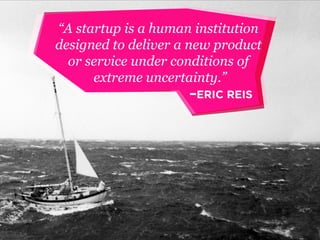
“A startup is a human institution
designed to deliver a new product
or service under conditions of
extreme uncertainty.”
–ERIC REIS
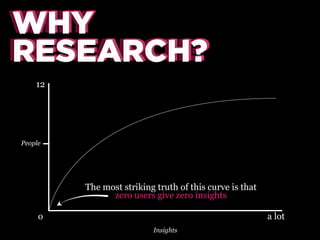
WHY
WHY
RESEARCH?
RESEARCH?
12

People

The most striking truth of this curve is that
zero users give zero insights
a lot

o
Insights
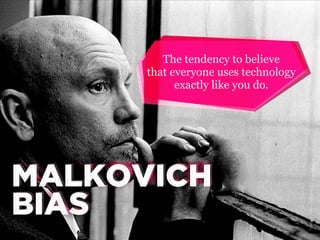
The tendency to believe
that everyone uses technology
exactly like you do.

MALKOVICH
MALKOVICH
BIAS
BIAS
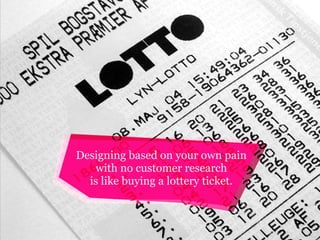
Designing based on your own pain
with no customer research
is like buying a lottery ticket.
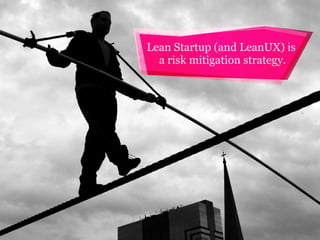
Lean Startup (and LeanUX) is
a risk mitigation strategy.
A DIRTY
A DIRTY
SECRET
SECRET
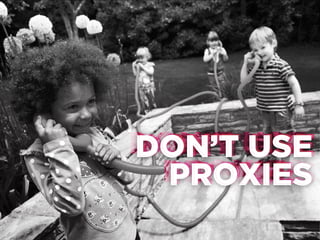
DON’T USE
DON’T USE
PROXIES
PROXIES
ETHNOGRAPHY
ETHNOGRAPHY
ETHNOGRAPHY
WTF?
WTF?
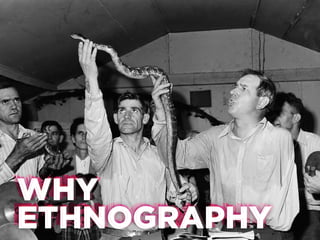
WHY
WHY
WHY
ETHNOGRAPHY
ETHNOGRAPHY
ETHNOGRAPHY
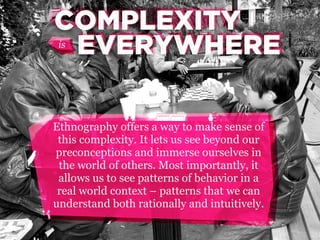
COMPLEXITY
COMPLEXITY
EVERYWHERE
is

Ethnography offers a way to make sense of
this complexity. It lets us see beyond our
preconceptions and immerse ourselves in
the world of others. Most importantly, it
allows us to see patterns of behavior in a
real world context – patterns that we can
understand both rationally and intuitively.
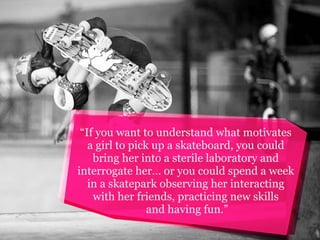
“If you want to understand what motivates
a girl to pick up a skateboard, you could
bring her into a sterile laboratory and
interrogate her… or you could spend a week
in a skatepark observing her interacting
with her friends, practicing new skills
and having fun.”
ETHNOGRAPHY
ETHNOGRAPHY
+

DESIGN
DESIGN
LEAN
LEAN
ETHNOGRAPHY?
ETHNOGRAPHY?
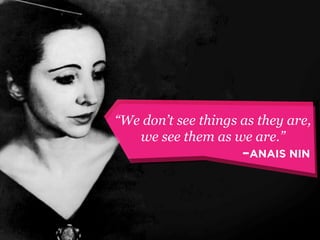
“We don’t see things as they are,
we see them as we are.”
–ANAIS NIN
NINE
PROBLEMS
WITH
LEAN
STARTUP
CUSTOMER
RESEARCH
Most teams practicing Lean Startup don't start with a customer hypothesis;
they work backwards from a solution hypothesis
Because teams start with a solution hypothesis, it's almost impossible
for them to generate multiple hypotheses for testing
If GOOB is not conducted in the appropriate context,
it almost never yields useful behavioral data
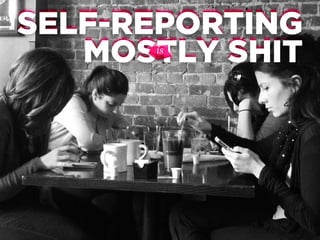
GOOB relies far too heavily on self-reporting, which is almost useless.
GOOB, when done poorly, is particularly prone to confirmation bias
Most teams have a very hard time formulating assumptions as hypotheses
Designing reliable experiments is a skill that takes time to learn
People new to customer research are really bad at listening for weak signals
When a customer interview is guided, it almost never provides
opportunity for serendipitous insights to emerge
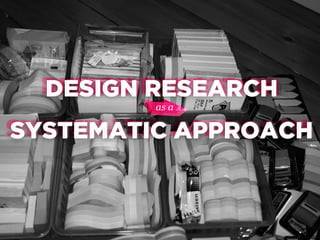
DESIGN RESEARCH
DESIGN RESEARCH
as a

SYSTEMATIC APPROACH
SYSTEMATIC APPROACH
DESIGN
DESIGN
ETHNOGRAPHY
ETHNOGRAPHY
ALLOWS
ALLOWS
US TO
US TO
1. Discover the semantics of living
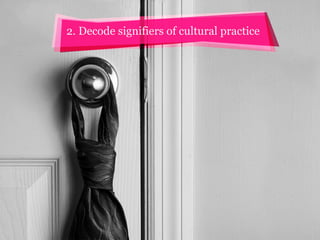
2. Decode signifiers of cultural practice
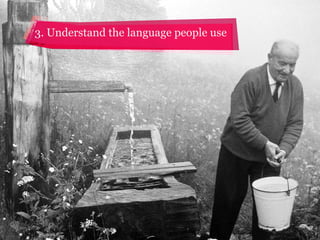
3. Understand the language people use
CONTEXT
CONTEXT
KING
KING
is
SELF-REPORTING
MOSTLY SHIT
is
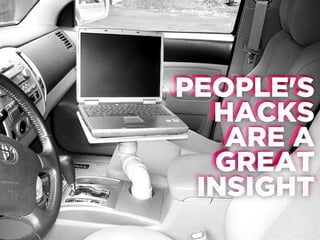
PEOPLE'S
PEOPLE'S
PEOPLE'S
HACKS
HACKS
HACKS
ARE A
ARE A
ARE A
GREAT
GREAT
INSIGHT
INSIGHT
EIGHT
EIGHT
STEPS IN
STEPS IN
ETHNOGRAPHIC
ETHNOGRAPHIC
RESEARCH
RESEARCH
1. Define your customer hypothesis
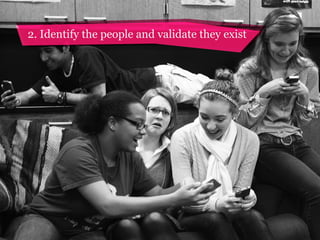
2. Identify the people and validate they exist
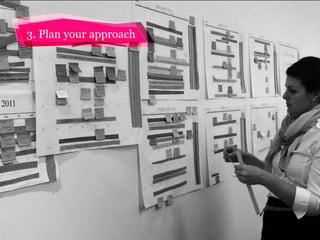
3. Plan your approach
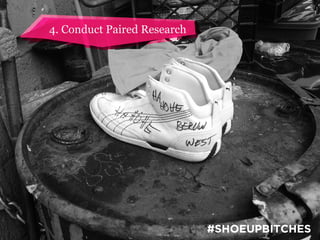
4. Conduct Paired Research

#SHOEUPBITCHES
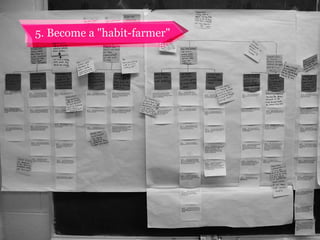
5. Become a "habit-farmer"
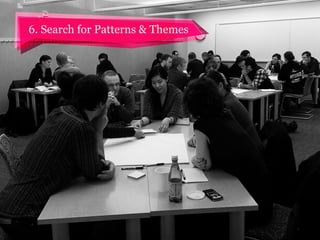
6. Search for Patterns & Themes
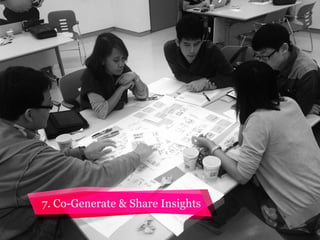
7. Co-Generate & Share Insights
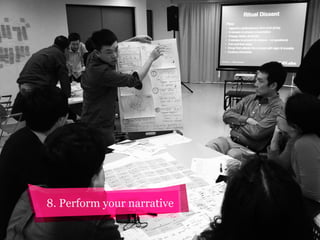
8. Perform your narrative
KEYS
KEYS
TO GOOD
TO GOOD
ETHNOGRAPHY
ETHNOGRAPHY
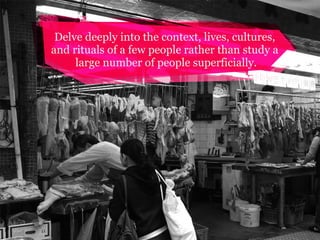
Delve deeply into the context, lives, cultures,
and rituals of a few people rather than study a
large number of people superficially.
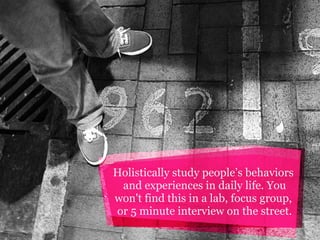
Holistically study people’s behaviors
and experiences in daily life. You
won't find this in a lab, focus group,
or 5 minute interview on the street.
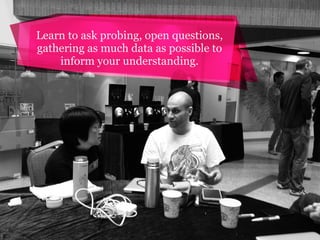
Learn to ask probing, open questions,
gathering as much data as possible to
inform your understanding.
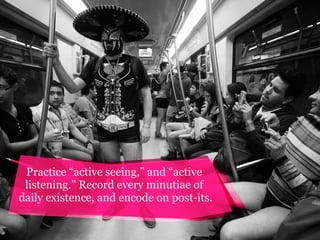
Practice “active seeing,” and “active
listening.” Record every minutiae of
daily existence, and encode on post-its.
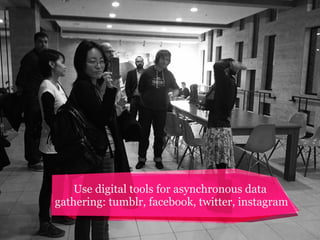
Use digital tools for asynchronous data
gathering: tumblr, facebook, twitter, instagram
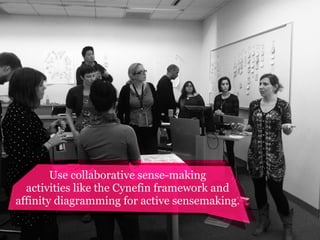
Use collaborative sense-making
activities like the Cynefin framework and
affinity diagramming for active sensemaking.
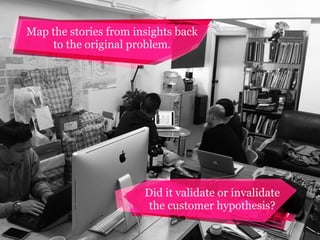
Map the stories from insights back
to the original problem.

Did it validate or invalidate
the customer hypothesis?
Did the new insights provide potentially
richer opportunities to solve?

NOW YOU CAN THINK ABOUT YOUR
SOLUTION HYPOTHESIS
THANKS
THANKS
@SemanticWill

WILL EVANS
DIRECTOR OF DESIGN

Design Ethnography