International Journal of Advances in Applied Sciences (IJAAS)
Vol. 7, No. 3, September 2018, pp. 240~244
ISSN: 2252-8814, DOI: 10.11591/ijaas.v7.i3.pp240-244  240
Journal homepage: http://iaescore.com/online/index.php/IJAAS
Design of an IOT based Online Monitoring Digital Stethoscope
B. Revanth Reddy1
, S. Roji Marjorie2
, P. Ramakrishna3
Department of Electronics and Communication Engineering, Saveetha School of Engineering, Saveetha University, India
Article Info ABSTRACT
Article history:
Received Nov 27, 2017
Revised Mar 30, 2018
Accepted Apr 13, 2018
Acoustic stethoscopes have low sound levels. Digital stethoscope overcomes
this issue by amplifying body sounds electronically. As the sound signals are
transmitted electronically, it can be wireless and can provide noise reduction.
Acoustic stethoscope can be changed into a digital stethoscope by inserting
an electric capacity microphone onto its head. Heart sounds received from
the microphone are processed, sampled and sound signals are converted
analog to digital and sent wirelessly using the Internet of Things(IOT)
techniques, so that multiple doctors can do auscultation and monitor
conditions of the patient.
Keyword:
Acoustic Stethoscope
Auscultation
Digital Stethoscope
Internet of Things
Copyright © 2018 Institute of Advanced Engineering and Science.
All rights reserved.
Corresponding Author:
Roji Marjorie.S,
Departement of Electronics and Communication Engineering,
Saveetha School of Engineering,
Saveetha University, Thandalam, Chennai 602105, Tamilnadu, India.
Email: roji.marjorie@gmail.com
1. INTRODUCTION
A Stethoscope is a device that helps in listening to the sounds of heart and lungs in our body [7]. By
using stethoscope, the doctor can check the problems of the heart and lung of patient. Acoustic stethoscope is
cheaper than electronic stethoscope. The function of electronic stethoscope is same as acoustic stethoscope.
Acoustic stethoscopes are common to most people, and operation of sound transmission from the chest piece,
through hollow tubes, to listener's ears [7]. The chest piece generally consists of two sides that can be placed
on the patient for hearing sound. If the diaphragm puts on the patient, body sounds vibrate the diaphragm and
creates acoustic pressure waves [2]. Those created acoustic pressure waves travel through the stethoscope,
resulting in hearing of body sounds. This stethoscope was invented by Rappaport and Sprague in the early
20th century [7]. Acoustic stethoscopes produce very low sound.
An electronic stethoscope amplifies low level body sounds and require conversion of acoustic sound
waves to electrical signals which can be amplified and processed for optimal listening [1]. The simplest and
low cost method of sound detection can be achieved by placing a microphone in the chest piece. Electronic
stethoscope module consists of different types of components that can be used to amplify and optimize the
sound signals in different frequencies. Sound signals can be digitized, encoded and decoded to have noise
reduction [3]. Processed data can be sent to the cloud using Internet of Things techniques. Internet of Things
is a technology that uses internet to control or monitor the electronic devices [6]. Heart beat sounds of a
digital stethoscope is monitored over internet using the IOT and then graphs can be drawn [5].
2. DESIGN
Preamplifier is used to amplify low level electrical signals for further processing. Filters allows
selection of suitable frequencies, so that particular heart sound frequencies can be reproduced. ADC converts
IJAAS ISSN: 2252-8814 
Design of an IOT based Online Monitoring Digital Stethoscope (B Revanth Reddy)
241
analog signals to digital, so that the heart beat sounds can be processed and then sent over internet wirelessly.
2.1 Block Diagram
Figure 1. Block Diagram
2.2 Condenser Microphone
A microphone or mic is an electric transducer that coverts the acoustic sounds to electrical signals. It
is inserted into head of the mechanical stethoscope which converts heart sounds received by diaphragm to the
electrical signals.
2.3 Preamplifiers
A preamplifier is used to generate a small electrical signal for further amplification. Two op-amps of
LM324 integrated circuit chip employed to amplify the signals from the piezoelectric crystal.2
This is AC
coupled to the first amplifier stage, which provides a gain of about 20. The second stage, which is identical to
the first stage in all respects, provides a subsequent gain of about 20 to give a total amplification of 400. The
input signals to the pre amplifier from the piezoelectric transducer are in the order of 0.5mV. Continuous
variation of gain is achieved through the 10kΩ potentiometer at the output of the second stage of the
Preamplifier. The input signal to the pre-amplification stage is amplified twice using two identical non-
inverting amplifiers. Capacitor C1is the coupling capacitor for the first amplification stage and C4 for the
second amplification stage respectively. Capacitors C2 and C5 are the feedback capacitances of stage one and
two. These capacitances serve to improve the stability of the circuit and the low frequency response.
Figure 2. Pre-amplifier
2.4 Filters
Filters permit selection of suitable frequency bands, so that particular heart sound frequencies can be
reproduced. In general, the high frequency components of cardiovascular sound have a much smaller
intensity than the low frequency components. In general, three to four sets of such filters with different cutoff
frequencies are used for clinical recording of the PCG as the shape of a murmur is often characteristically
 ISSN: 2252-8814
IJAAS Vol. 7, No. 3, September 2018: 240 – 244
242
displayed in one channel better than the other. Active low pass and high pass filters are used in this
equipment because of the advantages like flexibility in gain and frequency adjustments, high input
impedance and low cost. The requirement of the filter in this is to attenuate any frequency below 10Hz and
above 1KHz.
2.5 Power Amplifier
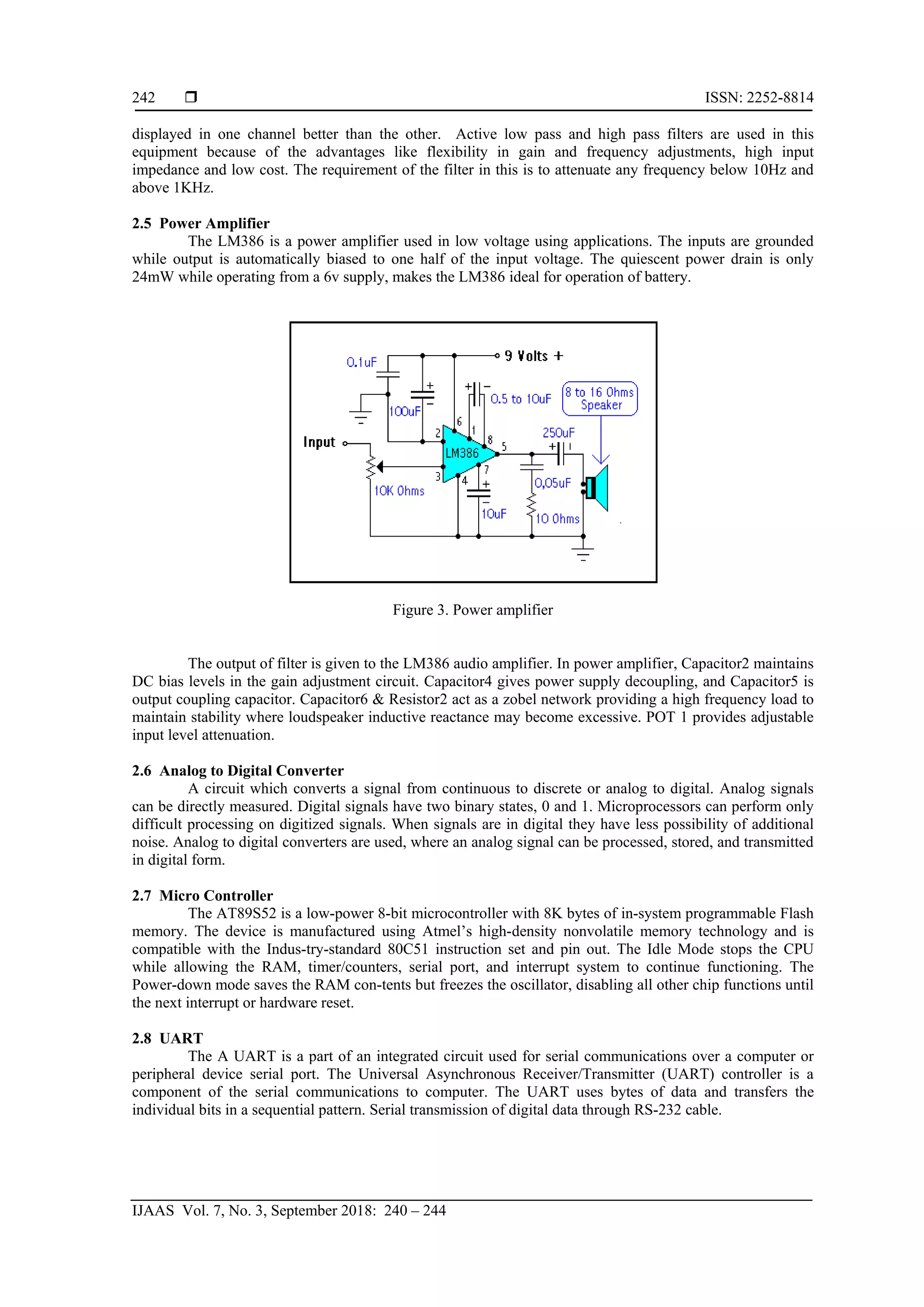
The LM386 is a power amplifier used in low voltage using applications. The inputs are grounded
while output is automatically biased to one half of the input voltage. The quiescent power drain is only
24mW while operating from a 6v supply, makes the LM386 ideal for operation of battery.
Figure 3. Power amplifier
The output of filter is given to the LM386 audio amplifier. In power amplifier, Capacitor2 maintains
DC bias levels in the gain adjustment circuit. Capacitor4 gives power supply decoupling, and Capacitor5 is
output coupling capacitor. Capacitor6 & Resistor2 act as a zobel network providing a high frequency load to
maintain stability where loudspeaker inductive reactance may become excessive. POT 1 provides adjustable
input level attenuation.
2.6 Analog to Digital Converter
A circuit which converts a signal from continuous to discrete or analog to digital. Analog signals
can be directly measured. Digital signals have two binary states, 0 and 1. Microprocessors can perform only
difficult processing on digitized signals. When signals are in digital they have less possibility of additional
noise. Analog to digital converters are used, where an analog signal can be processed, stored, and transmitted
in digital form.
2.7 Micro Controller
The AT89S52 is a low-power 8-bit microcontroller with 8K bytes of in-system programmable Flash
memory. The device is manufactured using Atmel’s high-density nonvolatile memory technology and is
compatible with the Indus-try-standard 80C51 instruction set and pin out. The Idle Mode stops the CPU
while allowing the RAM, timer/counters, serial port, and interrupt system to continue functioning. The
Power-down mode saves the RAM con-tents but freezes the oscillator, disabling all other chip functions until
the next interrupt or hardware reset.
2.8 UART
The A UART is a part of an integrated circuit used for serial communications over a computer or
peripheral device serial port. The Universal Asynchronous Receiver/Transmitter (UART) controller is a
component of the serial communications to computer. The UART uses bytes of data and transfers the
individual bits in a sequential pattern. Serial transmission of digital data through RS-232 cable.
IJAAS ISSN: 2252-8814 
Design of an IOT based Online Monitoring Digital Stethoscope (B Revanth Reddy)
243
2.9 Working of Module
A Condenser microphone is used in the chest-piece of the stethoscope which converts the heart
sounds in to electrical signals. These electrical signals are preamplified and then given to filters. In each case
of filters, heart sounds are processed in such a way that external noise is reduced. Obtained heart sounds are
again amplified using power amplifier which helps in getting high voltage signals. ADC is used to convert
the analog output at power amplifier to digital pulse. Pulse signals are counted using protocols in AT89S52
microcontroller and then heart beat rate per minute is displayed in LCD.
2.10 Transmission of Heart Beat Rates Through IOT
Heart beat rates displayed in the LCD are transmitted to PC through UART, Asynchronous serial
transmission and receiver using RS232 cable. Data received in the PC are processed in USB serial
communication package which uploads the data to the cloud storage. An authentication step is used in
retrieving the data, as this is related to health-related issues. Data can be retrieved and displayed in a website
or android app, so that mutiple doctors can monitor the patient conditions from any where at any time.
3. RESULTS AND ANALYSIS
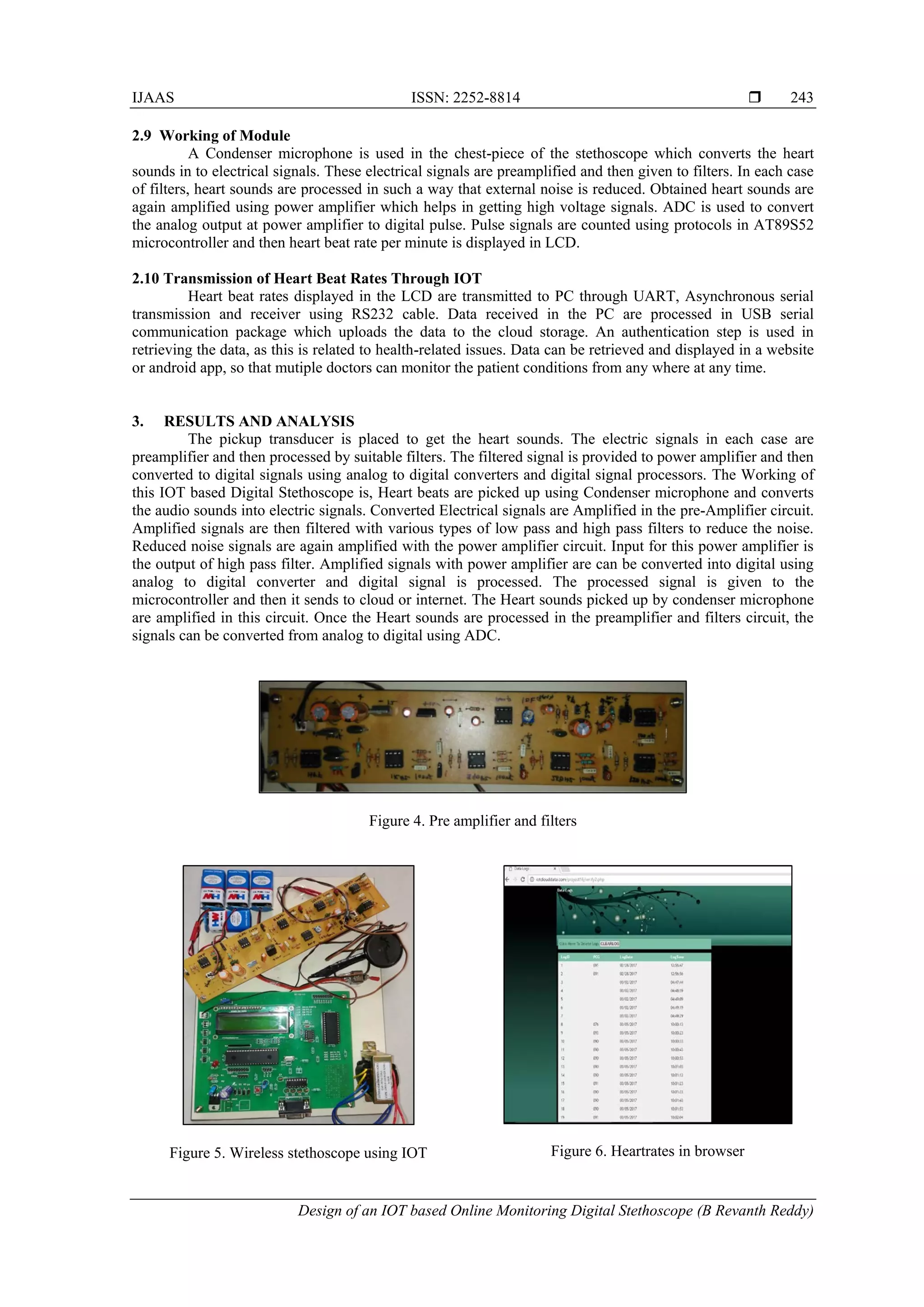
The pickup transducer is placed to get the heart sounds. The electric signals in each case are
preamplifier and then processed by suitable filters. The filtered signal is provided to power amplifier and then
converted to digital signals using analog to digital converters and digital signal processors. The Working of
this IOT based Digital Stethoscope is, Heart beats are picked up using Condenser microphone and converts
the audio sounds into electric signals. Converted Electrical signals are Amplified in the pre-Amplifier circuit.
Amplified signals are then filtered with various types of low pass and high pass filters to reduce the noise.
Reduced noise signals are again amplified with the power amplifier circuit. Input for this power amplifier is
the output of high pass filter. Amplified signals with power amplifier are can be converted into digital using
analog to digital converter and digital signal is processed. The processed signal is given to the
microcontroller and then it sends to cloud or internet. The Heart sounds picked up by condenser microphone
are amplified in this circuit. Once the Heart sounds are processed in the preamplifier and filters circuit, the
signals can be converted from analog to digital using ADC.
Figure 4. Pre amplifier and filters
Figure 5. Wireless stethoscope using IOT Figure 6. Heartrates in browser
 ISSN: 2252-8814
IJAAS Vol. 7, No. 3, September 2018: 240 – 244
244
The pre amplifier, active filters and power amplifiers. The pickup transducer is placed to get the
heart sounds. The electric signals in each case are preamplifier and then processed by suitable filters.
Implemented wireless stethoscope using FM transmitter can be modified by converting analog to digital
signals using ADC and then can be sent to cloud using IOT techniques. Heartbeats counted by micro
controller is displayed in the LCD as well as in a site using IOT..
5. CONCLUSION
A Digital Stethoscope has been implemented and signals can be transmitted through IOT. Heart
beats are picked up using Condenser microphone and converts the audio sounds into electric signals.
Converted Electrical signals are Amplified in the pre-Amplifier circuit. Amplified signals are then filtered
with various types of low pass and high pass filters to reduce the noise. Reduced noise signals are again
amplified with the power amplifier circuit. Input for this power amplifier is the output of high pass filter.
Amplified signals with power amplifier are can be converted into digital using analog to digital converter and
digital signal is processed. The processed signal is given to the microcontroller and then it sends to cloud or
internet.
REFERENCES
[1] Habin Wang, Jian Chen, Choi Samjin, “Heart Sound Measurement and Analysis System with Digital
Stethoscope”, International Conference on Biomedical Engineering and Informatics, 2009.
[2] Yang Tang, Guitao Cao, Hao Li, “The design of electronic heart sound stethoscope based on Bluetooth”
4th International Conference On Bioinformatics and Biomedical Engineering (ICBBE), 2010.
[3] Ashish Harsola, Sushil Thale, M.S. Panse, “Digital Stethoscope for Heart Sounds”, International
Conference and workshop on Emerging Trends in Technology (ICWET), 2011.
[4] R. P. Singh, S.D. Sapre, “Communication Systems Analog & Digital” Second edition, Tata
McGrow–HillPublication.
[5] “Sound sending over internet” by david middlecamp published in adafruit, music, particle.
[6] ESP8266 Wi-Fi + Arduino upload to xively and Thingspeak byjanisalnis in Internet of Things.
[7] Wikipedia, https://en.wikipedia.org/wiki/Stethoscope

Design of an IOT based Online Monitoring Digital Stethoscope

  • 1.
    International Journal ofAdvances in Applied Sciences (IJAAS) Vol. 7, No. 3, September 2018, pp. 240~244 ISSN: 2252-8814, DOI: 10.11591/ijaas.v7.i3.pp240-244  240 Journal homepage: http://iaescore.com/online/index.php/IJAAS Design of an IOT based Online Monitoring Digital Stethoscope B. Revanth Reddy1 , S. Roji Marjorie2 , P. Ramakrishna3 Department of Electronics and Communication Engineering, Saveetha School of Engineering, Saveetha University, India Article Info ABSTRACT Article history: Received Nov 27, 2017 Revised Mar 30, 2018 Accepted Apr 13, 2018 Acoustic stethoscopes have low sound levels. Digital stethoscope overcomes this issue by amplifying body sounds electronically. As the sound signals are transmitted electronically, it can be wireless and can provide noise reduction. Acoustic stethoscope can be changed into a digital stethoscope by inserting an electric capacity microphone onto its head. Heart sounds received from the microphone are processed, sampled and sound signals are converted analog to digital and sent wirelessly using the Internet of Things(IOT) techniques, so that multiple doctors can do auscultation and monitor conditions of the patient. Keyword: Acoustic Stethoscope Auscultation Digital Stethoscope Internet of Things Copyright © 2018 Institute of Advanced Engineering and Science. All rights reserved. Corresponding Author: Roji Marjorie.S, Departement of Electronics and Communication Engineering, Saveetha School of Engineering, Saveetha University, Thandalam, Chennai 602105, Tamilnadu, India. Email: roji.marjorie@gmail.com 1. INTRODUCTION A Stethoscope is a device that helps in listening to the sounds of heart and lungs in our body [7]. By using stethoscope, the doctor can check the problems of the heart and lung of patient. Acoustic stethoscope is cheaper than electronic stethoscope. The function of electronic stethoscope is same as acoustic stethoscope. Acoustic stethoscopes are common to most people, and operation of sound transmission from the chest piece, through hollow tubes, to listener's ears [7]. The chest piece generally consists of two sides that can be placed on the patient for hearing sound. If the diaphragm puts on the patient, body sounds vibrate the diaphragm and creates acoustic pressure waves [2]. Those created acoustic pressure waves travel through the stethoscope, resulting in hearing of body sounds. This stethoscope was invented by Rappaport and Sprague in the early 20th century [7]. Acoustic stethoscopes produce very low sound. An electronic stethoscope amplifies low level body sounds and require conversion of acoustic sound waves to electrical signals which can be amplified and processed for optimal listening [1]. The simplest and low cost method of sound detection can be achieved by placing a microphone in the chest piece. Electronic stethoscope module consists of different types of components that can be used to amplify and optimize the sound signals in different frequencies. Sound signals can be digitized, encoded and decoded to have noise reduction [3]. Processed data can be sent to the cloud using Internet of Things techniques. Internet of Things is a technology that uses internet to control or monitor the electronic devices [6]. Heart beat sounds of a digital stethoscope is monitored over internet using the IOT and then graphs can be drawn [5]. 2. DESIGN Preamplifier is used to amplify low level electrical signals for further processing. Filters allows selection of suitable frequencies, so that particular heart sound frequencies can be reproduced. ADC converts
  • 2.
    IJAAS ISSN: 2252-8814 Design of an IOT based Online Monitoring Digital Stethoscope (B Revanth Reddy) 241 analog signals to digital, so that the heart beat sounds can be processed and then sent over internet wirelessly. 2.1 Block Diagram Figure 1. Block Diagram 2.2 Condenser Microphone A microphone or mic is an electric transducer that coverts the acoustic sounds to electrical signals. It is inserted into head of the mechanical stethoscope which converts heart sounds received by diaphragm to the electrical signals. 2.3 Preamplifiers A preamplifier is used to generate a small electrical signal for further amplification. Two op-amps of LM324 integrated circuit chip employed to amplify the signals from the piezoelectric crystal.2 This is AC coupled to the first amplifier stage, which provides a gain of about 20. The second stage, which is identical to the first stage in all respects, provides a subsequent gain of about 20 to give a total amplification of 400. The input signals to the pre amplifier from the piezoelectric transducer are in the order of 0.5mV. Continuous variation of gain is achieved through the 10kΩ potentiometer at the output of the second stage of the Preamplifier. The input signal to the pre-amplification stage is amplified twice using two identical non- inverting amplifiers. Capacitor C1is the coupling capacitor for the first amplification stage and C4 for the second amplification stage respectively. Capacitors C2 and C5 are the feedback capacitances of stage one and two. These capacitances serve to improve the stability of the circuit and the low frequency response. Figure 2. Pre-amplifier 2.4 Filters Filters permit selection of suitable frequency bands, so that particular heart sound frequencies can be reproduced. In general, the high frequency components of cardiovascular sound have a much smaller intensity than the low frequency components. In general, three to four sets of such filters with different cutoff frequencies are used for clinical recording of the PCG as the shape of a murmur is often characteristically
  • 3.
     ISSN: 2252-8814 IJAASVol. 7, No. 3, September 2018: 240 – 244 242 displayed in one channel better than the other. Active low pass and high pass filters are used in this equipment because of the advantages like flexibility in gain and frequency adjustments, high input impedance and low cost. The requirement of the filter in this is to attenuate any frequency below 10Hz and above 1KHz. 2.5 Power Amplifier The LM386 is a power amplifier used in low voltage using applications. The inputs are grounded while output is automatically biased to one half of the input voltage. The quiescent power drain is only 24mW while operating from a 6v supply, makes the LM386 ideal for operation of battery. Figure 3. Power amplifier The output of filter is given to the LM386 audio amplifier. In power amplifier, Capacitor2 maintains DC bias levels in the gain adjustment circuit. Capacitor4 gives power supply decoupling, and Capacitor5 is output coupling capacitor. Capacitor6 & Resistor2 act as a zobel network providing a high frequency load to maintain stability where loudspeaker inductive reactance may become excessive. POT 1 provides adjustable input level attenuation. 2.6 Analog to Digital Converter A circuit which converts a signal from continuous to discrete or analog to digital. Analog signals can be directly measured. Digital signals have two binary states, 0 and 1. Microprocessors can perform only difficult processing on digitized signals. When signals are in digital they have less possibility of additional noise. Analog to digital converters are used, where an analog signal can be processed, stored, and transmitted in digital form. 2.7 Micro Controller The AT89S52 is a low-power 8-bit microcontroller with 8K bytes of in-system programmable Flash memory. The device is manufactured using Atmel’s high-density nonvolatile memory technology and is compatible with the Indus-try-standard 80C51 instruction set and pin out. The Idle Mode stops the CPU while allowing the RAM, timer/counters, serial port, and interrupt system to continue functioning. The Power-down mode saves the RAM con-tents but freezes the oscillator, disabling all other chip functions until the next interrupt or hardware reset. 2.8 UART The A UART is a part of an integrated circuit used for serial communications over a computer or peripheral device serial port. The Universal Asynchronous Receiver/Transmitter (UART) controller is a component of the serial communications to computer. The UART uses bytes of data and transfers the individual bits in a sequential pattern. Serial transmission of digital data through RS-232 cable.
  • 4.
    IJAAS ISSN: 2252-8814 Design of an IOT based Online Monitoring Digital Stethoscope (B Revanth Reddy) 243 2.9 Working of Module A Condenser microphone is used in the chest-piece of the stethoscope which converts the heart sounds in to electrical signals. These electrical signals are preamplified and then given to filters. In each case of filters, heart sounds are processed in such a way that external noise is reduced. Obtained heart sounds are again amplified using power amplifier which helps in getting high voltage signals. ADC is used to convert the analog output at power amplifier to digital pulse. Pulse signals are counted using protocols in AT89S52 microcontroller and then heart beat rate per minute is displayed in LCD. 2.10 Transmission of Heart Beat Rates Through IOT Heart beat rates displayed in the LCD are transmitted to PC through UART, Asynchronous serial transmission and receiver using RS232 cable. Data received in the PC are processed in USB serial communication package which uploads the data to the cloud storage. An authentication step is used in retrieving the data, as this is related to health-related issues. Data can be retrieved and displayed in a website or android app, so that mutiple doctors can monitor the patient conditions from any where at any time. 3. RESULTS AND ANALYSIS The pickup transducer is placed to get the heart sounds. The electric signals in each case are preamplifier and then processed by suitable filters. The filtered signal is provided to power amplifier and then converted to digital signals using analog to digital converters and digital signal processors. The Working of this IOT based Digital Stethoscope is, Heart beats are picked up using Condenser microphone and converts the audio sounds into electric signals. Converted Electrical signals are Amplified in the pre-Amplifier circuit. Amplified signals are then filtered with various types of low pass and high pass filters to reduce the noise. Reduced noise signals are again amplified with the power amplifier circuit. Input for this power amplifier is the output of high pass filter. Amplified signals with power amplifier are can be converted into digital using analog to digital converter and digital signal is processed. The processed signal is given to the microcontroller and then it sends to cloud or internet. The Heart sounds picked up by condenser microphone are amplified in this circuit. Once the Heart sounds are processed in the preamplifier and filters circuit, the signals can be converted from analog to digital using ADC. Figure 4. Pre amplifier and filters Figure 5. Wireless stethoscope using IOT Figure 6. Heartrates in browser
  • 5.
     ISSN: 2252-8814 IJAASVol. 7, No. 3, September 2018: 240 – 244 244 The pre amplifier, active filters and power amplifiers. The pickup transducer is placed to get the heart sounds. The electric signals in each case are preamplifier and then processed by suitable filters. Implemented wireless stethoscope using FM transmitter can be modified by converting analog to digital signals using ADC and then can be sent to cloud using IOT techniques. Heartbeats counted by micro controller is displayed in the LCD as well as in a site using IOT.. 5. CONCLUSION A Digital Stethoscope has been implemented and signals can be transmitted through IOT. Heart beats are picked up using Condenser microphone and converts the audio sounds into electric signals. Converted Electrical signals are Amplified in the pre-Amplifier circuit. Amplified signals are then filtered with various types of low pass and high pass filters to reduce the noise. Reduced noise signals are again amplified with the power amplifier circuit. Input for this power amplifier is the output of high pass filter. Amplified signals with power amplifier are can be converted into digital using analog to digital converter and digital signal is processed. The processed signal is given to the microcontroller and then it sends to cloud or internet. REFERENCES [1] Habin Wang, Jian Chen, Choi Samjin, “Heart Sound Measurement and Analysis System with Digital Stethoscope”, International Conference on Biomedical Engineering and Informatics, 2009. [2] Yang Tang, Guitao Cao, Hao Li, “The design of electronic heart sound stethoscope based on Bluetooth” 4th International Conference On Bioinformatics and Biomedical Engineering (ICBBE), 2010. [3] Ashish Harsola, Sushil Thale, M.S. Panse, “Digital Stethoscope for Heart Sounds”, International Conference and workshop on Emerging Trends in Technology (ICWET), 2011. [4] R. P. Singh, S.D. Sapre, “Communication Systems Analog & Digital” Second edition, Tata McGrow–HillPublication. [5] “Sound sending over internet” by david middlecamp published in adafruit, music, particle. [6] ESP8266 Wi-Fi + Arduino upload to xively and Thingspeak byjanisalnis in Internet of Things. [7] Wikipedia, https://en.wikipedia.org/wiki/Stethoscope