Eleanor—Jayne Browne | Major Project Notes | Design Me Better— Packaging Design For Pharmaceutical Products 1
Primary packaging also serves to
keep a product in storage, often for
long periods of time. In this case, it
is imperative that primary packaging
keep the product absolutely sealed
off from its environment.
Ease of handling and shelving is a
further aspect of primary packaging
to be considered, so as to ensure the
product can be easily handled by
consumers. Some of the most
common types include blister packs,
clamshell packaging, shrink—
wrapping, paperboard packaging and
unit dose packs.
Secondary packaging is the type
used to group various pre—packaged
products together (the primary
packaging). As secondary packaging
is not in direct contact with the actual
product, its use and application
usually differ distinctly from those
of primary packaging, although the
purpose of both types may at times
converge. Secondary packaging has
2 central functions:
1. Branding & Display
This packaging type plays a vital role
in the marketing strategy surrounding
the product. This is especially
relevant in the case of packaging
display.
2. Logistics
Secondary packaging serves to group
several products together for ease of
handling, transport and storage which
means it must be able to contain
relatively large volumes of primary
packaged products, transport the
product safely to its retail or
consumer destination and keep the
primary packaging in its original
condition during storage. Secondary
packaging is intended to protect not
only the product, but also the primary
packaging, which often is the
packaging most visible to the
consumer in retail displays.
Common examples of secondary
packaging include cardboard cartons,
cardboard boxes and cardboard/plastic
crates; labels and leaflets, laminations,
paper liners or wrapping materials.
Tertiary packaging is used for bulk
handling warehouse storage and
transport shipping. The normal
form is a “unit” load that packs tightly
into containers.
This kind of “outer”packaging includes
pallets, slip sheets, stretch wrap and
any labels used for the shipment and
distribution of goods. This packaging
is also referred to as transport or transit
packaging and is rarely seen by the
final consumer and the end destination
will often deal with this via its own
internal re use or recycling protocols.
Protecting health and safety is always
the first priority and, while medical
packaging design includes lids,
pouches, bags and trays, the drugs
and devices within are what truly
drive design. That means virtually
every package involves customisation,
whether to support sterilisation or
ease of administration.
With its primary role to protect a
packaged medical or pharmaceutical
product, medical packaging is designed
to both uphold the highest medical
standards and ergonomically protect
the integrity of a product. As a
result of the wide array of medical
components, medical packaging ranges
from pre—formed packages to
customised packages for specialty parts.
Variations in size, dimension, rigidity,
breathability and sterility enable even
the most delicate medical component
to be shipped in an appropriately
engineered package. Packaging options
include: peel pouches, pouches,
header bags, cartons, bottles, vials,
ampoules or trays to name a few.
Successful packaging design for both
medicine and medical, or
pharmaceutical, products must
address a long checklist of essentials
such as compliance with regulations,
ease of use for patients and caregivers,
compatibility with sterilisation
methods and efficient manufacturing.
Medicine packaging needs include:
(i) product physical protection
(ii) barrier protection
(iii) agglomeration
(iv) security
(v) convenience
(vi) dose control
(vii) product identification
(viii) product information
(ix) product cautions
(x) easy opening
(xi) non—reactions with product
(xii) not imparting taste or odour
(xiii) non—toxicity
(xiv) adaptability to high speed
packaging equipments
(xv) recyclability/sustainability
Packaging Types
Primary packaging is the term
used to designate the layer of
packaging in immediate contact with
the product; in other words, it is the
first packaging layer in which the
product is contained.
Primary packaging is constructed
both with the product itself and
any existing secondary layers of
packaging in mind. The properties
of the product (form, dimensions
and consistency) dictate the main
priorities of primary packaging.
Primary packaging can have diverse
applications and functions,
depending on the product, transit
and storage variables. The most
obvious, and important, function is
to protect and preserve the product
from damage, external interference
or contamination, spoiling and
chemical imbalances.
Design Me Better!
Packaging Design For Pharmaceutical Products
Eleanor—Jayne Browne | Major Project Notes | Design Me Better— Packaging Design For Pharmaceutical Products 2
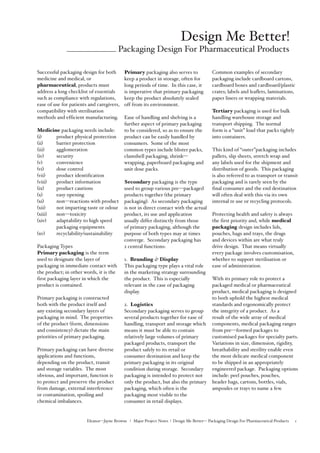
Blister packaging
Clamshell packaging
Shrink—wrap packaging
Paperboard packaging
Unit dose pack
Peel pouch
Header bag
Rigid tray
Eleanor—Jayne Browne | Major Project Notes | Design Me Better— Packaging Design For Pharmaceutical Products 3
The Vignelli Center for Design
Studies is a research unit located on
Rochester Institute of Technology’s
(RIT) campus in Rochester, New York.
It is home to the archives of Massimo
and Lella Vignelli. Massimo Vignelli,
1931—2014, was an Italian designer
who worked, with his wife, in a number
of areas ranging from package design
to houseware design and furniture
design to public signage and showroom
design. He co—founded Vignelli
Associates, with his wife Lella. His
ethos was, “If you can design one
thing, you can design everything,”
and this was reflected in the broad
range of his work.
The Vignelli Center for Design
Studies leads through practice and
programs in the interpretation of
quality design— in short, the centre
acts as a steward of the legacy of
Massimo and Lella Vignelli, who value
excellence, creativity and innovation.
The Vignellis’ work is firmly rooted
within the Modernist tradition and
focused on simplicity through the use
of basic geometric forms.
In 2014, The Vignelli Centre hosted
the Medicine + Design: Healthcare
and Wellness Conference at Rochester
Institute of Technology, US. where
healthcare professionals and designers
collaborated to produce innovative
solution to major challenges in the
wellness community.
In conclusion, package design elevates
the “value” of design as a strategic
business competence in the brand
marketing mix— from concept to
realisation to shelf. It is both a
catalyst and facilitator— for designers,
it keeps them in touch with the
manufacturing process, for end
users a desire for things is created,
or made better; and for businesses
profits can be increased!
Vital to the design process is the
selection of the right protective
material, to be chosen after considering
the different properties of available
material options. The ideal medical
packaging design material needs to
support the following priorities:
(i) allow for sterilisation
(ii) compatibility with
sterilisation processes
(iii) sterility maintenance until
use
(iv) barrier to microbial
penetration
(v) resistance to physical
damage and the environment
(vi) easy opening
(vii) provision for aseptic opening
(viii) ease of use by healthcare
providers
(ix) ease of manufacture
(x) regulatory compliance
(xi) product identification
(xii) information and cautions
(xiii) recyclability/sustainability.
Undoubtedly, packaging plays a
significant role in the medical market
and can often impact a product’s
success or failure; therefore it's ironic,
that sometimes this is the first area
a manufacturer will look at to cut
costs. Most consumers’ buying
decisions are made at the point of
purchase, so packaging is a crucial
tool for the differentiation and the
success of a product. However, for
a medical OEM or contract
manufacturer a packaging—related
“recall” can have a negative impact
on business, so with this in mind the
importance of building quality into
every package designed is critical.
Successful medical packaging
balances the need for manufacturing
efficiency and cost savings, with
compliance and regulations, and the
characteristics of the materials,
adhesives etc. so with all these criteria
to bear in mind, it’s plausible to ask:
can it also look beautiful?
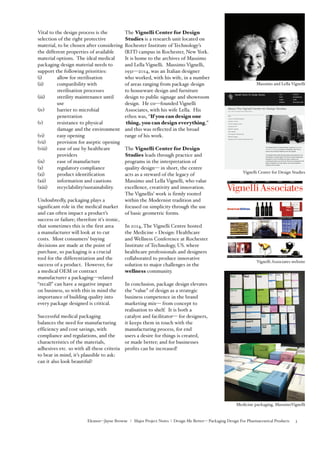
Vignelli Center for Design Studies
Massimo and Lella Vignelli
Vignelli Associates website
Medicine packaging, MassimoVignelli

Design Me Better: Teaching Notes

  • 1.
    Eleanor—Jayne Browne |Major Project Notes | Design Me Better— Packaging Design For Pharmaceutical Products 1 Primary packaging also serves to keep a product in storage, often for long periods of time. In this case, it is imperative that primary packaging keep the product absolutely sealed off from its environment. Ease of handling and shelving is a further aspect of primary packaging to be considered, so as to ensure the product can be easily handled by consumers. Some of the most common types include blister packs, clamshell packaging, shrink— wrapping, paperboard packaging and unit dose packs. Secondary packaging is the type used to group various pre—packaged products together (the primary packaging). As secondary packaging is not in direct contact with the actual product, its use and application usually differ distinctly from those of primary packaging, although the purpose of both types may at times converge. Secondary packaging has 2 central functions: 1. Branding & Display This packaging type plays a vital role in the marketing strategy surrounding the product. This is especially relevant in the case of packaging display. 2. Logistics Secondary packaging serves to group several products together for ease of handling, transport and storage which means it must be able to contain relatively large volumes of primary packaged products, transport the product safely to its retail or consumer destination and keep the primary packaging in its original condition during storage. Secondary packaging is intended to protect not only the product, but also the primary packaging, which often is the packaging most visible to the consumer in retail displays. Common examples of secondary packaging include cardboard cartons, cardboard boxes and cardboard/plastic crates; labels and leaflets, laminations, paper liners or wrapping materials. Tertiary packaging is used for bulk handling warehouse storage and transport shipping. The normal form is a “unit” load that packs tightly into containers. This kind of “outer”packaging includes pallets, slip sheets, stretch wrap and any labels used for the shipment and distribution of goods. This packaging is also referred to as transport or transit packaging and is rarely seen by the final consumer and the end destination will often deal with this via its own internal re use or recycling protocols. Protecting health and safety is always the first priority and, while medical packaging design includes lids, pouches, bags and trays, the drugs and devices within are what truly drive design. That means virtually every package involves customisation, whether to support sterilisation or ease of administration. With its primary role to protect a packaged medical or pharmaceutical product, medical packaging is designed to both uphold the highest medical standards and ergonomically protect the integrity of a product. As a result of the wide array of medical components, medical packaging ranges from pre—formed packages to customised packages for specialty parts. Variations in size, dimension, rigidity, breathability and sterility enable even the most delicate medical component to be shipped in an appropriately engineered package. Packaging options include: peel pouches, pouches, header bags, cartons, bottles, vials, ampoules or trays to name a few. Successful packaging design for both medicine and medical, or pharmaceutical, products must address a long checklist of essentials such as compliance with regulations, ease of use for patients and caregivers, compatibility with sterilisation methods and efficient manufacturing. Medicine packaging needs include: (i) product physical protection (ii) barrier protection (iii) agglomeration (iv) security (v) convenience (vi) dose control (vii) product identification (viii) product information (ix) product cautions (x) easy opening (xi) non—reactions with product (xii) not imparting taste or odour (xiii) non—toxicity (xiv) adaptability to high speed packaging equipments (xv) recyclability/sustainability Packaging Types Primary packaging is the term used to designate the layer of packaging in immediate contact with the product; in other words, it is the first packaging layer in which the product is contained. Primary packaging is constructed both with the product itself and any existing secondary layers of packaging in mind. The properties of the product (form, dimensions and consistency) dictate the main priorities of primary packaging. Primary packaging can have diverse applications and functions, depending on the product, transit and storage variables. The most obvious, and important, function is to protect and preserve the product from damage, external interference or contamination, spoiling and chemical imbalances. Design Me Better! Packaging Design For Pharmaceutical Products
  • 2.
    Eleanor—Jayne Browne |Major Project Notes | Design Me Better— Packaging Design For Pharmaceutical Products 2 Blister packaging Clamshell packaging Shrink—wrap packaging Paperboard packaging Unit dose pack Peel pouch Header bag Rigid tray
  • 3.
    Eleanor—Jayne Browne |Major Project Notes | Design Me Better— Packaging Design For Pharmaceutical Products 3 The Vignelli Center for Design Studies is a research unit located on Rochester Institute of Technology’s (RIT) campus in Rochester, New York. It is home to the archives of Massimo and Lella Vignelli. Massimo Vignelli, 1931—2014, was an Italian designer who worked, with his wife, in a number of areas ranging from package design to houseware design and furniture design to public signage and showroom design. He co—founded Vignelli Associates, with his wife Lella. His ethos was, “If you can design one thing, you can design everything,” and this was reflected in the broad range of his work. The Vignelli Center for Design Studies leads through practice and programs in the interpretation of quality design— in short, the centre acts as a steward of the legacy of Massimo and Lella Vignelli, who value excellence, creativity and innovation. The Vignellis’ work is firmly rooted within the Modernist tradition and focused on simplicity through the use of basic geometric forms. In 2014, The Vignelli Centre hosted the Medicine + Design: Healthcare and Wellness Conference at Rochester Institute of Technology, US. where healthcare professionals and designers collaborated to produce innovative solution to major challenges in the wellness community. In conclusion, package design elevates the “value” of design as a strategic business competence in the brand marketing mix— from concept to realisation to shelf. It is both a catalyst and facilitator— for designers, it keeps them in touch with the manufacturing process, for end users a desire for things is created, or made better; and for businesses profits can be increased! Vital to the design process is the selection of the right protective material, to be chosen after considering the different properties of available material options. The ideal medical packaging design material needs to support the following priorities: (i) allow for sterilisation (ii) compatibility with sterilisation processes (iii) sterility maintenance until use (iv) barrier to microbial penetration (v) resistance to physical damage and the environment (vi) easy opening (vii) provision for aseptic opening (viii) ease of use by healthcare providers (ix) ease of manufacture (x) regulatory compliance (xi) product identification (xii) information and cautions (xiii) recyclability/sustainability. Undoubtedly, packaging plays a significant role in the medical market and can often impact a product’s success or failure; therefore it's ironic, that sometimes this is the first area a manufacturer will look at to cut costs. Most consumers’ buying decisions are made at the point of purchase, so packaging is a crucial tool for the differentiation and the success of a product. However, for a medical OEM or contract manufacturer a packaging—related “recall” can have a negative impact on business, so with this in mind the importance of building quality into every package designed is critical. Successful medical packaging balances the need for manufacturing efficiency and cost savings, with compliance and regulations, and the characteristics of the materials, adhesives etc. so with all these criteria to bear in mind, it’s plausible to ask: can it also look beautiful? Vignelli Center for Design Studies Massimo and Lella Vignelli Vignelli Associates website Medicine packaging, MassimoVignelli