Eleanor—Jayne Browne | Professional Practice Notes | Publishing Handouts 1
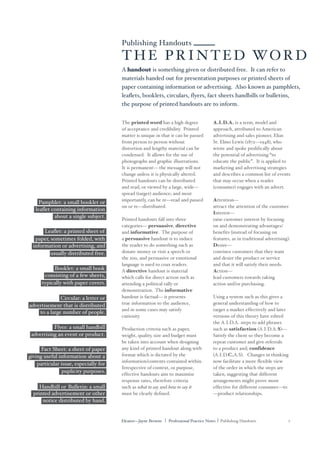
A handout is something given or distributed free. It can refer to
materials handed out for presentation purposes or printed sheets of
paper containing information or advertising. Also known as pamphlets,
leaflets, booklets, circulars, flyers, fact sheets handbills or bulletins,
the purpose of printed handouts are to inform.
Publishing Handouts
THE PRINTED WORD
The printed word has a high degree
of acceptance and credibility. Printed
matter is unique in that it can be passed
from person to person without
distortion and lengthy material can be
condensed. It allows for the use of
photographs and graphic illustrations.
It is permanent— the message will not
change unless it is physically altered.
Printed handouts can be distributed
and read, or viewed by a large, wide—
spread (target) audience; and most
importantly, can be re—read and passed
on or re—distributed.
Printed handouts fall into three
categories— persuasive, directive
and informative. The purpose of
a persuasive handout is to induce
the reader to do something such as
donate money or visit a speech or
the zoo, and persuasive or emotional
language is used to coax readers.
A directive handout is material
which calls for direct action such as
attending a political rally or
demonstration. The informative
handout is factual— it presents
true information to the audience,
and in some cases may satisfy
curiosity.
Production criteria such as paper,
weight, quality, size and budget must
be taken into account when designing
any kind of printed handout along with
format which is dictated by the
information/contents contained within.
Irrespective of context, or purpose,
effective handouts aim to maximise
response rates, therefore criteria
such as what to say and how to say it
must be clearly defined.
A.I.D.A. is a term, model and
approach, attributed to American
advertising and sales pioneer, Elias
St. Elmo Lewis (1872—1948), who
wrote and spoke prolifically about
the potential of advertising “to
educate the public”. It is applied to
marketing and advertising strategies
and describes a common list of events
that may occur when a reader
(consumer) engages with an advert.
Attention—
attract the attention of the customer.
Interest—
raise customer interest by focusing
on and demonstrating advantages/
benefits (instead of focusing on
features, as in traditional advertising).
Desire—
convince customers that they want
and desire the product or service
and that it will satisfy their needs.
Action—
lead customers towards taking
action and/or purchasing.
Using a system such as this gives a
general understanding of how to
target a market effectively and later
versions of this theory have edited
the A.I.D.A. steps to add phrases
such as satisfaction (A.I.D.A.S)—
Satisfy the client so they become a
repeat customer and give referrals
to a product and; confidence
(A.I.D.C.A.S). Changes in thinking
now facilitate a more flexible view
of the order in which the steps are
taken, suggesting that different
arrangements might prove more
effective for different consumer—to
—product relationships.
Pamphlet: a small booklet or
leaflet containing information
Leaflet: a printed sheet of
paper, sometimes folded, with
information or advertising, and
usually distributed free.
Booklet: a small book
consisting of a few sheets,
typically with paper covers.
Circular: a letter or
advertisement that is distributed
to a large number of people.
Flyer: a small handbill
advertising an event or product.
Fact Sheet: a sheet of paper
giving useful information about a
particular issue, especially for
puplicity purposes.
Handbill or Bulletin: a small
printed advertisement or other
notice distributed by hand.
about a single subject.
Eleanor—Jayne Browne | Professional Practice Notes | Publishing Handouts 2
Before design can begin a great deal
of pre—production, content
gathering and objective defining is
necessary, such as what the handout
should achieve and other factors
including: creating an awareness of
issues or services, a list of different
skills, directing viewers to a website,
promoting a specific event or
activity or; reminding readers of a
unique selling point/s. An additional
criterion to factor in is: who is the
material targeted at? Potential
clients/viewers? or, existing clients/
viewers?
Grammar and spelling must be
correct and without errors, typos or
mistakes, and body copy presented
in short sentences that make the
point clearly and concisely— a
handout's purpose is to deliver a
message with a call to action.
Additional information includes
contact details such as telephone
number, email and website address
along with a name or contact
window.
Overuse of, and inappropriate use,
of typographic elements such as
fonts must be avoided. Focus should
be placed on creating a high degree
of typographic authority with a clear
visual language based on a grid
structure. Choice of format, and
size, is determined primarily by
(quantity of) content, ie. how much
and budget as well as distribution
area. Select a size, and fold, that
allows the inclusion of information
while also remaining practical for
the handout's purpose— a big size
is definitely more noticeable but
may not be practical for mailing
purposes. A tri—fold is appropriate
for direct mailing but not the best
choice when an open spread is
required.
Readers always ask: “What’s in it for
me?” hence an attention grabbing
headline is mandatory. Ask what
selling point does this message
have that will attract attention, or
generate interest?
Known as the Shelf Shout the top
3" (approx. 7.5cm) of a handout are
what people see when the material
is in a stand or on display, therefore
whether organised (in a stand) or hand
distributed, the headline (or name/title)
belongs in the top third of the first page.
Headlines must be correct in fact and
implication, and connect to readers, in
order to attract attention through using
interesting, active words that set (or
match) the tone of the handout.
Straight or bent?
You only get one chance to get it right,
so get it right! Headlines are what
catch attention and they can be written
straight or bent; for example in
delivering a punchy headline for an air
conditioning company it could be
presented in 2 ways: as a straight
headline which might read “High
Quality Air Conditioning” or as a bent
headline and read “Cool Air—Hot
Prices”.
A common mistake is failure to
reinforce the headline with solid facts
— don't keep the tone off beat by a
focus on amusing the reader with joke
—ladened copy. If using a bent headline,
keep the body copy clean, concise and
full of benefits. Also, include a sub—
headline which maintains the momentum
created by the headline. Images used
in handouts can also be straight or bent
and the general rule is: use a straight
image with a bent headline, and vice
versa.
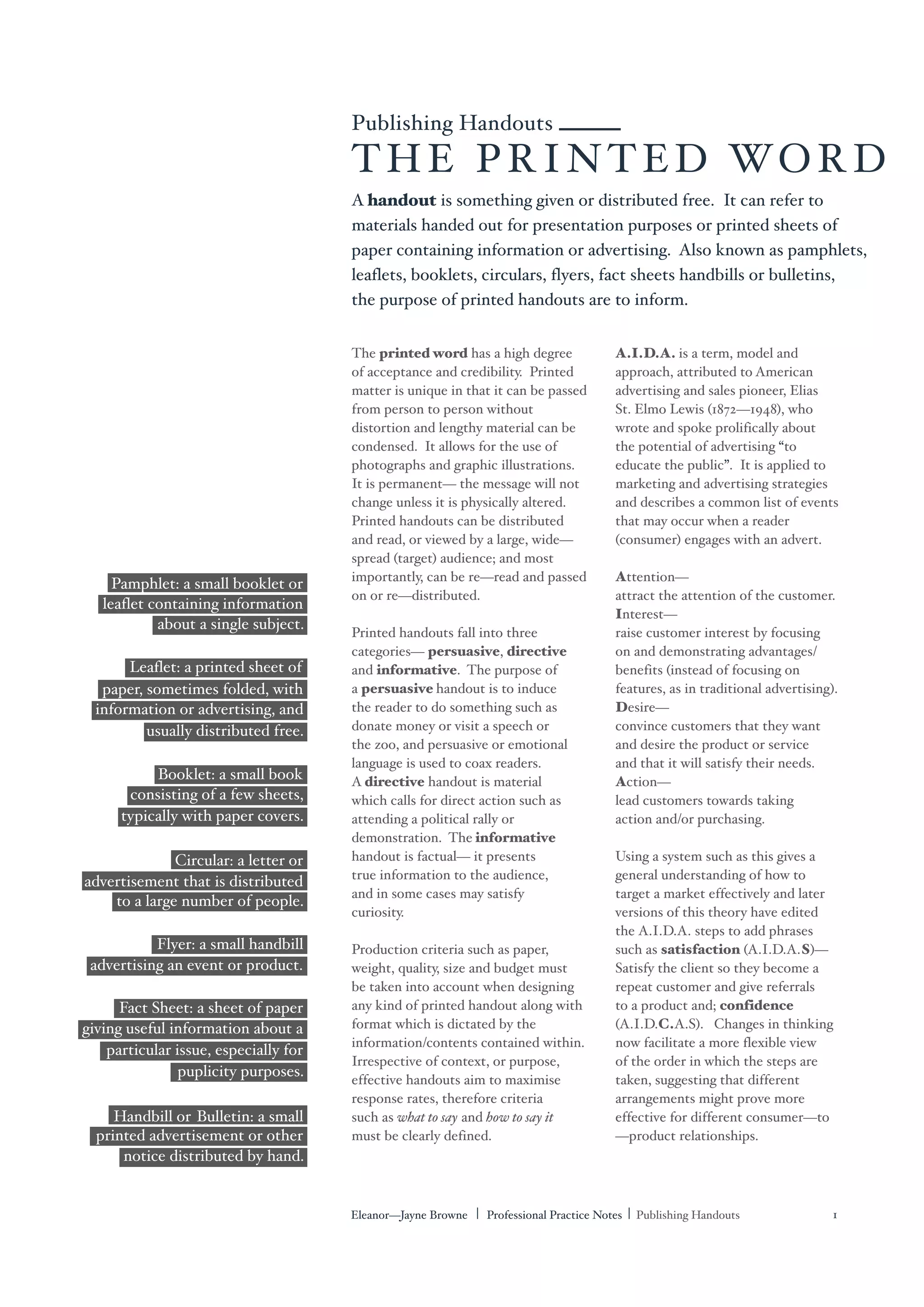
Bi—Fold: a single sheet printed
on both sides and folded into
Tri—Fold: a single sheet printed
on both sides and folded into
thirds resulting in six panels
(three on each side).
Gatefold: a folding method that
uses 2 parallel folds to create six
panels (3 on each side). The left
and right panels are roughly half
the width of the centre panels
and fold inward with no overlap.
French Fold: a sheet that is folded
vertically and then horizontally,
of a booklet or brochure and
expand to a final size that feels
like a poster.
accordion look is created by
Accordion Fold or Z—Fold: an
allowing a sheet to start the size
folding a sheet of paper back and
forth into 2, 3, 4 or more parallel
a fan. When folded only twice,
folds. This allows the document
to open fully with one pull, like
an Accordion Fold is known as a
Z—Fold.
half resulting in four panels
(two on each side).
Eleanor—Jayne Browne | Professional Practice Notes | Publishing Handouts 3
Eye—catching images speak for
themselves, however they must be
relevant, reinforce objectives and
pertinent to text. If promoting a
product/s use pictures of people
using it/them; and always use best
quality. Other graphic elements
may include a Wordmark or logo,
charts, graphs or statistics of some
kind— ensure that these elements
are designed with the same care as
the body text.
Also remember, white space, or
empty space is the designer's best
friend. Don't cram every inch of the
handout with too many images (and
text). Empty space, such as margins
or areas around the title keeps the
design well—balanced, improves
aesthetics and increases readability.
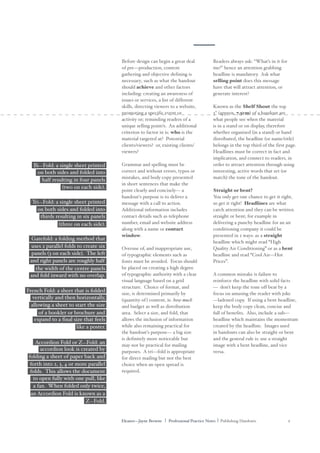
Design Checklist—
Handout objective
Handout readership
Distribution method
Headline
Sub—headline
Shelf shout (7.5cm)
Body copy
Contact information
Images
Handout format
Fold type
Choice of typeface
Core colour palette
Grid structure
Paper type
Paper weight
“Only Dove is one—quarter
moisturizing cream”.
noise in this new Rolls—Royce
“At 60 miles an hour the loudest
comes from the electric clock”.
Rolls—Royce, David Ogilvy
“Impossible is nothing”.
Adidas, Muhammad Ali
“They laughed at me when I sat
down at the piano. But when
I started to play...”
John Caples
Dove Soap, David Ogilvy

Publishing Handouts: The Printed Word

  • 1.
    Eleanor—Jayne Browne |Professional Practice Notes | Publishing Handouts 1 A handout is something given or distributed free. It can refer to materials handed out for presentation purposes or printed sheets of paper containing information or advertising. Also known as pamphlets, leaflets, booklets, circulars, flyers, fact sheets handbills or bulletins, the purpose of printed handouts are to inform. Publishing Handouts THE PRINTED WORD The printed word has a high degree of acceptance and credibility. Printed matter is unique in that it can be passed from person to person without distortion and lengthy material can be condensed. It allows for the use of photographs and graphic illustrations. It is permanent— the message will not change unless it is physically altered. Printed handouts can be distributed and read, or viewed by a large, wide— spread (target) audience; and most importantly, can be re—read and passed on or re—distributed. Printed handouts fall into three categories— persuasive, directive and informative. The purpose of a persuasive handout is to induce the reader to do something such as donate money or visit a speech or the zoo, and persuasive or emotional language is used to coax readers. A directive handout is material which calls for direct action such as attending a political rally or demonstration. The informative handout is factual— it presents true information to the audience, and in some cases may satisfy curiosity. Production criteria such as paper, weight, quality, size and budget must be taken into account when designing any kind of printed handout along with format which is dictated by the information/contents contained within. Irrespective of context, or purpose, effective handouts aim to maximise response rates, therefore criteria such as what to say and how to say it must be clearly defined. A.I.D.A. is a term, model and approach, attributed to American advertising and sales pioneer, Elias St. Elmo Lewis (1872—1948), who wrote and spoke prolifically about the potential of advertising “to educate the public”. It is applied to marketing and advertising strategies and describes a common list of events that may occur when a reader (consumer) engages with an advert. Attention— attract the attention of the customer. Interest— raise customer interest by focusing on and demonstrating advantages/ benefits (instead of focusing on features, as in traditional advertising). Desire— convince customers that they want and desire the product or service and that it will satisfy their needs. Action— lead customers towards taking action and/or purchasing. Using a system such as this gives a general understanding of how to target a market effectively and later versions of this theory have edited the A.I.D.A. steps to add phrases such as satisfaction (A.I.D.A.S)— Satisfy the client so they become a repeat customer and give referrals to a product and; confidence (A.I.D.C.A.S). Changes in thinking now facilitate a more flexible view of the order in which the steps are taken, suggesting that different arrangements might prove more effective for different consumer—to —product relationships. Pamphlet: a small booklet or leaflet containing information Leaflet: a printed sheet of paper, sometimes folded, with information or advertising, and usually distributed free. Booklet: a small book consisting of a few sheets, typically with paper covers. Circular: a letter or advertisement that is distributed to a large number of people. Flyer: a small handbill advertising an event or product. Fact Sheet: a sheet of paper giving useful information about a particular issue, especially for puplicity purposes. Handbill or Bulletin: a small printed advertisement or other notice distributed by hand. about a single subject.
  • 2.
    Eleanor—Jayne Browne |Professional Practice Notes | Publishing Handouts 2 Before design can begin a great deal of pre—production, content gathering and objective defining is necessary, such as what the handout should achieve and other factors including: creating an awareness of issues or services, a list of different skills, directing viewers to a website, promoting a specific event or activity or; reminding readers of a unique selling point/s. An additional criterion to factor in is: who is the material targeted at? Potential clients/viewers? or, existing clients/ viewers? Grammar and spelling must be correct and without errors, typos or mistakes, and body copy presented in short sentences that make the point clearly and concisely— a handout's purpose is to deliver a message with a call to action. Additional information includes contact details such as telephone number, email and website address along with a name or contact window. Overuse of, and inappropriate use, of typographic elements such as fonts must be avoided. Focus should be placed on creating a high degree of typographic authority with a clear visual language based on a grid structure. Choice of format, and size, is determined primarily by (quantity of) content, ie. how much and budget as well as distribution area. Select a size, and fold, that allows the inclusion of information while also remaining practical for the handout's purpose— a big size is definitely more noticeable but may not be practical for mailing purposes. A tri—fold is appropriate for direct mailing but not the best choice when an open spread is required. Readers always ask: “What’s in it for me?” hence an attention grabbing headline is mandatory. Ask what selling point does this message have that will attract attention, or generate interest? Known as the Shelf Shout the top 3" (approx. 7.5cm) of a handout are what people see when the material is in a stand or on display, therefore whether organised (in a stand) or hand distributed, the headline (or name/title) belongs in the top third of the first page. Headlines must be correct in fact and implication, and connect to readers, in order to attract attention through using interesting, active words that set (or match) the tone of the handout. Straight or bent? You only get one chance to get it right, so get it right! Headlines are what catch attention and they can be written straight or bent; for example in delivering a punchy headline for an air conditioning company it could be presented in 2 ways: as a straight headline which might read “High Quality Air Conditioning” or as a bent headline and read “Cool Air—Hot Prices”. A common mistake is failure to reinforce the headline with solid facts — don't keep the tone off beat by a focus on amusing the reader with joke —ladened copy. If using a bent headline, keep the body copy clean, concise and full of benefits. Also, include a sub— headline which maintains the momentum created by the headline. Images used in handouts can also be straight or bent and the general rule is: use a straight image with a bent headline, and vice versa. Bi—Fold: a single sheet printed on both sides and folded into Tri—Fold: a single sheet printed on both sides and folded into thirds resulting in six panels (three on each side). Gatefold: a folding method that uses 2 parallel folds to create six panels (3 on each side). The left and right panels are roughly half the width of the centre panels and fold inward with no overlap. French Fold: a sheet that is folded vertically and then horizontally, of a booklet or brochure and expand to a final size that feels like a poster. accordion look is created by Accordion Fold or Z—Fold: an allowing a sheet to start the size folding a sheet of paper back and forth into 2, 3, 4 or more parallel a fan. When folded only twice, folds. This allows the document to open fully with one pull, like an Accordion Fold is known as a Z—Fold. half resulting in four panels (two on each side).
  • 3.
    Eleanor—Jayne Browne |Professional Practice Notes | Publishing Handouts 3 Eye—catching images speak for themselves, however they must be relevant, reinforce objectives and pertinent to text. If promoting a product/s use pictures of people using it/them; and always use best quality. Other graphic elements may include a Wordmark or logo, charts, graphs or statistics of some kind— ensure that these elements are designed with the same care as the body text. Also remember, white space, or empty space is the designer's best friend. Don't cram every inch of the handout with too many images (and text). Empty space, such as margins or areas around the title keeps the design well—balanced, improves aesthetics and increases readability. Design Checklist— Handout objective Handout readership Distribution method Headline Sub—headline Shelf shout (7.5cm) Body copy Contact information Images Handout format Fold type Choice of typeface Core colour palette Grid structure Paper type Paper weight “Only Dove is one—quarter moisturizing cream”. noise in this new Rolls—Royce “At 60 miles an hour the loudest comes from the electric clock”. Rolls—Royce, David Ogilvy “Impossible is nothing”. Adidas, Muhammad Ali “They laughed at me when I sat down at the piano. But when I started to play...” John Caples Dove Soap, David Ogilvy