Describing Audience Flow on the Internet
  Using A Network Analytic Approach


                H A R S H TA N E J A
              P H D C A N D I DA T E ,
   MEDIA, TECHNOLOGY AND SOCIETY
     N O R T H W E S T E R N U N I V E R S I T Y,

      P R E S E N TA T I O N I N PA N E L : “ H O W
  F R A G M E N T E D A R E W E ? PA T T E R N S O F
      MEDIA USE AROUND THE GLOBE”
                 ICA 2012, PHOENIX
Aim : To Describe Global WWW Audience Flow

 The World Wide Web (WWW) – Structure and Usage
 Patterns

 A Network Analytic Approach to Audience Flow on WWW


 Empirical Test
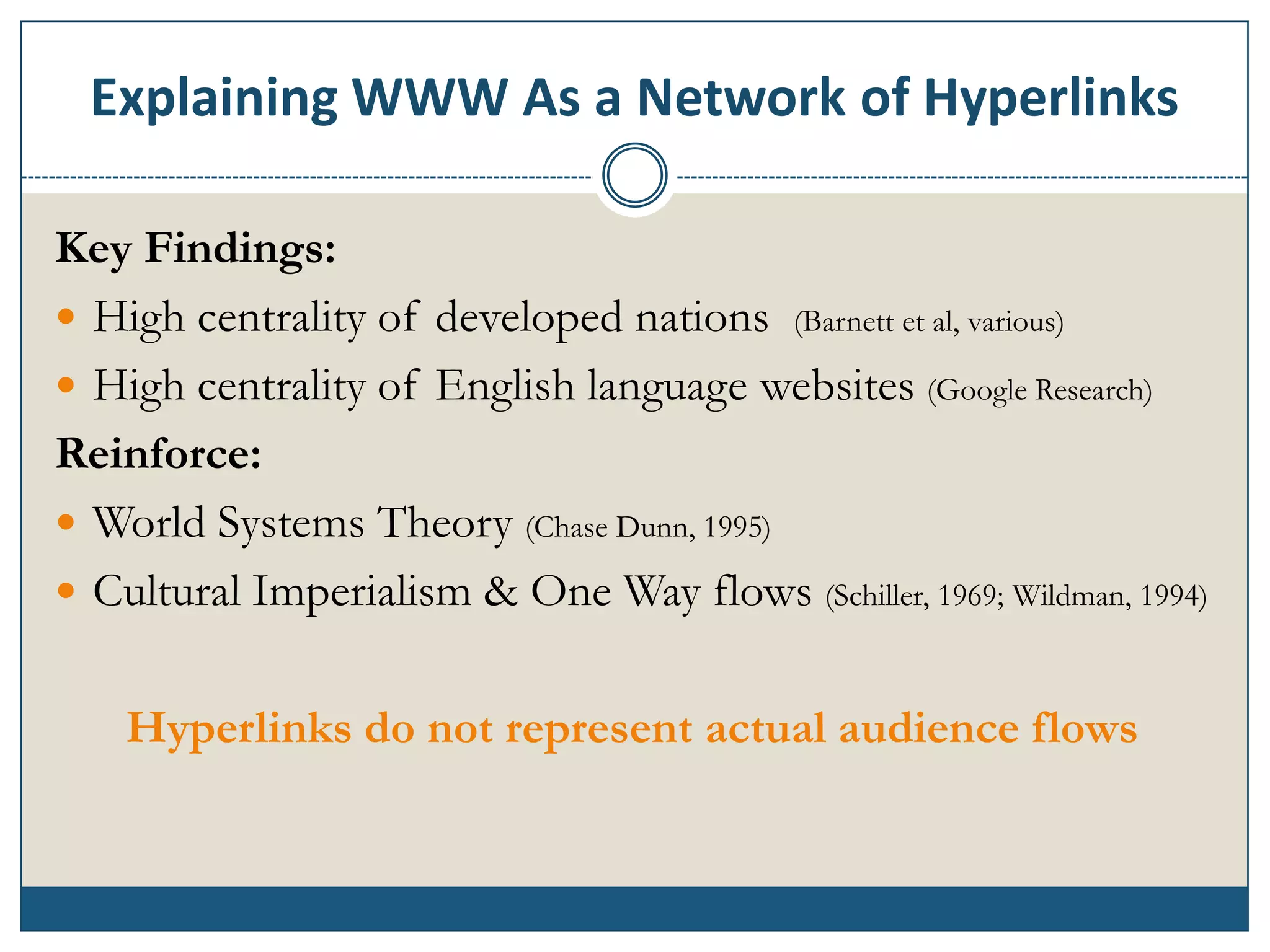
Explaining WWW As a Network of Hyperlinks

Key Findings:
 High centrality of developed nations (Barnett et al, various)
 High centrality of English language websites (Google Research)
Reinforce:
 World Systems Theory (Chase Dunn, 1995)
 Cultural Imperialism & One Way flows (Schiller, 1969; Wildman, 1994)


    Hyperlinks do not represent actual audience flows
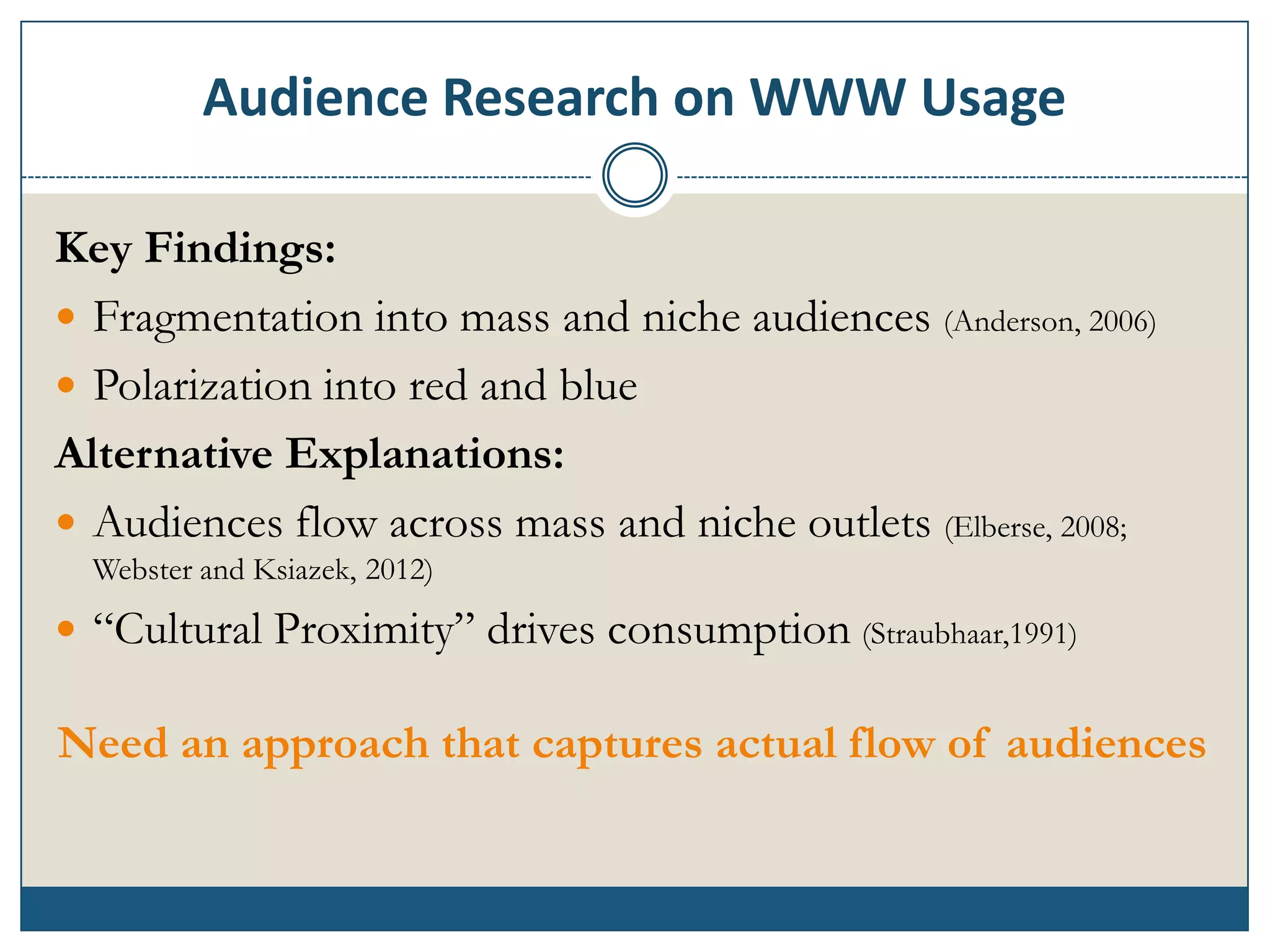
Audience Research on WWW Usage

Key Findings:
 Fragmentation into mass and niche audiences (Anderson, 2006)
 Polarization into red and blue
Alternative Explanations:
 Audiences flow across mass and niche outlets (Elberse, 2008;
  Webster and Ksiazek, 2012)

 “Cultural Proximity” drives consumption (Straubhaar,1991)

Need an approach that captures actual flow of audiences
Aim : To Describe Global WWW Audience Flow

 The World Wide Web (WWW) – Structure and Usage
 Patterns

 A Network Analytic Approach to Audience Flow on WWW


 Empirical Test
WWW Audience Flow in Network Analytic Terms

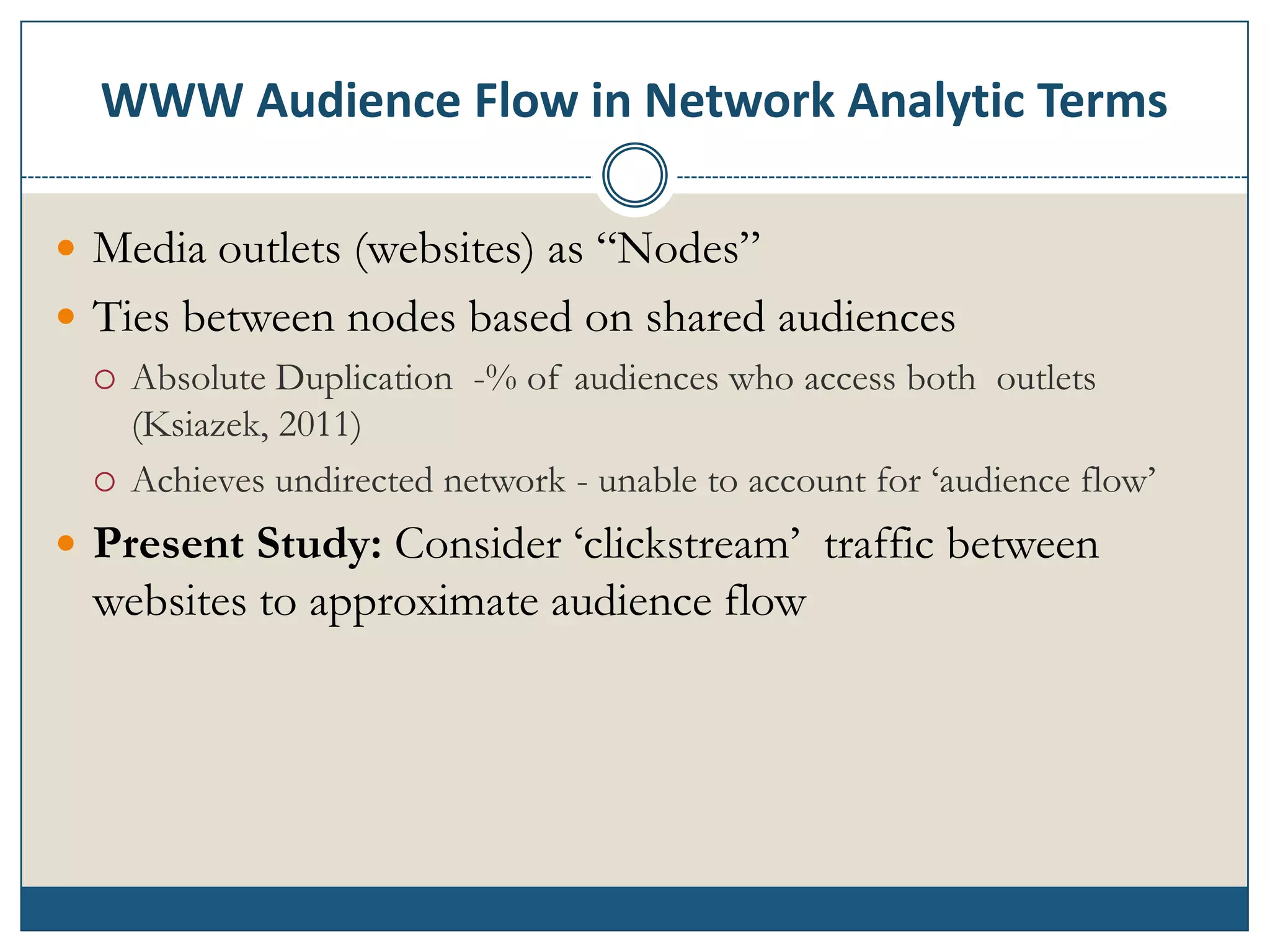
 Media outlets (websites) as “Nodes”
 Ties between nodes based on shared audiences
   Absolute Duplication -% of audiences who access both outlets
    (Ksiazek, 2011)
   Achieves undirected network - unable to account for „audience flow‟

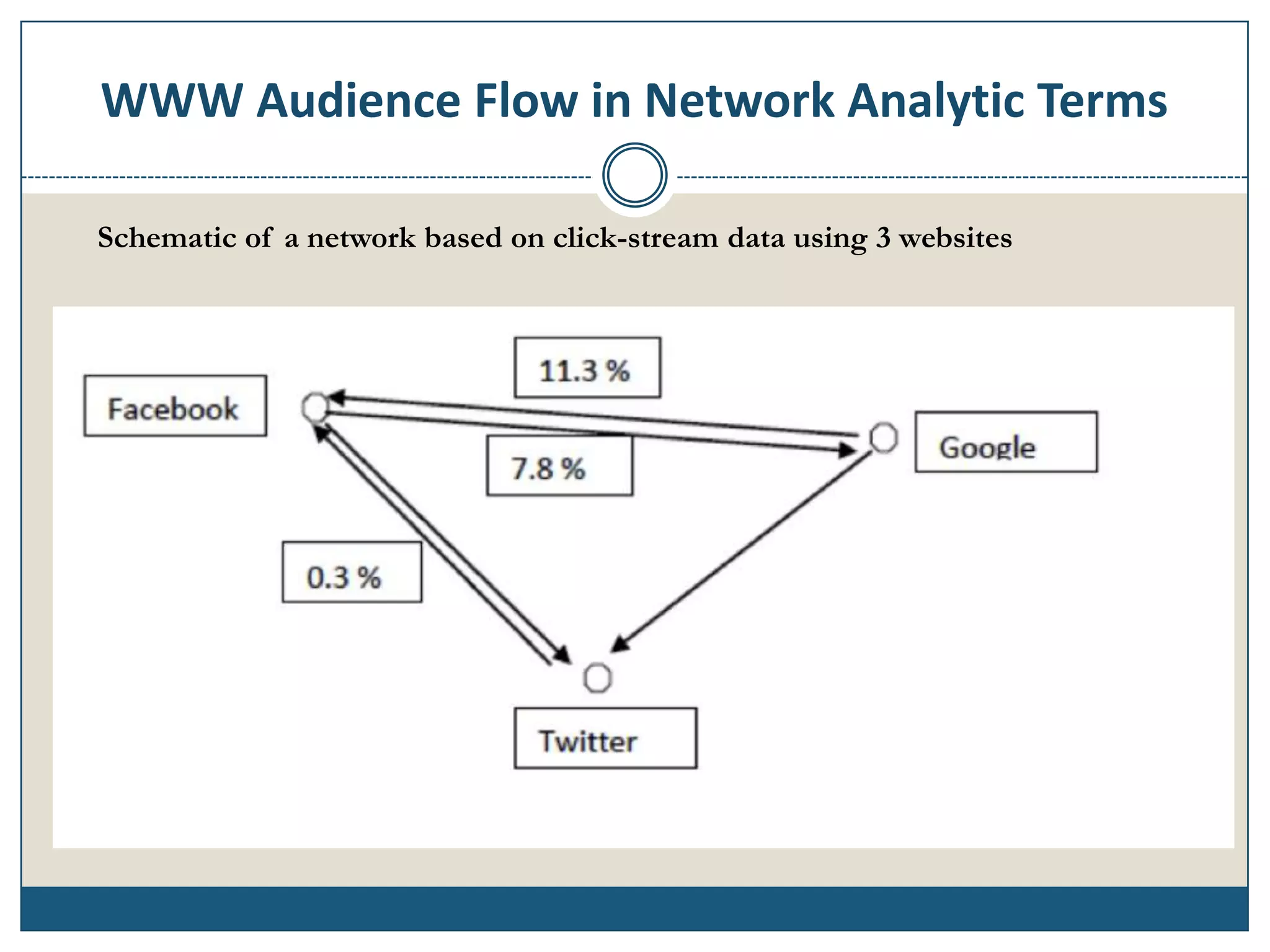
 Present Study: Consider „clickstream‟ traffic between
  websites to approximate audience flow
WWW Audience Flow in Network Analytic Terms

Schematic of a network based on click-stream data using 3 websites
Aim : To Describe Global WWW Audience Flow

 The World Wide Web (WWW) – Structure and Usage
 Patterns

 A Network Analytic Approach to Audience Flow on WWW


 Empirical Test
Data and Method

 Selected top 113 websites based on monthly unique users
  from comScore Media Metrix, December 2010
 Constructed a network using “incoming clickstream
  traffic” between each pair of websites
 Descriptive network analysis
    Used average clickstream traffic as cut off to define presence or
     absence of ties*
 Cluster analysis to segment nodes based on network
 positions
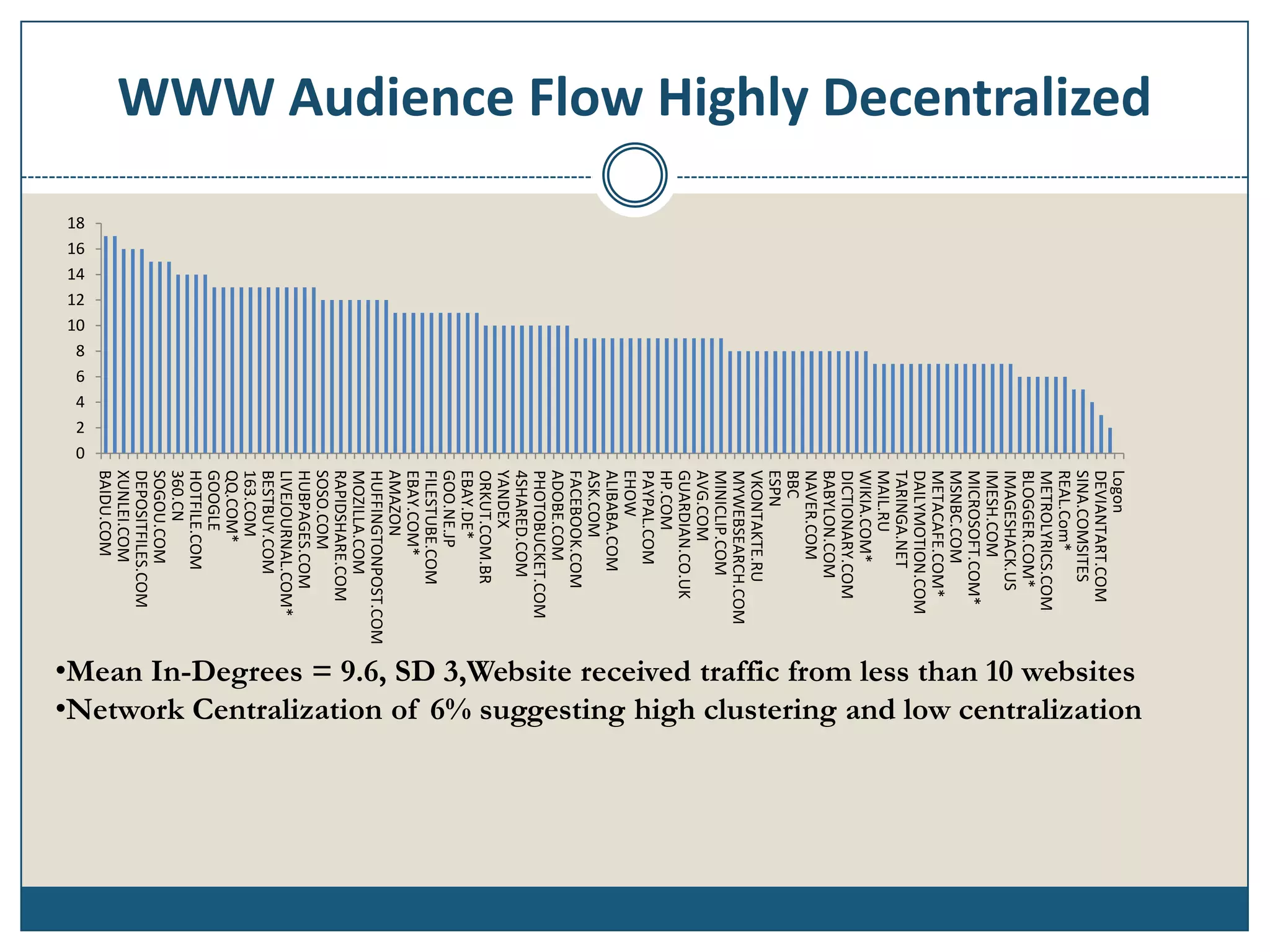
WWW Audience Flow Highly Decentralized


                                                                   •Network Centralization of 6% suggesting high clustering and low centralization
                                                                   •Mean In-Degrees = 9.6, SD 3,Website received traffic from less than 10 websites


                                              Logon
                                              DEVIANTART.COM
                                              SINA.COMSITES
                                              REAL.Com*
                                              METROLYRICS.COM
                                              BLOGGER.COM*
                                              IMAGESHACK.US
                                              IMESH.COM
                                              MICROSOFT.COM*
                                              MSNBC.COM
                                              METACAFE.COM*
                                              DAILYMOTION.COM
                                              TARINGA.NET
                                              MAIL.RU
                                              WIKIA.COM*
                                              DICTIONARY.COM
                                              BABYLON.COM
                                              NAVER.COM
                                              BBC
                                              ESPN
                                              VKONTAKTE.RU
                                              MYWEBSEARCH.COM
                                              MINICLIP.COM
                                              AVG.COM
                                              GUARDIAN.CO.UK
                                              HP.COM
                                              PAYPAL.COM
                                              EHOW
                                              ALIBABA.COM
                                              ASK.COM
                                              FACEBOOK.COM
                                              ADOBE.COM
                                              PHOTOBUCKET.COM
                                              4SHARED.COM
                                              YANDEX
                                              ORKUT.COM.BR
                                              EBAY.DE*
                                              GOO.NE.JP
                                              FILESTUBE.COM
                                              EBAY.COM*
                                              AMAZON
                                              HUFFINGTONPOST.COM
                                              MOZILLA.COM
                                              RAPIDSHARE.COM
                                              SOSO.COM
                                              HUBPAGES.COM
                                              LIVEJOURNAL.COM*
                                              BESTBUY.COM
                                              163.COM
                                              QQ.COM*
                                              GOOGLE
                                              HOTFILE.COM
                                              360.CN
                                              SOGOU.COM
                                              DEPOSITFILES.COM
                                              XUNLEI.COM
                                              BAIDU.COM


                                         18
                                         16
                                         14
                                         12
                                         10
                                          8
                                          6
                                          4
                                          2
                                          0
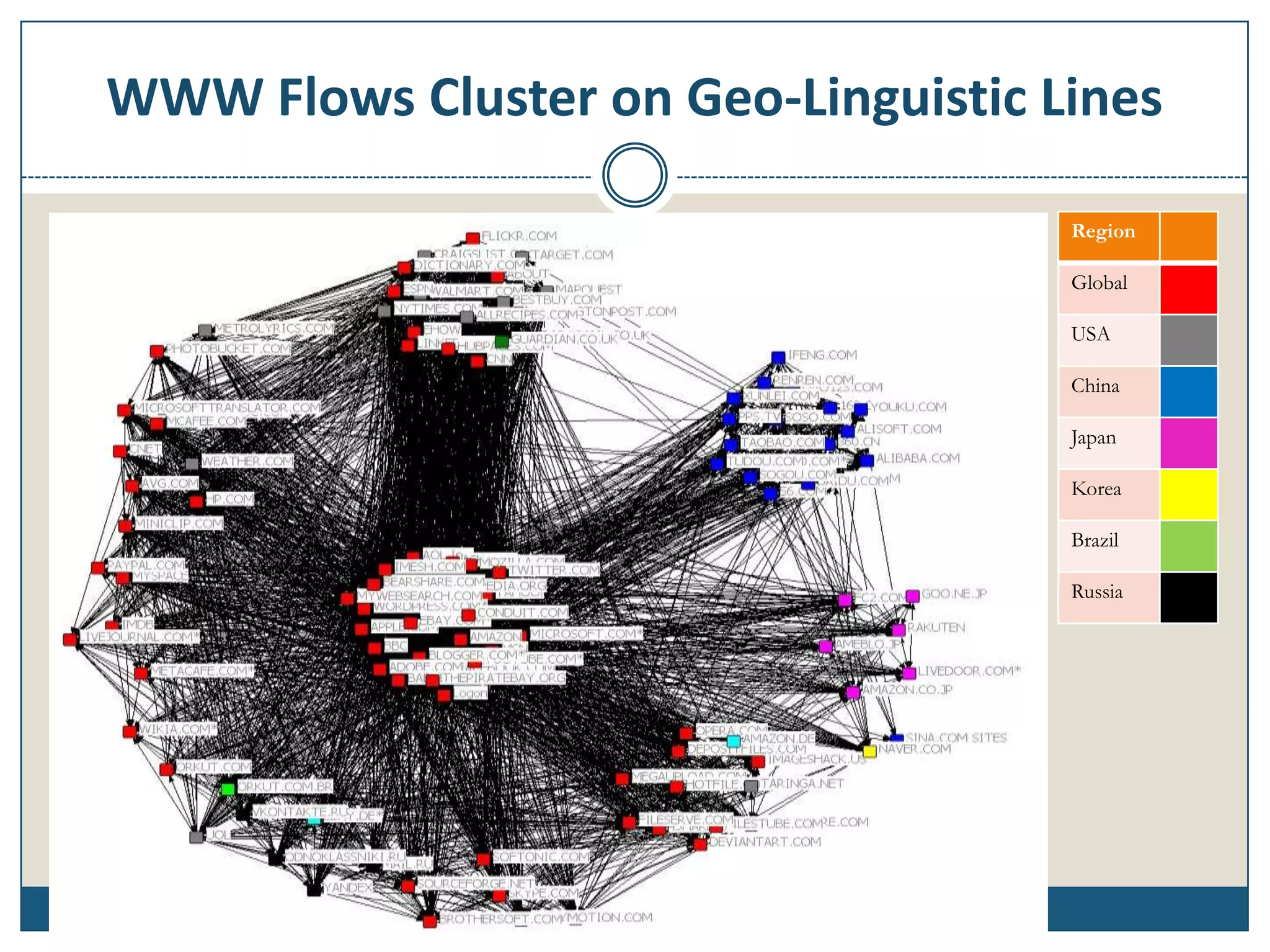
WWW Flows Cluster on Geo-Linguistic Lines

                                     Region

                                     Global

                                     USA

                                     China

                                     Japan

                                     Korea

                                     Brazil

                                     Russia
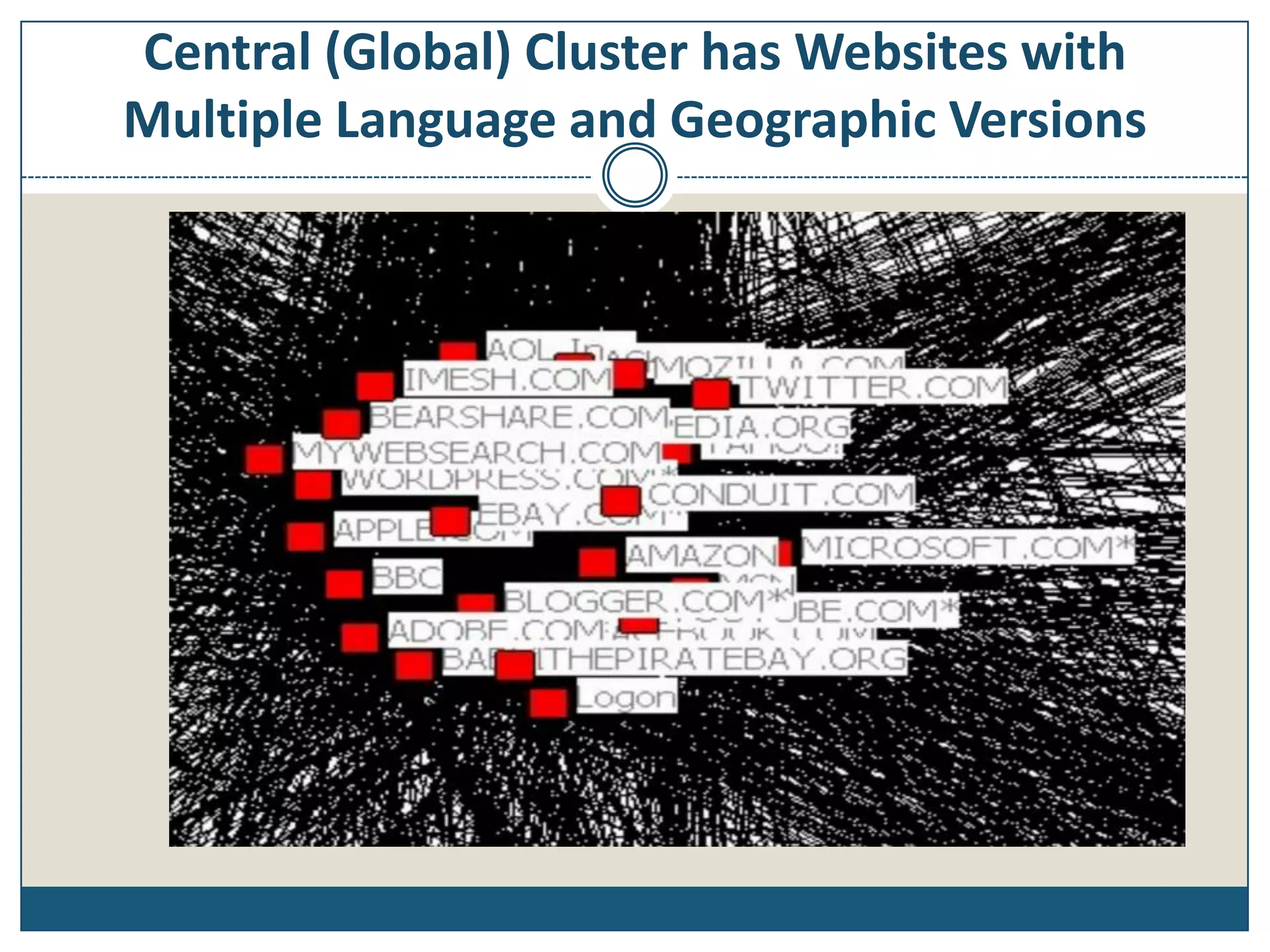
Central (Global) Cluster has Websites with
Multiple Language and Geographic Versions
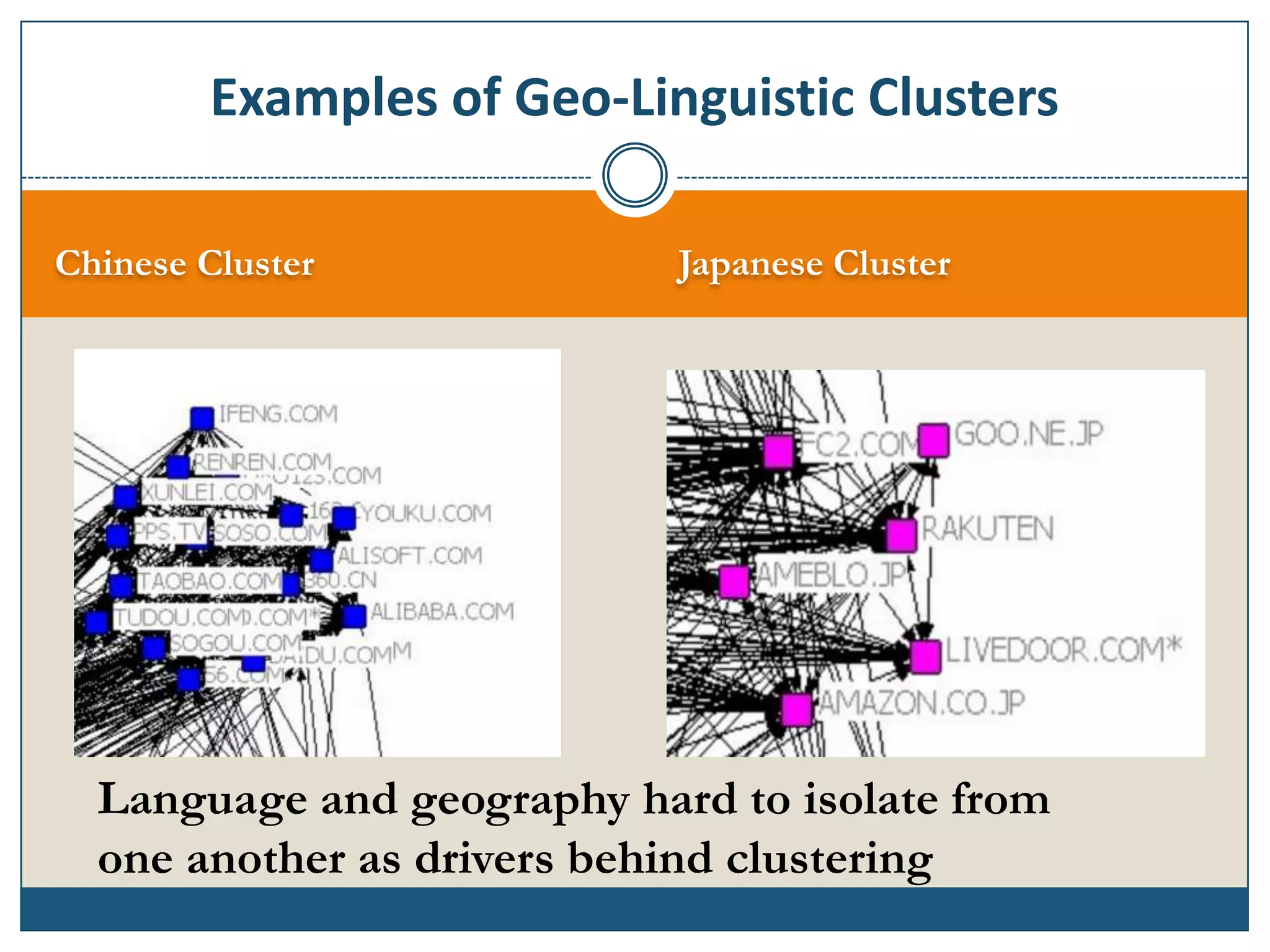
Examples of Geo-Linguistic Clusters

Chinese Cluster             Japanese Cluster


  Language and geography hard to isolate from
  one another as drivers behind clustering
Conclusions

 Cultural factors such as language and geography seem more
  powerful than hyperlinks in describing global WWW
  audience flow
 More evidence of culturally proximate consumption than
  evidence of cultural imperialism or one way flows
     Little evidence of centrality of English language or core countries
 Inclusion of larger samples of websites shall help
  disentangle roles of geography and language
Questions and Comments
       Welcome

E M A I L : H A R S H T @ U. N O R T H W E S T E R N . E D U
                TWITTER: @HARSHT
     H T T P : / / H A R S H T. W O R D P R E S S . C O M

Describing audience flow on the internet

  • 1.
    Describing Audience Flowon the Internet Using A Network Analytic Approach H A R S H TA N E J A P H D C A N D I DA T E , MEDIA, TECHNOLOGY AND SOCIETY N O R T H W E S T E R N U N I V E R S I T Y, P R E S E N TA T I O N I N PA N E L : “ H O W F R A G M E N T E D A R E W E ? PA T T E R N S O F MEDIA USE AROUND THE GLOBE” ICA 2012, PHOENIX
  • 2.
    Aim : ToDescribe Global WWW Audience Flow  The World Wide Web (WWW) – Structure and Usage Patterns  A Network Analytic Approach to Audience Flow on WWW  Empirical Test
  • 3.
    Explaining WWW Asa Network of Hyperlinks Key Findings:  High centrality of developed nations (Barnett et al, various)  High centrality of English language websites (Google Research) Reinforce:  World Systems Theory (Chase Dunn, 1995)  Cultural Imperialism & One Way flows (Schiller, 1969; Wildman, 1994) Hyperlinks do not represent actual audience flows
  • 4.
    Audience Research onWWW Usage Key Findings:  Fragmentation into mass and niche audiences (Anderson, 2006)  Polarization into red and blue Alternative Explanations:  Audiences flow across mass and niche outlets (Elberse, 2008; Webster and Ksiazek, 2012)  “Cultural Proximity” drives consumption (Straubhaar,1991) Need an approach that captures actual flow of audiences
  • 5.
    Aim : ToDescribe Global WWW Audience Flow  The World Wide Web (WWW) – Structure and Usage Patterns  A Network Analytic Approach to Audience Flow on WWW  Empirical Test
  • 6.
    WWW Audience Flowin Network Analytic Terms  Media outlets (websites) as “Nodes”  Ties between nodes based on shared audiences  Absolute Duplication -% of audiences who access both outlets (Ksiazek, 2011)  Achieves undirected network - unable to account for „audience flow‟  Present Study: Consider „clickstream‟ traffic between websites to approximate audience flow
  • 7.
    WWW Audience Flowin Network Analytic Terms Schematic of a network based on click-stream data using 3 websites
  • 8.
    Aim : ToDescribe Global WWW Audience Flow  The World Wide Web (WWW) – Structure and Usage Patterns  A Network Analytic Approach to Audience Flow on WWW  Empirical Test
  • 9.
    Data and Method Selected top 113 websites based on monthly unique users from comScore Media Metrix, December 2010  Constructed a network using “incoming clickstream traffic” between each pair of websites  Descriptive network analysis  Used average clickstream traffic as cut off to define presence or absence of ties*  Cluster analysis to segment nodes based on network positions
  • 10.
    WWW Audience FlowHighly Decentralized •Network Centralization of 6% suggesting high clustering and low centralization •Mean In-Degrees = 9.6, SD 3,Website received traffic from less than 10 websites Logon DEVIANTART.COM SINA.COMSITES REAL.Com* METROLYRICS.COM BLOGGER.COM* IMAGESHACK.US IMESH.COM MICROSOFT.COM* MSNBC.COM METACAFE.COM* DAILYMOTION.COM TARINGA.NET MAIL.RU WIKIA.COM* DICTIONARY.COM BABYLON.COM NAVER.COM BBC ESPN VKONTAKTE.RU MYWEBSEARCH.COM MINICLIP.COM AVG.COM GUARDIAN.CO.UK HP.COM PAYPAL.COM EHOW ALIBABA.COM ASK.COM FACEBOOK.COM ADOBE.COM PHOTOBUCKET.COM 4SHARED.COM YANDEX ORKUT.COM.BR EBAY.DE* GOO.NE.JP FILESTUBE.COM EBAY.COM* AMAZON HUFFINGTONPOST.COM MOZILLA.COM RAPIDSHARE.COM SOSO.COM HUBPAGES.COM LIVEJOURNAL.COM* BESTBUY.COM 163.COM QQ.COM* GOOGLE HOTFILE.COM 360.CN SOGOU.COM DEPOSITFILES.COM XUNLEI.COM BAIDU.COM 18 16 14 12 10 8 6 4 2 0
  • 11.
    WWW Flows Clusteron Geo-Linguistic Lines Region Global USA China Japan Korea Brazil Russia
  • 12.
    Central (Global) Clusterhas Websites with Multiple Language and Geographic Versions
  • 13.
    Examples of Geo-LinguisticClusters Chinese Cluster Japanese Cluster Language and geography hard to isolate from one another as drivers behind clustering
  • 14.
    Conclusions  Cultural factorssuch as language and geography seem more powerful than hyperlinks in describing global WWW audience flow  More evidence of culturally proximate consumption than evidence of cultural imperialism or one way flows  Little evidence of centrality of English language or core countries  Inclusion of larger samples of websites shall help disentangle roles of geography and language
  • 15.
    Questions and Comments Welcome E M A I L : H A R S H T @ U. N O R T H W E S T E R N . E D U TWITTER: @HARSHT H T T P : / / H A R S H T. W O R D P R E S S . C O M

Editor's Notes

  • #10 This analysis required us to define ties between outlets as either absent or present. However since at random most websites are likely to send traffic to most other websites, we needed to force a tie to be absent or present. Therefore for a website we used the average of such incoming traffic that it received from all other sites in the network as the cut-off.