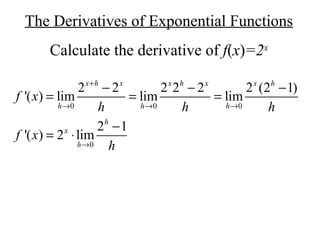
The Derivatives of Exponential Functions Calculate the derivative of  f ( x ) =2 x
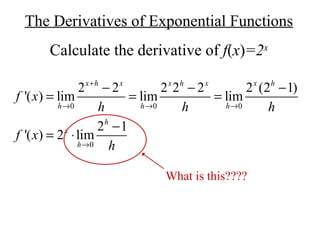
The Derivatives of Exponential Functions Calculate the derivative of  f ( x ) =2 x What is this????
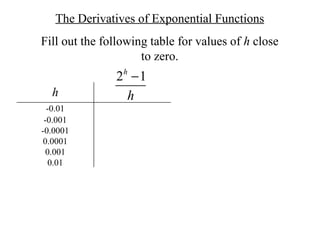
The Derivatives of Exponential Functions Fill out the following table for values of  h  close to zero. 0.01 0.001 0.0001 -0.0001 -0.001 -0.01 h
The Derivatives of Exponential Functions Fill out the following table for values of h close to zero. .69556 0.01 .69339 0.001 .69317 0.0001 .69312 -0.0001 .69291 -0.001 .69075 -0.01 h
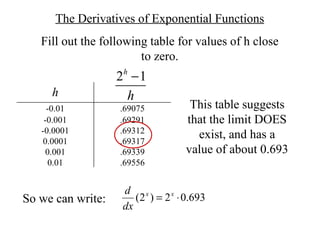
The Derivatives of Exponential Functions Fill out the following table for values of h close to zero. This table suggests that the limit DOES exist, and has a value of about 0.693 .69556 0.01 .69339 0.001 .69317 0.0001 .69312 -0.0001 .69291 -0.001 .69075 -0.01 h
The Derivatives of Exponential Functions Fill out the following table for values of h close to zero. This table suggests that the limit DOES exist, and has a value of about 0.693 So we can write: .69556 0.01 .69339 0.001 .69317 0.0001 .69312 -0.0001 .69291 -0.001 .69075 -0.01 h
So the derivative of  2 x   is proportional to  2 x   with a constant of proportionality 0.693. Hmmmm…
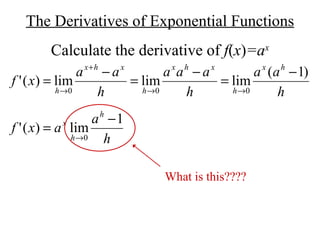
The Derivatives of Exponential Functions Calculate the derivative of  f ( x ) =a x
The Derivatives of Exponential Functions Calculate the derivative of  f ( x ) =a x What is this????
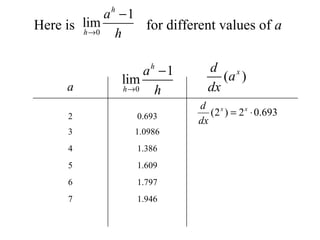
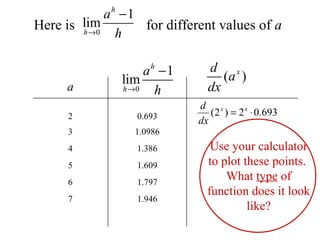
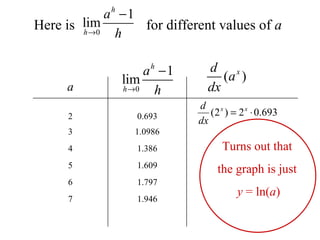
Here is  for different values of  a 1.946 1.797 1.609 1.386 1.0986 0.693 7 6 5 4 3 2 a
Here is  for different values of  a 1.946 1.797 1.609 1.386 1.0986 0.693 7 6 5 4 3 2 a Use your calculator to plot these points.  What  type  of function does it look like?
Here is  for different values of  a 1.946 1.797 1.609 1.386 1.0986 0.693 7 6 5 4 3 2 a Turns out that  the graph is just  y  = ln( a )
Here is  for different values of  a ln(7) = 1.946 ln(6) = 1.797 ln(5) = 1.609 ln(4) = 1.386 ln(3) = 1.0986 ln(2) = 0.693 7 6 5 4 3 2 a

Derive Exponential Derivative Rule

  • 1.
    The Derivatives ofExponential Functions Calculate the derivative of f ( x ) =2 x
  • 2.
    The Derivatives ofExponential Functions Calculate the derivative of f ( x ) =2 x What is this????
  • 3.
    The Derivatives ofExponential Functions Fill out the following table for values of h close to zero. 0.01 0.001 0.0001 -0.0001 -0.001 -0.01 h
  • 4.
    The Derivatives ofExponential Functions Fill out the following table for values of h close to zero. .69556 0.01 .69339 0.001 .69317 0.0001 .69312 -0.0001 .69291 -0.001 .69075 -0.01 h
  • 5.
    The Derivatives ofExponential Functions Fill out the following table for values of h close to zero. This table suggests that the limit DOES exist, and has a value of about 0.693 .69556 0.01 .69339 0.001 .69317 0.0001 .69312 -0.0001 .69291 -0.001 .69075 -0.01 h
  • 6.
    The Derivatives ofExponential Functions Fill out the following table for values of h close to zero. This table suggests that the limit DOES exist, and has a value of about 0.693 So we can write: .69556 0.01 .69339 0.001 .69317 0.0001 .69312 -0.0001 .69291 -0.001 .69075 -0.01 h
  • 7.
    So the derivativeof 2 x is proportional to 2 x with a constant of proportionality 0.693. Hmmmm…
  • 8.
    The Derivatives ofExponential Functions Calculate the derivative of f ( x ) =a x
  • 9.
    The Derivatives ofExponential Functions Calculate the derivative of f ( x ) =a x What is this????
  • 10.
    Here is for different values of a 1.946 1.797 1.609 1.386 1.0986 0.693 7 6 5 4 3 2 a
  • 11.
    Here is for different values of a 1.946 1.797 1.609 1.386 1.0986 0.693 7 6 5 4 3 2 a Use your calculator to plot these points. What type of function does it look like?
  • 12.
    Here is for different values of a 1.946 1.797 1.609 1.386 1.0986 0.693 7 6 5 4 3 2 a Turns out that the graph is just y = ln( a )
  • 13.
    Here is for different values of a ln(7) = 1.946 ln(6) = 1.797 ln(5) = 1.609 ln(4) = 1.386 ln(3) = 1.0986 ln(2) = 0.693 7 6 5 4 3 2 a