Depression, Suicide
 Chapter 15
   15.1 pages 527 to 562
Mood Disorders: Depression

 Mood is a pervasive and sustained feeling
  that is experienced internally and that
  influences a person's behavior and perception
  the world.
Depression

 Mood can be:
   normal,normal,
   elevated,elevated,
   or depressed.or depressed.
   Healthy persons experience a wide range
    of moods and have an equally large repertoire of
    affective expressions; they feel in control of their
    moods and affects.
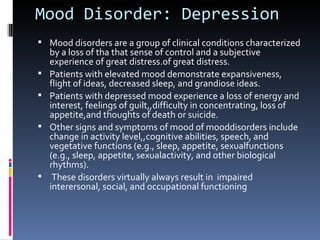
Mood Disorder: Depression
 Mood disorders are a group of clinical conditions characterized
    by a loss of tha that sense of control and a subjective
    experience of great distress.of great distress.
   Patients with elevated mood demonstrate expansiveness,
    flight of ideas, decreased sleep, and grandiose ideas.
   Patients with depressed mood experience a loss of energy and
    interest, feelings of guilt,,difficulty in concentrating, loss of
    appetite,and thoughts of death or suicide.
   Other signs and symptoms of mood of mooddisorders include
    change in activity level,,cognitive abilities, speech, and
    vegetative functions (e.g., sleep, appetite, sexualfunctions
    (e.g., sleep, appetite, sexualactivity, and other biological
    rhythms).
    These disorders virtually always result in impaired
    interersonal, social, and occupational functioning
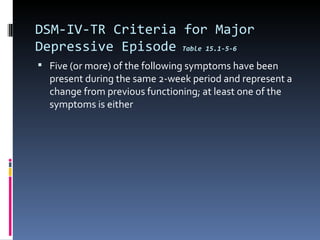
DSM-IV-TR Criteria for Major
Depressive Episode Table 15.1-5-6
 Five (or more) of the following symptoms have been
  present during the same 2-week period and represent a
  change from previous functioning; at least one of the
  symptoms is either
DSM-IV-TR Criteria for Major
Depressive Episode
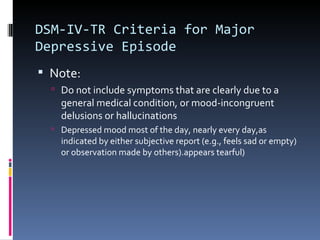
 Note:
   Do not include symptoms that are clearly due to a
    general medical condition, or mood-incongruent
    delusions or hallucinations
   Depressed mood most of the day, nearly every day,as
    indicated by either subjective report (e.g., feels sad or empty)
    or observation made by others).appears tearful)
DSM-IV-TR Criteria for Major
Depressive Episode
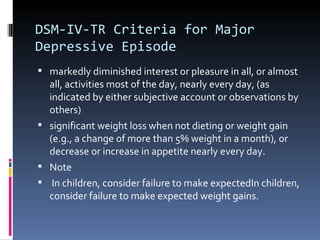
 markedly diminished interest or pleasure in all, or almost
  all, activities most of the day, nearly every day, (as
  indicated by either subjective account or observations by
  others)
 significant weight loss when not dieting or weight gain
  (e.g., a change of more than 5% weight in a month), or
  decrease or increase in appetite nearly every day.
 Note
 In children, consider failure to make expectedIn children,
  consider failure to make expected weight gains.
DSM-IV-TR Criteria for Major
Depressive Episode
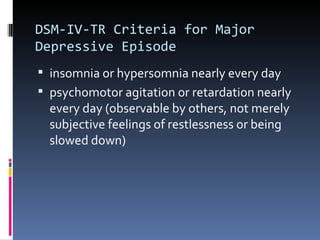
 insomnia or hypersomnia nearly every day
 psychomotor agitation or retardation nearly
  every day (observable by others, not merely
  subjective feelings of restlessness or being
  slowed down)
DSM-IV-TR Criteria for Major
Depressive Episode

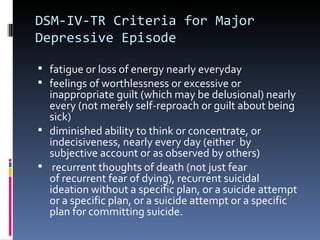
 fatigue or loss of energy nearly everyday
 feelings of worthlessness or excessive or
  inappropriate guilt (which may be delusional) nearly
  every (not merely self-reproach or guilt about being
  sick)
 diminished ability to think or concentrate, or
  indecisiveness, nearly every day (either by
  subjective account or as observed by others)
 recurrent thoughts of death (not just fear
  of recurrent fear of dying), recurrent suicidal
  ideation without a specific plan, or a suicide attempt
  or a specific plan, or a suicide attempt or a specific
  plan for committing suicide.
Treatment

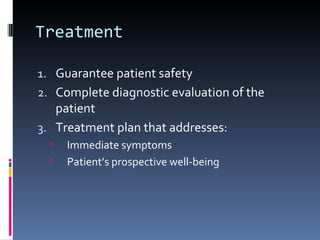
1. Guarantee patient safety
2. Complete diagnostic evaluation of the
   patient
3. Treatment plan that addresses:
     Immediate symptoms
     Patient’s prospective well-being
Pharmacotherapy

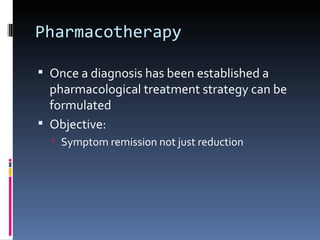
 Once a diagnosis has been established a
  pharmacological treatment strategy can be
  formulated
 Objective:
   Symptom remission not just reduction
Pharmacotherapy

 Major depressive disorder
 Most antidepressants have a lag period of 10 days to
  approximately 4 weeks before a therapeutic response is
  noted
 Increasing dose will not shorten this period, it will
  increase the incidence of adverse reactions
Pharmacotherapy

 Antidepressants
   3 main classes
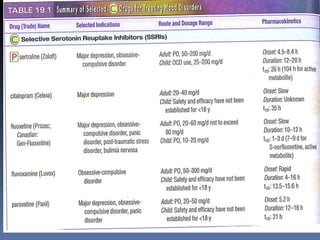
     Selective serotonin reuptake inhibitors (SSRIs)
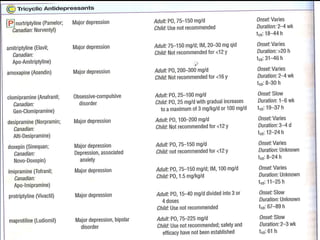
     Tricyclic Antidepressants ( Tas)
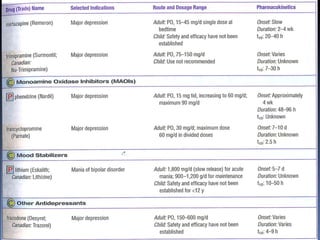
     Mono amine oxidase Inhibitors (MAOIs)
   All three classes work differently but all change
    brain chemistry to improve neurotransmission.
Pharmacotherapy

 Therapeutic response
   Not all patients respond the same way to a medication
   IF a patient fails to respond appropriately to an
    antidepressant, he or she may respond positively to
    another antidepressant, including another drug of the
    same pharmacologic class
   Similar positive responses to drug therapy can be
    obtained by augmenting the original drug with a drug
    of a different class.
SSRIs

 SSRIs are the first choice in treating depression
    They are preferred over TAs and MAOIs
      Less damaging to the heart
      Minimal anticholinergic effects
      Minimal hypotensive effects
    Fluoxetin (Prozac) 1987, became the first SSRI approved by the
     FDA for use as antidepressant.
    Currently sertraline (Zoloft) is one of the most widely used
     antidepressants in the United States.

    Readings- Chapter 36.29 pg 1083-1090
    See tables 36.29-1 and 36.29-2
SSRIs

  Pharmacokinetics
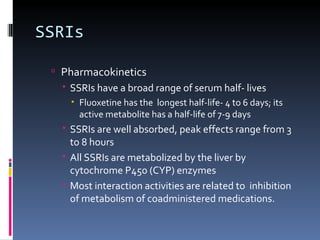
    SSRIs have a broad range of serum half- lives
      Fluoxetine has the longest half-life- 4 to 6 days; its
       active metabolite has a half-life of 7-9 days
    SSRIs are well absorbed, peak effects range from 3
     to 8 hours
    All SSRIs are metabolized by the liver by
     cytochrome P450 (CYP) enzymes
    Most interaction activities are related to inhibition
     of metabolism of coadministered medications.
Pharmacodynamics

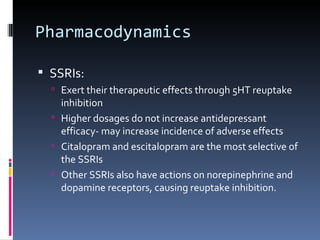
 SSRIs:
   Exert their therapeutic effects through 5HT reuptake
    inhibition
   Higher dosages do not increase antidepressant
    efficacy- may increase incidence of adverse effects
   Citalopram and escitalopram are the most selective of
    the SSRIs
   Other SSRIs also have actions on norepinephrine and
    dopamine receptors, causing reuptake inhibition.
Therapeutic Indication

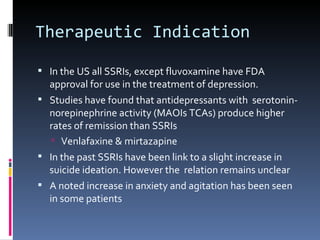
 In the US all SSRIs, except fluvoxamine have FDA
  approval for use in the treatment of depression.
 Studies have found that antidepressants with serotonin-
  norepinephrine activity (MAOIs TCAs) produce higher
  rates of remission than SSRIs
    Venlafaxine & mirtazapine
 In the past SSRIs have been link to a slight increase in
  suicide ideation. However the relation remains unclear
 A noted increase in anxiety and agitation has been seen
  in some patients
Pregnancy and Postpartum
Depression
 Postpartum depression affects a small percentage of
  mothers
 68 to 100 percent relapse in pregnant patients that
  discontinue therapy
 Evidence suggests increased rates of special care nursery
  admission after delivery for children of mothers on SSRIs
 SSRIs are secreted in breast milk; however [plasma]
  levels are usually very low in mothers that are breast
  feeding.
Depression in the Elderly

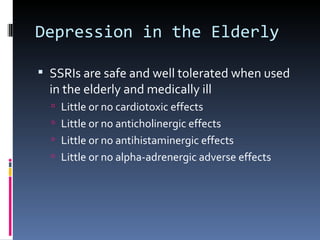
 SSRIs are safe and well tolerated when used
  in the elderly and medically ill
   Little or no cardiotoxic effects
   Little or no anticholinergic effects
   Little or no antihistaminergic effects
   Little or no alpha-adrenergic adverse effects
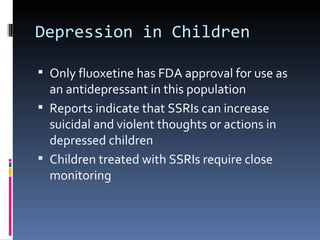
Depression in Children

 Only fluoxetine has FDA approval for use as
  an antidepressant in this population
 Reports indicate that SSRIs can increase
  suicidal and violent thoughts or actions in
  depressed children
 Children treated with SSRIs require close
  monitoring
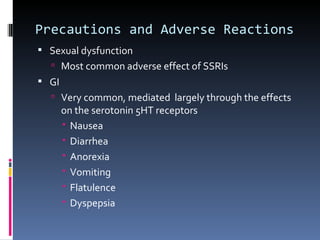
Precautions and Adverse Reactions
 Sexual dysfunction
   Most common adverse effect of SSRIs
 GI
   Very common, mediated largely through the effects
       on the serotonin 5HT receptors
        Nausea
        Diarrhea
        Anorexia
        Vomiting
        Flatulence
        Dyspepsia
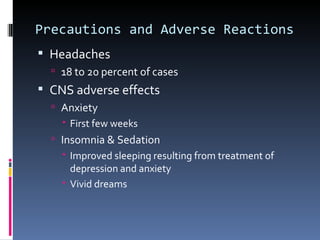
Precautions and Adverse Reactions
 Headaches
   18 to 20 percent of cases
 CNS adverse effects
   Anxiety
     First few weeks
   Insomnia & Sedation
     Improved sleeping resulting from treatment of
      depression and anxiety
     Vivid dreams
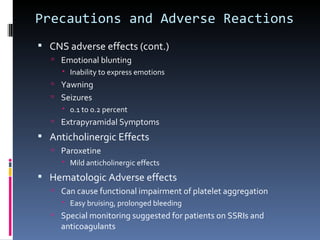
Precautions and Adverse Reactions
 CNS adverse effects (cont.)
    Emotional blunting
      Inability to express emotions
    Yawning
    Seizures
      0.1 to 0.2 percent
    Extrapyramidal Symptoms
 Anticholinergic Effects
    Paroxetine
      Mild anticholinergic effects
 Hematologic Adverse effects
    Can cause functional impairment of platelet aggregation
      Easy bruising, prolonged bleeding
    Special monitoring suggested for patients on SSRIs and
     anticoagulants
Precautions and Adverse Reactions

 Electrolyte and Glucose Disturbances
   SSRIs may decrease [glucose]
     Careful monitoring for diabetic patients suggested
 Endocrine and Allergic Reactions
   SSRIs can decrease prolactin levels
     Mammoplasia and galactorrhea in both men and
      women
     Various types of rashes- 4% of patients
 Serotonin syndrome
   Concurrent administration of an SSRI with MAOI, L-
    Tryptophan or lithium can raise plasma [serotonin]
    to toxic levels
Precautions and Adverse Reactions
 Sweating
   Experienced by some patients while on SSRIs
 SSRI withdrawal
   May exhibit withdrawal symptoms upon sudden
    discontinuation

   Drug interactions see table 36.29-3
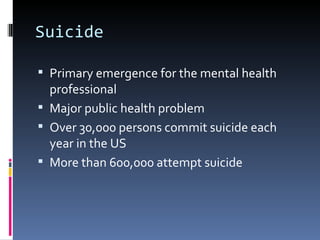
Suicide

 Primary emergence for the mental health
  professional
 Major public health problem
 Over 30,000 persons commit suicide each
  year in the US
 More than 600,000 attempt suicide
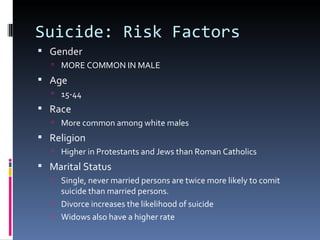
Suicide: Risk Factors
 Gender
   MORE COMMON IN MALE
 Age
   15-44
 Race
   More common among white males
 Religion
   Higher in Protestants and Jews than Roman Catholics
 Marital Status
   Single, never married persons are twice more likely to comit
    suicide than married persons.
   Divorce increases the likelihood of suicide
   Widows also have a higher rate
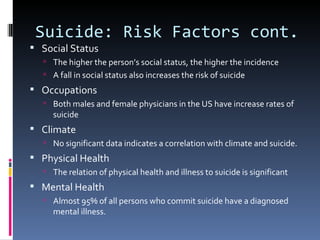
Suicide: Risk Factors cont.
 Social Status
   The higher the person’s social status, the higher the incidence
   A fall in social status also increases the risk of suicide
 Occupations
   Both males and female physicians in the US have increase rates of
     suicide
 Climate
   No significant data indicates a correlation with climate and suicide.
 Physical Health
   The relation of physical health and illness to suicide is significant
 Mental Health
   Almost 95% of all persons who commit suicide have a diagnosed
     mental illness.
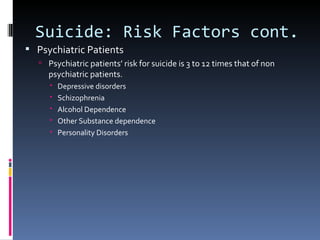
Suicide: Risk Factors cont.
 Psychiatric Patients
    Psychiatric patients’ risk for suicide is 3 to 12 times that of non
     psychiatric patients.
         Depressive disorders
         Schizophrenia
         Alcohol Dependence
         Other Substance dependence
         Personality Disorders
Suicide: Treatment
 Decision to hospitalize a patient with suicidal ideation
  depends on:
    Severity of depression
    Severity of suicidal ideation
    Patient’s family’s coping ability
    Patient’s living situation
    Availability of social support
    Absence or presence of risk factors for suicide
Suicide: Pharmacotherapy
 Patients hospitalized can receive medication for underlying
  diagnoses, leading to suicide ideations or attempts:
    Antidepressants
    Antipsychotics
    When patients present signs of both, medications like
     risperidone (Risperdal) that have both antipsychotic and
     antidepressant effects are very useful.
    Vigorous treatment should be initiated depending onunderlying
     disorder.
    Supportive psychotherapy is also indicated.
 ECT may be necessary for severely depressed patients

Depressionsuicide 120223170018-phpapp01

  • 1.
  • 2.
     Chapter 15  15.1 pages 527 to 562
  • 3.
    Mood Disorders: Depression Mood is a pervasive and sustained feeling that is experienced internally and that influences a person's behavior and perception the world.
  • 4.
    Depression  Mood canbe:  normal,normal,  elevated,elevated,  or depressed.or depressed.  Healthy persons experience a wide range of moods and have an equally large repertoire of affective expressions; they feel in control of their moods and affects.
  • 5.
    Mood Disorder: Depression Mood disorders are a group of clinical conditions characterized by a loss of tha that sense of control and a subjective experience of great distress.of great distress.  Patients with elevated mood demonstrate expansiveness, flight of ideas, decreased sleep, and grandiose ideas.  Patients with depressed mood experience a loss of energy and interest, feelings of guilt,,difficulty in concentrating, loss of appetite,and thoughts of death or suicide.  Other signs and symptoms of mood of mooddisorders include change in activity level,,cognitive abilities, speech, and vegetative functions (e.g., sleep, appetite, sexualfunctions (e.g., sleep, appetite, sexualactivity, and other biological rhythms).  These disorders virtually always result in impaired interersonal, social, and occupational functioning
  • 6.
    DSM-IV-TR Criteria forMajor Depressive Episode Table 15.1-5-6  Five (or more) of the following symptoms have been present during the same 2-week period and represent a change from previous functioning; at least one of the symptoms is either
  • 7.
    DSM-IV-TR Criteria forMajor Depressive Episode  Note:  Do not include symptoms that are clearly due to a general medical condition, or mood-incongruent delusions or hallucinations  Depressed mood most of the day, nearly every day,as indicated by either subjective report (e.g., feels sad or empty) or observation made by others).appears tearful)
  • 8.
    DSM-IV-TR Criteria forMajor Depressive Episode  markedly diminished interest or pleasure in all, or almost all, activities most of the day, nearly every day, (as indicated by either subjective account or observations by others)  significant weight loss when not dieting or weight gain (e.g., a change of more than 5% weight in a month), or decrease or increase in appetite nearly every day.  Note  In children, consider failure to make expectedIn children, consider failure to make expected weight gains.
  • 9.
    DSM-IV-TR Criteria forMajor Depressive Episode  insomnia or hypersomnia nearly every day  psychomotor agitation or retardation nearly every day (observable by others, not merely subjective feelings of restlessness or being slowed down)
  • 10.
    DSM-IV-TR Criteria forMajor Depressive Episode  fatigue or loss of energy nearly everyday  feelings of worthlessness or excessive or inappropriate guilt (which may be delusional) nearly every (not merely self-reproach or guilt about being sick)  diminished ability to think or concentrate, or indecisiveness, nearly every day (either by subjective account or as observed by others)  recurrent thoughts of death (not just fear of recurrent fear of dying), recurrent suicidal ideation without a specific plan, or a suicide attempt or a specific plan, or a suicide attempt or a specific plan for committing suicide.
  • 11.
    Treatment 1. Guarantee patientsafety 2. Complete diagnostic evaluation of the patient 3. Treatment plan that addresses:  Immediate symptoms  Patient’s prospective well-being
  • 12.
    Pharmacotherapy  Once adiagnosis has been established a pharmacological treatment strategy can be formulated  Objective:  Symptom remission not just reduction
  • 13.
    Pharmacotherapy  Major depressivedisorder  Most antidepressants have a lag period of 10 days to approximately 4 weeks before a therapeutic response is noted  Increasing dose will not shorten this period, it will increase the incidence of adverse reactions
  • 14.
    Pharmacotherapy  Antidepressants  3 main classes  Selective serotonin reuptake inhibitors (SSRIs)  Tricyclic Antidepressants ( Tas)  Mono amine oxidase Inhibitors (MAOIs)  All three classes work differently but all change brain chemistry to improve neurotransmission.
  • 15.
    Pharmacotherapy  Therapeutic response  Not all patients respond the same way to a medication  IF a patient fails to respond appropriately to an antidepressant, he or she may respond positively to another antidepressant, including another drug of the same pharmacologic class  Similar positive responses to drug therapy can be obtained by augmenting the original drug with a drug of a different class.
  • 16.
    SSRIs  SSRIs arethe first choice in treating depression  They are preferred over TAs and MAOIs  Less damaging to the heart  Minimal anticholinergic effects  Minimal hypotensive effects  Fluoxetin (Prozac) 1987, became the first SSRI approved by the FDA for use as antidepressant.  Currently sertraline (Zoloft) is one of the most widely used antidepressants in the United States.  Readings- Chapter 36.29 pg 1083-1090  See tables 36.29-1 and 36.29-2
  • 17.
    SSRIs  Pharmacokinetics  SSRIs have a broad range of serum half- lives  Fluoxetine has the longest half-life- 4 to 6 days; its active metabolite has a half-life of 7-9 days  SSRIs are well absorbed, peak effects range from 3 to 8 hours  All SSRIs are metabolized by the liver by cytochrome P450 (CYP) enzymes  Most interaction activities are related to inhibition of metabolism of coadministered medications.
  • 18.
    Pharmacodynamics  SSRIs:  Exert their therapeutic effects through 5HT reuptake inhibition  Higher dosages do not increase antidepressant efficacy- may increase incidence of adverse effects  Citalopram and escitalopram are the most selective of the SSRIs  Other SSRIs also have actions on norepinephrine and dopamine receptors, causing reuptake inhibition.
  • 19.
    Therapeutic Indication  Inthe US all SSRIs, except fluvoxamine have FDA approval for use in the treatment of depression.  Studies have found that antidepressants with serotonin- norepinephrine activity (MAOIs TCAs) produce higher rates of remission than SSRIs  Venlafaxine & mirtazapine  In the past SSRIs have been link to a slight increase in suicide ideation. However the relation remains unclear  A noted increase in anxiety and agitation has been seen in some patients
  • 20.
    Pregnancy and Postpartum Depression Postpartum depression affects a small percentage of mothers  68 to 100 percent relapse in pregnant patients that discontinue therapy  Evidence suggests increased rates of special care nursery admission after delivery for children of mothers on SSRIs  SSRIs are secreted in breast milk; however [plasma] levels are usually very low in mothers that are breast feeding.
  • 21.
    Depression in theElderly  SSRIs are safe and well tolerated when used in the elderly and medically ill  Little or no cardiotoxic effects  Little or no anticholinergic effects  Little or no antihistaminergic effects  Little or no alpha-adrenergic adverse effects
  • 22.
    Depression in Children Only fluoxetine has FDA approval for use as an antidepressant in this population  Reports indicate that SSRIs can increase suicidal and violent thoughts or actions in depressed children  Children treated with SSRIs require close monitoring
  • 23.
    Precautions and AdverseReactions  Sexual dysfunction  Most common adverse effect of SSRIs  GI  Very common, mediated largely through the effects on the serotonin 5HT receptors  Nausea  Diarrhea  Anorexia  Vomiting  Flatulence  Dyspepsia
  • 24.
    Precautions and AdverseReactions  Headaches  18 to 20 percent of cases  CNS adverse effects  Anxiety  First few weeks  Insomnia & Sedation  Improved sleeping resulting from treatment of depression and anxiety  Vivid dreams
  • 25.
    Precautions and AdverseReactions  CNS adverse effects (cont.)  Emotional blunting  Inability to express emotions  Yawning  Seizures  0.1 to 0.2 percent  Extrapyramidal Symptoms  Anticholinergic Effects  Paroxetine  Mild anticholinergic effects  Hematologic Adverse effects  Can cause functional impairment of platelet aggregation  Easy bruising, prolonged bleeding  Special monitoring suggested for patients on SSRIs and anticoagulants
  • 26.
    Precautions and AdverseReactions  Electrolyte and Glucose Disturbances  SSRIs may decrease [glucose]  Careful monitoring for diabetic patients suggested  Endocrine and Allergic Reactions  SSRIs can decrease prolactin levels  Mammoplasia and galactorrhea in both men and women  Various types of rashes- 4% of patients  Serotonin syndrome  Concurrent administration of an SSRI with MAOI, L- Tryptophan or lithium can raise plasma [serotonin] to toxic levels
  • 27.
    Precautions and AdverseReactions  Sweating  Experienced by some patients while on SSRIs  SSRI withdrawal  May exhibit withdrawal symptoms upon sudden discontinuation  Drug interactions see table 36.29-3
  • 31.
    Suicide  Primary emergencefor the mental health professional  Major public health problem  Over 30,000 persons commit suicide each year in the US  More than 600,000 attempt suicide
  • 32.
    Suicide: Risk Factors Gender  MORE COMMON IN MALE  Age  15-44  Race  More common among white males  Religion  Higher in Protestants and Jews than Roman Catholics  Marital Status  Single, never married persons are twice more likely to comit suicide than married persons.  Divorce increases the likelihood of suicide  Widows also have a higher rate
  • 33.
    Suicide: Risk Factorscont.  Social Status  The higher the person’s social status, the higher the incidence  A fall in social status also increases the risk of suicide  Occupations  Both males and female physicians in the US have increase rates of suicide  Climate  No significant data indicates a correlation with climate and suicide.  Physical Health  The relation of physical health and illness to suicide is significant  Mental Health  Almost 95% of all persons who commit suicide have a diagnosed mental illness.
  • 34.
    Suicide: Risk Factorscont.  Psychiatric Patients  Psychiatric patients’ risk for suicide is 3 to 12 times that of non psychiatric patients.  Depressive disorders  Schizophrenia  Alcohol Dependence  Other Substance dependence  Personality Disorders
  • 35.
    Suicide: Treatment  Decisionto hospitalize a patient with suicidal ideation depends on:  Severity of depression  Severity of suicidal ideation  Patient’s family’s coping ability  Patient’s living situation  Availability of social support  Absence or presence of risk factors for suicide
  • 36.
    Suicide: Pharmacotherapy  Patientshospitalized can receive medication for underlying diagnoses, leading to suicide ideations or attempts:  Antidepressants  Antipsychotics  When patients present signs of both, medications like risperidone (Risperdal) that have both antipsychotic and antidepressant effects are very useful.  Vigorous treatment should be initiated depending onunderlying disorder.  Supportive psychotherapy is also indicated.  ECT may be necessary for severely depressed patients