
Depreciation Accounting
Definition
Depreciation is a measure of the wearing out, consumption or other
loss of value of a depreciable asset arising from use, effluxion of time or
obsolescence through technology and market changes.
Depreciable Assets
Depreciable assets are assets which
(i) Are expected to be used during more than one accounting
period;
(ii) Have a limited useful life;
(iii) Are held by an enterprise for use in the production or supply of
goods and services (i.e. not for the purpose of sale in ordinary
course of business)
Applicability of the Accounting Standard 6
This accounting standard is applicable to all depreciable
assets except, the following:
(i) Forests, plantations and similar regenerative natural
resources;
(ii) Wasting assets including expenditure on the
exploration for and extraction of minerals, oils, natural gas
and similar non-regenerative resources;
(iii) Expenditure on research and development;
(iv)Goodwill;
(v) Live stock- Cattle, Animal Husbandry
Calculation of depreciation
The amount of depreciation is calculated as under:
(i) Historical cost or other amount substituted for the
historical cost of the depreciable asset when the asset
has been revalued;
(ii) Expected useful life of the depreciable asset; and
(iii) Estimated residual value of the depreciable asset.
Methods of depreciation
There are two methods of depreciation. These are:
i)Straight Line Method (SLM)
ii)Written down value Method (WDV)
Selection of appropriate method
It depends upon following methods:•Type of assets
•Nature of assets
•Circumstances of prevailing business
Note- A combination of more than one standards may be used
Accounting treatment- selected depreciation methods should
be applied consistently applied from period to period
Change in depreciation methods:
•Compliance of statute
•Compliance of accounting standards
•For more appropriate presentation of the financial statements

Procedure to be followed in change of methods:•Depreciation should be recomputed applying new method from date of
acquisition/installation till date of change of method.
•Difference between total depreciation under two methods and
accumulated depreciation under the old method till date of change may
be surplus or deficiency.
•Resultant surplus credited to profit and loss a/c under head
“depreciation written back”.
• Resultant deficiency charged to profit and loss a/c.
Change in depreciation method should be treated as change in
accounting policy (as per AS 5) and its effect should be quantified and
disclosed.
Change in estimated useful life
When there is change in estimated useful life of
assets, outstanding depreciable amount on the date
of change in estimated useful life of asset should
allocated over the revised remaining useful life of
assets.
Depreciation under GAAP
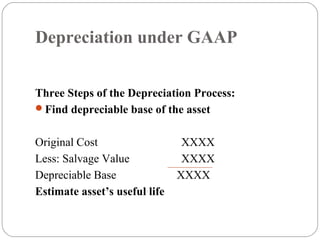
Three Steps of the Depreciation Process:
Find depreciable base of the asset
Original Cost
Less: Salvage Value
Depreciable Base
Estimate asset’s useful life

XXXX
XXXX
XXXX
Depreciation under GAAP cont’d
Three Important Notes About Depreciation: PP&E

held for sale is not depreciated
PP&E is not written up by an enterprise to reflect

appraisal, market, or current values which are above cost
to the enterprise
Estimates of useful life and residual value, and the method

of depreciation, are reviewed only when events or changes
indicate that the current estimates or depreciation method
no longer are appropriate
Depreciation under IFRS
• Current Authoritative Source–IAS 16
Same as GAAP except for two main differences:
• Estimates of useful life and residual value, and
the method of depreciation, are reviewed at
least at each annual reporting date
• For a company currently using GAAP a
change to IFRS could result in a greater
frequency of revisions in depreciation rates,
which in turn could mean less predictable
depreciation expense
Depreciation under IFRS cont’d
IFRS allows a company to choose between two

different models in order to value PP&E
(property, plant & equipment) after it has
been recognized on the booksCost model–this model is like GAAP where
PP&E is carried at its cost less any
accumulated depreciation
Revaluation model–this model allows a
company to revalue PP&E on its books to fair
value if fair value can be reliably measured
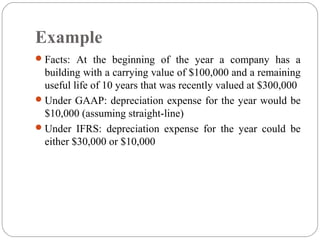
Example
 Facts: At the beginning of the year a company has a

building with a carrying value of $100,000 and a remaining
useful life of 10 years that was recently valued at $300,000
 Under GAAP: depreciation expense for the year would be
$10,000 (assuming straight-line)
 Under IFRS: depreciation expense for the year could be
either $30,000 or $10,000
Depreciation under IFRS cont’d
Three Important Notes About Depreciation:
If an item of PP&E is revalued, the entire class of
PP&E to which the asset belongs has to be
revalued
Examples of separate classes: land, machinery,

motor vehicles, office equipment
Items

in a class of PP&E are revalued
simultaneously to avoid selective revaluation of
assets
Depreciation under IFRS cont’d
 If an asset is revalued up, the increase is credited directly to

equity under the heading of revaluation surplus
 An increase is recognized in P&L to the extent that it

reverses a revaluation decrease of the same asset previously
recognized in P&L
 When PP&E is revalued, any accumulated depreciation can

be treated in one of two ways
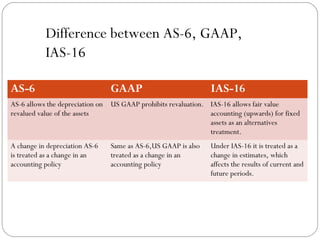
Difference between AS-6, GAAP,
IAS-16
AS-6

GAAP

IAS-16

AS-6 allows the depreciation on US GAAP prohibits revaluation. IAS-16 allows fair value
revalued value of the assets
accounting (upwards) for fixed
assets as an alternatives
treatment.
A change in depreciation AS-6
is treated as a change in an
accounting policy

Same as AS-6,US GAAP is also
treated as a change in an
accounting policy

Under IAS-16 it is treated as a
change in estimates, which
affects the results of current and
future periods.
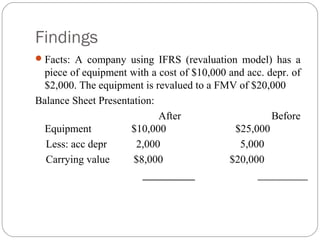
Findings
 Facts: A company using IFRS (revaluation model) has a

piece of equipment with a cost of $10,000 and acc. depr. of
$2,000. The equipment is revalued to a FMV of $20,000
Balance Sheet Presentation:
After
Before
Equipment
$10,000
$25,000
Less: acc depr
2,000
5,000
Carrying value
$8,000
$20,000
Objectives
In general
• The introduction accounting standards there was
uniformity in the accounts of various companies within
India.
• Converged Accounting Standards along with IFRS was
introduced so that accounts of India can be compared
with companies of the world
Related to Depreciation
• It will charged according to the shelve life of fixed asset .
Recommendations
• There are two types of depreciation which are:• Straight Line Depreciation Method
• Written Down Value Method
It would be better if only one kind of depreciation method is
followed all over the world
• There should be such accounting so that tax accounting and
financial statement accounting could be done together
• Slabs of tax accounting should be same with the financial
statements.
Depreciation accounting

Depreciation accounting

  • 1.
    Depreciation Accounting Definition Depreciation isa measure of the wearing out, consumption or other loss of value of a depreciable asset arising from use, effluxion of time or obsolescence through technology and market changes.
  • 2.
    Depreciable Assets Depreciable assetsare assets which (i) Are expected to be used during more than one accounting period; (ii) Have a limited useful life; (iii) Are held by an enterprise for use in the production or supply of goods and services (i.e. not for the purpose of sale in ordinary course of business)
  • 3.
    Applicability of theAccounting Standard 6 This accounting standard is applicable to all depreciable assets except, the following: (i) Forests, plantations and similar regenerative natural resources; (ii) Wasting assets including expenditure on the exploration for and extraction of minerals, oils, natural gas and similar non-regenerative resources; (iii) Expenditure on research and development; (iv)Goodwill; (v) Live stock- Cattle, Animal Husbandry
  • 4.
    Calculation of depreciation Theamount of depreciation is calculated as under: (i) Historical cost or other amount substituted for the historical cost of the depreciable asset when the asset has been revalued; (ii) Expected useful life of the depreciable asset; and (iii) Estimated residual value of the depreciable asset.
  • 5.
    Methods of depreciation Thereare two methods of depreciation. These are: i)Straight Line Method (SLM) ii)Written down value Method (WDV) Selection of appropriate method It depends upon following methods:•Type of assets •Nature of assets •Circumstances of prevailing business Note- A combination of more than one standards may be used Accounting treatment- selected depreciation methods should be applied consistently applied from period to period
  • 6.
    Change in depreciationmethods: •Compliance of statute •Compliance of accounting standards •For more appropriate presentation of the financial statements Procedure to be followed in change of methods:•Depreciation should be recomputed applying new method from date of acquisition/installation till date of change of method. •Difference between total depreciation under two methods and accumulated depreciation under the old method till date of change may be surplus or deficiency. •Resultant surplus credited to profit and loss a/c under head “depreciation written back”. • Resultant deficiency charged to profit and loss a/c. Change in depreciation method should be treated as change in accounting policy (as per AS 5) and its effect should be quantified and disclosed.
  • 7.
    Change in estimateduseful life When there is change in estimated useful life of assets, outstanding depreciable amount on the date of change in estimated useful life of asset should allocated over the revised remaining useful life of assets.
  • 8.
    Depreciation under GAAP ThreeSteps of the Depreciation Process: Find depreciable base of the asset Original Cost Less: Salvage Value Depreciable Base Estimate asset’s useful life XXXX XXXX XXXX
  • 9.
    Depreciation under GAAPcont’d Three Important Notes About Depreciation: PP&E held for sale is not depreciated PP&E is not written up by an enterprise to reflect appraisal, market, or current values which are above cost to the enterprise Estimates of useful life and residual value, and the method of depreciation, are reviewed only when events or changes indicate that the current estimates or depreciation method no longer are appropriate
  • 10.
    Depreciation under IFRS •Current Authoritative Source–IAS 16 Same as GAAP except for two main differences: • Estimates of useful life and residual value, and the method of depreciation, are reviewed at least at each annual reporting date • For a company currently using GAAP a change to IFRS could result in a greater frequency of revisions in depreciation rates, which in turn could mean less predictable depreciation expense
  • 11.
    Depreciation under IFRScont’d IFRS allows a company to choose between two different models in order to value PP&E (property, plant & equipment) after it has been recognized on the booksCost model–this model is like GAAP where PP&E is carried at its cost less any accumulated depreciation Revaluation model–this model allows a company to revalue PP&E on its books to fair value if fair value can be reliably measured
  • 12.
    Example  Facts: Atthe beginning of the year a company has a building with a carrying value of $100,000 and a remaining useful life of 10 years that was recently valued at $300,000  Under GAAP: depreciation expense for the year would be $10,000 (assuming straight-line)  Under IFRS: depreciation expense for the year could be either $30,000 or $10,000
  • 13.
    Depreciation under IFRScont’d Three Important Notes About Depreciation: If an item of PP&E is revalued, the entire class of PP&E to which the asset belongs has to be revalued Examples of separate classes: land, machinery, motor vehicles, office equipment Items in a class of PP&E are revalued simultaneously to avoid selective revaluation of assets
  • 14.
    Depreciation under IFRScont’d  If an asset is revalued up, the increase is credited directly to equity under the heading of revaluation surplus  An increase is recognized in P&L to the extent that it reverses a revaluation decrease of the same asset previously recognized in P&L  When PP&E is revalued, any accumulated depreciation can be treated in one of two ways
  • 15.
    Difference between AS-6,GAAP, IAS-16 AS-6 GAAP IAS-16 AS-6 allows the depreciation on US GAAP prohibits revaluation. IAS-16 allows fair value revalued value of the assets accounting (upwards) for fixed assets as an alternatives treatment. A change in depreciation AS-6 is treated as a change in an accounting policy Same as AS-6,US GAAP is also treated as a change in an accounting policy Under IAS-16 it is treated as a change in estimates, which affects the results of current and future periods.
  • 16.
    Findings  Facts: Acompany using IFRS (revaluation model) has a piece of equipment with a cost of $10,000 and acc. depr. of $2,000. The equipment is revalued to a FMV of $20,000 Balance Sheet Presentation: After Before Equipment $10,000 $25,000 Less: acc depr 2,000 5,000 Carrying value $8,000 $20,000
  • 17.
    Objectives In general • Theintroduction accounting standards there was uniformity in the accounts of various companies within India. • Converged Accounting Standards along with IFRS was introduced so that accounts of India can be compared with companies of the world Related to Depreciation • It will charged according to the shelve life of fixed asset .
  • 18.
    Recommendations • There aretwo types of depreciation which are:• Straight Line Depreciation Method • Written Down Value Method It would be better if only one kind of depreciation method is followed all over the world • There should be such accounting so that tax accounting and financial statement accounting could be done together • Slabs of tax accounting should be same with the financial statements.