

Depreciation 
Presented By: 
Hassan Jan Habib 
Roll# 24
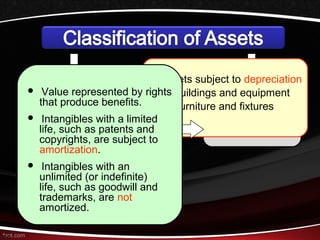
Tangible 
Physical 
Substance 
Assets subject to depreciation 
Buildings and equipment 
Furniture and fixtures 
Intangible 
No Physical 
Substance 
 Value represented by rights 
that produce benefits. 
 Intangibles with a limited 
life, such as patents and 
copyrights, are subject to 
amortization. 
 Intangibles with an 
unlimited (or indefinite) 
life, such as goodwill and 
trademarks, are not 
amortized. 
9-6
Disclosure
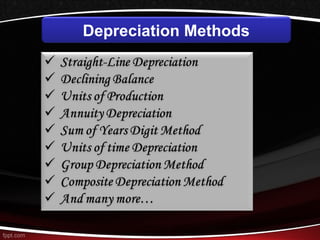
Depreciation Methods
Depreciation Methods 
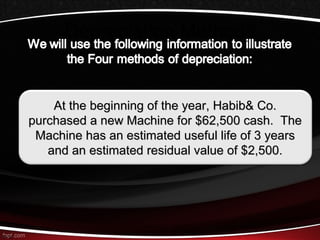
At the beginning ooff tthhee yyeeaarr,, HHaabbiibb&& CCoo.. 
ppuurrcchhaasseedd aa nneeww MMaacchhiinnee ffoorr $$6622,,550000 ccaasshh.. TThhee 
MMaacchhiinnee hhaass aann eessttiimmaatteedd uusseeffuull lliiffee ooff 33 yyeeaarrss 
aanndd aann eessttiimmaatteedd rreessiidduuaall vvaalluuee ooff $$22,,550000.. 
9-14
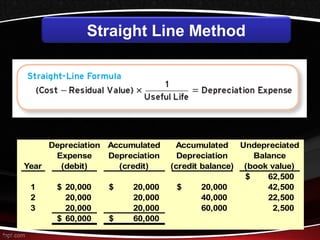
= $20,000 per year ($62,500 - $2,500) × 13 
Depreciation Accumulated Accumulated Undepreciated 
Expense Depreciation Depreciation Balance 
Year (debit) (credit) (credit balance) (book value) 
$ 62,500 
1 $ 20,000 $ 20,000 $ 20,000 42,500 
2 20,000 20,000 40,000 22,500 
3 20,000 20,000 60,000 2,500 
$ 60,000 $ 60,000 
9-15 
Straight Line Method
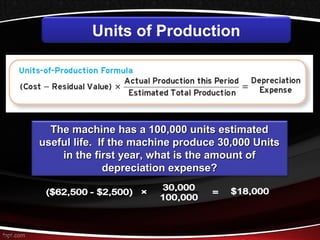
The machine has a 100,000 uunniittss eessttiimmaatteedd 
uusseeffuull lliiffee.. IIff tthhee mmaacchhiinnee pprroodduuccee 3300,,000000 UUnniittss 
iinn tthhee ffiirrsstt yyeeaarr,, wwhhaatt iiss tthhee aammoouunntt ooff 
ddeepprreecciiaattiioonn eexxppeennssee?? 
9-16 
Units of Production
Accumulated Undepreciated 
Depreciation Depreciation Balance 
Year Miles Expense Balance (book value) 
$ 62,500 
1 30,000 $ 18,000 $ 18,000 44,500 
2 50,000 
3 20,000 
100,000 
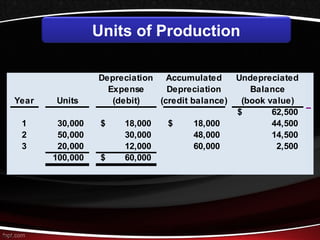
Depreciation Accumulated Undepreciated 
Expense Depreciation Balance 
Year Units (debit) (credit balance) (book value) 
$ 62,500 
1 30,000 $ 18,000 $ 18,000 44,500 
2 50,000 30,000 48,000 14,500 
3 20,000 12,000 60,000 2,500 
100,000 $ 60,000 
9-17 
Units of Production
Declining Balance Method 
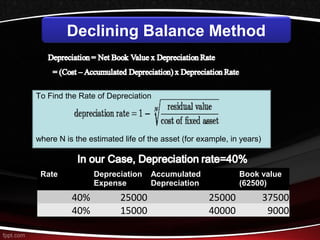
To Find the Rate of Depreciation 
where N is the estimated life of the asset (for example, in years) 
Rate Depreciation 
Expense 
Accumulated 
Depreciation 
Book value 
(62500) 
40% 25000 25000 37500 
40% 15000 40000 9000
For tax purposes, most corporations 
use the Modified Accelerated Cost 
Recovery System (MACRS). 
MACRS depreciation provides for rapid 
write-off of an asset’s cost in order to 
stimulate new investment. 
9-19 
Tax Depreciation
Depreciation

Depreciation

  • 2.
    Depreciation Presented By: Hassan Jan Habib Roll# 24
  • 6.
    Tangible Physical Substance Assets subject to depreciation Buildings and equipment Furniture and fixtures Intangible No Physical Substance  Value represented by rights that produce benefits.  Intangibles with a limited life, such as patents and copyrights, are subject to amortization.  Intangibles with an unlimited (or indefinite) life, such as goodwill and trademarks, are not amortized. 9-6
  • 12.
  • 13.
  • 14.
    Depreciation Methods Atthe beginning ooff tthhee yyeeaarr,, HHaabbiibb&& CCoo.. ppuurrcchhaasseedd aa nneeww MMaacchhiinnee ffoorr $$6622,,550000 ccaasshh.. TThhee MMaacchhiinnee hhaass aann eessttiimmaatteedd uusseeffuull lliiffee ooff 33 yyeeaarrss aanndd aann eessttiimmaatteedd rreessiidduuaall vvaalluuee ooff $$22,,550000.. 9-14
  • 15.
    = $20,000 peryear ($62,500 - $2,500) × 13 Depreciation Accumulated Accumulated Undepreciated Expense Depreciation Depreciation Balance Year (debit) (credit) (credit balance) (book value) $ 62,500 1 $ 20,000 $ 20,000 $ 20,000 42,500 2 20,000 20,000 40,000 22,500 3 20,000 20,000 60,000 2,500 $ 60,000 $ 60,000 9-15 Straight Line Method
  • 16.
    The machine hasa 100,000 uunniittss eessttiimmaatteedd uusseeffuull lliiffee.. IIff tthhee mmaacchhiinnee pprroodduuccee 3300,,000000 UUnniittss iinn tthhee ffiirrsstt yyeeaarr,, wwhhaatt iiss tthhee aammoouunntt ooff ddeepprreecciiaattiioonn eexxppeennssee?? 9-16 Units of Production
  • 17.
    Accumulated Undepreciated DepreciationDepreciation Balance Year Miles Expense Balance (book value) $ 62,500 1 30,000 $ 18,000 $ 18,000 44,500 2 50,000 3 20,000 100,000 Depreciation Accumulated Undepreciated Expense Depreciation Balance Year Units (debit) (credit balance) (book value) $ 62,500 1 30,000 $ 18,000 $ 18,000 44,500 2 50,000 30,000 48,000 14,500 3 20,000 12,000 60,000 2,500 100,000 $ 60,000 9-17 Units of Production
  • 18.
    Declining Balance Method To Find the Rate of Depreciation where N is the estimated life of the asset (for example, in years) Rate Depreciation Expense Accumulated Depreciation Book value (62500) 40% 25000 25000 37500 40% 15000 40000 9000
  • 19.
    For tax purposes,most corporations use the Modified Accelerated Cost Recovery System (MACRS). MACRS depreciation provides for rapid write-off of an asset’s cost in order to stimulate new investment. 9-19 Tax Depreciation

Editor's Notes

  • #7 Part I Long-lived assets are assets that are used actively in the operations of the business, and that are expected to benefit the operations into the future. Part II There are two major categories of long-lived assets. Tangible plant assets are long-term assets that have physical substance. Intangible assets are long-lived assets without physical substance. Part III Land, buildings, equipment, furniture, and fixtures are examples of long-lived tangible assets. Land is not depreciated. Buildings, equipment, furniture, and fixtures are depreciated. Depreciation allocates the cost of a long-lived asset over the periods benefited by its use. We will study depreciation in detail later in the chapter. Part IV Intangible assets have value represented by rights that produce benefits. Trademarks, copyrights, patents, licensing rights, technology, franchises, and goodwill are examples of intangible assets. We will take a look at each of these later in the chapter. Intangibles with a limited life, such as patents and copyrights, are subject to amortization. Intangibles with an unlimited (or indefinite) life, such as goodwill and trademarks, are not amortized. Amortization is a process of allocating cost over the useful life, similar to depreciation.
  • #15 Part I There are three popular methods of calculating depreciation expense. The easiest and most widely used method is called straight-line depreciation. In special circumstances, we may wish to use the units-of-productions method. We would elect this method if the life of the asset is generally measured in terms of units of production. For example, airplanes keep highly detailed records of engine operating hours. The unit of production may be the operating hours of an aircraft engine. The third method is called the declining-balance method. Under this method, we take more depreciation expense in the early years of the asset’s life and lower amounts of depreciation in later years. Several income tax depreciation calculations are based on the declining balance method. Part II At the beginning of the year, Cedar Fair purchased a new Go-Cart machine for $62,500 cash. The machine has an estimated useful life of 3 years and an estimated residual value of $2,500. We will use this information to illustration the three depreciation methods.
  • #16 Part I Depreciation expense for each year is determined by taking the asset’s cost less its estimated residual value and multiplying this amount by the fraction of 1 over the asset’s estimated useful life in years. Part II The annual depreciation is $20,000. Cost minus residual value ($62,500 - $2,500 = $60,000) is multiplied by one third. Part III. Notice that depreciation expense is the same amount in each of the three years. If we plot this amount on a graph, it would be a straight-line. That is how we got the name straight-line for this method. Accumulated depreciation increases by $20,000 each year. The cost of the asset ($62,500) less accumulated depreciation at the end of any year is called book value. Book value decreases by $20,000 each year. The book value is equal to the estimated salvage value at the end of the asset’s useful life. We want this to be true regardless of the method we use.
  • #17 Part I Depreciation expense for a year is determined by taking the asset’s cost less its estimated residual value and multiplying this amount by the fraction of actual production for the period divided by the estimated total production over the asset’s useful life. Part II Cedar Fair’s new Go Cart machine has a 100,000 mile useful life. If the machine is used 30,000 Units in the first year, what is the amount of depreciation expense for the year? Part III The depreciation expense for the first year is $18,000. Cost minus residual value ($62,500 - $2,500 = $60,000) is multiplied by the fraction of 30,000 over 100,000. Let’s look at a table of depreciation expense for this equipment over its life. Remember that we need to know the units produced in each year.
  • #18 Part I In the second column we see the Units for each of the three years. The $18,000 is the depreciation from our previous computation. Book value of $44,500 is the acquisition cost of $62,500 less the accumulated depreciation of $18,000. Take time to complete this table before advancing. Part II The depreciation expense amounts for each year are determined by multiplying the asset’s cost less its estimated residual value ($62,500 - $2,500 = $60,000) by the fraction of actual production for the period divided by the estimated total production over the asset’s useful. Finally, notice that the book value at the end of the third year is equal to the estimated residual value of $2,500.
  • #20 When filing a tax return most corporations use the modified accelerated cost recovery system developed by the Internal Revenue Service. Because the title of the method is so long most accountants refer to the tax method as “makers.”“Makers” is an accelerated depreciation method. It was designed to permit companies to quickly write-off the cost of long-lived tangible assets and thereby stimulate investment in new assets.