DENTAL IMPLANT AND
INSTRUMENTATION
DR .R SARAVANAN
BDS
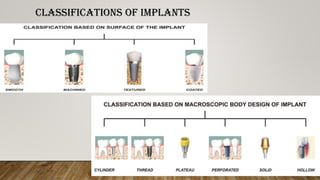
CLASSIFICATIONS OF IMPLANTS
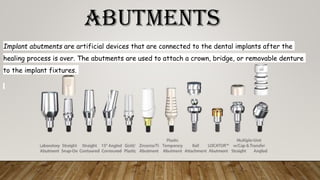
ABUTMENTS
Implant abutments are artificial devices that are connected to the dental implants after the
healing process is over. The abutments are used to attach a crown, bridge, or removable denture
to the implant fixtures.
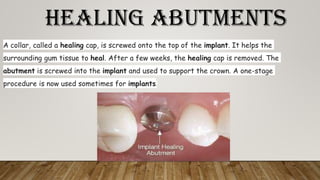
HEALING ABUTMENTS
A collar, called a healing cap, is screwed onto the top of the implant. It helps the
surrounding gum tissue to heal. After a few weeks, the healing cap is removed. The
abutment is screwed into the implant and used to support the crown. A one-stage
procedure is now used sometimes for implants.
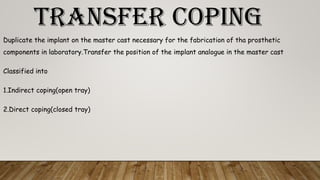
TRANSFER COPING
Duplicate the implant on the master cast necessary for the fabrication of tha prosthetic
components in laboratory.Transfer the position of the implant analogue in the master cast
Classified into
1.Indirect coping(open tray)
2.Direct coping(closed tray)
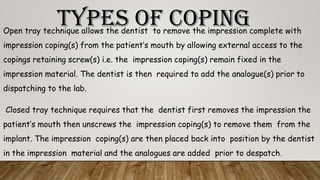
TYPES OF COPINGOpen tray technique allows the dentist to remove the impression complete with
impression coping(s) from the patient’s mouth by allowing external access to the
copings retaining screw(s) i.e. the impression coping(s) remain fixed in the
impression material. The dentist is then required to add the analogue(s) prior to
dispatching to the lab.
Closed tray technique requires that the dentist first removes the impression the
patient’s mouth then unscrews the impression coping(s) to remove them from the
implant. The impression coping(s) are then placed back into position by the dentist
in the impression material and the analogues are added prior to despatch.
IMPLANT ANALOGUE
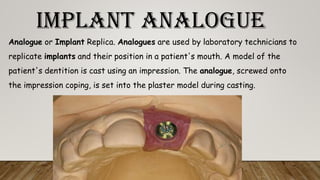
Analogue or Implant Replica. Analogues are used by laboratory technicians to
replicate implants and their position in a patient's mouth. A model of the
patient's dentition is cast using an impression. The analogue, screwed onto
the impression coping, is set into the plaster model during casting.
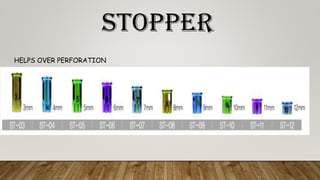
STOPPER
HELPS OVER PERFORATION
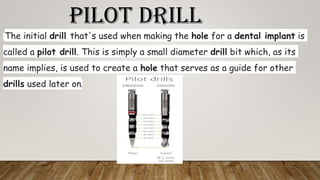
PILOT DRILL
The initial drill that's used when making the hole for a dental implant is
called a pilot drill. This is simply a small diameter drill bit which, as its
name implies, is used to create a hole that serves as a guide for other
drills used later on.
TREPHINE DRILLA surgical drill with a hollow cutting head used to remove a circular
section of bone or other tissue; also used to remove failed dental
implants.
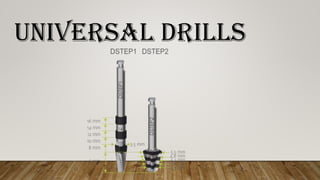
UNIVERSAL DRILLS
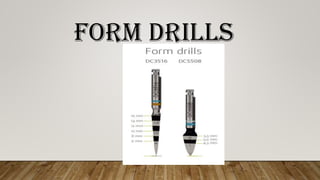
FORM DRILLS
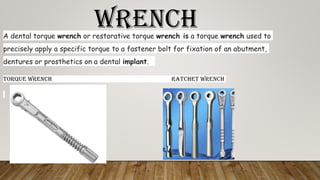
WRENCHA dental torque wrench or restorative torque wrench is a torque wrench used to
precisely apply a specific torque to a fastener bolt for fixation of an abutment,
dentures or prosthetics on a dental implant.
TORQUE WRENCH RATCHET WRENCH
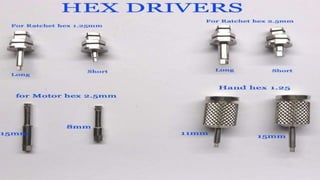
HEX DRIVER
DRILL EXTENDER
This instrument is included with the placement instruments for hard to reach
places in the mouth such as when the implant site is in a narrow place between two
long teeth. The Drill Extender allows the implant site by the clinician to access
extending the usable length of the drill.
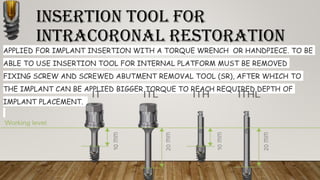
INSERTION TOOL FOR
INTRACORONAL RESTORATION
APPLIED FOR IMPLANT INSERTION WITH A TORQUE WRENCH OR HANDPIECE. TO BE
ABLE TO USE INSERTION TOOL FOR INTERNAL PLATFORM MUST BE REMOVED
FIXING SCREW AND SCREWED ABUTMENT REMOVAL TOOL (SR), AFTER WHICH TO
THE IMPLANT CAN BE APPLIED BIGGER TORQUE TO REACH REQUIRED DEPTH OF
IMPLANT PLACEMENT.
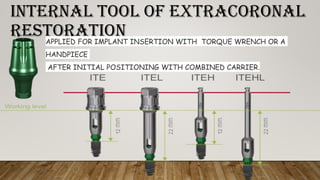
INTERNAL TOOL OF EXTRACORONAL
RESTORATIONAPPLIED FOR IMPLANT INSERTION WITH TORQUE WRENCH OR A
HANDPIECE
AFTER INITIAL POSITIONING WITH COMBINED CARRIER.
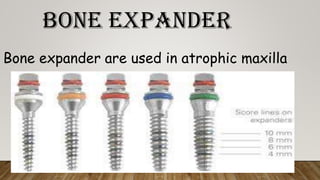
BONE EXPANDER
Bone expander are used in atrophic maxilla
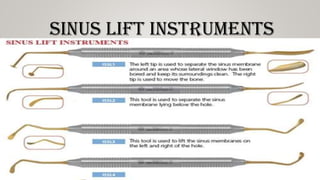
SINUS LIFT INSTRUMENTS
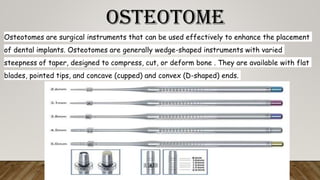
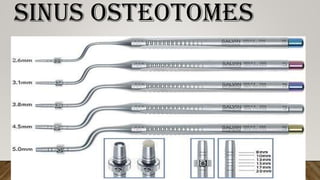
OSTEOTOME
Osteotomes are surgical instruments that can be used effectively to enhance the placement
of dental implants. Osteotomes are generally wedge-shaped instruments with varied
steepness of taper, designed to compress, cut, or deform bone . They are available with flat
blades, pointed tips, and concave (cupped) and convex (D-shaped) ends.
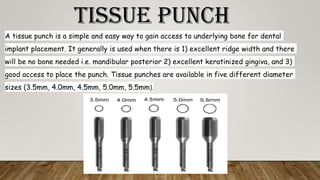
TISSUE PUNCH
A tissue punch is a simple and easy way to gain access to underlying bone for dental
implant placement. It generally is used when there is 1) excellent ridge width and there
will be no bone needed i.e. mandibular posterior 2) excellent keratinized gingiva, and 3)
good access to place the punch. Tissue punches are available in five different diameter
sizes (3.5mm, 4.0mm, 4.5mm, 5.0mm, 5.5mm).
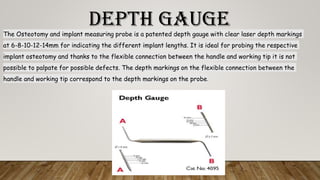
DEPTH GAUGEThe Osteotomy and implant measuring probe is a patented depth gauge with clear laser depth markings
at 6-8-10-12-14mm for indicating the different implant lengths. It is ideal for probing the respective
implant osteotomy and thanks to the flexible connection between the handle and working tip it is not
possible to palpate for possible defects. The depth markings on the flexible connection between the
handle and working tip correspond to the depth markings on the probe.
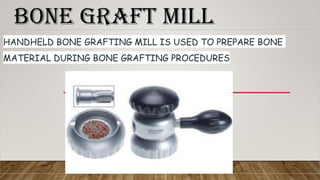
BONE GRAFT MILL
HANDHELD BONE GRAFTING MILL IS USED TO PREPARE BONE
MATERIAL DURING BONE GRAFTING PROCEDURES
SINUS OSTEOTOMES
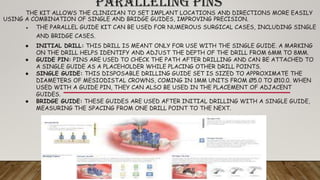
PARALLELING PINS
THE KIT ALLOWS THE CLINICIAN TO SET IMPLANT LOCATIONS AND DIRECTIONS MORE EASILY
USING A COMBINATION OF SINGLE AND BRIDGE GUIDES, IMPROVING PRECISION.
● THE PARALLEL GUIDE KIT CAN BE USED FOR NUMEROUS SURGICAL CASES, INCLUDING SINGLE
AND BRIDGE CASES.
● INITIAL DRILL: THIS DRILL IS MEANT ONLY FOR USE WITH THE SINGLE GUIDE. A MARKING
ON THE DRILL HELPS IDENTIFY AND ADJUST THE DEPTH OF THE DRILL FROM 6MM TO 8MM.
● GUIDE PIN: PINS ARE USED TO CHECK THE PATH AFTER DRILLING AND CAN BE ATTACHED TO
A SINGLE GUIDE AS A PLACEHOLDER WHILE PLACING OTHER DRILL POINTS.
● SINGLE GUIDE: THIS DISPOSABLE DRILLING GUIDE SET IS SIZED TO APPROXIMATE THE
DIAMETERS OF MESIODISTAL CROWNS, COMING IN 1MM UNITS FROM Ø5.0 TO Ø10.0. WHEN
USED WITH A GUIDE PIN, THEY CAN ALSO BE USED IN THE PLACEMENT OF ADJACENT
GUIDES.
● BRIDGE GUIDE: THESE GUIDES ARE USED AFTER INITIAL DRILLING WITH A SINGLE GUIDE,
MEASURING THE SPACING FROM ONE DRILL POINT TO THE NEXT.
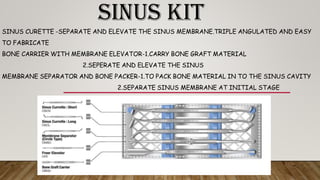
SINUS KIT
SINUS CURETTE -SEPARATE AND ELEVATE THE SINUS MEMBRANE.TRIPLE ANGULATED AND EASY
TO FABRICATE
BONE CARRIER WITH MEMBRANE ELEVATOR-1.CARRY BONE GRAFT MATERIAL
2.SEPERATE AND ELEVATE THE SINUS
MEMBRANE SEPARATOR AND BONE PACKER-1.TO PACK BONE MATERIAL IN TO THE SINUS CAVITY
2.SEPARATE SINUS MEMBRANE AT INITIAL STAGE
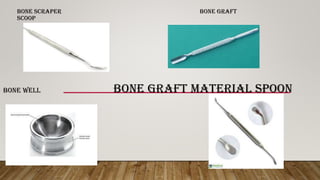
BONE SCRAPER BONE GRAFT
SCOOP
BONE WELL BONE GRAFT MATERIAL SPOON
Dental implant instruments

Dental implant instruments

  • 1.
  • 2.
  • 3.
    ABUTMENTS Implant abutments areartificial devices that are connected to the dental implants after the healing process is over. The abutments are used to attach a crown, bridge, or removable denture to the implant fixtures.
  • 4.
    HEALING ABUTMENTS A collar,called a healing cap, is screwed onto the top of the implant. It helps the surrounding gum tissue to heal. After a few weeks, the healing cap is removed. The abutment is screwed into the implant and used to support the crown. A one-stage procedure is now used sometimes for implants.
  • 5.
    TRANSFER COPING Duplicate theimplant on the master cast necessary for the fabrication of tha prosthetic components in laboratory.Transfer the position of the implant analogue in the master cast Classified into 1.Indirect coping(open tray) 2.Direct coping(closed tray)
  • 6.
    TYPES OF COPINGOpentray technique allows the dentist to remove the impression complete with impression coping(s) from the patient’s mouth by allowing external access to the copings retaining screw(s) i.e. the impression coping(s) remain fixed in the impression material. The dentist is then required to add the analogue(s) prior to dispatching to the lab. Closed tray technique requires that the dentist first removes the impression the patient’s mouth then unscrews the impression coping(s) to remove them from the implant. The impression coping(s) are then placed back into position by the dentist in the impression material and the analogues are added prior to despatch.
  • 7.
    IMPLANT ANALOGUE Analogue orImplant Replica. Analogues are used by laboratory technicians to replicate implants and their position in a patient's mouth. A model of the patient's dentition is cast using an impression. The analogue, screwed onto the impression coping, is set into the plaster model during casting.
  • 8.
  • 9.
    PILOT DRILL The initialdrill that's used when making the hole for a dental implant is called a pilot drill. This is simply a small diameter drill bit which, as its name implies, is used to create a hole that serves as a guide for other drills used later on.
  • 10.
    TREPHINE DRILLA surgicaldrill with a hollow cutting head used to remove a circular section of bone or other tissue; also used to remove failed dental implants.
  • 11.
  • 12.
  • 13.
    WRENCHA dental torquewrench or restorative torque wrench is a torque wrench used to precisely apply a specific torque to a fastener bolt for fixation of an abutment, dentures or prosthetics on a dental implant. TORQUE WRENCH RATCHET WRENCH
  • 14.
  • 15.
    DRILL EXTENDER This instrumentis included with the placement instruments for hard to reach places in the mouth such as when the implant site is in a narrow place between two long teeth. The Drill Extender allows the implant site by the clinician to access extending the usable length of the drill.
  • 16.
    INSERTION TOOL FOR INTRACORONALRESTORATION APPLIED FOR IMPLANT INSERTION WITH A TORQUE WRENCH OR HANDPIECE. TO BE ABLE TO USE INSERTION TOOL FOR INTERNAL PLATFORM MUST BE REMOVED FIXING SCREW AND SCREWED ABUTMENT REMOVAL TOOL (SR), AFTER WHICH TO THE IMPLANT CAN BE APPLIED BIGGER TORQUE TO REACH REQUIRED DEPTH OF IMPLANT PLACEMENT.
  • 17.
    INTERNAL TOOL OFEXTRACORONAL RESTORATIONAPPLIED FOR IMPLANT INSERTION WITH TORQUE WRENCH OR A HANDPIECE AFTER INITIAL POSITIONING WITH COMBINED CARRIER.
  • 18.
    BONE EXPANDER Bone expanderare used in atrophic maxilla
  • 19.
  • 20.
    OSTEOTOME Osteotomes are surgicalinstruments that can be used effectively to enhance the placement of dental implants. Osteotomes are generally wedge-shaped instruments with varied steepness of taper, designed to compress, cut, or deform bone . They are available with flat blades, pointed tips, and concave (cupped) and convex (D-shaped) ends.
  • 21.
    TISSUE PUNCH A tissuepunch is a simple and easy way to gain access to underlying bone for dental implant placement. It generally is used when there is 1) excellent ridge width and there will be no bone needed i.e. mandibular posterior 2) excellent keratinized gingiva, and 3) good access to place the punch. Tissue punches are available in five different diameter sizes (3.5mm, 4.0mm, 4.5mm, 5.0mm, 5.5mm).
  • 22.
    DEPTH GAUGEThe Osteotomyand implant measuring probe is a patented depth gauge with clear laser depth markings at 6-8-10-12-14mm for indicating the different implant lengths. It is ideal for probing the respective implant osteotomy and thanks to the flexible connection between the handle and working tip it is not possible to palpate for possible defects. The depth markings on the flexible connection between the handle and working tip correspond to the depth markings on the probe.
  • 23.
    BONE GRAFT MILL HANDHELDBONE GRAFTING MILL IS USED TO PREPARE BONE MATERIAL DURING BONE GRAFTING PROCEDURES
  • 24.
  • 25.
    PARALLELING PINS THE KITALLOWS THE CLINICIAN TO SET IMPLANT LOCATIONS AND DIRECTIONS MORE EASILY USING A COMBINATION OF SINGLE AND BRIDGE GUIDES, IMPROVING PRECISION. ● THE PARALLEL GUIDE KIT CAN BE USED FOR NUMEROUS SURGICAL CASES, INCLUDING SINGLE AND BRIDGE CASES. ● INITIAL DRILL: THIS DRILL IS MEANT ONLY FOR USE WITH THE SINGLE GUIDE. A MARKING ON THE DRILL HELPS IDENTIFY AND ADJUST THE DEPTH OF THE DRILL FROM 6MM TO 8MM. ● GUIDE PIN: PINS ARE USED TO CHECK THE PATH AFTER DRILLING AND CAN BE ATTACHED TO A SINGLE GUIDE AS A PLACEHOLDER WHILE PLACING OTHER DRILL POINTS. ● SINGLE GUIDE: THIS DISPOSABLE DRILLING GUIDE SET IS SIZED TO APPROXIMATE THE DIAMETERS OF MESIODISTAL CROWNS, COMING IN 1MM UNITS FROM Ø5.0 TO Ø10.0. WHEN USED WITH A GUIDE PIN, THEY CAN ALSO BE USED IN THE PLACEMENT OF ADJACENT GUIDES. ● BRIDGE GUIDE: THESE GUIDES ARE USED AFTER INITIAL DRILLING WITH A SINGLE GUIDE, MEASURING THE SPACING FROM ONE DRILL POINT TO THE NEXT.
  • 26.
    SINUS KIT SINUS CURETTE-SEPARATE AND ELEVATE THE SINUS MEMBRANE.TRIPLE ANGULATED AND EASY TO FABRICATE BONE CARRIER WITH MEMBRANE ELEVATOR-1.CARRY BONE GRAFT MATERIAL 2.SEPERATE AND ELEVATE THE SINUS MEMBRANE SEPARATOR AND BONE PACKER-1.TO PACK BONE MATERIAL IN TO THE SINUS CAVITY 2.SEPARATE SINUS MEMBRANE AT INITIAL STAGE
  • 27.
    BONE SCRAPER BONEGRAFT SCOOP BONE WELL BONE GRAFT MATERIAL SPOON