CHROME GuidedSMILE
Surgical Components
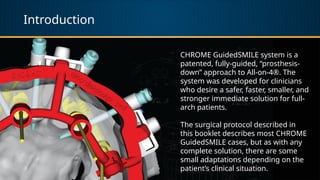
CHROME GuidedSMILE system is a
patented, fully-guided, “prosthesis-
down” approach to All-on-4®. The
system was developed for clinicians
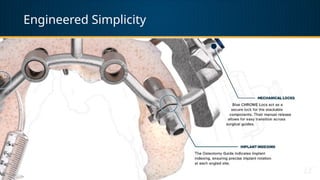
who desire a safer, faster, smaller, and
stronger immediate solution for full-
arch patients.
The surgical protocol described in
this booklet describes most CHROME
GuidedSMILE cases, but as with any
complete solution, there are some
small adaptations depending on the
patient’s clinical situation.
Introduction
Patented & Protected
Patented Surgical Guides
For the most up-to-date patent information visit
Purpose Fixation base and guides for dental
prosthesis installation
Patent No. 11173016
Patent
Date
Feb. 14, 2023
Abstract
(abbreviated)
Apparatus and method for installing a
multitooth dental prosthesis in one session
are shown and described. A first tool
attaches to the jawbone and serves as a
foundation for subsequently used guides.
Existing teeth and dental fixtures are
removed, and the bone tissue is removed
to accommodate the prosthesis.
Subsequently, a drill guide is used to drill
implant holes. An abutment guide is then
used to place abutments.
Surgical
Components
1. Pin Guide
2. Fixation Base
3. Osteotomy
Guide
4. Carrier
Guide
5. Provisional
Prosthetic
6. RAPID Appliance (Optional)
Surgical Components
3. Osteotomy Guide
4. Carrier Guide
2. Fixation Base
1. Pin Guide
5. Provisional Prosthesis 6. RAPID Appliance(Optional)
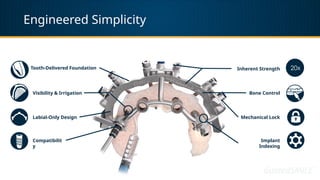
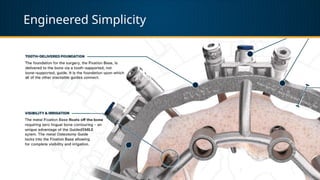
Tooth-Delivered Foundation
Visibility & Irrigation
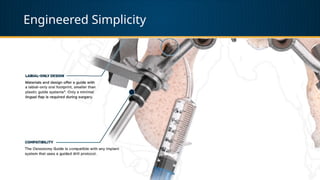
Labial-Only Design
Compatibilit
y
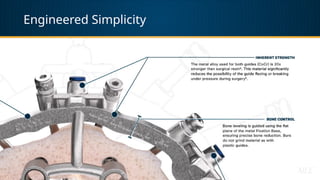
Inherent Strength
Mechanical Lock
Implant
Indexing
20x
Engineered Simplicity
Bone Control
Engineered Simplicity
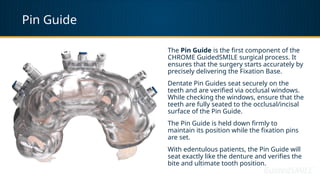
Pin Guide
The Pin Guide is the first component of the
CHROME GuidedSMILE surgical process. It
ensures that the surgery starts accurately by
precisely delivering the Fixation Base.
Dentate Pin Guides seat securely on the
teeth and are verified via occlusal windows.
While checking the windows, ensure that the
teeth are fully seated to the occlusal/incisal
surface of the Pin Guide.
The Pin Guide is held down firmly to
maintain its position while the fixation pins
are set.
With edentulous patients, the Pin Guide will
seat exactly like the denture and verifies the
bite and ultimate tooth position.
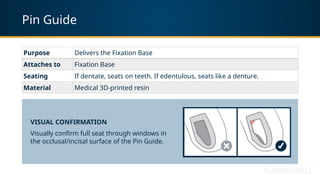
Pin Guide
Purpose Delivers the Fixation Base
Attaches to Fixation Base
Seating If dentate, seats on teeth. If edentulous, seats like a denture.
Material Medical 3D-printed resin
VISUAL CONFIRMATION
Visually confirm full seat through windows in
the occlusal/incisal surface of the Pin Guide.
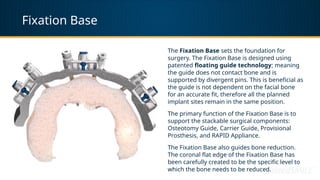
Fixation Base
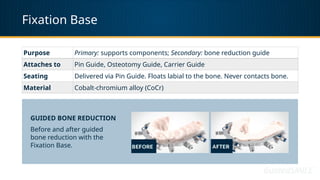
The Fixation Base sets the foundation for
surgery. The Fixation Base is designed using
patented floating guide technology; meaning
the guide does not contact bone and is
supported by divergent pins. This is beneficial as
the guide is not dependent on the facial bone
for an accurate fit, therefore all the planned
implant sites remain in the same position.
The primary function of the Fixation Base is to
support the stackable surgical components:
Osteotomy Guide, Carrier Guide, Provisional
Prosthesis, and RAPID Appliance.
The Fixation Base also guides bone reduction.
The coronal flat edge of the Fixation Base has
been carefully created to be the specific level to
which the bone needs to be reduced.
Fixation Base
Purpose Primary: supports components; Secondary: bone reduction guide
Attaches to Pin Guide, Osteotomy Guide, Carrier Guide
Seating Delivered via Pin Guide. Floats labial to the bone. Never contacts bone.
Material Cobalt-chromium alloy (CoCr)
GUIDED BONE REDUCTION
Before and after guided
bone reduction with the
Fixation Base.
Osteotomy Guide
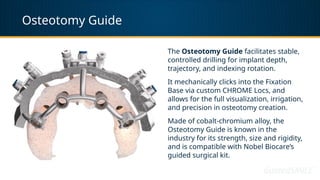
The Osteotomy Guide facilitates stable,
controlled drilling for implant depth,
trajectory, and indexing rotation.
It mechanically clicks into the Fixation
Base via custom CHROME Locs, and
allows for the full visualization, irrigation,
and precision in osteotomy creation.
Made of cobalt-chromium alloy, the
Osteotomy Guide is known in the
industry for its strength, size and rigidity,
and is compatible with Nobel Biocare’s
guided surgical kit.
Osteotomy Guide
Purpose Controls implant drilling - implant position, depth, angulation
Attaches to Fixation Base
Seating Mechanically clicks into the Fixation Base
Material Cobalt-chromium alloy (CoCr)
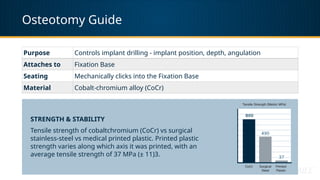
STRENGTH & STABILITY
Tensile strength of cobaltchromium (CoCr) vs surgical
stainless-steel vs medical printed plastic. Printed plastic
strength varies along which axis it was printed, with an
average tensile strength of 37 MPa (± 11)3.
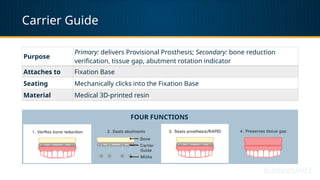
Carrier Guide
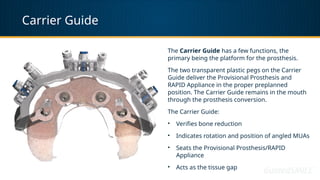
The Carrier Guide has a few functions, the
primary being the platform for the prosthesis.
The two transparent plastic pegs on the Carrier
Guide deliver the Provisional Prosthesis and
RAPID Appliance in the proper preplanned
position. The Carrier Guide remains in the mouth
through the prosthesis conversion.
The Carrier Guide:
• Verifies bone reduction
• Indicates rotation and position of angled MUAs
• Seats the Provisional Prosthesis/RAPID
Appliance
• Acts as the tissue gap
Purpose
Primary: delivers Provisional Prosthesis; Secondary: bone reduction
verification, tissue gap, abutment rotation indicator
Attaches to Fixation Base
Seating Mechanically clicks into the Fixation Base
Material Medical 3D-printed resin
FOUR FUNCTIONS
Carrier Guide
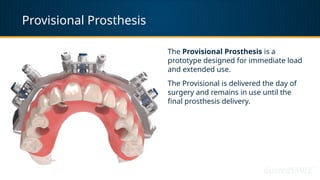
Provisional Prosthesis
The Provisional Prosthesis is a
prototype designed for immediate load
and extended use.
The Provisional is delivered the day of
surgery and remains in use until the
final prosthesis delivery.
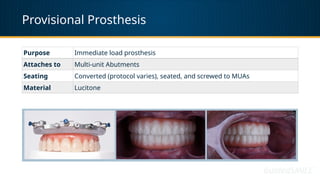
Provisional Prosthesis
Purpose Immediate load prosthesis
Attaches to Multi-unit Abutments
Seating Converted (protocol varies), seated, and screwed to MUAs
Material Lucitone
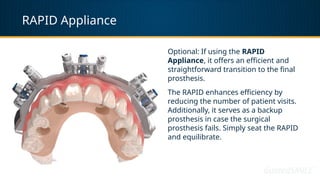
RAPID Appliance
Optional: If using the RAPID
Appliance, it offers an efficient and
straightforward transition to the final
prosthesis.
The RAPID enhances efficiency by
reducing the number of patient visits.
Additionally, it serves as a backup
prosthesis in case the surgical
prosthesis fails. Simply seat the RAPID
and equilibrate.
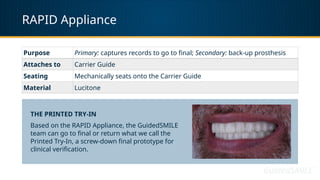
RAPID Appliance
Purpose Primary: captures records to go to final; Secondary: back-up prosthesis
Attaches to Carrier Guide
Seating Mechanically seats onto the Carrier Guide
Material Lucitone
THE PRINTED TRY-IN
Based on the RAPID Appliance, the GuidedSMILE
team can go to final or return what we call the
Printed Try-In, a screw-down final prototype for
clinical verification.
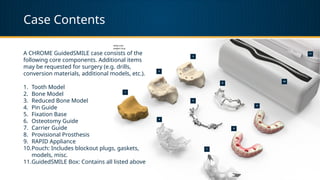
Case Contents
A CHROME GuidedSMILE case consists of the
following core components. Additional items
may be requested for surgery (e.g. drills,
conversion materials, additional models, etc.).
1. Tooth Model
2. Bone Model
3. Reduced Bone Model
4. Pin Guide
5. Fixation Base
6. Osteotomy Guide
7. Carrier Guide
8. Provisional Prosthesis
9. RAPID Appliance
10.Pouch: Includes blockout plugs, gaskets,
models, misc.
11.GuidedSMILE Box: Contains all listed above
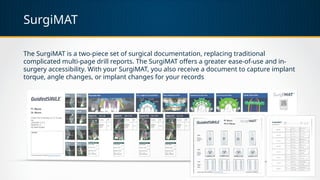
SurgiMAT
The SurgiMAT is a two-piece set of surgical documentation, replacing traditional
complicated multi-page drill reports. The SurgiMAT offers a greater ease-of-use and in-
surgery accessibility. With your SurgiMAT, you also receive a document to capture implant
torque, angle changes, or implant changes for your records
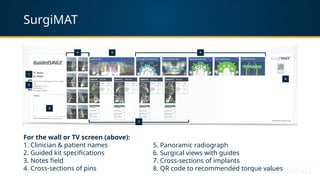
SurgiMAT
For the wall or TV screen (above):
1. Clinician & patient names
2. Guided kit specifications
3. Notes field
4. Cross-sections of pins
5. Panoramic radiograph
6. Surgical views with guides
7. Cross-sections of implants
8. QR code to recommended torque values
SurgiMAT
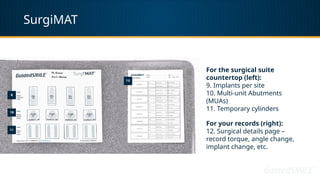
For the surgical suite
countertop (left):
9. Implants per site
10. Multi-unit Abutments
(MUAs)
11. Temporary cylinders
For your records (right):
12. Surgical details page –
record torque, angle change,
implant change, etc.
Q & A
Thank you!

GuidedSMILE NobelBiocare Surgical Components

  • 1.
  • 2.
    CHROME GuidedSMILE systemis a patented, fully-guided, “prosthesis- down” approach to All-on-4®. The system was developed for clinicians who desire a safer, faster, smaller, and stronger immediate solution for full- arch patients. The surgical protocol described in this booklet describes most CHROME GuidedSMILE cases, but as with any complete solution, there are some small adaptations depending on the patient’s clinical situation. Introduction
  • 3.
    Patented & Protected PatentedSurgical Guides For the most up-to-date patent information visit Purpose Fixation base and guides for dental prosthesis installation Patent No. 11173016 Patent Date Feb. 14, 2023 Abstract (abbreviated) Apparatus and method for installing a multitooth dental prosthesis in one session are shown and described. A first tool attaches to the jawbone and serves as a foundation for subsequently used guides. Existing teeth and dental fixtures are removed, and the bone tissue is removed to accommodate the prosthesis. Subsequently, a drill guide is used to drill implant holes. An abutment guide is then used to place abutments.
  • 4.
    Surgical Components 1. Pin Guide 2.Fixation Base 3. Osteotomy Guide 4. Carrier Guide 5. Provisional Prosthetic 6. RAPID Appliance (Optional)
  • 5.
    Surgical Components 3. OsteotomyGuide 4. Carrier Guide 2. Fixation Base 1. Pin Guide 5. Provisional Prosthesis 6. RAPID Appliance(Optional)
  • 6.
    Tooth-Delivered Foundation Visibility &Irrigation Labial-Only Design Compatibilit y Inherent Strength Mechanical Lock Implant Indexing 20x Engineered Simplicity Bone Control
  • 7.
  • 8.
  • 9.
  • 10.
  • 11.
    Pin Guide The PinGuide is the first component of the CHROME GuidedSMILE surgical process. It ensures that the surgery starts accurately by precisely delivering the Fixation Base. Dentate Pin Guides seat securely on the teeth and are verified via occlusal windows. While checking the windows, ensure that the teeth are fully seated to the occlusal/incisal surface of the Pin Guide. The Pin Guide is held down firmly to maintain its position while the fixation pins are set. With edentulous patients, the Pin Guide will seat exactly like the denture and verifies the bite and ultimate tooth position.
  • 12.
    Pin Guide Purpose Deliversthe Fixation Base Attaches to Fixation Base Seating If dentate, seats on teeth. If edentulous, seats like a denture. Material Medical 3D-printed resin VISUAL CONFIRMATION Visually confirm full seat through windows in the occlusal/incisal surface of the Pin Guide.
  • 13.
    Fixation Base The FixationBase sets the foundation for surgery. The Fixation Base is designed using patented floating guide technology; meaning the guide does not contact bone and is supported by divergent pins. This is beneficial as the guide is not dependent on the facial bone for an accurate fit, therefore all the planned implant sites remain in the same position. The primary function of the Fixation Base is to support the stackable surgical components: Osteotomy Guide, Carrier Guide, Provisional Prosthesis, and RAPID Appliance. The Fixation Base also guides bone reduction. The coronal flat edge of the Fixation Base has been carefully created to be the specific level to which the bone needs to be reduced.
  • 14.
    Fixation Base Purpose Primary:supports components; Secondary: bone reduction guide Attaches to Pin Guide, Osteotomy Guide, Carrier Guide Seating Delivered via Pin Guide. Floats labial to the bone. Never contacts bone. Material Cobalt-chromium alloy (CoCr) GUIDED BONE REDUCTION Before and after guided bone reduction with the Fixation Base.
  • 15.
    Osteotomy Guide The OsteotomyGuide facilitates stable, controlled drilling for implant depth, trajectory, and indexing rotation. It mechanically clicks into the Fixation Base via custom CHROME Locs, and allows for the full visualization, irrigation, and precision in osteotomy creation. Made of cobalt-chromium alloy, the Osteotomy Guide is known in the industry for its strength, size and rigidity, and is compatible with Nobel Biocare’s guided surgical kit.
  • 16.
    Osteotomy Guide Purpose Controlsimplant drilling - implant position, depth, angulation Attaches to Fixation Base Seating Mechanically clicks into the Fixation Base Material Cobalt-chromium alloy (CoCr) STRENGTH & STABILITY Tensile strength of cobaltchromium (CoCr) vs surgical stainless-steel vs medical printed plastic. Printed plastic strength varies along which axis it was printed, with an average tensile strength of 37 MPa (± 11)3.
  • 17.
    Carrier Guide The CarrierGuide has a few functions, the primary being the platform for the prosthesis. The two transparent plastic pegs on the Carrier Guide deliver the Provisional Prosthesis and RAPID Appliance in the proper preplanned position. The Carrier Guide remains in the mouth through the prosthesis conversion. The Carrier Guide: • Verifies bone reduction • Indicates rotation and position of angled MUAs • Seats the Provisional Prosthesis/RAPID Appliance • Acts as the tissue gap
  • 18.
    Purpose Primary: delivers ProvisionalProsthesis; Secondary: bone reduction verification, tissue gap, abutment rotation indicator Attaches to Fixation Base Seating Mechanically clicks into the Fixation Base Material Medical 3D-printed resin FOUR FUNCTIONS Carrier Guide
  • 19.
    Provisional Prosthesis The ProvisionalProsthesis is a prototype designed for immediate load and extended use. The Provisional is delivered the day of surgery and remains in use until the final prosthesis delivery.
  • 20.
    Provisional Prosthesis Purpose Immediateload prosthesis Attaches to Multi-unit Abutments Seating Converted (protocol varies), seated, and screwed to MUAs Material Lucitone
  • 21.
    RAPID Appliance Optional: Ifusing the RAPID Appliance, it offers an efficient and straightforward transition to the final prosthesis. The RAPID enhances efficiency by reducing the number of patient visits. Additionally, it serves as a backup prosthesis in case the surgical prosthesis fails. Simply seat the RAPID and equilibrate.
  • 22.
    RAPID Appliance Purpose Primary:captures records to go to final; Secondary: back-up prosthesis Attaches to Carrier Guide Seating Mechanically seats onto the Carrier Guide Material Lucitone THE PRINTED TRY-IN Based on the RAPID Appliance, the GuidedSMILE team can go to final or return what we call the Printed Try-In, a screw-down final prototype for clinical verification.
  • 23.
    Case Contents A CHROMEGuidedSMILE case consists of the following core components. Additional items may be requested for surgery (e.g. drills, conversion materials, additional models, etc.). 1. Tooth Model 2. Bone Model 3. Reduced Bone Model 4. Pin Guide 5. Fixation Base 6. Osteotomy Guide 7. Carrier Guide 8. Provisional Prosthesis 9. RAPID Appliance 10.Pouch: Includes blockout plugs, gaskets, models, misc. 11.GuidedSMILE Box: Contains all listed above
  • 24.
    SurgiMAT The SurgiMAT isa two-piece set of surgical documentation, replacing traditional complicated multi-page drill reports. The SurgiMAT offers a greater ease-of-use and in- surgery accessibility. With your SurgiMAT, you also receive a document to capture implant torque, angle changes, or implant changes for your records
  • 25.
    SurgiMAT For the wallor TV screen (above): 1. Clinician & patient names 2. Guided kit specifications 3. Notes field 4. Cross-sections of pins 5. Panoramic radiograph 6. Surgical views with guides 7. Cross-sections of implants 8. QR code to recommended torque values
  • 26.
    SurgiMAT For the surgicalsuite countertop (left): 9. Implants per site 10. Multi-unit Abutments (MUAs) 11. Temporary cylinders For your records (right): 12. Surgical details page – record torque, angle change, implant change, etc.
  • 27.
  • 28.