
Nguyen Van Thai, DDS
Objectives
By the end of this lesson you can
๏‚— Demonstrate steps of brushing with proper
method precisely
๏‚— Use floss to remove debris between teeth
effectively
๏‚— Choose mouth rinse suitable with your oral
condition
๏‚— Instruct your family members to brush
properly
Student task
๏‚— Write down on your draft how you
maintain good oral hygiene
๏‚— Why is it important?
๏‚— Discuss with your partner(s)
Why is good oral health important?
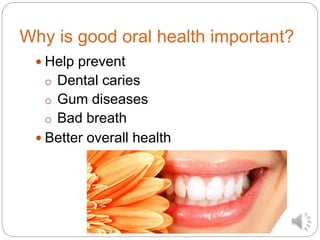
๏‚— Help prevent
o Dental caries
o Gum diseases
o Bad breath
๏‚— Better overall health
Bad oral
health sounds
scary!
What can I do
to fix it?
Donโ€™t worry.
Itโ€™s simple.
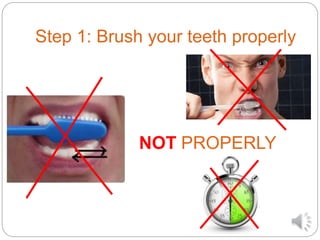
Step 1: Brush your teeth properly
PROPERLYNOT
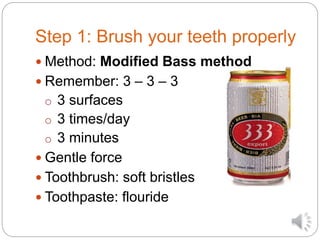
Step 1: Brush your teeth properly
๏‚— Method: Modified Bass method
๏‚— Remember: 3 โ€“ 3 โ€“ 3
o 3 surfaces
o 3 times/day
o 3 minutes
๏‚— Gentle force
๏‚— Toothbrush: soft bristles
๏‚— Toothpaste: flouride
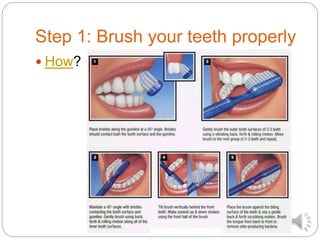
Step 1: Brush your teeth properly
๏‚— How?
Nguyen Van Thai, DDS
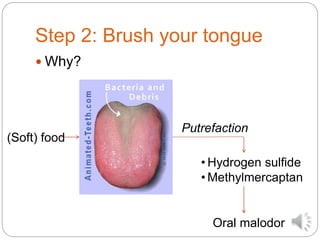
Step 2: Brush your tongue
๏‚— Why?
(Soft) food
โ€ข Hydrogen sulfide
โ€ข Methylmercaptan
Putrefaction
Oral malodor
Step 2: Brush your tongue
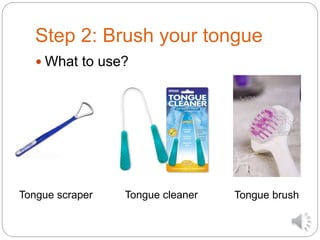
๏‚— What to use?
Tongue cleanerTongue scraper Tongue brush
Step 2: Brush your tongue
๏‚— How?
o Place your tongue as far as possible
o Place the tongue cleaner as far
posterior as possible
o Pull the cleaner forward slowly
o Remove the debris from the device
under running water
o Repeat until further debris cannot be
removed
o Clean and dry the device
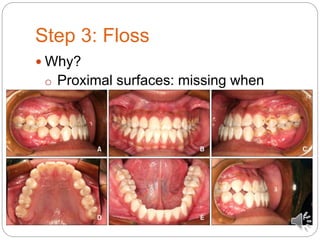
Step 3: Floss
๏‚— Why?
o Proximal surfaces: missing when
brushing
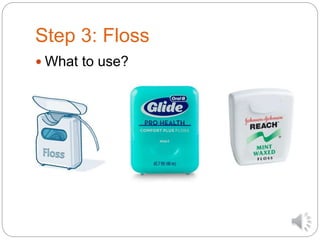
Step 3: Floss
๏‚— What to use?
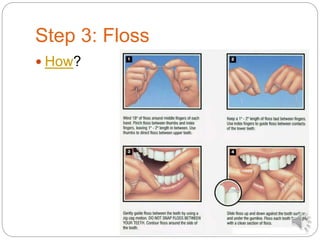
Step 3: Floss
๏‚— How?
Step 4: Rinsing
๏‚— Optional
๏‚— 2 types
o Cosmetic
o Therapeutic: regulated by the FDA and
approved by the ADA
โˆ’ Antiplaque/Antigingivitis rinses
โˆ’ Anticavity fluoride rinses
๏‚— Alcohol / Non-alcohol ?
FDA: Food and Drug Administratio
ADA: American Dental Association
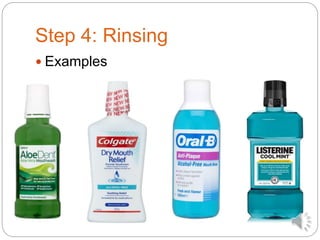
Step 4: Rinsing
๏‚— Examples
Student task
๏‚— Look at your first note and correct
mistakes if any
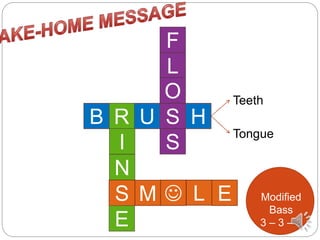
F
L
O
S
S
URB H
I
N
S
E
M ๏Š L E Modified
Bass
3 โ€“ 3 โ€“ 3
Tongue
Teeth
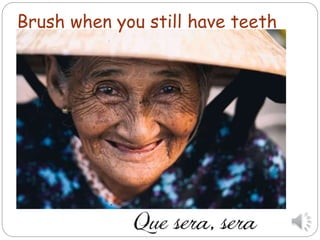
Brush when you still have teeth

Dental education

  • 2.
  • 3.
    Objectives By the endof this lesson you can ๏‚— Demonstrate steps of brushing with proper method precisely ๏‚— Use floss to remove debris between teeth effectively ๏‚— Choose mouth rinse suitable with your oral condition ๏‚— Instruct your family members to brush properly
  • 4.
    Student task ๏‚— Writedown on your draft how you maintain good oral hygiene ๏‚— Why is it important? ๏‚— Discuss with your partner(s)
  • 5.
    Why is goodoral health important? ๏‚— Help prevent o Dental caries o Gum diseases o Bad breath ๏‚— Better overall health
  • 6.
    Bad oral health sounds scary! Whatcan I do to fix it? Donโ€™t worry. Itโ€™s simple.
  • 7.
    Step 1: Brushyour teeth properly PROPERLYNOT
  • 8.
    Step 1: Brushyour teeth properly ๏‚— Method: Modified Bass method ๏‚— Remember: 3 โ€“ 3 โ€“ 3 o 3 surfaces o 3 times/day o 3 minutes ๏‚— Gentle force ๏‚— Toothbrush: soft bristles ๏‚— Toothpaste: flouride
  • 9.
    Step 1: Brushyour teeth properly ๏‚— How?
  • 10.
  • 11.
    Step 2: Brushyour tongue ๏‚— Why? (Soft) food โ€ข Hydrogen sulfide โ€ข Methylmercaptan Putrefaction Oral malodor
  • 12.
    Step 2: Brushyour tongue ๏‚— What to use? Tongue cleanerTongue scraper Tongue brush
  • 13.
    Step 2: Brushyour tongue ๏‚— How? o Place your tongue as far as possible o Place the tongue cleaner as far posterior as possible o Pull the cleaner forward slowly o Remove the debris from the device under running water o Repeat until further debris cannot be removed o Clean and dry the device
  • 14.
    Step 3: Floss ๏‚—Why? o Proximal surfaces: missing when brushing
  • 15.
  • 16.
  • 17.
    Step 4: Rinsing ๏‚—Optional ๏‚— 2 types o Cosmetic o Therapeutic: regulated by the FDA and approved by the ADA โˆ’ Antiplaque/Antigingivitis rinses โˆ’ Anticavity fluoride rinses ๏‚— Alcohol / Non-alcohol ? FDA: Food and Drug Administratio ADA: American Dental Association
  • 18.
  • 19.
    Student task ๏‚— Lookat your first note and correct mistakes if any
  • 20.
    F L O S S URB H I N S E M ๏ŠL E Modified Bass 3 โ€“ 3 โ€“ 3 Tongue Teeth
  • 21.
    Brush when youstill have teeth

Editor's Notes

  • #3ย http://drboutin.com/oral-hygiene-instruction/ http://www.dentistryiq.com/articles/2011/05/oral-hygiene-care.html http://www.nature.com/bdj/journal/v196/n2/full/4810891a.html http://www.ncbi.nlm.nih.gov/pmc/articles/PMC4072374/ http://orthocj.com/2007/05/the-importance-of-oral-hygiene-in-orthodontic-treatment/ http://www.simplestepsdental.com/SS/ihtSS/r.==/st.32578/t.32586/pr.3.html If you thought brushing and flossing were important before you got bracesโ€ฆwell, you were right. But people undergoing orthodontic treatment need to be even more dedicated to good oral hygiene. "Braces trap food very easily, which contributes to plaque formation," says Thomas Cangialosi, D.D.S. "If plaque is not carefully removed from teeth and from around braces, patients run the risk of developing gum disease, dental decay and bad breath." Dr. Cangialosi is chairman and professor of Orthodontics at the University of Medicine and Dentistry of New Jersey.
  • #9ย http://imuoralhealth.blogspot.com.ee/2010/07/importance-and-various-tooth-brushing.html
  • #10ย http://tube.medchrome.com/2013/04/brushing-technique-bass-and-modified.html
  • #11ย http://drboutin.com/oral-hygiene-instruction/ http://www.dentistryiq.com/articles/2011/05/oral-hygiene-care.html http://www.nature.com/bdj/journal/v196/n2/full/4810891a.html http://www.ncbi.nlm.nih.gov/pmc/articles/PMC4072374/ http://orthocj.com/2007/05/the-importance-of-oral-hygiene-in-orthodontic-treatment/ http://www.simplestepsdental.com/SS/ihtSS/r.==/st.32578/t.32586/pr.3.html If you thought brushing and flossing were important before you got bracesโ€ฆwell, you were right. But people undergoing orthodontic treatment need to be even more dedicated to good oral hygiene. "Braces trap food very easily, which contributes to plaque formation," says Thomas Cangialosi, D.D.S. "If plaque is not carefully removed from teeth and from around braces, patients run the risk of developing gum disease, dental decay and bad breath." Dr. Cangialosi is chairman and professor of Orthodontics at the University of Medicine and Dentistry of New Jersey.