Demographic
Transition Model
Sem- V
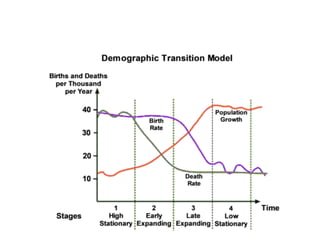
• Stage 1 - High Fluctuating
• Birth Rate and Death rate are both high. Population growth is slow and fluctuating.
• Reasons
• Birth Rate is high as a result of:
• Lack of family planning
• High Infant Mortality Rate: putting babies in the 'bank'
• Need for workers in agriculture
• Religious beliefs
• Children as economic assets
•
Death Rate is high because of:
• High levels of disease
• Famine
• Lack of clean water and sanitation
• Lack of health care
• War
• Competition for food from predators such as rats
• Lack of education
•
Typical of Britain in the 18th century and the Least Economically Developed Countries (LEDC's) today.
• Stage 2 - Early Expanding
• Birth Rate remains high. Death Rate is falling. Population begins to
rise steadily.
• Reasons
• Death Rate is falling as a result of:
• Improved health care (e.g. Smallpox Vaccine)
• Improved Hygiene (Water for drinking boiled)
• Improved sanitation
• Improved food production and storage
• Improved transport for food
• Decreased Infant Mortality Rates
•
Typical of Britain in 19th century; Bangladesh; Nigeria
• Stage 3 - Late Expanding
• Birth Rate starts to fall. Death Rate continues to fall.
Population rising.
• Reasons
• Family planning available
• Lower Infant Mortality Rate
• Increased mechanization reduces need for workers
• Increased standard of living
• Changing status of women
•
Typical of Britain in late 19th and early 20th century; China;
Brazil
• Stage 4 - Low Fluctuating
• Birth Rate and Death Rate both low.
Population steady.
• Typical of USA; Sweden; Japan; Britain
•
• Demographic Transition Model Applied Revision Table
• Area Birth Rate Reason Death Rate Reason LEDCs High No contraception
Couples have many babies to compensate for the high death rate caused by poor health care
Large families need to work on the land to contribute to family income
Children look after old
Religious reasons High Poor medical facilities
Disease
Poor nutrition
High Infant mortality NICs High/
Decreasing People are used to having many children. Takes time for culture to change
Changing status of women Decreasing As an economy develops money becomes available for better health care
Housing improves
Better childcare MEDCs Low Children are expensive
People know their children are going to survive so they can keep their families small
Widely available contraceptives
Changing status of women Low Better health care
Be
Demograpi7388c Transition Model ppt.pptx

Demograpi7388c Transition Model ppt.pptx

  • 1.
  • 2.
    • Stage 1- High Fluctuating • Birth Rate and Death rate are both high. Population growth is slow and fluctuating. • Reasons • Birth Rate is high as a result of: • Lack of family planning • High Infant Mortality Rate: putting babies in the 'bank' • Need for workers in agriculture • Religious beliefs • Children as economic assets • Death Rate is high because of: • High levels of disease • Famine • Lack of clean water and sanitation • Lack of health care • War • Competition for food from predators such as rats • Lack of education • Typical of Britain in the 18th century and the Least Economically Developed Countries (LEDC's) today.
  • 3.
    • Stage 2- Early Expanding • Birth Rate remains high. Death Rate is falling. Population begins to rise steadily. • Reasons • Death Rate is falling as a result of: • Improved health care (e.g. Smallpox Vaccine) • Improved Hygiene (Water for drinking boiled) • Improved sanitation • Improved food production and storage • Improved transport for food • Decreased Infant Mortality Rates • Typical of Britain in 19th century; Bangladesh; Nigeria
  • 4.
    • Stage 3- Late Expanding • Birth Rate starts to fall. Death Rate continues to fall. Population rising. • Reasons • Family planning available • Lower Infant Mortality Rate • Increased mechanization reduces need for workers • Increased standard of living • Changing status of women • Typical of Britain in late 19th and early 20th century; China; Brazil
  • 5.
    • Stage 4- Low Fluctuating • Birth Rate and Death Rate both low. Population steady. • Typical of USA; Sweden; Japan; Britain •
  • 6.
    • Demographic TransitionModel Applied Revision Table • Area Birth Rate Reason Death Rate Reason LEDCs High No contraception Couples have many babies to compensate for the high death rate caused by poor health care Large families need to work on the land to contribute to family income Children look after old Religious reasons High Poor medical facilities Disease Poor nutrition High Infant mortality NICs High/ Decreasing People are used to having many children. Takes time for culture to change Changing status of women Decreasing As an economy develops money becomes available for better health care Housing improves Better childcare MEDCs Low Children are expensive People know their children are going to survive so they can keep their families small Widely available contraceptives Changing status of women Low Better health care Be