DEM 741: Seminar in Governance and Managemant of
Educational Management
Report: Human Resource Management:
University As An Academic Community
BY:
Ma. Shiela T. Vera
Presented To:
Dr. Theresita Atienza
Second Semester/ S.Y. 2014-2015
Concept
Human Resource
Management
Concept
University As
Academic Community
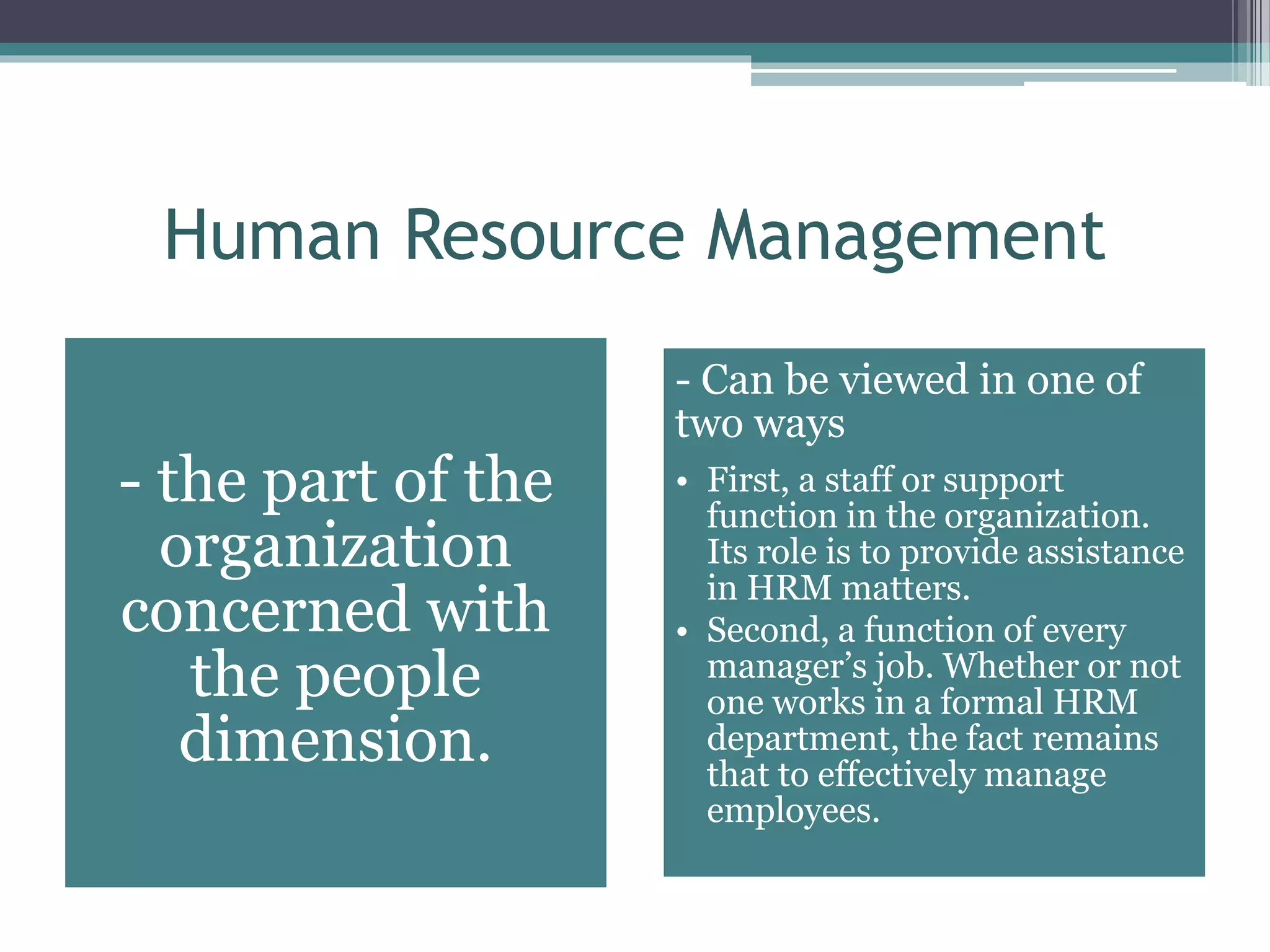
Human Resource Management
- the part of the
organization
concerned with
the people
dimension.
- Can be viewed in one of
two ways
• First, a staff or support
function in the organization.
Its role is to provide assistance
in HRM matters.
• Second, a function of every
manager’s job. Whether or not
one works in a formal HRM
department, the fact remains
that to effectively manage
employees.
Human Resource Management
Every organization is
made up of people.
Acquiring their
services, developing
their skills, motivating
them to high level of
performance and
ensuring that they
maintain their
commitment to the
organization are
essential to achieving
organizational
objectives.
This is true regardless
of the type of
organization-
government, business,
education, health,
recreation, or social
action. Hiring and
keeping good people is
critical to the success
of every organization.
HRM FOUR BASIC FUNCTIONS
 Staffing
Training and Development
Motivation
Maintenance
University as an Academic Community
UNESCO: ACADEMIC STAFF
DEVELOPMENT
UNESCO’s aim in the field of
staff development is to promote
co-operative and innovative
action so as to strengthen the
quality and relevance of higher
education, both now and in the
coming years.
The purpose of this book is to
illustrate how this aim is being
translated into action. It
assembles a broad range of
current experiences supported
by UN ESCO and related to staff
development in higher
education.
It is hoped that, as a
result, institutions may be
better informed in terms
of present practices and
thus plan their own future
activities on the basis of a
wider perspective.
Higher Education Staff Development For
The 21st Century By UNESCO
Scope:
In situating this book in relation to the main
trends and issues of higher education today, the
forces directing the process of change can be
clearly discerned:
 The increases demand for access to higher
education.
 The call for the diversification of this domain
 The assurance of quality and relevance of
higher education
Higher Education Staff Development
For The 21st Century By UNESCO
 The reform of higher education systems,
including the management of change by
institution especially universities.
 The significant reduction in funding for this
subsector
 The links between higher education and the
labour market.
 The internalization of higher education
resulting in increased inter-university co-
operation.
To offer a comprehensive view of the
current context, the chapter organize
three main themes:
Academic Staff Development
Higher Education Teaching
Networks
Managerial and Human Resource
Development
UNESCO’s Experience in Higher Education
Staff Development
This programme promotes the high-level
training and research capacities of
universities in priority fields related to the
development process.
… institutions in the developing world face
particularly pressing problems: on the one
hand , they require highly trained staff with
strong research capacities especially in
scientific and technological disciplines;
on the other hand, it is sometimes
difficult to release good middle-level
personnel who would like to take an
advanced degree because these people
are needed to assure heavy teaching
loads.
In addition, those who do leave to
study abroad can be caught up in the
Brain Drain phenomenon if better
opportunities are found elsewhere
A new focus in this initiative is the
University Volunteers Scheme which
UNESCO is now developing with the United
Nations Volunteers and the Council for
International Educational exchange. This
will offer opportunities to academics on
sabbatical or who recently retired to place
their expertise at the service of higher
education institutions in the developing
world.
Higher Education Teaching Development
Networks
UNESCO has initiated action in all regions
of the world which is designed to enhance
the quality and relevance of the entire
teaching and learning process at the
tertiary level.
o
While each mechanism has
developed its own specific
program of action, they share
two common objectives:
To improve the quality and
relevance of university teaching
in order to adequately meet the
changing needs of society.
To enhance the contribution of
higher education to the education
system as a whole .Here, the links
with basic and secondary teaching
are clear, involving areas such as
teacher training programmes and
the contribution of universities to
literacy.
Co-operative Partnership for
Managerial Staff Development
UNESCO’s action in this area responds
directly to the current situation faced by
institutional leaders and their personnel.
Today, the financial resources allocated
by governments for higher education
generally tend to remain static or to be
reduced. It would seem that all are being
subjected to more stringent
accountability measures.
Co-operative Partnership for
Managerial Staff Development
In addition, an ageing professoriate
and complexity surrounding the tenure
question constitute thorny issues for
higher education managers. Generally,
institutions are required to do more
with less- hence the necessity to
optimize the means available.
Co-operative Partnership for
Managerial Staff Development
The use of new Information and
Communication Technology (ICT) is
another priority area of institutional
management. UNESCO promotes
research, training and information
exchange to strengthen the expertise of
staff whether academic or
administrative.
Co-operative Partnership for
Managerial Staff Development
must therefore cover all those areas
where additional skills are required to
enhance and complement the teaching,
training and research expertise already
acquired.
Lastly and most importantly,
Higher Education staff development
must be situated as part of the
capacity-building process. This
balances education and training so
that each individual realizes his or
her talents in order to accede to a
better quality of life –as such, it is a
tenet of social and human
development.
In order to survive and function well,
higher education personnel must be
confident, competent and pro-active
in three essential areas:
-fields of knowledge
-the pedagogical process
-the managerial skills
Such an integrated vision requires
strong and serious emphasis on staff
development. This focus also serves
to reiterate the importance of
human resource development as the
basic motor and value of any
successful enterprise.
Within the parlance of the United
Nations system, this concept is known
as capacity-building-that activity
which merges broad educational skills
with highly specialized training to
foster human and social development
both in the individual and in societies.
There emerges a more holistic
vision of higher education
institutions and their staff- thus
suggesting a context where
present activities should be
designed to prepare the future.
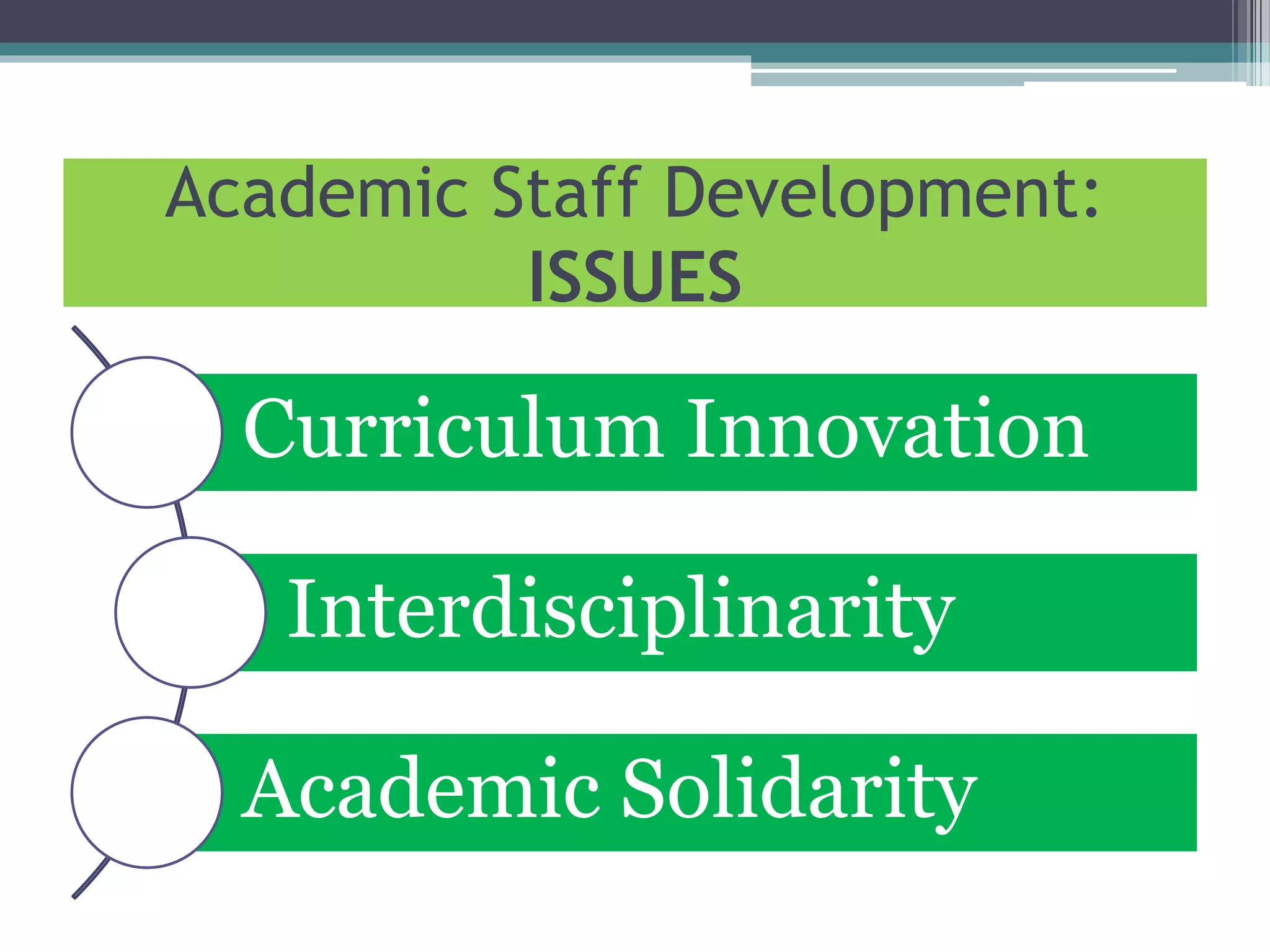
Academic Staff Development:
ISSUES
Curriculum Innovation
Interdisciplinarity
Academic Solidarity
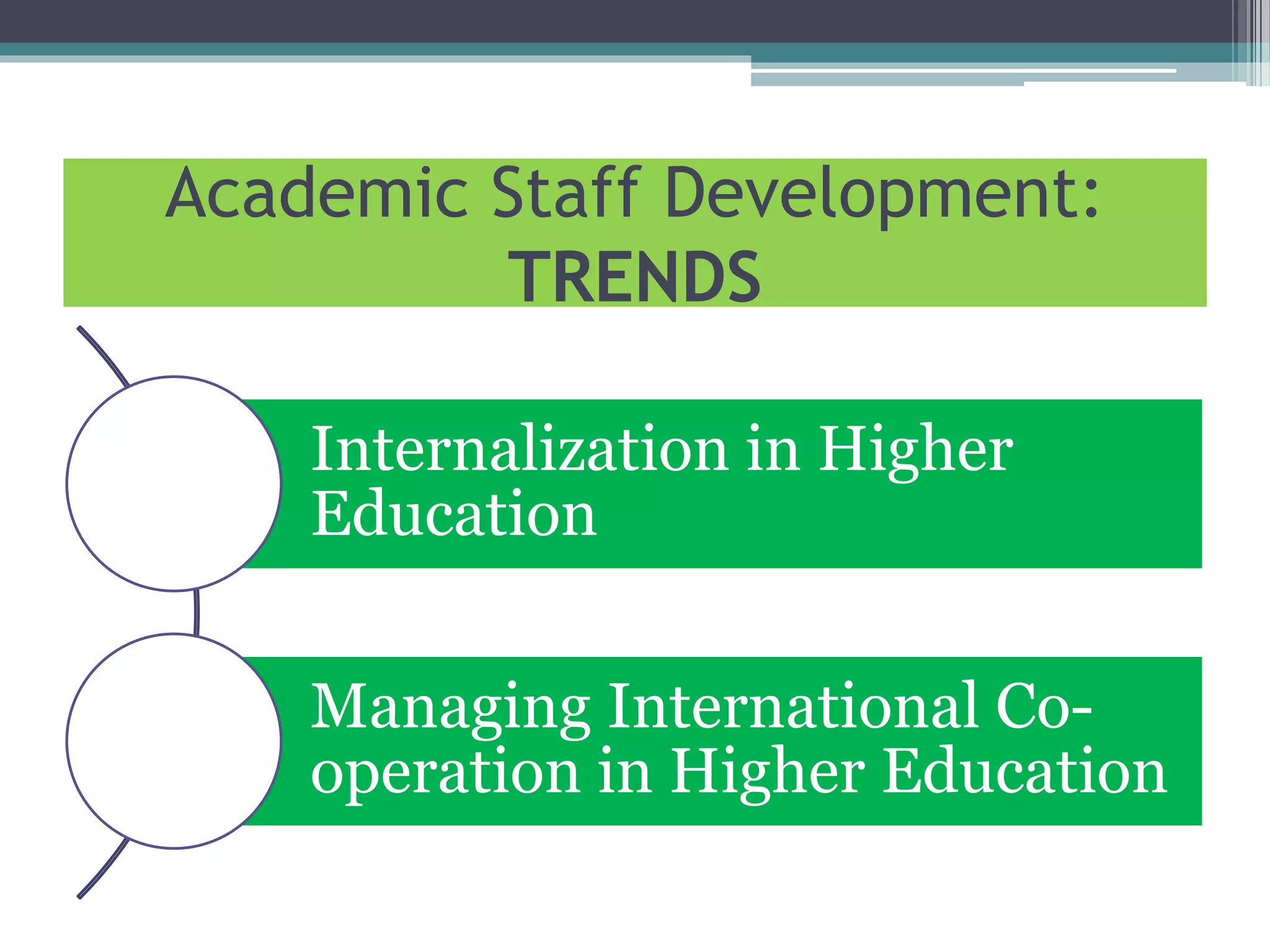
Academic Staff Development:
TRENDS
Internalization in Higher
Education
Managing International Co-
operation in Higher Education
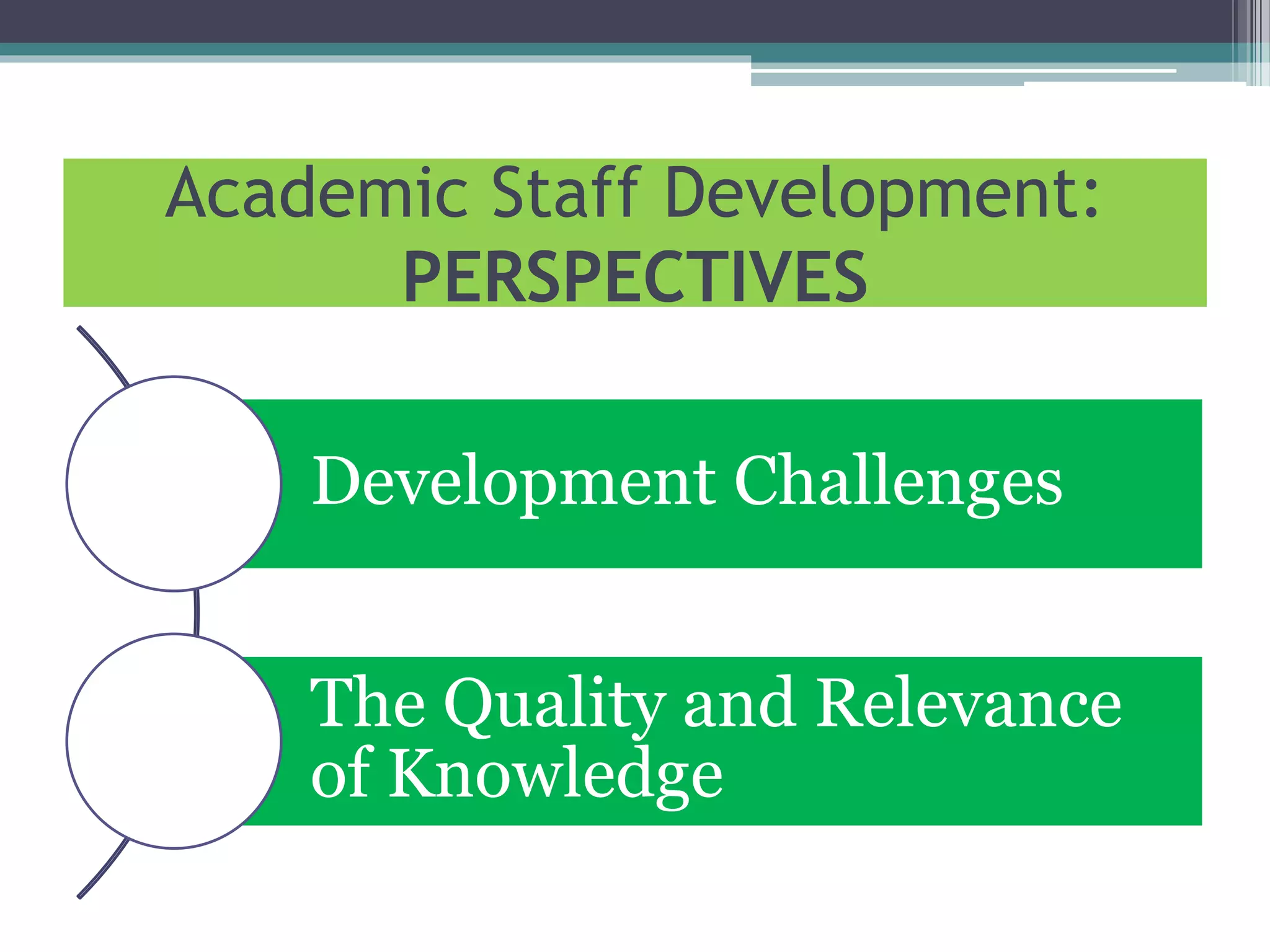
Academic Staff Development:
PERSPECTIVES
Development Challenges
The Quality and Relevance
of Knowledge
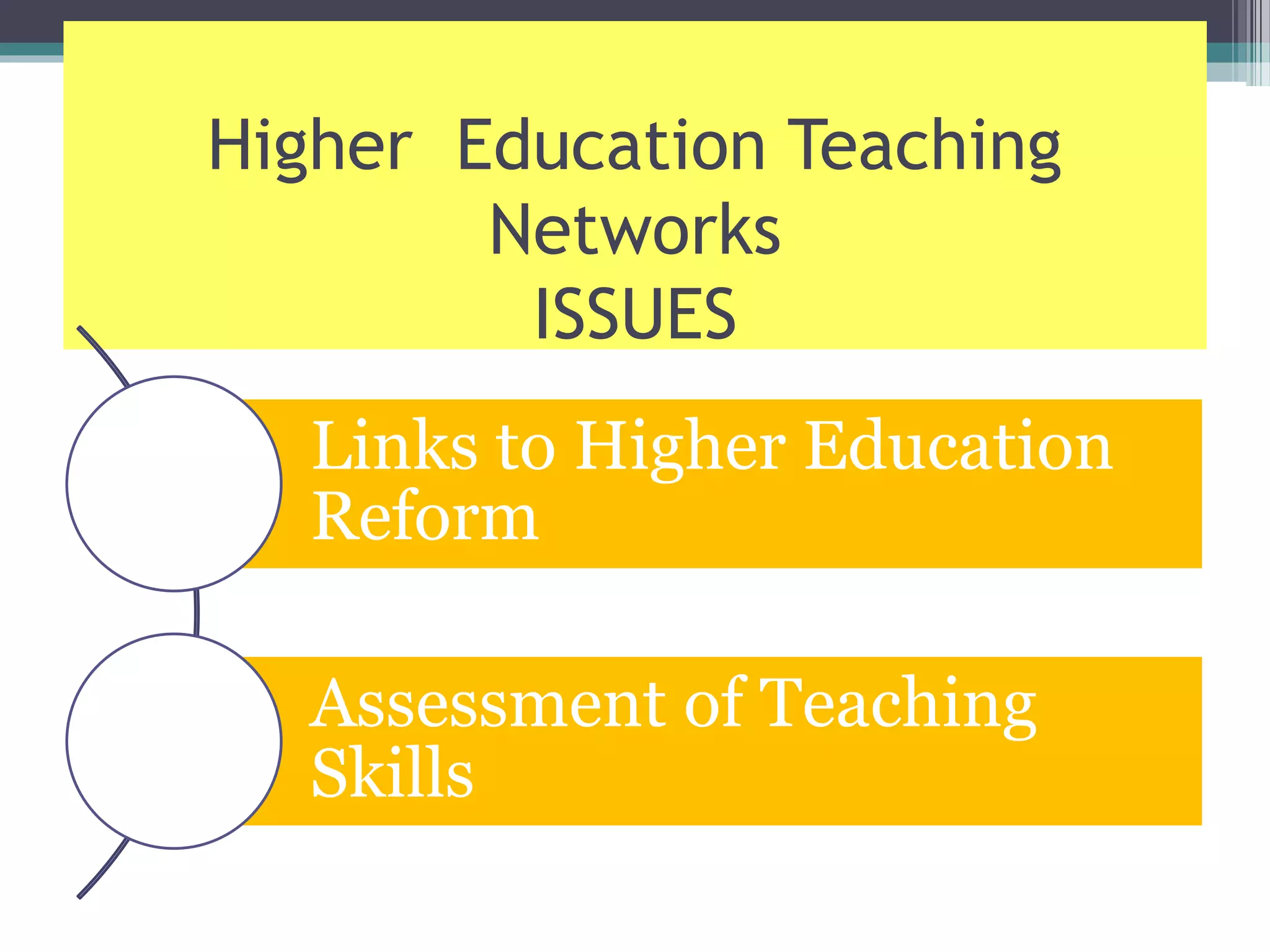
Higher Education Teaching
Networks
ISSUES
Links to Higher Education
Reform
Assessment of Teaching
Skills
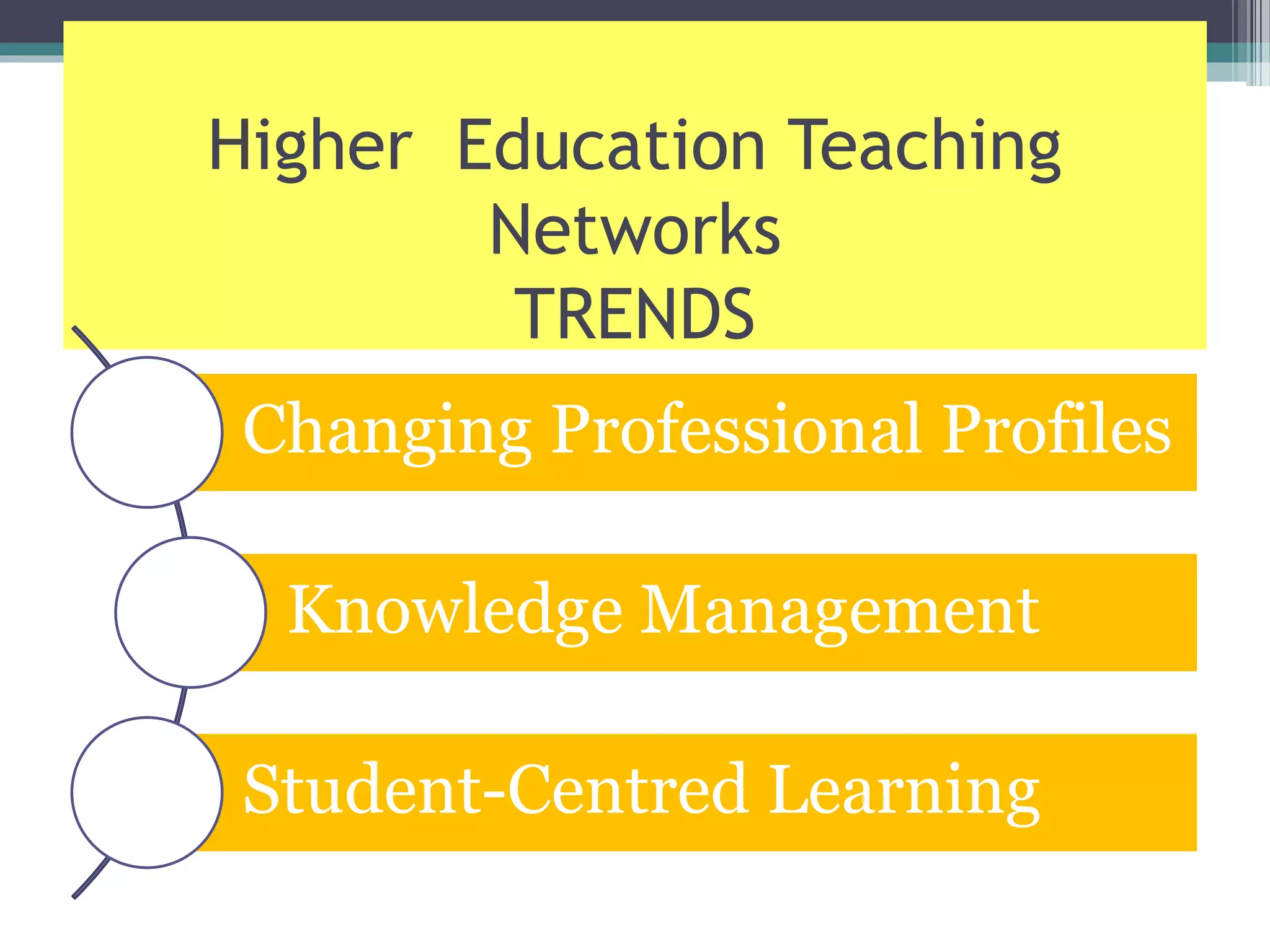
Higher Education Teaching
Networks
TRENDS
Changing Professional Profiles
Knowledge Management
Student-Centred Learning
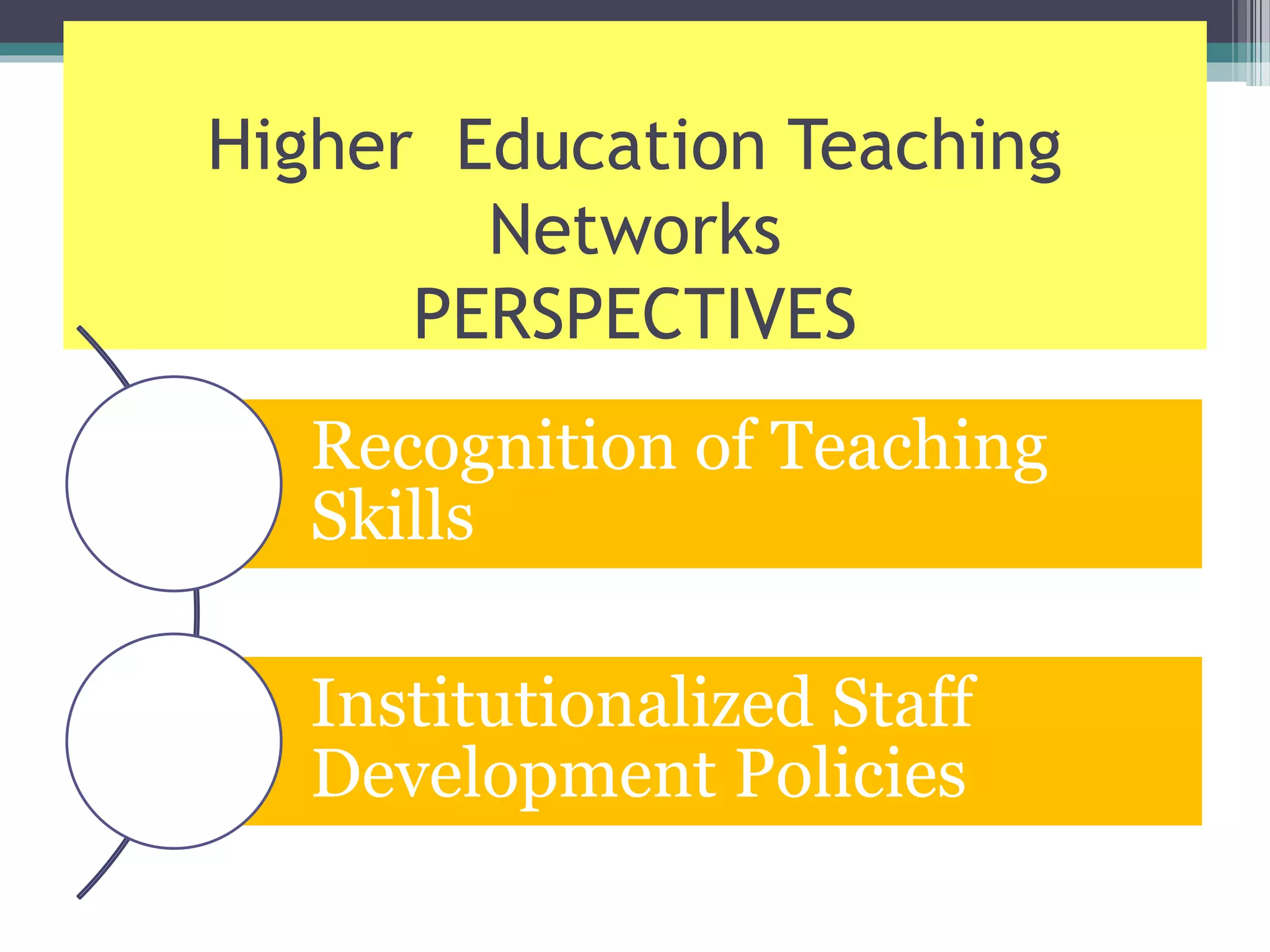
Higher Education Teaching
Networks
PERSPECTIVES
Recognition of Teaching
Skills
Institutionalized Staff
Development Policies
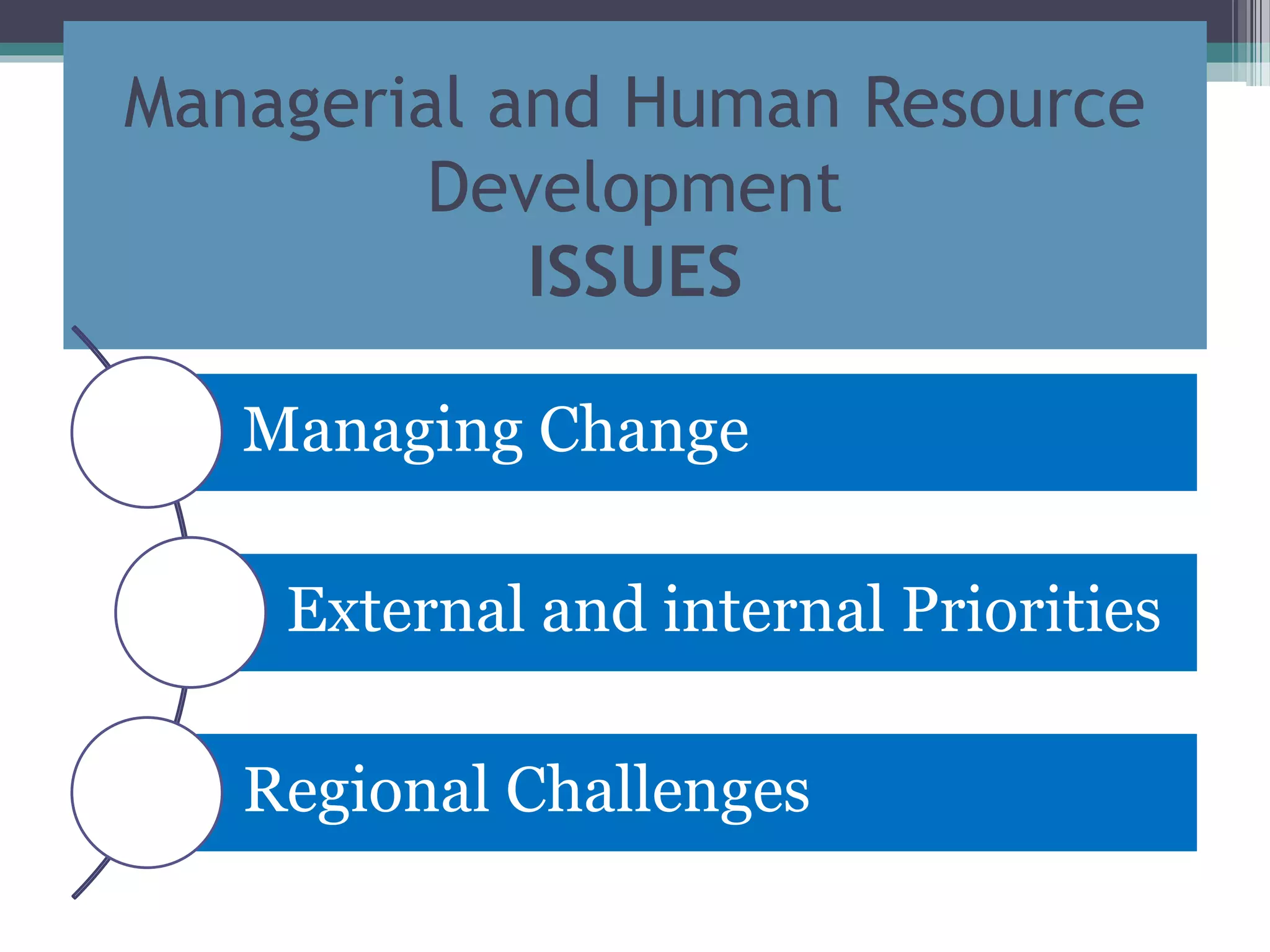
Managerial and Human Resource
Development
ISSUES
Managing Change
External and internal Priorities
Regional Challenges
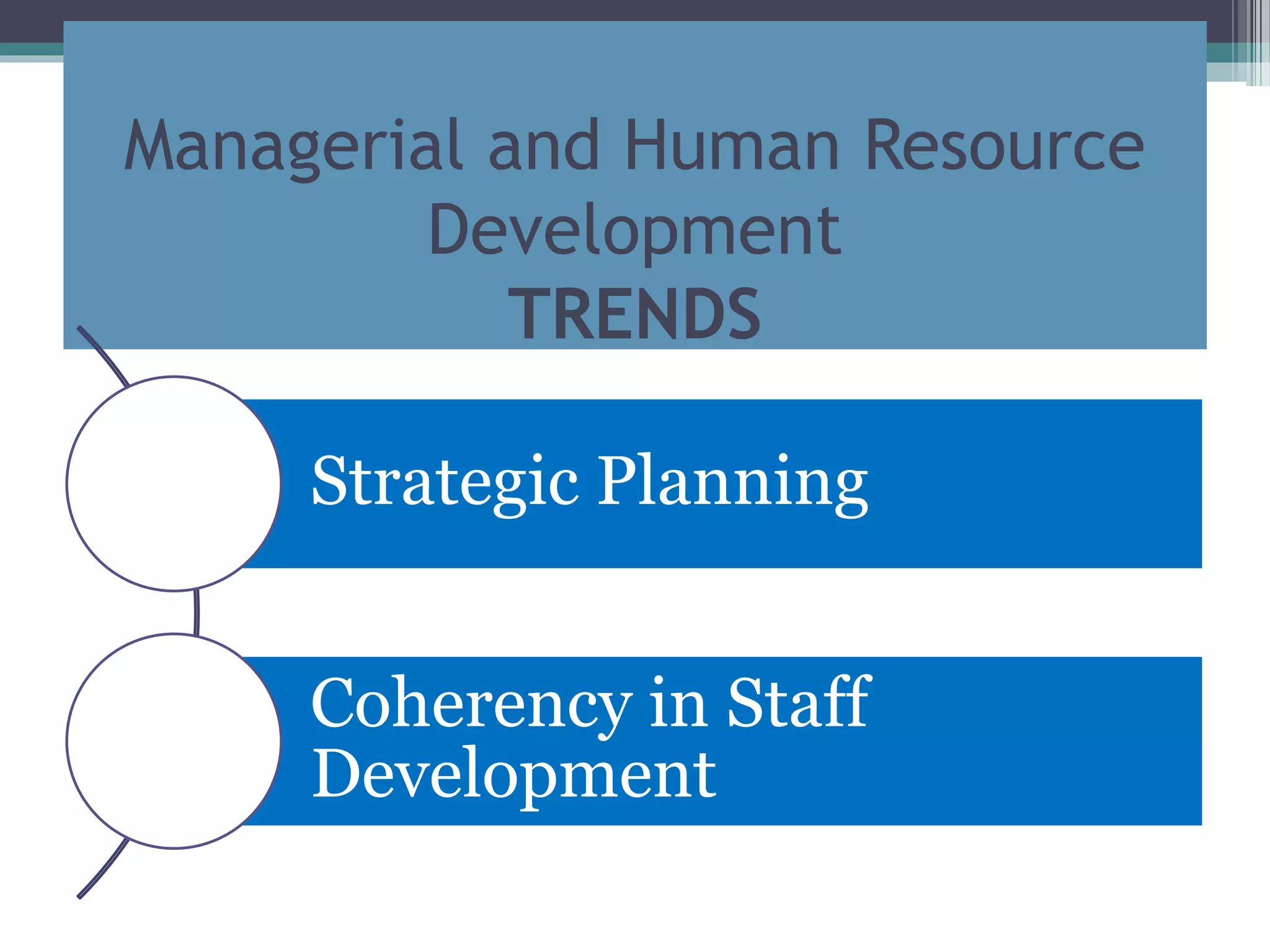
Managerial and Human Resource
Development
TRENDS
Strategic Planning
Coherency in Staff
Development
Managerial and Human Resource
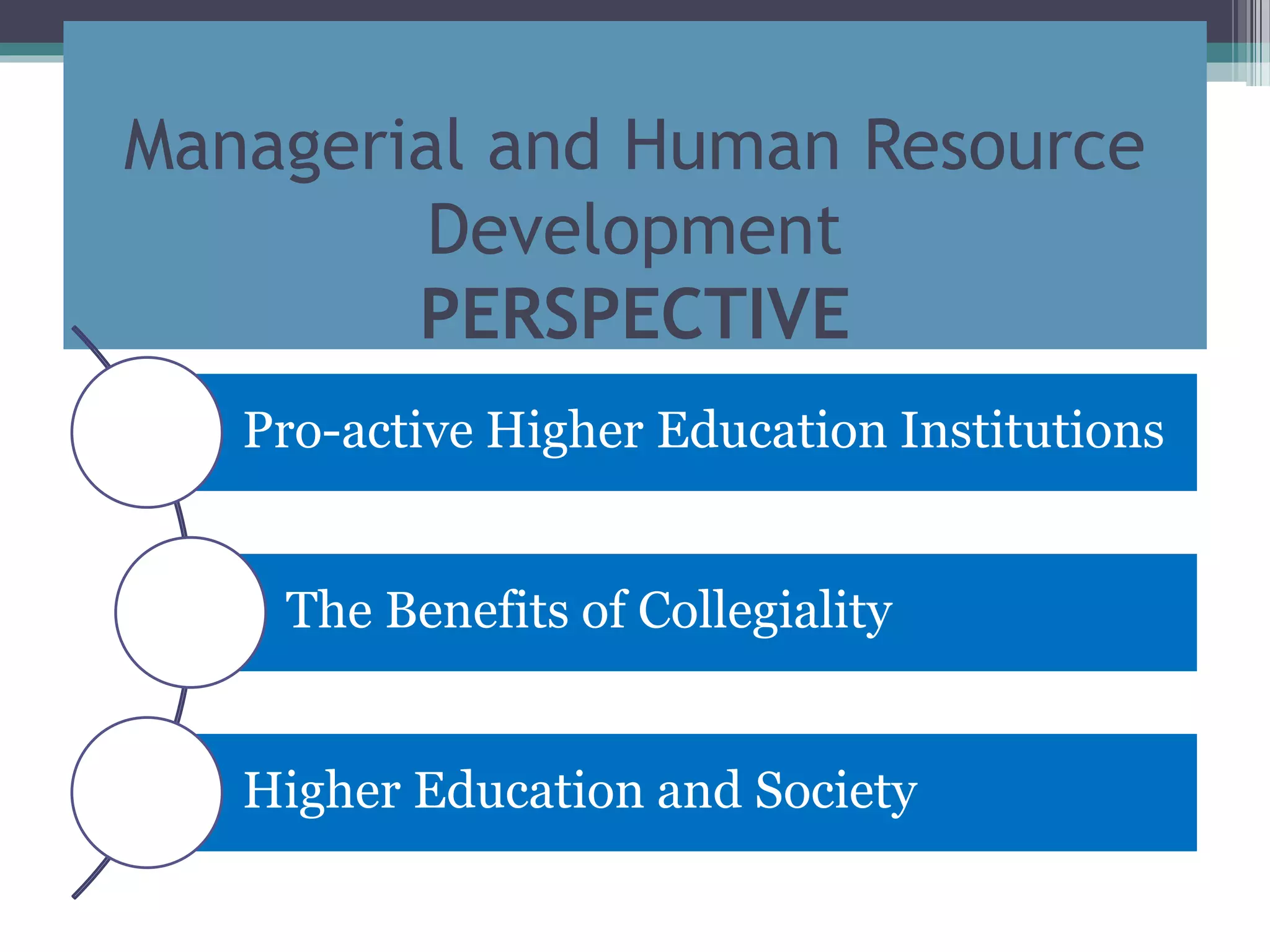
Development
PERSPECTIVE
Pro-active Higher Education Institutions
The Benefits of Collegiality
Higher Education and Society
CONCLUSION
This book therefore seeks to present
innovative practices in higher
education staff development so that
these may be shared- for emulation
or adaptation as may be deemed
appropriate. Overall, these case
studies emphasize three key
conclusions:
CONCLUSION
1. – that staff development, as
fundamental element of
institutional quality, must be part
of an integrated approach which
encompasses all types of training
necessary for enhanced
effectiveness and efficiency
CONCLUSION
2.- that investment in human
capital has become a vital strategy
in tackling the main issues
confronting higher education and
efficiency
CONCLUSION
3.- that staff development helps
assure the contribution of higher
education to capacity-building,
and thereby to the human and
social development processes
Staff development has emerged as a
key to the acquisition of these
capacities which permit higher
education to realize its optimal
contribution to society. In the final
analysis, successful action in this field
attests to the intent of institutions to
invest in their human resources-a
dynamic Higher Education Staff
Development Policy being the primary
manifestation of such a commitment.
Reference:
Human Resource Management by David A
DeCenzo et al.
HUMAN RESOURCE MANAGEMENT:
PERSONNEL ISSUES by UNESCO
HIGHER EDUCATION STAFF DEVELOPMENT :
DIRECTIONS FOR THE TWENTY-FIRST
CENTURY BY UNESCO
Thank You!GOD BLESS YOU ALL!!!!
Our natural tendency
is to grasp what we
have instead of freely
giving to those in
need. The challenge
of riches is living with
thankful hearts to
God and open hands
to others-
David McCasland

Dem 741 staff development

  • 1.
    DEM 741: Seminarin Governance and Managemant of Educational Management Report: Human Resource Management: University As An Academic Community BY: Ma. Shiela T. Vera Presented To: Dr. Theresita Atienza Second Semester/ S.Y. 2014-2015
  • 2.
  • 3.
  • 4.
    Human Resource Management -the part of the organization concerned with the people dimension. - Can be viewed in one of two ways • First, a staff or support function in the organization. Its role is to provide assistance in HRM matters. • Second, a function of every manager’s job. Whether or not one works in a formal HRM department, the fact remains that to effectively manage employees.
  • 5.
    Human Resource Management Everyorganization is made up of people. Acquiring their services, developing their skills, motivating them to high level of performance and ensuring that they maintain their commitment to the organization are essential to achieving organizational objectives. This is true regardless of the type of organization- government, business, education, health, recreation, or social action. Hiring and keeping good people is critical to the success of every organization.
  • 6.
    HRM FOUR BASICFUNCTIONS  Staffing Training and Development Motivation Maintenance
  • 7.
    University as anAcademic Community UNESCO: ACADEMIC STAFF DEVELOPMENT
  • 8.
    UNESCO’s aim inthe field of staff development is to promote co-operative and innovative action so as to strengthen the quality and relevance of higher education, both now and in the coming years.
  • 9.
    The purpose ofthis book is to illustrate how this aim is being translated into action. It assembles a broad range of current experiences supported by UN ESCO and related to staff development in higher education.
  • 10.
    It is hopedthat, as a result, institutions may be better informed in terms of present practices and thus plan their own future activities on the basis of a wider perspective.
  • 11.
    Higher Education StaffDevelopment For The 21st Century By UNESCO Scope: In situating this book in relation to the main trends and issues of higher education today, the forces directing the process of change can be clearly discerned:  The increases demand for access to higher education.  The call for the diversification of this domain  The assurance of quality and relevance of higher education
  • 12.
    Higher Education StaffDevelopment For The 21st Century By UNESCO  The reform of higher education systems, including the management of change by institution especially universities.  The significant reduction in funding for this subsector  The links between higher education and the labour market.  The internalization of higher education resulting in increased inter-university co- operation.
  • 13.
    To offer acomprehensive view of the current context, the chapter organize three main themes: Academic Staff Development Higher Education Teaching Networks Managerial and Human Resource Development
  • 14.
    UNESCO’s Experience inHigher Education Staff Development This programme promotes the high-level training and research capacities of universities in priority fields related to the development process. … institutions in the developing world face particularly pressing problems: on the one hand , they require highly trained staff with strong research capacities especially in scientific and technological disciplines;
  • 15.
    on the otherhand, it is sometimes difficult to release good middle-level personnel who would like to take an advanced degree because these people are needed to assure heavy teaching loads. In addition, those who do leave to study abroad can be caught up in the Brain Drain phenomenon if better opportunities are found elsewhere
  • 16.
    A new focusin this initiative is the University Volunteers Scheme which UNESCO is now developing with the United Nations Volunteers and the Council for International Educational exchange. This will offer opportunities to academics on sabbatical or who recently retired to place their expertise at the service of higher education institutions in the developing world.
  • 17.
    Higher Education TeachingDevelopment Networks UNESCO has initiated action in all regions of the world which is designed to enhance the quality and relevance of the entire teaching and learning process at the tertiary level.
  • 18.
    o While each mechanismhas developed its own specific program of action, they share two common objectives: To improve the quality and relevance of university teaching in order to adequately meet the changing needs of society.
  • 19.
    To enhance thecontribution of higher education to the education system as a whole .Here, the links with basic and secondary teaching are clear, involving areas such as teacher training programmes and the contribution of universities to literacy.
  • 20.
    Co-operative Partnership for ManagerialStaff Development UNESCO’s action in this area responds directly to the current situation faced by institutional leaders and their personnel. Today, the financial resources allocated by governments for higher education generally tend to remain static or to be reduced. It would seem that all are being subjected to more stringent accountability measures.
  • 21.
    Co-operative Partnership for ManagerialStaff Development In addition, an ageing professoriate and complexity surrounding the tenure question constitute thorny issues for higher education managers. Generally, institutions are required to do more with less- hence the necessity to optimize the means available.
  • 22.
    Co-operative Partnership for ManagerialStaff Development The use of new Information and Communication Technology (ICT) is another priority area of institutional management. UNESCO promotes research, training and information exchange to strengthen the expertise of staff whether academic or administrative.
  • 23.
    Co-operative Partnership for ManagerialStaff Development Managerial Staff Development must therefore cover all those areas where additional skills are required to enhance and complement the teaching, training and research expertise already acquired.
  • 24.
    Lastly and mostimportantly, Higher Education staff development must be situated as part of the capacity-building process. This balances education and training so that each individual realizes his or her talents in order to accede to a better quality of life –as such, it is a tenet of social and human development.
  • 25.
    In order tosurvive and function well, higher education personnel must be confident, competent and pro-active in three essential areas: -fields of knowledge -the pedagogical process -the managerial skills
  • 26.
    Such an integratedvision requires strong and serious emphasis on staff development. This focus also serves to reiterate the importance of human resource development as the basic motor and value of any successful enterprise.
  • 27.
    Within the parlanceof the United Nations system, this concept is known as capacity-building-that activity which merges broad educational skills with highly specialized training to foster human and social development both in the individual and in societies.
  • 28.
    There emerges amore holistic vision of higher education institutions and their staff- thus suggesting a context where present activities should be designed to prepare the future.
  • 29.
    Academic Staff Development: ISSUES CurriculumInnovation Interdisciplinarity Academic Solidarity
  • 30.
    Academic Staff Development: TRENDS Internalizationin Higher Education Managing International Co- operation in Higher Education
  • 31.
    Academic Staff Development: PERSPECTIVES DevelopmentChallenges The Quality and Relevance of Knowledge
  • 32.
    Higher Education Teaching Networks ISSUES Linksto Higher Education Reform Assessment of Teaching Skills
  • 33.
    Higher Education Teaching Networks TRENDS ChangingProfessional Profiles Knowledge Management Student-Centred Learning
  • 34.
    Higher Education Teaching Networks PERSPECTIVES Recognitionof Teaching Skills Institutionalized Staff Development Policies
  • 35.
    Managerial and HumanResource Development ISSUES Managing Change External and internal Priorities Regional Challenges
  • 36.
    Managerial and HumanResource Development TRENDS Strategic Planning Coherency in Staff Development
  • 37.
    Managerial and HumanResource Development PERSPECTIVE Pro-active Higher Education Institutions The Benefits of Collegiality Higher Education and Society
  • 38.
    CONCLUSION This book thereforeseeks to present innovative practices in higher education staff development so that these may be shared- for emulation or adaptation as may be deemed appropriate. Overall, these case studies emphasize three key conclusions:
  • 39.
    CONCLUSION 1. – thatstaff development, as fundamental element of institutional quality, must be part of an integrated approach which encompasses all types of training necessary for enhanced effectiveness and efficiency
  • 40.
    CONCLUSION 2.- that investmentin human capital has become a vital strategy in tackling the main issues confronting higher education and efficiency
  • 41.
    CONCLUSION 3.- that staffdevelopment helps assure the contribution of higher education to capacity-building, and thereby to the human and social development processes
  • 42.
    Staff development hasemerged as a key to the acquisition of these capacities which permit higher education to realize its optimal contribution to society. In the final analysis, successful action in this field attests to the intent of institutions to invest in their human resources-a dynamic Higher Education Staff Development Policy being the primary manifestation of such a commitment.
  • 43.
    Reference: Human Resource Managementby David A DeCenzo et al. HUMAN RESOURCE MANAGEMENT: PERSONNEL ISSUES by UNESCO HIGHER EDUCATION STAFF DEVELOPMENT : DIRECTIONS FOR THE TWENTY-FIRST CENTURY BY UNESCO
  • 44.
    Thank You!GOD BLESSYOU ALL!!!! Our natural tendency is to grasp what we have instead of freely giving to those in need. The challenge of riches is living with thankful hearts to God and open hands to others- David McCasland