DELIVERY SYSTEM IN BIOCONTROL AGENTS
COURSE TEACHER
Dr. K. SANJEEVKUMAR,
ASSOCIATE PROFESSOR,
DEPARTMENT OF PLANT PATHOLOGY.
SUBMITTED BY
SUNIL SURIYA M,
I - YEAR M.Sc., (Ag.),
DEPARTMENT OF PLANT PATHOLOGY.
PAT- 613 PRINCIPLES AND APPLIED PLANT PATHOLOGY (2+1)
D E PA RT M E N T O F P L A N T PAT H O LO GY
FAC U LT Y O F AG R I C U LT U R E
A N NA M A L A I U N I V E R S I T Y
DELIVERY SYSTEM IN BIOCONTROL AGENTS
INTRODUCTION
• Control of plant pathogens and disease caused by them through antagonistic microorganism is termed as
biological control agents
• So the efficacy of the biocontrol agent rely on the mode of application.
• The uniform and precise application of microbial particles close to the target organism and to the plant to
protected can increase the success of a biological control treatment.
 Fungal biocontrol agents - Trichoderma viride, Darluca filum, Nectria inventa and Chaetomium globosum.
 Bacterial biocontrol agents - Bacillus subtilis, Fluorescent pseudomonads, Rhizobium radiobacter strain K84.
IDEAL CHARACTERISTICS OF BIOCONTROL AGENTS
• ECOLOGICAL COMPATIBILITY (Environment factor)
• TEMPORAL SYNCHRONIZATION (Sync with target pathogens)
• DENSITY RESPOSIVENESS (Vigorous attacking of the pathogen)
• REPRODUCTIVE POTENTIAL (Fast multiplication)
• CULTURABILITY (Ease to mass multiplication)
• HOST SPECIFICITY AND COMPATIBILITY (Diverse host range)
METHODS OF APPLICATION OF BIOCONTROL AGENTS
• SEED TREATMENT
• SEEDLING ROOT DIPPING
• SOIL APPLICATION
• FOLIAR APPLICATION
• SUCKER TREATMENT
• CAPSULE APPLICATION
• MICROBIGATION (Drip irrigation & sprinkler irrigation)
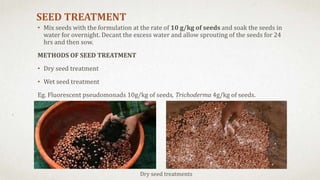
SEED TREATMENT
• Mix seeds with the formulation at the rate of 10 g/kg of seeds and soak the seeds in
water for overnight. Decant the excess water and allow sprouting of the seeds for 24
hrs and then sow.
METHODS OF SEED TREATMENT
• Dry seed treatment
• Wet seed treatment
Eg. Fluorescent pseudomonads 10g/kg of seeds, Trichoderma 4g/kg of seeds.
Dry seed treatments
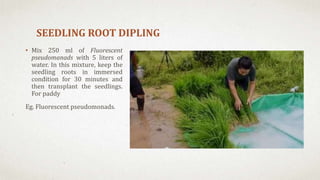
SEEDLING ROOT DIPLING
• Mix 250 ml of Fluorescent
pseudomanads with 5 liters of
water. In this mixture, keep the
seedling roots in immersed
condition for 30 minutes and
then transplant the seedlings.
For paddy
Eg. Fluorescent pseudomonads.
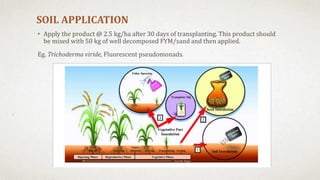
SOIL APPLICATION
• Apply the product @ 2.5 kg/ha after 30 days of transplanting. This product should
be mixed with 50 kg of well decomposed FYM/sand and then applied.
Eg. Trichoderma viride, Fluorescent pseudomonads.
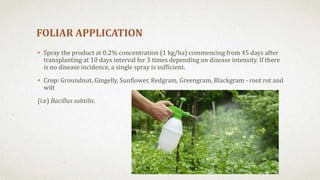
FOLIAR APPLICATION
• Spray the product at 0.2% concentration (1 kg/ha) commencing from 45 days after
transplanting at 10 days interval for 3 times depending on disease intensity. If there
is no disease incidence, a single spray is sufficient.
• Crop: Groundnut, Gingelly, Sunflower, Redgram, Greengram, Blackgram - root rot and
wilt
(i.e) Bacillus subtilis.
VOLUME OF SPRAY
The amount of spray fluid required for covering uniformly an area or a given amount of
foliage is known as volume of spray.
• High volume spray (HV) requires 500 L or more / ha
• Medium volume spray (MV) requires 150 to 400 L or more / ha
• Low volume spray (LV) requires 75 to 150 L / ha
• Ultra low volume spray (ULV) requires 1 to 10 L / ha
SUCKER TREATMENT
• Suckers were trimmed and sprinkled with Fluorescent pseudomonads @ 20g/sucker
• PARING & PRALINAGE
The paired sets should be dipped in a Bordeaux mixture – DBCP paste (made by mixing
20 kg hydrated lime, 20 kg copper sulphate, 1288 ml 70% DBCP and 455 litres of water)
DBCP paste 1,2 Dibromo-3-chloropropane C3H5Br2Cl
It is a highly persistent lipophilic (affinity towards the lipid), brominated, organochlorine
which actively affects the membrane system of nematodes Rhadopolus similis
(Burrowing nematode)
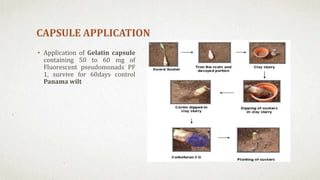
CAPSULE APPLICATION
• Application of Gelatin capsule
containing 50 to 60 mg of
Fluorescent pseudomonads PF
1, survive for 60days control
Panama wilt
MICROBIGATION
• Dicovered by Angela boari et al. 2008
• The recent and emerging trend in the application of biocontrol agent is the
microbigation
• The term ‘microbigation’ is here proposed for this kind of microbial application
technique
• Conidial suspensions of marketed or marketable agents were used,
(i.e). Fusarium oxysporum, F. solani, Trichoderma harzianum and Paecilomyces lilacinus.
• The experiments carried out demonstrated that conidial suspensions
(106 conidia/ml) can pass through the drippers without causing clogging, regardless
of their size, and remained viable.
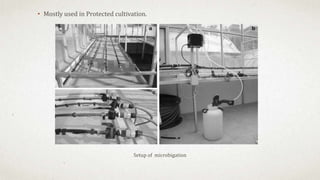
• Mostly used in Protected cultivation.
Setup of microbigation
REFERENCE
• https://agritech.tnau.ac.in/crop_protection/crop_prot_biocontrol%20control_agents.html
• https://agritech.tnau.ac.in/horticulture/horti_fruits_banana.html
Article
• https://www.researchgate.net/publication/225140869_'Microbigation'_Delivery_of_biological_con
trol_agents_through_drip_irrigation_systems
Book
• Srinivasulu B, Rajamannar M, Nagalakshimi T. (2017). Plant Pathology: Fundamentals and
Applications. Astral publication. ISBN-10 : 9789351248262.
DELIVERY SYSTEM IN BIOCONTROL AGENTS.pptx

DELIVERY SYSTEM IN BIOCONTROL AGENTS.pptx

  • 1.
    DELIVERY SYSTEM INBIOCONTROL AGENTS COURSE TEACHER Dr. K. SANJEEVKUMAR, ASSOCIATE PROFESSOR, DEPARTMENT OF PLANT PATHOLOGY. SUBMITTED BY SUNIL SURIYA M, I - YEAR M.Sc., (Ag.), DEPARTMENT OF PLANT PATHOLOGY. PAT- 613 PRINCIPLES AND APPLIED PLANT PATHOLOGY (2+1) D E PA RT M E N T O F P L A N T PAT H O LO GY FAC U LT Y O F AG R I C U LT U R E A N NA M A L A I U N I V E R S I T Y
  • 2.
    DELIVERY SYSTEM INBIOCONTROL AGENTS INTRODUCTION • Control of plant pathogens and disease caused by them through antagonistic microorganism is termed as biological control agents • So the efficacy of the biocontrol agent rely on the mode of application. • The uniform and precise application of microbial particles close to the target organism and to the plant to protected can increase the success of a biological control treatment.  Fungal biocontrol agents - Trichoderma viride, Darluca filum, Nectria inventa and Chaetomium globosum.  Bacterial biocontrol agents - Bacillus subtilis, Fluorescent pseudomonads, Rhizobium radiobacter strain K84.
  • 3.
    IDEAL CHARACTERISTICS OFBIOCONTROL AGENTS • ECOLOGICAL COMPATIBILITY (Environment factor) • TEMPORAL SYNCHRONIZATION (Sync with target pathogens) • DENSITY RESPOSIVENESS (Vigorous attacking of the pathogen) • REPRODUCTIVE POTENTIAL (Fast multiplication) • CULTURABILITY (Ease to mass multiplication) • HOST SPECIFICITY AND COMPATIBILITY (Diverse host range)
  • 4.
    METHODS OF APPLICATIONOF BIOCONTROL AGENTS • SEED TREATMENT • SEEDLING ROOT DIPPING • SOIL APPLICATION • FOLIAR APPLICATION • SUCKER TREATMENT • CAPSULE APPLICATION • MICROBIGATION (Drip irrigation & sprinkler irrigation)
  • 5.
    SEED TREATMENT • Mixseeds with the formulation at the rate of 10 g/kg of seeds and soak the seeds in water for overnight. Decant the excess water and allow sprouting of the seeds for 24 hrs and then sow. METHODS OF SEED TREATMENT • Dry seed treatment • Wet seed treatment Eg. Fluorescent pseudomonads 10g/kg of seeds, Trichoderma 4g/kg of seeds. Dry seed treatments
  • 6.
    SEEDLING ROOT DIPLING •Mix 250 ml of Fluorescent pseudomanads with 5 liters of water. In this mixture, keep the seedling roots in immersed condition for 30 minutes and then transplant the seedlings. For paddy Eg. Fluorescent pseudomonads.
  • 7.
    SOIL APPLICATION • Applythe product @ 2.5 kg/ha after 30 days of transplanting. This product should be mixed with 50 kg of well decomposed FYM/sand and then applied. Eg. Trichoderma viride, Fluorescent pseudomonads.
  • 8.
    FOLIAR APPLICATION • Spraythe product at 0.2% concentration (1 kg/ha) commencing from 45 days after transplanting at 10 days interval for 3 times depending on disease intensity. If there is no disease incidence, a single spray is sufficient. • Crop: Groundnut, Gingelly, Sunflower, Redgram, Greengram, Blackgram - root rot and wilt (i.e) Bacillus subtilis.
  • 9.
    VOLUME OF SPRAY Theamount of spray fluid required for covering uniformly an area or a given amount of foliage is known as volume of spray. • High volume spray (HV) requires 500 L or more / ha • Medium volume spray (MV) requires 150 to 400 L or more / ha • Low volume spray (LV) requires 75 to 150 L / ha • Ultra low volume spray (ULV) requires 1 to 10 L / ha
  • 10.
    SUCKER TREATMENT • Suckerswere trimmed and sprinkled with Fluorescent pseudomonads @ 20g/sucker • PARING & PRALINAGE The paired sets should be dipped in a Bordeaux mixture – DBCP paste (made by mixing 20 kg hydrated lime, 20 kg copper sulphate, 1288 ml 70% DBCP and 455 litres of water) DBCP paste 1,2 Dibromo-3-chloropropane C3H5Br2Cl It is a highly persistent lipophilic (affinity towards the lipid), brominated, organochlorine which actively affects the membrane system of nematodes Rhadopolus similis (Burrowing nematode)
  • 11.
    CAPSULE APPLICATION • Applicationof Gelatin capsule containing 50 to 60 mg of Fluorescent pseudomonads PF 1, survive for 60days control Panama wilt
  • 12.
    MICROBIGATION • Dicovered byAngela boari et al. 2008 • The recent and emerging trend in the application of biocontrol agent is the microbigation • The term ‘microbigation’ is here proposed for this kind of microbial application technique • Conidial suspensions of marketed or marketable agents were used, (i.e). Fusarium oxysporum, F. solani, Trichoderma harzianum and Paecilomyces lilacinus. • The experiments carried out demonstrated that conidial suspensions (106 conidia/ml) can pass through the drippers without causing clogging, regardless of their size, and remained viable.
  • 13.
    • Mostly usedin Protected cultivation. Setup of microbigation
  • 14.
    REFERENCE • https://agritech.tnau.ac.in/crop_protection/crop_prot_biocontrol%20control_agents.html • https://agritech.tnau.ac.in/horticulture/horti_fruits_banana.html Article •https://www.researchgate.net/publication/225140869_'Microbigation'_Delivery_of_biological_con trol_agents_through_drip_irrigation_systems Book • Srinivasulu B, Rajamannar M, Nagalakshimi T. (2017). Plant Pathology: Fundamentals and Applications. Astral publication. ISBN-10 : 9789351248262.