WHITE PAPER
     Valuation & Optimization: Your
     Customer’s Technical Support
     Experience

     Summary
     Providing a positive customer experience inside
     of efficient technical issue resolution is critical to
     retaining customers and expanding market share.
     Businesses that provide an exceptional product
     set for their customers must endeavor to provide
     a high level of technical support and customer
     service to complete the customer experience.

     November, 2012

     Kurt Leiblich VP
     Technical Services & Solutions, Aegis Communications
     Group
WHITE PAPER
                                                                                                             2


                      Introduction
                      Technical support is an integral piece of the customer experience mix.
                      Companies can leverage their customer experience as a differentiator,
                      and choose to outsource this specialized role. Outsourcing service
                      providers have for years continued to center value propositions on
                      people, process, and technology – but doing so is no longer enough.


                      There is a tendency for players in this market to consider technical support,
                      and specifically outsourced technical support, to be a commodity. Demand is
                      present but the services are perceived to be supplied without real qualitative
                      differentiation, so buyers are driven to a selection process primarily based on
                      hourly cost comparisons.

                      Why does this happen? Market operators initiate procurement or buying
                      cycles that typically start with RFP or RFI solicitations. Responses come back
                      from a multitude of potential vendors, those responses are reviewed,
                      questions are answered, facilities are toured, and each supplier always talks
                      about the same things. Each outsourcing partner has HR and recruiting teams
                      and mechanisms; all talk about training, knowledge transfer and
                      development, about operations, workforce management, reporting, program
                      management, IT and all of the other core delivery functions. After a while
                      everything can start to sound the same or very similar (even to experienced
                      market players) which ultimately contributes to a decision process focused on
                      hourly rates. Costs become king when everything else seems to be equal.

                      Everyone touts their people, process, and technology, which have become
                      table stakes, but each one of these components along with each
                      departmental function possesses a broad scale of variables. The combination
                      of these parameters is no longer enough. It is the architecture and solution
                      engineering alongside the respective delivery amplitude that produce the


www.aegisglobal.com                       Valuation & Optimization: Your Customer’s Technical Support Experience
WHITE PAPER
                                                                                                             3


                      differentiators and value creators. Even if the structural or operating
                      components are the same or similar across outsourcers, there is an enormous
                      amount of qualitative differentiation within each function and what is done
                      with the reins of operational execution, delivery, and opportunity. A good
                      analogy comes from the investment world; like shorting a stock (betting on
                      and making money from a stock price falling), although gains are possible the
                      opportunity costs (losses) in the aggregate calculation of variable impact
                      across operating and delivery functions are essentially limitless. As a result,
                      the rate focused view and buying perspective can create a significant degree
                      of cost from both a monetary and a customer relationship / lifetime value or
                      revenue realization perspective. To add the highest value, outsourced
                      technical support solutions need to be specifically engineered with
                      consideration for and focus on three key elements:

                      •   Output requirements that are centered on business level objectives,
                          KPI’s, metrics, and specific functional requirements

                      •   Process components that make up the measurement and management
                          of program execution and delivery to include performance measurement
                          strategies, reporting, data availability and analytics and risk mitigation
                          strategies - considering risk to customers, the client, and total cost of
                          ownership

                      •   Input requirements that directly correlate to the defined and variable
                          output parameters for the program, including: tactical skill sets and
                          qualifications, knowledge development and evaluation structures,
                          infrastructure and shoring, recruiting and compensation, etc.

                      Even outside of ownership and operating costs with respect to CSAT,
                      customer loyalty, or customer retention, let’s look at an example strictly from
                      a performance and operating cost perspective. If you are operating support
                      services domestically, have 5 million customers, a 10 minute AHT, and a 20%
                      contact rate, each 1% increase in first call resolution equates to a savings of
                      $50,000 per month. Then put that number into a respective technical support
                      delivery context based on recent information from the Aberdeen Group1 on
                      average there is up to a 22% FCR variance between Industry Laggards at the
                      bottom of the scale, the industry average, and best in class delivery with the
                      best in class FCR average at 87% - that means that if you are paying the same
                      hourly rate for each respective provider, a best in class supplier’s correlating
                      TCO (total cost of ownership) is going to be $1M less / month versus an
                      industry average performing vendor and $2.1M less / month versus an
                      industry laggard resulting in a $12-$25M spend variance within a $56M annual
                      budget, strictly from a direct cost perspective, and not including correlated
                      impacts, cost, and implicit fall out tied to customer relationship management
                      and revenue retention or augmentation. Commodities do not produce those
                      levels of variation, risk, and cost implications so it is important to look at
                      technical support and respective strategies in a way that appropriately takes
                      total cost and impact, both positive and negative, into consideration and
                      ultimately into buying decisions.

www.aegisglobal.com                       Valuation & Optimization: Your Customer’s Technical Support Experience
WHITE PAPER
                                                                                                             4


                      Using the previously mentioned context, we can start to look at how Aegis
                      provides value to our clients and their customers: we don’t manufacture
                      consumer products or build out broadband or cellular networks; what we do,
                      and what we have done for the last three decades, is specialize in managing
                      and enhancing customer relationships across the customer lifecycle,
                      partnering to help our clients reduce cost, and achieve their business level
                      objectives. OEMs, and MSO clients looking for value add and innovation may
                      get stuck in systemic performance gaps when their outsourcing partners do
                      not have those capabilities built into their corporate or program level
                      operating structures.

                      As mentioned, people and companies in our industry, have for years
                      continued to center value propositions on people, process, and technology
                      – but doing so is no longer enough. What we look at is the larger scale
                      and range of an outsourced operation and the correlating quantification
                      and valuation of an existing or potential business partnership – there is of
                      course value in the labor and geographical arbitrage components that exist
                      within an outsourced operation. Reducing the cost of your labor, reducing
                      the requirement for CapEx, overhead, and infrastructure costs, and right
                      shoring those labor efforts all create value; these are baseline expectations
                      and should be used as a foundation for a larger contribution. Performance
                      will always be a key factor. There may still be some disbelievers in the
                      marketplace, but properly built and executed outsourcing solutions can and
                      often do produce metric and KPI performance results that are stronger than
                      their in-house, higher paid, counterparts. Furthermore, there are many other
                      pillars within a TCO and quantified value analysis that deliver and create
                      opportunities for added value. Some of the things we look to are:

                      1.   The capability and expertise to deliver closer to core services i.e. those
                           processes downstream and adjacent to Tier 1 and 2 technical support
                           or others within the client support lifecycle, that open opportunities to
                           outsource and optimize other respective customer lifecycle touch-points.

                      2.   Leveraging our understanding of business processes, which is of course
                           a core function of what we do, and leveraging that expertise to help
                           our clients streamline operations, reduce redundancy and re-work, and
                           remove inaccuracy from adjacent and parallel business processes and
                           departmental functions.

                      3.   Providing skilled resources across program operations and support
                           functions that enable our clients to right size their operational efforts in
                           respective departments – not only within professional services functions
                           such as IT, but in core customer servicing responsibilities such as
                           training, project management, reporting and analytics, forecasting, and
                           staffing.


www.aegisglobal.com                       Valuation & Optimization: Your Customer’s Technical Support Experience
WHITE PAPER
                                                                                                              5


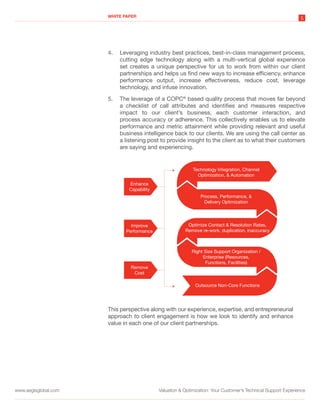
                      4.   Leveraging industry best practices, best-in-class management process,
                           cutting edge technology along with a multi-vertical global experience
                           set creates a unique perspective for us to work from within our client
                           partnerships and helps us find new ways to increase efficiency, enhance
                           performance output, increase effectiveness, reduce cost, leverage
                           technology, and infuse innovation.

                      5.   The leverage of a COPC® based quality process that moves far beyond
                           a checklist of call attributes and identifies and measures respective
                           impact to our client’s business, each customer interaction, and
                           process accuracy or adherence. This collectively enables us to elevate
                           performance and metric attainment while providing relevant and useful
                           business intelligence back to our clients. We are using the call center as
                           a listening post to provide insight to the client as to what their customers
                           are saying and experiencing.


                                                           Technology Integration, Channel
                                                             Optimization, & Automation
                              Enhance
                              Capability
                                                              Process, Performance, &
                                                                Delivery Optimization


                               Improve                  Optimize Contact & Resolution Rates,
                             Performance               Remove re-work, duplication, inaccuracy


                                                          Right Size Support Organization /
                                                               Enterprise (Resources,
                                                                Functions, Facilities)
                               Remove
                                Cost

                                                            Outsource Non-Core Functions


                      This perspective along with our experience, expertise, and entrepreneurial
                      approach to client engagement is how we look to identify and enhance
                      value in each one of our client partnerships.


www.aegisglobal.com                        Valuation & Optimization: Your Customer’s Technical Support Experience
WHITE PAPER
                                                                                                             6


                      Conclusion
                      Improved process performance, delivery optimization, and best practices are
                      keys to extracting value from outsourced technical support operations and
                      enhancing relationships with your customers. Selecting an outsourcing
                      partner with skill and expertise to do so is core to the critical nature of
                      mitigating against execution and delivery risk and impact variables, while
                      migrating your tech support operations from a cost arbitrage play to one
                      centered on long-term value creation and positive impact to the top and
                      bottom line performance of your organization.


                      About the Author
                      Kurt Leiblich
                      Kurt Leiblich, VP Technical Services & Solutions: Kurt is responsible for the
                      structuring and engineering of Technical Support solutions for technology and
                      telecom sector based Clients. He brings more than 12 years of experience
                      across multiple leadership and management functions within the BPO
                      industry. Prior to joining Aegis, Kurt was the Executive Director of Solutions at
                      Aditya Birla Minacs where he lead global solution development with a
                      specialized focus on the technology and telecommunication sectors and
                      served as the Head of product development for high-tech, telecom, and
                      manufacturing service products. Previously Kurt ran site Operations for
                      Minacs across 2 multi-national contact centers supporting technical CLM
                      services, and over the prior 7 years Kurt served in several senior Operations
                      and Account Management functions at Convergys supporting large scale
                      technical programs within Fortune 100 Client accounts. Kurt is a seasoned
                      BPO professional with an extensive range of experience and expertise within
                      a track record of achievement and demonstrated success managing large
                      scale contact center operations, driving exceptional P&L performance,
                      leading multi-national account management operations for Fortune 100
                      Clients, and delivering significant proficiency within the construction and
                      management of strategic business solutions across multiple verticals.


                      1.   (The Contact Center in a Profit Centric Service Organization – Shoring Up
                           the Foundation of Service Delivery, May 2011)


www.aegisglobal.com                       Valuation & Optimization: Your Customer’s Technical Support Experience
WHITE PAPER
                                                                                                                                                                                7


                      About Aegis
                      Aegis is a global consulting, technology, outsourcing and training & education
                      company committed to impacting clients’ business outcomes by focusing on
                      enhancing customer experience across all touch points and channels. Aegis
                      was founded 30 years ago in the US and now has operations in 56 locations
                      across 13 countries with more than 55,000 employees. Aegis services over
                      300 clients from verticals such as Banking, Financial Services & Insurance,
                      Technology, Telecom, Healthcare, Travel & Hospitality, Consumer Goods,
                      Retail and Energy & Utilities. The company is wholly owned by the Essar
                      Group, a USD 27 billion conglomerate.
                      For more information, write to us at info@aegisglobal.com or visit
                      www.aegisglobal.com


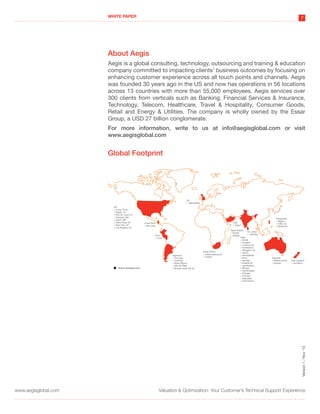
                      Global Footprint


                                                                                    UK:
                                                                                    > Manchester
                        US:
                        > Irving, TX (2)
                        > Killeen, TX
                        > Port St. Lucie, FL
                        > Fairmont, WV
                                                                                                                                                         Philippines:
                        > Joplin, MO
                                                                                                                                                         > Baguio
                        > Sierra Vista, AZ        Costa Rica:                                                             UAE:                           > Cebu (2)
                        > New York, NY            > San Jose                                                              > Dubai                        > Manila (3)
                        > Los Angeles, CA
                                                                                                                        Saudi Arabia:
                                                                                                                                        Sri Lanka:
                                                                                                                        > Riyadh
                                                                                                                                        > Colombo
                                                            Peru:                                                       > Jeddah
                                                            > Lima                                                               India:
                                                                                                                                 > Noida
                                                                                                                                 > Gurgaon
                                                                                                                                 > Lucknow (2)
                                                                                                                                 > Hyderabad
                                                                                                                                 > Bengaluru (2)
                                                                                                   South Africa:                 > Hazira
                                                                                                   > Johannesburg (2)            > Ahmedabad
                                                                      Argentina:
                                                                                                   > Durban                      > Pune
                                                                      > Tucuman                                                                      Australia:
                                                                      > Cordoba                                                  > Mumbai            > Melbourne (3)    New Zealand:
                                                                      > Bahia Blanca                                             > Kolkata (2)       > Sydney           > Auckland
                                                                      > Mar del Plata                                            > Jamshedpur
                            Global Headquarters                       > Buenos Aires City (2)                                    > Bhopal
                                                                                                                                 > Gandhinagar
                                                                                                                                 > Srinagar
                                                                                                                                 > Chennai
                                                                                                                                 > Vijaywada
                                                                                                                                 > Chhindwara


                                                                                                                                                                                 Version 1 / Nov ’12


www.aegisglobal.com                                             Valuation & Optimization: Your Customer’s Technical Support Experience

White paper tech support value

  • 1.
    WHITE PAPER Valuation & Optimization: Your Customer’s Technical Support Experience Summary Providing a positive customer experience inside of efficient technical issue resolution is critical to retaining customers and expanding market share. Businesses that provide an exceptional product set for their customers must endeavor to provide a high level of technical support and customer service to complete the customer experience. November, 2012 Kurt Leiblich VP Technical Services & Solutions, Aegis Communications Group
  • 2.
    WHITE PAPER 2 Introduction Technical support is an integral piece of the customer experience mix. Companies can leverage their customer experience as a differentiator, and choose to outsource this specialized role. Outsourcing service providers have for years continued to center value propositions on people, process, and technology – but doing so is no longer enough. There is a tendency for players in this market to consider technical support, and specifically outsourced technical support, to be a commodity. Demand is present but the services are perceived to be supplied without real qualitative differentiation, so buyers are driven to a selection process primarily based on hourly cost comparisons. Why does this happen? Market operators initiate procurement or buying cycles that typically start with RFP or RFI solicitations. Responses come back from a multitude of potential vendors, those responses are reviewed, questions are answered, facilities are toured, and each supplier always talks about the same things. Each outsourcing partner has HR and recruiting teams and mechanisms; all talk about training, knowledge transfer and development, about operations, workforce management, reporting, program management, IT and all of the other core delivery functions. After a while everything can start to sound the same or very similar (even to experienced market players) which ultimately contributes to a decision process focused on hourly rates. Costs become king when everything else seems to be equal. Everyone touts their people, process, and technology, which have become table stakes, but each one of these components along with each departmental function possesses a broad scale of variables. The combination of these parameters is no longer enough. It is the architecture and solution engineering alongside the respective delivery amplitude that produce the www.aegisglobal.com Valuation & Optimization: Your Customer’s Technical Support Experience
  • 3.
    WHITE PAPER 3 differentiators and value creators. Even if the structural or operating components are the same or similar across outsourcers, there is an enormous amount of qualitative differentiation within each function and what is done with the reins of operational execution, delivery, and opportunity. A good analogy comes from the investment world; like shorting a stock (betting on and making money from a stock price falling), although gains are possible the opportunity costs (losses) in the aggregate calculation of variable impact across operating and delivery functions are essentially limitless. As a result, the rate focused view and buying perspective can create a significant degree of cost from both a monetary and a customer relationship / lifetime value or revenue realization perspective. To add the highest value, outsourced technical support solutions need to be specifically engineered with consideration for and focus on three key elements: • Output requirements that are centered on business level objectives, KPI’s, metrics, and specific functional requirements • Process components that make up the measurement and management of program execution and delivery to include performance measurement strategies, reporting, data availability and analytics and risk mitigation strategies - considering risk to customers, the client, and total cost of ownership • Input requirements that directly correlate to the defined and variable output parameters for the program, including: tactical skill sets and qualifications, knowledge development and evaluation structures, infrastructure and shoring, recruiting and compensation, etc. Even outside of ownership and operating costs with respect to CSAT, customer loyalty, or customer retention, let’s look at an example strictly from a performance and operating cost perspective. If you are operating support services domestically, have 5 million customers, a 10 minute AHT, and a 20% contact rate, each 1% increase in first call resolution equates to a savings of $50,000 per month. Then put that number into a respective technical support delivery context based on recent information from the Aberdeen Group1 on average there is up to a 22% FCR variance between Industry Laggards at the bottom of the scale, the industry average, and best in class delivery with the best in class FCR average at 87% - that means that if you are paying the same hourly rate for each respective provider, a best in class supplier’s correlating TCO (total cost of ownership) is going to be $1M less / month versus an industry average performing vendor and $2.1M less / month versus an industry laggard resulting in a $12-$25M spend variance within a $56M annual budget, strictly from a direct cost perspective, and not including correlated impacts, cost, and implicit fall out tied to customer relationship management and revenue retention or augmentation. Commodities do not produce those levels of variation, risk, and cost implications so it is important to look at technical support and respective strategies in a way that appropriately takes total cost and impact, both positive and negative, into consideration and ultimately into buying decisions. www.aegisglobal.com Valuation & Optimization: Your Customer’s Technical Support Experience
  • 4.
    WHITE PAPER 4 Using the previously mentioned context, we can start to look at how Aegis provides value to our clients and their customers: we don’t manufacture consumer products or build out broadband or cellular networks; what we do, and what we have done for the last three decades, is specialize in managing and enhancing customer relationships across the customer lifecycle, partnering to help our clients reduce cost, and achieve their business level objectives. OEMs, and MSO clients looking for value add and innovation may get stuck in systemic performance gaps when their outsourcing partners do not have those capabilities built into their corporate or program level operating structures. As mentioned, people and companies in our industry, have for years continued to center value propositions on people, process, and technology – but doing so is no longer enough. What we look at is the larger scale and range of an outsourced operation and the correlating quantification and valuation of an existing or potential business partnership – there is of course value in the labor and geographical arbitrage components that exist within an outsourced operation. Reducing the cost of your labor, reducing the requirement for CapEx, overhead, and infrastructure costs, and right shoring those labor efforts all create value; these are baseline expectations and should be used as a foundation for a larger contribution. Performance will always be a key factor. There may still be some disbelievers in the marketplace, but properly built and executed outsourcing solutions can and often do produce metric and KPI performance results that are stronger than their in-house, higher paid, counterparts. Furthermore, there are many other pillars within a TCO and quantified value analysis that deliver and create opportunities for added value. Some of the things we look to are: 1. The capability and expertise to deliver closer to core services i.e. those processes downstream and adjacent to Tier 1 and 2 technical support or others within the client support lifecycle, that open opportunities to outsource and optimize other respective customer lifecycle touch-points. 2. Leveraging our understanding of business processes, which is of course a core function of what we do, and leveraging that expertise to help our clients streamline operations, reduce redundancy and re-work, and remove inaccuracy from adjacent and parallel business processes and departmental functions. 3. Providing skilled resources across program operations and support functions that enable our clients to right size their operational efforts in respective departments – not only within professional services functions such as IT, but in core customer servicing responsibilities such as training, project management, reporting and analytics, forecasting, and staffing. www.aegisglobal.com Valuation & Optimization: Your Customer’s Technical Support Experience
  • 5.
    WHITE PAPER 5 4. Leveraging industry best practices, best-in-class management process, cutting edge technology along with a multi-vertical global experience set creates a unique perspective for us to work from within our client partnerships and helps us find new ways to increase efficiency, enhance performance output, increase effectiveness, reduce cost, leverage technology, and infuse innovation. 5. The leverage of a COPC® based quality process that moves far beyond a checklist of call attributes and identifies and measures respective impact to our client’s business, each customer interaction, and process accuracy or adherence. This collectively enables us to elevate performance and metric attainment while providing relevant and useful business intelligence back to our clients. We are using the call center as a listening post to provide insight to the client as to what their customers are saying and experiencing. Technology Integration, Channel Optimization, & Automation Enhance Capability Process, Performance, & Delivery Optimization Improve Optimize Contact & Resolution Rates, Performance Remove re-work, duplication, inaccuracy Right Size Support Organization / Enterprise (Resources, Functions, Facilities) Remove Cost Outsource Non-Core Functions This perspective along with our experience, expertise, and entrepreneurial approach to client engagement is how we look to identify and enhance value in each one of our client partnerships. www.aegisglobal.com Valuation & Optimization: Your Customer’s Technical Support Experience
  • 6.
    WHITE PAPER 6 Conclusion Improved process performance, delivery optimization, and best practices are keys to extracting value from outsourced technical support operations and enhancing relationships with your customers. Selecting an outsourcing partner with skill and expertise to do so is core to the critical nature of mitigating against execution and delivery risk and impact variables, while migrating your tech support operations from a cost arbitrage play to one centered on long-term value creation and positive impact to the top and bottom line performance of your organization. About the Author Kurt Leiblich Kurt Leiblich, VP Technical Services & Solutions: Kurt is responsible for the structuring and engineering of Technical Support solutions for technology and telecom sector based Clients. He brings more than 12 years of experience across multiple leadership and management functions within the BPO industry. Prior to joining Aegis, Kurt was the Executive Director of Solutions at Aditya Birla Minacs where he lead global solution development with a specialized focus on the technology and telecommunication sectors and served as the Head of product development for high-tech, telecom, and manufacturing service products. Previously Kurt ran site Operations for Minacs across 2 multi-national contact centers supporting technical CLM services, and over the prior 7 years Kurt served in several senior Operations and Account Management functions at Convergys supporting large scale technical programs within Fortune 100 Client accounts. Kurt is a seasoned BPO professional with an extensive range of experience and expertise within a track record of achievement and demonstrated success managing large scale contact center operations, driving exceptional P&L performance, leading multi-national account management operations for Fortune 100 Clients, and delivering significant proficiency within the construction and management of strategic business solutions across multiple verticals. 1. (The Contact Center in a Profit Centric Service Organization – Shoring Up the Foundation of Service Delivery, May 2011) www.aegisglobal.com Valuation & Optimization: Your Customer’s Technical Support Experience
  • 7.
    WHITE PAPER 7 About Aegis Aegis is a global consulting, technology, outsourcing and training & education company committed to impacting clients’ business outcomes by focusing on enhancing customer experience across all touch points and channels. Aegis was founded 30 years ago in the US and now has operations in 56 locations across 13 countries with more than 55,000 employees. Aegis services over 300 clients from verticals such as Banking, Financial Services & Insurance, Technology, Telecom, Healthcare, Travel & Hospitality, Consumer Goods, Retail and Energy & Utilities. The company is wholly owned by the Essar Group, a USD 27 billion conglomerate. For more information, write to us at info@aegisglobal.com or visit www.aegisglobal.com Global Footprint UK: > Manchester US: > Irving, TX (2) > Killeen, TX > Port St. Lucie, FL > Fairmont, WV Philippines: > Joplin, MO > Baguio > Sierra Vista, AZ Costa Rica: UAE: > Cebu (2) > New York, NY > San Jose > Dubai > Manila (3) > Los Angeles, CA Saudi Arabia: Sri Lanka: > Riyadh > Colombo Peru: > Jeddah > Lima India: > Noida > Gurgaon > Lucknow (2) > Hyderabad > Bengaluru (2) South Africa: > Hazira > Johannesburg (2) > Ahmedabad Argentina: > Durban > Pune > Tucuman Australia: > Cordoba > Mumbai > Melbourne (3) New Zealand: > Bahia Blanca > Kolkata (2) > Sydney > Auckland > Mar del Plata > Jamshedpur Global Headquarters > Buenos Aires City (2) > Bhopal > Gandhinagar > Srinagar > Chennai > Vijaywada > Chhindwara Version 1 / Nov ’12 www.aegisglobal.com Valuation & Optimization: Your Customer’s Technical Support Experience