Delivering A Sustainable Future for Direct Mail The Government’s environmental priorities and review of waste policies The SMP Annual Conference: 19 May 2011 Simon Dawes, Policy Adviser – Waste Programme
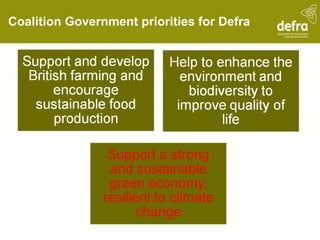
Coalition Government priorities for Defra
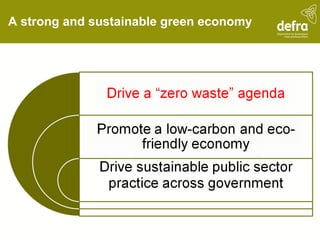
A strong and sustainable green economy
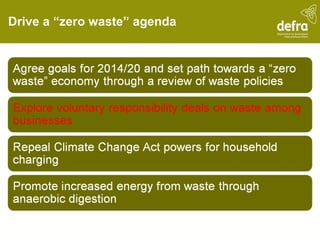
Drive a “zero waste” agenda
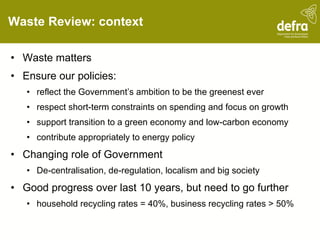
Waste Review: context Waste matters Ensure our policies: reflect the Government’s ambition to be the greenest ever respect short-term constraints on spending and focus on growth support transition to a green economy and low-carbon economy contribute appropriately to energy policy Changing role of Government De-centralisation, de-regulation, localism and big society Good progress over last 10 years, but need to go further household recycling rates = 40%, business recycling rates > 50%
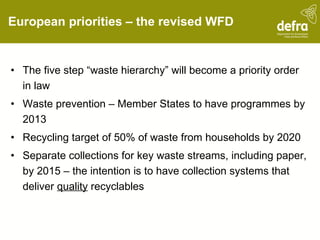
European priorities – the revised WFD The five step “waste hierarchy” will become a priority order in law Waste prevention – Member States to have programmes by 2013 Recycling target of 50% of waste from households by 2020 Separate collections for key waste streams, including paper, by 2015 – the intention is to have collection systems that deliver  quality  recyclables
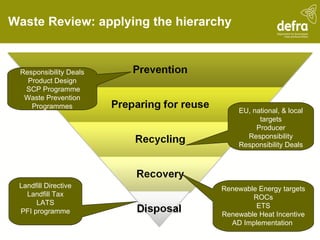
Waste Review: applying the hierarchy Responsibility Deals Product Design SCP Programme Waste Prevention Programmes EU, national, & local targets Producer Responsibility Responsibility Deals Guidance & advice Renewable Energy targets ROCs ETS Renewable Heat Incentive AD Implementation  Landfill Directive Landfill Tax LATS PFI programme
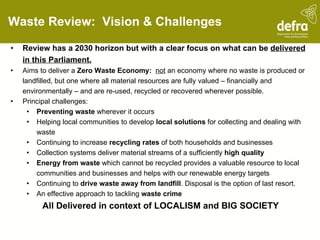
Waste Review:  Vision & Challenges Review has a 2030 horizon but with a clear focus on what can be  delivered in this Parliament. Aims to deliver a  Zero Waste Economy:  not  an economy where no waste is produced or landfilled, but one where all material resources are fully valued – financially and environmentally – and are re-used, recycled or recovered wherever possible.  Principal challenges: Preventing waste  wherever it occurs Helping local communities to develop  local solutions  for collecting and dealing with waste Continuing to increase  recycling rates  of both households and businesses Collection systems deliver material streams of a sufficiently  high quality Energy from waste  which cannot be recycled provides a valuable resource to local communities and businesses and helps with our renewable energy targets Continuing to  drive waste away from landfill . Disposal is the option of last resort. An effective approach to tackling  waste crime All Delivered in context of LOCALISM and BIG SOCIETY
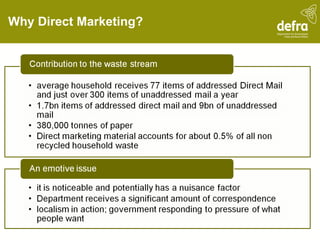
Why Direct Marketing?
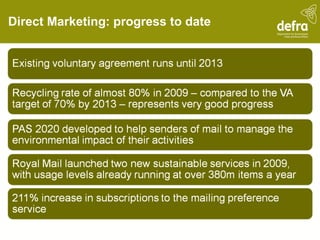
Direct Marketing: progress to date
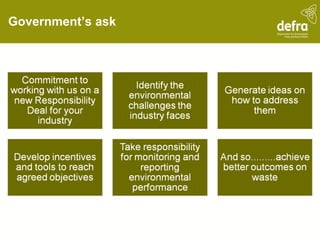
Government’s ask
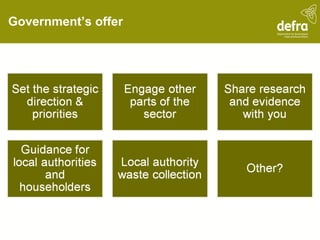
Government’s offer
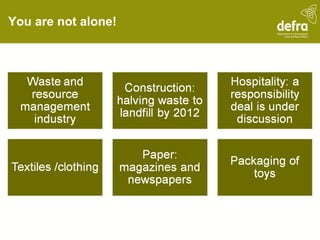
You are not alone!
Thank you for your attention

Delivering a sustainable future for direct mail

  • 1.
    Delivering A SustainableFuture for Direct Mail The Government’s environmental priorities and review of waste policies The SMP Annual Conference: 19 May 2011 Simon Dawes, Policy Adviser – Waste Programme
  • 2.
  • 3.
    A strong andsustainable green economy
  • 4.
    Drive a “zerowaste” agenda
  • 5.
    Waste Review: contextWaste matters Ensure our policies: reflect the Government’s ambition to be the greenest ever respect short-term constraints on spending and focus on growth support transition to a green economy and low-carbon economy contribute appropriately to energy policy Changing role of Government De-centralisation, de-regulation, localism and big society Good progress over last 10 years, but need to go further household recycling rates = 40%, business recycling rates > 50%
  • 6.
    European priorities –the revised WFD The five step “waste hierarchy” will become a priority order in law Waste prevention – Member States to have programmes by 2013 Recycling target of 50% of waste from households by 2020 Separate collections for key waste streams, including paper, by 2015 – the intention is to have collection systems that deliver quality recyclables
  • 7.
    Waste Review: applyingthe hierarchy Responsibility Deals Product Design SCP Programme Waste Prevention Programmes EU, national, & local targets Producer Responsibility Responsibility Deals Guidance & advice Renewable Energy targets ROCs ETS Renewable Heat Incentive AD Implementation Landfill Directive Landfill Tax LATS PFI programme
  • 8.
    Waste Review: Vision & Challenges Review has a 2030 horizon but with a clear focus on what can be delivered in this Parliament. Aims to deliver a Zero Waste Economy: not an economy where no waste is produced or landfilled, but one where all material resources are fully valued – financially and environmentally – and are re-used, recycled or recovered wherever possible. Principal challenges: Preventing waste wherever it occurs Helping local communities to develop local solutions for collecting and dealing with waste Continuing to increase recycling rates of both households and businesses Collection systems deliver material streams of a sufficiently high quality Energy from waste which cannot be recycled provides a valuable resource to local communities and businesses and helps with our renewable energy targets Continuing to drive waste away from landfill . Disposal is the option of last resort. An effective approach to tackling waste crime All Delivered in context of LOCALISM and BIG SOCIETY
  • 9.
  • 10.
  • 11.
  • 12.
  • 13.
  • 14.
    Thank you foryour attention