Circular
Economy
Natalia Matting
Michał Kubicki
European Commission
DG Internal Market, Industry,
Entrepreneurship and SMEs
Unit Clean Technologies and
Products
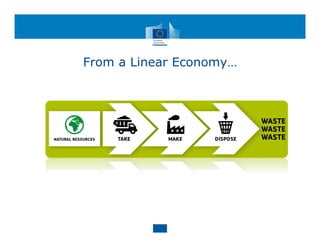
From a Linear Economy…
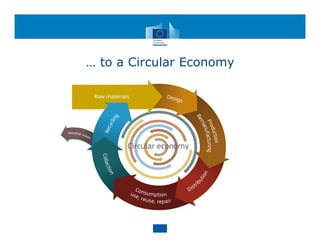
… to a Circular Economy
What is the Circular Economy?
• Maintaining the value of products, materials and
resources in the economy for as long as possible
while minimising waste generation
• To boost our economy and competitiveness with
new business opportunities and innovative
products and services.
• For economic, social and environmental gains
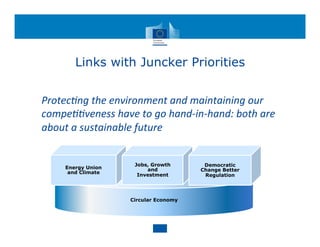
Circular Economy
Energy Union
and Climate
Jobs, Growth
and
Investment
Democratic
Change Better
Regulation
Links with Juncker Priorities
Protec'ng the environment and maintaining our
compe''veness have to go hand-in-hand: both are
about a sustainable future
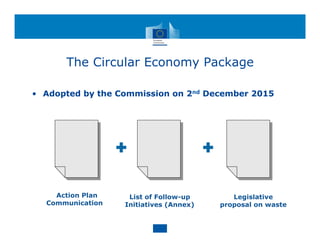
The Circular Economy Package
• Adopted by the Commission on 2nd December 2015
Action Plan
Communication
List of Follow-up
Initiatives (Annex)
Legislative
proposal on waste
Objectives of the new Package
• Synergies between environment and business
agendas
– Preserve resources while creating business opportunities
– Closer links to other key EU priorities: climate and energy,
jobs and growth, investment, innovation, social, industrial
competitiveness
• Propose concrete and ambitious action where EU
intervention has high added value
– e.g. long-term vision and targets on waste management;
internal market rules for products; environment and
consumers protection; regulatory obstacles or enforcement
issues; innovation and investments
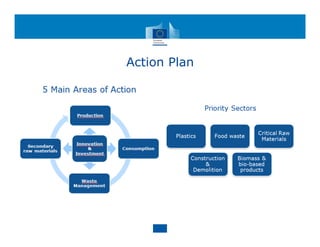
Action Plan
Areas
of Action
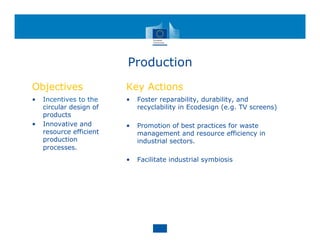
Production
Objectives
• Incentives to the
circular design of
products
• Innovative and
resource efficient
production
processes.
Key Actions
• Foster reparability, durability, and
recyclability in Ecodesign (e.g. TV screens)
• Promotion of best practices for waste
management and resource efficiency in
industrial sectors.
• Facilitate industrial symbiosis
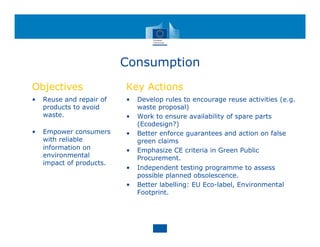
Consumption
Objectives
• Reuse and repair of
products to avoid
waste.
• Empower consumers
with reliable
information on
environmental
impact of products.
Key Actions
• Develop rules to encourage reuse activities (e.g.
waste proposal)
• Work to ensure availability of spare parts
(Ecodesign?)
• Better enforce guarantees and action on false
green claims
• Emphasize CE criteria in Green Public
Procurement.
• Independent testing programme to assess
possible planned obsolescence.
• Better labelling: EU Eco-label, Environmental
Footprint.
Waste management
Objectives
• Waste management
systems,
addressing the
existing
implementation
gap.
• Long-term vision
and drive
investments.
Key Actions
• Revised legislative package on waste Work
with Member States to improve waste
management, incl. to avoid overcapacities in
residual waste treatment (e.g. incineration
and Mechanical-biological treatment)
• Ensure that Cohesion Policy contributions are
guided by the EU waste hierarchy.
Market for secondary raw materials
Objectives
• Increase the use of secondary
raw materials.
• Increase the use of recycled
nutrients and the reuse of
treated wastewater.
• Safely manage the risks of
chemicals of concern.
• Improve knowledge of material
stocks and flows.
Key Actions
• Develop quality standards for
secondary raw materials.
• Revised EU regulation on
fertilizers.
• Legislative proposal on minimum
requirements for reused water
• Analysis on the interface between
chemicals, product, and waste
legislation.
• EU-wide electronic system for
cross-border transfers of waste.
Innovation & Investment
Objectives
• Right environment
for innovation and
investments.
Key Actions
• €650 million Horizon 2020 initiative on
‘Industry 2020 in the CE.
• Pilot "innovation deals" to address potential
regulatory obstacles for innovators.
• Targeted outreach of EU funding
• New platform for financing CE with EIB and
national promotional banks.
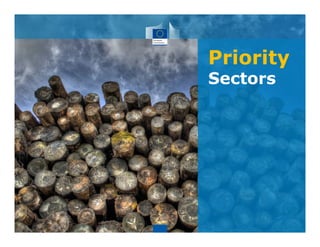
Priority
Sectors
Plastics
Objectives
• Provide a strategy
to improve
sustainability of
plastics throughout
its lifecycle
• Increase efficiency
in recycling - less
than 25% of plastic
waste collected is
recycled, and about
50% goes to
landfill.
Key Actions
• Adopt a specific strategy on plastics including
marine litter.
• A more ambitious target for the recycling of
plastic packaging in the legislative proposal
on waste.
Food waste
Objectives
• Reach Sustainable
Development Goal
to halve food waste
by 2030 – today
around 100 million
tonnes of food are
wasted annually in
the EU.
Key Actions
• Develop an EU methodology to measure food
waste.
• Create a platform for the SDG on food waste
and to share best practice and results
achieved.
• Clarify EU legislation relating to waste, food
and feed, and facilitate food donation.
• Improve the use and understanding of date
marking along the food chain (e.g."best
before" label).
Critical Raw Materials
Objectives
• Increasing efficient
use and recovery of
CRMs.
Key Actions
• Encourage recovery of CRMs, and prepare a
report on best practices and options for
further action at the EU level.
• Encourage action by Member States.
Construction & Demolition
Objectives
• Identify and
increase recovery of
valuable materials
Key Actions
• Ensure recovery of valuable resources and
adequate waste management in the
construction and demolition sector, as well as
facilitate assessing the environmental
performance of buildings
• Develop pre-demolition guidelines to boost
high-value recycling as well as voluntary
recycling protocols aimed to improve quality
of and build confidence.
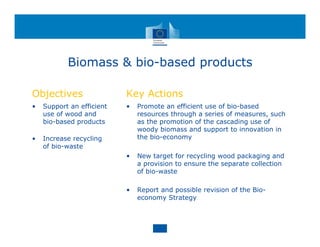
Biomass & bio-based products
Objectives
• Support an efficient
use of wood and
bio-based products
• Increase recycling
of bio-waste
Key Actions
• Promote an efficient use of bio-based
resources through a series of measures, such
as the promotion of the cascading use of
woody biomass and support to innovation in
the bio-economy
• New target for recycling wood packaging and
a provision to ensure the separate collection
of bio-waste
• Report and possible revision of the Bio-
economy Strategy
Main
elements
of the
legislative
proposal
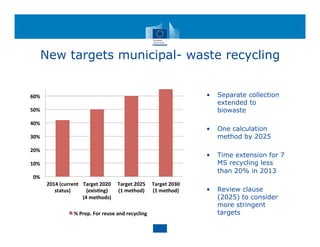
0%
10%
20%
30%
40%
50%
60%
2014 (current
status)
Target 2020
(exis8ng)
(4 methods)
Target 2025
(1 method)
Target 2030
(1 method)
% Prep. For reuse and recycling
New targets municipal- waste recycling
• Separate collection
extended to
biowaste
• One calculation
method by 2025
• Time extension for 7
MS recycling less
than 20% in 2013
• Review clause
(2025) to consider
more stringent
targets
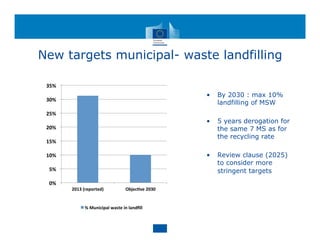
New targets municipal- waste landfilling
• By 2030 : max 10%
landfilling of MSW
• 5 years derogation for
the same 7 MS as for
the recycling rate
• Review clause (2025)
to consider more
stringent targets
0%
5%
10%
15%
20%
25%
30%
35%
2013 (reported) Objec8ve 2030
% Municipal waste in landfill
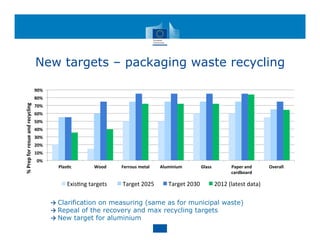
New targets – packaging waste recycling
0%
10%
20%
30%
40%
50%
60%
70%
80%
90%
Plas8c Wood Ferrous metal Aluminium Glass Paper and
cardboard
Overall
%
Prep
for
resue
and
recycling
Exis%ng targets Target 2025 Target 2030 2012 (latest data)
→ Clarification on measuring (same as for municipal waste)
→ Repeal of the recovery and max recycling targets
→ New target for aluminium
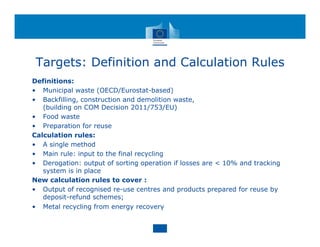
Targets: Definition and Calculation Rules
Definitions:
• Municipal waste (OECD/Eurostat-based)
• Backfilling, construction and demolition waste,
(building on COM Decision 2011/753/EU)
• Food waste
• Preparation for reuse
Calculation rules:
• A single method
• Main rule: input to the final recycling
• Derogation: output of sorting operation if losses are < 10% and tracking
system is in place
New calculation rules to cover :
• Output of recognised re-use centres and products prepared for reuse by
deposit-refund schemes;
• Metal recycling from energy recovery
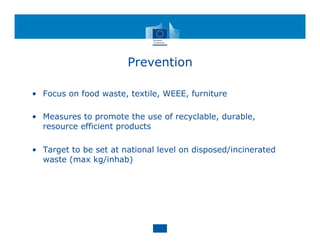
Prevention
• Focus on food waste, textile, WEEE, furniture
• Measures to promote the use of recyclable, durable,
resource efficient products
• Target to be set at national level on disposed/incinerated
waste (max kg/inhab)
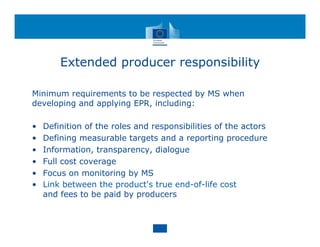
Extended producer responsibility
Minimum requirements to be respected by MS when
developing and applying EPR, including:
• Definition of the roles and responsibilities of the actors
• Defining measurable targets and a reporting procedure
• Information, transparency, dialogue
• Full cost coverage
• Focus on monitoring by MS
• Link between the product's true end-of-life cost
and fees to be paid by producers
Conclusions
• Ambitious and comprehensive package
• Waste legislation proposal now to be considered by
EU co-legislators
• Action Plan with EU actions for 2016-19

Circular Economy implementation in the EU

  • 1.
    Circular Economy Natalia Matting Michał Kubicki EuropeanCommission DG Internal Market, Industry, Entrepreneurship and SMEs Unit Clean Technologies and Products
  • 2.
    From a LinearEconomy…
  • 3.
    … to aCircular Economy
  • 4.
    What is theCircular Economy? • Maintaining the value of products, materials and resources in the economy for as long as possible while minimising waste generation • To boost our economy and competitiveness with new business opportunities and innovative products and services. • For economic, social and environmental gains
  • 5.
    Circular Economy Energy Union andClimate Jobs, Growth and Investment Democratic Change Better Regulation Links with Juncker Priorities Protec'ng the environment and maintaining our compe''veness have to go hand-in-hand: both are about a sustainable future
  • 6.
    The Circular EconomyPackage • Adopted by the Commission on 2nd December 2015 Action Plan Communication List of Follow-up Initiatives (Annex) Legislative proposal on waste
  • 7.
    Objectives of thenew Package • Synergies between environment and business agendas – Preserve resources while creating business opportunities – Closer links to other key EU priorities: climate and energy, jobs and growth, investment, innovation, social, industrial competitiveness • Propose concrete and ambitious action where EU intervention has high added value – e.g. long-term vision and targets on waste management; internal market rules for products; environment and consumers protection; regulatory obstacles or enforcement issues; innovation and investments
  • 8.
  • 9.
  • 10.
    Production Objectives • Incentives tothe circular design of products • Innovative and resource efficient production processes. Key Actions • Foster reparability, durability, and recyclability in Ecodesign (e.g. TV screens) • Promotion of best practices for waste management and resource efficiency in industrial sectors. • Facilitate industrial symbiosis
  • 11.
    Consumption Objectives • Reuse andrepair of products to avoid waste. • Empower consumers with reliable information on environmental impact of products. Key Actions • Develop rules to encourage reuse activities (e.g. waste proposal) • Work to ensure availability of spare parts (Ecodesign?) • Better enforce guarantees and action on false green claims • Emphasize CE criteria in Green Public Procurement. • Independent testing programme to assess possible planned obsolescence. • Better labelling: EU Eco-label, Environmental Footprint.
  • 12.
    Waste management Objectives • Wastemanagement systems, addressing the existing implementation gap. • Long-term vision and drive investments. Key Actions • Revised legislative package on waste Work with Member States to improve waste management, incl. to avoid overcapacities in residual waste treatment (e.g. incineration and Mechanical-biological treatment) • Ensure that Cohesion Policy contributions are guided by the EU waste hierarchy.
  • 13.
    Market for secondaryraw materials Objectives • Increase the use of secondary raw materials. • Increase the use of recycled nutrients and the reuse of treated wastewater. • Safely manage the risks of chemicals of concern. • Improve knowledge of material stocks and flows. Key Actions • Develop quality standards for secondary raw materials. • Revised EU regulation on fertilizers. • Legislative proposal on minimum requirements for reused water • Analysis on the interface between chemicals, product, and waste legislation. • EU-wide electronic system for cross-border transfers of waste.
  • 14.
    Innovation & Investment Objectives •Right environment for innovation and investments. Key Actions • €650 million Horizon 2020 initiative on ‘Industry 2020 in the CE. • Pilot "innovation deals" to address potential regulatory obstacles for innovators. • Targeted outreach of EU funding • New platform for financing CE with EIB and national promotional banks.
  • 15.
  • 16.
    Plastics Objectives • Provide astrategy to improve sustainability of plastics throughout its lifecycle • Increase efficiency in recycling - less than 25% of plastic waste collected is recycled, and about 50% goes to landfill. Key Actions • Adopt a specific strategy on plastics including marine litter. • A more ambitious target for the recycling of plastic packaging in the legislative proposal on waste.
  • 17.
    Food waste Objectives • ReachSustainable Development Goal to halve food waste by 2030 – today around 100 million tonnes of food are wasted annually in the EU. Key Actions • Develop an EU methodology to measure food waste. • Create a platform for the SDG on food waste and to share best practice and results achieved. • Clarify EU legislation relating to waste, food and feed, and facilitate food donation. • Improve the use and understanding of date marking along the food chain (e.g."best before" label).
  • 18.
    Critical Raw Materials Objectives •Increasing efficient use and recovery of CRMs. Key Actions • Encourage recovery of CRMs, and prepare a report on best practices and options for further action at the EU level. • Encourage action by Member States.
  • 19.
    Construction & Demolition Objectives •Identify and increase recovery of valuable materials Key Actions • Ensure recovery of valuable resources and adequate waste management in the construction and demolition sector, as well as facilitate assessing the environmental performance of buildings • Develop pre-demolition guidelines to boost high-value recycling as well as voluntary recycling protocols aimed to improve quality of and build confidence.
  • 20.
    Biomass & bio-basedproducts Objectives • Support an efficient use of wood and bio-based products • Increase recycling of bio-waste Key Actions • Promote an efficient use of bio-based resources through a series of measures, such as the promotion of the cascading use of woody biomass and support to innovation in the bio-economy • New target for recycling wood packaging and a provision to ensure the separate collection of bio-waste • Report and possible revision of the Bio- economy Strategy
  • 21.
  • 22.
    0% 10% 20% 30% 40% 50% 60% 2014 (current status) Target 2020 (exis8ng) (4methods) Target 2025 (1 method) Target 2030 (1 method) % Prep. For reuse and recycling New targets municipal- waste recycling • Separate collection extended to biowaste • One calculation method by 2025 • Time extension for 7 MS recycling less than 20% in 2013 • Review clause (2025) to consider more stringent targets
  • 23.
    New targets municipal-waste landfilling • By 2030 : max 10% landfilling of MSW • 5 years derogation for the same 7 MS as for the recycling rate • Review clause (2025) to consider more stringent targets 0% 5% 10% 15% 20% 25% 30% 35% 2013 (reported) Objec8ve 2030 % Municipal waste in landfill
  • 24.
    New targets –packaging waste recycling 0% 10% 20% 30% 40% 50% 60% 70% 80% 90% Plas8c Wood Ferrous metal Aluminium Glass Paper and cardboard Overall % Prep for resue and recycling Exis%ng targets Target 2025 Target 2030 2012 (latest data) → Clarification on measuring (same as for municipal waste) → Repeal of the recovery and max recycling targets → New target for aluminium
  • 25.
    Targets: Definition andCalculation Rules Definitions: • Municipal waste (OECD/Eurostat-based) • Backfilling, construction and demolition waste, (building on COM Decision 2011/753/EU) • Food waste • Preparation for reuse Calculation rules: • A single method • Main rule: input to the final recycling • Derogation: output of sorting operation if losses are < 10% and tracking system is in place New calculation rules to cover : • Output of recognised re-use centres and products prepared for reuse by deposit-refund schemes; • Metal recycling from energy recovery
  • 26.
    Prevention • Focus onfood waste, textile, WEEE, furniture • Measures to promote the use of recyclable, durable, resource efficient products • Target to be set at national level on disposed/incinerated waste (max kg/inhab)
  • 27.
    Extended producer responsibility Minimumrequirements to be respected by MS when developing and applying EPR, including: • Definition of the roles and responsibilities of the actors • Defining measurable targets and a reporting procedure • Information, transparency, dialogue • Full cost coverage • Focus on monitoring by MS • Link between the product's true end-of-life cost and fees to be paid by producers
  • 28.
    Conclusions • Ambitious andcomprehensive package • Waste legislation proposal now to be considered by EU co-legislators • Action Plan with EU actions for 2016-19