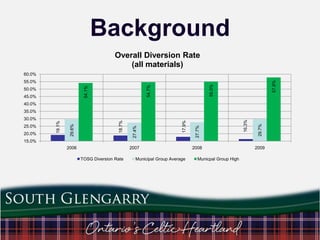
Township of South Glengarry
Waste Recycling Strategy
Objectives
Waste Recycling Strategy
• Review and evaluate current recycling/diversion practices
• Identify options to improve recovery rates/cost
efficiency/diversion
• Extend landfill site life expectancy
• To address Ministry of the Environment (MOE)/Waste
Diversion Ontario (WDO) targets
Background
Waste Recycling Strategy
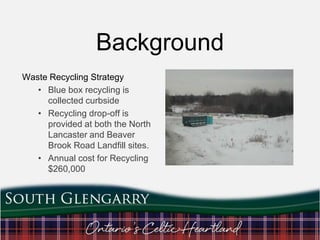
• Blue box recycling is
collected curbside
• Recycling drop-off is
provided at both the North
Lancaster and Beaver
Brook Road Landfill sites.
• Annual cost for Recycling
$260,000
Background
– Increased program effectiveness is essential to meet Waste
Diversion Ontario‟s (WDO) funding requirements
• A WRS is a fundamental best practice and without it, your
annual WDO funding decreases. Additionally, without a
WRS, recycling performance tends to decrease
• A WRS is a planning tool designed to provide guidance
and structure to municipalities for their specific recycling
program
• A WRS sets annual goals and targets and when used
with an appropriately funded and resourced
implementation plan, increases waste diversion and
lowers net costs
Background
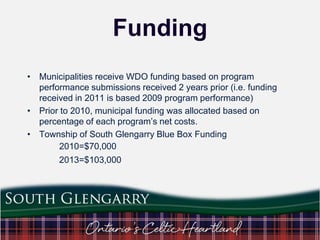
Overall Diversion Rate
(all materials)
60.0%

45.0%

55.0%

54.7%

54.1%

50.0%

57.8%

55.0%

40.0%

29.7%

16.3%

27.7%

17.9%

27.4%

20.0%

18.7%

25.0%

29.6%

30.0%

19.1%

35.0%

15.0%
2006

2007
TOSG Diversion Rate

Municipal Group Average

2008
Municpal Group High

2009
Funding
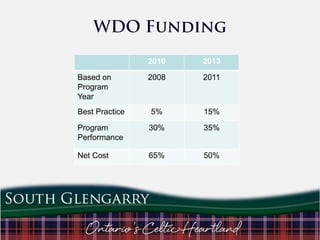
• Municipalities receive WDO funding based on program
performance submissions received 2 years prior (i.e. funding
received in 2011 is based 2009 program performance)
• Prior to 2010, municipal funding was allocated based on
percentage of each program‟s net costs.
• Township of South Glengarry Blue Box Funding
2010=$70,000
2013=$103,000
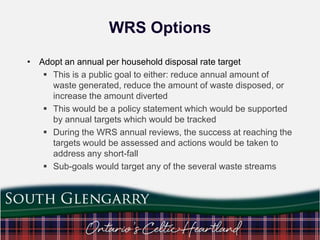
2010

2013

2008

2011

Best Practice

5%

15%

Program
Performance

30%

35%

Net Cost

65%

50%

Based on
Program
Year
WRS Options
• Adopt an annual per household disposal rate target
 This is a public goal to either: reduce annual amount of
waste generated, reduce the amount of waste disposed, or
increase the amount diverted
 This would be a policy statement which would be supported
by annual targets which would be tracked
 During the WRS annual reviews, the success at reaching the
targets would be assessed and actions would be taken to
address any short-fall
 Sub-goals would target any of the several waste streams
• Expand upon the Inter-Municipal Committee
 A Regional committee has been developed that comprises:
South Glengarry, SD&G, City of Cornwall, Prescott & Russell
and City of Ottawa which are working collectively toward
common regional goals for waste diversion
 Committee members should identify and discuss
opportunities for beneficial collaborations and can provide
support and feedback on each others waste diversion
programs
• Partner with other municipalities for services
 Municipalities often face considerable cost and capital
challenges when looking to collect and process recyclables
 Working collaboratively with other municipalities to provide
these services can increase economies of scale and allow
for the sharing of resources
 Joint tendering for services.
•

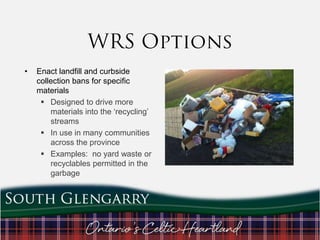
Enact landfill and curbside
collection bans for specific
materials
 Designed to drive more
materials into the „recycling‟
streams
 In use in many communities
across the province
 Examples: no yard waste or
recyclables permitted in the
garbage
• Implement a clear bag requirement for garbage
 Curbside collection and drop off at the landfills would require
garbage to be placed in a clear bag
 This is an active reinforcement policy that promotes waste
diversion in that garbage set out for collection / delivered for
disposal can be verified to be free of „divertible‟ materials
(such as recyclables and yard waste)
• Container limits for garbage
 Restrict the number of garbage bags a resident can set out
for curbside pick-up
 This encourages residents to divert more recyclable material
in-order to not exceed the two bag limit
• Consider implementing a full user-pay system for garbage
 This is a By-law that stipulates that a "bag tag" must be
placed on each garbage bag/container set out for collection
or taken to the landfill
 The purpose is to get people to divert more material by
removing the „free‟ disposal option
 This option also contributes to covering the cost of the
Township‟s waste management system (instead of paying for
the system through taxes)
• Review the recycling performance of multi-residential buildings
 Typically, buildings don‟t recycle as much as single family
homes
 Opportunities may exist to improve upon the current
performance
• Increase the recycling collection frequency to weekly
 Currently, recycling is collected every two weeks
 Weekly collection offers greater opportunity to increase
recycling rates and at the same time, reduce the quantity of
garbage produced
• Expand the list of acceptable recyclable materials
 Currently, Township recyclables are sent to R.A.R.E. in
Alexandria for processing. An opportunity may exist to
increase the types of materials acceptable
• Provide free/subsidized blue boxes
 If weekly collection of recyclables is adopted and more
materials are allowed in the program, more storage capacity
may be needed
 Additional boxes means less recyclables enter the garbage
stream thereby increasing the recycling rate
• Review leaf and yard waste collection
 Provide free/subsidized back-yard composters
 At home composting could be encouraged through the P&E
program
•

Make improvements to the recycling
depot at both of the Township landfills
 For those residents that prefer to
utilize the landfill, and/or use it for
specific disposal needs,
opportunities should be made
available to divert material prior
to disposal
 There are a number of Best
Practices in depot design and
management that may benefit
the Township
• Consider recycling in public and open spaces
 Recycling containers in high traffic areas, especially where
evidence of use is very conspicuous should be considered includes outdoor parks, campsites, trails, and public facilities
 By establishing recycling containers where garbage
containers are available, further opportunities exist to divert
more material
• Review the current communication methods and revise where
needed
 Future communications could include performance updates,
„calls to action‟ to divert more, etc.
 Include P&E campaign promoting at home composting
• On June 6th, 2013, Ontario‟s Minister of the Environment
introduced Bill 91, the proposed Waste Reduction Act, to
establish a new regime for the reduction, reuse and recycling of
waste.
• Ontario‟s Overall Diversion Rate has stalled at 25%
• At the same time, a draft Waste Reduction Strategy was
released for public comments, which provides a blue print for
the implementation of the Act. Comments were received until
September 4th
• If passed, the proposed Waste Reduction Act, along with a draft
Waste Reduction Strategy would form the cornerstone of a long
term effort to increase waste diversion and protect consumers
•
•
•
•
•
•
•

•
•

The proposed Waste Reduction Act and the draft Waste Reduction
Strategy aim to:
Increase the recycling of waste
Stimulate the reduction of waste
Make individual producers responsible for the end-of-life management
of designated products and packaging
Provide consumers with convenient and accessible diversion services
Reduce the amount of waste being sent to landfill
Shift the costs of diversion away from the municipal tax base and
municipal taxpayers to the producers of the products from which waste
is derived
Protect consumers from surprise “eco fees” at the cash register
Provide strong oversight and compliance to ensure outcomes are met
•

•
•
•

Part II and part V of the Act describes the responsibilities and powers of the
proposed Waste Reduction Authority and appropriate government oversight on
the Authority
The proposed Act would transform Waste Diversion Ontario into the Waste
Reduction Authority to undertake the compliance and enforcement role for the
individual producer responsibility regime and the integrated pricing provisions.
The Authority would also continue to oversee the existing waste diversion
programs until they are transitioned to the new producer responsibility
framework.
The Authority would report annually to the Minister of the Environment and the
public. In addition, a number of different accountability and transparency
provisions would apply.
•
•
•
•

Part III of the Act describes the new individual producer responsibility framework,
including the responsibilities of individual producers. Part III also describes the
role of municipalities.
Producers would be responsible for meeting outcomes set out in the Act and
regulations
Producers have options on how to meet the outcomes
Producers and intermediaries have joint responsibility for meeting recycling
outcomes
Producers would be responsible for meeting recycling outcomes. Where an
agreement enters with an intermediary the producer + intermediary would have
joint responsibility
•
•
•
•

Producers must collect the designated waste from the municipality unless they
have agreed otherwise
Producers must pay the reimbursable part of the municipality‟s costs which is
determined by a compensation formula based on reasonable cost
The Authority would establish a compensation formula, for designated products
The Authority would facilitate a resolution to a dispute between producers and
municipalities on matters of reimbursement upon the request of either party
Part IV of the Act requires all-in pricing. Separate “eco-fees” are not allowed.
• Producer or any seller of a product shall include any recovered recycling cost for
the product into the final advertised or displayed price of the product
• If a producer or a seller chooses to communicate the recycling cost of a product
in its price, the final advertised price must be more prominent than the recycling
cost and includes the name and amount of the recycling cost.
• The proposed Act also prohibits any false or misleading information with regards
to recycling costs (e.g. producers or retailers cannot portray it as a government
tax)
•

•

The proposed Waste Reduction Strategy sets out a blueprint for the
implementation of the Act, if passed, and complementary initiatives for
increasing diversion
The Waste Reduction Strategy identifies paper and packaging supplied into the
IC&I sectors as the first waste for designation under the Waste Reduction Act, if
passed
The Waste Reduction Strategy also identifies additional actions to support
diversion, including disposal bans, the development of recycling standards for
end-of-life vehicles, the development of a strategy to increase organics
diversion, and the use of disposal bans to support diversion.
Waste recycling strategy presentation   sg

Waste recycling strategy presentation sg

  • 1.
    Township of SouthGlengarry Waste Recycling Strategy
  • 2.
    Objectives Waste Recycling Strategy •Review and evaluate current recycling/diversion practices • Identify options to improve recovery rates/cost efficiency/diversion • Extend landfill site life expectancy • To address Ministry of the Environment (MOE)/Waste Diversion Ontario (WDO) targets
  • 3.
    Background Waste Recycling Strategy •Blue box recycling is collected curbside • Recycling drop-off is provided at both the North Lancaster and Beaver Brook Road Landfill sites. • Annual cost for Recycling $260,000
  • 4.
    Background – Increased programeffectiveness is essential to meet Waste Diversion Ontario‟s (WDO) funding requirements • A WRS is a fundamental best practice and without it, your annual WDO funding decreases. Additionally, without a WRS, recycling performance tends to decrease • A WRS is a planning tool designed to provide guidance and structure to municipalities for their specific recycling program • A WRS sets annual goals and targets and when used with an appropriately funded and resourced implementation plan, increases waste diversion and lowers net costs
  • 5.
    Background Overall Diversion Rate (allmaterials) 60.0% 45.0% 55.0% 54.7% 54.1% 50.0% 57.8% 55.0% 40.0% 29.7% 16.3% 27.7% 17.9% 27.4% 20.0% 18.7% 25.0% 29.6% 30.0% 19.1% 35.0% 15.0% 2006 2007 TOSG Diversion Rate Municipal Group Average 2008 Municpal Group High 2009
  • 6.
    Funding • Municipalities receiveWDO funding based on program performance submissions received 2 years prior (i.e. funding received in 2011 is based 2009 program performance) • Prior to 2010, municipal funding was allocated based on percentage of each program‟s net costs. • Township of South Glengarry Blue Box Funding 2010=$70,000 2013=$103,000
  • 7.
  • 8.
    WRS Options • Adoptan annual per household disposal rate target  This is a public goal to either: reduce annual amount of waste generated, reduce the amount of waste disposed, or increase the amount diverted  This would be a policy statement which would be supported by annual targets which would be tracked  During the WRS annual reviews, the success at reaching the targets would be assessed and actions would be taken to address any short-fall  Sub-goals would target any of the several waste streams
  • 9.
    • Expand uponthe Inter-Municipal Committee  A Regional committee has been developed that comprises: South Glengarry, SD&G, City of Cornwall, Prescott & Russell and City of Ottawa which are working collectively toward common regional goals for waste diversion  Committee members should identify and discuss opportunities for beneficial collaborations and can provide support and feedback on each others waste diversion programs
  • 10.
    • Partner withother municipalities for services  Municipalities often face considerable cost and capital challenges when looking to collect and process recyclables  Working collaboratively with other municipalities to provide these services can increase economies of scale and allow for the sharing of resources  Joint tendering for services.
  • 11.
    • Enact landfill andcurbside collection bans for specific materials  Designed to drive more materials into the „recycling‟ streams  In use in many communities across the province  Examples: no yard waste or recyclables permitted in the garbage
  • 12.
    • Implement aclear bag requirement for garbage  Curbside collection and drop off at the landfills would require garbage to be placed in a clear bag  This is an active reinforcement policy that promotes waste diversion in that garbage set out for collection / delivered for disposal can be verified to be free of „divertible‟ materials (such as recyclables and yard waste)
  • 13.
    • Container limitsfor garbage  Restrict the number of garbage bags a resident can set out for curbside pick-up  This encourages residents to divert more recyclable material in-order to not exceed the two bag limit
  • 14.
    • Consider implementinga full user-pay system for garbage  This is a By-law that stipulates that a "bag tag" must be placed on each garbage bag/container set out for collection or taken to the landfill  The purpose is to get people to divert more material by removing the „free‟ disposal option  This option also contributes to covering the cost of the Township‟s waste management system (instead of paying for the system through taxes)
  • 15.
    • Review therecycling performance of multi-residential buildings  Typically, buildings don‟t recycle as much as single family homes  Opportunities may exist to improve upon the current performance
  • 16.
    • Increase therecycling collection frequency to weekly  Currently, recycling is collected every two weeks  Weekly collection offers greater opportunity to increase recycling rates and at the same time, reduce the quantity of garbage produced • Expand the list of acceptable recyclable materials  Currently, Township recyclables are sent to R.A.R.E. in Alexandria for processing. An opportunity may exist to increase the types of materials acceptable
  • 17.
    • Provide free/subsidizedblue boxes  If weekly collection of recyclables is adopted and more materials are allowed in the program, more storage capacity may be needed  Additional boxes means less recyclables enter the garbage stream thereby increasing the recycling rate
  • 18.
    • Review leafand yard waste collection  Provide free/subsidized back-yard composters  At home composting could be encouraged through the P&E program
  • 19.
    • Make improvements tothe recycling depot at both of the Township landfills  For those residents that prefer to utilize the landfill, and/or use it for specific disposal needs, opportunities should be made available to divert material prior to disposal  There are a number of Best Practices in depot design and management that may benefit the Township
  • 20.
    • Consider recyclingin public and open spaces  Recycling containers in high traffic areas, especially where evidence of use is very conspicuous should be considered includes outdoor parks, campsites, trails, and public facilities  By establishing recycling containers where garbage containers are available, further opportunities exist to divert more material
  • 21.
    • Review thecurrent communication methods and revise where needed  Future communications could include performance updates, „calls to action‟ to divert more, etc.  Include P&E campaign promoting at home composting
  • 22.
    • On June6th, 2013, Ontario‟s Minister of the Environment introduced Bill 91, the proposed Waste Reduction Act, to establish a new regime for the reduction, reuse and recycling of waste. • Ontario‟s Overall Diversion Rate has stalled at 25% • At the same time, a draft Waste Reduction Strategy was released for public comments, which provides a blue print for the implementation of the Act. Comments were received until September 4th • If passed, the proposed Waste Reduction Act, along with a draft Waste Reduction Strategy would form the cornerstone of a long term effort to increase waste diversion and protect consumers
  • 23.
    • • • • • • • • • The proposed WasteReduction Act and the draft Waste Reduction Strategy aim to: Increase the recycling of waste Stimulate the reduction of waste Make individual producers responsible for the end-of-life management of designated products and packaging Provide consumers with convenient and accessible diversion services Reduce the amount of waste being sent to landfill Shift the costs of diversion away from the municipal tax base and municipal taxpayers to the producers of the products from which waste is derived Protect consumers from surprise “eco fees” at the cash register Provide strong oversight and compliance to ensure outcomes are met
  • 24.
    • • • • Part II andpart V of the Act describes the responsibilities and powers of the proposed Waste Reduction Authority and appropriate government oversight on the Authority The proposed Act would transform Waste Diversion Ontario into the Waste Reduction Authority to undertake the compliance and enforcement role for the individual producer responsibility regime and the integrated pricing provisions. The Authority would also continue to oversee the existing waste diversion programs until they are transitioned to the new producer responsibility framework. The Authority would report annually to the Minister of the Environment and the public. In addition, a number of different accountability and transparency provisions would apply.
  • 25.
    • • • • Part III ofthe Act describes the new individual producer responsibility framework, including the responsibilities of individual producers. Part III also describes the role of municipalities. Producers would be responsible for meeting outcomes set out in the Act and regulations Producers have options on how to meet the outcomes Producers and intermediaries have joint responsibility for meeting recycling outcomes Producers would be responsible for meeting recycling outcomes. Where an agreement enters with an intermediary the producer + intermediary would have joint responsibility
  • 26.
    • • • • Producers must collectthe designated waste from the municipality unless they have agreed otherwise Producers must pay the reimbursable part of the municipality‟s costs which is determined by a compensation formula based on reasonable cost The Authority would establish a compensation formula, for designated products The Authority would facilitate a resolution to a dispute between producers and municipalities on matters of reimbursement upon the request of either party
  • 27.
    Part IV ofthe Act requires all-in pricing. Separate “eco-fees” are not allowed. • Producer or any seller of a product shall include any recovered recycling cost for the product into the final advertised or displayed price of the product • If a producer or a seller chooses to communicate the recycling cost of a product in its price, the final advertised price must be more prominent than the recycling cost and includes the name and amount of the recycling cost. • The proposed Act also prohibits any false or misleading information with regards to recycling costs (e.g. producers or retailers cannot portray it as a government tax)
  • 28.
    • • The proposed WasteReduction Strategy sets out a blueprint for the implementation of the Act, if passed, and complementary initiatives for increasing diversion The Waste Reduction Strategy identifies paper and packaging supplied into the IC&I sectors as the first waste for designation under the Waste Reduction Act, if passed The Waste Reduction Strategy also identifies additional actions to support diversion, including disposal bans, the development of recycling standards for end-of-life vehicles, the development of a strategy to increase organics diversion, and the use of disposal bans to support diversion.