Delhi Monuments
• India Gate
• Red Fort
• Qutub Minar
India Gate
• The India Gate is the national monument of
  India. Situated in the heart of New Delhi, the
  India Gate was designed by Sir Edwin Lutyens,
  inspired by the Arc de Triomphe in Paris. It was
  built in 1931. Originally known as the All India
  War Memorial, it is a prominent landmark
  in Delhi and commemorates the 90,000 soldiers
  of the Indian Army who lost their lives while
  fighting for the Indian Empire, or more correctly
  the British Raj in World War I and the Third
  Anglo-Afghan War. It is composed of red and pale
  sandstone and granite.
Red Fort
• The Red Fort usually transcribed into English as (Lal
  Qil'ahor Lal Qila) is a 17th century fort complex
  constructed by the Mughal emperor Shah Jahan in the
  walled city of Old Delhi (in present day Delhi, India) that
  served as the residence of theMughal Emperors. It also
  served as the capital of the Mughals until 1857, when
  Mughal emperor Bahadur Shah Zafar was exiled by
  the British Indian government. It was designated
  a UNESCO World Heritage Site in 2007. he Red Fort is one
  of the most popular tourist destinations in Old Delhi,
  attracting thousands of visitors every year. The fort is also
  the site from which the Prime Minister of India addresses
  the nation on 15 August, the day India achieved
  independence from the British. It also happens to be the
  largest monument in Old Delhi.
Qutub Minar
• Qutub Minar is a UNESCO World Heritage Site.
  Located in Delhi, India. The Qutub Minar is
  constructed with red sandstone and marble, and is
  the tallest minaret in India, with a height of 72.5
  meters (237.8 ft), contains 379 stairs to reach the
  top, and the diameter of base is 14.3 meters where as
  the last store is of 2.7 meters. The Construction was
  commenced by Qutb-ud-din Aibak in 1192 and
  completed by Iltutmish. The Qutub Minar is notable
  for being one of the earliest and most prominent
  examples of Indo-Islamic architecture. It is
  surrounded by several other ancient and medieval
  structures and ruins, collectively known as Qutub
  complex.
Markets
• Kirti Nagar
• Khan Market
• Rajouri
Kirti Nagar
• Kirti Nagar is an area of West Delhi, India. Part
  of the Punjabi Bagh subzone of West Delhi, it
  primarily a residential colony. Kirti Nagar is
  home to Asia's largest furniture market
  housing showrooms of multi-national home
  remodeling and fittings companies, the most
  reputed interior design boutiques, imported
  kitchen and bath brands as well as traditional
  carpentry furniture makers.
Khan Market
1. Khan Market named in honour of Khan Abdul Ghaffar Khan
   (popularly khown as Frontier Gandhi or Badshah Khan), it is the
   costliest market strip in New Delhi. It has been ranked as the
   costliest retail location in India. In 2010, it was rated as the world's
   21st most expensive retail high street by real estate firm Cushman
   & Wakefield and is consistently ranked as one of the costliest high
   end streets. It is located almost at the heart of the city, close
   to India Gate. Surrounded by residential complexes – both
   government owned and private, including Golf Links, Lodhi Estate,
   Pandara Road, Rabindra Nagar and Sujan Singh Park. Its environs
   are home to a significant number of bureaucrats from the central
   government, and famous people like the satiric author Khushwant
   Singh It is one of the greenest pockets of the city, very close to the
   famedLodhi Gardens. Also in proximity are the India International
   Centre, the India Habitat Centre, offices of theWorld Wide Fund
   for Nature, and other organizations.
Rajouri
• Rajouri Garden is a popular market,
  comprising the Main Market, Nehru Market
  and many western style indoor shopping
  malls including TDI Mall, TDI Paragon
  Mall, Shoppers Stop, City Square, West Gate
  Mall, and Paradise Mall. Together, this area is
  now the largest single locality shopping
  conglomeration in Delhi ahead of South Delhi
Stadiums

• Jawaharlal Nehru Stadium
• Ferozshah Kotla
Jawaharlal Nehru Stadium
• Jawaharlal Nehru Stadium in Delhi, India, is a
  multipurpose sports arena hosting football and
  other sporting events, as well as large-scale
  entertainment events. It is named after the first
  Prime Minister of India. The all-seater facility
  seats 60,000 spectators, and up to 100,000 for
  concerts. In terms of seating capacity, it is
  the third largest multipurpose stadium in
  India and the 51st largest in the world. The
  stadium houses the headquarters of the Indian
  Olympic Association.
Ferozshah Kotla
• The Feroz Shah Kotla Kotla was originally a fortress
  built by Sultan Ferozshah Tughlaq to house his version
  of Delhi city called Ferozabad. A pristine polished
  sandstone pillar from the 3rd century B.C. rises from
  the palace's crumbling remains, one of many pillars
  left by the Mauryan emperor Ashoka; it was moved
  from Ambala, Punjab and re-erected in its current
  location in 1356. The Feroz Shah Kotla was
  established as a cricket ground in 1883. It is the
  second oldest international cricket stadium still
  functional in India, only after the Eden
  Gardens in Kolkata. It is located close to the 20,000
  capacity Ambedkar Stadium, the home of association
  football club New Delhi Heroes FC.
Temples


• Akshardham Temple
• Chattarpur Mandir
• Hanuman Mandir
Akshardham Temple
• The Akshardham Temple is one of the most recently
  built temples in Delhi. Constructed by the Bochasanvasi
  Aksharpurushottam Swaminarayan Sanstha (BAPS), it is
  situated on the banks of the River Yamuna. Delhi
  Akshar Dham Mandir was inaugurated in
  Novenmber'05 in the presence of President APJ Abdul
  Kalam. It is spread over an area of 100 acres and took
  about two years to complete. Akshardhaam Temple of
  New Delhi is built in an architectural style similar to
  that of the Akshardham temple of Gandhinagar in
  Gujarat, India. Its construction is based on the ancient
  Sthaapatya shastras of India and it is built without
  steel, entirely out of sandstone and marble.
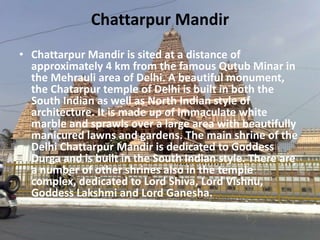
Chattarpur Mandir
• Chattarpur Mandir is sited at a distance of
  approximately 4 km from the famous Qutub Minar in
  the Mehrauli area of Delhi. A beautiful monument,
  the Chatarpur temple of Delhi is built in both the
  South Indian as well as North Indian style of
  architecture. It is made up of immaculate white
  marble and sprawls over a large area with beautifully
  manicured lawns and gardens. The main shrine of the
  Delhi Chattarpur Mandir is dedicated to Goddess
  Durga and is built in the South Indian style. There are
  a number of other shrines also in the temple
  complex, dedicated to Lord Shiva, Lord Vishnu,
  Goddess Lakshmi and Lord Ganesha.
Iskcon Temple
• Iskcon Temple is situated at Hari Krishna Hill, near East of
  Kailash. Built by the Hare-Rama Hare-Krishna cult, the
  temple dates back to the year 1998. New Delhi Iskon
  Temple is one of the 40 temples in India built by the
  International Society for Krishna Consciousness (Iskcon).
  Dedicated to Lord Krishna, the temple is one of the
  biggest temple complexes in India. The Hare Rama Hare
  Krishna Temple of New Delhi is beautifully built and is
  adorned with exquisite paintings on the life phases of
  Radha-Krishan, Sita-Ram, Laxman, Hanuman and
  Chaitanya Mahaprabhu, made by Russian artists. The
  shikhars, at a height of 90-feet above the ground level,
  also add to the grandeur of the temple.
Delhi

Delhi

  • 2.
    Delhi Monuments • IndiaGate • Red Fort • Qutub Minar
  • 3.
    India Gate • TheIndia Gate is the national monument of India. Situated in the heart of New Delhi, the India Gate was designed by Sir Edwin Lutyens, inspired by the Arc de Triomphe in Paris. It was built in 1931. Originally known as the All India War Memorial, it is a prominent landmark in Delhi and commemorates the 90,000 soldiers of the Indian Army who lost their lives while fighting for the Indian Empire, or more correctly the British Raj in World War I and the Third Anglo-Afghan War. It is composed of red and pale sandstone and granite.
  • 4.
    Red Fort • TheRed Fort usually transcribed into English as (Lal Qil'ahor Lal Qila) is a 17th century fort complex constructed by the Mughal emperor Shah Jahan in the walled city of Old Delhi (in present day Delhi, India) that served as the residence of theMughal Emperors. It also served as the capital of the Mughals until 1857, when Mughal emperor Bahadur Shah Zafar was exiled by the British Indian government. It was designated a UNESCO World Heritage Site in 2007. he Red Fort is one of the most popular tourist destinations in Old Delhi, attracting thousands of visitors every year. The fort is also the site from which the Prime Minister of India addresses the nation on 15 August, the day India achieved independence from the British. It also happens to be the largest monument in Old Delhi.
  • 5.
    Qutub Minar • QutubMinar is a UNESCO World Heritage Site. Located in Delhi, India. The Qutub Minar is constructed with red sandstone and marble, and is the tallest minaret in India, with a height of 72.5 meters (237.8 ft), contains 379 stairs to reach the top, and the diameter of base is 14.3 meters where as the last store is of 2.7 meters. The Construction was commenced by Qutb-ud-din Aibak in 1192 and completed by Iltutmish. The Qutub Minar is notable for being one of the earliest and most prominent examples of Indo-Islamic architecture. It is surrounded by several other ancient and medieval structures and ruins, collectively known as Qutub complex.
  • 6.
    Markets • Kirti Nagar •Khan Market • Rajouri
  • 7.
    Kirti Nagar • KirtiNagar is an area of West Delhi, India. Part of the Punjabi Bagh subzone of West Delhi, it primarily a residential colony. Kirti Nagar is home to Asia's largest furniture market housing showrooms of multi-national home remodeling and fittings companies, the most reputed interior design boutiques, imported kitchen and bath brands as well as traditional carpentry furniture makers.
  • 8.
    Khan Market 1. KhanMarket named in honour of Khan Abdul Ghaffar Khan (popularly khown as Frontier Gandhi or Badshah Khan), it is the costliest market strip in New Delhi. It has been ranked as the costliest retail location in India. In 2010, it was rated as the world's 21st most expensive retail high street by real estate firm Cushman & Wakefield and is consistently ranked as one of the costliest high end streets. It is located almost at the heart of the city, close to India Gate. Surrounded by residential complexes – both government owned and private, including Golf Links, Lodhi Estate, Pandara Road, Rabindra Nagar and Sujan Singh Park. Its environs are home to a significant number of bureaucrats from the central government, and famous people like the satiric author Khushwant Singh It is one of the greenest pockets of the city, very close to the famedLodhi Gardens. Also in proximity are the India International Centre, the India Habitat Centre, offices of theWorld Wide Fund for Nature, and other organizations.
  • 9.
    Rajouri • Rajouri Gardenis a popular market, comprising the Main Market, Nehru Market and many western style indoor shopping malls including TDI Mall, TDI Paragon Mall, Shoppers Stop, City Square, West Gate Mall, and Paradise Mall. Together, this area is now the largest single locality shopping conglomeration in Delhi ahead of South Delhi
  • 10.
    Stadiums • Jawaharlal NehruStadium • Ferozshah Kotla
  • 11.
    Jawaharlal Nehru Stadium •Jawaharlal Nehru Stadium in Delhi, India, is a multipurpose sports arena hosting football and other sporting events, as well as large-scale entertainment events. It is named after the first Prime Minister of India. The all-seater facility seats 60,000 spectators, and up to 100,000 for concerts. In terms of seating capacity, it is the third largest multipurpose stadium in India and the 51st largest in the world. The stadium houses the headquarters of the Indian Olympic Association.
  • 12.
    Ferozshah Kotla • TheFeroz Shah Kotla Kotla was originally a fortress built by Sultan Ferozshah Tughlaq to house his version of Delhi city called Ferozabad. A pristine polished sandstone pillar from the 3rd century B.C. rises from the palace's crumbling remains, one of many pillars left by the Mauryan emperor Ashoka; it was moved from Ambala, Punjab and re-erected in its current location in 1356. The Feroz Shah Kotla was established as a cricket ground in 1883. It is the second oldest international cricket stadium still functional in India, only after the Eden Gardens in Kolkata. It is located close to the 20,000 capacity Ambedkar Stadium, the home of association football club New Delhi Heroes FC.
  • 13.
    Temples • Akshardham Temple •Chattarpur Mandir • Hanuman Mandir
  • 14.
    Akshardham Temple • TheAkshardham Temple is one of the most recently built temples in Delhi. Constructed by the Bochasanvasi Aksharpurushottam Swaminarayan Sanstha (BAPS), it is situated on the banks of the River Yamuna. Delhi Akshar Dham Mandir was inaugurated in Novenmber'05 in the presence of President APJ Abdul Kalam. It is spread over an area of 100 acres and took about two years to complete. Akshardhaam Temple of New Delhi is built in an architectural style similar to that of the Akshardham temple of Gandhinagar in Gujarat, India. Its construction is based on the ancient Sthaapatya shastras of India and it is built without steel, entirely out of sandstone and marble.
  • 15.
    Chattarpur Mandir • ChattarpurMandir is sited at a distance of approximately 4 km from the famous Qutub Minar in the Mehrauli area of Delhi. A beautiful monument, the Chatarpur temple of Delhi is built in both the South Indian as well as North Indian style of architecture. It is made up of immaculate white marble and sprawls over a large area with beautifully manicured lawns and gardens. The main shrine of the Delhi Chattarpur Mandir is dedicated to Goddess Durga and is built in the South Indian style. There are a number of other shrines also in the temple complex, dedicated to Lord Shiva, Lord Vishnu, Goddess Lakshmi and Lord Ganesha.
  • 16.
    Iskcon Temple • IskconTemple is situated at Hari Krishna Hill, near East of Kailash. Built by the Hare-Rama Hare-Krishna cult, the temple dates back to the year 1998. New Delhi Iskon Temple is one of the 40 temples in India built by the International Society for Krishna Consciousness (Iskcon). Dedicated to Lord Krishna, the temple is one of the biggest temple complexes in India. The Hare Rama Hare Krishna Temple of New Delhi is beautifully built and is adorned with exquisite paintings on the life phases of Radha-Krishan, Sita-Ram, Laxman, Hanuman and Chaitanya Mahaprabhu, made by Russian artists. The shikhars, at a height of 90-feet above the ground level, also add to the grandeur of the temple.