(िदिल्ली)
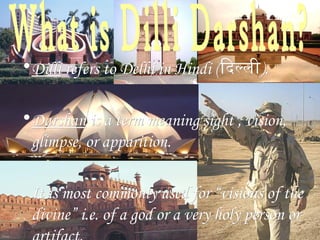
• Dilli refers to Delhi in Hindi (िदिल्ली).

• Darshan is a term meaning sight , vision,
  glimpse, or apparition.

  It is most commonly used for “visions of the
  divine” i.e. of a god or a very holy person or
        Delhi is the second-largest city in India and, with over 11
    million residents, the eighth largest metropolis in the world by
    population. It is a federally administered union territory
    officially known as the National Capital Region (NCR).

       It is the site of many ancient and medieval monuments,
    archaeological sites and remains.

       When India gained independence from British rule in
    1947, New Delhi was declared as the capital of India.

         Owing to the migration of people from across the
    country, Delhi has grown to be a cosmopolitan city. Its rapid
    development and urbanisation, coupled with the relatively
    high average income of its population, has transformed the
    city. Today Delhi is a major cultural, political, and
Delhi, being the capital of many empires for
centuries - especially of Mughal India, has a
number of forts and monuments to boast of. The
city has blended the past and the present
beautifully. There are strong citadels, such as
Red Fort, Old Fort, Jantar Mantar, Tombs of the
royal personages and Qutub Minar, which are
counted amongst some of the most luring
monuments of the capital city of India.
   Besides these, one can find a number of other
beautiful tombs, mosques and buildings
throughout the city that have interesting history
and legends attached to them. The lifestyle of the
people of New Delhi is interwoven with the age
HUMAYUN’S TOMB
• Humayun's tomb is a complex of buildings
  in Mughal architecture built by the Mughal
  emperor Humayun.

• It is located in Nizamuddin East, Delhi,
  India.

• The complex is a World Heritage Site and
  the first example of this type of Mughal
  architecture in India.
• The Yantra Mandir (literally the 'temple of
  instruments', and often called the Jantar
  Mantar ) located in the modern city of New
  Delhi, Delhi. It consists of 13 architectural
  astronomy instruments, built by Maharaja
  Jai Singh II of Jaipur, from 1724 onwards,
  and is one of five built by him, as he was
  given by Mughal emperor Muhammad Shah
  the task of revising the calendar and
  astronomical tables.

• The primary purpose of the observatory was
  to compile astronomical tables, and to predict
RED FORT
• The Red Fort of Delhi was built by the great
  Mughal emperor Shah Jahan.

• The Red Fort or the Lal Qila is located in the
  heart of Old Delhi.

• It took more than 10 million rupees during
  the reign of Shah Jahan to create this
  structure in red sandstone.

• The President of the country hoists the
  national flag on the Independence day(15th
  August) at the Red Fort.
•
          India gate
           The India Gate is one of the largest war
    memorials in India situated in the heart of New
    Delhi.

•             India Gate is prominent landmark in Delhi
    and commemorates the members of the erstwhile
    British Indian Army who lost their lives fighting for
    the Indian Empire in World War I and the Afghan
    Wars.

•           Following India's independence, India
    Gate became the site of Indian Army's Tomb of the
    Unknown Soldier, known as the Amar Jawan Jyoti.
•   Akshardham is a hindu temple complex in Delhi.

•   The famous Akshardham Temple of Delhi has entered in the Guinness Book
    of World Records as the largest Hindu temple complex in the world.

•   The complex displays centuries of traditional Indian and Hindu culture,
    spirituality, and architecture.

•   The building was inspired and moderated by Pramukh Swami Maharaj, the
    spiritual head of the Bochasanwasi Shri Akshar Purushottam Swaminarayan
    Sanstha, whose 3,000 volunteers helped 7,000 artisans construct
    Akshardham.

•   The temple, which attracts approximately 70 percent of all tourists who
    visit Delhi, was officially opened on 6 November 2005.

•    It sits on the banks of the Yamuna River adjacent to the proposed 2010
    Commonwealth Games village.
Lotus Temple
• Lotus Temple is one of the remarkable
  architectures located at Kalkaji in New Delhi.

• The temple is in the shape of a lotus flower and
  has received recognition from all over the world
  for its splendid architecture.

• Lotus is a symbol of peace, purity, love and
  immortality. It is this particular specialty of Lotus
  flower which makes the flower an important icon
  in Indian culture and society. This is why the
  design of Lotus temple has been inspired by lotus
  flower.
JAMA
              MASJID
• Jama Masjid is the largest mosque in India. Located
  in Old Delhi.

• The mosque has the capacity to accommodate
  25000 devotees.

• Jama Masjid was completed in 1656 AD and it was
  again the great Mughal Emperor Shah Jahan
  behind this architectural masterpiece.

• Close to some 5000 craftsmen were involved in the
  construction of the mosque.

• It is located in Old Delhi, just opposite to the
QUT M
         UB INAR
• Qutub Minar is a tower in Delhi and is
  the world's tallest brick minaret.

• It was constructed by India's first
  Muslim ruler Qutb-ud-din Aibak and
  the topmost storey of the minaret
  was completed by Firuz Shah
  Tughluq.

• The Qutub Minar is notable for being
  one of the earliest and most
  prominent examples of Indo-Islamic
  architecture.

• It is surrounded by several other
  ancient and medieval structures and
  ruins, collectively known as Qutub
  complex.
• Raj Ghat is a memorial to Mahatma Gandhi(a major political and
  spiritual leader of India ) It is a black marble platform that marks
  the spot of Gandhi's cremation on 31 January, 1948.

•    It is left open to the sky while an eternal flame burns perpetually
    at one end. It is located on the banks of the river Yamuna in Delhi
    in India.

•    In recent years, it has become customary for foreign dignitaries
    visiting India to pay their respects to Gandhi at the Raj Ghat by
    laying flowers or wreaths on the platform.

• As a sign of respect, visitors are required to remove footwear
  before approaching the memorial. A commemorative ceremony is
  held every Friday. Prayer sessions are held at the Raj Ghat on
  Gandhi's birth and death anniversaries.
Dilli darshan
Dilli darshan

Dilli darshan

  • 2.
    (िदिल्ली) • Dilli refersto Delhi in Hindi (िदिल्ली). • Darshan is a term meaning sight , vision, glimpse, or apparition. It is most commonly used for “visions of the divine” i.e. of a god or a very holy person or
  • 3.
    Delhi is the second-largest city in India and, with over 11 million residents, the eighth largest metropolis in the world by population. It is a federally administered union territory officially known as the National Capital Region (NCR).  It is the site of many ancient and medieval monuments, archaeological sites and remains.  When India gained independence from British rule in 1947, New Delhi was declared as the capital of India.  Owing to the migration of people from across the country, Delhi has grown to be a cosmopolitan city. Its rapid development and urbanisation, coupled with the relatively high average income of its population, has transformed the city. Today Delhi is a major cultural, political, and
  • 4.
    Delhi, being thecapital of many empires for centuries - especially of Mughal India, has a number of forts and monuments to boast of. The city has blended the past and the present beautifully. There are strong citadels, such as Red Fort, Old Fort, Jantar Mantar, Tombs of the royal personages and Qutub Minar, which are counted amongst some of the most luring monuments of the capital city of India. Besides these, one can find a number of other beautiful tombs, mosques and buildings throughout the city that have interesting history and legends attached to them. The lifestyle of the people of New Delhi is interwoven with the age
  • 6.
    HUMAYUN’S TOMB • Humayun'stomb is a complex of buildings in Mughal architecture built by the Mughal emperor Humayun. • It is located in Nizamuddin East, Delhi, India. • The complex is a World Heritage Site and the first example of this type of Mughal architecture in India.
  • 8.
    • The YantraMandir (literally the 'temple of instruments', and often called the Jantar Mantar ) located in the modern city of New Delhi, Delhi. It consists of 13 architectural astronomy instruments, built by Maharaja Jai Singh II of Jaipur, from 1724 onwards, and is one of five built by him, as he was given by Mughal emperor Muhammad Shah the task of revising the calendar and astronomical tables. • The primary purpose of the observatory was to compile astronomical tables, and to predict
  • 10.
    RED FORT • TheRed Fort of Delhi was built by the great Mughal emperor Shah Jahan. • The Red Fort or the Lal Qila is located in the heart of Old Delhi. • It took more than 10 million rupees during the reign of Shah Jahan to create this structure in red sandstone. • The President of the country hoists the national flag on the Independence day(15th August) at the Red Fort.
  • 12.
    India gate The India Gate is one of the largest war memorials in India situated in the heart of New Delhi. • India Gate is prominent landmark in Delhi and commemorates the members of the erstwhile British Indian Army who lost their lives fighting for the Indian Empire in World War I and the Afghan Wars. • Following India's independence, India Gate became the site of Indian Army's Tomb of the Unknown Soldier, known as the Amar Jawan Jyoti.
  • 14.
    Akshardham is a hindu temple complex in Delhi. • The famous Akshardham Temple of Delhi has entered in the Guinness Book of World Records as the largest Hindu temple complex in the world. • The complex displays centuries of traditional Indian and Hindu culture, spirituality, and architecture. • The building was inspired and moderated by Pramukh Swami Maharaj, the spiritual head of the Bochasanwasi Shri Akshar Purushottam Swaminarayan Sanstha, whose 3,000 volunteers helped 7,000 artisans construct Akshardham. • The temple, which attracts approximately 70 percent of all tourists who visit Delhi, was officially opened on 6 November 2005. • It sits on the banks of the Yamuna River adjacent to the proposed 2010 Commonwealth Games village.
  • 16.
    Lotus Temple • LotusTemple is one of the remarkable architectures located at Kalkaji in New Delhi. • The temple is in the shape of a lotus flower and has received recognition from all over the world for its splendid architecture. • Lotus is a symbol of peace, purity, love and immortality. It is this particular specialty of Lotus flower which makes the flower an important icon in Indian culture and society. This is why the design of Lotus temple has been inspired by lotus flower.
  • 18.
    JAMA MASJID • Jama Masjid is the largest mosque in India. Located in Old Delhi. • The mosque has the capacity to accommodate 25000 devotees. • Jama Masjid was completed in 1656 AD and it was again the great Mughal Emperor Shah Jahan behind this architectural masterpiece. • Close to some 5000 craftsmen were involved in the construction of the mosque. • It is located in Old Delhi, just opposite to the
  • 20.
    QUT M UB INAR • Qutub Minar is a tower in Delhi and is the world's tallest brick minaret. • It was constructed by India's first Muslim ruler Qutb-ud-din Aibak and the topmost storey of the minaret was completed by Firuz Shah Tughluq. • The Qutub Minar is notable for being one of the earliest and most prominent examples of Indo-Islamic architecture. • It is surrounded by several other ancient and medieval structures and ruins, collectively known as Qutub complex.
  • 22.
    • Raj Ghatis a memorial to Mahatma Gandhi(a major political and spiritual leader of India ) It is a black marble platform that marks the spot of Gandhi's cremation on 31 January, 1948. • It is left open to the sky while an eternal flame burns perpetually at one end. It is located on the banks of the river Yamuna in Delhi in India. • In recent years, it has become customary for foreign dignitaries visiting India to pay their respects to Gandhi at the Raj Ghat by laying flowers or wreaths on the platform. • As a sign of respect, visitors are required to remove footwear before approaching the memorial. A commemorative ceremony is held every Friday. Prayer sessions are held at the Raj Ghat on Gandhi's birth and death anniversaries.