How to be Sure Your Dust Collector 
Design and Installation are NFPA 
Compliant
Presented by:
Jeff Kice
Kice Industries, Inc.
Who is the NFPA?
• National Fire Protection Association
• Nonprofit international organization
• More than 81,000 members 
• 300 codes and standards
• Earned accreditation from the American National 
Standards Institute (ANSI)
NFPA 68
• On December 20, 2006, NFPA 68 changed from a Guide 
(2002 Edition) to a Standard (2007 Edition)
• “Should” changed to “SHALL” to show  mandatory
provisions for compliance
• Non‐mandatory Annexes are included for informational 
purposes only
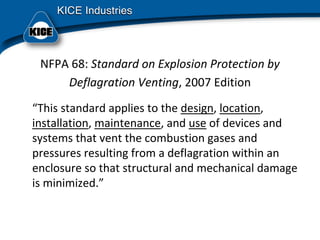
NFPA 68: Standard on Explosion Protection by 
Deflagration Venting, 2007 Edition
“This standard applies to the design, location, 
installation, maintenance, and use of devices and 
systems that vent the combustion gases and 
pressures resulting from a deflagration within an 
enclosure so that structural and mechanical damage 
is minimized.”
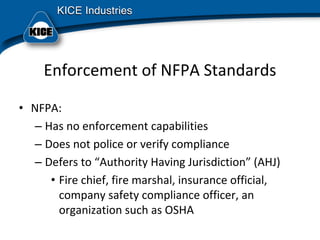
Enforcement of NFPA Standards
• NFPA:
– Has no enforcement capabilities
– Does not police or verify compliance
– Defers to “Authority Having Jurisdiction” (AHJ)
• Fire chief, fire marshal, insurance official, 
company safety compliance officer, an 
organization such as OSHA
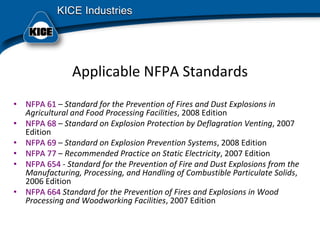
Applicable NFPA Standards
•• NFPA 61 NFPA 61 – Standard for the Prevention of Fires and Dust Explosions in 
Agricultural and Food Processing Facilities, 2008 Edition
•• NFPA 68NFPA 68 – Standard on Explosion Protection by Deflagration Venting, 2007 
Edition
•• NFPA 69NFPA 69 – Standard on Explosion Prevention Systems, 2008 Edition
•• NFPA 77NFPA 77 – Recommended Practice on Static Electricity, 2007 Edition
•• NFPA 654NFPA 654 ‐ Standard for the Prevention of Fire and Dust Explosions from the
Manufacturing, Processing, and Handling of Combustible Particulate Solids, 
2006 Edition
•• NFPA 664NFPA 664 Standard for the Prevention of Fires and Explosions in Wood 
Processing and Woodworking Facilities, 2007 Edition 
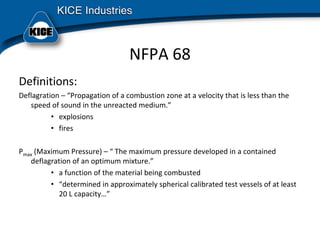
NFPA 68
Definitions:
Deflagration – “Propagation of a combustion zone at a velocity that is less than the 
speed of sound in the unreacted medium.”
• explosions
• fires
Pmax (Maximum Pressure) – “ The maximum pressure developed in a contained 
deflagration of an optimum mixture.”
• a function of the material being combusted
• “determined in approximately spherical calibrated test vessels of at least 
20 L capacity…”
NFPA 68
Definitions (cont’d):
Kst – “The deflagration index of a dust cloud.”
– Kst “shall be computed from the maximum rate of pressure rise attained by 
combustion in a closed…approximately spherical calibrated test vessel of at 
least 20 L capacity…”
– Published lists of example values are available for certain materials, 
but variations in characteristics, such as particle size and moisture 
content, of seemingly identical materials can produce varied results. 
NOTE: NFPA 68 states “where the actual material is available, the Kst 
shall be verified by test”.
NFPA 68
Definitions (cont’d):
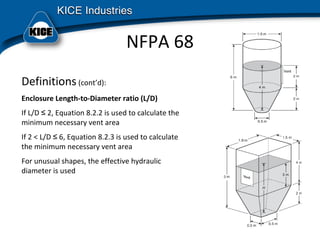
Enclosure Length‐to‐Diameter ratio (L/D)
If L/D ≤ 2, Equation 8.2.2 is used to calculate the 
minimum necessary vent area
If 2 < L/D ≤ 6, Equation 8.2.3 is used to calculate 
the minimum necessary vent area
For unusual shapes, the effective hydraulic 
diameter is used 
NFPA 68
Definitions (cont’d):
Pred (Reduced Pressure) – “The maximum pressure developed in a vented enclosure 
during a vented deflagration.”
“Pred shall not exceed two‐thirds of the ultimate strength for the vented 
enclosure, provided deformation of the equipment can be tolerated.”
– 2/3 Ultimate strength of the vessel 
• Less required vent area (lower costs)
• Potential for permanent deformation of equipment
“Where deformation cannot be tolerated, Pred shall not exceed two‐thirds of the 
yield strength for the vented enclosure.”
– 2/3 Yield strength of the vessel 
• More vent area required (higher costs)
• Permanent deformation of equipment from deflagration unlikely
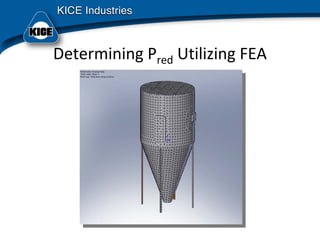
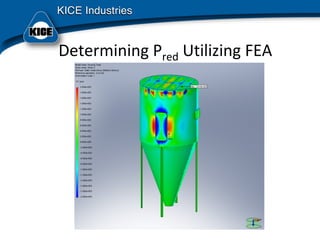
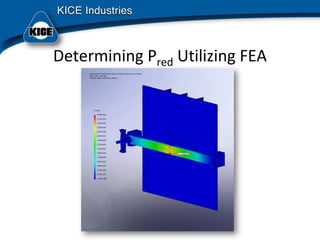
Determining Pred
Decide if the enclosure design pressure selection will be 
based on 2/3 of the ultimate strength or 2/3 of the 
yield strength
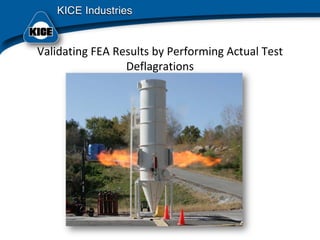
Identify weakest point of design by either:
• Performing actual test explosions, or
• Finite Element Analysis (FEA)
Determining Pred Utilizing FEA
Validating FEA Results by Performing Actual Test 
Deflagrations
Dust Collector Venting Alternatives
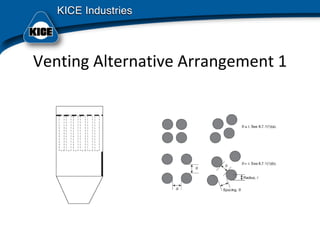
Alternative Arrangement 1
• Condition 1
Spacing between the bags < radius of the bag 
and 
all of the venting is located below the bottom of the bags
– “…the vent area shall be permitted to be calculated on the basis of the 
volume below the lower end of the bags” (lower housing and hopper)  
– yields the smallest volume and thereby reduces the required vent area 
– filter housing must be taller or the bag length shorter to provide the space 
beneath the bags required for the vent(s)
Venting Alternative Arrangement 1
Dust Collector Venting Alternatives
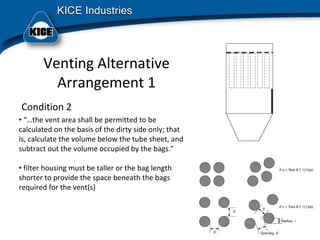
Alternative Arrangement 1
• Condition 2
Spacing between the bags > radius of the bag 
and 
all of the venting is located below the bottom of 
the bags
Venting Alternative 
Arrangement 1
• “…the vent area shall be permitted to be 
calculated on the basis of the dirty side only; that 
is, calculate the volume below the tube sheet, and 
subtract out the volume occupied by the bags.”
• filter housing must be taller or the bag length 
shorter to provide the space beneath the bags 
required for the vent(s)
Condition 2
Dust Collector Venting 
Alternatives
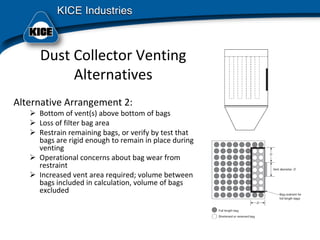
Alternative Arrangement 2:
Bottom of vent(s) above bottom of bags
Loss of filter bag area
Restrain remaining bags, or verify by test that 
bags are rigid enough to remain in place during 
venting
Operational concerns about bag wear from 
restraint
Increased vent area required; volume between 
bags included in calculation, volume of bags 
excluded
Dust Collector Venting Alternatives
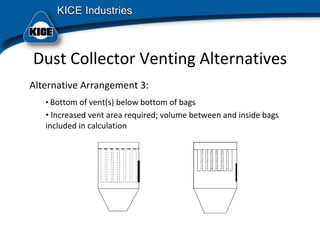
Alternative Arrangement 3:
• Bottom of vent(s) below bottom of bags
• Increased vent area required; volume between and inside bags 
included in calculation
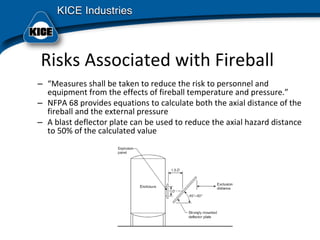
Risks Associated with Fireball
– “Measures shall be taken to reduce the risk to personnel and 
equipment from the effects of fireball temperature and pressure.”
– NFPA 68 provides equations to calculate both the axial distance of the 
fireball and the external pressure
– A blast deflector plate can be used to reduce the axial hazard distance 
to 50% of the calculated value
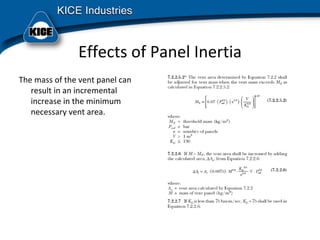
Effects of Panel Inertia
The mass of the vent panel can 
result in an incremental 
increase in the minimum 
necessary vent area.
Effects of Vent Discharge Ducts
– If it is necessary to locate a dust collector with deflagration vents inside of a building, a vent 
duct shall be used to direct vented material from the dust collector to the outdoors.
– “A vent duct shall have a cross sectional area at least as great as that of the vent itself, but 
shall be limited to no more than 150% of the vent itself at any point in the vent duct.”
– “Vent area calculations shall include the effects of vent ducts.”
– The equation to calculate the effect of vent ducts has a solution that is iterative, requiring a 
trial and error process (or the goal seek button in Excel).
– Vent ducts “shall be of noncombustible construction and shall be strong enough to 
withstand the expected Pred“.
– Bends in the vent duct are now allowed, but “support calculations shall include reaction 
forces based on the expected Pred“.
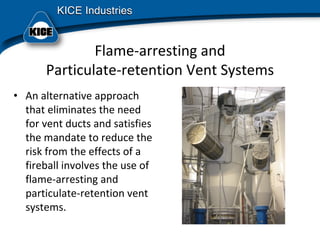
Flame‐arresting and
Particulate‐retention Vent Systems
• An alternative approach 
that eliminates the need 
for vent ducts and satisfies 
the mandate to reduce the 
risk from the effects of a 
fireball involves the use of 
flame‐arresting and 
particulate‐retention vent 
systems.
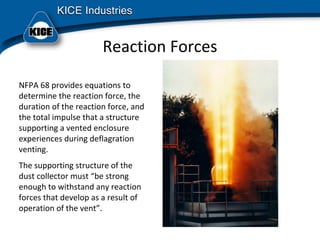
Reaction Forces
NFPA 68 provides equations to 
determine the reaction force, the 
duration of the reaction force, and 
the total impulse that a structure 
supporting a vented enclosure 
experiences during deflagration 
venting.
The supporting structure of the 
dust collector must “be strong 
enough to withstand any reaction 
forces that develop as a result of 
operation of the vent”.
Suppression Concept (NFPA 69)
– The heat of combustion develops pressure.
– Upon pressure detection, sufficient suppressant agent is 
dispersed into the protected volume.
– Flame is quenched which prevents any further pressure 
increase.
– Flame, pressure and unburned mixture are contained inside 
the vessel.
Explosion Isolation (NFPA 69 and 654)
– Prevent explosion propagation through ductwork
– Explosion isolation devices:
Chokes
Rotary valves
Automatic fast‐acting valve systems
Flame front diverters
Chemical isolation (suppression) systems
Maintaining NFPA Compliance
Documentation
InspectionInspection
MaintenanceMaintenance
Record Keeping and TrainingRecord Keeping and Training
NFPA 68
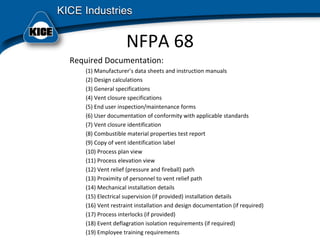
Required Documentation:
(1) Manufacturer’s data sheets and instruction manuals
(2) Design calculations
(3) General specifications
(4) Vent closure specifications
(5) End user inspection/maintenance forms
(6) User documentation of conformity with applicable standards
(7) Vent closure identification
(8) Combustible material properties test report
(9) Copy of vent identification label
(10) Process plan view
(11) Process elevation view
(12) Vent relief (pressure and fireball) path
(13) Proximity of personnel to vent relief path
(14) Mechanical installation details
(15) Electrical supervision (if provided) installation details
(16) Vent restraint installation and design documentation (if required)
(17) Process interlocks (if provided)
(18) Event deflagration isolation requirements (if required)
(19) Employee training requirements
Maintaining NFPA Compliance
DocumentationDocumentation
Inspection
MaintenanceMaintenance
Record Keeping and TrainingRecord Keeping and Training
NFPA 68
Vent closures shall be inspected at least annually:
(1) The opening is free and clear of any obstructions on both sides.
(2) The discharged material and fireball pathway does not extend into an area normally 
occupied by personnel or critical process equipment.
(3) The closure has been properly installed according to manufacturer’s instructions.
(4) The closure is not corroded or mechanically damaged.
(5) The closure is clearly identified with manufacturer’s information.
(6) The closure is clearly labeled as an explosion relief device.
(7) The closure has no damage and is protected from the accumulation of water, snow, ice, or 
debris after any act of nature.
(8) The closure has not been painted or coated other than by manufacturer.
(9) The closure has no buildup of deposits on the inside surfaces or between layers of the 
vent.
(10) The closure has not been tampered with.
(11) The closure shows no fatigue and has not released.
(12) The closure hinges (if provided) are lubricated and operate freely.
(13) The closure restraints (if provided) are in place and operational.
(14) The closure seals, tamper indicators, or vent rupture indicators (e.g., breakwire switches), 
if provided, are in place.
(15) The flame‐arresting and particulate‐retention device is being maintained, is clean, and is 
unobstructed in accordance with the manufacturer’s listing.
(16) The closure has no conditions that would hinder its operation.
Maintaining NFPA Compliance
DocumentationDocumentation
InspectionInspection
Maintenance
Record Keeping and TrainingRecord Keeping and Training
NFPA 68
Maintenance
– Vent closure maintenance shall be performed after every act of nature or process upset 
condition to ensure that the closure has not been physically damaged and there are no 
obstructions including but not limited to snow, ice, water, mud, or process material that could 
lessen or impair the efficiency of the vent closure.
– An inspection shall be performed after every process maintenance turnaround.
– If process material has a tendency to adhere to the vent closure, the vent closure shall be 
cleaned periodically to maintain vent efficiency.
– Process interlocks, if provided, shall be verified.
– Known potential ignition sources shall be inspected and maintained.
– Records shall be kept of any maintenance and repairs performed.
Maintaining NFPA Compliance
DocumentationDocumentation
InspectionInspection
MaintenanceMaintenance
Record Keeping and Training
NFPA 68
Record Keeping and Training
1. The records of inspections and any maintenance and 
repairs performed shall be retained for a minimum of 3 
years.
2. Initial and refresher training shall be provided and 
training records maintained for employees who are 
involved in operating, maintaining, and supervising 
facilities that utilize devices for venting of deflagrations.
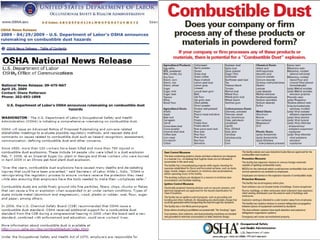
OSHA’s “Combustible Dust National Emphasis Program 
(Reissued)”
“The purpose of this NEP is to inspect facilities that create or 
handle combustible dusts which can cause intense burning or 
other fire hazards when suspended in air, and can lead to 
explosions.”
“As a result of a recent catastrophic accident involving 
combustible dust at a sugar refinery plant, OSHA is 
intensifying its enforcement activities at facilities where 
combustible dust hazards are known to exist.”
Found on OSHA’s new combustible dust safety and health website:  
http://www.osha.gov/dsg/combustibledust/index.html
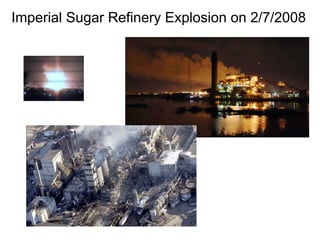
Imperial Sugar Refinery Explosion on 2/7/2008
Petition from Worker Organizations
“We want OSHA to issue comprehensive 
combustible dust standards and we fully back 
the Committee on Education and Labor in 
their request to Secretary of Labor Elaine 
Chao for answers and action based on the CSB 
investigations and recommendations.”
Sugar Plant Blast Puts Heat on OSHA's 
Rulemaking 
"I see such an incredible lack of urgency on the part of your ag"I see such an incredible lack of urgency on the part of your agency toency to
protect workers that it is astounding," Rep.protect workers that it is astounding," Rep. George MillerGeorge Miller (D(D--Calif.),Calif.),
who heads thewho heads the House Education and Labor CommitteeHouse Education and Labor Committee, told OSHA, told OSHA
directordirector Edwin G. Foulke JrEdwin G. Foulke Jr..
-- Cindy Skrzycki, Business Columnist for The Washington PostCindy Skrzycki, Business Columnist for The Washington Post
Retroactivity of NFPA Standards
NFPA 68:
Section 1.5.1.1 – “…the provisions of this standard shall not apply to facilities, 
equipment, structures, or installations that existed or were approved for 
construction or installation prior to the effective date of the standard.”
(December 20, 2006) 
Exceptions:
“In those cases where the authority having jurisdiction determines that 
the existing situation presents an unacceptable degree of risk, the 
authority having jurisdiction shall be permitted to apply retroactively any 
portions of this standard deemed appropriate.”
(Section 1.5.1.2)
or
“When major replacement or renovation of existing facilities is planned, 
provisions of this standard shall apply.” (Section 1.5.3)
Thank you for the opportunity to speak 
with you today
Should you have any questions 
please visit our website at
www.kice.com
or contact me
jeffkice@kice.com

Deflagration vent (1)