UNIT - 3
Legal Environment
3
Contents:
⚫ Legal Environment:
⚫ Business Law: Meaning, Scope and
need for Business Law
⚫ Source of Business Law
⚫ Indian Contract Act 1872
⚫ Its Essentials Breach of Contract
and Remedies.
⚫ Intellectual Property Rights.
⚫ Negotiable Instruments Act 1881
Business Law
⚫ INTRODUCTION TO LAW
⚫ As a social being, man comes into contact with people in
different capacities
⚫ He comes into contact For example:
⚫ 1. with a landlord as a tenant
⚫ 2. with Government as a Taxpayer
⚫ 3. with customers as a seller and
⚫ 4. with suppliers as a buyer.
⚫ Inevitable consequence of modern civilization
⚫ In all these associations, he is expected to observe a code or a set of rules.
The word ‘Law’ is a general term and has different connotations for
different people. e.g.,
⚫ 1.A citizen may think of Law as a set of rules which he must obey.
⚫ 2.A Lawyer who practices law may think of Law as a vocation.
⚫ 3.A legislator may look at law as something Created by him
⚫ 4.A judge may think as guiding principles to be applied in making decision
Meaning, Scope & Need for Business Law
⚫ Meaning:
⚫ Business law encompasses all the laws that dictate how to form and run a
business.
⚫ This includes all of the laws that govern how to start, buy, manage and close or
sell any type of business.
⚫ Business laws establish the rules that all businesses should follow.
⚫ Scope:
⚫ Business Law, also known as commercial law, controls the rules and
regulations associated with the business.
⚫ It specifies the codes related to business deals, the conduct of
people associated with the industry, and laws related to any organization's
rights, order, and dispute settlement.
⚫ Need:
⚫ The initiation of business laws has helped to protect both businesses and
consumers.
⚫ Business owners, employees and consumers can feel secure and confident
while trading and investing, as the law helps to maintain order, give
sanctions and protect the rights of the people in the business world.
DEFINITION OF LAW
⚫ In the words of Salmond, “Law is the body of principles recognized and applied by the
state in the administration of justice.”
⚫ Woodrow Wilson has defined law as “that portion of the established habit and thought
of mankind which has gained distinct and formal recognition in the shape of uniform
rules backed by the authority and power of the government.”
⚫ Law is not static laws are changed to fit the requirements of the society.
⚫ Law prevailing in a society at any point of time must be in conformity with the general
sentiments customs and -aspirations of its people.
⚫ It is a real phenomenon having a real existence in relation to the facts of human affairs
⚫ OBJECT OF LAW:
⚫ The object of law is order and the result of order is that men are enabled to look ahead
business laws notes with some sort of security as to the future.
⚫ In the context of new emerging India, the main object of law is “ to
establish socio-economic justice and remove the existence imbalance in the socio-
economic structure.”
⚫ In the pre- independence era, the principal concern of the government was limited to
the maintenance of law and order in the country.
⚫ The situation has changed now and the fundamental task of broadening the horizons
of the welfare state is being pursued by the legislation covering the entire gamut of
social activity
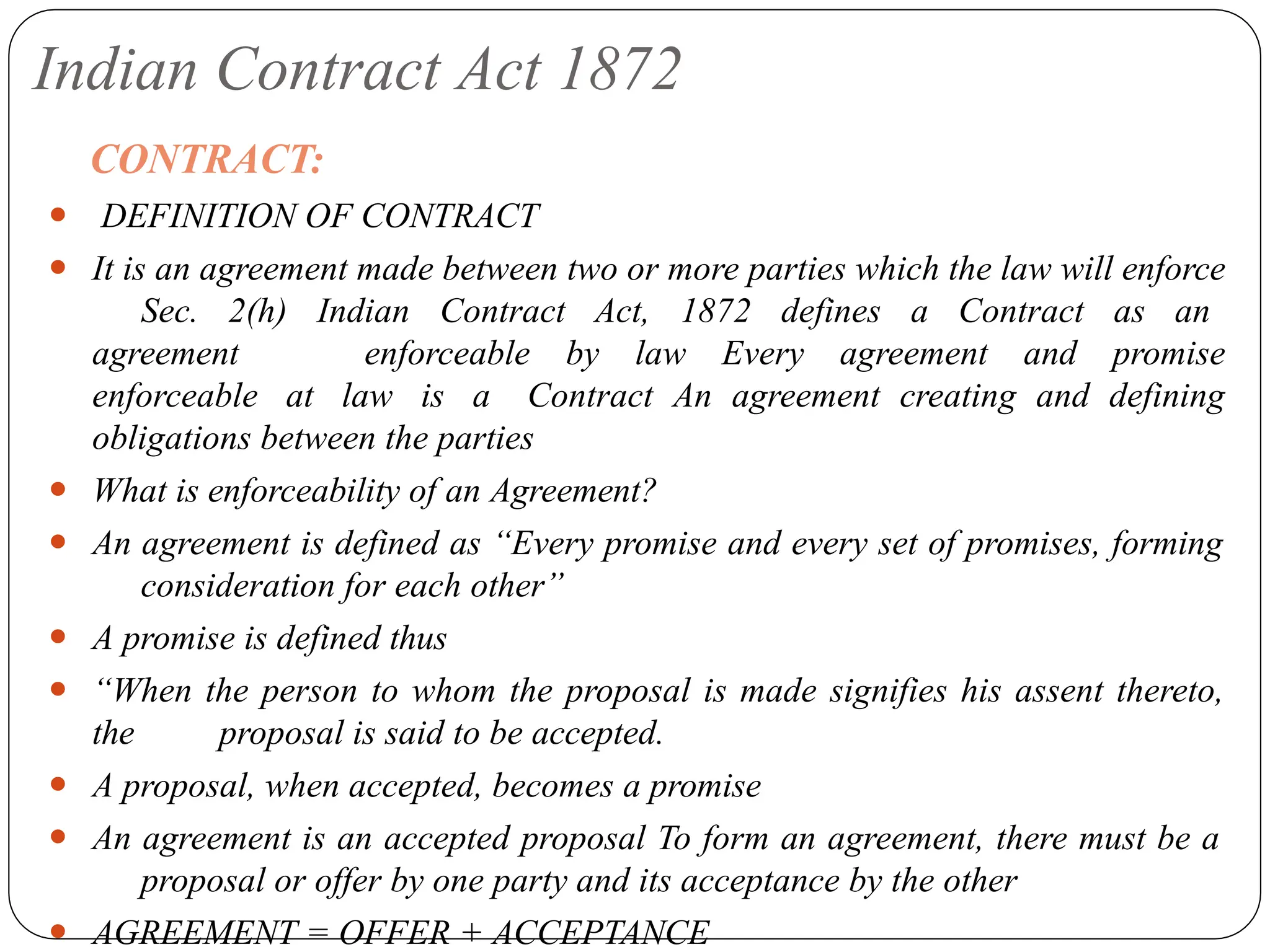
Indian Contract Act 1872
CONTRACT:
⚫ DEFINITION OF CONTRACT
⚫ It is an agreement made between two or more parties which the law will enforce
Sec. 2(h) Indian Contract Act, 1872 defines a Contract as an
agreement enforceable by law Every agreement and promise
enforceable at law is a Contract An agreement creating and defining
obligations between the parties
⚫ What is enforceability of an Agreement?
⚫ An agreement is defined as “Every promise and every set of promises, forming
consideration for each other”
⚫ A promise is defined thus
⚫ “When the person to whom the proposal is made signifies his assent thereto,
the proposal is said to be accepted.
⚫ A proposal, when accepted, becomes a promise
⚫ An agreement is an accepted proposal To form an agreement, there must be a
proposal or offer by one party and its acceptance by the other
⚫ AGREEMENT = OFFER + ACCEPTANCE
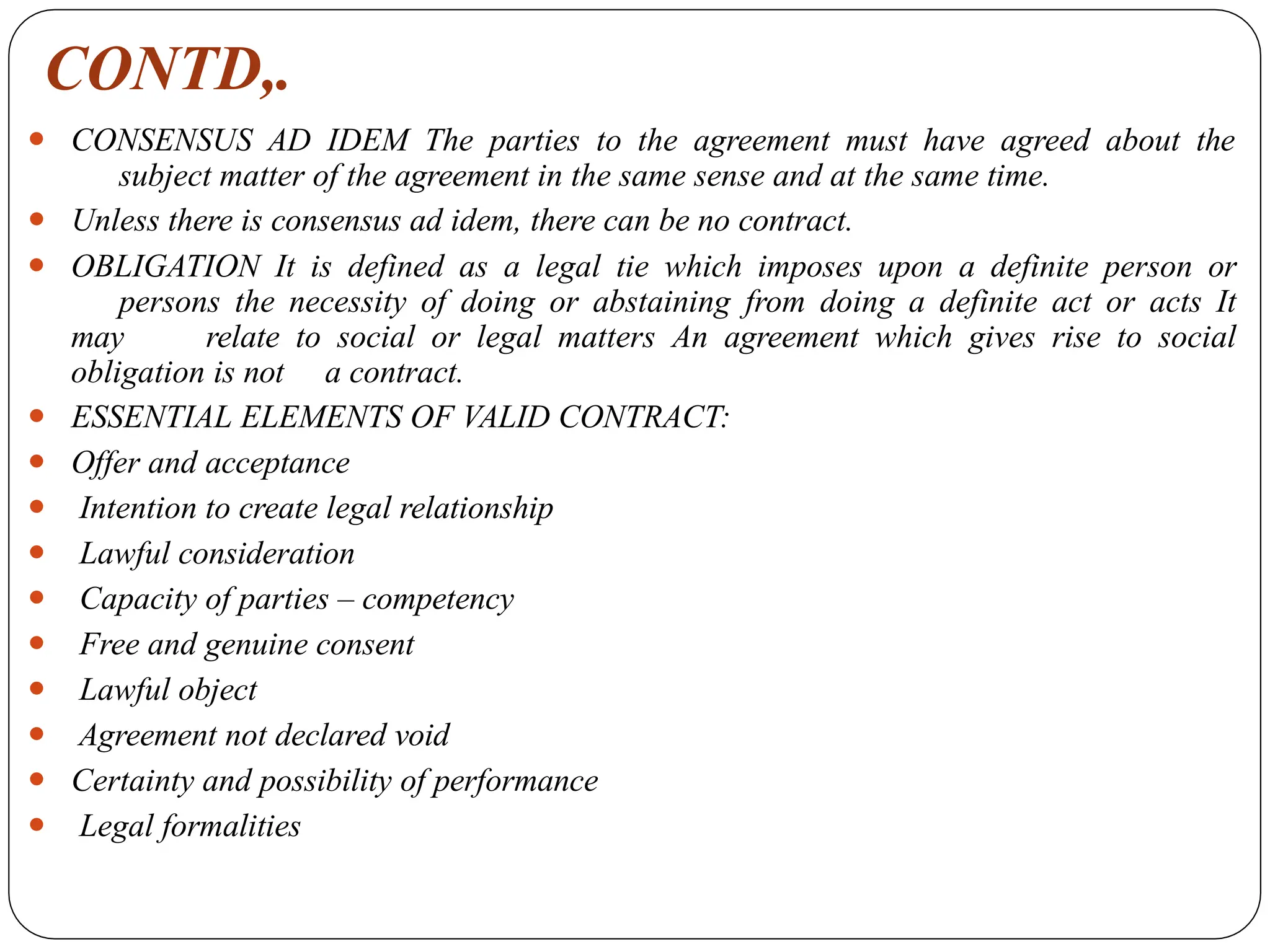
CONTD,.
⚫ CONSENSUS AD IDEM The parties to the agreement must have agreed about the
subject matter of the agreement in the same sense and at the same time.
⚫ Unless there is consensus ad idem, there can be no contract.
⚫ OBLIGATION It is defined as a legal tie which imposes upon a definite person or
persons the necessity of doing or abstaining from doing a definite act or acts It
may relate to social or legal matters An agreement which gives rise to social
obligation is not a contract.
⚫ ESSENTIAL ELEMENTS OF VALID CONTRACT:
⚫ Offer and acceptance
⚫ Intention to create legal relationship
⚫ Lawful consideration
⚫ Capacity of parties – competency
⚫ Free and genuine consent
⚫ Lawful object
⚫ Agreement not declared void
⚫ Certainty and possibility of performance
⚫ Legal formalities
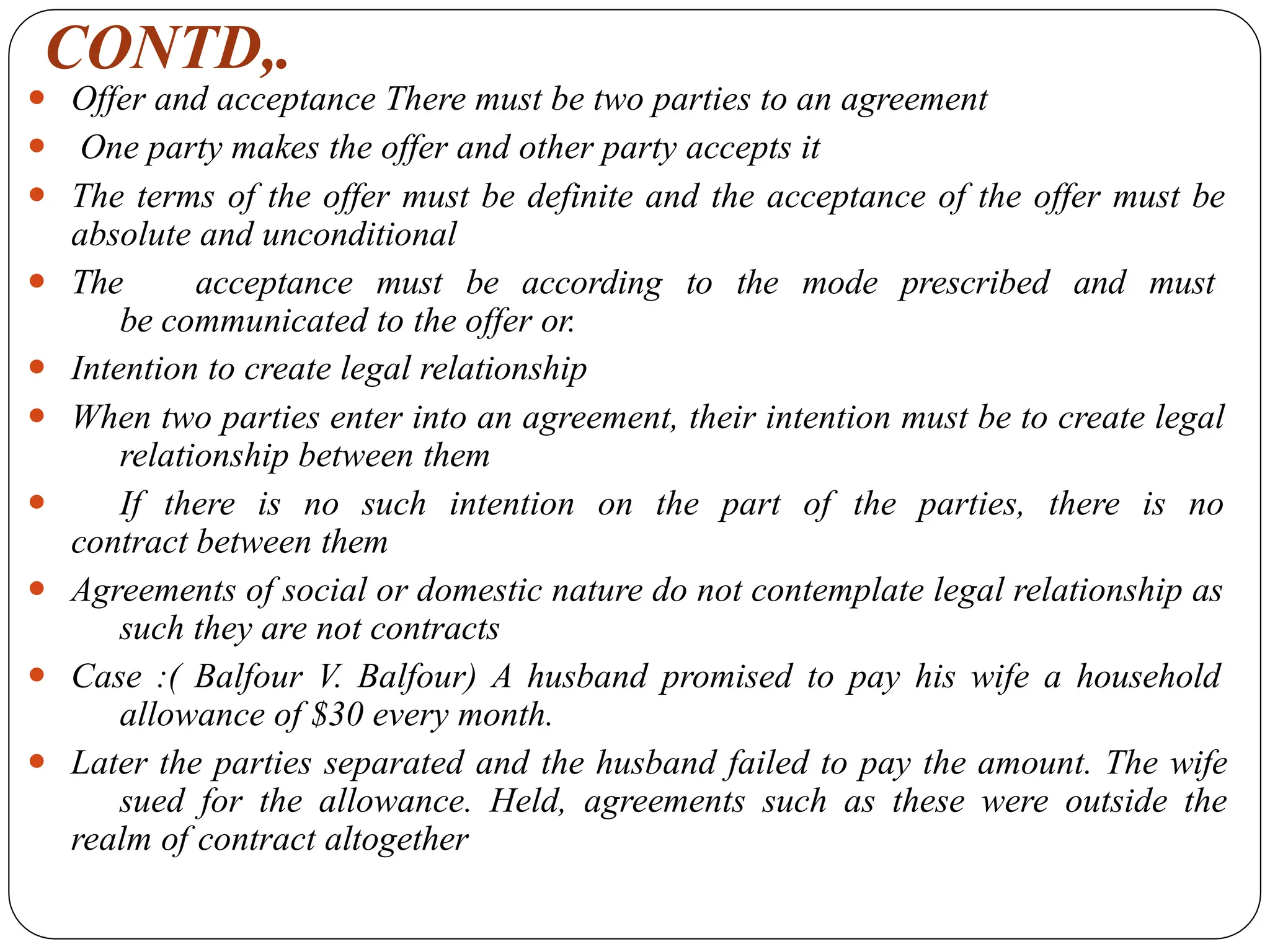
CONTD,.
⚫ Offer and acceptance There must be two parties to an agreement
⚫ One party makes the offer and other party accepts it
⚫ The terms of the offer must be definite and the acceptance of the offer must be
absolute and unconditional
⚫ The acceptance must be according to the mode prescribed and must
be communicated to the offer or.
⚫ Intention to create legal relationship
⚫ When two parties enter into an agreement, their intention must be to create legal
relationship between them
⚫ If there is no such intention on the part of the parties, there is no
contract between them
⚫ Agreements of social or domestic nature do not contemplate legal relationship as
such they are not contracts
⚫ Case :( Balfour V. Balfour) A husband promised to pay his wife a household
allowance of $30 every month.
⚫ Later the parties separated and the husband failed to pay the amount. The wife
sued for the allowance. Held, agreements such as these were outside the
realm of contract altogether
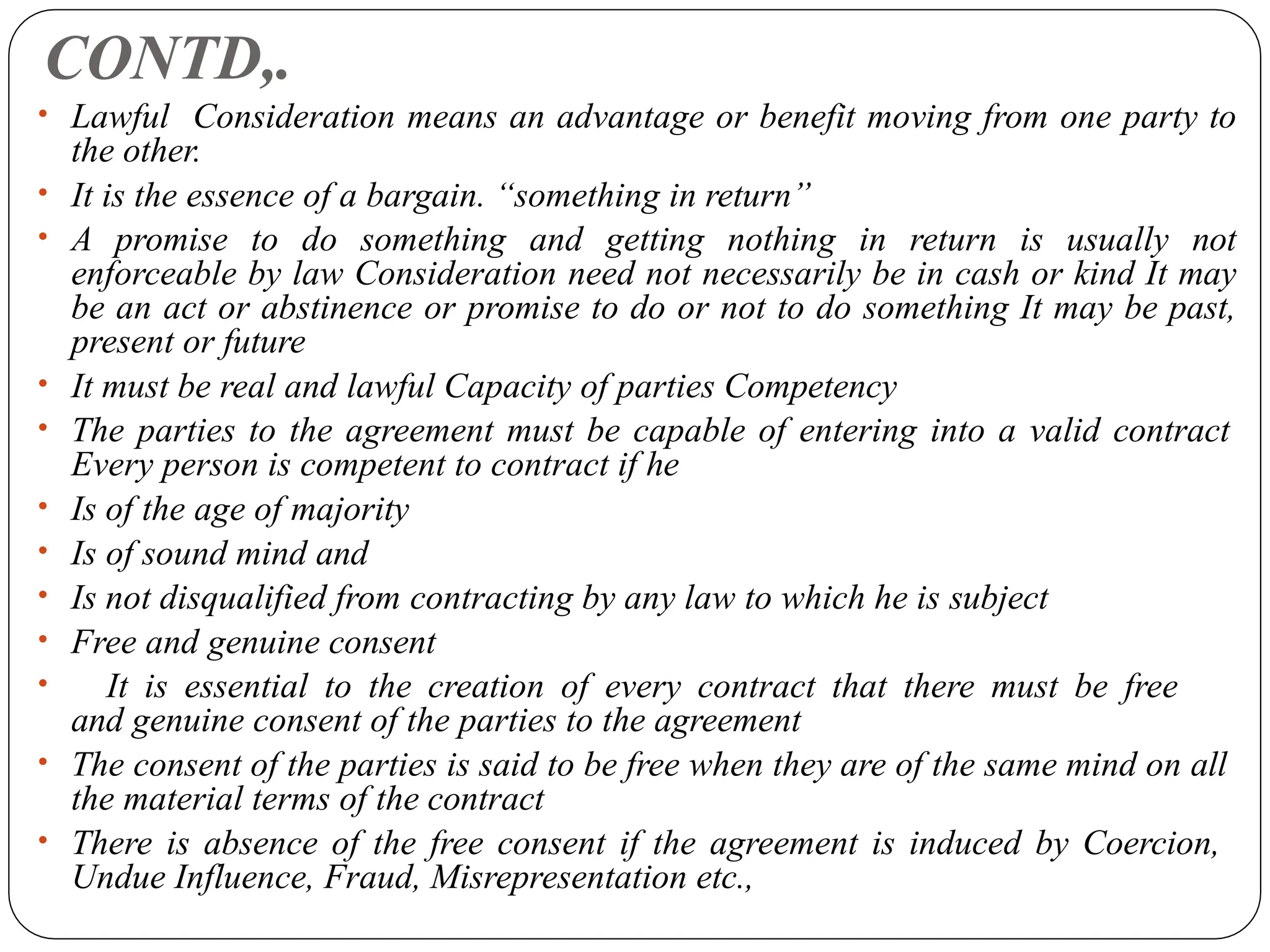
CONTD,.
• Lawful Consideration means an advantage or benefit moving from one party to
the other.
• It is the essence of a bargain. “something in return”
• A promise to do something and getting nothing in return is usually not
enforceable by law Consideration need not necessarily be in cash or kind It may
be an act or abstinence or promise to do or not to do something It may be past,
present or future
• It must be real and lawful Capacity of parties Competency
• The parties to the agreement must be capable of entering into a valid contract
Every person is competent to contract if he
• Is of the age of majority
• Is of sound mind and
• Is not disqualified from contracting by any law to which he is subject
• Free and genuine consent
• It is essential to the creation of every contract that there must be free
and genuine consent of the parties to the agreement
• The consent of the parties is said to be free when they are of the same mind on all
the material terms of the contract
• There is absence of the free consent if the agreement is induced by Coercion,
Undue Influence, Fraud, Misrepresentation etc.,
CONTD,.
• Lawful object
• The object must not be
• Illegal Immoral Opposed to public policy
• If an agreement suffers from any legal flaw, it would not be enforceable by law
⚫ Agreement not declared void
⚫ The agreement must not have been expressly declared void by law in force in the
country Certainty and possibility of Performance
⚫ The agreement must be certain and not vague or indefinite, if not it cannot
be enforced
⚫ Legal formalities
⚫ A contract may be made by words spoken or written
⚫ As regards the legal effects, there is no difference between a contract in writing
and a contract made by word of mouth
⚫ In the interest of parties, the contract should be in writing
⚫ The document in which the contract is incorporated is to be stamped
⚫ When there is a statutory requirement that a contract should be made in writing or in
the presence of witnesses or registered, the required statutory formalities must
be complied with
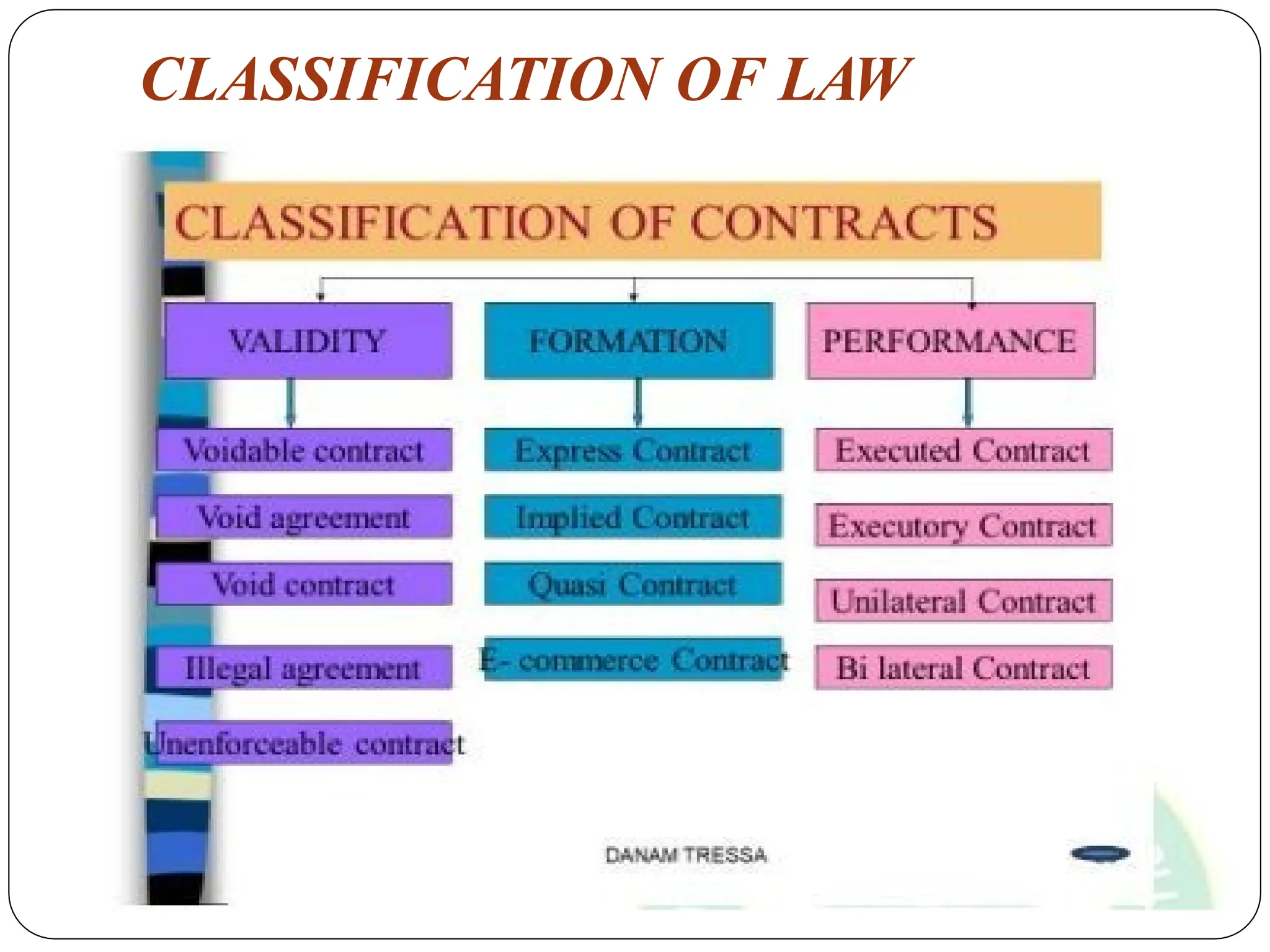
CLASSIFICATION OF LAW
CONTD,.
⚫ CONTRACTS ACCRODING TO VALIDITY Voidable contract – An agreement which is
enforceable by law at the option of one or more parties thereto, but not at the option of
the other or others is a voidable contract
⚫ When the consent of a party of a contract is not free the contract is voidable at his option
⚫ When a party to a contract promises to perform all obligation within a specified
time, any failure on his part to perform his obligation within the fixed time makes the
contract voidable at the option of the promise.
⚫ Void agreement
⚫ An agreement not enforceable by law is said to be void
⚫ A void agreement does not create any legal rights or obligations
⚫ Void contract
⚫ A contract which ceases to be enforceable by law becomes void when it ceases to be
enforceable
⚫ A contract, when originally entered into, may be valid and binding on the parties, it
may be subsequently become void Eg war or Govt. Order
⚫ Illegal agreement
⚫ An illegal agreement is one which transgress (controversy) some rule or basic
public policy or which is criminal in nature or which is immoral.
⚫ All Illegal agreements are void but all void agreements are not necessarily illegal
Unenforceable contract
⚫ An unenforceable contract is one which cannot be enforced in court of law because of
some technical defect such as absence or writing etc.,
CONTD,.
⚫ CLASSIFICATION ACCORIDNG TO FORMATION
⚫ Express contract – If the terms of contract expressly agreed upon at the time of
formation of the contract, the contract is said to be an express contract
⚫ Implied contract – An implied contract is one which is inferred from the acts or
conduct of the parties or course of dealings between them
⚫ Quasi contract – A quasi contract is not a contract at all. A contract is intentionally
entered into by the parties.
⚫ A quasi contract is created by law.
⚫ It resembles a contract in that a legal obligation is imposed on a party who is required
to perform it. • Eg : a tradesman, leaves goods at C’s house by mistake. C treats
the goods as his own. C is bound to pay for the goods
⚫ E commerce contract – The contracts which is entered into between two parties
via internet is called E Commerce Contract
⚫ CLASSIFICATION ACCORDING TO PERFORMANCE
⚫ Executed contract – Executed means that which is done.
⚫ If both the parties have performed their obligations, they are executed contracts
⚫ Executory contract – Both the parties have yet to perform their obligations – It
may sometimes partly executed and partly executory
⚫ Unilateral – When only one party has to fulfill his obligation at the time of the
formation of the contract, the other party having fulfilled his obligation at the
time of the contract or before the contract comes into existence
CONTD,.
⚫ A permits a railway coolie to carry his luggage and place it in a carriage. The contract comes to
an end as it places it in carriage. Now it is the obligation of A to pay the amount’
⚫ Bilateral contract – The obligation on the part of both the parties the contract is outstanding at the
time of formation of the contract. (Executory Contracts)
⚫ REMEDIES FOR BREACH OF CONTRACT
⚫ WHAT IS A REMEDY? a remedy is the means given by law for the enforcement of a right.
⚫ WHEN A CONTRACT IS BROKEN, THE INJURED PARTY, HAS ONE OR MORE OF THE
FOLLOWING REMEDIES:
⚫ Rescission of the contract
⚫ Suit for Damages
⚫ Suit upon Quantum Merit
⚫ Suit for specific performance of the Contract
⚫ Suit for injunction.
⚫ RECISSION When a contract is broken by one party, the other party may sue to treat the contract
as rescinded and refuse further performance.
⚫ In such a case, he is absolved of all his obligations under the contract.
⚫ Eg: A promises B to supply 10 Bags of cement on a certain day. B agrees to pay the price after the
receipt of the goods.
⚫ A does not supply the goods. B is discharged from liability to pay the price.
⚫ DAMAGES are the monetary compensation allowed to the injured party by the court for the loss of
injury suffered by him by the breach of a contract.
⚫ OBJECTS OF AWARDING DAMAGES It is to put the injured party in the same position, so far as
money can do it, as if he had not been injured, I.e., in the position in which he would have been
there been performance and not breach.
Intellectual Property Rights.
Intellectual property rights (IPR) can be defined as the rights given to
people over the creation of their minds. They usually give the creator an
exclusive right over the use of his/her creations for a certain period.
Intellectual property is an intangible creation of the human mind,
usually expressed or translated into a tangible form that is assigned
certain rights of property.
Examples of intellectual property include an author's copyright on a
book or article, a distinctive logo design representing a soft drink
company and its products, unique design elements of a web site, or a
patent on the process to manufacture chewing gum.
Intellectual property rights (IPR) can be defined as the rights given to
people over the creation of their minds.
They usually give the creator an exclusive right over the use of his/her
creations for a certain period.
Intellectual property (IP) refers to creations of the mind: inventions,
literary and artistic works, and symbols, names, images, and designs
used in commerce
Types of IPR
⚫ Trademark
⚫ Copyright
⚫ Geographical Indication
⚫ Trade secrets
⚫ Patents
⚫ Industrial designs
⚫ Trademarks:
⚫ A trademark is a type of intellectual property consisting of a
recognizable sign, design, or expression that identifies
products or services from a particular source and
distinguishes them from others. The trademark owner can
be an individual, business organization, or any legal
entity.
⚫ Copyright:
⚫ Copyright (or author’s right) is a legal term used to describe
the rights that creators have over their literary and artistic
works. Works covered by copyright range from books,
CONTD,.
⚫ Geographical Indication:
A geographical indication (GI) is a sign used on products that have a specific geographical
origin and possess qualities or a reputation that are due to that origin. To function as a GI,
a sign must identify a product as originating in each place. In addition, the qualities,
characteristics or reputation of the product should be essentially due to the place of origin.
Since the qualities depend on the geographical place of production, there is a clear link
between the product and its original place of production.
Trade secrets:
Trade secrets are intellectual property (IP) rights on confidential information which may
be sold or licensed.
In general, to qualify as a trade secret, the information must be:
⚫ commercially valuable because it is secret,
⚫ be known only to a limited group of persons, and
⚫ be subject to reasonable steps taken by the rightful holder of the information to keep it
secret, including the use of confidentiality agreements for business partners
and employees.
The unauthorized acquisition, use or disclosure of such secret information in a manner
contrary to honest commercial practices by others is regarded as an unfair practice and
a violation of the trade secret protection.
CONTD,.
⚫ Patents:
⚫ A patent is an exclusive right granted for an invention, which
is a product or a process that provides, in general, a new way
of doing something, or offers a new technical solution to a
problem.
⚫ To get a patent, technical information about the invention
must be disclosed to the public in a patent application.
⚫ Industrial designs:
⚫ In a legal sense, an industrial design constitutes the
ornamental aspect of an article.
⚫ An industrial design may consist of three-dimensional
features, such as the shape of an article, or two-
dimensional features, such as patterns, lines or color.
Negotiable Instruments Act 1881
⚫ The Negotiable Instruments Act, 1881 is a significant law that governs the use of
negotiable instruments in India. It provides for the regulation of
promissory notes, bills of exchange, and cheques. The Act was enacted to
provide a uniform legal framework for the use of negotiable instruments
in India.
⚫ What is the summary of the negotiable instruments act?
⚫ The “Negotiable Instruments Act” was first developed in 1866, and it was finally
passed into law in 1881. Chapter XVII, which includes sections 138 to 142,
was added to this statute in 1988, after than a century. Section 138 of
the Act essentially lays out the punishment for the crime of dishonoring a
cheque.
⚫ A promissory note, bill of exchange or cheque payable to order is negotiable by
the holder by endorsement and delivery thereof. The Act requires
presentment of negotiable instruments. Presentment is simply a demand by
which holder of the instruments is required to do as per direction of the
instruments.
⚫ A Negotiable Instrument, in simple terms, refers to a document that guarantees
payment of a specific amount from one party to another. The

BELA UNIT - 3.pptxdxxvxvxcbcbcbcbcbcbcbccb

  • 1.
    UNIT - 3 LegalEnvironment 3
  • 2.
    Contents: ⚫ Legal Environment: ⚫Business Law: Meaning, Scope and need for Business Law ⚫ Source of Business Law ⚫ Indian Contract Act 1872 ⚫ Its Essentials Breach of Contract and Remedies. ⚫ Intellectual Property Rights. ⚫ Negotiable Instruments Act 1881
  • 3.
    Business Law ⚫ INTRODUCTIONTO LAW ⚫ As a social being, man comes into contact with people in different capacities ⚫ He comes into contact For example: ⚫ 1. with a landlord as a tenant ⚫ 2. with Government as a Taxpayer ⚫ 3. with customers as a seller and ⚫ 4. with suppliers as a buyer. ⚫ Inevitable consequence of modern civilization ⚫ In all these associations, he is expected to observe a code or a set of rules. The word ‘Law’ is a general term and has different connotations for different people. e.g., ⚫ 1.A citizen may think of Law as a set of rules which he must obey. ⚫ 2.A Lawyer who practices law may think of Law as a vocation. ⚫ 3.A legislator may look at law as something Created by him ⚫ 4.A judge may think as guiding principles to be applied in making decision
  • 4.
    Meaning, Scope &Need for Business Law ⚫ Meaning: ⚫ Business law encompasses all the laws that dictate how to form and run a business. ⚫ This includes all of the laws that govern how to start, buy, manage and close or sell any type of business. ⚫ Business laws establish the rules that all businesses should follow. ⚫ Scope: ⚫ Business Law, also known as commercial law, controls the rules and regulations associated with the business. ⚫ It specifies the codes related to business deals, the conduct of people associated with the industry, and laws related to any organization's rights, order, and dispute settlement. ⚫ Need: ⚫ The initiation of business laws has helped to protect both businesses and consumers. ⚫ Business owners, employees and consumers can feel secure and confident while trading and investing, as the law helps to maintain order, give sanctions and protect the rights of the people in the business world.
  • 5.
    DEFINITION OF LAW ⚫In the words of Salmond, “Law is the body of principles recognized and applied by the state in the administration of justice.” ⚫ Woodrow Wilson has defined law as “that portion of the established habit and thought of mankind which has gained distinct and formal recognition in the shape of uniform rules backed by the authority and power of the government.” ⚫ Law is not static laws are changed to fit the requirements of the society. ⚫ Law prevailing in a society at any point of time must be in conformity with the general sentiments customs and -aspirations of its people. ⚫ It is a real phenomenon having a real existence in relation to the facts of human affairs ⚫ OBJECT OF LAW: ⚫ The object of law is order and the result of order is that men are enabled to look ahead business laws notes with some sort of security as to the future. ⚫ In the context of new emerging India, the main object of law is “ to establish socio-economic justice and remove the existence imbalance in the socio- economic structure.” ⚫ In the pre- independence era, the principal concern of the government was limited to the maintenance of law and order in the country. ⚫ The situation has changed now and the fundamental task of broadening the horizons of the welfare state is being pursued by the legislation covering the entire gamut of social activity
  • 6.
    Indian Contract Act1872 CONTRACT: ⚫ DEFINITION OF CONTRACT ⚫ It is an agreement made between two or more parties which the law will enforce Sec. 2(h) Indian Contract Act, 1872 defines a Contract as an agreement enforceable by law Every agreement and promise enforceable at law is a Contract An agreement creating and defining obligations between the parties ⚫ What is enforceability of an Agreement? ⚫ An agreement is defined as “Every promise and every set of promises, forming consideration for each other” ⚫ A promise is defined thus ⚫ “When the person to whom the proposal is made signifies his assent thereto, the proposal is said to be accepted. ⚫ A proposal, when accepted, becomes a promise ⚫ An agreement is an accepted proposal To form an agreement, there must be a proposal or offer by one party and its acceptance by the other ⚫ AGREEMENT = OFFER + ACCEPTANCE
  • 7.
    CONTD,. ⚫ CONSENSUS ADIDEM The parties to the agreement must have agreed about the subject matter of the agreement in the same sense and at the same time. ⚫ Unless there is consensus ad idem, there can be no contract. ⚫ OBLIGATION It is defined as a legal tie which imposes upon a definite person or persons the necessity of doing or abstaining from doing a definite act or acts It may relate to social or legal matters An agreement which gives rise to social obligation is not a contract. ⚫ ESSENTIAL ELEMENTS OF VALID CONTRACT: ⚫ Offer and acceptance ⚫ Intention to create legal relationship ⚫ Lawful consideration ⚫ Capacity of parties – competency ⚫ Free and genuine consent ⚫ Lawful object ⚫ Agreement not declared void ⚫ Certainty and possibility of performance ⚫ Legal formalities
  • 8.
    CONTD,. ⚫ Offer andacceptance There must be two parties to an agreement ⚫ One party makes the offer and other party accepts it ⚫ The terms of the offer must be definite and the acceptance of the offer must be absolute and unconditional ⚫ The acceptance must be according to the mode prescribed and must be communicated to the offer or. ⚫ Intention to create legal relationship ⚫ When two parties enter into an agreement, their intention must be to create legal relationship between them ⚫ If there is no such intention on the part of the parties, there is no contract between them ⚫ Agreements of social or domestic nature do not contemplate legal relationship as such they are not contracts ⚫ Case :( Balfour V. Balfour) A husband promised to pay his wife a household allowance of $30 every month. ⚫ Later the parties separated and the husband failed to pay the amount. The wife sued for the allowance. Held, agreements such as these were outside the realm of contract altogether
  • 9.
    CONTD,. • Lawful Considerationmeans an advantage or benefit moving from one party to the other. • It is the essence of a bargain. “something in return” • A promise to do something and getting nothing in return is usually not enforceable by law Consideration need not necessarily be in cash or kind It may be an act or abstinence or promise to do or not to do something It may be past, present or future • It must be real and lawful Capacity of parties Competency • The parties to the agreement must be capable of entering into a valid contract Every person is competent to contract if he • Is of the age of majority • Is of sound mind and • Is not disqualified from contracting by any law to which he is subject • Free and genuine consent • It is essential to the creation of every contract that there must be free and genuine consent of the parties to the agreement • The consent of the parties is said to be free when they are of the same mind on all the material terms of the contract • There is absence of the free consent if the agreement is induced by Coercion, Undue Influence, Fraud, Misrepresentation etc.,
  • 10.
    CONTD,. • Lawful object •The object must not be • Illegal Immoral Opposed to public policy • If an agreement suffers from any legal flaw, it would not be enforceable by law ⚫ Agreement not declared void ⚫ The agreement must not have been expressly declared void by law in force in the country Certainty and possibility of Performance ⚫ The agreement must be certain and not vague or indefinite, if not it cannot be enforced ⚫ Legal formalities ⚫ A contract may be made by words spoken or written ⚫ As regards the legal effects, there is no difference between a contract in writing and a contract made by word of mouth ⚫ In the interest of parties, the contract should be in writing ⚫ The document in which the contract is incorporated is to be stamped ⚫ When there is a statutory requirement that a contract should be made in writing or in the presence of witnesses or registered, the required statutory formalities must be complied with
  • 11.
  • 12.
    CONTD,. ⚫ CONTRACTS ACCRODINGTO VALIDITY Voidable contract – An agreement which is enforceable by law at the option of one or more parties thereto, but not at the option of the other or others is a voidable contract ⚫ When the consent of a party of a contract is not free the contract is voidable at his option ⚫ When a party to a contract promises to perform all obligation within a specified time, any failure on his part to perform his obligation within the fixed time makes the contract voidable at the option of the promise. ⚫ Void agreement ⚫ An agreement not enforceable by law is said to be void ⚫ A void agreement does not create any legal rights or obligations ⚫ Void contract ⚫ A contract which ceases to be enforceable by law becomes void when it ceases to be enforceable ⚫ A contract, when originally entered into, may be valid and binding on the parties, it may be subsequently become void Eg war or Govt. Order ⚫ Illegal agreement ⚫ An illegal agreement is one which transgress (controversy) some rule or basic public policy or which is criminal in nature or which is immoral. ⚫ All Illegal agreements are void but all void agreements are not necessarily illegal Unenforceable contract ⚫ An unenforceable contract is one which cannot be enforced in court of law because of some technical defect such as absence or writing etc.,
  • 13.
    CONTD,. ⚫ CLASSIFICATION ACCORIDNGTO FORMATION ⚫ Express contract – If the terms of contract expressly agreed upon at the time of formation of the contract, the contract is said to be an express contract ⚫ Implied contract – An implied contract is one which is inferred from the acts or conduct of the parties or course of dealings between them ⚫ Quasi contract – A quasi contract is not a contract at all. A contract is intentionally entered into by the parties. ⚫ A quasi contract is created by law. ⚫ It resembles a contract in that a legal obligation is imposed on a party who is required to perform it. • Eg : a tradesman, leaves goods at C’s house by mistake. C treats the goods as his own. C is bound to pay for the goods ⚫ E commerce contract – The contracts which is entered into between two parties via internet is called E Commerce Contract ⚫ CLASSIFICATION ACCORDING TO PERFORMANCE ⚫ Executed contract – Executed means that which is done. ⚫ If both the parties have performed their obligations, they are executed contracts ⚫ Executory contract – Both the parties have yet to perform their obligations – It may sometimes partly executed and partly executory ⚫ Unilateral – When only one party has to fulfill his obligation at the time of the formation of the contract, the other party having fulfilled his obligation at the time of the contract or before the contract comes into existence
  • 14.
    CONTD,. ⚫ A permitsa railway coolie to carry his luggage and place it in a carriage. The contract comes to an end as it places it in carriage. Now it is the obligation of A to pay the amount’ ⚫ Bilateral contract – The obligation on the part of both the parties the contract is outstanding at the time of formation of the contract. (Executory Contracts) ⚫ REMEDIES FOR BREACH OF CONTRACT ⚫ WHAT IS A REMEDY? a remedy is the means given by law for the enforcement of a right. ⚫ WHEN A CONTRACT IS BROKEN, THE INJURED PARTY, HAS ONE OR MORE OF THE FOLLOWING REMEDIES: ⚫ Rescission of the contract ⚫ Suit for Damages ⚫ Suit upon Quantum Merit ⚫ Suit for specific performance of the Contract ⚫ Suit for injunction. ⚫ RECISSION When a contract is broken by one party, the other party may sue to treat the contract as rescinded and refuse further performance. ⚫ In such a case, he is absolved of all his obligations under the contract. ⚫ Eg: A promises B to supply 10 Bags of cement on a certain day. B agrees to pay the price after the receipt of the goods. ⚫ A does not supply the goods. B is discharged from liability to pay the price. ⚫ DAMAGES are the monetary compensation allowed to the injured party by the court for the loss of injury suffered by him by the breach of a contract. ⚫ OBJECTS OF AWARDING DAMAGES It is to put the injured party in the same position, so far as money can do it, as if he had not been injured, I.e., in the position in which he would have been there been performance and not breach.
  • 15.
    Intellectual Property Rights. Intellectualproperty rights (IPR) can be defined as the rights given to people over the creation of their minds. They usually give the creator an exclusive right over the use of his/her creations for a certain period. Intellectual property is an intangible creation of the human mind, usually expressed or translated into a tangible form that is assigned certain rights of property. Examples of intellectual property include an author's copyright on a book or article, a distinctive logo design representing a soft drink company and its products, unique design elements of a web site, or a patent on the process to manufacture chewing gum. Intellectual property rights (IPR) can be defined as the rights given to people over the creation of their minds. They usually give the creator an exclusive right over the use of his/her creations for a certain period. Intellectual property (IP) refers to creations of the mind: inventions, literary and artistic works, and symbols, names, images, and designs used in commerce
  • 16.
    Types of IPR ⚫Trademark ⚫ Copyright ⚫ Geographical Indication ⚫ Trade secrets ⚫ Patents ⚫ Industrial designs ⚫ Trademarks: ⚫ A trademark is a type of intellectual property consisting of a recognizable sign, design, or expression that identifies products or services from a particular source and distinguishes them from others. The trademark owner can be an individual, business organization, or any legal entity. ⚫ Copyright: ⚫ Copyright (or author’s right) is a legal term used to describe the rights that creators have over their literary and artistic works. Works covered by copyright range from books,
  • 17.
    CONTD,. ⚫ Geographical Indication: Ageographical indication (GI) is a sign used on products that have a specific geographical origin and possess qualities or a reputation that are due to that origin. To function as a GI, a sign must identify a product as originating in each place. In addition, the qualities, characteristics or reputation of the product should be essentially due to the place of origin. Since the qualities depend on the geographical place of production, there is a clear link between the product and its original place of production. Trade secrets: Trade secrets are intellectual property (IP) rights on confidential information which may be sold or licensed. In general, to qualify as a trade secret, the information must be: ⚫ commercially valuable because it is secret, ⚫ be known only to a limited group of persons, and ⚫ be subject to reasonable steps taken by the rightful holder of the information to keep it secret, including the use of confidentiality agreements for business partners and employees. The unauthorized acquisition, use or disclosure of such secret information in a manner contrary to honest commercial practices by others is regarded as an unfair practice and a violation of the trade secret protection.
  • 18.
    CONTD,. ⚫ Patents: ⚫ Apatent is an exclusive right granted for an invention, which is a product or a process that provides, in general, a new way of doing something, or offers a new technical solution to a problem. ⚫ To get a patent, technical information about the invention must be disclosed to the public in a patent application. ⚫ Industrial designs: ⚫ In a legal sense, an industrial design constitutes the ornamental aspect of an article. ⚫ An industrial design may consist of three-dimensional features, such as the shape of an article, or two- dimensional features, such as patterns, lines or color.
  • 19.
    Negotiable Instruments Act1881 ⚫ The Negotiable Instruments Act, 1881 is a significant law that governs the use of negotiable instruments in India. It provides for the regulation of promissory notes, bills of exchange, and cheques. The Act was enacted to provide a uniform legal framework for the use of negotiable instruments in India. ⚫ What is the summary of the negotiable instruments act? ⚫ The “Negotiable Instruments Act” was first developed in 1866, and it was finally passed into law in 1881. Chapter XVII, which includes sections 138 to 142, was added to this statute in 1988, after than a century. Section 138 of the Act essentially lays out the punishment for the crime of dishonoring a cheque. ⚫ A promissory note, bill of exchange or cheque payable to order is negotiable by the holder by endorsement and delivery thereof. The Act requires presentment of negotiable instruments. Presentment is simply a demand by which holder of the instruments is required to do as per direction of the instruments. ⚫ A Negotiable Instrument, in simple terms, refers to a document that guarantees payment of a specific amount from one party to another. The