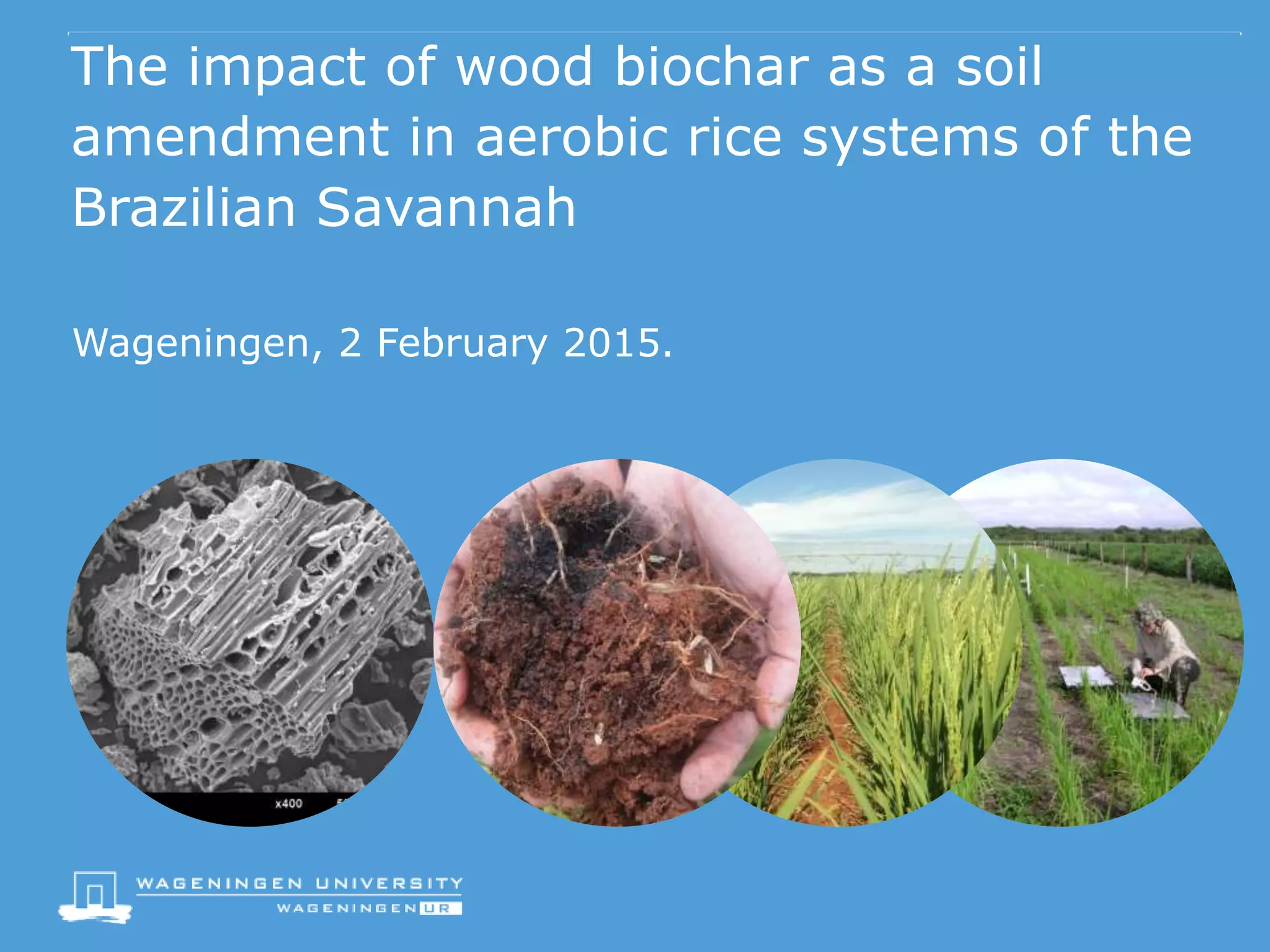


The impact of wood biochar as a soil
amendment in aerobic rice systems of the
Brazilian Savannah
Wageningen, 2 February 2015.
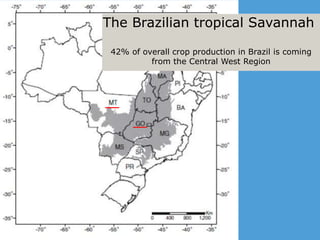
The Brazilian tropical Savannah
42% of overall crop production in Brazil is coming
from the Central West Region
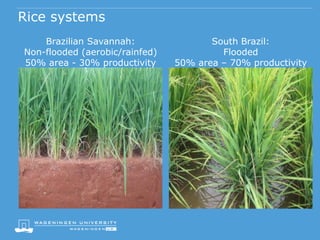
Rice systems
Brazilian Savannah:
Non-flooded (aerobic/rainfed)
50% area - 30% productivity
South Brazil:
Flooded
50% area – 70% productivity
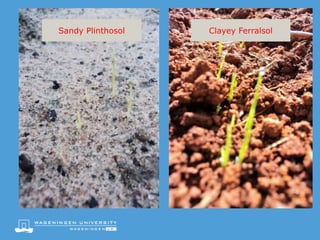
Sandy Plinthosol Clayey Ferralsol
Large yield gap
• Actual yield ≤ 1 t/ha  attainable yield ≥ 5 t/ha
• Causes:
• Biotic stress
• Rice blast (disease) and weed infestations
• Weathered soils
• Acidic
• Low soil organic matter content
• Poor nutrient availability
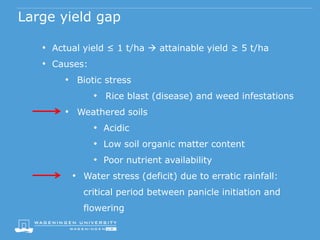
• Water stress (deficit) due to erratic rainfall:
critical period between panicle initiation and
flowering
Critical period
Optimal:
220 to 250 mm
30-33ºC
Growing period of Aerobic rice
650 – 750 mm / 20 – 35ºC
Sowing HarvestingFloweringPanicle
initiation
End of
Tillering
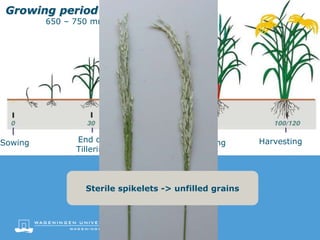
Sterile spikelets -> unfilled grains
Wood biochar
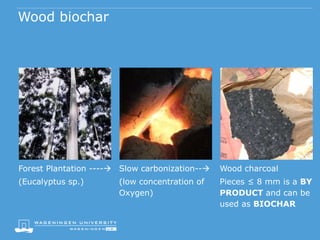
Forest Plantation ---- Slow carbonization-- Wood charcoal
(Eucalyptus sp.) (low concentration of
Oxygen)
Pieces ≤ 8 mm is a BY
PRODUCT and can be
used as BIOCHAR
Biochar as a soil amendment
 Decrease acidity (liming effect)
 Increase soil nutrients availability
 Increase water retention
 Potential increase in crop yields ~ 10%
 Positive effects mainly from:
● Artificially controlled conditions (pot experiments)
● Rates of biochar higher than 2% w/w
● Short term experiments (1-2 years)
● Other crops than rice
Objectives
 Quantify the effect of wood biochar amendment and its
combination with mineral N fertilizer on aerobic rice crop
performance on a sandy (non-irrigated) and clay soil
(irrigated) of the Brazilian tropical Savannah
 Analyse the effect of wood biochar amendment on soil
physical and chemical properties throughout 4 rice
seasons after biochar application
 Monitor the effect of wood biochar amendment on
N2O-N fluxes throughout crop seasons
Research design
• BIOCHAR: 4 levels (0, 8, 16 and 32 t/ha) incorporated once to
a depth of up to 15 cm
• NITROGEN: 4 levels (0,30, 60 and 90 kg/ha) applied annually
• SOIL TYPE (2 sites): Sandy soil in Mato Grosso (rainfed) and
Clay soil in Goias (rainfed + irrigation)
• 4 Blocks with 4 repetitions = 64 plots of 40 m2 in each site
• TIMESPAN, years after biochar application in soil:
Clay soil: 5 seasons S0.0, S0.5, S1.5, S2.5, S3.5
Sandy soil: 4 seasons S0, S1, S2, S3
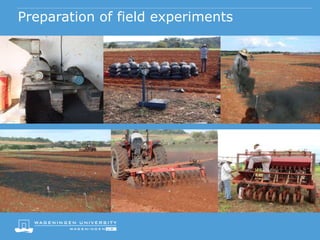
Preparation of field experiments
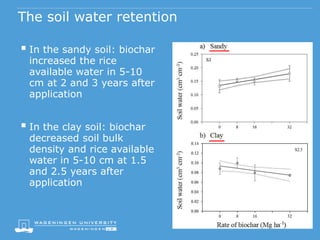
The soil water retention
 In the sandy soil: biochar
increased the rice
available water in 5-10
cm at 2 and 3 years after
application
 In the clay soil: biochar
decreased soil bulk
density and rice available
water in 5-10 cm at 1.5
and 2.5 years after
application
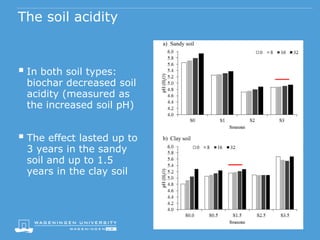
The soil acidity
 In both soil types:
biochar decreased soil
acidity (measured as
the increased soil pH)
 The effect lasted up to
3 years in the sandy
soil and up to 1.5
years in the clay soil
a) Sandy soil
b) Clay soil
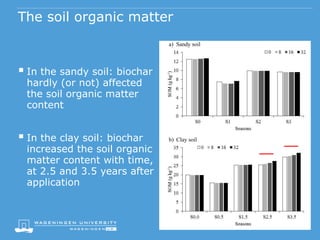
The soil organic matter
 In the sandy soil: biochar
hardly (or not) affected
the soil organic matter
content
 In the clay soil: biochar
increased the soil organic
matter content with time,
at 2.5 and 3.5 years after
application
a) Sandy soil
b) Clay soil
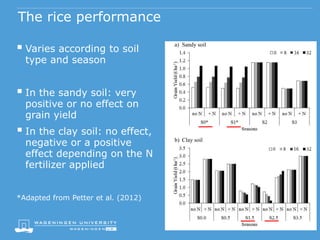
The rice performance
 Varies according to soil
type and season
 In the sandy soil: very
positive or no effect on
grain yield
 In the clay soil: no effect,
negative or a positive
effect depending on the N
fertilizer applied
*Adapted from Petter et al. (2012)
a) Sandy soil
b) Clay soil
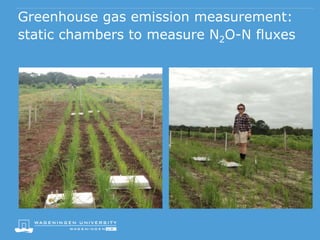
Greenhouse gas emission measurement:
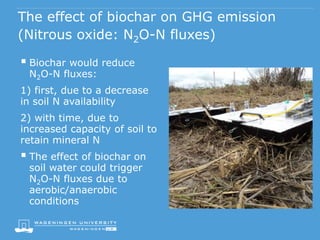
static chambers to measure N2O-N fluxes
The effect of biochar on GHG emission
(Nitrous oxide: N2O-N fluxes)
 Biochar would reduce
N2O-N fluxes:
1) first, due to a decrease
in soil N availability
2) with time, due to
increased capacity of soil to
retain mineral N
 The effect of biochar on
soil water could trigger
N2O-N fluxes due to
aerobic/anaerobic
conditions
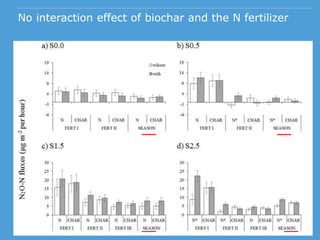
No interaction effect of biochar and the N fertilizer
Contribution to sustainable intensification
of farming systems in a tropical Savannah
The type of wood biochar used in this study:
• Can be used as an alternative to soil liming and
supplementary mineral fertilization
• Can be used as an strategy to increase water retention
in sandy soils
• Can be used as an amendment to enhance the soil
organic matter content in clay soils with time
• Rate up to 32 t/ha was not sufficient to guarantee an
increase in aerobic rice yield, and complementary
mineral N fertilization is likely to be needed.
Funding
Obrigada!
Thanks!
Bedankt!
“Life isn’t a game, friend.
Life is the art of the
encounter.
Even though there might
be so much discord (dis-
encounter) in this life.”
(Samba da Bênção, 1967)

The impact of wood biochar as a soil amendment in aerobic rie systems of the Brazilian Savannah

  • 1.
    The impact ofwood biochar as a soil amendment in aerobic rice systems of the Brazilian Savannah Wageningen, 2 February 2015.
  • 2.
    The Brazilian tropicalSavannah 42% of overall crop production in Brazil is coming from the Central West Region
  • 3.
    Rice systems Brazilian Savannah: Non-flooded(aerobic/rainfed) 50% area - 30% productivity South Brazil: Flooded 50% area – 70% productivity
  • 4.
  • 5.
    Large yield gap •Actual yield ≤ 1 t/ha  attainable yield ≥ 5 t/ha • Causes: • Biotic stress • Rice blast (disease) and weed infestations • Weathered soils • Acidic • Low soil organic matter content • Poor nutrient availability • Water stress (deficit) due to erratic rainfall: critical period between panicle initiation and flowering
  • 6.
    Critical period Optimal: 220 to250 mm 30-33ºC Growing period of Aerobic rice 650 – 750 mm / 20 – 35ºC Sowing HarvestingFloweringPanicle initiation End of Tillering Sterile spikelets -> unfilled grains
  • 7.
    Wood biochar Forest Plantation---- Slow carbonization-- Wood charcoal (Eucalyptus sp.) (low concentration of Oxygen) Pieces ≤ 8 mm is a BY PRODUCT and can be used as BIOCHAR
  • 8.
    Biochar as asoil amendment  Decrease acidity (liming effect)  Increase soil nutrients availability  Increase water retention  Potential increase in crop yields ~ 10%  Positive effects mainly from: ● Artificially controlled conditions (pot experiments) ● Rates of biochar higher than 2% w/w ● Short term experiments (1-2 years) ● Other crops than rice
  • 9.
    Objectives  Quantify theeffect of wood biochar amendment and its combination with mineral N fertilizer on aerobic rice crop performance on a sandy (non-irrigated) and clay soil (irrigated) of the Brazilian tropical Savannah  Analyse the effect of wood biochar amendment on soil physical and chemical properties throughout 4 rice seasons after biochar application  Monitor the effect of wood biochar amendment on N2O-N fluxes throughout crop seasons
  • 10.
    Research design • BIOCHAR:4 levels (0, 8, 16 and 32 t/ha) incorporated once to a depth of up to 15 cm • NITROGEN: 4 levels (0,30, 60 and 90 kg/ha) applied annually • SOIL TYPE (2 sites): Sandy soil in Mato Grosso (rainfed) and Clay soil in Goias (rainfed + irrigation) • 4 Blocks with 4 repetitions = 64 plots of 40 m2 in each site • TIMESPAN, years after biochar application in soil: Clay soil: 5 seasons S0.0, S0.5, S1.5, S2.5, S3.5 Sandy soil: 4 seasons S0, S1, S2, S3
  • 11.
  • 12.
    The soil waterretention  In the sandy soil: biochar increased the rice available water in 5-10 cm at 2 and 3 years after application  In the clay soil: biochar decreased soil bulk density and rice available water in 5-10 cm at 1.5 and 2.5 years after application
  • 13.
    The soil acidity In both soil types: biochar decreased soil acidity (measured as the increased soil pH)  The effect lasted up to 3 years in the sandy soil and up to 1.5 years in the clay soil a) Sandy soil b) Clay soil
  • 14.
    The soil organicmatter  In the sandy soil: biochar hardly (or not) affected the soil organic matter content  In the clay soil: biochar increased the soil organic matter content with time, at 2.5 and 3.5 years after application a) Sandy soil b) Clay soil
  • 15.
    The rice performance Varies according to soil type and season  In the sandy soil: very positive or no effect on grain yield  In the clay soil: no effect, negative or a positive effect depending on the N fertilizer applied *Adapted from Petter et al. (2012) a) Sandy soil b) Clay soil
  • 16.
    Greenhouse gas emissionmeasurement: static chambers to measure N2O-N fluxes
  • 17.
    The effect ofbiochar on GHG emission (Nitrous oxide: N2O-N fluxes)  Biochar would reduce N2O-N fluxes: 1) first, due to a decrease in soil N availability 2) with time, due to increased capacity of soil to retain mineral N  The effect of biochar on soil water could trigger N2O-N fluxes due to aerobic/anaerobic conditions
  • 18.
    No interaction effectof biochar and the N fertilizer
  • 19.
    Contribution to sustainableintensification of farming systems in a tropical Savannah The type of wood biochar used in this study: • Can be used as an alternative to soil liming and supplementary mineral fertilization • Can be used as an strategy to increase water retention in sandy soils • Can be used as an amendment to enhance the soil organic matter content in clay soils with time • Rate up to 32 t/ha was not sufficient to guarantee an increase in aerobic rice yield, and complementary mineral N fertilization is likely to be needed.
  • 20.
  • 21.
    Obrigada! Thanks! Bedankt! “Life isn’t agame, friend. Life is the art of the encounter. Even though there might be so much discord (dis- encounter) in this life.” (Samba da Bênção, 1967)

Editor's Notes

  • #2 Boa tarde! Good afternoon! Goodmidag! My name is Marcia Thais de Melo Carvalho, I am 34 years old, an Agronomist and I will present to you a summary of my thesis: The impact of wood biochar….
  • #3 First, let me introduce to you