By the end of this presentation the students
will be able to:
 Define defense mechanism
 Discuss various types of defense mechanism
o
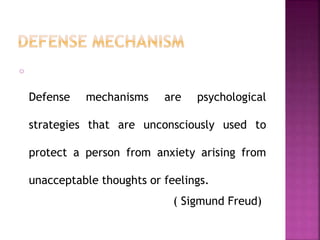
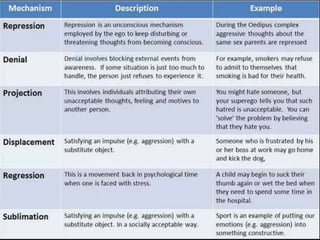
Defense mechanisms are psychological
strategies that are unconsciously used to
protect a person from anxiety arising from
unacceptable thoughts or feelings.
( Sigmund Freud)
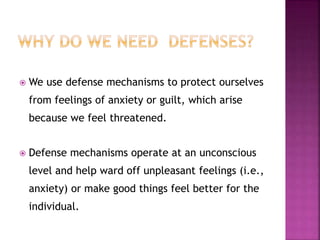
 We use defense mechanisms to protect ourselves
from feelings of anxiety or guilt, which arise
because we feel threatened.
 Defense mechanisms operate at an unconscious
level and help ward off unpleasant feelings (i.e.,
anxiety) or make good things feel better for the
individual.
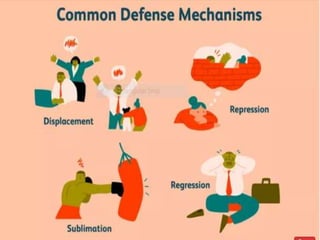
 Repression
 projection
 Displacement
 Sublimation
 Denial
 intellectualization
 Rationalization
 Regression
o Repression is well-known defense mechanism.
Repression acts to keep information out
of conscious awareness. However, these
memories don't just disappear they continue to
influence our behavior.
o For example, a person who has repressed
memories of abuse suffered as a child may later
have difficulty forming relationships.
 Projection is a psychological defense
mechanism in which an individual attributes
unwanted thoughts, feelings and motives
onto another person.
 A person who is afraid of crossing a bridge
with a friend might accuse them of having a
fear of heights, for example, and in doing so,
avoids accepting their own weaknesses.
 Displacement involves taking out our
frustrations, feelings, and impulses on people or
objects that are less threatening.
 Have ever had a really bad day at work and then
gone home and taken out your frustration on
family and friends?
 Someone who is frustrated by his or her
superiors may go home and kick the dog, beat up
a family member
 Sublimation is the process of diverting your
feelings about the negative self-concepts
that you have of yourself or others into more
socially acceptable activities.
 For example, a person experiencing extreme
anger might take up kick-boxing as a means
of venting frustration.
 Denial is one of the most common defense
mechanisms. It occurs when you refuse to
accept reality or facts. You block external
events or circumstances from your mind so
that you don’t have to deal with the
emotional impact. In other words, you avoid
the painful feelings or events
 Intellectualization works to reduce anxiety
by thinking about events in detail.
 This defense mechanism allows us to avoid
thinking about the stressful, emotional
aspect of the situation and instead focus only
on the intellectual component.
 For example, a person who has just been
diagnosed with a terminal illness might focus
on learning everything about the disease in
order to avoid distress and remain distant
from the reality of the situation.
 Rationalization is a defense mechanism that
involves explaining an unacceptable behavior
or feeling in a rational or logical manner,
avoiding the true reasons for the behavior.
 For example, A student might blame a poor
exam score on the instructor rather than his
or her lack of preparation.
 When confronted by stressful events, people
sometimes abandon coping strategies and
revert to patterns of behavior used earlier in
development.
 They might regress by eating meals that
they were given as a child, watching old
films or cartoons.
 McLeod, S. A. (2019, April 10). Defense
mechanisms. Simply Psychology.
https://www.simplypsychology.org/defense-
mechanisms.
Defence mechanism

Defence mechanism

  • 2.
    By the endof this presentation the students will be able to:  Define defense mechanism  Discuss various types of defense mechanism
  • 3.
    o Defense mechanisms arepsychological strategies that are unconsciously used to protect a person from anxiety arising from unacceptable thoughts or feelings. ( Sigmund Freud)
  • 4.
     We usedefense mechanisms to protect ourselves from feelings of anxiety or guilt, which arise because we feel threatened.  Defense mechanisms operate at an unconscious level and help ward off unpleasant feelings (i.e., anxiety) or make good things feel better for the individual.
  • 5.
     Repression  projection Displacement  Sublimation  Denial  intellectualization  Rationalization  Regression
  • 6.
    o Repression iswell-known defense mechanism. Repression acts to keep information out of conscious awareness. However, these memories don't just disappear they continue to influence our behavior. o For example, a person who has repressed memories of abuse suffered as a child may later have difficulty forming relationships.
  • 7.
     Projection isa psychological defense mechanism in which an individual attributes unwanted thoughts, feelings and motives onto another person.  A person who is afraid of crossing a bridge with a friend might accuse them of having a fear of heights, for example, and in doing so, avoids accepting their own weaknesses.
  • 8.
     Displacement involvestaking out our frustrations, feelings, and impulses on people or objects that are less threatening.  Have ever had a really bad day at work and then gone home and taken out your frustration on family and friends?  Someone who is frustrated by his or her superiors may go home and kick the dog, beat up a family member
  • 9.
     Sublimation isthe process of diverting your feelings about the negative self-concepts that you have of yourself or others into more socially acceptable activities.  For example, a person experiencing extreme anger might take up kick-boxing as a means of venting frustration.
  • 10.
     Denial isone of the most common defense mechanisms. It occurs when you refuse to accept reality or facts. You block external events or circumstances from your mind so that you don’t have to deal with the emotional impact. In other words, you avoid the painful feelings or events
  • 12.
     Intellectualization worksto reduce anxiety by thinking about events in detail.  This defense mechanism allows us to avoid thinking about the stressful, emotional aspect of the situation and instead focus only on the intellectual component.  For example, a person who has just been diagnosed with a terminal illness might focus on learning everything about the disease in order to avoid distress and remain distant from the reality of the situation.
  • 13.
     Rationalization isa defense mechanism that involves explaining an unacceptable behavior or feeling in a rational or logical manner, avoiding the true reasons for the behavior.  For example, A student might blame a poor exam score on the instructor rather than his or her lack of preparation.
  • 14.
     When confrontedby stressful events, people sometimes abandon coping strategies and revert to patterns of behavior used earlier in development.  They might regress by eating meals that they were given as a child, watching old films or cartoons.
  • 17.
     McLeod, S.A. (2019, April 10). Defense mechanisms. Simply Psychology. https://www.simplypsychology.org/defense- mechanisms.

Editor's Notes