Convolutional Neural Networks (CNN)
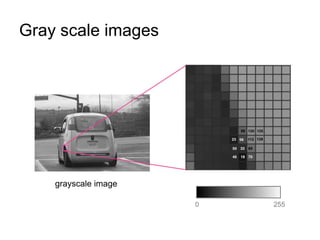
Gray scale images
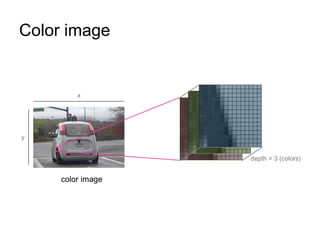
Color image
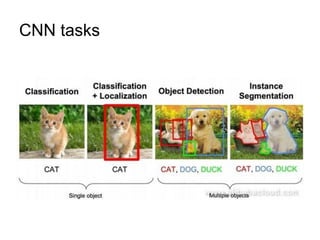
CNN tasks
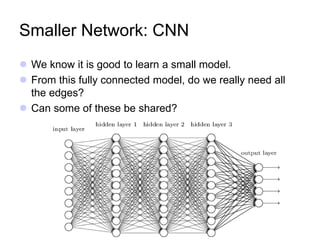
Smaller Network: CNN
⚫ We know it is good to learn a small model.
⚫ From this fully connected model, do we really need all
the edges?
⚫ Can some of these be shared?
Consider learning an image:
⚫Some patterns are much smaller than
the whole image
“beak” detector
Can represent a small region with fewer parameters
Same pattern appears in different places:
They can be compressed!
What about training a lot of such “small” detectors
and each detector must “move around”.
“upper-left
beak” detector
“middle beak”
detector
They can be compressed
to the same parameters.
A convolutional layer
A filter
A CNN is a neural network with some convolutional layers
(and some other layers). A convolutional layer has a number
of filters that does convolutional operation.
Beak detector
Convolution
1 0 0 0 0 1
0 1 0 0 1 0
0 0 1 1 0 0
1 0 0 0 1 0
0 1 0 0 1 0
0 0 1 0 1 0
6 x 6 image
1 -1 -1
-1 1 -1
-1 -1 1
Filter 1
-1 1 -1
-1 1 -1
-1 1 -1
Filter 2
…
…
These are the network
parameters to be learned.
Each filter detects a
small pattern (3 x 3).
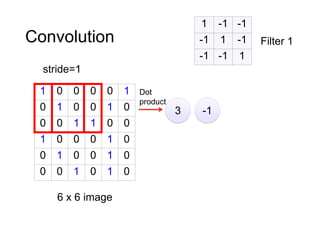
Convolution
1 0 0 0 0 1
0 1 0 0 1 0
0 0 1 1 0 0
1 0 0 0 1 0
0 1 0 0 1 0
0 0 1 0 1 0
6 x 6 image
1 -1 -1
-1 1 -1
-1 -1 1
Filter 1
3 -1
stride=1
Dot
product
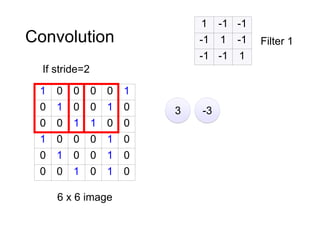
Convolution
1 0 0 0 0 1
0 1 0 0 1 0
0 0 1 1 0 0
1 0 0 0 1 0
0 1 0 0 1 0
0 0 1 0 1 0
6 x 6 image
1 -1 -1
-1 1 -1
-1 -1 1
Filter 1
3 -3
If stride=2
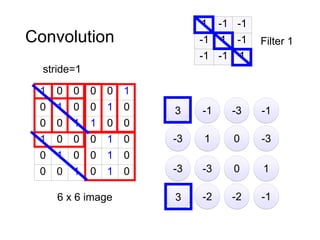
Convolution
1 0 0 0 0 1
0 1 0 0 1 0
0 0 1 1 0 0
1 0 0 0 1 0
0 1 0 0 1 0
0 0 1 0 1 0
6 x 6 image
1 -1 -1
-1 1 -1
-1 -1 1
Filter 1
3 -1 -3 -1
-3 1 0 -3
-3 -3 0 1
3 -2 -2 -1
stride=1
Convolution
1 0 0 0 0 1
0 1 0 0 1 0
0 0 1 1 0 0
1 0 0 0 1 0
0 1 0 0 1 0
0 0 1 0 1 0
6 x 6 image
3 -1 -3 -1
-3 1 0 -3
-3 -3 0 1
3 -2 -2 -1
-1 1 -1
-1 1 -1
-1 1 -1
Filter 2
-1 -1 -1 -1
-1 -1 -2 1
-1 -1 -2 1
-1 0 -4 3
Repeat this for each filter
stride=1
Two 4 x 4 images
Forming 2 x 4 x 4 matrix
Feature
Map
Color image: RGB 3 channels
1 0 0 0 0 1
0 1 0 0 1 0
0 0 1 1 0 0
1 0 0 0 1 0
0 1 0 0 1 0
0 0 1 0 1 0
1 0 0 0 0 1
0 1 0 0 1 0
0 0 1 1 0 0
1 0 0 0 1 0
0 1 0 0 1 0
0 0 1 0 1 0
1 0 0 0 0 1
0 1 0 0 1 0
0 0 1 1 0 0
1 0 0 0 1 0
0 1 0 0 1 0
0 0 1 0 1 0
1 -1 -1
-1 1 -1
-1 -1 1 Filter 1
-1 1 -1
-1 1 -1
-1 1 -1 Filter 2
1 -1 -1
-1 1 -1
-1 -1 1
1 -1 -1
-1 1 -1
-1 -1 1
-1 1 -1
-1 1 -1
-1 1 -1
-1 1 -1
-1 1 -1
-1 1 -1
Color image
1 0 0 0 0 1
0 1 0 0 1 0
0 0 1 1 0 0
1 0 0 0 1 0
0 1 0 0 1 0
0 0 1 0 1 0
image
convolution
-1 1 -1
-1 1 -1
-1 1 -1
1 -1 -1
-1 1 -1
-1 -1 1
x1
x2
…
…
x36
…
…
1 0 0 0 0 1
0 1 0 0 1 0
0 0 1 1 0 0
1 0 0 0 1 0
0 1 0 0 1 0
0 0 1 0 1 0
Convolution v.s. Fully Connected
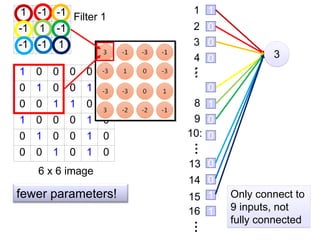
Fully-
connected
1 0 0 0 0 1
0 1 0 0 1 0
0 0 1 1 0 0
1 0 0 0 1 0
0 1 0 0 1 0
0 0 1 0 1 0
6 x 6 image
1 -1 -1
-1 1 -1
-1 -1 1
Filter 1
1
2
3
…
8
9
…
13
14
15
… Only connect to
9 inputs, not
fully connected
4
:
10:
16
1
0
0
0
0
1
0
0
0
0
1
1
3
fewer parameters!
1 0 0 0 0 1
0 1 0 0 1 0
0 0 1 1 0 0
1 0 0 0 1 0
0 1 0 0 1 0
0 0 1 0 1 0
1 -1 -1
-1 1 -1
-1 -1 1
Filter 1
1
:
2
:
3
:
…
7
:
8
:
9
:
…
13
:
14
:
15
:
…
4
:
10:
16
:
1
0
0
0
0
1
0
0
0
0
1
1
3
-1
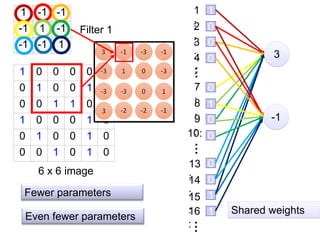
Shared weights
6 x 6 image
Fewer parameters
Even fewer parameters
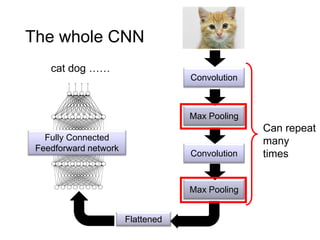
The whole CNN
Fully Connected
Feedforward network
cat dog ……
Convolution
Max Pooling
Convolution
Max Pooling
Flattened
Can repeat
many
times
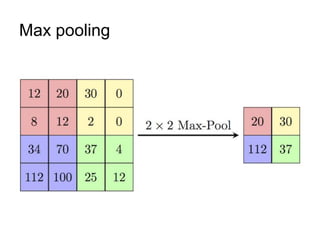
Max pooling
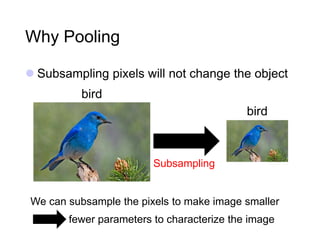
Why Pooling
⚫ Subsampling pixels will not change the object
Subsampling
bird
bird
We can subsample the pixels to make image smaller
fewer parameters to characterize the image
A CNN compresses a fully connected
network in two ways:
⚫Reducing number of connections
⚫Shared weights on the edges
⚫Max pooling further reduces the complexity
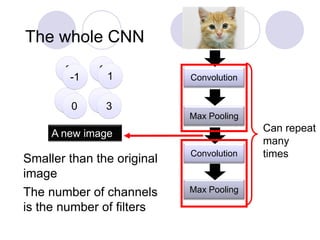
The whole CNN
Convolution
Max Pooling
Convolution
Max Pooling
Can repeat
many
times
A new image
The number of channels
is the number of filters
Smaller than the original
image
3 0
1
3
-1 1
3
0
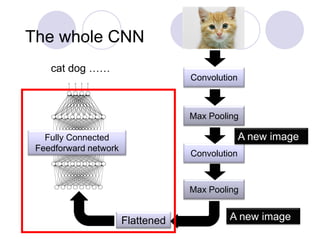
The whole CNN
Fully Connected
Feedforward network
cat dog ……
Convolution
Max Pooling
Convolution
Max Pooling
Flattened
A new image
A new image
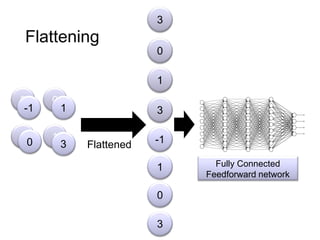
Flattening
3 0
1
3
-1 1
3
0 Flattened
3
0
1
3
-1
1
0
3
Fully Connected
Feedforward network
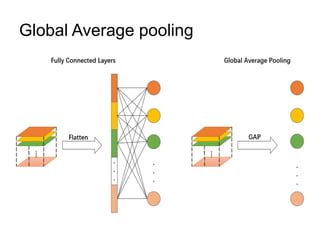
Global Average pooling
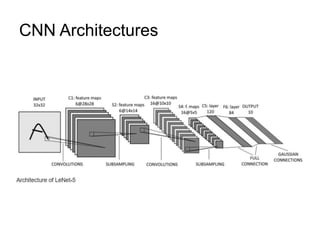
CNN Architectures
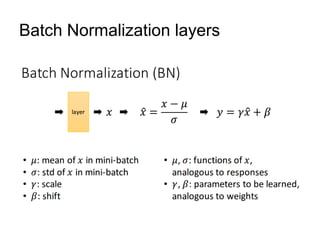
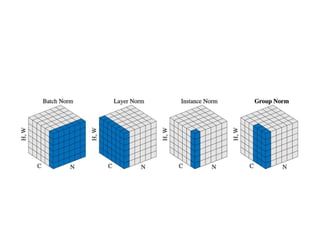
Batch Normalization layers
Pytorch Models
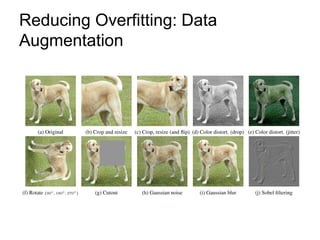
Reducing overfitting: Dropout
Reducing Overfitting: Data
Augmentation
CNN in speech recognition
Time
Frequency
Spectrogram
CNN
Image
The filters move in the
frequency direction.

convolutional neural networks for machine learning

  • 1.
  • 2.
  • 3.
  • 4.
  • 5.
    Smaller Network: CNN ⚫We know it is good to learn a small model. ⚫ From this fully connected model, do we really need all the edges? ⚫ Can some of these be shared?
  • 6.
    Consider learning animage: ⚫Some patterns are much smaller than the whole image “beak” detector Can represent a small region with fewer parameters
  • 7.
    Same pattern appearsin different places: They can be compressed! What about training a lot of such “small” detectors and each detector must “move around”. “upper-left beak” detector “middle beak” detector They can be compressed to the same parameters.
  • 8.
    A convolutional layer Afilter A CNN is a neural network with some convolutional layers (and some other layers). A convolutional layer has a number of filters that does convolutional operation. Beak detector
  • 9.
    Convolution 1 0 00 0 1 0 1 0 0 1 0 0 0 1 1 0 0 1 0 0 0 1 0 0 1 0 0 1 0 0 0 1 0 1 0 6 x 6 image 1 -1 -1 -1 1 -1 -1 -1 1 Filter 1 -1 1 -1 -1 1 -1 -1 1 -1 Filter 2 … … These are the network parameters to be learned. Each filter detects a small pattern (3 x 3).
  • 11.
    Convolution 1 0 00 0 1 0 1 0 0 1 0 0 0 1 1 0 0 1 0 0 0 1 0 0 1 0 0 1 0 0 0 1 0 1 0 6 x 6 image 1 -1 -1 -1 1 -1 -1 -1 1 Filter 1 3 -1 stride=1 Dot product
  • 12.
    Convolution 1 0 00 0 1 0 1 0 0 1 0 0 0 1 1 0 0 1 0 0 0 1 0 0 1 0 0 1 0 0 0 1 0 1 0 6 x 6 image 1 -1 -1 -1 1 -1 -1 -1 1 Filter 1 3 -3 If stride=2
  • 13.
    Convolution 1 0 00 0 1 0 1 0 0 1 0 0 0 1 1 0 0 1 0 0 0 1 0 0 1 0 0 1 0 0 0 1 0 1 0 6 x 6 image 1 -1 -1 -1 1 -1 -1 -1 1 Filter 1 3 -1 -3 -1 -3 1 0 -3 -3 -3 0 1 3 -2 -2 -1 stride=1
  • 14.
    Convolution 1 0 00 0 1 0 1 0 0 1 0 0 0 1 1 0 0 1 0 0 0 1 0 0 1 0 0 1 0 0 0 1 0 1 0 6 x 6 image 3 -1 -3 -1 -3 1 0 -3 -3 -3 0 1 3 -2 -2 -1 -1 1 -1 -1 1 -1 -1 1 -1 Filter 2 -1 -1 -1 -1 -1 -1 -2 1 -1 -1 -2 1 -1 0 -4 3 Repeat this for each filter stride=1 Two 4 x 4 images Forming 2 x 4 x 4 matrix Feature Map
  • 15.
    Color image: RGB3 channels 1 0 0 0 0 1 0 1 0 0 1 0 0 0 1 1 0 0 1 0 0 0 1 0 0 1 0 0 1 0 0 0 1 0 1 0 1 0 0 0 0 1 0 1 0 0 1 0 0 0 1 1 0 0 1 0 0 0 1 0 0 1 0 0 1 0 0 0 1 0 1 0 1 0 0 0 0 1 0 1 0 0 1 0 0 0 1 1 0 0 1 0 0 0 1 0 0 1 0 0 1 0 0 0 1 0 1 0 1 -1 -1 -1 1 -1 -1 -1 1 Filter 1 -1 1 -1 -1 1 -1 -1 1 -1 Filter 2 1 -1 -1 -1 1 -1 -1 -1 1 1 -1 -1 -1 1 -1 -1 -1 1 -1 1 -1 -1 1 -1 -1 1 -1 -1 1 -1 -1 1 -1 -1 1 -1 Color image
  • 16.
    1 0 00 0 1 0 1 0 0 1 0 0 0 1 1 0 0 1 0 0 0 1 0 0 1 0 0 1 0 0 0 1 0 1 0 image convolution -1 1 -1 -1 1 -1 -1 1 -1 1 -1 -1 -1 1 -1 -1 -1 1 x1 x2 … … x36 … … 1 0 0 0 0 1 0 1 0 0 1 0 0 0 1 1 0 0 1 0 0 0 1 0 0 1 0 0 1 0 0 0 1 0 1 0 Convolution v.s. Fully Connected Fully- connected
  • 17.
    1 0 00 0 1 0 1 0 0 1 0 0 0 1 1 0 0 1 0 0 0 1 0 0 1 0 0 1 0 0 0 1 0 1 0 6 x 6 image 1 -1 -1 -1 1 -1 -1 -1 1 Filter 1 1 2 3 … 8 9 … 13 14 15 … Only connect to 9 inputs, not fully connected 4 : 10: 16 1 0 0 0 0 1 0 0 0 0 1 1 3 fewer parameters!
  • 18.
    1 0 00 0 1 0 1 0 0 1 0 0 0 1 1 0 0 1 0 0 0 1 0 0 1 0 0 1 0 0 0 1 0 1 0 1 -1 -1 -1 1 -1 -1 -1 1 Filter 1 1 : 2 : 3 : … 7 : 8 : 9 : … 13 : 14 : 15 : … 4 : 10: 16 : 1 0 0 0 0 1 0 0 0 0 1 1 3 -1 Shared weights 6 x 6 image Fewer parameters Even fewer parameters
  • 19.
    The whole CNN FullyConnected Feedforward network cat dog …… Convolution Max Pooling Convolution Max Pooling Flattened Can repeat many times
  • 20.
  • 21.
    Why Pooling ⚫ Subsamplingpixels will not change the object Subsampling bird bird We can subsample the pixels to make image smaller fewer parameters to characterize the image
  • 22.
    A CNN compressesa fully connected network in two ways: ⚫Reducing number of connections ⚫Shared weights on the edges ⚫Max pooling further reduces the complexity
  • 23.
    The whole CNN Convolution MaxPooling Convolution Max Pooling Can repeat many times A new image The number of channels is the number of filters Smaller than the original image 3 0 1 3 -1 1 3 0
  • 24.
    The whole CNN FullyConnected Feedforward network cat dog …… Convolution Max Pooling Convolution Max Pooling Flattened A new image A new image
  • 25.
    Flattening 3 0 1 3 -1 1 3 0Flattened 3 0 1 3 -1 1 0 3 Fully Connected Feedforward network
  • 26.
  • 27.
  • 28.
  • 30.
  • 31.
  • 32.
  • 33.
    CNN in speechrecognition Time Frequency Spectrogram CNN Image The filters move in the frequency direction.