Deep Learning for Computer Vision: Training Neural Network-Part-2
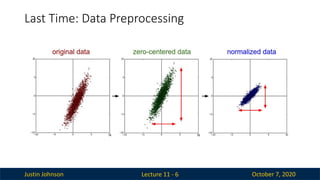
1.
Justin Johnson October7, 2020
Lecture 11:
Training Neural Networks
(Part 2)
Lecture 11 - 1
2.
Justin Johnson October7, 2020
Reminder: A3
Lecture 11 - 2
Due this Friday 10/9 at 11:59pm EST
Reminder: 100% on autograder does not mean 100%
score! Some components of each assignment will be
hand-graded.
3.
Justin Johnson October7, 2020
Midterm
Lecture 11 - 3
• Monday, October 19
• Will be online via https://crabster.org/
• Exam is 90 minutes
• You can take it any time in a 24-hour window
• We will have 3-4 “on-call” periods during the 24-hour window where
GSIs will answer questions within ~15 minutes
• Open note
• True / False, multiple choice, short answer
• For short answer questions requiring math, either write LaTeX or
upload an image with handwritten math
4.
Justin Johnson October7, 2020
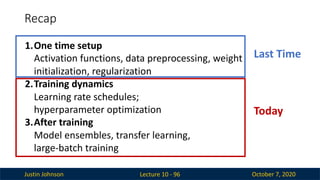
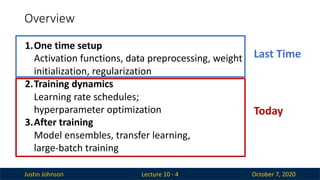
Overview
Lecture 10 - 4
1.One time setup
Activation functions, data preprocessing, weight
initialization, regularization
2.Training dynamics
Learning rate schedules;
hyperparameter optimization
3.After training
Model ensembles, transfer learning,
large-batch training
Last Time
Today
5.
Justin Johnson October7, 2020
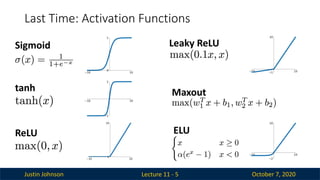
Last Time: Activation Functions
Lecture 11 - 5
Sigmoid
tanh
ReLU
Leaky ReLU
Maxout
ELU
Justin Johnson October7, 2020
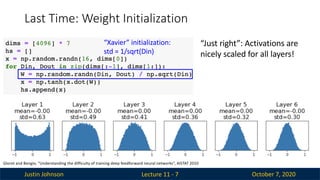
Last Time: Weight Initialization
Lecture 11 - 7
“Just right”: Activations are
nicely scaled for all layers!
“Xavier” initialization:
std = 1/sqrt(Din)
Glorot and Bengio, “Understanding the difficulty of training deep feedforward neural networks”, AISTAT 2010
8.
Justin Johnson October7, 2020
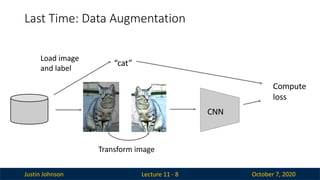
Last Time: Data Augmentation
Lecture 11 - 8
Transform image
Load image
and label
“cat”
CNN
Compute
loss
9.
Justin Johnson October7, 2020
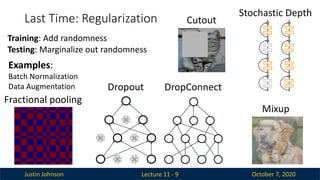
Last Time: Regularization
Lecture 11 - 9
Examples:
Batch Normalization
Data Augmentation
Training: Add randomness
Testing: Marginalize out randomness
Dropout
Stochastic Depth
Cutout
Fractional pooling
DropConnect
Mixup
10.
Justin Johnson October7, 2020
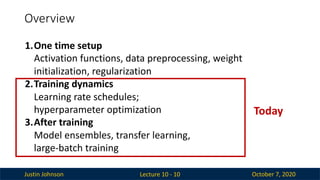
Overview
Lecture 10 - 10
1.One time setup
Activation functions, data preprocessing, weight
initialization, regularization
2.Training dynamics
Learning rate schedules;
hyperparameter optimization
3.After training
Model ensembles, transfer learning,
large-batch training
Today
Justin Johnson October7, 2020
Lecture 11 - 12
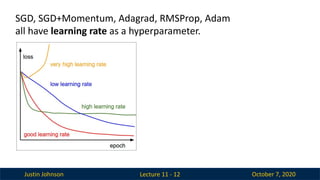
SGD, SGD+Momentum, Adagrad, RMSProp, Adam
all have learning rate as a hyperparameter.
13.
Justin Johnson October7, 2020
Lecture 11 - 13
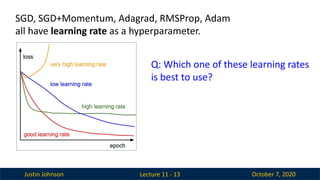
SGD, SGD+Momentum, Adagrad, RMSProp, Adam
all have learning rate as a hyperparameter.
Q: Which one of these learning rates
is best to use?
14.
Justin Johnson October7, 2020
Lecture 11 - 14
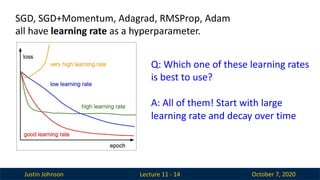
SGD, SGD+Momentum, Adagrad, RMSProp, Adam
all have learning rate as a hyperparameter.
Q: Which one of these learning rates
is best to use?
A: All of them! Start with large
learning rate and decay over time
15.
Justin Johnson October7, 2020
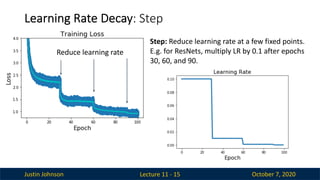
Learning Rate Decay: Step
Lecture 11 - 15
Reduce learning rate
Step: Reduce learning rate at a few fixed points.
E.g. for ResNets, multiply LR by 0.1 after epochs
30, 60, and 90.
16.
Justin Johnson October7, 2020
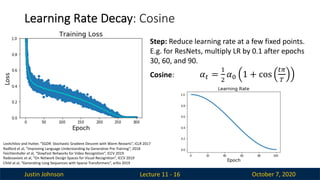
Learning Rate Decay: Cosine
Lecture 11 - 16
Loshchilov and Hutter, “SGDR: Stochastic Gradient Descent with Warm Restarts”, ICLR 2017
Radford et al, “Improving Language Understanding by Generative Pre-Training”, 2018
Feichtenhofer et al, “SlowFast Networks for Video Recognition”, ICCV 2019
Radosavovic et al, “On Network Design Spaces for Visual Recognition”, ICCV 2019
Child at al, “Generating Long Sequences with Sparse Transformers”, arXiv 2019
Step: Reduce learning rate at a few fixed points.
E.g. for ResNets, multiply LR by 0.1 after epochs
30, 60, and 90.
Cosine: 𝛼! =
"
#
𝛼$ 1 + cos
!%
&
17.
Justin Johnson October7, 2020
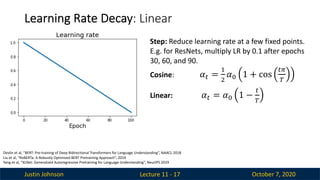
Learning Rate Decay: Linear
Lecture 11 - 17
Devlin et al, “BERT: Pre-training of Deep Bidirectional Transformers for Language Understanding”, NAACL 2018
Liu et al, “RoBERTa: A Robustly Optimized BERT Pretraining Approach”, 2019
Yang et al, “XLNet: Generalized Autoregressive Pretraining for Language Understanding”, NeurIPS 2019
Step: Reduce learning rate at a few fixed points.
E.g. for ResNets, multiply LR by 0.1 after epochs
30, 60, and 90.
Cosine: 𝛼! =
"
#
𝛼$ 1 + cos
!%
&
Linear: 𝛼! = 𝛼$ 1 −
!
&
18.
Justin Johnson October7, 2020
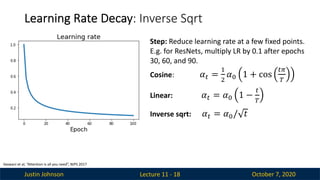
Learning Rate Decay: Inverse Sqrt
Lecture 11 - 18
Vaswani et al, “Attention is all you need”, NIPS 2017
Step: Reduce learning rate at a few fixed points.
E.g. for ResNets, multiply LR by 0.1 after epochs
30, 60, and 90.
Cosine: 𝛼! =
"
#
𝛼$ 1 + cos
!%
&
Linear: 𝛼! = 𝛼$ 1 −
!
&
Inverse sqrt: 𝛼! = 𝛼$/ 𝑡
19.
Justin Johnson October7, 2020
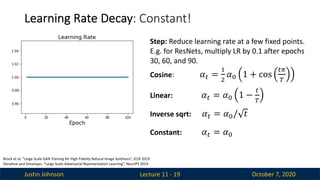
Learning Rate Decay: Constant!
Lecture 11 - 19
Step: Reduce learning rate at a few fixed points.
E.g. for ResNets, multiply LR by 0.1 after epochs
30, 60, and 90.
Cosine: 𝛼! =
"
#
𝛼$ 1 + cos
!%
&
Linear: 𝛼! = 𝛼$ 1 −
!
&
Inverse sqrt: 𝛼! = 𝛼$/ 𝑡
Constant: 𝛼! = 𝛼$
Brock et al, “Large Scale GAN Training for High Fidelity Natural Image Synthesis”, ICLR 2019
Donahue and Simonyan, “Large Scale Adversarial Representation Learning”, NeurIPS 2019
20.
Justin Johnson October7, 2020
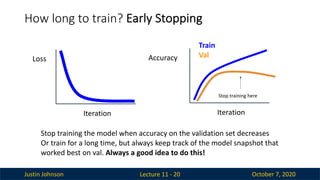
How long to train? Early Stopping
Lecture 11 - 20
Iteration
Loss
Iteration
Accuracy
Train
Val
Stop training here
Stop training the model when accuracy on the validation set decreases
Or train for a long time, but always keep track of the model snapshot that
worked best on val. Always a good idea to do this!
Justin Johnson October7, 2020
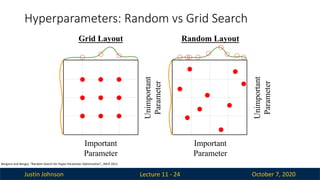
Choosing Hyperparameters: Grid Search
Lecture 11 - 22
Choose several values for each hyperparameter
(Often space choices log-linearly)
Example:
Weight decay: [1x10⁻⁴, 1x10⁻³, 1x10⁻², 1x10⁻¹]
Learning rate: [1x10⁻⁴, 1x10⁻³, 1x10⁻², 1x10⁻¹]
Evaluate all possible choices on this
hyperparameter grid
23.
Justin Johnson October7, 2020
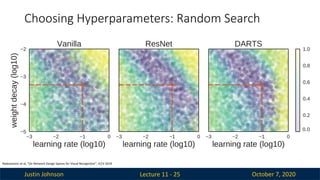
Choosing Hyperparameters: Random Search
Lecture 11 - 23
Choose several values for each hyperparameter
(Often space choices log-linearly)
Example:
Weight decay: log-uniform on [1x10⁻⁴, 1x10⁻¹]
Learning rate: log-uniform on [1x10⁻⁴, 1x10⁻¹]
Run many different trials
24.
Justin Johnson October7, 2020
Hyperparameters: Random vs Grid Search
Lecture 11 - 24
Important
Parameter
Important
Parameter
Unimportant
Parameter
Unimportant
Parameter
Grid Layout Random Layout
Bergstra and Bengio, “Random Search for Hyper-Parameter Optimization”, JMLR 2012
25.
Justin Johnson October7, 2020
Choosing Hyperparameters: Random Search
Lecture 11 - 25
Radosavovic et al, “On Network Design Spaces for Visual Recognition”, ICCV 2019
26.
Justin Johnson October7, 2020
Lecture 11 - 26
Choosing Hyperparameters
(without tons of GPUs)
27.
Justin Johnson October7, 2020
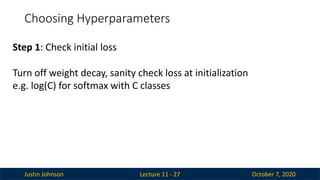
Choosing Hyperparameters
Lecture 11 - 27
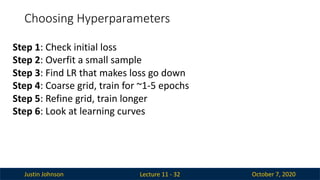
Step 1: Check initial loss
Turn off weight decay, sanity check loss at initialization
e.g. log(C) for softmax with C classes
28.
Justin Johnson October7, 2020
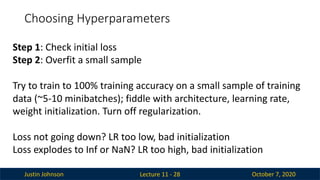
Choosing Hyperparameters
Lecture 11 - 28
Step 1: Check initial loss
Step 2: Overfit a small sample
Try to train to 100% training accuracy on a small sample of training
data (~5-10 minibatches); fiddle with architecture, learning rate,
weight initialization. Turn off regularization.
Loss not going down? LR too low, bad initialization
Loss explodes to Inf or NaN? LR too high, bad initialization
29.
Justin Johnson October7, 2020
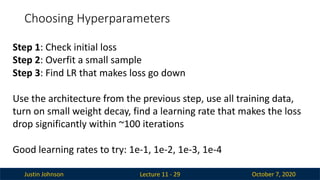
Choosing Hyperparameters
Lecture 11 - 29
Step 1: Check initial loss
Step 2: Overfit a small sample
Step 3: Find LR that makes loss go down
Use the architecture from the previous step, use all training data,
turn on small weight decay, find a learning rate that makes the loss
drop significantly within ~100 iterations
Good learning rates to try: 1e-1, 1e-2, 1e-3, 1e-4
30.
Justin Johnson October7, 2020
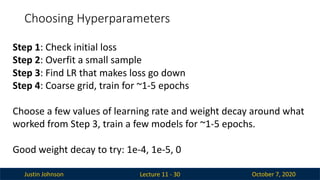
Choosing Hyperparameters
Lecture 11 - 30
Step 1: Check initial loss
Step 2: Overfit a small sample
Step 3: Find LR that makes loss go down
Step 4: Coarse grid, train for ~1-5 epochs
Choose a few values of learning rate and weight decay around what
worked from Step 3, train a few models for ~1-5 epochs.
Good weight decay to try: 1e-4, 1e-5, 0
31.
Justin Johnson October7, 2020
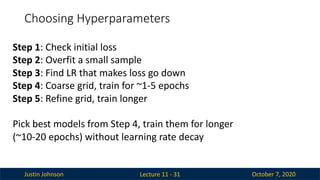
Choosing Hyperparameters
Lecture 11 - 31
Step 1: Check initial loss
Step 2: Overfit a small sample
Step 3: Find LR that makes loss go down
Step 4: Coarse grid, train for ~1-5 epochs
Step 5: Refine grid, train longer
Pick best models from Step 4, train them for longer
(~10-20 epochs) without learning rate decay
32.
Justin Johnson October7, 2020
Choosing Hyperparameters
Lecture 11 - 32
Step 1: Check initial loss
Step 2: Overfit a small sample
Step 3: Find LR that makes loss go down
Step 4: Coarse grid, train for ~1-5 epochs
Step 5: Refine grid, train longer
Step 6: Look at learning curves
33.
Justin Johnson October7, 2020
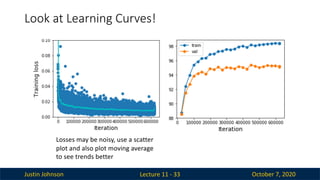
Look at Learning Curves!
Lecture 11 - 33
Losses may be noisy, use a scatter
plot and also plot moving average
to see trends better
34.
Justin Johnson October7, 2020
Lecture 11 - 34
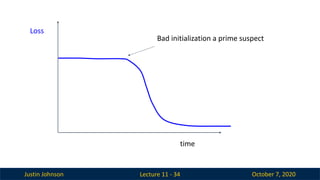
Loss
time
Bad initialization a prime suspect
35.
Justin Johnson October7, 2020
Lecture 11 - 35
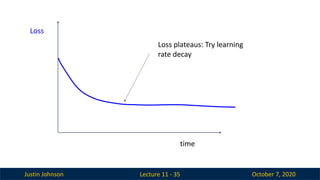
Loss
time
Loss plateaus: Try learning
rate decay
36.
Justin Johnson October7, 2020
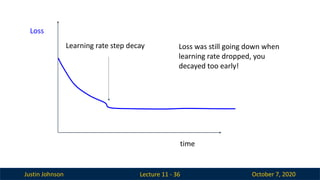
Lecture 11 - 36
Loss
time
Learning rate step decay Loss was still going down when
learning rate dropped, you
decayed too early!
37.
Justin Johnson October7, 2020
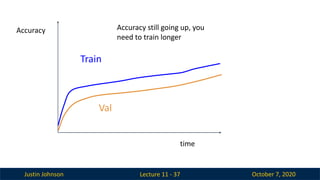
Lecture 11 - 37
Accuracy
time
Train
Accuracy still going up, you
need to train longer
Val
38.
Justin Johnson October7, 2020
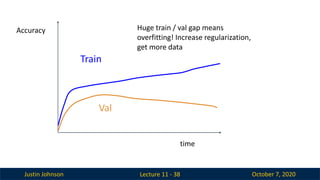
Lecture 11 - 38
Accuracy
time
Train
Huge train / val gap means
overfitting! Increase regularization,
get more data
Val
39.
Justin Johnson October7, 2020
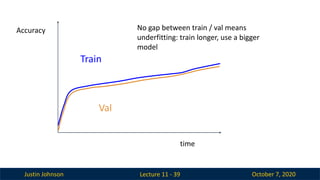
Lecture 11 - 39
Accuracy
time
Train
No gap between train / val means
underfitting: train longer, use a bigger
model
Val
40.
Justin Johnson October7, 2020
Lecture 11 - 40
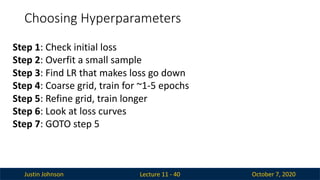
Choosing Hyperparameters
Step 1: Check initial loss
Step 2: Overfit a small sample
Step 3: Find LR that makes loss go down
Step 4: Coarse grid, train for ~1-5 epochs
Step 5: Refine grid, train longer
Step 6: Look at loss curves
Step 7: GOTO step 5
41.
Justin Johnson October7, 2020
Lecture 11 - 41
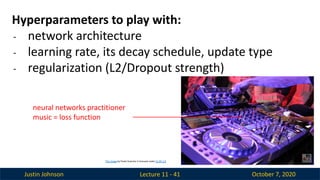
Hyperparameters to play with:
- network architecture
- learning rate, its decay schedule, update type
- regularization (L2/Dropout strength)
neural networks practitioner
music = loss function
This image by Paolo Guereta is licensed under CC-BY 2.0
Justin Johnson October7, 2020
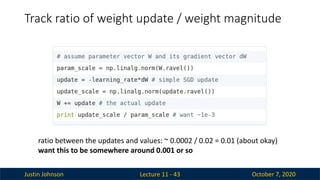
Track ratio of weight update / weight magnitude
Lecture 11 - 43
ratio between the updates and values: ~ 0.0002 / 0.02 = 0.01 (about okay)
want this to be somewhere around 0.001 or so
44.
Justin Johnson October7, 2020
Overview
Lecture 10 - 44
1.One time setup
Activation functions, data preprocessing, weight
initialization, regularization
2.Training dynamics
Learning rate schedules;
hyperparameter optimization
3.After training
Model ensembles, transfer learning,
large-batch training
45.
Justin Johnson October7, 2020
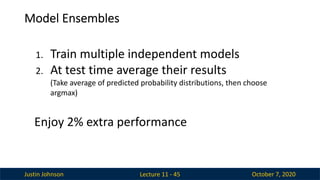
Model Ensembles
Lecture 11 - 45
1. Train multiple independent models
2. At test time average their results
(Take average of predicted probability distributions, then choose
argmax)
Enjoy 2% extra performance
46.
Justin Johnson October7, 2020
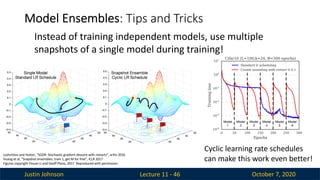
Cyclic learning rate schedules
can make this work even better!
Model Ensembles: Tips and Tricks
Lecture 11 - 46
Instead of training independent models, use multiple
snapshots of a single model during training!
Loshchilov and Hutter, “SGDR: Stochastic gradient descent with restarts”, arXiv 2016
Huang et al, “Snapshot ensembles: train 1, get M for free”, ICLR 2017
Figures copyright Yixuan Li and Geoff Pleiss, 2017. Reproduced with permission.
47.
Justin Johnson October7, 2020
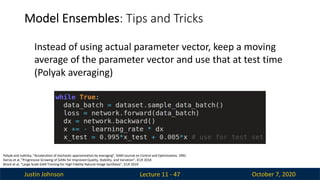
Model Ensembles: Tips and Tricks
Lecture 11 - 47
Instead of using actual parameter vector, keep a moving
average of the parameter vector and use that at test time
(Polyak averaging)
Polyak and Juditsky, “Acceleration of stochastic approximation by averaging”, SIAM Journal on Control and Optimization, 1992.
Karras et al, “Progressive Growing of GANs for Improved Quality, Stability, and Variation”, ICLR 2018
Brock et al, “Large Scale GAN Training for High Fidelity Natural Image Synthesis”, ICLR 2019
Justin Johnson October7, 2020
Transfer Learning
Lecture 11 - 49
“You need a lot of a data if you
want to train/use CNNs”
50.
Justin Johnson October7, 2020
Transfer Learning
Lecture 11 - 50
“You need a lot of a data if you
want to train/use CNNs”
B
U
S
T
E
D
51.
Justin Johnson October7, 2020
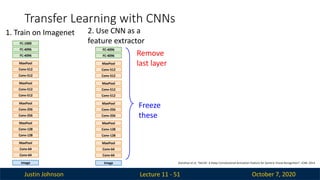
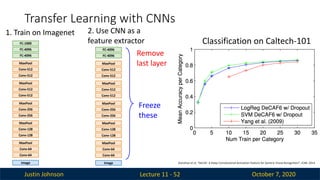
Transfer Learning with CNNs
Lecture 11 - 51
Image
Conv-64
Conv-64
MaxPool
Conv-128
Conv-128
MaxPool
Conv-256
Conv-256
MaxPool
Conv-512
Conv-512
MaxPool
Conv-512
Conv-512
MaxPool
FC-4096
FC-4096
FC-1000
1. Train on Imagenet
Image
Conv-64
Conv-64
MaxPool
Conv-128
Conv-128
MaxPool
Conv-256
Conv-256
MaxPool
Conv-512
Conv-512
MaxPool
Conv-512
Conv-512
MaxPool
FC-4096
FC-4096
Freeze
these
Remove
last layer
Donahue et al, “DeCAF: A Deep Convolutional Activation Feature for Generic Visual Recognition”, ICML 2014
2. Use CNN as a
feature extractor
52.
Justin Johnson October7, 2020
Transfer Learning with CNNs
Lecture 11 - 52
Image
Conv-64
Conv-64
MaxPool
Conv-128
Conv-128
MaxPool
Conv-256
Conv-256
MaxPool
Conv-512
Conv-512
MaxPool
Conv-512
Conv-512
MaxPool
FC-4096
FC-4096
FC-1000
1. Train on Imagenet
Image
Conv-64
Conv-64
MaxPool
Conv-128
Conv-128
MaxPool
Conv-256
Conv-256
MaxPool
Conv-512
Conv-512
MaxPool
Conv-512
Conv-512
MaxPool
FC-4096
FC-4096
Freeze
these
Remove
last layer
Donahue et al, “DeCAF: A Deep Convolutional Activation Feature for Generic Visual Recognition”, ICML 2014
2. Use CNN as a
feature extractor Classification on Caltech-101
53.
Justin Johnson October7, 2020
Transfer Learning with CNNs
Lecture 11 - 53
Image
Conv-64
Conv-64
MaxPool
Conv-128
Conv-128
MaxPool
Conv-256
Conv-256
MaxPool
Conv-512
Conv-512
MaxPool
Conv-512
Conv-512
MaxPool
FC-4096
FC-4096
FC-1000
1. Train on Imagenet
Image
Conv-64
Conv-64
MaxPool
Conv-128
Conv-128
MaxPool
Conv-256
Conv-256
MaxPool
Conv-512
Conv-512
MaxPool
Conv-512
Conv-512
MaxPool
FC-4096
FC-4096
Freeze
these
Remove
last layer
Donahue et al, “DeCAF: A Deep Convolutional Activation Feature for Generic Visual Recognition”, ICML 2014
2. Use CNN as a
feature extractor
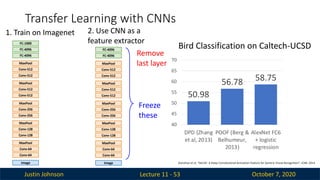
Bird Classification on Caltech-UCSD
50.98
56.78 58.75
64.96
40
45
50
55
60
65
70
DPD (Zhang
et al, 2013)
POOF (Berg &
Belhumeur,
2013)
AlexNet FC6
+ logistic
regression
AlexNet FC6
+ DPD
54.
Justin Johnson October7, 2020
Transfer Learning with CNNs
Lecture 11 - 54
Image
Conv-64
Conv-64
MaxPool
Conv-128
Conv-128
MaxPool
Conv-256
Conv-256
MaxPool
Conv-512
Conv-512
MaxPool
Conv-512
Conv-512
MaxPool
FC-4096
FC-4096
FC-1000
1. Train on Imagenet
Image
Conv-64
Conv-64
MaxPool
Conv-128
Conv-128
MaxPool
Conv-256
Conv-256
MaxPool
Conv-512
Conv-512
MaxPool
Conv-512
Conv-512
MaxPool
FC-4096
FC-4096
Freeze
these
Remove
last layer
Donahue et al, “DeCAF: A Deep Convolutional Activation Feature for Generic Visual Recognition”, ICML 2014
2. Use CNN as a
feature extractor
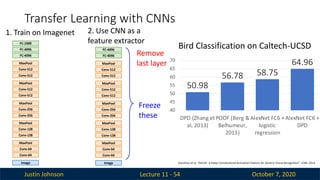
Bird Classification on Caltech-UCSD
50.98
56.78 58.75
64.96
40
45
50
55
60
65
70
DPD (Zhang et
al, 2013)
POOF (Berg &
Belhumeur,
2013)
AlexNet FC6 +
logistic
regression
AlexNet FC6 +
DPD
55.
Justin Johnson October7, 2020
Transfer Learning with CNNs
Lecture 11 - 55
Image
Conv-64
Conv-64
MaxPool
Conv-128
Conv-128
MaxPool
Conv-256
Conv-256
MaxPool
Conv-512
Conv-512
MaxPool
Conv-512
Conv-512
MaxPool
FC-4096
FC-4096
FC-1000
1. Train on Imagenet
Image
Conv-64
Conv-64
MaxPool
Conv-128
Conv-128
MaxPool
Conv-256
Conv-256
MaxPool
Conv-512
Conv-512
MaxPool
Conv-512
Conv-512
MaxPool
FC-4096
FC-4096
2. Use CNN as a
feature extractor
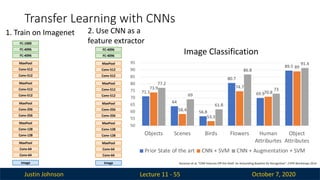
Image Classification
71.1
64
56.8
80.7
69.9
89.5
73.9
58.4
53.3
74.7
70.8
89
77.2
69
61.8
86.8
73
91.4
50
55
60
65
70
75
80
85
90
95
Objects Scenes Birds Flowers Human
Attriburtes
Object
Attributes
Prior State of the art CNN + SVM CNN + Augmentation + SVM
Razavian et al, “CNN Features Off-the-Shelf: An Astounding Baseline for Recognition”, CVPR Workshops 2014
56.
Justin Johnson October7, 2020
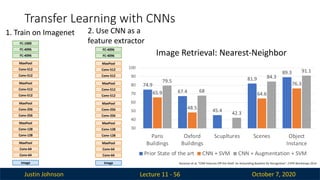
Transfer Learning with CNNs
Lecture 11 - 56
Image
Conv-64
Conv-64
MaxPool
Conv-128
Conv-128
MaxPool
Conv-256
Conv-256
MaxPool
Conv-512
Conv-512
MaxPool
Conv-512
Conv-512
MaxPool
FC-4096
FC-4096
FC-1000
1. Train on Imagenet
Image
Conv-64
Conv-64
MaxPool
Conv-128
Conv-128
MaxPool
Conv-256
Conv-256
MaxPool
Conv-512
Conv-512
MaxPool
Conv-512
Conv-512
MaxPool
FC-4096
FC-4096
2. Use CNN as a
feature extractor
Image Retrieval: Nearest-Neighbor
Razavian et al, “CNN Features Off-the-Shelf: An Astounding Baseline for Recognition”, CVPR Workshops 2014
74.9
67.4
45.4
81.9
89.3
65.9
48.5
64.6
76.3
79.5
68
42.3
84.3
91.1
30
40
50
60
70
80
90
100
Paris
Buildings
Oxford
Buildings
Scupltures Scenes Object
Instance
Prior State of the art CNN + SVM CNN + Augmentation + SVM
57.
Justin Johnson October7, 2020
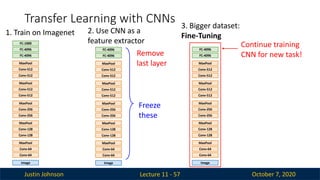
Transfer Learning with CNNs
Lecture 11 - 57
Image
Conv-64
Conv-64
MaxPool
Conv-128
Conv-128
MaxPool
Conv-256
Conv-256
MaxPool
Conv-512
Conv-512
MaxPool
Conv-512
Conv-512
MaxPool
FC-4096
FC-4096
FC-1000
1. Train on Imagenet
Image
Conv-64
Conv-64
MaxPool
Conv-128
Conv-128
MaxPool
Conv-256
Conv-256
MaxPool
Conv-512
Conv-512
MaxPool
Conv-512
Conv-512
MaxPool
FC-4096
FC-4096
Continue training
CNN for new task!
Image
Conv-64
Conv-64
MaxPool
Conv-128
Conv-128
MaxPool
Conv-256
Conv-256
MaxPool
Conv-512
Conv-512
MaxPool
Conv-512
Conv-512
MaxPool
FC-4096
FC-4096
Freeze
these
Remove
last layer
2. Use CNN as a
feature extractor
3. Bigger dataset:
Fine-Tuning
58.
Justin Johnson October7, 2020
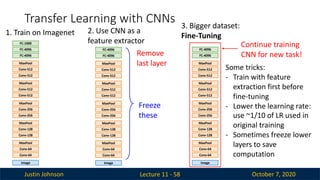
Transfer Learning with CNNs
Lecture 11 - 58
Image
Conv-64
Conv-64
MaxPool
Conv-128
Conv-128
MaxPool
Conv-256
Conv-256
MaxPool
Conv-512
Conv-512
MaxPool
Conv-512
Conv-512
MaxPool
FC-4096
FC-4096
FC-1000
1. Train on Imagenet
Image
Conv-64
Conv-64
MaxPool
Conv-128
Conv-128
MaxPool
Conv-256
Conv-256
MaxPool
Conv-512
Conv-512
MaxPool
Conv-512
Conv-512
MaxPool
FC-4096
FC-4096
Continue training
CNN for new task!
Image
Conv-64
Conv-64
MaxPool
Conv-128
Conv-128
MaxPool
Conv-256
Conv-256
MaxPool
Conv-512
Conv-512
MaxPool
Conv-512
Conv-512
MaxPool
FC-4096
FC-4096
Freeze
these
Remove
last layer
2. Use CNN as a
feature extractor
3. Bigger dataset:
Fine-Tuning
Some tricks:
- Train with feature
extraction first before
fine-tuning
- Lower the learning rate:
use ~1/10 of LR used in
original training
- Sometimes freeze lower
layers to save
computation
59.
Justin Johnson October7, 2020
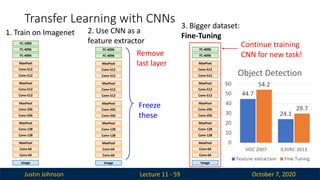
Transfer Learning with CNNs
Lecture 11 - 59
Image
Conv-64
Conv-64
MaxPool
Conv-128
Conv-128
MaxPool
Conv-256
Conv-256
MaxPool
Conv-512
Conv-512
MaxPool
Conv-512
Conv-512
MaxPool
FC-4096
FC-4096
FC-1000
1. Train on Imagenet
Image
Conv-64
Conv-64
MaxPool
Conv-128
Conv-128
MaxPool
Conv-256
Conv-256
MaxPool
Conv-512
Conv-512
MaxPool
Conv-512
Conv-512
MaxPool
FC-4096
FC-4096
3. Bigger dataset:
Fine-Tuning
Continue training
CNN for new task!
Image
Conv-64
Conv-64
MaxPool
Conv-128
Conv-128
MaxPool
Conv-256
Conv-256
MaxPool
Conv-512
Conv-512
MaxPool
Conv-512
Conv-512
MaxPool
FC-4096
FC-4096
Freeze
these
Remove
last layer
2. Use CNN as a
feature extractor
44.7
24.1
54.2
29.7
0
10
20
30
40
50
60
VOC 2007 ILSVRC 2013
Object Detection
Feature extraction Fine Tuning
60.
Justin Johnson October7, 2020
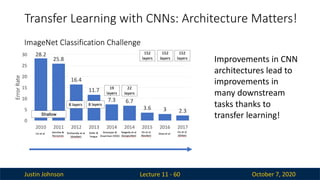
Transfer Learning with CNNs: Architecture Matters!
Lecture 11 - 60
Improvements in CNN
architectures lead to
improvements in
many downstream
tasks thanks to
transfer learning!
61.
Justin Johnson October7, 2020
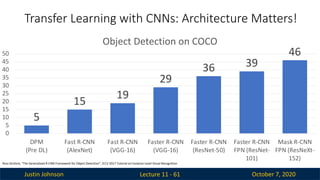
Transfer Learning with CNNs: Architecture Matters!
Lecture 11 - 61
5
15
19
29
36 39
46
0
5
10
15
20
25
30
35
40
45
50
DPM
(Pre DL)
Fast R-CNN
(AlexNet)
Fast R-CNN
(VGG-16)
Faster R-CNN
(VGG-16)
Faster R-CNN
(ResNet-50)
Faster R-CNN
FPN (ResNet-
101)
Mask R-CNN
FPN (ResNeXt-
152)
Object Detection on COCO
Ross Girshick, “The Generalized R-CNN Framework for Object Detection”, ICCV 2017 Tutorial on Instance-Level Visual Recognition
62.
Justin Johnson October7, 2020
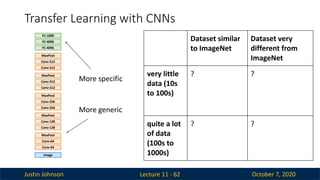
Transfer Learning with CNNs
Lecture 11 - 62
Image
Conv-64
Conv-64
MaxPool
Conv-128
Conv-128
MaxPool
Conv-256
Conv-256
MaxPool
Conv-512
Conv-512
MaxPool
Conv-512
Conv-512
MaxPool
FC-4096
FC-4096
FC-1000
More generic
More specific
Dataset similar
to ImageNet
Dataset very
different from
ImageNet
very little
data (10s
to 100s)
? ?
quite a lot
of data
(100s to
1000s)
? ?
63.
Justin Johnson October7, 2020
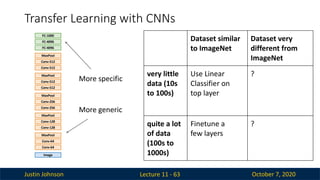
Transfer Learning with CNNs
Lecture 11 - 63
Image
Conv-64
Conv-64
MaxPool
Conv-128
Conv-128
MaxPool
Conv-256
Conv-256
MaxPool
Conv-512
Conv-512
MaxPool
Conv-512
Conv-512
MaxPool
FC-4096
FC-4096
FC-1000
More generic
More specific
Dataset similar
to ImageNet
Dataset very
different from
ImageNet
very little
data (10s
to 100s)
Use Linear
Classifier on
top layer
?
quite a lot
of data
(100s to
1000s)
Finetune a
few layers
?
64.
Justin Johnson October7, 2020
Transfer Learning with CNNs
Lecture 11 - 64
Image
Conv-64
Conv-64
MaxPool
Conv-128
Conv-128
MaxPool
Conv-256
Conv-256
MaxPool
Conv-512
Conv-512
MaxPool
Conv-512
Conv-512
MaxPool
FC-4096
FC-4096
FC-1000
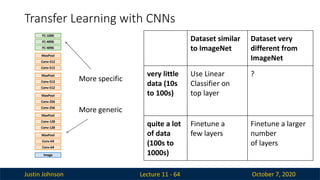
More generic
More specific
Dataset similar
to ImageNet
Dataset very
different from
ImageNet
very little
data (10s
to 100s)
Use Linear
Classifier on
top layer
?
quite a lot
of data
(100s to
1000s)
Finetune a
few layers
Finetune a larger
number
of layers
65.
Justin Johnson October7, 2020
Transfer Learning with CNNs
Lecture 11 - 65
Image
Conv-64
Conv-64
MaxPool
Conv-128
Conv-128
MaxPool
Conv-256
Conv-256
MaxPool
Conv-512
Conv-512
MaxPool
Conv-512
Conv-512
MaxPool
FC-4096
FC-4096
FC-1000
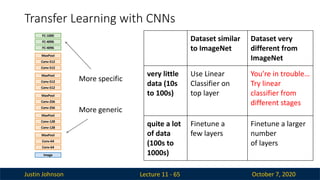
More generic
More specific
Dataset similar
to ImageNet
Dataset very
different from
ImageNet
very little
data (10s
to 100s)
Use Linear
Classifier on
top layer
You’re in trouble…
Try linear
classifier from
different stages
quite a lot
of data
(100s to
1000s)
Finetune a
few layers
Finetune a larger
number
of layers
66.
Justin Johnson October7, 2020
Lecture 11 - 66
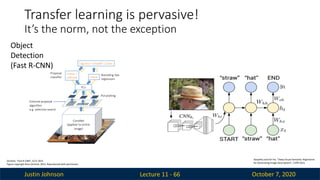
Girshick, “Fast R-CNN”, ICCV 2015
Figure copyright Ross Girshick, 2015. Reproduced with permission.
Karpathy and Fei-Fei, “Deep Visual-Semantic Alignments
for Generating Image Descriptions”, CVPR 2015
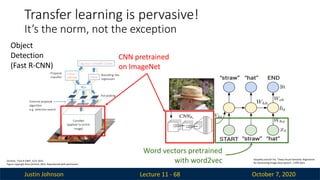
Object
Detection
(Fast R-CNN)
Transfer learning is pervasive!
It’s the norm, not the exception
67.
Justin Johnson October7, 2020
Lecture 11 - 67
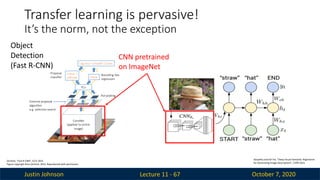
Girshick, “Fast R-CNN”, ICCV 2015
Figure copyright Ross Girshick, 2015. Reproduced with permission.
CNN pretrained
on ImageNet
Karpathy and Fei-Fei, “Deep Visual-Semantic Alignments
for Generating Image Descriptions”, CVPR 2015
Object
Detection
(Fast R-CNN)
Transfer learning is pervasive!
It’s the norm, not the exception
68.
Justin Johnson October7, 2020
Lecture 11 - 68
Girshick, “Fast R-CNN”, ICCV 2015
Figure copyright Ross Girshick, 2015. Reproduced with permission.
CNN pretrained
on ImageNet
Word vectors pretrained
with word2vec Karpathy and Fei-Fei, “Deep Visual-Semantic Alignments
for Generating Image Descriptions”, CVPR 2015
Object
Detection
(Fast R-CNN)
Transfer learning is pervasive!
It’s the norm, not the exception
69.
Justin Johnson October7, 2020
Lecture 11 - 69
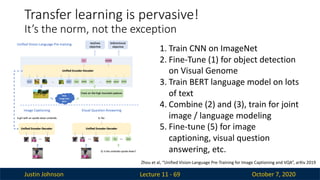
Transfer learning is pervasive!
It’s the norm, not the exception
1. Train CNN on ImageNet
2. Fine-Tune (1) for object detection
on Visual Genome
3. Train BERT language model on lots
of text
4. Combine (2) and (3), train for joint
image / language modeling
5. Fine-tune (5) for image
captioning, visual question
answering, etc.
Zhou et al, “Unified Vision-Language Pre-Training for Image Captioning and VQA”, arXiv 2019
70.
Justin Johnson October7, 2020
Lecture 11 - 70
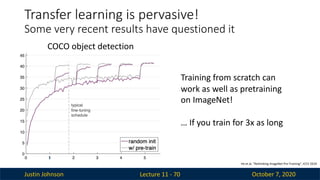
Transfer learning is pervasive!
Some very recent results have questioned it
He et al, ”Rethinking ImageNet Pre-Training”, ICCV 2019
COCO object detection
Training from scratch can
work as well as pretraining
on ImageNet!
… If you train for 3x as long
71.
Justin Johnson October7, 2020
Lecture 11 - 71
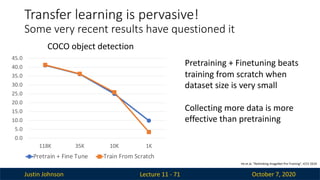
Transfer learning is pervasive!
Some very recent results have questioned it
He et al, ”Rethinking ImageNet Pre-Training”, ICCV 2019
COCO object detection
Pretraining + Finetuning beats
training from scratch when
dataset size is very small
Collecting more data is more
effective than pretraining
0.0
5.0
10.0
15.0
20.0
25.0
30.0
35.0
40.0
45.0
118K 35K 10K 1K
Pretrain + Fine Tune Train From Scratch
72.
Justin Johnson October7, 2020
Lecture 11 - 72
Transfer learning is pervasive!
Some very recent results have questioned it
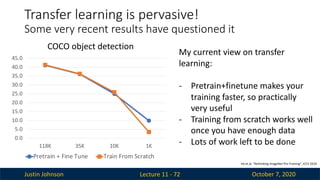
He et al, ”Rethinking ImageNet Pre-Training”, ICCV 2019
COCO object detection
My current view on transfer
learning:
- Pretrain+finetune makes your
training faster, so practically
very useful
- Training from scratch works well
once you have enough data
- Lots of work left to be done
0.0
5.0
10.0
15.0
20.0
25.0
30.0
35.0
40.0
45.0
118K 35K 10K 1K
Pretrain + Fine Tune Train From Scratch
Justin Johnson October7, 2020
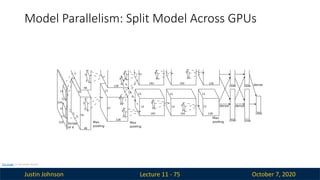
Model Parallelism: Split Model Across GPUs
Lecture 11 - 75
This image is in the public domain
76.
Justin Johnson October7, 2020
Model Parallelism: Split Model Across GPUs
Lecture 11 - 76
This image is in the public domain
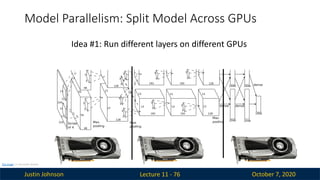
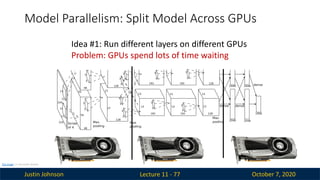
Idea #1: Run different layers on different GPUs
77.
Justin Johnson October7, 2020
Model Parallelism: Split Model Across GPUs
Lecture 11 - 77
This image is in the public domain
Idea #1: Run different layers on different GPUs
Problem: GPUs spend lots of time waiting
78.
Justin Johnson October7, 2020
Model Parallelism: Split Model Across GPUs
Lecture 11 - 78
This image is in the public domain
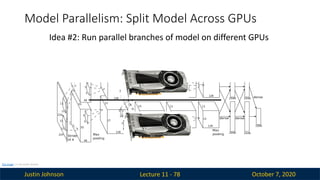
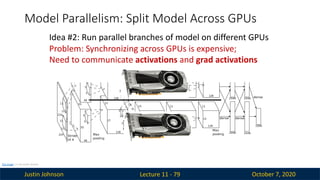
Idea #2: Run parallel branches of model on different GPUs
79.
Justin Johnson October7, 2020
Model Parallelism: Split Model Across GPUs
Lecture 11 - 79
This image is in the public domain
Idea #2: Run parallel branches of model on different GPUs
Problem: Synchronizing across GPUs is expensive;
Need to communicate activations and grad activations
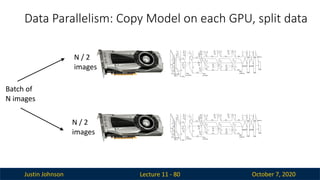
80.
Justin Johnson October7, 2020
Data Parallelism: Copy Model on each GPU, split data
Lecture 11 - 80
Batch of
N images
N / 2
images
N / 2
images
81.
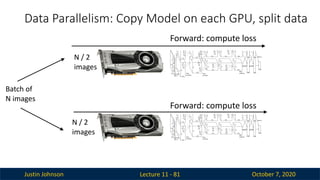
Justin Johnson October7, 2020
Data Parallelism: Copy Model on each GPU, split data
Lecture 11 - 81
Batch of
N images
N / 2
images
N / 2
images
Forward: compute loss
Forward: compute loss
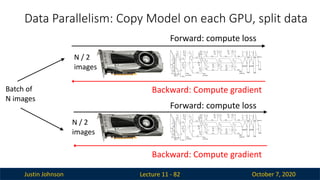
82.
Justin Johnson October7, 2020
Data Parallelism: Copy Model on each GPU, split data
Lecture 11 - 82
Batch of
N images
N / 2
images
N / 2
images
Forward: compute loss
Backward: Compute gradient
Forward: compute loss
Backward: Compute gradient
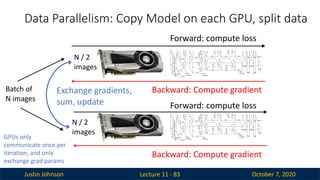
83.
Justin Johnson October7, 2020
Data Parallelism: Copy Model on each GPU, split data
Lecture 11 - 83
Batch of
N images
N / 2
images
N / 2
images
Forward: compute loss
Backward: Compute gradient
Forward: compute loss
Backward: Compute gradient
Exchange gradients,
sum, update
GPUs only
communicate once per
iteration, and only
exchange grad params
84.
Justin Johnson October7, 2020
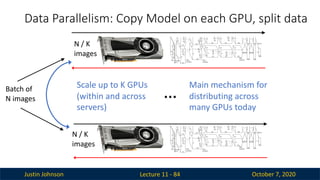
Data Parallelism: Copy Model on each GPU, split data
Lecture 11 - 84
Batch of
N images
N / K
images
N / K
images
…
Scale up to K GPUs
(within and across
servers)
Main mechanism for
distributing across
many GPUs today
85.
Justin Johnson October7, 2020
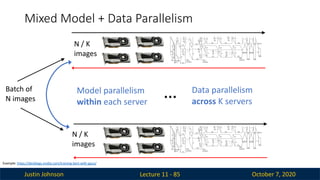
Mixed Model + Data Parallelism
Lecture 11 - 85
Batch of
N images
N / K
images
N / K
images
…
Model parallelism
within each server
Data parallelism
across K servers
Example: https://devblogs.nvidia.com/training-bert-with-gpus/
86.
Justin Johnson October7, 2020
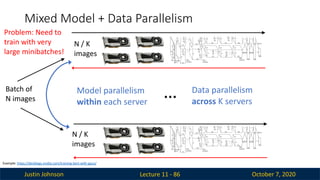
Mixed Model + Data Parallelism
Lecture 11 - 86
Batch of
N images
N / K
images
N / K
images
…
Model parallelism
within each server
Data parallelism
across K servers
Example: https://devblogs.nvidia.com/training-bert-with-gpus/
Problem: Need to
train with very
large minibatches!
Justin Johnson October7, 2020
Large-Batch Training
Lecture 11 - 88
…
Suppose we can train a
good model with one GPU
How to scale up to data-
parallel training on K GPUs?
89.
Justin Johnson October7, 2020
Large-Batch Training
Lecture 11 - 89
…
Suppose we can train a
good model with one GPU
How to scale up to data-
parallel training on K GPUs?
Goal: Train for same number of
epochs, but use larger minibatches.
We want model to train K times faster!
90.
Justin Johnson October7, 2020
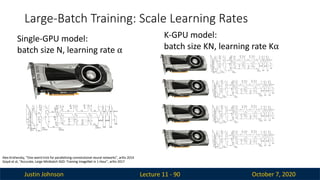
Large-Batch Training: Scale Learning Rates
Lecture 11 - 90
Single-GPU model:
batch size N, learning rate ⍺
K-GPU model:
batch size KN, learning rate K⍺
Alex Krizhevsky, “One weird trick for parallelizing convolutional neural networks”, arXiv 2014
Goyal et al, “Accurate, Large Minibatch SGD: Training ImageNet in 1 Hour”, arXiv 2017
91.
Justin Johnson October7, 2020
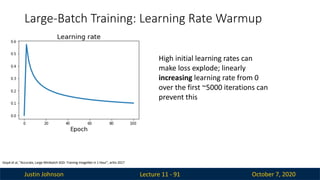
Large-Batch Training: Learning Rate Warmup
Lecture 11 - 91
Goyal et al, “Accurate, Large Minibatch SGD: Training ImageNet in 1 Hour”, arXiv 2017
High initial learning rates can
make loss explode; linearly
increasing learning rate from 0
over the first ~5000 iterations can
prevent this
92.
Justin Johnson October7, 2020
Large-Batch Training: Other Concerns
Lecture 11 - 92
Goyal et al, “Accurate, Large Minibatch SGD: Training ImageNet in 1 Hour”, arXiv 2017
Be careful with weight decay and momentum, and data shuffling
For Batch Normalization, only normalize within a GPU
93.
Justin Johnson October7, 2020
Large-Batch Training: ImageNet in One Hour!
Lecture 11 - 93
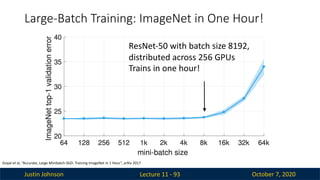
ResNet-50 with batch size 8192,
distributed across 256 GPUs
Trains in one hour!
Goyal et al, “Accurate, Large Minibatch SGD: Training ImageNet in 1 Hour”, arXiv 2017
94.
Justin Johnson October7, 2020
Large-Batch Training: ImageNet in One Hour!
Lecture 11 - 94
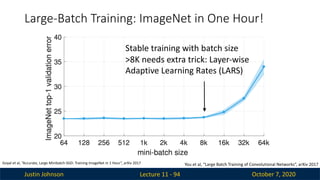
Stable training with batch size
>8K needs extra trick: Layer-wise
Adaptive Learning Rates (LARS)
Goyal et al, “Accurate, Large Minibatch SGD: Training ImageNet in 1 Hour”, arXiv 2017 You et al, “Large Batch Training of Convolutional Networks”, arXiv 2017
95.
Justin Johnson October7, 2020
Large-Batch Training
Lecture 11 - 95
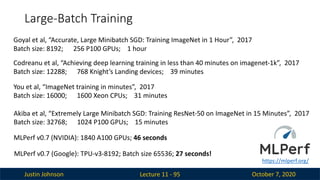
Goyal et al, “Accurate, Large Minibatch SGD: Training ImageNet in 1 Hour”, 2017
Batch size: 8192; 256 P100 GPUs; 1 hour
Codreanu et al, “Achieving deep learning training in less than 40 minutes on imagenet-1k”, 2017
Batch size: 12288; 768 Knight’s Landing devices; 39 minutes
You et al, “ImageNet training in minutes”, 2017
Batch size: 16000; 1600 Xeon CPUs; 31 minutes
Akiba et al, “Extremely Large Minibatch SGD: Training ResNet-50 on ImageNet in 15 Minutes”, 2017
Batch size: 32768; 1024 P100 GPUs; 15 minutes
MLPerf v0.7 (NVIDIA): 1840 A100 GPUs; 46 seconds
MLPerf v0.7 (Google): TPU-v3-8192; Batch size 65536; 27 seconds!
https://mlperf.org/
96.
Justin Johnson October7, 2020
Recap
Lecture 10 - 96
1.One time setup
Activation functions, data preprocessing, weight
initialization, regularization
2.Training dynamics
Learning rate schedules;
hyperparameter optimization
3.After training
Model ensembles, transfer learning,
large-batch training
Last Time
Today

![Justin Johnson October 7, 2020
Choosing Hyperparameters: Grid Search
Lecture 11 - 22
Choose several values for each hyperparameter
(Often space choices log-linearly)
Example:
Weight decay: [1x10⁻⁴, 1x10⁻³, 1x10⁻², 1x10⁻¹]
Learning rate: [1x10⁻⁴, 1x10⁻³, 1x10⁻², 1x10⁻¹]
Evaluate all possible choices on this
hyperparameter grid](https://image.slidesharecdn.com/598fa2020lecture11-250731190648-79f825d9/85/Deep-Learning-for-Computer-Vision-Training-Neural-Network-Part-2-22-320.jpg)
![Justin Johnson October 7, 2020
Choosing Hyperparameters: Random Search
Lecture 11 - 23
Choose several values for each hyperparameter
(Often space choices log-linearly)
Example:
Weight decay: log-uniform on [1x10⁻⁴, 1x10⁻¹]
Learning rate: log-uniform on [1x10⁻⁴, 1x10⁻¹]
Run many different trials](https://image.slidesharecdn.com/598fa2020lecture11-250731190648-79f825d9/85/Deep-Learning-for-Computer-Vision-Training-Neural-Network-Part-2-23-320.jpg)