Deep Learning Disruption Wave
Usman Qayyum
PhD (Robotics)
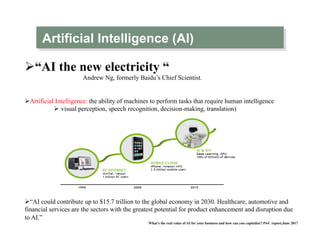
Artificial Intelligence (AI)
Ø “AI the new electricity “
Andrew Ng, formerly Baidu’s Chief Scientist.
Ø Artificial Intelligence: the ability of machines to perform tasks that require human intelligence
Ø  visual perception, speech recognition, decision-making, translation)
Ø “AI could contribute up to $15.7 trillion to the global economy in 2030. Healthcare, automotive and
financial services are the sectors with the greatest potential for product enhancement and disruption due
to AI.”
What’s the real value of AI for your business and how can you capitalize? PwC report,June 2017
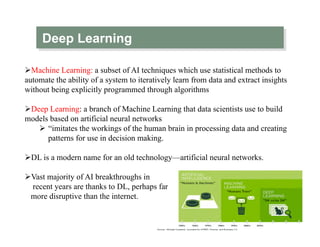
Deep Learning
Ø Machine Learning: a subset of AI techniques which use statistical methods to
automate the ability of a system to iteratively learn from data and extract insights
without being explicitly programmed through algorithms
Ø Deep Learning: a branch of Machine Learning that data scientists use to build
models based on artificial neural networks
Ø  “imitates the workings of the human brain in processing data and creating
patterns for use in decision making.
Ø DL is a modern name for an old technology—artificial neural networks.
Ø Vast majority of AI breakthroughs in
recent years are thanks to DL, perhaps far
more disruptive than the internet.
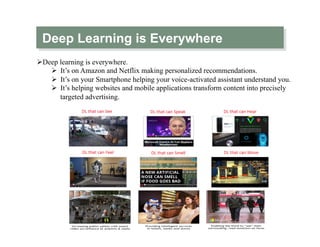
Deep Learning is Everywhere
Ø Deep learning is everywhere.
Ø  It’s on Amazon and Netflix making personalized recommendations.
Ø  It’s on your Smartphone helping your voice-activated assistant understand you.
Ø  It’s helping websites and mobile applications transform content into precisely
targeted advertising.
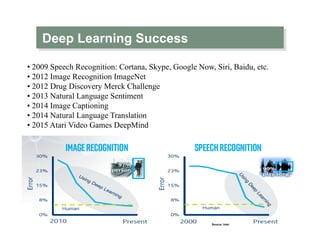
Deep Learning Success
Source: Intel
• 2009 Speech Recognition: Cortana, Skype, Google Now, Siri, Baidu, etc.
• 2012 Image Recognition ImageNet
• 2012 Drug Discovery Merck Challenge
• 2013 Natural Language Sentiment
• 2014 Image Captioning
• 2014 Natural Language Translation
• 2015 Atari Video Games DeepMind
Why Now
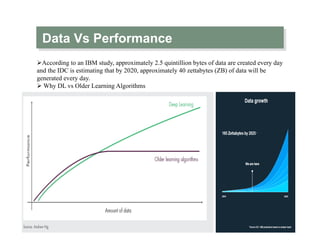
Data Vs Performance
Ø According to an IBM study, approximately 2.5 quintillion bytes of data are created every day
and the IDC is estimating that by 2020, approximately 40 zettabytes (ZB) of data will be
generated every day.
Ø Why DL vs Older Learning Algorithms
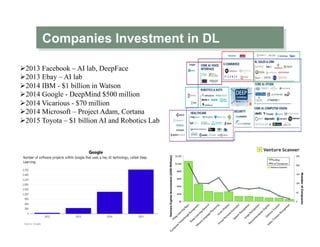
Companies Investment in DL
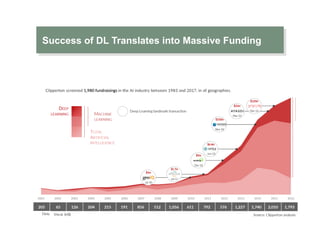
Ø 2013 Facebook – AI lab, DeepFace
Ø 2013 Ebay – AI lab
Ø 2014 IBM - $1 billion in Watson
Ø 2014 Google - DeepMind $500 million
Ø 2014 Vicarious - $70 million
Ø 2014 Microsoft – Project Adam, Cortana
Ø 2015 Toyota – $1 billion AI and Robotics Lab
Success of DL Translates into Massive Funding
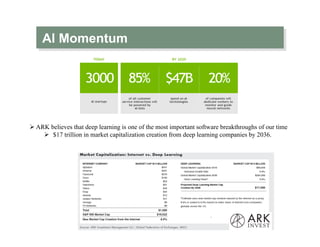
AI Momentum
Ø ARK believes that deep learning is one of the most important software breakthroughs of our time
Ø  $17 trillion in market capitalization creation from deep learning companies by 2036.
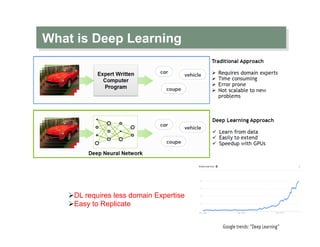
What is Deep Learning
Ø DL requires less domain Expertise
Ø Easy to Replicate
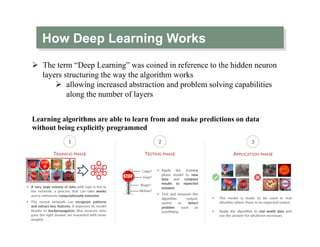
How Deep Learning Works
Ø  The term “Deep Learning” was coined in reference to the hidden neuron
layers structuring the way the algorithm works
Ø  allowing increased abstraction and problem solving capabilities
along the number of layers
Learning algorithms are able to learn from and make predictions on data
without being explicitly programmed
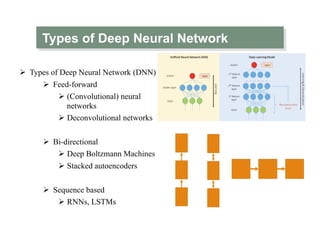
Types of Deep Neural Network
Ø  Types of Deep Neural Network (DNN)
Ø  Feed-forward
Ø (Convolutional) neural
networks
Ø Deconvolutional networks
Ø  Bi-directional
Ø Deep Boltzmann Machines
Ø Stacked autoencoders
Ø  Sequence based
Ø RNNs, LSTMs
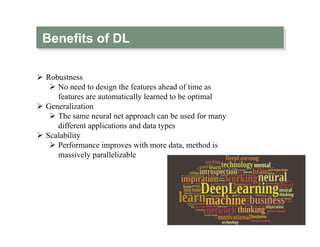
Benefits of DL
Ø  Robustness
Ø  No need to design the features ahead of time as
features are automatically learned to be optimal
Ø  Generalization
Ø  The same neural net approach can be used for many
different applications and data types
Ø  Scalability
Ø  Performance improves with more data, method is
massively parallelizable
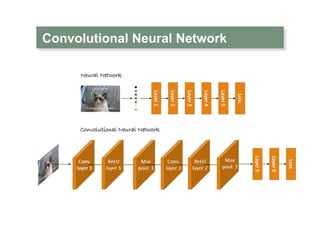
Convolutional Neural Network
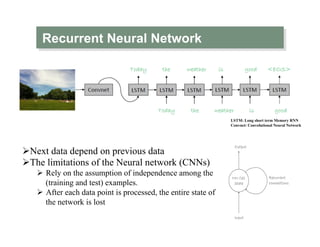
Recurrent Neural Network
Ø Next data depend on previous data
Ø The limitations of the Neural network (CNNs)
Ø  Rely on the assumption of independence among the
(training and test) examples.
Ø  After each data point is processed, the entire state of
the network is lost
LSTM: Long short term Memory RNN
Convnet: Convolutional Neural Network
Application Areas
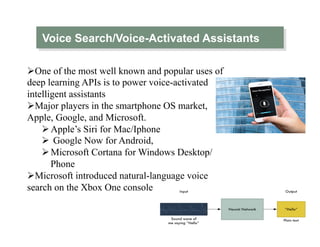
Voice Search/Voice-Activated Assistants
Ø One of the most well known and popular uses of
deep learning APIs is to power voice-activated
intelligent assistants
Ø Major players in the smartphone OS market,
Apple, Google, and Microsoft.
Ø Apple’s Siri for Mac/Iphone
Ø  Google Now for Android,
Ø Microsoft Cortana for Windows Desktop/
Phone
Ø Microsoft introduced natural-language voice
search on the Xbox One console
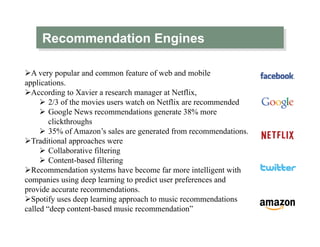
Recommendation Engines
Ø A very popular and common feature of web and mobile
applications.
Ø According to Xavier a research manager at Netflix,
Ø  2/3 of the movies users watch on Netflix are recommended
Ø  Google News recommendations generate 38% more
clickthroughs
Ø  35% of Amazon’s sales are generated from recommendations.
Ø Traditional approaches were
Ø  Collaborative filtering
Ø  Content-based filtering
Ø Recommendation systems have become far more intelligent with
companies using deep learning to predict user preferences and
provide accurate recommendations.
Ø Spotify uses deep learning approach to music recommendations
called “deep content-based music recommendation”
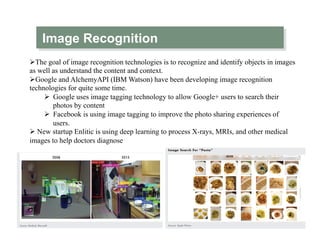
Image Recognition
Ø The goal of image recognition technologies is to recognize and identify objects in images
as well as understand the content and context.
Ø Google and AlchemyAPI (IBM Watson) have been developing image recognition
technologies for quite some time.
Ø  Google uses image tagging technology to allow Google+ users to search their
photos by content
Ø  Facebook is using image tagging to improve the photo sharing experiences of
users.
Ø New startup Enlitic is using deep learning to process X-rays, MRIs, and other medical
images to help doctors diagnose
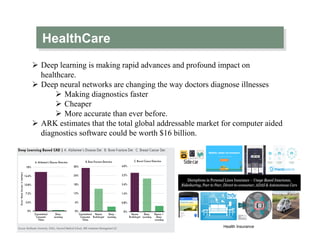
HealthCare
Ø  Deep learning is making rapid advances and profound impact on
healthcare.
Ø  Deep neural networks are changing the way doctors diagnose illnesses
Ø  Making diagnostics faster
Ø  Cheaper
Ø  More accurate than ever before.
Ø  ARK estimates that the total global addressable market for computer aided
diagnostics software could be worth $16 billion.
Health Insurance
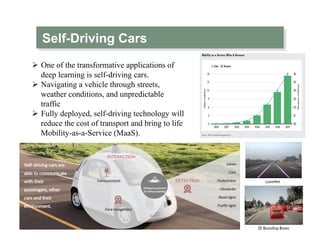
Self-Driving Cars
Ø  One of the transformative applications of
deep learning is self-driving cars.
Ø  Navigating a vehicle through streets,
weather conditions, and unpredictable
traffic
Ø  Fully deployed, self-driving technology will
reduce the cost of transport and bring to life
Mobility-as-a-Service (MaaS).
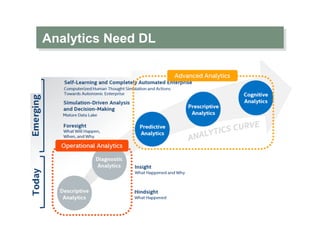
Analytics Need DL
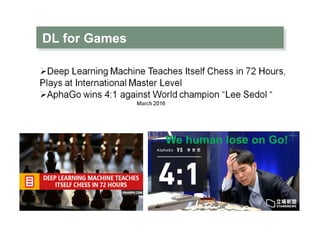
DL for Games
We human lose on Go!
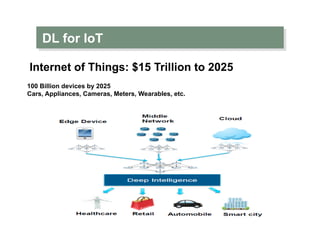
DL for IoT
Internet of Things: $15 Trillion to 2025
100 Billion devices by 2025
Cars, Appliances, Cameras, Meters, Wearables, etc.
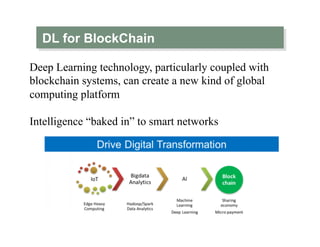
DL for BlockChain
Deep Learning technology, particularly coupled with
blockchain systems, can create a new kind of global
computing platform
Intelligence “baked in” to smart networks
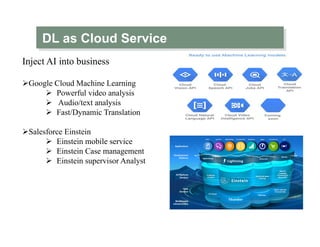
DL as Cloud Service
Inject AI into business
Ø Google Cloud Machine Learning
Ø  Powerful video analysis
Ø  Audio/text analysis
Ø  Fast/Dynamic Translation
Ø Salesforce Einstein
Ø  Einstein mobile service
Ø  Einstein Case management
Ø  Einstein supervisor Analyst
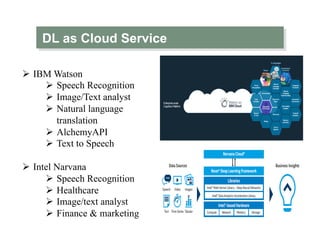
DL as Cloud Service
Ø  IBM Watson
Ø  Speech Recognition
Ø  Image/Text analyst
Ø  Natural language
translation
Ø  AlchemyAPI
Ø  Text to Speech
Ø  Intel Narvana
Ø  Speech Recognition
Ø  Healthcare
Ø  Image/text analyst
Ø  Finance & marketing
Deep Learning disruption

Deep Learning disruption

  • 1.
    Deep Learning DisruptionWave Usman Qayyum PhD (Robotics)
  • 2.
    Artificial Intelligence (AI) Ø “AIthe new electricity “ Andrew Ng, formerly Baidu’s Chief Scientist. Ø Artificial Intelligence: the ability of machines to perform tasks that require human intelligence Ø  visual perception, speech recognition, decision-making, translation) Ø “AI could contribute up to $15.7 trillion to the global economy in 2030. Healthcare, automotive and financial services are the sectors with the greatest potential for product enhancement and disruption due to AI.” What’s the real value of AI for your business and how can you capitalize? PwC report,June 2017
  • 3.
    Deep Learning Ø Machine Learning:a subset of AI techniques which use statistical methods to automate the ability of a system to iteratively learn from data and extract insights without being explicitly programmed through algorithms Ø Deep Learning: a branch of Machine Learning that data scientists use to build models based on artificial neural networks Ø  “imitates the workings of the human brain in processing data and creating patterns for use in decision making. Ø DL is a modern name for an old technology—artificial neural networks. Ø Vast majority of AI breakthroughs in recent years are thanks to DL, perhaps far more disruptive than the internet.
  • 4.
    Deep Learning isEverywhere Ø Deep learning is everywhere. Ø  It’s on Amazon and Netflix making personalized recommendations. Ø  It’s on your Smartphone helping your voice-activated assistant understand you. Ø  It’s helping websites and mobile applications transform content into precisely targeted advertising.
  • 5.
    Deep Learning Success Source:Intel • 2009 Speech Recognition: Cortana, Skype, Google Now, Siri, Baidu, etc. • 2012 Image Recognition ImageNet • 2012 Drug Discovery Merck Challenge • 2013 Natural Language Sentiment • 2014 Image Captioning • 2014 Natural Language Translation • 2015 Atari Video Games DeepMind
  • 6.
  • 7.
    Data Vs Performance Ø Accordingto an IBM study, approximately 2.5 quintillion bytes of data are created every day and the IDC is estimating that by 2020, approximately 40 zettabytes (ZB) of data will be generated every day. Ø Why DL vs Older Learning Algorithms
  • 8.
    Companies Investment inDL Ø 2013 Facebook – AI lab, DeepFace Ø 2013 Ebay – AI lab Ø 2014 IBM - $1 billion in Watson Ø 2014 Google - DeepMind $500 million Ø 2014 Vicarious - $70 million Ø 2014 Microsoft – Project Adam, Cortana Ø 2015 Toyota – $1 billion AI and Robotics Lab
  • 9.
    Success of DLTranslates into Massive Funding
  • 10.
    AI Momentum Ø ARK believesthat deep learning is one of the most important software breakthroughs of our time Ø  $17 trillion in market capitalization creation from deep learning companies by 2036.
  • 11.
    What is DeepLearning Ø DL requires less domain Expertise Ø Easy to Replicate
  • 12.
    How Deep LearningWorks Ø  The term “Deep Learning” was coined in reference to the hidden neuron layers structuring the way the algorithm works Ø  allowing increased abstraction and problem solving capabilities along the number of layers Learning algorithms are able to learn from and make predictions on data without being explicitly programmed
  • 13.
    Types of DeepNeural Network Ø  Types of Deep Neural Network (DNN) Ø  Feed-forward Ø (Convolutional) neural networks Ø Deconvolutional networks Ø  Bi-directional Ø Deep Boltzmann Machines Ø Stacked autoencoders Ø  Sequence based Ø RNNs, LSTMs
  • 14.
    Benefits of DL Ø Robustness Ø  No need to design the features ahead of time as features are automatically learned to be optimal Ø  Generalization Ø  The same neural net approach can be used for many different applications and data types Ø  Scalability Ø  Performance improves with more data, method is massively parallelizable
  • 15.
  • 16.
    Recurrent Neural Network Ø Nextdata depend on previous data Ø The limitations of the Neural network (CNNs) Ø  Rely on the assumption of independence among the (training and test) examples. Ø  After each data point is processed, the entire state of the network is lost LSTM: Long short term Memory RNN Convnet: Convolutional Neural Network
  • 17.
  • 18.
    Voice Search/Voice-Activated Assistants Ø Oneof the most well known and popular uses of deep learning APIs is to power voice-activated intelligent assistants Ø Major players in the smartphone OS market, Apple, Google, and Microsoft. Ø Apple’s Siri for Mac/Iphone Ø  Google Now for Android, Ø Microsoft Cortana for Windows Desktop/ Phone Ø Microsoft introduced natural-language voice search on the Xbox One console
  • 19.
    Recommendation Engines Ø A verypopular and common feature of web and mobile applications. Ø According to Xavier a research manager at Netflix, Ø  2/3 of the movies users watch on Netflix are recommended Ø  Google News recommendations generate 38% more clickthroughs Ø  35% of Amazon’s sales are generated from recommendations. Ø Traditional approaches were Ø  Collaborative filtering Ø  Content-based filtering Ø Recommendation systems have become far more intelligent with companies using deep learning to predict user preferences and provide accurate recommendations. Ø Spotify uses deep learning approach to music recommendations called “deep content-based music recommendation”
  • 20.
    Image Recognition Ø The goalof image recognition technologies is to recognize and identify objects in images as well as understand the content and context. Ø Google and AlchemyAPI (IBM Watson) have been developing image recognition technologies for quite some time. Ø  Google uses image tagging technology to allow Google+ users to search their photos by content Ø  Facebook is using image tagging to improve the photo sharing experiences of users. Ø New startup Enlitic is using deep learning to process X-rays, MRIs, and other medical images to help doctors diagnose
  • 21.
    HealthCare Ø  Deep learningis making rapid advances and profound impact on healthcare. Ø  Deep neural networks are changing the way doctors diagnose illnesses Ø  Making diagnostics faster Ø  Cheaper Ø  More accurate than ever before. Ø  ARK estimates that the total global addressable market for computer aided diagnostics software could be worth $16 billion. Health Insurance
  • 22.
    Self-Driving Cars Ø  Oneof the transformative applications of deep learning is self-driving cars. Ø  Navigating a vehicle through streets, weather conditions, and unpredictable traffic Ø  Fully deployed, self-driving technology will reduce the cost of transport and bring to life Mobility-as-a-Service (MaaS).
  • 23.
  • 24.
    DL for Games Wehuman lose on Go!
  • 25.
    DL for IoT Internetof Things: $15 Trillion to 2025 100 Billion devices by 2025 Cars, Appliances, Cameras, Meters, Wearables, etc.
  • 26.
    DL for BlockChain DeepLearning technology, particularly coupled with blockchain systems, can create a new kind of global computing platform Intelligence “baked in” to smart networks
  • 27.
    DL as CloudService Inject AI into business Ø Google Cloud Machine Learning Ø  Powerful video analysis Ø  Audio/text analysis Ø  Fast/Dynamic Translation Ø Salesforce Einstein Ø  Einstein mobile service Ø  Einstein Case management Ø  Einstein supervisor Analyst
  • 28.
    DL as CloudService Ø  IBM Watson Ø  Speech Recognition Ø  Image/Text analyst Ø  Natural language translation Ø  AlchemyAPI Ø  Text to Speech Ø  Intel Narvana Ø  Speech Recognition Ø  Healthcare Ø  Image/text analyst Ø  Finance & marketing