

Demystifying artificial 
intelligence 
What business leaders need to 
know about cognitive technologies 
A Deloitte series on cognitive technologies
Deloitte Consulting LLP’s Enterprise Science offering employs data science, 
cognitive technologies such as machine learning, and advanced algorithms to 
create high-value solutions for clients. Services include cognitive automation, 
which uses cognitive technologies such as natural language processing to 
automate knowledge-intensive processes; cognitive engagement, which applies 
machine learning and advanced analytics to make customer interactions 
dramatically more personalized, relevant, and profitable; and cognitive insight, 
which employs data science and machine learning to detect critical patterns, make 
high-quality predictions, and support business performance. For more information 
about the Enterprise Science offering, contact Plamen Petrov (ppetrov@deloitte. 
com) or Rajeev Ronanki (rronanki@deloitte.com).
Contents 
Overview | 2 
Artificial intelligence and cognitive technologies | 3 
Cognitive technologies are already in wide use | 8 
Why the impact of cognitive technologies is growing | 10 
How can your organization apply cognitive technologies? | 13 
Endnotes | 14 
What business leaders need to know about cognitive technologies 
1
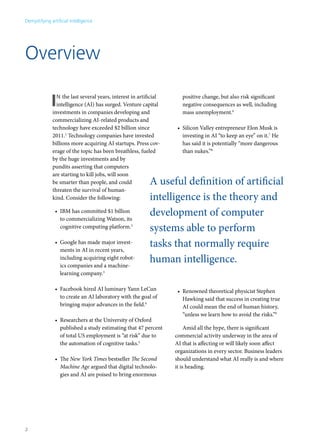
IN the last several years, interest in artificial 
intelligence (AI) has surged. Venture capital 
investments in companies developing and 
commercializing AI-related products and 
technology have exceeded $2 billion since 
2011.1 Technology companies have invested 
billions more acquiring AI startups. Press cov-erage 
of the topic has been breathless, fueled 
by the huge investments and by 
pundits asserting that computers 
are starting to kill jobs, will soon 
be smarter than people, and could 
threaten the survival of human-kind. 
Consider the following: 
• IBM has committed $1 billion 
to commercializing Watson, its 
cognitive computing platform.2 
• Google has made major invest-ments 
in AI in recent years, 
including acquiring eight robot-ics 
companies and a machine-learning 
company.3 
• Facebook hired AI luminary Yann LeCun 
to create an AI laboratory with the goal of 
bringing major advances in the field.4 
• Researchers at the University of Oxford 
published a study estimating that 47 percent 
of total US employment is “at risk” due to 
the automation of cognitive tasks.5 
• The New York Times bestseller The Second 
Machine Age argued that digital technolo-gies 
and AI are poised to bring enormous 
positive change, but also risk significant 
negative consequences as well, including 
mass unemployment.6 
• Silicon Valley entrepreneur Elon Musk is 
investing in AI “to keep an eye” on it.7 He 
has said it is potentially “more dangerous 
than nukes.”8 
• Renowned theoretical physicist Stephen 
Hawking said that success in creating true 
AI could mean the end of human history, 
“unless we learn how to avoid the risks.”9 
Amid all the hype, there is significant 
commercial activity underway in the area of 
AI that is affecting or will likely soon affect 
organizations in every sector. Business leaders 
should understand what AI really is and where 
it is heading. 
Overview 
A useful definition of artificial 
intelligence is the theory and 
development of computer 
systems able to perform 
tasks that normally require 
human intelligence. 
Demystifying artificial intelligence 
2
What business leaders need to know about cognitive technologies 
Artificial intelligence and 
cognitive technologies 
THE first steps in demystifying AI are 
defining the term, outlining its history, 
and describing some of the core technologies 
underlying it. 
Defining artificial intelligence10 
The field of AI suffers from both too few 
and too many definitions. Nils Nilsson, one of 
the founding researchers in the field, has writ-ten 
that AI “may lack an agreed-upon defini-tion. 
. . .”11 A well-respected AI textbook, now 
in its third edition, offers eight definitions, and 
declines to prefer one over the other.12 For us, a 
useful definition of AI is the theory and devel-opment 
of computer systems able to perform 
tasks that normally require human intelligence. 
Examples include tasks such as visual percep-tion, 
speech recognition, decision making 
under uncertainty, learning, and translation 
between languages.13 Defining AI in terms of 
the tasks humans do, rather than how humans 
think, allows us to discuss its practical appli-cations 
today, well before science 
arrives at a definitive understand-ing 
of the neurological mechanisms 
of intelligence.14 It is worth noting 
that the set of tasks that normally 
require human intelligence is subject 
to change as computer systems able 
to perform those tasks are invented 
and then widely diffused. Thus, the 
meaning of “AI” evolves over time, 
a phenomenon known as the “AI 
effect,” concisely stated as “AI is 
whatever hasn’t been done yet.”15 
The history of artificial 
intelligence 
AI is not a new idea. Indeed, the term itself 
dates from the 1950s. The history of the field is 
marked by “periods of hype and high expecta-tions 
alternating with periods of setback and 
disappointment,” as a recent apt summation 
puts it.16 After articulating the bold goal of 
simulating human intelligence in the 1950s, 
researchers developed a range of demonstra-tion 
programs through the 1960s and into the 
‘70s that showed computers able to accom-plish 
a number of tasks once thought to be 
solely the domain of human endeavor, such as 
proving theorems, solving calculus problems, 
responding to commands by planning and 
performing physical actions—even imperson-ating 
a psychotherapist and composing music. 
But simplistic algorithms, poor methods for 
handling uncertainty (a surprisingly ubiqui-tous 
fact of life), and limitations on computing 
power stymied attempts to tackle harder or 
3
more diverse problems. Amid disappointment 
with a lack of continued progress, AI fell out of 
fashion by the mid-1970s. 
In the early 1980s, Japan launched a 
program to develop an advanced computer 
architecture that could advance the field of AI. 
Western anxiety about losing ground to Japan 
contributed to decisions to invest anew in AI. 
The 1980s saw the launch of commercial ven-dors 
of AI technology products, some of which 
had initial public offerings, such as Intellicorp, 
Symbolics,17 and Teknowledge.18 By the end of 
the 1980s, perhaps half of the Fortune 500 were 
developing or maintaining “expert systems,” 
an AI technology that models human exper-tise 
with a knowledge base of facts and rules.19 
High hopes for the potential of expert systems 
were eventually tempered as their limitations, 
including a glaring lack of common sense, the 
difficulty of capturing experts’ tacit knowledge, 
and the cost and complexity of building and 
maintaining large systems, became widely 
recognized. AI ran out of steam again. 
In the 1990s, technical work on AI con-tinued 
with a lower profile. Techniques such 
as neural networks and genetic algorithms 
received fresh attention, in part because they 
avoided some of the limitations of expert 
systems and partly because new algorithms 
made them more effective. The design of 
neural networks is inspired by the structure of 
the brain. Genetic algorithms aim to “evolve” 
solutions to problems by iteratively generating 
candidate solutions, culling the weakest, and 
introducing new solution variants by introduc-ing 
random mutations. 
Catalysts of progress 
By the late 2000s, a number of factors 
helped renew progress in AI, particularly in 
a few key technologies. We explain the fac-tors 
most responsible for the recent progress 
below and then describe those technologies in 
more detail. 
Moore’s Law. The relentless increase in 
computing power available at a given price and 
size, sometimes known as Moore’s Law after 
Intel cofounder Gordon Moore, has benefited 
all forms of computing, including the types AI 
researchers use. Advanced system designs that 
might have worked in principle were in prac-tice 
off limits just a few years ago because they 
required computer power that was cost-pro-hibitive 
or just didn’t exist. Today, the power 
necessary to implement these designs is readily 
available. A dramatic illustration: The current 
generation of microprocessors delivers 4 mil-lion 
times the performance of the first single-chip 
microprocessor introduced in 1971.20 
Big data. Thanks in part to the Internet, 
social media, mobile devices, and low-cost 
sensors, the volume of data in the world is 
increasing rapidly.21 Growing understanding of 
the potential value of this data22 has led to the 
development of new techniques for manag-ing 
and analyzing very large data sets.23 Big 
data has been a boon to the development of 
AI. The reason is that some AI techniques use 
statistical models for reasoning probabilisti-cally 
about data such as images, text, or speech. 
These models can be improved, or “trained,” by 
exposing them to large sets of data, which are 
now more readily available than ever.24 
The Internet and the cloud. Closely related 
to the big data phenomenon, the Internet 
and cloud computing can be credited with 
advances in AI for two reasons. First, they 
make available vast amounts of data and infor-mation 
to any Internet-connected comput-ing 
device. This has helped propel work on 
AI approaches that require large data sets.25 
Second, they have provided a way for humans 
to collaborate—sometimes explicitly and at 
other times implicitly—in helping to train AI 
systems. For example, some researchers have 
used cloud-based crowdsourcing services 
like Mechanical Turk to enlist thousands of 
humans to describe digital images, enabling 
image classification algorithms to learn from 
these descriptions.26 Google’s language transla-tion 
project analyzes feedback and freely offers 
contributions from its users to improve the 
quality of automated translation.27 
New algorithms. An algorithm is a routine 
process for solving a program or performing a 
Demystifying artificial intelligence 
4
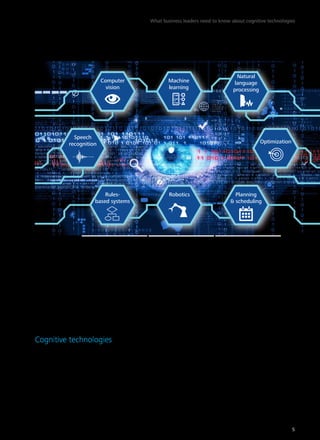
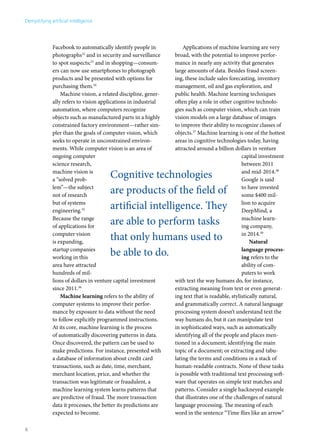
Figure 1. The field of artificial intelligence has produced a number of cognitive technologies 
Speech 
recognition 
task. In recent years, new algorithms have been 
developed that dramatically improve the per-formance 
of machine learning, an important 
technology in its own right and an enabler of 
other technologies such as computer vision.28 
(These technologies are described below.) The 
fact that machine learning algorithms are now 
available on an open-source basis is likely to 
foster further improvements as developers con-tribute 
enhancements to each other’s work.29 
Cognitive technologies 
We distinguish between the field of AI and 
the technologies that emanate from the field. 
The popular press portrays AI as the advent 
of computers as smart as—or smarter than— 
humans. The individual technologies, by con-trast, 
are getting better at performing specific 
tasks that only humans used to be able to do. 
We call these cognitive technologies (figure 1), 
and it is these that business and public sector 
leaders should focus their attention on. Below 
we describe some of the most important cogni-tive 
technologies—those that are seeing wide 
adoption, making rapid progress, or receiving 
significant investment. 
Computer vision refers to the ability of 
computers to identify objects, scenes, and 
activities in images. Computer vision technol-ogy 
uses sequences of imaging-processing 
operations and other techniques to decompose 
the task of analyzing images into manageable 
pieces. There are techniques for detecting the 
edges and textures of objects in an image, for 
instance. Classification techniques may be used 
to determine if the features identified in an 
image are likely to represent a kind of object 
already known to the system.30 
Computer vision has diverse applica-tions, 
including analyzing medical imaging 
to improve prediction, diagnosis, and treat-ment 
of diseases;31 face recognition, used by 
Computer 
vision 
Machine 
learning 
Natural 
language 
processing 
Optimization 
Planning 
& scheduling 
Rules- Robotics 
based systems 
Graphic: Deloitte University Press | DUPress.com 
What business leaders need to know about cognitive technologies 
5
Facebook to automatically identify people in 
photographs32 and in security and surveillance 
to spot suspects;33 and in shopping—consum-ers 
can now use smartphones to photograph 
products and be presented with options for 
purchasing them.34 
Machine vision, a related discipline, gener-ally 
refers to vision applications in industrial 
automation, where computers recognize 
objects such as manufactured parts in a highly 
constrained factory environment—rather sim-pler 
than the goals of computer vision, which 
seeks to operate in unconstrained environ-ments. 
While computer vision is an area of 
ongoing computer 
science research, 
machine vision is 
a “solved prob-lem”— 
the subject 
not of research 
but of systems 
engineering.35 
Because the range 
of applications for 
computer vision 
is expanding, 
startup companies 
working in this 
area have attracted 
hundreds of mil-lions 
Cognitive technologies 
are products of the field of 
artificial intelligence. They 
are able to perform tasks 
that only humans used to 
be able to do. 
of dollars in venture capital investment 
since 2011.36 
Machine learning refers to the ability of 
computer systems to improve their perfor-mance 
by exposure to data without the need 
to follow explicitly programmed instructions. 
At its core, machine learning is the process 
of automatically discovering patterns in data. 
Once discovered, the pattern can be used to 
make predictions. For instance, presented with 
a database of information about credit card 
transactions, such as date, time, merchant, 
merchant location, price, and whether the 
transaction was legitimate or fraudulent, a 
machine learning system learns patterns that 
are predictive of fraud. The more transaction 
data it processes, the better its predictions are 
expected to become. 
Applications of machine learning are very 
broad, with the potential to improve perfor-mance 
in nearly any activity that generates 
large amounts of data. Besides fraud screen-ing, 
these include sales forecasting, inventory 
management, oil and gas exploration, and 
public health. Machine learning techniques 
often play a role in other cognitive technolo-gies 
such as computer vision, which can train 
vision models on a large database of images 
to improve their ability to recognize classes of 
objects.37 Machine learning is one of the hottest 
areas in cognitive technologies today, having 
attracted around a billion dollars in venture 
capital investment 
between 2011 
and mid-2014.38 
Google is said 
to have invested 
some $400 mil-lion 
to acquire 
DeepMind, a 
machine learn-ing 
company, 
in 2014.39 
Natural 
language process-ing 
refers to the 
ability of com-puters 
to work 
with text the way humans do, for instance, 
extracting meaning from text or even generat-ing 
text that is readable, stylistically natural, 
and grammatically correct. A natural language 
processing system doesn’t understand text the 
way humans do, but it can manipulate text 
in sophisticated ways, such as automatically 
identifying all of the people and places men-tioned 
in a document; identifying the main 
topic of a document; or extracting and tabu-lating 
the terms and conditions in a stack of 
human-readable contracts. None of these tasks 
is possible with traditional text processing soft-ware 
that operates on simple text matches and 
patterns. Consider a single hackneyed example 
that illustrates one of the challenges of natural 
language processing. The meaning of each 
word in the sentence “Time flies like an arrow” 
Demystifying artificial intelligence 
6
seems clear, until you encounter the sentence 
“Fruit flies like a banana.” Substituting “fruit” 
for “time” and “banana” for “arrow” changes 
the meaning of the words “flies” and “like.”40 
Natural language processing, like computer 
vision, comprises multiple techniques that may 
be used together to achieve its goals. Language 
models are used to predict the probability 
distribution of language expressions—the 
likelihood that a given string of characters or 
words is a valid part of a language, for instance. 
Feature selection may be used to identify the 
elements of a piece of text that may distinguish 
one kind of text from another—say a spam 
email versus a legitimate one. Classification, 
powered by machine learning, would then 
operate on the extracted features to classify a 
message as spam or not.41 
Because context is so important for under-standing 
why “time flies” and “fruit flies” are 
so different, practical applications of natural 
language processing often address relative 
narrow domains such as analyzing customer 
feedback about a particular product or ser-vice, 
42 automating discovery in civil litigation 
or government investigations (e-discovery),43 
and automating writing of formulaic stories on 
topics such as corporate earnings or sports.44 
Robotics, by integrating cognitive technol-ogies 
such as computer vision and automated 
planning with tiny, high-performance sensors, 
actuators, and cleverly designed hardware, 
has given rise to a new generation of robots 
that can work alongside people and flexibly 
perform many different tasks in unpredictable 
environments.45 Examples include unmanned 
aerial vehicles,46 “cobots” that share jobs with 
humans on the factory floor,47 robotic vacuum 
What business leaders need to know about cognitive technologies 
cleaners,48 and a slew of consumer products, 
from toys to home helpers.49 
Speech recognition focuses on auto-matically 
and accurately transcribing human 
speech. The technology has to contend with 
some of the same challenges as natural lan-guage 
processing, in addition to the difficulties 
of coping with diverse accents, background 
noise, distinguishing between homophones 
(“buy” and “by” sound the same), and the 
need to work at the speed of natural speech. 
Speech recognition systems use some of the 
same techniques as natural language pro-cessing 
systems, plus others such as acoustic 
models that describe sounds and their prob-ability 
of occurring in a given sequence in a 
given language.50 Applications include medical 
dictation, hands-free writing, voice control of 
computer systems, and telephone customer 
service applications. Domino’s Pizza recently 
introduced a mobile app that allows customers 
to use natural speech to order, for instance.51 
As noted, the cognitive technologies above 
are making rapid progress and attracting 
significant investment. Other cognitive tech-nologies 
are relatively mature and can still be 
important components of enterprise software 
systems. These more mature cognitive tech-nologies 
include optimization, which auto-mates 
complex decisions and trade-offs about 
limited resources;52 planning and scheduling, 
which entails devising a sequence of actions 
to meet goals and observe constraints;53 and 
rules-based systems, the technology underly-ing 
expert systems, which use databases of 
knowledge and rules to automate the process 
of making inferences about information.54 
7
Cognitive technologies 
are already in wide use 
ORGANIZATIONS in every sector of the 
economy are already using cognitive tech-nologies 
in diverse business functions. 
In banking, automated fraud detection sys-tems 
use machine learning to identify behavior 
patterns that could indicate fraudulent pay-ment 
activity, speech recognition technology to 
automate customer service telephone interac-tions, 
and voice recognition technology to 
verify the identity of callers.55 
In health care, automatic speech recogni-tion 
for transcribing notes dictated by physi-cians 
is used in around half of US hospitals, 
and its use is growing rapidly.56 Computer 
vision systems automate the analysis of mam-mograms 
and other medical images.57 IBM’s 
Watson uses natural language processing to 
read and understand a vast medical literature, 
hypothesis generation techniques to automate 
diagnosis, and machine learning to improve 
its accuracy.58 
In life sciences, machine learning systems 
are being used to predict cause-and-effect 
relationships from biological data59 and the 
activities of compounds,60 helping pharmaceu-tical 
companies identify promising drugs.61 
In media and entertainment, a number of 
companies are using data analytics and natural 
language generation technology to automati-cally 
draft articles and other narrative material 
about data-focused topics such as corporate 
earnings or sports game summaries.62 
Oil and gas producers use machine 
learning in a wide range of applica-tions, 
from locating mineral deposits63 
to diagnosing mechanical problems with 
drilling equipment.64 
The public sector is adopting cogni-tive 
technologies for a variety of purposes 
including surveillance, compliance and 
fraud detection, and automation. The state 
of Georgia, for instance, employs a system 
combining automated handwriting recogni-tion 
with crowdsourced human assistance to 
digitize financial disclosure and campaign 
contribution forms.65 
Retailers use machine learning to automat-ically 
discover attractive cross-sell offers and 
effective promotions.66 
Technology companies are using cogni-tive 
technologies such as computer vision and 
machine learning to enhance products or cre-ate 
entirely new product categories, such as the 
Roomba robotic vacuum cleaner67 or the Nest 
intelligent thermostat.68 
As the examples above show, the poten-tial 
business benefits of cognitive technolo-gies 
are much broader than cost savings that 
may be implied by the term “automation.” 
They include: 
• Faster actions and decisions (for example, 
automated fraud detection, planning and 
scheduling) 
• Better outcomes (for example, medi-cal 
diagnosis, oil exploration, demand 
forecasting) 
• Greater efficiency (that is, better use 
of high-skilled people or expensive 
equipment) 
• Lower costs (for example, reducing labor 
costs with automated telephone customer 
service) 
• Greater scale (that is, performing large-scale 
tasks impractical to perform 
manually) 
• Product and service innovation (from add-ing 
new features to creating entirely new 
products) 
Demystifying artificial intelligence 
8
What business leaders need to know about cognitive technologies 
9
Demystifying artificial intelligence 
Why the impact of cognitive 
technologies is growing 
THE impact of cognitive technologies on 
business should grow significantly over 
the next five years. This is due to two factors. 
First, the performance of these technologies 
has improved substantially in recent years, 
and we can expect continuing R&D efforts to 
extend this progress. Second, billions of dol-lars 
have been invested to commercialize these 
technologies. Many companies are working to 
tailor and package cognitive technologies for a 
range of sectors and business functions, mak-ing 
them easier to buy and deploy. While not 
all of these vendors will thrive, their activities 
should collectively drive the market forward. 
Together, improvements in performance and 
commercialization are expanding the range of 
applications for cognitive technologies and will 
likely continue to do so over the next several 
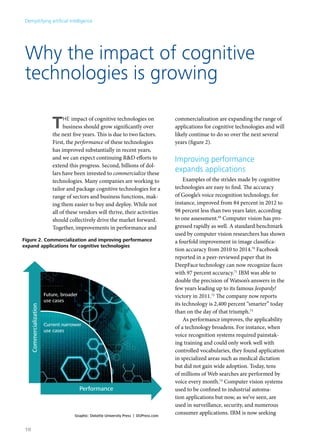
years (figure 2). 
Improving performance 
expands applications 
Examples of the strides made by cognitive 
technologies are easy to find. The accuracy 
of Google’s voice recognition technology, for 
instance, improved from 84 percent in 2012 to 
98 percent less than two years later, according 
to one assessment.69 Computer vision has pro-gressed 
rapidly as well. A standard benchmark 
used by computer vision researchers has shown 
a fourfold improvement in image classifica-tion 
accuracy from 2010 to 2014.70 Facebook 
reported in a peer-reviewed paper that its 
DeepFace technology can now recognize faces 
with 97 percent accuracy.71 IBM was able to 
double the precision of Watson’s answers in the 
few years leading up to its famous Jeopardy! 
victory in 2011.72 The company now reports 
its technology is 2,400 percent “smarter” today 
than on the day of that triumph.73 
As performance improves, the applicability 
of a technology broadens. For instance, when 
voice recognition systems required painstak-ing 
training and could only work well with 
controlled vocabularies, they found application 
in specialized areas such as medical dictation 
but did not gain wide adoption. Today, tens 
of millions of Web searches are performed by 
voice every month.74 Computer vision systems 
used to be confined to industrial automa-tion 
applications but now, as we’ve seen, are 
Figure 2. Commercialization and improving performance 
expand applications for cognitive technologies 
Current narrower 
use cases 
used in surveillance, security, and numerous 
consumer applications. IBM is now seeking Graphic: Deloitte University Press | DUPress.com 
Commercialization 
Performance 
Future, broader 
use cases 
10
to apply Watson to a broad range of domains 
outside of game-playing, from medical diag-nostics 
to research to financial advice to call 
center automation.75 
Not all cognitive technologies are seeing 
such rapid improvement. Machine transla-tion 
has progressed, but at a slower pace. One 
benchmark found a 13 percent improvement in 
the accuracy of Arabic 
to English translations 
between 2009 and 
2012, for instance.76 
Even if these technolo-gies 
are imperfect, they 
can be good enough 
to have a big impact 
on the work organiza-tions 
do. Professional 
translators regularly 
rely on machine trans-lation, 
for instance, to 
What business leaders need to know about cognitive technologies 
Many companies are working to tailor and 
package cognitive technologies for a range 
of sectors and business functions, making 
them easier to buy and easier to deploy. 
improve their efficiency, automating routine 
translation tasks so they can focus on the 
challenging ones.77 
Major investments in 
commercialization 
From 2011 through May 2014, over $2 
billion dollars in venture capital funds have 
flowed to companies building products and 
services based on cognitive technologies.78 
During this same period, over 100 companies 
merged or were acquired, some by technology 
giants such as Amazon, Apple, IBM, Facebook, 
and Google.79 All of this investment has nur-tured 
a diverse landscape of companies that are 
commercializing cognitive technologies. 
This is not the place for providing a detailed 
analysis of the vendor landscape. Rather, we 
want to illustrate the diversity of offerings, 
since this is an indicator of dynamism that 
may help propel and develop the market. The 
following list of cognitive technology vendor 
categories, while neither exhaustive nor mutu-ally 
exclusive, gives a sense of this. 
Data management and analytical tools 
that employ cognitive technologies such as 
natural language processing and machine 
learning. These tools use natural language 
processing technology to help extract insights 
from unstructured text or machine learning 
to help analysts uncover insights from large 
datasets. Examples in this category include 
Context Relevant, Palantir Technologies, 
and Skytree. 
Cognitive technology components that 
can be embedded into applications or business 
processes to add features or improve effec-tiveness. 
Wise.io, for instance, offers a set of 
modules that aim to improve processes such as 
customer support, marketing, and sales with 
machine-learning models that predict which 
customers are most likely to churn or which 
sales leads are most likely to convert to cus-tomers. 
80 Nuance provides speech recognition 
technology that developers can use to speech-enable 
mobile applications.81 
Point solutions. A sign of the maturation 
of some cognitive technologies is that they are 
increasingly embedded in solutions to spe-cific 
business problems. These solutions are 
designed to work better than solutions in their 
existing categories and require little expertise 
in cognitive technologies. Popular application 
areas include advertising,82 marketing and sales 
automation,83 and forecasting and planning.84 
Platforms. Platforms are intended to pro-vide 
a foundation for building highly custom-ized 
business solutions. They may offer a suite 
of capabilities including data management, 
tools for machine learning, natural language 
processing, knowledge representation and 
11
reasoning, and a framework for integrating 
these pieces with custom software. Some of 
the vendors mentioned above can serve as 
platforms of sorts. IBM is offering Watson as a 
cloud-based platform.85 
Emerging applications 
If current trends in performance and 
commercialization continue, we can expect 
the applications of cognitive technologies to 
broaden and adoption to grow. The billions of 
investment dollars that have flowed to hun-dreds 
of companies building products based 
on machine learning, natural language pro-cessing, 
computer vision, or robotics suggests 
that many new applications are on their way 
to market. We also see ample opportunity for 
organizations to take advantage of cognitive 
technologies to automate business processes 
and enhance their products and services.86 
Demystifying artificial intelligence 
12
What business leaders need to know about cognitive technologies 
How can your organization 
apply cognitive technologies? 
COGNITIVE technologies will likely become 
pervasive in the years ahead. Technological 
progress and commercialization should 
expand the impact of cognitive technologies on 
organizations over the next three to five years 
and beyond. A growing number of organiza-tions 
will likely find compelling uses for these 
technologies; leading organizations may find 
innovative applications that dramatically 
improve their performance or create new capa-bilities, 
enhancing their competitive position. 
IT organizations can start today, developing 
awareness of these technologies, evaluating 
opportunities to pilot them, and presenting 
leaders in their organizations with options 
for creating value with them. Senior business 
and public sector leaders should reflect on 
how cognitive technologies will affect their 
sector and their own organization and how 
these technologies can foster innovation and 
improve operating performance. 
Read more on cognitive technologies in “Cognitive technologies: The real opportunities for 
business,” to be published in issue 16 of Deloitte Review in January 2015. 
13
Endnotes 
1. CB Insights data, Deloitte analysis. The 
$2 billion figure includes investments 
in companies selling AI technology or 
products with the technology embedded. 
2. IBM, “IBM Watson,” http://www-03. 
ibm.com/press/us/en/presskit/27297. 
wss, accessed October 3, 2014. 
3. Amit Chowdhry, “Google to acquire artificial 
intelligence company DeepMind,” Forbes, 
January 27, 2014, http://www.forbes.com/ 
sites/amitchowdhry/2014/01/27/google-to- 
acquire-artificial-intelligence-company-deepmind/, 
accessed October 3, 2014. 
4. Josh Constine, “NYU ‘Deep Learning’ Profes-sor 
LeCun will head Facebook’s new artificial 
intelligence lab,” TechCrunch, December 9, 
2013, http://techcrunch.com/2013/12/09/ 
facebook-artificial-intelligence-lab-lecun/, 
accessed October 3, 2014. 
5. Carl Benedikt Frey and Michael A. Osborne, 
The future of employment: How susceptible are 
jobs to computerisation?, Oxford Martin School, 
University of Oxford, September 17, 2013. 
6. Andrew McAfee and Erik Brynjolfsson, 
The Second Machine Age (New York: 
Norton, 2014), http://books.wwnorton. 
com/books/The-Second-Machine-Age/. 
7. Allen Wastler, “Elon Musk, Stephen 
Hawking and fearing the machine,” CNBC, 
http://www.cnbc.com/id/101774267, 
accessed October 3, 2014. 
8. Eliene Augenbraun, “Elon Musk: Artificial 
intelligence may be ‘more dangerous 
than nukes’,” CBS News, http://www. 
cbsnews.com/news/elon-musk-artificial-intelligence- 
may-be-more-dangerous-than- 
nukes/, accessed October 3, 2014. 
9. Stephen Hawking, Stuart Russell, Max Teg-mark, 
and Frank Wilczek, “Stephen Hawking: 
Transcendence looks at the implications of arti-ficial 
intelligence—but are we taking AI seri-ously 
enough?,” The Independent, May 1, 2014, 
http://www.independent.co.uk/news/science/ 
stephen-hawking-transcendence-looks-at-the-implications- 
of-artificial-intelligence--but-are- 
we-taking-ai-seriously-enough-9313474. 
html, accessed October 3, 2014. 
10. For a high-level discussion of AI as an 
“exponential technology,” undergoing rapid 
progress and with transformative implications, 
see Bill Briggs, “Tech Trends 2014: Exponen-tials,” 
Deloitte University Press, February 2014, 
http://dupress.com/articles/2014-tech-trends-exponentials/, 
accessed October 9, 2014. 
11. Nils Nilsson, The Quest for Artificial 
Intelligence, (Cambridge: Cambridge 
University Press, 2010), p. 13. 
12. Stuart Russell and Peter Norvig, Artifi-cial 
Intelligence, third edition, (Saddle 
River: Prentice Hall, 2010), p. 1-5. 
13. Oxford Dictionaries, “Definition of artificial 
intelligence,” http://www.oxforddictionaries. 
com/us/definition/american_english/artificial-intelligence, 
accessed October 3, 2014. 
14. A number of research projects with federal 
and private funding are at work on this and 
other questions about the brain. They are 
preparing for a multi-year effort. See, for 
instance, The White House, “BRAIN Initiative 
Challenges Researchers to Unlock Mysteries 
of Human Mind,” http://www.whitehouse. 
gov/blog/2013/04/02/brain-initiative-challenges- 
researchers-unlock-mysteries-human- 
mind, accessed October 8, 2014. 
15. Douglas R. Hofstadter, Gödel, Escher, Bach: 
An Eternal Golden Braid, (Harmondsworth, 
Middlesex: Penguin, 1980), p. 597, accessed 
October 9, 2014 at http://www.physixfan.com/ 
wp-content/files/GEBen.pdf. Hofstadter called 
this Tesler’s Theorem. Tesler says Hofstadter 
misquoted him and that what he really said 
was, “Intelligence is whatever machines 
haven’t done yet.” See Larry Tesler, “Adages 
and coinages,” http://www.nomodes.com/ 
Larry_Tesler_Consulting/Adages_and_Coin-ages. 
html, accessed October 9, 2014. 
16. This historical summary is adapted 
from Nick Bostrom, Superintelligence: 
Paths, Dangers, Strategies (Oxford: 
Oxford University Press, 2014). 
17. David E. Sanger, “Smart machines get 
smarter,” New York Times, December 15, 
1985, http://www.nytimes.com/1985/12/15/ 
business/smart-machines-get-smarter. 
html, accessed October 5, 2014. 
Demystifying artificial intelligence 
14
18. Maura McEnaney, “Teknowledge retools 
expert systems for business market,” 
Computerworld, August 4, 1986, p. 76. 
19. Beth Enslow, “The payoff from expert 
systems,” Across the Board, January/Febru-ary, 
1989, p. 56, citing the estimate of an 
analyst in High Technology Business. 
20. Andrew Danowitz et al., “CPU DB: Record-ing 
microprocessor history,” ACMQueue 10, 
no. 4 (2014), http://queue.acm.org/detail. 
cfm?id=2181798, accessed October 11, 2014. 
21. As Peter Lyman and Hal R. Varian noted in 
2000, “Not only is digital information produc-tion 
the largest in total, it is also the most 
rapidly growing.” See Peter Lyman and Hal R. 
Varian, “How much information,” 2000, http:// 
www2.sims.berkeley.edu/research/projects/ 
how-much-info/, accessed October 10, 2014. 
22. Interest in big data was fueled by examples 
of extracting valuable insights from “large 
amounts of unlabeled, noisy data.” See Alon 
Halevy, Peter Norvig, and Fernando Pereira, 
“The unreasonable effectiveness of data,” IEEE 
Intelligent Systems, 24, no. 2 (2009): pp. 8–12. 
23. See, for instance, Jeff Bertolucci, “Hadoop: 
From experiment to leading big data platform,” 
InformationWeek, June 24, 2013, http://www. 
informationweek.com/software/hadoop-from-experiment- 
to-leading-big-data-platform/d/d-id/ 
1110491?, accessed October, 9, 2014. 
24. For a discussion of the challenges of extract-ing 
meaningful insight from big data, see 
James Guszcza et al. “Too big to ignore,” 
Deloitte University Press, January 31, 
2013, http://dupress.com/articles/too-big-to- 
ignore/, accessed October 9, 2014. 
25. For discussion of “cognitive analytics,” 
including the role of cloud computing, see 
Rajeev Ronanki and David Steier, “Cogni-tive 
analytics,” Deloitte University Press, 
February 21, 2014, http://dupress.com/ 
articles/2014-tech-trends-cognitive-analytics/, 
accessed October 9, 2014. 
26. Catherine Wah, “Crowdsourcing and its ap-plications 
in computer vision,” U.C. San Diego, 
May 26, 2011, http://vision.ucsd.edu/~cwah/ 
files/re_cwah.pdf, accessed October 8, 2014. 
27. Google Inc., “Google Translate Community 
FAQ,” https://docs.google.com/document/d/1 
dwS4CZzgZwmvoB9pAx4A6Yytmv7itk_XE- 
968RMiqpMY/pub, accessed October 8, 2014. 
28. Multiple researchers have devised algorithms 
that have improved the performance of 
machine learning. Google Scholar finds some 
What business leaders need to know about cognitive technologies 
500,000 scholarly papers on the topic of neural 
networks, for example, published since 2006. 
Geoffrey Hinton is a widely published and 
cited researcher in this area credited with 
several important innovations. See: Geoffrey 
Hinton, “Home Page of Geoffrey Hinton,” 
http://www.cs.toronto.edu/~hinton/, accessed 
October 6, 2014. Other researchers who are 
widely recognized for contributions in this 
area include Yann LeCun (See Yann LeCunn, 
“Yann LeCun’s Home Page,” http://yann. 
lecun.com/, accessed October 9, 2014), and 
Yoshua Bengio (see Yoshua Bengio, “Yoshua 
Bengio’s Research,” http://www.iro.umontreal. 
ca/~bengioy/yoshua_en/research.html, ac-cessed 
October 9, 2014). Recently, Microsoft 
demonstrated a new machine learning 
architecture that dramatically accelerates the 
machine learning process, improving precision 
and accuracy. See, Microsoft Research, “On 
Welsh Corgis, computer vision, and the power 
of deep learning,” http://research.microsoft. 
com/en-us/news/features/dnnvision-071414. 
aspx?0hp=002c, accessed October 6, 2014. 
29. The Apache Software Foundation sponsors 
Apache Mahout, an open source machine 
learning library. Startup PredictionIO is 
offering an open-source machine learning 
server and recently received $2.5 million 
in venture funding. See Steve O’Hear, 
“PredictionIO raises $2.5M for its open 
source machine learning server,” TechCrunch, 
July 17, 2014, accessed October 6, 2014. 
30. Russell and Norvig, Artificial Intelligence. 
31. C.H. Chen, Computer Vision in Medi-cal 
Imaging (Singapore: World Scientific 
Publishing Company, 2014). 
32. Justin Mitchell, “Making photo tag-ging 
easier,” Facebook, https://www. 
facebook.com/notes/facebook/making-photo- 
tagging-easier/467145887130, ac-cessed 
on October 18, 2014. 
33. Charlie Savage, “Facial scanning is making 
gains in surveillance,” New York Times, August 
21, 2013, http://www.nytimes.com/2013/08/21/ 
us/facial-scanning-is-making-gains-in-surveillance. 
html, accessed October 8, 2014. 
34. Dawn Chmielewski, “Amazon’s Fire smart-phone 
uses ‘Firefly’ image recognition,” 
Recode, http://recode.net/2014/06/18/ 
amazons-fire-smartphone-uses-firefly-image-recognition/, 
accessed October 3, 2014. 
35. Mark Graves and Bruce G. Batchelor, 
Machine Vision for the Inspection of Natural 
Products (London: Springer, 2003), p. 8. 
15
36. CB Insights data, Deloitte analysis. 
37. For instance, Microsoft recently announced 
that it had developed a computer vision 
system able to identify dog breeds. It relies 
in part on machine learning techniques and 
was trained using a database of millions of 
images. See Microsoft Research, “On Welsh 
Corgis, computer vision, and the power of 
deep learning,” http://research.microsoft. 
com/en-us/news/features/dnnvision-071414. 
aspx?0hp=002c, accessed October 6, 2014. 
38. CB Insights data, Deloitte analysis. 
39. Chowdhry, “Google to acquire artificial 
intelligence company DeepMind.” 
40. For an early use of this example see Gilbert 
Burck, The Computer Age and its Potential 
for Management, (New York: Harper & Row, 
1965), p. 62, accessed at https://archive.org/ 
details/TheComputerAgeAndItsPotential- 
ForManagement on October 9, 2014. 
41. Russell and Norvig, Artificial In-telligence, 
pp. 860–885. 
42. See, for instance, Clarabaridge, Inc., 
http://clarabridge.com/, and Luminoso 
Technologies, Inc., http://www.luminoso. 
com/, accessed October 13, 2014. 
43. John Markoff, “Armies of expensive law-yers, 
replaced by cheaper software,” New 
York Times, March 4, 2011, http://www. 
nytimes.com/2011/03/05/science/05legal. 
html, accessed on October 9, 2014. 
44. Jason Belzer, “Automated insights poised 
to revolutionize sports media,” Forbes, 
http://www.forbes.com/sites/jasonbel-zer/ 
2013/02/26/automated-insights-poised-to- 
revolutionize-sports-media/, February 
26, 2013, accessed on October 9, 2014. 
45. For a discussion of robotics as an “exponential 
technology,” see Briggs, “Tech Trends 2014.” 
46. Dominic Rushe, “Google reveals home 
delivery drone program Project Wing,” 
Guardian, August 29, 2014, http://www. 
theguardian.com/technology/2014/aug/29/ 
google-joins-amazon-in-testing-home-delivery- 
drones accessed October 9, 2014. 
47. See, for instance, the Baxter Robot by ReThink 
Robotics, http://www.rethinkrobotics.com/. 
48. See, for instance, iRobot’s Roomba, 
http://www.irobot.com/For-the-Home/ 
Vacuum-Cleaning/Roomba. 
49. Erico Guizzo, “Friendly robot is a hands-free 
home helper,” Discovery, July 17, 2014, 
http://news.discovery.com/tech/robotics/ 
friendly-robot-is-a-hands-free-home-helper- 
140717.htm, accessed October 9, 2014. 
50. Russell and Norvig, Artificial In-telligence, 
pp. 912–919. 
51. Bruce Horovitz, “Domino’s app lets you 
voice-order pizza,” USA Today, June 17, 
2014, http://www.usatoday.com/story/ 
money/business/2014/06/16/dominos-voice-ordering- 
app-nuance-fast-food-restau-rants/ 
10626419/, accessed October 3, 2014. 
52. IBM, “Decision optimization,” http://www-03. 
ibm.com/software/products/en/category/deci-sion- 
optimization, accessed October 13, 2014. 
53. Russell and Norvig, Artificial In-telligence, 
pp. 366–431. 
54. Microsoft, “Best practices for rule-based 
application development,” http://msdn. 
microsoft.com/en-us/library/aa480020. 
aspx, accessed October 13, 2014. 
55. Matthew Finnegan, “Barclays to offer voice 
recognition for telephone banking,” Computer-worldUK, 
June 23, 2014, http://www.comput-erworlduk. 
com/news/applications/3526401/ 
barclays-offer-voice-recognition-for-telephone-banking/, 
accessed October 12, 2014. 
56. HIMMS Analytics, “Essentials of the U.S. 
hospital IT market: Support services,” 2013, 
http://assets.fiercemarkets.com/public/ 
newsletter/fiercehealthit/himssanalyt-ics10- 
17.pdf, accessed October 3, 2014. 
57. VuComp, “M-Vu CAD for mammography,” 
http://www.vucomp.com/products/m-vu- 
system, accessed October 3, 2014. 
58. IBM, “Memorial Sloan-Kettering Cancer 
Center, IBM to collaborate in applying Watson 
technology to help oncologists,” https:// 
www-03.ibm.com/press/us/en/pressre-lease/ 
37235.wss, accessed October 3, 2014. 
59. Leonardo Rodrigues et al., “Berg Inter-rogative 
Biology™ Informatics Suite: 
Data driven integration of multi-omic 
technologies using Bayesian AI,” Cancer 
Research, 73, no. 8, supplement 1 (2013), 
DOI: 10.1158/1538-7445.AM2013-5230. 
60. George E. Dahl, Navdeep Jaitly, and 
Ruslan Salakhutdinov, “Multi-task 
neural networks for QSAR predictions,” 
arXiv:1406.1231v1 [stat.ML] (2014). 
Demystifying artificial intelligence 
16
61. Jenni Whalen, “Revolutionizing the 
healthcare system,” Boston Magazine, 
July 31, 2013, http://www.boston-magazine. 
com/health/blog/2013/07/31/ 
revolutionizing-the-healthcare-system-bergpharma/, 
accessed October 3, 2014. 
62. Ravi Somaiya, “The A.P. plans to automate 
quarterly earnings articles,” New York 
Times, June 30, 2014, http://www.nytimes. 
com/2014/07/01/business/media/the-ap-plans-for- 
computers-to-write-corporate-earnings-news. 
html?_r=0, accessed October 3, 2014. 
63. César E. Bravo et al., “State of the art 
of artificial intelligence and predictive 
analytics in the E&P industry: A technology 
survey,” SPE Journal 19, no. 04 (2014): pp. 
547–563, http://dx.doi.org/10.2118/150314- 
PA, accessed October 12, 2014. 
64. Karen Boman, “Artificial intelligence software 
aids decision-making in onshore drilling,” Rig-zone, 
July 10, 2014, http://www.rigzone.com/ 
news/oil_gas/a/133973/Artificial_Intelligence_ 
Software_Aids_DecisionMaking_in_Onshore_ 
Drilling/?all=HG2, accessed October 12, 2014. 
65. Information Week, “Georgia solves campaign 
finance data challenge via OCR,” http:// 
www.informationweek.com/government/ 
cloud-computing/georgia-solves-campaign-finance- 
data-challenge-via-ocr/d/d-id/ 
1204471, accessed October 3, 2014. 
66. See, for instance, RichRelevance, 
“Product recommendations and per-sonalization— 
RichRecs,” http://www. 
richrelevance.com/solutions/merchandis-ing/, 
accessed October 12, 2014. 
67. iRobot, “iRobot Roomba vacuum clean-ing 
robot,” http://www.irobot.com/ 
For-the-Home/Vacuum-Cleaning/ 
Roomba, accessed October 12, 2014. 
68. Nest Labs, “Nest Labs introduces the world’s 
first learning thermostat,” https://nest.com/ 
press/nest-labs-introduces-worlds-first-learn-ing- 
thermostat/, accessed October 12, 2014. 
69. Apple Insider, “Tests find Apple’s Siri 
improving, but Google Now voice search 
slightly better,” http://appleinsider.com/ 
articles/14/07/22/tests-find-apples-siri-improving- 
but-google-now-voice-search-slightly- 
better, accessed October 3, 2014. 
70. Olga Russakovsky et al., “ImageNet Large 
Scale Visual Recognition Challenge,” 
arXiv:1409.0575v1 [cs.CV] (September 1, 
2014), http://arxiv.org/pdf/1409.0575v1. 
pdf, accessed October 3, 2014. 
What business leaders need to know about cognitive technologies 
71. Facebook, “DeepFace: Closing the gap 
to human-level performance in face 
verification,” https://www.facebook. 
com/publications/546316888800776/, 
accessed October 3, 2014. 
72. David Ferrucci et al., “The AI behind Wat-son— 
the technical article,” AI Magazine, 
2010, http://www.aaai.org/Magazine/Watson/ 
watson.php, accessed October 3, 2014. 
73. IBM, “IBM Watson,” http://www-03. 
ibm.com/press/us/en/presskit/27297. 
wss, accessed October 3, 2014. 
74. Total US search query volume was 17.7 billion 
in February 2014. 67.5 percent of search 
queries are conducted on Google. See Search 
Engine Land, “Google search share stable, 
Bing growth continues at Yahoo’s expense,” 
http://searchengineland.com/google-search-share- 
stable-bing-continues-cannibalize-yahoo- 
187124, accessed October 3, 2014. 
The volume of mobile search is on track to 
surpass the volume of desktop search. See Greg 
Sterling, “Matt Cutts: Google mobile queries 
may surpass PC search this year,” Search Engine 
Land, March 17, 2014, http://searchengineland. 
com/matt-cutts-mobile-queries-may-surpass-pc- 
year-186816, accessed October 13, 2014. 
The share of mobile searches performed by 
voice ranges from 1 to 4 percent. See 
Google and Nielsen, “Mobile search mo-ments: 
Understanding how mobile drives 
conversions,” http://ssl.gstatic.com/think/ 
docs/creating-moments-that-matter_research-studies. 
pdf, accessed October 13, 2014. 
75. Joab Jackson, “IBM expands Watson’s 
presence across multiple industries,” 
PCWorld, October 7, 2014, http://www. 
pcworld.com/article/2712392/ibm-expands-watsons- 
presence-across-multiple-industries. 
html, accessed October 8, 2014. 
76. NIST Information Technology Laboratory, 
“OpenMT12 Evaluation Results,” August 28, 
2012, http://www.nist.gov/itl/iad/mig/open-mt12results. 
cfm, accessed October 8, 2014. 
BBN’s system, BBN_ara2eng_primary_cn, 
performed better than all competitors in 
both years but improved just 13 percent. 
77. Martin Williams, “Tech is removing language 
barriers—but will jobs be lost in translation?,” 
Guardian, September 19, 2014, http://www. 
theguardian.com/education/2014/sep/19/ 
tech-removing-language-barriers-jobs-lost-translation, 
accessed October 3, 2014. 
78. CB Insights, Deloitte analysis. 
79. Ibid. 
17
80. Wise.io, “Wise.io,” http://www.wise. 
io/, accessed October 10, 2014. 
81. Nuance, “For developers,” http://www. 
nuance.com/for-developers/index. 
htm, accessed October 10, 2014. 
82. Rocket Fuel, Inc., “About Rocket Fuel,” 
http://rocketfuel.com/about-rocket-fuel# 
what_we_do, accessed October 10, 2014. 
83. Conversica LLC, “How Conversica Works,” 
https://www.conversica.com/persona-how- 
it-works-email-inbound-marketing-ai/, 
accessed October 10, 2014. 
84. ToolsGroup, “Powerfully simple demand 
forecasting, demand accuracy,” http://www. 
toolsgroup.com/en/what-we-offer/our-solu-tion/ 
powerfully-simple-demand-forecasting. 
html#content, accessed October 10, 2014. 
85. IBM, “IBM Watson: Build with Watson,” 
http://www.ibm.com/smarterplanet/ 
us/en/ibmwatson/build-with-watson. 
html, accessed October 10, 2014. 
86. We will explore this subject in greater detail 
in a forthcoming issue of Deloitte Review. 
Demystifying artificial intelligence 
18
What business leaders need to know about cognitive technologies 
About the authors 
David Schatsky 
David Schatsky is a senior manager at Deloitte LLP. He tracks and analyzes emerging technology 
and business trends, including the growing impact of cognitive technologies, for the firm’s leaders 
and its clients. 
Craig Muraskin 
Craig Muraskin is managing director of the Innovation group in Deloitte LLP. He works with lead-ership 
to set the group’s agenda and overall innovation strategy, and counsels Deloitte’s businesses 
on their innovation efforts. 
Ragu Gurumurthy 
Ragu Gurumurthy is national managing principal of the Innovation group in Deloitte LLP, guiding 
overall innovation efforts across all Deloitte’s business units. He advises clients in the technology 
and telecommunications sectors on a wide range of topics including innovation, growth, and new 
business models. 
19
Demystifying artificial intelligence 
Acknowledgements 
The authors would like to acknowledge the contributions of Mark Cotteleer of Deloitte Services 
LP; Plamen Petrov, Rajeev Ronanki, and David Steier of Deloitte Consulting LLP; and Shankar 
Lakshman, Laveen Jethani, and Divya Ravichandran of Deloitte Support Services India Pvt Ltd. 
Contacts 
David Schatsky 
Senior Manager 
Deloitte LLP 
+1 646 582 5209 
dschatsky@deloitte.com 
Craig Muraskin 
Director 
Deloitte LLP 
+1 212 492 3848 
cmuraskin@deloitte.com 
20
Follow @DU_Press 
Sign up for Deloitte University Press updates at DUPress.com. 
About Deloitte University Press 
Deloitte University Press publishes original articles, reports and periodicals that provide insights for businesses, the public sector and 
NGOs. Our goal is to draw upon research and experience from throughout our professional services organization, and that of coauthors in 
academia and business, to advance the conversation on a broad spectrum of topics of interest to executives and government leaders. 
Deloitte University Press is an imprint of Deloitte Development LLC. 
About this publication 
This publication contains general information only, and none of Deloitte Touche Tohmatsu Limited, its member firms, or their related 
entities (collectively the “Deloitte Network”) is, by means of this publication, rendering professional advice or services. Before making any 
decision or taking any action that may affect your finances or your business, you should consult a qualified professional adviser. No entity 
in the Deloitte Network shall be responsible for any loss whatsoever sustained by any person who relies on this publication. 
About Deloitte 
Deloitte refers to one or more of Deloitte Touche Tohmatsu Limited, a UK private company limited by guarantee (“DTTL”), its network of 
member firms, and their related entities. DTTL and each of its member firms are legally separate and independent entities. DTTL (also 
referred to as “Deloitte Global”) does not provide services to clients. Please see www.deloitte.com/about for a more detailed description 
of DTTL and its member firms. 
Deloitte provides audit, tax, consulting, and financial advisory services to public and private clients spanning multiple industries. With 
a globally connected network of member firms in more than 150 countries and territories, Deloitte brings world-class capabilities and 
high-quality service to clients, delivering the insights they need to address their most complex business challenges. Deloitte’s more than 
200,000 professionals are committed to becoming the standard of excellence. 
© 2014. For information, contact Deloitte Touche Tohmatsu Limited.

Cognitive technologies

  • 1.
    Demystifying artificial intelligence What business leaders need to know about cognitive technologies A Deloitte series on cognitive technologies
  • 2.
    Deloitte Consulting LLP’sEnterprise Science offering employs data science, cognitive technologies such as machine learning, and advanced algorithms to create high-value solutions for clients. Services include cognitive automation, which uses cognitive technologies such as natural language processing to automate knowledge-intensive processes; cognitive engagement, which applies machine learning and advanced analytics to make customer interactions dramatically more personalized, relevant, and profitable; and cognitive insight, which employs data science and machine learning to detect critical patterns, make high-quality predictions, and support business performance. For more information about the Enterprise Science offering, contact Plamen Petrov (ppetrov@deloitte. com) or Rajeev Ronanki (rronanki@deloitte.com).
  • 3.
    Contents Overview |2 Artificial intelligence and cognitive technologies | 3 Cognitive technologies are already in wide use | 8 Why the impact of cognitive technologies is growing | 10 How can your organization apply cognitive technologies? | 13 Endnotes | 14 What business leaders need to know about cognitive technologies 1
  • 4.
    IN the lastseveral years, interest in artificial intelligence (AI) has surged. Venture capital investments in companies developing and commercializing AI-related products and technology have exceeded $2 billion since 2011.1 Technology companies have invested billions more acquiring AI startups. Press cov-erage of the topic has been breathless, fueled by the huge investments and by pundits asserting that computers are starting to kill jobs, will soon be smarter than people, and could threaten the survival of human-kind. Consider the following: • IBM has committed $1 billion to commercializing Watson, its cognitive computing platform.2 • Google has made major invest-ments in AI in recent years, including acquiring eight robot-ics companies and a machine-learning company.3 • Facebook hired AI luminary Yann LeCun to create an AI laboratory with the goal of bringing major advances in the field.4 • Researchers at the University of Oxford published a study estimating that 47 percent of total US employment is “at risk” due to the automation of cognitive tasks.5 • The New York Times bestseller The Second Machine Age argued that digital technolo-gies and AI are poised to bring enormous positive change, but also risk significant negative consequences as well, including mass unemployment.6 • Silicon Valley entrepreneur Elon Musk is investing in AI “to keep an eye” on it.7 He has said it is potentially “more dangerous than nukes.”8 • Renowned theoretical physicist Stephen Hawking said that success in creating true AI could mean the end of human history, “unless we learn how to avoid the risks.”9 Amid all the hype, there is significant commercial activity underway in the area of AI that is affecting or will likely soon affect organizations in every sector. Business leaders should understand what AI really is and where it is heading. Overview A useful definition of artificial intelligence is the theory and development of computer systems able to perform tasks that normally require human intelligence. Demystifying artificial intelligence 2
  • 5.
    What business leadersneed to know about cognitive technologies Artificial intelligence and cognitive technologies THE first steps in demystifying AI are defining the term, outlining its history, and describing some of the core technologies underlying it. Defining artificial intelligence10 The field of AI suffers from both too few and too many definitions. Nils Nilsson, one of the founding researchers in the field, has writ-ten that AI “may lack an agreed-upon defini-tion. . . .”11 A well-respected AI textbook, now in its third edition, offers eight definitions, and declines to prefer one over the other.12 For us, a useful definition of AI is the theory and devel-opment of computer systems able to perform tasks that normally require human intelligence. Examples include tasks such as visual percep-tion, speech recognition, decision making under uncertainty, learning, and translation between languages.13 Defining AI in terms of the tasks humans do, rather than how humans think, allows us to discuss its practical appli-cations today, well before science arrives at a definitive understand-ing of the neurological mechanisms of intelligence.14 It is worth noting that the set of tasks that normally require human intelligence is subject to change as computer systems able to perform those tasks are invented and then widely diffused. Thus, the meaning of “AI” evolves over time, a phenomenon known as the “AI effect,” concisely stated as “AI is whatever hasn’t been done yet.”15 The history of artificial intelligence AI is not a new idea. Indeed, the term itself dates from the 1950s. The history of the field is marked by “periods of hype and high expecta-tions alternating with periods of setback and disappointment,” as a recent apt summation puts it.16 After articulating the bold goal of simulating human intelligence in the 1950s, researchers developed a range of demonstra-tion programs through the 1960s and into the ‘70s that showed computers able to accom-plish a number of tasks once thought to be solely the domain of human endeavor, such as proving theorems, solving calculus problems, responding to commands by planning and performing physical actions—even imperson-ating a psychotherapist and composing music. But simplistic algorithms, poor methods for handling uncertainty (a surprisingly ubiqui-tous fact of life), and limitations on computing power stymied attempts to tackle harder or 3
  • 6.
    more diverse problems.Amid disappointment with a lack of continued progress, AI fell out of fashion by the mid-1970s. In the early 1980s, Japan launched a program to develop an advanced computer architecture that could advance the field of AI. Western anxiety about losing ground to Japan contributed to decisions to invest anew in AI. The 1980s saw the launch of commercial ven-dors of AI technology products, some of which had initial public offerings, such as Intellicorp, Symbolics,17 and Teknowledge.18 By the end of the 1980s, perhaps half of the Fortune 500 were developing or maintaining “expert systems,” an AI technology that models human exper-tise with a knowledge base of facts and rules.19 High hopes for the potential of expert systems were eventually tempered as their limitations, including a glaring lack of common sense, the difficulty of capturing experts’ tacit knowledge, and the cost and complexity of building and maintaining large systems, became widely recognized. AI ran out of steam again. In the 1990s, technical work on AI con-tinued with a lower profile. Techniques such as neural networks and genetic algorithms received fresh attention, in part because they avoided some of the limitations of expert systems and partly because new algorithms made them more effective. The design of neural networks is inspired by the structure of the brain. Genetic algorithms aim to “evolve” solutions to problems by iteratively generating candidate solutions, culling the weakest, and introducing new solution variants by introduc-ing random mutations. Catalysts of progress By the late 2000s, a number of factors helped renew progress in AI, particularly in a few key technologies. We explain the fac-tors most responsible for the recent progress below and then describe those technologies in more detail. Moore’s Law. The relentless increase in computing power available at a given price and size, sometimes known as Moore’s Law after Intel cofounder Gordon Moore, has benefited all forms of computing, including the types AI researchers use. Advanced system designs that might have worked in principle were in prac-tice off limits just a few years ago because they required computer power that was cost-pro-hibitive or just didn’t exist. Today, the power necessary to implement these designs is readily available. A dramatic illustration: The current generation of microprocessors delivers 4 mil-lion times the performance of the first single-chip microprocessor introduced in 1971.20 Big data. Thanks in part to the Internet, social media, mobile devices, and low-cost sensors, the volume of data in the world is increasing rapidly.21 Growing understanding of the potential value of this data22 has led to the development of new techniques for manag-ing and analyzing very large data sets.23 Big data has been a boon to the development of AI. The reason is that some AI techniques use statistical models for reasoning probabilisti-cally about data such as images, text, or speech. These models can be improved, or “trained,” by exposing them to large sets of data, which are now more readily available than ever.24 The Internet and the cloud. Closely related to the big data phenomenon, the Internet and cloud computing can be credited with advances in AI for two reasons. First, they make available vast amounts of data and infor-mation to any Internet-connected comput-ing device. This has helped propel work on AI approaches that require large data sets.25 Second, they have provided a way for humans to collaborate—sometimes explicitly and at other times implicitly—in helping to train AI systems. For example, some researchers have used cloud-based crowdsourcing services like Mechanical Turk to enlist thousands of humans to describe digital images, enabling image classification algorithms to learn from these descriptions.26 Google’s language transla-tion project analyzes feedback and freely offers contributions from its users to improve the quality of automated translation.27 New algorithms. An algorithm is a routine process for solving a program or performing a Demystifying artificial intelligence 4
  • 7.
    Figure 1. Thefield of artificial intelligence has produced a number of cognitive technologies Speech recognition task. In recent years, new algorithms have been developed that dramatically improve the per-formance of machine learning, an important technology in its own right and an enabler of other technologies such as computer vision.28 (These technologies are described below.) The fact that machine learning algorithms are now available on an open-source basis is likely to foster further improvements as developers con-tribute enhancements to each other’s work.29 Cognitive technologies We distinguish between the field of AI and the technologies that emanate from the field. The popular press portrays AI as the advent of computers as smart as—or smarter than— humans. The individual technologies, by con-trast, are getting better at performing specific tasks that only humans used to be able to do. We call these cognitive technologies (figure 1), and it is these that business and public sector leaders should focus their attention on. Below we describe some of the most important cogni-tive technologies—those that are seeing wide adoption, making rapid progress, or receiving significant investment. Computer vision refers to the ability of computers to identify objects, scenes, and activities in images. Computer vision technol-ogy uses sequences of imaging-processing operations and other techniques to decompose the task of analyzing images into manageable pieces. There are techniques for detecting the edges and textures of objects in an image, for instance. Classification techniques may be used to determine if the features identified in an image are likely to represent a kind of object already known to the system.30 Computer vision has diverse applica-tions, including analyzing medical imaging to improve prediction, diagnosis, and treat-ment of diseases;31 face recognition, used by Computer vision Machine learning Natural language processing Optimization Planning & scheduling Rules- Robotics based systems Graphic: Deloitte University Press | DUPress.com What business leaders need to know about cognitive technologies 5
  • 8.
    Facebook to automaticallyidentify people in photographs32 and in security and surveillance to spot suspects;33 and in shopping—consum-ers can now use smartphones to photograph products and be presented with options for purchasing them.34 Machine vision, a related discipline, gener-ally refers to vision applications in industrial automation, where computers recognize objects such as manufactured parts in a highly constrained factory environment—rather sim-pler than the goals of computer vision, which seeks to operate in unconstrained environ-ments. While computer vision is an area of ongoing computer science research, machine vision is a “solved prob-lem”— the subject not of research but of systems engineering.35 Because the range of applications for computer vision is expanding, startup companies working in this area have attracted hundreds of mil-lions Cognitive technologies are products of the field of artificial intelligence. They are able to perform tasks that only humans used to be able to do. of dollars in venture capital investment since 2011.36 Machine learning refers to the ability of computer systems to improve their perfor-mance by exposure to data without the need to follow explicitly programmed instructions. At its core, machine learning is the process of automatically discovering patterns in data. Once discovered, the pattern can be used to make predictions. For instance, presented with a database of information about credit card transactions, such as date, time, merchant, merchant location, price, and whether the transaction was legitimate or fraudulent, a machine learning system learns patterns that are predictive of fraud. The more transaction data it processes, the better its predictions are expected to become. Applications of machine learning are very broad, with the potential to improve perfor-mance in nearly any activity that generates large amounts of data. Besides fraud screen-ing, these include sales forecasting, inventory management, oil and gas exploration, and public health. Machine learning techniques often play a role in other cognitive technolo-gies such as computer vision, which can train vision models on a large database of images to improve their ability to recognize classes of objects.37 Machine learning is one of the hottest areas in cognitive technologies today, having attracted around a billion dollars in venture capital investment between 2011 and mid-2014.38 Google is said to have invested some $400 mil-lion to acquire DeepMind, a machine learn-ing company, in 2014.39 Natural language process-ing refers to the ability of com-puters to work with text the way humans do, for instance, extracting meaning from text or even generat-ing text that is readable, stylistically natural, and grammatically correct. A natural language processing system doesn’t understand text the way humans do, but it can manipulate text in sophisticated ways, such as automatically identifying all of the people and places men-tioned in a document; identifying the main topic of a document; or extracting and tabu-lating the terms and conditions in a stack of human-readable contracts. None of these tasks is possible with traditional text processing soft-ware that operates on simple text matches and patterns. Consider a single hackneyed example that illustrates one of the challenges of natural language processing. The meaning of each word in the sentence “Time flies like an arrow” Demystifying artificial intelligence 6
  • 9.
    seems clear, untilyou encounter the sentence “Fruit flies like a banana.” Substituting “fruit” for “time” and “banana” for “arrow” changes the meaning of the words “flies” and “like.”40 Natural language processing, like computer vision, comprises multiple techniques that may be used together to achieve its goals. Language models are used to predict the probability distribution of language expressions—the likelihood that a given string of characters or words is a valid part of a language, for instance. Feature selection may be used to identify the elements of a piece of text that may distinguish one kind of text from another—say a spam email versus a legitimate one. Classification, powered by machine learning, would then operate on the extracted features to classify a message as spam or not.41 Because context is so important for under-standing why “time flies” and “fruit flies” are so different, practical applications of natural language processing often address relative narrow domains such as analyzing customer feedback about a particular product or ser-vice, 42 automating discovery in civil litigation or government investigations (e-discovery),43 and automating writing of formulaic stories on topics such as corporate earnings or sports.44 Robotics, by integrating cognitive technol-ogies such as computer vision and automated planning with tiny, high-performance sensors, actuators, and cleverly designed hardware, has given rise to a new generation of robots that can work alongside people and flexibly perform many different tasks in unpredictable environments.45 Examples include unmanned aerial vehicles,46 “cobots” that share jobs with humans on the factory floor,47 robotic vacuum What business leaders need to know about cognitive technologies cleaners,48 and a slew of consumer products, from toys to home helpers.49 Speech recognition focuses on auto-matically and accurately transcribing human speech. The technology has to contend with some of the same challenges as natural lan-guage processing, in addition to the difficulties of coping with diverse accents, background noise, distinguishing between homophones (“buy” and “by” sound the same), and the need to work at the speed of natural speech. Speech recognition systems use some of the same techniques as natural language pro-cessing systems, plus others such as acoustic models that describe sounds and their prob-ability of occurring in a given sequence in a given language.50 Applications include medical dictation, hands-free writing, voice control of computer systems, and telephone customer service applications. Domino’s Pizza recently introduced a mobile app that allows customers to use natural speech to order, for instance.51 As noted, the cognitive technologies above are making rapid progress and attracting significant investment. Other cognitive tech-nologies are relatively mature and can still be important components of enterprise software systems. These more mature cognitive tech-nologies include optimization, which auto-mates complex decisions and trade-offs about limited resources;52 planning and scheduling, which entails devising a sequence of actions to meet goals and observe constraints;53 and rules-based systems, the technology underly-ing expert systems, which use databases of knowledge and rules to automate the process of making inferences about information.54 7
  • 10.
    Cognitive technologies arealready in wide use ORGANIZATIONS in every sector of the economy are already using cognitive tech-nologies in diverse business functions. In banking, automated fraud detection sys-tems use machine learning to identify behavior patterns that could indicate fraudulent pay-ment activity, speech recognition technology to automate customer service telephone interac-tions, and voice recognition technology to verify the identity of callers.55 In health care, automatic speech recogni-tion for transcribing notes dictated by physi-cians is used in around half of US hospitals, and its use is growing rapidly.56 Computer vision systems automate the analysis of mam-mograms and other medical images.57 IBM’s Watson uses natural language processing to read and understand a vast medical literature, hypothesis generation techniques to automate diagnosis, and machine learning to improve its accuracy.58 In life sciences, machine learning systems are being used to predict cause-and-effect relationships from biological data59 and the activities of compounds,60 helping pharmaceu-tical companies identify promising drugs.61 In media and entertainment, a number of companies are using data analytics and natural language generation technology to automati-cally draft articles and other narrative material about data-focused topics such as corporate earnings or sports game summaries.62 Oil and gas producers use machine learning in a wide range of applica-tions, from locating mineral deposits63 to diagnosing mechanical problems with drilling equipment.64 The public sector is adopting cogni-tive technologies for a variety of purposes including surveillance, compliance and fraud detection, and automation. The state of Georgia, for instance, employs a system combining automated handwriting recogni-tion with crowdsourced human assistance to digitize financial disclosure and campaign contribution forms.65 Retailers use machine learning to automat-ically discover attractive cross-sell offers and effective promotions.66 Technology companies are using cogni-tive technologies such as computer vision and machine learning to enhance products or cre-ate entirely new product categories, such as the Roomba robotic vacuum cleaner67 or the Nest intelligent thermostat.68 As the examples above show, the poten-tial business benefits of cognitive technolo-gies are much broader than cost savings that may be implied by the term “automation.” They include: • Faster actions and decisions (for example, automated fraud detection, planning and scheduling) • Better outcomes (for example, medi-cal diagnosis, oil exploration, demand forecasting) • Greater efficiency (that is, better use of high-skilled people or expensive equipment) • Lower costs (for example, reducing labor costs with automated telephone customer service) • Greater scale (that is, performing large-scale tasks impractical to perform manually) • Product and service innovation (from add-ing new features to creating entirely new products) Demystifying artificial intelligence 8
  • 11.
    What business leadersneed to know about cognitive technologies 9
  • 12.
    Demystifying artificial intelligence Why the impact of cognitive technologies is growing THE impact of cognitive technologies on business should grow significantly over the next five years. This is due to two factors. First, the performance of these technologies has improved substantially in recent years, and we can expect continuing R&D efforts to extend this progress. Second, billions of dol-lars have been invested to commercialize these technologies. Many companies are working to tailor and package cognitive technologies for a range of sectors and business functions, mak-ing them easier to buy and deploy. While not all of these vendors will thrive, their activities should collectively drive the market forward. Together, improvements in performance and commercialization are expanding the range of applications for cognitive technologies and will likely continue to do so over the next several years (figure 2). Improving performance expands applications Examples of the strides made by cognitive technologies are easy to find. The accuracy of Google’s voice recognition technology, for instance, improved from 84 percent in 2012 to 98 percent less than two years later, according to one assessment.69 Computer vision has pro-gressed rapidly as well. A standard benchmark used by computer vision researchers has shown a fourfold improvement in image classifica-tion accuracy from 2010 to 2014.70 Facebook reported in a peer-reviewed paper that its DeepFace technology can now recognize faces with 97 percent accuracy.71 IBM was able to double the precision of Watson’s answers in the few years leading up to its famous Jeopardy! victory in 2011.72 The company now reports its technology is 2,400 percent “smarter” today than on the day of that triumph.73 As performance improves, the applicability of a technology broadens. For instance, when voice recognition systems required painstak-ing training and could only work well with controlled vocabularies, they found application in specialized areas such as medical dictation but did not gain wide adoption. Today, tens of millions of Web searches are performed by voice every month.74 Computer vision systems used to be confined to industrial automa-tion applications but now, as we’ve seen, are Figure 2. Commercialization and improving performance expand applications for cognitive technologies Current narrower use cases used in surveillance, security, and numerous consumer applications. IBM is now seeking Graphic: Deloitte University Press | DUPress.com Commercialization Performance Future, broader use cases 10
  • 13.
    to apply Watsonto a broad range of domains outside of game-playing, from medical diag-nostics to research to financial advice to call center automation.75 Not all cognitive technologies are seeing such rapid improvement. Machine transla-tion has progressed, but at a slower pace. One benchmark found a 13 percent improvement in the accuracy of Arabic to English translations between 2009 and 2012, for instance.76 Even if these technolo-gies are imperfect, they can be good enough to have a big impact on the work organiza-tions do. Professional translators regularly rely on machine trans-lation, for instance, to What business leaders need to know about cognitive technologies Many companies are working to tailor and package cognitive technologies for a range of sectors and business functions, making them easier to buy and easier to deploy. improve their efficiency, automating routine translation tasks so they can focus on the challenging ones.77 Major investments in commercialization From 2011 through May 2014, over $2 billion dollars in venture capital funds have flowed to companies building products and services based on cognitive technologies.78 During this same period, over 100 companies merged or were acquired, some by technology giants such as Amazon, Apple, IBM, Facebook, and Google.79 All of this investment has nur-tured a diverse landscape of companies that are commercializing cognitive technologies. This is not the place for providing a detailed analysis of the vendor landscape. Rather, we want to illustrate the diversity of offerings, since this is an indicator of dynamism that may help propel and develop the market. The following list of cognitive technology vendor categories, while neither exhaustive nor mutu-ally exclusive, gives a sense of this. Data management and analytical tools that employ cognitive technologies such as natural language processing and machine learning. These tools use natural language processing technology to help extract insights from unstructured text or machine learning to help analysts uncover insights from large datasets. Examples in this category include Context Relevant, Palantir Technologies, and Skytree. Cognitive technology components that can be embedded into applications or business processes to add features or improve effec-tiveness. Wise.io, for instance, offers a set of modules that aim to improve processes such as customer support, marketing, and sales with machine-learning models that predict which customers are most likely to churn or which sales leads are most likely to convert to cus-tomers. 80 Nuance provides speech recognition technology that developers can use to speech-enable mobile applications.81 Point solutions. A sign of the maturation of some cognitive technologies is that they are increasingly embedded in solutions to spe-cific business problems. These solutions are designed to work better than solutions in their existing categories and require little expertise in cognitive technologies. Popular application areas include advertising,82 marketing and sales automation,83 and forecasting and planning.84 Platforms. Platforms are intended to pro-vide a foundation for building highly custom-ized business solutions. They may offer a suite of capabilities including data management, tools for machine learning, natural language processing, knowledge representation and 11
  • 14.
    reasoning, and aframework for integrating these pieces with custom software. Some of the vendors mentioned above can serve as platforms of sorts. IBM is offering Watson as a cloud-based platform.85 Emerging applications If current trends in performance and commercialization continue, we can expect the applications of cognitive technologies to broaden and adoption to grow. The billions of investment dollars that have flowed to hun-dreds of companies building products based on machine learning, natural language pro-cessing, computer vision, or robotics suggests that many new applications are on their way to market. We also see ample opportunity for organizations to take advantage of cognitive technologies to automate business processes and enhance their products and services.86 Demystifying artificial intelligence 12
  • 15.
    What business leadersneed to know about cognitive technologies How can your organization apply cognitive technologies? COGNITIVE technologies will likely become pervasive in the years ahead. Technological progress and commercialization should expand the impact of cognitive technologies on organizations over the next three to five years and beyond. A growing number of organiza-tions will likely find compelling uses for these technologies; leading organizations may find innovative applications that dramatically improve their performance or create new capa-bilities, enhancing their competitive position. IT organizations can start today, developing awareness of these technologies, evaluating opportunities to pilot them, and presenting leaders in their organizations with options for creating value with them. Senior business and public sector leaders should reflect on how cognitive technologies will affect their sector and their own organization and how these technologies can foster innovation and improve operating performance. Read more on cognitive technologies in “Cognitive technologies: The real opportunities for business,” to be published in issue 16 of Deloitte Review in January 2015. 13
  • 16.
    Endnotes 1. CBInsights data, Deloitte analysis. The $2 billion figure includes investments in companies selling AI technology or products with the technology embedded. 2. IBM, “IBM Watson,” http://www-03. ibm.com/press/us/en/presskit/27297. wss, accessed October 3, 2014. 3. Amit Chowdhry, “Google to acquire artificial intelligence company DeepMind,” Forbes, January 27, 2014, http://www.forbes.com/ sites/amitchowdhry/2014/01/27/google-to- acquire-artificial-intelligence-company-deepmind/, accessed October 3, 2014. 4. Josh Constine, “NYU ‘Deep Learning’ Profes-sor LeCun will head Facebook’s new artificial intelligence lab,” TechCrunch, December 9, 2013, http://techcrunch.com/2013/12/09/ facebook-artificial-intelligence-lab-lecun/, accessed October 3, 2014. 5. Carl Benedikt Frey and Michael A. Osborne, The future of employment: How susceptible are jobs to computerisation?, Oxford Martin School, University of Oxford, September 17, 2013. 6. Andrew McAfee and Erik Brynjolfsson, The Second Machine Age (New York: Norton, 2014), http://books.wwnorton. com/books/The-Second-Machine-Age/. 7. Allen Wastler, “Elon Musk, Stephen Hawking and fearing the machine,” CNBC, http://www.cnbc.com/id/101774267, accessed October 3, 2014. 8. Eliene Augenbraun, “Elon Musk: Artificial intelligence may be ‘more dangerous than nukes’,” CBS News, http://www. cbsnews.com/news/elon-musk-artificial-intelligence- may-be-more-dangerous-than- nukes/, accessed October 3, 2014. 9. Stephen Hawking, Stuart Russell, Max Teg-mark, and Frank Wilczek, “Stephen Hawking: Transcendence looks at the implications of arti-ficial intelligence—but are we taking AI seri-ously enough?,” The Independent, May 1, 2014, http://www.independent.co.uk/news/science/ stephen-hawking-transcendence-looks-at-the-implications- of-artificial-intelligence--but-are- we-taking-ai-seriously-enough-9313474. html, accessed October 3, 2014. 10. For a high-level discussion of AI as an “exponential technology,” undergoing rapid progress and with transformative implications, see Bill Briggs, “Tech Trends 2014: Exponen-tials,” Deloitte University Press, February 2014, http://dupress.com/articles/2014-tech-trends-exponentials/, accessed October 9, 2014. 11. Nils Nilsson, The Quest for Artificial Intelligence, (Cambridge: Cambridge University Press, 2010), p. 13. 12. Stuart Russell and Peter Norvig, Artifi-cial Intelligence, third edition, (Saddle River: Prentice Hall, 2010), p. 1-5. 13. Oxford Dictionaries, “Definition of artificial intelligence,” http://www.oxforddictionaries. com/us/definition/american_english/artificial-intelligence, accessed October 3, 2014. 14. A number of research projects with federal and private funding are at work on this and other questions about the brain. They are preparing for a multi-year effort. See, for instance, The White House, “BRAIN Initiative Challenges Researchers to Unlock Mysteries of Human Mind,” http://www.whitehouse. gov/blog/2013/04/02/brain-initiative-challenges- researchers-unlock-mysteries-human- mind, accessed October 8, 2014. 15. Douglas R. Hofstadter, Gödel, Escher, Bach: An Eternal Golden Braid, (Harmondsworth, Middlesex: Penguin, 1980), p. 597, accessed October 9, 2014 at http://www.physixfan.com/ wp-content/files/GEBen.pdf. Hofstadter called this Tesler’s Theorem. Tesler says Hofstadter misquoted him and that what he really said was, “Intelligence is whatever machines haven’t done yet.” See Larry Tesler, “Adages and coinages,” http://www.nomodes.com/ Larry_Tesler_Consulting/Adages_and_Coin-ages. html, accessed October 9, 2014. 16. This historical summary is adapted from Nick Bostrom, Superintelligence: Paths, Dangers, Strategies (Oxford: Oxford University Press, 2014). 17. David E. Sanger, “Smart machines get smarter,” New York Times, December 15, 1985, http://www.nytimes.com/1985/12/15/ business/smart-machines-get-smarter. html, accessed October 5, 2014. Demystifying artificial intelligence 14
  • 17.
    18. Maura McEnaney,“Teknowledge retools expert systems for business market,” Computerworld, August 4, 1986, p. 76. 19. Beth Enslow, “The payoff from expert systems,” Across the Board, January/Febru-ary, 1989, p. 56, citing the estimate of an analyst in High Technology Business. 20. Andrew Danowitz et al., “CPU DB: Record-ing microprocessor history,” ACMQueue 10, no. 4 (2014), http://queue.acm.org/detail. cfm?id=2181798, accessed October 11, 2014. 21. As Peter Lyman and Hal R. Varian noted in 2000, “Not only is digital information produc-tion the largest in total, it is also the most rapidly growing.” See Peter Lyman and Hal R. Varian, “How much information,” 2000, http:// www2.sims.berkeley.edu/research/projects/ how-much-info/, accessed October 10, 2014. 22. Interest in big data was fueled by examples of extracting valuable insights from “large amounts of unlabeled, noisy data.” See Alon Halevy, Peter Norvig, and Fernando Pereira, “The unreasonable effectiveness of data,” IEEE Intelligent Systems, 24, no. 2 (2009): pp. 8–12. 23. See, for instance, Jeff Bertolucci, “Hadoop: From experiment to leading big data platform,” InformationWeek, June 24, 2013, http://www. informationweek.com/software/hadoop-from-experiment- to-leading-big-data-platform/d/d-id/ 1110491?, accessed October, 9, 2014. 24. For a discussion of the challenges of extract-ing meaningful insight from big data, see James Guszcza et al. “Too big to ignore,” Deloitte University Press, January 31, 2013, http://dupress.com/articles/too-big-to- ignore/, accessed October 9, 2014. 25. For discussion of “cognitive analytics,” including the role of cloud computing, see Rajeev Ronanki and David Steier, “Cogni-tive analytics,” Deloitte University Press, February 21, 2014, http://dupress.com/ articles/2014-tech-trends-cognitive-analytics/, accessed October 9, 2014. 26. Catherine Wah, “Crowdsourcing and its ap-plications in computer vision,” U.C. San Diego, May 26, 2011, http://vision.ucsd.edu/~cwah/ files/re_cwah.pdf, accessed October 8, 2014. 27. Google Inc., “Google Translate Community FAQ,” https://docs.google.com/document/d/1 dwS4CZzgZwmvoB9pAx4A6Yytmv7itk_XE- 968RMiqpMY/pub, accessed October 8, 2014. 28. Multiple researchers have devised algorithms that have improved the performance of machine learning. Google Scholar finds some What business leaders need to know about cognitive technologies 500,000 scholarly papers on the topic of neural networks, for example, published since 2006. Geoffrey Hinton is a widely published and cited researcher in this area credited with several important innovations. See: Geoffrey Hinton, “Home Page of Geoffrey Hinton,” http://www.cs.toronto.edu/~hinton/, accessed October 6, 2014. Other researchers who are widely recognized for contributions in this area include Yann LeCun (See Yann LeCunn, “Yann LeCun’s Home Page,” http://yann. lecun.com/, accessed October 9, 2014), and Yoshua Bengio (see Yoshua Bengio, “Yoshua Bengio’s Research,” http://www.iro.umontreal. ca/~bengioy/yoshua_en/research.html, ac-cessed October 9, 2014). Recently, Microsoft demonstrated a new machine learning architecture that dramatically accelerates the machine learning process, improving precision and accuracy. See, Microsoft Research, “On Welsh Corgis, computer vision, and the power of deep learning,” http://research.microsoft. com/en-us/news/features/dnnvision-071414. aspx?0hp=002c, accessed October 6, 2014. 29. The Apache Software Foundation sponsors Apache Mahout, an open source machine learning library. Startup PredictionIO is offering an open-source machine learning server and recently received $2.5 million in venture funding. See Steve O’Hear, “PredictionIO raises $2.5M for its open source machine learning server,” TechCrunch, July 17, 2014, accessed October 6, 2014. 30. Russell and Norvig, Artificial Intelligence. 31. C.H. Chen, Computer Vision in Medi-cal Imaging (Singapore: World Scientific Publishing Company, 2014). 32. Justin Mitchell, “Making photo tag-ging easier,” Facebook, https://www. facebook.com/notes/facebook/making-photo- tagging-easier/467145887130, ac-cessed on October 18, 2014. 33. Charlie Savage, “Facial scanning is making gains in surveillance,” New York Times, August 21, 2013, http://www.nytimes.com/2013/08/21/ us/facial-scanning-is-making-gains-in-surveillance. html, accessed October 8, 2014. 34. Dawn Chmielewski, “Amazon’s Fire smart-phone uses ‘Firefly’ image recognition,” Recode, http://recode.net/2014/06/18/ amazons-fire-smartphone-uses-firefly-image-recognition/, accessed October 3, 2014. 35. Mark Graves and Bruce G. Batchelor, Machine Vision for the Inspection of Natural Products (London: Springer, 2003), p. 8. 15
  • 18.
    36. CB Insightsdata, Deloitte analysis. 37. For instance, Microsoft recently announced that it had developed a computer vision system able to identify dog breeds. It relies in part on machine learning techniques and was trained using a database of millions of images. See Microsoft Research, “On Welsh Corgis, computer vision, and the power of deep learning,” http://research.microsoft. com/en-us/news/features/dnnvision-071414. aspx?0hp=002c, accessed October 6, 2014. 38. CB Insights data, Deloitte analysis. 39. Chowdhry, “Google to acquire artificial intelligence company DeepMind.” 40. For an early use of this example see Gilbert Burck, The Computer Age and its Potential for Management, (New York: Harper & Row, 1965), p. 62, accessed at https://archive.org/ details/TheComputerAgeAndItsPotential- ForManagement on October 9, 2014. 41. Russell and Norvig, Artificial In-telligence, pp. 860–885. 42. See, for instance, Clarabaridge, Inc., http://clarabridge.com/, and Luminoso Technologies, Inc., http://www.luminoso. com/, accessed October 13, 2014. 43. John Markoff, “Armies of expensive law-yers, replaced by cheaper software,” New York Times, March 4, 2011, http://www. nytimes.com/2011/03/05/science/05legal. html, accessed on October 9, 2014. 44. Jason Belzer, “Automated insights poised to revolutionize sports media,” Forbes, http://www.forbes.com/sites/jasonbel-zer/ 2013/02/26/automated-insights-poised-to- revolutionize-sports-media/, February 26, 2013, accessed on October 9, 2014. 45. For a discussion of robotics as an “exponential technology,” see Briggs, “Tech Trends 2014.” 46. Dominic Rushe, “Google reveals home delivery drone program Project Wing,” Guardian, August 29, 2014, http://www. theguardian.com/technology/2014/aug/29/ google-joins-amazon-in-testing-home-delivery- drones accessed October 9, 2014. 47. See, for instance, the Baxter Robot by ReThink Robotics, http://www.rethinkrobotics.com/. 48. See, for instance, iRobot’s Roomba, http://www.irobot.com/For-the-Home/ Vacuum-Cleaning/Roomba. 49. Erico Guizzo, “Friendly robot is a hands-free home helper,” Discovery, July 17, 2014, http://news.discovery.com/tech/robotics/ friendly-robot-is-a-hands-free-home-helper- 140717.htm, accessed October 9, 2014. 50. Russell and Norvig, Artificial In-telligence, pp. 912–919. 51. Bruce Horovitz, “Domino’s app lets you voice-order pizza,” USA Today, June 17, 2014, http://www.usatoday.com/story/ money/business/2014/06/16/dominos-voice-ordering- app-nuance-fast-food-restau-rants/ 10626419/, accessed October 3, 2014. 52. IBM, “Decision optimization,” http://www-03. ibm.com/software/products/en/category/deci-sion- optimization, accessed October 13, 2014. 53. Russell and Norvig, Artificial In-telligence, pp. 366–431. 54. Microsoft, “Best practices for rule-based application development,” http://msdn. microsoft.com/en-us/library/aa480020. aspx, accessed October 13, 2014. 55. Matthew Finnegan, “Barclays to offer voice recognition for telephone banking,” Computer-worldUK, June 23, 2014, http://www.comput-erworlduk. com/news/applications/3526401/ barclays-offer-voice-recognition-for-telephone-banking/, accessed October 12, 2014. 56. HIMMS Analytics, “Essentials of the U.S. hospital IT market: Support services,” 2013, http://assets.fiercemarkets.com/public/ newsletter/fiercehealthit/himssanalyt-ics10- 17.pdf, accessed October 3, 2014. 57. VuComp, “M-Vu CAD for mammography,” http://www.vucomp.com/products/m-vu- system, accessed October 3, 2014. 58. IBM, “Memorial Sloan-Kettering Cancer Center, IBM to collaborate in applying Watson technology to help oncologists,” https:// www-03.ibm.com/press/us/en/pressre-lease/ 37235.wss, accessed October 3, 2014. 59. Leonardo Rodrigues et al., “Berg Inter-rogative Biology™ Informatics Suite: Data driven integration of multi-omic technologies using Bayesian AI,” Cancer Research, 73, no. 8, supplement 1 (2013), DOI: 10.1158/1538-7445.AM2013-5230. 60. George E. Dahl, Navdeep Jaitly, and Ruslan Salakhutdinov, “Multi-task neural networks for QSAR predictions,” arXiv:1406.1231v1 [stat.ML] (2014). Demystifying artificial intelligence 16
  • 19.
    61. Jenni Whalen,“Revolutionizing the healthcare system,” Boston Magazine, July 31, 2013, http://www.boston-magazine. com/health/blog/2013/07/31/ revolutionizing-the-healthcare-system-bergpharma/, accessed October 3, 2014. 62. Ravi Somaiya, “The A.P. plans to automate quarterly earnings articles,” New York Times, June 30, 2014, http://www.nytimes. com/2014/07/01/business/media/the-ap-plans-for- computers-to-write-corporate-earnings-news. html?_r=0, accessed October 3, 2014. 63. César E. Bravo et al., “State of the art of artificial intelligence and predictive analytics in the E&P industry: A technology survey,” SPE Journal 19, no. 04 (2014): pp. 547–563, http://dx.doi.org/10.2118/150314- PA, accessed October 12, 2014. 64. Karen Boman, “Artificial intelligence software aids decision-making in onshore drilling,” Rig-zone, July 10, 2014, http://www.rigzone.com/ news/oil_gas/a/133973/Artificial_Intelligence_ Software_Aids_DecisionMaking_in_Onshore_ Drilling/?all=HG2, accessed October 12, 2014. 65. Information Week, “Georgia solves campaign finance data challenge via OCR,” http:// www.informationweek.com/government/ cloud-computing/georgia-solves-campaign-finance- data-challenge-via-ocr/d/d-id/ 1204471, accessed October 3, 2014. 66. See, for instance, RichRelevance, “Product recommendations and per-sonalization— RichRecs,” http://www. richrelevance.com/solutions/merchandis-ing/, accessed October 12, 2014. 67. iRobot, “iRobot Roomba vacuum clean-ing robot,” http://www.irobot.com/ For-the-Home/Vacuum-Cleaning/ Roomba, accessed October 12, 2014. 68. Nest Labs, “Nest Labs introduces the world’s first learning thermostat,” https://nest.com/ press/nest-labs-introduces-worlds-first-learn-ing- thermostat/, accessed October 12, 2014. 69. Apple Insider, “Tests find Apple’s Siri improving, but Google Now voice search slightly better,” http://appleinsider.com/ articles/14/07/22/tests-find-apples-siri-improving- but-google-now-voice-search-slightly- better, accessed October 3, 2014. 70. Olga Russakovsky et al., “ImageNet Large Scale Visual Recognition Challenge,” arXiv:1409.0575v1 [cs.CV] (September 1, 2014), http://arxiv.org/pdf/1409.0575v1. pdf, accessed October 3, 2014. What business leaders need to know about cognitive technologies 71. Facebook, “DeepFace: Closing the gap to human-level performance in face verification,” https://www.facebook. com/publications/546316888800776/, accessed October 3, 2014. 72. David Ferrucci et al., “The AI behind Wat-son— the technical article,” AI Magazine, 2010, http://www.aaai.org/Magazine/Watson/ watson.php, accessed October 3, 2014. 73. IBM, “IBM Watson,” http://www-03. ibm.com/press/us/en/presskit/27297. wss, accessed October 3, 2014. 74. Total US search query volume was 17.7 billion in February 2014. 67.5 percent of search queries are conducted on Google. See Search Engine Land, “Google search share stable, Bing growth continues at Yahoo’s expense,” http://searchengineland.com/google-search-share- stable-bing-continues-cannibalize-yahoo- 187124, accessed October 3, 2014. The volume of mobile search is on track to surpass the volume of desktop search. See Greg Sterling, “Matt Cutts: Google mobile queries may surpass PC search this year,” Search Engine Land, March 17, 2014, http://searchengineland. com/matt-cutts-mobile-queries-may-surpass-pc- year-186816, accessed October 13, 2014. The share of mobile searches performed by voice ranges from 1 to 4 percent. See Google and Nielsen, “Mobile search mo-ments: Understanding how mobile drives conversions,” http://ssl.gstatic.com/think/ docs/creating-moments-that-matter_research-studies. pdf, accessed October 13, 2014. 75. Joab Jackson, “IBM expands Watson’s presence across multiple industries,” PCWorld, October 7, 2014, http://www. pcworld.com/article/2712392/ibm-expands-watsons- presence-across-multiple-industries. html, accessed October 8, 2014. 76. NIST Information Technology Laboratory, “OpenMT12 Evaluation Results,” August 28, 2012, http://www.nist.gov/itl/iad/mig/open-mt12results. cfm, accessed October 8, 2014. BBN’s system, BBN_ara2eng_primary_cn, performed better than all competitors in both years but improved just 13 percent. 77. Martin Williams, “Tech is removing language barriers—but will jobs be lost in translation?,” Guardian, September 19, 2014, http://www. theguardian.com/education/2014/sep/19/ tech-removing-language-barriers-jobs-lost-translation, accessed October 3, 2014. 78. CB Insights, Deloitte analysis. 79. Ibid. 17
  • 20.
    80. Wise.io, “Wise.io,”http://www.wise. io/, accessed October 10, 2014. 81. Nuance, “For developers,” http://www. nuance.com/for-developers/index. htm, accessed October 10, 2014. 82. Rocket Fuel, Inc., “About Rocket Fuel,” http://rocketfuel.com/about-rocket-fuel# what_we_do, accessed October 10, 2014. 83. Conversica LLC, “How Conversica Works,” https://www.conversica.com/persona-how- it-works-email-inbound-marketing-ai/, accessed October 10, 2014. 84. ToolsGroup, “Powerfully simple demand forecasting, demand accuracy,” http://www. toolsgroup.com/en/what-we-offer/our-solu-tion/ powerfully-simple-demand-forecasting. html#content, accessed October 10, 2014. 85. IBM, “IBM Watson: Build with Watson,” http://www.ibm.com/smarterplanet/ us/en/ibmwatson/build-with-watson. html, accessed October 10, 2014. 86. We will explore this subject in greater detail in a forthcoming issue of Deloitte Review. Demystifying artificial intelligence 18
  • 21.
    What business leadersneed to know about cognitive technologies About the authors David Schatsky David Schatsky is a senior manager at Deloitte LLP. He tracks and analyzes emerging technology and business trends, including the growing impact of cognitive technologies, for the firm’s leaders and its clients. Craig Muraskin Craig Muraskin is managing director of the Innovation group in Deloitte LLP. He works with lead-ership to set the group’s agenda and overall innovation strategy, and counsels Deloitte’s businesses on their innovation efforts. Ragu Gurumurthy Ragu Gurumurthy is national managing principal of the Innovation group in Deloitte LLP, guiding overall innovation efforts across all Deloitte’s business units. He advises clients in the technology and telecommunications sectors on a wide range of topics including innovation, growth, and new business models. 19
  • 22.
    Demystifying artificial intelligence Acknowledgements The authors would like to acknowledge the contributions of Mark Cotteleer of Deloitte Services LP; Plamen Petrov, Rajeev Ronanki, and David Steier of Deloitte Consulting LLP; and Shankar Lakshman, Laveen Jethani, and Divya Ravichandran of Deloitte Support Services India Pvt Ltd. Contacts David Schatsky Senior Manager Deloitte LLP +1 646 582 5209 dschatsky@deloitte.com Craig Muraskin Director Deloitte LLP +1 212 492 3848 cmuraskin@deloitte.com 20
  • 24.
    Follow @DU_Press Signup for Deloitte University Press updates at DUPress.com. About Deloitte University Press Deloitte University Press publishes original articles, reports and periodicals that provide insights for businesses, the public sector and NGOs. Our goal is to draw upon research and experience from throughout our professional services organization, and that of coauthors in academia and business, to advance the conversation on a broad spectrum of topics of interest to executives and government leaders. Deloitte University Press is an imprint of Deloitte Development LLC. About this publication This publication contains general information only, and none of Deloitte Touche Tohmatsu Limited, its member firms, or their related entities (collectively the “Deloitte Network”) is, by means of this publication, rendering professional advice or services. Before making any decision or taking any action that may affect your finances or your business, you should consult a qualified professional adviser. No entity in the Deloitte Network shall be responsible for any loss whatsoever sustained by any person who relies on this publication. About Deloitte Deloitte refers to one or more of Deloitte Touche Tohmatsu Limited, a UK private company limited by guarantee (“DTTL”), its network of member firms, and their related entities. DTTL and each of its member firms are legally separate and independent entities. DTTL (also referred to as “Deloitte Global”) does not provide services to clients. Please see www.deloitte.com/about for a more detailed description of DTTL and its member firms. Deloitte provides audit, tax, consulting, and financial advisory services to public and private clients spanning multiple industries. With a globally connected network of member firms in more than 150 countries and territories, Deloitte brings world-class capabilities and high-quality service to clients, delivering the insights they need to address their most complex business challenges. Deloitte’s more than 200,000 professionals are committed to becoming the standard of excellence. © 2014. For information, contact Deloitte Touche Tohmatsu Limited.