@crichardson
Using sagas to maintain data
consistency in a microservice
architecture
Chris Richardson
Founder of Eventuate.io
Founder of the original CloudFoundry.com
Author of POJOs in Action
@crichardson
chris@chrisrichardson.net
http://eventuate.io
@crichardson
Presentation goal
Distributed data management challenges
in a microservice architecture
Why 2PC is not an option
Sagas as the transaction model
@crichardson
About Chris
@crichardson
About Chris
Consultant and trainer
focusing on modern
application architectures
including microservices
(http://www.chrisrichardson.net/)
@crichardson
About Chris
Founder of a startup that is creating
an open-source/SaaS platform
that simplifies the development of
transactional microservices
(http://eventuate.io)
@crichardson
For more information
http://learnmicroservices.io
@crichardson
Agenda
ACID is not an option
Overview of sagas
Coordinating sagas
The microservice architecture
structures
an application as a
set of loosely coupled
services
@crichardson
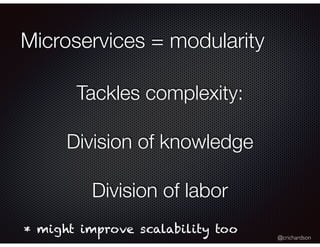
Microservices = modularity
Tackles complexity:
Division of knowledge
Division of labor
* might improve scalability too
@crichardson
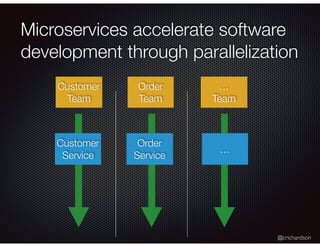
Microservices accelerate software
development through parallelization
Customer
Service
Order
Service
…
Customer
Team
Order
Team
…
Team
@crichardson
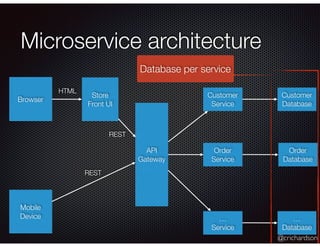
Microservice architecture
Browser
Mobile
Device
Store
Front UI
API
Gateway
Customer
Service
Order
Service
…
Service
Customer
Database
Order
Database
…
Database
HTML
REST
REST
Database per service
@crichardson
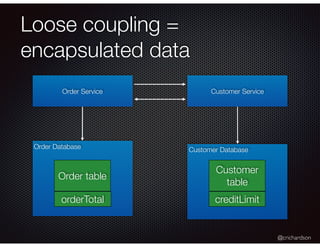
Loose coupling =
encapsulated data
Order Service Customer Service
Order Database Customer Database
Order table
Customer
table
orderTotal creditLimit
@crichardson
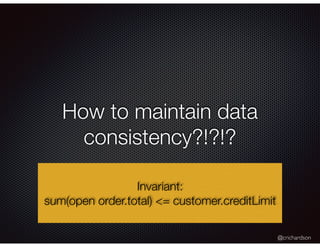
How to maintain data
consistency?!?!?
Invariant:
sum(open order.total) <= customer.creditLimit
@crichardson
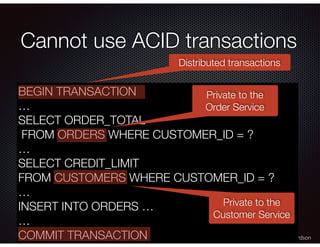
Cannot use ACID transactions
BEGIN TRANSACTION
…
SELECT ORDER_TOTAL
FROM ORDERS WHERE CUSTOMER_ID = ?
…
SELECT CREDIT_LIMIT
FROM CUSTOMERS WHERE CUSTOMER_ID = ?
…
INSERT INTO ORDERS …
…
COMMIT TRANSACTION
Private to the
Order Service
Private to the
Customer Service
Distributed transactions
@crichardson
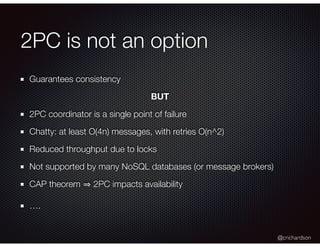
2PC is not an option
Guarantees consistency
BUT
2PC coordinator is a single point of failure
Chatty: at least O(4n) messages, with retries O(n^2)
Reduced throughput due to locks
Not supported by many NoSQL databases (or message brokers)
CAP theorem 2PC impacts availability
….
@crichardson
Agenda
ACID is not an option
Overview of sagas
Coordinating sagas
@crichardson
From a 1987 paper
@crichardson
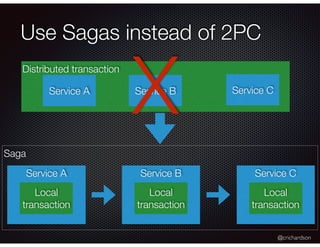
Saga
Use Sagas instead of 2PC
Distributed transaction
Service A Service B
Service A
Local
transaction
Service B
Local
transaction
Service C
Local
transaction
X Service C
@crichardson
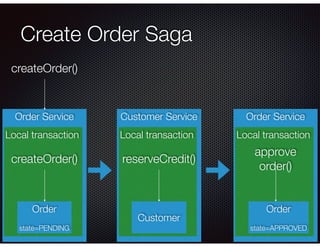
Order Service
Create Order Saga
Local transaction
Order
state=PENDING
createOrder()
Customer Service
Local transaction
Customer
reserveCredit()
Order Service
Local transaction
Order
state=APPROVED
approve
order()
createOrder()
@crichardson
If only it were this easy…
@crichardson
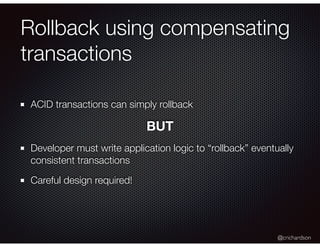
Rollback using compensating
transactions
ACID transactions can simply rollback
BUT
Developer must write application logic to “rollback” eventually
consistent transactions
Careful design required!
@crichardson
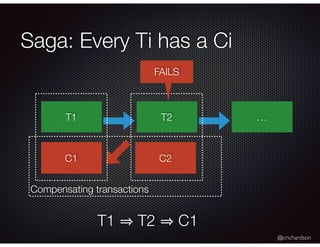
Saga: Every Ti has a Ci
T1 T2 …
C1 C2
Compensating transactions
T1 T2 C1
FAILS
@crichardson
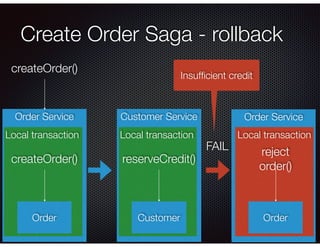
Order Service
Create Order Saga - rollback
Local transaction
Order
createOrder()
Customer Service
Local transaction
Customer
reserveCredit()
Order Service
Local transaction
Order
reject
order()
createOrder()
FAIL
Insufficient credit
@crichardson
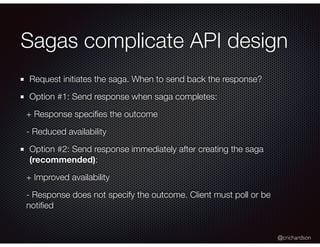
Sagas complicate API design
Request initiates the saga. When to send back the response?
Option #1: Send response when saga completes:
+ Response specifies the outcome
- Reduced availability
Option #2: Send response immediately after creating the saga
(recommended):
+ Improved availability
- Response does not specify the outcome. Client must poll or be
notified
@crichardson
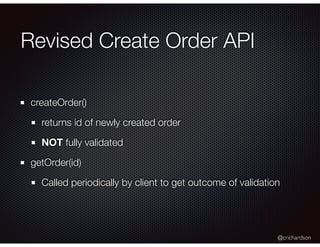
Revised Create Order API
createOrder()
returns id of newly created order
NOT fully validated
getOrder(id)
Called periodically by client to get outcome of validation
@crichardson
Minimal impact on UI
UI hides asynchronous API from the user
Saga will usually appear instantaneous (<= 100ms)
If it takes longer UI displays “processing” popup
Server can push notification to UI
@crichardson
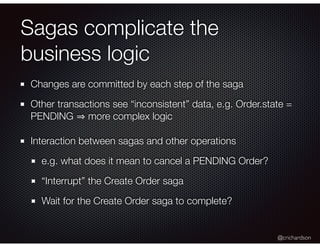
Sagas complicate the
business logic
Changes are committed by each step of the saga
Other transactions see “inconsistent” data, e.g. Order.state =
PENDING more complex logic
Interaction between sagas and other operations
e.g. what does it mean to cancel a PENDING Order?
“Interrupt” the Create Order saga
Wait for the Create Order saga to complete?
@crichardson
Agenda
ACID is not an option
Overview of sagas
Coordinating sagas
@crichardson
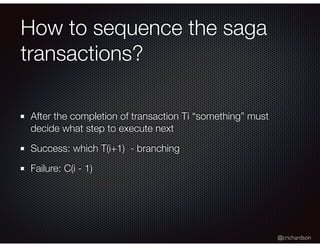
How to sequence the saga
transactions?
After the completion of transaction Ti “something” must
decide what step to execute next
Success: which T(i+1) - branching
Failure: C(i - 1)
@crichardson
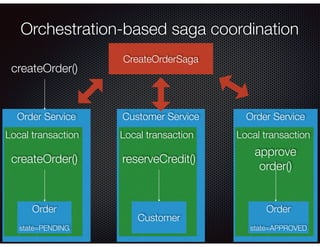
Order Service
Orchestration-based saga coordination
Local transaction
Order
state=PENDING
createOrder()
Customer Service
Local transaction
Customer
reserveCredit()
Order Service
Local transaction
Order
state=APPROVED
approve
order()
createOrder()
CreateOrderSaga
@crichardson
Complex coordination logic is
centralized 😀
@crichardson
Services expose APIs that are
invoked by saga 😄
@crichardson
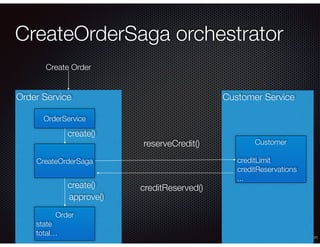
Order Service
CreateOrderSaga orchestrator
Customer Service
Create Order
Customer
creditLimit
creditReservations
...
Order
state
total…
reserveCredit()
CreateOrderSaga
OrderService
create()
create()
approve()
creditReserved()
@crichardson
Saga orchestrators are state
machines
RESERVING
CREDIT
APPROVED
REJECTED
/ customerService.
reserveCredit()
credit reserved
/ order.approve()
credit limit exceed
/ order.reject()
event [guard] / action
Initial action
reply and action
@crichardson
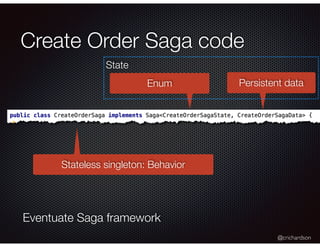
Create Order Saga code
Enum Persistent data
Stateless singleton: Behavior
Eventuate Saga framework
State
@crichardson
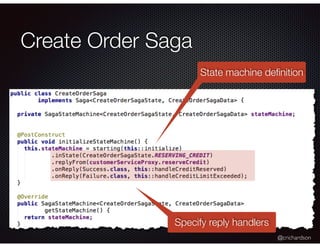
Create Order Saga
State machine definition
Specify reply handlers
@crichardson
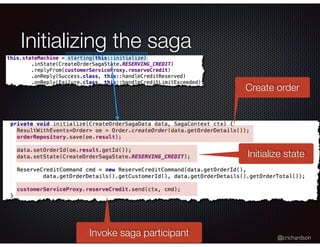
Initializing the saga
Invoke saga participant
Initialize state
Create order
@crichardson
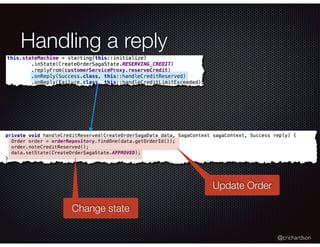
Handling a reply
Change state
Update Order
@crichardson
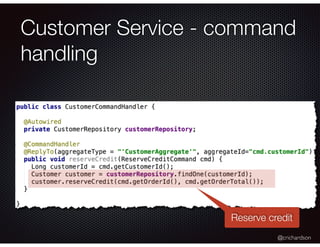
Customer Service - command
handling
Reserve credit
@crichardson
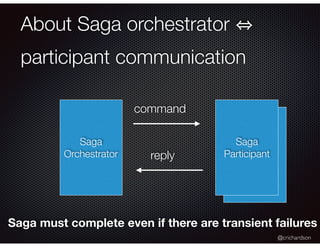
Saga
Participant
About Saga orchestrator
participant communication
Saga
Orchestrator
Saga
Participant
command
reply
Saga must complete even if there are transient failures
@crichardson
Use asynchronous
messaging
@crichardson
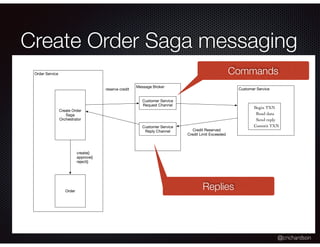
Create Order Saga messaging
Order Service
Message Broker
Customer Service
Begin TXN
Read data
Send reply
Commit TXN
Credit Reserved
Credit Limit Exceeded
Create Order
Saga
Orchestrator
reserve credit
Customer Service
Request Channel
Customer Service
Reply Channel
Order
create()
approve()
reject()
Commands
Replies
@crichardson
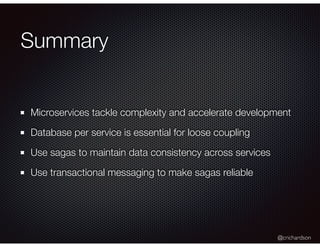
Summary
Microservices tackle complexity and accelerate development
Database per service is essential for loose coupling
Use sagas to maintain data consistency across services
Use transactional messaging to make sagas reliable
@crichardson
@crichardson chris@chrisrichardson.net
http://learnmicroservices.io
Questions?

Gluecon: Using sagas to maintain data consistency in a microservice architecture