

Decoding Digital Friends Local Social Summit 2010
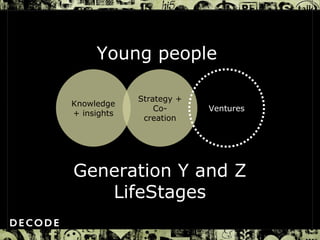
Knowledge + insights Strategy + Co-creation Ventures Young people Generation Y and Z LifeStages
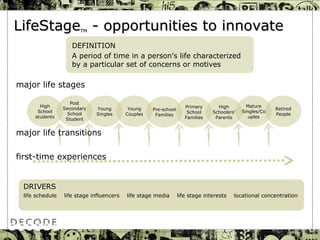
LifeStage TM  - opportunities to innovate Post Secondary School Student Young Singles High School students major life stages Young Couples Mature Singles/Couples Retired People Primary School Families High Schoolers’ Parents Pre-school Families major life transitions first-time experiences DRIVERS life schedule  life stage influencers  life stage media  life stage interests  locational concentration DEFINITION A period of time in a person's life characterized by a particular set of concerns or motives
Decoding Digital Friends study
43 Page
66 Page
The big strategic questions on social media:  Why should you invest? What is the  value  of using social media?  Who do you want to connect with? How are  relationships  being built in digital environments? What is distributed? How is  content  created and effectively distributed through networks? How will it affect behaviour? How are digital relationships  influential ?  CONFIDENTIAL  © DECODE 2010  www.decode.net   [email_address] net
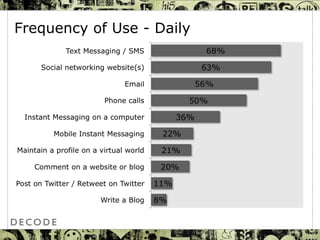
Frequency of Use - Daily
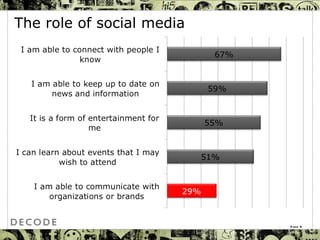
The role of social media Page
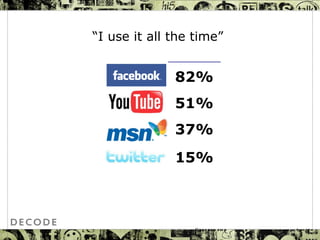
“ I use it all the time”  Page  © DECODE 2010  www.decode.net   82% 51% 37% 15%
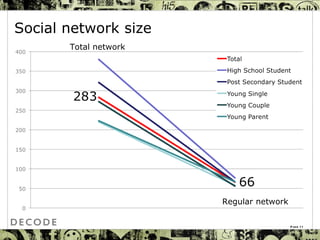
Social network size Page  Total network Regular network
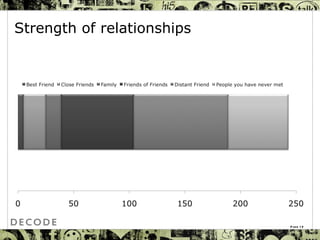
Strength of relationships Page
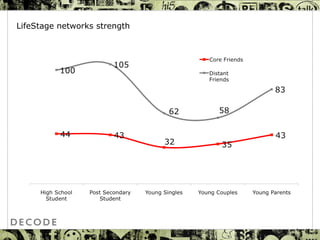
Page  LifeStage networks strength
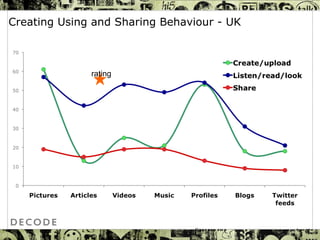
Creating Using and Sharing Behaviour - UK © DECODE 2010  www.decode.net   Page  rating
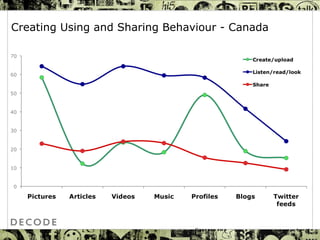
© DECODE 2010  www.decode.net   Page  Creating Using and Sharing Behaviour - Canada
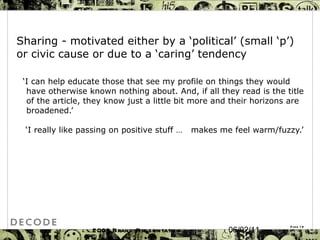
Sharing -  motivated either by a ‘political’ (small ‘p’) or civic cause or due to a ‘caring’ tendency ‘ I can help educate those that see my profile on things they would have otherwise known nothing about. And, if all they read is the title of the article, they know just a little bit more and their horizons are broadened.’ ‘ I really like passing on positive stuff …  makes me feel warm/fuzzy.’ 2009 Brand Presentation Template Page  06/02/11
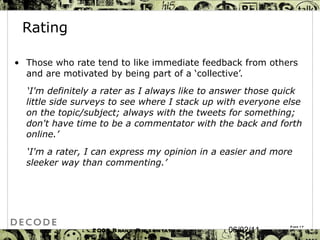
Rating Those who rate tend to like immediate feedback from others and are motivated by being part of a ‘collective’. ‘ I'm definitely a rater as I always like to answer those quick little side surveys to see where I stack up with everyone else on the topic/subject; always with the tweets for something; don't have time to be a commentator with the back and forth online.’ ‘ I'm a rater, I can express my opinion in a easier and more sleeker way than commenting.’ 2009 Brand Presentation Template Page  06/02/11
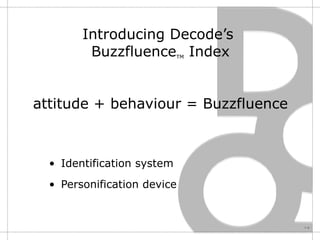
Introducing Decode’s  Buzzfluence TM  Index attitude + behaviour = Buzzfluence Identification system Personification device
Page
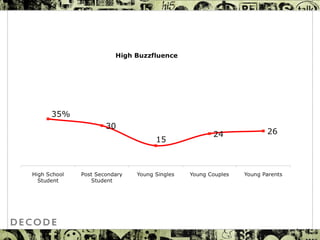
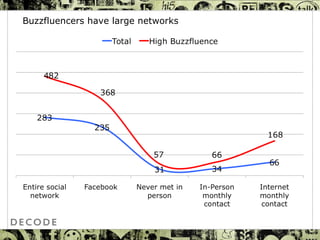
Buzzfluencers have large networks
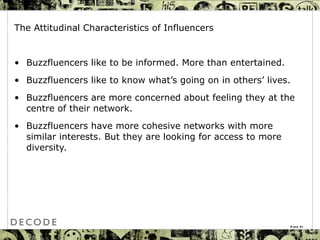
The Attitudinal Characteristics of Influencers Buzzfluencers like to be informed. More than entertained. Buzzfluencers  like to know what’s going on in others’ lives.  Buzzfluencers  are more concerned about feeling they at the centre of their network.  Buzzfluencers  have more cohesive networks with more similar interests. But they are looking for access to more diversity. Page
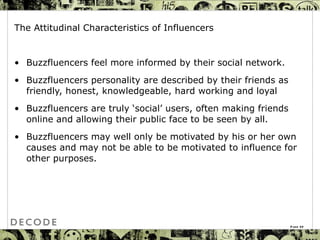
The Attitudinal Characteristics of Influencers Buzzfluencers  feel more informed by their social network.  Buzzfluencers personality are described by their friends as friendly, honest, knowledgeable, hard working and loyal  Buzzfluencers are truly ‘social’ users, often making friends online and allowing their public face to be seen by all.  Buzzfluencers may well only be motivated by his or her own causes and may not be able to be motivated to influence for other purposes. Page
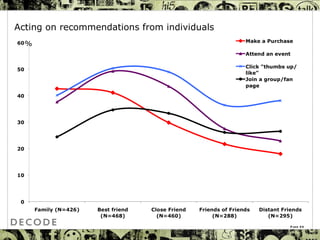
Acting on recommendations from individuals Page  %
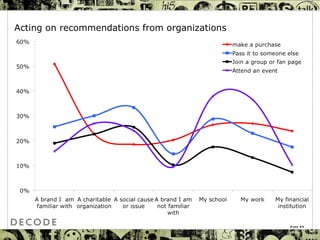
Acting on recommendations from organizations Page
Digital Brand Relationships  Page
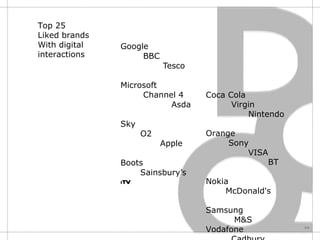
Google  BBC  Tesco  Microsoft  Channel 4  Asda  Sky  O2  Apple  Boots  Sainsbury’s iTV  Coca Cola  Virgin  Nintendo  Orange  Sony  VISA  BT  Nokia  McDonald's  Samsung  M&S Vodafone  Cadbury Top 25 Liked brands With digital interactions
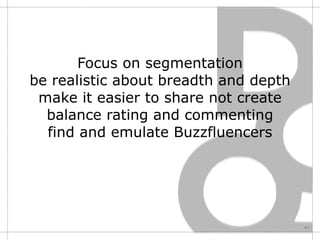
Focus on segmentation be realistic about breadth and depth make it easier to share not create balance rating and commenting find and emulate Buzzfluencers
Please connect Robert Barnard [email_address] +44 793 3014461

DECODE presents at Local Social Summit 2010

  • 1.
    Decoding Digital FriendsLocal Social Summit 2010
  • 2.
    Knowledge + insightsStrategy + Co-creation Ventures Young people Generation Y and Z LifeStages
  • 3.
    LifeStage TM - opportunities to innovate Post Secondary School Student Young Singles High School students major life stages Young Couples Mature Singles/Couples Retired People Primary School Families High Schoolers’ Parents Pre-school Families major life transitions first-time experiences DRIVERS life schedule life stage influencers life stage media life stage interests locational concentration DEFINITION A period of time in a person's life characterized by a particular set of concerns or motives
  • 4.
  • 5.
  • 6.
  • 7.
    The big strategicquestions on social media: Why should you invest? What is the value of using social media? Who do you want to connect with? How are relationships being built in digital environments? What is distributed? How is content created and effectively distributed through networks? How will it affect behaviour? How are digital relationships influential ? CONFIDENTIAL © DECODE 2010 www.decode.net [email_address] net
  • 8.
  • 9.
    The role ofsocial media Page
  • 10.
    “ I useit all the time” Page © DECODE 2010 www.decode.net 82% 51% 37% 15%
  • 11.
    Social network sizePage Total network Regular network
  • 12.
  • 13.
    Page LifeStagenetworks strength
  • 14.
    Creating Using andSharing Behaviour - UK © DECODE 2010 www.decode.net Page rating
  • 15.
    © DECODE 2010 www.decode.net Page Creating Using and Sharing Behaviour - Canada
  • 16.
    Sharing - motivated either by a ‘political’ (small ‘p’) or civic cause or due to a ‘caring’ tendency ‘ I can help educate those that see my profile on things they would have otherwise known nothing about. And, if all they read is the title of the article, they know just a little bit more and their horizons are broadened.’ ‘ I really like passing on positive stuff … makes me feel warm/fuzzy.’ 2009 Brand Presentation Template Page 06/02/11
  • 17.
    Rating Those whorate tend to like immediate feedback from others and are motivated by being part of a ‘collective’. ‘ I'm definitely a rater as I always like to answer those quick little side surveys to see where I stack up with everyone else on the topic/subject; always with the tweets for something; don't have time to be a commentator with the back and forth online.’ ‘ I'm a rater, I can express my opinion in a easier and more sleeker way than commenting.’ 2009 Brand Presentation Template Page 06/02/11
  • 18.
    Introducing Decode’s Buzzfluence TM Index attitude + behaviour = Buzzfluence Identification system Personification device
  • 19.
  • 20.
  • 21.
    The Attitudinal Characteristicsof Influencers Buzzfluencers like to be informed. More than entertained. Buzzfluencers like to know what’s going on in others’ lives. Buzzfluencers are more concerned about feeling they at the centre of their network. Buzzfluencers have more cohesive networks with more similar interests. But they are looking for access to more diversity. Page
  • 22.
    The Attitudinal Characteristicsof Influencers Buzzfluencers feel more informed by their social network. Buzzfluencers personality are described by their friends as friendly, honest, knowledgeable, hard working and loyal Buzzfluencers are truly ‘social’ users, often making friends online and allowing their public face to be seen by all. Buzzfluencers may well only be motivated by his or her own causes and may not be able to be motivated to influence for other purposes. Page
  • 23.
    Acting on recommendationsfrom individuals Page %
  • 24.
    Acting on recommendationsfrom organizations Page
  • 25.
  • 26.
    Google BBC Tesco Microsoft Channel 4 Asda Sky O2 Apple Boots Sainsbury’s iTV Coca Cola Virgin Nintendo Orange Sony VISA BT Nokia McDonald's Samsung M&S Vodafone Cadbury Top 25 Liked brands With digital interactions
  • 27.
    Focus on segmentationbe realistic about breadth and depth make it easier to share not create balance rating and commenting find and emulate Buzzfluencers
  • 28.
    Please connect RobertBarnard [email_address] +44 793 3014461

Editor's Notes

  • #9 Twitter and Blogs are more used with less frequency (every two weeks, once a month, or every several months): 19% Post on twitter, 26.7% write a blog, and 37.9% comment a blog Twitting and writing blogs are more frequent among older groups like young parents and men.
  • #11 Youtube is driven by the younger three groups. Msn is driven by youngest group. LinkedIn is mostly used by young parents (daily). Reading twitter is mainly young parents and to some extent young singles. So much of the conversation is now taking place on only 3 platforms. While Twitter is creeping up the ranks it has a noticeably older skew
  • #14 The number of friends in a network decreases for young singles (largely due to them dropping their post-secondary friends). Numbers increase for young couples, as they incorporate their partner’s network into their own. However, across all life-stages the numbers of close and best friends are approximately the same but the number of family decrease for young singles. School friends decrease over time and work place friends increase.
  • #15 -The high percentage of people who look at/watch/listen pictures, videos, and music is associated with one of the main social media value: entertainment (65% of users say that social media ‘it’s a form of entertainment for me’). - The high percentage of people who create, look, comment Profiles can be explained by the fact that 55% of ‘profiles users’ are ‘gossip’, they agree with the following statement: “I like to feel I can see what’s going on in the lives of others.’ 58% of ‘profiles-commenter’ also agree with that. The profile-creators tend to have more profiles than the total sample (5 in average) and maintain them most frequent (43% against 35% total) Young couples and women tend to read public forums most. The latter along with high school students comment the most on public forums. Although creating and uploading music is dominated by high school students, they don’t tend to create/share/read blogs, twitter, and podcasts. Young singles, couples, and parents blog more than young students. Young parents use Twitter most. Podscasts and twitter are most used by men
  • #16 -The high percentage of people who look at/watch/listen pictures, videos, and music is associated with one of the main social media value: entertainment (65% of users say that social media ‘it’s a form of entertainment for me’). - The high percentage of people who create, look, comment Profiles can be explained by the fact that 55% of ‘profiles users’ are ‘gossip’, they agree with the following statement: “I like to feel I can see what’s going on in the lives of others.’ 58% of ‘profiles-commenter’ also agree with that. The profile-creators tend to have more profiles than the total sample (5 in average) and maintain them most frequent (43% against 35% total) Young couples and women tend to read public forums most. The latter along with high school students comment the most on public forums. Although creating and uploading music is dominated by high school students, they don’t tend to create/share/read blogs, twitter, and podcasts. Young singles, couples, and parents blog more than young students. Young parents use Twitter most. Podscasts and twitter are most used by men
  • #20 The number of friends in a network decreases for young singles (largely due to them dropping their post-secondary friends). Numbers increase for young couples, as they incorporate their partner’s network into their own. However, across all life-stages the numbers of close and best friends are approximately the same but the number of family decrease for young singles. School friends decrease over time and work place friends increase.
  • #21 The size of the online and offline social network increases by the grade of influence. Among high internet influencer, the social network size is larger for students than non-students. Students have a large number of in-person contacts while non-students have more online contacts that they never met in person.