Declarative input validation
with JSR 303 and ExtVal
April 13th, 2011 – Bart Kummel
Who am I?


●   Bart Kummel
●   10 years experience
    in software development
    ●   Of which 6 years in Java EE
●   Consultant @ Transfer Solutions,
    Leerdam, NL
●   Competence manager @
    Transfer Solutions, Leerdam, NL
●   Author of Apache MyFaces 1.2
    Web Application Development
    ●   See http://tinyurl.com/am12wad


                                         2
Photo: Salar de Uyuni, Bolivia; © 2010 by Bart Kummel   3
Don’t Repeat Yourself


●   Less code = less bugs

●   Duplicated code = duplicated bugs

●   Duplicated code = duplicated maintenance

●   Dupliacted maintenance = forgotten maintenance


                                                     4
DRY violations in classic Java EE apps


●   Validation is programmed in Model beans
    ●   Because that’s where it belongs

●   Validation is repeated in View layer
    ●   Because you have to use JSF Validators

●   Validation is even repeated multiple times in the View
    ●   Because the same bean is used in multiple JSF pages


                                                              5
Let’s fix this


●   Remove validation code from View
●   Let View generate validation based on Model


How to fix it?

●   That’s why Bean Validation (JSR 303) was created


                                                       6
JSR 303: the idea


●   Standardized way to express validation constraints

●   Any UI technology can interpret those constraints and enforce
    them

●   Non-UI technologies can also use the validation information


                                                                    7
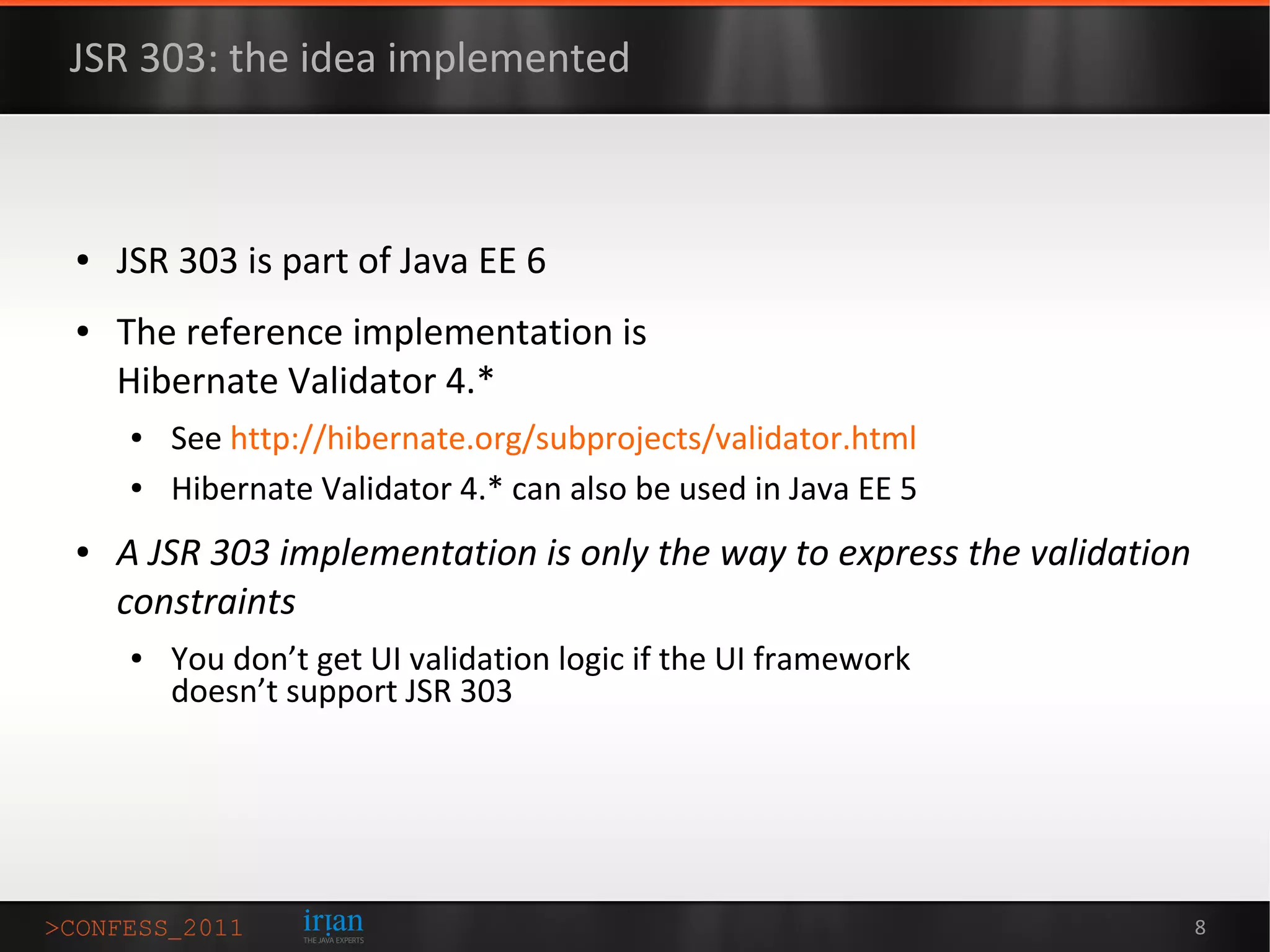
JSR 303: the idea implemented


●   JSR 303 is part of Java EE 6
●   The reference implementation is
    Hibernate Validator 4.*
    ●   See http://hibernate.org/subprojects/validator.html
    ●   Hibernate Validator 4.* can also be used in Java EE 5
●   A JSR 303 implementation is only the way to express the validation
    constraints
    ●   You don’t get UI validation logic if the UI framework
        doesn’t support JSR 303


                                                                         8
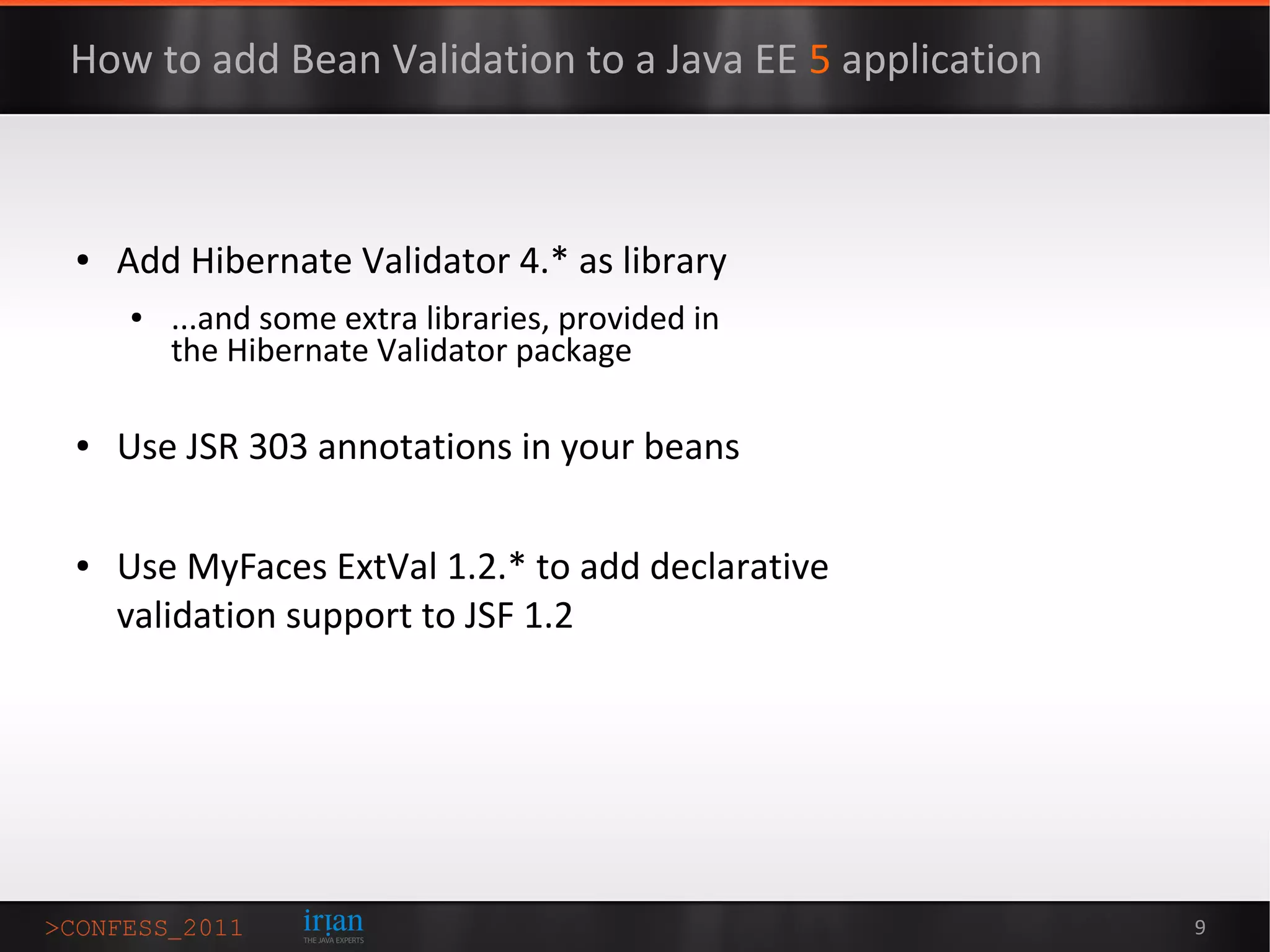
How to add Bean Validation to a Java EE 5 application


●   Add Hibernate Validator 4.* as library
    ●   ...and some extra libraries, provided in
        the Hibernate Validator package

●   Use JSR 303 annotations in your beans

●   Use MyFaces ExtVal 1.2.* to add declarative
    validation support to JSF 1.2


                                                        9
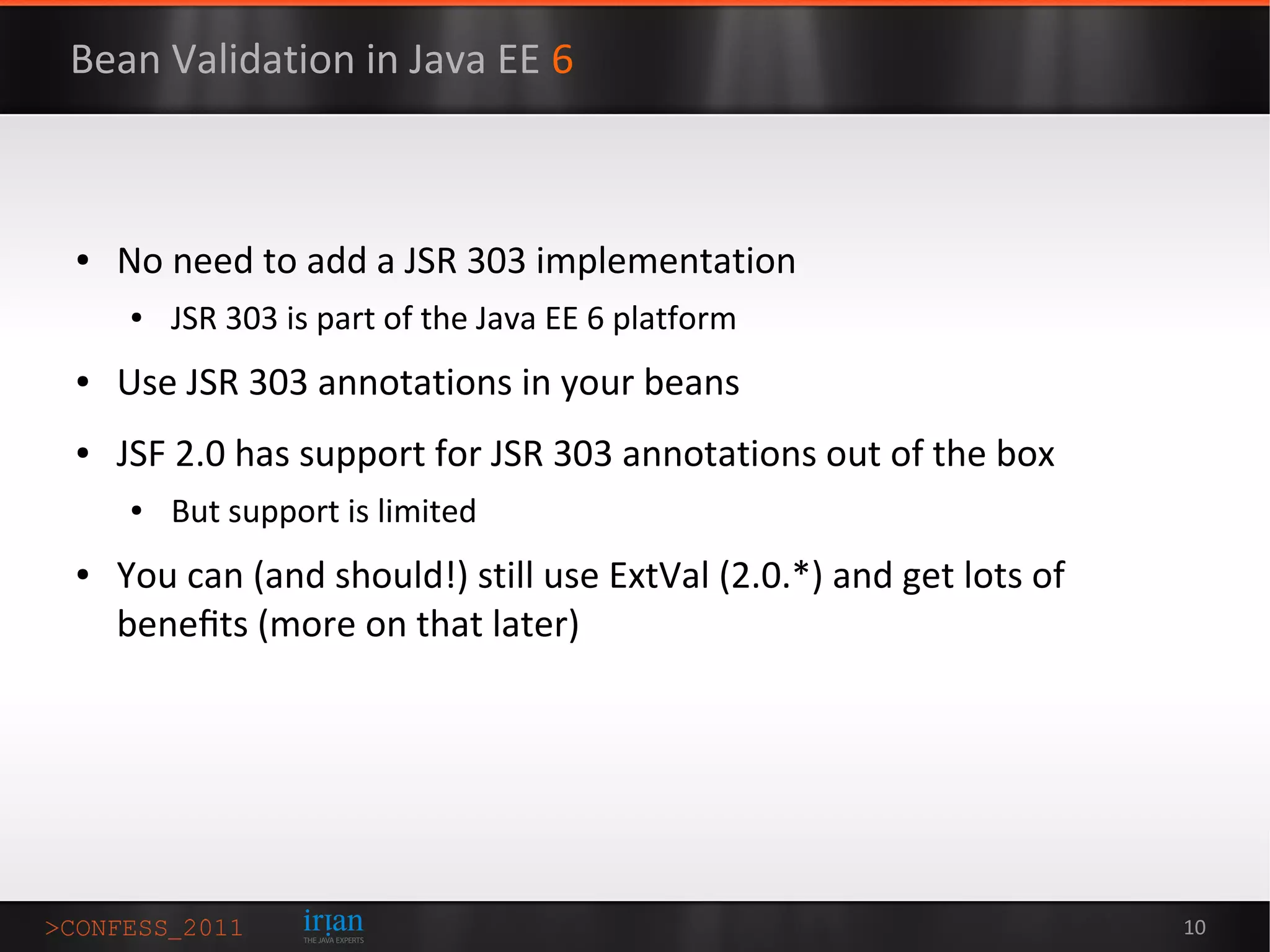
Bean Validation in Java EE 6


●   No need to add a JSR 303 implementation
    ●   JSR 303 is part of the Java EE 6 platform
●   Use JSR 303 annotations in your beans
●   JSF 2.0 has support for JSR 303 annotations out of the box
    ●   But support is limited
●   You can (and should!) still use ExtVal (2.0.*) and get lots of
    benefits (more on that later)


                                                                     10
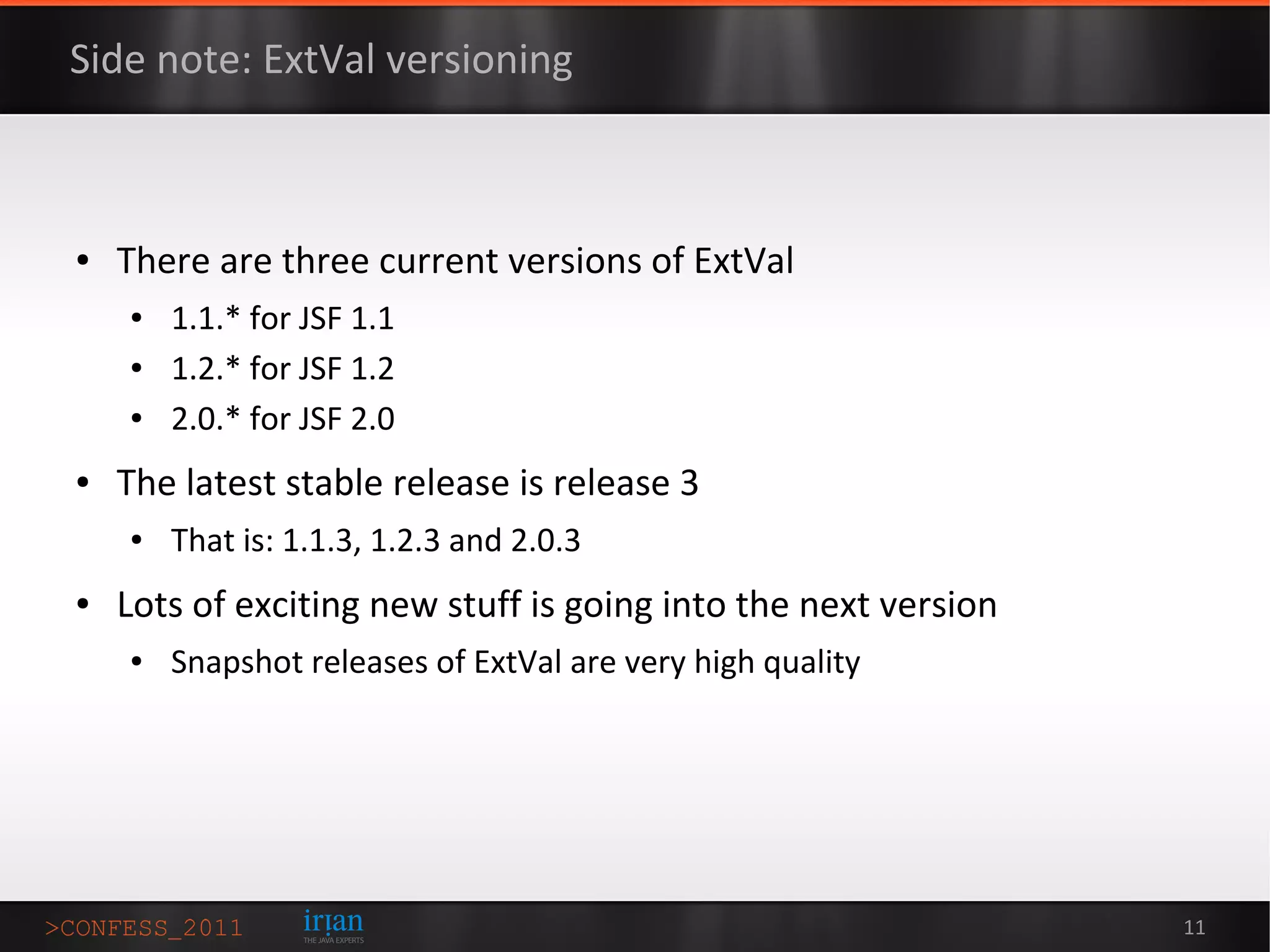
Side note: ExtVal versioning


●   There are three current versions of ExtVal
    ●   1.1.* for JSF 1.1
    ●   1.2.* for JSF 1.2
    ●   2.0.* for JSF 2.0
●   The latest stable release is release 3
    ●   That is: 1.1.3, 1.2.3 and 2.0.3
●   Lots of exciting new stuff is going into the next version
    ●   Snapshot releases of ExtVal are very high quality


                                                                11
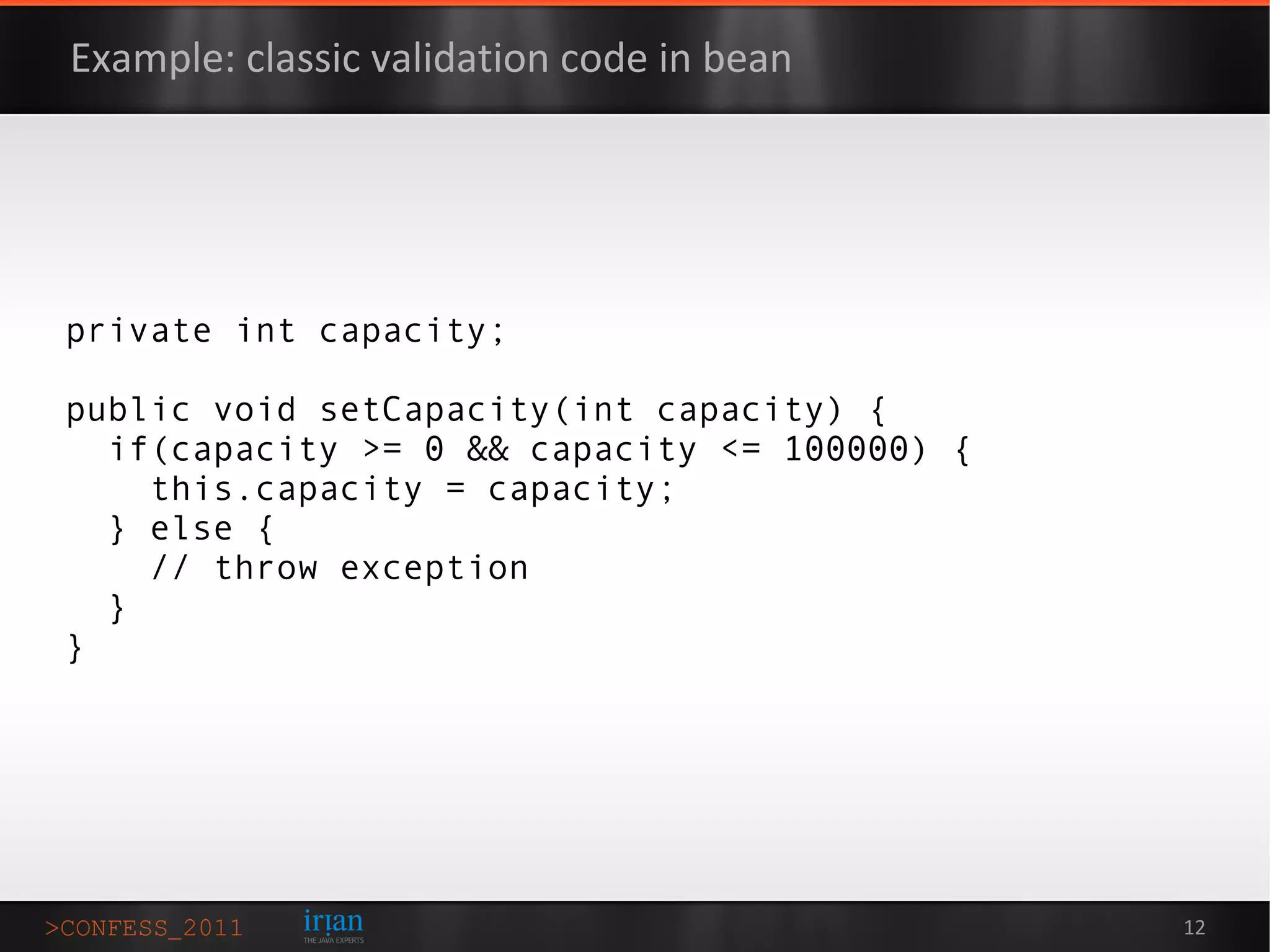
Example: classic validation code in bean


private int capacity;

public void setCapacity(int capacity) {
  if(capacity >= 0 && capacity <= 100000) {
    this.capacity = capacity;
  } else {
    // throw exception
  }
}


                                              12
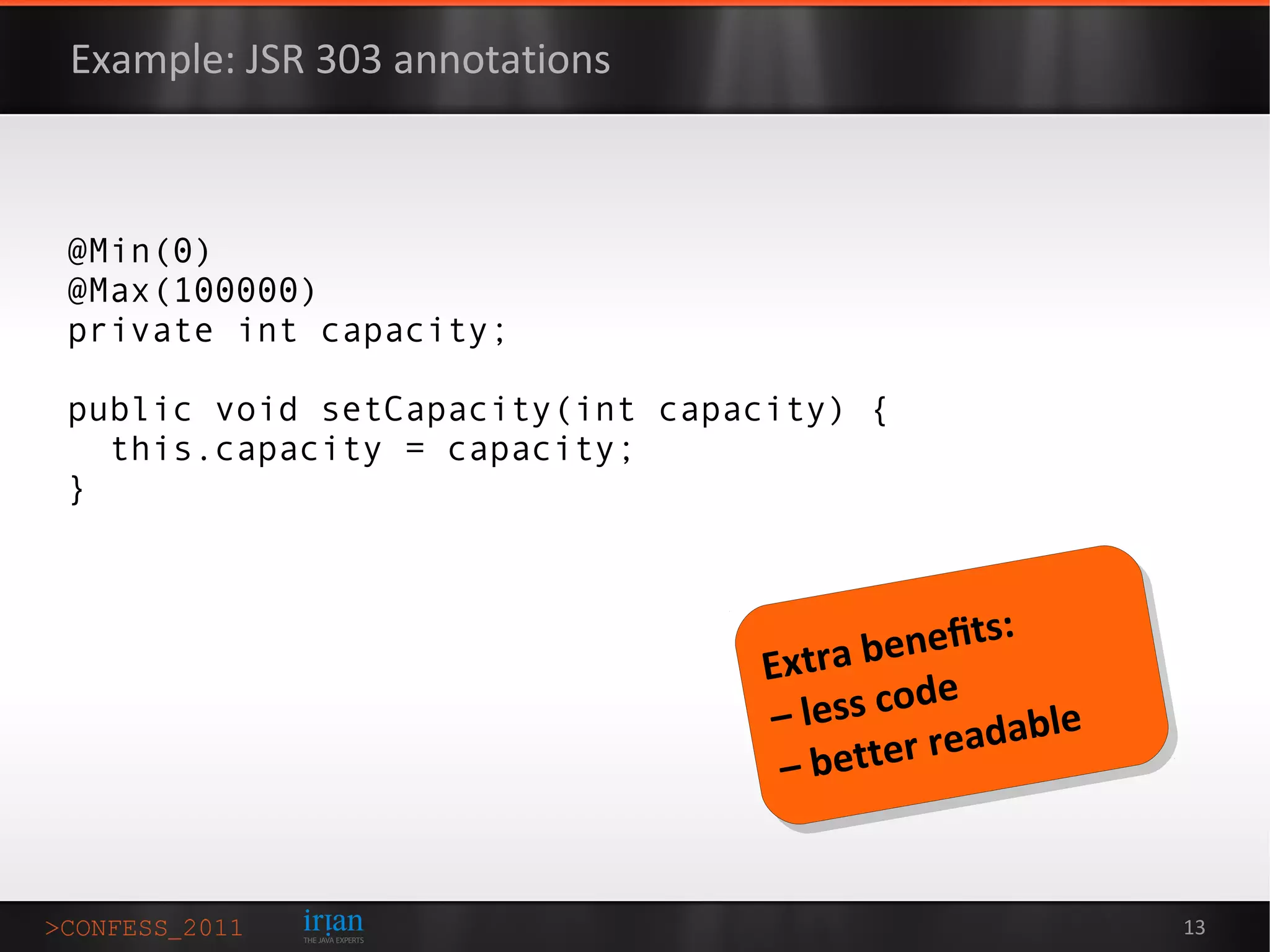
Example: JSR 303 annotations


@Min(0)
@Max(100000)
private int capacity;

public void setCapacity(int capacity) {
  this.capacity = capacity;
}


                                         enefits:
                                 Extra b
                                 – less code
                                             eadable
                                  – better r


                                                       13
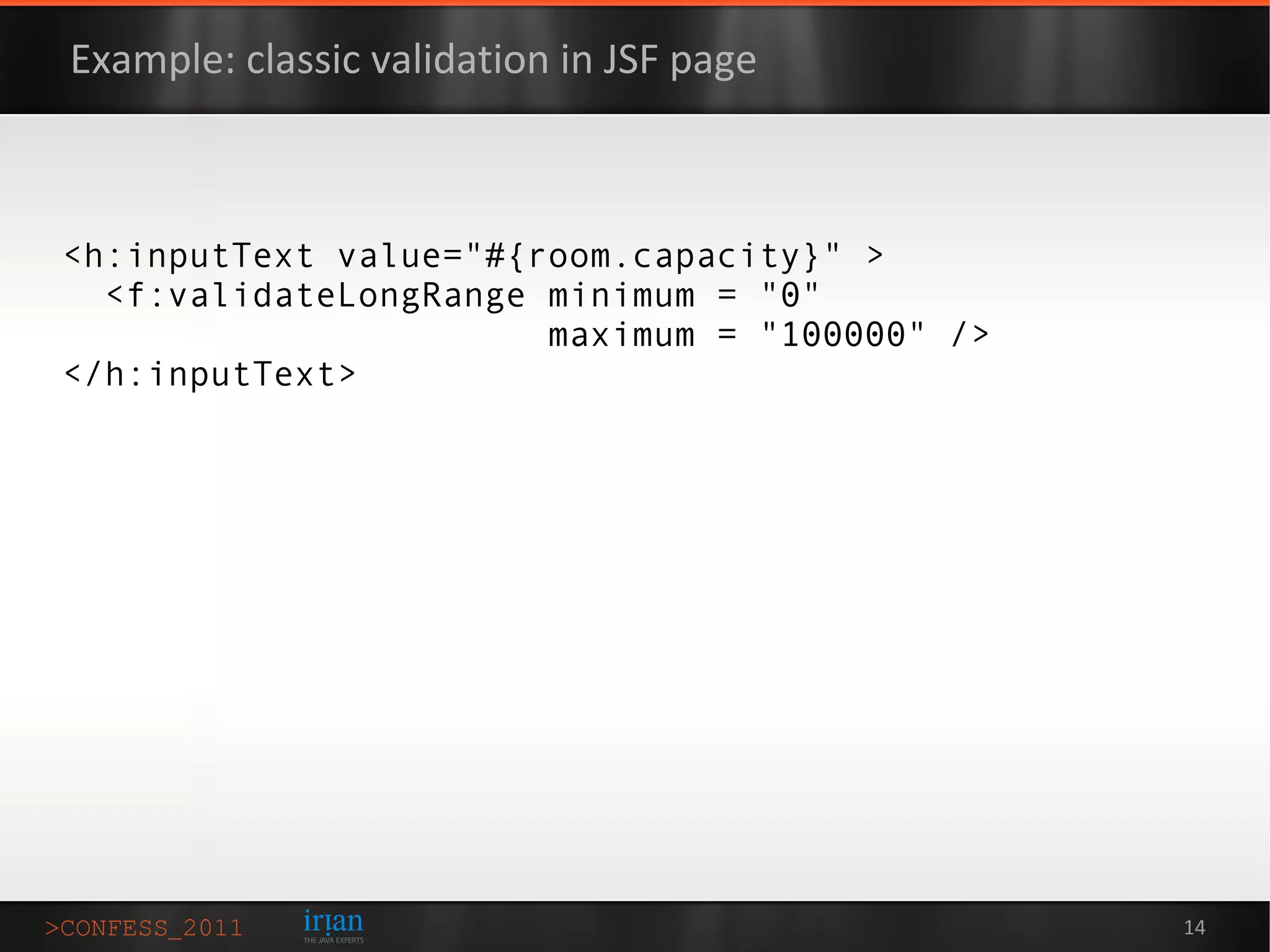
Example: classic validation in JSF page


<h:inputText value="#{room.capacity}" >
  <f:validateLongRange minimum = "0"
                       maximum = "100000" />
</h:inputText>


                                               14
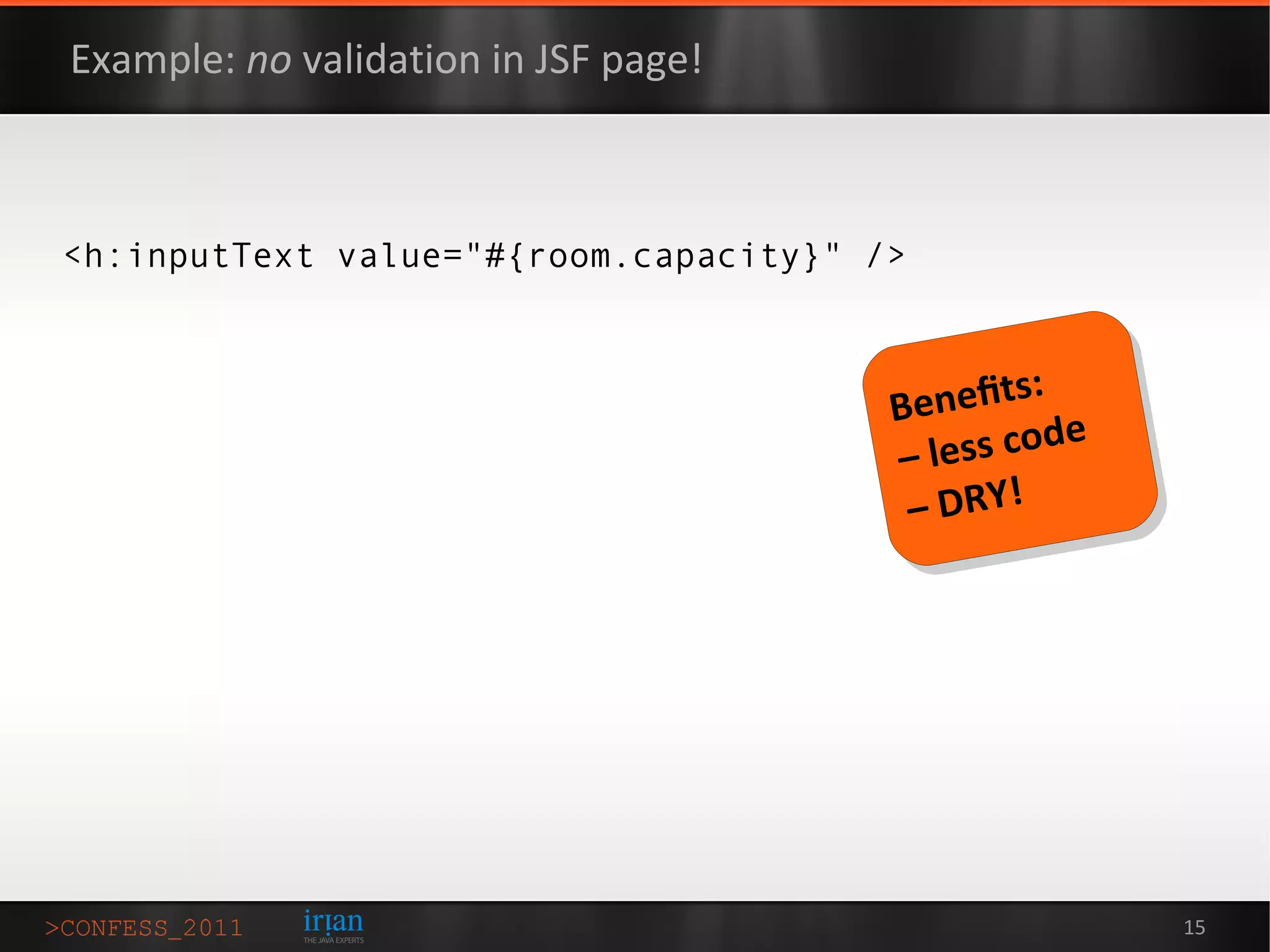
Example: no validation in JSF page!


<h:inputText value="#{room.capacity}" />


                                           15
Demo 1:
Bean Validation basics in Java EE 6
So why do we need ExtVal?


●   To use Bean Validation in Java EE 5 / JSF 1.2

●   To have advanced options in Java EE 6


                                                    17
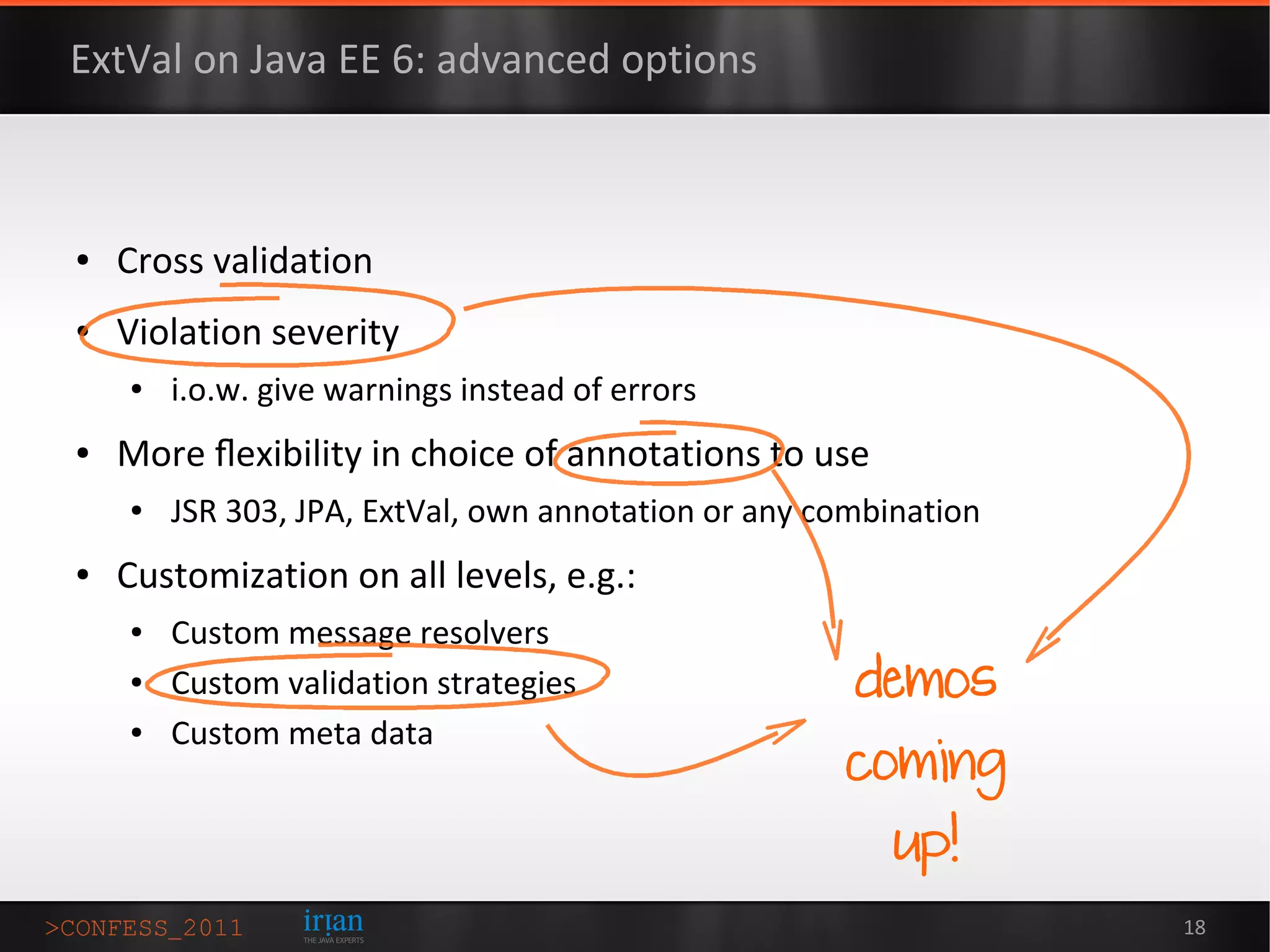
ExtVal on Java EE 6: advanced options


●   Cross validation
●   Violation severity
    ●   i.o.w. give warnings instead of errors
●   More flexibility in choice of annotations to use
    ●   JSR 303, JPA, ExtVal, own annotation or any combination
●   Customization on all levels, e.g.:
    ●   Custom message resolvers
    ●   Custom validation strategies                  demos
        Custom meta data
                                                     coming
    ●


                                                         up!
                                                                  18
Configuring ExtVal


●   Just add the ExtVal .jar files to your project


                                                    19
Demo 2:
Adding the ExtVal .jar files to our project
Cross validation


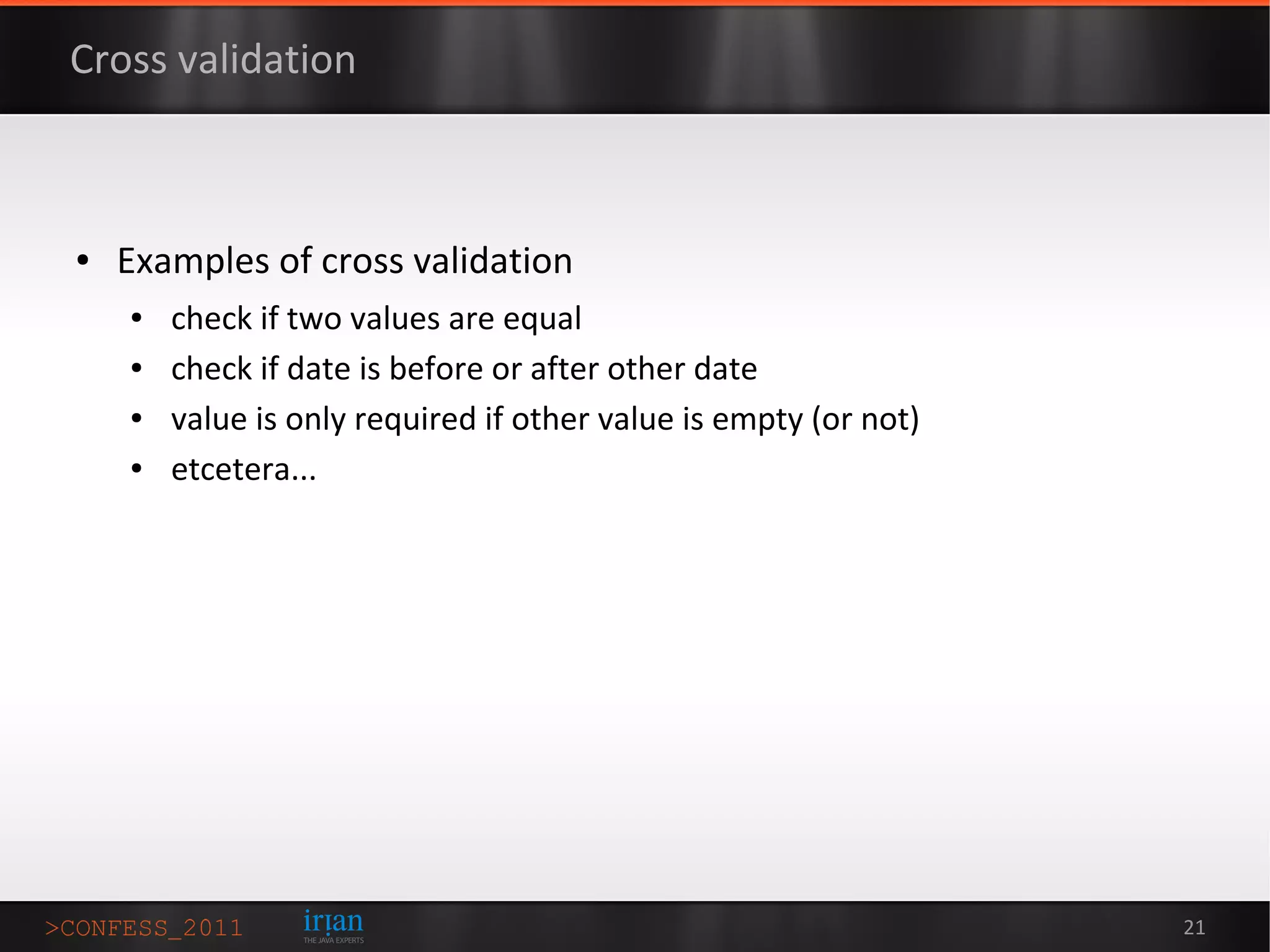
●   Examples of cross validation
    ●   check if two values are equal
    ●   check if date is before or after other date
    ●   value is only required if other value is empty (or not)
    ●   etcetera...


                                                                  21
Demo 3:
Cross validation
Demo 3 – Summary


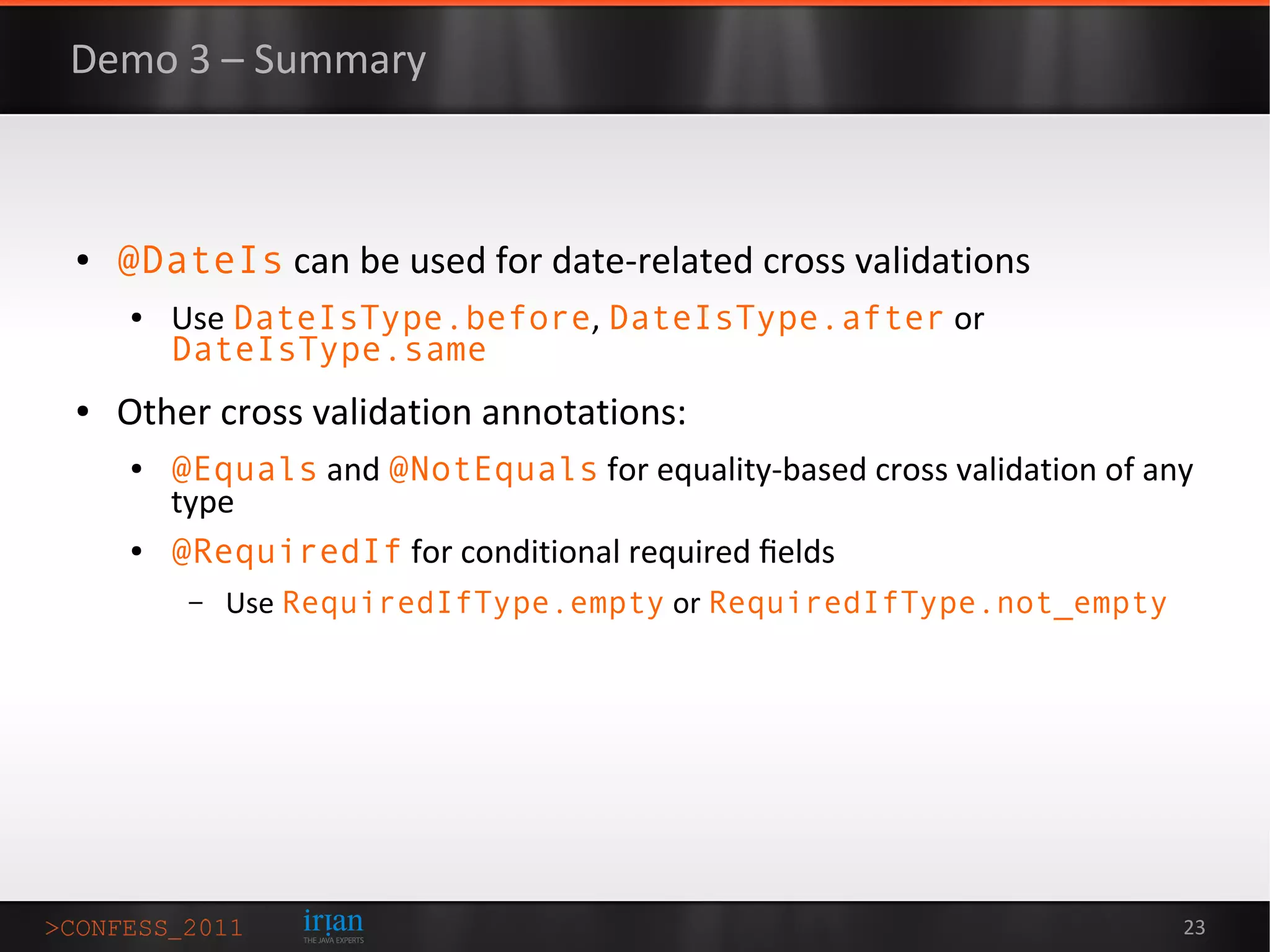
●   @DateIs can be used for date-related cross validations
    ●   Use DateIsType.before, DateIsType.after or
        DateIsType.same
●   Other cross validation annotations:
    ●   @Equals and @NotEquals for equality-based cross validation of any
        type
    ●   @RequiredIf for conditional required fields
         –   Use RequiredIfType.empty or RequiredIfType.not_empty


                                                                        23
Violation severity


●   Give certain validation rules a severity level of “warning”

●   A warning will be given to the user, but “invalid” data can be
    submitted


                                                                     24
Demo 4:
Setting violation severity to “warning”
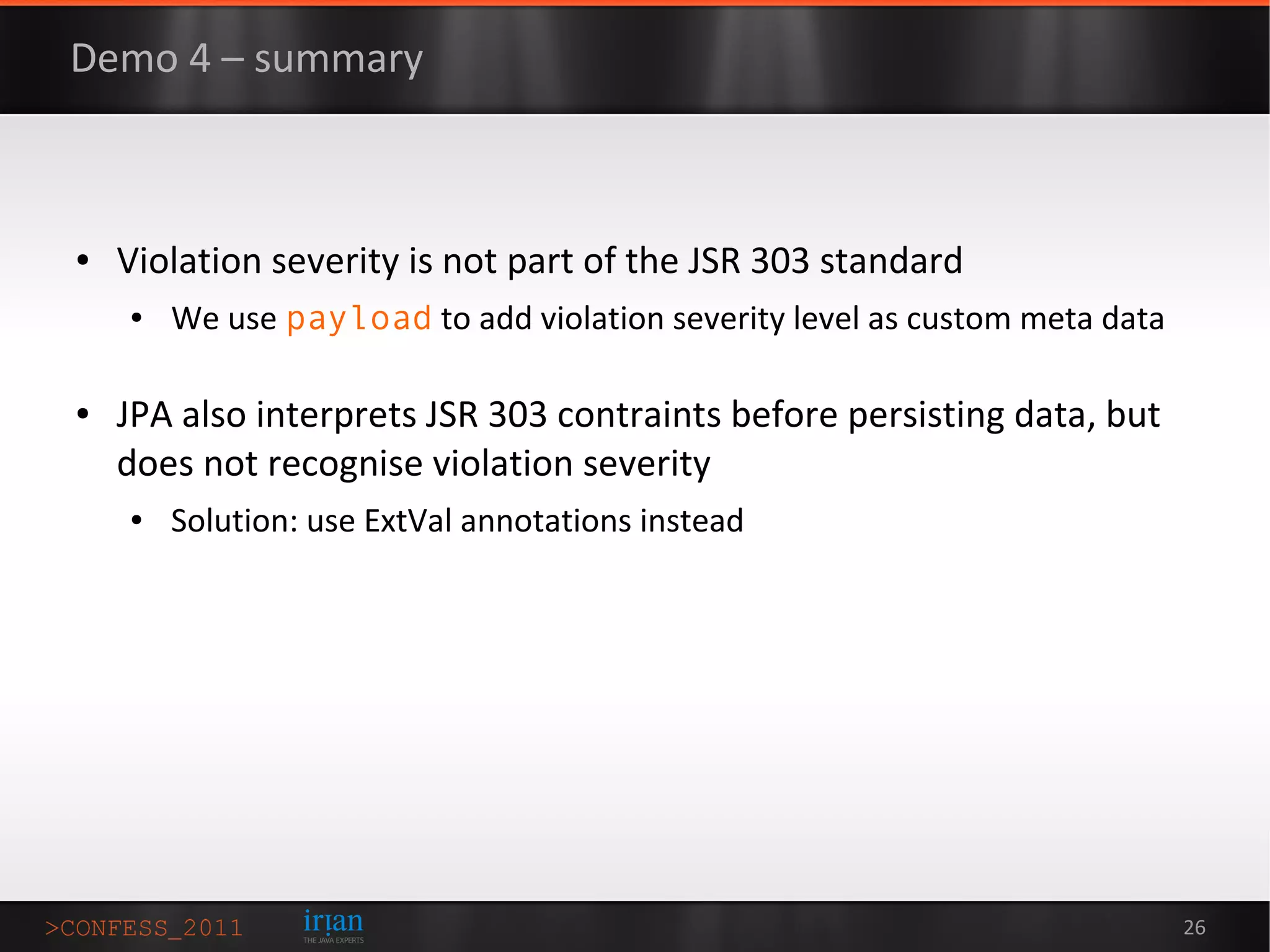
Demo 4 – summary


●   Violation severity is not part of the JSR 303 standard
    ●   We use payload to add violation severity level as custom meta data

●   JPA also interprets JSR 303 contraints before persisting data, but
    does not recognise violation severity
    ●   Solution: use ExtVal annotations instead


                                                                             26
Customization on all levels


 ●   ExtVal is full of customization hooks

 ●   A lot of ready-made add-ons are available
     ●   see http://os890.blogspot.com


                                                 27
Demo 5:
Creating a custom annotation and a
custom validation strategy
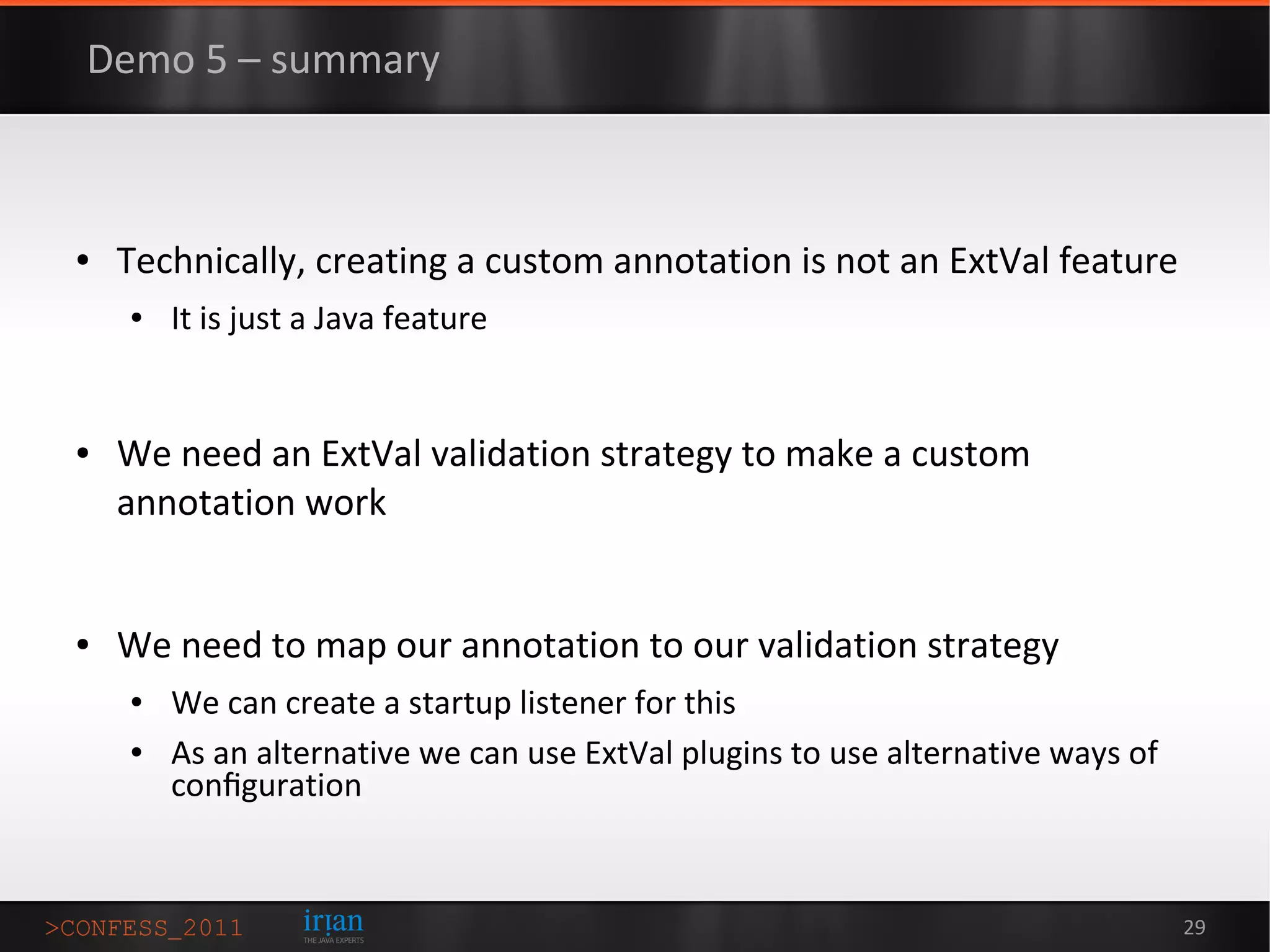
Demo 5 – summary


●   Technically, creating a custom annotation is not an ExtVal feature
    ●   It is just a Java feature


●   We need an ExtVal validation strategy to make a custom
    annotation work


●   We need to map our annotation to our validation strategy
    ●   We can create a startup listener for this
    ●   As an alternative we can use ExtVal plugins to use alternative ways of
        configuration


                                                                                 29
Summary


●   With annotation based validation, we can
    finally create DRY JSF applications

●   ExtVal gives us the opportunity to use
    annotation-based validation on Java EE 5

●   On Java EE 6, ExtVal gives us:
    ●   More powerful annotation-based validation
    ●   More flexibility


                                                    30
More info...

●   Workshop tomorrow: ‘Rule your model with Bean-Validation’
    ●   08:00 – 10:00, Room 2 – Gerhard Petracek

●   I will put links to slides & demo code on my blog
    ●   http://www.bartkummel.net

●   Chapter 10 of MyFaces 1.2
    Web Application Development
    ●   http://tinyurl.com/am12wad

●   MyFaces ExtVal:
    ●   http://myfaces.apache.org/extensions/validator
    ●   http://os890.blogspot.com/

                                                                31
Questions & answers


     A wise man can learn more from a
    foolish question than a fool can learn
             from a wise answer.
                                  Bruce Lee


                                              32

Declarative Input Validation with JSR 303 and ExtVal

  • 1.
    Declarative input validation withJSR 303 and ExtVal April 13th, 2011 – Bart Kummel
  • 2.
    Who am I? ● Bart Kummel ● 10 years experience in software development ● Of which 6 years in Java EE ● Consultant @ Transfer Solutions, Leerdam, NL ● Competence manager @ Transfer Solutions, Leerdam, NL ● Author of Apache MyFaces 1.2 Web Application Development ● See http://tinyurl.com/am12wad 2
  • 3.
    Photo: Salar deUyuni, Bolivia; © 2010 by Bart Kummel 3
  • 4.
    Don’t Repeat Yourself ● Less code = less bugs ● Duplicated code = duplicated bugs ● Duplicated code = duplicated maintenance ● Dupliacted maintenance = forgotten maintenance 4
  • 5.
    DRY violations inclassic Java EE apps ● Validation is programmed in Model beans ● Because that’s where it belongs ● Validation is repeated in View layer ● Because you have to use JSF Validators ● Validation is even repeated multiple times in the View ● Because the same bean is used in multiple JSF pages 5
  • 6.
    Let’s fix this ● Remove validation code from View ● Let View generate validation based on Model How to fix it? ● That’s why Bean Validation (JSR 303) was created 6
  • 7.
    JSR 303: theidea ● Standardized way to express validation constraints ● Any UI technology can interpret those constraints and enforce them ● Non-UI technologies can also use the validation information 7
  • 8.
    JSR 303: theidea implemented ● JSR 303 is part of Java EE 6 ● The reference implementation is Hibernate Validator 4.* ● See http://hibernate.org/subprojects/validator.html ● Hibernate Validator 4.* can also be used in Java EE 5 ● A JSR 303 implementation is only the way to express the validation constraints ● You don’t get UI validation logic if the UI framework doesn’t support JSR 303 8
  • 9.
    How to addBean Validation to a Java EE 5 application ● Add Hibernate Validator 4.* as library ● ...and some extra libraries, provided in the Hibernate Validator package ● Use JSR 303 annotations in your beans ● Use MyFaces ExtVal 1.2.* to add declarative validation support to JSF 1.2 9
  • 10.
    Bean Validation inJava EE 6 ● No need to add a JSR 303 implementation ● JSR 303 is part of the Java EE 6 platform ● Use JSR 303 annotations in your beans ● JSF 2.0 has support for JSR 303 annotations out of the box ● But support is limited ● You can (and should!) still use ExtVal (2.0.*) and get lots of benefits (more on that later) 10
  • 11.
    Side note: ExtValversioning ● There are three current versions of ExtVal ● 1.1.* for JSF 1.1 ● 1.2.* for JSF 1.2 ● 2.0.* for JSF 2.0 ● The latest stable release is release 3 ● That is: 1.1.3, 1.2.3 and 2.0.3 ● Lots of exciting new stuff is going into the next version ● Snapshot releases of ExtVal are very high quality 11
  • 12.
    Example: classic validationcode in bean private int capacity; public void setCapacity(int capacity) { if(capacity >= 0 && capacity <= 100000) { this.capacity = capacity; } else { // throw exception } } 12
  • 13.
    Example: JSR 303annotations @Min(0) @Max(100000) private int capacity; public void setCapacity(int capacity) { this.capacity = capacity; } enefits: Extra b – less code eadable – better r 13
  • 14.
    Example: classic validationin JSF page <h:inputText value="#{room.capacity}" > <f:validateLongRange minimum = "0" maximum = "100000" /> </h:inputText> 14
  • 15.
    Example: no validationin JSF page! <h:inputText value="#{room.capacity}" /> 15
  • 16.
    Demo 1: Bean Validationbasics in Java EE 6
  • 17.
    So why dowe need ExtVal? ● To use Bean Validation in Java EE 5 / JSF 1.2 ● To have advanced options in Java EE 6 17
  • 18.
    ExtVal on JavaEE 6: advanced options ● Cross validation ● Violation severity ● i.o.w. give warnings instead of errors ● More flexibility in choice of annotations to use ● JSR 303, JPA, ExtVal, own annotation or any combination ● Customization on all levels, e.g.: ● Custom message resolvers ● Custom validation strategies demos Custom meta data coming ● up! 18
  • 19.
    Configuring ExtVal ● Just add the ExtVal .jar files to your project 19
  • 20.
    Demo 2: Adding theExtVal .jar files to our project
  • 21.
    Cross validation ● Examples of cross validation ● check if two values are equal ● check if date is before or after other date ● value is only required if other value is empty (or not) ● etcetera... 21
  • 22.
  • 23.
    Demo 3 –Summary ● @DateIs can be used for date-related cross validations ● Use DateIsType.before, DateIsType.after or DateIsType.same ● Other cross validation annotations: ● @Equals and @NotEquals for equality-based cross validation of any type ● @RequiredIf for conditional required fields – Use RequiredIfType.empty or RequiredIfType.not_empty 23
  • 24.
    Violation severity ● Give certain validation rules a severity level of “warning” ● A warning will be given to the user, but “invalid” data can be submitted 24
  • 25.
    Demo 4: Setting violationseverity to “warning”
  • 26.
    Demo 4 –summary ● Violation severity is not part of the JSR 303 standard ● We use payload to add violation severity level as custom meta data ● JPA also interprets JSR 303 contraints before persisting data, but does not recognise violation severity ● Solution: use ExtVal annotations instead 26
  • 27.
    Customization on alllevels ● ExtVal is full of customization hooks ● A lot of ready-made add-ons are available ● see http://os890.blogspot.com 27
  • 28.
    Demo 5: Creating acustom annotation and a custom validation strategy
  • 29.
    Demo 5 –summary ● Technically, creating a custom annotation is not an ExtVal feature ● It is just a Java feature ● We need an ExtVal validation strategy to make a custom annotation work ● We need to map our annotation to our validation strategy ● We can create a startup listener for this ● As an alternative we can use ExtVal plugins to use alternative ways of configuration 29
  • 30.
    Summary ● With annotation based validation, we can finally create DRY JSF applications ● ExtVal gives us the opportunity to use annotation-based validation on Java EE 5 ● On Java EE 6, ExtVal gives us: ● More powerful annotation-based validation ● More flexibility 30
  • 31.
    More info... ● Workshop tomorrow: ‘Rule your model with Bean-Validation’ ● 08:00 – 10:00, Room 2 – Gerhard Petracek ● I will put links to slides & demo code on my blog ● http://www.bartkummel.net ● Chapter 10 of MyFaces 1.2 Web Application Development ● http://tinyurl.com/am12wad ● MyFaces ExtVal: ● http://myfaces.apache.org/extensions/validator ● http://os890.blogspot.com/ 31
  • 32.
    Questions & answers A wise man can learn more from a foolish question than a fool can learn from a wise answer. Bruce Lee 32