@ 2010 Tata McGraw-Hill Education
1
Education
Decision Making and LoopingDecision Making and Looping
@ 2010 Tata McGraw-Hill Education
2
Education
Introduction
A computer is well suited to perform repetitive operations. It can do so
tirelessly ten, hundred or even ten thousand times. Every computer language
must have features that instruct a computer to perform such repetitive tasks.
The process of repeatedly executing a block of statements is known as
looping. The statements in the block may be executed any number of times,
from zero to an infinite
number. If a loop continues forever, it is called an infinite loop. C# supports
such looping features that enable us to develop concise programs containing
repetitive processes without using unconditional branching statements like
the goto statement.
@ 2010 Tata McGraw-Hill Education
3
Education
A looping process, in general, would include the following four steps:
1. Setting and initialization of a counter.
2. Execution of the statements in the loop.
3. Test for a specifi ed condition for execution of the loop.
4. Incrementing the counter.
The test may be either to determine whether the loop has been repeated the
specified number of times or to determine whether a particular condition has
been met with. The C# language provides for four constructs for performing
loop operations. They are:
1. The while statement
2. The do statement
3. The for statement
4. The foreach statement
@ 2010 Tata McGraw-Hill Education
4
Education
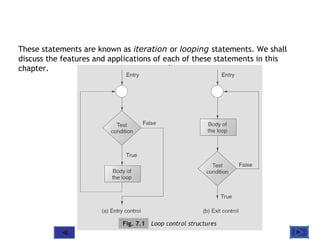
These statements are known as iteration or looping statements. We shall
discuss the features and applications of each of these statements in this
chapter.
@ 2010 Tata McGraw-Hill Education
5
Education
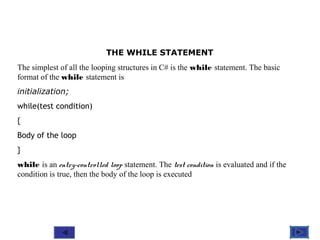
THE WHILE STATEMENT
The simplest of all the looping structures in C# is the while statement. The basic
format of the while statement is
initialization;
while(test condition)
{
Body of the loop
}
while is an entry-controlled loop statement. The test condition is evaluated and if the
condition is true, then the body of the loop is executed
@ 2010 Tata McGraw-Hill Education
6
Education
THE DO STATEMENT
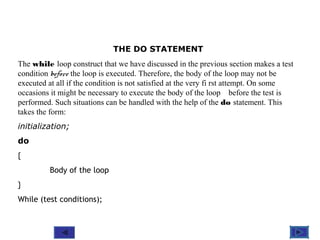
The while loop construct that we have discussed in the previous section makes a test
condition before the loop is executed. Therefore, the body of the loop may not be
executed at all if the condition is not satisfied at the very fi rst attempt. On some
occasions it might be necessary to execute the body of the loop before the test is
performed. Such situations can be handled with the help of the do statement. This
takes the form:
initialization;
do
{
Body of the loop
}
While (test conditions);
@ 2010 Tata McGraw-Hill Education
7
Education
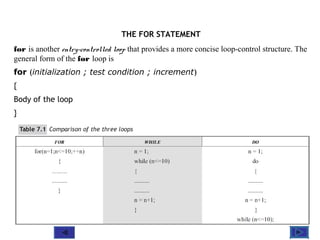
THE FOR STATEMENT
for is another entry-controlled loop that provides a more concise loop-control structure. The
general form of the for loop is
for (initialization ; test condition ; increment)
{
Body of the loop
}
@ 2010 Tata McGraw-Hill Education
8
Education
THE FOREACH STATEMENT
The foreach statement is similar to the for statement but implemented differently. It
enables us to iterate the elements in arrays and collection classes such as List and
HashTable. The general form of the foreach statement is:
foreach (type variable in expression)
{
Body of the loop
}
The type and variable declare the iteration variable. During execution, the iteration
variable represents the array element (or collection element in case of collections) for
which an iteration is currently being performed. in is a keyword
@ 2010 Tata McGraw-Hill Education
9
Education
JUMPS IN LOOPS
Loops perform a set of operations repeatedly until the control variable fails to satisfy
the test condition. The number of times a loop is repeated is decided in advance and the
test condition is written to achieve this.
Jumping Out of a Loop
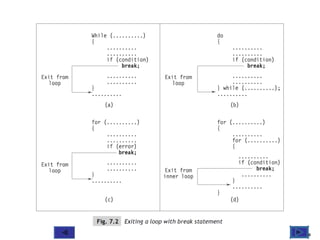
An early exit from a loop can be accomplished by using the break and goto
statements. We have already seen the use of the break in the switch statement.
These statements can also be used within while, do or for loops for an early exit
Skipping a Part of a Loop
During the loop operations, it may be necessary to skip a part of the body of the loop
under certain conditions
@ 2010 Tata McGraw-Hill Education
10
Education

Decision making and loop in C#

  • 1.
    @ 2010 TataMcGraw-Hill Education 1 Education Decision Making and LoopingDecision Making and Looping
  • 2.
    @ 2010 TataMcGraw-Hill Education 2 Education Introduction A computer is well suited to perform repetitive operations. It can do so tirelessly ten, hundred or even ten thousand times. Every computer language must have features that instruct a computer to perform such repetitive tasks. The process of repeatedly executing a block of statements is known as looping. The statements in the block may be executed any number of times, from zero to an infinite number. If a loop continues forever, it is called an infinite loop. C# supports such looping features that enable us to develop concise programs containing repetitive processes without using unconditional branching statements like the goto statement.
  • 3.
    @ 2010 TataMcGraw-Hill Education 3 Education A looping process, in general, would include the following four steps: 1. Setting and initialization of a counter. 2. Execution of the statements in the loop. 3. Test for a specifi ed condition for execution of the loop. 4. Incrementing the counter. The test may be either to determine whether the loop has been repeated the specified number of times or to determine whether a particular condition has been met with. The C# language provides for four constructs for performing loop operations. They are: 1. The while statement 2. The do statement 3. The for statement 4. The foreach statement
  • 4.
    @ 2010 TataMcGraw-Hill Education 4 Education These statements are known as iteration or looping statements. We shall discuss the features and applications of each of these statements in this chapter.
  • 5.
    @ 2010 TataMcGraw-Hill Education 5 Education THE WHILE STATEMENT The simplest of all the looping structures in C# is the while statement. The basic format of the while statement is initialization; while(test condition) { Body of the loop } while is an entry-controlled loop statement. The test condition is evaluated and if the condition is true, then the body of the loop is executed
  • 6.
    @ 2010 TataMcGraw-Hill Education 6 Education THE DO STATEMENT The while loop construct that we have discussed in the previous section makes a test condition before the loop is executed. Therefore, the body of the loop may not be executed at all if the condition is not satisfied at the very fi rst attempt. On some occasions it might be necessary to execute the body of the loop before the test is performed. Such situations can be handled with the help of the do statement. This takes the form: initialization; do { Body of the loop } While (test conditions);
  • 7.
    @ 2010 TataMcGraw-Hill Education 7 Education THE FOR STATEMENT for is another entry-controlled loop that provides a more concise loop-control structure. The general form of the for loop is for (initialization ; test condition ; increment) { Body of the loop }
  • 8.
    @ 2010 TataMcGraw-Hill Education 8 Education THE FOREACH STATEMENT The foreach statement is similar to the for statement but implemented differently. It enables us to iterate the elements in arrays and collection classes such as List and HashTable. The general form of the foreach statement is: foreach (type variable in expression) { Body of the loop } The type and variable declare the iteration variable. During execution, the iteration variable represents the array element (or collection element in case of collections) for which an iteration is currently being performed. in is a keyword
  • 9.
    @ 2010 TataMcGraw-Hill Education 9 Education JUMPS IN LOOPS Loops perform a set of operations repeatedly until the control variable fails to satisfy the test condition. The number of times a loop is repeated is decided in advance and the test condition is written to achieve this. Jumping Out of a Loop An early exit from a loop can be accomplished by using the break and goto statements. We have already seen the use of the break in the switch statement. These statements can also be used within while, do or for loops for an early exit Skipping a Part of a Loop During the loop operations, it may be necessary to skip a part of the body of the loop under certain conditions
  • 10.
    @ 2010 TataMcGraw-Hill Education 10 Education