D R . L O T H E S A V I T A A .
Decision Control and Iterative
Statements in C Programming
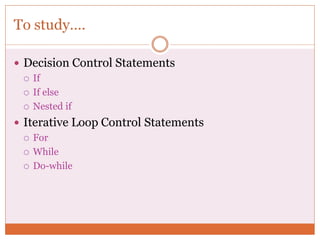
To study….
 Decision Control Statements
 If
 If else
 Nested if
 Iterative Loop Control Statements
 For
 While
 Do-while
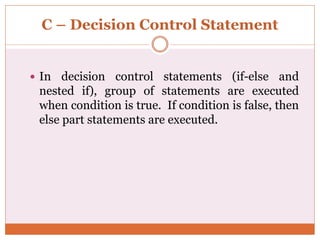
C – Decision Control Statement
 In decision control statements (if-else and
nested if), group of statements are executed
when condition is true. If condition is false, then
else part statements are executed.
 There are 3 types of decision making control
statements in C language. They are,
 if statements
 if else statements
 nested if statements
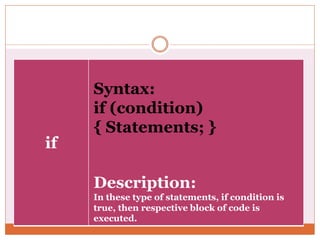
if
Syntax:
if (condition)
{ Statements; }
Description:
In these type of statements, if condition is
true, then respective block of code is
executed.
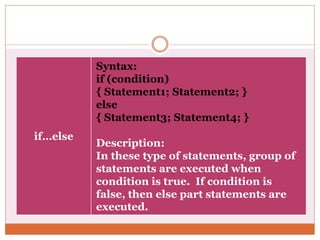
if…else
Syntax:
if (condition)
{ Statement1; Statement2; }
else
{ Statement3; Statement4; }
Description:
In these type of statements, group of
statements are executed when
condition is true. If condition is
false, then else part statements are
executed.
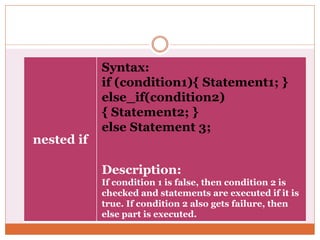
nested if
Syntax:
if (condition1){ Statement1; }
else_if(condition2)
{ Statement2; }
else Statement 3;
Description:
If condition 1 is false, then condition 2 is
checked and statements are executed if it is
true. If condition 2 also gets failure, then
else part is executed.
C – Loop Control statements
 Loop control statements in C are used to perform
looping operations until the given condition is true.
Control comes out of the loop statements once
condition becomes false.
TYPES OF LOOP CONTROL STATEMENTS IN C
 There are 3 types of loop control statements in C
language. They are,
 for
 while
 do-while
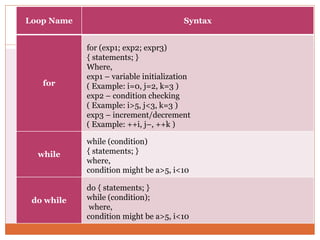
Loop Name Syntax
for
for (exp1; exp2; expr3)
{ statements; }
Where,
exp1 – variable initialization
( Example: i=0, j=2, k=3 )
exp2 – condition checking
( Example: i>5, j<3, k=3 )
exp3 – increment/decrement
( Example: ++i, j–, ++k )
while
while (condition)
{ statements; }
where,
condition might be a>5, i<10
do while
do { statements; }
while (condition);
where,
condition might be a>5, i<10
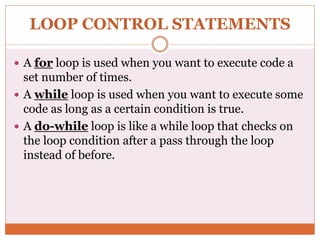
LOOP CONTROL STATEMENTS
 A for loop is used when you want to execute code a
set number of times.
 A while loop is used when you want to execute some
code as long as a certain condition is true.
 A do-while loop is like a while loop that checks on
the loop condition after a pass through the loop
instead of before.
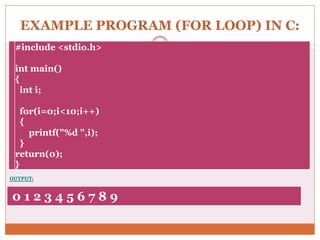
EXAMPLE PROGRAM (FOR LOOP) IN C:
#include <stdio.h>
int main()
{
int i;
for(i=0;i<10;i++)
{
printf("%d ",i);
}
return(0);
}
0 1 2 3 4 5 6 7 8 9
OUTPUT:
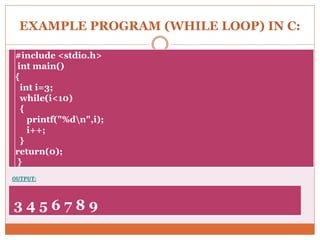
EXAMPLE PROGRAM (WHILE LOOP) IN C:
#include <stdio.h>
int main()
{
int i=3;
while(i<10)
{
printf("%dn",i);
i++;
}
return(0);
}
3 4 5 6 7 8 9
OUTPUT:
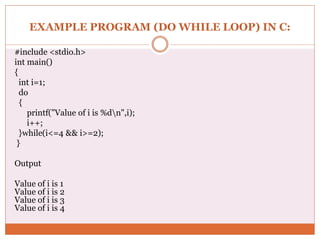
EXAMPLE PROGRAM (DO WHILE LOOP) IN C:
#include <stdio.h>
int main()
{
int i=1;
do
{
printf("Value of i is %dn",i);
i++;
}while(i<=4 && i>=2);
}
Output
Value of i is 1
Value of i is 2
Value of i is 3
Value of i is 4
Decision control and iterative statements

Decision control and iterative statements

  • 1.
    D R .L O T H E S A V I T A A . Decision Control and Iterative Statements in C Programming
  • 2.
    To study….  DecisionControl Statements  If  If else  Nested if  Iterative Loop Control Statements  For  While  Do-while
  • 3.
    C – DecisionControl Statement  In decision control statements (if-else and nested if), group of statements are executed when condition is true. If condition is false, then else part statements are executed.
  • 4.
     There are3 types of decision making control statements in C language. They are,  if statements  if else statements  nested if statements
  • 5.
    if Syntax: if (condition) { Statements;} Description: In these type of statements, if condition is true, then respective block of code is executed.
  • 6.
    if…else Syntax: if (condition) { Statement1;Statement2; } else { Statement3; Statement4; } Description: In these type of statements, group of statements are executed when condition is true. If condition is false, then else part statements are executed.
  • 7.
    nested if Syntax: if (condition1){Statement1; } else_if(condition2) { Statement2; } else Statement 3; Description: If condition 1 is false, then condition 2 is checked and statements are executed if it is true. If condition 2 also gets failure, then else part is executed.
  • 8.
    C – LoopControl statements  Loop control statements in C are used to perform looping operations until the given condition is true. Control comes out of the loop statements once condition becomes false.
  • 9.
    TYPES OF LOOPCONTROL STATEMENTS IN C  There are 3 types of loop control statements in C language. They are,  for  while  do-while
  • 10.
    Loop Name Syntax for for(exp1; exp2; expr3) { statements; } Where, exp1 – variable initialization ( Example: i=0, j=2, k=3 ) exp2 – condition checking ( Example: i>5, j<3, k=3 ) exp3 – increment/decrement ( Example: ++i, j–, ++k ) while while (condition) { statements; } where, condition might be a>5, i<10 do while do { statements; } while (condition); where, condition might be a>5, i<10
  • 11.
    LOOP CONTROL STATEMENTS A for loop is used when you want to execute code a set number of times.  A while loop is used when you want to execute some code as long as a certain condition is true.  A do-while loop is like a while loop that checks on the loop condition after a pass through the loop instead of before.
  • 12.
    EXAMPLE PROGRAM (FORLOOP) IN C: #include <stdio.h> int main() { int i; for(i=0;i<10;i++) { printf("%d ",i); } return(0); } 0 1 2 3 4 5 6 7 8 9 OUTPUT:
  • 13.
    EXAMPLE PROGRAM (WHILELOOP) IN C: #include <stdio.h> int main() { int i=3; while(i<10) { printf("%dn",i); i++; } return(0); } 3 4 5 6 7 8 9 OUTPUT:
  • 14.
    EXAMPLE PROGRAM (DOWHILE LOOP) IN C: #include <stdio.h> int main() { int i=1; do { printf("Value of i is %dn",i); i++; }while(i<=4 && i>=2); } Output Value of i is 1 Value of i is 2 Value of i is 3 Value of i is 4