Do Now Dec 22
- Explain the difference between a
proton, an electron and a neutron.
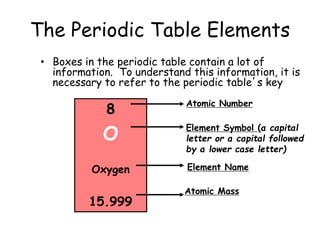
The Periodic Table Elements
• Boxes in the periodic table contain a lot of
information. To understand this information, it is
necessary to refer to the periodic table’s key
Atomic Number
Element Symbol (a capital
letter or a capital followed
by a lower case letter)
Atomic Mass
8
O
Oxygen
15.999
Element Name
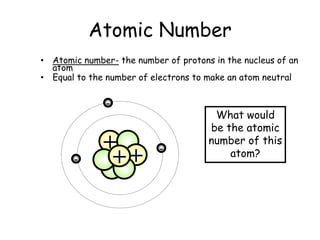
Atomic Number
• Atomic number- the number of protons in the nucleus of an
atom
• Equal to the number of electrons to make an atom neutral
+
++
-
-
-
What would
be the atomic
number of this
atom?
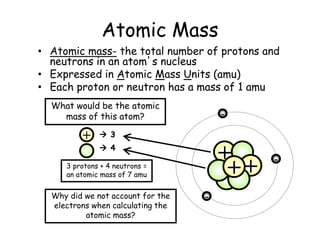
Atomic Mass
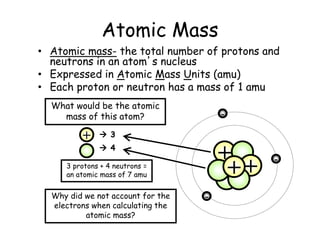
• Atomic mass- the total number of protons and
neutrons in an atom’s nucleus
• Expressed in Atomic Mass Units (amu)
• Each proton or neutron has a mass of 1 amu
+
++
-
-
-
What would be the atomic
mass of this atom?
+  3
 4
3 protons + 4 neutrons =
an atomic mass of 7 amu
Why did we not account for the
electrons when calculating the
atomic mass?
Atomic Mass
• Atomic mass- the total number of protons and
neutrons in an atom’s nucleus
• Expressed in Atomic Mass Units (amu)
• Each proton or neutron has a mass of 1 amu
+
++
-
-
-
What would be the atomic
mass of this atom?
+  3
 4
3 protons + 4 neutrons =
an atomic mass of 7 amu
Why did we not account for the
electrons when calculating the
atomic mass?
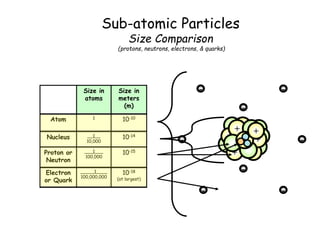
Sub-atomic Particles
Size Comparison
(protons, neutrons, electrons, & quarks)
Size in
atoms
Size in
meters
(m)
Atom 1 10-10
Nucleus __1__
10,000
10-14
Proton or
Neutron
___1___
100,000
10-15
Electron
or Quark
_____1____
100,000,000
10-18
(at largest)
+
+
+
+
+
++
-
-
-
-
--
-
-
+
Stations
• 1. Students will be able to calculate the atomic
mass unit in order to determine atomic mass
unit. Complete math section in textbook on
page 93.
• 2. Students will be able to infer information
about electromagnetic energy in order to
answer questions based on information. PSSA
LTS orange pages 76 to 79.

Dec 8 do now

  • 1.
    Do Now Dec22 - Explain the difference between a proton, an electron and a neutron.
  • 2.
    The Periodic TableElements • Boxes in the periodic table contain a lot of information. To understand this information, it is necessary to refer to the periodic table’s key Atomic Number Element Symbol (a capital letter or a capital followed by a lower case letter) Atomic Mass 8 O Oxygen 15.999 Element Name
  • 3.
    Atomic Number • Atomicnumber- the number of protons in the nucleus of an atom • Equal to the number of electrons to make an atom neutral + ++ - - - What would be the atomic number of this atom?
  • 4.
    Atomic Mass • Atomicmass- the total number of protons and neutrons in an atom’s nucleus • Expressed in Atomic Mass Units (amu) • Each proton or neutron has a mass of 1 amu + ++ - - - What would be the atomic mass of this atom? +  3  4 3 protons + 4 neutrons = an atomic mass of 7 amu Why did we not account for the electrons when calculating the atomic mass?
  • 5.
    Atomic Mass • Atomicmass- the total number of protons and neutrons in an atom’s nucleus • Expressed in Atomic Mass Units (amu) • Each proton or neutron has a mass of 1 amu + ++ - - - What would be the atomic mass of this atom? +  3  4 3 protons + 4 neutrons = an atomic mass of 7 amu Why did we not account for the electrons when calculating the atomic mass?
  • 6.
    Sub-atomic Particles Size Comparison (protons,neutrons, electrons, & quarks) Size in atoms Size in meters (m) Atom 1 10-10 Nucleus __1__ 10,000 10-14 Proton or Neutron ___1___ 100,000 10-15 Electron or Quark _____1____ 100,000,000 10-18 (at largest) + + + + + ++ - - - - -- - - +
  • 7.
    Stations • 1. Studentswill be able to calculate the atomic mass unit in order to determine atomic mass unit. Complete math section in textbook on page 93. • 2. Students will be able to infer information about electromagnetic energy in order to answer questions based on information. PSSA LTS orange pages 76 to 79.