www.salt.pe
EQUITY Financing
DEBT Financing vs
www.salt.pe
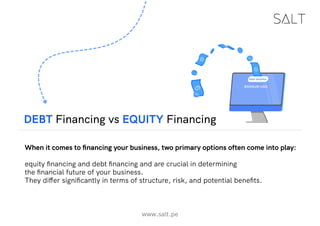
DEBT Financing vs EQUITY Financing
When it comes to financing your business, two primary options often come into play:
equity financing and debt financing and are crucial in determining
the financial future of your business.
They differ significantly in terms of structure, risk, and potential benefits.
www.salt.pe
What is Equity Financing?
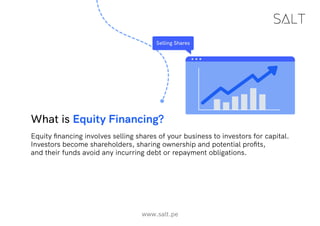
Equity financing involves selling shares of your business to investors for capital.
Investors become shareholders, sharing ownership and potential profits,
and their funds avoid any incurring debt or repayment obligations.
Selling Shares
www.salt.pe
Advantages of Equity Financing
Shared Risk between Founder and Investor
Access to Expertise
No Debt/Repayment Obligations
Potentially Greater Returns for Investors
www.salt.pe
Considerations for Equity Financing
Loss of Decision-Making authority
Dilution of Founder’s Ownership
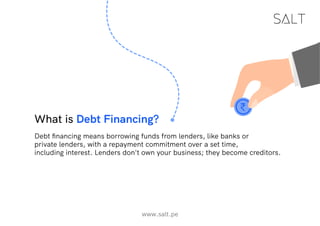
What is Debt Financing?
Debt financing means borrowing funds from lenders, like banks or
private lenders, with a repayment commitment over a set time,
including interest. Lenders don't own your business; they become creditors.
www.salt.pe
www.salt.pe
Advantages of Debt Financing
Founder retains ownership and control
Repayment Amount and Schedule is Fixed
Tax Benefits
www.salt.pe
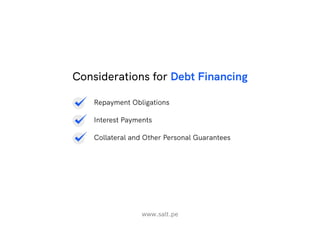
Considerations for Debt Financing
Repayment Obligations
Interest Payments
Collateral and Other Personal Guarantees
www.salt.pe
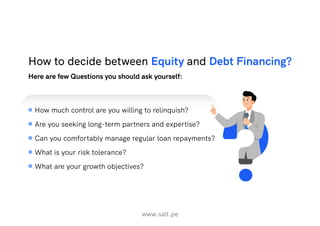
Here are few Questions you should ask yourself:
How to decide between Equity and Debt Financing?
How much control are you willing to relinquish?
Are you seeking long-term partners and expertise?
Can you comfortably manage regular loan repayments?
What is your risk tolerance?
What are your growth objectives?
www.salt.pe
Conclusion
Equity and debt financing differ in numerous ways,
each with its pros and cons.
Your choice depends on your business's needs and goals.
Evaluate both methods thoroughly, and seek professional
guidance for sound financial decisions.
SALT helps you receive funds from your overseas investors
through TABLE: Our FDI tool.

DEBT Financing vs EQUITY Financing (1).pdf

  • 1.
  • 2.
    www.salt.pe DEBT Financing vsEQUITY Financing When it comes to financing your business, two primary options often come into play: equity financing and debt financing and are crucial in determining the financial future of your business. They differ significantly in terms of structure, risk, and potential benefits.
  • 3.
    www.salt.pe What is EquityFinancing? Equity financing involves selling shares of your business to investors for capital. Investors become shareholders, sharing ownership and potential profits, and their funds avoid any incurring debt or repayment obligations. Selling Shares
  • 4.
    www.salt.pe Advantages of EquityFinancing Shared Risk between Founder and Investor Access to Expertise No Debt/Repayment Obligations Potentially Greater Returns for Investors
  • 5.
    www.salt.pe Considerations for EquityFinancing Loss of Decision-Making authority Dilution of Founder’s Ownership
  • 6.
    What is DebtFinancing? Debt financing means borrowing funds from lenders, like banks or private lenders, with a repayment commitment over a set time, including interest. Lenders don't own your business; they become creditors. www.salt.pe
  • 7.
    www.salt.pe Advantages of DebtFinancing Founder retains ownership and control Repayment Amount and Schedule is Fixed Tax Benefits
  • 8.
    www.salt.pe Considerations for DebtFinancing Repayment Obligations Interest Payments Collateral and Other Personal Guarantees
  • 9.
    www.salt.pe Here are fewQuestions you should ask yourself: How to decide between Equity and Debt Financing? How much control are you willing to relinquish? Are you seeking long-term partners and expertise? Can you comfortably manage regular loan repayments? What is your risk tolerance? What are your growth objectives?
  • 10.
    www.salt.pe Conclusion Equity and debtfinancing differ in numerous ways, each with its pros and cons. Your choice depends on your business's needs and goals. Evaluate both methods thoroughly, and seek professional guidance for sound financial decisions. SALT helps you receive funds from your overseas investors through TABLE: Our FDI tool.