EQUITY FINANCING
In the name of Allah, most
gracious and merciful
Group Name
The Researchers
Muhammad Ali (Group Leader)
Mudassir Ali
Shakeel Ahmed
Rana M. Usman
Muhammad Ali
What is Equity?
• Equity means…
– A stock or any other security representing
an ownership interest.
– On a company's balance sheet, the amount of
the funds contributed by the owners (the
stockholders) plus the retained earnings (or
losses). Also referred to as "shareholders'
equity".
What is Finance?
• In Short…
– The science of the management of money and
other assets.
• Proper Definition…
– A branch of economics concerned with resource
allocation resource management, acquisition and
investment. Simply finance deals with matters
related to money markets.
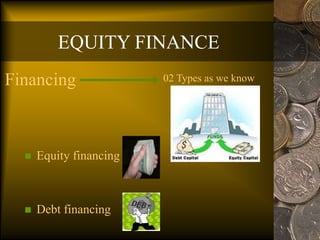
EQUITY FINANCE
Financing
 Equity financing
 Debt financing
02 Types as we know
Equity Financing…….
1. A method of financing in which a
company issues shares of its stock
and receives money in return.
Depending on how you raise equity
capital.
Equity Financing:
company sells shares of ownership in
the enterprise, called stock
Simply…………
The act of
raising money
for company
activities by
selling
common or
preferred
stock to
individual or
institutional
investors. In
return for the
Equity Financing…(according to Investopedia)
1. The act of raising money for
company activities by selling
common or preferred stock to
individual or institutional
investors. In return for the
money paid, shareholders
receive ownership interests in
the corporation.
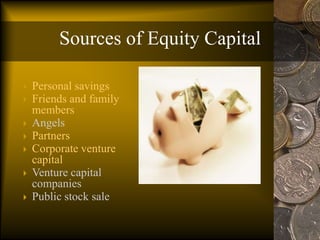
Sources of Equity Capital
 Personal savings
 Friends and family
members
 Angels
 Partners
 Corporate venture
capital
 Venture capital
companies
 Public stock sale
• Private equity market
– “Angel” Finance (informal market
for direct equity finance provided
by high net worth individuals.)
Sources of Equity Capital
Angel Point of View
+ Knowledge of industry
+ Knowledge of technology
+ Knowledge of revenue model
+ Scalability of the project
+ First mover advantage
+ Timing of commercialization
+ Other investors
Entrepreneur Point of View
+ Competences of Business Angels
+ Complement competences
+ Sharing experiences
+ Short due diligence
+ Longer investment horizons
Venture Capital
 More Popular form of
equity finance:
 Every Kind of Business
investment.
 Company Investment
A venture capitalist is a very
active financial intermediary,
providing financing to relatively
new and small businesses.
VCs also participate in strategic
planning and operational
decisions.
Types of Venture Capital
 Pvt. Venture Capital
 Investor Venture Cap.
 Individual Pvt. Investor
 Small Business Investment Corporation
 Specialized Small business Investment
Next: Mudasir Ali
Mudasir Ali
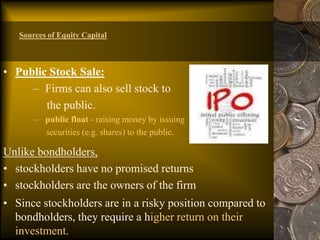
• Public Stock Sale:
– Firms can also sell stock to
the public.
– public float - raising money by issuing
securities (e.g. shares) to the public.
Unlike bondholders,
• stockholders have no promised returns
• stockholders are the owners of the firm
• Since stockholders are in a risky position compared to
bondholders, they require a higher return on their
investment.
Sources of Equity Capital
Seed
Sub £1m
Start-up
Prob pre profit
Up to £5m
Expansion
Roll out. First
profits
Less than £10m
Maturity
Poss Exit – IPO/
Trade sale
Up to £50m
Stagnate
Rationalise –
MBO/MBI
Poss £100m+
Rejuvenate
2nd
exit
opportunity
Angels Traditional VC Traditional Private Equity
Funding types vs Stage
of Growth
Market
Value
Time
•Freedom from debt - unlike debt finance, you
don't make repayments on investments. Not having
the burden of debt can be a huge advantage,
particularly for small start-up businesses.
•Business experience and contacts - as well as
funds, investors often bring valuable experience,
managerial or technical skills, contacts or networks,
and credibility to the business.
•Follow-up funding - investors are often willing to
provide additional funding as the business
develops and grows.
Benefits of Equity Finance
Next: Shakeel
Adv. & Dis Adv. Of
equity financing
Shakeel Ahmed
Rana M Usman
The main advantages of equity finance are:
•The funding is committed to your business and your intended projects
•You will not have to keep up with costs of servicing bank loans or debt
finance, allowing you to use the capital for business activities.
•Outside investors expect the business to deliver value, helping you
explore and execute growth ideas.
•The right business angels and venture capitalists can bring valuable
skills, contacts and experience to your business. They can also assist
with strategy and key decision making.
•In common with you, investors have a vested interest in the business'
success, ice its growth, profitability and increase in value.
Advantages…of equity fin:
Next: Usman
Rana M.
Usman
Dis- Advantages…of equity fin:
The main Dis-advantages of equity finance are:
Raising equity finance is demanding, costly and time consuming,
and may take management focus away from the core business
activities.
Difficult to Manage the Business solely.
•Shared ownership - in return for investment funds, you will have
to give up some control of your business. Investors not only share
profits, they also have a say in how the business is run. While this
has advantages, you need to think carefully about how much
control you surrender.
•Personal relationships - accepting investment funds from family
or friends can affect personal relationships if the business fails.
•Time and money - approaching investors and becoming
investment-ready is demanding. It takes time and money. Your
business may suffer if you have to spend a lot of time on
investment strategies.
Dis- Advantages…of equity fin:
Cf presentation ok

Cf presentation ok

  • 1.
    EQUITY FINANCING In thename of Allah, most gracious and merciful
  • 2.
    Group Name The Researchers MuhammadAli (Group Leader) Mudassir Ali Shakeel Ahmed Rana M. Usman
  • 3.
  • 4.
    What is Equity? •Equity means… – A stock or any other security representing an ownership interest. – On a company's balance sheet, the amount of the funds contributed by the owners (the stockholders) plus the retained earnings (or losses). Also referred to as "shareholders' equity".
  • 5.
    What is Finance? •In Short… – The science of the management of money and other assets. • Proper Definition… – A branch of economics concerned with resource allocation resource management, acquisition and investment. Simply finance deals with matters related to money markets.
  • 6.
    EQUITY FINANCE Financing  Equityfinancing  Debt financing 02 Types as we know
  • 7.
    Equity Financing……. 1. Amethod of financing in which a company issues shares of its stock and receives money in return. Depending on how you raise equity capital. Equity Financing: company sells shares of ownership in the enterprise, called stock Simply………… The act of raising money for company activities by selling common or preferred stock to individual or institutional investors. In return for the
  • 8.
    Equity Financing…(according toInvestopedia) 1. The act of raising money for company activities by selling common or preferred stock to individual or institutional investors. In return for the money paid, shareholders receive ownership interests in the corporation.
  • 9.
    Sources of EquityCapital  Personal savings  Friends and family members  Angels  Partners  Corporate venture capital  Venture capital companies  Public stock sale
  • 10.
    • Private equitymarket – “Angel” Finance (informal market for direct equity finance provided by high net worth individuals.) Sources of Equity Capital
  • 11.
    Angel Point ofView + Knowledge of industry + Knowledge of technology + Knowledge of revenue model + Scalability of the project + First mover advantage + Timing of commercialization + Other investors
  • 12.
    Entrepreneur Point ofView + Competences of Business Angels + Complement competences + Sharing experiences + Short due diligence + Longer investment horizons
  • 13.
    Venture Capital  MorePopular form of equity finance:  Every Kind of Business investment.  Company Investment A venture capitalist is a very active financial intermediary, providing financing to relatively new and small businesses. VCs also participate in strategic planning and operational decisions.
  • 14.
    Types of VentureCapital  Pvt. Venture Capital  Investor Venture Cap.  Individual Pvt. Investor  Small Business Investment Corporation  Specialized Small business Investment Next: Mudasir Ali
  • 15.
  • 16.
    • Public StockSale: – Firms can also sell stock to the public. – public float - raising money by issuing securities (e.g. shares) to the public. Unlike bondholders, • stockholders have no promised returns • stockholders are the owners of the firm • Since stockholders are in a risky position compared to bondholders, they require a higher return on their investment. Sources of Equity Capital
  • 17.
    Seed Sub £1m Start-up Prob preprofit Up to £5m Expansion Roll out. First profits Less than £10m Maturity Poss Exit – IPO/ Trade sale Up to £50m Stagnate Rationalise – MBO/MBI Poss £100m+ Rejuvenate 2nd exit opportunity Angels Traditional VC Traditional Private Equity Funding types vs Stage of Growth Market Value Time
  • 18.
    •Freedom from debt- unlike debt finance, you don't make repayments on investments. Not having the burden of debt can be a huge advantage, particularly for small start-up businesses. •Business experience and contacts - as well as funds, investors often bring valuable experience, managerial or technical skills, contacts or networks, and credibility to the business. •Follow-up funding - investors are often willing to provide additional funding as the business develops and grows. Benefits of Equity Finance Next: Shakeel
  • 19.
    Adv. & DisAdv. Of equity financing Shakeel Ahmed Rana M Usman
  • 20.
    The main advantagesof equity finance are: •The funding is committed to your business and your intended projects •You will not have to keep up with costs of servicing bank loans or debt finance, allowing you to use the capital for business activities. •Outside investors expect the business to deliver value, helping you explore and execute growth ideas. •The right business angels and venture capitalists can bring valuable skills, contacts and experience to your business. They can also assist with strategy and key decision making. •In common with you, investors have a vested interest in the business' success, ice its growth, profitability and increase in value. Advantages…of equity fin: Next: Usman
  • 21.
  • 22.
    Dis- Advantages…of equityfin: The main Dis-advantages of equity finance are: Raising equity finance is demanding, costly and time consuming, and may take management focus away from the core business activities. Difficult to Manage the Business solely.
  • 23.
    •Shared ownership -in return for investment funds, you will have to give up some control of your business. Investors not only share profits, they also have a say in how the business is run. While this has advantages, you need to think carefully about how much control you surrender. •Personal relationships - accepting investment funds from family or friends can affect personal relationships if the business fails. •Time and money - approaching investors and becoming investment-ready is demanding. It takes time and money. Your business may suffer if you have to spend a lot of time on investment strategies. Dis- Advantages…of equity fin: