Testing Visual
                                        Perceptual Skills Using
                                              Eye Gaze


                                        10 May 2012


Produced by partners from KCC and NHS                    Website:www.kenttrustweb.org.uk/senict
What is Visual
                                        Perceptual Performance

      •  Perception is the integration of sensory impressions into
         psychologically meaning information.

      •  Visual Perception is the interpretation of visual stimuli.


Produced by partners from KCC and NHS                            Website:www.kenttrustweb.org.uk/senict
7 Areas of Visual Perceptual
                                               Performance

      •      Visual discrimination
      •      Visual memory
      •      Visual spatial relationships
      •      Visual form constancy
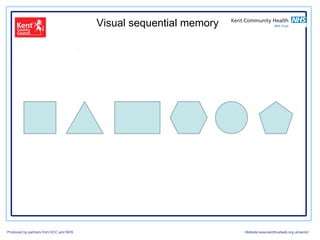
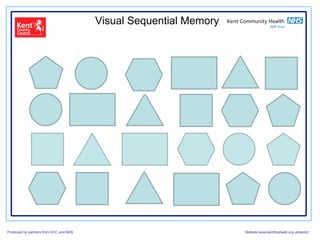
      •      Visual sequential memory
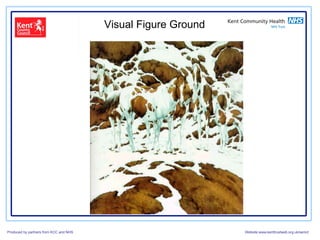
      •      Visual figure ground
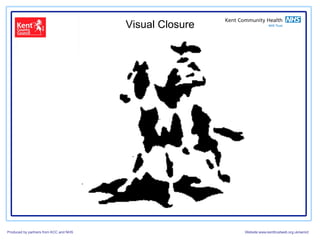
      •      Visual closure


Produced by partners from KCC and NHS                                  Website:www.kenttrustweb.org.uk/senict
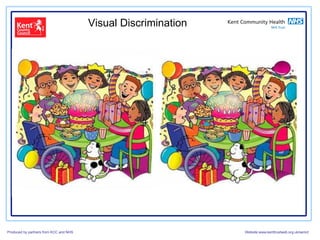
Visual Discrimination


Produced by partners from KCC and NHS                           Website:www.kenttrustweb.org.uk/senict
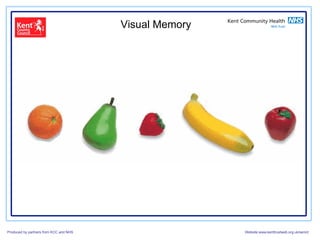
Visual Memory


Produced by partners from KCC and NHS                   Website:www.kenttrustweb.org.uk/senict
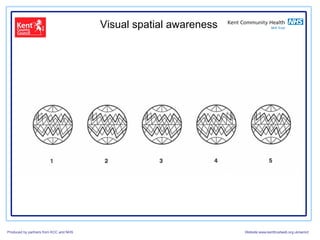
Visual spatial awareness


Produced by partners from KCC and NHS                              Website:www.kenttrustweb.org.uk/senict
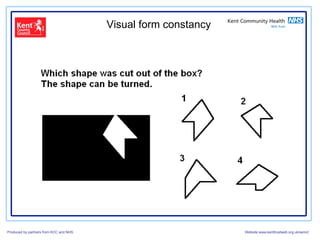
Visual form constancy


Produced by partners from KCC and NHS                           Website:www.kenttrustweb.org.uk/senict
Visual sequential memory


Produced by partners from KCC and NHS                              Website:www.kenttrustweb.org.uk/senict
Visual Sequential Memory


Produced by partners from KCC and NHS                              Website:www.kenttrustweb.org.uk/senict
Visual Figure Ground


Produced by partners from KCC and NHS                          Website:www.kenttrustweb.org.uk/senict
Visual Closure


Produced by partners from KCC and NHS                    Website:www.kenttrustweb.org.uk/senict
Impact of Visual Perceptual
                                                Difficulties

      •      Matching
      •      Learning and retaining information
      •      Spelling and sequencing of letters
      •      Slow in copying information
      •      Spacing of numbers and letters
      •      Difficulty finding way around a new environment
      •      AAC and


Produced by partners from KCC and NHS                                 Website:www.kenttrustweb.org.uk/senict
•  Difficulty counting objects on a page

      •  Unable to recognize a symbol when it is presented in a slightly
         different way.

      •  Difficulty with categorizing or sorting objects.

      •  Difficulties with 2D and 3D images e.g. recognizing food objects
         from a picture.

      •  Difficulty recognizing a shape or symbol on a page when there are
         other symbols present.

Produced by partners from KCC and NHS                          Website:www.kenttrustweb.org.uk/senict
Cerebral Palsy and Visual
                                         Perceptual Difficulties

      •  There is a high correlation between cerebral palsy and
         Visual perceptual difficulties.

      •  The relationship between visual impairment and damage
         to the Basal Ganglia. If visual impairment is significant
         there will be an impact upon learning and
         communication. (Jennifer Sargent, March 2012)

      •  The children with a severe form of cerebral palsy are
         most in need of an estimate of vision for communication
         (Mcullooch & Dutton 2011)

Produced by partners from KCC and NHS                               Website:www.kenttrustweb.org.uk/senict
Using Eye Gaze as a Medium
                                        to Test Visual Perceptual Skills

     •  Symbols were enlarged from the book (2 X 2 cm)

     •  Symbols laminated using matt pouches.

     •  Symbols placed in the 4 corners of an E-Tran frame (+ 1
        in middle)

     •  Each subtest was scored

     •  Test completed over several sessions due to fatigue
        levels
Produced by partners from KCC and NHS                                      Website:www.kenttrustweb.org.uk/senict
Cards vs. Book


      •  Took a little longer with cards

      •  Good correlation of results

      •  Tested cards and book with children with Cerebral palsy
         and with comparison group of mainstream children with
         no apparent physical difficulties.


Produced by partners from KCC and NHS                    Website:www.kenttrustweb.org.uk/senict
Advantages


      •  Provides information regarding cell sizes on grids

      •  Information on number of pages for navigation

      •  May provide information on symbol sets

      •  Information on background and foreground colours.

      •  Provides a guide and qualitative information.


Produced by partners from KCC and NHS                    Website:www.kenttrustweb.org.uk/senict
Disadvantages


      •  De standardised test – gives qualitative information but
         not quantitive information.

      •  Maybe difficult to replicate in future tests.


Produced by partners from KCC and NHS                    Website:www.kenttrustweb.org.uk/senict
Cognitive assessment
                                        Kristine Stadskleiv Psychologist Oslo University Hospital


      Precise understanding/diagnosis:
      •  Easy to both over- and underestimate cognitive functioning when a child is
         not speaking
      •  Information about strengths and difficulties
      •  Information about general and specific cognitive problems
      •  Monitor cognitive development

      Intervention:
      •  Knowledge about cognitive functioning supports AAC interventions
      •  The children are at risk of having problems in other areas of development:
           –  social development/interaction with other children
           –  quality of life
           –  functional communication (often passive communication partners)
           –  language development (no feedback and correction from own speech)
           –  reading and writing


Produced by partners from KCC and NHS                                                               Website:www.kenttrustweb.org.uk/senict
Challenges when assessing
                                        children with severe speech- and
                                               movement disorders
                                           Kristine Stadskleiv Psychologist Oslo University Hospital


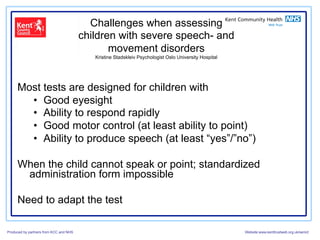
     Most tests are designed for children with
       •  Good eyesight
       •  Ability to respond rapidly
       •  Good motor control (at least ability to point)
       •  Ability to produce speech (at least “yes”/”no”)

     When the child cannot speak or point; standardized
      administration form impossible

     Need to adapt the test

Produced by partners from KCC and NHS                                                                  Website:www.kenttrustweb.org.uk/senict
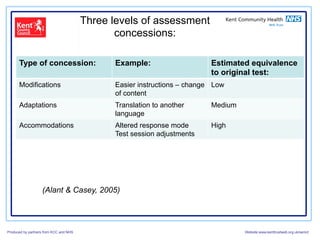
Three levels of assessment
                                               concessions:

      Type of concession:                      Example:                    Estimated equivalence
                                                                           to original test:
      Modifications                            Easier instructions – change Low
                                               of content
      Adaptations                              Translation to another      Medium
                                               language
      Accommodations                           Altered response mode       High
                                               Test session adjustments


                   (Alant & Casey, 2005)


Produced by partners from KCC and NHS                                               Website:www.kenttrustweb.org.uk/senict
Questions


Produced by partners from KCC and NHS               Website:www.kenttrustweb.org.uk/senict

Debbie bailey, tricia hawkes visual perception

  • 1.
    Testing Visual Perceptual Skills Using Eye Gaze 10 May 2012 Produced by partners from KCC and NHS Website:www.kenttrustweb.org.uk/senict
  • 2.
    What is Visual Perceptual Performance •  Perception is the integration of sensory impressions into psychologically meaning information. •  Visual Perception is the interpretation of visual stimuli. Produced by partners from KCC and NHS Website:www.kenttrustweb.org.uk/senict
  • 3.
    7 Areas ofVisual Perceptual Performance •  Visual discrimination •  Visual memory •  Visual spatial relationships •  Visual form constancy •  Visual sequential memory •  Visual figure ground •  Visual closure Produced by partners from KCC and NHS Website:www.kenttrustweb.org.uk/senict
  • 4.
    Visual Discrimination Produced bypartners from KCC and NHS Website:www.kenttrustweb.org.uk/senict
  • 5.
    Visual Memory Produced bypartners from KCC and NHS Website:www.kenttrustweb.org.uk/senict
  • 6.
    Visual spatial awareness Producedby partners from KCC and NHS Website:www.kenttrustweb.org.uk/senict
  • 7.
    Visual form constancy Producedby partners from KCC and NHS Website:www.kenttrustweb.org.uk/senict
  • 8.
    Visual sequential memory Producedby partners from KCC and NHS Website:www.kenttrustweb.org.uk/senict
  • 9.
    Visual Sequential Memory Producedby partners from KCC and NHS Website:www.kenttrustweb.org.uk/senict
  • 10.
    Visual Figure Ground Producedby partners from KCC and NHS Website:www.kenttrustweb.org.uk/senict
  • 11.
    Visual Closure Produced bypartners from KCC and NHS Website:www.kenttrustweb.org.uk/senict
  • 12.
    Impact of VisualPerceptual Difficulties •  Matching •  Learning and retaining information •  Spelling and sequencing of letters •  Slow in copying information •  Spacing of numbers and letters •  Difficulty finding way around a new environment •  AAC and Produced by partners from KCC and NHS Website:www.kenttrustweb.org.uk/senict
  • 13.
    •  Difficulty countingobjects on a page •  Unable to recognize a symbol when it is presented in a slightly different way. •  Difficulty with categorizing or sorting objects. •  Difficulties with 2D and 3D images e.g. recognizing food objects from a picture. •  Difficulty recognizing a shape or symbol on a page when there are other symbols present. Produced by partners from KCC and NHS Website:www.kenttrustweb.org.uk/senict
  • 14.
    Cerebral Palsy andVisual Perceptual Difficulties •  There is a high correlation between cerebral palsy and Visual perceptual difficulties. •  The relationship between visual impairment and damage to the Basal Ganglia. If visual impairment is significant there will be an impact upon learning and communication. (Jennifer Sargent, March 2012) •  The children with a severe form of cerebral palsy are most in need of an estimate of vision for communication (Mcullooch & Dutton 2011) Produced by partners from KCC and NHS Website:www.kenttrustweb.org.uk/senict
  • 15.
    Using Eye Gazeas a Medium to Test Visual Perceptual Skills •  Symbols were enlarged from the book (2 X 2 cm) •  Symbols laminated using matt pouches. •  Symbols placed in the 4 corners of an E-Tran frame (+ 1 in middle) •  Each subtest was scored •  Test completed over several sessions due to fatigue levels Produced by partners from KCC and NHS Website:www.kenttrustweb.org.uk/senict
  • 16.
    Cards vs. Book •  Took a little longer with cards •  Good correlation of results •  Tested cards and book with children with Cerebral palsy and with comparison group of mainstream children with no apparent physical difficulties. Produced by partners from KCC and NHS Website:www.kenttrustweb.org.uk/senict
  • 17.
    Advantages •  Provides information regarding cell sizes on grids •  Information on number of pages for navigation •  May provide information on symbol sets •  Information on background and foreground colours. •  Provides a guide and qualitative information. Produced by partners from KCC and NHS Website:www.kenttrustweb.org.uk/senict
  • 18.
    Disadvantages •  De standardised test – gives qualitative information but not quantitive information. •  Maybe difficult to replicate in future tests. Produced by partners from KCC and NHS Website:www.kenttrustweb.org.uk/senict
  • 19.
    Cognitive assessment Kristine Stadskleiv Psychologist Oslo University Hospital Precise understanding/diagnosis: •  Easy to both over- and underestimate cognitive functioning when a child is not speaking •  Information about strengths and difficulties •  Information about general and specific cognitive problems •  Monitor cognitive development Intervention: •  Knowledge about cognitive functioning supports AAC interventions •  The children are at risk of having problems in other areas of development: –  social development/interaction with other children –  quality of life –  functional communication (often passive communication partners) –  language development (no feedback and correction from own speech) –  reading and writing Produced by partners from KCC and NHS Website:www.kenttrustweb.org.uk/senict
  • 20.
    Challenges when assessing children with severe speech- and movement disorders Kristine Stadskleiv Psychologist Oslo University Hospital Most tests are designed for children with •  Good eyesight •  Ability to respond rapidly •  Good motor control (at least ability to point) •  Ability to produce speech (at least “yes”/”no”) When the child cannot speak or point; standardized administration form impossible Need to adapt the test Produced by partners from KCC and NHS Website:www.kenttrustweb.org.uk/senict
  • 21.
    Three levels ofassessment concessions: Type of concession: Example: Estimated equivalence to original test: Modifications Easier instructions – change Low of content Adaptations Translation to another Medium language Accommodations Altered response mode High Test session adjustments (Alant & Casey, 2005) Produced by partners from KCC and NHS Website:www.kenttrustweb.org.uk/senict
  • 22.
    Questions Produced by partnersfrom KCC and NHS Website:www.kenttrustweb.org.uk/senict