ddd meets
cqrs and
events sourcing
who am I
gottfried szing
 doing IT stuff for 30+ years
 requirements engineer/business analyst
 software/solution architect
 java, kotlin, js
@GottfriedSzing
gottfried@szing.eu
what to expect...
 some patterns & concepts
 no code, json snippets for illustration
 no silver bullet for solving problems
a possible path to an scalable, maintainable, fault tolerant, fault
resilient application
Patterns & Concepts in
DDD
Patterns & concepts in DDD
 ubiquitous language
 domain & subdomain
 bounded context
 context map
 layered architecture
 entity
 value object
 aggregate
 service
 repository
 factory
 domain event
“
”
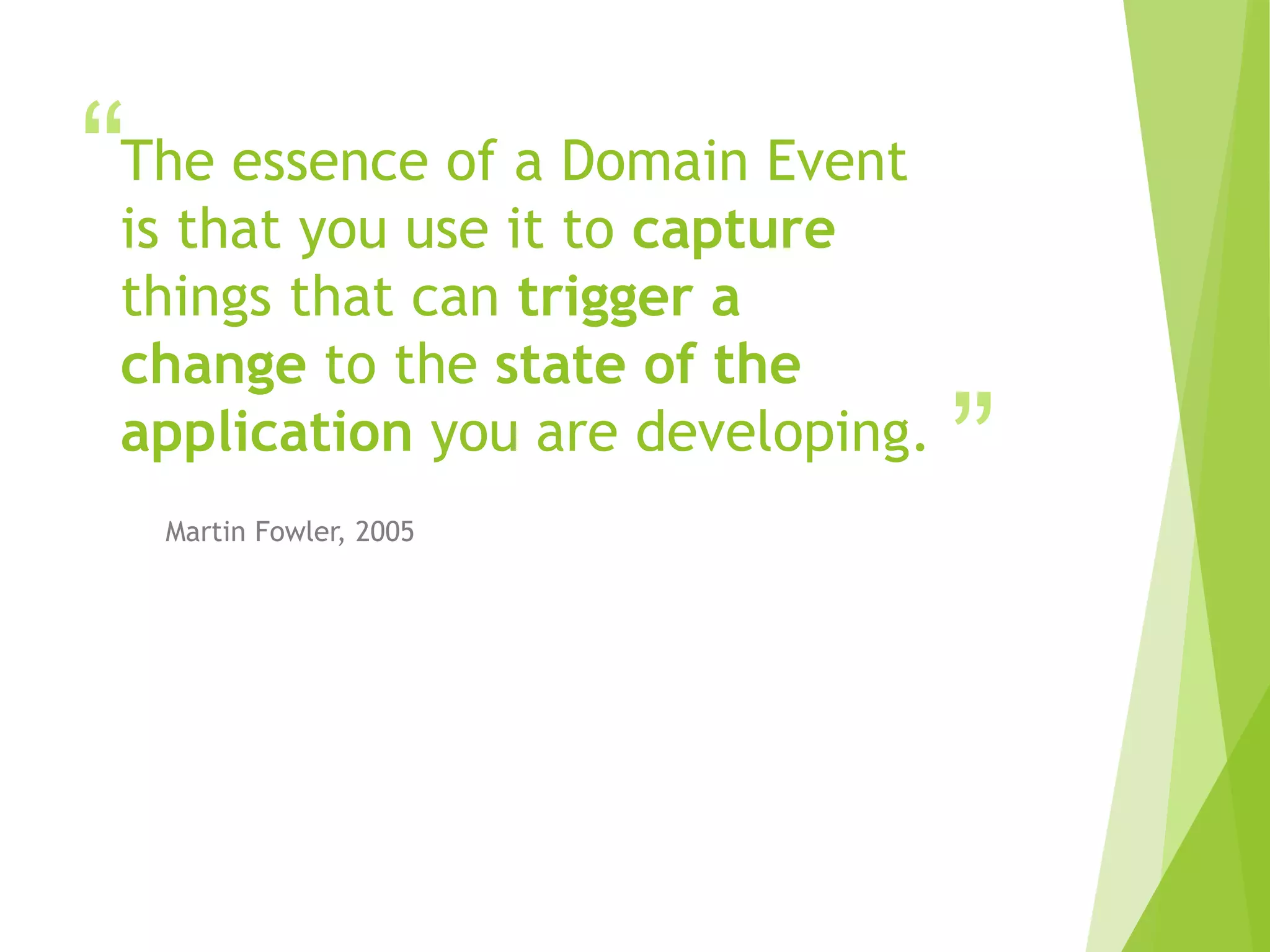
The essence of a Domain Event
is that you use it to capture
things that can trigger a
change to the state of the
application you are developing.
Martin Fowler, 2005
“
”
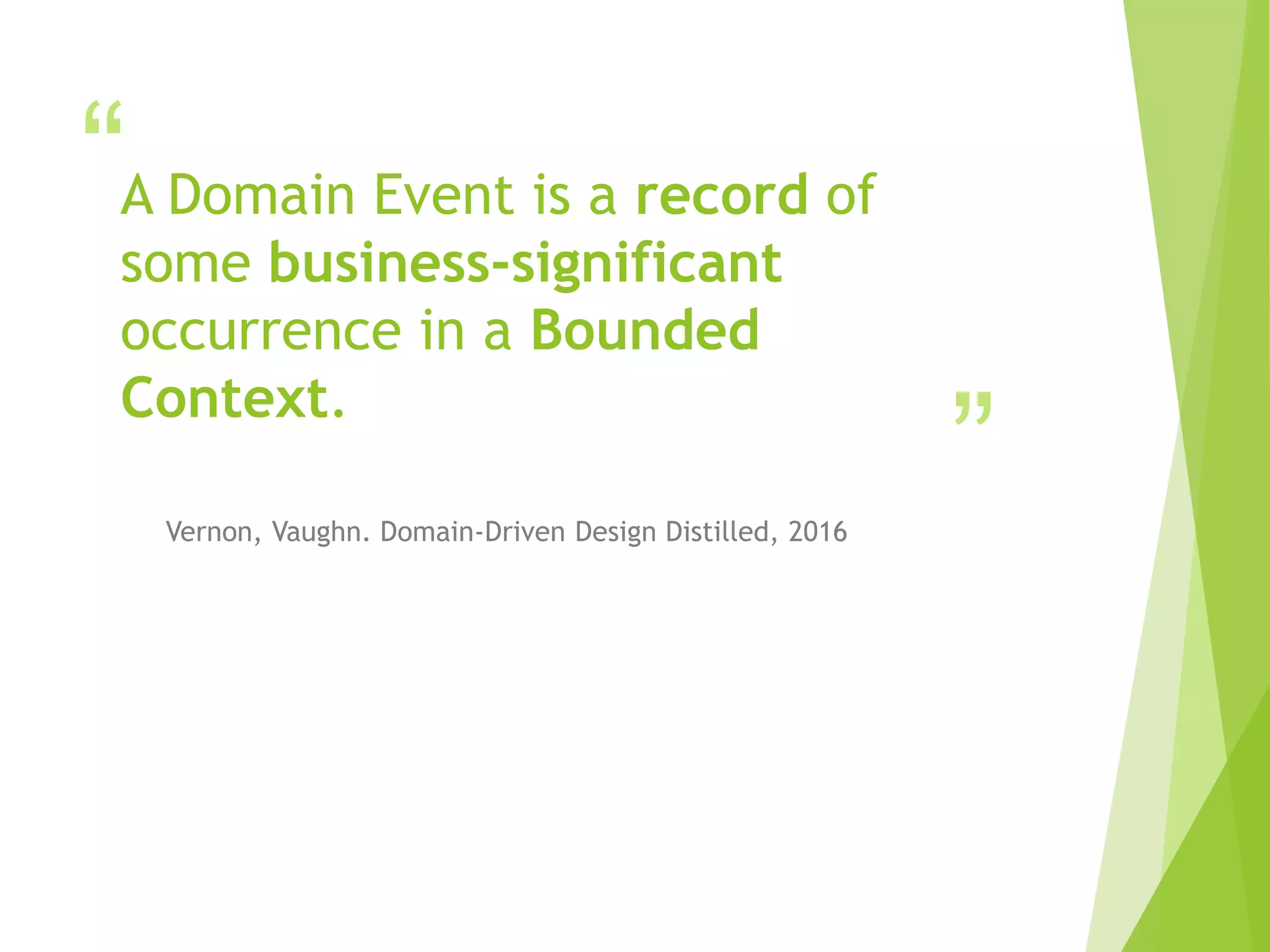
A Domain Event is a record of
some business-significant
occurrence in a Bounded
Context.
Vernon, Vaughn. Domain-Driven Design Distilled, 2016
Customer
Created
Product Version
Changed
Characteristics of Domain Events
 result of a state change
 events happened in the past
 events are facts
 events can never be rejected
 events can never be changed, they are immutable
 part of the ubiquitous language
 nameChanged
 invoicePrinted
 orderConfirmed
 callRecorded
 softwareCrashed
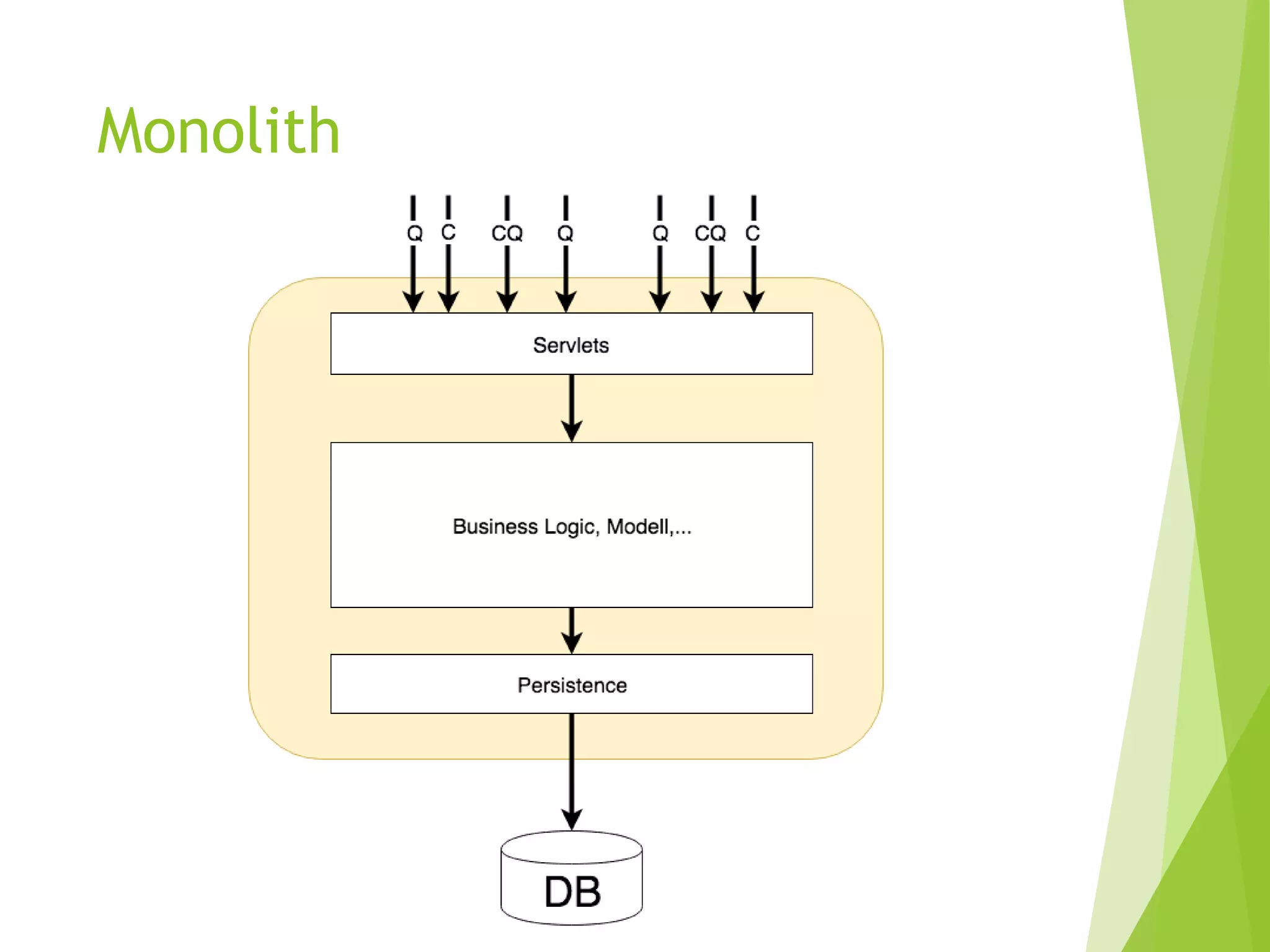
A typical application
Zoomed in...
Slaying a monolith
Microservices to the rescue!?
What are microservices?
 Small,
 independent applications,
 loosely coupled,
 communicating with each other in an asynchronous
manner (across system boundaries), and
 can fail independently, and if one or some fails, the
system as a whole still works, though the functionality
might be downgraded when there are failures.
First approach
First approach
Let’s try it again...
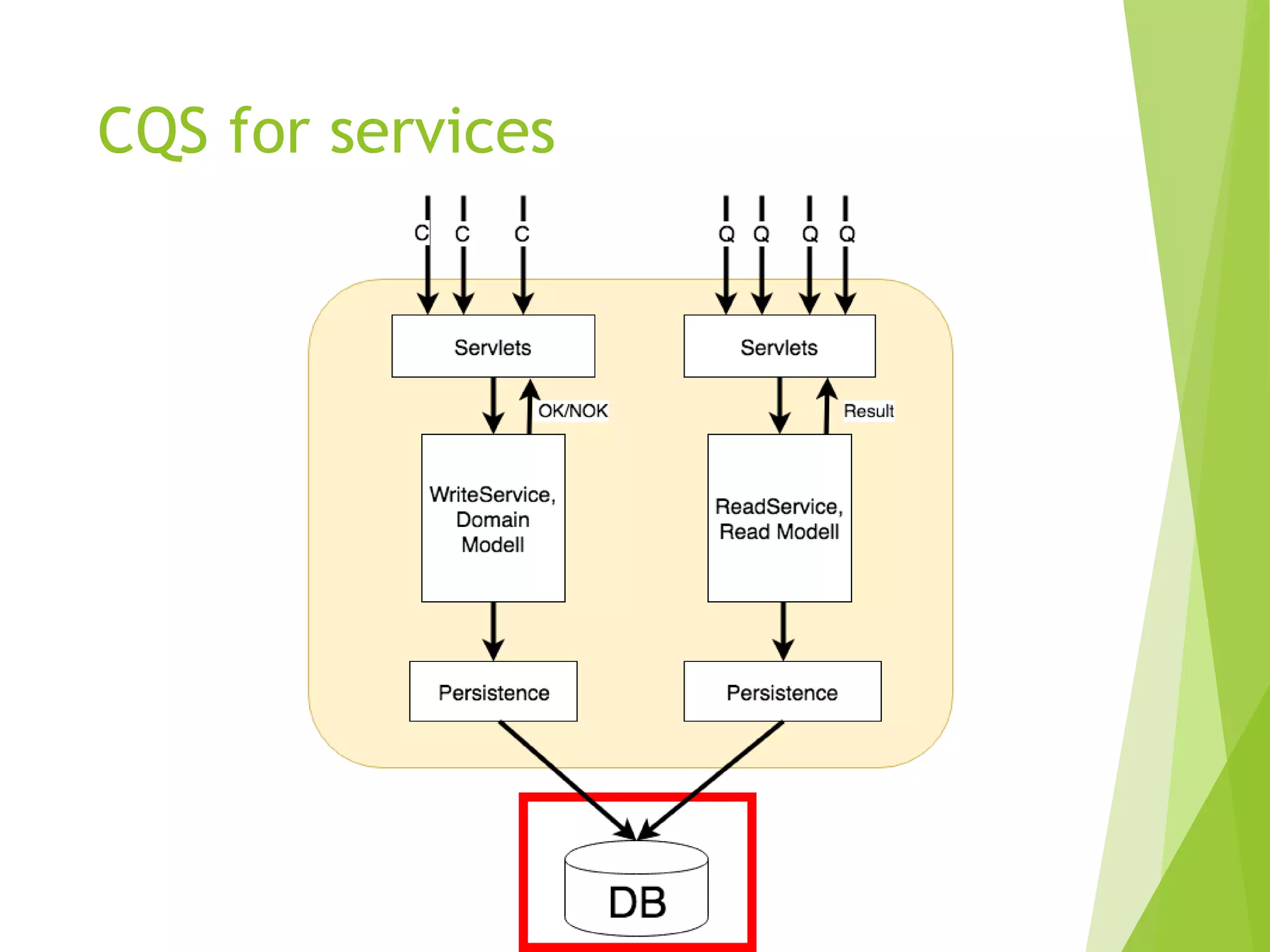
CQS: command-query separation
 pattern on component level
Methods either query or command but never both:
 query does not change state
 command does not return value, only changes the state
 read/write can have a separated model
 reads can be run multiple times without side effects
 reads are automatically idempotent
Example
Commands
Queries
Hidden query,
because
returns
value via
supplied
reference!
Query and command
combined
CQS applied
Monolith
CQS for services
CQS with datapump
Event driven CQRS
CQRS for multiple read models
Example for commands & events
commands for the write side: cause a state change of an
aggregate
public class ConfirmOrder {
public Guid OrderId;
}
events for the result side: are the result of a command
public class OrderConfirmed {
public Guid OrderId;
public DateTime ConfirmationDate;
}
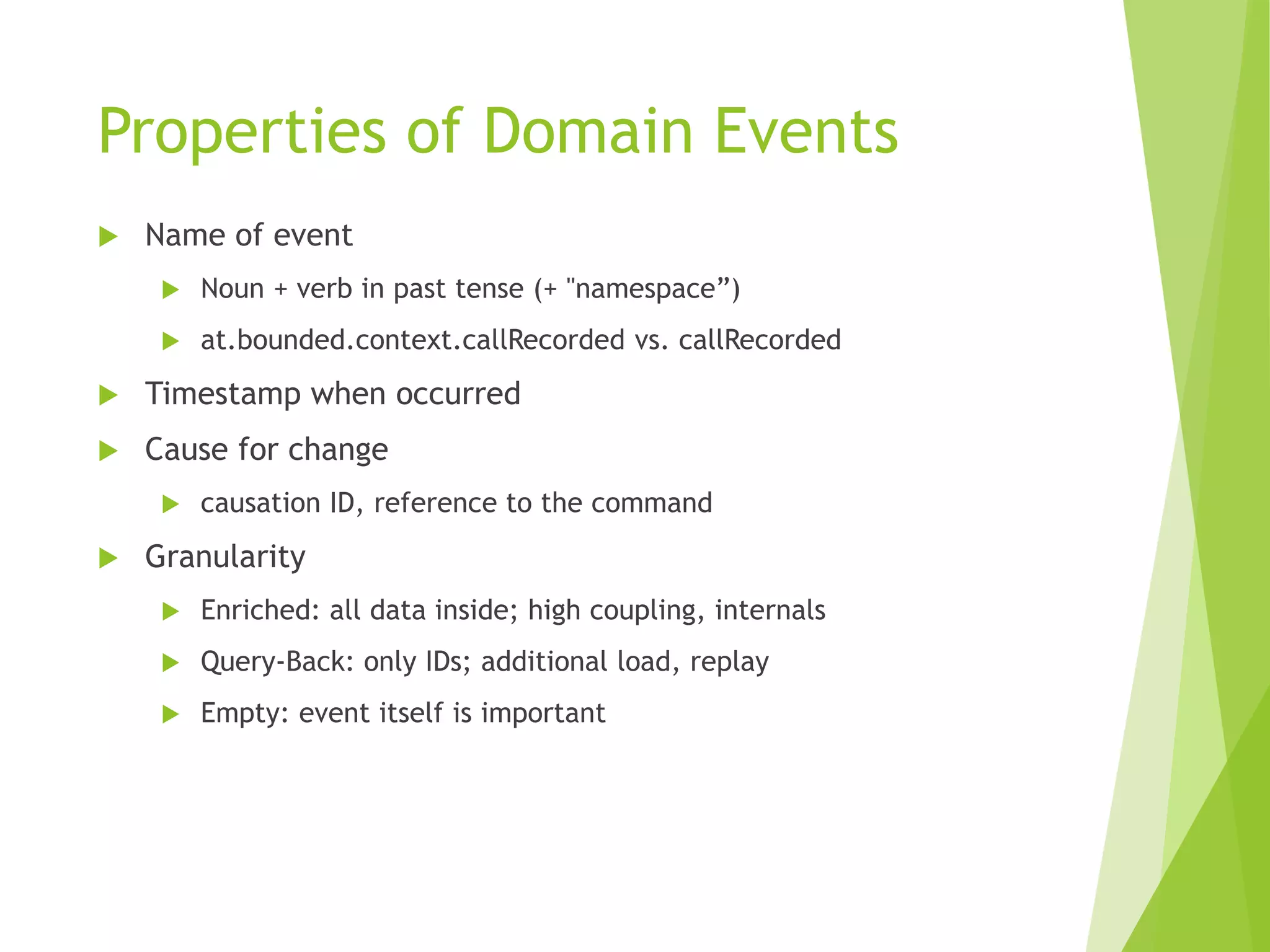
Properties of Domain Events
 Name of event
 Noun + verb in past tense (+ "namespace”)
 at.bounded.context.callRecorded vs. callRecorded
 Timestamp when occurred
 Cause for change
 causation ID, reference to the command
 Granularity
 Enriched: all data inside; high coupling, internals
 Query-Back: only IDs; additional load, replay
 Empty: event itself is important
Concurrency of commands
commands should be handled
concurrently...
... but this could lead to conflicts!
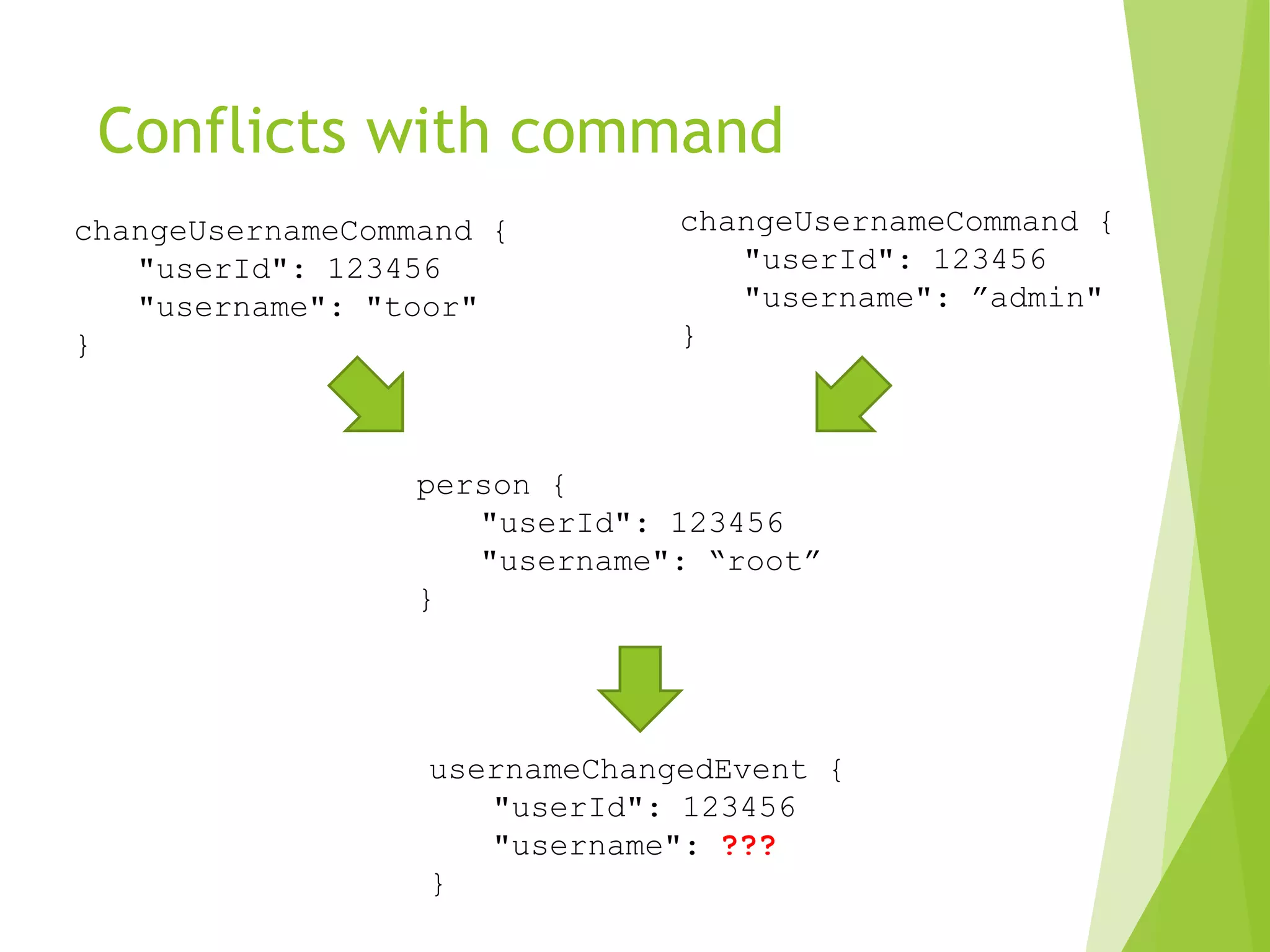
Conflicts with command
person {
"userId": 123456
"username": “root”
}
changeUsernameCommand {
"userId": 123456
"username": "toor"
}
changeUsernameCommand {
"userId": 123456
"username": ”admin"
}
usernameChangedEvent {
"userId": 123456
"username": ???
}
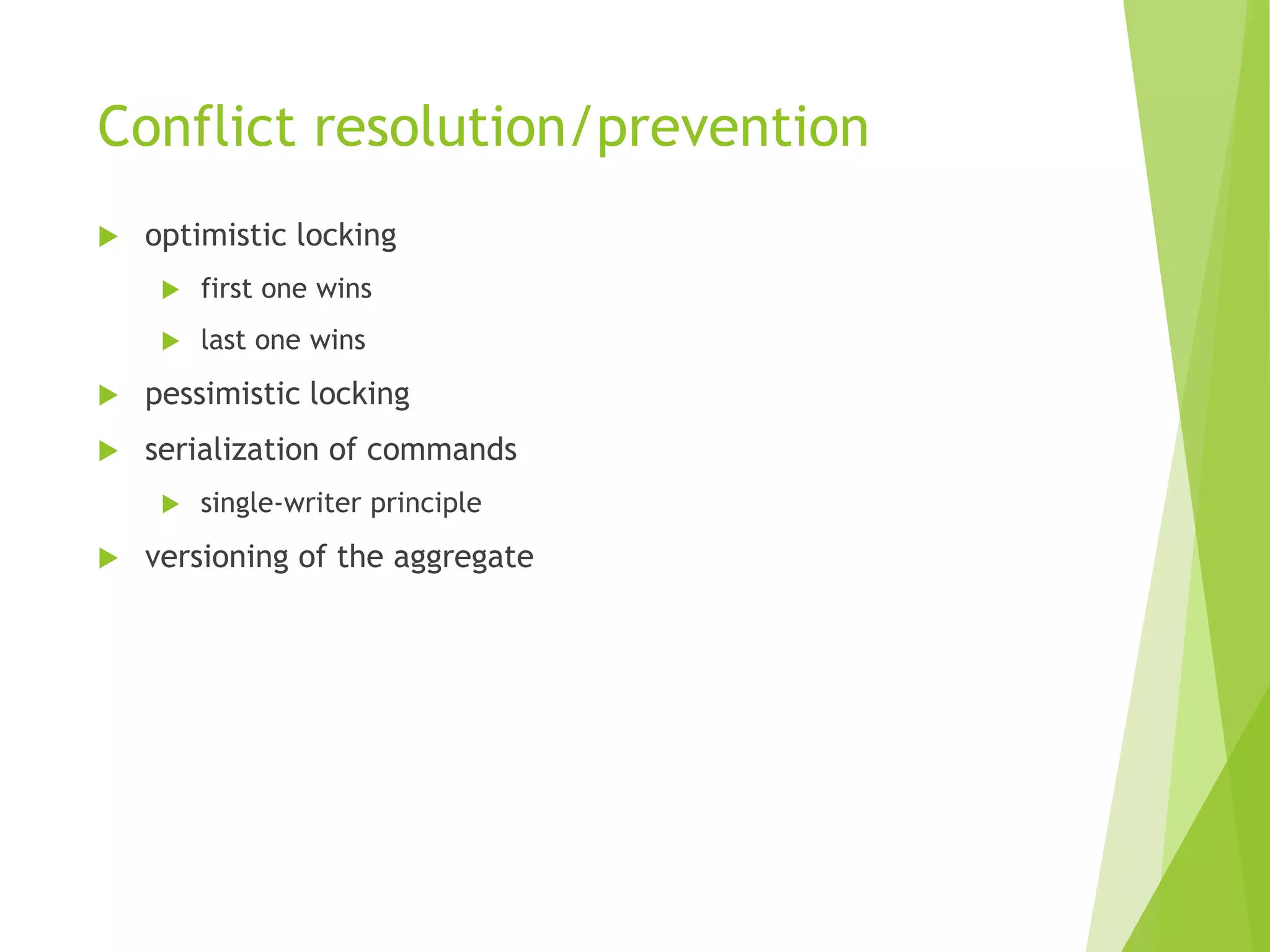
Conflict resolution/prevention
 optimistic locking
 first one wins
 last one wins
 pessimistic locking
 serialization of commands
 single-writer principle
 versioning of the aggregate
Evolution of events
Reason for changes
 aggregate boundaries are wrong
 new attributes
 refactoring
 typos
 type changes
 ...
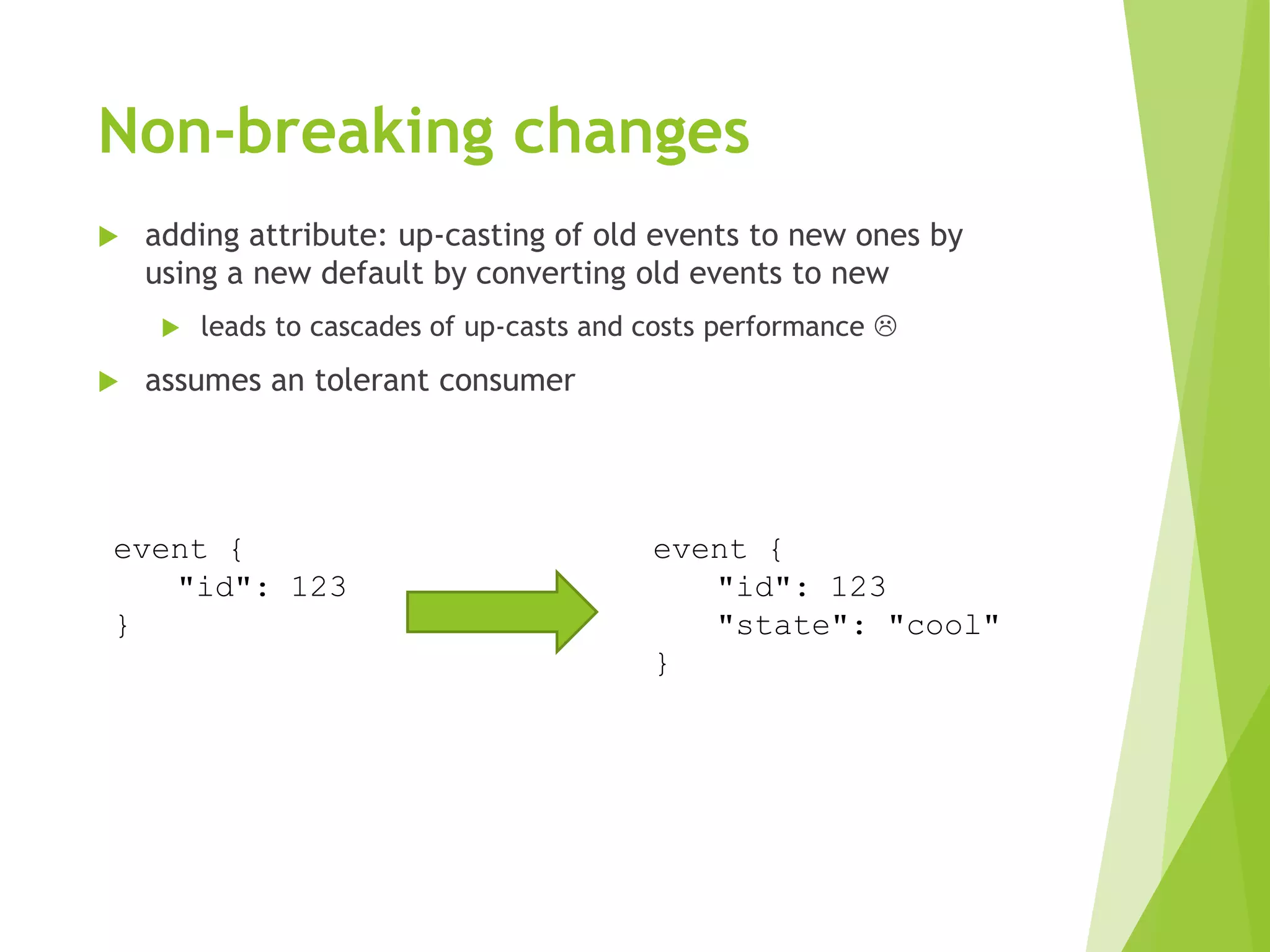
Non-breaking changes
 adding attribute: up-casting of old events to new ones by
using a new default by converting old events to new
 leads to cascades of up-casts and costs performance 
 assumes an tolerant consumer
event {
"id": 123
}
event {
"id": 123
"state": "cool"
}
Breaking changes
 removing attribute
 leave it in
 renaming of attribute
 add new attribute or live with it
 changes of semantic meaning
 e.g. discount of price in percentage or euro?
 type changes
 e.g. flag to array
 better to add an additional array to the existing flag
event {
"id": 123
”discont": ”10”
"flag": "boolean”
”newFlag": ["boolean”]
}
Event sourcing
What is event sourcing?
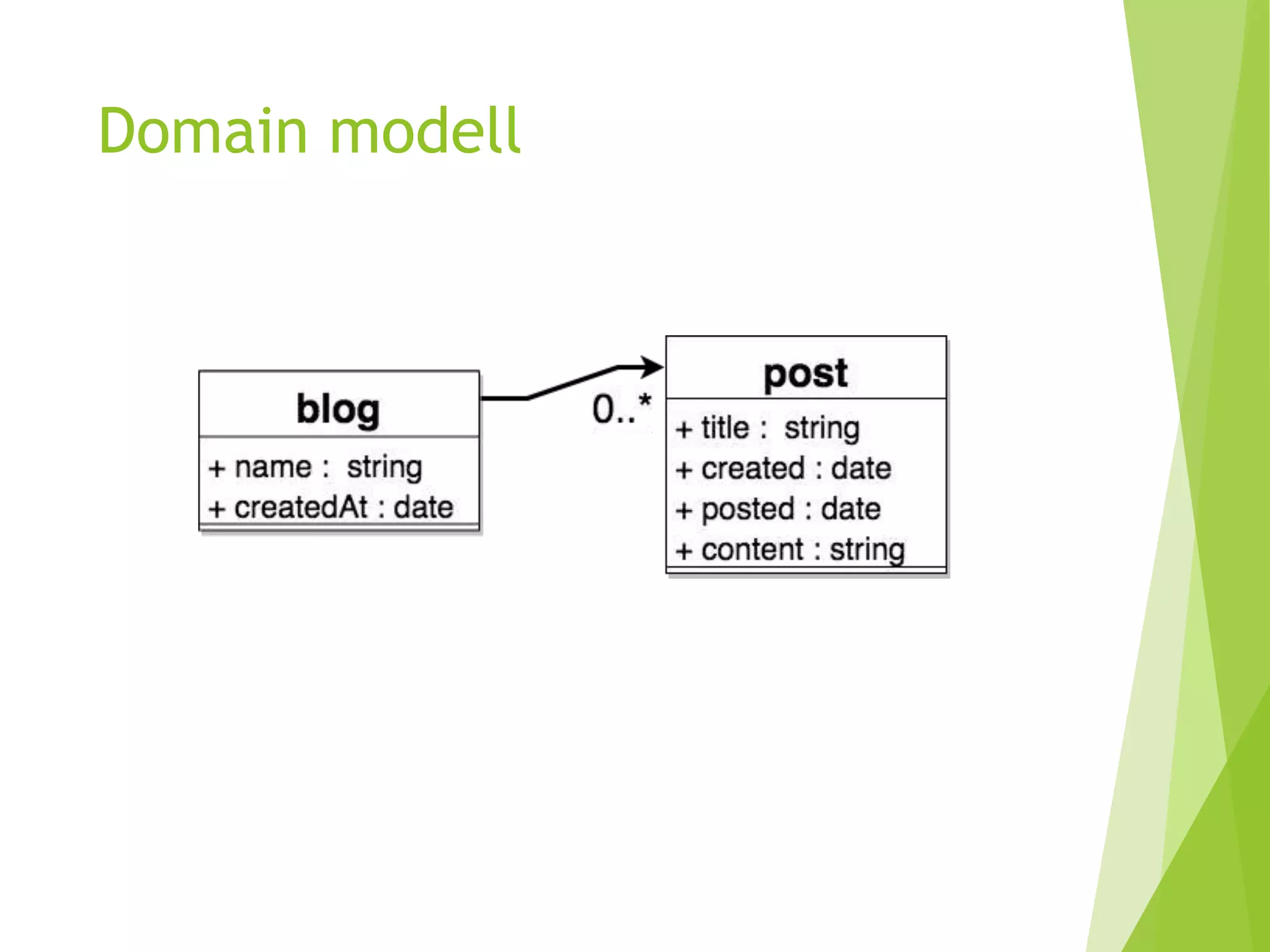
Domain modell
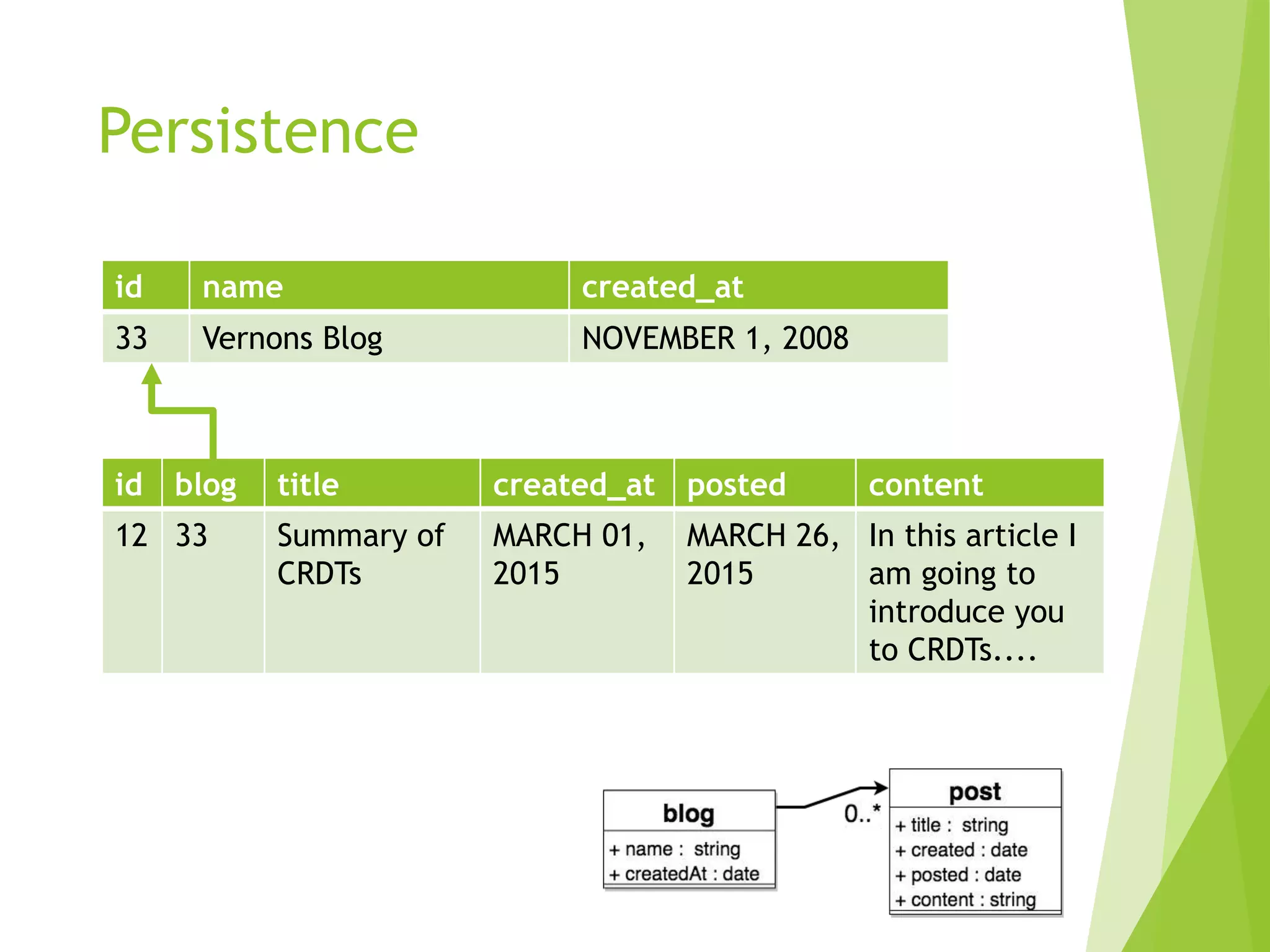
Persistence
id name created_at
33 Vernons Blog NOVEMBER 1, 2008
id blog title created_at posted content
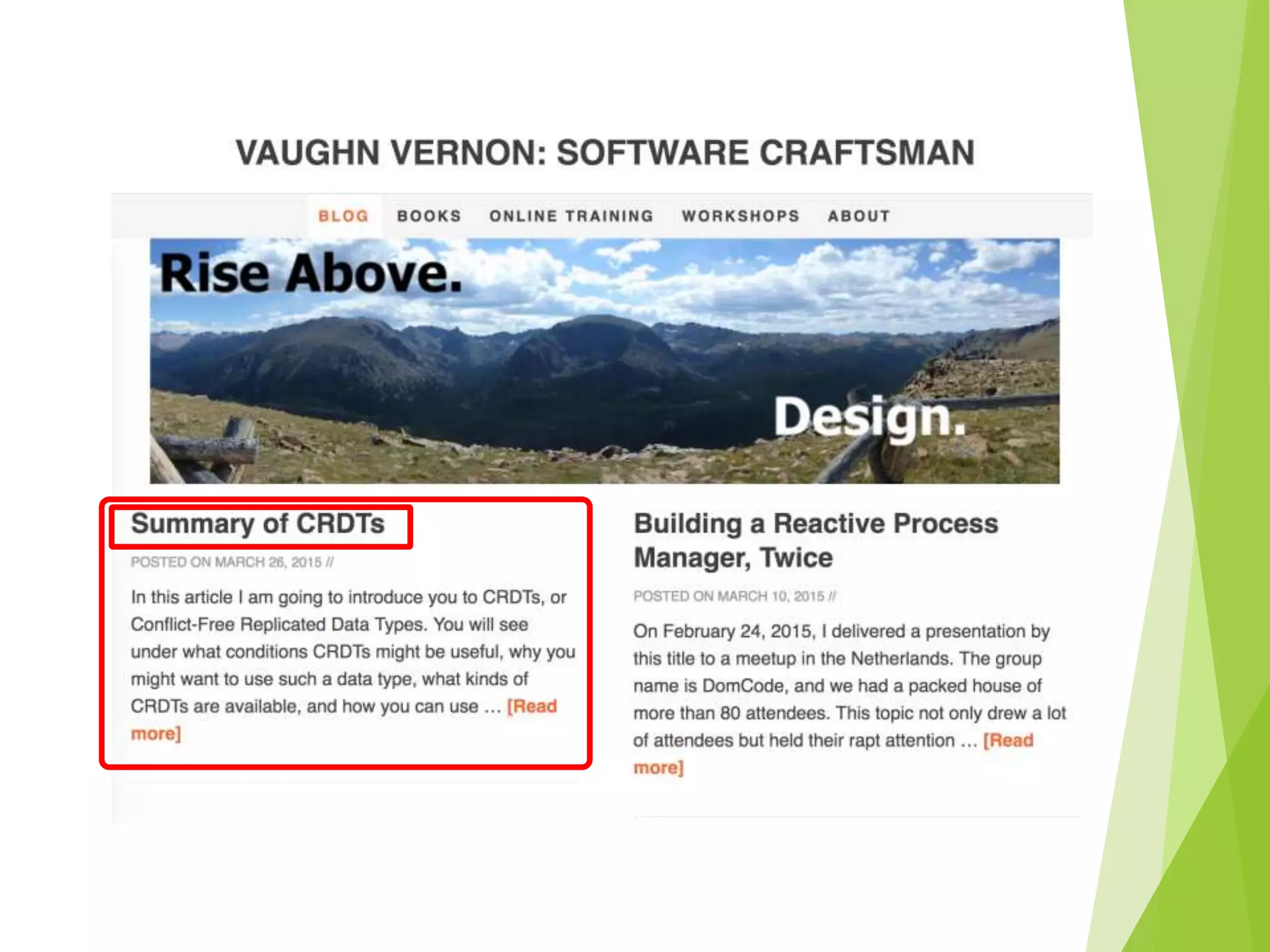
12 33 Summary of
CRDTs
MARCH 01,
2015
MARCH 26,
2015
In this article I
am going to
introduce you
to CRDTs....
Events for persistence
Time
blogEntryCreated 12;33;MARCH 01, 2015
blogEntryEdited 12;“...CDRTs...”
blogEntryEdited 12;“...CRDTs...”
blogEntryPublished 12;Vernon, MARCH 25, 2015
blogEntryTitleChanged 12;“Summary of CRDTs”
blogEntryEdited 12;“Yeah, But…”
blogEntryPublished 12;Vernon, MARCH 26, 2015
blogEntryCreated 13;33;MAY 14, 2015
id blog title created_at posted content
12 33 Summary of
CRDTs
MARCH 01,
2015
MARCH 26,
2015
...CRDTs...
13 33 MAY 14, 2015
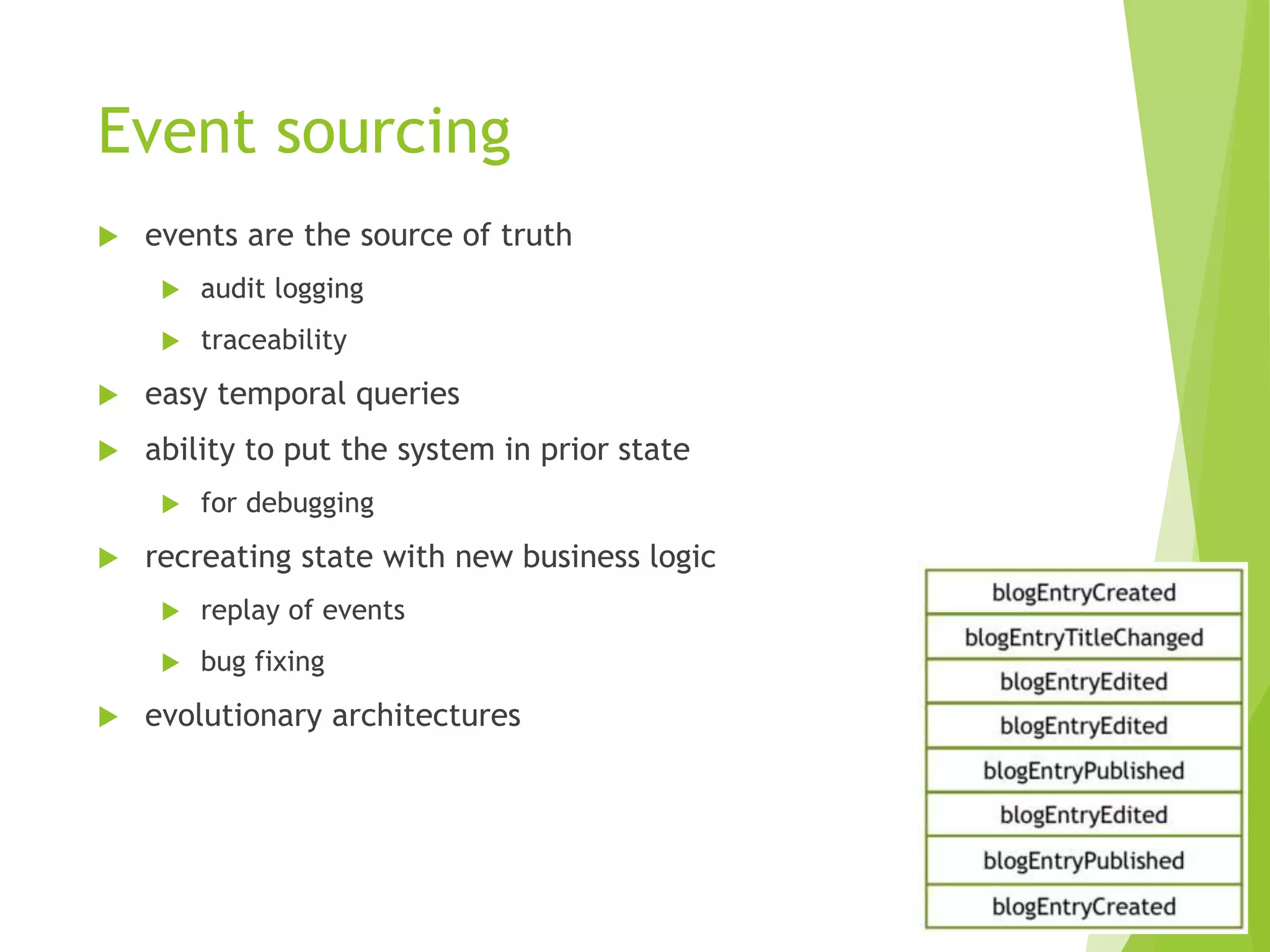
Event sourcing
 events are the source of truth
 audit logging
 traceability
 easy temporal queries
 ability to put the system in prior state
 for debugging
 recreating state with new business logic
 replay of events
 bug fixing
 evolutionary architectures
Events for integration
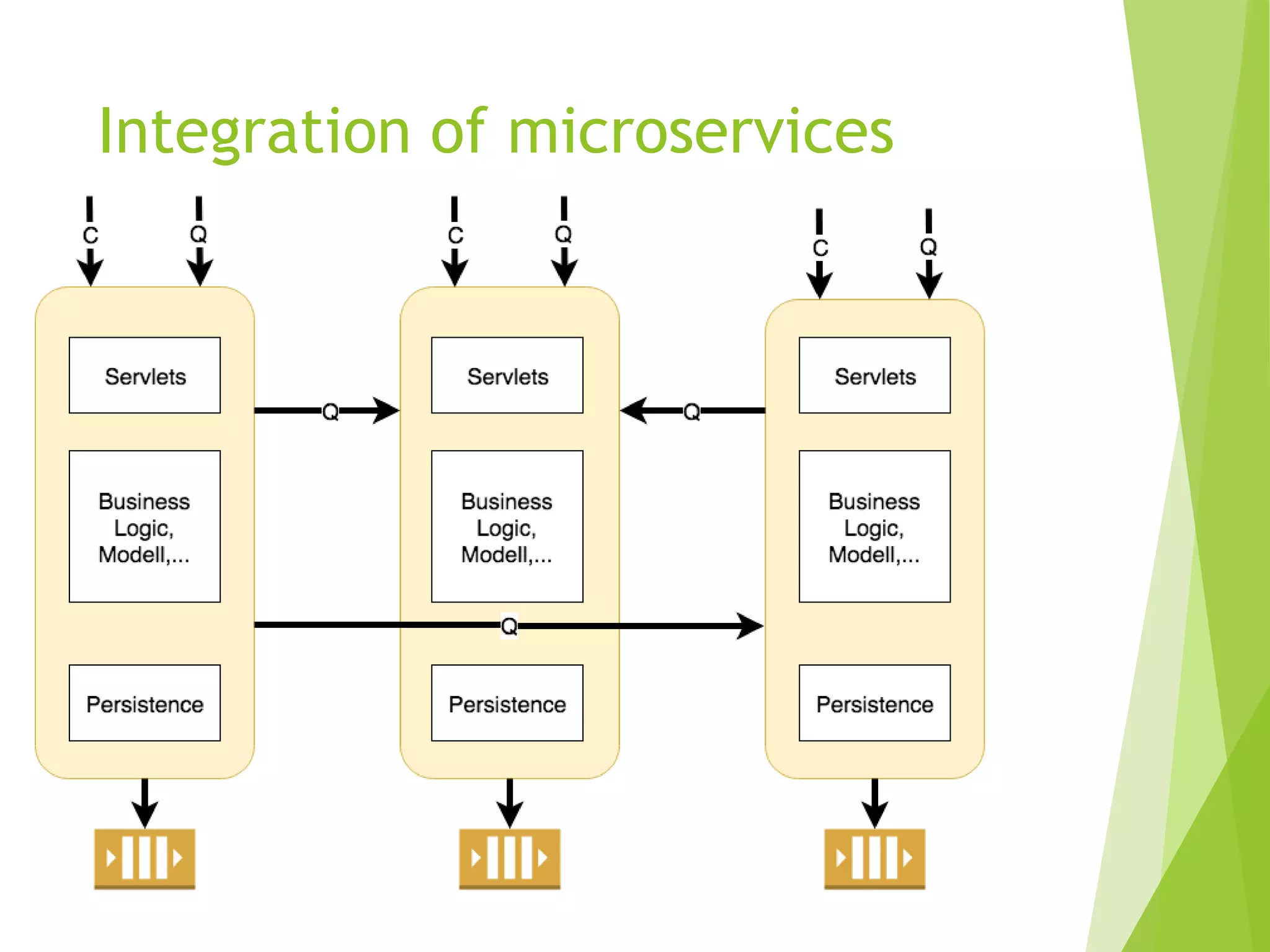
Integration of microservices
Integration Events
private
public
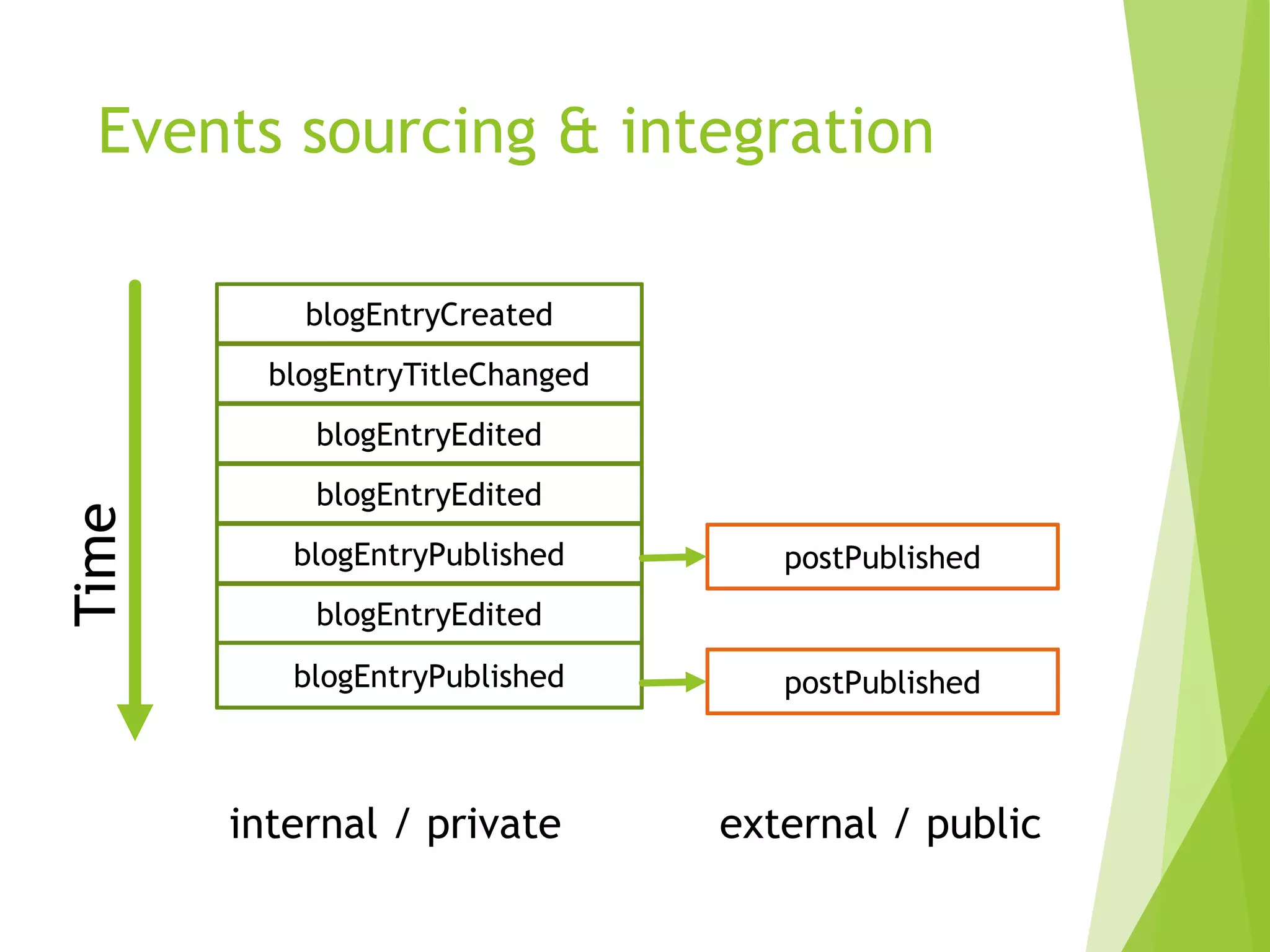
Events sourcing & integration
blogEntryCreated
Time
blogEntryEdited
blogEntryEdited
blogEntryPublished
blogEntryTitleChanged
blogEntryEdited
blogEntryPublished
postPublished
postPublished
internal / private external / public
Recap
Recap...
 domain events
 monoliths
 microservice
 distributed monoliths
 CQS
 CQRS
 CQRS with integration events
 event sourcing
Further topics and pitfalls
 versioning of events
 performance in event sourcing
 long running processes: orchestration vs. choreography
 sagas for long lived/distributed transactions
 how to identify domain events
 data protection, authorization, GDPR,...
 “reactive” microservices
 ...
“
”
[...] each pattern represents our current best
guess as to what arrangement of the physical
environment will work to solve the problem
presented.
[...] patterns are still hypotheses, all 253 of
them—and are therefore all tentative, all free to
evolve under the impact of new experience and
observation.
— Christopher Alexander et al., A Pattern Language, p. xv, 1977
conclusion
• apply the patterns wisely, you don’t have to use (all of)
them!
• patterns change over time! new patterns emerge
permanently!
Questions...

DDD meets CQRS and event sourcing

  • 1.
  • 2.
    who am I gottfriedszing  doing IT stuff for 30+ years  requirements engineer/business analyst  software/solution architect  java, kotlin, js @GottfriedSzing gottfried@szing.eu
  • 3.
    what to expect... some patterns & concepts  no code, json snippets for illustration  no silver bullet for solving problems a possible path to an scalable, maintainable, fault tolerant, fault resilient application
  • 4.
  • 5.
    Patterns & conceptsin DDD  ubiquitous language  domain & subdomain  bounded context  context map  layered architecture  entity  value object  aggregate  service  repository  factory  domain event
  • 6.
    “ ” The essence ofa Domain Event is that you use it to capture things that can trigger a change to the state of the application you are developing. Martin Fowler, 2005
  • 7.
    “ ” A Domain Eventis a record of some business-significant occurrence in a Bounded Context. Vernon, Vaughn. Domain-Driven Design Distilled, 2016
  • 8.
  • 9.
  • 10.
    Characteristics of DomainEvents  result of a state change  events happened in the past  events are facts  events can never be rejected  events can never be changed, they are immutable  part of the ubiquitous language  nameChanged  invoicePrinted  orderConfirmed  callRecorded  softwareCrashed
  • 11.
  • 12.
  • 13.
  • 14.
    What are microservices? Small,  independent applications,  loosely coupled,  communicating with each other in an asynchronous manner (across system boundaries), and  can fail independently, and if one or some fails, the system as a whole still works, though the functionality might be downgraded when there are failures.
  • 15.
  • 16.
  • 17.
  • 18.
    CQS: command-query separation pattern on component level Methods either query or command but never both:  query does not change state  command does not return value, only changes the state  read/write can have a separated model  reads can be run multiple times without side effects  reads are automatically idempotent
  • 19.
  • 20.
  • 21.
  • 22.
  • 23.
  • 24.
  • 25.
    CQRS for multipleread models
  • 26.
    Example for commands& events commands for the write side: cause a state change of an aggregate public class ConfirmOrder { public Guid OrderId; } events for the result side: are the result of a command public class OrderConfirmed { public Guid OrderId; public DateTime ConfirmationDate; }
  • 27.
    Properties of DomainEvents  Name of event  Noun + verb in past tense (+ "namespace”)  at.bounded.context.callRecorded vs. callRecorded  Timestamp when occurred  Cause for change  causation ID, reference to the command  Granularity  Enriched: all data inside; high coupling, internals  Query-Back: only IDs; additional load, replay  Empty: event itself is important
  • 28.
    Concurrency of commands commandsshould be handled concurrently... ... but this could lead to conflicts!
  • 29.
    Conflicts with command person{ "userId": 123456 "username": “root” } changeUsernameCommand { "userId": 123456 "username": "toor" } changeUsernameCommand { "userId": 123456 "username": ”admin" } usernameChangedEvent { "userId": 123456 "username": ??? }
  • 30.
    Conflict resolution/prevention  optimisticlocking  first one wins  last one wins  pessimistic locking  serialization of commands  single-writer principle  versioning of the aggregate
  • 31.
  • 32.
    Reason for changes aggregate boundaries are wrong  new attributes  refactoring  typos  type changes  ...
  • 33.
    Non-breaking changes  addingattribute: up-casting of old events to new ones by using a new default by converting old events to new  leads to cascades of up-casts and costs performance   assumes an tolerant consumer event { "id": 123 } event { "id": 123 "state": "cool" }
  • 34.
    Breaking changes  removingattribute  leave it in  renaming of attribute  add new attribute or live with it  changes of semantic meaning  e.g. discount of price in percentage or euro?  type changes  e.g. flag to array  better to add an additional array to the existing flag event { "id": 123 ”discont": ”10” "flag": "boolean” ”newFlag": ["boolean”] }
  • 35.
    Event sourcing What isevent sourcing?
  • 37.
  • 38.
    Persistence id name created_at 33Vernons Blog NOVEMBER 1, 2008 id blog title created_at posted content 12 33 Summary of CRDTs MARCH 01, 2015 MARCH 26, 2015 In this article I am going to introduce you to CRDTs....
  • 39.
    Events for persistence Time blogEntryCreated12;33;MARCH 01, 2015 blogEntryEdited 12;“...CDRTs...” blogEntryEdited 12;“...CRDTs...” blogEntryPublished 12;Vernon, MARCH 25, 2015 blogEntryTitleChanged 12;“Summary of CRDTs” blogEntryEdited 12;“Yeah, But…” blogEntryPublished 12;Vernon, MARCH 26, 2015 blogEntryCreated 13;33;MAY 14, 2015 id blog title created_at posted content 12 33 Summary of CRDTs MARCH 01, 2015 MARCH 26, 2015 ...CRDTs... 13 33 MAY 14, 2015
  • 40.
    Event sourcing  eventsare the source of truth  audit logging  traceability  easy temporal queries  ability to put the system in prior state  for debugging  recreating state with new business logic  replay of events  bug fixing  evolutionary architectures
  • 41.
  • 42.
  • 43.
  • 44.
    Events sourcing &integration blogEntryCreated Time blogEntryEdited blogEntryEdited blogEntryPublished blogEntryTitleChanged blogEntryEdited blogEntryPublished postPublished postPublished internal / private external / public
  • 45.
  • 46.
    Recap...  domain events monoliths  microservice  distributed monoliths  CQS  CQRS  CQRS with integration events  event sourcing
  • 47.
    Further topics andpitfalls  versioning of events  performance in event sourcing  long running processes: orchestration vs. choreography  sagas for long lived/distributed transactions  how to identify domain events  data protection, authorization, GDPR,...  “reactive” microservices  ...
  • 48.
    “ ” [...] each patternrepresents our current best guess as to what arrangement of the physical environment will work to solve the problem presented. [...] patterns are still hypotheses, all 253 of them—and are therefore all tentative, all free to evolve under the impact of new experience and observation. — Christopher Alexander et al., A Pattern Language, p. xv, 1977 conclusion • apply the patterns wisely, you don’t have to use (all of) them! • patterns change over time! new patterns emerge permanently!
  • 49.

Editor's Notes

  • #38 https://vaughnvernon.co/?p=1012