Unless otherwise indicated, these slides are © 2013-2015 Pivotal Software, Inc. and licensed under a Creative Commons Attribution-NonCommercial license: http://creativecommons.org/licenses/by-nc/3.0/
SPRINGONE2GX
WASHINGTON, DC
Building Microservices with Event
Sourcing and CQRS
Michael Ploed - innoQ
@bitboss
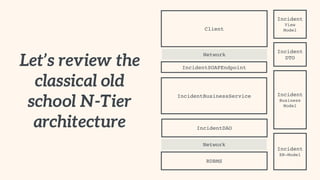
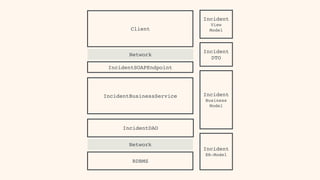
IncidentSOAPEndpoint
IncidentBusinessService
IncidentDAO
Incident
Business
Model
Client
Incident

DTO
Incident

View

Model
RDBMS
Incident

ER-Model
Network
Network
Let’s review the
classical old
school N-Tier
architecture
Characteristics
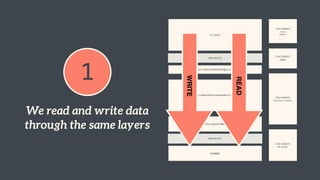
1
We read and write data
through the same layers
IncidentSOAPEndpoint
IncidentBusinessService
IncidentDAO
Incident
Business Model
Client
Incident

DTO
Incident

View

Model
RDBMS
Incident

ER-Model
Network
Network
READ
WRITE
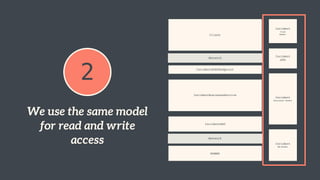
2
We use the same model

for read and write
access
IncidentSOAPEndpoint
IncidentBusinessService
IncidentDAO
Incident
Business Model
Client
Incident

DTO
Incident

View

Model
RDBMS
Incident

ER-Model
Network
Network
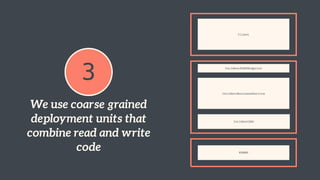
3
We use coarse grained
deployment units that
combine read and write
code
IncidentSOAPEndpoint
IncidentBusinessService
IncidentDAO
Client
RDBMS
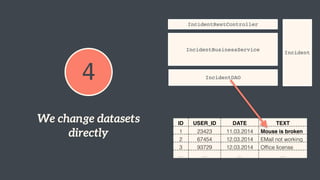
4
We change datasets
directly
IncidentRestController
IncidentBusinessService
IncidentDAO
Incident
ID USER_ID DATE TEXT
1 23423 11.03.2014 Mouse is broken
2 67454 12.03.2014 EMail not working
3 93729 12.03.2014 Office license
… … … …
We’ve done that
for ages already and
it’s proven
Many applications will
run smooth and fine
with this kind of
approach
However there are
drawbacks to this kind
of architecture
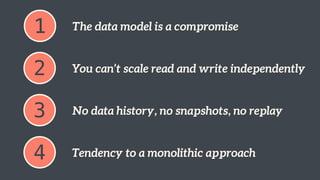
1 The data model is a compromise
2 You can’t scale read and write independently
3 No data history, no snapshots, no replay
4 Tendency to a monolithic approach
Event Sourcing is an
architectural pattern in
which the state of the
application is being
determined by a
sequence of events
Building Blocks
Applications
Event
Queue
Applications issues
events to a queue
Event
Handler
Event
Store
Events are stored in
the event store
The Event handler is
processing the events
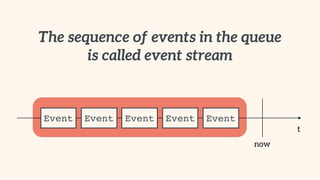
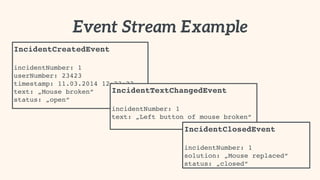
The sequence of events in the queue
is called event stream
t
now
EventEventEventEventEvent
IncidentCreatedEvent


incidentNumber: 1

userNumber: 23423
timestamp: 11.03.2014 12:23:23

text: „Mouse broken“
status: „open“
Event Stream Example
IncidentTextChangedEvent


incidentNumber: 1

text: „Left button of mouse broken“
IncidentClosedEvent


incidentNumber: 1

solution: „Mouse replaced“
status: „closed“
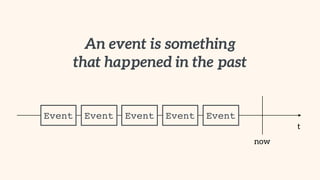
An event is something 

that happened in the past
t
now
EventEventEventEventEvent
The names of the events are part
of the

Ubiquitous Language
D D D
ShipmentDeliveredEvent

CustomerVerifiedEvent
CartCheckedOutEvent
CreateCustomerEvent

WillSaveItemEvent

DoStuffEvent
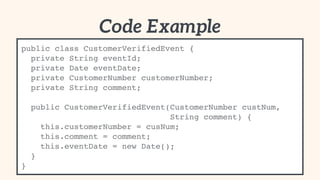
Code Example
public class CustomerVerifiedEvent {
private String eventId;
private Date eventDate;
private CustomerNumber customerNumber;
private String comment;
public CustomerVerifiedEvent(CustomerNumber custNum, 

String comment) {

this.customerNumber = cusNum;
this.comment = comment;
this.eventDate = new Date();
}
}
Scope your events based on

Aggregates
D D D
An Event is always immutable
!
There is no deletion of events
!
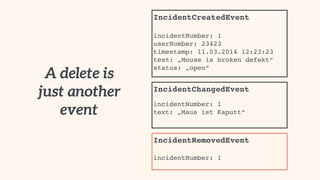
A delete is
just another
event
IncidentCreatedEvent


incidentNumber: 1

userNumber: 23423
timestamp: 11.03.2014 12:23:23

text: „Mouse is broken defekt“
status: „open“
IncidentChangedEvent


incidentNumber: 1

text: „Maus ist Kaputt“
IncidentRemovedEvent


incidentNumber: 1

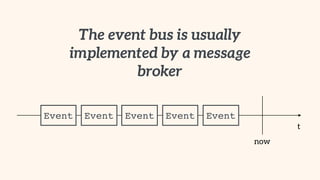
The event bus is usually
implemented by a message
broker
t
now
EventEventEventEventEvent
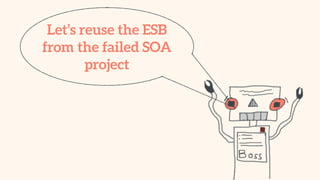
Let’s reuse the ESB
from the failed SOA
project
NO
NO
NO
!
Prefer dumb pipes
with smart
endpoints as a
suitable message
broker architecture
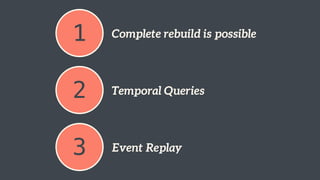
1 Complete rebuild is possible
2 Temporal Queries
3 Event Replay
Well known examples
=

Version Control Systems

or
Database Transaction Logs
The Event
Store has a
very high
business value
Aren’t there performance
issues attached to this kind of
data storage?
YES!
Application
State
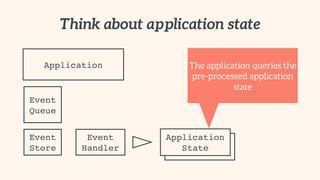
Think about application state
Application
Event
Queue
Event
Handler
Event
Store
Application
State
The application queries the
pre-processed application
state
CQRS
Command
Query
Responsibility
Separation
IncidentSOAPEndpoint
IncidentBusinessService
IncidentDAO
Incident
Business
Model
Client
Incident

DTO
Incident

View

Model
RDBMS
Incident

ER-Model
Network
Network
IncidentQueryEndpoint
IncidentQueryService
IncidentQueryDAO
RDBMS
Network
IncidentCommandEndpoint
IncidentCommandService
IncidentCommandDAO
Basically the idea behind CQRS is simple
Code Example
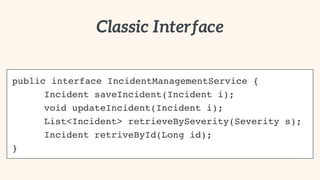
Classic Interface
public interface IncidentManagementService {
Incident saveIncident(Incident i);
void updateIncident(Incident i);
List<Incident> retrieveBySeverity(Severity s);
Incident retriveById(Long id);
}
CQRS-ified Interfaces
public interface IncidentManagementQueryService {
List<Incident> retrieveBySeverity(Severity s);
Incident retriveById(Long id);
}
public interface IncidentManagementCommandService {
Incident saveIncident(Incident i);
void updateIncident(Incident i);
}
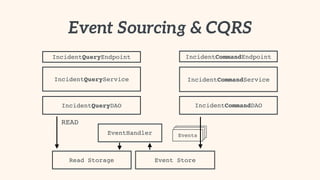
Event Store
EventHandler EventsEvents
Event Sourcing & CQRS
IncidentCommandEndpoint
IncidentCommandService
IncidentCommandDAO
IncidentQueryEndpoint
IncidentQueryService
IncidentQueryDAO
Read Storage
Events
READ
1 Individual scalability and deployment
options
2
Technological freedom of choice for
command, query and event handler
code
3 Excellent Fit for Bounded Context
(Domain Driven Design)
Event Sourcing and CQRS
are interesting architectural
options. However there are
various challanges, that have
to be taken care of
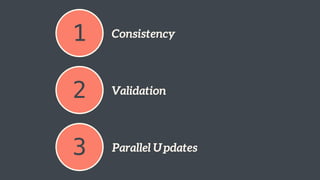
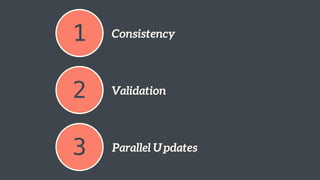
1 Consistency
2 Validation
3 Parallel Updates
YES
!
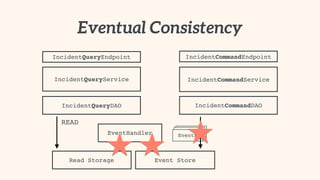
Systems based on
CQRS and Event
Sourcing are
mostly eventually
consistent
Event Store
EventHandler EventsEvents
Eventual Consistency
IncidentCommandEndpoint
IncidentCommandService
IncidentCommandDAO
IncidentQueryEndpoint
IncidentQueryService
IncidentQueryDAO
Read Storage
Events
READ
BUT
!
You can build a 

fully consistent
system which
follows Event
Sourcing
principles
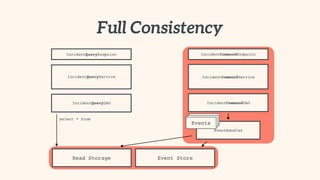
EventHandler
EventsEvents
Full Consistency
IncidentCommandEndpoint
IncidentCommandService
IncidentCommandDAO
IncidentQueryEndpoint
IncidentQueryService
IncidentQueryDAO
Read Storage
Events
Select * from
Event Store
Your business domain drives the level
of consistency not technology

Deeper Insight
D D D
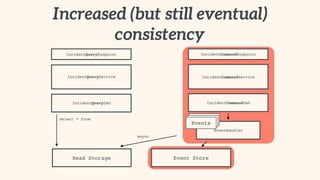
Increased (but still eventual)
consistency
EventHandler
EventsEvents
IncidentCommandEndpoint
IncidentCommandService
IncidentCommandDAO
IncidentQueryEndpoint
IncidentQueryService
IncidentQueryDAO
Read Storage
Events
Select * from
Event Store
async
! There is no
standard solution
1 Consistency
2 Validation
3 Parallel Updates
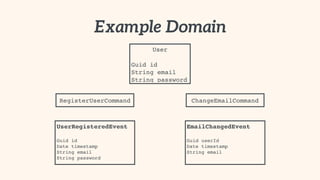
Example Domain
User

Guid id
String email
String password
RegisterUserCommand ChangeEmailCommand
UserRegisteredEvent


Guid id
Date timestamp
String email
String password
EmailChangedEvent


Guid userId
Date timestamp
String email
We process 2
million+ registrations per
day. A user can change her
email address. However the
emails address must be
unique
?
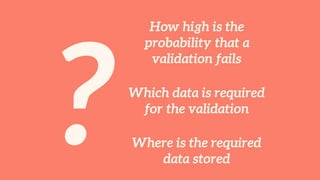
How high is the
probability that a
validation fails
Which data is required
for the validation
Where is the required
data stored
$
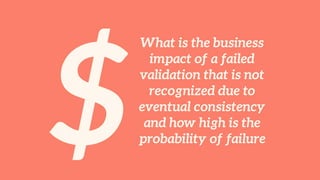
What is the business
impact of a failed
validation that is not
recognized due to
eventual consistency
and how high is the
probability of failure
Your business domain drives the level
of consistency

Deeper Insight
D D D
1 Validate from Event Store
2 Validate from Read Store
3 Perform Validation in Event
Handler
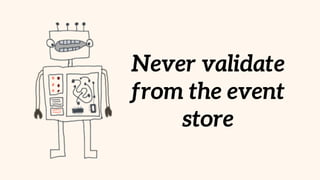
Never validate
from the event
store
1 Consistency
2 Validation
3 Parallel Updates
Example Domain
User

Guid id
String email
String password
RegisterUserCommand ChangeEmailCommand
UserRegisteredEvent


Guid id
Date timestamp
String email
String password
EmailChangedEvent


Guid userId
Date timestamp
String email
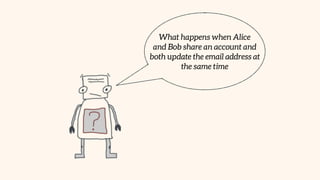
What happens when Alice
and Bob share an account and
both update the email address at
the same time
?
What would we do
in a
„classic old school
architecture“
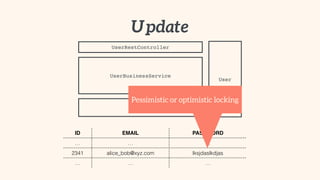
UserRestController
UserBusinessService
UserDAO
User
ID EMAIL PASSWORD
… … …
2341 alice_bob@xyz.com lksjdaslkdjas
… … …
Update
Pessimistic or optimistic locking
Your business domain drives the
locking quality

Deeper Insight
D D D
!
Pessimistic
locking on a
data-level will
hardly work in
event sourcing
architectures
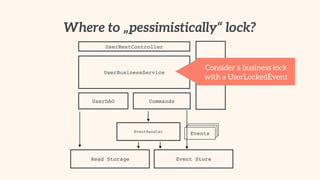
EventHandler EventsEvents
Where to „pessimistically“ lock?
Read Storage
Events
Event Store
UserRestController
UserBusinessService
UserDAO
User
Commands
Consider a business lock
with a UserLockedEvent
?
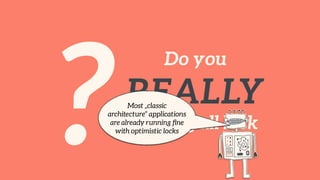
Do you

REALLY
need a full lock
Most „classic
architecture“ applications
are already running fine
with optimistic locks
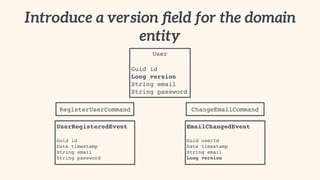
Introduce a version field for the domain
entity
User

Guid id
Long version
String email
String password
RegisterUserCommand ChangeEmailCommand
UserRegisteredEvent


Guid id
Date timestamp
String email
String password
EmailChangedEvent


Guid userId
Date timestamp
String email
Long version
Each writing event
increases the version
UserRegisteredEvent
{guid: 12, version: 0,

email: alicebob@xyz.com, password: werwe2343}
EmailChangedEvent
version: 0
EmailChangedEvent
version: 1
EmailChangedEvent
version: 1
{guid: 12, version: 1,

email: alice_bob@xyz.com, password: werwe2343}
{guid: 12, version: 2,

email: alice@xyz.com, password: werwe2343}
EmailChangeFailedEvent
Also here:

you should be as
consistent as
your domain
requires
Unless otherwise indicated, these slides are © 2013-2015 Pivotal Software, Inc. and licensed under a Creative Commons Attribution-NonCommercial license: http://creativecommons.org/licenses/by-nc/3.0/
SPRINGONE2GX
WASHINGTON, DC
Thank You!
Michael Ploed - innoQ


Twitter: @bitboss
Slides: http://slideshare.net/mploed

Building Microservices with Event Sourcing and CQRS