dcmotor 1
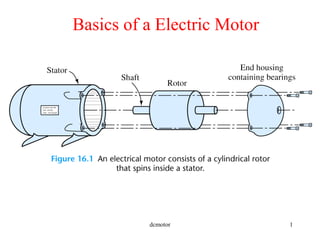
Basics of a Electric Motor
dcmotor 2
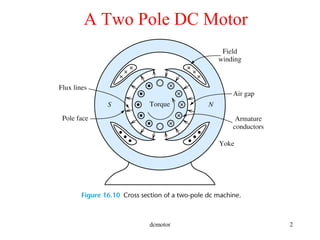
A Two Pole DC Motor
dcmotor 3
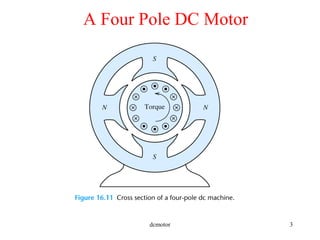
A Four Pole DC Motor
dcmotor 4
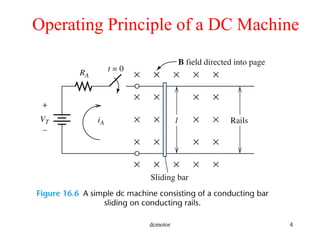
Operating Principle of a DC Machine
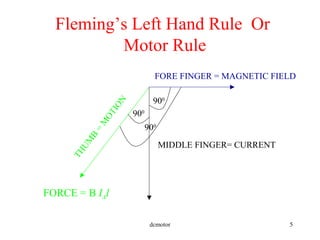
dcmotor 5
FORE FINGER = MAGNETIC FIELD
900
900
900
MIDDLE FINGER= CURRENT
THUM
B
=
M
OTION
FORCE = B IAl
Fleming’s Left Hand Rule Or
Motor Rule
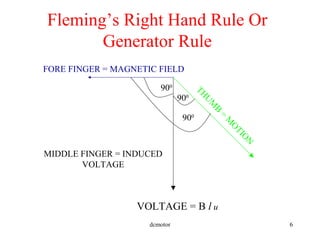
dcmotor 6
FORE FINGER = MAGNETIC FIELD
900
900
900
MIDDLE FINGER = INDUCED
VOLTAGE
TH
U
M
B
=
M
O
TIO
N
VOLTAGE = B l u
Fleming’s Right Hand Rule Or
Generator Rule
dcmotor 7
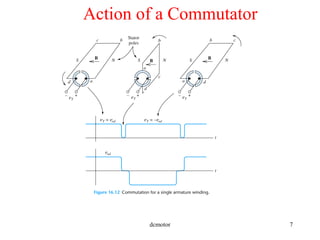
Action of a Commutator
dcmotor 8
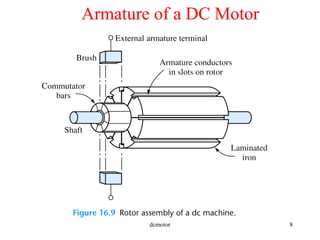
Armature of a DC Motor
dcmotor 9
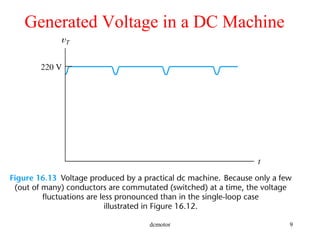
Generated Voltage in a DC Machine
dcmotor 10
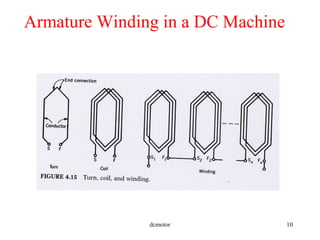
Armature Winding in a DC Machine
dcmotor 11
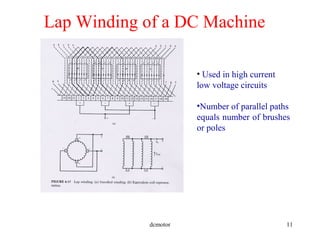
Lap Winding of a DC Machine
• Used in high current
low voltage circuits
•Number of parallel paths
equals number of brushes
or poles
dcmotor 12
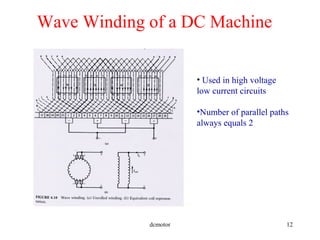
Wave Winding of a DC Machine
• Used in high voltage
low current circuits
•Number of parallel paths
always equals 2
dcmotor 13
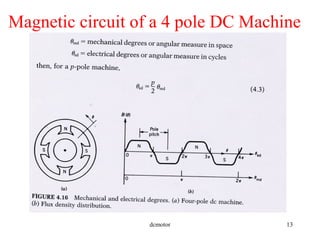
Magnetic circuit of a 4 pole DC Machine
dcmotor 14
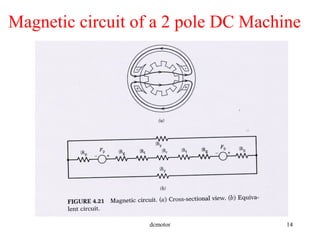
Magnetic circuit of a 2 pole DC Machine
dcmotor 15
Summary of a DC Machine
• Basically consists of
1. An electromagnetic or permanent magnetic structure called
field which is static
2. An Armature which rotates
• The Field produces a magnetic medium
• The Armature produces voltage and torque under the action
of the magnetic field
dcmotor 16
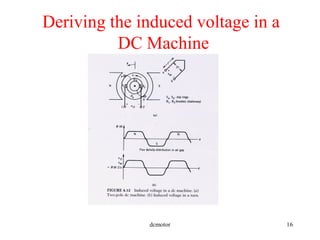
Deriving the induced voltage in a
DC Machine
dcmotor 17
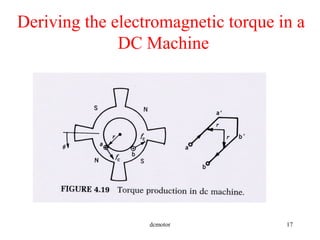
Deriving the electromagnetic torque in a
DC Machine
dcmotor 18
Voltage and Torque developed in a
DC Machine
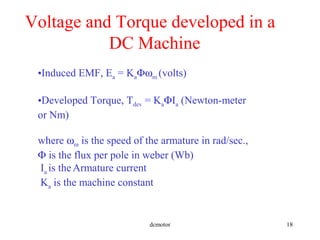
•Induced EMF, Ea = KaΦωm (volts)
•Developed Torque, Tdev = KaΦIa (Newton-meter
or Nm)
where ωm is the speed of the armature in rad/sec.,
Φ is the flux per pole in weber (Wb)
Ia is theArmature current
Ka is the machine constant
dcmotor 19
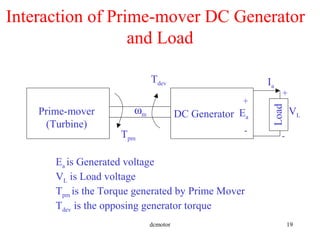
Interaction of Prime-mover DC Generator
and Load
Prime-mover
(Turbine)
DC Generator
Load
Ia
Tdev
ωm Ea
+
-
VL
+
-Tpm
Ea is Generated voltage
VL is Load voltage
Tpm is the Torque generated by Prime Mover
Tdev is the opposing generator torque
dcmotor 20
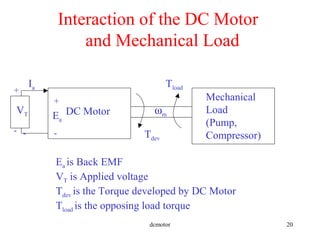
Interaction of the DC Motor
and Mechanical Load
DC Motor
Mechanical
Load
(Pump,
Compressor)
Tload
ωmEa
+
- Tdev
Ea is Back EMF
VT is Applied voltage
Tdev is the Torque developed by DC Motor
Tload is the opposing load torque
Ia
VT
+
--
dcmotor 21
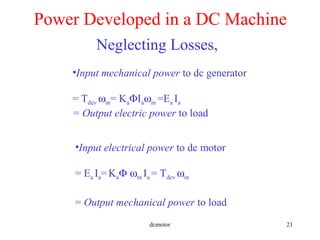
Power Developed in a DC Machine
•Input mechanical power to dc generator
= Tdev ωm= KaΦIaωm =Ea Ia
= Output electric power to load
•Input electrical power to dc motor
= Ea Ia=KaΦ ωm Ia = Tdev ωm
= Output mechanical power to load
Neglecting Losses,
dcmotor 22
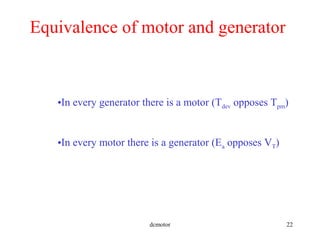
Equivalence of motor and generator
•In every generator there is a motor (Tdev opposes Tpm)
•In every motor there is a generator (Ea opposes VT)
dcmotor 23
Example of winding specific motor and
generator
Worked out on greenboard
dcmotor 24
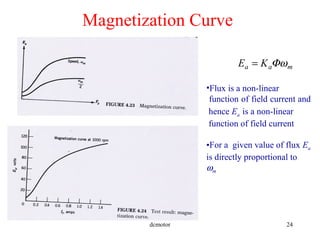
Magnetization Curve
maa KE ωΦ=
•Flux is a non-linear
function of field current and
hence Ea is a non-linear
function of field current
•For a given value of flux Ea
is directly proportional to
ωm
dcmotor 25
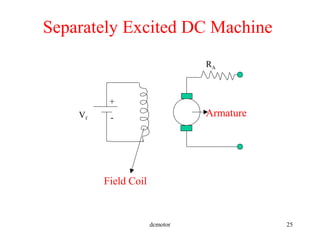
Field Coil
Armature
RA
Vf
Separately Excited DC Machine
+
-
dcmotor 26
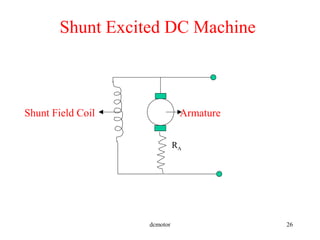
Shunt Field Coil Armature
RA
Shunt Excited DC Machine
dcmotor 27
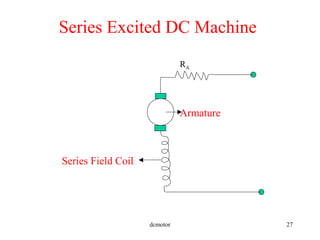
Series Field Coil
Armature
RA
Series Excited DC Machine
dcmotor 28
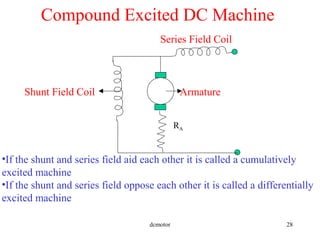
Shunt Field Coil Armature
RA
Compound Excited DC Machine
Series Field Coil
•If the shunt and series field aid each other it is called a cumulatively
excited machine
•If the shunt and series field oppose each other it is called a differentially
excited machine
dcmotor 29
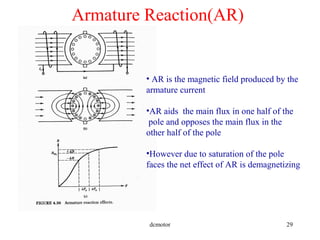
Armature Reaction(AR)
• AR is the magnetic field produced by the
armature current
•AR aids the main flux in one half of the
pole and opposes the main flux in the
other half of the pole
•However due to saturation of the pole
faces the net effect of AR is demagnetizing
dcmotor 30
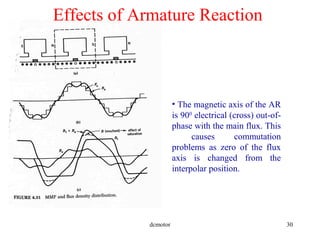
Effects of Armature Reaction
• The magnetic axis of the AR
is 900
electrical (cross) out-of-
phase with the main flux. This
causes commutation
problems as zero of the flux
axis is changed from the
interpolar position.
dcmotor 31
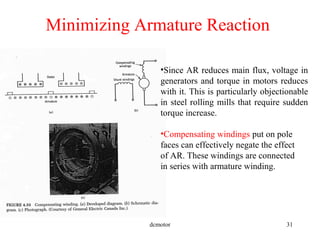
Minimizing Armature Reaction
•Since AR reduces main flux, voltage in
generators and torque in motors reduces
with it. This is particularly objectionable
in steel rolling mills that require sudden
torque increase.
•Compensating windings put on pole
faces can effectively negate the effect
of AR. These windings are connected
in series with armature winding.
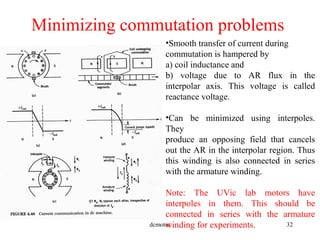
dcmotor 32
Minimizing commutation problems
•Smooth transfer of current during
commutation is hampered by
a) coil inductance and
b) voltage due to AR flux in the
interpolar axis. This voltage is called
reactance voltage.
•Can be minimized using interpoles.
They
produce an opposing field that cancels
out the AR in the interpolar region. Thus
this winding is also connected in series
with the armature winding.
Note: The UVic lab motors have
interpoles in them. This should be
connected in series with the armature
winding for experiments.
dcmotor 33
Question:
Can interpoles be
replaced by compensating
windings and vice-versa?
Why or why not?
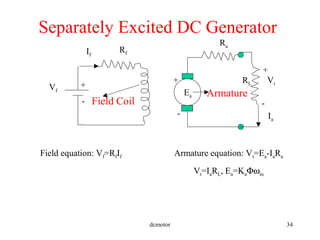
dcmotor 34
Field Coil
Armature
Ra
Vf
Separately Excited DC Generator
+
-
Rf
Vt
+
-
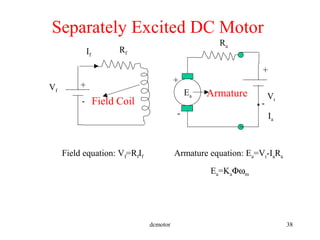
Field equation: Vf=RfIf
If
Ia
+
-
Ea
Armature equation: Vt=Ea-IaRa
Vt=IaRL, Ea=KaΦωm
RL
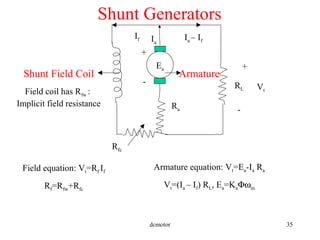
dcmotor 35
Shunt Generators
Field equation: Vt=Rf If
Rf=Rfw+Rfc
Armature equation: Vt=Ea-Ia Ra
Vt=(Ia – If) RL, Ea=KaΦωm
Shunt Field Coil Armature
Ra
RL
If Ia
Ia – If
Vt
+
-
Rfc
Ea
+
-
Field coil has Rfw :
Implicit field resistance
dcmotor 36
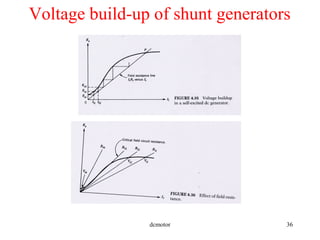
Voltage build-up of shunt generators
dcmotor 37
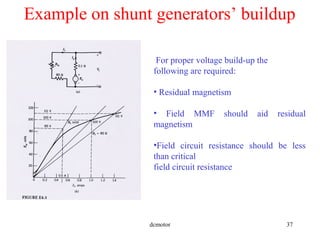
Example on shunt generators’ buildup
For proper voltage build-up the
following are required:
• Residual magnetism
• Field MMF should aid residual
magnetism
•Field circuit resistance should be less
than critical
field circuit resistance
dcmotor 38
Field Coil
Armature
Ra
Vf
Separately Excited DC Motor
+
-
Rf
Vt
+
-
If
Ia
+
-
Ea
Armature equation: Ea=Vt-IaRa
Ea=KaΦωm
Field equation: Vf=RfIf
dcmotor 39
Field Coil
Armature
RA
Vf
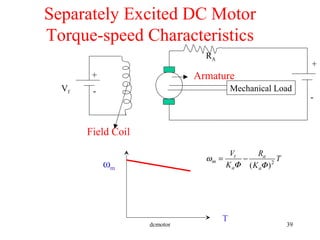
Separately Excited DC Motor
Torque-speed Characteristics
+
-
ωm
T
T
K
R
K
V
a
a
a
t
m 2
)( ΦΦ
ω −=
Mechanical Load
+
-
dcmotor 40
Separately excited DC Motor-Example I
A dc motor has Ra =2 Ω, Ia=5 A, Ea = 220V, Nm = 1200 rpm.
Determine i) voltage applied to the armature, developed torque,
developed power . ii) Repeat with Nm = 1500 rpm. Assume same
Ia.
Solution on Greenboard
dcmotor 41
Speed Control of Separately Excited
DC Motor(2)
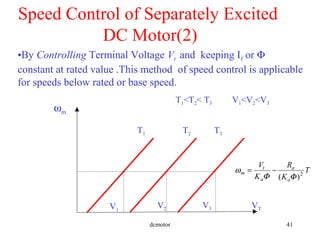
•By Controlling Terminal Voltage Vt and keeping If or Φ
constant at rated value .This method of speed control is applicable
for speeds below rated or base speed.
ωm
VT
T1 T2 T3
T1<T2< T3
T
K
R
K
V
a
a
a
t
m 2
)( ΦΦ
ω −=
V1<V2<V3
V1
V2 V3
dcmotor 42
Speed Control of Separately Excited
DC Motor
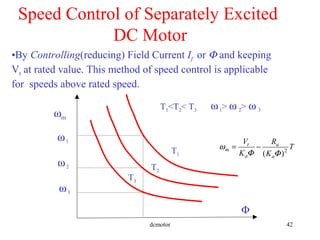
•By Controlling(reducing) Field Current If or Φ and keeping
Vt at rated value. This method of speed control is applicable
for speeds above rated speed.
ωm
T1
T2
T3
T1<T2< T3
Φ
T
K
R
K
V
a
a
a
t
m 2
)( ΦΦ
ω −=
ω1
ω1> ω 2> ω 3
ω2
ω3
dcmotor 43
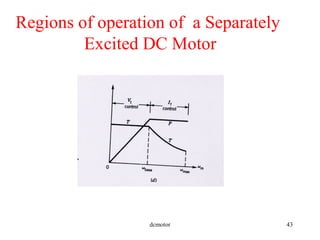
Regions of operation of a Separately
Excited DC Motor
dcmotor 44
A separately excited dc motor with negligible armature resistance
operates at 1800 rpm under no-load with Vt =240V(rated voltage).
The rated speed of the motor is 1750 rpm.
i) Determine Vt if the motor has to operate at 1200 rpm under no-load.
ii) Determine Φ(flux/pole) if the motor has to operate at 2400 rpm
under no-load; given that K = 400/π.
iii) Determine the rated flux per pole of the machine.
Separately excited dc motor –Example 2
Solution on Greenboard
dcmotor 45
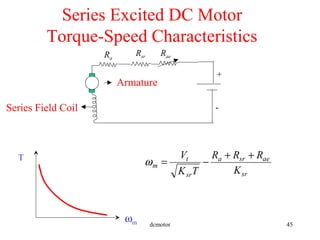
Series Field Coil
Armature
Ra
Series Excited DC Motor
Torque-Speed Characteristics
ωm
T
sr
aesra
sr
t
m
K
RRR
TK
V ++
−=ω
Rsr Rae
-
+
dcmotor 46
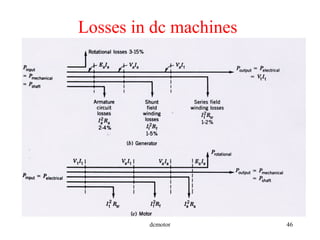
Losses in dc machines
dcmotor 47
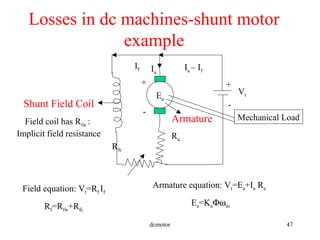
Losses in dc machines-shunt motor
example
Field equation: Vt=Rf If
Rf=Rfw+Rfc
Armature equation: Vt=Ea+Ia Ra
Ea=KaΦωm
Shunt Field Coil
Armature
Ra
If Ia
Ia – If
Vt
+
-
Rfc
Ea
+
-
Field coil has Rfw :
Implicit field resistance
Mechanical Load

Dcmotor

  • 1.
    dcmotor 1 Basics ofa Electric Motor
  • 2.
    dcmotor 2 A TwoPole DC Motor
  • 3.
    dcmotor 3 A FourPole DC Motor
  • 4.
  • 5.
    dcmotor 5 FORE FINGER= MAGNETIC FIELD 900 900 900 MIDDLE FINGER= CURRENT THUM B = M OTION FORCE = B IAl Fleming’s Left Hand Rule Or Motor Rule
  • 6.
    dcmotor 6 FORE FINGER= MAGNETIC FIELD 900 900 900 MIDDLE FINGER = INDUCED VOLTAGE TH U M B = M O TIO N VOLTAGE = B l u Fleming’s Right Hand Rule Or Generator Rule
  • 7.
    dcmotor 7 Action ofa Commutator
  • 8.
  • 9.
  • 10.
  • 11.
    dcmotor 11 Lap Windingof a DC Machine • Used in high current low voltage circuits •Number of parallel paths equals number of brushes or poles
  • 12.
    dcmotor 12 Wave Windingof a DC Machine • Used in high voltage low current circuits •Number of parallel paths always equals 2
  • 13.
    dcmotor 13 Magnetic circuitof a 4 pole DC Machine
  • 14.
    dcmotor 14 Magnetic circuitof a 2 pole DC Machine
  • 15.
    dcmotor 15 Summary ofa DC Machine • Basically consists of 1. An electromagnetic or permanent magnetic structure called field which is static 2. An Armature which rotates • The Field produces a magnetic medium • The Armature produces voltage and torque under the action of the magnetic field
  • 16.
    dcmotor 16 Deriving theinduced voltage in a DC Machine
  • 17.
    dcmotor 17 Deriving theelectromagnetic torque in a DC Machine
  • 18.
    dcmotor 18 Voltage andTorque developed in a DC Machine •Induced EMF, Ea = KaΦωm (volts) •Developed Torque, Tdev = KaΦIa (Newton-meter or Nm) where ωm is the speed of the armature in rad/sec., Φ is the flux per pole in weber (Wb) Ia is theArmature current Ka is the machine constant
  • 19.
    dcmotor 19 Interaction ofPrime-mover DC Generator and Load Prime-mover (Turbine) DC Generator Load Ia Tdev ωm Ea + - VL + -Tpm Ea is Generated voltage VL is Load voltage Tpm is the Torque generated by Prime Mover Tdev is the opposing generator torque
  • 20.
    dcmotor 20 Interaction ofthe DC Motor and Mechanical Load DC Motor Mechanical Load (Pump, Compressor) Tload ωmEa + - Tdev Ea is Back EMF VT is Applied voltage Tdev is the Torque developed by DC Motor Tload is the opposing load torque Ia VT + --
  • 21.
    dcmotor 21 Power Developedin a DC Machine •Input mechanical power to dc generator = Tdev ωm= KaΦIaωm =Ea Ia = Output electric power to load •Input electrical power to dc motor = Ea Ia=KaΦ ωm Ia = Tdev ωm = Output mechanical power to load Neglecting Losses,
  • 22.
    dcmotor 22 Equivalence ofmotor and generator •In every generator there is a motor (Tdev opposes Tpm) •In every motor there is a generator (Ea opposes VT)
  • 23.
    dcmotor 23 Example ofwinding specific motor and generator Worked out on greenboard
  • 24.
    dcmotor 24 Magnetization Curve maaKE ωΦ= •Flux is a non-linear function of field current and hence Ea is a non-linear function of field current •For a given value of flux Ea is directly proportional to ωm
  • 25.
  • 26.
    dcmotor 26 Shunt FieldCoil Armature RA Shunt Excited DC Machine
  • 27.
    dcmotor 27 Series FieldCoil Armature RA Series Excited DC Machine
  • 28.
    dcmotor 28 Shunt FieldCoil Armature RA Compound Excited DC Machine Series Field Coil •If the shunt and series field aid each other it is called a cumulatively excited machine •If the shunt and series field oppose each other it is called a differentially excited machine
  • 29.
    dcmotor 29 Armature Reaction(AR) •AR is the magnetic field produced by the armature current •AR aids the main flux in one half of the pole and opposes the main flux in the other half of the pole •However due to saturation of the pole faces the net effect of AR is demagnetizing
  • 30.
    dcmotor 30 Effects ofArmature Reaction • The magnetic axis of the AR is 900 electrical (cross) out-of- phase with the main flux. This causes commutation problems as zero of the flux axis is changed from the interpolar position.
  • 31.
    dcmotor 31 Minimizing ArmatureReaction •Since AR reduces main flux, voltage in generators and torque in motors reduces with it. This is particularly objectionable in steel rolling mills that require sudden torque increase. •Compensating windings put on pole faces can effectively negate the effect of AR. These windings are connected in series with armature winding.
  • 32.
    dcmotor 32 Minimizing commutationproblems •Smooth transfer of current during commutation is hampered by a) coil inductance and b) voltage due to AR flux in the interpolar axis. This voltage is called reactance voltage. •Can be minimized using interpoles. They produce an opposing field that cancels out the AR in the interpolar region. Thus this winding is also connected in series with the armature winding. Note: The UVic lab motors have interpoles in them. This should be connected in series with the armature winding for experiments.
  • 33.
    dcmotor 33 Question: Can interpolesbe replaced by compensating windings and vice-versa? Why or why not?
  • 34.
    dcmotor 34 Field Coil Armature Ra Vf SeparatelyExcited DC Generator + - Rf Vt + - Field equation: Vf=RfIf If Ia + - Ea Armature equation: Vt=Ea-IaRa Vt=IaRL, Ea=KaΦωm RL
  • 35.
    dcmotor 35 Shunt Generators Fieldequation: Vt=Rf If Rf=Rfw+Rfc Armature equation: Vt=Ea-Ia Ra Vt=(Ia – If) RL, Ea=KaΦωm Shunt Field Coil Armature Ra RL If Ia Ia – If Vt + - Rfc Ea + - Field coil has Rfw : Implicit field resistance
  • 36.
    dcmotor 36 Voltage build-upof shunt generators
  • 37.
    dcmotor 37 Example onshunt generators’ buildup For proper voltage build-up the following are required: • Residual magnetism • Field MMF should aid residual magnetism •Field circuit resistance should be less than critical field circuit resistance
  • 38.
    dcmotor 38 Field Coil Armature Ra Vf SeparatelyExcited DC Motor + - Rf Vt + - If Ia + - Ea Armature equation: Ea=Vt-IaRa Ea=KaΦωm Field equation: Vf=RfIf
  • 39.
    dcmotor 39 Field Coil Armature RA Vf SeparatelyExcited DC Motor Torque-speed Characteristics + - ωm T T K R K V a a a t m 2 )( ΦΦ ω −= Mechanical Load + -
  • 40.
    dcmotor 40 Separately excitedDC Motor-Example I A dc motor has Ra =2 Ω, Ia=5 A, Ea = 220V, Nm = 1200 rpm. Determine i) voltage applied to the armature, developed torque, developed power . ii) Repeat with Nm = 1500 rpm. Assume same Ia. Solution on Greenboard
  • 41.
    dcmotor 41 Speed Controlof Separately Excited DC Motor(2) •By Controlling Terminal Voltage Vt and keeping If or Φ constant at rated value .This method of speed control is applicable for speeds below rated or base speed. ωm VT T1 T2 T3 T1<T2< T3 T K R K V a a a t m 2 )( ΦΦ ω −= V1<V2<V3 V1 V2 V3
  • 42.
    dcmotor 42 Speed Controlof Separately Excited DC Motor •By Controlling(reducing) Field Current If or Φ and keeping Vt at rated value. This method of speed control is applicable for speeds above rated speed. ωm T1 T2 T3 T1<T2< T3 Φ T K R K V a a a t m 2 )( ΦΦ ω −= ω1 ω1> ω 2> ω 3 ω2 ω3
  • 43.
    dcmotor 43 Regions ofoperation of a Separately Excited DC Motor
  • 44.
    dcmotor 44 A separatelyexcited dc motor with negligible armature resistance operates at 1800 rpm under no-load with Vt =240V(rated voltage). The rated speed of the motor is 1750 rpm. i) Determine Vt if the motor has to operate at 1200 rpm under no-load. ii) Determine Φ(flux/pole) if the motor has to operate at 2400 rpm under no-load; given that K = 400/π. iii) Determine the rated flux per pole of the machine. Separately excited dc motor –Example 2 Solution on Greenboard
  • 45.
    dcmotor 45 Series FieldCoil Armature Ra Series Excited DC Motor Torque-Speed Characteristics ωm T sr aesra sr t m K RRR TK V ++ −=ω Rsr Rae - +
  • 46.
  • 47.
    dcmotor 47 Losses indc machines-shunt motor example Field equation: Vt=Rf If Rf=Rfw+Rfc Armature equation: Vt=Ea+Ia Ra Ea=KaΦωm Shunt Field Coil Armature Ra If Ia Ia – If Vt + - Rfc Ea + - Field coil has Rfw : Implicit field resistance Mechanical Load