Data Models, Schemas &
Instances
Ms.Simmi S
Assistant Professor
Department of Computer Science [UG]
Kristu Jayanti College,Bangalore
Simmi S Dept of CS UG
Data Abstraction
Data abstraction generally refers to the suppression of details of data organization
and storage, and the highlighting of the essential features for an improved
understanding of data.
A data model—a collection of concepts that can be used to describe the structure
of a database—provides the necessary means to achieve this abstraction.
 By structure of a database we mean the data types, relationships, and constraints
that apply to the data.
Simmi S Dept of CS UG
Categories of Data Models
High-level or conceptual data models provide concepts that are close
to the way many users perceive data, whereas low-level or physical
data models provide concepts that describe the details of how data is
stored on the computer storage media, typically magnetic disks.
 Concepts provided by physical data models are generally meant for
computer specialists, not for end users.
Simmi S Dept of CS UG
Conceptual Data Model
Conceptual data models use concepts such as entities, attributes, and
relationships.
An entity represents a real-world object or concept, such as an employee or a
project from the miniworld that is described in the database.
 An attribute represents some property of interest that further describes an
entity, such as the employee’s name or salary. A relationship among two or more
entities represents an association among the entities.
Simmi S Dept of CS UG
Schemas, Instances, and Database State
Schemas, Instances, and Database State In a data model, it is important to
distinguish between the description of the database and the database itself.
 The description of a database is called the database schema, which is specified
during database design and is not expected to change frequently.
 A displayed schema is called a schema diagram.
A schema diagram displays only some aspects of a schema, such as the names of
record types and data items, and some types of constraints.
Simmi S Dept of CS UG
Schemas, Instances, and Database State
 The data in the database at a particular moment in time is called a
database state or snapshot.
It is also called the current set of occurrences or instances in the
database.
Simmi S Dept of CS UG
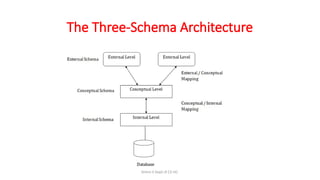
The Three-Schema Architecture
The goal of the three-schema architecture, is to separate the user
applications from the physical database.
 In this architecture, schemas can be defined at the following three
levels
Simmi S Dept of CS UG
The Three-Schema Architecture
Simmi S Dept of CS UG
Internal Level
The internal level has an internal schema which describes
the physical storage structure of the database.
The internal schema is also known as a physical schema.
It uses the physical data model, It is used to define how the
data will be stored in a block.
The physical level is used to describe complex low-level data
structures in detail.
Simmi S Dept of CS UG
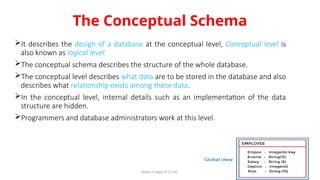
The Conceptual Schema
It describes the design of a database at the conceptual level, Conceptual level is
also known as logical level.
The conceptual schema describes the structure of the whole database.
The conceptual level describes what data are to be stored in the database and also
describes what relationship exists among those data.
In the conceptual level, internal details such as an implementation of the data
structure are hidden.
Programmers and database administrators work at this level.
Simmi S Dept of CS UG
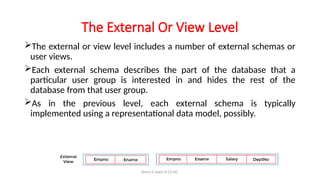
The External Or View Level
The external or view level includes a number of external schemas or
user views.
Each external schema describes the part of the database that a
particular user group is interested in and hides the rest of the
database from that user group.
As in the previous level, each external schema is typically
implemented using a representational data model, possibly.
Simmi S Dept of CS UG
Data Independence
The capacity to change the schema at one level of a database system
without having to change the schema at the next higher level.
. Logical data independence
Physical data independence
Simmi S Dept of CS UG
Logical data independence
It is the capacity to change the conceptual schema without having to
change external schemas or application programs.
We may change the conceptual schema to expand the database (by
adding a record type or data item), to change constraints, or to
reduce the database (by removing a record type or data item).
In the last case, external schemas that refer only to the remaining
data should not be affected.
Simmi S Dept of CS UG
Physical data independence
It is the capacity to change the internal schema without having to
change the conceptual schema.
Hence, the external schemas need not be changed as well.
Changes to the internal schema may be needed because some
physical files were reorganized—for example, by creating additional
access structures—to improve the performance of retrieval or update.
Simmi S Dept of CS UG
DBMS Interfaces
Menu-based Interfaces for Web Clients or Browsing.
These interfaces present the user with lists of options (called menus)
that lead the user through the formulation of a request.
 Menus do away with the need to memorize the specific commands
and syntax of a query language; rather, the query is composed step-
bystep by picking options from a menu that is displayed by the
system.
 Pull-down menus are a very popular technique in Web-based user
interfaces
Simmi S Dept of CS UG
Apps for Mobile Devices.
These interfaces present mobile users with access to their data.
For example, banking, reservations, and insurance companies, among
many others, provide apps that allow users to access their data
through a mobile phone or mobile device
DBMS Interfaces
Simmi S Dept of CS UG
Forms-based Interfaces.
A forms-based interface displays a form to each user.
Users can fill out all of the form entries to insert new data, or they
can fill out only certain entries, in which case the DBMS will retrieve
matching data for the remaining entries.
 Forms are usually designed and programmed for naive users as
interfaces to canned transactions.
DBMS Interfaces
Simmi S Dept of CS UG
Graphical User Interfaces.
A GUI typically displays a schema to the user in diagrammatic form.
The user then can specify a query by manipulating the diagram.
 In many cases, GUIs utilize both menus and forms.
DBMS Interfaces
Simmi S Dept of CS UG
Natural Language Interfaces
 These interfaces accept requests written in English or some other
language and attempt to understand them.
A natural language interface usually has its own schema, which is
similar to the database conceptual schema, as well as a dictionary of
important words.
DBMS Interfaces
Simmi S Dept of CS UG
Keyword-based Database Search
 These are somewhat similar to Web search engines, which accept
strings of natural language (like English or Spanish) words and match
them with documents at specific sites (for local search engines) or
Web pages on the Web at large (for engines like Google or Ask).
They use predefined indexes on words and use ranking functions to
retrieve and present resulting documents in a decreasing degree of
match
DBMS Interfaces
Simmi S Dept of CS UG
Interfaces for the DBA.
Most database systems contain privileged commands that can be
used only by the DBA staff.
These include commands for creating accounts, setting system
parameters, granting account authorization, changing a schema, and
reorganizing the storage structures of a database.
DBMS Interfaces
Simmi S Dept of CS UG
Interfaces for Parametric Users.
Parametric users, such as bank tellers, often have a small set of
operations that they must perform repeatedly.
For example, a teller is able to use single function keys to invoke
routine and repetitive transactions such as account deposits or
withdrawals, or balance inquiries
DBMS Interfaces
Simmi S Dept of CS UG

DBMS Data Models, Schemas & Instances.pptx

  • 1.
    Data Models, Schemas& Instances Ms.Simmi S Assistant Professor Department of Computer Science [UG] Kristu Jayanti College,Bangalore Simmi S Dept of CS UG
  • 2.
    Simmi S Deptof CS UG Data Abstraction Data abstraction generally refers to the suppression of details of data organization and storage, and the highlighting of the essential features for an improved understanding of data. A data model—a collection of concepts that can be used to describe the structure of a database—provides the necessary means to achieve this abstraction.  By structure of a database we mean the data types, relationships, and constraints that apply to the data.
  • 3.
    Simmi S Deptof CS UG Categories of Data Models High-level or conceptual data models provide concepts that are close to the way many users perceive data, whereas low-level or physical data models provide concepts that describe the details of how data is stored on the computer storage media, typically magnetic disks.  Concepts provided by physical data models are generally meant for computer specialists, not for end users.
  • 4.
    Simmi S Deptof CS UG Conceptual Data Model Conceptual data models use concepts such as entities, attributes, and relationships. An entity represents a real-world object or concept, such as an employee or a project from the miniworld that is described in the database.  An attribute represents some property of interest that further describes an entity, such as the employee’s name or salary. A relationship among two or more entities represents an association among the entities.
  • 5.
    Simmi S Deptof CS UG Schemas, Instances, and Database State Schemas, Instances, and Database State In a data model, it is important to distinguish between the description of the database and the database itself.  The description of a database is called the database schema, which is specified during database design and is not expected to change frequently.  A displayed schema is called a schema diagram. A schema diagram displays only some aspects of a schema, such as the names of record types and data items, and some types of constraints.
  • 6.
    Simmi S Deptof CS UG Schemas, Instances, and Database State  The data in the database at a particular moment in time is called a database state or snapshot. It is also called the current set of occurrences or instances in the database.
  • 7.
    Simmi S Deptof CS UG The Three-Schema Architecture The goal of the three-schema architecture, is to separate the user applications from the physical database.  In this architecture, schemas can be defined at the following three levels
  • 8.
    Simmi S Deptof CS UG The Three-Schema Architecture
  • 9.
    Simmi S Deptof CS UG Internal Level The internal level has an internal schema which describes the physical storage structure of the database. The internal schema is also known as a physical schema. It uses the physical data model, It is used to define how the data will be stored in a block. The physical level is used to describe complex low-level data structures in detail.
  • 10.
    Simmi S Deptof CS UG The Conceptual Schema It describes the design of a database at the conceptual level, Conceptual level is also known as logical level. The conceptual schema describes the structure of the whole database. The conceptual level describes what data are to be stored in the database and also describes what relationship exists among those data. In the conceptual level, internal details such as an implementation of the data structure are hidden. Programmers and database administrators work at this level.
  • 11.
    Simmi S Deptof CS UG The External Or View Level The external or view level includes a number of external schemas or user views. Each external schema describes the part of the database that a particular user group is interested in and hides the rest of the database from that user group. As in the previous level, each external schema is typically implemented using a representational data model, possibly.
  • 12.
    Simmi S Deptof CS UG Data Independence The capacity to change the schema at one level of a database system without having to change the schema at the next higher level. . Logical data independence Physical data independence
  • 13.
    Simmi S Deptof CS UG Logical data independence It is the capacity to change the conceptual schema without having to change external schemas or application programs. We may change the conceptual schema to expand the database (by adding a record type or data item), to change constraints, or to reduce the database (by removing a record type or data item). In the last case, external schemas that refer only to the remaining data should not be affected.
  • 14.
    Simmi S Deptof CS UG Physical data independence It is the capacity to change the internal schema without having to change the conceptual schema. Hence, the external schemas need not be changed as well. Changes to the internal schema may be needed because some physical files were reorganized—for example, by creating additional access structures—to improve the performance of retrieval or update.
  • 15.
    Simmi S Deptof CS UG DBMS Interfaces Menu-based Interfaces for Web Clients or Browsing. These interfaces present the user with lists of options (called menus) that lead the user through the formulation of a request.  Menus do away with the need to memorize the specific commands and syntax of a query language; rather, the query is composed step- bystep by picking options from a menu that is displayed by the system.  Pull-down menus are a very popular technique in Web-based user interfaces
  • 16.
    Simmi S Deptof CS UG Apps for Mobile Devices. These interfaces present mobile users with access to their data. For example, banking, reservations, and insurance companies, among many others, provide apps that allow users to access their data through a mobile phone or mobile device DBMS Interfaces
  • 17.
    Simmi S Deptof CS UG Forms-based Interfaces. A forms-based interface displays a form to each user. Users can fill out all of the form entries to insert new data, or they can fill out only certain entries, in which case the DBMS will retrieve matching data for the remaining entries.  Forms are usually designed and programmed for naive users as interfaces to canned transactions. DBMS Interfaces
  • 18.
    Simmi S Deptof CS UG Graphical User Interfaces. A GUI typically displays a schema to the user in diagrammatic form. The user then can specify a query by manipulating the diagram.  In many cases, GUIs utilize both menus and forms. DBMS Interfaces
  • 19.
    Simmi S Deptof CS UG Natural Language Interfaces  These interfaces accept requests written in English or some other language and attempt to understand them. A natural language interface usually has its own schema, which is similar to the database conceptual schema, as well as a dictionary of important words. DBMS Interfaces
  • 20.
    Simmi S Deptof CS UG Keyword-based Database Search  These are somewhat similar to Web search engines, which accept strings of natural language (like English or Spanish) words and match them with documents at specific sites (for local search engines) or Web pages on the Web at large (for engines like Google or Ask). They use predefined indexes on words and use ranking functions to retrieve and present resulting documents in a decreasing degree of match DBMS Interfaces
  • 21.
    Simmi S Deptof CS UG Interfaces for the DBA. Most database systems contain privileged commands that can be used only by the DBA staff. These include commands for creating accounts, setting system parameters, granting account authorization, changing a schema, and reorganizing the storage structures of a database. DBMS Interfaces
  • 22.
    Simmi S Deptof CS UG Interfaces for Parametric Users. Parametric users, such as bank tellers, often have a small set of operations that they must perform repeatedly. For example, a teller is able to use single function keys to invoke routine and repetitive transactions such as account deposits or withdrawals, or balance inquiries DBMS Interfaces
  • 23.
    Simmi S Deptof CS UG