Learning Resource
On
Database Management Systems
Chapter-4
Enhanced Entity Relationship Model
Prepared By:
Kunal Anand, Asst. Professor
SCE, KIIT, DU, Bhubaneswar-24
Chapter Outcome:
• After the completion of this chapter, the students
will be able to:
– Define Enhanced Entity Relationship Model
– Distinguish between super class and sub class
– Distinguish between specialization and generalization
– Explain aggregation and composition
– Draw Enhanced ER Diagram
Organization of this Chapter:
• Introduction
• Superclasses and Subclasses
• Specialization and Generalization
• Constraints on specialization/generalization
• Aggregation and Composition
• Sample example
Enhanced ER Model
• The Enhanced ER model, EER model, includes all the
modeling concepts of ER model along with some additional
concepts like super class and sub class, specialization,
generalization, aggregation, and composition.
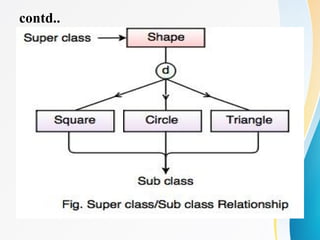
• Super class and Sub class:
– Super class is an entity type that has a relationship with one
or more subtypes. On the other hand, Sub class is a group
of entities with unique attributes.
– Sub class inherits properties and attributes from its super
class. Sub class and Super class relationship leads the
concept of Inheritance.
– The relationship between sub class and super class is
denoted with d symbol, where d means disjointness.
contd..
Specialization and Generalization
• Specialization
– The process of designating sub groupings within
an entity set is called Specialization.
– An entity set may be specialized by more than one
distinguishing features.
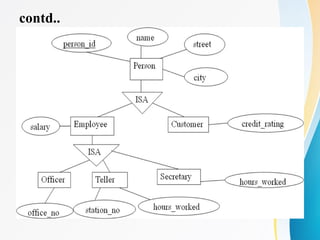
– ER-design, specialization is depicted by an
Inverted Triangle component labeled “IS A” (is a).
– Specialization can be repeatedly used to refine a
ER design.
contd..
EER Model (contd..)
• Generalization:
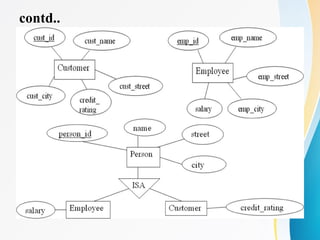
– Generalization is a simple inversion of specialization. It is
the process of extracting common properties from a set of
entity types and creating a generalized entity type from it.
– It is a bottom-up approach in which two or more entitiy
types can be generalized to a higher level entity type, if
they have some attributes in common.
– Specialization adopts top-down approach, while
Generalization adopts bottom-up approach.
– A crucial property of the higher-level and lower-level
entities created by specialization and generalization is
attribute inheritance.
– A lower-level entity set (or subclass) also inherits
participation in the relationship sets in which its higher-
level entity (or superclass) participates
contd..
Constraints on Generalization/Specialization
• Membership Constraint
– Condition defined
• Membership of a specialization/generalization relationship can be
defined as a condition in the requirements e.g. tanker is a ship
where cargo = oil.
– User-defined
• User-defined lower-level entity sets are not constrained by a
membership condition; rather, the database user assigns entities to a
given entity set.
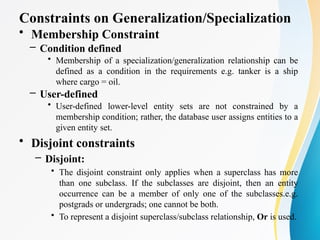
• Disjoint constraints
– Disjoint:
• The disjoint constraint only applies when a superclass has more
than one subclass. If the subclasses are disjoint, then an entity
occurrence can be a member of only one of the subclasses.e.g.
postgrads or undergrads; one cannot be both.
• To represent a disjoint superclass/subclass relationship, Or is used.
contd..
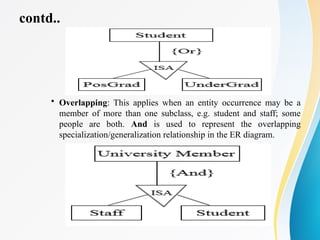
• Overlapping: This applies when an entity occurrence may be a
member of more than one subclass, e.g. student and staff; some
people are both. And is used to represent the overlapping
specialization/generalization relationship in the ER diagram.
contd..
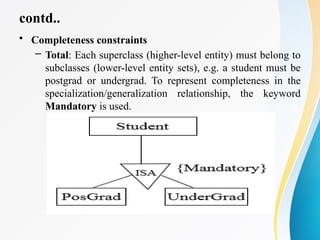
• Completeness constraints
– Total: Each superclass (higher-level entity) must belong to
subclasses (lower-level entity sets), e.g. a student must be
postgrad or undergrad. To represent completeness in the
specialization/generalization relationship, the keyword
Mandatory is used.
contd..
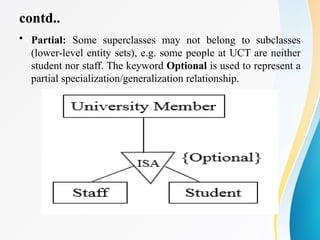
• Partial: Some superclasses may not belong to subclasses
(lower-level entity sets), e.g. some people at UCT are neither
student nor staff. The keyword Optional is used to represent a
partial specialization/generalization relationship.
Aggregation and Composition
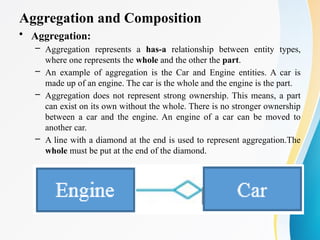
• Aggregation:
– Aggregation represents a has-a relationship between entity types,
where one represents the whole and the other the part.
– An example of aggregation is the Car and Engine entities. A car is
made up of an engine. The car is the whole and the engine is the part.
– Aggregation does not represent strong ownership. This means, a part
can exist on its own without the whole. There is no stronger ownership
between a car and the engine. An engine of a car can be moved to
another car.
– A line with a diamond at the end is used to represent aggregation.The
whole must be put at the end of the diamond.
contd..
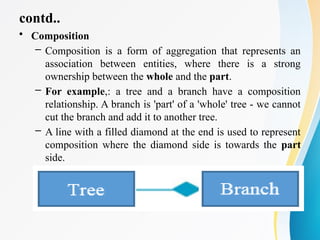
• Composition
– Composition is a form of aggregation that represents an
association between entities, where there is a strong
ownership between the whole and the part.
– For example,: a tree and a branch have a composition
relationship. A branch is 'part' of a 'whole' tree - we cannot
cut the branch and add it to another tree.
– A line with a filled diamond at the end is used to represent
composition where the diamond side is towards the part
side.
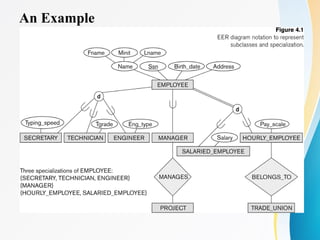
An Example

Module1-Ch1.pptx foriutyrhbrb rghrgreeew

  • 1.
    Learning Resource On Database ManagementSystems Chapter-4 Enhanced Entity Relationship Model Prepared By: Kunal Anand, Asst. Professor SCE, KIIT, DU, Bhubaneswar-24
  • 2.
    Chapter Outcome: • Afterthe completion of this chapter, the students will be able to: – Define Enhanced Entity Relationship Model – Distinguish between super class and sub class – Distinguish between specialization and generalization – Explain aggregation and composition – Draw Enhanced ER Diagram
  • 3.
    Organization of thisChapter: • Introduction • Superclasses and Subclasses • Specialization and Generalization • Constraints on specialization/generalization • Aggregation and Composition • Sample example
  • 4.
    Enhanced ER Model •The Enhanced ER model, EER model, includes all the modeling concepts of ER model along with some additional concepts like super class and sub class, specialization, generalization, aggregation, and composition. • Super class and Sub class: – Super class is an entity type that has a relationship with one or more subtypes. On the other hand, Sub class is a group of entities with unique attributes. – Sub class inherits properties and attributes from its super class. Sub class and Super class relationship leads the concept of Inheritance. – The relationship between sub class and super class is denoted with d symbol, where d means disjointness.
  • 5.
  • 6.
    Specialization and Generalization •Specialization – The process of designating sub groupings within an entity set is called Specialization. – An entity set may be specialized by more than one distinguishing features. – ER-design, specialization is depicted by an Inverted Triangle component labeled “IS A” (is a). – Specialization can be repeatedly used to refine a ER design.
  • 7.
  • 8.
    EER Model (contd..) •Generalization: – Generalization is a simple inversion of specialization. It is the process of extracting common properties from a set of entity types and creating a generalized entity type from it. – It is a bottom-up approach in which two or more entitiy types can be generalized to a higher level entity type, if they have some attributes in common. – Specialization adopts top-down approach, while Generalization adopts bottom-up approach. – A crucial property of the higher-level and lower-level entities created by specialization and generalization is attribute inheritance. – A lower-level entity set (or subclass) also inherits participation in the relationship sets in which its higher- level entity (or superclass) participates
  • 9.
  • 10.
    Constraints on Generalization/Specialization •Membership Constraint – Condition defined • Membership of a specialization/generalization relationship can be defined as a condition in the requirements e.g. tanker is a ship where cargo = oil. – User-defined • User-defined lower-level entity sets are not constrained by a membership condition; rather, the database user assigns entities to a given entity set. • Disjoint constraints – Disjoint: • The disjoint constraint only applies when a superclass has more than one subclass. If the subclasses are disjoint, then an entity occurrence can be a member of only one of the subclasses.e.g. postgrads or undergrads; one cannot be both. • To represent a disjoint superclass/subclass relationship, Or is used.
  • 11.
    contd.. • Overlapping: Thisapplies when an entity occurrence may be a member of more than one subclass, e.g. student and staff; some people are both. And is used to represent the overlapping specialization/generalization relationship in the ER diagram.
  • 12.
    contd.. • Completeness constraints –Total: Each superclass (higher-level entity) must belong to subclasses (lower-level entity sets), e.g. a student must be postgrad or undergrad. To represent completeness in the specialization/generalization relationship, the keyword Mandatory is used.
  • 13.
    contd.. • Partial: Somesuperclasses may not belong to subclasses (lower-level entity sets), e.g. some people at UCT are neither student nor staff. The keyword Optional is used to represent a partial specialization/generalization relationship.
  • 14.
    Aggregation and Composition •Aggregation: – Aggregation represents a has-a relationship between entity types, where one represents the whole and the other the part. – An example of aggregation is the Car and Engine entities. A car is made up of an engine. The car is the whole and the engine is the part. – Aggregation does not represent strong ownership. This means, a part can exist on its own without the whole. There is no stronger ownership between a car and the engine. An engine of a car can be moved to another car. – A line with a diamond at the end is used to represent aggregation.The whole must be put at the end of the diamond.
  • 15.
    contd.. • Composition – Compositionis a form of aggregation that represents an association between entities, where there is a strong ownership between the whole and the part. – For example,: a tree and a branch have a composition relationship. A branch is 'part' of a 'whole' tree - we cannot cut the branch and add it to another tree. – A line with a filled diamond at the end is used to represent composition where the diamond side is towards the part side.
  • 16.