BUILDING CLIMATE 
RESILIENCE FROM THE 
BOTTOM UP 
Catalyzing Small Business Engagement in 
Climate Change Adaptation 
LISA DOUGHERTY-CHOUX L.DOUGHERTY-CHOUX@WRI.ORG 
PIETER TERPSTRA PTERPSTRA@WRI.ORG
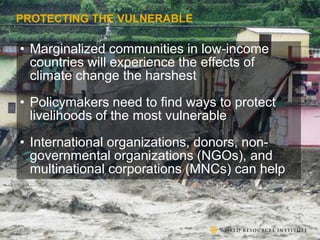
PROTECTING THE VULNERABLE 
• Marginalized communities in low-income 
countries will experience the effects of 
climate change the harshest 
• Policymakers need to find ways to protect 
livelihoods of the most vulnerable 
• International organizations, donors, non-governmental 
Photo Credit: Flickr/Oxfam International 
organizations (NGOs), and 
multinational corporations (MNCs) can help
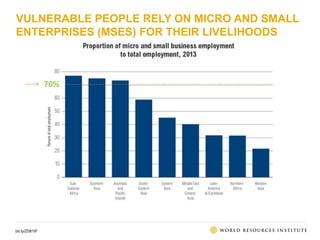
VULNERABLE PEOPLE RELY ON MICRO AND SMALL 
ENTERPRISES (MSES) FOR THEIR LIVELIHOODS 
bit.ly/Z081IF 
70%
THE IMPORTANCE OF AGRICULTURE IN THE RURAL 
ECONOMY 
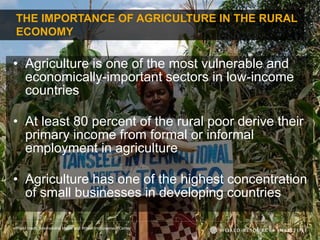
• Agriculture is one of the most vulnerable and 
economically-important sectors in low-income 
countries 
• At least 80 percent of the rural poor derive their 
primary income from formal or informal 
employment in agriculture 
• Agriculture has one of the highest concentration 
of small businesses in developing countries 
Photo credit: International Maize and Wheat Improvement Center
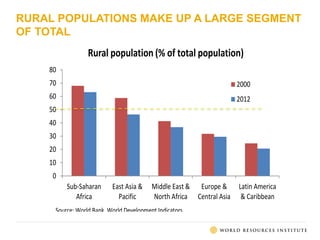
RURAL POPULATIONS MAKE UP A LARGE SEGMENT 
OF TOTAL 
80 
70 
60 
50 
40 
30 
20 
10 
0 
Rural population (% of total population) 
Sub-Saharan 
Africa 
East Asia & 
Pacific 
Middle East & 
North Africa 
Europe & 
Central Asia 
2000 
2012 
Latin America 
& Caribbean 
Source: World Bank, World Development Indicators.
WHY FOCUS ON MICRO AND SMALL BUSINESSES 
(MSES) IN ADAPTATION 
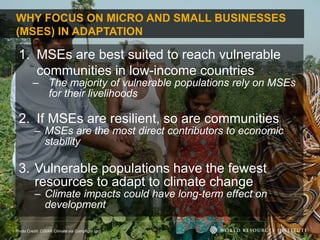
1. MSEs are best suited to reach vulnerable 
communities in low-income countries 
– The majority of vulnerable populations rely on MSEs 
for their livelihoods 
2. If MSEs are resilient, so are communities 
– MSEs are the most direct contributors to economic 
stability 
3. Vulnerable populations have the fewest 
resources to adapt to climate change 
– Climate impacts could have long-term effect on 
development 
Photo Credit: CGIAR Climate via Compfight (cc)
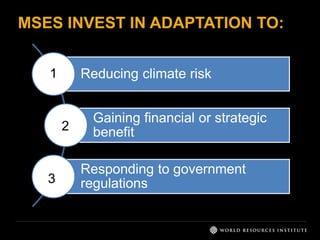
MSES INVEST IN ADAPTATION TO: 
Reducing climate risk 
Gaining financial or strategic 
benefit 
Responding to government 
regulations 
1 
2 
3
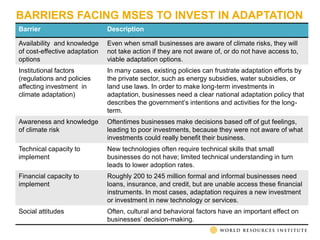
BARRIERS FACING MSES TO INVEST IN ADAPTATION 
Barrier Description 
Availability and knowledge 
of cost-effective adaptation 
options 
Even when small businesses are aware of climate risks, they will 
not take action if they are not aware of, or do not have access to, 
viable adaptation options. 
Institutional factors 
(regulations and policies 
affecting investment in 
climate adaptation) 
In many cases, existing policies can frustrate adaptation efforts by 
the private sector, such as energy subsidies, water subsidies, or 
land use laws. In order to make long-term investments in 
adaptation, businesses need a clear national adaptation policy that 
describes the government’s intentions and activities for the long-term. 
Awareness and knowledge 
of climate risk 
Oftentimes businesses make decisions based off of gut feelings, 
leading to poor investments, because they were not aware of what 
investments could really benefit their business. 
Technical capacity to 
implement 
New technologies often require technical skills that small 
businesses do not have; limited technical understanding in turn 
leads to lower adoption rates. 
Financial capacity to 
implement 
Roughly 200 to 245 million formal and informal businesses need 
loans, insurance, and credit, but are unable access these financial 
instruments. In most cases, adaptation requires a new investment 
or investment in new technology or services. 
Social attitudes Often, cultural and behavioral factors have an important effect on 
businesses’ decision-making.
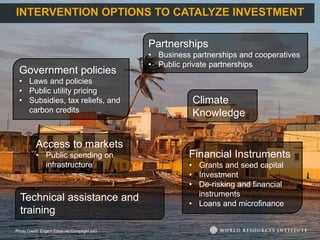
INTERVENTION OPTIONS TO CATALYZE INVESTMENT 
Government policies 
• Laws and policies 
• Public utility pricing 
• Subsidies, tax reliefs, and 
carbon credits 
Access to markets 
• Public spending on 
infrastructure 
Photo Credit: Evgeni Zotov via Compfight (cc) 
Climate 
Knowledge 
Technical assistance and 
training 
Partnerships 
• Business partnerships and cooperatives 
• Public private partnerships 
Financial Instruments 
• Grants and seed capital 
• Investment 
• De-risking and financial 
instruments 
• Loans and microfinance
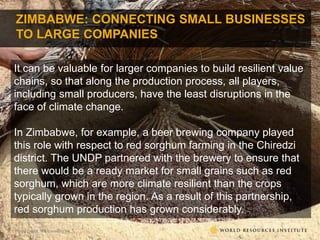
ZIMBABWE: CONNECTING SMALL BUSINESSES 
TO LARGE COMPANIES 
It can be valuable for larger companies to build resilient value 
chains, so that along the production process, all players, 
including small producers, have the least disruptions in the 
face of climate change. 
In Zimbabwe, for example, a beer brewing company played 
this role with respect to red sorghum farming in the Chiredzi 
district. The UNDP partnered with the brewery to ensure that 
there would be a ready market for small grains such as red 
sorghum, which are more climate resilient than the crops 
typically grown in the region. As a result of this partnership, 
red sorghum production has grown considerably. 
Photo Credit: 10b travelling via
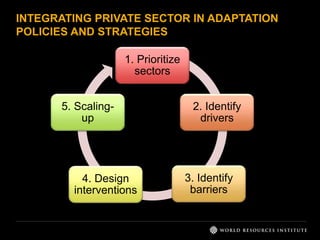
INTEGRATING PRIVATE SECTOR IN ADAPTATION 
POLICIES AND STRATEGIES 
1. Prioritize 
sectors 
2. Identify 
drivers 
3. Identify 
barriers 
5. Scaling-up 
4. Design 
interventions
CONTACT FOR MORE INFORMATION: 
l.dougherty-choux@wri.org 
pterpstra@wri.org 
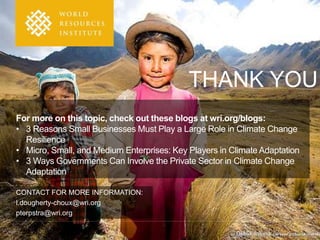
THANK YOU 
For more on this topic, check out these blogs at wri.org/blogs: 
• 3 Reasons Small Businesses Must Play a Large Role in Climate Change 
Resilience 
• Micro, Small, and Medium Enterprises: Key Players in Climate Adaptation 
• 3 Ways Governments Can Involve the Private Sector in Climate Change 
Adaptation

Building Climate Resilience from the Bottom Up

  • 1.
    BUILDING CLIMATE RESILIENCEFROM THE BOTTOM UP Catalyzing Small Business Engagement in Climate Change Adaptation LISA DOUGHERTY-CHOUX L.DOUGHERTY-CHOUX@WRI.ORG PIETER TERPSTRA PTERPSTRA@WRI.ORG
  • 2.
    PROTECTING THE VULNERABLE • Marginalized communities in low-income countries will experience the effects of climate change the harshest • Policymakers need to find ways to protect livelihoods of the most vulnerable • International organizations, donors, non-governmental Photo Credit: Flickr/Oxfam International organizations (NGOs), and multinational corporations (MNCs) can help
  • 3.
    VULNERABLE PEOPLE RELYON MICRO AND SMALL ENTERPRISES (MSES) FOR THEIR LIVELIHOODS bit.ly/Z081IF 70%
  • 4.
    THE IMPORTANCE OFAGRICULTURE IN THE RURAL ECONOMY • Agriculture is one of the most vulnerable and economically-important sectors in low-income countries • At least 80 percent of the rural poor derive their primary income from formal or informal employment in agriculture • Agriculture has one of the highest concentration of small businesses in developing countries Photo credit: International Maize and Wheat Improvement Center
  • 5.
    RURAL POPULATIONS MAKEUP A LARGE SEGMENT OF TOTAL 80 70 60 50 40 30 20 10 0 Rural population (% of total population) Sub-Saharan Africa East Asia & Pacific Middle East & North Africa Europe & Central Asia 2000 2012 Latin America & Caribbean Source: World Bank, World Development Indicators.
  • 6.
    WHY FOCUS ONMICRO AND SMALL BUSINESSES (MSES) IN ADAPTATION 1. MSEs are best suited to reach vulnerable communities in low-income countries – The majority of vulnerable populations rely on MSEs for their livelihoods 2. If MSEs are resilient, so are communities – MSEs are the most direct contributors to economic stability 3. Vulnerable populations have the fewest resources to adapt to climate change – Climate impacts could have long-term effect on development Photo Credit: CGIAR Climate via Compfight (cc)
  • 7.
    MSES INVEST INADAPTATION TO: Reducing climate risk Gaining financial or strategic benefit Responding to government regulations 1 2 3
  • 8.
    BARRIERS FACING MSESTO INVEST IN ADAPTATION Barrier Description Availability and knowledge of cost-effective adaptation options Even when small businesses are aware of climate risks, they will not take action if they are not aware of, or do not have access to, viable adaptation options. Institutional factors (regulations and policies affecting investment in climate adaptation) In many cases, existing policies can frustrate adaptation efforts by the private sector, such as energy subsidies, water subsidies, or land use laws. In order to make long-term investments in adaptation, businesses need a clear national adaptation policy that describes the government’s intentions and activities for the long-term. Awareness and knowledge of climate risk Oftentimes businesses make decisions based off of gut feelings, leading to poor investments, because they were not aware of what investments could really benefit their business. Technical capacity to implement New technologies often require technical skills that small businesses do not have; limited technical understanding in turn leads to lower adoption rates. Financial capacity to implement Roughly 200 to 245 million formal and informal businesses need loans, insurance, and credit, but are unable access these financial instruments. In most cases, adaptation requires a new investment or investment in new technology or services. Social attitudes Often, cultural and behavioral factors have an important effect on businesses’ decision-making.
  • 9.
    INTERVENTION OPTIONS TOCATALYZE INVESTMENT Government policies • Laws and policies • Public utility pricing • Subsidies, tax reliefs, and carbon credits Access to markets • Public spending on infrastructure Photo Credit: Evgeni Zotov via Compfight (cc) Climate Knowledge Technical assistance and training Partnerships • Business partnerships and cooperatives • Public private partnerships Financial Instruments • Grants and seed capital • Investment • De-risking and financial instruments • Loans and microfinance
  • 10.
    ZIMBABWE: CONNECTING SMALLBUSINESSES TO LARGE COMPANIES It can be valuable for larger companies to build resilient value chains, so that along the production process, all players, including small producers, have the least disruptions in the face of climate change. In Zimbabwe, for example, a beer brewing company played this role with respect to red sorghum farming in the Chiredzi district. The UNDP partnered with the brewery to ensure that there would be a ready market for small grains such as red sorghum, which are more climate resilient than the crops typically grown in the region. As a result of this partnership, red sorghum production has grown considerably. Photo Credit: 10b travelling via
  • 11.
    INTEGRATING PRIVATE SECTORIN ADAPTATION POLICIES AND STRATEGIES 1. Prioritize sectors 2. Identify drivers 3. Identify barriers 5. Scaling-up 4. Design interventions
  • 12.
    CONTACT FOR MOREINFORMATION: l.dougherty-choux@wri.org pterpstra@wri.org THANK YOU For more on this topic, check out these blogs at wri.org/blogs: • 3 Reasons Small Businesses Must Play a Large Role in Climate Change Resilience • Micro, Small, and Medium Enterprises: Key Players in Climate Adaptation • 3 Ways Governments Can Involve the Private Sector in Climate Change Adaptation

Editor's Notes

  • #2  Climate change is happening and will only become more severe in the future. This will bring more frequent climate extremes, heightened variability of weather patterns, and long-term changes to the norms of the climate. Those who will experience the social and economic effects of climate change most harshly are the marginalized and poor populations who live in low-income countries, many of which are located in tropical regions and lack the resources to invest in adaptation. These changes could have long-term impacts on development efforts. Although financial assistance from donors, MNCs, and others, has a central role in planning for adaptation, adaptation at scale cannot be achieved without the involvement of the private sector investing in its own climate resilience. Developing countries rely heavily on the private sector for economic growth and job creation. Therefore, governments in these countries have a strong interest in fostering an enabling environment for the private sector to contribute to this growth. By ensuring that the private sector has a high adaptive capacity in the face of climate change, poor men and women will be able to increase, or at least sustain, their livelihoods.
  • #4  The majority of the developing world relies on small businesses for employment. They play a huge role for the livelihoods of vulnerable communities. In total, about 60 percent of all employees in developing countries work in micro and small businesses. In Sub-Saharan Africa, these businesses account for 90 percent of all firms and make up about 25 percent of GDP. Some of these businesses are slowly responding to the effects of climate change but many are not prepared for the long-term impacts.
  • #6  Rural populations make up a large percentage of total populations especially in least developed regions, although they are slowly declining. Still, almost the majority in Sub-Saharan Africa and East Asia and Pacific live in rural areas. As the pace of climate change accelerates, many farmers are unable to keep up and safeguard their businesses against long-term climate risks. Supporting local farmers to adapt to climate change is important, not only for global food security, but also to sustain livelihoods in these communities.
  • #7 For more information, check out: http://www.wri.org/blog/2014/10/3-reasons-small-businesses-must-play-large-role-climate-change-resilience Photo Credit: <a href="https://www.flickr.com/photos/55227776@N04/8570061085/">CGIAR Climate</a> via <a href="http://compfight.com">Compfight</a> <a href="https://creativecommons.org/licenses/by-nc-sa/2.0/">cc</a>
  • #8  Policymakers need to understand what motivates businesses to invest in adaptation. Economics would tell us that small businesses are motivated to invest in adaptation when they can seek to maximize their returns and make the most of climate conditions. Here are three main reasons why businesses would decide to invest in adaptation. 1. One of the primary ways that businesses manage climate-induced risks, such as floods, droughts, storms, and other climatic events, is to safeguard their operations and processes. Businesses can be affected by direct risks, such as risks related to assets and processes under the control of the business owner, or indirect risks, which usually stem from spillover effects such as quality of infrastructure, availability of finance, and economic and political stability. Ultimately, these risks, if not managed well by the public and private sectors will affect the operations of the business. Risk management is thus not only essential for protecting the business but can also lead to financial benefits and spillover effects that increase the adaptive capacity of the community. 2. Climate change could present an opportunity for businesses, because it could increase demand for new goods and services that help people to adapt. Businesses engaged in developing more resilient products can gain a financial or strategic benefit, while contributing to adaptation and expanding into new markets. Businesses that have taken steps to invest in these adaptation products and services could gain a market advantage. 3. Governments can directly increase investment in adaptation through regulation, provided that there is a well-functioning mechanism to enforce them. Correcting market inefficiencies for businesses is a direct way to incentivize small businesses to invest in adaptation. Artificially reducing the costs of adapting through subsidies can lead to more firms investing in adaptive measures, although the practice would only be temporary during the early stages of implementing an intervention to correct well-identified market inefficiencies. Other regulations include property rights, zoning laws, regulations imposed on larger businesses, among others. There are a couple of caveats, however. Due to the large size of the informal economy in developing countries, governments should bear in mind that many policies to correct market failures will not be effective. Additionally, governments need to be careful that regulations do not discourage businesses operating in the informal sector from joining the formal sector. Incentives are more likely to encourage small businesses to register their businesses formally than additional taxes and regulation.
  • #9  The majority of micro and small businesses face many barriers for investing in climate change adaption. We identified six categories of barriers. 1. Even when small businesses are aware of climate risks, they will not take action if they are not aware of, or do not have access to, viable adaptation options. Adaptation options must be cost-effective at a small scale, and competitive against non-adaptation options in regards to price or costs of production. For adaptation measures to be viable, there must be a market and demand for the resilient goods or services. Ensuring market access must therefore be part of the design of adaptation interventions. 2. In many developing countries, government institutions have difficulty executing their intended role in encouraging adaptation practices. In many cases, existing policies can frustrate adaptation efforts by the private sector, such as energy subsidies, water subsidies, or land use laws. In order to make long-term investments in adaptation, businesses need a clear national adaptation policy that describes the government’s intentions and activities for the long-term. 3. Awareness and knowledge of climate risk is a very common barrier in rural areas where many do not have access to information. Oftentimes businesses make decisions based off of gut feelings, leading to poor investments, because they were not aware of what investments could really benefit their business. These businesses need access to information in a form that is simple and actionable and related to their specific sector. 4. New technologies often require technical skills that small businesses do not have; limited technical understanding in turn leads to lower adoption rates. Many small businesses in developing countries are severely constrained when it comes to technical knowledge and human capacity. 5. Roughly 200 to 245 million formal and informal businesses need loans, insurance, and credit, but are unable access these financial instruments. In most cases, adaptation requires a new investment or investment in new technology or services. Banks are often hesitant to invest in these kinds of activities as they bear a high risk, are difficult to evaluate and small businesses can often not provide enough collateral. 6. Often, cultural and behavioral factors have an important effect on businesses’ decision-making. Overcoming social and cultural barriers requires a good understanding of small business dynamics in communities.
  • #10  Governments have a significant role in instituting policies that facilitate adaptation for businesses. Although many of them do not have the necessary capacity to provide sufficient public support for all businesses to invest in adaptation, they have the influence and capacity to work with NGOs, financial institutions and international organizations to address barriers facing micro and small enterprises. The public sector can use interventions to remove barriers, and also create an enabling environment for small businesses to invest in adaptation. There is no one-size-fits-all approach to achieve these objectives, as each country is very different. To have the most impact, the interventions should be tailored to the context of a country’s economy and natural environment. Photo Credit: <a href="https://www.flickr.com/photos/23609393@N03/6822424075/">Evgeni Zotov</a> via <a href="http://compfight.com">Compfight</a> <a href="https://creativecommons.org/licenses/by-nc-nd/2.0/">cc</a>
  • #11 Photo Credit: <a href="https://www.flickr.com/photos/77334245@NCompfight (cc)00/7999589582/">10b travelling</a> via <a href="http://compfight.com">Compfight</a> <a href="https://creativecommons.org/licenses/by-nc-nd/2.0/">cc</a>
  • #12  This slide presents an overview of the framework we propose to policymakers to tackle this climate change challenge. It is crucial for businesses and their representatives to be involved early on in the policy design process in order for policymakers to understand the relevant drivers and barriers and design effectiveness policy options. 1. Prioritizing sectors is an important step in the policymaking process, as each country has a diverse base of economically important sectors. Blanket policies that aim to engage the entire private sector of a country are likely to not be as effective as sector-specific policies. 2. Understanding what drives private sector investment in adaptation in a sector is important as it determines the design of interventions and regulation. 3. To even begin designing interventions, policymakers need to identify the barriers to adaptation. 4. Once that’s done, they can design interventions that create an enabling environment for small businesses to adapt. 5. There are various ways through which interventions can be scaled, either bottom-up starting with several pilot projects or top-down through a nation-wide program of reforms.
  • #13 For more on this topic, check out these blogs at wri.org/blogs: 3 Reasons Small Businesses Must Play a Large Role in Climate Change Resilience http://www.wri.org/blog/2014/10/3-reasons-small-businesses-must-play-large-role-climate-change-resilience Micro, Small, and Medium Enterprises: Key Players in Climate Adaptation http://www.wri.org/blog/2013/12/micro-small-and-medium-enterprises-key-players-climate-adaptation 3 Ways Governments Can Involve the Private Sector in Climate Change Adaptation http://www.wri.org/blog/2013/12/3-ways-governments-can-involve-private-sector-climate-change-adaptation