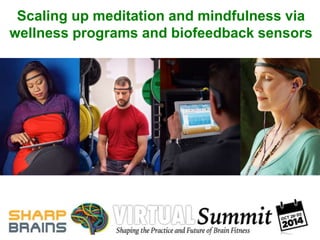
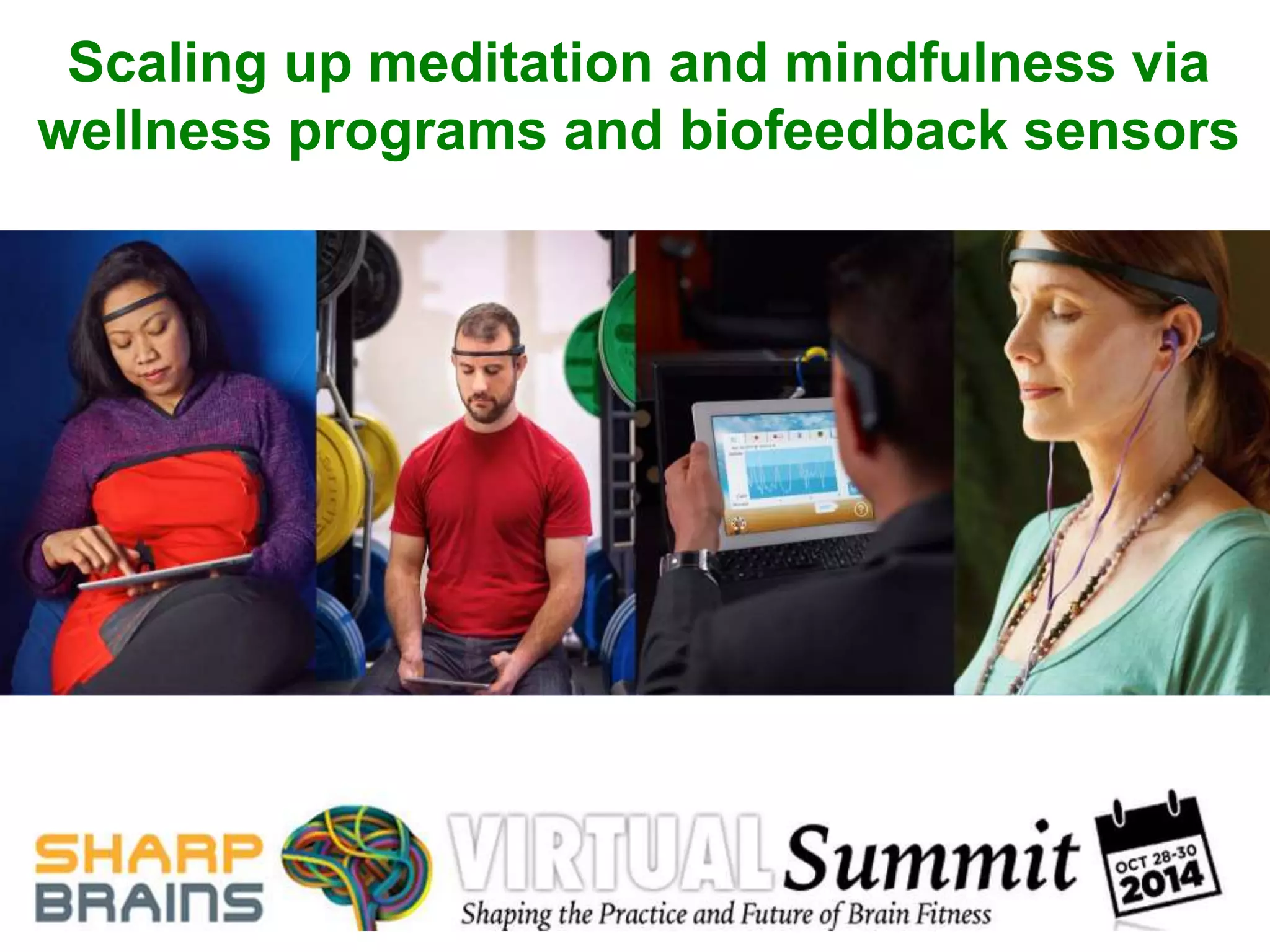









Scaling up meditation and mindfulness via 
wellness programs and biofeedback sensors
Sponsors 
Welcome!
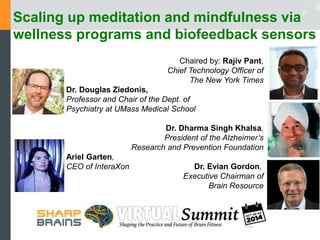
Scaling up meditation and mindfulness via 
wellness programs and biofeedback sensors 
Chaired by: Rajiv Pant, 
Chief Technology Officer of 
The New York Times 
Dr. Douglas Ziedonis, 
Professor and Chair of the Dept. of 
Psychiatry at UMass Medical School 
Dr. Dharma Singh Khalsa, 
President of the Alzheimer’s 
Research and Prevention Foundation 
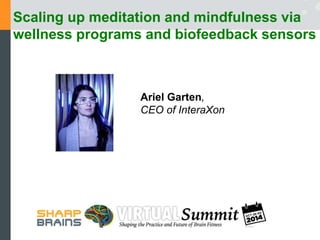
Ariel Garten, 
CEO of InteraXon Dr. Evian Gordon, 
Executive Chairman of 
Brain Resource
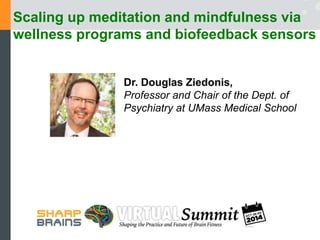
Scaling up meditation and mindfulness via 
wellness programs and biofeedback sensors 
Dr. Douglas Ziedonis, 
Professor and Chair of the Dept. of 
Psychiatry at UMass Medical School
Douglas Ziedonis, M.D., M.P.H. 
Professor and Chairman 
Department of Psychiatry 
UMass Memorial Medical Center/ 
University of Massachusetts Medical School 
Douglas.Ziedonis@umassmemorial.org 
Tuesday, October 29th, 2014
Mindfulness: What is it? 
 “The awareness that emerges through paying 
attention on purpose, in the present moment, 
and non-judgmentally to the unfolding of 
experience moment to moment” 
– Jon Kabat-Zinn, UMass Medical School’s 
Center for Mindfulness
Two Component Definition 
of Mindfulness 
1) Self-regulation of attention so that it is 
maintained on immediate experience, thereby 
allowing for increased recognition of mental 
events in the present moment. 
 Body sensations, Feelings, & Thoughts 
2) Adopting a particular orientation toward one’s 
experiences in the present moment, characterized 
by curiosity, openness, and acceptance. 
 Compassion Bishop 2004
Purposeful Pause @ Virtual Summit
Why? 
Why Mindfulness? 
 Why Scale up Mindfulness? 
Why Care? 
 Mission, purpose, cause ….. inspiration 
What outcomes intended? 
 For Individual 
 For Organization 
 For Community
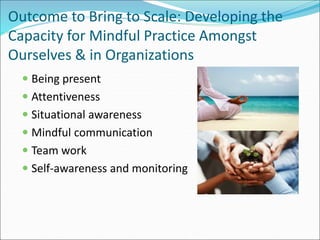
Outcome to Bring to Scale: Developing the 
Capacity for Mindful Practice Amongst 
Ourselves & in Organizations 
 Being present 
 Attentiveness 
 Situational awareness 
 Mindful communication 
 Team work 
 Self-awareness and monitoring
Incorporating Mindfulness & Mindful Leadership 
Attributes & Practices into our work activities, 
organization and daily life 
THREE EXAMPLES: 
1. Mindfulness in Psychiatry – UMass Department of Psychiatry 
•Over 360 faculty supported by 2000 staff 
•Leading by example – own “practice” 
2. Mindfulness in Wellness Initiative & Leadership - UMass 
Memorial Health Care 
* Targeting 34,000 employees and family members 
3. Mindful Physician Leadership Program 
* Massachusetts State Wide Initiative
How Scale Up? 
Link to Mission & Personal Goals 
Leadership & Engagement 
Strategic Planning / Prioritization 
Customers & Staff – Added Value 
Organizational Change Approach 
Process for Why, How & What
Addressing Why Through Organizational 
Change (AWTOC) 
 Identify the “Why” which links the “Identified 
Problem” to the Culture’s Mission and Desired Change 
 What problems lead one to mindfulness as solution? 
 Use AWTOC to structure the process of change 
 3 Phases & 10 Steps 
 Leadership: Roles & Responsibilities 
 Importance of Communication 
 People & Technology 
 Training, Apps, websites, MP3s, etc 
 Tracking and Sustaining Change 
 EX: http://umassmed.edu/psychiatry/resources/Tobacco/attoc/
Mindfulness in Psychiatry 
 Strategic Plan & Organizational Change 
 Leadership & Engagement 
 Collaborations with Center for Mindfulness 
 Mindfulness as Platform for Wellness Initiative 
 All Mission Areas 
 Embed in Clinical Practices 
 Training Opportunities for All – many versions 
 Research activities 
 Leadership Development 
 Community Support Groups 
 Academic Interest Groups, Research Groups, Mindfulness Practice Get-togethers 
 Website & Apps
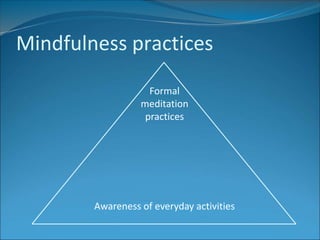
Mindfulness practices 
Formal 
meditation 
practices 
Awareness of everyday activities
Formal Practices 
 Meditation & Gentle Yoga Exercises 
 Specific Exercises: 
 MEDITATIONS: 
• Awareness of Breathing 
• Sitting Meditation 
• Slow Walking Meditation 
• Body-scan 
• Raisin Exercise (mindful eating) 
• Gentle Yoga Exercises 
• Mountain / Lake Meditation 
• , Loving-kindness Meditation 
• Forgiveness Meditations 
• Home Practice
Informal Practice 
 Many opportunities in the everyday living to bring 
enhanced awareness: 
 Any moment – perhaps when you catch yourself being 
mindless 
 Thoughts, Feelings, & Body Sensations 
 How the weather affects us physically 
 Pleasant experiences & Unpleasant experiences 
 Reactivity to stressful situations or events 
 While communicating with others 
 Consider journal / log of your experiences. 
 PURPOSEFUL PAUSES – Routine Activities or When 
notice swirling of mind in tension
Integrating Mindfulness into Clinical Practice 
 Enhanced Presence & Listening 
 Brief 5 minute Moments 
 Mindfulness Based Stress Reduction (MBSR) 
 Acceptance and Commitment Therapy (ACT) 
 Mindfulness-Based Cognitive Therapy (MBCT) 
 Dual Recovery Therapy (DRT) 
 Dialectical Behavior Therapy (DBT) 
 “what” and “how” skills 
 Mindfulness Based Addiction Treatments 
 12-Step Facilitation 
 Apps & websites & mp3s
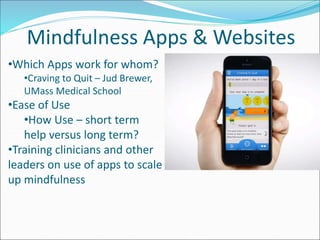
Mindfulness Apps & Websites 
•Which Apps work for whom? 
•Craving to Quit – Jud Brewer, 
UMass Medical School 
•Ease of Use 
•How Use – short term 
help versus long term? 
•Training clinicians and other 
leaders on use of apps to scale 
up mindfulness
Mindfulness integrated in Wellness Initiative & 
Leadership Program: UMass Memorial Health Care 
Employee Wellness Initiative 
On-Site support 
MBSR – UMass Center for Mindfulness 
 Internet Portal – On-line with coaching 
 Executive Leadership – Mindfulness Practice 
 Leadership Training
Mindful Physician Leadership Program 
 Thanks to Janice Marturano, Co-PI 
 Physicians Foundation grant 
 AAMC & Massachusetts Medical Society 
 Mindfulness creates space to be more focused, clear, 
creative and compassionate leader 
 Three practices of the mindful leader: 
 Reflections 
 Purposeful pauses 
 Mindful meditation 
 One day retreat, 6 ninety minute webinars, and 10 
monthly ninety minute community meetings
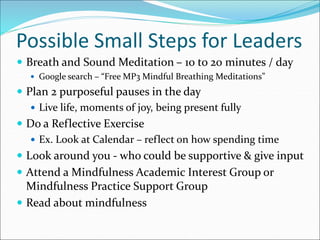
Possible Small Steps for Leaders 
 Breath and Sound Meditation – 10 to 20 minutes / day 
 Google search – “Free MP3 Mindful Breathing Meditations” 
 Plan 2 purposeful pauses in the day 
 Live life, moments of joy, being present fully 
 Do a Reflective Exercise 
 Ex. Look at Calendar – reflect on how spending time 
 Look around you - who could be supportive & give input 
 Attend a Mindfulness Academic Interest Group or 
Mindfulness Practice Support Group 
 Read about mindfulness
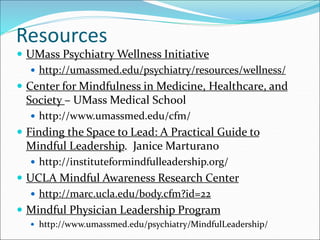
Resources 
 UMass Psychiatry Wellness Initiative 
 http://umassmed.edu/psychiatry/resources/wellness/ 
 Center for Mindfulness in Medicine, Healthcare, and 
Society – UMass Medical School 
 http://www.umassmed.edu/cfm/ 
 Finding the Space to Lead: A Practical Guide to 
Mindful Leadership. Janice Marturano 
 http://instituteformindfulleadership.org/ 
 UCLA Mindful Awareness Research Center 
 http://marc.ucla.edu/body.cfm?id=22 
 Mindful Physician Leadership Program 
 http://www.umassmed.edu/psychiatry/MindfulLeadership/
Scaling up meditation and mindfulness via 
wellness programs and biofeedback sensors 
Dr. Dharma Singh Khalsa, 
President of the Alzheimer’s 
Research and Prevention Foundation
www.alzheimersprevention.org 
Stress, 
Meditation and 
Memory: 
A Now Dimension in Prevention 
Dharma Singh Khalsa, M.D. 
President/Medical Director 
Alzheimer’s Research and Prevention Foundation 
drdharma@alzheimersprevention.org
From ISIS to Ebola 
Stress Got Your Nerves on Edge?
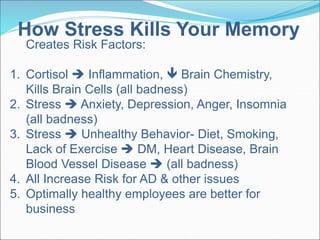
How Stress Kills Your Memory 
Creates Risk Factors: 
1. Cortisol  Inflammation,  Brain Chemistry, 
Kills Brain Cells (all badness) 
2. Stress  Anxiety, Depression, Anger, Insomnia 
(all badness) 
3. Stress  Unhealthy Behavior- Diet, Smoking, 
Lack of Exercise  DM, Heart Disease, Brain 
Blood Vessel Disease  (all badness) 
4. All Increase Risk for AD & other issues 
5. Optimally healthy employees are better for 
business
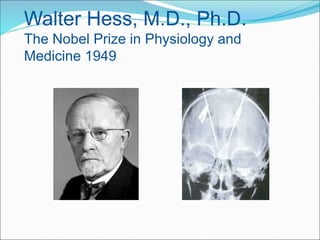
Walter Hess, M.D., Ph.D. 
The Nobel Prize in Physiology and 
Medicine 1949
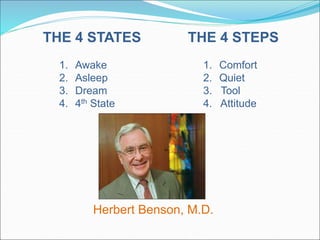
THE 4 STEPS 
1. Comfort 
2. Quiet 
3. Tool 
4. Attitude 
THE 4 STATES 
1. Awake 
2. Asleep 
3. Dream 
4. 4th State 
Herbert Benson, M.D.
Many Published Studies 
Reveal Multiple Benefits of 
Meditation: 
From Better Memory to 
Improved Cellular & Genetic 
Health and PSWB 
(all goodness)
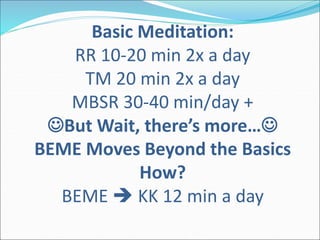
Basic Meditation: 
RR 10-20 min 2x a day 
TM 20 min 2x a day 
MBSR 30-40 min/day + 
But Wait, there’s more… 
BEME Moves Beyond the Basics 
How? 
BEME  KK 12 min a day
How to Move from 
Information to 
Experience
1. The key to incorporate the many 
cognitive-enhancing benefits of 
meditation into your corporation, 
business, or environment is to first 
and foremost have your own 
consistent practice. 
2. Become familiar with ongoing 
research
3. Create innovative ways to 
incorporate your experience and 
knowledge to make positive 
changes at the organizational, 
community and national levels 
4. If you are an entrepreneur, get 
endorsements from reputable 
organizations or researchers and 
create alliances with distribution 
channels.
Conclusion: 
Meditate More 
A Sharp Brain, Psychological 
Wellbeing and Spiritual Fitness 
are the Now Dimension 
To Be Experienced on Oct 30th…. 
www.alzheimersprevention.org 
drdharma@alzheimersprevention.org
Scaling up meditation and mindfulness via 
wellness programs and biofeedback sensors 
Ariel Garten, 
CEO of InteraXon
Ariel Garten, CEO ariel@interaxon.ca @arielgarten www.choosemuse.com
S e n s o r R e v o l u t i o n
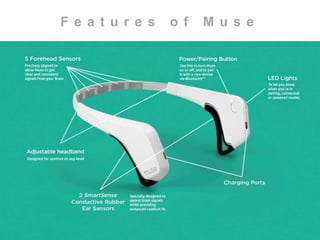
F e a t u r e s o f M u s e
C l i n i c a l G r a d e E E G 
in Consumer Form 
Muse ($299 MSRP) Actichamp ($36,000 MSRP)
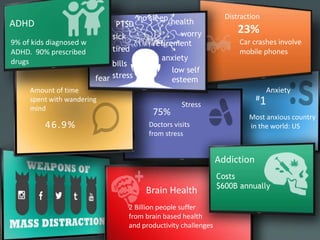
ADHD 
9% of kids diagnosed w 
ADHD. 90% prescribed 
drugs 
no sleep 
worry 
retirement 
Amount of time 
spent with wandering 
mind 75% 
Brain Health 
2 Billion people suffer 
from brain based health 
and productivity challenges 
23% 
#1 
Most anxious country 
46.9% in the world: US 
Doctors visits 
from stress 
Car crashes involve 
mobile phones 
Addiction 
Costs 
$600B annually 
fear stress 
low self 
esteem 
PTSD 
sick 
health 
tired 
bills 
anxiety 
Distraction 
Anxiety 
Stress
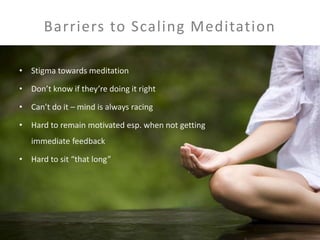
Barriers to Scaling Meditation 
• Stigma towards meditation 
• Don’t know if they’re doing it right 
• Can’t do it – mind is always racing 
• Hard to remain motivated esp. when not getting 
immediate feedback 
• Hard to sit “that long”
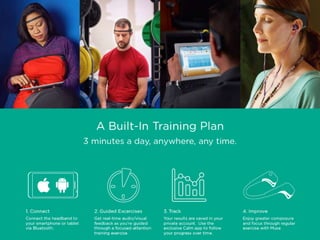
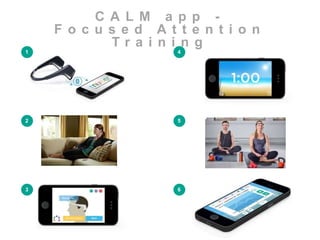
C A L M a p p - 
F o c u s e d A t t e n t i o n 
T r a i n i n g 
1 
2 
3 
4 
5 
6
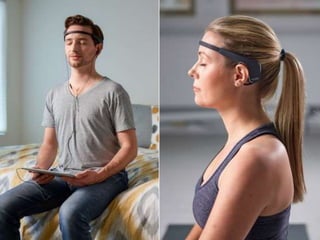
Muse: the brain sensing headband
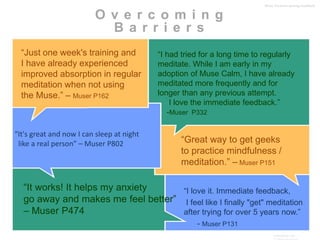
O v e r c o m i n g 
B a r r i e r s 
“I had tried for a long time to regularly 
meditate. While I am early in my 
adoption of Muse Calm, I have already 
meditated more frequently and for 
longer than any previous attempt. 
I love the immediate feedback.” 
-Muser P332 
“Great way to get geeks 
to practice mindfulness / 
meditation.” – Muser P151 
“I love it. Immediate feedback, 
I feel like I finally "get" meditation 
after trying for over 5 years now.” 
InteraXon Inc – 
CONFIDENTIAL 
- Muser P131 
“Just one week's training and 
I have already experienced 
improved absorption in regular 
meditation when not using 
the Muse.” – Muser P162 
“It works! It helps my anxiety 
go away and makes me feel better” 
– Muser P474 
Muse: the brain sensing headband 
“It's great and now I can sleep at night 
like a real person” – Muser P802
Muse: the brain sensing headband 
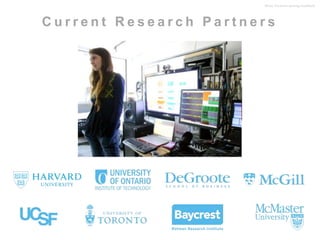
C u r r e n t R e s e a r c h P a r t n e r s
Scaling up meditation and mindfulness via 
wellness programs and biofeedback sensors 
Dr. Evian Gordon, 
Executive Chairman of 
Brain Resource
 To learn more, visit SharpBrains.com

Scal­ing up med­i­ta­tion and mind­ful­ness via well­ness pro­grams and biofeed­back sensors

  • 1.
    Scaling up meditationand mindfulness via wellness programs and biofeedback sensors
  • 2.
  • 3.
    Scaling up meditationand mindfulness via wellness programs and biofeedback sensors Chaired by: Rajiv Pant, Chief Technology Officer of The New York Times Dr. Douglas Ziedonis, Professor and Chair of the Dept. of Psychiatry at UMass Medical School Dr. Dharma Singh Khalsa, President of the Alzheimer’s Research and Prevention Foundation Ariel Garten, CEO of InteraXon Dr. Evian Gordon, Executive Chairman of Brain Resource
  • 4.
    Scaling up meditationand mindfulness via wellness programs and biofeedback sensors Dr. Douglas Ziedonis, Professor and Chair of the Dept. of Psychiatry at UMass Medical School
  • 5.
    Douglas Ziedonis, M.D.,M.P.H. Professor and Chairman Department of Psychiatry UMass Memorial Medical Center/ University of Massachusetts Medical School Douglas.Ziedonis@umassmemorial.org Tuesday, October 29th, 2014
  • 6.
    Mindfulness: What isit?  “The awareness that emerges through paying attention on purpose, in the present moment, and non-judgmentally to the unfolding of experience moment to moment” – Jon Kabat-Zinn, UMass Medical School’s Center for Mindfulness
  • 7.
    Two Component Definition of Mindfulness 1) Self-regulation of attention so that it is maintained on immediate experience, thereby allowing for increased recognition of mental events in the present moment.  Body sensations, Feelings, & Thoughts 2) Adopting a particular orientation toward one’s experiences in the present moment, characterized by curiosity, openness, and acceptance.  Compassion Bishop 2004
  • 8.
    Purposeful Pause @Virtual Summit
  • 9.
    Why? Why Mindfulness?  Why Scale up Mindfulness? Why Care?  Mission, purpose, cause ….. inspiration What outcomes intended?  For Individual  For Organization  For Community
  • 10.
    Outcome to Bringto Scale: Developing the Capacity for Mindful Practice Amongst Ourselves & in Organizations  Being present  Attentiveness  Situational awareness  Mindful communication  Team work  Self-awareness and monitoring
  • 11.
    Incorporating Mindfulness &Mindful Leadership Attributes & Practices into our work activities, organization and daily life THREE EXAMPLES: 1. Mindfulness in Psychiatry – UMass Department of Psychiatry •Over 360 faculty supported by 2000 staff •Leading by example – own “practice” 2. Mindfulness in Wellness Initiative & Leadership - UMass Memorial Health Care * Targeting 34,000 employees and family members 3. Mindful Physician Leadership Program * Massachusetts State Wide Initiative
  • 12.
    How Scale Up? Link to Mission & Personal Goals Leadership & Engagement Strategic Planning / Prioritization Customers & Staff – Added Value Organizational Change Approach Process for Why, How & What
  • 13.
    Addressing Why ThroughOrganizational Change (AWTOC)  Identify the “Why” which links the “Identified Problem” to the Culture’s Mission and Desired Change  What problems lead one to mindfulness as solution?  Use AWTOC to structure the process of change  3 Phases & 10 Steps  Leadership: Roles & Responsibilities  Importance of Communication  People & Technology  Training, Apps, websites, MP3s, etc  Tracking and Sustaining Change  EX: http://umassmed.edu/psychiatry/resources/Tobacco/attoc/
  • 14.
    Mindfulness in Psychiatry  Strategic Plan & Organizational Change  Leadership & Engagement  Collaborations with Center for Mindfulness  Mindfulness as Platform for Wellness Initiative  All Mission Areas  Embed in Clinical Practices  Training Opportunities for All – many versions  Research activities  Leadership Development  Community Support Groups  Academic Interest Groups, Research Groups, Mindfulness Practice Get-togethers  Website & Apps
  • 15.
    Mindfulness practices Formal meditation practices Awareness of everyday activities
  • 16.
    Formal Practices Meditation & Gentle Yoga Exercises  Specific Exercises:  MEDITATIONS: • Awareness of Breathing • Sitting Meditation • Slow Walking Meditation • Body-scan • Raisin Exercise (mindful eating) • Gentle Yoga Exercises • Mountain / Lake Meditation • , Loving-kindness Meditation • Forgiveness Meditations • Home Practice
  • 17.
    Informal Practice Many opportunities in the everyday living to bring enhanced awareness:  Any moment – perhaps when you catch yourself being mindless  Thoughts, Feelings, & Body Sensations  How the weather affects us physically  Pleasant experiences & Unpleasant experiences  Reactivity to stressful situations or events  While communicating with others  Consider journal / log of your experiences.  PURPOSEFUL PAUSES – Routine Activities or When notice swirling of mind in tension
  • 18.
    Integrating Mindfulness intoClinical Practice  Enhanced Presence & Listening  Brief 5 minute Moments  Mindfulness Based Stress Reduction (MBSR)  Acceptance and Commitment Therapy (ACT)  Mindfulness-Based Cognitive Therapy (MBCT)  Dual Recovery Therapy (DRT)  Dialectical Behavior Therapy (DBT)  “what” and “how” skills  Mindfulness Based Addiction Treatments  12-Step Facilitation  Apps & websites & mp3s
  • 19.
    Mindfulness Apps &Websites •Which Apps work for whom? •Craving to Quit – Jud Brewer, UMass Medical School •Ease of Use •How Use – short term help versus long term? •Training clinicians and other leaders on use of apps to scale up mindfulness
  • 20.
    Mindfulness integrated inWellness Initiative & Leadership Program: UMass Memorial Health Care Employee Wellness Initiative On-Site support MBSR – UMass Center for Mindfulness  Internet Portal – On-line with coaching  Executive Leadership – Mindfulness Practice  Leadership Training
  • 21.
    Mindful Physician LeadershipProgram  Thanks to Janice Marturano, Co-PI  Physicians Foundation grant  AAMC & Massachusetts Medical Society  Mindfulness creates space to be more focused, clear, creative and compassionate leader  Three practices of the mindful leader:  Reflections  Purposeful pauses  Mindful meditation  One day retreat, 6 ninety minute webinars, and 10 monthly ninety minute community meetings
  • 22.
    Possible Small Stepsfor Leaders  Breath and Sound Meditation – 10 to 20 minutes / day  Google search – “Free MP3 Mindful Breathing Meditations”  Plan 2 purposeful pauses in the day  Live life, moments of joy, being present fully  Do a Reflective Exercise  Ex. Look at Calendar – reflect on how spending time  Look around you - who could be supportive & give input  Attend a Mindfulness Academic Interest Group or Mindfulness Practice Support Group  Read about mindfulness
  • 23.
    Resources  UMassPsychiatry Wellness Initiative  http://umassmed.edu/psychiatry/resources/wellness/  Center for Mindfulness in Medicine, Healthcare, and Society – UMass Medical School  http://www.umassmed.edu/cfm/  Finding the Space to Lead: A Practical Guide to Mindful Leadership. Janice Marturano  http://instituteformindfulleadership.org/  UCLA Mindful Awareness Research Center  http://marc.ucla.edu/body.cfm?id=22  Mindful Physician Leadership Program  http://www.umassmed.edu/psychiatry/MindfulLeadership/
  • 24.
    Scaling up meditationand mindfulness via wellness programs and biofeedback sensors Dr. Dharma Singh Khalsa, President of the Alzheimer’s Research and Prevention Foundation
  • 25.
    www.alzheimersprevention.org Stress, Meditationand Memory: A Now Dimension in Prevention Dharma Singh Khalsa, M.D. President/Medical Director Alzheimer’s Research and Prevention Foundation drdharma@alzheimersprevention.org
  • 26.
    From ISIS toEbola Stress Got Your Nerves on Edge?
  • 27.
    How Stress KillsYour Memory Creates Risk Factors: 1. Cortisol  Inflammation,  Brain Chemistry, Kills Brain Cells (all badness) 2. Stress  Anxiety, Depression, Anger, Insomnia (all badness) 3. Stress  Unhealthy Behavior- Diet, Smoking, Lack of Exercise  DM, Heart Disease, Brain Blood Vessel Disease  (all badness) 4. All Increase Risk for AD & other issues 5. Optimally healthy employees are better for business
  • 28.
    Walter Hess, M.D.,Ph.D. The Nobel Prize in Physiology and Medicine 1949
  • 29.
    THE 4 STEPS 1. Comfort 2. Quiet 3. Tool 4. Attitude THE 4 STATES 1. Awake 2. Asleep 3. Dream 4. 4th State Herbert Benson, M.D.
  • 30.
    Many Published Studies Reveal Multiple Benefits of Meditation: From Better Memory to Improved Cellular & Genetic Health and PSWB (all goodness)
  • 31.
    Basic Meditation: RR10-20 min 2x a day TM 20 min 2x a day MBSR 30-40 min/day + But Wait, there’s more… BEME Moves Beyond the Basics How? BEME  KK 12 min a day
  • 32.
    How to Movefrom Information to Experience
  • 33.
    1. The keyto incorporate the many cognitive-enhancing benefits of meditation into your corporation, business, or environment is to first and foremost have your own consistent practice. 2. Become familiar with ongoing research
  • 34.
    3. Create innovativeways to incorporate your experience and knowledge to make positive changes at the organizational, community and national levels 4. If you are an entrepreneur, get endorsements from reputable organizations or researchers and create alliances with distribution channels.
  • 35.
    Conclusion: Meditate More A Sharp Brain, Psychological Wellbeing and Spiritual Fitness are the Now Dimension To Be Experienced on Oct 30th…. www.alzheimersprevention.org drdharma@alzheimersprevention.org
  • 36.
    Scaling up meditationand mindfulness via wellness programs and biofeedback sensors Ariel Garten, CEO of InteraXon
  • 37.
    Ariel Garten, CEOariel@interaxon.ca @arielgarten www.choosemuse.com
  • 38.
    S e ns o r R e v o l u t i o n
  • 40.
    F e at u r e s o f M u s e
  • 41.
    C l in i c a l G r a d e E E G in Consumer Form Muse ($299 MSRP) Actichamp ($36,000 MSRP)
  • 43.
    ADHD 9% ofkids diagnosed w ADHD. 90% prescribed drugs no sleep worry retirement Amount of time spent with wandering mind 75% Brain Health 2 Billion people suffer from brain based health and productivity challenges 23% #1 Most anxious country 46.9% in the world: US Doctors visits from stress Car crashes involve mobile phones Addiction Costs $600B annually fear stress low self esteem PTSD sick health tired bills anxiety Distraction Anxiety Stress
  • 44.
    Barriers to ScalingMeditation • Stigma towards meditation • Don’t know if they’re doing it right • Can’t do it – mind is always racing • Hard to remain motivated esp. when not getting immediate feedback • Hard to sit “that long”
  • 45.
    C A LM a p p - F o c u s e d A t t e n t i o n T r a i n i n g 1 2 3 4 5 6
  • 46.
    Muse: the brainsensing headband
  • 47.
    O v er c o m i n g B a r r i e r s “I had tried for a long time to regularly meditate. While I am early in my adoption of Muse Calm, I have already meditated more frequently and for longer than any previous attempt. I love the immediate feedback.” -Muser P332 “Great way to get geeks to practice mindfulness / meditation.” – Muser P151 “I love it. Immediate feedback, I feel like I finally "get" meditation after trying for over 5 years now.” InteraXon Inc – CONFIDENTIAL - Muser P131 “Just one week's training and I have already experienced improved absorption in regular meditation when not using the Muse.” – Muser P162 “It works! It helps my anxiety go away and makes me feel better” – Muser P474 Muse: the brain sensing headband “It's great and now I can sleep at night like a real person” – Muser P802
  • 48.
    Muse: the brainsensing headband C u r r e n t R e s e a r c h P a r t n e r s
  • 49.
    Scaling up meditationand mindfulness via wellness programs and biofeedback sensors Dr. Evian Gordon, Executive Chairman of Brain Resource
  • 50.
     To learnmore, visit SharpBrains.com