• 75 minminute webinar
• Be present (no multitasking)
• Be prepared to take action to
implement ideas into your life
• Bring a sense of openness &
curiosity
Housekeeping
4.
Today’s objectives
1. Whydo we need mindfulness as
mental health practitioners?
2. Mindfulness essentials & mindfulness
practices
3. Neuroplasticity and benefits of
mindfulness for self-care
4. Practical tools to improve wellbeing
5. Action plan
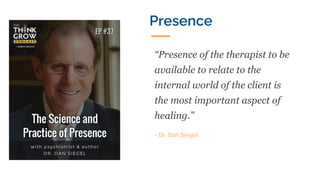
“Presence of thetherapist to be
available to relate to the
internal world of the client is
the most important aspect of
healing.”
- Dr. Dan Siegel
Presence
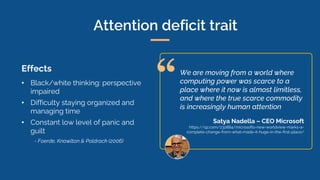
Attention deficit trait
Effects
•Black/white thinking: perspective
impaired
• Difficulty staying organized and
managing time
• Constant low level of panic and
guilt
- Foerde, Knowlton & Poldrack (2006)
We are moving from a world where
computing power was scarce to a
place where it now is almost limitless,
and where the true scarce commodity
is increasingly human attention
Satya Nadella – CEO Microsoft
https://qz.com/232884/microsofts-new-worldview-marks-a-
complete-change-from-what-made-it-huge-in-the-first-place/
“
Illusion of multitasking
conscious_beginnings
JonUnal
consciousbeginnings
Check every 5 mins
=
waste 8.5 hours
per week
64
seconds
Average of 64 seconds to
recover train of thought after
checking email
-Jackson, Dawson & Wilson (2002)
“
19.
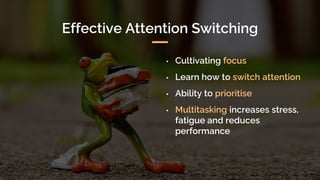
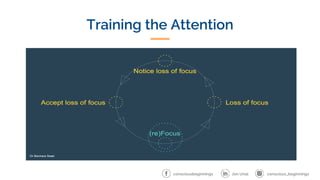
• Cultivating focus
•Learn how to switch attention
• Ability to prioritise
• Multitasking increases stress,
fatigue and reduces
performance
Effective Attention Switching
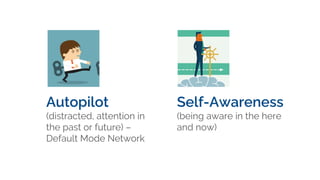
“Staying present inthis moment
as it is, moment after moment,
rather than daydreaming,
ruminating or being distracted.”
- RICK HANSON
Definition
conscious_beginnings
Jon Unal
consciousbeginnings
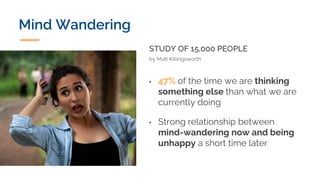
• 47% ofthe time we are thinking
something else than what we are
currently doing
• Strong relationship between
mind-wandering now and being
unhappy a short time later
STUDY OF 15,000 PEOPLE
by Matt Killingsworth
Mind Wandering
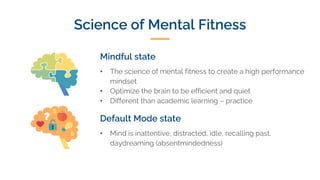
Science of MentalFitness
Mindful state
• The science of mental fitness to create a high performance
mindset
• Optimize the brain to be efficient and quiet
• Different than academic learning – practice
Default Mode state
• Mind is inattentive, distracted, idle, recalling past,
daydreaming (absentmindedness)
28.
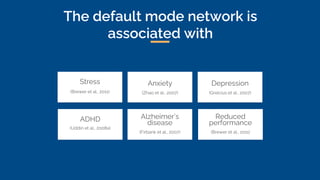
Stress
(Brewer et al.,2011)
Anxiety
(Zhao et al., 2007)
Depression
(Greicius et al., 2007)
ADHD
(Uddin et al., 2008a)
Alzheimer’s
disease
(Firbank et al., 2007)
Reduced
performance
(Brewer et al., 2011)
The default mode network is
associated with
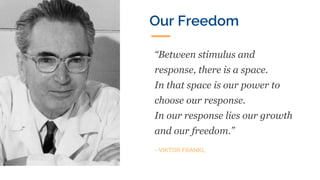
“Between stimulus and
response,there is a space.
In that space is our power to
choose our response.
In our response lies our growth
and our freedom.”
- VIKTOR FRANKL
Our Freedom
Reflection
1. What didyou notice
during this practice?
2. How do you feel
now?
3. How was your
attention?
conscious_beginnings
Jon Unal
consciousbeginnings
33.
The Mindfulness Practicesfor
Mental Health Practitioners
1. Mindfulness of breath
2. Body scan
3. Observing your thoughts (labelling)
4. Loving kindness & mindful self-compassion
5. Mindful listening
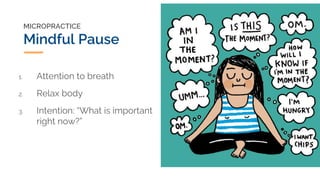
6. Mindful pause / 4-7-8 breath (Stress reduction for therapists)
7. Mindful walking
8. Mindful eating
34.
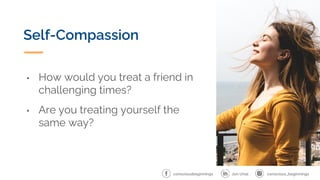
Self-Compassion
• How wouldyou treat a friend in
challenging times?
• Are you treating yourself the
same way?
conscious_beginnings
Jon Unal
consciousbeginnings
35.
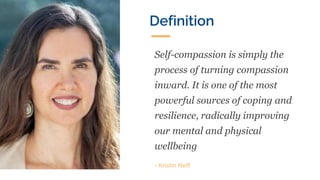
Self-compassion is simplythe
process of turning compassion
inward. It is one of the most
powerful sources of coping and
resilience, radically improving
our mental and physical
wellbeing
- Kristin Neff
Definition
36.
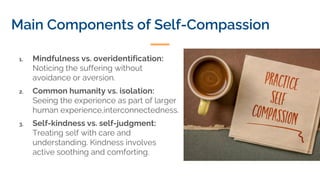
Main Components ofSelf-Compassion
1. Mindfulness vs. overidentification:
Noticing the suffering without
avoidance or aversion.
2. Common humanity vs. isolation:
Seeing the experience as part of larger
human experience,interconnectedness.
3. Self-kindness vs. self-judgment:
Treating self with care and
understanding. Kindness involves
active soothing and comforting.
37.
Loving Kindness &Self-Compassion Practice
conscious_beginnings
Jon Unal
consciousbeginnings
1. How wouldyou rate your level
of wellbeing from 0 to 10?
2. What are some of your biggest
challenges regarding your
wellbeing?
3. What do you currently do that
works well for your wellbeing?
Reflection
47.
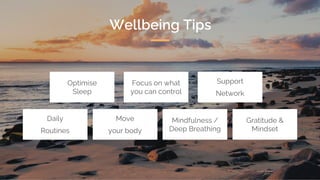
Focus on what
youcan control
Optimise
Sleep
Support
Network
Daily
Routines
Move
your body
Mindfulness /
Deep Breathing
Gratitude &
Mindset
Wellbeing Tips
48.
Hydration - welose
about 1 litre of water
every night from the
humidity in the breath
Sunlight – 15-20
minutes for circadian
rhythm
No technology
Mindfulness and
gratitude practice
Morning stretch –
limber up the body
No caffeine before 90
minutes of waking up
Cold shower
Morning Routine
Summary
1. Why dowe need mindfulness as
mental health practitioners?
2. Mindfulness essentials & mindfulness
practices
3. Neuroplasticity and benefits of
mindfulness for self-care
4. Practical tools to improve wellbeing
5. Action plan